


SIST EN 45560:2025
(Main)Method to achieve circular designs of products
Method to achieve circular designs of products
This document proposes a method to achieve circular designs of products. It details principles, requirements and guidance associated with the proposed method. This document:
• specifies requirements and guidance for integrating circularity into the design and development process of products by an organization and,
• supports organizations to develop product design rules to fulfil their chosen circular business targets (e.g. the circular business models chosen by the organization or the legislation requirements).
Having life cycle thinking as a core principle, this document provides guidance on how to reduce environmental impacts, and how to deal with challenges such as trade-offs during circular product design, without compromising other product functions including safety.
This document focusses on material efficiency. It is not a management system standard.
This document can be applied when no product-specific or product group standard exist. Where such documents are developed, this document can be used as reference to ensure consistency and harmonization across the different product areas and supply chains or networks.
NOTE For the purpose of this document, the following products are excluded: food, feed, medicinal products for human use, veterinary medicinal products, living plants, animals and microorganisms, products of human origin, products of plants and animals relating directly to their future reproduction.
Methode zur Gestaltung von zirkulären Produkten
In diesem Dokument wird ein Verfahren zum Definieren von Designregeln für zirkuläre Produkte vorgeschlagen. Es enthält Grundsätze, Anforderungen und Leitlinien, die mit dem vorgeschlagenen Verfahren verknüpft sind. Dieses Dokument:
- legt Anforderungen und Leitlinien für das Integrieren von Zirkularität in den Design- und Entwicklungsprozess von Produkten durch eine Organisation fest.
- unterstützt Organisationen beim Entwickeln von Produktdesignregeln zum Erfüllen ihrer gewählten zirkulären Kategorien (z. B. der von der Organisation oder aufgrund der rechtlichen Anforderungen gewählten zirkulären Geschäftsmodelle).
Dieses Dokument hat die Lebenswegbetrachtung als zentralen Grundsatz und liefert einen Leitfaden zum Reduzieren von Umweltauswirkungen und zum Umgang mit Herausforderungen wie Zielkonflikten im zirkulären Produktdesign, ohne Funktionen und Sicherheit zu beeinträchtigen.
Der Fokus dieses Dokuments liegt auf der Materialeffizienz. Es handelt sich nicht um eine Managementsystemnorm.
Dieses Dokument kann angewendet werden, wenn keine produktspezifische Norm oder Produktgruppennorm existiert. Wenn solche Dokumente erarbeitet werden, kann dieses Dokument als Referenz verwendet werden, um Konsistenz und Harmonisierung über verschiedene Produktbereiche und Lieferketten oder netzwerke hinweg sicherzustellen.
Méthode pour réaliser des conceptions circulaires de produits
Le présent document propose une méthode pour définir des règles de conception circulaire des produits. Il décrit les principes, exigences et recommandations associés à la méthode proposée. Le présent document:
• spécifie les exigences et recommandations relatives à l'intégration de la circularité dans le processus de conception et de développement des produits par un organisme;
• aide les organismes à établir des règles de conception des produits pour satisfaire aux catégories circulaires choisies (par exemple, les modèles d'affaires circulaires choisis par l'organisme ou les exigences de la législation).
Le présent document, dont le principe fondamental est la pensée cycle de vie, fournit des recommandations quant à la façon de réduire les impacts environnementaux, et quant à la façon de relever des défis tels que les compromis lors de la conception circulaire des produits, sans compromettre les fonctions et la sécurité.
Le présent document se concentre sur l'utilisation rationnelle des matériaux. Il ne s'agit pas d'une norme de système de management.
Le présent document peut être appliqué lorsqu'il n'existe aucune norme spécifique au produit ou au groupe de produits. Lorsque de tels documents sont élaborés, le présent document peut servir de référence pour assurer la cohérence et l'harmonisation entre les différents secteurs de produits et les chaînes ou réseaux d'approvisionnement.
Metoda za doseganje krožnega oblikovanja izdelkov
Ta dokument predlaga metodo za opredelitev pravil krožnega oblikovanja izdelkov. Podrobno opisuje načela, zahteve in smernice, povezane s predlagano metodo. Ta dokument:
– določa zahteve in smernice za vključitev krožnosti v proces oblikovanja in razvoja izdelkov s strani organizacije;
– podpira organizacije pri razvoju pravil oblikovanja izdelkov za izpolnitev njihovih izbranih krožnih kategorij (npr. krožnih poslovnih modelov, ki jih je izbrala organizacija, ali zakonodajnih zahtev).
Ker je temeljno načelo tega dokumenta upoštevanje življenjskega cikla, zagotavlja smernice o tem, kako zmanjšati vplive na okolje in kako se soočiti z izzivi, kot so kompromisi med krožnim oblikovanjem izdelkov, ne da bi to vplivalo na funkcije in varnost.
Ta dokument se osredotoča na učinkovitost materialov in ni standard za sistem vodenja.
Ta dokument je mogoče uporabljati, kadar ne obstaja noben standard za izdelek ali skupino izdelkov. Če taki dokumenti obstajajo, je ta dokument mogoče uporabljati kot referenco za zagotavljanje doslednosti in usklajenosti na različnih področjih izdelkov ter v dobavnih verigah ali omrežjih.
General Information
- Status
- Published
- Public Enquiry End Date
- 31-Oct-2023
- Publication Date
- 27-Nov-2024
- Technical Committee
- I11 - Imaginarni 11
- Current Stage
- 6060 - National Implementation/Publication (Adopted Project)
- Start Date
- 27-Nov-2024
- Due Date
- 01-Feb-2025
- Completion Date
- 28-Nov-2024
Overview - EN 45560:2024 (CLC)
EN 45560:2024, “Method to achieve circular designs of products”, provides a practical method for integrating circularity into product design and development. Published by CLC/CENELEC, the standard focuses on material efficiency and applies life‑cycle thinking to help organisations define product design rules that meet circular business targets or regulatory requirements. It is not a management system standard and can be used when no product‑specific standard exists or as a horizontal reference to harmonize product‑group standards. Note: products such as food, feed, medicines, living organisms and products of human origin are excluded.
Key topics and technical requirements
- Principles and concepts: core circular product design principles with life‑cycle thinking at the centre.
- Material flows strategy: guidance on narrowing (use less material), slowing (extend product lifetime/quality) and closing (reuse, remanufacture, recycle) material flows.
- Material value hierarchy: prioritisation framework to keep materials at highest value for as long as possible.
- Design requirements and guidance: how to integrate circularity goals into the design and development process and create product design rules aligned with circular business models.
- Circular product attributes: definitions and use of attributes (durability, reparability, recyclability, reuse potential, recycled content, etc.).
- Decision support: tools for building a circular product design matrix and addressing trade‑offs (environmental impacts vs. functionality and safety).
- Transition measurement and communication: guidance for setting circular goals, measuring organisational transition towards circularity, and communicating circular aspects to stakeholders and users.
- Scope of use: applicable across product sectors as a generic method; intended to support product technical committees and designers.
Practical applications and users
Who uses EN 45560:2024:
- Product designers and engineers integrating circularity into new or revised products.
- Sustainability managers, ecodesign teams and R&D leaders setting circular product rules.
- OEMs and manufacturers implementing circular business models (repair, remanufacture, reuse, take‑back).
- Standardisation bodies and product technical committees seeking a horizontal reference to ensure consistency across supply chains.
- Regulators and procurement teams assessing compliance with circular economy or ecodesign requirements.
Typical applications:
- Defining design specifications for improved reparability, recyclability or longevity.
- Creating product design matrices and trade‑off assessments during concept development.
- Aligning product portfolios to circular business models and legislative material‑efficiency targets.
Related standards and references
EN 45560 complements the CEN/CLC EN 4555X–4556X material‑efficiency series (durability, repairability, recyclability, recycled content, etc.) and links to EN IEC 62430 (environmentally conscious design) and relevant ISO standards on circular economy and ecodesign. Use EN 45560 as a horizontal method to harmonize design rules across product groups and supply chains.



Frequently Asked Questions
SIST EN 45560:2025 is a standard published by the Slovenian Institute for Standardization (SIST). Its full title is "Method to achieve circular designs of products". This standard covers: This document proposes a method to achieve circular designs of products. It details principles, requirements and guidance associated with the proposed method. This document: • specifies requirements and guidance for integrating circularity into the design and development process of products by an organization and, • supports organizations to develop product design rules to fulfil their chosen circular business targets (e.g. the circular business models chosen by the organization or the legislation requirements). Having life cycle thinking as a core principle, this document provides guidance on how to reduce environmental impacts, and how to deal with challenges such as trade-offs during circular product design, without compromising other product functions including safety. This document focusses on material efficiency. It is not a management system standard. This document can be applied when no product-specific or product group standard exist. Where such documents are developed, this document can be used as reference to ensure consistency and harmonization across the different product areas and supply chains or networks. NOTE For the purpose of this document, the following products are excluded: food, feed, medicinal products for human use, veterinary medicinal products, living plants, animals and microorganisms, products of human origin, products of plants and animals relating directly to their future reproduction.
This document proposes a method to achieve circular designs of products. It details principles, requirements and guidance associated with the proposed method. This document: • specifies requirements and guidance for integrating circularity into the design and development process of products by an organization and, • supports organizations to develop product design rules to fulfil their chosen circular business targets (e.g. the circular business models chosen by the organization or the legislation requirements). Having life cycle thinking as a core principle, this document provides guidance on how to reduce environmental impacts, and how to deal with challenges such as trade-offs during circular product design, without compromising other product functions including safety. This document focusses on material efficiency. It is not a management system standard. This document can be applied when no product-specific or product group standard exist. Where such documents are developed, this document can be used as reference to ensure consistency and harmonization across the different product areas and supply chains or networks. NOTE For the purpose of this document, the following products are excluded: food, feed, medicinal products for human use, veterinary medicinal products, living plants, animals and microorganisms, products of human origin, products of plants and animals relating directly to their future reproduction.
SIST EN 45560:2025 is classified under the following ICS (International Classification for Standards) categories: 03.100.50 - Production. Production management; 03.100.99 - Other standards related to company organization and management; 13.020.20 - Environmental economics. Sustainability; 13.020.60 - Product life-cycles. The ICS classification helps identify the subject area and facilitates finding related standards.
SIST EN 45560:2025 is available in PDF format for immediate download after purchase. The document can be added to your cart and obtained through the secure checkout process. Digital delivery ensures instant access to the complete standard document.
Standards Content (Sample)
SLOVENSKI STANDARD
01-januar-2025
Metoda za doseganje krožnega oblikovanja izdelkov
Method to achieve circular designs of products
Methode zur Gestaltung von zirkulären Produkten
Méthode pour réaliser des conceptions circulaires de produits
Ta slovenski standard je istoveten z: EN 45560:2024
ICS:
03.100.99 Drugi standardi v zvezi z Other standards related to
organizacijo in vodenjem company organization and
podjetja management
13.020.60 Življenjski ciklusi izdelkov Product life-cycles
2003-01.Slovenski inštitut za standardizacijo. Razmnoževanje celote ali delov tega standarda ni dovoljeno.
EUROPEAN STANDARD EN 45560
NORME EUROPÉENNE
EUROPÄISCHE NORM November 2024
ICS 03.100.50; 13.020.20
English Version
Method to achieve circular designs of products
Méthode pour réaliser des conceptions circulaires de Verfahren zur Realisierung zirkulärer Produktgestaltung
produits
This European Standard was approved by CENELEC on 14 October 2024. CEN and CENELEC members are bound to comply with the
CEN/CENELEC Internal Regulations which stipulate the conditions for giving this European Standard the status of a national standard
without any alteration.
Up-to-date lists and bibliographical references concerning such national standards may be obtained on application to the CEN-CENELEC
Management Centre or to any CEN and CENELEC member.
This European Standard exists in three official versions (English, French, German). A version in any other language made by translation
under the responsibility of a CEN and CENELEC member into its own language and notified to the CEN-CENELEC Management Centre
has the same status as the official versions.
CEN and CENELEC members are the national standards bodies and national electrotechnical committees of Austria, Belgium, Bulgaria,
Croatia, Cyprus, Czech Republic, Denmark, Estonia, Finland, France, Germany, Greece, Hungary, Iceland, Ireland, Italy, Latvia, Lithuania,
Luxembourg, Malta, Netherlands, Norway, Poland, Portugal, Republic of North Macedonia, Romania, Serbia, Slovakia, Slovenia, Spain,
Sweden, Switzerland, Türkiye and United Kingdom
European Committee for Electrotechnical Standardization
Comité Européen de Normalisation Electrotechnique
Europäisches Komitee für Elektrotechnische Normung
CEN-CENELEC Management Centre: Rue de la Science 23, B-1040 Brussels
© 2024 All rights of exploitation in any form and by any means reserved worldwide for CEN national Members and for
CEN/CENELEC CENELEC Members.
Ref. No. EN 45560:2024 E
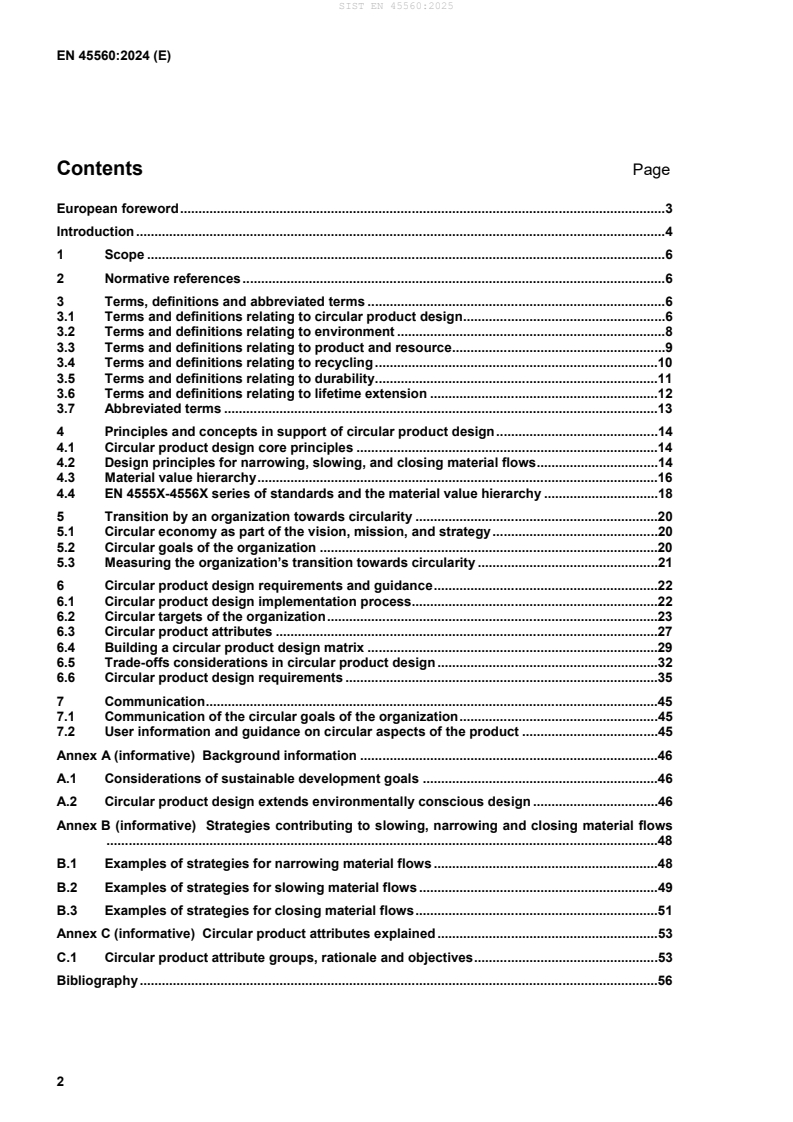
Contents Page
European foreword . 3
Introduction . 4
1 Scope . 6
2 Normative references . 6
3 Terms, definitions and abbreviated terms . 6
3.1 Terms and definitions relating to circular product design . 6
3.2 Terms and definitions relating to environment . 8
3.3 Terms and definitions relating to product and resource . 9
3.4 Terms and definitions relating to recycling .10
3.5 Terms and definitions relating to durability .11
3.6 Terms and definitions relating to lifetime extension .12
3.7 Abbreviated terms .13
4 Principles and concepts in support of circular product design .14
4.1 Circular product design core principles .14
4.2 Design principles for narrowing, slowing, and closing material flows .14
4.3 Material value hierarchy .16
4.4 EN 4555X-4556X series of standards and the material value hierarchy .18
5 Transition by an organization towards circularity .20
5.1 Circular economy as part of the vision, mission, and strategy .20
5.2 Circular goals of the organization .20
5.3 Measuring the organization’s transition towards circularity .21
6 Circular product design requirements and guidance .22
6.1 Circular product design implementation process.22
6.2 Circular targets of the organization .23
6.3 Circular product attributes .27
6.4 Building a circular product design matrix .29
6.5 Trade-offs considerations in circular product design .32
6.6 Circular product design requirements .35
7 Communication .45
7.1 Communication of the circular goals of the organization .45
7.2 User information and guidance on circular aspects of the product .45
Annex A (informative) Background information .46
A.1 Considerations of sustainable development goals .46
A.2 Circular product design extends environmentally conscious design .46
Annex B (informative) Strategies contributing to slowing, narrowing and closing material flows
......................................................................................................................................................48
B.1 Examples of strategies for narrowing material flows .48
B.2 Examples of strategies for slowing material flows .49
B.3 Examples of strategies for closing material flows .51
Annex C (informative) Circular product attributes explained .53
C.1 Circular product attribute groups, rationale and objectives .53
Bibliography .56
European foreword
This document [EN 45560:2024] has been prepared by CEN/CLC/JTC 10 “Material efficiency aspects for
products in scope of Ecodesign legislation”.
The following dates are fixed:
• latest date by which this document has to be (dop) 2025–11–30
implemented at national level by publication of
an identical national standard or by
endorsement
• latest date by which the national standards (dow) 2027–11–30
conflicting with this document have to be
withdrawn
Attention is drawn to the possibility that some of the elements of this document may be the subject of patent
rights. CENELEC shall not be held responsible for identifying any or all such patent rights.
CEN/CLC/JTC 10 has the objective to produce generic and horizontal CEN-CENELEC publications covering
aspects such as assessment methods, design rules, dematerialization, digitalization and transfer of information
on a variety of material efficiency topics, in particular (but not limited to):
a) Extending product lifetime;
b) Ability to reuse components or recycle materials from products at end-of-life;
c) Use of reused components and/or recycled materials in products.
This document is intended to be used by organizations applying directly to products but can also be used by
product technical committees when producing horizontal, generic, product-group, or product-specific standards.
It can, therefore, be cited together with product-group or product-specific standards, e.g. developed by product
technical committees.
Any feedback and questions on this document should be directed to the users’ national committee. A complete
listing of these bodies can be found on the CENELEC website.
Including coverage of the European Commission defined list of critical raw materials (CRM).
Introduction
0.1 Background
Climate change, biodiversity loss, resource depletion and the ever-increasing production of waste and pollution
represent major challenges to society today. Circular economy, with its focus on material efficiency and the
promise for longer lifetime of products, minimization of waste and closing the flows for materials is believed to
be an important means to overcome these challenges. When transitioning into a circular economy, design plays
a crucial role. It has been reported that 80 % of a product’s environmental impacts are determined at the product
design phase [1] and design choices can determine whether the efforts to improve circularity will be successful
or not. Circular product design is a key element of developing and implementing circular business models and
transitioning towards a circular economy.
In Europe, the Green Deal [2] launched in 2019 proposes a concerted strategy for a climate-neutral, resource-
efficient and competitive economy. Scaling up the circular economy from front-runners to the mainstream
economic players will make decisive contributions to achieving climate neutrality by 2050 and to decoupling
economic growth from the use of natural resources by using these resources more effectively, while ensuring
long-term competitiveness of and within the EU. This document, focusing on circular product design, supports
achieving the ambition stated in the European Circular Economy Action Plan (CEAP) [3].
Sustainable management and efficient use of natural resources is addressed by the UN’s sustainable
development goals (SDGs). This document supports these goals, particularly SDG 12, to ensure sustainable
consumption and production patterns (see Annex A for more details).
The main purpose of this document is to develop a systematic way (method) of defining design rules and
activities for the design and development of products such that these are made circular by design within a
circular economy.
This document is intended for organizations designing and developing products that fall under the scope of the
ecodesign legislation [4]. It focusses on optimizing material utilization and efficiency with strategies that enable
narrowing (use less materials), slowing (extend product life, keep quality of products and materials as high as
possible for as long as possible) and closing flows (parts recovery, remanufacture, repurpose and recycling).
0.2 Relation with other horizontal or generic standards
Although there are regulatory requirements for resource efficiency across most geographies, to date, the focus
has been mostly on the energy efficiency of products. Recently standards focusing on the material efficiency
became available, with the publication of the CEN/CLC/JTC 10 EN 4555X-4556X series of standards. These
standards focus on the assessment of different aspects of material efficiency, such as durability of products
(EN 45552 [5]), ability to remanufacture (EN 45553 [6]), ability to be repaired, reused and upgraded
(EN 45554 [7]), recyclability (EN 45555 [8]), proportion of reused components (EN 45556 [9]), recycled content
(EN 45557 [10]), and communication on the use of critical raw materials (CRMs) (EN 45558 [11]) and material
efficiency (EN 45559 [70]). These standards address how to assess ability (how easy or difficult it is) to e.g.
repair, remanufacture or recycle a product. However, these standards do not provide guidance on what aspects
to consider when designing a product. This document intends to fill in such a gap.
The standard EN IEC 62430 (see Clause 2 in this document) assists organizations to incorporate
environmentally conscious design (ECD) into their product design and development process. IEC/TS 63428
[12] links circularity to environmentally conscious design.
ISO 14009 [13] provides guidelines to organizations on how to incorporate circular product design strategies in
the design and development within their environment management system. ISO 14006 [14] provides guidelines
to assist organizations in establishing a systematic and structured approach to the incorporation and
implementation of ecodesign within an environment management system, such as described in ISO 14001 [15].
Assessments of environmental impacts including aspects of material circularity and material cost accounting
are considered in documents such as EN 50693 [16], EN 15804 [17], and ISO 14040 [18], ISO 14044 [19], and
ISO 14051 [20].
IEC 62309 [21] contains guidance and requirements for dependability assessment of products containing
reused parts and it also specifies requirements about declaration and designation of reused parts “qualified-as-
good-as-new”. The IEC 60300 series [22] include general guidance on dependability, availability, reliability and
maintainability, and IEC 62402 [23] addresses obsolescence management.
International standards currently under development by ISO/TC 323 on circular economy are ISO 59004 on
terminology, principles and guidance for implementation [24], ISO 59010 providing guidance on the transition
of business models and value networks [25], ISO 59020 on measuring and assessing circularity [26], and
ISO/FDIS 59040 proposing a product circularity data sheet [27].
The ITU-T recommendation L.1023 [28] has standardized a framework for circularity performance scoring,
defining key circularity terms and how these fit together in a scoring system.
In the design rules for circular economy, all domains such as environmental, social, economic, and technical
are considered. As part of this holistic approach, value management is addressed in EN 12973 [29] and
EN 16271 [30].
To avoid duplication as much as possible, this document references the above listed standards (sometimes
normatively).
1 Scope
This document proposes a method to achieve circular designs of products. It details principles, requirements
and guidance associated with the proposed method. This document:
• specifies requirements and guidance for integrating circularity into the design and development process of
products by an organization and,
• supports organizations to develop product design rules to fulfil their chosen circular business targets (e.g.
the circular business models chosen by the organization or the legislation requirements).
Having life cycle thinking as a core principle, this document provides guidance on how to reduce environmental
impacts, and how to deal with challenges such as trade-offs during circular product design, without
compromising other product functions including safety.
This document focusses on material efficiency. It is not a management system standard.
This document can be applied when no product-specific or product group standard exist. Where such
documents are developed, this document can be used as reference to ensure consistency and harmonization
across the different product areas and supply chains or networks.
NOTE For the purpose of this document, the following products are excluded: food, feed, medicinal products for human
use, veterinary medicinal products, living plants, animals and microorganisms, products of human origin, products of plants
and animals relating directly to their future reproduction.
2 Normative references
The following documents are referred to in the text in such a way that some or all their content constitutes
requirements of this document. For dated references, only the edition cited applies. For undated references, the
latest edition of the referenced document (including any amendments) applies.
EN IEC 62430:2019, Environmentally conscious design (ECD) — Principles, requirements and guidance
3 Terms, definitions and abbreviated terms
For the purposes of this document, the following terms and definitions apply.
ISO and IEC maintain terminological databases for use in standardization at the following addresses:
• ISO Online browsing platform: available at https://www.iso.org/obp
• IEC Electropedia: available at https://www.electropedia.org/
3.1 Terms and definitions relating to circular product design
3.1.1
circular economy
economic system that uses a systemic approach to circulate products and materials at highest value for as long
as possible by aiming to eliminate waste and pollution, while contributing to sustainable development and giving
the opportunity for natural systems to regenerate themselves
Note 1 to entry: The inflow of primary material is kept as low as possible.
[SOURCE: IEC 60050-193:2024 (IEV 193-01-01)]
3.1.2
circular goal
goal aligned with the principles of a circular economy
Stage at the publication of this document is CD.
Note 1 to entry: The principles of a circular economy [31] include: (i) eliminate waste and pollution; (ii) circulate products and
materials at their highest value; and (iii) regenerate nature.
3.1.3
circular product attribute
characteristic or property of a product addressing circularity
3.1.4
circular product design
circular design of products
process of creating products that are aligned with the principles of a circular economy
Note 1 to entry: The principles of a circular economy [31] include: (i) eliminate waste and pollution; (ii) circulate products and
materials at their highest value; and (iii) and regenerate nature.
Note 2 to entry: The concept can be also applied to existing products through redesign.
3.1.5
circularity
alignment with the principles of a circular economy
Note 1 to entry: Can refer to an organization, system, product, part or material.
Note 2 to entry: The principles of a circular economy [31] include: (i) eliminate waste and pollution; (ii) circulate products and
materials at their highest value; and (iii) regenerate nature.
[SOURCE: IEC 60050-193:2024 (IEV 193-01-03)]
3.1.6
function
effect of a product or one of its constituents
[SOURCE: EN 16271:2012, 3.8]
3.1.7
functionality
ability to deliver intended functions
3.1.8
material efficiency
degree of performance in relation to the materials used
Note 1 to entry: Materials used can refer to materials utilized consumed or both.
Note 2 to entry: Materials used can refer to both production and utilization stage.
Note 3 to entry: Performance includes satisfaction of the needs in relation to product function, product durability and recovery
at end of life.
[SOURCE: IEC 60050-193:2024 (IEV 193-01-09), modified — Figure and note 4 were removed]
3.1.9
performance
effectiveness with which an intended function is carried out
[SOURCE: IEC 61226:2020, 3.16, modified — Examples were removed]
3.1.10
value
gains from satisfying needs and expectations, in relation to the resources used
EXAMPLE: Revenues, savings, productivity, sustainability, satisfaction, empowerment, engagement, experience, trust.
Note 1 to entry: Value is relative to, and determined by the perception of, the organization and interested parties.
Note 2 to entry: Value can be financial or non-financial.
Note 3 to entry: Value can be created, realized, acquired, redistributed, shared, lost, or destroyed.
Note 4 to entry: The value of an entity is generally determined in terms of the amount of other entities for which it can be
exchanged.
Note 5 to entry: The word “value” sometimes refers to a (numerical) unit of data, e.g. the output from measurement and
“values” sometimes refers to principles or standards of behaviour, e.g. included in the concept of culture. When “value” is
used in these senses, it should always be used with some form of qualifier, e.g. “numerical value” or the meaning should be
obvious from the context.
Note 6 to entry: When a process is inefficient, the amount of resources used can exceed the amount of resources required.
Note 7 to entry: The formula below illustrates that value is proportional to satisfaction of needs in relation to resources used:
satisfaction of the needs
value∝
resources used
[SOURCE: ISO 56000:2020, 3.7.6, modified — Notes 6 and 7 to entry have been added]
3.2 Terms and definitions relating to environment
3.2.1
environment
surroundings in which an organization operates, including air, water, land, natural resources, flora, fauna,
humans and their interrelationships
[SOURCE: ISO 14050:2020, 3.2.2]
3.2.2
environmental aspect
element of an organization’s activities or products that interacts or can interact with the environment
[SOURCE: ISO 14050:2020, 3.2.20]
3.2.3
environmental impact
change to the environment, whether adverse or beneficial, including possible consequences, wholly or partially
resulting from an organization’s environmental aspects
[SOURCE: ISO 14050:2020, 3.2.22]
3.2.4
environmentally conscious design
ECD
systematic approach which considers environmental aspects in the design and development with the aim to
reduce adverse environmental impacts throughout the life cycle of a product
Note 1 to entry: Other terminology used worldwide with the same meaning includes ecodesign, design for environment
(DFE), green design and environmentally sustainable design.
Note 2 to entry: This note applies to the French language only.
[SOURCE: EN IEC 62430:2019, 3.1.1]
3.2.5
life cycle thinking
LCT
life cycle perspective
LCP
consideration of all relevant environmental aspects of a product during its entire life cycle
Note 1 to entry: LCT does not imply undertaking a life cycle assessment.
Note 2 to entry: This note applies to the French language only.
[SOURCE: EN IEC 62430:2019, 3.2.3]
3.3 Terms and definitions relating to product and resource
3.3.1
component
constituent of a product which cannot be fragmented without losing its particular function
[SOURCE: IEC 60050-151:2001/AMD5:2021 (IEV-151-11-21), modified — The term “part of a device” was
replaced by “of a product, and “physically divided into smaller parts” was replaced by “fragmented”]
3.3.2
material
matter of which an object is composed
[SOURCE: IEC 82474-1:2024, 3.1.7]
3.3.3
part
constituent of a product
EXAMPLE: Hardware or other physical matter, software, firmware, liquid, gas, etc.
Note 1 to entry: A part can be an assembly, sub-assembly or a component.
3.3.4
product
goods, service, or combination thereof
[SOURCE: ISO 14050:2020, 3.5.12, modified — In the definition the term “any” has been removed, and the
term “or combination thereof” has been added]
3.3.5
resource
asset that is utilized or consumed to satisfy a need
Note 1 to entry: Resource can be physical, financial, intellectual, and social. Resource can also include skills and time.
Stage at the publication of this document is FDIS.
[SOURCE: IEC 60050-193:2024 (IEV 193-03-01)]
3.3.6
modular
composed of modules for easy construction or arrangement and adaptation or disassembly
[SOURCE: ISO 20887:2020, 3.22]
3.4 Terms and definitions relating to recycling
3.4.1
recovery
operation that gives value to waste
Note 1 to entry: Recovery can result in products, parts, materials and/or energy.
Note 2 to entry: A concept diagram of recovery is provided here below:
[SOURCE: IEC 60050-193:2024 (IEV 193-04-06)]
3.4.2
recycled content
proportion, by mass, of recycled material in a product or part
Note 1 to entry: The proportion is often expressed as a percentage of mass.
[SOURCE: ISO 14021:2016, 7.8.1.1 a), modified — “or packaging” has been replaced by “or part” and Note 1
to entry was included]
3.4.3
recycled material
secondary material
material that has been reprocessed from end-of-life products, parts and material
3.4.4
recycling
production of useful material through controlled processing of waste, excluding energy recovery
[SOURCE: IEC 60050-193:2024 (IEV 193-04-11)]
3.4.5
waste
material or object which the holder decides or is required to dispose of
Note 1 to entry: Triggers for the decision or need to discard include, for example: function no longer available, change in the
needs by the user, interoperability with new system elements not supported, loss or unavailability of data or history
information about the object (e.g. instruction for use not available; service information; information needed for refurbishment).
[SOURCE: IEC 60050-193:2024 (IEV 193-04-01)]
3.5 Terms and definitions relating to durability
3.5.1
durability
ability to function as required, under specified conditions of use, maintenance and repair, until the end-of-life is
reached
Note 1 to entry: For the purpose of this document, the designer has to specify the criteria for durability.
Note 2 to entry: The criteria are based on predictable aspects (e.g. technical aspects) so that the durability can be estimated.
Note 3 to entry: Durability can be expressed in units appropriate to the part or product concerned, e.g. calendar time,
operating cycles, distance run, etc. The units should always be clearly stated.
[SOURCE: EN 45552:2020 definition 3.1.1.1, modified — In the term “” was deleted, in
the definition “defined” has been replaced by “specified” and “a limiting state” has been replaced by “the end-
of-life”, notes 1 and 2 to entry were removed and three new notes were added]
3.5.2
useful life
time interval from first use until the requirements of the last user are no longer met due to social, economic, or
technical reasons
Note 1 to entry: Concept not intended for measurement.
Note 2 to entry: Useful life can only be quantified retroactively.
Note 3 to entry: Social (e.g. trends in fashion), economic, or technical reasons can result in parts obsolescence.
[SOURCE: IEC 60050-193:2024 (IEV 193-05-04)]
3.5.3
service life
expected service life
time that a manufactured item can be expected to be economically maintainable, or supported by its
manufacturer
[SOURCE: IEC TS 63265:2022, modified — In the definition, the term “any manufactured” was replaced by “a
manufactured” and the term “serviceable” was replaced by “maintainable”]
3.5.4
end-of-life
EoL
end-of-last-use
point in the life-cycle of a product where the decision is made to either dispose it or to give it a new life under
new identity
[SOURCE: IEC 60050-193:2024 (IEV 193-05-06)]
3.5.5
end-of-use
point the life-cycle of the product when the user or owner does not want maintain, or does not want to use the
product anymore
[SOURCE: IEC 60050-193:2024 (IEV 193-05-07)]
3.5.6
limiting event
occurrence which results in a primary or secondary function no longer being delivered
Note 1 to entry: Examples of limiting events are failure, wear-out failure or deviation of any analogue signal.
[SOURCE: EN 45552:2020, 3.1.1.3]
3.5.7
reliability
probability that a product functions as required under given conditions, including maintenance, for a given
duration without limiting event
Note 1 to entry: The intended function(s) and given conditions are described in the information for use provided with the
product.
Note 2 to entry: Duration can be expressed in units appropriate to the part or product concerned, e.g. calendar time,
operating cycles, distance run, etc. The units should always be clearly stated.
[SOURCE: EN 45552:2020, 3.1.1.2]
3.6 Terms and definitions relating to lifetime extension
3.6.1
disassembly
process whereby a product is taken apart in such a way that it could subsequently be reassembled and made
operational
[SOURCE: IEC 60050-904:2014/AMD3:2019 (IEV 904-04-01), modified — In the definition the term “an item”
has been replaced by “a product” and note 1 to entry has been deleted]
3.6.2
maintenance
process to retain a product in, or restore it to, a state in which it can perform as intended
[SOURCE: IEC 60050-192:2015 (IEV 192-06-01), modified — In the definition the term “combination of all
technical and management actions intended” was replaced by “process”, the term “item” was replaced by
“product” and the term “required” was replaced by “intended”, and the Note to entry has been deleted]
3.6.3
repair
process of returning a faulty product to a state where it can fulfil its intended use
[SOURCE: EN 45554:2020, modified — In the definition “condition” was replaced by “state”]
3.6.4
refurbishing
reconditioning
industrial process to return or improve a product or part within the limits of its original design
Note 1 to entry: Original design include form, functionality, performance and safety aspects.
Note 2 to entry: Refurbishment can result in extended lifetimes.
Note 3 to entry: The identity of the product or part shall be maintained (e.g. serial or type number).
3.6.5
remanufacturing
industrial process to create a product by combining different parts from used products and including, where
necessary, new parts
Note 1 to entry: Remanufacturing also occurs when at least one change is made which influences the safety or original
design of an existing product.
Note 2 to entry: The product shall be given a new identity (e.g. serial or type number).
3.6.6
reuse
operation by which a product or part having reached the end-of-use is used again
Note 1 to entry: When the product or part is reused for another purpose, it is called repurpose.
Note 2 to entry: Normal, regular or sporadic use is not considered as reuse.
[SOURCE: IEC 60050-193:2024 (IEV 193-06-10)]
3.6.7
upgrade
upgrading
process to enhance the functionality, aesthetics, or performance of a product
Note 1 to entry: An upgrade to a product can involve changes to its software, firmware or hardware (e.g. adding memory).
Note 2 to entry: An upgrade to a product can involve addition or replacement of parts.
Note 3 to entry: Upgrade takes place within the limits of the original design of the product.
[SOURCE: IEC 60050-193:2024 (IEV 193-06-15)]
3.7 Abbreviated terms
CE Circular economy
CRM Critical raw material
ECD Environmentally conscious design
ErP Energy-related product
FMEA Failure mode and effect analysis
GHG Greenhouse gas
ICT Information and communication technology
ME Material efficiency
SDG Sustainable development goal
4 Principles and concepts in support of circular product design
4.1 Circular product design core principles
The core principles that lead to a circular designed product are:
• Circular economy becoming part of the environment, social, and governance (ESG) policy of the
organization, ensuring management understanding and early contribution and commitment of all relevant
business functions in accordance with the ECD principles of the EN IEC 62430:2019, Clause 4.
• Considers the whole life cycle of the product taking a “life cycle thinking” approach in accordance with the
ECD principles of the EN IEC 62430:2019, Clause 4.
• Based on circular business targets chosen by the organization for the product, product designs are
optimized following the design principles for narrowing, slowing and closing the flows.
• Create and promote sustainable circular systems (e.g. reverse logistics, repair systems) that enable product
and material recirculation and support and educate customers to contribute to closing the loop.
• Managing trade-offs is the solution to achieve a circular product design, and so helping organizations with
difficult decisions e.g. durability vs. using less material.
The organisation should adopt these principles in such way that avoids adverse environmental impacts. See
Annex A for more information.
4.2 Design principles for narrowing, slowing, and closing material flows
4.2.1 General
Resource depletion and scarcity and increasing production of waste and pollution represent major challenges
today and are the focus of different legislations such as ESPR [4] and ESRS [32]. The efficient use of resources
is central in this document. See Annex A for more information.
The linear ‘take-make-dispose’ economic model is reaching its limits, and initiatives to develop alternative
economic models are emerging. The circular economy strives for an industrial system that is restorative and
regenerative by design and where resources are managed within technical and biological cycles [31]. The
circular economy is based on three principles [31], driven by design:
a) eliminate waste and pollution;
b) circulate products and materials at their highest value; and
c) regenerate nature.
Products and components can flow in technical cycles with activities to reuse, recover, restore or reutilize
resources within existing or new products. Products and materials should be kept in the technical cycles as long
as possible. Closing the biological cycle means that biodegradable materials which cannot be kept or reused in
the technical cycles are broken down by microorganisms at the molecular level and thus can be used by living
systems. These materials should not be detrimental to the water, soil or biodiversity of the ecosystem in which
these were introduced. In this way these are restored into the biosphere and can contribute to the regeneration
of natural systems.
As part of the circular economy, material efficiency can be increased through the three principles of slowing
down, narrowing, and closing material flows [33]. Slowing and closing the flows are fundamental principles
toward the cycling (circulation) of materials. These are distinct from the other approach of narrowing the flows,
which focus ultimately on overall reduction of the material use.
NOTE These principles are intended as source of inspiration for circular product design.
While not exhaustive, Figure 1 presents a schematic representation of these three principles along with
representation of a linear flow for comparison. Examples of strategies which can be implemented that contribute
to these three principles are given in Annex B.
Figure 1 — Principles of narrowing, slowing and closing material flows
The principles of narrowing, slowing, and closing material flows should not be considered in isolation. Assessing
trade-offs will help inform the decision (see 6.5).
4.2.2 Narrowing material flows
The principle for narrowing material flows involve strategies using less materials (and energy) to deliver the
same or equivalent function to the user. It also involves strategies such as intensifying the use of products
through sharing services. It involves making trade-offs between durability and the types and quantities of
materials utilized.
The principle of narrowing material flows is different from slowing flows, as it does not influence the speed of
the flow of products and does not involve any service flows (e.g. repair). Narrowing material flows has been
applied successfully within a linear business model, and existing strategies can be used in conjunction with
other circular strategies.
Examples of strategies for narrowing material flows can be found in B.1.
4.2.3 Slowing material flows
This principle is aimed at using products, components and materials longer through the design of long-life goods
(increased reliability and durability) in combination with product-life extension strategies such as maintenance,
repair, hardware or software upgrade or software update, and refurbishment. With such strategies, the utilization
period of products is extended, resulting in a slowdown of the flow of materials by reducing the need to replace
existing products or by decreasing the need for new products.
The ultimate goal of this principle is to reuse products again and again, which needs complementary activities
like planning circular systems around the product including reverse logistics or to develop new business models
to rethink ownership.
Examples of strategies for slowing material flows can be found in B.2.
4.2.4 Closing material flows
Closing the material flows refers to activities that bring post-consumer waste back into the economic cycle.
Recycling is the most common strategy to close the material flows. Activities such as remanufacturing and
repurpose also allow for closure of the loop by creating (new) products from already used products or parts.
Lately, the use of renewable content is becoming popular to close the material flows. However, there are a
number of criteria which should be considered so that the biodegradable material may go back into the
biosphere at the end-of-life and close the biological cycle. A final step to close the biological cycle is the safe
return to the biosphere through activities like biodegradation, anaerobic digestion or composting of the material.
This asks that the material can be safely returned to the biosphere and used by living systems. Those materials
should only be returned into the biosphere when all precautions have been taken to avoid negative effects to
the environment.
EXAMPLE Not all biodegradable plastic degrades in marine environment; semi-degraded biodegradable material is even
more difficult to recover from the sea, and when recovered more difficult to recycle.
Recycling of biological materials should be the preferred solution to close material flows if the remaining quality
and functionality of that material after use is still acceptable. Biodegradability should be applied when there is
no way of collecting products and keeping them in the technical cycle while avoiding environmental pollution.
Materials should be kept in the technical cycle as long as possible.
NOTE Whether a material gets recycled in practice depends on the availability of recycling processes, technology, and
infrastructure as well as the stakeholders’ understanding and awareness.
Examples of strategies for closing the material flows can be found in B.3.
4.3 Material value hierarchy
The material value hierarchy represents the concept of keeping the value of materials as high as possible in the
economy. It is intimately related to one of the principles of the circular economy, namely circulate products and
materials at their highest value. The material value hierarchy is also a good model to represent material
efficiency, that is defined as a degree of performance (which includes satisfaction of the user needs, durability
and material recovery) in relation to the materials used (utilized or consumed) to make or use the product.
Figure 2 shows the material value hierarchy. This hierarchy represents value loss (or additional resources
needed) when moving from up to down the ladder.
Figure 2 — Material value hierarchy
The material value hierarchy can be used as support by organizations that are making the transition to circular
economy. Having a good understanding on how the value of materials evolve when applying different circular
solutions helps organizations to make a more conscious choice of the circular business targets and related
circular design strategies. Organizations can use the material value hierarchy as source of inspiration, as
relevant.
Material value hierarchy and use less or narrowing flows strategies
The hierarchy depicted in Figure 2 shows what strategies can be best applied to hold the value of materials in
the economy. In the first shown strategy, use less and longer, less value is lost if fewer inputs (or no input at all)
of resources are used to make a product. Creating the virtual equivalent will not reduce the resource
consumption to zero, as often the demand on energy increases, but is likely to reduce it considerably.
Additionally, when products are made, they are able to retain (preserve) more value when they are made in
such a way that they have very long useful lives.
Organizations should take into account trade-offs with other important aspects. For instance, consuming less
material to design a product could impact its durability; or for safety reasons a product may be chosen not to be
(easily) repairable. Therefore, organizations need to consider the different strategies of this figure and analyse
the trade-offs with other aspects that are relevant when defining their circular goals, circular business targets,
and circular product design strategies.
Material value hierarchy and use longer or slowing flows strategies
As there are plenty of reasons not to make products able to last forever (no technology available, none or not
enough durable materials available, safety aspects, users not interested to keeping a product for long due to
fashion aspects, etc.), the best next approach is to design and develop products and parts that are able to have
their lives extended over and over again (use longer strategies).
• Within the various lifetime extension strategies, reusing a product “as is” would result in the least loss of
value (from the material perspective). Being able to upgrade parts would potentially involve some material
loss that is associated with e.g. the parts replacement, but on the other hand, that would make that product
more attractive for reuse.
• The longer the products are used and reused, greater the chance repairs are needed. Repairing asks for
resources (worn parts need to be replaced, expertise and other resources are needed to perform the repair,
etc.). Those resources are to be included in the overall value loss accountancy linked to the product when
it is repaired.
• When the owner starts losing its interest in the product for example because the functions are no longer
sufficient, an effective next strategy to bring the product back to
...
Questions, Comments and Discussion
Ask us and Technical Secretary will try to provide an answer. You can facilitate discussion about the standard in here.
Loading comments...