


SIST EN 16510-2-5:2025
(Main)Residential solid fuel burning appliances - Part 2-5: Slow heat release appliances
Residential solid fuel burning appliances - Part 2-5: Slow heat release appliances
This document is applicable to slow heat release appliances for solid fuel (freestanding manually fuelled intermittent burning slow heat release appliances (SHRA) having heat storage capacity such that they can provide heat and release it for an extended period after the fire has gone out).
The intended use of the appliances is space heating in residential buildings. They can be fitted with a boiler or heat exchanger (integral part of the appliance containing water to be heated up) for the supply of hot water for central heating systems.
These slow heat release appliances may be supplied either as an assembled appliance or as a pre-designed unit consisting of prefabricated components designed to be built on site in accordance with the-specified assembly instructions.
These appliances can burn one or more types of the following solid fuels as specified:
— wood logs;
— compressed untreated wood;
— wood pellets;
— lignite briquettes;
— solid mineral fuels;
— peat briquettes.
This document is not applicable to:
— mechanically fed appliances
— appliances with fan assisted combustion air
— one off installations
This document specifies procedures for assessment and verification of constancy of performance (AVCP) of characteristics of solid fuel burning slow heat release appliances.
Häusliche Feuerstätten für feste Brennstoffe - Teil 2-5: Speicherfeuerstätten
Dieses Dokument ist anzuwenden für Speicherfeuerstätten für feste Brennstoffe (freistehende handbetriebene intermittierend brennende Geräte mit langsamer Wärmeabgabe (Speicherfeuerstätten), die über eine solche Wärmespeicherkapazität verfügen, dass sie über einen längeren Zeitraum nach dem Erlöschen des Feuers Wärme liefern und abgeben können).
Der Verwendungszweck der Geräte ist Raumheizung in Wohngebäuden. Sie können mit wasserführenden Bauteilen (als feste Bestandteile des Gerätes mit zu erhitzendem Wasser) zur Warmwasserbereitung der Zentralheizung ausgestattet sein.
Diese Speicherfeuerstätten können entweder als fertig montiertes Gerät oder als vorgefertigte Einheit geliefert werden, die aus vorgefertigten Bauteilen besteht, die vor Ort gemäß der angegebenen Montageanleitung zusammengebaut werden sollen.
Die Geräte können wie angegeben einen oder mehrere der folgenden festen Brennstoffe verfeuern:
Scheitholz;
Holzbriketts;
Holzpellets;
Braunkohlenbriketts;
feste mineralische Brennstoffe;
Torfbriketts.
Dieses Dokument ist nicht anwendbar für
mechanisch beschickte Geräte;
Geräte mit Verbrennungsluftgebläse;
einmalige Installationen.
Dieses Dokument legt das Verfahren für die Bewertung und Überprüfung der Leistungsbeständigkeit (AVCP) der Eigenschaften von Raumheizern für feste Brennstoffe fest.
Appareils de chauffage domestiques à combustible solide - Partie 2-5: Appareils à libération lente de chaleur (SHRA)
Le présent document s’applique aux appareils de chauffage à combustible solide à libération lente de chaleur (SHRA à combustion intermittente alimentés manuellement, dont la capacité de stockage thermique leur permet de fournir et libérer de la chaleur pendant une durée prolongée après la fin de la combustion).
L’usage prévu des appareils est le chauffage des locaux dans les bâtiments résidentiels. Ils peuvent être équipés d’un bouilleur ou d’un échangeur de chaleur (faisant partie intégrante de l’appareil et contenant de l’eau à chauffer) pour fournir de l’eau chaude aux systèmes de chauffage central.
Ces SHRA peuvent être fournis sous la forme soit d’un appareil assemblé, soit d’une unité conçue au préalable, constituée d’éléments préfabriqués, destinés à être montés sur le site conformément aux instructions d’assemblage spécifiées.
Ces appareils peuvent utiliser un ou plusieurs des types de combustibles solides suivants, comme spécifié :
— bûches de bois ;
— bois compressé non traité ;
— granulés de bois ;
— briquettes de lignite ;
— combustibles minéraux solides ;
— briquettes de tourbe.
Le présent document ne s’applique pas :
— aux appareils à alimentation mécanique ;
— aux appareils dont l’air de combustion est assisté par un ventilateur ;
— aux installations uniques.
Le présent document spécifie des modes opératoires pour l’évaluation et la vérification de la constance des performances (EVCP) des caractéristiques des SHRA.
Grelne naprave na trdna goriva za stanovanjske stavbe - 2-5. del: Naprave, ki počasi oddajajo toploto
Ta dokument se uporablja za naprave na trdna goriva, ki počasi oddajajo toploto (prosto stoječe ročno kurjene naprave, ki počasi oddajajo toploto (SHRA), s funkcijo občasnega ogrevanja in zmogljivostjo shranjevanja toplote, kar omogoča proizvajanje toplote in njeno oddajanje dlje časa po tem, ko ogenj ugasne). Naprave so namenjene ogrevanju prostorov v stanovanjskih stavbah. Opremljene so lahko s kotlom ali toplotnim izmenjevalnikom (sestavni del naprave z vodo, ki jo je treba segreti) za oskrbo sistemov centralnega ogrevanja s toplo vodo. Te naprave, ki počasi oddajajo toploto, so lahko dobavljene kot sestavljena naprava ali kot vnaprej zasnovana enota, sestavljena iz montažnih komponent, namenjenih za vgradnjo na mestu uporabe v skladu z navodili za sestavljanje. V teh napravah je mogoče kuriti eno ali več vrst naslednjih trdnih goriv, kot je določeno: – lesena polena; – stisnjen neobdelan les; – leseni briketi; – briketi iz rjavega premoga; – trdna mineralna goriva; – šotni briketi. Ta dokument se ne uporablja za: – naprave z mehanskim dodajanjem; – naprave, ki delujejo z zrakom za zgorevanje s pomočjo ventilatorja; – naprave, izdelane kot enkraten proizvod. Ta dokument določa postopke za ocenjevanje in preverjanje nespremenljivosti lastnosti (AVCP) naprav na trdna goriva, ki počasi oddajajo toploto.
General Information
- Status
- Published
- Public Enquiry End Date
- 30-Jun-2023
- Publication Date
- 13-May-2025
- Technical Committee
- OGS - Heating for buildings
- Current Stage
- 6060 - National Implementation/Publication (Adopted Project)
- Start Date
- 07-May-2025
- Due Date
- 12-Jul-2025
- Completion Date
- 14-May-2025
Relations
- Effective Date
- 01-Jul-2025
Overview
EN 16510-2-5:2025 is the CEN European standard for residential slow heat release appliances (SHRA) burning solid fuels. It defines scope, test methods and procedures for assessment and verification of constancy of performance (AVCP) of freestanding, manually‑fuelled intermittent appliances that store heat and continue releasing it after the fire has died down. The standard covers appliances used for space heating in residential buildings, including units with an integral boiler or heat exchanger for supply of hot water to central heating systems. EN 16510-2-5:2025 supersedes EN 15250:2007.
Key topics and requirements
- Appliance scope and fuels: Applies to SHRA that use one or more of: wood logs, compressed untreated wood, wood pellets, lignite briquettes, solid mineral fuels and peat briquettes. Excludes mechanically fed appliances, fan‑assisted combustion and one‑off installations.
- Performance characteristics: Specifies how to evaluate load bearing capacity, protection of combustible materials, safety and accessibility, energy economy and heat retention.
- Emissions measurement: Includes procedures for measuring CO, NOx, organic gaseous compounds (OGC) and particulate matter (PM) emissions and aligns threshold concepts with relevant EU regulations.
- Energy efficiency & labelling: Adds requirements for seasonal space heating efficiency and energy class labelling consistent with Commission Regulations.
- Water‑bearing safety: Sets safety requirements for appliances fitted with integral boilers or heat exchangers.
- Assessment & AVCP: Defines procedures for Assessment and Verification of Constancy of Performance (AVCP) including conformity systems (AVCP 3+ added).
- Test methods & annexes: Contains normative annexes detailing test environment, assembly, measurement equipment, fuels, leakage measurements and calculation/reporting procedures.
Practical applications
- Manufacturers: Use the standard to design, test and declare performance (efficiency, emissions, safety) of SHRA and to prepare documentation for CE marking and market access across CEN members.
- Test laboratories & certification bodies: Apply the annexed test procedures and AVCP rules for type testing and ongoing conformity assessment.
- Installers, architects & specifiers: Use declared characteristics (clearances, mass, heat output, emission class) to select compliant appliances and ensure safe installations in residential buildings.
- Regulators & procurement: Reference the standard to verify product compliance with environmental, energy and safety requirements.
Related standards
- EN 16510-1:2022 (general requirements and test methods)
- EN 16510-2-4:2022 (independent boilers)
- EN 303-5:2021 (heating boilers for solid fuels)
- EN 15804:2012+A2:2019 (environmental product declarations)
Keywords: EN 16510-2-5:2025, slow heat release appliances, SHRA, residential solid fuel appliances, emissions (NOx, PM, OGC), AVCP, energy efficiency, boiler, heat exchanger, CEN.

Frequently Asked Questions
SIST EN 16510-2-5:2025 is a standard published by the Slovenian Institute for Standardization (SIST). Its full title is "Residential solid fuel burning appliances - Part 2-5: Slow heat release appliances". This standard covers: This document is applicable to slow heat release appliances for solid fuel (freestanding manually fuelled intermittent burning slow heat release appliances (SHRA) having heat storage capacity such that they can provide heat and release it for an extended period after the fire has gone out). The intended use of the appliances is space heating in residential buildings. They can be fitted with a boiler or heat exchanger (integral part of the appliance containing water to be heated up) for the supply of hot water for central heating systems. These slow heat release appliances may be supplied either as an assembled appliance or as a pre-designed unit consisting of prefabricated components designed to be built on site in accordance with the-specified assembly instructions. These appliances can burn one or more types of the following solid fuels as specified: — wood logs; — compressed untreated wood; — wood pellets; — lignite briquettes; — solid mineral fuels; — peat briquettes. This document is not applicable to: — mechanically fed appliances — appliances with fan assisted combustion air — one off installations This document specifies procedures for assessment and verification of constancy of performance (AVCP) of characteristics of solid fuel burning slow heat release appliances.
This document is applicable to slow heat release appliances for solid fuel (freestanding manually fuelled intermittent burning slow heat release appliances (SHRA) having heat storage capacity such that they can provide heat and release it for an extended period after the fire has gone out). The intended use of the appliances is space heating in residential buildings. They can be fitted with a boiler or heat exchanger (integral part of the appliance containing water to be heated up) for the supply of hot water for central heating systems. These slow heat release appliances may be supplied either as an assembled appliance or as a pre-designed unit consisting of prefabricated components designed to be built on site in accordance with the-specified assembly instructions. These appliances can burn one or more types of the following solid fuels as specified: — wood logs; — compressed untreated wood; — wood pellets; — lignite briquettes; — solid mineral fuels; — peat briquettes. This document is not applicable to: — mechanically fed appliances — appliances with fan assisted combustion air — one off installations This document specifies procedures for assessment and verification of constancy of performance (AVCP) of characteristics of solid fuel burning slow heat release appliances.
SIST EN 16510-2-5:2025 is classified under the following ICS (International Classification for Standards) categories: 97.100.30 - Solid fuel heaters. The ICS classification helps identify the subject area and facilitates finding related standards.
SIST EN 16510-2-5:2025 has the following relationships with other standards: It is inter standard links to SIST EN 15250:2007. Understanding these relationships helps ensure you are using the most current and applicable version of the standard.
SIST EN 16510-2-5:2025 is associated with the following European legislation: EU Directives/Regulations: 305/2011; Standardization Mandates: M/577, M/577 AMD 1. When a standard is cited in the Official Journal of the European Union, products manufactured in conformity with it benefit from a presumption of conformity with the essential requirements of the corresponding EU directive or regulation.
SIST EN 16510-2-5:2025 is available in PDF format for immediate download after purchase. The document can be added to your cart and obtained through the secure checkout process. Digital delivery ensures instant access to the complete standard document.
Standards Content (Sample)
SLOVENSKI STANDARD
01-julij-2025
Nadomešča:
SIST EN 15250:2007
Grelne naprave na trdna goriva za stanovanjske stavbe - 2-5. del: Naprave, ki
počasi oddajajo toploto
Residential solid fuel burning appliances - Part 2-5: Slow heat release appliances
Häusliche Feuerstätten für feste Brennstoffe - Teil 2-5: Speicherfeuerstätten
Appareils de chauffage domestiques à combustible solide - Partie 2-5: Appareils à
libération lente de chaleur (SHRA)
Ta slovenski standard je istoveten z: EN 16510-2-5:2025
ICS:
97.100.30 Grelniki na trdo gorivo Solid fuel heaters
2003-01.Slovenski inštitut za standardizacijo. Razmnoževanje celote ali delov tega standarda ni dovoljeno.
EN 16510-2-5
EUROPEAN STANDARD
NORME EUROPÉENNE
April 2025
EUROPÄISCHE NORM
ICS 97.100.30 Supersedes EN 15250:2007
English Version
Residential solid fuel burning appliances - Part 2-5: Slow
heat release appliances
Appareils de chauffage domestiques à combustible Häusliche Feuerstätten für feste Brennstoffe - Teil 2-5:
solide - Partie 2-5: Appareils à libération lente de Speicherfeuerstätten
chaleur (SHRA)
This European Standard was approved by CEN on 7 April 2025.
CEN members are bound to comply with the CEN/CENELEC Internal Regulations which stipulate the conditions for giving this
European Standard the status of a national standard without any alteration. Up-to-date lists and bibliographical references
concerning such national standards may be obtained on application to the CEN-CENELEC Management Centre or to any CEN
member.
This European Standard exists in three official versions (English, French, German). A version in any other language made by
translation under the responsibility of a CEN member into its own language and notified to the CEN-CENELEC Management
Centre has the same status as the official versions.
CEN members are the national standards bodies of Austria, Belgium, Bulgaria, Croatia, Cyprus, Czech Republic, Denmark, Estonia,
Finland, France, Germany, Greece, Hungary, Iceland, Ireland, Italy, Latvia, Lithuania, Luxembourg, Malta, Netherlands, Norway,
Poland, Portugal, Republic of North Macedonia, Romania, Serbia, Slovakia, Slovenia, Spain, Sweden, Switzerland, Türkiye and
United Kingdom.
EUROPEAN COMMITTEE FOR STANDARDIZATION
COMITÉ EUROPÉEN DE NORMALISATION
EUROPÄISCHES KOMITEE FÜR NORMUNG
CEN-CENELEC Management Centre: Rue de la Science 23, B-1040 Brussels
© 2025 CEN All rights of exploitation in any form and by any means reserved Ref. No. EN 16510-2-5:2025 E
worldwide for CEN national Members.
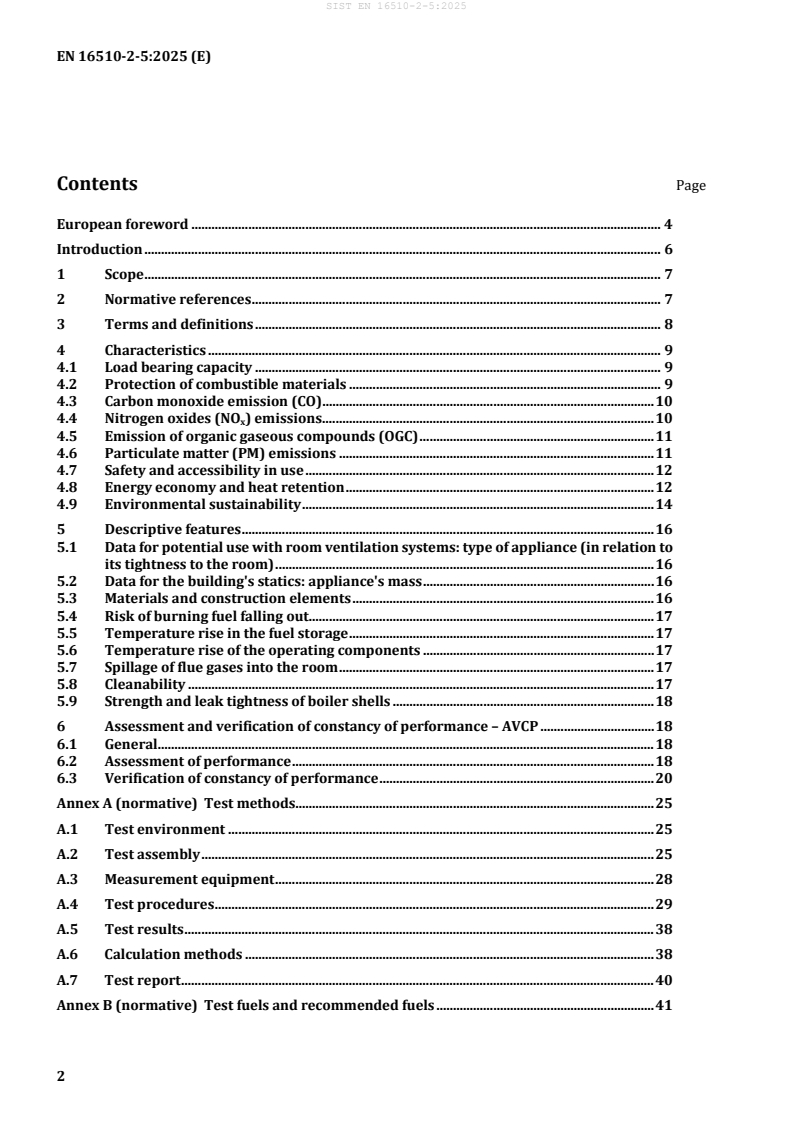
Contents Page
European foreword . 4
Introduction . 6
1 Scope . 7
2 Normative references . 7
3 Terms and definitions . 8
4 Characteristics . 9
4.1 Load bearing capacity . 9
4.2 Protection of combustible materials . 9
4.3 Carbon monoxide emission (CO) . 10
4.4 Nitrogen oxides (NO ) emissions . 10
x
4.5 Emission of organic gaseous compounds (OGC) . 11
4.6 Particulate matter (PM) emissions . 11
4.7 Safety and accessibility in use . 12
4.8 Energy economy and heat retention . 12
4.9 Environmental sustainability . 14
5 Descriptive features . 16
5.1 Data for potential use with room ventilation systems: type of appliance (in relation to
its tightness to the room) . 16
5.2 Data for the building's statics: appliance's mass . 16
5.3 Materials and construction elements . 16
5.4 Risk of burning fuel falling out. 17
5.5 Temperature rise in the fuel storage . 17
5.6 Temperature rise of the operating components . 17
5.7 Spillage of flue gases into the room . 17
5.8 Cleanability . 17
5.9 Strength and leak tightness of boiler shells . 18
6 Assessment and verification of constancy of performance – AVCP . 18
6.1 General. 18
6.2 Assessment of performance . 18
6.3 Verification of constancy of performance . 20
Annex A (normative) Test methods. 25
A.1 Test environment . 25
A.2 Test assembly . 25
A.3 Measurement equipment . 28
A.4 Test procedures . 29
A.5 Test results . 38
A.6 Calculation methods . 38
A.7 Test report . 40
Annex B (normative) Test fuels and recommended fuels . 41
Annex C (normative) Arrangement for measuring the leakage rate . 42
Annex D (normative) Measuring procedure for nitrogen oxides (NOx) . 43
Annex E (normative) Measuring procedure for organic gaseous carbon (OGC) . 44
Annex F (normative) Measurement procedure for particulate matter (PM) . 45
Annex G (normative) Guideline for the characteristics to be considered to decide on families
of appliances . 46
Annex E A (normative) Calculation of an approximate heat release curve against time . 48
Annex ZA (informative) Relationship of this European Standard with Regulation (EU) No.
305/2011 . 51
European foreword
This document (EN 16510-2-5:2025) has been prepared by Technical Committee CEN/TC 295
“Residential solid fuel burning appliances”, the secretariat of which is held by BSI.
This European Standard shall be given the status of a national standard, either by publication of an
identical text or by endorsement, at the latest by October 2025, and conflicting national standards shall
be withdrawn at the latest by October 2025.
Attention is drawn to the possibility that some of the elements of this document may be the subject of
patent rights. CEN shall not be held responsible for identifying any or all such patent rights.
This document supersedes EN 15250:2007.
EN 16510-2-5 includes the following significant technical changes with respect to EN 15250:2007:
— the scope is updated with space heating appliances in residential buildings that can be fitted with a
boiler or heat exchanger (integral part of the appliance containing water to be heated up) for the
supply of hot water for central heating systems integral boiler or heat exchanger water heat output
— Measurement methods for NO , hydrocarbon and particulate matter emissions for solid fuel burning
x
appliances;
— specifications for classification of solid fuel burning appliances and system boundaries for room
sealed appliances;
— requirements for the safety of solid fuel burning appliances with water-bearing components added;
— Annex ZA updated according to requirements of M/577;
— Assessment and verification of constancy of performance – AVCP 3+ added;
— energy efficiency and energy class labelling and seasonal space heating efficiency added;
— requirements for environmental sustainability added.
This document has been prepared under a standardization request given to CEN by the European
Commission. The Standing Committee of the EFTA States subsequently approves these requests for its
Member States.
For relationship with (EU) Regulation 305/2011, see informative Annex ZA, which is an integral part of
this document.
The structure of EN 16510, Residential solid fuel burning appliances, is as follows:
— Part 1: General requirements and test methods;
— Part 2-1: Roomheaters;
— Part 2-2: Inset appliances including open fires;
— Part 2-3: Cookers;
— Part 2-4: Independent boilers – Nominal heat output up to 50 kW;
— Part 2-5: Slow heat release appliances;
— Part 2-6: Mechanically by wood pellets fed roomheaters, inset appliances and cookers.
Other sections of Part 2 will be added to cover residential solid fuel burning appliances not included in
parts 2-1 to 2-6.
Subclauses and Figures which are additional to those in EN 16510-1:2022 are numbered starting with
501. Annexes which are additional to those in EN 16510-1:2022 are numbered starting with EA.
Any feedback and questions on this document should be directed to the users’ national standards body.
A complete listing of these bodies can be found on the CEN website.
According to the CEN-CENELEC Internal Regulations, the national standards organisations of the
following countries are bound to implement this European Standard: Austria, Belgium, Bulgaria, Croatia,
Cyprus, Czech Republic, Denmark, Estonia, Finland, France, Germany, Greece, Hungary, Iceland, Ireland,
Italy, Latvia, Lithuania, Luxembourg, Malta, Netherlands, Norway, Poland, Portugal, Republic of North
Macedonia, Romania, Serbia, Slovakia, Slovenia, Spain, Sweden, Switzerland, Türkiye and the United
Kingdom.
Introduction
The energy efficiency classification is aligned with Commission Regulation (EU) 2015/1186, Annex II.
Upon the revision of Regulation (EU) 2015/1186, the standard should be updated to reflect the new
classification.
The threshold levels for OGC, CO, NOx and PM emissions and the threshold levels for the seasonal space
heating energy efficiency are aligned with Commission Regulation (EU) 2015/1185, Annex II. Upon the
revision of Regulation 2015/1185, the standard should be updated to reflect the new classification.
1 Scope
This document is applicable to slow heat release appliances for solid fuel (freestanding manually fuelled
intermittent burning slow heat release appliances (SHRA) having heat storage capacity such that they
can provide heat and release it for an extended period after the fire has gone out).
The intended use of the appliances is space heating in residential buildings. They can be fitted with a
boiler or heat exchanger (integral part of the appliance containing water to be heated up) for the supply
of hot water for central heating systems.
These slow heat release appliances may be supplied either as an assembled appliance or as a pre-
designed unit consisting of prefabricated components designed to be built on site in accordance with the-
specified assembly instructions.
These appliances can burn one or more types of the following solid fuels as specified:
— wood logs;
— compressed untreated wood;
— wood pellets;
— lignite briquettes;
— solid mineral fuels;
— peat briquettes.
This document is not applicable to:
— mechanically fed appliances
— appliances with fan assisted combustion air
— one off installations
This document specifies procedures for assessment and verification of constancy of performance (AVCP)
of characteristics of solid fuel burning slow heat release appliances.
2 Normative references
The following documents are referred to in the text in such a way that some or all of their content
constitutes requirements of this document. For dated references, only the edition cited applies. For
undated references, the latest edition of the referenced document (including any amendments) applies.
EN 15804:2012+A2:2019, Sustainability of construction works - Environmental product declarations - Core
rules for the product category of construction products
EN 16510-1:2022, Residential solid fuel burning appliances - Part 1: General requirements and test methods
EN 16510-2-4:2022, Residential solid fuel burning appliances - Part 2-4: Independent boilers - Nominal heat
output up to 50 kW
EN 993-1:2018, Methods of test for dense shaped refractory products - Part 1: Determination of bulk density,
apparent porosity and true porosity
EN 993-10:2020, Methods of test for dense shaped refractory products - Part 10: Determination of
permanent change in dimensions on heating
EN 993-12:1997, Methods of test for dense shaped refractory products - Part 12: Determination of
pyrometric cone equivalent (refractoriness)
EN 1936:2006, Natural stone test methods - Determination of real density and apparent density, and of total
and open porosity
EN 303-5:2021, Heating boilers - Part 5: Heating boilers for solid fuels, manually and automatically stoked,
nominal heat output of up to 500 kW - Terminology, requirements, testing and marking
EN 14597:2012, Temperature control devices and temperature limiters for heat generating systems
3 Terms and definitions
For the purposes of this document, the terms and definitions given in EN 16510-1:2022 and the following
apply.
ISO and IEC maintain terminology databases for use in standardization at the following addresses:
— ISO Online browsing platform: available at https://www.iso.org/obp/
— IEC Electropedia: available at https://www.electropedia.org/
3.14
EN 16510-1:2022 definition 3.14 is replaced in this document with following:
batch charge
for slow heat release appliances proportion of the test load as specified for slow heat release appliances
that can be added at specified intervals during the test period of the performance test at nominal heat
output
3.501
total energy
thermal energy of slow heat release appliance transferred to the room over whole heat release period of
heating cycle, expressed in [kWh]
3.502
test load
mass of test fuel specified for the burning period
Note 1 to entry: The test load can be added as batch charges if this is specified in the appliance instructions.
3.503
burning period
period when test load is burned in SHRA
3.504
heat release period
period when the SHRA provides the heat by radiation and convection from the surface of the appliance
into the space where the appliance is installed
Impacted by EN 303-5:2021+A1:2022.
4 Characteristics
4.1 Load bearing capacity
The performance of the appliance in relation to the ability to carry a chimney shall be determined in
accordance with A.4.10 of this document and EN 16510-1:2022, 4.6.
If for an appliance with an upper outlet the ability to carry a chimney is specified the value of the
maximum load is to be given in [kg] as an integer according to EN 16510-1:2022, Table 22, no. 57
(m ).
chim
4.2 Protection of combustible materials
The performance of the appliance in relation to protection of combustible materials shall be determined
in accordance with A.4.10 of this document and EN 16510-1:2022, 5.6.
When tested in accordance with EN 16510-1:2022, 5.6, the protection measure(s) as specified according
to Table 1 shall be given as minimum distance to combustibles and if appropriate as material type and
thickness of protective insulation material.
The protection measures as specified shall be given in [mm] as an integer according to EN 16510-1:2022,
Table 22, no. 33, 34, 35, 36, 37, 38, 39 and 41 (d , d , d , d , d , d , d , s).
R S C P F L B
Table 1 — Protection of combustible materials
Protection measure Declared clearance distance to Protective insulation
combustible material or thickness of material if any
protective insulation material
[mm]
Minimum distance to -
combustibles - bottom (d )
B
Minimum distance to -
combustibles – floor in front
(d )
F
Minimum distance to -
combustibles – ceiling (d )
C
Minimum distance to -
combustibles – rear (d )
R
Minimum distance to -
combustibles – side (d )
S
Minimum distance to -
combustibles – side
radiation area (d )
L
Protection measure Declared clearance distance to Protective insulation
combustible material or thickness of material if any
protective insulation material
[mm]
Minimum distance to -
adjacent combustible
materials (e.g. furniture) (d )
P
Protective insulation
material (s)
4.3 Carbon monoxide emission (CO)
The performance of the appliance in relation to carbon monoxide emission at nominal heat output shall
be determined in accordance with A.4.7 of this document and EN 16510-1:2022, 6.3.2.
The CO value specified at nominal heat output is to be given in [mg/m ] as an integer according to
EN 16510-1:2022, Table 22, no. 17 (CO (13 % O )).
nom 2
When tested in accordance with A.4.7 and EN 16510-1:2022, 6.3.2 the CO emission at nominal heat
output shall not exceed the threshold levels as given in Table 2.
Table 2 — Threshold levels for CO emission
Appliance type Threshold level at 13 % O
open fronted solid fuel local space heaters 2000 mg/m
closed fronted solid fuel local space heaters using
solid fuel other than compressed wood in the form
1500 mg/m
of pellets including cookers
closed fronted solid fuel local space heaters using
compressed wood in form of pellets including 300 mg/m
cookers
4.4 Nitrogen oxides (NOx) emissions
The performance of the appliance in relation to nitrogen oxides emissions at nominal heat output shall
be determined in accordance with A.4.7 of this document and EN 16510-1:2022, 6.3.3.
The NO value specified at nominal heat output is to be given in [mg/m ] as an integer according to
x
EN 16510-1:2022, Table 22, no. 20 (NOxnom (13 % O2)).
When tested in accordance with A.4.7 and EN 16510-1:2022, 6.3.3 the NO emissions at nominal heat
x
output shall not exceed the threshold levels as given in Table 3.
Table 3 — Threshold levels for NO emissions (expressed as NO )
x 2
Appliance type Threshold level at 13 % O
open fronted solid fuel local space heaters, closed
fronted solid fuel local space heaters and cookers 200 mg/m
using biomass
open fronted solid fuel local space heaters, closed
fronted solid fuel local space heaters and cookers 300 mg/m
using fossil solid fuel
4.5 Emission of organic gaseous compounds (OGC)
The performance of the appliance in relation to organic gaseous compounds emission at nominal heat
output shall be determined in accordance with A.4.7 of this document and EN 16510-1:2022, 6.3.4.
The OGC value specified at nominal heat output is to be given in [mg/m ] as an integer according to
EN 16510-1:2022, Table 22, no. 23 (OGC (13 % O )).
nom 2
When tested in accordance with A.4.7 and EN 16510-1:2022, 6.3.4 the OGC emission at nominal heat
output shall not exceed the threshold levels as given in Table 4.
Table 4 — Threshold levels for OGC emission (expressed as C)
Appliance type Threshold level at 13 % O
open fronted solid fuel local space heaters 120 mg C/m
closed fronted solid fuel local space heaters using
solid fuel other than compressed wood in the form 120 mg C/m
of pellets including cookers
closed fronted solid fuel local space heaters using
compressed wood in form of pellets including 60 mg C/ m
cookers
4.6 Particulate matter (PM) emissions
The performance of the appliance in relation to particulate matter emissions at nominal heat output shall
be determined in accordance with A.4.7of this document and EN 16510-1:2022, 6.3.5.
The particulate matter value specified at nominal heat output is to be given in [mg/m ] as an integer
according to EN 16510-1:2022, Table 22, no. 26 (PM (13 % O )).
nom 2
When tested in accordance with A.4.7 and EN 16510-1:2022, 6.3.5 the particulate matter (PM) emissions
at nominal heat output shall not exceed the threshold levels as given in Table 5.
Table 5 — Threshold levels for PM emissions
Appliance type Threshold level at 13 % O
open fronted solid fuel local space heaters 50 mg/m
closed fronted solid fuel local space heaters using
solid fuel other than compressed wood in the form 40 mg/m
of pellets and cookers
closed fronted solid fuel local space heaters using
20 mg/m
compressed wood in form of pellets
4.7 Safety and accessibility in use
4.7.1 General
The data for the installation to a chimney are to be evaluated at nominal heat output. Specific data are to
be evaluated at safety test heat output.
4.7.2 Flue gas outlet temperature at nominal heat output
The performance of the appliance in relation to flue gas outlet temperature at nominal heat output shall
be determined in accordance with A.4.7 of this document and EN 16510-1:2022, 6.2.1.
The value of the flue gas outlet temperature for the installation of the appliance to a chimney if specified
is to be given in [°C] as an integer according to EN 16510-1:2022, Table 22, no. 47 (T ).
snom
4.7.3 Minimum flue draught at nominal heat output
The performance of the appliance in relation to the minimum flue draught at nominal heat output shall
be determined in accordance with A.4.7 of this document and EN 16510-1:2022, 6.5.
The value of the minimum flue draught if specified at nominal heat output for the installation of the
appliance to a chimney is to be given in [Pa] as an integer according to EN 16510-1:2022, Table 22, no.
29 (p ).
nom
4.7.4 Flue gas mass flow at nominal heat output
The performance of the appliance in relation to the flue gas mass flow at nominal heat output shall be
determined in accordance with A.4.7 of this document and EN 16510-1:2022, 6.12.
The flue gas mass flow value if specified at nominal heat output for the installation of the appliance to a
chimney is to be given in [g/s] with 1 decimal according to EN 16510-1:2022, Table 22, no. 50 (ϕ ).
f,g nom
4.7.5 Fire safety of installation to the chimney
The performance of the appliance in relation to the flue gas temperature (mean value) at safety test shall
be determined in accordance with A.4.10 of this document.
The data for installation of the appliance to a chimney with regards to the fire safety if specified is to be
given as the Tclass of the chimney required according to EN 16510-1:2022, 6.2.2 and EN 16510-1:2022,
Table 22, no. 49.
4.8 Energy economy and heat retention
4.8.1 Space heat output at nominal heat output
The performance of the appliance in relation to space heat output at nominal heat output shall be
determined in accordance with A.4.7 of this document.
The space heat output of the appliance if specified at nominal heat output is to be given in [kW] with 1
decimal according to EN 16510-1:2022, Table 22, no. 2 (P ).
SHnom
For the proper performance of the appliance the following shall be considered as well for those essential
characteristics and descriptive features assessed during the nominal heat output test (A.4.7 of this
document).
Additional devices, such as flue gas outlet components, components built-in the flue ways, combustion
air supply control devices, charging doors and ash-pit doors, flue bypass devices, internal flue gas
diverters, front fire bars and/or draught regulators for the safety or function of the appliance may be
present.
Some of these devices are optional, but if present their influence on the performance of the appliance
shall be checked according to EN 16510-1:2022, 4.4.4, 4.4.6, 4.4.9, 4.4.11, 4.4.12, 4.4.13, 4.4.14, and 4.4.16.
4.8.2 Water heat output, if existing at nominal heat output
The performance of the appliance in relation to water heat output (where appropriate) at nominal heat
output shall be determined in accordance with A.4.7 of this document.
The water heat output of the appliance if specified at nominal heat output is to be given in [kW] with 1
decimal according to EN 16510-1:2022, Table 22, no. 3 (P ).
Wnom
4.8.3 Efficiency at nominal heat output
The performance of the appliance in relation to efficiency at nominal heat output shall be determined in
accordance with A.4.7 of this document.
The efficiency of the appliance if specified at nominal heat output is to be given in [%] as an integer
according to EN 16510-1:2022, Table 22, no. 13 (η ).
nom
4.8.4 Seasonal space heating efficiency at appliance’s nominal heat output
The performance of the appliance in relation to seasonal space heating efficiency at nominal heat output
shall be determined in accordance with EN 16510-1:2022, 6.4.2.
The seasonal space heating efficiency of the appliance if specified at nominal heat output is to be given in
[%] as an integer according to EN 16510-1:2022, Table 22, no. 15 (ηS).
When tested in accordance with EN 16510-1:2022, 6.4.2 the seasonal space heating efficiency at nominal
heat output shall not underrun the threshold levels as given in Table 6.
Table 6— Threshold level of seasonal space heating energy efficiency
Appliance type Threshold level
open fronted solid fuel local space heaters 30 %
closed fronted solid fuel local space heaters using 65 %
solid fuel other than compressed wood in the form
of pellets
closed fronted solid fuel local space heaters using 79 %
compressed wood in the form of pellets
4.8.5 Energy efficiency
The performance of the appliance in relation to energy efficiency classification shall be determined in
accordance with EN 16510-1:2022, 6.4.3.
The energy efficiency classification of the appliance if specified shall be given according to
EN 16510-1:2022, Table 22, no. 16 (EEI) and shall be determined according to Table 7.
Table 7— Energy efficiency classification based on the energy efficiency index (EEI)
Energy efficiency class Energy efficiency index (EEI)
A++ EEI ≥ 130
A+ 107 ≤ EEI < 130
A 88 ≤ EEI < 107
B 82 ≤ EEI < 88
C 77 ≤ EEI < 82
Energy efficiency class Energy efficiency index (EEI)
D 72 ≤ EEI < 77
E 62 ≤ EEI < 72
F 42 ≤ EEI < 62
G EEI < 42
4.8.6 Electric power consumption at nominal heat output, if existing
The performance of the appliance in relation to electric power consumption at nominal heat output shall
be determined in accordance with A.4.7 of this document and EN 16510-1:2022, 6.11.
The electric power consumption of the appliance if specified at nominal heat output is to be given in [kW]
with 3 decimals according to EN 16510-1:2022, Table 22, no. 43 (el ).
max
4.8.7 Standby mode power consumption, if existing
The performance of the appliance in relation to standby mode power consumption at standby mode
(where appropriate) shall be determined in accordance with A.4.7 of this document and
EN 16510-1:2022, 6.11.
The standby mode power consumption of the appliance if specified is to be given in [kW] with 3 decimals
according to EN 16510-1:2022, Table 22, no. 42 (el ).
SB
4.8.501 Total energy at nominal heat output
The performance of the SHRA in relation to total energy at nominal heat output shall be determined in
accordance with A.4.7 and A.6.2.501 of this document. Total energy (E ) at nominal heat output is to be
kWh
given in [kWh] with 1 decimal.
4.8.502 Heat release period at nominal heat output
The performance of heat release period of SHRA shall be determined from the surface temperatures
defined in Clauses A.4.7 and A.2.501 of this document. The times T100 %, T50 %, T25 % of heat release
period at nominal heat output is to be given [h] with 1 decimal.
When tested in accordance with A.4.7 of this document the minimum heat release time defined by T50 %
- T100 % at nominal heat output shall not be less than 4 h.
For the calculation of time specific heat output use Annex EA.
4.9 Environmental sustainability
All relevant elements of the performance related to the whole life cycle of the appliance shall be identified
and enumerated on the basis on the information modules of EN 15804:2012+A2:2019.
The necessary environmental sustainability information shall be determined to enable the life cycle
analysis of the appliance concerned and the declaration of its performance in relation to the essential
characteristic environmental sustainability. This shall comprise in particular the definition of the
scenarios required for this complete period, including the reference service life, where appropriate.
The performance of the appliance in relation to the environmental sustainability shall be determined in
accordance with EN 16510-1:2022, Clause 8.
The environmental sustainability elements are given in Table 8.
Table 8 —Elements for the environmental sustainability
Environmental sustainability elements to be given in
kg CO equivalent
Global Warming Potential total (GWP-total)
kg CO equivalent
Global Warming Potential (GWP-fossil)
kg CO equivalent
Global Warming Potential (GWP-biogenic)
kg CO equivalent
Global Warming Potential land use and land use change (GWP-luluc)
Depletion potential of the stratospheric ozone layer (ODP) kg CFC 11 equivalent
+
Acidification potential, Accumulated Exceedance (AP)
mol H equivalent
Eutrophication potential, Fraction of nutrients reaching freshwater
kg PO equivalent
end compartment (EP-freshwater)
Eutrophication potential, Fraction of nutrients reaching marine end
kg N equivalent
compartment (EP-marine)
Eutrophication potential, Accumulated Exceedance (EP-terrestrial) mol N equivalent
Formation potential of tropospheric ozone (POCP) kg NMVOC equivalent
Abiotic depletion potential for non-fossil resources (ADP-minerals
kg Sb equivalent
and metals)
Abiotic depletion potential for fossil resources (ADP-fossil) MJ, net calorific value
Water (user) deprivation potential, deprivation-weighted water
m world equivalent
consumption (WDP)
deprived
Potential incidence of disease due to PM emissions (PM) Disease incidence
Potential Human exposure efficiency relative to U235 (IRP) kBq U235 equivalent
Eco-toxicity (freshwater) (ETP-fw) CTUe
Potential Comparative Toxic Unit for ecosystems (ETP-fw) CTUe
Potential Comparative Toxic Unit for humans (HTP-c) CTUh
Potential Comparative Toxic Unit for humans (HTP-nc) CTUh
Potential soil quality index (SQP) dimensionless
Hazardous waste disposed kg
Non-hazardous waste disposed kg
Radioactive waste disposed kg
Use of renewable primary energy excluding renewable primary
MJ, net calorific value
energy resources used as raw materials
Use of renewable primary energy resources used as raw materials MJ, net calorific value
Total use of renewable primary energy resources (primary energy
MJ, net calorific value
and primary energy resources used as raw materials)
Use of non-renewable primary energy excluding non-renewable
MJ, net calorific value
primary energy resources used as raw materials
Environmental sustainability elements to be given in
Use of non-renewable primary energy resources used as raw
MJ, net calorific value
materials
Total use of non-renewable primary energy resources (primary
MJ, net calorific value
energy and primary energy resources used as raw materials)
Use of secondary material kg
Use of renewable secondary fuels MJ, net calorific value
Use of non-renewable secondary fuels MJ, net calorific value
Use of net fresh water
m
Components for re-use kg
Materials for recycling kg
Materials for energy recovery kg
Exported energy MJ per energy carrier
5 Descriptive features
5.1 Data for potential use with room ventilation systems: type of appliance (in relation
to its tightness to the room)
The designation of the appliance in relation to the potential use with ventilation systems is to be given in
accordance with EN 16510-1:2022, 4.1.
5.2 Data for the building's statics: appliance's mass
The appliance’s mass in relation to the building’s statics is to be given in accordance with
EN 16510-1:2022, 7.2, paragraph 8).
5.3 Materials and construction elements
5.3.1 General
The shape and dimensions of the components and equipment and the method of design and manufacture
and, if assembled on site, the method of assembly and installation, shall ensure that, when operated as
specified in accordance with the test procedures of this document and exposed to the associated
mechanical, chemical and thermal stresses, the appliance shall operate reliably and safely such that
during normal operation no combustion gas posing a hazard can escape into the room in which the
appliance is installed nor can embers fall out.
Non-combustible materials (materials according with A.4.7, A.4.10, A.4.501 of this document and
EN 16510-1:2022, 4.4.1.1) shall be used, except that it shall be permissible to use combustible materials
for the following applications:
— components or accessories fitted outside the appliance;
— internal components of controls and safety equipment;
— operating handles;
— electrical equipment.
5.3.2 General stresses
The proper operation of the appliance in relation to the general stresses to materials and construction
elements is to be tested in accordance with A.4.7, A.4.10, A.4.501 of this document and EN 16510-1:2022,
4.4.1 and 4.4.2.
5.3.3 Integral boiler or heat exchanger
The proper operation of the appliance’s integral boiler or heat exchanger is to be tested in accordance
with A.4.7.3, A.4.10.7 of this document and EN 16510-1:2022, 4.4.2, 5.3 and 5.7.
5.4 Risk of burning fuel falling out
The prevention of the risk of burning fuel falling out of the appliance is to be tested in accordance with
A.4.7, A.4.10 of this document and EN 16510-1:2022, 5.2.
5.5 Temperature rise in the fuel storage
The rise of the temperature above ambient temperature in the fuel storage is to be tested in accordance
with A.4.7 and A.4.10 of this document and EN 16510-1:2022, 5.4. This rise of the temperature shall not
exceed 65 K.
5.6 Temperature rise of the operating components
The rise of the temperature above ambient temperature of the operation components is to be tested in
accordance with A.4.7 of this document and EN 16510-1:2022, 5.5. This rise of the temperature shall not
exceed the material specific limits given in EN 16510-1:2022, 5.5.
5.7 Spillage of flue gases into the room
5.7.1 Possible spillage of CO, if relevant for the fuel type
The prevention of possible spillage of CO is to be tested in accordance with EN 16510-1:2022, 5.1 and
A.4.10.5 depending on the intended fuel type.
5.7.2 Open operation
The prevention of possible spillage of flue gases is to be tested in accordance with EN 16510-1:2022, 5.2
for appliances intended for open operation.
5.8 Cleanability
5.8.1 Heating surfaces
The safety of the heating surfaces especially in relation to cleanability is to be tested in accordance with
EN 16510-1:2022, 4.4.3.
5.8.2 Flueways
The safety of the flueways especially in relation to cleanability is to be tested in accordance with
EN 16510-1:2022, 4.4.5.
5.8.3 Ashpan
If an ashpan is fitted its safety especially in relation to cleanability is to be tested in accordance with
EN 16510-1:2022, 4.4.7.
5.8.4 Bottomgrate
If a bottomgrate is fitted its safety especially in relation to cleanability is to be tested in accordance with
EN 16510-1:2022, 4.4.8.
5.8.5 Damper
If a damper is fitted its safety especially in relation to cleanability is to be tested in accordance with
EN 16510-1:2022, 4.4.10.
5.8.6 Fan-cut-out-device
If a fan-cut-out-device is fitted its safety especially in relation to cleanability is to be tested in accordance
with EN 16510-1:2022, 4.4.10 and EN 16510-2-4:2022, A.4.401.
5.9 Strength and leak tightness of boiler shells
The strength and leak tightness of integrated boiler shells are to be tested in accordance with A.4.7 of this
document and EN 16510-1:2022, 5.3.
6 Assessment and verification of constancy of performance – AVCP
6.1 General
The technical details necessary for the implementation of the system of assessment and verification of
constancy of performance comprise provisions with regards to:
— the assessment of the performance of the residential solid fuel burning appliance, which may be
carried out on the basis of testing (including sampling), calculation, tabulated values or descriptive
documentation of the product and
— the applicable factory production control.
6.2 Assessment of performance
6.2.1 General
When the intention is to declare any performance related to characteristics included in Annex ZA of this
standard this shall be carried out on the basis of testing (including sampling), calculation, tabulated
values or descriptive documentation of the product, in accordance with clause 'characteristics'.
Assessment previously performed in accordance with the provisions of this document, may be
considered provided that this assessment was made to the same or a more rigorous assessment method,
under the same AVCP system on the same product or products of similar design, construction and
functionality, such that the results are applicable to the product in question.
For the purposes of assessment, the products may be grouped into families, where it is considered that
the results for one or more characteristics from any one product within the family are representative for
that same characteristic for all products within that same family (see Annex G and EN 16510-1:2022,
Annex G).
Products may be grouped into different families for different characteristics.
In addition, the determination of the product type shall be:
— carried out for all characteristics included in the standard for which it is intended to declare the
performance:
— on first application of this standard, or
— at the beginning of the production of a new or modified residential solid fuel burning appliance,
unless a member of the same product family; or
— at the beginning of a new or modified method of production, where the modification may affect the
stated properties;
— repeated for the characteristic(s) in question, whenever a change occurs in the residential solid fuel
burning appliance design, in the raw material(s) or in the supplier of the components, and/or in the
method of production (subject to the definition of a family), which may affect significantly the
performance in relation to one or more of the characteristics;
Where kit components are used whose performance in relation to their characteristics has already been
determined on the basis of assessment methods of other harmonized technical specifications and those
components bear CE marking in accordance with those harmonized technical specifications, these
performances do not need to be re-assessed, if the intended use and the assessment methods of this
standard correspond to previously used. The specifications of these components shall be documented.
6.2.2 Test samples, testing and compliance criteria
The samples residential solid fuel burning appliance to be tested/assessed shall be in accordance with
Table 9.
Table 9 — Number of samples to be tested and assessment criteria
Characteristic Clause Assessment No. of Assessment criteria
method samples
Load bearing capacity 4.1 A.4.10 1 4.1
Protection of combustible materials 4.2 A.4.10 1 4.2
Carbon monoxide (CO) emission 4.3 A.4.7 1 4.3, Table 2
Nitrogen oxides (NO ) emission 4.4 A.4.7 1 4.4, Table 3
x
Organic gaseous compounds (OGC) 4.5 A.4.7 1 4.5, Table 4
emission
Particulate matter (PM) emission 4.6 A.4.7 1 4.6, Table 5
Flue gas outlet temperature 4.7.2 A.4.7 1 4.7.2
Minimum flue draught 4.7.3 A.4.7 1 4.7.4
Flue gas mass flow 4.7.4 A.4.7 1 4.7.6
Fire safety of installation to a 4.7.5 A.4.10.4 1 4.7.8
chimney
Space heat output 4.8.1 A.4.7 1 4.8.1
Total energy 4.8.501 A.4.7 1 4.8.501
Heat release period 4.8.502 A.4.7 1 4.8.502
Characteristic Cla
...
Questions, Comments and Discussion
Ask us and Technical Secretary will try to provide an answer. You can facilitate discussion about the standard in here.
Loading comments...