


SIST EN 60060-1:2011
High-voltage test techniques - Part 1: General definitions and test requirements (IEC 60060-1:2010)
High-voltage test techniques - Part 1: General definitions and test requirements (IEC 60060-1:2010)
IEC 60060-1:2010 applies to dielectric tests with alternating voltage; dielectric tests with direct voltage; dielectric tests with impulse voltage and dielectric tests with combinations of the above. This document is applicable to tests on equipment having its highest voltage for equipment Um above 1 kV. The third edition cancels and replaces the second edition, published in 1989, and constitutes a technical revision. The major technical changes with respect to the previous edition are as follows: - artifical pollution test procedures were removed as they are now described in IEC 60507, - measurement of impulse current has been transferred to a new standard on current measurement (IEC 62475), - the atmospheric correction factors are now presented as formulas.
Hochspannungs-Prüftechnik - Teil 1: Allgemeine Begriffe und Prüfbedingungen (IEC 60060-1:2010)
Technique des essais à haute tension - Partie 1: Définitions et exigences générales (CEI 60060-1:2010)
La CEI 60060-1:2010 S'applique aux essais diélectriques en tension alternative, aux essais diélectriques en tension continue, aux essais diélectriques en tension de choc et aux essais diélectriques combinant les essais ci-dessus. Ce document est applicable aux essais de matériels dont la tension la plus élevée Um pour le matériel est supérieure à 1 kV. Cette troisième édition annule et remplace la seconde édition publiée en 1989 et constitue une révision technique. Les changements techniques importants, par rapport à l'édition précédente, sont les suivants: - les procédés de test de pollution artificielle ont été retirés car ils sont inclus dans la CEI 60507, - la mesure de courant de choc a été transférée dans une nouvelle norme de mesure de courant (CEI 62475), - les facteurs de correction atmosphérique sont présentés sous forme de formules.
Visokonapetostne preskusne tehnike - 1. del: Splošne definicije in preskusne zahteve (IEC 60060-1:2010)
Ta del IEC 60060 velja za: - dielektrične preskuse z enosmerno napetostjo;- dielektrične preskuse z izmenično napetostjo; - dielektrične preskuse s pulzno napetostjo; dielektrične preskuse s kombinacijo zgoraj navedenega. Ta del velja za preskuse na opremi, za katero velja najvišja napetost opreme Um nad 1 kV.
General Information
- Status
- Published
- Publication Date
- 04-Jan-2011
- Technical Committee
- IVNT - High-voltage testing techniques
- Current Stage
- 6060 - National Implementation/Publication (Adopted Project)
- Start Date
- 15-Dec-2010
- Due Date
- 19-Feb-2011
- Completion Date
- 05-Jan-2011
Relations
- Effective Date
- 28-Jan-2023
- Effective Date
- 01-Sep-2025
- Effective Date
- 03-Dec-2013
Overview
SIST EN 60060-1:2011 (IEC 60060-1:2010) - High-voltage test techniques - Part 1: General definitions and test requirements - defines fundamental concepts, test requirements and procedures for dielectric testing of electrical equipment. The standard applies to dielectric tests with alternating voltage (AC), direct voltage (DC), impulse voltage and combinations of these, for equipment whose highest voltage for equipment (Um) is above 1 kV. Edition 3 (2010/2011) supersedes the 1989 edition and contains important technical updates.
Key topics and technical requirements
- Scope of dielectric tests: AC, DC, lightning-impulse, switching-impulse and combined/composite voltages.
- Test categories and procedures: definitions and requirements for withstand voltage tests, disruptive-discharge voltage tests and assured disruptive-discharge voltage tests.
- Generation and measurement: guidance on generation and measurement of test voltages and currents (note: measurement of impulse current moved to IEC 62475).
- Atmospheric correction: atmospheric correction factors for dry tests are now provided as formulas and guidance on application and measurement of atmospheric parameters.
- Wet and artificial pollution tests: wet test procedures and atmospheric corrections described; artificial pollution procedures removed (now covered by IEC 60507 / EN 60507).
- Impulse waveform evaluation: new method for calculating time parameters of lightning impulses (improved handling of overshoot and oscillations).
- Statistical treatment and software: annexes addressing statistical evaluation of results, calculation procedures for impulse parameters and guidance for software used to evaluate lightning-impulse voltages.
Practical applications and users
SIST EN 60060-1:2011 is essential for anyone involved in high-voltage testing, including:
- Manufacturers of transformers, switchgear, insulators and high-voltage apparatus - for type testing and design verification.
- Independent test laboratories and certification bodies - to ensure compliant test methods and repeatable measurement.
- Utilities and asset owners - for acceptance testing, commissioning and diagnostic testing of HV equipment.
- R&D teams and standards engineers - for consistent definitions, test setup requirements and interpretation of impulse waveform parameters.
Using this standard helps ensure accurate dielectric test results, repeatable procedures and harmonized interpretation of AC, DC and impulse test outcomes across laboratories and manufacturers.
Related standards (normative/relevant)
- IEC/EN 60060-2 - High-voltage test techniques - Part 2: Measuring systems
- IEC/EN 60270 - Partial discharge measurements
- IEC/EN 60507 - Artificial pollution tests on HV insulators
- IEC/EN 61083 series - Instruments/software for impulse measurements
- IEC/EN 62475 - High-current test techniques (impulse current measurement)
Keywords: high-voltage test techniques, dielectric tests, IEC 60060-1, SIST EN 60060-1:2011, impulse voltage, atmospheric correction factors, lightning impulse, switching impulse, high-voltage testing, dielectric testing.

Frequently Asked Questions
SIST EN 60060-1:2011 is a standard published by the Slovenian Institute for Standardization (SIST). Its full title is "High-voltage test techniques - Part 1: General definitions and test requirements (IEC 60060-1:2010)". This standard covers: IEC 60060-1:2010 applies to dielectric tests with alternating voltage; dielectric tests with direct voltage; dielectric tests with impulse voltage and dielectric tests with combinations of the above. This document is applicable to tests on equipment having its highest voltage for equipment Um above 1 kV. The third edition cancels and replaces the second edition, published in 1989, and constitutes a technical revision. The major technical changes with respect to the previous edition are as follows: - artifical pollution test procedures were removed as they are now described in IEC 60507, - measurement of impulse current has been transferred to a new standard on current measurement (IEC 62475), - the atmospheric correction factors are now presented as formulas.
IEC 60060-1:2010 applies to dielectric tests with alternating voltage; dielectric tests with direct voltage; dielectric tests with impulse voltage and dielectric tests with combinations of the above. This document is applicable to tests on equipment having its highest voltage for equipment Um above 1 kV. The third edition cancels and replaces the second edition, published in 1989, and constitutes a technical revision. The major technical changes with respect to the previous edition are as follows: - artifical pollution test procedures were removed as they are now described in IEC 60507, - measurement of impulse current has been transferred to a new standard on current measurement (IEC 62475), - the atmospheric correction factors are now presented as formulas.
SIST EN 60060-1:2011 is classified under the following ICS (International Classification for Standards) categories: 19.080 - Electrical and electronic testing. The ICS classification helps identify the subject area and facilitates finding related standards.
SIST EN 60060-1:2011 has the following relationships with other standards: It is inter standard links to SIST HD 588.1 S1:1998, SIST EN IEC 60060-1:2025, SIST HD 588.1 S1:1998. Understanding these relationships helps ensure you are using the most current and applicable version of the standard.
SIST EN 60060-1:2011 is available in PDF format for immediate download after purchase. The document can be added to your cart and obtained through the secure checkout process. Digital delivery ensures instant access to the complete standard document.
Standards Content (Sample)
2003-01.Slovenski inštitut za standardizacijo. Razmnoževanje celote ali delov tega standarda ni dovoljeno.Visokonapetostne preskusne tehnike - 1. del: Splošne definicije in preskusne zahteve (IEC 60060-1:2010)Hochspannungs-Prüftechnik - Teil 1: Allgemeine Begriffe und Prüfbedingungen (IEC 60060-1:2010)Technique des essais à haute tension - Partie 1: Définitions et exigences générales (CEI 60060-1:2010)High-voltage test techniques - Part 1: General definitions and test requirements (IEC 60060-1:2010)19.080SUHVNXãDQMHElectrical and electronic testingICS:Ta slovenski standard je istoveten z:EN 60060-1:2010SIST EN 60060-1:2011en01-februar-2011SIST EN 60060-1:2011SLOVENSKI
STANDARDSIST HD 588.1 S1:19981DGRPHãþD
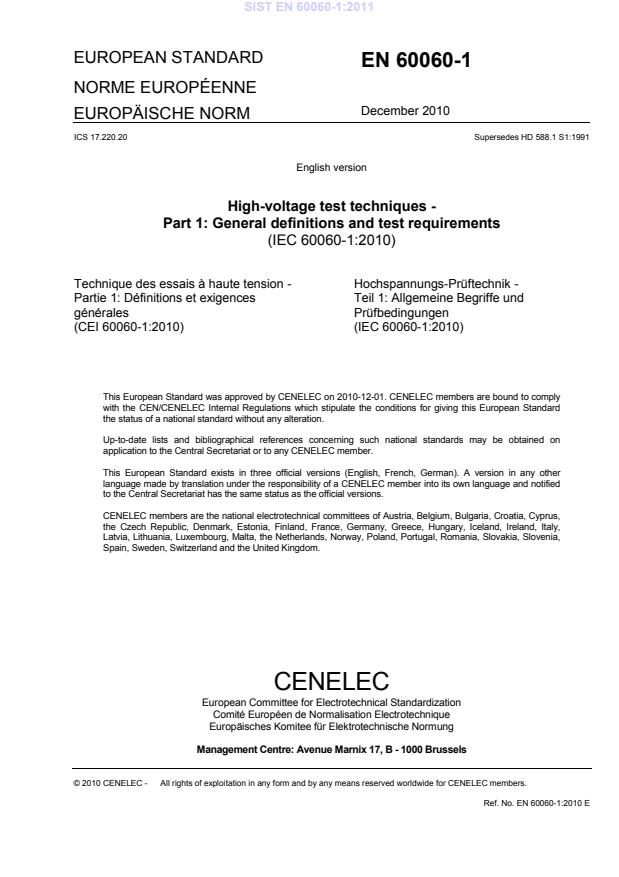
EUROPEAN STANDARD EN 60060-1 NORME EUROPÉENNE
EUROPÄISCHE NORM December 2010
CENELEC European Committee for Electrotechnical Standardization Comité Européen de Normalisation Electrotechnique Europäisches Komitee für Elektrotechnische Normung
Management Centre: Avenue Marnix 17, B - 1000 Brussels
© 2010 CENELEC -
All rights of exploitation in any form and by any means reserved worldwide for CENELEC members.
Ref. No. EN 60060-1:2010 E
ICS 17.220.20 Supersedes HD 588.1 S1:1991
English version
High-voltage test techniques -
Part 1: General definitions and test requirements (IEC 60060-1:2010)
Technique des essais à haute tension -
Partie 1: Définitions et exigences générales (CEI 60060-1:2010)
Hochspannungs-Prüftechnik -
Teil 1: Allgemeine Begriffe und Prüfbedingungen (IEC 60060-1:2010)
This European Standard was approved by CENELEC on 2010-12-01. CENELEC members are bound to comply with the CEN/CENELEC Internal Regulations which stipulate the conditions for giving this European Standard the status of a national standard without any alteration.
Up-to-date lists and bibliographical references concerning such national standards may be obtained on application to the Central Secretariat or to any CENELEC member.
This European Standard exists in three official versions (English, French, German). A version in any other language made by translation under the responsibility of a CENELEC member into its own language and notified to the Central Secretariat has the same status as the official versions.
CENELEC members are the national electrotechnical committees of Austria, Belgium, Bulgaria, Croatia, Cyprus, the Czech Republic, Denmark, Estonia, Finland, France, Germany, Greece, Hungary, Iceland, Ireland, Italy, Latvia, Lithuania, Luxembourg, Malta, the Netherlands, Norway, Poland, Portugal, Romania, Slovakia, Slovenia, Spain, Sweden, Switzerland and the United Kingdom.
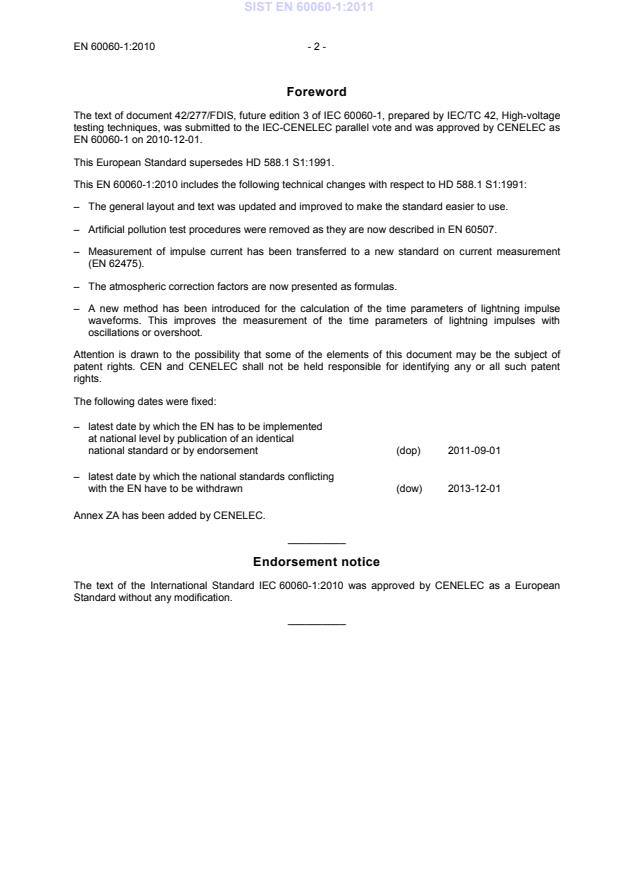
(EN 62475). – The atmospheric correction factors are now presented as formulas. – A new method has been introduced for the calculation of the time parameters of lightning impulse waveforms. This improves the measurement of the time parameters of lightning impulses with oscillations or overshoot. Attention is drawn to the possibility that some of the elements of this document may be the subject of patent rights. CEN and CENELEC shall not be held responsible for identifying any or all such patent rights. The following dates were fixed: – latest date by which the EN has to be implemented
at national level by publication of an identical
national standard or by endorsement
(dop)
2011-09-01 – latest date by which the national standards conflicting
with the EN have to be withdrawn
(dow)
2013-12-01 Annex ZA has been added by CENELEC. __________ Endorsement notice The text of the International Standard IEC 60060-1:2010 was approved by CENELEC as a European Standard without any modification. __________
- 3 - EN 60060-1:2010 Annex ZA
(normative)
Normative references to international publications with their corresponding European publications
The following referenced documents are indispensable for the application of this document. For dated references, only the edition cited applies. For undated references, the latest edition of the referenced document (including any amendments) applies.
NOTE
When an international publication has been modified by common modifications, indicated by (mod), the relevant EN/HD applies.
Publication Year Title EN/HD Year
IEC 60060-2 - High-voltage test techniques -
Part 2: Measuring systems EN 60060-2 -
IEC 60270 - High-voltage test techniques - Partial discharge measurements EN 60270 -
IEC 60507 1991 Artificial pollution tests on high-voltage insulators to be used on a.c. systems EN 60507 1993
IEC 61083-1 - Instruments and software used for measurement in high-voltage impulse tests - Part 1: Requirements for instruments EN 61083-1 -
IEC 61083-2 - Digital recorders for measurements in high-voltage impulse tests -
Part 2: Evaluation of software used for the determination of the parameters of impulse waveforms EN 61083-2 -
IEC 62475 - High-current test techniques - Definitions and requirements for test currents and measuring systems EN 62475 -
IEC 60060-1Edition 3.0 2010-09INTERNATIONAL STANDARD NORME INTERNATIONALEHigh-voltage test techniques –
Part 1: General definitions and test requirements
Technique des essais à haute tension –
Partie 1: Définitions et exigences générales
INTERNATIONAL ELECTROTECHNICAL COMMISSION COMMISSION ELECTROTECHNIQUE INTERNATIONALE XBICS 17.220.20 PRICE CODECODE PRIXISBN 978-2-88912-185-4
– 2 – 60060-1 © IEC:2010 CONTENTS FOREWORD.5 1 Scope.7 2 Normative references.7 3 Terms and definitions.7 3.1 Definitions related to characteristics of discharges.8 3.2 Definitions relating to characteristics of the test voltage.8 3.3 Definitions relating to tolerance and uncertainty.9 3.4 Definitions relating to statistical characteristics of disruptive-discharge voltage values.9 3.5 Definitions relating to classification of insulation in test objects.10 4 General requirements.11 4.1 General requirements for test procedures.11 4.2 Arrangement of the test object in dry tests.11 4.3 Atmospheric corrections in dry tests.12 4.3.1 Standard reference atmosphere.12 4.3.2 Atmospheric correction factors for air gaps.12 4.3.3 Application of correction factors.13 4.3.4 Correction factor components.13 4.3.5 Measurement of atmospheric parameters.16 4.3.6 Conflicting requirements for testing internal and external insulation.17 4.4 Wet tests.18 4.4.1 Wet test procedure.18 4.4.2 Atmospheric corrections for wet tests.19 4.5 Artificial pollution tests.19 5 Tests with direct voltage.19 5.1 Definitions for direct voltage tests.19 5.2 Test voltage.20 5.2.1 Requirements for the test voltage.20 5.2.2 Generation of the test voltage.20 5.2.3 Measurement of the test voltage.20 5.2.4 Measurement of the test current.21 5.3 Test procedures.21 5.3.1 Withstand voltage tests.21 5.3.2 Disruptive-discharge voltage tests.22 5.3.3 Assured disruptive-discharge voltage tests.22 6 Tests with alternating voltage.22 6.1 Definitions for alternating voltage tests.22 6.2 Test Voltage.22 6.2.1 Requirements for the test voltage.22 6.2.2 Generation of the test voltage.23 6.2.3 Measurement of the test voltage.24 6.2.4 Measurement of the test current.25 6.3 Test procedures.25 6.3.1 Withstand voltage tests.25 6.3.2 Disruptive-discharge voltage tests.25 6.3.3 Assured disruptive-discharge voltage tests.25 SIST EN 60060-1:2011
60060-1 © IEC:2010 – 3 – 7 Tests with lightning-impulse voltage.26 7.1 Definitions for lightning-impulse voltage tests.26 7.2 Test Voltage.33 7.2.1 Standard lightning-impulse voltage.33 7.2.2 Tolerances.34 7.2.3 Standard chopped lightning-impulse voltage.34 7.2.4 Special lightning-impulse voltages.34 7.2.5 Generation of the test voltage.34 7.2.6 Measurement of the test voltage and determination of impulse shape.34 7.2.7 Measurement of current during tests with impulse voltages.35 7.3 Test Procedures.35 7.3.1 Withstand voltage tests.35 7.3.2 Procedures for assured disruptive-discharge voltage tests.36 8 Tests with switching-impulse voltage.36 8.1 Definitions for switching-impulse voltage tests.36 8.2 Test voltage.38 8.2.1 Standard switching-impulse voltage.38 8.2.2 Tolerances.38 8.2.3 Time-to-peak evaluation.38 8.2.4 Special switching-impulse voltages.38 8.2.5 Generation of the test voltage.38 8.2.6 Measurement of test voltage and determination of impulse shape.39 8.2.7 Measurement of current during tests with impulse voltages.39 8.3 Test procedures.39 9 Tests with combined and composite voltages.39 9.1 Definitions for combined- and composite-voltage tests.39 9.2.4 Tolerances.42 9.2.5 Generation.42 9.2.6 Measurement.42 9.3 Composite test voltages.43 9.3.1 Parameters.43 9.3.2 Tolerances.43 9.3.3 Generation.43 9.3.4 Measurement.43 9.4 Test procedures.43 Annex A (informative)
Statistical treatment of test results.45 Annex B (normative)
Procedures for calculation of parameters of standard lightning-impulse voltages with superimposed overshoot or oscillations.54 Annex C (informative)
Guidance for implementing software for evaluation of lightning-impulse voltage parameters.59 Annex D (informative)
Background to the introduction of the test voltage factor for evaluation of impulses with overshoot.62 Annex E (informative)
The iterative calculation method in the converse procedure for the determination of atmospheric correction factor.68 Bibliography.73
Figure 1 – Recommended minimum clearance D of extraneous live or earthed objects to the energized electrode of a test object, during an a.c. or positive switching impulse test at the maximum voltage U applied during test.12 SIST EN 60060-1:2011
– 4 – 60060-1 © IEC:2010 Figure 2 – k as a function of the ratio of the absolute humidity h to the relative air density δž (see
4.3.4.2 for limits of applicability).14 Figure 3 – Values of exponents m and w.16 Figure 4 – Absolute humidity of air as a function of dry- and wet-bulb thermometer readings.17 Figure 5 – Full lightning-impulse voltage.26 Figure 6 – Test voltage function.28 Figure 7 – Full impulse voltage time parameters.29 Figure 8 – Voltage time interval.30 Figure 9 – Voltage integral.30 Figure 10 – Lightning-impulse voltage chopped on the front.31 Figure 11 – Lightning-impulse voltage chopped on the tail.32 Figure 12 – Linearly rising front chopped impulse.32 Figure 13 – Voltage/time curve for impulses of constant prospective shape.33 Figure 14 – Switching-impulse voltage.37 Figure 15 – Circuit for a combined voltage test.40 Figure 16 – Schematic example for combined and composite voltage.41 Figure 17 – Circuit for a composite voltage test.42 Figure 18 – Definition of time delay Δt.43 Figure A.1 – Example of a multiple-level (Class 1) test.48 Figure A.2 – Examples of decreasing and increasing up-and-down (Class 2) tests for determination of 10 % and 90 % disruptive-discharge probabilities respectively.49 Figure A.3 – Examples of progressive stress (Class 3) tests.50 Figure B.1 – Recorded and base curve showing overshoot and residual curve.55 Figure B.2 – Test voltage curve (addition of base curve and filtered residual curve).55 Figure B.3 – Recorded and test voltage curves.56 Figure D.1 – “Effective” test voltage function in IEC 60060-1:1989.63 Figure D.2 – Representative experimental points from European experiments and test voltage function.65 Figure E.1 – Atmospheric pressure as a function of altitude.69
Table 1 – Values of exponents, m for air density correction and w for humidity correction, as a function of the parameter g.15 Table 2 – Precipitation conditions for standard procedure.19 Table A.1– Discharge probabilities in up-and-down testing.52 Table E.1 – Altitudes and air pressure of some locations.69 Table E.2 – Initial Kt and its sensitivity coefficients with respect to U50 for the example of the standard phase-to-earth a.c. test voltage of 395 kV.70 Table E.3 – Initial and converged Kt values for the example of the standard phase-to-earth a.c. test voltage of 395 kV.72
60060-1 © IEC:2010 – 5 – INTERNATIONAL ELECTROTECHNICAL COMMISSION ____________
HIGH-VOLTAGE TEST TECHNIQUES –
Part 1: General definitions and test requirements
FOREWORD 1) The International Electrotechnical Commission (IEC) is a worldwide organization for standardization comprising all national electrotechnical committees (IEC National Committees). The object of IEC is to promote international co-operation on all questions concerning standardization in the electrical and electronic fields. To this end and in addition to other activities, IEC publishes International Standards, Technical Specifications, Technical Reports, Publicly Available Specifications (PAS) and Guides (hereafter referred to as “IEC Publication(s)”). Their preparation is entrusted to technical committees; any IEC National Committee interested in the subject dealt with may participate in this preparatory work. International, governmental and non-governmental organizations liaising with the IEC also participate in this preparation. IEC collaborates closely with the International Organization for Standardization (ISO) in accordance with conditions determined by agreement between the two organizations. 2) The formal decisions or agreements of IEC on technical matters express, as nearly as possible, an international consensus of opinion on the relevant subjects since each technical committee has representation from all interested IEC National Committees.
3) IEC Publications have the form of recommendations for international use and are accepted by IEC National Committees in that sense. While all reasonable efforts are made to ensure that the technical content of IEC Publications is accurate, IEC cannot be held responsible for the way in which they are used or for any misinterpretation by any end user. 4) In order to promote international uniformity, IEC National Committees undertake to apply IEC Publications transparently to the maximum extent possible in their national and regional publications. Any divergence between any IEC Publication and the corresponding national or regional publication shall be clearly indicated in the latter. 5) IEC itself does not provide any attestation of conformity. Independent certification bodies provide conformity assessment services and, in some areas, access to IEC marks of conformity. IEC is not responsible for any services carried out by independent certification bodies. 6) All users should ensure that they have the latest edition of this publication. 7) No liability shall attach to IEC or its directors, employees, servants or agents including individual experts and members of its technical committees and IEC National Committees for any personal injury, property damage or other damage of any nature whatsoever, whether direct or indirect, or for costs (including legal fees) and expenses arising out of the publication, use of, or reliance upon, this IEC Publication or any other IEC Publications.
8) Attention is drawn to the Normative references cited in this publication. Use of the referenced publications is indispensable for the correct application of this publication. 9) Attention is drawn to the possibility that some of the elements of this IEC Publication may be the subject of patent rights. IEC shall not be held responsible for identifying any or all such patent rights. International Standard IEC 60060-1 has been prepared by IEC technical committee 42: High-voltage test techniques. This third edition of IEC 60060-1 cancels and replaces the second edition, published in 1989, and constitutes a technical revision. The significant technical changes with respect to the previous edition are as follows: a) The general layout and text was updated and improved to make the standard easier to use. b) Artificial pollution test procedures were removed as they are now described in IEC 60507.
c) Measurement of impulse current has been transferred to a new standard on current measurement (IEC 62475).
d) The atmospheric correction factors are now presented as formulas. SIST EN 60060-1:2011
– 6 – 60060-1 © IEC:2010 e) A new method has been introduced for the calculation of the time parameters of lightning impulse waveforms. This improves the measurement of the time parameters of lightning impulses with oscillations or overshoot. The text of this standard is based on the following documents: FDIS Report on voting 42/277/FDIS 42/282/RVD
Full information on the voting for the approval of this standard can be found in the report on voting indicated in the above table. This publication has been drafted in accordance with the ISO/IEC Directives, Part 2 A list of all the parts in the IEC 60060 series, under the general title High-voltage test techniques, can be found on the IEC website. The committee has decided that the contents of this publication will remain unchanged until the stability date indicated on the IEC website under "http://webstore.iec.ch" in the data related to this specific publication. At this date, the publication will be: • reconfirmed; • withdrawn; • replaced by a revised edition or • amended.
60060-1 © IEC:2010 – 7 – HIGH-VOLTAGE TEST TECHNIQUES –
Part 1: General definitions and test requirements
1 Scope This part of IEC 60060 is applicable to: –
dielectric tests with direct voltage; –
dielectric tests with alternating voltage; –
dielectric tests with impulse voltage; – dielectric tests with combinations of the above. This part is applicable to tests on equipment having its highest voltage for equipment Um above 1 kV. NOTE 1 Alternative test procedures may be required to obtain reproducible and significant results. The choice of a suitable test procedure should be made by the relevant Technical Committee. NOTE 2 For voltages Um above 800 kV meeting some specified procedures, tolerances and uncertainties may not be achievable. 2 Normative references The following referenced documents are indispensable for the application of this document. For dated references, only the edition cited applies. For undated references, the latest edition of the referenced document (including any amendments) applies. IEC 60060-2, High-voltage test techniques – Part 2: Measuring systems IEC 60270, High-voltage test techniques – Partial discharge measurements IEC 60507:1991, Artificial pollution tests on high-voltage insulators to be used on a.c. systems IEC 61083-1, Instruments and software used for measurement in high-voltage impulse tests – Part 1: Requirements for instruments IEC 61083-2, Digital recorders for measurements in high-voltage impulse tests – Part 2: Evaluation of software used for the determination of the parameters of impulse waveforms IEC 62475, High-current test techniques: Definitions and requirements for test currents and measuring systems 3 Terms and definitions For the purposes of this document, the following terms and definitions apply. SIST EN 60060-1:2011
– 8 – 60060-1 © IEC:2010 3.1 Definitions related to characteristics of discharges 3.1.1
disruptive discharge failure of insulation under electric stress, in which the discharge completely bridges the insulation under test, reducing the voltage between electrodes to practically zero NOTE 1 Non-sustained disruptive discharge in which the test object is momentarily bridged by a spark or arc may occur. During these events the voltage across the test object is momentarily reduced to zero or to a very small value. Depending on the characteristics of the test circuit and the test object, a recovery of dielectric strength may occur and may even allow the test voltage to reach a higher value. Such an event should be interpreted as a disruptive discharge unless otherwise specified by the relevant Technical Committee. NOTE 2 A disruptive discharge in a solid dielectric produces permanent loss of dielectric strength; in a liquid or gaseous dielectric the loss may be only temporary. 3.1.2
sparkover disruptive discharge that occurs in a gaseous or liquid dielectric 3.1.3
flashover disruptive discharge that occurs over the surface of a dielectric in a gaseous or liquid dielectric 3.1.4
puncture disruptive discharge that occurs through a solid dielectric 3.1.5
disruptive-discharge voltage value of a test object value of the test voltage causing disruptive discharge, as specified, for the various tests, in the relevant clauses of the present standard 3.1.6
non-disruptive discharge discharge between intermediate electrodes or conductors where the test voltage does not collapse to zero NOTE 1 Such an event should not be interpreted as a disruptive discharge unless so specified by the relevant Technical Committee. NOTE 2 Some non-disruptive discharges are termed “partial discharges” and are dealt with in IEC 60270. 3.2 Definitions relating to characteristics of the test voltage 3.2.1
prospective characteristics of a test voltage characteristics which would have been obtained if no disruptive discharge had occurred. When a prospective characteristic is used, this shall always be stated. 3.2.2
actual characteristics of a test voltage those characteristics which occur during the test at the terminals of the test object 3.2.3
value of the test voltage as defined in the relevant clauses of this standard SIST EN 60060-1:2011
60060-1 © IEC:2010 – 9 – 3.2.4
withstand voltage of a test object specified prospective voltage value which characterizes the insulation of the object with regard to a withstand test NOTE 1 Unless otherwise specified, withstand voltages are referred to standard reference atmospheric conditions (see
4.3.1). NOTE 2 This applies to external insulation only. 3.2.5
assured disruptive-discharge voltage of a test object specified prospective voltage value which characterizes its performance with regard to a disruptive-discharge test 3.3 Definitions relating to tolerance and uncertainty 3.3.1
tolerance constitutes the permitted difference between the measured value and the specified value
NOTE 1 This difference should be distinguished from the uncertainty of a measurement.
NOTE 2 A pass/fail decision is based on the measured value, without consideration of the measurement uncertainty. 3.3.2
uncertainty (of measurement) parameter, associated with the result of a measurement, that characterizes the dispersion of the values that could be reasonably attributed to the measurand
[IEV 311-01-02]
NOTE 1 In this standard, all uncertainty values are specified at a level of confidence of 95 %. NOTE 2 Uncertainty is positive and given without sign. NOTE 3 It should not be confused with the tolerance of a test-specified value or parameter. 3.4 Definitions relating to statistical characteristics of disruptive-discharge voltage values 3.4.1
disruptive-discharge probability of a test object p probability that one application of a certain prospective voltage value of a given shape will cause disruptive discharge in the test object NOTE The parameter p may be expressed as a percentage or a proper fraction. 3.4.2
withstand probability of a test object q probability that an application of a certain prospective voltage value of a given shape does not cause a disruptive discharge on the test object NOTE If the disruptive-discharge probability is p, the withstand probability q is (1 – p). 3.4.3
p % disruptive-discharge voltage of a test object Up prospective voltage value which has p % probability of producing a disruptive discharge on the test object SIST EN 60060-1:2011
– 10 – 60060-1 © IEC:2010 NOTE 1 Mathematically the p % disruptive-discharge voltage is the quantile of the order p (or p quantile) of the breakdown voltage. NOTE 2 U10 is called the “statistical withstand voltage” and U90 is called the “statistical assured disruptive-discharge voltage”. 3.4.4
50 % disruptive-discharge voltage of a test object U50 prospective voltage value which has a 50 % probability of producing a disruptive discharge on the test object 3.4.5
arithmetic mean value of the disruptive-discharge voltage of a test object,
Ua
∑==niinaUU11 where iU
is the measured disruptive-discharge voltage and n
is the number of observations (discharges). NOTE For symmetric distributions Ua is identical to U50.
3.4.6
standard deviation of the disruptive voltage of a test object s a measure of the dispersion of the disruptive voltage estimated by
()∑=−−=niaiUUns1211 where Ui
is the ith measured disruptive voltage and Ua
is the arithmetic mean of the disruptive voltages (in most cases it is identical to U50). n
is the number of observations (discharges). NOTE 1 It can also be evaluated by the difference between the 50 % and 16 % disruptive-discharge voltages (or between the 84 % and 50 % disruptive-discharge voltages). It is often expressed in per unit or percentage value referred to the 50 % disruptive-discharge voltage. NOTE 2 For successive disruptive-discharge tests the standard deviation s is defined by the formula. For multiple level and up-and-down tests it is defined by the difference of the quantiles. The methods are equivalent because, between p = 16 % and p = 84 % all distribution functions are nearly identical. 3.5 Definitions relating to classification of insulation in test objects 3.5.1
external insulation air insulation and the exposed surfaces of solid insulation of the equipment, which are subject both to dielectric stresses and to the direct effects of atmospheric and other external conditions 3.5.2
internal insulation internal solid, liquid or gaseous elements of the insulation of equipment protected from the direct effects of external conditions such as pollution, humidity and vermin SIST EN 60060-1:2011
60060-1 © IEC:2010 – 11 – 3.5.3
self-restoring insulation insulation which completely recovers its insulating properties after a disruptive discharge caused by the application of a test voltage [IEV 604-03-04, modified] 3.5.4
non-self-restoring insulation insulation which loses its insulating properties, or does not recover them completely, after a disruptive discharge caused by the application of a test voltage [IEV 604-03-05, modified] NOTE In high-voltage apparatus, parts of both self-restoring and non-self-restoring insulation are always operating in combination and some parts may be degraded by repeated or continued voltage applications. The behaviour of the insulation in this respect should be taken into account by the relevant Technical Committee when specifying the test procedures to be applied. 4 General requirements 4.1 General requirements for test procedures The test procedures applicable to particular types of test objects, for example, the test voltage, the polarity to be used, the preferred order if both polarities are to be used, the number of applications and the interval between applications shall be specified by the relevant Technical Committee, having regard to such factors as: –
the required accuracy of the test results; – the random nature of the observed phenomena; – any polarity dependence of the measured characteristics and – the possibility of progressive deterioration with repeated voltage applications. At the time of a test, the test object shall be complete in all essential details, and it should have been processed in the normal manner for similar equipment. At the time of a test, the test object should have become acclimatised as much as practicable to the ambient atmospheric conditions of the test area. The period allocated to reach equilibrium should be recorded. 4.2 Arrangement of the test object in dry tests The disruptive-discharge characteristics of a test object with external insulation may be affected by its general arrangement (for example, proximity effects such as distance in air from other live or earthed structures, height above ground level and the arrangement of its high-voltage lead). The general arrangement should be specified by the relevant Technical Committee. NOTE 1 A clearance to extraneous structures not less than 1,5 times the length of the shortest possible discharge path on the test object usually makes such proximity effects negligible. In wet or pollution tests, or wherever the voltage distribution along the test object and the electric field around its energized electrode are sufficiently independent of external influences, smaller clearances may be acceptable, provided that discharges do not occur to extraneous structures.
NOTE 2 In the case of a.c. or positive switching-impulse voltage tests above 750 kV (peak) the influence of an extraneous structure may be considered as negligible if its distance from the energized electrode is also not less than the height of this electrode above the ground plane. A guide for recommended minimum clearance is given in Figure 1, as a function of the highest test voltage. Significant shorter clearances may be suitable in individual SIST EN 60060-1:2011
– 12 – 60060-1 © IEC:2010 cases. However, an experimental adaptation or a field calculation, taking into account a voltage dependent maximum field strength as described in the literature [1, 2]1, is recommended.
3 4 5 6 7 8 9 10 11 12 13 14 15 16 750 1 000 1 2501 5001 7502 000 U peak
(kV)D
(m) IEC
2204/10
Figure 1 – Recommended minimum clearance D of extraneous live or earthed objects to the energized electrode of a test object, during an a.c. or positive switching impulse test at the maximum voltage U applied during test If not otherwise specified by the relevant Technical Committee, the test should be made at ambient atmospheric conditions in the test area without extraneous precipitation or pollution. The procedure for voltage application shall be as specified in the relevant clauses of this standard.
4.3 Atmospheric corrections in dry tests 4.3.1 Standard reference atmosphere The standard reference atmosphere is:
– temperature
t0 = 20 °C ;
– absolute pressure
p0 = 1 013 hPa (1 013 mbar) ; – absolute humidity
h0 = 11 g/m3. NOTE 1 An absolute pressure of 1 013 hPa corresponds to the height of 760 mm of the mercury column in a mercury barometer at 0 °C. If the barometer height is H mm of mercury, the atmospheric pressure in hectopascal is approximately: p = 1,333 H hPa Correction for temperature with respect to the height of the mercury column is considered to be negligible. NOTE 2 Instruments automatically correcting pressure to sea level are not suitable and should not be used. 4.3.2 Atmospheric correction factors for air gaps The disruptive discharge of external insulation depends upon the atmospheric conditions. Usually, the disruptive-discharge voltage for a given path in air is increased by an increase in either air density or humidity. However, when the relative humidity exceeds about 80 %, the disruptive-discharge voltage becomes irregular, especially when the disruptive discharge occurs over an insulating surface. ___________ 1 Numbers in square brackets refer to the Bibliography. SIST EN 60060-1:2011
60060-1 © IEC:2010 – 13 – NOTE Atmospheric corrections do not apply to flashover, only to sparkover. The disruptive-discharge voltage is proportional to the atmospheric correction factor Kt that results from the product of two correction factors: –
the air density correction factor k1 (see
4.3.4.1); –
the humidity correction factor k2 (see
4.3.4.2). 21kkKt= 4.3.3 Application of correction factors 4.3.3.1 Standard procedure By applying correction factors, a disruptive-discharge voltage measured in given test conditions (temperature t, pressure p, humidity h) may be converted to the value, which would have been obtained under the standard reference atmospheric conditions (t0, p0, h0). Disruptive-discharge voltages, U, measured at given test conditions are corrected to U0 corresponding to standard reference atmosphere by dividing by Kt: tKUU=0 The test report shall always contain the actual atmospheric conditions during the test and the correction factors applied. 4.3.3.2 Converse procedure Conversely, where a test voltage is specified for standard reference conditions, it shall be converted into the equivalent value under the test conditions and this may require an iterative procedure.
If not otherwise specified by the relevant Technical Committee, the voltage U to be applied during a test on external insulation is determined by multiplying the specified test voltage U0 by Kt;
tKUU0= However, as U enters into the calculation of Kt, an iterative procedure might have to be used (see
Annex E). NOTE 1 The test for the correct choice of U for the calculation of Kt is to divide U by Kt. If the result is the specified test voltage, U0, then a correct choice of U has been made. If U0 is too high, U has to be reduced but if it is too low, it has to be increased. NOTE 2 When Kt is close to unity, iterative calculation is not necessary. NOTE 3 In correcting power-frequency voltage the peak value has to be used, because the discharge behaviour is based on the peak value. 4.3.4 Correction factor components 4.3.4.1 Air density correction factor, k1 The air density correction factor k1 depends on the relative air density / and can be generally expressed as:
mkδ=1 SIST EN 60060-1:2011
– 14 – 60060-1 © IEC:2010 where m is an exponent given in
4.3.4.3.
When the temperatures t and t0 are expressed in degrees Celsius and the atmospheric pressures p and p0 are expressed in the same units, the relative air density is:
ttpp++×=27327300δ The correction is considered reliable for 0,8 < k1 < 1,05. 4.3.4.2 Humidity correction factor, k2 The humidity correction factor may be expressed as:
wkk=2 where w is an exponent given in
4.3.4.3 and k is a parameter that depends on the type of test voltage and may be obtained as a function of the ratio of absolute humidity, h, to the relative air density, δ, using the following equations (Figure 2): DC
()()2110002201101401−−−+=δδhhk,, for 1 g/m3 < h// < 15 g/m3 AC
()1101201−+=δhk,
for 1 g/m3 < h// < 15 g/m3
Impulse ()1101001−+=/h,k
for 1 g/m3 < h// < 20 g/m3
NOTE The impulse equation is based on experimental results for positive lightning-impulse waveforms. This equation also applies to negative lightning-impulse voltages and switching-impulse voltages.
0,8 0,85 0,9 0,95 1,0 1,05 1,1 1,15 1,2 0 510 152025 30h/δ
(g/m3) k DC AC Impulse IEC
2205/10
Figure 2 – k as a function of the ratio of the absolute humidity h to the relative air density δž (see
4.3.4.2 for limits of applicability) SIST EN 60060-1:2011
60060-1 © IEC:2010 – 15 – For Um below 72,5 kV (or approximately gap lengths l < 0,5 m) no humidity correction can at present be specified. NOTE For specific apparatus, the relevant Technical Committee has specified other procedures (e.g. IEC 62271-1). 4.3.4.3 Exponents m and w As the correction factors depend on the type of pre-discharges, this fact can be taken into account by considering the parameter:
kLUgδ50050= where U50 is the 50 % disruptive-discharge voltage (measured or estimated) at the actual atmospheric conditions, in kilovolt peak, L is the minimum discharge path in m, / is the relative air density and
k is the dimension less parameter defined in
4.3.4.2. In the case of a withstand test where an estimate of the 50 % disruptive-discharge voltage is not available, U50 can be assumed to be 1,1 times the test voltage, U0.
The exponents, m and w, are obtained from Table 1 for the specified ranges of g (Figure 3). Table 1 – Values of exponents, m for air density correction and w for humidity correction, as a function of the parameter g g m w <0,2 0 0 0,2 to 1,0 g(g-0,2)/0,8 g(g-0,2)/0,8 1,0 to 1,2 1,0 1,0 1,2 to 2,0 1,0 (2,2-g)(2,0-g)/0,8 >2,0 1,0 0
0 0,1 0,2 0,3 0,4 0,5 0,6 0,7 0,8 0,9 1,0 1,1 0 0,2 0,4 0,6 0,81,01,21,41,61,82,02,22,42,62,83,0gm IEC
2206/10
Figure 3a – Values of exponent m for air density correction
as a function of parameter g SIST EN 60060-1:2011
– 16 – 60060-1 © IEC:2010
0 0,1 0,2 0,3 0,4 0,5 0,6 0,7 0,8 0,9 1,0 1,1 0 0,2 0,4 0,6 0,8 1,01,2 1,4 1,6 1,8 2,0 2,2 2,4 2,6 2,8 3,0 g w IEC
2207/10
Figure 3b – Values of exponent w for humidity correction
as a function of parameter g Figure 3 – Va
...
Questions, Comments and Discussion
Ask us and Technical Secretary will try to provide an answer. You can facilitate discussion about the standard in here.
Loading comments...