


SIST EN IEC 62522:2024
(Main)Calibration of tuneable laser sources (IEC 62522:2024)
Calibration of tuneable laser sources (IEC 62522:2024)
IEC 62522:2024 is available as IEC 62522:2024 RLV which contains the International Standard and its Redline version, showing all changes of the technical content compared to the previous edition.
IEC 62552:2024 provides a stable and reproducible procedure to calibrate the wavelength and power output of a tuneable laser against reference instrumentation such as optical power meters and optical wavelength meters (including optical frequency meters) that have been previously traceably calibrated.
Kalibrierung von abstimmbaren Laserquellen (IEC 62522:2024)
Étalonnage des sources laser accordables (IEC 62522:2024)
IEC 62522:2024 est disponible sous forme de IEC 62522:2024 RLV qui contient la Norme internationale et sa version Redline, illustrant les modifications du contenu technique depuis l'édition précédente.
L'IEC 62552:2024 fournit une procédure fiable et reproductible pour étalonner la longueur d’onde et la puissance de sortie d’un laser accordable en fonction des instruments de référence tels que des wattmètres optiques et des appareils de mesure de longueur d’onde optique (y compris des fréquencemètres optiques) dont la traçabilité a été préalablement étalonnée.
Umerjanje nastavljivih laserskih virov (IEC 62522:2024)
Ta dokument podaja stabilen in ponovljiv postopek za umerjanje valovne dolžine in izhodne moči nastavljivega laserja glede na referenčne instrumente, kot so merilniki optične moči in optične valovne dolžine (vključno z merilniki optične frekvence), ki so bili predhodno sledljivo umerjeni.
General Information
- Status
- Published
- Public Enquiry End Date
- 27-Apr-2023
- Publication Date
- 15-Aug-2024
- Technical Committee
- MOC - Mobile Communications
- Current Stage
- 6060 - National Implementation/Publication (Adopted Project)
- Start Date
- 07-Aug-2024
- Due Date
- 12-Oct-2024
- Completion Date
- 16-Aug-2024
Relations
- Effective Date
- 01-Sep-2024
Overview
EN IEC 62522:2024 - Calibration of tuneable laser sources establishes a stable, reproducible procedure to calibrate the wavelength and optical power output of tuneable laser sources. Published by CLC/CENELEC and aligned with IEC 62522:2024, this edition is available as an RLV (Redline Version) showing changes from the previous edition and supersedes EN 62522:2014. The standard defines procedures that ensure calibration results are traceable to reference instruments such as optical power meters and optical wavelength/frequency meters.
Key topics and requirements
- Scope and traceability
- Calibration against previously traceably calibrated reference instrumentation.
- Requirements for organization, preparation, and reference calibration conditions.
- Wavelength calibration
- Measurement set-ups and procedures for calibrating wavelength at reference conditions and operating conditions.
- Procedures to evaluate dependence on environmental and source conditions (temperature, power, stability).
- Identification and reporting of measurement uncertainty sources and calculation methods.
- Optical power calibration
- Set-ups and procedures for intrinsic optical power calibration and for calibrations at operating conditions.
- Consideration of wavelength dependence, power level dependence, connector repeatability and stability.
- Tables and guidance for listing sources of uncertainty.
- Uncertainty and reporting
- Normative annex with mathematical basis for Type A and Type B uncertainty evaluations and combined standard uncertainty.
- Requirements for documenting calibration data, conditions, and uncertainty.
- Additional tests (informative annexes)
- Tests for wavelength/power tuning resolution, signal-to-spontaneous-emission ratio, and side-mode suppression ratio (SMSR).
Practical applications and users
EN IEC 62522:2024 is intended for organizations requiring reliable optical source calibration and traceability, including:
- Calibration laboratories and national metrology institutes following ISO/IEC 17025.
- Manufacturers of tuneable lasers and optical test equipment.
- Fiber optic system integrators and test houses performing device characterization.
- R&D and quality assurance teams that need documented, reproducible wavelength and power calibration with quantified measurement uncertainty.
Benefits include improved interoperability of optical components, consistent performance verification, and defensible calibration certificates for test and production environments.
Related standards
- IEC 61315 - Calibration of fibre‑optic power meters
- IEC 62129-2 - Calibration of wavelength/optical frequency measurement instruments
- ISO/IEC 17025 - General requirements for the competence of testing and calibration laboratories
- IEC 60825 series - Laser product safety
Keywords: EN IEC 62522:2024, calibration of tuneable laser sources, wavelength calibration, optical power calibration, traceability, measurement uncertainty, tuneable laser, optical wavelength meter, optical power meter.

Frequently Asked Questions
SIST EN IEC 62522:2024 is a standard published by the Slovenian Institute for Standardization (SIST). Its full title is "Calibration of tuneable laser sources (IEC 62522:2024)". This standard covers: <!-- NEW! -->IEC 62522:2024 is available as <a href="https://webstore.iec.ch/publication/96055">IEC 62522:2024 RLV</a> which contains the International Standard and its Redline version, showing all changes of the technical content compared to the previous edition.</br></br>IEC 62552:2024 provides a stable and reproducible procedure to calibrate the wavelength and power output of a tuneable laser against reference instrumentation such as optical power meters and optical wavelength meters (including optical frequency meters) that have been previously traceably calibrated.
<!-- NEW! -->IEC 62522:2024 is available as <a href="https://webstore.iec.ch/publication/96055">IEC 62522:2024 RLV</a> which contains the International Standard and its Redline version, showing all changes of the technical content compared to the previous edition.</br></br>IEC 62552:2024 provides a stable and reproducible procedure to calibrate the wavelength and power output of a tuneable laser against reference instrumentation such as optical power meters and optical wavelength meters (including optical frequency meters) that have been previously traceably calibrated.
SIST EN IEC 62522:2024 is classified under the following ICS (International Classification for Standards) categories: 31.260 - Optoelectronics. Laser equipment; 33.180.01 - Fibre optic systems in general. The ICS classification helps identify the subject area and facilitates finding related standards.
SIST EN IEC 62522:2024 has the following relationships with other standards: It is inter standard links to SIST EN 62522:2015. Understanding these relationships helps ensure you are using the most current and applicable version of the standard.
SIST EN IEC 62522:2024 is available in PDF format for immediate download after purchase. The document can be added to your cart and obtained through the secure checkout process. Digital delivery ensures instant access to the complete standard document.
Standards Content (Sample)
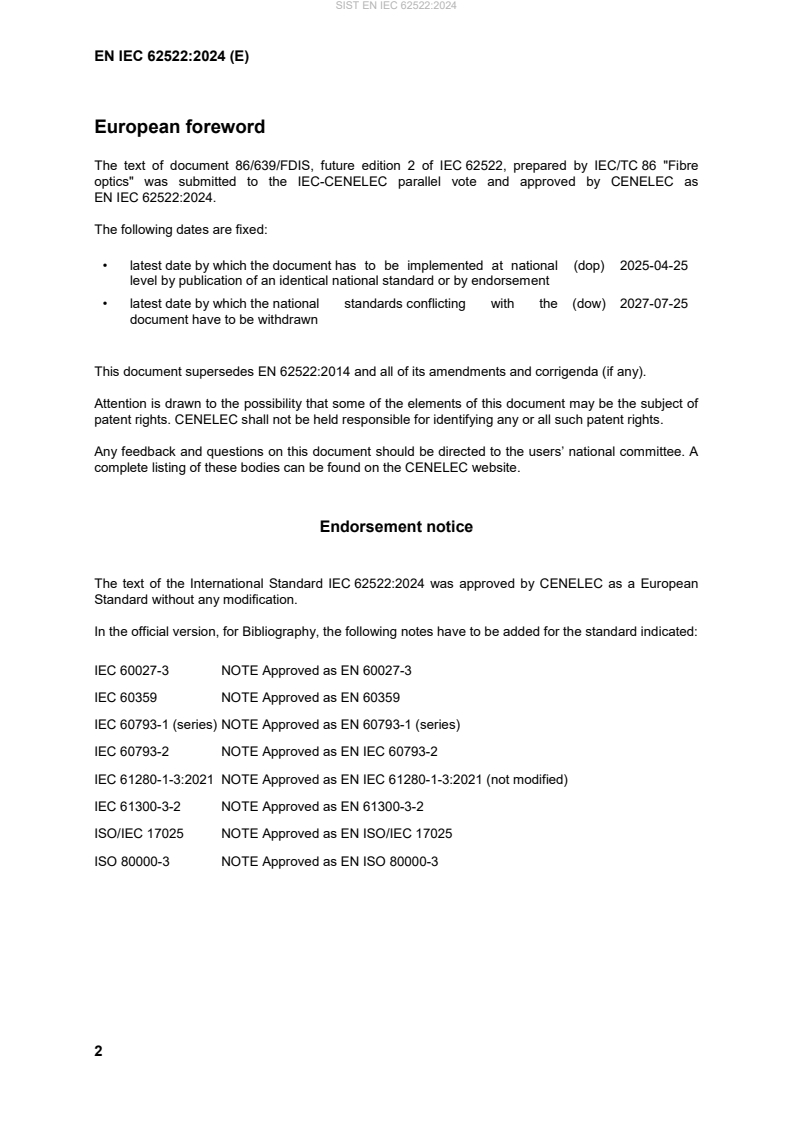
SLOVENSKI STANDARD
01-september-2024
Umerjanje nastavljivih laserskih virov (IEC 62522:2024)
Calibration of tuneable laser sources (IEC 62522:2024)
Kalibrierung von abstimmbaren Laserquellen (IEC 62522:2024)
Étalonnage des sources laser accordables (IEC 62522:2024)
Ta slovenski standard je istoveten z: EN IEC 62522:2024
ICS:
31.260 Optoelektronika, laserska Optoelectronics. Laser
oprema equipment
33.180.01 Sistemi z optičnimi vlakni na Fibre optic systems in
splošno general
2003-01.Slovenski inštitut za standardizacijo. Razmnoževanje celote ali delov tega standarda ni dovoljeno.
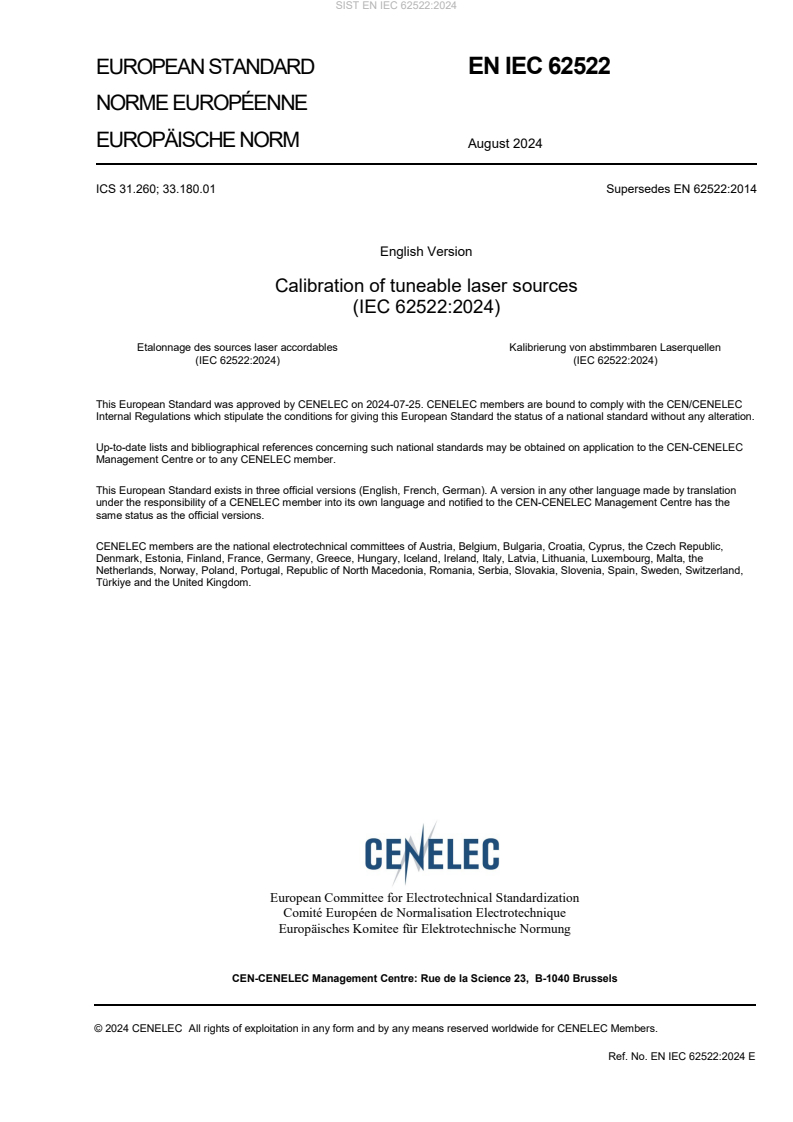
EUROPEAN STANDARD EN IEC 62522
NORME EUROPÉENNE
EUROPÄISCHE NORM August 2024
ICS 31.260; 33.180.01 Supersedes EN 62522:2014
English Version
Calibration of tuneable laser sources
(IEC 62522:2024)
Etalonnage des sources laser accordables Kalibrierung von abstimmbaren Laserquellen
(IEC 62522:2024) (IEC 62522:2024)
This European Standard was approved by CENELEC on 2024-07-25. CENELEC members are bound to comply with the CEN/CENELEC
Internal Regulations which stipulate the conditions for giving this European Standard the status of a national standard without any alteration.
Up-to-date lists and bibliographical references concerning such national standards may be obtained on application to the CEN-CENELEC
Management Centre or to any CENELEC member.
This European Standard exists in three official versions (English, French, German). A version in any other language made by translation
under the responsibility of a CENELEC member into its own language and notified to the CEN-CENELEC Management Centre has the
same status as the official versions.
CENELEC members are the national electrotechnical committees of Austria, Belgium, Bulgaria, Croatia, Cyprus, the Czech Republic,
Denmark, Estonia, Finland, France, Germany, Greece, Hungary, Iceland, Ireland, Italy, Latvia, Lithuania, Luxembourg, Malta, the
Netherlands, Norway, Poland, Portugal, Republic of North Macedonia, Romania, Serbia, Slovakia, Slovenia, Spain, Sweden, Switzerland,
Türkiye and the United Kingdom.
European Committee for Electrotechnical Standardization
Comité Européen de Normalisation Electrotechnique
Europäisches Komitee für Elektrotechnische Normung
CEN-CENELEC Management Centre: Rue de la Science 23, B-1040 Brussels
© 2024 CENELEC All rights of exploitation in any form and by any means reserved worldwide for CENELEC Members.
Ref. No. EN IEC 62522:2024 E
European foreword
The text of document 86/639/FDIS, future edition 2 of IEC 62522, prepared by IEC/TC 86 "Fibre
optics" was submitted to the IEC-CENELEC parallel vote and approved by CENELEC as
The following dates are fixed:
• latest date by which the document has to be implemented at national (dop) 2025-04-25
level by publication of an identical national standard or by endorsement
• latest date by which the national standards conflicting with the (dow) 2027-07-25
document have to be withdrawn
This document supersedes EN 62522:2014 and all of its amendments and corrigenda (if any).
Attention is drawn to the possibility that some of the elements of this document may be the subject of
patent rights. CENELEC shall not be held responsible for identifying any or all such patent rights.
Any feedback and questions on this document should be directed to the users’ national committee. A
complete listing of these bodies can be found on the CENELEC website.
Endorsement notice
The text of the International Standard IEC 62522:2024 was approved by CENELEC as a European
Standard without any modification.
In the official version, for Bibliography, the following notes have to be added for the standard indicated:
IEC 60027-3 NOTE Approved as EN 60027-3
IEC 60359 NOTE Approved as EN 60359
IEC 60793-1 (series) NOTE Approved as EN 60793-1 (series)
IEC 60793-2 NOTE Approved as EN IEC 60793-2
IEC 61280-1-3:2021 NOTE Approved as EN IEC 61280-1-3:2021 (not modified)
IEC 61300-3-2 NOTE Approved as EN 61300-3-2
ISO/IEC 17025 NOTE Approved as EN ISO/IEC 17025
ISO 80000-3 NOTE Approved as EN ISO 80000-3
Annex ZA
(normative)
Normative references to international publications
with their corresponding European publications
The following documents are referred to in the text in such a way that some or all of their content
constitutes requirements of this document. For dated references, only the edition cited applies. For
undated references, the latest edition of the referenced document (including any amendments)
applies.
NOTE 1 Where an International Publication has been modified by common modifications, indicated by (mod), the
relevant EN/HD applies.
NOTE 2 Up-to-date information on the latest versions of the European Standards listed in this annex is available
here: www.cencenelec.eu.
Publication Year Title EN/HD Year
IEC 60793-2-50 - Optical fibres - Part 2-50: Product EN IEC 60793-2-50 -
specifications - Sectional specification for
class B single-mode fibres
IEC 60825-1 - Safety of laser products - Part 1: EN 60825-1 -
Equipment classification and requirements
IEC 60825-2 - Safety of laser products - Part 2: Safety of - -
optical fibre communication systems
(OFCSs)
IEC 61315 - Calibration of fibre-optic power meters EN IEC 61315 -
IEC 62129-2 - Calibration of wavelength/optical frequency EN 62129-2 -
measurement instruments - Part 2:
Michelson interferometer single
wavelength meters
ISO/IEC Guide 98-3 2008 Uncertainty of measurement - Part 3: - -
Guide to the expression of uncertainty in
measurement (GUM:1995)
IEC 62522 ®
Edition 2.0 2024-06
INTERNATIONAL
STANDARD
NORME
INTERNATIONALE
Calibration of tuneable laser sources
Étalonnage des sources laser accordables
INTERNATIONAL
ELECTROTECHNICAL
COMMISSION
COMMISSION
ELECTROTECHNIQUE
INTERNATIONALE
ICS 31.260, 33.180.01 ISBN 978-2-8322-9034-7
– 2 – IEC 62522:2024 © IEC 2024
CONTENTS
FOREWORD . 4
INTRODUCTION . 6
1 Scope . 7
2 Normative references . 7
3 Terms, definitions, and abbreviated terms . 7
3.1 Terms and definitions . 7
3.2 Abbreviated terms . 10
4 Preparation for calibration . 10
4.1 Organization . 10
4.2 Traceability . 10
4.3 Preparation . 10
4.4 Reference calibration conditions . 11
5 Wavelength calibration . 11
5.1 Overview. 11
5.2 Wavelength calibration at reference conditions . 12
5.2.1 Set-up . 12
5.2.2 Calibration equipment . 12
5.2.3 Procedure for wavelength calibration . 12
5.2.4 Dependence on conditions . 13
5.2.5 Uncertainty at reference conditions . 15
5.3 Wavelength calibration at operating conditions . 16
5.3.1 General . 16
5.3.2 Optical power dependence . 16
5.3.3 Uncertainty at operating conditions . 17
6 Optical power calibration . 18
6.1 Overview. 18
6.2 Optical power calibration at reference conditions . 18
6.2.1 Set-up . 18
6.2.2 Calibration equipment . 19
6.2.3 Procedure for power calibration at reference conditions . 19
6.2.4 Dependence on conditions . 20
6.2.5 Uncertainty at reference conditions . 23
6.3 Optical power calibration at operating conditions . 23
6.3.1 General . 23
6.3.2 Wavelength dependence . 24
6.3.3 Uncertainty at operating conditions . 25
7 Documentation . 25
7.1 Calibration data and uncertainty . 25
7.2 Calibration conditions . 26
Annex A (normative) Mathematical basis for measurement uncertainty calculations . 27
A.1 General . 27
A.2 Type A evaluation of uncertainty . 27
A.3 Type B evaluation of uncertainty . 28
A.4 Determining the combined standard uncertainty . 29
A.5 Reporting . 29
Annex B (informative) Other testing . 30
IEC 62522:2024 © IEC 2024 – 3 –
B.1 General . 30
B.2 Wavelength tuning resolution . 30
B.2.1 Set-up . 30
B.2.2 Testing equipment . 30
B.2.3 Testing procedure for determining wavelength resolution . 30
B.3 Optical power tuning resolution . 31
B.3.1 Set-up . 31
B.3.2 Testing equipment . 31
B.3.3 Testing procedure for optical power resolution . 31
B.4 Signal-to-source spontaneous emission ratio . 32
B.4.1 General . 32
B.4.2 Set-up . 32
B.4.3 Testing equipment . 32
B.4.4 Testing procedure for determining signal-to-source spontaneous
emission ratio . 32
B.5 Side-mode suppression ratio . 33
B.5.1 General . 33
B.5.2 Set-up . 33
B.5.3 Testing equipment . 34
B.5.4 Testing procedure for determining the side-mode suppression ratio . 34
Annex C (informative) Linear to dB scale conversion of uncertainties . 37
C.1 Definition of decibel . 37
C.2 Conversion of relative uncertainties . 37
Bibliography . 39
Figure 1 – Measurement set-up for wavelength calibration . 12
Figure 2 – Measurement set-up for temperature dependence . 13
Figure 3 – Measurement set-up for wavelength stability . 14
Figure 4 – Measurement set-up for optical power dependence . 16
Figure 5 – Measurement set-up for intrinsic optical power calibration . 18
Figure 6 – Measurement set-up for temperature dependence . 20
Figure 7 – Measurement set-up for optical power stability . 21
Figure 8 – Measurement set-up for connection repeatability/reproducibility . 22
Figure 9 – Measurement set-up for wavelength dependence . 24
Figure B.1 – Measurement set-up for wavelength resolution . 30
Figure B.2 – Measurement set-up for optical power resolution setting test . 31
Figure B.3 – Measurement set-up for signal to total source spontaneous emission ratio . 32
Figure B.4 – Measurement of the signal to spontaneous emission ratio. 33
Figure B.5 – Measurement set-up for the side-mode suppression ratio test . 33
Figure B.6 – Optical spectrum of tuneable laser source . 35
Figure B.7 – Measurement set-up for SMSR . 35
Table 1 – Source of uncertainty for wavelength calibration . 11
Table 2 – Source of uncertainty for optical power calibration . 18
– 4 – IEC 62522:2024 © IEC 2024
INTERNATIONAL ELECTROTECHNICAL COMMISSION
____________
CALIBRATION OF TUNEABLE LASER SOURCES
FOREWORD
1) The International Electrotechnical Commission (IEC) is a worldwide organization for standardization comprising
all national electrotechnical committees (IEC National Committees). The object of IEC is to promote international
co-operation on all questions concerning standardization in the electrical and electronic fields. To this end and
in addition to other activities, IEC publishes International Standards, Technical Specifications, Technical Reports,
Publicly Available Specifications (PAS) and Guides (hereafter referred to as "IEC Publication(s)"). Their
preparation is entrusted to technical committees; any IEC National Committee interested in the subject dealt with
may participate in this preparatory work. International, governmental and non-governmental organizations liaising
with the IEC also participate in this preparation. IEC collaborates closely with the International Organization for
Standardization (ISO) in accordance with conditions determined by agreement between the two organizations.
2) The formal decisions or agreements of IEC on technical matters express, as nearly as possible, an international
consensus of opinion on the relevant subjects since each technical committee has representation from all
interested IEC National Committees.
3) IEC Publications have the form of recommendations for international use and are accepted by IEC National
Committees in that sense. While all reasonable efforts are made to ensure that the technical content of IEC
Publications is accurate, IEC cannot be held responsible for the way in which they are used or for any
misinterpretation by any end user.
4) In order to promote international uniformity, IEC National Committees undertake to apply IEC Publications
transparently to the maximum extent possible in their national and regional publications. Any divergence between
any IEC Publication and the corresponding national or regional publication shall be clearly indicated in the latter.
5) IEC itself does not provide any attestation of conformity. Independent certification bodies provide conformity
assessment services and, in some areas, access to IEC marks of conformity. IEC is not responsible for any
services carried out by independent certification bodies.
6) All users should ensure that they have the latest edition of this publication.
7) No liability shall attach to IEC or its directors, employees, servants or agents including individual experts and
members of its technical committees and IEC National Committees for any personal injury, property damage or
other damage of any nature whatsoever, whether direct or indirect, or for costs (including legal fees) and
expenses arising out of the publication, use of, or reliance upon, this IEC Publication or any other IEC
Publications.
8) Attention is drawn to the Normative references cited in this publication. Use of the referenced publications is
indispensable for the correct application of this publication.
9) IEC draws attention to the possibility that the implementation of this document may involve the use of (a)
patent(s). IEC takes no position concerning the evidence, validity or applicability of any claimed patent rights in
respect thereof. As of the date of publication of this document, IEC had not received notice of (a) patent(s), which
may be required to implement this document. However, implementers are cautioned that this may not represent
the latest information, which may be obtained from the patent database available at https://patents.iec.ch. IEC
shall not be held responsible for identifying any or all such patent rights.
IEC 62522 has been prepared by IEC technical committee 86: Fibre optics. It is an International
Standard.
This second edition cancels and replaces the first edition published in 2014. This edition
constitutes a technical revision.
This edition includes the following significant technical changes with respect to the previous
edition:
a) addition of references to IEC 61315;
b) addition of Table 1 and Table 2 on uncertainties;
c) clarification of the reference power meter settings in 6.2.3 and 6.3.2.3.
IEC 62522:2024 © IEC 2024 – 5 –
The text of this International Standard is based on the following documents:
Draft Report on voting
86/639/FDIS 86/643/RVD
Full information on the voting for its approval can be found in the report on voting indicated in
the above table.
The language used for the development of this International Standard is English.
This document was drafted in accordance with ISO/IEC Directives, Part 2, and developed in
accordance with ISO/IEC Directives, Part 1 and ISO/IEC Directives, IEC Supplement, available
at www.iec.ch/members_experts/refdocs. The main document types developed by IEC are
described in greater detail at www.iec.ch/publications.
The committee has decided that the contents of this document will remain unchanged until the
stability date indicated on the IEC website under webstore.iec.ch in the data related to the
specific document. At this date, the document will be
• reconfirmed,
• withdrawn, or
• revised.
– 6 – IEC 62522:2024 © IEC 2024
INTRODUCTION
Wavelength-division multiplexing (WDM) transmission systems have been deployed in optical
trunk lines. ITU-T Recommendations in the G.694 series describe the frequency and wavelength
grids for WDM applications. For example, the frequency grid of ITU-T Recommendation G.694.1
supports a variety of channel spacing ranging from 12,5 GHz to 100 GHz and wider. WDM
devices, such as arrayed waveguide grating (AWG), thin film filter or grating based multiplexers
(MUX), and demultiplexers (DMUX) with narrow channel spacing are incorporated in the WDM
transmission systems. When measuring the characteristics of such devices, wavelength
tuneable laser sources are commonly used and are required to have well-calibrated
performances; wavelength uncertainty, wavelength tuning repeatability, wavelength stability,
and output optical power stability are important parameters.
The tuneable laser source (TLS) is generally equipped with the following features:
a) the output wavelength is continuously tuneable in a wavelength range starting at 1 260 nm
or higher and ending at less than 1 675 nm (the output should excite only the fundamental
LP01 fibre mode);
b) an output port for optical fibre connectors.
The envelope of the spectrum is a single longitudinal mode with a full-width at half-maximum
(FWHM) of at most 0,1 nm. Any adjacent modes are at least 20 dB lower than the main spectral
mode (for example, a distributed feedback laser diode (DFB-LD), external cavity laser, etc.).
IEC 62522:2024 © IEC 2024 – 7 –
CALIBRATION OF TUNEABLE LASER SOURCES
1 Scope
This document provides a stable and reproducible procedure to calibrate the wavelength and
power output of a tuneable laser against reference instrumentation such as optical power
meters and optical wavelength meters (including optical frequency meters) that have been
previously traceably calibrated.
2 Normative references
The following documents are referred to in the text in such a way that some or all of their content
constitutes requirements of this document. For dated references, only the edition cited applies.
For undated references, the latest edition of the referenced document (including any
amendments) applies.
IEC 60793-2-50, Optical fibres – Part 2-50: Product specifications – Sectional specification for
class B single-mode fibres
IEC 60825-1, Safety of laser products – Part 1: Equipment classification and requirements
IEC 60825-2, Safety of laser products – Part 2: Safety of optical fibre communication systems
(OFCSs)
IEC 61315, Calibration of fibre-optic power meters
IEC 62129-2, Calibration of wavelength/optical frequency measurement instruments – Part 2:
Michelson interferometer single wavelength meters
ISO/IEC Guide 98-3:2008, Uncertainty of measurement – Part 3: Guide to the expression of
uncertainty in measurement (GUM:1995)
3 Terms, definitions, and abbreviated terms
3.1 Terms and definitions
For the purposes of this document, the following terms and definitions apply.
ISO and IEC maintain terminology databases for use in standardization at the following
addresses:
• IEC Electropedia: available at https://www.electropedia.org/
• ISO Online browsing platform: available at https://www.iso.org/obp
3.1.1
accredited calibration laboratory
calibration laboratory authorized by an appropriate national organization to issue calibration
certificates that demonstrates traceability to national standards
– 8 – IEC 62522:2024 © IEC 2024
3.1.2
adjustment
set of operations carried out on an instrument in order that it provides given indications
corresponding to given values of the measurand
Note 1 to entry: For more information, see ISO/IEC Guide 99:2007, 3.11.
[SOURCE: IEC 60050-311:2001, 311-03-16, modified – Domain deleted, words "measuring
instrument" deleted in the definition, and omission of the Note to entry therein.]
3.1.3
calibration
set of operations that establish, under specified conditions, the relationship between the values
of quantities indicated by a measuring instrument and the corresponding values realized by
standards
Note 1 to entry: The results of a calibration permit either the assignment of measurand values to the indications or
the determination of corrections with respect to the indications.
Note 2 to entry: A calibration can also determine other metrological properties such as the effects of influence
quantities.
Note 3 to entry: The result of a calibration can be recorded in a document, called a calibration certificate or a
calibration report.
Note 4 to entry: See also ISO/IEC Guide 99:2007, 2.39.
3.1.4
calibration conditions
conditions of measurement in which the calibration is performed
3.1.5
calibration at reference conditions
calibration which includes the evaluation of the uncertainty at reference conditions of the light
source under calibration
3.1.6
calibration at operating conditions
calibration which includes the evaluation of the uncertainty at operating conditions of the light
source under calibration
3.1.7
level of confidence
estimated probability that the true value of a measured parameter lies in the given range
3.1.8
coverage factor
k
factor used to calculate the expanded uncertainty U from the standard uncertainty u
IEC 62522:2024 © IEC 2024 – 9 –
3.1.9
optical power deviation
D
P
difference between the set power of the light source under calibration, P , and the
TLS
corresponding reference power, P , measured by the reference power meter
meas
P − P
TLS meas
D =
P
P
meas
Note 1 to entry: Power P is expressed in linear units, for example W.
Note 2 to entry: This deviation is relative, it has no unit (it can be expressed in %).
3.1.10
operating conditions
appropriate set of specified ranges of values with influence quantities usually wider than the
reference conditions for which the uncertainties of a measuring instrument are specified
Note 1 to entry: Operating conditions and the uncertainty at operating conditions are usually specified by the
manufacturer for the convenience of the user.
3.1.11
reference conditions
conditions used for testing the performance of a measuring instrument or for the
intercomparison of the measurement results
Note 1 to entry: Reference conditions generally include reference values or reference ranges for the quantities
influencing and affecting the measuring instrument.
3.1.12
side-mode suppression ratio
SMSR
peak power ratio between the main mode spectrum and the largest side mode spectrum in a
single-mode laser diode such as a DFB-LD
Note 1 to entry: Side-mode suppression ratio is usually expressed in dB.
3.1.13
wavelength
wavelength (in a vacuum) of a light source
3.1.14
wavelength deviation
D
λ
difference between the target wavelength, set on the light source under calibration, λ , and
TLS
the measured wavelength, λ , in nm or µm
meas
D λλ−
λ TLS meas
=
– 10 – IEC 62522:2024 © IEC 2024
3.2 Abbreviated terms
APC angled physical contact
AWG arrayed waveguide grating
DFB-LD distributed feedback laser diode
DMUX demultiplexers
FWHM full-width at half-maximum
MUX multiplexers
O/E optical-electrical
OSA optical spectrum analyser
RIN relative intensity noise
SMSR side-mode suppression ratio
TLS tuneable laser source
WDM wavelength-division multiplexing
4 Preparation for calibration
4.1 Organization
The calibration laboratory should ensure that suitable requirements for calibration are followed.
NOTE Guidance about good practices for calibration can be found in ISO/IEC 17025.
There should be a documented measurement procedure for each type of calibration performed,
giving step-by-step operating instructions and equipment to be used.
4.2 Traceability
The calibration laboratory should ensure that suitable requirements are followed.
NOTE Guidance about good practices for calibration can be found in ISO/IEC 17025.
All standards used in the calibration process shall be calibrated according to a documented
program with traceability to national standards laboratories or to accredited calibration
laboratories.
It is advisable to maintain more than one standard on each hierarchical level, so that the
performance of the standard can be verified by comparisons on the same level. Make sure that
any other calibration equipment which have a significant influence on the calibration results are
calibrated.
4.3 Preparation
The environmental conditions shall be commensurate with the level of uncertainty that is
required for calibration:
a) calibrations shall be carried out in a clean environment;
b) temperature monitoring and control is required;
c) all laser sources shall be safely operated (according to IEC 60825-1 and IEC 60825-2);
d) the output of the TLS should be examined with an optical spectrum analyser (OSA) having
sufficient resolution to resolve the longitudinal mode structure to check for single mode
operation.
IEC 62522:2024 © IEC 2024 – 11 –
The recommended temperature is 23 °C, for example, (23 ± 2) °C. Give the calibration
equipment enough time prior to testing (2 h is recommended) to reach equilibrium within its
environment. Allow the TLS a warm-up period in accordance with the manufacturer's
instructions.
4.4 Reference calibration conditions
The reference calibration conditions usually include the following parameters and, if necessary,
their tolerance bands: date, temperature, relative humidity, atmospheric pressure, displayed
optical power, displayed wavelength, fibre, connector-adapter combination, (spectral)
bandwidth and resolution bandwidth (spectral resolution) set. Unless otherwise specified, use
a single-mode optical fibre category B1.1 or B1.3 pigtail as specified in IEC 60793-2-50, having
a length of at least 2 m. It is desirable to perform all the calibration in a situation where back-
reflections are negligible. Thus, angled connectors and isolators should be used wherever the
situation permits.
Operate the TLS in accordance with the manufacturer's specifications and operating
procedures. Where practical, select a range of calibration conditions and parameters that
emulate the actual field operating conditions of the TLS under calibration. Choose these
parameters to optimize the tuneable laser source's accuracy, as specified by the manufacturer's
operating procedures.
Document the conditions as specified in Clause 7.
NOTE The calibration results only apply to the set of calibration conditions used in the calibration process.
5 Wavelength calibration
5.1 Overview
The factors making up the uncertainty in the wavelength of the light source under calibration
consist of:
a) the intrinsic uncertainty of the light source under calibration as found in the calibration at
reference conditions, including temperature and time dependences for these tight
conditions, and;
b) the uncertainties due to dependences on optical power, temperature and time as found in
the calibrations at broader operating conditions.
The list of the source of uncertainty is summarized in Table 1.
Table 1 – Source of uncertainty for wavelength calibration
Source of uncertainty Type of origin Symbol
Repeatability Measurement
s
λ
j
Temperature Environment
u
λ ,ΔΘ
j
Stability Light source under calibration
u
λt,Δ
j
Wavelength resolution Reference wavelength meter
u
λ ,res
j
Wavelength meter calibration Reference wavelength meter
u
WM
λ
j
Optical power Light source under calibration
u
λP,
j
– 12 – IEC 62522:2024 © IEC 2024
The wavelength calibration at reference conditions for discrete wavelengths, as described in
5.2, is mandatory. The calibration at operating conditions, described in 5.3, is optional.
5.2 Wavelength calibration at reference conditions
5.2.1 Set-up
Figure 1 shows a system for wavelength calibration. The calibration is performed under the
given reference conditions.
Figure 1 – Measurement set-up for wavelength calibration
5.2.2 Calibration equipment
A wavelength meter shall be used for the calibration. The wavelength meter shall be calibrated
according to IEC 62129-2.
5.2.3 Procedure for wavelength calibration
The calibration procedure is as follows:
a) Regarding the calibration system shown in Figure 1, the set wavelength of the light source
is given by λ and the measured values are given by λ . The uncertainty of the
TLS j meas i, j
wavelength measurement takes into account the tuning repeatability and hysteresis of the
TLS. Hysteresis is defined as the deviation resulting from tuning the desired wavelength
from both the shorter and the longer wavelengths.
b) It is recommended to repeat the wavelength measurement ten (m) times. Ensure that the
TLS is tuned to λ prior to each measurement. The target wavelength (j) should be
TLS j
approached in such a way that tuning occurs from both longer and shorter wavelengths.
λ :
c) Calculate the average measured wavelength
meas j
m
λλ=
(1)
meas, j ∑ measi, j
m
i=1
where
m is the number of measurements performed.
Each λ is suggested to be an averaged value from the wavelength meter.
meas i, j
d) Calculate the wavelength deviation D :
λ
j
D λλ−
(2)
λjTLS measj
j
where λ is the tuned wavelength of the TLS.
TLS j
=
IEC 62522:2024 © IEC 2024 – 13 –
e) Calculate the standard deviation for λ from the (m) wavelength measurement results
j
:
λ
meas i, j
m 2
(3)
s λλ−
( )
λ ∑ measi,j measj
j
m−1
i= 1
f) Calculate the wavelength tuning repeatability S :
rep,λ
j
Ss2×
rep,λλ (4)
jj
NOTE A default level of confidence of 95 % is used in Formula (4).
This calibration procedure shall be performed for each calibration wavelength. A minimum of
10 discrete wavelengths or every 10 nm, including the first, the central and the last wavelength
of the range, shall be measured.
5.2.4 Dependence on conditions
5.2.4.1 Temperature dependence (optional if known)
5.2.4.1.1 Set-up
Figure 2 shows a calibration system for temperature dependence. This calibration is performed
under the reference calibration conditions with the exception of temperature.
Figure 2 – Measurement set-up for temperature dependence
5.2.4.1.2 Calibration equipment
The calibration equipment is as follows:
a) A wavelength meter capable of detecting wavelength deviation of the TLS due to
temperature.
b) Temperature-controlled chamber: make sure that the measurement results are immune to
the inner temperature distribution.
5.2.4.1.3 Calibration procedure for determining temperature dependence
The calibration procedure is as follows:
a) Regarding the calibration system of Figure 2, measure the nominal wavelength (j) of the
TLS at optical power P at reference conditions: λ . The wavelength used should
TLSj j,ref
possess the maximum response to temperature variations. Otherwise, characterization of
several output wavelengths should be performed.
=
=
– 14 – IEC 62522:2024 © IEC 2024
b) Measure the wavelength of the TLS at temperature (i): λ Wavelength readings
j,Θ
i
corresponding to each temperature setting should be averaged to determine λ .
j,Θ
i
c) Calculate the wavelength deviation:
D λλ−
λ jj,Θ ,ref
(5)
j,Θ i
i
d) Repeat steps b) and c) with (m) different temperature settings Θ ensuring that the
i
instrument is allowed the necessary time to eliminate sufficiently any thermal gradients.
i=m i=m
e) Calculate the maximum max D and minimum min D wavelength
( λ ) ( λ )
j,Θ j,Θ
i i
i=1 i=1
deviations.
u
f) The standard uncertainty for wavelength temperature dependence at the calibration
λ
j,ΔΘ
wavelength (j) using a rectangular distribution model is:
im im
u max DD− min
(6)
λ ( λλ) ( )
j,ΔΘ jj,,Θ Θ
ii
ii11
where
ΔΘ
is the temperature variation.
It is recommended that a wavelength acquisition be performed with the optical wavelength
meter for the duration of this calibration.
5.2.4.2 Wavelength stability
5.2.4.2.1 Set-up
Figure 3 shows a calibration system for wavelength stability. This calibration is performed under
the reference calibration conditions with the exception of time.
Figure 3 – Measurement set-up for wavelength stability
5.2.4.2.2 Calibration equipment
It is recommended to use a wavelength meter capable of detecting wavelength fluctuations of
the TLS.
==
=
==
=
IEC 62522:2024 © IEC 2024 – 15 –
5.2.4.2.3 Calibration procedure for wavelength stability
The calibration procedure is as follows:
a) A time period (∆t), for example 10 min, shall be chosen that is long enough to permit at least
10 wavelength measurements with the reference wavelength meter (in the case of the
example, a stability over 10 min will be measured).
b) A continuous wavelength acquisition should be performed with wavelength data and time
stamp.
c) Ensure to correlate (m) measurements per time period where (m > 10) and conforms exactly
to the desired time period (∆t).
d) Calculate the standard deviation of the (m) wavelength measurements corresponding to time
period (∆t)
mm 2
(7)
u ()λλ−
λ ,Δt ∑∑j,,t jt
j ii
mm−1
ii11
e) A minimum of 1 time period is required to evaluate the wavelength stability of the TLS
source. In this case, the wavelength stability uncertainty becomes:
Su2×
stab,λt,ΔΔλt,
(8)
jj
NOTE A default level of confidence of 95 % is used in Formula (8).
The wavelength of the light source should be measured more than ten times (m times)
consecutively; at least a few measurements per minute is recommended. The time interval
between the repeated measurements should be longer than the response time of the light
source. It is preferred to calculate several time periods from the acquisition data using a sliding
window and report the maximum value.
5.2.5 Uncertainty at reference conditions
The uncertainty for the calibration wavelength (j) at reference conditions is given by:
2
s
λ
j
22 2 2
(9)
u = + u + uu+ + u
λ λ ,ΔΘ λt,Δ λ ,res WM
j,ref j jj λ
m j
where
u and u are evaluated for the reference conditions as defined in 5.2.4;
λ ,ΔΘ λt,Δ
j j
u is the uncertainty of wavelength resolution defined by ud= λ / 2 3
λ ,res λ ,res j
j j
( dλ is the wavelength resolution of the wavelength meter);
j
u is the uncertainty of the wavelength meter at wavelength (j) as described in
WM
λ
j
its certification.
=
==
=
– 16 – IEC 62522:2024 © IEC 2024
The expanded uncertainty for the calibration wavelength (j) at reference conditions, U , with
λ
j,ref
a coverage factor k is expressed as follows:
U = ku
λλ
(10)
j,ref j,ref
where
k corresponds to an appropriate level of confidence as described in Clause A.5.
Refer to Annex A and Annex C for information on uncertainties.
When adjustments are made to the instrument based on the calibration results, it is advisable
to repeat the calibrations after these adjustments to verify the corrections.
5.3 Wavelength calibration at operating conditions
5.3.1 General
Perform the calibration procedure when the light source is used beyond the reference
conditions.
The individual factors in wavelength uncertainty at operating conditions consist of following:
a) optical power dependence;
b) temperature dependence;
c) wavelength stability.
5.3.2 Optical power dependence
5.3.2.1 General
Figure 4 shows a calibration system for optical power dependence. This calibration should be
performed under the reference calibration conditions with the exception of the optical power. It
shall be performed after the optical power calibration (6.2.3).
Figure 4 – Measurement set-up for optical power dependence
5.3.2.2 Calibration equipment
The wavelength meter shall be calibrated according to IEC 62129-2.
IEC 62522:2024 © IEC 2024 – 17 –
5.3.2.3 Calibration procedures for determining power dependence
The calibration procedures are as follows:
a) The wavelength (j) is measured at m optical powers of the light source, including the
P
TLS ij,
upper and lower limits of the specified power range. The interval between these
neighbouring levels should be smaller than 10 dB.
b) Regarding the calibration system of Figure 4, the set wavelength of the light source is given
by λ , and the instrument reading of the wavelength meter is given by λ .
TLS ij, P
i, j
c) Record the measured wavelength λ for all (m) output power settings P used.
P TLS ij,
i, j
d) Calculate the standard uncertainty of wavelength (j) due to TLS output optical power
according to
mm
2
(11)
u ()λλ−
λ ∑∑PP
j,P i,,j i j
mm−1
ii11
5.3.3 Uncertainty at operating conditions
The uncertainty for the calibration wavelength (j) for any operating conditions is given by
2
22 2 2 2 2
(12)
u = su++ u + u + u + u
λ λ λP, λ ,ΔΘ λ ,Δt λ ,res WM
j,op jj j j j λ
j
where
u , u and u are evaluated for the operating conditions;
λP, λ ,ΔΘ λt,Δ
j j j
u is the uncertainty of wavelength resolution defined by ud= λ / 2 3
λ ,res λj,res
j j
( dλ is wavelength resolution of the wavelength meter);
j
u is the uncertainty of
...
Questions, Comments and Discussion
Ask us and Technical Secretary will try to provide an answer. You can facilitate discussion about the standard in here.
Loading comments...