


SIST EN 13204:2025
(Main)Powered rescue tools for fire and rescue service use - Safety and performance requirements
Powered rescue tools for fire and rescue service use - Safety and performance requirements
This document specifies safety and performance requirements for powered rescue tools manufactured after the date of publication.
This document is applicable to powered rescue tools which are intended for use by the firefighting and rescue services, principally for cutting, crushing, spreading, squeezing, pushing or pulling the structural parts of road vehicles, ships, trains, aircraft and building structures involved in accidents. This document is not applicable to hydraulic power packs covered by 2000/14/EC.
Powered rescue tools consist of tool(s) and the necessary system components (e.g. energy source, drive system and prime mover) and intended accessories, as defined in Clause 3.
This document deals with all significant hazards, hazardous situations or hazardous events relevant to the machinery, when it is used as intended and under conditions or misuse which are reasonably foreseeable by the manufacturer.
NOTE 1 The aim of powered rescue tools is to assist the firefighting and rescue services while extracting the casualties or to create a working space for paramedical services taking the local conditions into account.
This document does not include:
- tools with pneumatic drive systems or pneumatic energy sources;
- tools which are single acting (for example spring /gravity return jacks, powered struts, etc.).
It is not applicable to additional requirements for:
a) operation in severe conditions (e.g. extreme environmental conditions such as temperatures outside the range –20 °C and +55 °C, corrosive environment, tropical environment, contaminating environments, strong magnetic fields, potentially explosive atmospheres, underwater use);
b) the risk directly arising from the means provided for the portability, transportability, mobility and decommissioning of powered rescue tools during periods of their operation;
c) generic tools such as, but not limited to, powered drills, angle grinders, saws, not solely intended for extrication purposes;
d) tools intended to lift and/or hoist, not solely intended for extrication purposes.
NOTE 2 EN 13731:2007 deals with lifting bag systems for fire and rescue services.
NOTE 3 For the EU/EEA other Directives can be applicable to the equipment in the scope, for example the Electro Magnetic Compatibility Directive.
Angetriebene Rettungsgeräte für Feuerwehr- und Rettungsdienste - Sicherheits- und Leistungsanforderungen
Dieses Dokument legt Sicherheits- und Leistungsanforderungen an angetriebene Rettungsgeräte fest, die nach dem Erscheinungsdatum hergestellt werden.
Dieses Dokument ist anwendbar für angetriebene Rettungsgeräte, die für den Einsatz durch Feuerwehren und Rettungsdienste vorgesehen sind, im Wesentlichen für das Schneiden, Brechen, Spreizen, Quetschen, Drücken oder Ziehen von Bauteilen von Fahrzeugen, Schiffen, Schienenfahrzeugen, Flugzeugen und Gebäudeteilen, die in Unfälle verwickelt sind. Dieses Dokument ist auf in 2000/14/EG behandelte hydraulische Pumpenaggregate nicht anwendbar.
Angetriebene Rettungsgeräte bestehen aus Werkzeug(en) und den erforderlichen Systemkomponenten (z. B. Energiequelle, Antriebssystem und Primärantrieb) sowie vorgesehenem Zubehör, wie in Abschnitt 3 festgelegt.
Dieses Dokument behandelt sämtliche signifikanten Gefährdungen, Gefährdungssituationen oder Gefährdungsereignisse, die für die Maschinen relevant sind, wenn sie wie vom Hersteller vorgesehen oder unter vom Hersteller vernünftigerweise vorhersehbaren Missbrauchsbedingungen verwendet werden.
ANMERKUNG 1 Das Ziel von angetriebenen Rettungsgeräten ist die Unterstützung von Feuerwehren und Rettungsdiensten bei der Bergung von Unfallopfern oder das Schaffen eines Arbeitsbereiches für Sanitätsdienste unter Berücksichtigung der örtlichen Gegebenheiten.
Dieses Dokument umfasst nicht:
- Geräte mit pneumatischen Antriebssystemen oder pneumatischen Energiequellen;
- einfach wirkende Geräte (z. B. Heber mit Feder-/Schwerkraftrückzug, kraftbetriebene Streben usw.).
Es ist nicht anwendbar für zusätzliche Anforderungen an:
a) den Betrieb unter schwierigen Bedingungen (z. B. extreme Umgebungsbedingungen wie: Temperaturen außerhalb des Bereichs von −20 °C bis +55 °C, korrosive Umgebung, tropische Umgebung, kontaminierende Umgebungen, starke Magnetfelder, potentiell explosionsfähige Atmosphären, Unterwassereinsatz);
b) das Risiko, das direkt aus den Einrichtungen entsteht, die zum Tragen, Transportieren, für die Mobilität und Außerbetriebnahme von angetriebenen Rettungsgeräten während des Einsatzzeitraumes vorgesehen sind;
c) allgemeine Geräte, darunter kraftbetriebene Bohrer, Winkelschleifer und Sägen, die nicht ausschließlich für Bergungszwecke bestimmt sind;
d) Geräte zum Anheben/Heben, die nicht ausschließlich für Bergungszwecke bestimmt sind.
ANMERKUNG 2 EN 13731:2007 behandelt Hebekissensysteme für Feuerwehren und Rettungsdienste.
ANMERKUNG 3 Für die EU/den EWR können weitere Richtlinien für die im Anwendungsbereich genannten Geräte gelten, wie z. B. die Richtlinie zur elektromagnetischen Verträglichkeit.
Outils de désincarcération à usage des services d'incendie et de secours - Prescriptions de sécurité et de performance
Le présent document spécifie les exigences de sécurité et de performance des outils de sauvetage motorisés fabriqués après sa date de publication.
Le présent document s'applique aux outils de sauvetage motorisés destinés aux services d'incendie et de secours, principalement pour découper, briser, écarter, écraser, pousser ou tirer sur les parties structurelles des véhicules routiers, des bateaux, des trains, des avions et des structures de bâtiments impliquées dans des accidents. Le présent document ne s’applique pas aux groupes hydrauliques couverts par 2000/14/CE.
Les outils de sauvetage motorisés sont constitués d’un ou plusieurs outils et des composants de système nécessaires (par exemple source d'énergie, système d'entraînement et moteur d'entraînement) ainsi que des accessoires prévus, tels que définis à l'Article 3.
Le présent document traite tous les phénomènes dangereux, situations dangereuses ou événements dangereux significatifs qui sont pertinents pour ces machines, lorsqu'elles sont utilisées normalement et dans les conditions de mauvais usage raisonnablement prévisibles par le fabricant.
NOTE 1 L'objectif des outils de sauvetage motorisés est d’assister les services de lutte contre l’incendie et de secours lors de l'extraction des blessés ou à créer un espace de travail pour les équipes paramédicales en tenant compte de la situation rencontrée.
Le présent document ne traite pas :
— des outils avec systèmes d'entraînement pneumatiques ou sources d'énergie pneumatiques ;
— des outils à simple effet (par exemple vérin à rappel par ressort/gravité, vérins de commande, etc.).
Il ne s'applique pas aux exigences supplémentaires pour :
a) le fonctionnement dans des conditions très difficiles (par exemple, des conditions d'environnement extrêmes telles que des températures en dehors de la plage –20 °C et +55 °C, un environnement corrosif, un milieu tropical, un environnement contaminant, des champs magnétiques intenses ou des atmosphères potentiellement explosibles, un environnement subaquatique) ;
b) les risques découlant directement des moyens utilisés pour la portabilité, la transportabilité, la mobilité et la mise hors service des outils de désincarcération au cours de leur utilisation ;
c) les outils divers tels que, sans toutefois s'y limiter, les perceuses électriques, les ponceuses d'angle, les scies, qui ne sont pas exclusivement destinés à des applications de désincarcération ;
d) les outils conçus pour le levage et/ou le treuillage, qui ne sont pas exclusivement destinés à des applications de désincarcération.
NOTE 2 L'EN 13731:2007 traite des coussins de levage à l'usage des services d'incendie et de secours.
NOTE 3 Pour l'UE/EEE, d'autres directives peuvent s'appliquer aux équipements concernés par le présent domaine d’application, par exemple la Directive Compatibilité Électromagnétique.
Reševalne naprave za gasilske in reševalne enote - Varnostne zahteve za delovanje
Ta dokument določa varnostne zahteve za delovanje reševalnih naprav, izdelanih po datumu njegove objave. Ta dokument se uporablja za reševalne naprave, ki so namenjene za protipožarno obrambo in reševanje, predvsem za prebijanje prek konstrukcijskih delov cestnih vozil, ladij, vlakov, zrakoplovov in zgradb v nesrečah. Ta dokument se ne uporablja za hidravlične agregate, ki so zajeti v Direktivi 2000/14/ES. Reševalne naprave vključujejo orodja ter potrebne sistemske komponente (npr. vir energije, pogonski sistem in glavni pogon) in predvideno dodatno opremo, kot je opredeljeno v točki 3. Ta dokument obravnava vsa večja tveganja, nevarne situacije in dogodke v zvezi s stroji, kadar se uporabljajo v skladu s predvidenim namenom in pod pogoji pričakovane nepravilne uporabe, ki jih določa proizvajalec. OPOMBA 1: Cilj reševalnih naprav je pomagati gasilskim in reševalnim enotam pri reševanju žrtev ali ustvariti delovno okolje za pomožne zdravstvene storitve ob upoštevanju lokalnih pogojev. Ta dokument ne vključuje: – naprav s pnevmatskim pogonskim sistemom ali pnevmatskim virom energije; – naprav z enosmernim delovanjem (npr. vzmetni/gravitacijski povratni mehanizmi, podporniki za stabilizacijo vozila itd.). Ne uporablja se za dodatne zahteve za: a) delovanje v težkih pogojih (npr. ekstremne podnebne razmere, kot so temperature zunaj območja –20 °C in +55 °C, korozivno okolje, tropsko okolje, onesnažujoča okolja, močna magnetna polja, potencialno eksplozivne atmosfere, uporaba pod vodo); b) tveganje, ki izhaja neposredno iz sredstev, zagotovljenih za prenosljivost, prevozljivost, mobilnost in izločitev reševalnih naprav iz uporabe med njihovim delovanjem; c) generična orodja, med drugim električne vrtalnike, kotne brusilnike, žage, ki niso namenjena izključno reševanju; d) orodja za dvigovanje, ki niso namenjena izključno reševanju. OPOMBA 2: Standard EN 13731:2007 obravnava dvižne blazine in sisteme za gasilske in reševalne enote. OPOMBA 3: Za EU/EGP je mogoče uporabiti druge direktive, ki veljajo za področje uporabe opreme, na primer direktivo o elektromagnetni združljivosti.
General Information
- Status
- Published
- Public Enquiry End Date
- 30-Oct-2022
- Publication Date
- 03-Apr-2025
- Technical Committee
- POZ - Požarna varnost
- Current Stage
- 6060 - National Implementation/Publication (Adopted Project)
- Start Date
- 03-Apr-2025
- Due Date
- 08-Jun-2025
- Completion Date
- 04-Apr-2025
Relations
- Effective Date
- 01-May-2025
Overview - What EN 13204:2025 covers
SIST / EN 13204:2025 defines safety and performance requirements for powered rescue tools intended for fire and rescue service use. Applicable to tools manufactured after publication, the standard covers powered cutting, crushing, spreading, squeezing, pushing and pulling of structural parts of road vehicles, ships, trains, aircraft and building structures involved in accidents. It is a Type C machine safety standard that replaces EN 13204:2016 and extends scope to include self‑contained (battery) tools, wedge and crusher types and new classification and testing requirements.
Key technical topics and requirements
- Scope and exclusions: excludes pneumatic-drive tools, single‑acting devices (e.g. spring/gravity return jacks), hydraulic power packs covered by 2000/14/EC and additional severe‑condition operating requirements (e.g. outside –20 °C to +55 °C).
- Safety and performance tests: mandatory runtime, endurance and energy‑source depletion tests to verify minimum cycles and lifetime; verification of opening/closing times and mass ready for use.
- Classification and designation: updated tool classes (e.g. cutter CU1–CU3, spreader SP1–SP4, combi‑tool CT1–CT3, wedge and crusher classes, and powerpack designations) to help procurement and performance comparison.
- System integration level: defines how tools and power sources are considered (fully integrated, semi‑integrated, non‑integrated).
- Noise and acoustics: Annex B (noise test code) and requirements for emission sound pressure and sound power determinations (fully/semi‑integrated PRTs).
- Documentation and marking: requirements for information for use, data sheets (Annex C: cutting performance; Annex E: mass and runtime) and markings to support safe operation and procurement.
- Normative references: cross‑references to standards for batteries (EN 62133), EMC, hoses, materials and machinery safety (EN 62841-1 for electric powered tools).
Practical applications - who uses EN 13204:2025
- Manufacturers and designers of powered rescue tools to ensure compliant product design, testing and performance declarations.
- Procurement officers in fire & rescue services to specify and compare tools using harmonized classifications and data sheets.
- Regulators and market surveillance to assess conformity with machine safety and applicable EU directives (e.g. 2006/42/EC, EMC requirements).
- Maintenance and training organisations to understand lifecycle, runtime/endurance expectations and safe operation information.
Related standards and directives
- EN 62841‑1 (electric tool safety), EN 13731 (lifting bag systems), battery safety (EN 62133 series), EMC standards and Directive 2006/42/EC. These cross‑references support safety, electromagnetic compatibility and component requirements for powered rescue tools.
Keywords: EN 13204:2025, powered rescue tools, fire and rescue service, safety and performance requirements, cutter, spreader, runtime test, endurance, noise emission, tool classification.

Frequently Asked Questions
SIST EN 13204:2025 is a standard published by the Slovenian Institute for Standardization (SIST). Its full title is "Powered rescue tools for fire and rescue service use - Safety and performance requirements". This standard covers: This document specifies safety and performance requirements for powered rescue tools manufactured after the date of publication. This document is applicable to powered rescue tools which are intended for use by the firefighting and rescue services, principally for cutting, crushing, spreading, squeezing, pushing or pulling the structural parts of road vehicles, ships, trains, aircraft and building structures involved in accidents. This document is not applicable to hydraulic power packs covered by 2000/14/EC. Powered rescue tools consist of tool(s) and the necessary system components (e.g. energy source, drive system and prime mover) and intended accessories, as defined in Clause 3. This document deals with all significant hazards, hazardous situations or hazardous events relevant to the machinery, when it is used as intended and under conditions or misuse which are reasonably foreseeable by the manufacturer. NOTE 1 The aim of powered rescue tools is to assist the firefighting and rescue services while extracting the casualties or to create a working space for paramedical services taking the local conditions into account. This document does not include: - tools with pneumatic drive systems or pneumatic energy sources; - tools which are single acting (for example spring /gravity return jacks, powered struts, etc.). It is not applicable to additional requirements for: a) operation in severe conditions (e.g. extreme environmental conditions such as temperatures outside the range –20 °C and +55 °C, corrosive environment, tropical environment, contaminating environments, strong magnetic fields, potentially explosive atmospheres, underwater use); b) the risk directly arising from the means provided for the portability, transportability, mobility and decommissioning of powered rescue tools during periods of their operation; c) generic tools such as, but not limited to, powered drills, angle grinders, saws, not solely intended for extrication purposes; d) tools intended to lift and/or hoist, not solely intended for extrication purposes. NOTE 2 EN 13731:2007 deals with lifting bag systems for fire and rescue services. NOTE 3 For the EU/EEA other Directives can be applicable to the equipment in the scope, for example the Electro Magnetic Compatibility Directive.
This document specifies safety and performance requirements for powered rescue tools manufactured after the date of publication. This document is applicable to powered rescue tools which are intended for use by the firefighting and rescue services, principally for cutting, crushing, spreading, squeezing, pushing or pulling the structural parts of road vehicles, ships, trains, aircraft and building structures involved in accidents. This document is not applicable to hydraulic power packs covered by 2000/14/EC. Powered rescue tools consist of tool(s) and the necessary system components (e.g. energy source, drive system and prime mover) and intended accessories, as defined in Clause 3. This document deals with all significant hazards, hazardous situations or hazardous events relevant to the machinery, when it is used as intended and under conditions or misuse which are reasonably foreseeable by the manufacturer. NOTE 1 The aim of powered rescue tools is to assist the firefighting and rescue services while extracting the casualties or to create a working space for paramedical services taking the local conditions into account. This document does not include: - tools with pneumatic drive systems or pneumatic energy sources; - tools which are single acting (for example spring /gravity return jacks, powered struts, etc.). It is not applicable to additional requirements for: a) operation in severe conditions (e.g. extreme environmental conditions such as temperatures outside the range –20 °C and +55 °C, corrosive environment, tropical environment, contaminating environments, strong magnetic fields, potentially explosive atmospheres, underwater use); b) the risk directly arising from the means provided for the portability, transportability, mobility and decommissioning of powered rescue tools during periods of their operation; c) generic tools such as, but not limited to, powered drills, angle grinders, saws, not solely intended for extrication purposes; d) tools intended to lift and/or hoist, not solely intended for extrication purposes. NOTE 2 EN 13731:2007 deals with lifting bag systems for fire and rescue services. NOTE 3 For the EU/EEA other Directives can be applicable to the equipment in the scope, for example the Electro Magnetic Compatibility Directive.
SIST EN 13204:2025 is classified under the following ICS (International Classification for Standards) categories: 11.160 - First aid; 13.220.10 - Fire-fighting. The ICS classification helps identify the subject area and facilitates finding related standards.
SIST EN 13204:2025 has the following relationships with other standards: It is inter standard links to SIST EN 13204:2016. Understanding these relationships helps ensure you are using the most current and applicable version of the standard.
SIST EN 13204:2025 is associated with the following European legislation: EU Directives/Regulations: 2006/42/EC; Standardization Mandates: M/396. When a standard is cited in the Official Journal of the European Union, products manufactured in conformity with it benefit from a presumption of conformity with the essential requirements of the corresponding EU directive or regulation.
SIST EN 13204:2025 is available in PDF format for immediate download after purchase. The document can be added to your cart and obtained through the secure checkout process. Digital delivery ensures instant access to the complete standard document.
Standards Content (Sample)
SLOVENSKI STANDARD
01-maj-2025
Nadomešča:
SIST EN 13204:2016
Reševalne naprave za gasilske in reševalne enote - Varnostne zahteve za
delovanje
Powered rescue tools for fire and rescue service use - Safety and performance
requirements
Angetriebene Rettungsgeräte für Feuerwehr- und Rettungsdienste - Sicherheits- und
Leistungsanforderungen
Outils de désincarcération à usage des services d'incendie et de secours - Prescriptions
de sécurité et de performance
Ta slovenski standard je istoveten z: EN 13204:2025
ICS:
11.160 Prva pomoč First aid
13.220.10 Gašenje požara Fire-fighting
2003-01.Slovenski inštitut za standardizacijo. Razmnoževanje celote ali delov tega standarda ni dovoljeno.
EN 13204
EUROPEAN STANDARD
NORME EUROPÉENNE
March 2025
EUROPÄISCHE NORM
ICS 13.220.10 Supersedes EN 13204:2016
English Version
Powered rescue tools for fire and rescue service use -
Safety and performance requirements
Outils de sauvetage motorisés à usage des services Angetriebene Rettungsgeräte für Feuerwehr- und
d'incendie et de secours - Exigences de sécurité et de Rettungsdienste - Sicherheits- und
performance Leistungsanforderungen
This European Standard was approved by CEN on 10 February 2025.
CEN members are bound to comply with the CEN/CENELEC Internal Regulations which stipulate the conditions for giving this
European Standard the status of a national standard without any alteration. Up-to-date lists and bibliographical references
concerning such national standards may be obtained on application to the CEN-CENELEC Management Centre or to any CEN
member.
This European Standard exists in three official versions (English, French, German). A version in any other language made by
translation under the responsibility of a CEN member into its own language and notified to the CEN-CENELEC Management
Centre has the same status as the official versions.
CEN members are the national standards bodies of Austria, Belgium, Bulgaria, Croatia, Cyprus, Czech Republic, Denmark, Estonia,
Finland, France, Germany, Greece, Hungary, Iceland, Ireland, Italy, Latvia, Lithuania, Luxembourg, Malta, Netherlands, Norway,
Poland, Portugal, Republic of North Macedonia, Romania, Serbia, Slovakia, Slovenia, Spain, Sweden, Switzerland, Türkiye and
United Kingdom.
EUROPEAN COMMITTEE FOR STANDARDIZATION
COMITÉ EUROPÉEN DE NORMALISATION
EUROPÄISCHES KOMITEE FÜR NORMUNG
CEN-CENELEC Management Centre: Rue de la Science 23, B-1040 Brussels
© 2025 CEN All rights of exploitation in any form and by any means reserved Ref. No. EN 13204:2025 E
worldwide for CEN national Members.
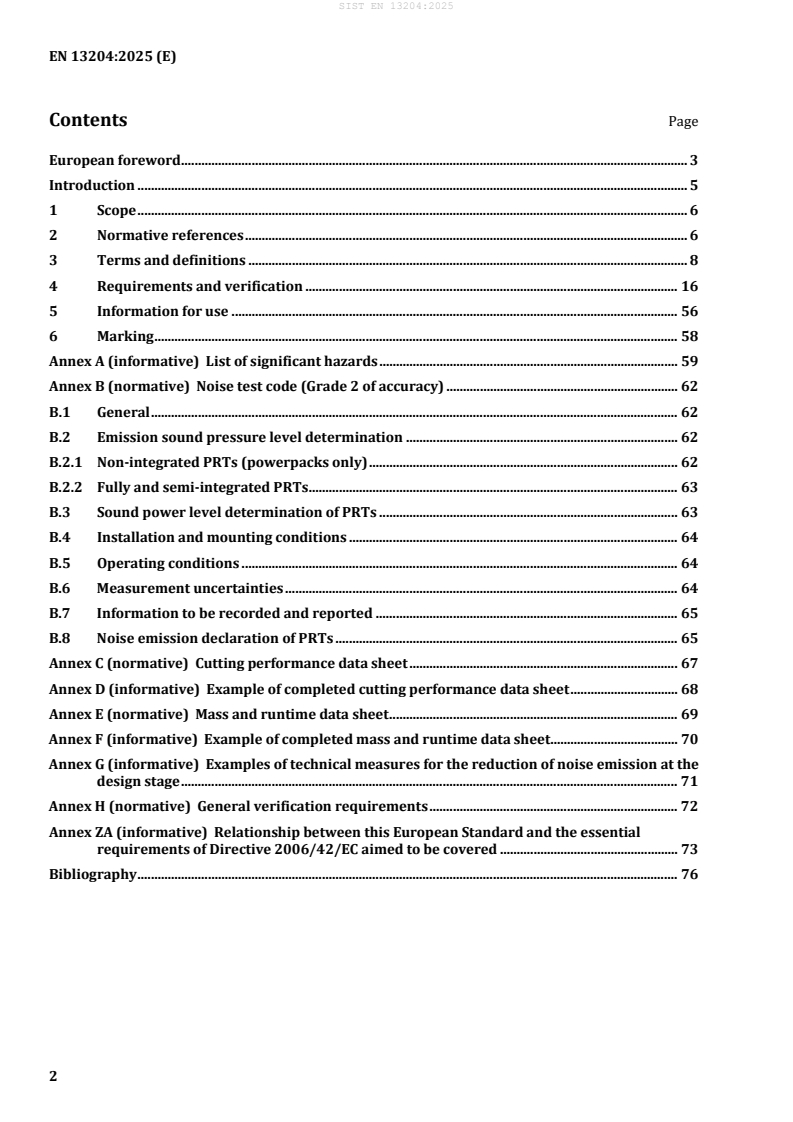
Contents Page
European foreword . 3
Introduction . 5
1 Scope . 6
2 Normative references . 6
3 Terms and definitions . 8
4 Requirements and verification . 16
5 Information for use . 56
6 Marking . 58
Annex A (informative) List of significant hazards . 59
Annex B (normative) Noise test code (Grade 2 of accuracy) . 62
B.1 General . 62
B.2 Emission sound pressure level determination . 62
B.2.1 Non-integrated PRTs (powerpacks only) . 62
B.2.2 Fully and semi-integrated PRTs . 63
B.3 Sound power level determination of PRTs . 63
B.4 Installation and mounting conditions . 64
B.5 Operating conditions . 64
B.6 Measurement uncertainties . 64
B.7 Information to be recorded and reported . 65
B.8 Noise emission declaration of PRTs . 65
Annex C (normative) Cutting performance data sheet . 67
Annex D (informative) Example of completed cutting performance data sheet . 68
Annex E (normative) Mass and runtime data sheet . 69
Annex F (informative) Example of completed mass and runtime data sheet. 70
Annex G (informative) Examples of technical measures for the reduction of noise emission at the
design stage . 71
Annex H (normative) General verification requirements . 72
Annex ZA (informative) Relationship between this European Standard and the essential
requirements of Directive 2006/42/EC aimed to be covered . 73
Bibliography . 76
European foreword
This document (EN 13204:2025) has been prepared by Technical Committee CEN/TC 192 “Fire service
equipment”, the secretariat of which is held by BSI.
This European Standard shall be given the status of a national standard, either by publication of an
identical text or by endorsement, at the latest by September 2025 and conflicting national standards shall
be withdrawn at the latest by September 2025.
Attention is drawn to the possibility that some of the elements of this document may be the subject of
patent rights. CEN shall not be held responsible for identifying any or all such patent rights.
This document supersedes EN 13204:2016.
This document includes the following significant technical changes with respect to EN 13204:2016:
— the Title of the document changed from “Double acting hydraulic rescue tools” to “Powered rescue
tools”. Powered rescue tools are not exclusive to hydraulic remotely powered tools;
— the Scope was extended to include:
— self-contained tools (battery powered, hand powered tools);
— wedge and crusher type tool;
— Clause 3, “Terms and definitions” has been updated;
— extensive changes throughout the standard including:
— numbering of clauses has been updated;
— a requirement for all PRTs utilizing electric power has been added regarding compliance with
the safety requirements of EN 62841-1:2015 (subclause 4.1.10.1);
— the term ‘mass’ was changed to ‘mass ready for use’ (subclause 4.2.1.3) for better comparison
between non-integrated tools (e.g. hosed tools) and fully-integrated tools (e.g. battery tools);
— “PRT runtime test” (subclause 4.2.8) has been added to set minimum required cycles for each
type of PRT;
— “PRT endurance test” (subclause 4.2.9) has been added to set minimum lifetime for each type of
PRT;
— “Energy sources” (subclause 4.2.10) has been added to have the number of cycles (subclause
4.2.8) tested until energy source is empty;
— “System integration level” (subclause 4.2.14) has been added;
— “Designation of the equipment” (subclause 4.2.15) was changed;
— mass is no longer part of tool classification;
— “Cutter classification” (subclause 4.2.15.2): CU1, CU2, CU3 was AC, BC, CC;
— “Spreader classification” (subclause 4.2.15.3): SP1, SP2, SP3, SP4 was AS, BS, CS;
— “Combi-tool classification” (subclause 4.2.15.4): CT1, CT2, CT3 was AK, BK, CK;
— “Wedge classification” (subclause 4.2.15.6) and “Crusher classification” (subclause 4.2.15.7)
have been added;
— VTO to “Powerpack classification” (subclause 4.2.15.8) has been added;
— Emission sound pressure level determination for PRTs (fully- and semi-integrated only)
(subclause B.2.2) has been added;
— Annex E, “Mass and runtime data sheet” has been added, with data from performance
requirements for mass ready for use, runtime of energy sources and opening and closing times.
This document has been prepared under a standardization request addressed to CEN by the European
Commission. The Standing Committee of the EFTA States subsequently approves these requests for its
Member States.
For the relationship with EU Legislation, see informative Annex ZA, which is an integral part of this
document.
Any feedback and questions on this document should be directed to the users’ national standards body.
A complete listing of these bodies can be found on the CEN website.
According to the CEN-CENELEC Internal Regulations, the national standards organizations of the
following countries are bound to implement this European Standard: Austria, Belgium, Bulgaria, Croatia,
Cyprus, Czech Republic, Denmark, Estonia, Finland, France, Germany, Greece, Hungary, Iceland, Ireland,
Italy, Latvia, Lithuania, Luxembourg, Malta, Netherlands, Norway, Poland, Portugal, Republic of North
Macedonia, Romania, Serbia, Slovakia, Slovenia, Spain, Sweden, Switzerland, Türkiye and the United
Kingdom.
Introduction
This document is a type C standard as stated in EN ISO 12100:2010.
This document is of relevance, in particular, for the following stakeholder groups representing the market
players with regard to machinery safety:
— machine manufacturers (small, medium and large enterprises);
— health and safety bodies (regulators, accident prevention organizations, market surveillance, etc.).
Others can be affected by the level of machinery safety achieved with the means of the document by the
above-mentioned stakeholder groups:
— machine users/employers (small, medium and large enterprises);
— machine users/employees (e.g. trade unions, organizations for people with special needs);
— service providers, e.g. for maintenance (small, medium and large enterprises);
— consumers (in the case of machinery intended for use by consumers).
The above-mentioned stakeholder groups have been given the possibility to participate at the drafting
process of this document.
The machinery concerned and the extent to which hazards, hazardous situations or hazardous events are
covered are indicated in the Scope of this document.
When provisions of this type-C standard are different from those which are stated in type-A or type-B
standards, the requirements of this type-C standard take precedence over the requirements of the other
standards for machines that have been designed and built according to the requirements of this type-C
standard.
When compiling this document, it was assumed that:
a) the manufacturer designs and/or uses components without specific requirements in accordance
with the good engineering practice and calculation codes, taking into account all foreseeable failure
modes;
b) only trained and competent persons will use and operate the machinery;
c) the machinery is kept in good repair and working order, by a trained and competent person, so that
the required characteristics remain despite wear;
d) the working place is adequately lit;
e) negotiations occur between the manufacturer and the purchaser concerning particular conditions
for the use and places of use for the machinery related to performance and health and safety;
f) the manufacturer considers and minimizes the impact to the environment during all stages of the
product life cycle.
1 Scope
This document specifies safety and performance requirements for powered rescue tools manufactured
after the date of publication.
This document is applicable to powered rescue tools which are intended for use by the firefighting and
rescue services, principally for cutting, crushing, spreading, squeezing, pushing or pulling the structural
parts of road vehicles, ships, trains, aircraft and building structures involved in accidents. This document
is not applicable to hydraulic power packs covered by 2000/14/EC.
Powered rescue tools consist of tool(s) and the necessary system components (e.g. energy source, drive
system and prime mover) and intended accessories, as defined in Clause 3.
This document deals with all significant hazards, hazardous situations or hazardous events relevant to
the machinery, when it is used as intended and under conditions or misuse which are reasonably
foreseeable by the manufacturer.
NOTE 1 The aim of powered rescue tools is to assist the firefighting and rescue services while extracting the
casualties or to create a working space for paramedical services taking the local conditions into account.
This document does not include:
— tools with pneumatic drive systems or pneumatic energy sources;
— tools which are single acting (for example spring /gravity return jacks, powered struts, etc.).
It is not applicable to additional requirements for:
a) operation in severe conditions (e.g. extreme environmental conditions such as temperatures outside
the range –20 °C and +55 °C, corrosive environment, tropical environment, contaminating
environments, strong magnetic fields, potentially explosive atmospheres, underwater use);
b) the risk directly arising from the means provided for the portability, transportability, mobility and
decommissioning of powered rescue tools during periods of their operation;
c) generic tools such as, but not limited to, powered drills, angle grinders, saws, not solely intended for
extrication purposes;
d) tools intended to lift and/or hoist, not solely intended for extrication purposes.
NOTE 2 EN 13731:2007 deals with lifting bag systems for fire and rescue services.
NOTE 3 For the EU/EEA other Directives can be applicable to the equipment in the scope, for example the Electro
Magnetic Compatibility Directive.
2 Normative references
The following documents are referred to in the text in such a way that some or all of their content
constitutes requirements of this document. For dated references, only the edition cited applies. For
undated references, the latest edition of the referenced document (including any amendments) applies.
EN 659:2003+A1:2008, Protective gloves for firefighters
EN 837-1:1996, Pressure gauges - Part 1: Bourdon tube pressure gauges - Dimensions, metrology,
requirements and testing
As impacted by EN 659:2003+A1:2008/AC:2009.
As impacted by EN 837-1:1996/AC:1998.
EN 853:2015, Rubber hoses and hose assemblies - Wire braid reinforced hydraulic type - Specification
EN 854:2015, Rubber hoses and hose assemblies - Textile reinforced hydraulic type - Specification
EN 856:2015+AC:2019, Rubber hoses and hose assemblies - Rubber-covered spiral wire reinforced
hydraulic type - Specification
EN 857:2015, Rubber hoses and hose assemblies - Wire braid reinforced compact type for hydraulic
applications - Specification
EN 10025-1:2004, Hot rolled products of structural steels - Part 1: General technical delivery conditions
EN 10025-2:2019, Hot rolled products of structural steels - Part 2: Technical delivery conditions for non-
alloy structural steels
EN 10210-2:2019, Hot finished steel structural hollow sections - Part 2: Tolerances, dimensions and
sectional properties
EN 10219-2:2019, Cold formed welded steel structural hollow sections - Part 2: Tolerances, dimensions and
sectional properties
EN 50565-2:2014, Electric cables - Guide to use for cables with a rated voltage not exceeding 450/750 V
(U0/U) - Part 2: Specific guidance related to EN 50525 cable types
Degrees of protection provided by enclosures (IP Code) (IEC 60529:1989)
EN 60529:1991,
EN 62133-1:2017, Secondary cells and batteries containing alkaline or other non-acid electrolytes - Safety
requirements for portable sealed secondary cells, and for batteries made from them, for use in portable
applications - Part 1: Nickel systems (IEC 62133-1:2017)
EN 62133-2:2017, Secondary cells and batteries containing alkaline or other non-acid electrolytes - Safety
requirements for portable sealed secondary cells, and for batteries made from them, for use in portable
applications - Part 2: Lithium systems (IEC 62133-2:2017)
EN 62841-1:2015, Electric motor-operated hand-held tools, transportable tools and lawn and garden
machinery - Safety - Part 1: General requirements (IEC 62841-1:2014, modified)
EN IEC 61000-6-1:2019, Electromagnetic compatibility (EMC) - Part 6-1: Generic standards - Immunity
standard for residential, commercial and light-industrial environments (IEC 61000-6-1:2016)
EN IEC 61000-6-3:2021, Electromagnetic compatibility (EMC) - Part 6-3: Generic standards - Emission
standard for equipment in residential environments (IEC 61000-6-3:2020)
EN ISO 1402:2021, Rubber and plastics hoses and hose assemblies - Hydrostatic testing (ISO 1402:2021)
EN ISO 3744:2010, Acoustics - Determination of sound power levels and sound energy levels of noise sources
using sound pressure - Engineering methods for an essentially free field over a reflecting plane (ISO
3744:2010)
As impacted by EN 60529:1991/corrigendum May 1993, EN 60529:1991/A1:2000, EN 60529:1991/A2:2013,
EN 60529:1991/A2:2013/AC:2019-02 and EN 60529:1991/AC:2016-12.
As impacted by EN 62841-1:2015/AC:2015 and EN 62841-1:2015/A11:2022.
EN ISO 3949:2020, Plastics hoses and hose assemblies - Textile-reinforced types for hydraulic applications
- Specification (ISO 3949:2020, Corrected version 2020-12)
EN ISO 4413:2010, Hydraulic fluid power - General rules and safety requirements for systems and their
components (ISO 4413:2010)
EN ISO 4871:2009, Acoustics - Declaration and verification of noise emission values of machinery and
equipment (ISO 4871:1996)
EN ISO 7751:2016, Rubber and plastics hoses and hose assemblies - Ratios of proof and burst pressure to
maximum working pressure (ISO 7751:2016)
EN ISO 10619-1:2018, Rubber and plastics hoses and tubing - Measurement of flexibility and stiffness - Part
1: Bending tests at ambient temperature (ISO 10619-1:2017)
EN ISO 11201:2010, Acoustics - Noise emitted by machinery and equipment - Determination of emission
sound pressure levels at a work station and at other specified positions in an essentially free field over a
reflecting plane with negligible environmental corrections (ISO 11201:2010)
EN ISO 12100:2010, Safety of machinery - General principles for design - Risk assessment and risk reduction
(ISO 12100:2010)
EN ISO 13732-1:2008, Ergonomics of the thermal environment - Methods for the assessment of human
responses to contact with surfaces - Part 1: Hot surfaces (ISO 13732-1:2006)
EN ISO 14120:2015, Safety of machinery - Guards - General requirements for the design and construction
of fixed and movable guards (ISO 14120:2015)
3 Terms and definitions
For the purposes of this document, the terms and definitions given in EN ISO 12100:2010 and the
following apply.
ISO and IEC maintain terminology databases for use in standardization at the following addresses:
— ISO Online browsing platform: available at https://www.iso.org/obp/
— IEC Electropedia: available at https://www.electropedia.org/
NOTE All figures in this document only give an example of the principle not limiting other shapes or designs.
3.1
powered rescue tool
PRT
tool and components intended for use by the firefighting and rescue services, principally for cutting,
crushing, spreading, squeezing, pushing or pulling the structural parts of road vehicles, ships, trains,
aircraft and building structures involved in accidents and driven by electrical, hydraulic or other non-
manual force
Note 1 to entry: See Figure 1 and Tables 1 and 2.
Key
A tips
B functional part
C drive system
D control device & manual control actuator
E principal power output device
F motor
G replaceable energy source or internal energy source
H external energy source (e.g. mains power)
I hose reel
J hose or cable assembly
K hand pump or powerpack powered by external energy source
L powerpack with replaceable or internal energy source
Figure 1 — Components of the system
3.2 PRT integration level
3.2.1
non-integrated PRT
PRT where the energy source (replaceable and/or integrated and/or external) and prime mover are not
integrated as part of the tool
3.2.2
semi integrated PRT
PRT where the prime mover is integrated as part of the tool, and the energy source (replaceable and/or
external) is not integrated as part of the tool
3.2.3
fully integrated PRT
PRT where the energy source (replaceable and/or integrated) and prime mover are integrated as part of
the tool without any cables or hose assemblies attached during use
Note 1 to entry: Tools with human powered prime mover are considered as fully integrated system.
Table 1 — PRT overview
Integration PRT (Powered Rescue Tool)
Level
Tool Components
NON Integrated
PRT
SEMI Integrated
PRT
FULLY Integrated
PRT
Optional functions are not indicated but will require additional safety testing.
3.3 Tools
3.3.1
tool
handheld device, consisting of all necessary parts, to carry out a particular function
3.3.2
combi-tool
PRT able to perform at least the three functions spreading, squeezing and cutting, without exchange of
detachable parts
3.3.3
crusher
PRT able to perform a crushing function on materials such as concrete, brick structure(s)
3.3.4
cutter
PRT able to perform a cutting function
3.3.5
ram
PRT able to perform pushing functions with the aid of detachable parts or integral feet at both ends of the
tool operated by a single, double or telescopic piston(s)
3.3.6
spreader
PRT able to perform at least the three functions spreading, pulling and squeezing, without exchange of
detachable parts, pulling attachments excluded
3.3.7
wedge
PRT able to perform a spreading function only and having a tapering to a thin edge that is designed to be
positioned between two objects to separate them
3.3.8
manual PRT
PRT powered by hand or foot pump
3.4 PRT components
3.4.1
functional part
part(s) of the tool that is (are) designed to cut, spread, squeeze, pull, crush or push
3.4.2
drive system
part(s) of the PRT that transfer(s) power from the prime mover to the functional part of the tool
EXAMPLES Hydraulic cylinder, worm drive, spindle, etc.
3.4.3
prime mover
motor used to power the drive system
EXAMPLES Electric motor, internal combustion engine, hydraulic motor, etc.
3.4.4
external energy source
energy available through external sources such as mains power, portable or truck mounted generators
and manual power
3.4.5
replaceable energy source
replaceable container with electric energy (battery) that can be changed by hand without the use of any
tools
3.4.6
integrated energy source
container with energy that is a permanent part of the tool
3.4.7
level indicator
visual representation displaying the remaining amount of the total content
3.4.8
accessory
additional detachable part to enable a tool to perform a certain function
EXAMPLES Pulling attachment, pulling chain, pulling strap, saddle, extension tube, etc.
3.4.9
detachable part
part or component which can be removed by hand (without tools) under no load conditions and without
which the PRT cannot perform its function
EXAMPLES Spreader tip, ram head, replaceable energy source (e.g. battery).
3.4.10
manual control actuator
component, located on the tool, which controls the operation of the tool, and is designed to be operated
by one person
3.4.11
hold-to-run control device
control device which initiates and maintains machine functions only as long as the manual control
(actuator) is actuated
[SOURCE: EN ISO 12100:2010, definition 3.28.3]
3.4.12
powerpack
non-integrated PRT component consisting of a prime mover, the hydraulic principal power output device
and the energy source used to power the tool
3.4.13
smart system
device for automatic energy management
3.4.14
hose assembly
one or more hydraulic hoses complete with hose fittings, one or more quick action couplings and
hydraulic fluid
3.4.15
hose fitting
fitting attached at each end of the hose in order to mount the hose to a tool/pump or to equip it with quick
action coupling
3.4.16
quick action coupling
manually operated connector without the use of a tool for the purpose of quickly connecting and
disconnecting a hose assembly to/from other matching connector(s)
3.4.17
hose reel
drum-like structure around which length(s) of hose assemblies are stowed
3.4.18
cable assembly
PRT component consisting of the power cable with all permanently attached connectors that connect the
tool or the powerpack to the energy source
3.5 Functions of a PRT
Table 2 — Functions of a PRT
Function Tool
of Tool
Combi-tool Crusher Cutter Ram Spreader Wedge
Crushing X
Cutting X X
Pulling X
Pushing X
Spreading X X X
Squeezing X X
X = required function for classification/designation of tool.
Optional functions are not indicated but will require additional safety testing.
3.5.1
crushing
inward movement of the jaw(s) or arm(s) to disintegrate structural parts or elements
3.5.2
cutting
inward movement of the cutting area of the jaw(s) or blade(s) to shear or separate structural parts or
elements
3.5.3
pulling
inward movement of the jaw(s), arm(s) or piston(s) when fitted with pulling attachments to draw
structural parts or elements together
Note 1 to entry: Hoisting or lifting actions do not fall under the definition of pulling.
3.5.4
pushing
outward movement of the piston(s) to force/move apart structural parts or elements
3.5.5
spreading
outward movement of the jaw(s) or arm(s) to force apart structural parts or elements
3.5.6
squeezing
inward movement of the jaw(s) or arm(s) to compress structural parts or elements
3.6 Tool specification
3.6.1
spreading force
force at a position within the spreading distance
Note 1 to entry: Force is expressed in kN.
3.6.2
spreading distance
distance of travel at the tips between the fully closed position and fully open position, measured under
no load conditions
Note 1 to entry: Distance of travel is expressed in mm.
3.6.3
pulling force
force at a position within the pulling distance
Note 1 to entry: Force is expressed in kN.
3.6.4
pulling distance
distance of travel between the fully open position and the fully closed position, measured under no load
conditions
Note 1 to entry: Distance of travel is expressed in mm.
3.6.5
cutter opening
distance between the blade tips when the blades are in an open position
Note 1 to entry: Distance is expressed in mm.
Note 2 to entry: See Table 5 and Figure 18.
3.6.6
cutter reach
distance from the base of the cutting edge to the midpoint between the tips of the blades when opened
Note 1 to entry: Distance is expressed in mm.
Note 2 to entry: See Figure 18.
3.6.7
pushing force
force at a position within the range of the stroke
Note 1 to entry: Force is expressed in kN.
3.6.8
operator
only person operating the manual control actuator of the tool
3.6.9
hydraulic fluid
fluid medium for power transfer
3.6.10
tool integrity
capability of a PRT:
a) to maintain the position it has reached;
b) to withstand the effects of internal or external load intensification
3.6.11
competent person
designated person, suitably trained qualified by knowledge and practical experience, and provided with
the necessary instructions to enable the required (operation, test and/or examination) to be carried out
safely
Note 1 to entry: See definition in ISO 10015:2019, 3.1, 3.3 and 3.4.
3.6.12
system input
operating pressure or voltage for each component of the PRT designated by the manufacturer
Note 1 to entry: Pressure is expressed in MPa and voltage is expressed in V.
3.6.13
nominal
manufacturer-claimed characteristics used for classification
3.6.14
nominal pressure
operating pressure for each component of the PRT, designated by the manufacturer
Note 1 to entry: Pressure is expressed in MPa.
3.6.15
nominal voltage
operating voltage for each component of the PRT, designated by the manufacturer
Note 1 to entry: Voltage is expressed in V.
3.6.16
mass ready for use
weight of the PRT with its power source and ready for use
Note 1 to entry: The mass is expressed in kg to one decimal point.
3.6.17
stroke
distance of travel of the piston(s)
Note 1 to entry: Distance of travel is expressed in mm.
3.6.18
crusher reach
distance from the base of the crusher arms to the midpoint between the crusher tips when opened
Note 1 to entry: Distance is expressed in mm.
Note 2 to entry: See Figure 21.
3.6.19
documentary check
check to establish whether the requirement is fulfilled by a manufacturer statement
3.6.20
visual inspection
check to establish whether something is present on the specific component or the system, or that
documents, drawings are provided and are adequate to meet the requirements of the standard
EXAMPLES Guard, marking, etc.
3.6.21
measurement
check to establish whether the stated measurable parameters have been met
EXAMPLES Geometric dimension, mass, pressure, safety distance, etc.
3.6.22
functional test
check to establish whether, in working operation under nominal load, the component or the system,
including all safety devices, works as intended and all functions comply with the requirements and with
the provided technical information
4 Requirements and verification
4.1 Safety requirements and/or protective/risk reduction measures and verification
4.1.1 General
General verification requirements shall be as specified in Annex H.
PRTs in all possible configurations, and their accessories shall comply with the safety requirements
and/or protective/risk reduction measures of this clause.
In addition, they shall be designed according to the principles of EN ISO 12100:2010 for relevant but not
significant hazards which are not dealt with by this document (see Annex A).
The safe operation of rescue tools and their accessories also depends on the safe environment associated
with the use of personal protective equipment (PPE), such as gloves, footwear, eye, head and hearing
protective equipment, as well as safe working procedures (see Clause 5).
The application of type B standards such as EN ISO 4413:2010 and EN 60204-1:2018 can require the
selection of relevant and appropriate risk reduction measures from those available. When specific
measures are not identified in this document, the manufacturer should carry out an adequate risk
assessment to specify the required risk reduction measures. This specific risk assessment is part of the
general risk assessment relating to the hazards not covered by this type C standard. These risk reduction
measures are outside the scope of this document.
Particular attention should be given to protection against parts and/or materials ejected during use of
the tool(s).
4.1.2 Opening or closing times
The opening or closing times of any PRT shall not be less than 2 s.
For non-integrated tools the powerpack with the highest flow rate designated for that tool shall be used.
Verification:
Conduct a functional test by operating the manual control actuator for maximum speed. Measure and
record the times for each full cycle (e.g. fully open to fully closed) five times. Repeat the test for each
direction. Verify that all the times are longer than 2 s.
4.1.3 Manual control actuator
4.1.3.1 A PRT shall have a manual control actuator for safe and controlled operation and the manual
control actuator shall be:
a) located on the tool itself;
b) designed to be activated by the operator only;
c) designed to enable to operate the tools at a variable speed (manual PRTs excluded);
d) designed as a hold-to-run control device (manual PRTs excluded)
e) designed for operators wearing gloves (complying with EN 659:2003+A1:2008) during the
operation.
f) designed to operate and /or carry the equipment safely. Its location and/or design shall prevent the
operator extending finger(s) and contacting moving parts.
Verification:
a) Conduct a visual inspection.
b) Operate the manual control actuator by one person.
c) Conduct a functional test.
d) Operate the manual control actuator to any operating positions, including the maximum positions
and allow the tool to move. Release the manual control actuator from the different operating
positions. Verify that the manual control actuator returns to the neutral position within 0,5 s
e) Conduct a functional test.
f) Operate according to the manufacturers operating instructions, conduct a functional test.
4.1.3.2 When the manual control actuator is engaged the arm(s)/jaw(s)/blade(s)/tip(s) or in the
case of rams the feet, shall only move in the direction that is indicated on the tool or the actuator itself.
Verification:
Conduct a functional test.
4.1.3.3 When the manual control actuator is released from any engaged position, all moving parts
(i.e. arms, blades, jaws, feet, tips) of the tool shall stop.
Verification:
Operate the manual control actuator to any operating positions under no-load condition, including the
maximum position and allow the tool to move. Release the manual control actuator from the different
operating positions. Verify that the moving parts of the tool stop within 0,5 s and remain in their
respective positions for a period of at least 5 min. Record any movement and verify that any movement
does not exceed 1 % of the nominal opening distance.
4.1.4 Mass and handling positions
4.1.4.1 Tools, powerpacks and hose reels shall be equipped with carrying means (handles) designed
to carry and /or operate the equipment safely.
Verification:
Conduct a visual inspection.
4.1.4.2 Handles installed to carry tools shall be designed to prevent the operator extending his
finger(s) and contacting any moving parts (i.e. arms, blades, jaws) which are within 200 mm and likely to
create a hazard (as listed in Annex A, Table A.1) (Figure 2).
NOTE For adjustable handles, consider the intended operational position(s).
Dimensions in millimetres
Key
1 guard
Figure 2 — Examples how to measure distance
Verification:
Measure the distance.
4.1.4.3 Where size or shape prevents the use of carrying handles, such as with small single hand
operated tools, the location of intended handling positions to safely carry and/or operate the tool shall
be unambiguous. Their location and/or design shall prevent the operator extending finger(s) and
contacting moving parts (i.e. arms of the tool, blades, jaws) which are likely to create a hazard (as listed
in Annex A) whilst operating the tool.
Verification:
Operate according to the manufacturers operating instructions, conduct a functional test.
4.1.4.4 Tools, powerpacks or hose reels with a mass ready for use exceeding 25 kg:
a) shall be provided with adequate handles and/or handling positions.
b) shall be designed to be carried and/or supported by 2 or more persons based on multiples of 25 kg.
c) shall be designed that the centre of gravity is always below the designated carrying positions.
Verification:
Measure the mass ready for use (refer to 4.2.1.3).
a) Verify it can be carried by adequate number of persons.
b) Verify the mass ready for use and conduct a functional test.
c) Verify the centre of gravity is below the multiple persons carrying handle(s).
4.1.4.5 Tools ready for use (tools less than 8 kg and rams excluded) shall have at least one position
on its carrying handle in which they are in equilibrium of no more than 30° of the horizontal axis when
carried by one hand.
Verification:
Measure the equilibrium to the horizontal axis with the tool suspended on the carrying position.
a) For fully integrated PRTs record the equilibrium of the PRT ready for use including the energy
source(s).
b) For semi-integrated PRTs record the equilibrium of the PRT ready for use whilst connected to the
energy source by a hose or cable at a height of 1 m.
c) For non-integrated PRTs record the equilibrium of the PRT ready for use while connected to the
powerpack by a hydraulic hose at a height of 1 m (see Figure 11). The non-integrated PRT is in a
position with the least amount of hydraulic fluid in the tool.
When the PRT is lifted the hose or cable shall touch the floor.
4.1.5 PRT containing hydraulics
4.1.5.1 Hydraulic components used in the PRT shall comply with all safety requirements specified in
EN ISO 4413:2010.
Verification:
Perform a documentary check.
4.1.5.2 Hydraulic fluid
4.1.5.2.1 Hydraulic fluid shall not have an acute and dangerous health risk when coming into direct
contact with persons and the environment.
Verification:
Perform a documentary check.
4.1.5.2.2 Hydraulic fluid shall have a flash point of no less than 90 °C.
Verification:
Perform a documentary check.
4.1.5.3 Quick action couplings
4.1.5.3.1 Non-integrated PRTs shall be equipped with quick action coupling(s).
Verification:
Conduct a visual inspection.
4.1.5.3.2 Quick action couplings for pressure and return connection shall not be interchangeable.
Verification:
Conduct a functional test.
4.1.5.3.3 Quick action couplings shall be provided with a locking action or device to prevent accidental
uncoupling during operation thereby causing a hazard.
Verification:
Conduct a functional test.
4.1.5.3.4 Quick action couplings shall withstand an axial pulling force of 1 000 N ± 10 N for a period of
5 min when not pressurized and when pressurized to the nominal pressure whilst coupled. The quick
action couplers, the hose fittings and the hose shall not show any visible permanent deformation nor shall
they leak fluid after the test.
Verification:
Apply an axial pulling force of 1 000 N ± 10 N to a connected pair (male + female) of quick action
couplings whilst at nominal pressure and without pressure. Observe for any failure e.g. leakage.
4.1.5.3.5 Quick action couplings shall be designed to prevent continuous leakage of fluid during
connecting or disconnecting.
Verification:
Pressurize and depressurise each half of the coupling. Connect and disconnect each half of the coupling.
Visually inspect each half of the coupling for continuous leakage.
4.1.5.3.6 Disconnected quick action couplings shall not leak fluid continuously.
Verification:
Pressurize each half of the disconnected coupling to the nominal pressure for no less than 60 s. visually
inspect each half of the coupling for leakage.
Quick action couplers with integrated by-pass that will not reach nominal pressure shall not leak when
connected to a powerpack delivering flow of hydraulic fluid.
4.1.5.3.7 For connecting/disconnecting purposes, quick action couplings shall allow the release of
pressure.
NOTE This will enable users to release pressures of hose assemblies resulting from expansion due to external
heat.
Verification:
Verify the manufacturer's instructions and conduct a functional test.
4.1.6 Powerpacks
4.1.6.1 On/off switch, choke/accelerator, emergency stop device and any other devices for the
operation of the prime mover shall be integral parts of the powerpack.
Verification:
Conduct a visual inspection and functional test.
4.1.6.2 Powerpacks shall be provided with an on/off switch causing the prime mover to stop within
the shortest time compatible with the safety of the PRT.
Verification:
Verify from manufacturer’s data and conduct a functional test.
4.1.6.3 Powerpacks (all classification and operating modes) shall be fitted with a tamper resistant
pressure relief valve(s), pre-set by the manufacturer to operate within ± 10 % of the nominal pressure.
Verification:
Connect a tool to each available outlet of the powerpack with pressure indicators in the supply line(s).
After starting the pump, the tool(s) shall be operated 5 times at maximum working pressure for a period
of at least 10 s. The interval between each of the 5 sequential operations shall be no more than 60 s.
Record the maximum pressure at each of the 5 sequential operations. Verify the pressure is
within ± 10 % of the nominal pressure.
4.1.6.4 Powerpacks shall neither tip over, nor leak, nor move for no less than 60 s, when positioned
on an inclined surface of 30° angle (α) ± 3° in the directions as per Figure 17 (D1-D4), without the prime
mover running.
Verification:
Place the powerpack, without the prime mover running and without tools or hoses deployed, on a
surface inclined at 30° (α) ± 3°. Observe for leakage of fluids during a period of for no less than 60 s.
Repeat this procedure for each of the other three orientations (see Figure 17). Verify that the powerpack
does not tip over, leak or move.
4.1.6.5 All pressure containing parts of powerpacks shall withstand a pressure of 1,5 times the
nominal pressure for no less than 60 s without any leakage.
Verification:
A pressure of 1,5 times the nominal pressure shall be applied to the supply outlet for no less than 60 s.
R
...
Questions, Comments and Discussion
Ask us and Technical Secretary will try to provide an answer. You can facilitate discussion about the standard in here.
Loading comments...