


SIST EN ISO 20553:2025
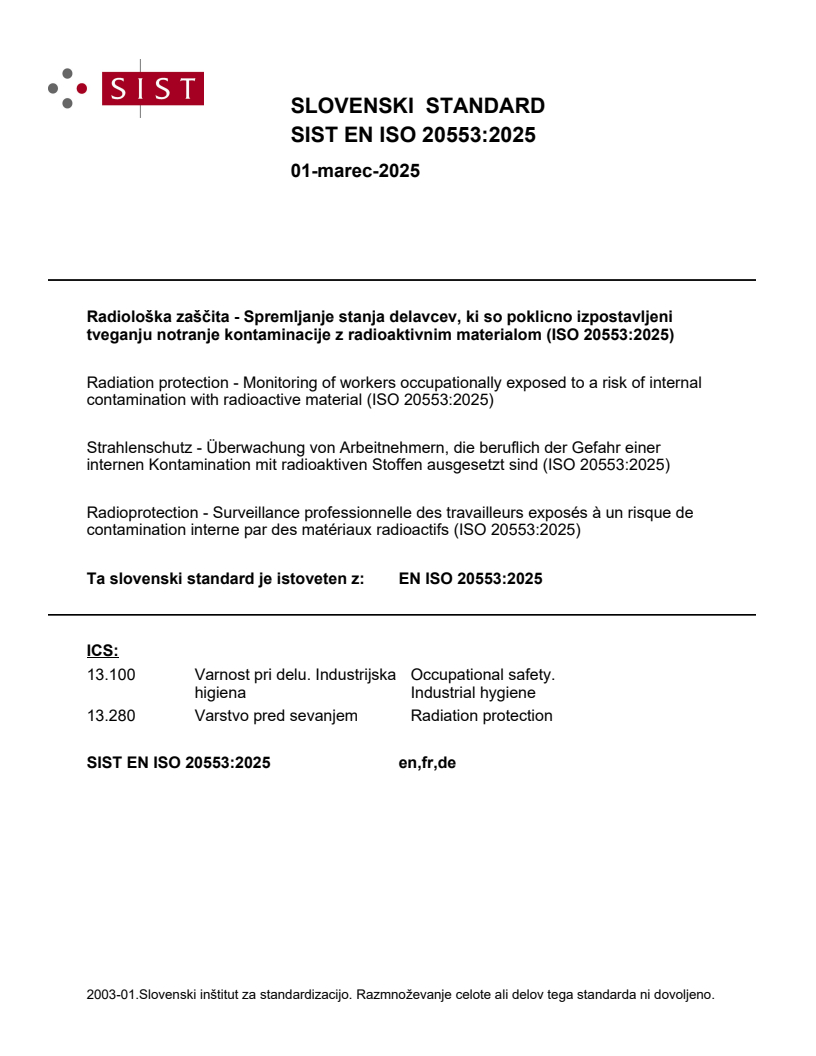
(Main)Radiation protection - Monitoring of workers occupationally exposed to a risk of internal contamination with radioactive material (ISO 20553:2025)
Radiation protection - Monitoring of workers occupationally exposed to a risk of internal contamination with radioactive material (ISO 20553:2025)
This document specifies the minimum requirements for the design of programmes to monitor workers exposed to the risk of internal contamination by radioactive material and establishes principles for the development of compatible goals and requirements for monitoring programmes.
This document specifies the
a) purposes of monitoring and monitoring programmes,
b) description of the different categories of monitoring programmes,
c) quantitative criteria for conducting monitoring programmes,
d) suitable monitoring methods and criteria for their selection,
e) information that has to be collected for the design of a monitoring programme,
f) general requirements for monitoring programmes (e.g. detection limits, tolerated uncertainties),
g) frequencies of measurements calculated using the ICRP Occupational Intakes of Radionuclides (OIR) series,
h) individual monitoring in specific cases (intake of actinides, intake via a wound and intake through the intact skin),
i) quality assurance, and
j) documentation, reporting and record-keeping.
This document does not apply to
— the monitoring of exposure to radon and its radioactive decay products,
— detailed descriptions of measuring methods and techniques,
— detailed procedures for in vivo measurements and in vitro analysis,
— interpretation of measurements results in terms of dose,
— biokinetic data and mathematical models for converting measured activities into absorbed dose, equivalent dose and effective dose,
— the investigation of the causes or implications of an exposure or intake.
Strahlenschutz - Überwachung von Arbeitnehmern, die beruflich der Gefahr einer internen Kontamination mit radioaktiven Stoffen ausgesetzt sind (ISO 20553:2025)
Dieses Dokument legt die Mindestanforderungen an die Gestaltung von professionellen Programmen zur Überwachung von Beschäftigten fest, bei denen ein Risiko der inneren Kontamination durch radioaktive Stoffe besteht, und legt Grundsätze für die Entwicklung von kompatiblen Zielen für und Anforderungen an Überwachungsprogramme fest.
Dieses Dokument legt Folgendes fest:
a) die Zwecke von Überwachung und Überwachungsprogrammen;
b) die Beschreibung der verschiedenen Kategorien von Überwachungsprogrammen;
c) die quantitativen Kriterien für die Durchführung von Überwachungsprogrammen;
d) die geeigneten Überwachungsverfahren und Kriterien für deren Auswahl;
e) die Informationen, die für die Gestaltung eines Überwachungsprogramms zu sammeln sind;
f) die allgemeinen Anforderungen an Überwachungsprogramme (z. B. Nachweisgrenzen, geduldete Unsicherheiten);
g) die Häufigkeiten von Messungen, berechnet mithilfe der Reihe „Occupational Intakes of Radionuclides (OIR)“ der ICRP;
h) die individuelle Überwachung in Sonderfällen (Zufuhr von Actinoiden, Zufuhr über eine Wunde und Zufuhr über die unversehrte Haut);
i) die Qualitätssicherung; und
j) die Dokumentation, die Berichterstattung und das Führen von Aufzeichnungen.
Dieses Dokument ist für Folgendes nicht anwendbar:
die Überwachung der Exposition gegenüber Radon und seinen radioaktiven Zerfallsprodukten;
ausführliche Beschreibungen von Messverfahren und -techniken;
ausführliche Verfahren für In-vivo-Messungen und In-vitro-Analyse;
die Auswertung von Messergebnissen in Bezug auf die Dosis;
biokinetische Daten und mathematische Modelle zur Umwandlung gemessener Aktivitäten in die absorbierte Dosis, Äquivalentdosis und effektive Dosis;
die Untersuchung der Ursachen oder Auswirkungen einer Exposition oder Aktivitätszufuhr.
Radioprotection - Surveillance professionnelle des travailleurs exposés à un risque de contamination interne par des matériaux radioactifs (ISO 20553:2025)
Le présent document décrit les exigences minimales permettant d’établir des programmes de surveillance des travailleurs exposés à un risque de contamination interne par des substances radioactives, et établit des principes pour le développement de finalités et d’exigences compatibles avec les programmes de surveillance.
Le présent document spécifie:
a) les objectifs de la surveillance et des programmes de surveillance;
b) la description des différentes catégories des programmes de surveillance;
c) les critères quantitatifs pour la conduite des programmes de surveillance;
d) les méthodes de surveillance appropriées et les critères de sélection;
e) les informations à collecter pour la conception d’un programme de surveillance;
f) les exigences générales pour les programmes de surveillance (par exemple, limite de détection, incertitudes tolérées);
g) les fréquences des mesurages calculées en se basant sur la série de rapports de la CIPR «Occupational Intakes of Radionuclides (OIR)»;
h) la surveillance individuelle dans certains cas (incorporation d’actinides, incorporation par plaie et incorporation à travers la peau intacte);
i) l’assurance qualité;
j) la documentation, la transmission et l’archivage des résultats.
Le présent document ne s’applique pas:
— à la surveillance de l’exposition au radon et à ses produits de filiation radioactifs;
— aux descriptions détaillées des méthodes et des techniques de mesurage;
— aux modes opératoires détaillés pour les mesurages in vivo et les analyses in vitro;
— à l’interprétation des résultats de mesure en termes de doses;
— aux données biocinétiques et aux modèles mathématiques pour convertir les activités mesurées en dose absorbée, en dose équivalente et en dose efficace;
— à l’investigation des causes ou des implications d’une exposition ou d’une incorporation.
Radiološka zaščita - Spremljanje stanja delavcev, ki so poklicno izpostavljeni tveganju notranje kontaminacije z radioaktivnim materialom (ISO 20553:2025)
Ta dokument določa minimalne zahteve za načrtovanje programov za spremljanje stanja delavcev, ki so izpostavljeni tveganju notranje kontaminacije z radioaktivnim materialom, ter načela za oblikovanje združljivih ciljev in zahtev za tovrstne programe.
Ta dokument določa:
a) namene spremljanja in programov za spremljanje;
b) opis različnih kategorij programov za spremljanje;
c) kvantitativne kriterije za izvajanje programov za spremljanje;
d) primerne metode spremljanja in merila za njihovo izbiro;
e) informacije, ki jih je treba zbrati za načrtovanje programa za spremljanje;
f) splošne zahteve za programe za spremljanje (npr. meje zaznavanja, dovoljene negotovosti);
g) pogostost merjenj, izračunano na podlagi vnosa radionuklidov pri poklicni izpostavljenosti (OIR) v okviru Mednarodne komisije za radiološko zaščito (ICRP);
h) individualno spremljanje v posebnih primerih (vnos aktinidov, vnos prek rane in vnos skozi
nepoškodovano kožo);
i) zagotavljanje kakovosti; ter
j) dokumentiranje, poročanje in vodenje evidenc.
Ta dokument se ne uporablja za:
– spremljanje izpostavljenosti radonu in njegovim radioaktivnim razpadnim produktom;
– podrobno opisovanje merilnih metod in tehnik;
– podrobne postopke izvajanja meritev in vivo ter analize in vitro;
– interpretacijo rezultatov meritev glede na odmerek;
– biokinetične podatke in matematične modele za pretvorbo izmerjenih aktivnosti v absorbirani,
ekvivalentni in efektivni odmerek;
– raziskovanje razlogov ali vplivov izpostavljenosti oziroma vnosa.
General Information
- Status
- Published
- Public Enquiry End Date
- 14-Feb-2024
- Publication Date
- 03-Feb-2025
- Technical Committee
- I13 - Imaginarni 13
- Current Stage
- 6060 - National Implementation/Publication (Adopted Project)
- Start Date
- 30-Jan-2025
- Due Date
- 06-Apr-2025
- Completion Date
- 04-Feb-2025
Relations
- Effective Date
- 19-Jan-2023
Overview
EN ISO 20553:2025 - "Radiation protection - Monitoring of workers occupationally exposed to a risk of internal contamination with radioactive material" (ISO 20553:2025) specifies minimum requirements for designing programmes to monitor workers at risk of internal contamination. Published by CEN and aligned with the ISO edition, this standard establishes principles for setting compatible goals and requirements for monitoring programmes in occupational radiation protection.
Key topics and technical requirements
The standard defines the scope and core elements of monitoring programmes without prescribing detailed measurement techniques. Major topics include:
- Purposes of monitoring: objectives for routine, special, task-related and confirmatory monitoring.
- Categories of programmes: definitions and use-cases for routine, special, task-related and confirmatory monitoring.
- Quantitative criteria: decision criteria for when and how to monitor occupational intakes.
- Selection of monitoring methods: guidance on suitable in vivo and in vitro methods and criteria for choosing them.
- Required information: data to be collected to design an effective monitoring programme (work tasks, radionuclides, exposure pathways).
- General programme requirements: performance expectations such as detection limits and tolerated uncertainties.
- Measurement frequencies: calculation of measurement intervals using the ICRP Occupational Intakes of Radionuclides (OIR) series.
- Special-case individual monitoring: procedures for actinide intakes, wound intakes and transdermal intakes.
- Quality assurance: programmatic QA elements to ensure reliability of monitoring.
- Documentation and record-keeping: reporting, record retention and worker information requirements.
The standard explicitly excludes radon and its progeny monitoring, detailed measuring procedures, dose interpretation, and biokinetic models for dose conversion.
Practical applications and users
EN ISO 20553:2025 is designed for organizations that manage occupational exposure to radioactive materials, including:
- Radiation protection officers and health physicists
- Employers in nuclear power, research reactors, radiopharmacies, nuclear medicine departments and industrial radiography
- Occupational hygiene and safety teams responsible for programme design and implementation
- Accredited laboratories and in vivo monitoring facilities developing routine or special monitoring services
- Regulators and inspectors establishing compliance expectations
Practical applications include designing routine individual and workplace monitoring programmes, establishing measurement schedules based on ICRP OIR guidance, selecting appropriate bioassay or in vivo techniques, and implementing QA and record-keeping systems to document worker exposures and programme performance.
Related standards
- ISO 20553:2025 (this document; supersedes EN ISO 20553:2017)
- ICRP Occupational Intakes of Radionuclides (OIR) series - used for calculating monitoring frequencies and assessment criteria
EN ISO 20553:2025 helps organizations implement robust, defensible monitoring programmes for internal contamination risk, integrating radiation protection best practices, quality assurance, and regulatory compliance.


Frequently Asked Questions
SIST EN ISO 20553:2025 is a standard published by the Slovenian Institute for Standardization (SIST). Its full title is "Radiation protection - Monitoring of workers occupationally exposed to a risk of internal contamination with radioactive material (ISO 20553:2025)". This standard covers: This document specifies the minimum requirements for the design of programmes to monitor workers exposed to the risk of internal contamination by radioactive material and establishes principles for the development of compatible goals and requirements for monitoring programmes. This document specifies the a) purposes of monitoring and monitoring programmes, b) description of the different categories of monitoring programmes, c) quantitative criteria for conducting monitoring programmes, d) suitable monitoring methods and criteria for their selection, e) information that has to be collected for the design of a monitoring programme, f) general requirements for monitoring programmes (e.g. detection limits, tolerated uncertainties), g) frequencies of measurements calculated using the ICRP Occupational Intakes of Radionuclides (OIR) series, h) individual monitoring in specific cases (intake of actinides, intake via a wound and intake through the intact skin), i) quality assurance, and j) documentation, reporting and record-keeping. This document does not apply to — the monitoring of exposure to radon and its radioactive decay products, — detailed descriptions of measuring methods and techniques, — detailed procedures for in vivo measurements and in vitro analysis, — interpretation of measurements results in terms of dose, — biokinetic data and mathematical models for converting measured activities into absorbed dose, equivalent dose and effective dose, — the investigation of the causes or implications of an exposure or intake.
This document specifies the minimum requirements for the design of programmes to monitor workers exposed to the risk of internal contamination by radioactive material and establishes principles for the development of compatible goals and requirements for monitoring programmes. This document specifies the a) purposes of monitoring and monitoring programmes, b) description of the different categories of monitoring programmes, c) quantitative criteria for conducting monitoring programmes, d) suitable monitoring methods and criteria for their selection, e) information that has to be collected for the design of a monitoring programme, f) general requirements for monitoring programmes (e.g. detection limits, tolerated uncertainties), g) frequencies of measurements calculated using the ICRP Occupational Intakes of Radionuclides (OIR) series, h) individual monitoring in specific cases (intake of actinides, intake via a wound and intake through the intact skin), i) quality assurance, and j) documentation, reporting and record-keeping. This document does not apply to — the monitoring of exposure to radon and its radioactive decay products, — detailed descriptions of measuring methods and techniques, — detailed procedures for in vivo measurements and in vitro analysis, — interpretation of measurements results in terms of dose, — biokinetic data and mathematical models for converting measured activities into absorbed dose, equivalent dose and effective dose, — the investigation of the causes or implications of an exposure or intake.
SIST EN ISO 20553:2025 is classified under the following ICS (International Classification for Standards) categories: 13.100 - Occupational safety. Industrial hygiene; 13.280 - Radiation protection. The ICS classification helps identify the subject area and facilitates finding related standards.
SIST EN ISO 20553:2025 has the following relationships with other standards: It is inter standard links to SIST EN ISO 20553:2017. Understanding these relationships helps ensure you are using the most current and applicable version of the standard.
SIST EN ISO 20553:2025 is available in PDF format for immediate download after purchase. The document can be added to your cart and obtained through the secure checkout process. Digital delivery ensures instant access to the complete standard document.
Standards Content (Sample)
SLOVENSKI STANDARD
01-marec-2025
Radiološka zaščita - Spremljanje stanja delavcev, ki so poklicno izpostavljeni
tveganju notranje kontaminacije z radioaktivnim materialom (ISO 20553:2025)
Radiation protection - Monitoring of workers occupationally exposed to a risk of internal
contamination with radioactive material (ISO 20553:2025)
Strahlenschutz - Überwachung von Arbeitnehmern, die beruflich der Gefahr einer
internen Kontamination mit radioaktiven Stoffen ausgesetzt sind (ISO 20553:2025)
Radioprotection - Surveillance professionnelle des travailleurs exposés à un risque de
contamination interne par des matériaux radioactifs (ISO 20553:2025)
Ta slovenski standard je istoveten z: EN ISO 20553:2025
ICS:
13.100 Varnost pri delu. Industrijska Occupational safety.
higiena Industrial hygiene
13.280 Varstvo pred sevanjem Radiation protection
2003-01.Slovenski inštitut za standardizacijo. Razmnoževanje celote ali delov tega standarda ni dovoljeno.
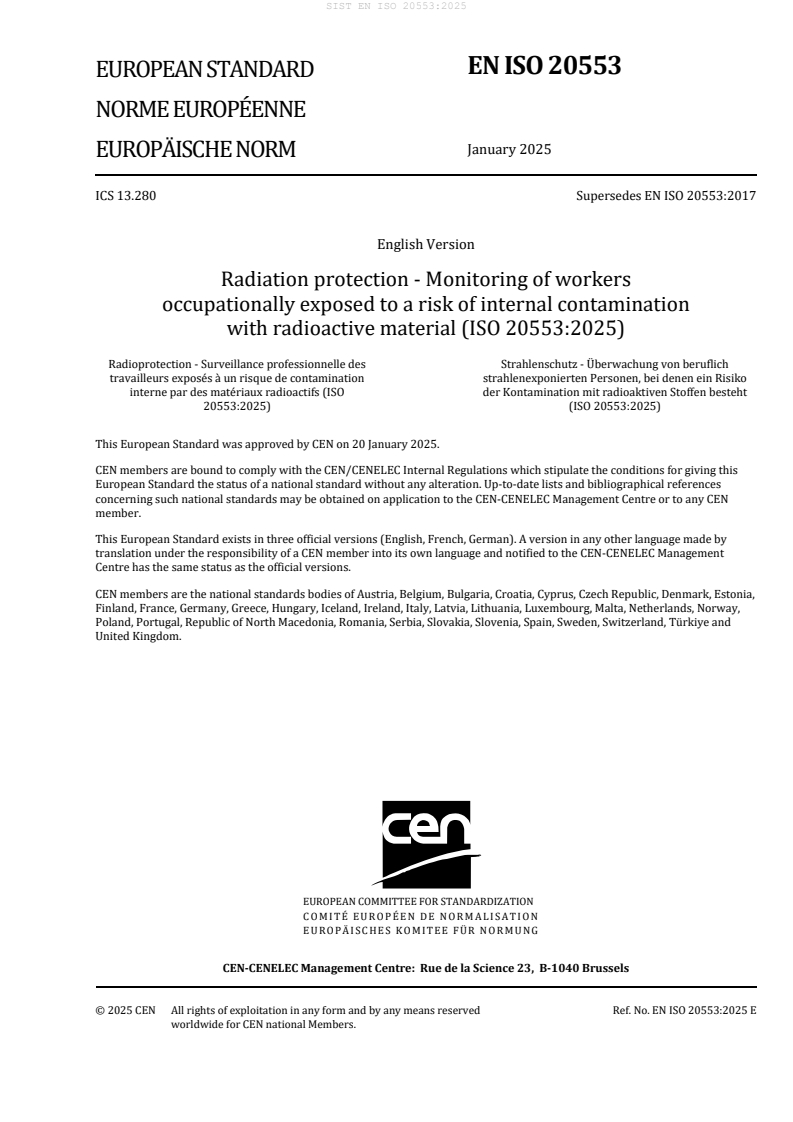
EN ISO 20553
EUROPEAN STANDARD
NORME EUROPÉENNE
January 2025
EUROPÄISCHE NORM
ICS 13.280 Supersedes EN ISO 20553:2017
English Version
Radiation protection - Monitoring of workers
occupationally exposed to a risk of internal contamination
with radioactive material (ISO 20553:2025)
Radioprotection - Surveillance professionnelle des Strahlenschutz - Überwachung von beruflich
travailleurs exposés à un risque de contamination strahlenexponierten Personen, bei denen ein Risiko
interne par des matériaux radioactifs (ISO der Kontamination mit radioaktiven Stoffen besteht
20553:2025) (ISO 20553:2025)
This European Standard was approved by CEN on 20 January 2025.
CEN members are bound to comply with the CEN/CENELEC Internal Regulations which stipulate the conditions for giving this
European Standard the status of a national standard without any alteration. Up-to-date lists and bibliographical references
concerning such national standards may be obtained on application to the CEN-CENELEC Management Centre or to any CEN
member.
This European Standard exists in three official versions (English, French, German). A version in any other language made by
translation under the responsibility of a CEN member into its own language and notified to the CEN-CENELEC Management
Centre has the same status as the official versions.
CEN members are the national standards bodies of Austria, Belgium, Bulgaria, Croatia, Cyprus, Czech Republic, Denmark, Estonia,
Finland, France, Germany, Greece, Hungary, Iceland, Ireland, Italy, Latvia, Lithuania, Luxembourg, Malta, Netherlands, Norway,
Poland, Portugal, Republic of North Macedonia, Romania, Serbia, Slovakia, Slovenia, Spain, Sweden, Switzerland, Türkiye and
United Kingdom.
EUROPEAN COMMITTEE FOR STANDARDIZATION
COMITÉ EUROPÉEN DE NORMALISATION
EUROPÄISCHES KOMITEE FÜR NORMUNG
CEN-CENELEC Management Centre: Rue de la Science 23, B-1040 Brussels
© 2025 CEN All rights of exploitation in any form and by any means reserved Ref. No. EN ISO 20553:2025 E
worldwide for CEN national Members.
Contents Page
European foreword . 3
European foreword
This document (EN ISO 20553:2025) has been prepared by Technical Committee ISO/TC 85 "Nuclear
energy, nuclear technologies, and radiological protection" in collaboration with Technical Committee
CEN/TC 430 “Nuclear energy, nuclear technologies, and radiological protection” the secretariat of
which is held by AFNOR.
This European Standard shall be given the status of a national standard, either by publication of an
identical text or by endorsement, at the latest by July 2025, and conflicting national standards shall be
withdrawn at the latest by July 2025.
Attention is drawn to the possibility that some of the elements of this document may be the subject of
patent rights. CEN shall not be held responsible for identifying any or all such patent rights.
This document supersedes EN ISO 20553:2017.
Any feedback and questions on this document should be directed to the users’ national standards
body/national committee. A complete listing of these bodies can be found on the CEN website.
According to the CEN-CENELEC Internal Regulations, the national standards organizations of the
following countries are bound to implement this European Standard: Austria, Belgium, Bulgaria,
Croatia, Cyprus, Czech Republic, Denmark, Estonia, Finland, France, Germany, Greece, Hungary, Iceland,
Ireland, Italy, Latvia, Lithuania, Luxembourg, Malta, Netherlands, Norway, Poland, Portugal, Republic of
North Macedonia, Romania, Serbia, Slovakia, Slovenia, Spain, Sweden, Switzerland, Türkiye and the
United Kingdom.
Endorsement notice
The text of ISO 20553:2025 has been approved by CEN as EN ISO 20553:2025 without any modification.
International
Standard
ISO 20553
Second edition
Radiation protection — Monitoring
2025-01
of workers occupationally exposed
to a risk of internal contamination
with radioactive material
Radioprotection — Surveillance professionnelle des travailleurs
exposés à un risque de contamination interne par des substances
radioactives
Reference number
ISO 20553:2025(en) © ISO 2025
ISO 20553:2025(en)
© ISO 2025
All rights reserved. Unless otherwise specified, or required in the context of its implementation, no part of this publication may
be reproduced or utilized otherwise in any form or by any means, electronic or mechanical, including photocopying, or posting on
the internet or an intranet, without prior written permission. Permission can be requested from either ISO at the address below
or ISO’s member body in the country of the requester.
ISO copyright office
CP 401 • Ch. de Blandonnet 8
CH-1214 Vernier, Geneva
Phone: +41 22 749 01 11
Email: copyright@iso.org
Website: www.iso.org
Published in Switzerland
ii
ISO 20553:2025(en)
Contents Page
Foreword .v
Introduction .vi
1 Scope . 1
2 Normative references . 1
3 Terms and definitions . 2
4 Symbols and abbreviated terms. 6
5 Purpose and need for monitoring programmes . 6
5.1 General aspects .6
5.2 Types of monitoring .7
5.2.1 Workplace monitoring .7
5.2.2 Individual monitoring . .7
5.3 Categories of monitoring programmes .7
5.3.1 Routine monitoring programme .7
5.3.2 Special monitoring programme .8
5.3.3 Task-related monitoring programme .8
5.3.4 Confirmatory monitoring programme .8
6 Designing a routine monitoring programme . 8
6.1 General requirements .8
6.2 Routine individual monitoring .9
6.2.1 General .9
6.2.2 Methods .9
6.2.3 Determining the frequency of monitoring .9
6.2.4 Methods and time intervals for commonly encountered radionuclides .11
6.2.5 Tolerances for monitoring intervals .16
6.3 Routine workplace monitoring .16
7 Designing a special monitoring programme . 17
7.1 Special individual monitoring . .17
7.1.1 General .17
7.1.2 In vivo measurements and in vitro analyses .17
7.1.3 Other techniques .17
7.2 Special workplace monitoring .18
8 Designing a task-related monitoring programme .18
9 Designing a confirmatory monitoring programme .18
10 Individual monitoring in specific cases .18
10.1 Monitoring of nuclear medicine and radiopharmacy staff exposed to short-lived
radionuclides .18
10.2 Intakes of actinides.19
10.3 Intake via a wound .19
10.4 Intake through the intact skin .19
11 Investigation levels . 19
12 Recording, documentation and reporting .20
12.1 Recording and documentation . 20
12.1.1 General . 20
12.1.2 Samples . 20
12.1.3 Measurements . 20
12.1.4 Dose assessment .21
12.2 Reporting .21
12.2.1 Routine monitoring programmes .21
12.2.2 Special monitoring programmes . 22
12.2.3 Worker information . 22
iii
ISO 20553:2025(en)
13 Quality management .22
Annex A (informative) Techniques and detection limits of in vitro bioassay or in vivo
measurements selected to calculate routine monitoring time intervals for the
radionuclides considered in Tables 1, 2, 3 and 4 .23
Annex B (informative) Recommended methods for special monitoring programmes after
inhalation .25
Bibliography .27
iv
ISO 20553:2025(en)
Foreword
ISO (the International Organization for Standardization) is a worldwide federation of national standards
bodies (ISO member bodies). The work of preparing International Standards is normally carried out through
ISO technical committees. Each member body interested in a subject for which a technical committee
has been established has the right to be represented on that committee. International organizations,
governmental and non-governmental, in liaison with ISO, also take part in the work. ISO collaborates closely
with the International Electrotechnical Commission (IEC) on all matters of electrotechnical standardization.
The procedures used to develop this document and those intended for its further maintenance are described
in the ISO/IEC Directives, Part 1. In particular, the different approval criteria needed for the different types
of ISO document should be noted. This document was drafted in accordance with the editorial rules of the
ISO/IEC Directives, Part 2 (see www.iso.org/directives).
ISO draws attention to the possibility that the implementation of this document may involve the use of (a)
patent(s). ISO takes no position concerning the evidence, validity or applicability of any claimed patent
rights in respect thereof. As of the date of publication of this document, ISO had not received notice of (a)
patent(s) which may be required to implement this document. However, implementers are cautioned that
this may not represent the latest information, which may be obtained from the patent database available at
www.iso.org/patents. ISO shall not be held responsible for identifying any or all such patent rights.
Any trade name used in this document is information given for the convenience of users and does not
constitute an endorsement.
For an explanation of the voluntary nature of standards, the meaning of ISO specific terms and expressions
related to conformity assessment, as well as information about ISO's adherence to the World Trade
Organization (WTO) principles in the Technical Barriers to Trade (TBT), see www.iso.org/iso/foreword.html.
This document was prepared by Technical Committee ISO/TC 85, Nuclear energy, nuclear technologies, and
radiological protection, Subcommittee SC 2, Radiological protection, in collaboration with the European
Committee for Standardization (CEN) Technical Committee CEN/TC 430, Nuclear energy, nuclear technologies,
and radiological protection, in accordance with the Agreement on technical cooperation between ISO and
CEN (Vienna Agreement).
This second edition cancels and replaces the first edition (ISO 20553:2006), which has been technically
revised.
The main changes are as follows:
— the reference to the recent publication of ICRP Occupational Intakes of Radionuclides (OIR) series,
instead of ICRP publications 66 and 78, to calculate the maximum time intervals for routine monitoring
programmes.
Any feedback or questions on this document should be directed to the user’s national standards body. A
complete listing of these bodies can be found at www.iso.org/members.html.
v
ISO 20553:2025(en)
Introduction
In the course of employment, individuals may work with radioactive materials that could be taken into the
body. Minimising the risks to workers from incorporated radionuclides requires the monitoring of potential
or actual intakes. The requirements for such a monitoring programme and the selection of methods and
frequencies of monitoring depend upon the applicable legislation or regulatory body, the purpose of the
radiation protection programme, the probability of potential intakes, and the characteristics of the materials
handled.
This document offers guidance for making a decision whether a monitoring programme is required, in
the absence of any value set by regulations, and proposes the methodology for setting up a monitoring
program, as well as its design. Its intention is to optimise the efforts for such a monitoring programme
consistent with legal requirements and with the purpose of the radiation protection programme.
Recommendations of international expert bodies and international experience with the practical application
of these recommendations in radiation protection programmes have been considered in the development
of this document. Its application facilitates the exchanges of information between authorities, supervisory
institutions and employers. This document is not a substitute for legal requirements.
vi
International Standard ISO 20553:2025(en)
Radiation protection — Monitoring of workers occupationally
exposed to a risk of internal contamination with radioactive
material
1 Scope
This document specifies the minimum requirements for the design of programmes to monitor workers
exposed to the risk of internal contamination by radioactive material and establishes principles for the
development of compatible goals and requirements for monitoring programmes.
This document specifies the
a) purposes of monitoring and monitoring programmes,
b) description of the different categories of monitoring programmes,
c) quantitative criteria for conducting monitoring programmes,
d) suitable monitoring methods and criteria for their selection,
e) information that has to be collected for the design of a monitoring programme,
f) general requirements for monitoring programmes (e.g. detection limits, tolerated uncertainties),
g) frequencies of measurements calculated using the ICRP Occupational Intakes of Radionuclides (OIR) series,
h) individual monitoring in specific cases (intake of actinides, intake via a wound and intake through the
intact skin),
i) quality assurance, and
j) documentation, reporting and record-keeping.
This document does not apply to
— the monitoring of exposure to radon and its radioactive decay products,
— detailed descriptions of measuring methods and techniques,
— detailed procedures for in vivo measurements and in vitro analysis,
— interpretation of measurements results in terms of dose,
— biokinetic data and mathematical models for converting measured activities into absorbed dose,
equivalent dose and effective dose,
— the investigation of the causes or implications of an exposure or intake.
2 Normative references
The following documents are referred to in the text in such a way that some or all of their content constitutes
requirements of this document. For dated references, only the edition cited applies. For undated references,
the latest edition of the referenced document (including any amendments) applies.
ISO 15189, Medical laboratories — Requirements for quality and competence
ISO 20553:2025(en)
ISO 17025, General requirements for the competence of testing and calibration laboratories
ISO 23588, Radiological protection — General requirements for proficiency tests for in vivo radiobioassay
ISO 28218, Radiation protection — Performance criteria for radiobioassay
3 Terms and definitions
For the purposes of this document, the following terms and definitions apply.
ISO and IEC maintain terminological databases for use in standardization at the following addresses:
— ISO Online browsing platform: available at https:// www .iso .org/ obp
— IEC Electropedia: available at https:// www .electropedia .org/
3.1
absorption type
type of material, classified according to its rate of absorption from the respiratory tract into blood
3.1.1
absorption type V
type V
deposited materials that, for dosimetric purposes, are assumed to be instantaneously absorbed into blood
from the respiratory tract (only certain gases and vapours; very fast absorption)
[SOURCE: ICRP publication 130]
3.1.2
absorption type F
type F
deposited materials that are readily absorbed into blood from the respiratory tract (fast absorption)
[SOURCE: ICRP publication 130]
3.1.3
absorption type M
type M
deposited materials that have intermediate rates of absorption into blood from the respiratory tract
(moderate absorption)
[SOURCE: ICRP publication 130]
3.1.4
absorption type S
type S
deposited materials that are relatively insoluble in the respiratory tract (slow absorption)
[SOURCE: ICRP publication 130]
3.2
activity
quotient of –dN by dt, where dN is the change in the number of radioactive nuclei, at a particular energy
state and at a given time, due to spontaneous nuclear transformations in the time interval dt
Note 1 to entry: It is expressed as A = -dN/dt . Activity can be calculated as A = λN, where λ is the decay constant and N
is the number of present radioactive nuclei.
Note 2 to entry: The special name for the unit of activity in the International System of Units is becquerel (Bq), One
-1 10
Bq equals one transformation per second (1 Bq = 1 s ). The use of the former unit curie (1 Ci = 3,7 х 10 Bq), is also
accepted in many countries and by the Bureau International des Poids et Mesures.
ISO 20553:2025(en)
[SOURCE: ISO 12749-1:2020, 3.1.2, modified – By removing the capital letter from the word "Curie" and
adding “One Bq equals one transformation per second”]
3.3
activity median aerodynamic diameter
AMAD
value of aerodynamic diameter such that 50 % of the airborne activity (3.2) in a specified aerosol is
associated with particles smaller than the AMAD, and 50 % of the activity (3.2) is associated with particles
larger than the AMAD
Note 1 to entry: The aerodynamic diameter of an airborne particle is the diameter of a unit density sphere that has the
same terminal settling velocity in air as the particle of interest.
3.4
clearance
net effect of the biological processes by which radionuclides are removed from the body or from a tissue,
organ or region of the body
Note 1 to entry: The clearance rate is the rate at which this occurs.
3.5
radioactive contamination
contamination
radioactive substances on surfaces, or within solids, liquids or gases, including the human body, where their
presence is unintended or undesirable, or the process giving rise to their presence in such places
[SOURCE: ISO 12749-2:2022, 3.1.5]
3.6
committed effective dose
quantity E()τ , defined as:
Ew()ττ=⋅H ()
TT
∑
T
where H ()τ is the committed equivalent dose to tissue or organ T over the integration time τ elapsed after
T
an intake (3.12) of radioactive substances and w is the tissue weighting factor for tissue or organ T.
T
Note 1 to entry: The committed equivalent dose to an organ or tissue is the time integral of the equivalent dose rate to
that organ or tissue after an intake (3.12) of radioactive substances.
Note 2 to entry: Where τ is not specified, it is taken to be 50 years for adults and the time to the age of 70 years for
intakes (3.12) by children. For workers, the integration time to calculate committed equivalent doses is 50 years.
[SOURCE: ISO 12749-2:2022, 3.1.19, modified by adding Note 1 and “For workers, the integration time to
calculate committed equivalent doses is 50 years” in Note 2]
3.7
annual committed dose
committed effective dose (3.6) from intakes (3.12) of radionuclides in one year
3.8
dose coefficient
committed effective dose (3.6) per unit intake (3.13), e(50), where 50 is the dose-commitment period in years
over which the dose is calculated
3.9
retention function
function m(t) representing the activity of a radionuclide in the whole body or in an organ, at a time t after a
unit acute intake (3.12) as predicted by a reference biokinetic model
ISO 20553:2025(en)
3.10
excretion function
function m(t) representing the activity of a radionuclide in a 24 h excreta sample, at a time t after a unit
acute intake (3.12) as predicted by a reference biokinetic model
3.11
event
any unintended occurrence, including operating error, equipment failure or other mishap, and deliberate
action on the part of others, the consequences or potential consequences of which are not negligible from
the point of view of protection and safety
[SOURCE: ISO 12749-2:2022, 3.3.25]
3.12
intake
act or process of taking radionuclides into the body by inhalation or ingestion or through the skin
Note 1 to entry: Other exposure pathways by intake are injection (e.g. in nuclear medicine) and intake via a wound, as
distinguished from intake through (intact) skin.
[SOURCE: IAEA Nuclear Safety and Security Glossary: 2022 (Interim) Edition]
3.13
intake
activity (3.2) of a radionuclide taken into the body in a given time period or as a result of a given
event (3.11)
[SOURCE: IAEA Nuclear Safety and Security Glossary: 2022 (Interim) Edition]
3.14
in vitro analysis
analysis including measurements of radioactivity present in biological samples taken from an individual
Note 1 to entry: These include urine, faeces and nasal samples. In special monitoring programmes, samples of other
materials such as blood and hair may be taken.
Note 2 to entry: These analyses are sometimes referred to as indirect measurements.
Note 3 to entry: In the case of urine or faeces analysis, the time of the measurement is the end day of sample collection.
3.15
in vivo measurement
direct measurements
measurement to determine the presence of or to estimate the amount of radioactive material in a living
organism
Note 1 to entry: Normally, the measurement devices are whole-body or partial-body (e.g. lung, thyroid) counters.
[SOURCE: ISO 12749-2:2022, 3.4.8]
3.16
investigation level
value of a quantity such as effective dose, intake (3.13) or contamination (3.5) per unit area or volume at or
above which an investigation would be conducted
[SOURCE: IAEA Nuclear Safety and Security Glossary: 2022 (Interim) Edition]
3.17
detection limit
smallest true value of the measurand which ensures a specified probability of being detectable by the
measurement procedure
[SOURCE: ISO 12749-1:2020, 3.4.11]
ISO 20553:2025(en)
3.18
monitoring
measurement of dose, dose rate or activity for reasons relating to the assessment or control of exposure to
radiation or exposure due to radioactive material, and the interpretation of the results
3.18.1
individual monitoring
monitoring using measurements by equipment worn by individuals, or measurements of the quantities of
radioactive substances in or on, or taken into, the bodies of individuals, or measurements of quantities of
radioactive substances excreted from the body by individuals
[SOURCE: IAEA Nuclear Safety and Security Glossary: 2022 (Interim) Edition]
3.18.2
workplace monitoring
monitoring using measurements made in the working environment
3.19
monitoring programme
pre-planned set of personal or workplace measurements used to determine personal exposure to radioactive
materials
Note 1 to entry: This document distinguishes four different categories of monitoring programme, namely routine
monitoring programme (3.19.1), special monitoring programme (3.19.2), confirmatory monitoring programme (3.19.3),
and task-related monitoring programme (3.19.4).
3.19.1
routine monitoring programme
monitoring programme associated with continuing operations and intended to demonstrate that working
conditions, including the levels of individual dose, remain satisfactory, and to meet regulatory requirements
3.19.2
special monitoring programme
monitoring programme performed to quantify intakes (3.13) following actual or suspected events (3.11)
3.19.3
confirmatory monitoring programme
monitoring programme carried out to confirm assumptions about working conditions, for example that
significant intakes (3.13) do not occur
3.19.4
task-related monitoring programme
monitoring programme related to a specific operation, to provide information on a specific operation of
limited duration, or following major modifications applied to the installations or operating procedures, or to
confirm that the routine monitoring programme is suitable
3.19.5
monitoring interval
period between two times of measurement of the same type and category
3.20
quality assurance
QA
part of quality management focused on providing confidence that quality requirements will be fulfilled
[SOURCE: ISO 9000:2015, 3.3.6]
3.21
quality control
part of quality management focused on fulfilling quality requirements
[SOURCE: ISO 9000:2015, 3.3.7]
ISO 20553:2025(en)
3.22
quality management
management with regard to quality
Note 1 to entry: Quality management can include establishing quality policies and quality objectives, and processes to
achieve these quality objectives through quality planning, quality assurance, quality control, and quality improvement
[SOURCE: ISO 9000:2015, 3.3.4]
3.23
recording level
level of dose, exposure or intake (3.13) specified by the regulatory body at or above which values of dose,
exposure or intake (3.13) received by workers are to be entered in their individual exposure records
[SOURCE: ISO 12749-2:2022, 3.6.10]
4 Symbols and abbreviated terms
AMAD Activity median aerodynamic diameter
#
A Detection limit
e(50) Dose coefficient: committed effective dose accumulated within 50 years following a unit intake
m(t) Value of the retention or the excretion function at time, t, (in days) after a unit intake
IAEA International Atomic Energy Agency
ICRP International Commission on Radiological Protection
PAS Personal air sampling
QA Quality assurance
SAS Static air sampling
ΔT Time interval (in days) between two measurements in a routine monitoring programme
5 Purpose and need for monitoring programmes
5.1 General aspects
5.1.1 The purpose of monitoring, in general, is to verify and document that the worker is protected
adequately against risks from intakes and that the protection complies with regulatory requirements.
Therefore, it forms part of the overall radiation protection programme, starting with an assessment
to identify work situations in which there is a risk of radionuclide intake by workers and to quantify the
likely intake of radioactive material and the received committed effective dose. Decisions about the need
for monitoring and the design of the monitoring programme should be made in the light of such a risk
assessment. It is always necessary, in the first instance, to put in place radiation protection measures in
order to reduce the risk of intakes to as low as reasonably practicable.
5.1.2 Factors determining the need for a monitoring programme are
— the magnitude of likely intakes;
— the need to detect intakes events when they occur;
— the need to assess the effectiveness of protective equipment such as respiratory protective equipment;
ISO 20553:2025(en)
— the need to assess the effectiveness of workplace controls.
5.1.3 The purpose of the monitoring programme, e.g. for dose assessment purposes or to show that intakes
are as low as reasonably practicable or to confirm that routine monitoring is not required, shall be clearly
defined.
5.1.4 The way the monitoring programme is to be organized shall be documented according to Clause 12
including the basis for interpreting the results. The monitoring programme shall be reviewed after any
major modifications have been made to the installation, to operations, or to the regulatory requirements.
5.2 Types of monitoring
5.2.1 Workplace monitoring
5.2.1.1 Workplace monitoring includes measurements of airborne activity and surface contamination
in the workplace. The primary aim is to determine the possible presence of contamination by radioactive
material on the surfaces or in the air in order to assess the risk of intake by workers who may be present
there. The results of the measurements can be used to make decisions on the need for, and design of, an
individual monitoring programme or as reassurance that such a programme is not required.
5.2.1.2 Surface contamination is not directly related to individual exposure but can indicate the pre-
existence of uncontrolled spread of radioactive material and the potential for an intake due to inhalation,
ingestion, or intake via a wound or through (intact) skin.
5.2.1.3 Continuous monitoring of airborne radionuclides is important, because inhalation is generally the
main exposure pathway for workers. The main objectives of airborne activity monitoring are to:
— help to assess the intakes of workers through inhalation;
— support individual dose assessments, e.g. air monitoring can provide information on the time of an intake;
— rapidly detect abnormal or deteriorating conditions, thereby making it possible to take the appropriate
protective action, for example, the use of respiratory protective equipment;
— provide information for setting up individual monitoring programmes for workers.
It can also be needed in those cases where individual monitoring is not sufficiently sensitive.
In the absence of a value set by regulations, workplace monitoring is required in workplaces where
individual annual committed doses are likely to exceed 1 mSv and recommended where there is a potential
for contamination.
5.2.2 Individual monitoring
Individual monitoring provides the information needed to assess the exposure of a single worker by
measuring the person’s whole body, organ or excreta activity. Individual monitoring can be used to show
that the worker has not been contaminated by radioactive material at the workplace, or if this is not the
case, provides data on which to calculate the dose due to the intake.
5.3 Categories of monitoring programmes
5.3.1 Routine monitoring programme
Routine monitoring programmes are performed to quantify doses where there is the possibility either of
undetected accidental intakes or of chronic intakes. They can also be used to demonstrate that the work
[9]
environment and work procedures are under satisfactory control .
ISO 20553:2025(en)
In the absence of a value set by regulations, workers shall be routinely individually monitored, and the
results used to assess dose, when they could potentially receive an intake of radionuclides resulting in a
committed effective dose of more than 5 mSv per year.
Workers should be routinely individually monitored, and the results used to assess dose, when they could
potentially receive an intake of radionuclides resulting in a committed effective dose between 1 and 5 mSv
per year.
These values take into account only exposures by incorporated radionuclides. In cases where external
exposure is likely to be significant, the value of the potential external exposure shall be subtracted.
The likely magnitude of intakes should initially be assessed taking into account the possibility of chronic
intakes due to insufficient personal protective measures or accidental intakes due to failure of these
measures. If available, this assessment can be done on the basis of results of earlier monitoring programmes
(individual or workplace monitoring).
If a worker is exposed to more than one radionuclide, the design of a monitoring programme may disregard
radionuclides whose contribution to the likely annual committed dose is not significant. In the case of
mixtures where the radionuclide composition is well known, it is possible to use the measurement of a single
or a few radionuclides to infer the activities of the others.
5.3.2 Special monitoring programme
Special monitoring programmes are performed to quantify significant intakes following actual or suspected
abnormal events. Therefore, the time of intake is usually known, and additional information can be
available, which helps to reduce the uncertainty of dose assessment. The purposes of dose assessment in
such cases include assisting in decisions about countermeasures (e.g. decorporation therapy), compliance
with legal regulations, and aiding decisions for the improvement of conditions at the workplace. In most
cases, special monitoring programmes includes individual monitoring. In cases where there is reason to
suspect that regulatory dose limits for occupational exposure could be exceeded, it can be appropriate to
extend the measurements in order to derive individual retention and excretion functions and biokinetic
model parameters and improve the dose assessment.
5.3.3 Task-related monitoring programme
Task-related monitoring programmes apply to a specific operation (construction work, site, etc…) having
a fixed duration. Where work is of a short duration, it may be appropriate to have task-related monitoring
rather than routine monitoring. The purpose and the dose criteria for carrying out task-related monitoring
programmes are identical to those for routine monitoring programmes and may include workplace and
individual monitoring.
5.3.4 Confirmatory monitoring programme
Confirmatory monitoring programmes can be required to check the assumptions about exposure conditions
underlying the procedures selected (e.g. the effectiveness of protection measures). Even if there is no
requirement for individual monitoring for dose assessment purposes, the appropriateness of confirmatory
monitoring should be considered. It may consist of workplace or individual monitoring (e.g. by occasional
measurements to investigate the potential accumulation of activity in the body or by in vivo measurements
or in vitro analysis performed for selected workers representing groups of workers with identical or similar
risks of intake).
6 Designing a routine monitoring programme
6.1 General requirements
Routine monitoring programmes shall be established including suitable individual monitoring and
workplace monitoring according to the requirements specified in Clause 5 and Clause 6.
ISO 20553:2025(en)
The basis for routine monitoring programmes is the assumption that working conditions, and thus risks
of intake, remain reasonably constant. The design of such a programme of regular measurements strongly
depends on the level of the annual committed dose which is to be detected. This level shall be well below
regulatory dose limits for occupational exposure; its definition should take into account uncertainties to
a reasonable extent, for example in activity measurement and dose assessment. If this level is too high,
intakes representing considerable fractions of regulatory dose limits for occupational exposure could be
overlooked
...
Questions, Comments and Discussion
Ask us and Technical Secretary will try to provide an answer. You can facilitate discussion about the standard in here.
Loading comments...