


SIST IEC/TR 61334-1-1:1997
(Main)Distribution automation using distribution line carrier systems - Part 1: General considerations - Section 1: Distribution automation system architecture
Distribution automation using distribution line carrier systems - Part 1: General considerations - Section 1: Distribution automation system architecture
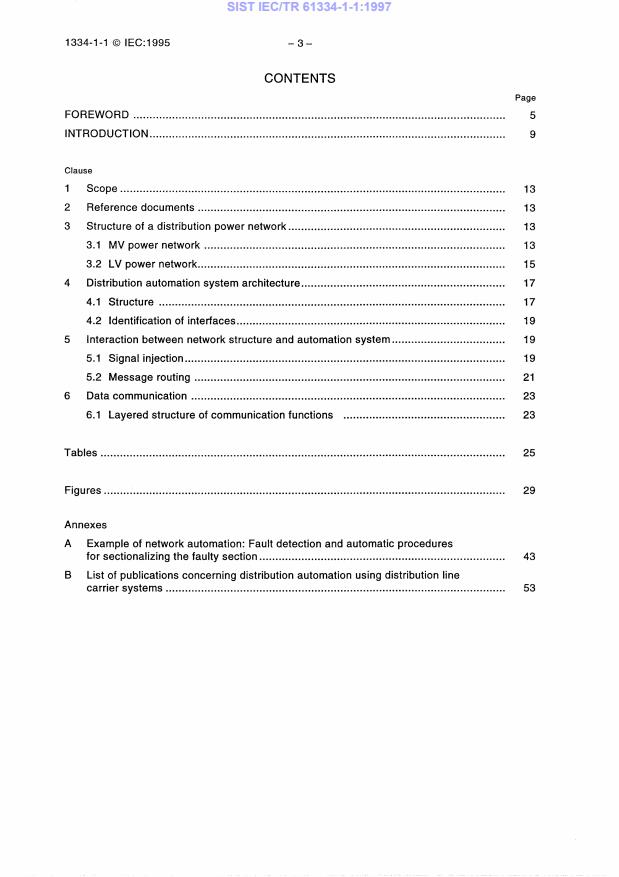
Describes the structure of distribution networks for both medium and low-voltage levels and presents the architecture of a distribution automation system using distribution line carrier systems.[
]This publication has the status of a Technical Report - type 3.
Automatisation de la distribution à l'aide de systèmes de communication à courants porteurs - Partie 1: Considérations générales - Section 1: Architecture des systèmes d'automatisation de la distribution
Décrit la structure des réseaux de distribution à moyenne et basse tension et présente l'architecture d'un système d'automatisation de la distribution basé sur l'utilisation des courants porteurs sur lignes de distribution.[
]Cette publication a le statut d'un rapport technique - type 3.
Distribution automation using distribution line carrier systems - Part 1: General considerations - Section 1: Distribution automation system architecture
General Information
- Status
- Published
- Publication Date
- 31-Jul-1997
- Technical Committee
- PSE - Power systems management
- Current Stage
- 6060 - National Implementation/Publication (Adopted Project)
- Start Date
- 01-Aug-1997
- Due Date
- 01-Aug-1997
- Completion Date
- 01-Aug-1997
Overview - IEC TS 60079-32-1:2013 (Electrostatic hazards, guidance)
IEC TS 60079-32-1:2013 is an IEC Technical Specification that provides guidance on electrostatic hazards in explosive atmospheres. The document explains equipment, product and process properties and the operational measures needed to avoid ignition and electrostatic shock caused by static electricity. It is intended for use in risk assessment of electrostatic hazards and for preparing product-family or dedicated product standards for both electrical and non‑electrical machines and equipment.
Key topics and technical requirements
This guidance covers the full range of static-electricity issues relevant to explosive atmospheres, including:
- General principles for avoiding ignition by static discharge and limiting electrostatic shock.
- Static in solid materials: use of conductive/dissipative materials, earthing of items, restrictions for insulating surfaces, coatings, meshes and charge‑reduction methods.
- Static in liquids: charging mechanisms, tank and container precautions, pumps, hoses, piping, filling procedures (aircraft fuelling, road tankers, retail stations), mixing, spraying and tank cleaning.
- Static in gases and powders: grit blasting, spray cabinets, vacuum systems, bulk powders, FIBC (flexible intermediate bulk containers) and pneumatic transfer.
- Explosives and electro‑explosive devices: special handling, storage and earthing measures.
- Static on people and electrostatic shock: dissipative floors, footwear, clothing, gloves and grounding devices to protect personnel.
- Measurement and assessment: guidance on methods to determine the incendivity of discharges and classifications for charge dissipation.
The TS emphasizes preventive measures such as earthing of conductors, reduction of charging, restriction of chargeable areas, humidification, ionisation/charge neutralisation and procedural precautions.
Practical applications and who uses it
IEC TS 60079-32-1 is used by:
- Design engineers and manufacturers of electrical and non‑electrical equipment for hazardous areas
- Safety engineers and HSE professionals performing electrostatic risk assessments
- Standard writers preparing product‑family or dedicated standards
- Plant operators in chemical, petrochemical, fuel distribution, pharmaceutical and powder‑handling industries
- Maintenance and commissioning teams responsible for earthing, bonding and safe operating procedures
Typical applications include designing earthing/bonding systems, specifying conductive or dissipative materials, defining safe filling and transfer procedures, and setting controls for personnel and portable equipment.
Related standards
- IEC 60079 series (Explosive atmospheres) - consult other parts of the series for equipment protection concepts and electrical/explosion‑protection methods.

IEC TS 60079-32-1:2013+AMD1:2017 CSV - Explosive atmospheres - Part 32-1: Electrostatic hazards - guidance Released:3/16/2017 Isbn:9782832241219
IEC TS 60079-32-1:2013 - Explosive atmospheres - Part 32-1: Electrostatic hazards, guidance Released:8/20/2013 Isbn:9782832210550

IEC TS 60079-32-1:2013+AMD1:2017 CSV - Explosive atmospheres - Part 32-1: Electrostatic hazards - guidance Released:3/16/2017 Isbn:9782832288870


IEC TS 60079-32-1:2013 - Explosive atmospheres - Part 32-1: Electrostatic hazards, guidance



Frequently Asked Questions
SIST IEC/TR 61334-1-1:1997 is a technical specification published by the Slovenian Institute for Standardization (SIST). Its full title is "Distribution automation using distribution line carrier systems - Part 1: General considerations - Section 1: Distribution automation system architecture". This standard covers: Describes the structure of distribution networks for both medium and low-voltage levels and presents the architecture of a distribution automation system using distribution line carrier systems.[<BR>]This publication has the status of a Technical Report - type 3.
Describes the structure of distribution networks for both medium and low-voltage levels and presents the architecture of a distribution automation system using distribution line carrier systems.[<BR>]This publication has the status of a Technical Report - type 3.
SIST IEC/TR 61334-1-1:1997 is classified under the following ICS (International Classification for Standards) categories: 29.240.20 - Power transmission and distribution lines; 33.040.40 - Data communication networks; 33.200 - Telecontrol. Telemetering. The ICS classification helps identify the subject area and facilitates finding related standards.
SIST IEC/TR 61334-1-1:1997 is available in PDF format for immediate download after purchase. The document can be added to your cart and obtained through the secure checkout process. Digital delivery ensures instant access to the complete standard document.
Standards Content (Sample)
IEC TS 60079-32-1 ®
Edition 1.1 2017-03
CONSOLIDATED VERSION
TECHNICAL
SPECIFICATION
colour
inside
Explosive atmospheres –
Part 32-1: Electrostatic hazards, guidance
All rights reserved. Unless otherwise specified, no part of this publication may be reproduced or utilized in any form
or by any means, electronic or mechanical, including photocopying and microfilm, without permission in writing from
either IEC or IEC's member National Committee in the country of the requester. If you have any questions about IEC
copyright or have an enquiry about obtaining additional rights to this publication, please contact the address below or
your local IEC member National Committee for further information.
IEC Central Office Tel.: +41 22 919 02 11
3, rue de Varembé info@iec.ch
CH-1211 Geneva 20 www.iec.ch
Switzerland
About the IEC
The International Electrotechnical Commission (IEC) is the leading global organization that prepares and publishes
International Standards for all electrical, electronic and related technologies.
About IEC publications
The technical content of IEC publications is kept under constant review by the IEC. Please make sure that you have the
latest edition, a corrigendum or an amendment might have been published.
IEC publications search - webstore.iec.ch/advsearchform Electropedia - www.electropedia.org
The advanced search enables to find IEC publications by a The world's leading online dictionary on electrotechnology,
variety of criteria (reference number, text, technical containing more than 22 000 terminological entries in English
committee,…). It also gives information on projects, replaced and French, with equivalent terms in 16 additional languages.
and withdrawn publications. Also known as the International Electrotechnical Vocabulary
(IEV) online.
IEC Just Published - webstore.iec.ch/justpublished
Stay up to date on all new IEC publications. Just Published IEC Glossary - std.iec.ch/glossary
details all new publications released. Available online and 67 000 electrotechnical terminology entries in English and
once a month by email. French extracted from the Terms and definitions clause of
IEC publications issued between 2002 and 2015. Some
IEC Customer Service Centre - webstore.iec.ch/csc entries have been collected from earlier publications of IEC
If you wish to give us your feedback on this publication or TC 37, 77, 86 and CISPR.
need further assistance, please contact the Customer Service
Centre: sales@iec.ch.
IEC TS 60079-32-1 ®
Edition 1.1 2017-03
CONSOLIDATED VERSION
TECHNICAL
SPECIFICATION
colour
inside
Explosive atmospheres –
Part 32-1: Electrostatic hazards, guidance
INTERNATIONAL
ELECTROTECHNICAL
COMMISSION
ICS 29.260.20 ISBN 978-2-8322-4121-9
IEC TS 60079-32-1 ®
Edition 1.1 2017-03
CONSOLIDATED VERSION
REDLINE VERSION
colour
inside
Explosive atmospheres –
Part 32-1: Electrostatic hazards, guidance
– 2 – IEC TS 60079-32-1:2013+AMD1:2017 CSV
© IEC 2017
CONTENTS
FOREWORD . 11
INTRODUCTION . 13
1 Scope . 14
2 Normative references . 14
3 Terms and definitions . 17
4 Nomenclature . 20
5 General . 21
6 Static electricity in solid materials . 22
6.1 General considerations . 22
6.2 The use of conductive or dissipative materials in place of insulating ones . 24
6.2.1 General considerations . 24
6.2.2 Dissipative solid materials . 24
6.2.3 Earthing of conductive and dissipative items . 25
6.3 Precautions required when using insulating solid materials . 26
6.3.1 General . 26
6.3.2 Restrictions on the size of chargeable insulating surfaces . 27
6.3.3 Earthed metal meshes . 28
6.3.4 Insulating coatings on earthed conductive surfaces . 28
6.3.5 Conductive or dissipative coatings on insulating materials . 29
6.3.6 Static dissipative agents . 30
6.3.7 Humidification . 30
6.3.8 Ionisation / Charge Neutralisation . 30
6.3.9 Methods to determine the incendivity of discharges . 31
6.4 Conveyor belts and transmission belts . 32
6.4.1 General . 32
6.4.2 Conveyor belts . 32
6.4.3 Transmission belts . 33
7 Static electricity in liquids . 34
7.1 General considerations . 34
7.1.1 Occurrence of flammable atmospheres . 34
7.1.2 Ignition sensitivity and limitations to the scope of advice. 35
7.1.3 Charging mechanisms . 36
7.1.4 Charge accumulation and conductivity classifications . 36
7.1.5 Incendive discharges produced during liquid handling
operations . 37
7.2 Summary of precautions against ignition hazards during liquid handling
operations . 38
7.2.1 Earthing and avoidance of isolated conductors . 38
7.2.2 Restricting charge generation . 38
7.2.3 Avoidance of a flammable atmosphere . 39
7.2.4 Promoting charge dissipation . 39
7.3 Tanks and Containers . 39
7.3.1 General . 39
7.3.2 Conductive tanks and containers . 40
7.3.3 Tanks and containers made entirely of dissipative material . 53
7.3.4 Tanks and containers with insulating surfaces . 53
© IEC 2017
7.3.5 Use of liners in containers . 57
7.4 High viscosity liquids . 58
7.5 High charging equipment . 58
7.5.1 Filters, water separators and strainers . 58
7.5.2 Pumps and other equipment . 59
7.6 Gauging and sampling in tanks . 60
7.6.1 General . 60
7.6.2 Precautions during gauging and sampling . 60
7.7 Pipes and hose assemblies for liquids . 61
7.7.1 General . 61
7.7.2 Pipes . 61
7.7.3 Hoses and hose assemblies . 64
7.8 Special filling procedures . 70
7.8.1 Aircraft fuelling . 70
7.8.2 Road tanker deliveries . 71
7.8.3 Retail filling stations . 72
7.8.4 Mobile or temporary liquid handling equipment . 76
7.9 Plant processes (blending, stirring, mixing, crystallisation and stirred
reactors) . 76
7.9.1 General . 76
7.9.2 Earthing . 76
7.9.3 In-line blending . 76
7.9.4 Blending in vessels or tanks . 77
7.9.5 Jet mixing . 77
7.9.6 High speed mixing . 78
7.10 Spraying liquids and tank cleaning . 78
7.10.1 General . 78
7.10.2 Tank cleaning with low or medium pressure water jets (up to
about 12 bar) . 78
7.10.3 Tank cleaning with low conductivity liquids . 79
7.10.4 Tank cleaning with high pressure water or solvent jets (above
12 bar) . 79
7.10.5 Steam cleaning tanks . 79
7.10.6 Water deluge systems . 80
7.11 Glass systems . 80
7.11.1 General . 80
7.11.2 Precautions to be taken for low conductivity liquids . 80
8 Static electricity in gases . 81
8.1 General . 81
8.2 Grit blasting . 81
8.3 Fire extinguishers . 82
8.4 Inerting . 82
8.5 Steam cleaning . 82
8.6 Accidental leakage of compressed gas . 82
8.7 Spraying of flammable paints and powders . 83
8.7.1 General . 83
8.7.2 Earthing . 83
8.7.3 Plastic spray cabinets . 83
8.8 Vacuum cleaners, fixed and mobile . 83
– 4 – IEC TS 60079-32-1:2013+AMD1:2017 CSV
© IEC 2017
8.8.1 General . 83
8.8.2 Fixed systems. 83
8.8.3 Portable systems . 84
8.8.4 Vacuum trucks . 84
9 Static electricity in powders . 84
9.1 General . 84
9.2 Discharges, occurrence and incendivity . 85
9.3 Procedural measures . 86
9.3.1 General . 86
9.3.2 Humidification . 86
9.3.3 Hoses for pneumatic transfer . 86
9.3.4 Ionisation . 86
9.4 Bulk materials in the absence of flammable gases and vapours . 87
9.4.1 General . 87
9.4.2 Equipment and objects made of conductive or dissipative
materials. 87
9.4.3 Equipment and objects made of insulating materials . 87
9.4.4 Dust separators . 88
9.4.5 Silos and Containers. 88
9.5 Additional requirements for bulk material in the presence of flammable
gases and vapours . 94
9.5.1 General . 94
9.5.2 Measures for resistivity greater equal 100 MΩ m . 94
9.5.3 Measures for resistivity less than 100 MΩ m . 94
9.5.4 Filling of bulk material into a container . 95
9.6 Flexible intermediate bulk containers (FIBC) . 96
9.6.1 General . 96
9.6.2 Additional precautions when using FIBC . 98
10 Static electricity when handling explosives and electro-explosive devices . 99
10.1 Explosives manufacture, handling and storage . 99
10.1.1 General . 99
10.1.2 First degree protection . 99
10.1.3 Intermediate protection . 99
10.1.4 Second degree protection . 99
10.2 Handling of electro-explosive devices . 100
10.2.1 General . 100
10.2.2 Earthing . 100
10.2.3 Precautions during storage and issue . 101
10.2.4 Precautions during preparation for use . 101
11 Static electricity on people . 101
11.1 General considerations . 101
11.2 Static dissipative floors . 102
11.3 Dissipative and conductive footwear . 102
11.4 Supplementary devices for earthing of people . 103
11.5 Clothing . 103
11.6 Gloves . 105
11.7 Other Items . 105
12 Electrostatic shock . 105
12.1 Introduction . 105
© IEC 2017
12.2 Discharges relevant to electrostatic shocks . 106
12.3 Sources of electrostatic shock. 106
12.4 Precautions to avoid electrostatic shocks . 107
12.4.1 Sources of electrostatic shocks. 107
12.4.2 Reported shocks from equipment or processes . 107
12.4.3 Shocks as a result of people being charged . 107
12.5 Precautions in special cases . 108
12.5.1 Pneumatic conveying . 108
12.5.2 Vacuum cleaners . 108
12.5.3 Reels of charged film or sheet . 108
12.5.4 Fire extinguishers . 109
13 Earthing and bonding. 109
13.1 General . 109
13.2 Criteria for the dissipation of static electricity from a conductor . 110
13.2.1 Basic considerations . 110
13.2.2 Practical criteria . 110
13.3 Earthing requirements in practical systems . 112
13.3.1 All-metal systems . 112
13.3.2 Metal plant with insulating parts . 113
13.3.3 Insulating materials . 114
13.3.4 Conductive and dissipative materials . 115
13.3.5 Earthing via intrinsic safety circuits . 115
13.3.6 Earthing of ships . 115
13.4 The establishment and monitoring of earthing systems . 115
13.4.1 Design . 115
13.4.2 Monitoring . 116
14 Special requirements for equipment according to IEC 60079-0 . 116
14.1 General . 116
14.2 Electrostatic charges on external non-metallic materials . 117
14.2.1 Applicability . 117
14.2.2 Avoidance of a build-up of electrostatic charge on Group I or
Group II electrical equipment . 117
14.2.3 Avoidance of a build-up of electrostatic charge on equipment
for Group III . 120
14.3 Electrostatic charges on external conductive parts . 120
Annex A (informative) Fundamentals of static electricity . 121
A.1 Electrostatic charging . 121
A.1.1 Introduction . 121
A.1.2 Contact charging . 121
A.1.3 Contact charging of liquids . 121
A.1.4 Charge generation on liquids flowing in pipes . 122
A.1.5 Charge generation in filters . 125
A.1.6 Charge generation during stirring and mixing of liquids . 125
A.1.7 Settling potentials . 125
A.1.8 Breakup of liquid jets . 125
A.1.9 Contact charging of powders . 125
A.1.10 Charging by induction . 126
A.1.11 Charge transfer by conduction . 126
A.1.12 Charging by corona discharge . 126
– 6 – IEC TS 60079-32-1:2013+AMD1:2017 CSV
© IEC 2017
A.2 Accumulation of electrostatic charge . 126
A.2.1 General . 126
A.2.2 Charge accumulation on liquids . 127
A.2.3 Charge accumulation on powders . 128
A.3 Electrostatic discharges . 129
A.3.1 Introduction . 129
A.3.2 Sparks . 129
A.3.3 Corona . 130
A.3.4 Brush discharges . 130
A.3.5 Propagating brush discharges. 131
A.3.6 Lightning like discharges . 131
A.3.7 Cone discharges . 132
A.4 Measurements for risk assessment . 132
Annex B (informative) Electrostatic discharges in specific situations . 134
B.1 Incendive discharges involving insulating solid materials . 134
B.1.1 General . 134
B.1.2 Sparks from isolated conductors . 134
B.1.3 Brush discharges from insulating solid materials . 134
B.1.4 Propagating brush discharges from insulating solid materials . 134
B.2 Incendive discharges produced during liquid handling . 135
B.2.1 General . 135
B.2.2 Calculated maximum safe flow velocities for filling medium-
sized vertical axis storage tanks . 135
B.3 Incendive discharges produced during powder handling and storage . 137
B.3.1 General . 137
B.3.2 Discharges from bulk powder . 137
B.3.3 Discharges from powder clouds . 137
B.3.4 Discharges involving insulating containers and people . 137
B.3.5 The use of liners in powder processes . 137
B.3.6 Spark discharges in powder processes . 138
B.3.7 Brush discharges in powder processes . 138
B.3.8 Corona discharges in powder processes . 138
B.3.9 Propagating brush discharges in powder processes . 138
Annex C (informative) Flammability properties of substances . 140
C.1 General . 140
C.2 Effect of oxygen concentration and ambient conditions . 140
C.3 Explosive limits for gases and liquids . 140
C.4 Inerting . 140
C.5 Flash point . 141
C.6 Minimum ignition energies. 141
C.7 Combustible powders . 144
C.8 Biofuels. 144
Annex D (informative) Classification of hazardous areas . 145
D.1 Concept of zoning . 145
D.2 Classification . 145
D.3 Explosion groups . 145
D.3.1 General . 145
D.3.2 Group I . 145
D.3.3 Group II . 146
© IEC 2017
D.3.4 Group III . 146
Annex E (informative) Classification of equipment protection level . 147
Annex F (informative) Flow chart for a systematic electrostatic evaluation . 148
Annex G (informative) Tests . 150
G.1 General . 150
G.2 Surface resistance . 150
G.2.1 General . 150
G.2.2 Principle . 150
G.2.3 Apparatus . 150
G.2.4 Test sample . 151
G.2.5 Procedure . 152
G.2.6 Acceptance criteria . 152
G.2.7 Test report . 152
G.3 Surface resistivity . 152
G.4 Leakage resistance . 153
G.4.1 General . 153
G.4.2 Principle . 153
G.4.3 Apparatus . 153
G.4.4 Test sample . 153
G.4.5 Procedure . 154
G.4.6 Acceptance criteria . 154
G.4.7 Test report . 154
G.5 In-use testing of footwear . 154
G.5.1 General . 154
G.5.2 Principle . 154
G.5.3 Apparatus . 154
G.5.4 Procedure . 155
G.5.5 Acceptance criteria . 155
G.5.6 Test report . 155
G.6 In-use testing of gloves . 155
G.6.1 General . 155
G.6.2 Principle . 155
G.6.3 Apparatus . 156
G.6.4 Procedure . 156
G.6.5 Acceptance criteria . 156
G.6.6 Test report . 156
G.7 Powder resistivity . 156
G.7.1 General . 156
G.7.2 Principle . 156
G.7.3 Apparatus . 157
G.7.4 Procedure . 157
G.7.5 Acceptance criteria . 158
G.7.6 Test report . 158
G.8 Liquid conductivity . 158
G.8.1 General . 158
G.8.2 Principle . 158
G.8.3 Apparatus . 158
G.8.4 Procedure . 159
G.8.5 Acceptance criteria . 159
– 8 – IEC TS 60079-32-1:2013+AMD1:2017 CSV
© IEC 2017
G.8.6 Test report . 159
G.9 Capacitance . 160
G.9.1 General . 160
G.9.2 Principle . 160
G.9.3 Apparatus . 160
G.9.4 Test sample . 160
G.9.5 Procedure for moveable items . 160
G.9.6 Procedure for installed items . 161
G.9.7 Acceptance criteria . 161
G.9.8 Test report . 161
G.10 Transferred charge . 162
G.10.1 General . 162
G.10.2 Principle . 162
G.10.3 Apparatus . 162
G.10.4 Test sample . 163
G.10.5 Procedure . 163
G.10.6 Acceptance criteria . 164
G.10.7 Test report . 164
G.11 Ignition test . 165
G.11.1 General . 165
G.11.2 Apparatus . 165
G.11.3 Procedure . 168
G.11.4 Acceptance criteria . 168
G.11.5 Test report . 168
G.12 Measuring of charge decay . 169
G.12.1 General . 169
G.12.2 Principle . 169
G.12.3 Apparatus . 169
G.12.4 Test sample . 170
G.12.5 Procedure . 170
G.12.6 Acceptance criteria . 171
G.12.7 Test report . 171
G.13 Breakthrough voltage . 171
G.13.1 General . 171
G.13.2 Principle . 171
G.13.3 Apparatus . 171
G.13.4 Test procedure . 172
G.13.5 Acceptance criteria . 172
G.13.6 Test report . 172
Bibliography . 174
Figure 1 – Flow diagram: Assessment of bulk material with ρ ≤ 1 MΩ m . 90
Figure 2 – Flow diagram: Assessment of bulk material with 1 MΩ m < ρ ≤ 10 GΩ m . 91
Figure 3 – Flow diagram: Assessment of bulk material with ρ > 10 GΩ m . 92
Figure 4 – Difference between earthing and bonding . 109
Figure 5 – Hazardous earthed conductor in contact with a flowing insulator . 114
Figure A.1 – Equivalent electrical circuit for an electrostatically charged conductor. 127
© IEC 2017
Figure B.1 – Calculated maximum safe filling velocities for medium sized tanks (see
7.3.2.2.5.2) . 136
Figure F.1 – Flowchart for a systematic electrostatic evaluation . 149
Figure G.1 – Test sample with applied electrodes . 151
Figure G.2 – Measuring cell for powder resistivity . 157
Figure G.3 – Measuring cell for liquid conductivity . 159
Figure G.4 – Ignition probe . 167
Figure G.5 – Perforated plate of ignition probe . 168
Figure G.6 – Example of an arrangement for measurement of charge decay . 170
Figure G.7 – Electrodes for measuring breakthrough voltage of sheets . 172
Table 1 – Boundary limits at (23 ± 2) °C and (25 ± 5) % RH for the characterisation of
solid materials and examples for the classification of objects . 23
Table 2 – Maximum allowed isolated capacitance in Zones with explosive atmosphere . 26
Table 3 – Restriction on size of insulating solid materials in hazardous areas . 28
Table 4 – Maximum acceptable transferred charge . 32
Table 5 – Requirements for conveyor belts . 33
Table 6 – Requirements for transmission belts . 34
Table 7 – Conductivities and relaxation times of some liquids . 37
Table 8 – Precautions for filling large conductive tanks with low conductivity liquids . 42
Table 9 – Filling rate limits for filling medium-sized vertical-axis tanks through
schedule 40 pipes . 48
Table 10 – Velocity and filling rate limits for loading low conductivity liquids into short
(N=1), fixed horizontal axis tanks via schedule 40 pipes . 49
Table 11 – Vehicles and compartments suitable for high-speed loading for ADR
compliant vehicles . 50
Table 12 – Influence of the sulphur content on middle distillate vd limits for road
tankers . 51
Table 13 – Velocity and filling rate limits for road tankers based on schedule 40 pipes;
rates for hoses will be similar . 51
Table 14 – Velocity and filling rate limits for loading rail tankers . 52
Table 15 – Classification of end-to-end hose resistances for control of hazards from
static electricity and stray current . 65
Table 16 – ISO 8031 classification of hose grades . 67
Table 17 – Hybrid grades of hoses and hose assemblies . 68
Table 18 – Hose selection Table for flammable liquid service . 69
Table 19 – Use of the different types of FIBC . 97
Table 20 – Inner liners and FIBC: combinations that are permissible and not
permissible in hazardous atmospheres . 98
Table 21 – Determination of requirement for electrostatic dissipative protective clothing
and other items of personal protective equipment . 104
Table 22 – Summary of maximum earthing resistances for the control of static
electricity in hazardous areas . 111
Table 23 – Alternative restrictions on insulating solid materials and isolated conductive
or dissipative parts in hazardous areas for equipment within the scope of IEC 60079-0 . 119
Table A.1 – Charge bu
...
IEC/TS 60079-32-1 ®
Edition 1.0 2013-08
TECHNICAL
SPECIFICATION
Explosive atmospheres –
Part 32-1: Electrostatic hazards, guidance
IEC/TS 60079-32-1:2013(E)
All rights reserved. Unless otherwise specified, no part of this publication may be reproduced or utilized in any form
or by any means, electronic or mechanical, including photocopying and microfilm, without permission in writing from
either IEC or IEC's member National Committee in the country of the requester.
If you have any questions about IEC copyright or have an enquiry about obtaining additional rights to this publication,
please contact the address below or your local IEC member National Committee for further information.
IEC Central Office Tel.: +41 22 919 02 11
3, rue de Varembé Fax: +41 22 919 03 00
CH-1211 Geneva 20 info@iec.ch
Switzerland www.iec.ch
About the IEC
The International Electrotechnical Commission (IEC) is the leading global organization that prepares and publishes
International Standards for all electrical, electronic and related technologies.
About IEC publications
The technical content of IEC publications is kept under constant review by the IEC. Please make sure that you have the
latest edition, a corrigenda or an amendment might have been published.
Useful links:
IEC publications search - www.iec.ch/searchpub Electropedia - www.electropedia.org
The advanced search enables you to find IEC publications The world's leading online dictionary of electronic and
by a variety of criteria (reference number, text, technical electrical terms containing more than 30 000 terms and
committee,…). definitions in English and French, with equivalent terms in
It also gives information on projects, replaced and additional languages. Also known as the International
withdrawn publications. Electrotechnical Vocabulary (IEV) on-line.
IEC Just Published - webstore.iec.ch/justpublished Customer Service Centre - webstore.iec.ch/csc
Stay up to date on all new IEC publications. Just Published If you wish to give us your feedback on this publication
details all new publications released. Available on-line and or need further assistance, please contact the
also once a month by email. Customer Service Centre: csc@iec.ch.
IEC/TS 60079-32-1 ®
Edition 1.0 2013-08
TECHNICAL
SPECIFICATION
Explosive atmospheres –
Part 32-1: Electrostatic hazards, guidance
INTERNATIONAL
ELECTROTECHNICAL
COMMISSION
PRICE CODE
XH
ICS 29.260.20 ISBN 978-2-8322-1055-0
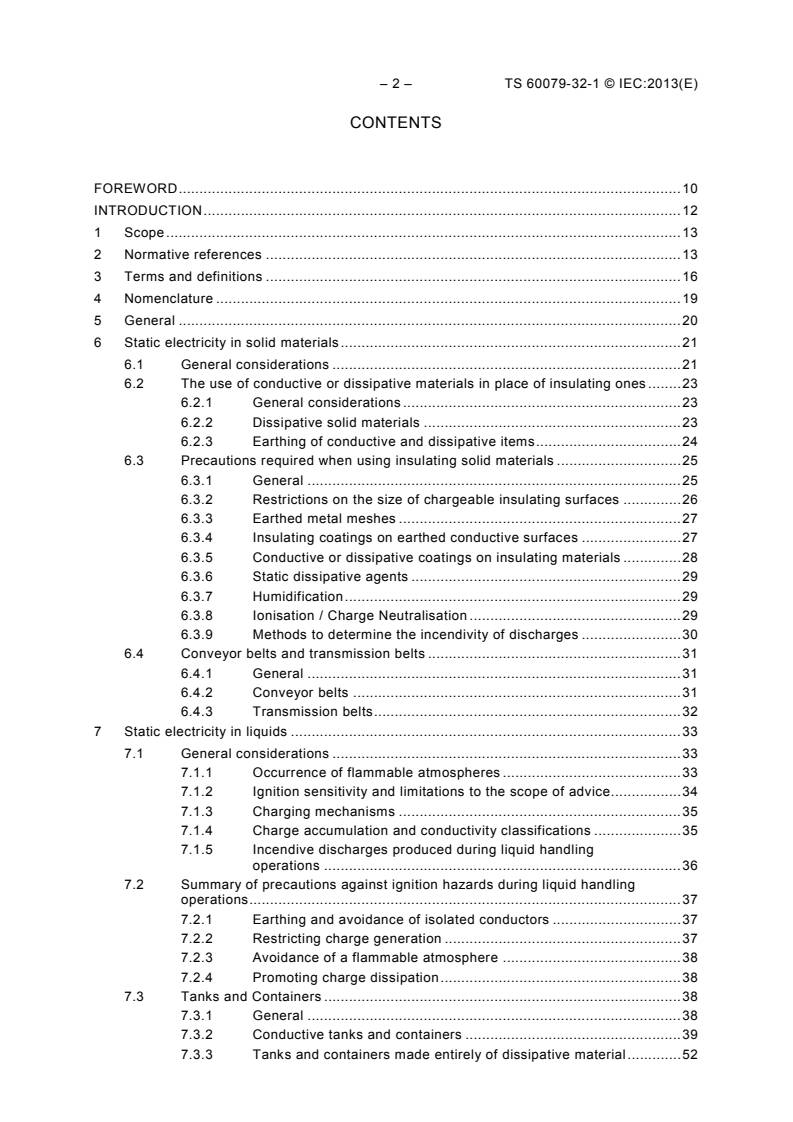
– 2 – TS 60079-32-1 © IEC:2013(E)
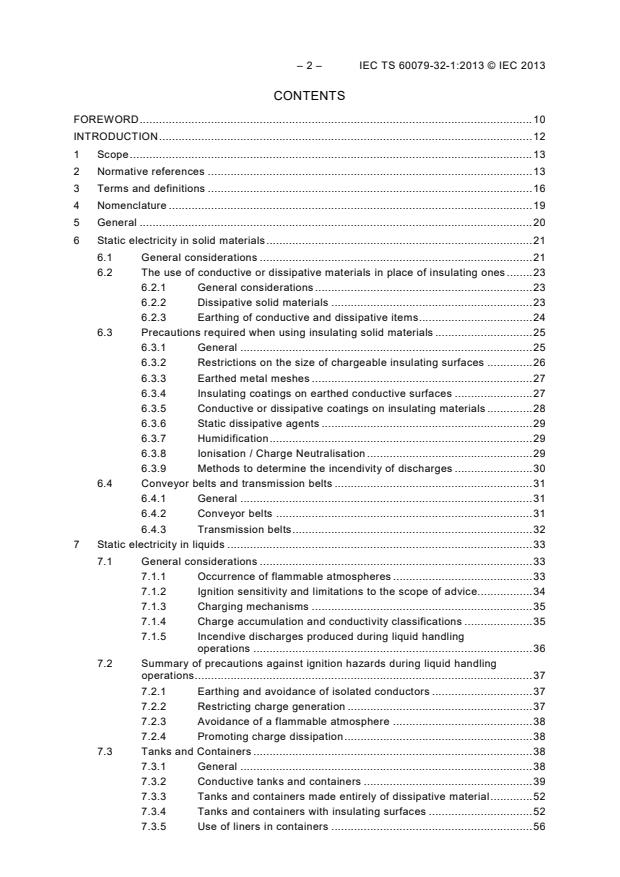
CONTENTS
FOREWORD . 10
INTRODUCTION . 12
1 Scope . 13
2 Normative references . 13
3 Terms and definitions . 16
4 Nomenclature . 19
5 General . 20
6 Static electricity in solid materials . 21
6.1 General considerations . 21
6.2 The use of conductive or dissipative materials in place of insulating ones . 23
6.2.1 General considerations . 23
6.2.2 Dissipative solid materials . 23
6.2.3 Earthing of conductive and dissipative items . 24
6.3 Precautions required when using insulating solid materials . 25
6.3.1 General . 25
6.3.2 Restrictions on the size of chargeable insulating surfaces . 26
6.3.3 Earthed metal meshes . 27
6.3.4 Insulating coatings on earthed conductive surfaces . 27
6.3.5 Conductive or dissipative coatings on insulating materials . 28
6.3.6 Static dissipative agents . 29
6.3.7 Humidification . 29
6.3.8 Ionisation / Charge Neutralisation . 29
6.3.9 Methods to determine the incendivity of discharges . 30
6.4 Conveyor belts and transmission belts . 31
6.4.1 General . 31
6.4.2 Conveyor belts . 31
6.4.3 Transmission belts . 32
7 Static electricity in liquids . 33
7.1 General considerations . 33
7.1.1 Occurrence of flammable atmospheres . 33
7.1.2 Ignition sensitivity and limitations to the scope of advice. 34
7.1.3 Charging mechanisms . 35
7.1.4 Charge accumulation and conductivity classifications . 35
7.1.5 Incendive discharges produced during liquid handling
operations . 36
7.2 Summary of precautions against ignition hazards during liquid handling
operations . 37
7.2.1 Earthing and avoidance of isolated conductors . 37
7.2.2 Restricting charge generation . 37
7.2.3 Avoidance of a flammable atmosphere . 38
7.2.4 Promoting charge dissipation . 38
7.3 Tanks and Containers . 38
7.3.1 General . 38
7.3.2 Conductive tanks and containers . 39
7.3.3 Tanks and containers made entirely of dissipative material . 52
TS 60079-32-1 © IEC:2013(E) – 3 –
7.3.4 Tanks and containers with insulating surfaces . 52
7.3.5 Use of liners in containers . 56
7.4 High viscosity liquids . 57
7.5 High charging equipment . 57
7.5.1 Filters, water separators and strainers . 57
7.5.2 Pumps and other equipment . 58
7.6 Gauging and sampling in tanks . 59
7.6.1 General . 59
7.6.2 Precautions during gauging and sampling . 59
7.7 Pipes and hose assemblies for liquids . 60
7.7.1 General . 60
7.7.2 Pipes . 60
7.7.3 Hoses and hose assemblies . 63
7.8 Special filling procedures . 69
7.8.1 Aircraft fuelling . 69
7.8.2 Road tanker deliveries . 70
7.8.3 Retail filling stations . 71
7.8.4 Mobile or temporary liquid handling equipment . 75
7.9 Plant processes (blending, stirring, mixing, crystallisation and stirred
reactors) . 75
7.9.1 General . 75
7.9.2 Earthing . 75
7.9.3 In-line blending . 75
7.9.4 Blending in vessels or tanks . 76
7.9.5 Jet mixing . 76
7.9.6 High speed mixing . 77
7.10 Spraying liquids and tank cleaning . 77
7.10.1 General . 77
7.10.2 Tank cleaning with low or medium pressure water jets (up to
about 12 bar) . 77
7.10.3 Tank cleaning with low conductivity liquids . 78
7.10.4 Tank cleaning with high pressure water or solvent jets (above
12 bar) . 78
7.10.5 Steam cleaning tanks . 78
7.10.6 Water deluge systems . 79
7.11 Glass systems . 79
7.11.1 General . 79
7.11.2 Precautions to be taken for low conductivity liquids . 79
8 Static electricity in gases . 80
8.1 General . 80
8.2 Grit blasting . 80
8.3 Fire extinguishers . 81
8.4 Inerting . 81
8.5 Steam cleaning . 81
8.6 Accidental leakage of compressed gas . 81
8.7 Spraying of flammable paints and powders . 82
8.7.1 General . 82
8.7.2 Earthing . 82
8.7.3 Plastic spray cabinets . 82
– 4 – TS 60079-32-1 © IEC:2013(E)
8.8 Vacuum cleaners, fixed and mobile . 82
8.8.1 General . 82
8.8.2 Fixed systems. 82
8.8.3 Portable systems . 83
8.8.4 Vacuum trucks . 83
9 Static electricity in powders . 83
9.1 General . 83
9.2 Discharges, occurrence and incendivity . 84
9.3 Procedural measures . 85
9.3.1 General . 85
9.3.2 Humidification . 85
9.3.3 Hoses for pneumatic transfer . 85
9.3.4 Ionisation . 85
9.4 Bulk materials in the absence of flammable gases and vapours . 86
9.4.1 General . 86
9.4.2 Equipment and objects made of conductive or dissipative
materials. 86
9.4.3 Equipment and objects made of insulating materials . 86
9.4.4 Dust separators . 87
9.4.5 Silos and Containers. 87
9.5 Additional requirements for bulk material in the presence of flammable
gases and vapours . 93
9.5.1 General . 93
9.5.2 Measures for resistivity greater equal 100 MΩ m . 93
9.5.3 Measures for resistivity less than 100 MΩ m . 93
9.5.4 Filling of bulk material into a container . 94
9.6 Flexible intermediate bulk containers (FIBC) . 95
9.6.1 General . 95
9.6.2 Additional precautions when using FIBC . 97
10 Static electricity when handling explosives and electro-explosive devices . 98
10.1 Explosives manufacture, handling and storage . 98
10.1.1 General . 98
10.1.2 First degree protection . 98
10.1.3 Intermediate protection . 98
10.1.4 Second degree protection . 98
10.2 Handling of electro-explosive devices . 99
10.2.1 General . 99
10.2.2 Earthing . 99
10.2.3 Precautions during storage and issue . 100
10.2.4 Precautions during preparation for use . 100
11 Static electricity on people . 100
11.1 General considerations . 100
11.2 Static dissipative floors . 101
11.3 Dissipative and conductive footwear . 101
11.4 Supplementary devices for earthing of people . 102
11.5 Clothing . 102
11.6 Gloves . 104
11.7 Other Items . 104
12 Electrostatic shock . 104
TS 60079-32-1 © IEC:2013(E) – 5 –
12.1 Introduction . 104
12.2 Discharges relevant to electrostatic shocks . 105
12.3 Sources of electrostatic shock. 105
12.4 Precautions to avoid electrostatic shocks . 106
12.4.1 Sources of electrostatic shocks. 106
12.4.2 Reported shocks from equipment or processes . 106
12.4.3 Shocks as a result of people being charged . 106
12.5 Precautions in special cases . 107
12.5.1 Pneumatic conveying . 107
12.5.2 Vacuum cleaners . 107
12.5.3 Reels of charged film or sheet . 107
12.5.4 Fire extinguishers . 108
13 Earthing and bonding. 108
13.1 General . 108
13.2 Criteria for the dissipation of static electricity from a conductor . 109
13.2.1 Basic considerations . 109
13.2.2 Practical criteria . 109
13.3 Earthing requirements in practical systems . 111
13.3.1 All-metal systems . 111
13.3.2 Metal plant with insulating parts . 112
13.3.3 Insulating materials . 113
13.3.4 Conductive and dissipative materials . 114
13.3.5 Earthing via intrinsic safety circuits . 114
13.3.6 Earthing of ships . 114
13.4 The establishment and monitoring of earthing systems . 114
13.4.1 Design . 114
13.4.2 Monitoring . 115
Annex A (informative) Fundamentals of static electricity . 116
A.1 Electrostatic charging . 116
A.1.1 Introduction . 116
A.1.2 Contact charging . 116
A.1.3 Contact charging of liquids . 116
A.1.4 Charge generation on liquids flowing in pipes . 117
A.1.5 Charge generation in filters . 120
A.1.6 Charge generation during stirring and mixing of liquids . 120
A.1.7 Settling potentials . 120
A.1.8 Breakup of liquid jets . 120
A.1.9 Contact charging of powders . 120
A.1.10 Charging by induction . 121
A.1.11 Charge transfer by conduction . 121
A.1.12 Charging by corona discharge . 121
A.2 Accumulation of electrostatic charge . 121
A.2.1 General . 121
A.2.2 Charge accumulation on liquids . 122
A.2.3 Charge accumulation on powders . 123
A.3 Electrostatic discharges . 124
A.3.1 Introduction . 124
A.3.2 Sparks . 124
A.3.3 Corona . 125
– 6 – TS 60079-32-1 © IEC:2013(E)
A.3.4 Brush discharges . 125
A.3.5 Propagating brush discharges. 126
A.3.6 Lightning like discharges . 126
A.3.7 Cone discharges . 127
A.4 Measurements for risk assessment . 127
Annex B (informative) Electrostatic discharges in specific situations . 129
B.1 Incendive discharges involving insulating solid materials . 129
B.1.1 General . 129
B.1.2 Sparks from isolated conductors . 129
B.1.3 Brush discharges from insulating solid materials . 129
B.1.4 Propagating brush discharges from insulating solid materials . 129
B.2 Incendive discharges produced during liquid handling . 130
B.2.1 General . 130
B.2.2 Calculated maximum safe flow velocities for filling medium-
sized vertical axis storage tanks . 130
B.3 Incendive discharges produced during powder handling and storage . 132
B.3.1 General . 132
B.3.2 Discharges from bulk powder . 132
B.3.3 Discharges from powder clouds . 132
B.3.4 Discharges involving insulating containers and people . 132
B.3.5 The use of liners in powder processes . 132
B.3.6 Spark discharges in powder processes . 133
B.3.7 Brush discharges in powder processes . 133
B.3.8 Corona discharges in powder processes . 133
B.3.9 Propagating brush discharges in powder processes . 133
Annex C (informative) Flammability properties of substances . 135
C.1 General . 135
C.2 Effect of oxygen concentration and ambient conditions . 135
C.3 Explosive limits for gases and liquids . 135
C.4 Inerting . 135
C.5 Flash point . 136
C.6 Minimum ignition energies. 136
C.7 Combustible powders . 139
C.8 Biofuels. 139
Annex D (informative) Classification of hazardous areas . 140
D.1 Concept of zoning . 140
D.2 Classification . 140
D.3 Explosion groups . 140
D.3.1 General . 140
D.3.2 Group I . 140
D.3.3 Group II . 141
D.3.4 Group III . 141
Annex E (informative) Classification of equipment protection level . 142
Annex F (informative) Flow chart for a systematic electrostatic evaluation . 143
Annex G (informative) Tests . 145
G.1 General . 145
G.2 Surface resistance . 145
G.2.1 General . 145
TS 60079-32-1 © IEC:2013(E) – 7 –
G.2.2 Principle . 145
G.2.3 Apparatus . 145
G.2.4 Test sample . 146
G.2.5 Procedure . 147
G.2.6 Acceptance criteria . 147
G.2.7 Test report . 147
G.3 Surface resistivity . 147
G.4 Leakage resistance . 148
G.4.1 General . 148
G.4.2 Principle . 148
G.4.3 Apparatus . 148
G.4.4 Test sample . 148
G.4.5 Procedure . 149
G.4.6 Acceptance criteria . 149
G.4.7 Test report . 149
G.5 In-use testing of footwear . 149
G.5.1 General . 149
G.5.2 Principle . 149
G.5.3 Apparatus . 149
G.5.4 Procedure . 150
G.5.5 Acceptance criteria . 150
G.5.6 Test report . 150
G.6 In-use testing of gloves . 150
G.6.1 General . 150
G.6.2 Principle . 150
G.6.3 Apparatus . 151
G.6.4 Procedure . 151
G.6.5 Acceptance criteria . 151
G.6.6 Test report . 151
G.7 Powder resistivity . 151
G.7.1 General . 151
G.7.2 Principle . 151
G.7.3 Apparatus . 152
G.7.4 Procedure . 152
G.7.5 Acceptance criteria . 153
G.7.6 Test report . 153
G.8 Liquid conductivity . 153
G.8.1 General . 153
G.8.2 Principle . 153
G.8.3 Apparatus . 153
G.8.4 Procedure . 154
G.8.5 Acceptance criteria . 154
G.8.6 Test report . 154
G.9 Capacitance . 155
G.9.1 General . 155
G.9.2 Principle . 155
G.9.3 Apparatus . 155
G.9.4 Test sample . 155
G.9.5 Procedure for moveable items . 155
– 8 – TS 60079-32-1 © IEC:2013(E)
G.9.6 Procedure for installed items . 156
G.9.7 Acceptance criteria . 156
G.9.8 Test report . 156
G.10 Transferred charge . 157
G.10.1 General . 157
G.10.2 Principle . 157
G.10.3 Apparatus . 157
G.10.4 Test sample . 158
G.10.5 Procedure . 158
G.10.6 Acceptance criteria . 159
G.10.7 Test report . 159
G.11 Ignition test . 160
G.11.1 General . 160
G.11.2 Apparatus . 160
G.11.3 Procedure . 163
G.11.4 Acceptance criteria . 163
G.11.5 Test report . 163
G.12 Measuring of charge decay . 164
G.12.1 General . 164
G.12.2 Principle . 164
G.12.3 Apparatus . 164
G.12.4 Test sample . 165
G.12.5 Procedure . 165
G.12.6 Acceptance criteria . 166
G.12.7 Test report . 166
G.13 Breakthrough voltage . 166
G.13.1 General . 166
G.13.2 Principle . 166
G.13.3 Apparatus . 166
G.13.4 Test procedure . 167
G.13.5 Acceptance criteria . 167
G.13.6 Test report . 167
Bibliography . 169
Figure 1 – Flow diagram: Assessment of bulk material with ρ ≤ 1 MΩ m . 89
Figure 2 – Flow diagram: Assessment of bulk material with 1 MΩ m < ρ ≤ 10 GΩ m . 90
Figure 3 – Flow diagram: Assessment of bulk material with ρ > 10 GΩ m . 91
Figure 4 – Difference between earthing and bonding . 108
Figure 5 – Hazardous earthed conductor in contact with a flowing insulator . 113
Figure A.1 – Equivalent electrical circuit for an electrostatically charged conductor. 122
Figure B.1 – Calculated maximum safe filling velocities for medium sized tanks (see
7.3.2.2.5.2) . 131
Figure F.1 – Flowchart for a systematic electrostatic evaluation . 144
Figure G.1 – Test sample with applied electrodes . 146
Figure G.2 – Measuring cell for powder resistivity . 152
Figure G.3 – Measuring cell for liquid conductivity . 154
Figure G.4 – Ignition probe . 162
TS 60079-32-1 © IEC:2013(E) – 9 –
Figure G.5 – Perforated plate of ignition probe . 163
Figure G.6 – Example of an arrangement for measurement of charge decay . 165
Figure G.7 – Electrodes for measuring breakthrough voltage of sheets . 167
Table 1 – Boundary limits at (23 ± 2) °C and (25 ± 5) % RH for the characterisation of
solid materials and examples for the classification of objects . 22
Table 2 – Maximum allowed isolated capacitance in Zones with explosive atmosphere . 25
Table 3 – Restriction on size of insulating solid materials in hazardous areas . 27
Table 4 – Maximum acceptable transferred charge . 31
Table 5 – Requirements for conveyor belts . 32
Table 6 – Requirements for transmission belts . 33
Table 7 – Conductivities and relaxation times of some liquids . 36
Table 8 – Precautions for filling large conductive tanks with low conductivity liquids . 41
Table 9 – Filling rate limits for filling medium-sized vertical-axis tanks through
schedule 40 pipes . 47
Table 10 – Velocity and filling rate limits for loading low conductivity liquids into short
(N=1), fixed horizontal axis tanks via schedule 40 pipes . 48
Table 11 – Vehicles and compartments suitable for high-speed loading for ADR
compliant vehicles . 49
Table 12 – Influence of the sulphur content on middle distillate vd limits for road
tankers . 50
Table 13 – Velocity and filling rate limits for road tankers based on schedule 40 pipes;
rates for hoses will be similar . 50
Table 14 – Velocity and filling rate limits for loading rail tankers . 51
Table 15 – Classification of end-to-end hose resistances for control of hazards from
static electricity and stray current . 64
Table 16 – ISO 8031 classification of hose grades . 66
Table 17 – Hybrid grades of hoses and hose assemblies . 67
Table 18 – Hose selection Table for flammable liquid service . 68
Table 19 – Use of the different types of FIBC . 96
Table 20 – Inner liners and FIBC: combinations that are permissible and not
permissible in hazardous atmospheres . 97
Table 21 – Determination of requirement for electrostatic dissipative protective clothing
and other items of personal protective equipment . 103
Table 22 – Summary of maximum earthing resistances for the control of static
electricity in hazardous areas . 110
Table A.1 – Charge build up on powders . 121
Table A.2 – Values of capacitances for typical conductors . 125
Table C.1 – Typical MIE intervals with examples . 137
Table C.2 – Minimum ignition energy MIE and minimum ignition charge MIQ . 138
Table G.1 – Volume concentrations of flammable gas mixtures . 161
– 10 – TS 60079-32-1 © IEC:2013(E)
INTERNATIONAL ELECTROTECHNICAL COMMISSION
____________
EXPLOSIVE ATMOSPHERES –
Part 32-1: Electrostatic hazards, guidance
FOREWORD
1) The International Electrotechnical Commission (IEC) is a worldwide organization for standardization comprising
all national electrotechnical committees (IEC National Committees). The object of IEC is to promote
international co-operation on all questions concerning standardization in the electrical and electronic fields. To
this end and in addition to other activities, IEC publishes International Standards, Technical Specifications,
Technical Reports, Publicly Available Specifications (PAS) and Guides (hereafter referred to as “IEC
Publication(s)”). Their preparation is entrusted to technical committees; any IEC National Committee interested
in the subject dealt with may participate in this preparatory work. International, governmental and non-
governmental organizations liaising with the IEC also participate in this preparation. IEC collaborates closely
with the International Organization for Standardization (ISO) in accordance with conditions determined by
agreement between the two organizations.
2) The formal decisions or agreemen
...
IEC TS 60079-32-1 ®
Edition 1.1 2017-03
CONSOLIDATED VERSION
TECHNICAL
SPECIFICATION
SPECIFICATION
TECHNIQUE
colour
inside
Explosive atmospheres –
Part 32-1: Electrostatic hazards, guidance
Atmosphères explosives –
Partie 32-1: Dangers électrostatiques – Recommandations
All rights reserved. Unless otherwise specified, no part of this publication may be reproduced or utilized in any form
or by any means, electronic or mechanical, including photocopying and microfilm, without permission in writing from
either IEC or IEC's member National Committee in the country of the requester. If you have any questions about IEC
copyright or have an enquiry about obtaining additional rights to this publication, please contact the address below or
your local IEC member National Committee for further information.
Droits de reproduction réservés. Sauf indication contraire, aucune partie de cette publication ne peut être reproduite
ni utilisée sous quelque forme que ce soit et par aucun procédé, électronique ou mécanique, y compris la photocopie
et les microfilms, sans l'accord écrit de l'IEC ou du Comité national de l'IEC du pays du demandeur. Si vous avez des
questions sur le copyright de l'IEC ou si vous désirez obtenir des droits supplémentaires sur cette publication, utilisez
les coordonnées ci-après ou contactez le Comité national de l'IEC de votre pays de résidence.
IEC Central Office Tel.: +41 22 919 02 11
3, rue de Varembé info@iec.ch
CH-1211 Geneva 20 www.iec.ch
Switzerland
About the IEC
The International Electrotechnical Commission (IEC) is the leading global organization that prepares and publishes
International Standards for all electrical, electronic and related technologies.
About IEC publications
The technical content of IEC publications is kept under constant review by the IEC. Please make sure that you have the
latest edition, a corrigendum or an amendment might have been published.
IEC publications search - webstore.iec.ch/advsearchform Electropedia - www.electropedia.org
The advanced search enables to find IEC publications by a The world's leading online dictionary on electrotechnology,
variety of criteria (reference number, text, technical containing more than 22 000 terminological entries in English
committee,…). It also gives information on projects, replaced and French, with equivalent terms in 16 additional languages.
and withdrawn publications. Also known as the International Electrotechnical Vocabulary
(IEV) online.
IEC Just Published - webstore.iec.ch/justpublished
Stay up to date on all new IEC publications. Just Published IEC Glossary - std.iec.ch/glossary
details all new publications released. Available online and 67 000 electrotechnical terminology entries in English and
once a month by email. French extracted from the Terms and definitions clause of
IEC publications issued between 2002 and 2015. Some
IEC Customer Service Centre - webstore.iec.ch/csc entries have been collected from earlier publications of IEC
If you wish to give us your feedback on this publication or TC 37, 77, 86 and CISPR.
need further assistance, please contact the Customer Service
Centre: sales@iec.ch.
A propos de l'IEC
La Commission Electrotechnique Internationale (IEC) est la première organisation mondiale qui élabore et publie des
Normes internationales pour tout ce qui a trait à l'électricité, à l'électronique et aux technologies apparentées.
A propos des publications IEC
Le contenu technique des publications IEC est constamment revu. Veuillez vous assurer que vous possédez l’édition la
plus récente, un corrigendum ou amendement peut avoir été publié.
Recherche de publications IEC - Electropedia - www.electropedia.org
webstore.iec.ch/advsearchform Le premier dictionnaire d'électrotechnologie en ligne au
La recherche avancée permet de trouver des publications IEC monde, avec plus de 22 000 articles terminologiques en
en utilisant différents critères (numéro de référence, texte, anglais et en français, ainsi que les termes équivalents dans
comité d’études,…). Elle donne aussi des informations sur les 16 langues additionnelles. Egalement appelé Vocabulaire
projets et les publications remplacées ou retirées. Electrotechnique International (IEV) en ligne.
IEC Just Published - webstore.iec.ch/justpublished Glossaire IEC - std.iec.ch/glossary
Restez informé sur les nouvelles publications IEC. Just 67 000 entrées terminologiques électrotechniques, en anglais
Published détaille les nouvelles publications parues. et en français, extraites des articles Termes et définitions des
Disponible en ligne et une fois par mois par email. publications IEC parues entre 2002 et 2015. Plus certaines
entrées antérieures extraites des publications des CE 37, 77,
Service Clients - webstore.iec.ch/csc 86 et CISPR de l'IEC.
Si vous désirez nous donner des commentaires sur cette
publication ou si vous avez des questions contactez-nous:
sales@iec.ch.
IEC TS 60079-32-1 ®
Edition 1.1 2017-03
CONSOLIDATED VERSION
TECHNICAL
SPECIFICATION
SPECIFICATION
TECHNIQUE
colour
inside
Explosive atmospheres –
Part 32-1: Electrostatic hazards, guidance
Atmosphères explosives –
Partie 32-1: Dangers électrostatiques – Recommandations
INTERNATIONAL
ELECTROTECHNICAL
COMMISSION
COMMISSION
ELECTROTECHNIQUE
INTERNATIONALE
ICS 29.260.20 ISBN 978-2-8322-8887-0
IEC TS 60079-32-1 ®
Edition 1.1 2017-03
CONSOLIDATED VERSION
REDLINE VERSION
VERSION REDLINE
colour
inside
Explosive atmospheres –
Part 32-1: Electrostatic hazards, guidance
Atmosphères explosives –
Partie 32-1: Dangers électrostatiques – Recommandations
– 2 – IEC TS 60079-32-1:2013+AMD1:2017 CSV
© IEC 2017
CONTENTS
FOREWORD . 11
INTRODUCTION . 13
1 Scope . 14
2 Normative references . 14
3 Terms and definitions . 17
4 Nomenclature . 20
5 General . 21
6 Static electricity in solid materials . 22
6.1 General considerations . 22
6.2 The use of conductive or dissipative materials in place of insulating ones . 24
6.2.1 General considerations . 24
6.2.2 Dissipative solid materials . 24
6.2.3 Earthing of conductive and dissipative items . 25
6.3 Precautions required when using insulating solid materials . 26
6.3.1 General . 26
6.3.2 Restrictions on the size of chargeable insulating surfaces . 27
6.3.3 Earthed metal meshes . 28
6.3.4 Insulating coatings on earthed conductive surfaces . 28
6.3.5 Conductive or dissipative coatings on insulating materials . 29
6.3.6 Static dissipative agents . 30
6.3.7 Humidification . 30
6.3.8 Ionisation / Charge Neutralisation . 30
6.3.9 Methods to determine the incendivity of discharges . 31
6.4 Conveyor belts and transmission belts . 32
6.4.1 General . 32
6.4.2 Conveyor belts . 32
6.4.3 Transmission belts . 33
7 Static electricity in liquids . 34
7.1 General considerations . 34
7.1.1 Occurrence of flammable atmospheres . 34
7.1.2 Ignition sensitivity and limitations to the scope of advice. 35
7.1.3 Charging mechanisms . 36
7.1.4 Charge accumulation and conductivity classifications . 36
7.1.5 Incendive discharges produced during liquid handling
operations . 37
7.2 Summary of precautions against ignition hazards during liquid handling
operations . 38
7.2.1 Earthing and avoidance of isolated conductors . 38
7.2.2 Restricting charge generation . 38
7.2.3 Avoidance of a flammable atmosphere . 39
7.2.4 Promoting charge dissipation . 39
7.3 Tanks and Containers . 39
7.3.1 General . 39
7.3.2 Conductive tanks and containers . 40
7.3.3 Tanks and containers made entirely of dissipative material . 53
7.3.4 Tanks and containers with insulating surfaces . 53
© IEC 2017
7.3.5 Use of liners in containers . 57
7.4 High viscosity liquids . 58
7.5 High charging equipment . 58
7.5.1 Filters, water separators and strainers . 58
7.5.2 Pumps and other equipment . 59
7.6 Gauging and sampling in tanks . 60
7.6.1 General . 60
7.6.2 Precautions during gauging and sampling . 60
7.7 Pipes and hose assemblies for liquids . 61
7.7.1 General . 61
7.7.2 Pipes . 61
7.7.3 Hoses and hose assemblies . 64
7.8 Special filling procedures . 70
7.8.1 Aircraft fuelling . 70
7.8.2 Road tanker deliveries . 71
7.8.3 Retail filling stations . 72
7.8.4 Mobile or temporary liquid handling equipment . 76
7.9 Plant processes (blending, stirring, mixing, crystallisation and stirred
reactors) . 76
7.9.1 General . 76
7.9.2 Earthing . 76
7.9.3 In-line blending . 76
7.9.4 Blending in vessels or tanks . 77
7.9.5 Jet mixing . 77
7.9.6 High speed mixing . 78
7.10 Spraying liquids and tank cleaning . 78
7.10.1 General . 78
7.10.2 Tank cleaning with low or medium pressure water jets (up to
about 12 bar) . 78
7.10.3 Tank cleaning with low conductivity liquids . 79
7.10.4 Tank cleaning with high pressure water or solvent jets (above
12 bar) . 79
7.10.5 Steam cleaning tanks . 79
7.10.6 Water deluge systems . 80
7.11 Glass systems . 80
7.11.1 General . 80
7.11.2 Precautions to be taken for low conductivity liquids . 80
8 Static electricity in gases . 81
8.1 General . 81
8.2 Grit blasting . 81
8.3 Fire extinguishers . 82
8.4 Inerting . 82
8.5 Steam cleaning . 82
8.6 Accidental leakage of compressed gas . 82
8.7 Spraying of flammable paints and powders . 83
8.7.1 General . 83
8.7.2 Earthing . 83
8.7.3 Plastic spray cabinets . 83
8.8 Vacuum cleaners, fixed and mobile . 83
– 4 – IEC TS 60079-32-1:2013+AMD1:2017 CSV
© IEC 2017
8.8.1 General . 83
8.8.2 Fixed systems. 83
8.8.3 Portable systems . 84
8.8.4 Vacuum trucks . 84
9 Static electricity in powders . 84
9.1 General . 84
9.2 Discharges, occurrence and incendivity . 85
9.3 Procedural measures . 86
9.3.1 General . 86
9.3.2 Humidification . 86
9.3.3 Hoses for pneumatic transfer . 86
9.3.4 Ionisation . 86
9.4 Bulk materials in the absence of flammable gases and vapours . 87
9.4.1 General . 87
9.4.2 Equipment and objects made of conductive or dissipative
materials. 87
9.4.3 Equipment and objects made of insulating materials . 87
9.4.4 Dust separators . 88
9.4.5 Silos and Containers. 88
9.5 Additional requirements for bulk material in the presence of flammable
gases and vapours . 94
9.5.1 General . 94
9.5.2 Measures for resistivity greater equal 100 MΩ m . 94
9.5.3 Measures for resistivity less than 100 MΩ m . 94
9.5.4 Filling of bulk material into a container . 95
9.6 Flexible intermediate bulk containers (FIBC) . 96
9.6.1 General . 96
9.6.2 Additional precautions when using FIBC . 98
10 Static electricity when handling explosives and electro-explosive devices . 99
10.1 Explosives manufacture, handling and storage . 99
10.1.1 General . 99
10.1.2 First degree protection . 99
10.1.3 Intermediate protection . 99
10.1.4 Second degree protection . 99
10.2 Handling of electro-explosive devices . 100
10.2.1 General . 100
10.2.2 Earthing . 100
10.2.3 Precautions during storage and issue . 101
10.2.4 Precautions during preparation for use . 101
11 Static electricity on people . 101
11.1 General considerations . 101
11.2 Static dissipative floors . 102
11.3 Dissipative and conductive footwear . 102
11.4 Supplementary devices for earthing of people . 103
11.5 Clothing . 103
11.6 Gloves . 105
11.7 Other Items . 105
12 Electrostatic shock . 105
12.1 Introduction . 105
© IEC 2017
12.2 Discharges relevant to electrostatic shocks . 106
12.3 Sources of electrostatic shock. 106
12.4 Precautions to avoid electrostatic shocks . 107
12.4.1 Sources of electrostatic shocks. 107
12.4.2 Reported shocks from equipment or processes . 107
12.4.3 Shocks as a result of people being charged . 107
12.5 Precautions in special cases . 108
12.5.1 Pneumatic conveying . 108
12.5.2 Vacuum cleaners . 108
12.5.3 Reels of charged film or sheet . 108
12.5.4 Fire extinguishers . 109
13 Earthing and bonding. 109
13.1 General . 109
13.2 Criteria for the dissipation of static electricity from a conductor . 110
13.2.1 Basic considerations . 110
13.2.2 Practical criteria . 110
13.3 Earthing requirements in practical systems . 112
13.3.1 All-metal systems . 112
13.3.2 Metal plant with insulating parts . 113
13.3.3 Insulating materials . 114
13.3.4 Conductive and dissipative materials . 115
13.3.5 Earthing via intrinsic safety circuits . 115
13.3.6 Earthing of ships . 115
13.4 The establishment and monitoring of earthing systems . 115
13.4.1 Design . 115
13.4.2 Monitoring . 116
14 Special requirements for equipment according to IEC 60079-0 . 116
14.1 General . 116
14.2 Electrostatic charges on external non-metallic materials . 117
14.2.1 Applicability . 117
14.2.2 Avoidance of a build-up of electrostatic charge on Group I or
Group II electrical equipment . 117
14.2.3 Avoidance of a build-up of electrostatic charge on equipment
for Group III . 120
14.3 Electrostatic charges on external conductive parts . 120
Annex A (informative) Fundamentals of static electricity . 121
A.1 Electrostatic charging . 121
A.1.1 Introduction . 121
A.1.2 Contact charging . 121
A.1.3 Contact charging of liquids . 121
A.1.4 Charge generation on liquids flowing in pipes . 122
A.1.5 Charge generation in filters . 125
A.1.6 Charge generation during stirring and mixing of liquids . 125
A.1.7 Settling potentials . 125
A.1.8 Breakup of liquid jets . 125
A.1.9 Contact charging of powders . 125
A.1.10 Charging by induction . 126
A.1.11 Charge transfer by conduction . 126
A.1.12 Charging by corona discharge . 126
– 6 – IEC TS 60079-32-1:2013+AMD1:2017 CSV
© IEC 2017
A.2 Accumulation of electrostatic charge . 126
A.2.1 General . 126
A.2.2 Charge accumulation on liquids . 127
A.2.3 Charge accumulation on powders . 128
A.3 Electrostatic discharges . 129
A.3.1 Introduction . 129
A.3.2 Sparks . 129
A.3.3 Corona . 130
A.3.4 Brush discharges . 130
A.3.5 Propagating brush discharges. 131
A.3.6 Lightning like discharges . 131
A.3.7 Cone discharges . 132
A.4 Measurements for risk assessment . 132
Annex B (informative) Electrostatic discharges in specific situations . 134
B.1 Incendive discharges involving insulating solid materials . 134
B.1.1 General . 134
B.1.2 Sparks from isolated conductors . 134
B.1.3 Brush discharges from insulating solid materials . 134
B.1.4 Propagating brush discharges from insulating solid materials . 134
B.2 Incendive discharges produced during liquid handling . 135
B.2.1 General . 135
B.2.2 Calculated maximum safe flow velocities for filling medium-
sized vertical axis storage tanks . 135
B.3 Incendive discharges produced during powder handling and storage . 137
B.3.1 General . 137
B.3.2 Discharges from bulk powder . 137
B.3.3 Discharges from powder clouds . 137
B.3.4 Discharges involving insulating containers and people . 137
B.3.5 The use of liners in powder processes . 137
B.3.6 Spark discharges in powder processes . 138
B.3.7 Brush discharges in powder processes . 138
B.3.8 Corona discharges in powder processes . 138
B.3.9 Propagating brush discharges in powder processes . 138
Annex C (informative) Flammability properties of substances . 140
C.1 General . 140
C.2 Effect of oxygen concentration and ambient conditions . 140
C.3 Explosive limits for gases and liquids . 140
C.4 Inerting . 140
C.5 Flash point . 141
C.6 Minimum ignition energies. 141
C.7 Combustible powders . 144
C.8 Biofuels. 144
Annex D (informative) Classification of hazardous areas . 145
D.1 Concept of zoning . 145
D.2 Classification . 145
D.3 Explosion groups . 145
D.3.1 General . 145
D.3.2 Group I . 145
D.3.3 Group II . 146
© IEC 2017
D.3.4 Group III . 146
Annex E (informative) Classification of equipment protection level . 147
Annex F (informative) Flow chart for a systematic electrostatic evaluation . 148
Annex G (informative) Tests . 150
G.1 General . 150
G.2 Surface resistance . 150
G.2.1 General . 150
G.2.2 Principle . 150
G.2.3 Apparatus . 150
G.2.4 Test sample . 151
G.2.5 Procedure . 152
G.2.6 Acceptance criteria . 152
G.2.7 Test report . 152
G.3 Surface resistivity . 152
G.4 Leakage resistance . 153
G.4.1 General . 153
G.4.2 Principle . 153
G.4.3 Apparatus . 153
G.4.4 Test sample . 153
G.4.5 Procedure . 154
G.4.6 Acceptance criteria . 154
G.4.7 Test report . 154
G.5 In-use testing of footwear . 154
G.5.1 General . 154
G.5.2 Principle . 154
G.5.3 Apparatus . 154
G.5.4 Procedure . 155
G.5.5 Acceptance criteria . 155
G.5.6 Test report . 155
G.6 In-use testing of gloves . 155
G.6.1 General . 155
G.6.2 Principle . 155
G.6.3 Apparatus . 156
G.6.4 Procedure . 156
G.6.5 Acceptance criteria . 156
G.6.6 Test report . 156
G.7 Powder resistivity . 156
G.7.1 General . 156
G.7.2 Principle . 156
G.7.3 Apparatus . 157
G.7.4 Procedure . 157
G.7.5 Acceptance criteria . 158
G.7.6 Test report . 158
G.8 Liquid conductivity . 158
G.8.1 General . 158
G.8.2 Principle . 158
G.8.3 Apparatus . 158
G.8.4 Procedure . 159
G.8.5 Acceptance criteria . 159
– 8 – IEC TS 60079-32-1:2013+AMD1:2017 CSV
© IEC 2017
G.8.6 Test report . 159
G.9 Capacitance . 160
G.9.1 General . 160
G.9.2 Principle . 160
G.9.3 Apparatus . 160
G.9.4 Test sample . 160
G.9.5 Procedure for moveable items . 160
G.9.6 Procedure for installed items . 161
G.9.7 Acceptance criteria . 161
G.9.8 Test report . 161
G.10 Transferred charge . 162
G.10.1 General . 162
G.10.2 Principle . 162
G.10.3 Apparatus . 162
G.10.4 Test sample . 163
G.10.5 Procedure . 163
G.10.6 Acceptance criteria . 164
G.10.7 Test report . 164
G.11 Ignition test . 165
G.11.1 General . 165
G.11.2 Apparatus . 165
G.11.3 Procedure . 168
G.11.4 Acceptance criteria . 168
G.11.5 Test report . 168
G.12 Measuring of charge decay . 169
G.12.1 General . 169
G.12.2 Principle . 169
G.12.3 Apparatus . 169
G.12.4 Test sample . 170
G.12.5 Procedure . 170
G.12.6 Acceptance criteria . 171
G.12.7 Test report . 171
G.13 Breakthrough voltage . 171
G.13.1 General . 171
G.13.2 Principle . 171
G.13.3 Apparatus . 171
G.13.4 Test procedure . 172
G.13.5 Acceptance criteria . 172
G.13.6 Test report . 172
Bibliography . 174
Figure 1 – Flow diagram: Assessment of bulk material with ρ ≤ 1 MΩ m . 90
Figure 2 – Flow diagram: Assessment of bulk material with 1 MΩ m < ρ ≤ 10 GΩ m . 91
Figure 3 – Flow diagram: Assessment of bulk material with ρ > 10 GΩ m . 92
Figure 4 – Difference between earthing and bonding . 109
Figure 5 – Hazardous earthed conductor in contact with a flowing insulator . 114
Figure A.1 – Equivalent electrical circuit for an electrostatically charged conductor. 127
© IEC 2017
Figure B.1 – Calculated maximum safe filling velocities for medium sized tanks (see
7.3.2.2.5.2) . 136
Figure F.1 – Flowchart for a systematic electrostatic evaluation . 149
Figure G.1 – Test sample with applied electrodes . 151
Figure G.2 – Measuring cell for powder resistivity . 157
Figure G.3 – Measuring cell for liquid conductivity . 159
Figure G.4 – Ignition probe . 167
Figure G.5 – Perforated plate of ignition probe . 168
Figure G.6 – Example of an arrangement for measurement of charge decay . 170
Figure G.7 – Electrodes for measuring breakthrough voltage of sheets . 172
Table 1 – Boundary limits at (23 ± 2) °C and (25 ± 5) % RH for the characterisation of
solid materials and examples for the classification of objects . 23
Table 2 – Maximum allowed isolated capacitance in Zones with explosive atmosphere . 26
Table 3 – Restriction on size of insulating solid materials in hazardous areas . 28
Table 4 – Maximum acceptable transferred charge . 32
Table 5 – Requirements for conveyor belts . 33
Table 6 – Requirements for transmission belts . 34
Table 7 – Conductivities and re
...
IEC TS 60079-32-1 ®
Edition 1.0 2013-03
TECHNICAL
SPECIFICATION
SPECIFICATION
TECHNIQUE
Explosive atmospheres –
Part 32-1: Electrostatic hazards, guidance
Atmosphères explosives –
Partie 32-1: Dangers électrostatiques – Recommandations
All rights reserved. Unless otherwise specified, no part of this publication may be reproduced or utilized in any form
or by any means, electronic or mechanical, including photocopying and microfilm, without permission in writing from
either IEC or IEC's member National Committee in the country of the requester. If you have any questions about IEC
copyright or have an enquiry about obtaining additional rights to this publication, please contact the address below or
your local IEC member National Committee for further information.
Droits de reproduction réservés. Sauf indication contraire, aucune partie de cette publication ne peut être reproduite
ni utilisée sous quelque forme que ce soit et par aucun procédé, électronique ou mécanique, y compris la photocopie
et les microfilms, sans l'accord écrit de l'IEC ou du Comité national de l'IEC du pays du demandeur. Si vous avez des
questions sur le copyright de l'IEC ou si vous désirez obtenir des droits supplémentaires sur cette publication, utilisez
les coordonnées ci-après ou contactez le Comité national de l'IEC de votre pays de résidence.
IEC Central Office Tel.: +41 22 919 02 11
3, rue de Varembé info@iec.ch
CH-1211 Geneva 20 www.iec.ch
Switzerland
About the IEC
The International Electrotechnical Commission (IEC) is the leading global organization that prepares and publishes
International Standards for all electrical, electronic and related technologies.
About IEC publications
The technical content of IEC publications is kept under constant review by the IEC. Please make sure that you have the
latest edition, a corrigenda or an amendment might have been published.
IEC Catalogue - webstore.iec.ch/catalogue Electropedia - www.electropedia.org
The stand-alone application for consulting the entire The world's leading online dictionary of electronic and
bibliographical information on IEC International Standards, electrical terms containing 21 000 terms and definitions in
Technical Specifications, Technical Reports and other English and French, with equivalent terms in 16 additional
documents. Available for PC, Mac OS, Android Tablets and languages. Also known as the International Electrotechnical
iPad. Vocabulary (IEV) online.
IEC publications search - webstore.iec.ch/advsearchform IEC Glossary - std.iec.ch/glossary
The advanced search enables to find IEC publications by a 67 000 electrotechnical terminology entries in English and
variety of criteria (reference number, text, technical French extracted from the Terms and Definitions clause of
committee,…). It also gives information on projects, replaced IEC publications issued since 2002. Some entries have been
and withdrawn publications. collected from earlier publications of IEC TC 37, 77, 86 and
CISPR.
IEC Just Published - webstore.iec.ch/justpublished
Stay up to date on all new IEC publications. Just Published IEC Customer Service Centre - webstore.iec.ch/csc
details all new publications released. Available online and If you wish to give us your feedback on this publication or
also once a month by email. need further assistance, please contact the Customer Service
Centre: sales@iec.ch.
A propos de l'IEC
La Commission Electrotechnique Internationale (IEC) est la première organisation mondiale qui élabore et publie des
Normes internationales pour tout ce qui a trait à l'électricité, à l'électronique et aux technologies apparentées.
A propos des publications IEC
Le contenu technique des publications IEC est constamment revu. Veuillez vous assurer que vous possédez l’édition la
plus récente, un corrigendum ou amendement peut avoir été publié.
Catalogue IEC - webstore.iec.ch/catalogue Electropedia - www.electropedia.org
Application autonome pour consulter tous les renseignements
Le premier dictionnaire en ligne de termes électroniques et
bibliographiques sur les Normes internationales,
électriques. Il contient 21 000 termes et définitions en anglais
Spécifications techniques, Rapports techniques et autres
et en français, ainsi que les termes équivalents dans 16
documents de l'IEC. Disponible pour PC, Mac OS, tablettes
langues additionnelles. Egalement appelé Vocabulaire
Android et iPad.
Electrotechnique International (IEV) en ligne.
Recherche de publications IEC -
Glossaire IEC - std.iec.ch/glossary
webstore.iec.ch/advsearchform
67 000 entrées terminologiques électrotechniques, en anglais
La recherche avancée permet de trouver des publications IEC et en français, extraites des articles Termes et Définitions des
en utilisant différents critères (numéro de référence, texte, publications IEC parues depuis 2002. Plus certaines entrées
comité d’études,…). Elle donne aussi des informations sur les antérieures extraites des publications des CE 37, 77, 86 et
projets et les publications remplacées ou retirées. CISPR de l'IEC.
IEC Just Published - webstore.iec.ch/justpublished Service Clients - webstore.iec.ch/csc
Restez informé sur les nouvelles publications IEC. Just Si vous désirez nous donner des commentaires sur cette
Published détaille les nouvelles publications parues. publication ou si vous avez des questions contactez-nous:
Disponible en ligne et aussi une fois par mois par email. sales@iec.ch.
IEC TS 60079-32-1 ®
Edition 1.0 2013-03
TECHNICAL
SPECIFICATION
SPECIFICATION
TECHNIQUE
Explosive atmospheres –
Part 32-1: Electrostatic hazards, guidance
Atmosphères explosives –
Partie 32-1: Dangers électrostatiques – Recommandations
INTERNATIONAL
ELECTROTECHNICAL
COMMISSION
COMMISSION
ELECTROTECHNIQUE
INTERNATIONALE
ICS 29.260.20 ISBN 978-2-8322-6241-2
– 2 – IEC TS 60079-32-1:2013 © IEC 2013
CONTENTS
FOREWORD . 10
INTRODUCTION . 12
1 Scope . 13
2 Normative references . 13
3 Terms and definitions . 16
4 Nomenclature . 19
5 General . 20
6 Static electricity in solid materials . 21
6.1 General considerations . 21
6.2 The use of conductive or dissipative materials in place of insulating ones . 23
6.2.1 General considerations . 23
6.2.2 Dissipative solid materials . 23
6.2.3 Earthing of conductive and dissipative items . 24
6.3 Precautions required when using insulating solid materials . 25
6.3.1 General . 25
6.3.2 Restrictions on the size of chargeable insulating surfaces . 26
6.3.3 Earthed metal meshes . 27
6.3.4 Insulating coatings on earthed conductive surfaces . 27
6.3.5 Conductive or dissipative coatings on insulating materials . 28
6.3.6 Static dissipative agents . 29
6.3.7 Humidification . 29
6.3.8 Ionisation / Charge Neutralisation . 29
6.3.9 Methods to determine the incendivity of discharges . 30
6.4 Conveyor belts and transmission belts . 31
6.4.1 General . 31
6.4.2 Conveyor belts . 31
6.4.3 Transmission belts . 32
7 Static electricity in liquids . 33
7.1 General considerations . 33
7.1.1 Occurrence of flammable atmospheres . 33
7.1.2 Ignition sensitivity and limitations to the scope of advice. 34
7.1.3 Charging mechanisms . 35
7.1.4 Charge accumulation and conductivity classifications . 35
7.1.5 Incendive discharges produced during liquid handling
operations . 36
7.2 Summary of precautions against ignition hazards during liquid handling
operations . 37
7.2.1 Earthing and avoidance of isolated conductors . 37
7.2.2 Restricting charge generation . 37
7.2.3 Avoidance of a flammable atmosphere . 38
7.2.4 Promoting charge dissipation . 38
7.3 Tanks and Containers . 38
7.3.1 General . 38
7.3.2 Conductive tanks and containers . 39
7.3.3 Tanks and containers made entirely of dissipative material . 52
7.3.4 Tanks and containers with insulating surfaces . 52
7.3.5 Use of liners in containers . 56
7.4 High viscosity liquids . 57
7.5 High charging equipment . 57
7.5.1 Filters, water separators and strainers . 57
7.5.2 Pumps and other equipment . 58
7.6 Gauging and sampling in tanks . 59
7.6.1 General . 59
7.6.2 Precautions during gauging and sampling . 59
7.7 Pipes and hose assemblies for liquids . 60
7.7.1 General . 60
7.7.2 Pipes . 60
7.7.3 Hoses and hose assemblies . 63
7.8 Special filling procedures . 69
7.8.1 Aircraft fuelling . 69
7.8.2 Road tanker deliveries . 70
7.8.3 Retail filling stations . 71
7.8.4 Mobile or temporary liquid handling equipment . 75
7.9 Plant processes (blending, stirring, mixing, crystallisation and stirred
reactors) . 75
7.9.1 General . 75
7.9.2 Earthing . 75
7.9.3 In-line blending . 75
7.9.4 Blending in vessels or tanks . 76
7.9.5 Jet mixing . 76
7.9.6 High speed mixing . 77
7.10 Spraying liquids and tank cleaning . 77
7.10.1 General . 77
7.10.2 Tank cleaning with low or medium pressure water jets (up to
about 12 bar) . 77
7.10.3 Tank cleaning with low conductivity liquids . 78
7.10.4 Tank cleaning with high pressure water or solvent jets (above
12 bar) . 78
7.10.5 Steam cleaning tanks . 78
7.10.6 Water deluge systems . 79
7.11 Glass systems . 79
7.11.1 General . 79
7.11.2 Precautions to be taken for low conductivity liquids . 79
8 Static electricity in gases . 80
8.1 General . 80
8.2 Grit blasting . 80
8.3 Fire extinguishers . 81
8.4 Inerting . 81
8.5 Steam cleaning . 81
8.6 Accidental leakage of compressed gas . 81
8.7 Spraying of flammable paints and powders . 82
8.7.1 General . 82
8.7.2 Earthing . 82
8.7.3 Plastic spray cabinets . 82
– 4 – IEC TS 60079-32-1:2013 © IEC 2013
8.8 Vacuum cleaners, fixed and mobile . 82
8.8.1 General . 82
8.8.2 Fixed systems. 82
8.8.3 Portable systems . 83
8.8.4 Vacuum trucks . 83
9 Static electricity in powders . 83
9.1 General . 83
9.2 Discharges, occurrence and incendivity . 84
9.3 Procedural measures . 85
9.3.1 General . 85
9.3.2 Humidification . 85
9.3.3 Hoses for pneumatic transfer . 85
9.3.4 Ionisation . 85
9.4 Bulk materials in the absence of flammable gases and vapours . 86
9.4.1 General . 86
9.4.2 Equipment and objects made of conductive or dissipative
materials. 86
9.4.3 Equipment and objects made of insulating materials . 86
9.4.4 Dust separators . 87
9.4.5 Silos and Containers. 87
9.5 Additional requirements for bulk material in the presence of flammable
gases and vapours . 93
9.5.1 General . 93
9.5.2 Measures for resistivity greater equal 100 MΩ m . 93
9.5.3 Measures for resistivity less than 100 MΩ m . 93
9.5.4 Filling of bulk material into a container . 94
9.6 Flexible intermediate bulk containers (FIBC) . 95
9.6.1 General . 95
9.6.2 Additional precautions when using FIBC . 97
10 Static electricity when handling explosives and electro-explosive devices . 98
10.1 Explosives manufacture, handling and storage . 98
10.1.1 General . 98
10.1.2 First degree protection . 98
10.1.3 Intermediate protection . 98
10.1.4 Second degree protection . 98
10.2 Handling of electro-explosive devices . 99
10.2.1 General . 99
10.2.2 Earthing . 99
10.2.3 Precautions during storage and issue . 100
10.2.4 Precautions during preparation for use . 100
11 Static electricity on people . 100
11.1 General considerations . 100
11.2 Static dissipative floors . 101
11.3 Dissipative and conductive footwear . 101
11.4 Supplementary devices for earthing of people . 102
11.5 Clothing . 102
11.6 Gloves . 104
11.7 Other Items . 104
12 Electrostatic shock . 104
12.1 Introduction . 104
12.2 Discharges relevant to electrostatic shocks . 105
12.3 Sources of electrostatic shock. 105
12.4 Precautions to avoid electrostatic shocks . 106
12.4.1 Sources of electrostatic shocks. 106
12.4.2 Reported shocks from equipment or processes . 106
12.4.3 Shocks as a result of people being charged . 106
12.5 Precautions in special cases . 107
12.5.1 Pneumatic conveying . 107
12.5.2 Vacuum cleaners . 107
12.5.3 Reels of charged film or sheet . 107
12.5.4 Fire extinguishers . 108
13 Earthing and bonding. 108
13.1 General . 108
13.2 Criteria for the dissipation of static electricity from a conductor . 109
13.2.1 Basic considerations . 109
13.2.2 Practical criteria . 109
13.3 Earthing requirements in practical systems . 111
13.3.1 All-metal systems . 111
13.3.2 Metal plant with insulating parts . 112
13.3.3 Insulating materials . 113
13.3.4 Conductive and dissipative materials . 114
13.3.5 Earthing via intrinsic safety circuits . 114
13.3.6 Earthing of ships . 114
13.4 The establishment and monitoring of earthing systems . 114
13.4.1 Design . 114
13.4.2 Monitoring . 115
Annex A (informative) Fundamentals of static electricity . 116
A.1 Electrostatic charging . 116
A.1.1 Introduction . 116
A.1.2 Contact charging . 116
A.1.3 Contact charging of liquids . 116
A.1.4 Charge generation on liquids flowing in pipes . 117
A.1.5 Charge generation in filters . 120
A.1.6 Charge generation during stirring and mixing of liquids . 120
A.1.7 Settling potentials . 120
A.1.8 Breakup of liquid jets . 120
A.1.9 Contact charging of powders . 120
A.1.10 Charging by induction . 121
A.1.11 Charge transfer by conduction . 121
A.1.12 Charging by corona discharge . 121
A.2 Accumulation of electrostatic charge . 121
A.2.1 General . 121
A.2.2 Charge accumulation on liquids . 122
A.2.3 Charge accumulation on powders . 123
A.3 Electrostatic discharges . 124
A.3.1 Introduction . 124
A.3.2 Sparks . 124
– 6 – IEC TS 60079-32-1:2013 © IEC 2013
A.3.3 Corona . 125
A.3.4 Brush discharges . 125
A.3.5 Propagating brush discharges. 126
A.3.6 Lightning like discharges . 126
A.3.7 Cone discharges . 127
A.4 Measurements for risk assessment . 127
Annex B (informative) Electrostatic discharges in specific situations . 129
B.1 Incendive discharges involving insulating solid materials . 129
B.1.1 General . 129
B.1.2 Sparks from isolated conductors . 129
B.1.3 Brush discharges from insulating solid materials . 129
B.1.4 Propagating brush discharges from insulating solid materials . 129
B.2 Incendive discharges produced during liquid handling . 130
B.2.1 General . 130
B.2.2 Calculated maximum safe flow velocities for filling medium-
sized vertical axis storage tanks . 130
B.3 Incendive discharges produced during powder handling and storage . 132
B.3.1 General . 132
B.3.2 Discharges from bulk powder . 132
B.3.3 Discharges from powder clouds . 132
B.3.4 Discharges involving insulating containers and people . 132
B.3.5 The use of liners in powder processes . 132
B.3.6 Spark discharges in powder processes . 133
B.3.7 Brush discharges in powder processes . 133
B.3.8 Corona discharges in powder processes . 133
B.3.9 Propagating brush discharges in powder processes . 133
Annex C (informative) Flammability properties of substances . 135
C.1 General . 135
C.2 Effect of oxygen concentration and ambient conditions . 135
C.3 Explosive limits for gases and liquids . 135
C.4 Inerting . 135
C.5 Flash point . 136
C.6 Minimum ignition energies. 136
C.7 Combustible powders . 139
C.8 Biofuels. 139
Annex D (informative) Classification of hazardous areas . 140
D.1 Concept of zoning . 140
D.2 Classification . 140
D.3 Explosion groups . 140
D.3.1 General . 140
D.3.2 Group I . 140
D.3.3 Group II . 141
D.3.4 Group III . 141
Annex E (informative) Classification of equipment protection level . 142
Annex F (informative) Flow chart for a systematic electrostatic evaluation . 143
Annex G (informative) Tests . 145
G.1 General . 145
G.2 Surface resistance . 145
G.2.1 General . 145
G.2.2 Principle . 145
G.2.3 Apparatus . 145
G.2.4 Test sample . 146
G.2.5 Procedure . 147
G.2.6 Acceptance criteria . 147
G.2.7 Test report . 147
G.3 Surface resistivity . 147
G.4 Leakage resistance . 148
G.4.1 General . 148
G.4.2 Principle . 148
G.4.3 Apparatus . 148
G.4.4 Test sample . 148
G.4.5 Procedure . 149
G.4.6 Acceptance criteria . 149
G.4.7 Test report . 149
G.5 In-use testing of footwear . 149
G.5.1 General . 149
G.5.2 Principle . 149
G.5.3 Apparatus . 149
G.5.4 Procedure . 150
G.5.5 Acceptance criteria . 150
G.5.6 Test report . 150
G.6 In-use testing of gloves . 150
G.6.1 General . 150
G.6.2 Principle . 150
G.6.3 Apparatus . 151
G.6.4 Procedure . 151
G.6.5 Acceptance criteria . 151
G.6.6 Test report . 151
G.7 Powder resistivity . 151
G.7.1 General . 151
G.7.2 Principle . 151
G.7.3 Apparatus . 152
G.7.4 Procedure . 152
G.7.5 Acceptance criteria . 153
G.7.6 Test report . 153
G.8 Liquid conductivity . 153
G.8.1 General . 153
G.8.2 Principle . 153
G.8.3 Apparatus . 153
G.8.4 Procedure . 154
G.8.5 Acceptance criteria . 154
G.8.6 Test report . 154
G.9 Capacitance . 155
G.9.1 General . 155
G.9.2 Principle . 155
G.9.3 Apparatus . 155
G.9.4 Test sample . 155
– 8 – IEC TS 60079-32-1:2013 © IEC 2013
G.9.5 Procedure for moveable items . 155
G.9.6 Procedure for installed items . 156
G.9.7 Acceptance criteria . 156
G.9.8 Test report . 156
G.10 Transferred charge . 157
G.10.1 General . 157
G.10.2 Principle . 157
G.10.3 Apparatus . 157
G.10.4 Test sample . 158
G.10.5 Procedure . 158
G.10.6 Acceptance criteria . 159
G.10.7 Test report . 159
G.11 Ignition test . 160
G.11.1 General . 160
G.11.2 Apparatus . 160
G.11.3 Procedure . 163
G.11.4 Acceptance criteria . 163
G.11.5 Test report . 163
G.12 Measuring of charge decay . 164
G.12.1 General . 164
G.12.2 Principle . 164
G.12.3 Apparatus . 164
G.12.4 Test sample . 165
G.12.5 Procedure . 165
G.12.6 Acceptance criteria . 166
G.12.7 Test report . 166
G.13 Breakthrough voltage . 166
G.13.1 General . 166
G.13.2 Principle . 166
G.13.3 Apparatus . 166
G.13.4 Test procedure . 167
G.13.5 Acceptance criteria . 167
G.13.6 Test report . 167
Bibliography . 169
Figure 1 – Flow diagram: Assessment of bulk material with ρ ≤ 1 MΩ m . 89
Figure 2 – Flow diagram: Assessment of bulk material with 1 MΩ m < ρ ≤ 10 GΩ m . 90
Figure 3 – Flow diagram: Assessment of bulk material with ρ > 10 GΩ m . 91
Figure 4 – Difference between earthing and bonding . 108
Figure 5 – Hazardous earthed conductor in contact with a flowing insulator . 113
Figure A.1 – Equivalent electrical circuit for an electrostatically charged conductor. 122
Figure B.1 – Calculated maximum safe filling velocities for medium sized tanks (see
7.3.2.2.5.2) . 131
Figure F.1 – Flowchart for a systematic electrostatic evaluation . 144
Figure G.1 – Test sample with applied electrodes . 146
Figure G.2 – Measuring cell for powder resistivity . 152
Figure G.3 – Measuring cell for liquid conductivity . 154
Figure G.4 – Ignition probe . 162
Figure G.5 – Perforated plate of ignition probe . 163
Figure G.6 – Example of an arrangement for measurement of charge decay . 165
Figure G.7 – Electrodes for measuring breakthrough voltage of sheets . 167
Table 1 – Boundary limits at (23 ± 2) °C and (25 ± 5) % RH for the characterisation of
solid materials and examples for the classification of objects . 22
Table 2 – Maximum allowed isolated capacitance in Zones with explosive atmosphere . 25
Table 3 – Restriction on size of insulating solid materials in hazardous areas . 27
Table 4 – Maximum acceptable transferred charge . 31
Table 5 – Requirements for conveyor belts . 32
Table 6 – Requirements for transmission belts . 33
Table 7 – Conductivities and relaxation times of some liquids . 36
Table 8 – Precautions for filling large conductive tanks with low conductivity liquids . 41
Table 9 – Filling rate limits for filling medium-sized vertical-axis tanks through
schedule 40 pipes . 47
Table 10 – Velocity and filling rate limits for loading low conductivity liquids into short
(N=1), fixed horizontal axis tanks via schedule 40 pipes . 48
Table 11 – Vehicles and compartments suitable for high-speed loading for ADR
compliant vehicles . 49
Table 12 – Influence of the sulphur content on middle distillate vd limi
...
SLOVENSKI STANDARD
01-avgust-1997
Distribution automation using distribution line carrier systems - Part 1: General
considerations - Section 1: Distribution automation system architecture
Distribution automation using distribution line carrier systems - Part 1: General
considerations - Section 1: Distribution automation system architecture
Automatisation de la distribution à l'aide de systèmes de communication à courants
porteurs - Partie 1: Considérations générales - Section 1: Architecture des systèmes
d'automatisation de la distribution
Ta slovenski standard je istoveten z: IEC/TR 61334-1-1
ICS:
29.240.20 Daljnovodi Power transmission and
distribution lines
33.040.40 Podatkovna komunikacijska Data communication
omrežja networks
33.200 Daljinsko krmiljenje, daljinske Telecontrol. Telemetering
meritve (telemetrija)
2003-01.Slovenski inštitut za standardizacijo. Razmnoževanje celote ali delov tega standarda ni dovoljeno.
RAPPORT C E1
IEC
TECHNIQUE - TYPE 3
1334-1-1
TECHNICAL
Première
TYPE
REPORT 3 First edition
1995-11
Automatisation de la distribution
à l'aide de systèmes de communication
à courants porteurs —
Partie 1:
Considérations générales —
Section 1: Architecture des systèmes
d'automatisation de la distribution
Distribution automation using
distribution line carrier systems —
Part 1:
—
General considerations
1: Distribution automation system
Section
architecture
réservés — Copyright — all rights reserved
© CEI 1995 Droits de reproduction
No pa of this publication may be reproduced or utilized in
Aucune partie de cette publication ne peut être reproduite ni rt
any form or by any means, electronic or mechanical,
utilisée sous quelque forme que ce soit et par aucun pro-
including photocopying and microfilm, without permission
cédé, électronique ou mécanique, y compris la photocopie et
in writing from the publisher.
les microfilms, sans l'accord écrit de l'éditeur.
rnationale 3, rue de Varembé Genève, Suisse
Bureau Central de la Commission Electrotechnique Inte
Commission Electrotechnique Internationale
CODE PRIX
International Electrotechnical Commission
PRICE CODE U
IEC Me.tptyHapontae 3neurporexmoiecnan HoMr+ecwa
Pour prix, voir catalogue en vigueur •
fa
For price, see current catalogue
1334-1-1 ©
IEC:1995 - 3 -
CONTENTS
Page
FOREWORD 5
INTRODUCTION 9
Clause
1 Scope 13
2 Reference documents 13
3 Structure of a distribution power network 13
3.1 MV power network 13
3.2 LV power network 15
4 Distribution automation system architecture 17
4.1 Structure 17
4.2 Identification of interfaces 19
5 Interaction between network structure and automation system 19
5.1 Signal injection 19
5.2 Message routing 21
6 Data communication 23
6.1 Layered structure of communication functions 23
Tables 25
Figures 29
Annexes
A Example of network automation: Fault detection and automatic procedures
for sectionalizing the faulty section 43
B List of publications concerning distribution automation using distribution line
carrier systems 53
1334-1-1 ©IEC:1995 - 5 -
INTERNATIONAL ELECTROTECHNICAL COMMISSION
DISTRIBUTION AUTOMATION USING
DISTRIBUTION LINE CARRIER SYSTEMS -
Part 1: General considerations -
Section 1: Distribution automation system architecture
FOREWORD
1) The IEC (International Electrotechnical Commission) is a worldwide organization for standardization
comprising all national electrotechnical committees (IEC National Committees). The object of the IEC is to
promote international co-operation on all questions concerning standardization in the electrical and electronic
fields. To this end and in addition to other activities, the IEC publishes International Standards. Their
preparation is entrusted to technical committees; any IEC National Committee interested in the subject dealt
with may participate in this preparatory work. International, governmental and non-governmental organizations
liaising with the IEC also participate in this preparation. The IEC collaborates closely with the International
Organization for Standardization (ISO) in accordance with conditions determined by agreement between the
two organizations.
The formal decisions or agreements of the IEC on technical matters, express as nearly as possible, an
2)
international consensus of opinion on the relevant subjects since each technical committee has representation
from all interested National Committees.
3) The documents produced have the form of recommendations for international use and are published in the
s or guides and they are accepted by the National Committees in that
form of standards, technical repo rt
sense.
In order to promote international unification, IEC National Committees undertake to apply IEC International
4)
Standards transparently to the maximum extent possible in their national and regional standards. Any
divergence between the IEC Standard and the corresponding national or regional standard shall be clearly
indicated in the latter.
5) The IEC provides no marking procedure to indicate its approval and cannot be rendered responsible for any
equipment declared to be in conformity with one of its standards.
Attention is drawn to the possibility that some of the elements of this International Standard may be the
6)
subject of patent rights. IEC shall not be held responsible for identifying any or all such patent rights.
The main task of IEC technical committees is to prepare International Standards. In exceptional
rt of one
circumstances, a technical committee may propose the publication of a technical repo
of the following types:
type 1, when the required support cannot be obtained for the publication of an
•
International Standard, despite repeated efforts;
• type 2, when the subject is still under technical development or where for any other
reason there is the future but not immediate possibility of an agreement on an International
Standard;
type 3, when a technical committee has collected data of a different kind from that which
•
is normally published as an International Standard, for example "state of the art".
Technical reports of types 1 and 2 are subject to review within three years of publication to
decide whether they can be transformed into International Standards. Technical reports of
type 3 do not necessarily have to be reviewed until the data they provide are considered to be
no longer valid or useful.
IEC 1334-1-1, which is a technical report of type 3, has been prepared by IEC technical
committee 57: Power system control and associated communications.
1334-1-1 © IEC:1995 - 7 -
The text of this technical report is based on the following documents:
Repo rt on voting
Committee draft
57(SEC)196 57/240/RVC
Full information on the voting for the approval of this standard can be found in the report on
voting indicated in the above table.
This series of IEC 1334, listed in annex B, concerns distribution automation systems supported
by two-way communication channels using medium- and low-voltage distribution power mains
as data transmission media.
Such communication channels will be referred to as "DLC", which stands for distribution line
carrier.
Distribution automation systems are intended to provide a large amount of facilities related to
two main applications, concerning network automation and customer service automation.
Table 1 summarizes the most important options concerning the above-mentioned applications.
Requirements concerning these options will be included in the future IEC 1334-1-2.
As medium-voltage and low-voltage power mains have been designed for electric energy
supply and, consequently, can only offer poor performances for data transmission, stringent
requirements are necessary in order to ensure data integrity and transmission efficiency
suitable to the application needs.
The aim of these publications is to provide adequate information for correct design and reliable
operation of distribution automation systems using DLC.
1334-1-1 © IEC:1995 – 9 –
INTRODUCTION
Distribution networks, in spite of being difficult channels for data communication because of
signal attenuation, noise level and the fact that coupling side impedance can vary unpredictably
with time, have always been considered by the electric utilities as the most attractive resource
for supporting the introduction of automation techniques aimed at reducing operating cost and
capital expenditure.
Compared to other communication media, distribution networks are owned by the electric
utilities. This allows the creation of new services without requiring additional communication
carrier costs or significant operational increase of costs.
Moreover, electric utilities can keep direct control over the transmission equipment, thus
avoiding reliance on a third party.
For these reasons, a number of communication systems using distribution networks as a
transmission medium have been already developed at industrial levels.
The first systems, due to the limited possibilities offered by technology, could only offer a one-
way link from control centres towards the remote equipment to be controlled.
However, they opened the way to the implementation of distribution automation techniques
suitable to satisfactorily respond to certain important needs, mainly related to the field of
customer service automation, as for example:
– introduction of advanced tariff system (indirect load management);
– direct management of customer load.
In more recent years, due to the progress of electronics, two-way communication systems
providing low data transmission speed (not more than a few bits/s) have been installed. They
have been utilized to support network automation techniques requiring the acknowledgement of
commands sent towards line switches, as for example:
– automatic sectionalizing of feeders affected by fault;
–
remote operation of capacitor banks.
At present industrial development of very effective two-way communication systems can be
envisaged. Their main feature is the ability to provide higher data transmission speed (from
tens to hundreds of bits/s), so that a single channel can support most applications of
distribution automation, thus allowing favourable cost/benefits evaluation.
In this way, a large number of facilities related to both network and customer service
automation seems to be able to find a very comprehensive solution within the framework of
integrated distribution automation systems.
1334-1-1 © IEC:1995 - 11 -
It should be noticed that, even though the technique for transmitting communication signals on
a distribution network is quite similar to that already well developed for high-voltage lines,
stringent constraint for identifying cost-effective solutions is to be considered as a mandatory
requirement.
Experience with high-voltage line carrier systems may not be directly applicable to distribution
network line-carrier systems due to factors including cost considerations. Therefore, line carrier
communication systems on distribution networks should be treated as a completely new
application area in relation to what is already known for high-voltage networks.
- 13-
1334-1-1 © IEC:1995
DISTRIBUTION AUTOMATION USING
DISTRIBUTION LINE CARRIER SYSTEMS -
Part 1: General considerations -
Section 1: Distribution automation system architecture
1 Scope
This technical report of type 3, after a short description of the structure of distribution networks
for both medium- and low-voltage levels, presents the architecture of a distribution automation
system (DAS) using distribution line carrier systems.
It outlines and discusses the interaction between the distribution network structure and the
configuration of the distribution automation system.
It provides an overview of the functional elements which constitute the basic structure and it
deals with the main options concerning the coupling methods for the transmission signal
injection.
It also identifies the ISO-OSI levels involved in the functional architecture of distribution
automation systems.
2 Reference documents
IEC 38: 1983, IEC standard voltages
ISO 7498: 1984, Information processing systems - Open Systems Interconnection - Basic
reference model
3 Structure of a distribution power network
A distribution power network includes two main power networks referred to as MV (medium-
voltage) and LV (low-voltage).
Table 2 summarizes the values of standard and exceptional voltages of the distribution power
network, according to IEC 38.
3.1 MV power network
MV power networks are supplied through HV/MV transformers, installed in HV/MV substations,
typically as shown in figure 1.
Each HV/MV transformer whose MV winding neutral point can be either isolated or connected
to earth by means of a suitable impedance supplies a section of busbar.
1334-1-1 © IEC:1995 – 15–
Each busbar section supplies a number of MV feeders through circuit-breakers with associated
protection and possibly control (auto-reclosing) devices.
MV busbar sections in an HV/MV substation may be interconnected through a circuit-breaker to
allow energizing all the MV feeders from one HV/MV transformer.
For power factor compensation, one switched capacitor bank per busbar section may also be
installed.
MV feeders are an aggregation of several line sections delimited by switches, without any
protection device associated, installed within an MV/LV substation. A typical diagram is shown
in figure 2.
In relation to the operation of line switches, which can be either motorized or not, the resulting
configuration of the MV power network is dynamic.
Each line section can be composed of one or more of the following main types: underground or
overhead insulated cables, overhead lines with bare conductors.
Since most feeders rejoin MV busbar of adjacent HV/MV substations, the MV power network
composed by MV feeders and MV/LV substations is a meshed network. A typical diagram is
shown in figure 3.
In some cases, the MV network supplied by the same HV/MV substations, can include two
different voltage levels, interconnected between themselves by means of suitable MV/MV
transformers.
From the point of view of data transmission and network automation requirements, it is
important to stress that this network can be operated in two different ways:
– radial scheme,
– interconnected scheme.
In the first case, each feeder is energized through a single circuit-breaker connected to a
busbar section of an HV/MV substation, up to the end of the line sections where the final switch
called "border line switch" is open.
In the second case, each feeder is energized by several circuit-breakers, normally belonging to
different substations.
3.2 LV power network
LV power networks are supplied through MV/LV transformers, installed in MV/LV substations.
Each MV/LV transformer, whose LV winding neutral point is generally directly connected to
earth, energizes a busbar section which supplies a number of LV lines through circuit-breakers
with associated overload and overcurrent relays or fuses.
1334-1-1 ©IEC:1995 - 17-
Since most LV lines coming out from an MV/LV substation rejoin LV busbar of neighbouring
MV/LV substations, the structure of the LV network (whose typical diagram is shown in
figure 4) is similar to that of the MV power network as far as meshing possibilities and radial or
interconnected operation is concerned.
LV lines may also include line sections of different types: underground or overhead insulated
cables, overhead lines with bare conductors. Each LV line is responsible for the supply of
number of LV customers.
Since line switches can be operated for various reasons, the resulting configuration can also
change dynamically.
4 Distribution automation system architecture
4.1 Structure
Figure 5 shows the general architecture of a distribution automation system (DAS), using a
DLC system and providing both the facilities concerning network and customer automation.
This architecture, whose diagram is strictly dependent on the distribution power network
structure, includes the following units:
- central unit (CU) which performs all the functions required by the applications needs. It
may be connected to a number of central medium-voltage units (CMUs), installed in each
HV/MV substation, and/or to a number of central low-voltage units (CLUs) installed in each
MV/LV substation.
- (CMU) which is located in HV/MV substations. It injects the
central medium-voltage unit
transmission signal into the MV power network by means of an appropriate coupling device,
establishing in this way a communication channel with the remote medium-voltage units
(RMUs).
- remote medium-voltage unit (RMU), which is located at any MV distribution installation
(typically an MV/LV substation, an MV customer, etc.). It injects the appropriate trans-
mission signal into the MV power network by means of an appropriate coupling device. The
RMU is connected at:
- each energy delivery point supplying an MV customer, to the corresponding MV
metering unit, performing energy measurement and data consumption processing;
- each MV/LV substation to a central low-voltage unit (CLU) performing the functions
required by network automation (telecontrol) and/or customer service automation;
- typical points of MV networks to intelligent units performing other network automation
applications (e.g. feeder switch selectors, fault detectors, reclosers, etc.);
-
central low-voltage unit (CLU) which is located in each MV/LV substation. It provides the
signal injection on the LV network in order to carry out a communication link with the remote
low-voltage units (RLUs).
- remote low-voltage unit (RLU) which is typically located at the LV customer premises and
connected to the LV metering unit.
Each of the above-mentioned units can be subdivided into a maximum of three functional
components as shown in figure 6 and described below.
1334-1-1 © IEC:1995 – 19 –
(xxCU) accepts messages with their destination addresses and
– The communication unit
delivers messages with their source addresses. Possible functions performed by the xxCU
are: message routing, error handling, modulation, demodulation, signal injection, etc.
The xxCUs can communicate with each other (via the power mains) and with their
processing units.
(xxPU) processes data in order to allow their transfer between the
– The processing unit
interfaces (to the outside of the DLC system) and the xxCUs.
Possible functions performed by the xxPU are: message interpretation, data compression,
interface serving, etc.
(xxl) towards the outside of the DLC system perform the data transfer
– The interfaces
between the DLC system and the foreign system(s).
It can be stressed that the central unit (GU) does not contain a communication unit because it
does not communicate via the mains. Access to other communication media is provided by a
(Cl).
corresponding interface
The described architecture represents the most general functional model of a DLC system for
distribution automation system applications.
When the aim of the distribution automation system concerns only customer service
automation, it is possible to envisage alternative solutions, whose reference model depends on
the extension of the facilities to be provided.
As an example, figure 7 shows a DLC system directly exchanging data between an HV/MV
substation and the LV consumers supplied by an MV/LV transformer. In this case, it consists
only of one CMU and of a number of RLUs. The function of the RMU and the CLU are
performed by the CMU.
Figure 8 shows another example where a DLC system only allows house meter reading via the
mains from a socket located in the street, to which a hand-held CLU can be connected.
In figure 9 a system is presented which uses DLC only within the LV network(s). The CLUs are
connected to the CU via the public switched telephone network (PSTN).
4.2 Identification of interfaces
Table 3 lists the foreign systems and the DLC subsystems to which the DLC interfaces are
connected. In a real system, some of them may be omitted, some are functionally implemented
and some are physically reachable.
5 Interaction between network structure and automation system
5.1 Signal injection
The injection of the transmission signal into the MV power lines may be:
a) on MV busbar, upstream of the MV feeders' circuit-breakers or switches;
b) on MV lines, downstream of MV feeders' circuit-breakers or switches.
1334-1-1 © IEC:1995 – 21 –
The first solution is a more cost-effective installation, due to the reduced amount of coupling
devices required, but it can ensure data transmission only for energized feeders.
This solution, even though completely acceptable for customer service automation functions,
could appear as a serious constraint of the communication medium if used for network
automation, as remote control of MV line switches along a feeder, affected by a permanent
fault, would be impossible until the fault is identified and sectionalized.
On the other hand, this limitation can be easily overcome by entrusting to the CLUs installed in
the remote-controlled MV/LV substations the ability of performing autonomous functions aimed
at:
– firstly, the detection of the actual line section affected by the fault;
secondly, to command the opening of the line switch immediately upstream of the above-
–
mentioned section line.
In the case of a decentralized automation system, two possible procedures are described in
annex A. It is important to stress that both procedures do not involve any increase of CLUs
hardware cost, as they require only a dedicated software.
5.2 Message routing
Taking into account the architecture of the distribution automation system, described in
clause 3, one of the most important functional aspects of the system concerns message
routing.
ant to stress and determine the effect and interference that the dynamic
It is import
configuration of the LV and MV network (the actual status of the circuit-breakers and line
isolators) and the MV power system transmission characteristics will have on the message
routing activity.
Figure 5 shows the messages exchanged between the CU and a prefixed CLU follow a route
which can be subdivided into two sections:
– the first point-to-point section, between CU and CMU;
the second multi-point section, between CMU and RMU to which the prefixed CLU is
–
connected.
The multi-point characteristic of the second section comes from the fact that the same physical
medium (MV network), which allows an HV/MV substation to supply the group of MV/LV
substations, simultaneously links the CMU to a corresponding group of RMUs.
Therefore, the message routing depends on the MV network real status, whose change, due to
network operation, also involves a change of the HV/MV substation supplying one or more
MV/LV substations. Consequently an RMU may be alternatively connected to different CMUs.
In addition, it may be necessary to use a store-and-forward technique within the RMUs in order
to overcome two obstacles due to the physical medium transmission characteristics an
...
Questions, Comments and Discussion
Ask us and Technical Secretary will try to provide an answer. You can facilitate discussion about the standard in here.
Loading comments...