


kSIST FprEN 18120-1:2025
(Main)Packaging - Design for recycling of plastic packaging - Part 1: Definitions and principles for design-for-recycling of plastic packaging
Packaging - Design for recycling of plastic packaging - Part 1: Definitions and principles for design-for-recycling of plastic packaging
This document provides a framework and principles for design for recycling documents for assessing the identification of the level of compatibility of plastic-packaging feature with the applicable collection, sorting and recycling processes, describing the level of compatibility.
This document covers any packaging predominantly made of plastic and separate components predominantly made of plastic. It aims to provide a consistent approach for the guidelines and protocols for each polymer and format.
Verpackung - Recyclingorientierte Gestaltung von Kunststoffverpackungsprodukten - Teil 1: Definitionen und Grundsätze für die recyclingorientierte Gestaltung von Kunststoffverpackungen
Dieses Dokument liefert einen Rahmen und Prinzipien für Dokumente in Bezug auf die recyclingorientierte Gestaltung zur Bewertung der Bestimmung des Grads der Kompatibilität von Kunststoffverpackungen mit den geltenden Sammel , Sortier- und Recyclingverfahren, wobei der Grad der Kompatibilität beschrieben wird.
Dieses Dokument gilt für jegliche hauptsächlich aus Kunststoff bestehende Verpackung und hauptsächlich aus Kunststoff bestehende separate Bestandteile. Sein Ziel ist die Bereitstellung eines konsistenten Ansatzes für die Leitlinien und Protokolle für jedes Polymer und Format.
Emballages - Conception des emballages plastiques en vue de leur recyclage - Partie 1 : Définitions et principes liés à la conception des emballages plastiques en vue de leur recyclage
Le présent document fournit un processus permettant de gérer l’identification du niveau de compatibilité des caractéristiques des emballages plastiques avec la collecte, le tri et le recyclage les décrivant comme entièrement, partiellement ou non recyclables.
La présente norme s’applique à tous les emballages plastiques dont le corps principal est constitué de matière plastique. Elle vise à harmoniser l’approche standard de la conception en vue du recyclage pour chaque résine.
Embalaža - Načrtovanje za recikliranje plastične embalaže - 1. del: Definicije in načela za načrtovanje za recikliranje plastične embalaže
General Information
- Status
- Not Published
- Public Enquiry End Date
- 01-Nov-2024
- Technical Committee
- EPO - Packaging - sales and grouped
- Current Stage
- 5020 - Formal vote (FV) (Adopted Project)
- Start Date
- 17-Dec-2025
- Due Date
- 04-Feb-2026
- Completion Date
- 19-Dec-2025
Overview
FprEN 18120-1 (prEN 18120-1:2024) is a draft CEN standard prepared by Technical Committee CEN/TC 261 that establishes definitions and high‑level principles for the design‑for‑recycling of plastic packaging. Part 1 delivers a harmonized framework to assess how packaging features are compatible with current collection, sorting and mechanical (and emerging chemical) recycling routes. It forms the foundation of the broader EN 18120 series that provides guidelines and protocols by polymer and format.
Key topics and requirements
- Clear terminology and scope - standardized definitions for packaging types (rigid, flexible, semi‑rigid), components (integrated vs separate), constituents and recyclability categories.
- Compatibility categories - three-level classification used across the series:
- Green: full compatibility with state‑of‑the‑art recycling.
- Yellow: limited compatibility.
- Red: not compatible / disruptive to recycling.
- Principles for assessment - process to identify the main polymer, evaluate integrated vs separate components, and assess potential impurities that degrade recycled material quality.
- Behaviour in waste management - guidance on household packaging behavior in sorting centres, role of packaging size, and criteria for partial vs full coverage of components.
- Governance of guidelines - requirements for creating, updating and verifying design‑for‑recycling guidelines; mandatory content for recyclability evaluation processes and protocols.
- Forward‑looking annexes - informative material on anticipated future developments and the interplay with chemical recycling technologies.
Applications
This standard is practical for organizations that need consistent, auditable methods to evaluate and improve packaging recyclability:
- Packaging designers and material engineers - to select materials and constructions that score “green” or “yellow” for recyclability.
- Brand owners and product developers - to verify packaging meets circularity goals and reporting needs.
- Recyclers and sorting operators - to align acceptance criteria with design guidance and inform process adaptations.
- Regulators, EPR schemes and procurement teams - to harmonize requirements and benchmarks for packaging recyclability.
- Standards bodies and certification schemes - as the normative foundation for detailed protocols and testing in Parts 2–15.
Related standards
Part 1 is the foundational document of EN 18120. Relevant complementary parts include:
- Part 2: Process and governance for recyclability evaluation
- Part 3: Sorting evaluation process
- Parts 4–9: Design guidelines for specific polymers/formats (PET, PE/PP, PS, EPS, etc.)
- Parts 10–15: Recyclability evaluation protocols for corresponding polymers and formats
Using FprEN 18120-1 helps organizations implement consistent, SEO‑relevant best practices around “design for recycling”, “plastic packaging recyclability”, and “recyclability evaluation” to support circular packaging strategies.

Get Certified
Connect with accredited certification bodies for this standard

NSF International
Global independent organization facilitating standards development and certification.

Smithers Quality Assessments
US management systems and product certification.

BRCGS (Brand Reputation Compliance Global Standards)
Global food safety and quality standards owner.
Sponsored listings
Frequently Asked Questions
kSIST FprEN 18120-1:2025 is a draft published by the Slovenian Institute for Standardization (SIST). Its full title is "Packaging - Design for recycling of plastic packaging - Part 1: Definitions and principles for design-for-recycling of plastic packaging". This standard covers: This document provides a framework and principles for design for recycling documents for assessing the identification of the level of compatibility of plastic-packaging feature with the applicable collection, sorting and recycling processes, describing the level of compatibility. This document covers any packaging predominantly made of plastic and separate components predominantly made of plastic. It aims to provide a consistent approach for the guidelines and protocols for each polymer and format.
This document provides a framework and principles for design for recycling documents for assessing the identification of the level of compatibility of plastic-packaging feature with the applicable collection, sorting and recycling processes, describing the level of compatibility. This document covers any packaging predominantly made of plastic and separate components predominantly made of plastic. It aims to provide a consistent approach for the guidelines and protocols for each polymer and format.
kSIST FprEN 18120-1:2025 is classified under the following ICS (International Classification for Standards) categories: 13.030.50 - Recycling; 55.020 - Packaging and distribution of goods in general; 55.040 - Packaging materials and accessories; 83.080.20 - Thermoplastic materials. The ICS classification helps identify the subject area and facilitates finding related standards.
kSIST FprEN 18120-1:2025 is associated with the following European legislation: Standardization Mandates: M/584. When a standard is cited in the Official Journal of the European Union, products manufactured in conformity with it benefit from a presumption of conformity with the essential requirements of the corresponding EU directive or regulation.
kSIST FprEN 18120-1:2025 is available in PDF format for immediate download after purchase. The document can be added to your cart and obtained through the secure checkout process. Digital delivery ensures instant access to the complete standard document.
Standards Content (Sample)
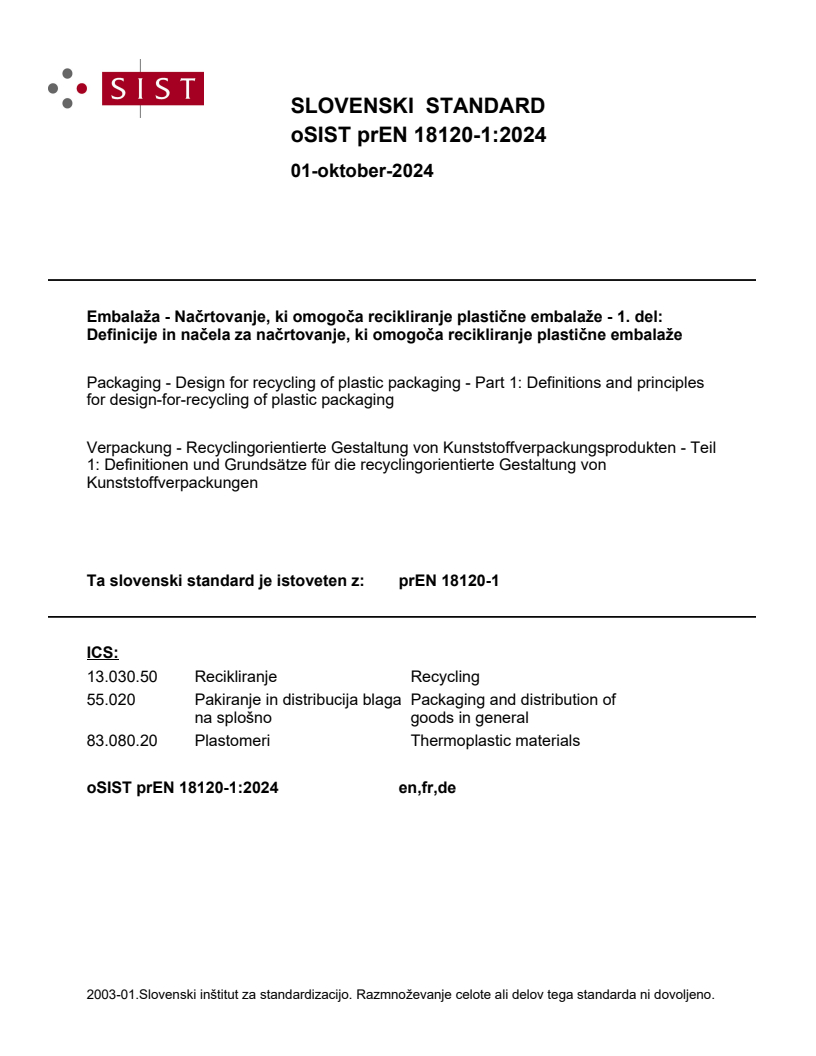
SLOVENSKI STANDARD
oSIST prEN 18120-1:2024
01-oktober-2024
Embalaža - Načrtovanje, ki omogoča recikliranje plastične embalaže - 1. del:
Definicije in načela za načrtovanje, ki omogoča recikliranje plastične embalaže
Packaging - Design for recycling of plastic packaging - Part 1: Definitions and principles
for design-for-recycling of plastic packaging
Verpackung - Recyclingorientierte Gestaltung von Kunststoffverpackungsprodukten - Teil
1: Definitionen und Grundsätze für die recyclingorientierte Gestaltung von
Kunststoffverpackungen
Ta slovenski standard je istoveten z: prEN 18120-1
ICS:
13.030.50 Recikliranje Recycling
55.020 Pakiranje in distribucija blaga Packaging and distribution of
na splošno goods in general
83.080.20 Plastomeri Thermoplastic materials
oSIST prEN 18120-1:2024 en,fr,de
2003-01.Slovenski inštitut za standardizacijo. Razmnoževanje celote ali delov tega standarda ni dovoljeno.
oSIST prEN 18120-1:2024
oSIST prEN 18120-1:2024
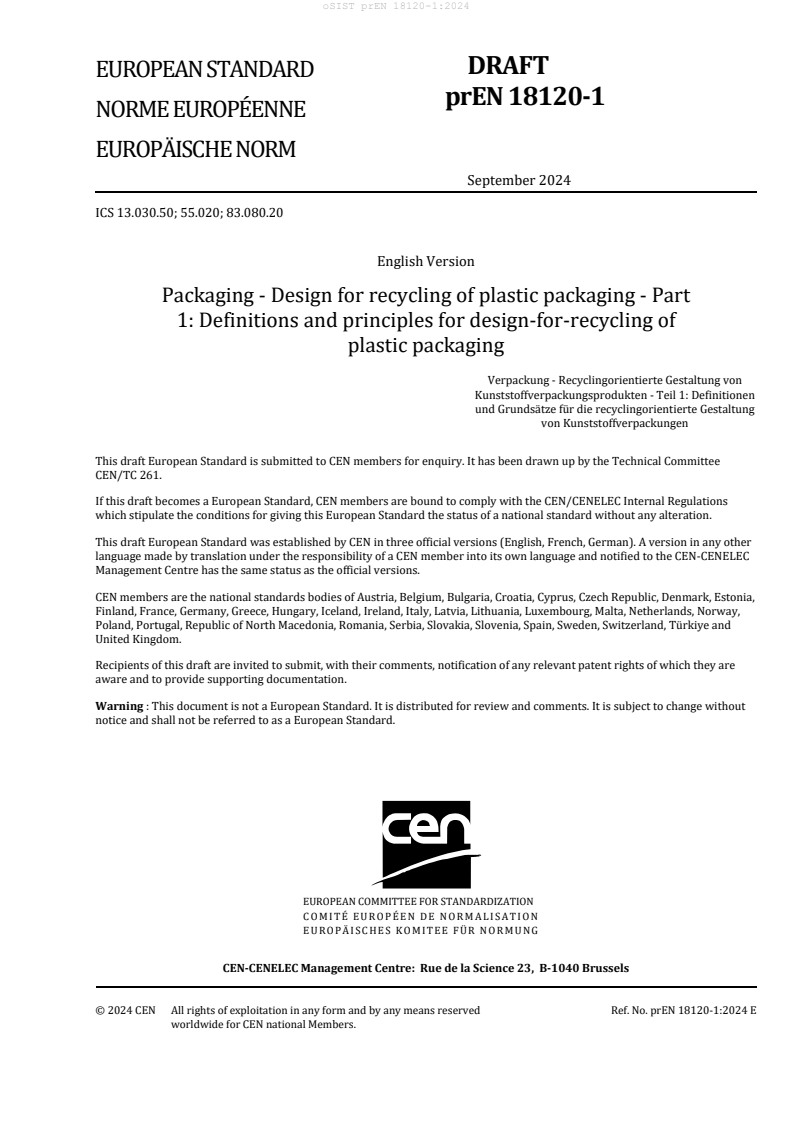
DRAFT
EUROPEAN STANDARD
prEN 18120-1
NORME EUROPÉENNE
EUROPÄISCHE NORM
September 2024
ICS 13.030.50; 55.020; 83.080.20
English Version
Packaging - Design for recycling of plastic packaging - Part
1: Definitions and principles for design-for-recycling of
plastic packaging
Verpackung - Recyclingorientierte Gestaltung von
Kunststoffverpackungsprodukten - Teil 1: Definitionen
und Grundsätze für die recyclingorientierte Gestaltung
von Kunststoffverpackungen
This draft European Standard is submitted to CEN members for enquiry. It has been drawn up by the Technical Committee
CEN/TC 261.
If this draft becomes a European Standard, CEN members are bound to comply with the CEN/CENELEC Internal Regulations
which stipulate the conditions for giving this European Standard the status of a national standard without any alteration.
This draft European Standard was established by CEN in three official versions (English, French, German). A version in any other
language made by translation under the responsibility of a CEN member into its own language and notified to the CEN-CENELEC
Management Centre has the same status as the official versions.
CEN members are the national standards bodies of Austria, Belgium, Bulgaria, Croatia, Cyprus, Czech Republic, Denmark, Estonia,
Finland, France, Germany, Greece, Hungary, Iceland, Ireland, Italy, Latvia, Lithuania, Luxembourg, Malta, Netherlands, Norway,
Poland, Portugal, Republic of North Macedonia, Romania, Serbia, Slovakia, Slovenia, Spain, Sweden, Switzerland, Türkiye and
United Kingdom.
Recipients of this draft are invited to submit, with their comments, notification of any relevant patent rights of which they are
aware and to provide supporting documentation.
Warning : This document is not a European Standard. It is distributed for review and comments. It is subject to change without
notice and shall not be referred to as a European Standard.
EUROPEAN COMMITTEE FOR STANDARDIZATION
COMITÉ EUROPÉEN DE NORMALISATION
EUROPÄISCHES KOMITEE FÜR NORMUNG
CEN-CENELEC Management Centre: Rue de la Science 23, B-1040 Brussels
© 2024 CEN All rights of exploitation in any form and by any means reserved Ref. No. prEN 18120-1:2024 E
worldwide for CEN national Members.
oSIST prEN 18120-1:2024
prEN 18120-1:2024 (E)
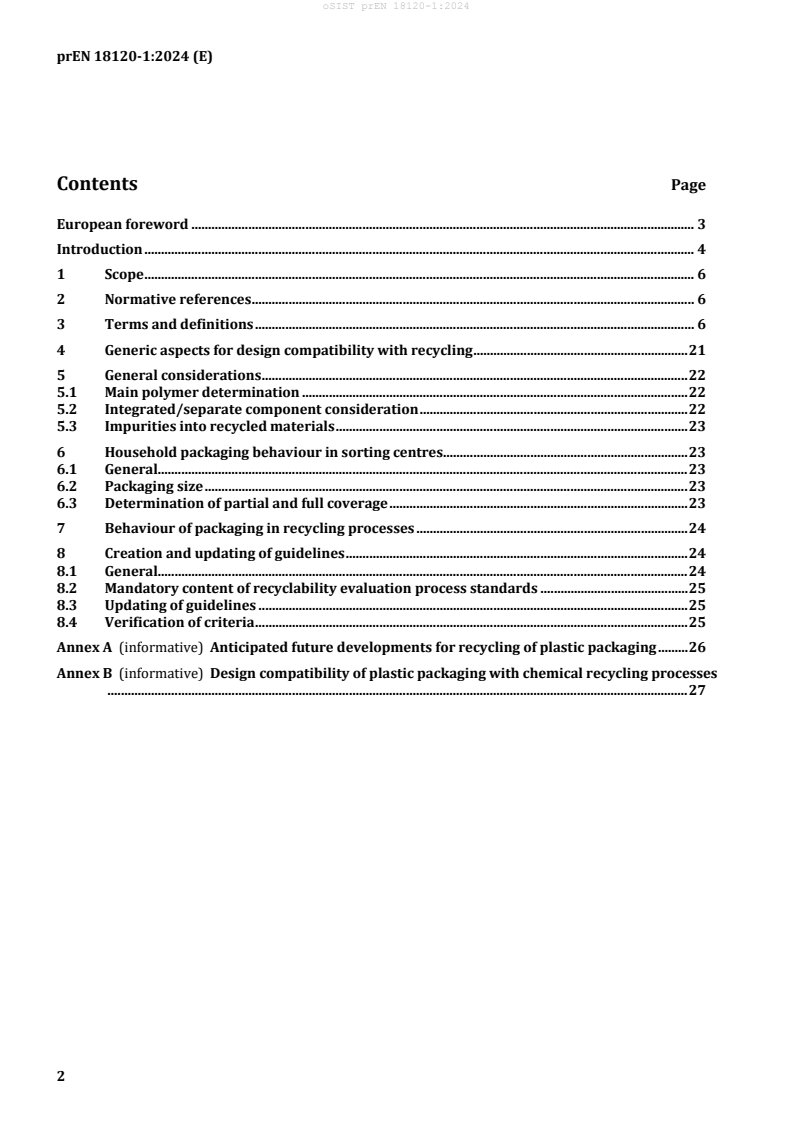
Contents Page
European foreword . 3
Introduction . 4
1 Scope . 6
2 Normative references . 6
3 Terms and definitions . 6
4 Generic aspects for design compatibility with recycling . 21
5 General considerations . 22
5.1 Main polymer determination . 22
5.2 Integrated/separate component consideration . 22
5.3 Impurities into recycled materials . 23
6 Household packaging behaviour in sorting centres. 23
6.1 General. 23
6.2 Packaging size . 23
6.3 Determination of partial and full coverage . 23
7 Behaviour of packaging in recycling processes . 24
8 Creation and updating of guidelines . 24
8.1 General. 24
8.2 Mandatory content of recyclability evaluation process standards . 25
8.3 Updating of guidelines . 25
8.4 Verification of criteria . 25
Annex A (informative) Anticipated future developments for recycling of plastic packaging . 26
Annex B (informative) Design compatibility of plastic packaging with chemical recycling processes
............................................................................................................................................................................. 27
oSIST prEN 18120-1:2024
prEN 18120-1:2024 (E)
European foreword
This document (prEN 18120-1:2024) has been prepared by Technical Committee CEN/TC 261
“Packaging”, the secretariat of which is held by AFNOR.
This document is currently submitted to the CEN Enquiry.
This document has been prepared under a standardization request addressed to CEN by the European
Commission. The Standing Committee of the EFTA States subsequently approves these requests for its
Member States.
oSIST prEN 18120-1:2024
prEN 18120-1:2024 (E)
Introduction
EN 18120 consisting of 15 parts aims via a series of guidelines and protocols to establish consistency and
improvement for the Design for recycling of household, industrial and commercial plastic packaging.
— Part 1: Definitions and principles for design-for-recycling of plastic packaging
— Part 2: Process and governance to evaluate the recyclability of plastic packaging
— Part 3: Sorting evaluation process for plastic packaging
— Part 4: Guideline for PET bottles
— Part 5: Guideline for PET other rigid packaging
— Part 6: Guideline for PE and PP rigid packaging
— Part 7: Guideline and protocols for PE and PP flexible packaging
— Part 8: Guideline for PS and XPS packaging
— Part 9: Guideline for EPS packaging
— Part 10: Recyclability evaluation process for plastic packaging — Protocols for PET bottles
— Part 11: Recyclability evaluation process for plastic packaging — Protocols for PET other rigid
packaging
— Part 12: Recyclability evaluation process for plastic packaging — Protocols for PE and PP rigid
packaging
— Part 13: Recyclability evaluation process for plastic packaging — Protocols for PE and PP flexible
packaging
— Part 14: Recyclability evaluation process for plastic packaging — Protocols for PS and XPS packaging
— Part 15: Recyclability evaluation process for plastic packaging — Protocols for EPS packaging
Design for recycling guidelines are a common way of describing compatibility with plastic packaging
collection, sorting and recycling into high quality recycled plastic into state-of-the-art facilities. They
provide guidance on the level compatibility, defined as:
— green: Packaging constituents with full compatibility with recycling;
— yellow: Packaging constituents with limited compatibility with recycling;
— red: Packaging constituents which are not compatible with recycling.
Recyclability guidelines will require regular review and improvement to reflect innovations in design,
collection, sorting and recycling.
The Design for Recycling Guidelines provided in this series of standards are representative of the state of
the art in Europe and cover all steps from design for recycling, packaging waste collection, sorting,
recycling into recycled plastic and to use in a new application.
oSIST prEN 18120-1:2024
prEN 18120-1:2024 (E)
Packaging recyclability is the combination of five parameters: packaging designed for recycling,
packaging waste collection, sorting when necessary, recycling and use of recycled plastic in a new
application. This series of standards covers one parameter: the design for recycling.
oSIST prEN 18120-1:2024
prEN 18120-1:2024 (E)
1 Scope
This document provides a process that manages the identification of the level of compatibility of plastic
packaging features with collection, sorting and recycling, describing the level of compatibility as fully,
limited, and not recyclable.
This standard covers any plastic packaging where the main body is made of plastic material. It targets to
harmonize the design for recycling standard approach for each resin.
2 Normative references
The following documents are referred to in the text in such a way that some or all of their content
constitutes requirements of this document. For dated references, only the edition cited applies. For
undated references, the latest edition of the referenced document (including any amendments) applies.
prEN 18120-3, Packaging — Design for recycling of plastic packaging — Part 3: Sorting evaluation process
for plastic packaging
prEN 18120-10, Packaging — Design for recycling of plastic packaging — Part 10: Recyclability evaluation
process for plastic packaging — Protocols for PET bottles
prEN 18120-11, Packaging — Design for recycling of plastic packaging — Part 11: Recyclability evaluation
process for plastic packaging — Protocols for PET rigid packaging (except bottles)
prEN 18120-12, Packaging — Design for recycling of plastic packaging — Part 12: Recyclability evaluation
process for plastic packaging — Protocols for PE and PP rigid packaging
prEN 18120-13, Packaging — Design for recycling of plastic packaging — Part 13: Recyclability evaluation
process for plastic packaging — Protocols for PE and PP flexible packaging
prEN 18120-14, Packaging — Design for recycling of plastic packaging — Part 14: Recyclability evaluation
process for plastic packaging — Protocols for PS and XPS packaging
prEN 18120-15, Packaging — Design for recycling of plastic packaging — Part 15: Recyclability evaluation
process for plastic packaging — Protocols for EPS packaging
3 Terms and definitions
For the purposes of this document, the following terms and definitions apply.
ISO and IEC maintain terminology databases for use in standardization at the following addresses:
— ISO Online browsing platform: available at https://www.iso.org/obp/
— IEC Electropedia: available at https://www.electropedia.org/
3.1
sales packaging
packaging conceived so as to constitute a sales unit consisting of products and packaging to the end user
at the point of sale
3.2
grouped packaging
packaging conceived so as to constitute a grouping of a certain number of sales units at the point of sale
whether the latter is sold as such to the end user or it serves only as a means to replenish the shelves at
oSIST prEN 18120-1:2024
prEN 18120-1:2024 (E)
the point of sale or create a stock-keeping or distribution unit, and which can be removed from the
product without affecting its characteristics
3.3
transport packaging
packaging conceived so as to facilitate handling and transport of one or more sales units or grouped
packages, including e-commerce packaging but excluding road, rail, ship and air containers, in order to
prevent damage to the product from physical handling and transport
3.4
unit of packaging
means a unit as a whole, including any integrated or separate components, which together serve a
packaging function such as the containment, protection, handling, delivery, storage, transport and
presentation of products, and including independent units of grouped or transport packaging where they
are discarded prior to the point of sale
3.5
green category
category for identifying components or constituents of a plastic packaging that is in the scope of the
design for recycling guidelines of a given packaging type that are recognized as compatible with state-of-
the-art collection, sorting and recycling or are demonstrated as suitable for recycling through technical
evaluation and can fully meet the quality requirements of secondary raw material in the recycling process
3.6
yellow category
category for identifying components or constituents of a plastic packaging that is in the scope of the
design for recycling guidelines of a given packaging type are recognized as acceptable with limited
compatibility with state-of-the-art collection, sorting and recycling, or are demonstrated as having
limited compatibility through technical evaluation or will not meet all quality requirements of secondary
raw material in the recycling process
3.7
red category
category for identifying components or constituents of a plastic packaging that is in the scope of the
design for recycling guidelines of a given packaging type generally leads to rejection of the packaging item
in sorting or recycling processes or are generally recognized as detrimental (disrupting) for recycling or
are demonstrated as disrupting for recycling through technical evaluation or are demonstrated as
unacceptable downgrading the yield or the quality of recycled plastic
3.8
state of the art
generally recognised good practice in the European market, fulfilling the following non-exhaustive
criteria: proven and commercially available, technology at TRL9, delivering sufficient results in terms of
yield and quality, already in use in the European market, affordable to relevant economic operators in
the EU
Note 1 to entry: Preferably non-proprietary technology (i.e. technology that is openly available to the packaging
users) is considered.
3.9
integrated component
packaging component that may be distinct from the main body of the packaging unit, and may be of a
different material, but is integral to the packaging unit and its functioning and does not need to be
oSIST prEN 18120-1:2024
prEN 18120-1:2024 (E)
separated from the main packaging unit in order to consume the product and is typically discarded at the
same time as the packaging unit, although not necessarily in the same disposal route
3.10
separate component
packaging component that is distinct from the main body of the packaging unit, which may be of a
different material, that needs to be disassembled completely and permanently from the main packaging
unit in order to access the product, and that is typically discarded prior to and separately from the
packaging unit
3.11
high quality recycled plastic
recycled plastic from any recovery operation by which plastic waste are reprocessed into secondary raw
material with comparable quality to feed a closed material loop scheme
3.12
packaging
product to be used for the containment, protection, handling, delivery, storage, transport and
presentation of goods, from raw materials to processed goods, from the producer to the user or
consumer, including processor, assembler or other intermediary
[SOURCE: ISO 21067-1:2016, definition 2.1.1]
3.13
packaging component
part of packaging that can be separated by hand or by using simple physical means
[SOURCE: ISO 21067-2:2015, definition 2.1.1]
3.14
packaging constituent
part from which packaging or its components are made and which cannot be separated
by hand or by using simple physical means
[SOURCE: ISO 21067-2:2015, definition 2.1.2]
3.15
packaging main component
component with the heaviest weight in the packaging composition
3.16
rigid plastic packaging
collective description for packaging types that are assigned to the so-called “rigid plastic fractions” in the
waste classification, for example bottles, cups, trays, tubes, tins, buckets, canisters, pots, cosmetic jars,
jerrycans, drums, IBCs and boxes
3.17
flexible plastic packaging
collective description for packaging types that are assigned to the so-called ‘flexible plastic fractions” in
the waste classification, for example bags, pouches, envelopes, sachets, removable lidding/liners, wraps
and similar flexible packaging items
oSIST prEN 18120-1:2024
prEN 18120-1:2024 (E)
Note 1 to entry: Flexible packaging structures can be single or multi-layered using a variety of materials including
plastic film, paper, aluminium foil or any combination of these. The construction may be plain, printed, coated
and/or laminated.
Note 2 to entry: Flexible packaging structures are generally used to package and protect consumer and other
products. These can include Fast Moving Consumer Goods (FMCG) products such as confectionery, snack foods,
frozen foods, produce, bakery, meat, dairy, pet foods, processed food, cosmetics, personal care, household
detergents, beverage bottle/can wrapping, pharmaceuticals, medical and other technical products such as utensils
and tools which might not be included in the definition of FMCG.
3.18
semi-rigid/semi-flexible packaging
all packaging that cannot be clearly categorised by type as either rigid or flexible packaging, such as two-
piece packaging with a thick but flexible bottom film or pouches with dimensionally stable closure
systems. (Supplement: As this packaging behaves diffusely in the separation processes used to separate
the flexibles (air classifying and ballistic separation), it is recommended that the requirements for
flexibles and rigids are both applied to such packaging when assessing recyclability)
3.19
polyethylene
PE
thermoplastic polymer principally composed of CH2– repeating units with a density of typically (0,85 to
0,97) grams/cubic centimetres
Note 1 to entry: PE materials can include additional polymers such as polyethylene copolymers.
Note 2 to entry: Additives often play a critical role as they can deliver improved performance including features
such as enhanced thermal stability, easier processing, slip, antiblock properties, UV protection or simply change in
density. Additives can be added during manufacturing of the polymer (typically antioxidants, polymer processing
aids, antiblock and/or slip) and during downstream converting. Some additives added during further processing
steps have a profound effect on the density of the material such as inorganic fillers or foaming agents.
Note 3 to entry: Foaming (both chemical and physical) can decrease the density of a PE component compared to
the intrinsic density value of the polymer itself.
Note 4 to entry: Melting temperatures of PE typically range from (55 to 135) °C.
3.20
low-density polyethylene
PE-LD
LDPE
polyethylene which is highly branched (short and long chains) and has a density of typically 0,910
grams/cubic centimetre to 0,940 grams/cubic centimetre
Note 1 to entry: Upper density limit changed compared to the definition in the source.
Note 2 to entry: Melting temperatures of LDPE typically range from (105 to 125) °C.
[SOURCE: EN ISO 472:2013, definition 2.1371, modified -- upper density limit changed compared to the
definition in the source; note 2 added; ‘typically’ added]
3.21
very low-density polyethylene
VLDPE
polyethylene which is highly branched and has a density of typically (0,850 to 0,910) grams/cubic
centimetre
oSIST prEN 18120-1:2024
prEN 18120-1:2024 (E)
Note 1 to entry: Melting temperatures of VLDPE typically range from (55 to 120) °C.
Note 2 to entry: VLDPE exists with and without long-chain branches.
3.22
high-density polyethylene
PE-HD
HDPE
polyethylene, containing very few short-chain branches (< 4 per 1 000 carbon atoms), having a density
of typically (0,940 to 0,970) grams/cubic centimetre
Note 1 to entry: Melting temperatures of HDPE typically range from (120 to 135) °C.
[SOURCE: EN ISO 472:2013, definition 2.1370, modified – new density range provided; note added]
3.23
linear low-density polyethylene
PE-LLD
LLDPE
polyethylene containing insignificant amounts of long-chain branching (when compared to low-density
polyethylene) but which can, by design, contain significant amounts of short-chain branching and
normally has a density of typically 0,900 grams/cubic centimetre to 0,940 grams/cubic centimetre
Note 1 to entry: LLDPE is commonly made by copolymerization of ethylene with longer-chain alpha-olefins (like
butene C4, hexene C6 or octene C8).
Note 2 to entry: Melting temperatures of LLDPE typically range from (90 to 130) °C.
[SOURCE: EN ISO 472:2013, definition 2.1372, modified -- density limits changed; note added]
3.24
polyethylene copolymer
thermoplastic polymer in which the ethylene repeating units are partially replaced by or combined with
one or several comonomers
Note 1 to entry: Comonomers can be non-polar, like alpha olefins and norbornene or polar, like vinyl acetate,
alkylacrylates or carboxylic acids (MAH, and methacrylic acid, acrylic acidand their ionomers) They can be
copolymerised in a reactor or they can be grafted.
Note 2 to entry: In the case that several comonomers are used, the copolymers are also called terpolymers or
quarterpolymers.
Note 3 to entry: Polyethylene copolymers include ethylene-based polyolefin plastomers (POP) and certain
polymers belonging to the group of polyolefin elastomers (POE)
3.25
ethylene vinyl acetate copolymer
EVA
thermoplastic polymer principally composed of ethylene and vinyl acetate repeating units
3.26
ethylene methyl acrylate copolymer
EMA
thermoplastic polymer principally composed of ethylene and methyl acrylate repeating units
oSIST prEN 18120-1:2024
prEN 18120-1:2024 (E)
3.27
ethylene ethyl acrylate copolymer
EEA
thermoplastic polymer principally composed of ethylene and ethyl acrylate repeating units
3.28
ethylene butyl acrylate copolymer
EBA
thermoplastic polymer principally composed of ethylene and butyl acrylate repeating units
3.29
ethylene acrylic acid copolymer
thermoplastic polymer principally composed of repeating units of ethylene and acrylic acid
3.30
ethylene methacrylic acid copolymer
thermoplastic polymer principally composed of repeating units of ethylene and methacrylic acid
3.31
ethylene acrylic acid ionomers
thermoplastic polymer principally composed of repeating units of ethylene and the Na, Zn, or other metal
salts of acrylic acid’
3.32
ethylene methacrylic acid ionomers
thermoplastic polymer principally composed of repeating units of ethylene and the Na, Zn, or other metal
salts of methacrylic acid
3.33
ethylene maleic anhydride copolymer
thermoplastic polymer principally composed of ethylene repeating units with copolymerised or grafted
maleic anhydride structures
3.34
polypropylene
PP
thermoplastic polymer principally composed of CH2–CH(CH3)– repeating units with a density of typically
0,895 to 0,910 grams/cubic centimetre
Note 1 to entry: PP materials can include additional polymers such as polypropylene copolymers.
Note 2 to entry: Additives and fillers which are added to polypropylene can increase the density of a PP component
over the intrinsic density value of the polymer itself. Foaming (both chemical and physical) can decrease the density
of a PP component compared to the intrinsic density value of the polymer itself.
Note 3 to entry: Melting temperatures of PP typically range from (110 to 167) °C.
Note 4 to entry: Each repeating unit in PP can assume on of two possible orientations with regard to its CH3
sidechain. Within a given polymer chain, these orientations can be random (atatic polymer), all the same (isotactic
polymer) or alternating in regular patterns (syndiotactic polymer).
3.35
polypropylene homopolymer
thermoplastic polymer composed almost exclusively of CH2–CH(CH3)– repeating units
oSIST prEN 18120-1:2024
prEN 18120-1:2024 (E)
Note 1 to entry: Melting temperatures of PP homopolymers typically range from (150 to 167) °C.
3.36
polypropylene copolymer
thermoplastic polymer in which the propylene repeating units are partially replaced by or combined with
one or several comonomers
Note 1 to entry: Comonomers can be non-polar, like alpha olefins or dienes or polar, like vinyl acetate,
alkylacrylates or carboxylic acids (MAH, methacrylic acid, acrylic acid, and their ionomers) They can be
copolymerised in a reactor, or they can be grafted.
Note 2 to entry: In the case that several comonomers are used, the copolymers are also called terpolymers or
quarterpolymers.
3.37
polybutene-1
PB-1
thermoplastic polymer principally composed of 1-butene repeating units with a density of typically
(0,860 to 0,910) grams per cubic centimeter and a meting temperature of typically 40 °C to 128 °C
3.38
polybutene-1 homopolymer
thermoplastic polymer composed of 1-butene repeating units
3.39
polybutene-1 copolymer
thermoplastic polymer in which the 1-butene repeating units are partially replaced by one or several alfa-
olefin comonomers
3.40
polypropylene (random) copolymer
thermoplastic polymer in which the propylene repeating units are partially replaced randomly by
ethylene and/or another α-olefin
Note 1 to entry: Melting temperatures of PP random copolymers typically range from (110 to 160) °C.
[SOURCE: EN ISO 472:2013, definition 2.1380, modified – ‘(random)’ added; notes added; structure of
repeating unit converted to text]
3.41
polypropylene heterophasic copolymer
thermoplastic polymer principally composed of propylene repeating units with embedded sections
(phases) of an elastomeric polymer
Note 1 to entry: Melting temperatures of PP block copolymers typically range from (110 to 167) °C.
Note 2 to entry: Also referred to as polypropylene block copolymer or impact copolymer.
3.42
silicon oxide coating
SiOx
very high gas and moisture barrier coating, comprised of a very thin layer of silicon oxide (typically (0,001
to 0,05) micrometres)
Note 1 to entry: Often used in combination with a suitable primer and/or protective top coating.
oSIST prEN 18120-1:2024
prEN 18120-1:2024 (E)
3.43
aluminium oxide coating
AlOx
very high gas and moisture barrier coating, comprised of a very thin layer of aluminium oxide (typically
(0,001 to 0,05) micrometres)
Note 1 to entry: Aluminium oxide coatings are transparent and not to be confused with aluminium foil or
metallisation.
Note 2 to entry: Often used in combination with a suitable primer and/or protective top coating.
3.44
ethylene vinyl alcohol
EVOH
copolymer of ethylene and vinyl alcohol
Note 1 to entry: EVOH offers barrier to gases, such as oxygen, carbon dioxide and nitrogen and has very high
resistance to hydrocarbons and organic solvents. It is typically co-extruded but can also be a laminated barrier layer
or a coating in many food packaging applications.
Note 2 to entry: In addition to the its most common form, a coextruded layer, films of EVOH for lamination to other
polymer films do also exist.
3.45
polyvinyl alcohol
PVOH
thermoplastic polymer principally composed of CH2CH(OH)– repeating units
Note 1 to entry: PVOH is sometimes modified to reduce sensitivity to moisture.
3.46
acrylic resin
synthetic resin resulting from the polymerization or copolymerization of acrylic and/or methacrylic
monomers, frequently together with other monomers
[SOURCE: EN ISO 4618:2023, definition 3.5]
3.47
aluminium foil
rolled aluminium with a thickness of (5 to 200) micrometres
Note 1 to entry: Thicknesses for flexible packaging applications are typically below 120 microns. Aluminium foil is
used in flexible packaging structures either as the major component (aluminium-based structures) or as a (barrier)
layer within other material structures.
3.48
poly(ethylene terephthalate)
PET
polymer made by the polycondensation of ethylene glycol and terephthalic acid or dimethyl terephthalate
[SOURCE: EN ISO 472:2013, definition 2.610]
oSIST prEN 18120-1:2024
prEN 18120-1:2024 (E)
3.49
polystyrene
PS
thermoplastic polymer produced by the polymerization of styrene
[SOURCE: EN 923:2015, definition 2.320]
3.50
Expandible polystyrene
EPS
thermoplastic polymer (either made by polymerisation of styrene or by extrusion of PS) in the form of
granulates containing blowing agent
Note 1 to entry: Expandible Polystyrene is a raw material which will be converted to an Expanded Polystyrene
which is a foam.
3.51
polyamide
PA
polymer in which the repeating linkage in the chain is -NH-CO-
[SOURCE: EN 923:2015]
3.52
polyamide-6
PA6
polyamide based on polymers of caprolactam
3.53
polyamide-6/6.6
PA6/6.6
polyamide based on copolymers of caprolactam, hexamethylene diamine and adipic acid
3.54
polyamide 6/IPDI PA6/IPDI
polyamide based on copolymers of caprolactam, isophorone diamine (IPD) and isopthalic acid (I)
3.55
poly(vinylidene chloride) plastic
PVDC plastic
plastic based on polymers of vinylidene chloride or copolymers of vinylidene chloride with other
monomers, the vinylidene chloride being in the greatest amount by mass
Note 1 to entry: PVDC can be integrated into packaging both in form of a coating on another plastic flexible
constituent as well as a film made of PVDC itself.
[SOURCE: EN ISO 472:2013, definiti
...
Questions, Comments and Discussion
Ask us and Technical Secretary will try to provide an answer. You can facilitate discussion about the standard in here.
Loading comments...