


SIST EN 50367:2020/A1:2022
(Amendment)Railway applications - Fixed installations and rolling stock - Criteria to achieve technical compatibility between pantographs and overhead contact line
Railway applications - Fixed installations and rolling stock - Criteria to achieve technical compatibility between pantographs and overhead contact line
This document specifies requirements for the technical compatibility between pantographs and overhead contact lines, to achieve free access to the lines of the European railway network.
NOTE These requirements are defined for a limited number of pantograph types conforming to the requirements in 5.3, together with the geometry and characteristics of compatible overhead contact lines.
Bahnanwendungen - Zusammenwirken der Systeme -Technische Kriterien für das Zusammenwirken zwischen Stromabnehmer und Oberleitung für einen freien Zugang
Applications ferroviaires - Installations fixes de traction et matériel roulant - Critères techniques d'interaction entre le pantographe et la ligne aérienne de contact
Železniške naprave - Fiksni postroji in vozna sredstva - Kriteriji za doseganje tehnične združljivosti med odjemnikom toka in kontaktnim vodnikom - Dopolnilo A1
General Information
- Status
- Published
- Public Enquiry End Date
- 30-Oct-2021
- Publication Date
- 10-Nov-2022
- Technical Committee
- ŽEN - Electrical applications for railways
- Current Stage
- 6060 - National Implementation/Publication (Adopted Project)
- Start Date
- 17-Oct-2022
- Due Date
- 22-Dec-2022
- Completion Date
- 11-Nov-2022
- Directive
- Slovenian Regulation2011-01-2104 - Pravilnik o tehnični skladnosti tirnih vozil



Relations
- Effective Date
- 09-Feb-2026
- Effective Date
- 03-Feb-2026
- Effective Date
- 08-Dec-2020
Overview
SIST EN 50367:2020/A1:2022 is a European standard developed by the Slovenski inštitut za standardizacijo (SIST) that focuses on the technical compatibility between pantographs and overhead contact lines (OCL) within railway applications. This amendment refines the core requirements that ensure interoperability between fixed railway infrastructure and rolling stock. The document targets the safe, reliable, and efficient interface essential for free access across the European railway network. The requirements address a clear, limited scope of pantograph types and compatible OCL systems, supporting both AC and DC traction systems.
The standard responds to EU Directive 2016/797/EU and forms a vital part of ensuring technical compatibility-the central element for open railway networks, improved international rail connections, and meeting the requirements of interoperability as defined in relevant Technical Specifications for Interoperability (TSI).
Key Topics
- Infrastructure Gauge and OCL Geometry: Requirements for the free passage of pantographs under varying infrastructure gauges, including consideration for tunnel cross-sections and verification points.
- Pantograph and Contact Strip Specifications: Acceptable types and technical specifications for contact strips (including materials), and clearances for pantograph operation to maintain consistent electrical contact and minimize wear.
- Contact Wire Height and Lateral Deviation: Standardizes dimensional tolerances for contact wire height and allowable lateral deviation, ensuring safe and efficient current collection across different railway systems.
- Dynamic Interactions: Assessment of static and dynamic contact forces, current capacity, and methods for evaluation (simulation and measurement) of pantograph-OCL interactions, both under normal operation and in special cases (e.g., neutral sections, tunnels).
- Neutral Sections and Restart Requirements: Defines approach for neutral sections in the OCL, including requirements for restarting trains in these sections, supporting operational continuity.
- Performance Testing: Provisions for current collection testing at standstill and in motion, applicable especially to DC systems, ensuring compliance for both newly commissioned and existing equipment.
- Formation of Trains with Multiple Pantographs: Specifies arrangements for trains operating with multiple pantographs, distance requirements between pantographs, and methods for compliance assessment.
Applications
The SIST EN 50367:2020/A1:2022 standard is widely applicable to:
- Railway Infrastructure Managers: To design, upgrade, and maintain overhead contact line systems that are compatible with a range of rolling stock across the European railway network.
- Rolling Stock Manufacturers: Ensuring newly constructed or retrofitted trains are equipped with pantographs that are interoperable with standardized OCL geometries and characteristics.
- Rail Operators: To facilitate smooth cross-border operations by guaranteeing compatibility and safe passage on international lines.
- Certification Bodies: Supporting assessment and certification processes in line with EU technical and interoperability requirements, particularly for projects targeting conformity with EU Directive 2016/797.
- Engineering Consultants: Providing a consistent framework for infrastructure design, integration, and modernization, particularly where multiple pantograph and OCL types might interact.
Implementing this standard helps reduce operational disruptions, ensures consistent current collection, and supports seamless railway operations across national boundaries.
Related Standards
- EN 50119 – Overhead contact lines for electric railways: Provides the fundamental technical requirements for OCL design and installation.
- EN 50206-1:2010 – Railway applications, pantographs: Details the requirements for pantograph operating systems.
- EN 50388:2012 – Railway applications, power supply and rolling stock: Covers basic requirements for electrical interfaces and current capacity.
- Commission Regulation (EU) No 1301/2014 and No 1302/2014 – Technical Specifications for Interoperability (Energy and Rolling Stock): Provides regulatory context for how standards like EN 50367 relate to wider interoperability goals.
- IEC 60050-811:2017 – International Electrotechnical Vocabulary (Electric traction): Reference for terminology used in railway electric traction standards.
By aligning with SIST EN 50367:2020/A1:2022, stakeholders ensure compliance with European best practices for railway electrification and maintain interoperability and safety throughout the rail system.
Get Certified
Connect with accredited certification bodies for this standard

IMQ S.p.A. (Certification)
Italian electrical product certification.

SLG Prüf- und Zertifizierungs GmbH
German testing and certification body.

UL Solutions
Global safety science company with testing, inspection and certification.
Sponsored listings
Frequently Asked Questions
SIST EN 50367:2020/A1:2022 is a amendment published by the Slovenian Institute for Standardization (SIST). Its full title is "Railway applications - Fixed installations and rolling stock - Criteria to achieve technical compatibility between pantographs and overhead contact line". This standard covers: This document specifies requirements for the technical compatibility between pantographs and overhead contact lines, to achieve free access to the lines of the European railway network. NOTE These requirements are defined for a limited number of pantograph types conforming to the requirements in 5.3, together with the geometry and characteristics of compatible overhead contact lines.
This document specifies requirements for the technical compatibility between pantographs and overhead contact lines, to achieve free access to the lines of the European railway network. NOTE These requirements are defined for a limited number of pantograph types conforming to the requirements in 5.3, together with the geometry and characteristics of compatible overhead contact lines.
SIST EN 50367:2020/A1:2022 is classified under the following ICS (International Classification for Standards) categories: 29.280 - Electric traction equipment. The ICS classification helps identify the subject area and facilitates finding related standards.
SIST EN 50367:2020/A1:2022 has the following relationships with other standards: It is inter standard links to SIST EN 15955-2:2025, SIST-TS CLC/TS 50729:2025, SIST EN 50367:2020. Understanding these relationships helps ensure you are using the most current and applicable version of the standard.
SIST EN 50367:2020/A1:2022 is associated with the following European legislation: EU Directives/Regulations: 2011-01-2104, 2016/797/EU; Standardization Mandates: M/483, M/591. When a standard is cited in the Official Journal of the European Union, products manufactured in conformity with it benefit from a presumption of conformity with the essential requirements of the corresponding EU directive or regulation.
SIST EN 50367:2020/A1:2022 is available in PDF format for immediate download after purchase. The document can be added to your cart and obtained through the secure checkout process. Digital delivery ensures instant access to the complete standard document.
Standards Content (Sample)
SLOVENSKI STANDARD
01-december-2022
Železniške naprave - Fiksni postroji in vozna sredstva - Kriteriji za doseganje
tehnične združljivosti med odjemnikom toka in kontaktnim vodnikom - Dopolnilo
A1
Railway applications - Fixed installations and rolling stock - Criteria to achieve technical
compatibility between pantographs and overhead contact line
Bahnanwendungen - Zusammenwirken der Systeme -Technische Kriterien für das
Zusammenwirken zwischen Stromabnehmer und Oberleitung für einen freien Zugang
Applications ferroviaires - Installations fixes de traction et matériel roulant - Critères
techniques d'interaction entre le pantographe et la ligne aérienne de contact
Ta slovenski standard je istoveten z: EN 50367:2020/A1:2022
ICS:
29.280 Električna vlečna oprema Electric traction equipment
2003-01.Slovenski inštitut za standardizacijo. Razmnoževanje celote ali delov tega standarda ni dovoljeno.
EUROPEAN STANDARD EN 50367:2020/A1
NORME EUROPÉENNE
EUROPÄISCHE NORM October 2022
ICS 29.280
English Version
Railway applications - Fixed installations and rolling stock -
Criteria to achieve technical compatibility between pantographs
and overhead contact line
Applications ferroviaires - Installations fixes de traction et Bahnanwendungen - Ortsfeste Anlagen und Fahrzeuge -
matériel roulant - Critères techniques d'interaction entre le Kriterien zur Erreichung der technischen Kompatibilität
pantographe et la ligne aérienne de contact zwischen Dachstromabnehmern und Oberleitung
This amendment A1 modifies the European Standard EN 50367:2020; it was approved by CENELEC on 2022-08-15. CENELEC members
are bound to comply with the CEN/CENELEC Internal Regulations which stipulate the conditions for giving this amendment the status of a
national standard without any alteration.
Up-to-date lists and bibliographical references concerning such national standards may be obtained on application to the CEN-CENELEC
Management Centre or to any CENELEC member.
This amendment exists in three official versions (English, French, German). A version in any other language made by translation under the
responsibility of a CENELEC member into its own language and notified to the CEN-CENELEC Management Centre has the same status as
the official versions.
CENELEC members are the national electrotechnical committees of Austria, Belgium, Bulgaria, Croatia, Cyprus, the Czech Republic,
Denmark, Estonia, Finland, France, Germany, Greece, Hungary, Iceland, Ireland, Italy, Latvia, Lithuania, Luxembourg, Malta, the
Netherlands, Norway, Poland, Portugal, Republic of North Macedonia, Romania, Serbia, Slovakia, Slovenia, Spain, Sweden, Switzerland,
Türkiye and the United Kingdom.
European Committee for Electrotechnical Standardization
Comité Européen de Normalisation Electrotechnique
Europäisches Komitee für Elektrotechnische Normung
CEN-CENELEC Management Centre: Rue de la Science 23, B-1040 Brussels
© 2022 CENELEC All rights of exploitation in any form and by any means reserved worldwide for CENELEC Members.
Ref. No. EN 50367:2020/A1:2022 E
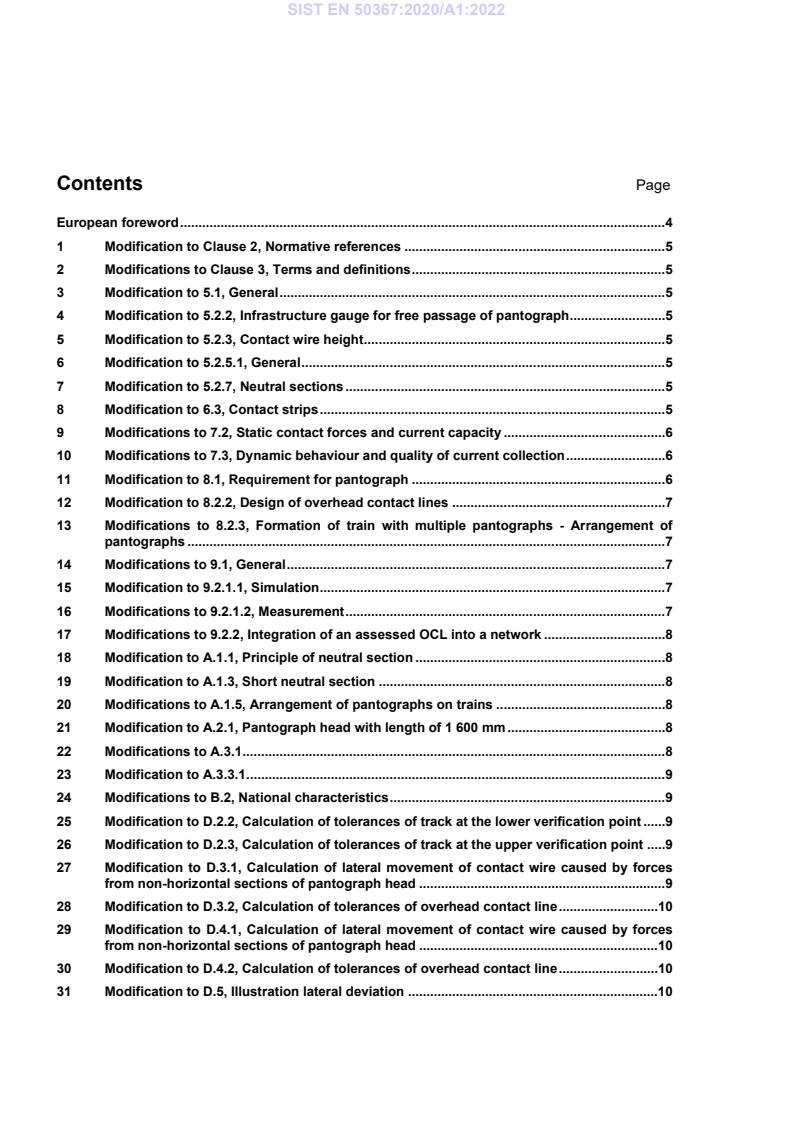
Contents Page
European foreword . 4
1 Modification to Clause 2, Normative references . 5
2 Modifications to Clause 3, Terms and definitions . 5
3 Modification to 5.1, General . 5
4 Modification to 5.2.2, Infrastructure gauge for free passage of pantograph . 5
5 Modification to 5.2.3, Contact wire height . 5
6 Modification to 5.2.5.1, General . 5
7 Modification to 5.2.7, Neutral sections . 5
8 Modification to 6.3, Contact strips . 5
9 Modifications to 7.2, Static contact forces and current capacity . 6
10 Modifications to 7.3, Dynamic behaviour and quality of current collection . 6
11 Modification to 8.1, Requirement for pantograph . 6
12 Modification to 8.2.2, Design of overhead contact lines . 7
13 Modifications to 8.2.3, Formation of train with multiple pantographs - Arrangement of
pantographs . 7
14 Modifications to 9.1, General . 7
15 Modification to 9.2.1.1, Simulation . 7
16 Modifications to 9.2.1.2, Measurement . 7
17 Modifications to 9.2.2, Integration of an assessed OCL into a network . 8
18 Modification to A.1.1, Principle of neutral section . 8
19 Modification to A.1.3, Short neutral section . 8
20 Modifications to A.1.5, Arrangement of pantographs on trains . 8
21 Modification to A.2.1, Pantograph head with length of 1 600 mm . 8
22 Modifications to A.3.1 . 8
23 Modification to A.3.3.1 . 9
24 Modifications to B.2, National characteristics . 9
25 Modification to D.2.2, Calculation of tolerances of track at the lower verification point . 9
26 Modification to D.2.3, Calculation of tolerances of track at the upper verification point . 9
27 Modification to D.3.1, Calculation of lateral movement of contact wire caused by forces
from non-horizontal sections of pantograph head . 9
28 Modification to D.3.2, Calculation of tolerances of overhead contact line .10
29 Modification to D.4.1, Calculation of lateral movement of contact wire caused by forces
from non-horizontal sections of pantograph head .10
30 Modification to D.4.2, Calculation of tolerances of overhead contact line .10
31 Modification to D.5, Illustration lateral deviation .10
32 Modification to Annex ZA, Relationship between this European standard and the essential
requirements of EU Directive 2016/797/EU [2016 OJ L138] aimed to be covered . 10
33 Modification to Bibliography . 12
European foreword
This document (EN 50367:2020/A1:2022) was prepared by SC 9XC, "Electric supply and earthing systems for
public transport equipment and ancillary apparatus (fixed installations)", of CLC/TC 9X, "Electrical and electronic
applications for railways".
The following dates are fixed:
• latest date by which this document has to be (dop) 2022-08-15
implemented at national level by publication of
an identical national standard or by
endorsement
• latest date by which the national standards (dow) 2025-08-15
conflicting with this document have to be
withdrawn
Attention is drawn to the possibility that some of the elements of this document may be the subject of patent
rights. CENELEC shall not be held responsible for identifying any or all such patent rights.
This document has been prepared under a Standardization Request given to CENELEC by the European
Commission and the European Free Trade Association, and supports essential requirements of EU Directive(s)
/ Regulation(s).
For relationship with EU Directive(s) / Regulation(s), see informative Annex ZZ, which is an integral part of this
document.
Any feedback and questions on this document should be directed to the users’ national committee. A complete
listing of these bodies can be found on the CENELEC website.
1 Modification to Clause 2, Normative references
Delete “IEC 60050-811:2017, International Electrotechnical Vocabulary (IEV) - Part 811: Electric traction”.
2 Modifications to Clause 3, Terms and definitions
Replace the introductory text with the following:
“For the purposes of this document, the following terms and definitions apply.
ISO and IEC maintain terminological databases for use in standardization at the following addresses:
— ISO Online browsing platform: available at https://www.iso.org/obp
— IEC Electropedia: available at https://www.electropedia.org/”
Replace the definition of 3.11 maximum design contact wire height with the following:
"theoretical contact wire height taking account of tolerances, movements, etc., designed to ensure the maximum
contact wire height is not exceeded
[SOURCE: EN 50119:2020, 3.1.5.8]"
3 Modification to 5.1, General
Exchange the first and second paragraph.
In the third paragraph change “applies” to “apply”.
4 Modification to 5.2.2, Infrastructure gauge for free passage of pantograph
In the fourth paragraph, second sentence (last sentence before Note 2), replace the word “can” with the word
“may”.
5 Modification to 5.2.3, Contact wire height
In Table 1, Contact wire height and gradient for AC and DC systems, in the last row, last column, replace “No
gradient” with “in accordance with EN 50119:2020, Table 12”.
6 Modification to 5.2.5.1, General
Replace the second sentence after Table 2 “The wind speeds and pantograph head lengths used to calculate
the limit of lateral deviation, needs to be defined.” with “The wind speeds and pantograph head lengths used to
calculate the limit of lateral deviation shall be defined.”
7 Modification to 5.2.7, Neutral sections
Replace the text of the last bullet with “adequate means shall be provided to allow a train that is stopped within
the neutral section to be restarted, except for short neutral sections as set out in Annex A, A.1.3.” and delete
the following NOTE.
8 Modification to 6.3, Contact strips
Replace the first sentence after the bullet list “Contact strips of either plain carbon or impregnated carbon with
additive material shall be permitted.” with “Contact strips shall be either plain carbon or impregnated carbon with
additive material.”
9 Modifications to 7.2, Static contact forces and current capacity
Replace the first sentence after the bullet list “The current demand of the train shall comply with the working
limits of the overhead contact line as set out in EN 50388:2012.” with “The current demand of the train as set
out in EN 50388:2012, 7.3 shall comply with the working limits of the overhead contact line.”
Replace the sentence inside Table 5, last row “The overhead contact line is designed to accept as a minimum
the value of current at standstill per pantograph stated here.” with “The overhead contact line shall be designed
to accept, as a minimum, the value of current at standstill per pantograph stated in this table.”
Replace the first paragraph after Table 5 with the following:
“For DC systems the maximum current at standstill shall be assessed in accordance with the test specified in
Annex A.3.
For pantograph assessment, the current at standstill shall be as a minimum, in accordance with Table 5 for
interoperable use, or a value in accordance with the specific vehicle consumption.”
After the now third paragraph, ending in "with the maximum current at standstill for this traction unit.", add the
following fourth paragraph:
“For the OCL assessment, the current collected by the pantograph shall be as a minimum, equal to the current
in Table 5.”
Rename the Note as "NOTE 1" and add the following Note 2:
“
NOTE 2 The figure for AC railways of 80 A has been derived empirically from experience gained from networks and
therefore does not require further testing.”
10 Modifications to 7.3, Dynamic behaviour and quality of current collection
Replace the second sentence in the sixth paragraph with: “The values to be achieved by the chosen method
are set out in Tables 6, 7 and 8.”
Replace the title of Table 7 “Limits for interaction performance (contact force) in tunnels with cross-sections ≤
2 2
55 m ” with “Different design limit for maximum mean contact force in tunnels with cross sections ≤ 55m ”
In the footer of Table 7, add the following Note:
“
NOTE The factor 1,25 has been derived empirically from experience gained from networks with small tunnels.”
In the first paragraph after Table 7, replace the first sentence with “The overhead contact line shall be designed
to accept as a minimum, the value of mean force (F ) in Tables 6 and for small tunnels in Table 7.”
m,max
In the first paragraph after Table 7, replace the second sentence with “The pantograph shall apply as a maximum
the mean force (F ) in Tables 6 and 7.”
m,max
11 Modification to 8.1, Requiremen
...