


SIST-TS CLC/TS 50729:2025
(Main)Railway applications - Fixed installations and rolling stock - Interface requirements between charging infrastructure with dedicated contact line sections and electric traction units with onboard electric traction energy storages and current collectors
Railway applications - Fixed installations and rolling stock - Interface requirements between charging infrastructure with dedicated contact line sections and electric traction units with onboard electric traction energy storages and current collectors
This document specifies interface requirements between charging infrastructure with dedicated contact line sections and electric traction units with onboard electric traction energy storages and current collectors.
The dedicated contact line section can be
- separated from other contact line systems of electrified railway lines and fed separately, or
- connected electrically and/or mechanically with contact line systems of electrified railway lines.
The charging infrastructure can be used for charging the traction units with onboard electric traction energy storages at a standstill and/or when moving.
This document covers the following aspects:
- supply voltages and frequencies,
- compatibility (e.g. avoidance of (unacceptable) unbalances) with the feeding grid (national 3 AC grid),
- interaction between the vehicle traction/charging system and the electric traction charging power supply system,
- transmitting required information towards driver and/or electric traction unit,
- contact line system,
- maximum load current,
- contact line protection principles,
- electrical safety,
- stray current protection (in case of DC electric traction power supply systems),
- protection against influence on signalling systems, and
- energy measurement and settlement.
This document applies to new charging infrastructure and/or new electric traction units with onboard electric traction energy storage.
Although this document is primarily applicable to railways it can also be partially applied to guided mass transport systems such as:
1) tramways, and
2) elevated and underground railways.
This document does not apply to charging with a plug or connector solution or inverted current collectors mounted on the infrastructure side.
This document does not apply to electric road systems with overhead contact line systems.
Bahnanwendungen - Ortsfeste Anlagen - Anforderungen für auf dafür vorgesehenen Fahrleitungsabschnitten basierende Ladeinfrastruktur von Akkumulator-elektrischen
Applications ferroviaires - Installations fixes - Exigences relatives aux infrastructures de charge pour les unités de traction électrique à accumulateur basées sur des sections de ligne de contact
Železniške naprave - Fiksni postroji in vozna sredstva - Zahteve za vmesnik med polnilno infrastrukturo z namenskimi odseki voznega voda in električnimi vlečnimi enotami z vgrajenimi hranilniki energije za električno vleko in odjemniki toka
Ta dokument določa zahteve za vmesnik med polnilno infrastrukturo z namenskimi odseki voznega voda in električnimi vlečnimi enotami z vgrajenimi hranilniki energije za električno vleko in odjemniki toka. Namenski odsek voznega voda je lahko: – ločen od drugih sistemov voznega voda elektrificiranih železniških prog, z ločenim napajanjem; ali – električno in/ali mehansko povezan s sistemi voznega voda elektrificiranih železniških prog. Polnilno infrastrukturo je mogoče uporabljati za napajanje vlečnih enot z vgrajenimi hranilniki energije za električno vleko v mirovanju in/ali med vožnjo. Ta dokument zajema naslednje vidike: – napajalne napetosti in frekvence; – združljivost (npr. preprečevanje (nesprejemljivih) neuravnoteženosti) z napajalnim omrežjem (nacionalno trifazno izmenično omrežje); – interakcija med sistemom vleke/polnjenja vozil in sistemom za napajanje električne vleke; – prenos potrebnih informacij vozniku in/ali električni vlečni enoti; – sistem voznega voda; – največji obremenitveni tok; – načela zaščite voznega voda; – električna varnost; – zaščita pred blodečimi tokovi (v primeru sistemov za enosmerno napajanje električne vleke); – zaščita pred vplivi na signalne sisteme; ter – merjenje in poravnava energije. Ta dokument se uporablja za novo polnilno infrastrukturo in/ali nove električne vlečne enote z vgrajenimi hranilniki energije za električno vleko. Čeprav se ta dokument prvotno uporablja za železnice, ga je mogoče delno uporabljati tudi za vodene sisteme javnega prevoza, kot so: 1) tramvaji ter 2) nadzemne in podzemne železnice. Ta dokument se ne uporablja za napajanje prek vtičev ali konektorjev ali odjemnikov obrnjenega toka, nameščenih na infrastrukturo. Ta dokument se ne uporablja za električne cestne sisteme s sistemi nadzemnega voznega voda.
General Information
- Status
- Published
- Publication Date
- 22-Jul-2025
- Technical Committee
- ŽEN - Electrical applications for railways
- Current Stage
- 6060 - National Implementation/Publication (Adopted Project)
- Start Date
- 14-May-2025
- Due Date
- 19-Jul-2025
- Completion Date
- 23-Jul-2025
Overview
CLC/TS 50729:2025 - "Railway applications - Interface requirements between charging infrastructure with dedicated contact line sections and electric traction units with onboard electric traction energy storages and current collectors" - defines the electrical, mechanical and operational interface requirements for charging railway vehicles from dedicated contact line sections. Published by CLC/CENELEC in 2025, this Technical Specification supports safe, interoperable and energy-efficient charging of traction units equipped with onboard energy storage (batteries or similar) either at standstill or while moving.
Keywords: CLC/TS 50729:2025, charging infrastructure, electric traction units, onboard energy storage, contact line, railway charging.
Key topics and technical requirements
The document addresses interface requirements without prescribing proprietary solutions. Major technical topics include:
- Supply voltages and frequencies for dedicated contact line sections and their compatibility with national 3‑phase AC grids.
- Compatibility and grid interaction, including avoidance of unacceptable unbalances and coordination with the distribution grid.
- Interaction between vehicle and power supply, covering power/ current limits, vehicle power limitation functions and dimensioning studies.
- Mechanical interface between contact line systems (overhead or third rail) and current collectors, including contact forces and thermal limits.
- Protection principles: contact line protection, protection coordination and electrical safety measures.
- Electromagnetic compatibility (EMC) and protection against influence on signalling and train detection systems (track circuits, axle counters).
- Stray current protection for DC traction power supplies.
- Operational interfaces and information exchange toward drivers and vehicle systems, including transition zones between electrified and non‑electrified sections.
- Energy measurement and settlement requirements for charging events and billing.
The standard applies to new charging infrastructure and new traction units with onboard storage. It excludes plug/connector charging solutions, inverted infrastructure-mounted collectors and electric road systems.
Applications and who uses this standard
CLC/TS 50729:2025 is intended for stakeholders involved in design, procurement, installation and operation of railway charging systems:
- Railway infrastructure owners and operators planning dedicated contact line charging sites
- Rolling stock manufacturers and integrators of onboard energy storage and current collectors
- Substation and distribution grid engineers ensuring compatibility and protection coordination
- Signalling and EMC engineers assessing interference risks and mitigations
- Energy suppliers, metering and settlement service providers
- Tram, metro and guided urban transit system planners (partial applicability)
Use cases include specification of interfaces for depot charging, wayside charging on short non‑electrified runs, interoperability checks and safety/EMC impact assessments.
Related standards
Relevant referenced standards include EN/CLC series for EMC, traction supply and pantograph/overhead compatibility and energy measurement, for example:
- EN 50121 (EMC), EN 50367 (pantograph/overhead), EN 50388 (coordination traction supply & rolling stock)
- EN 50122 series (electrical safety, stray currents) and EN 50463 (on‑board energy measurement)
Use CLC/TS 50729:2025 together with these standards to ensure comprehensive technical and regulatory compliance for railway charging infrastructure.

Frequently Asked Questions
SIST-TS CLC/TS 50729:2025 is a technical specification published by the Slovenian Institute for Standardization (SIST). Its full title is "Railway applications - Fixed installations and rolling stock - Interface requirements between charging infrastructure with dedicated contact line sections and electric traction units with onboard electric traction energy storages and current collectors". This standard covers: This document specifies interface requirements between charging infrastructure with dedicated contact line sections and electric traction units with onboard electric traction energy storages and current collectors. The dedicated contact line section can be - separated from other contact line systems of electrified railway lines and fed separately, or - connected electrically and/or mechanically with contact line systems of electrified railway lines. The charging infrastructure can be used for charging the traction units with onboard electric traction energy storages at a standstill and/or when moving. This document covers the following aspects: - supply voltages and frequencies, - compatibility (e.g. avoidance of (unacceptable) unbalances) with the feeding grid (national 3 AC grid), - interaction between the vehicle traction/charging system and the electric traction charging power supply system, - transmitting required information towards driver and/or electric traction unit, - contact line system, - maximum load current, - contact line protection principles, - electrical safety, - stray current protection (in case of DC electric traction power supply systems), - protection against influence on signalling systems, and - energy measurement and settlement. This document applies to new charging infrastructure and/or new electric traction units with onboard electric traction energy storage. Although this document is primarily applicable to railways it can also be partially applied to guided mass transport systems such as: 1) tramways, and 2) elevated and underground railways. This document does not apply to charging with a plug or connector solution or inverted current collectors mounted on the infrastructure side. This document does not apply to electric road systems with overhead contact line systems.
This document specifies interface requirements between charging infrastructure with dedicated contact line sections and electric traction units with onboard electric traction energy storages and current collectors. The dedicated contact line section can be - separated from other contact line systems of electrified railway lines and fed separately, or - connected electrically and/or mechanically with contact line systems of electrified railway lines. The charging infrastructure can be used for charging the traction units with onboard electric traction energy storages at a standstill and/or when moving. This document covers the following aspects: - supply voltages and frequencies, - compatibility (e.g. avoidance of (unacceptable) unbalances) with the feeding grid (national 3 AC grid), - interaction between the vehicle traction/charging system and the electric traction charging power supply system, - transmitting required information towards driver and/or electric traction unit, - contact line system, - maximum load current, - contact line protection principles, - electrical safety, - stray current protection (in case of DC electric traction power supply systems), - protection against influence on signalling systems, and - energy measurement and settlement. This document applies to new charging infrastructure and/or new electric traction units with onboard electric traction energy storage. Although this document is primarily applicable to railways it can also be partially applied to guided mass transport systems such as: 1) tramways, and 2) elevated and underground railways. This document does not apply to charging with a plug or connector solution or inverted current collectors mounted on the infrastructure side. This document does not apply to electric road systems with overhead contact line systems.
SIST-TS CLC/TS 50729:2025 is classified under the following ICS (International Classification for Standards) categories: 29.280 - Electric traction equipment; 35.240.50 - IT applications in industry. The ICS classification helps identify the subject area and facilitates finding related standards.
SIST-TS CLC/TS 50729:2025 is available in PDF format for immediate download after purchase. The document can be added to your cart and obtained through the secure checkout process. Digital delivery ensures instant access to the complete standard document.
Standards Content (Sample)
SLOVENSKI STANDARD
01-september-2025
Železniške naprave - Fiksni postroji in vozna sredstva - Zahteve za vmesnik med
polnilno infrastrukturo z namenskimi odseki voznega voda in električnimi vlečnimi
enotami z vgrajenimi hranilniki energije za električno vleko in odjemniki toka
Railway applications - Fixed installations and rolling stock - Interface requirements
between charging infrastructure with dedicated contact line sections and electric traction
units with onboard electric traction energy storages and current collectors
Bahnanwendungen - Ortsfeste Anlagen - Anforderungen für auf dafür vorgesehenen
Fahrleitungsabschnitten basierende Ladeinfrastruktur von Akkumulator-elektrischen
Applications ferroviaires - Installations fixes - Exigences relatives aux infrastructures de
charge pour les unités de traction électrique à accumulateur basées sur des sections de
ligne de contact
Ta slovenski standard je istoveten z: CLC/TS 50729:2025
ICS:
29.280 Električna vlečna oprema Electric traction equipment
35.240.50 Uporabniške rešitve IT v IT applications in industry
industriji
2003-01.Slovenski inštitut za standardizacijo. Razmnoževanje celote ali delov tega standarda ni dovoljeno.
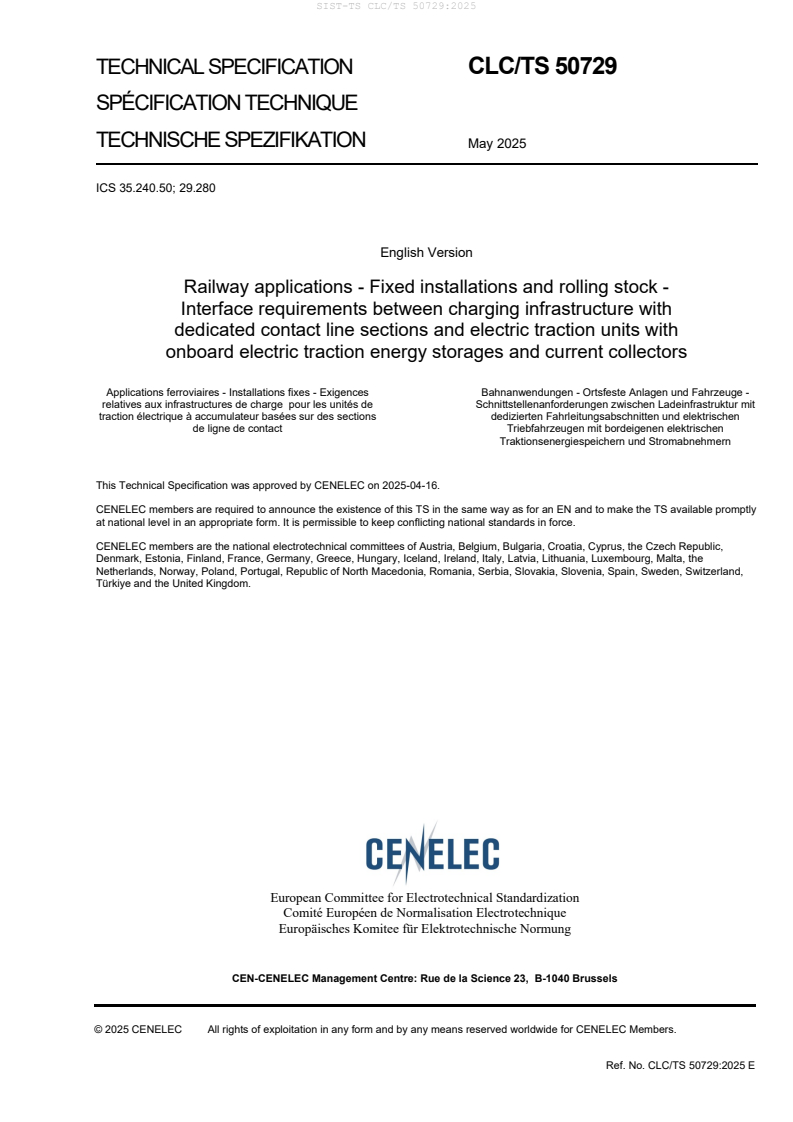
TECHNICAL SPECIFICATION CLC/TS 50729
SPÉCIFICATION TECHNIQUE
TECHNISCHE SPEZIFIKATION May 2025
ICS 35.240.50; 29.280
English Version
Railway applications - Fixed installations and rolling stock -
Interface requirements between charging infrastructure with
dedicated contact line sections and electric traction units with
onboard electric traction energy storages and current collectors
Applications ferroviaires - Installations fixes - Exigences Bahnanwendungen - Ortsfeste Anlagen und Fahrzeuge -
relatives aux infrastructures de charge pour les unités de Schnittstellenanforderungen zwischen Ladeinfrastruktur mit
traction électrique à accumulateur basées sur des sections dedizierten Fahrleitungsabschnitten und elektrischen
de ligne de contact Triebfahrzeugen mit bordeigenen elektrischen
Traktionsenergiespeichern und Stromabnehmern
This Technical Specification was approved by CENELEC on 2025-04-16.
CENELEC members are required to announce the existence of this TS in the same way as for an EN and to make the TS available promptly
at national level in an appropriate form. It is permissible to keep conflicting national standards in force.
CENELEC members are the national electrotechnical committees of Austria, Belgium, Bulgaria, Croatia, Cyprus, the Czech Republic,
Denmark, Estonia, Finland, France, Germany, Greece, Hungary, Iceland, Ireland, Italy, Latvia, Lithuania, Luxembourg, Malta, the
Netherlands, Norway, Poland, Portugal, Republic of North Macedonia, Romania, Serbia, Slovakia, Slovenia, Spain, Sweden, Switzerland,
Türkiye and the United Kingdom.
European Committee for Electrotechnical Standardization
Comité Européen de Normalisation Electrotechnique
Europäisches Komitee für Elektrotechnische Normung
CEN-CENELEC Management Centre: Rue de la Science 23, B-1040 Brussels
© 2025 CENELEC All rights of exploitation in any form and by any means reserved worldwide for CENELEC Members.
Ref. No. CLC/TS 50729:2025 E
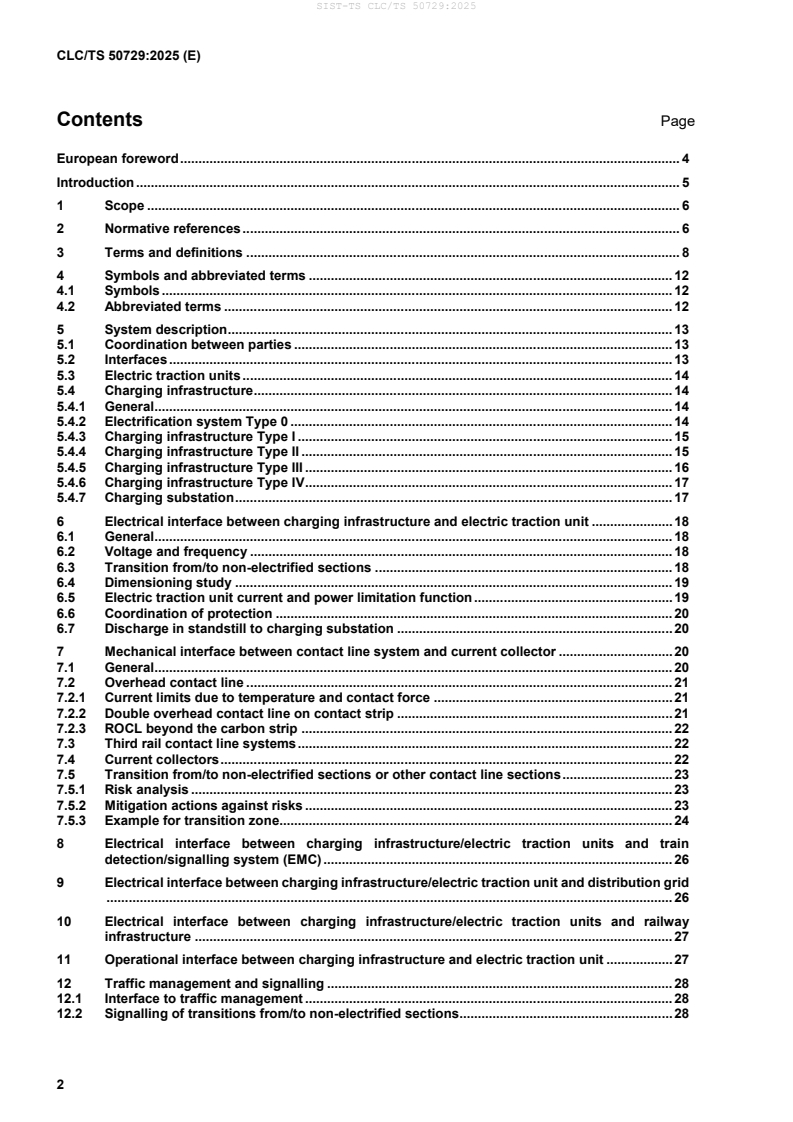
Contents Page
European foreword . 4
Introduction . 5
1 Scope . 6
2 Normative references . 6
3 Terms and definitions . 8
4 Symbols and abbreviated terms . 12
4.1 Symbols . 12
4.2 Abbreviated terms . 12
5 System description . 13
5.1 Coordination between parties . 13
5.2 Interfaces . 13
5.3 Electric traction units . 14
5.4 Charging infrastructure . 14
5.4.1 General . 14
5.4.2 Electrification system Type 0 . 14
5.4.3 Charging infrastructure Type I . 15
5.4.4 Charging infrastructure Type II . 15
5.4.5 Charging infrastructure Type III . 16
5.4.6 Charging infrastructure Type IV . 17
5.4.7 Charging substation . 17
6 Electrical interface between charging infrastructure and electric traction unit . 18
6.1 General . 18
6.2 Voltage and frequency . 18
6.3 Transition from/to non-electrified sections . 18
6.4 Dimensioning study . 19
6.5 Electric traction unit current and power limitation function . 19
6.6 Coordination of protection . 20
6.7 Discharge in standstill to charging substation . 20
7 Mechanical interface between contact line system and current collector . 20
7.1 General . 20
7.2 Overhead contact line . 21
7.2.1 Current limits due to temperature and contact force . 21
7.2.2 Double overhead contact line on contact strip . 21
7.2.3 ROCL beyond the carbon strip . 22
7.3 Third rail contact line systems . 22
7.4 Current collectors . 22
7.5 Transition from/to non-electrified sections or other contact line sections . 23
7.5.1 Risk analysis . 23
7.5.2 Mitigation actions against risks . 23
7.5.3 Example for transition zone. 24
8 Electrical interface between charging infrastructure/electric traction units and train
detection/signalling system (EMC) . 26
9 Electrical interface between charging infrastructure/electric traction unit and distribution grid
.......................................................................................................................................................... 26
10 Electrical interface between charging infrastructure/electric traction units and railway
infrastructure . 27
11 Operational interface between charging infrastructure and electric traction unit . 27
12 Traffic management and signalling . 28
12.1 Interface to traffic management . 28
12.2 Signalling of transitions from/to non-electrified sections . 28
13 Energy measurement and settlement . 29
Bibliography . 30
Figures
Figure 1 — Schema of interfaces . 14
Figure 2 — Example for charging infrastructure Type I . 15
Figure 3 — Example for charging infrastructure Type II (vertical profile) . 16
Figure 4 — Example for charging infrastructure Type III . 16
Figure 5 — Example for charging infrastructure Type IV . 17
Figure 6 — Example for double overhead contact line on contact strip . 21
Figure 7 — Example for two ROCLs beyond the carbon strip . 22
Figure 8 — Principle of a transition-from/to non-electrified section. 25
European foreword
This document (CLC/TS 50729:2025) has been prepared by CLC/SC 9XC “Electric supply and earthing
systems for public transport equipment and ancillary apparatus (Fixed installations)” of CLC/TC 9X “Electrical
and electronic applications for railways”.
It is also relevant to the scope and expertise of CLC/SC 9XB, “Electromechanical material on board of rolling
stock”.
Attention is drawn to the possibility that some of the elements of this document may be the subject of patent
rights. CENELEC shall not be held responsible for identifying any or all such patent rights.
Any feedback and questions on this document should be directed to the users’ national committee. A complete
listing of these bodies can be found on the CENELEC website.
Introduction
Climate change requires the use of railway vehicles that have a climate-neutral energy balance and avoid fossil
fuels.
Electric traction units with onboard electric traction energy storages are one of these solutions. They can be
charged by current collectors from a contact line system and connected substation(s).
In addition to the use of the known electric traction power supply systems, the document is intended to allow
new, technically feasible supply systems for charging on dedicated contact line sections.
By approving such systems, a contribution to a climate-neutral system can be made quickly. Additionally, there
are economical solutions for such charging infrastructure.
1 Scope
This document specifies interface requirements between charging infrastructure with dedicated contact line
sections and electric traction units with onboard electric traction energy storages and current collectors.
The dedicated contact line section can be
— separated from other contact line systems of electrified railway lines and fed separately, or
— connected electrically and/or mechanically with contact line systems of electrified railway lines.
The charging infrastructure can be used for charging the traction units with onboard electric traction energy
storages at a standstill and/or when moving.
This document covers the following aspects:
— supply voltages and frequencies,
— compatibility (e.g. avoidance of (unacceptable) unbalances) with the feeding grid (national 3 AC grid),
— interaction between the vehicle traction/charging system and the electric traction charging power supply
system,
— transmitting required information towards driver and/or electric traction unit,
— contact line system,
— maximum load current,
— contact line protection principles,
— electrical safety,
— stray current protection (in case of DC electric traction power supply systems),
— protection against influence on signalling systems, and
— energy measurement and settlement.
This document applies to new charging infrastructure and/or new electric traction units with onboard electric
traction energy storage.
Although this document is primarily applicable to railways it can also be partially applied to guided mass
transport systems such as:
1) tramways, and
2) elevated and underground railways.
This document does not apply to charging with a plug or connector solution or inverted current collectors
mounted on the infrastructure side.
This document does not apply to electric road systems with overhead contact line systems.
2 Normative references
The following documents are referred to in the text in such a way that some or all of their content constitutes
requirements of this document. For dated references, only the edition cited applies. For undated references, the
latest edition of the referenced document (including any amendments) applies.
EN 50121-1:2017, Railway applications - Electromagnetic compatibility - Part 1: General
EN 50121-2:2017, Railway applications - Electromagnetic compatibility - Part 2: Emission of the whole railway
system to the outside world
EN 50121-3-1:2017, Railway applications - Electromagnetic compatibility - Part 3-1: Rolling stock - Train and
complete vehicle
EN 50121-5:2017, Railway applications - Electromagnetic compatibility - Part 5: Emission and immunity of fixed
power supply installations and apparatus
EN 50122-1:2022, Railway applications - Fixed installations - Electrical safety, earthing and the return circuit -
Part 1: Protective provisions against electric shock
EN 50122-2:2022, Railway applications - Fixed installations - Electrical safety, earthing and the return circuit -
Part 2: Provisions against the effects of stray currents caused by DC traction systems
EN 50122-3:2022, Railway applications - Fixed installations - Electrical safety, earthing and the return circuit -
Part 3: Mutual Interaction of AC and DC traction systems
EN 50124-1:2017, Railway applications - Insulation coordination - Part 1: Basic requirements - Clearances and
creepage distances for all electrical and electronic equipment
EN 50160:2010, Voltage characteristics of electricity supplied by public electricity networks
EN 50163:2004, Railway applications - Supply voltages of traction systems
EN 50238-1:2019, Railway applications - Compatibility between rolling stock and train detection systems - Part
1: General
CLC/TS 50238-2:2020, Railway applications - Compatibility between rolling stock and train detection systems -
Part 2: Compatibility with track circuits
CLC/TS 50238-3:2022, Railway applications - Compatibility between rolling stock and train detection systems -
Part 3: Compatibility with axle counters
EN 50367:2020, Railway applications - Fixed installations and rolling stock - Criteria to achieve technical
compatibility between pantographs and overhead contact line
EN 50388-1:2022, Railway Applications - Fixed installations and rolling stock - Technical criteria for the
coordination between electric traction power supply systems and rolling stock to achieve interoperability - Part
1: General
EN 50388-2:2025, Fixed installations and rolling stock for railway applications - Technical criteria for the
coordination between electric traction power supply systems and rolling stock to achieve interoperability - Part
2: Stability and harmonics
EN 50463-1:2017, Railway applications - Energy measurement on board trains - Part 1: General
EN 50463-2:2017, Railway applications - Energy measurement on board trains - Part 2: Energy measuring
EN 50463-3:2017, Railway applications - Energy measurement on board trains - Part 3: Data handling
As impacted by EN 50160:2010/corrigendum Dec. 2010, EN 50160:2010/A1:2015, EN 50160:2010/A2:2019
and EN 50160:2010/A3:2019.
As impacted by EN 50163:2004/A1:2007, EN 50163:2004/corrigendum May 2010, EN 50163:2004/AC:2013,
EN 50163:2004/A2:2020 and EN 50163:2004/A3:2022.
As impacted by EN 50367:2020/A1:2022 and EN 50367:2020/A2:2025.
EN 50463-4:2017, Railway applications - Energy measurement on board trains - Part 4: Communication
EN 50463-5:2017, Railway applications - Energy measurement on board trains - Part 5: Conformity assessment
EN 50488:2021, Railway applications - Fixed installations - Electrical protective measures for working on or
near an overhead contact line system and/or its associated return circuit
EN 50617-1:2015, Railway applications - Technical parameters of train detection systems for the interoperability
of the trans-European railway system - Part 1: Track circuits
EN 50617-2:2015, Railway Applications - Technical parameters of train detection systems for the interoperability
of the trans-European railway system - Part 2: Axle counters
EN 50562:2018, Railway applications - Fixed installations - Process, protective measures and demonstration of
safety for electric traction systems
EN 50633:2016, Railway applications - Fixed installations - Protection principles for AC and DC electric traction
systems
EN 50702:2021, Railway applications - Rolling stock - Conductor rail current collectors (shoegear):
Characteristics and tests
IEC 60050-811:2017, International Electrotechnical Vocabulary (IEV) - Part 811: Electric traction
EN 61000-1-2:2016, Electromagnetic compatibility (EMC) - Part 1-2: General - Methodology for the
achievement of functional safety of electrical and electronic systems including equipment with regard to
electromagnetic phenomena
EN IEC 61000-2 (all parts), Electromagnetic compatibility (EMC) - Part 2: Environment compatibility levels
EN IEC 61000-3 (all parts), Electromagnetic compatibility (EMC) - Part 3: Limits
EN IEC 61000-4 (all parts), Electromagnetic compatibility (EMC) - Part 4: Testing and measurement techniques
EN 61000-5 (all parts), Electromagnetic compatibility (EMC) - Part 5: Installation and mitigation guidelines
EN IEC 61000-6 (all parts), Electromagnetic compatibility (EMC) - Part 6: Generic standards Immunity
3 Terms and definitions
For the purposes of this document, the terms and definitions given in IEC 60050-811:2017 and the following
apply.
ISO and IEC maintain terminology databases for use in standardization at the following addresses:
— ISO Online browsing platform: available at https://www.iso.org/obp
— IEC Electropedia: available at https://www.electropedia.org/.
3.1
automatic train operation
ATO
method of operation in which the movement of the train is automatically controlled without the intervention of a
driver, who, if provided, exercises only a supervisory function
[SOURCE: IEC 60050-821:2017, 821-09-01]
3.2
charging infrastructure
dedicated contact line sections, substations and connections between them supplying electric energy to electric
traction units with onboard electric traction energy storages by current collecting equipment
3.3
charging infrastructure border
point or zone between dedicated contact line sections and other sections which can be electrified or non-
electrified
3.4
charging strategy
logic of controlling charging power of the onboard electric traction energy storage, taking into account e.g.
available power, mission profile, state of charge, temperature, aiming at one or more, often conflicting goals e.g.
efficiency, life time, operational reliability
Note 1 to entry: Possible charging strategies are:
— quick-charging with the highest possible power,
— comfort-charging with reduced power.
3.5
conductor rail
rigid metallic conductor mounted on insulators intended to interface with a vehicle mounted current collector
Note 1 to entry: The conductor rail can be mounted in a variety of positions including at ground level or overhead.
Note 2 to entry: The conductor rail can be of composite construction
[SOURCE: IEC 60050-811:2017, 811-34-01]
3.6
contact line
conductor system for supplying traction units with electrical energy via current-collection equipment
Note 1 to entry: This includes all current-collecting conductors and conducting rails or bars, including the following:
— reinforcing feeders;
— cross-track feeders;
— disconnectors;
— section insulators;
— over-voltage protection devices;
— supports that are not insulated from the conductors;
— insulators connected to live parts;
but excluding other conductors, such as the following:
— along-track feeders;
— earth wires and return conductors.
[SOURCE: IEC 60050-811:2017, 811-33-01, modified – “electric energy to vehicles through current-collecting
equipment” has been replaced with “traction units with electrical energy via current-collection equipment”. The
Note 1 to entry has been modified.]
3.7
contact line system
support system and contact line supplying electric energy to vehicles through current-collecting equipment
Note 1 to entry: The mechanical system can be comprised of:
— the contact line;
— structures and foundations;
— supports and any components supporting or registering the conductors;
— head and cross spans;
— along-track feeders, negative feeders, and other lines like earth wires and return conductors, including boosters, as far
as they are supported from contact line system structures;
— cross-track feeders;
— disconnectors;
— over-voltage protection devices;
— conductors connected permanently to the contact line for supply of other electrical equipment such as lights, signal
operation, point control and point heating;
— any other equipment necessary for operating the contact line.
[SOURCE: IEC 60050-811:2017, 811-33-59, modified – Note 1 to entry has been modified.]
3.8
contact strip
replaceable wearing part of the roof mounted current collector head which interfaces with the contact wire
[SOURCE: IEC 60050-811:2017, 811-32-06, modified – synonym term has been removed, “pantograph” has
been replaced by “roof mounted current collector”]
3.9
current collector
equipment fitted to a vehicle and intended to collect current from a contact wire or conductor rail
[SOURCE: IEC 60050-811:2017, 811-32-01]
3.10
data collecting system
system on ground collecting energy metering data from onboard energy measurement systems in a
standardised way and transmitting it to energy settlement systems further on ground
3.11
dedicated contact line section
part of a contact line system purpose-built to the charging of electric traction units with onboard electric traction
energy storage
3.12
distribution grid
3AC grid used for the delivery of electricity to customers
3.13
driver advisory system
DAS
system receiving data from different sources, calculating the ideal driving profile for the train and assisting
drivers with the delivery of a train service
3.14
electric traction power supply system
railway electrical distribution network used to provide energy for rolling stock
Note 1 to entry: The system may comprise:
— contact line systems;
— extended return circuit;
— running rails of non-electrified tracks, which are in the vicinity of, and conductively connected to the running rails of an
electric traction system;
— electrical installations, which are supplied from contact lines either directly or via a transformer;
— electrical installations in power plants in substations, which are utilized solely for distribution of power directly to the
contact line;
— electrical installations of switching stations.
[SOURCE: EN 50122-1:2022, 3.4.1]
3.15
electric traction unit
vehicle or group of railway vehicles in fixed formation, for which the energy is taken from and/or returned to a
contact line
Note 1 to entry: In the context of this document, they are equipped with onboard electric traction energy storages.
3.16
energy settlement system
system on ground allocating and exchanging energy consumption data with other countries, validating energy
metering data, estimating missing energy consumption data and allocating them to the correct end user
3.17
grid operator
entity responsible for operating, ensuring the maintenance and developing the distribution grid in a given area
3.18
nominal voltage
Un
value of the voltage by which the electrical installation or part of the electrical
installation is designated and identified
[SOURCE: IEC 60050-826:2022, 826-11-01]
3.19
onboard electric traction energy storage
onboard system storing electrical energy coming from contact line or regenerative braking, and delivering this
energy for running an electric traction unit on non-electrified lines
3.20
onboard energy measurement system
onboard system measuring voltages and currents, calculating electrical energy over a given time period, adding
geo-locations at end of each time period and transmitting this energy metering data in a standardised way to a
data collecting system on ground
3.21
railway infrastructure
structures, buildings, land and equipment comprising railway lines
3.22
signalling system
system to ensure the safe movement of trains by means of one or more of the following:
— lineside indications,
— wayside/onboard data exchange,
— indications given in the driver's cab
[SOURCE: IEC 60050-821:2017, 821-01-03]
3.23
train detection system
system for safe recognition of the presence or absence of any trains on a defined section of the track or at a
given point
4 Symbols and abbreviated terms
4.1 Symbols
h nominal contact wire height
CWnom
h first contact wire lift up height difference
h second contact wire lift up height difference
h maximum height of uplifted current collector contact strip
CWcc,max
h maximum design contact wire height
CWd,max
d maximum contact wire height
CWmax
4.2 Abbreviated terms
AC Alternating Current
ATO Automatic Train Operation
DAS Driver Advisory System
DC Direct Current
EMC Electromagnetic Compatibility
ERTMS European Rail Traffic Management System
ETCS European Train Control System
GSM-R Global System for Mobile Communications – Railway
IRS International Railway Solution
ROCL Rigid Overhead Contact Line
UIC Union Internationale des Chemins de fer
UNISIG Union Industry of Signalling
5 System description
5.1 Coordination between parties
The parties for the introduction of a system with electric traction units with onboard electric traction energy
storages and charging infrastructure with dedicated contact line section are
— train operators/transport authorities/railway undertakings,
— electric traction unit manufacturers, and
— infrastructure managers/infrastructure manufacturers.
To ensure effective design, it is necessary for the parties concerned to cooperate and coordinate:
— how the traffic can be carried out in the lines or network,
— charging capability of electric traction unit onboard electric traction energy storages, and
— dimensioning of the charging or electrification infrastructure.
This coordination is particularly important in applications with limited
— operational flexibility of the charging process (e.g. traffic management),
— capability of onboard electric traction energy storages, or
— performance of the charging infrastructure.
Important input parameters are
— operational requirements,
— rolling stock characteristics, and
— infrastructure capabilities.
5.2 Interfaces
The following interfaces (see Figure 1) are considered in this document:
— electrical interface between charging infrastructure and electric traction unit (Clause 6),
— mechanical interface between contact line and current collector (Clause 7),
— electrical interface between train detection system/interlocking system and the interaction of charging
infrastructure and electric traction units (Clause 8),
— electrical interface between distribution grid and the interaction of charging infrastructure and electric
traction unit (Clause 9),
— electrical interface between charging infrastructure and railway infrastructure (e.g. electrical safety, stray
current protection) (Clause 10),
— operational interface between charging infrastructure and electric traction unit (including communication
and control) (Clause 11),
— traffic management (timetable construction, timetable forecast, real time prioritization) (Clause 12), and
— energy measurement and settlement (Clause 13).
Figure 1 — Schema of interfaces
5.3 Electric traction units
In the context of this document, electric traction units are equipped with onboard electric traction energy
storages.
Based on this equipment they can operate also on non-electrified lines. In this case the onboard electric traction
energy storage feeds the traction drives and the auxiliaries. It is able to store regenerated energy.
Because both the capacity of the onboard electric traction energy storages and charging time is limited, frequent
recharging is necessary with relatively high power. The charging is carried out over the current collector.
5.4 Charging infrastructure
5.4.1 General
The charging infrastructure is categorized in different types (Type I to IV) compared to the infrastructure of an
electrified line as reference (Type 0).
It consists of
— dedicated contact line section(s),
— charging substation,
— electric connections for feeding with ded
...
Questions, Comments and Discussion
Ask us and Technical Secretary will try to provide an answer. You can facilitate discussion about the standard in here.
Loading comments...