


SIST EN 868-7:2025
(Main)Packaging for terminally sterilized medical devices - Part 7: Adhesive coated paper for low temperature sterilization processes - Requirements and test methods
Packaging for terminally sterilized medical devices - Part 7: Adhesive coated paper for low temperature sterilization processes - Requirements and test methods
This document specifies test methods and values for sealable adhesive coated paper manufactured from paper complying with EN 868-6, used as single-use sterile barrier systems and/or single-use packaging systems for terminally sterilized medical devices by the means of low temperature sterilization processes.
Other than the general requirements as specified in EN ISO 11607-1 and EN ISO 11607-2 [2], this part of EN 868 specifies materials, test methods and values that are specific to the products covered by this document.
Verpackungen für in der Endverpackung zu sterilisierende Medizinprodukte - Teil 7: Klebemittelbeschichtetes Papier für Niedertemperatur-Sterilisationsverfahren - Anforderungen und Prüfverfahren
Dieses Dokument legt Prüfverfahren und Werte für siegelfähiges, klebemittelbeschichtetes Papier, hergestellt aus Papier nach EN 868 6 fest, das für sterile Barrieresysteme zum Einmalgebrauch und/oder Verpackungssysteme zum Einmalgebrauch für mittels Niedertemperatur-Sterilisationsverfahren in der Endverpackung zu sterilisierende Medizinprodukte verwendet wird.
Im Gegensatz zu den allgemeinen Anforderungen, welche durch EN ISO 11607 1 und EN ISO 11607 2 [2] festgelegt sind, legt dieser Teil von EN 868 Materialien, Prüfverfahren und Werte fest, welche spezifisch für die in diesem Dokument betrachteten Produkte sind.
Emballages pour les dispositifs médicaux stérilisés au stade terminal - Partie 7 : Papier enduit d'adhésif pour la fabrication d'emballages thermoscellables à usage médical pour stérilisation à l'oxyde d'éthylène ou par irradiation - Exigences et méthodes d'essai
Le présent document spécifie des méthodes d’essai et des valeurs applicables au papier enduit d’adhésif, fabriqué à partir de papier conforme à l’EN 868 6 et utilisé comme systèmes de barrière stérile et/ou systèmes d’emballage à usage unique destinés à des dispositifs médicaux stérilisés au stade terminal au moyen de procédés de stérilisation à basse température.
Mis à part les exigences générales spécifiées dans l’EN ISO 11607 1 et l’EN ISO 11607 2 [2], la présente partie de l’EN 868 spécifie les matériaux, les méthodes d’essai et les valeurs spécifiques aux produits couverts par le présent document.
Embalaža za končno sterilizirane medicinske pripomočke - 7. del: Papir z lepilno prevleko za sterilizacijske procese z nizko temperaturo - Zahteve in preskusne metode
Ta dokument določa preskusne metode in vrednosti za papir s tesnilno lepilno prevleko, izdelan iz papirja v skladu s standardom EN 868-6, ki se uporablja kot sterilni pregradni sistemi za enkratno uporabo in/ali sistemi embalaže za enkratno uporabo za medicinske pripomočke, končno sterilizirane s postopki nizkotemperaturne sterilizacije. Razen splošnih zahtev, ki so določene v standardih EN ISO 11607-1 in EN ISO 11607-2 [2], ta del standarda EN 868 določa materiale, preskusne metode in vrednosti, ki so specifične za izdelke, zajete v tem dokumentu.
General Information
- Status
- Published
- Public Enquiry End Date
- 29-Jun-2024
- Publication Date
- 14-May-2025
- Technical Committee
- VAZ - Healthcare
- Current Stage
- 6060 - National Implementation/Publication (Adopted Project)
- Start Date
- 08-May-2025
- Due Date
- 13-Jul-2025
- Completion Date
- 15-May-2025
Relations
- Effective Date
- 01-Jun-2025
Overview
EN 868-7:2025 (CEN) defines requirements and test methods for adhesive coated paper used as single‑use sterile barrier systems and packaging for medical devices sterilized by low temperature processes (e.g., ethylene oxide or irradiation). This Part 7 of the EN 868 series complements the general requirements of EN ISO 11607‑1/2 by specifying material properties, performance limits and normative test methods that are specific to adhesive‑coated papers. The 2025 edition supersedes EN 868‑7:2017 and includes new clauses on sterilization compatibility and environmental declarations.
Key topics and technical requirements
The standard focuses on measurable properties and laboratory methods (Annexes A–E), plus informative guidance (Annexes F–G). Important technical points include:
- Material scope: Adhesive coated paper manufactured from paper complying with EN 868‑6 for low temperature sterilization.
- Mass tolerance: Average mass per metre (EN ISO 536) within ±7.5% of manufacturer nominal.
- Chemical limits: pH of aqueous extract between 5 and 8 (ISO 6588‑2); chloride ≤ 0.05% (ISO 9197); sulfate ≤ 0.25% (ISO 9198).
- Optical/fluorescence: D65 brightness increase from optical brighteners ≤ 1% (ISO 2470‑2); fluorescent spots limit when exposed to UV.
- Mechanical performance: Internal tearing resistance ≥ 300 mN (machine and cross directions, EN ISO 1974); bursting strength ≥ 200 kPa; air permeance 0.2–6.0 µm/Pa·s (ISO 5636‑3) - with possible exclusion for irradiation‑only materials.
- Seal and coating tests: Normative methods for pore size, water repellency, regularity of adhesive coating, mass per unit area of coating, and seal strength (Annexes B–E).
- Traceability and labelling: Requirements for transport and individual unit labelling and information to be supplied, including sealing conditions and environmental declarations.
Applications and users
EN 868‑7:2025 is intended for:
- Manufacturers of adhesive coated paper and preformed sterile barrier systems (pouches, reels).
- Medical device manufacturers and sterilization service providers validating packaging for terminal sterilization by low temperature processes.
- Test laboratories performing compliance testing and qualification of packaging materials.
- Regulatory and procurement teams assessing packaging suitability for sterile devices.
Practical benefits include improved validation data for aseptic presentation, clearer acceptance criteria for incoming materials, and alignment with EN ISO 11607 for regulatory submissions.
Related standards
- EN ISO 11607‑1 / EN ISO 11607‑2 (packaging for terminally sterilized medical devices)
- EN 868 series Parts 2–10 (other sterile packaging materials and systems)
- Referenced test standards: ISO 6588‑2, ISO 9197, ISO 9198, ISO 2470‑2, ISO 5636‑3, EN ISO 1974, EN ISO 536
Keywords: EN 868-7:2025, adhesive coated paper, low temperature sterilization, sterile barrier systems, packaging for terminally sterilized medical devices, test methods, CEN.

Frequently Asked Questions
SIST EN 868-7:2025 is a standard published by the Slovenian Institute for Standardization (SIST). Its full title is "Packaging for terminally sterilized medical devices - Part 7: Adhesive coated paper for low temperature sterilization processes - Requirements and test methods". This standard covers: This document specifies test methods and values for sealable adhesive coated paper manufactured from paper complying with EN 868-6, used as single-use sterile barrier systems and/or single-use packaging systems for terminally sterilized medical devices by the means of low temperature sterilization processes. Other than the general requirements as specified in EN ISO 11607-1 and EN ISO 11607-2 [2], this part of EN 868 specifies materials, test methods and values that are specific to the products covered by this document.
This document specifies test methods and values for sealable adhesive coated paper manufactured from paper complying with EN 868-6, used as single-use sterile barrier systems and/or single-use packaging systems for terminally sterilized medical devices by the means of low temperature sterilization processes. Other than the general requirements as specified in EN ISO 11607-1 and EN ISO 11607-2 [2], this part of EN 868 specifies materials, test methods and values that are specific to the products covered by this document.
SIST EN 868-7:2025 is classified under the following ICS (International Classification for Standards) categories: 11.080.30 - Sterilized packaging; 55.040 - Packaging materials and accessories. The ICS classification helps identify the subject area and facilitates finding related standards.
SIST EN 868-7:2025 has the following relationships with other standards: It is inter standard links to SIST EN 868-7:2017. Understanding these relationships helps ensure you are using the most current and applicable version of the standard.
SIST EN 868-7:2025 is available in PDF format for immediate download after purchase. The document can be added to your cart and obtained through the secure checkout process. Digital delivery ensures instant access to the complete standard document.
Standards Content (Sample)
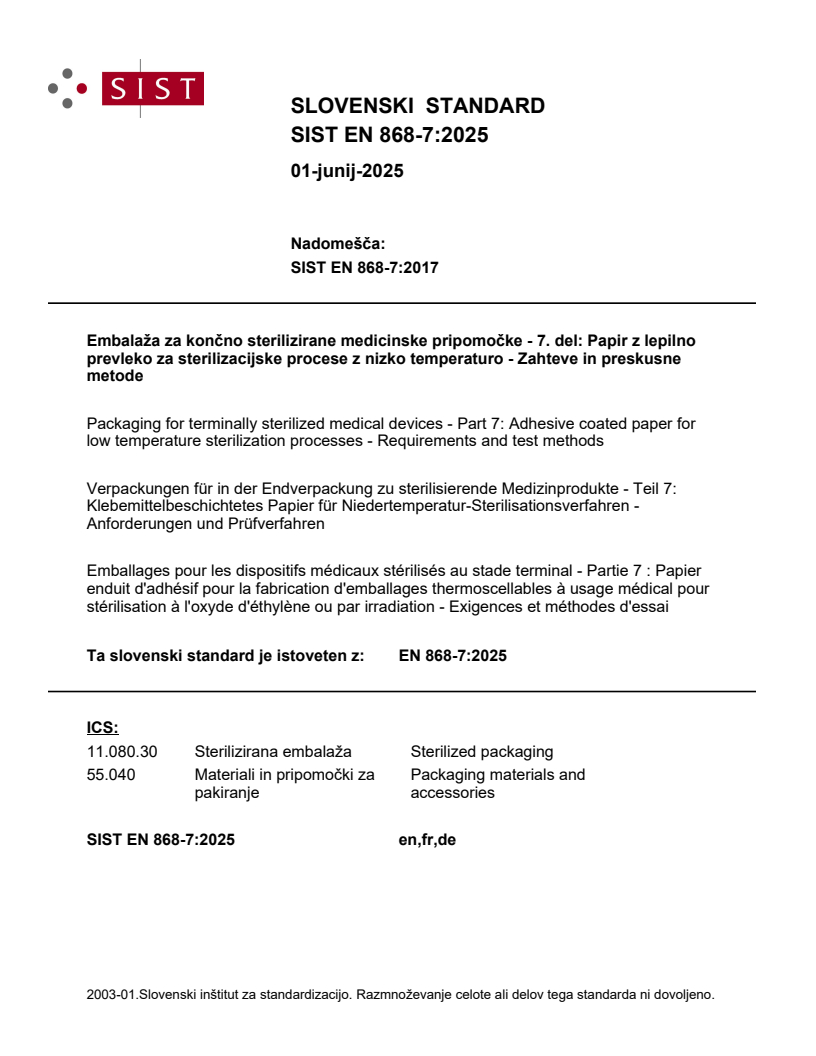
SLOVENSKI STANDARD
01-junij-2025
Nadomešča:
SIST EN 868-7:2017
Embalaža za končno sterilizirane medicinske pripomočke - 7. del: Papir z lepilno
prevleko za sterilizacijske procese z nizko temperaturo - Zahteve in preskusne
metode
Packaging for terminally sterilized medical devices - Part 7: Adhesive coated paper for
low temperature sterilization processes - Requirements and test methods
Verpackungen für in der Endverpackung zu sterilisierende Medizinprodukte - Teil 7:
Klebemittelbeschichtetes Papier für Niedertemperatur-Sterilisationsverfahren -
Anforderungen und Prüfverfahren
Emballages pour les dispositifs médicaux stérilisés au stade terminal - Partie 7 : Papier
enduit d'adhésif pour la fabrication d'emballages thermoscellables à usage médical pour
stérilisation à l'oxyde d'éthylène ou par irradiation - Exigences et méthodes d'essai
Ta slovenski standard je istoveten z: EN 868-7:2025
ICS:
11.080.30 Sterilizirana embalaža Sterilized packaging
55.040 Materiali in pripomočki za Packaging materials and
pakiranje accessories
2003-01.Slovenski inštitut za standardizacijo. Razmnoževanje celote ali delov tega standarda ni dovoljeno.
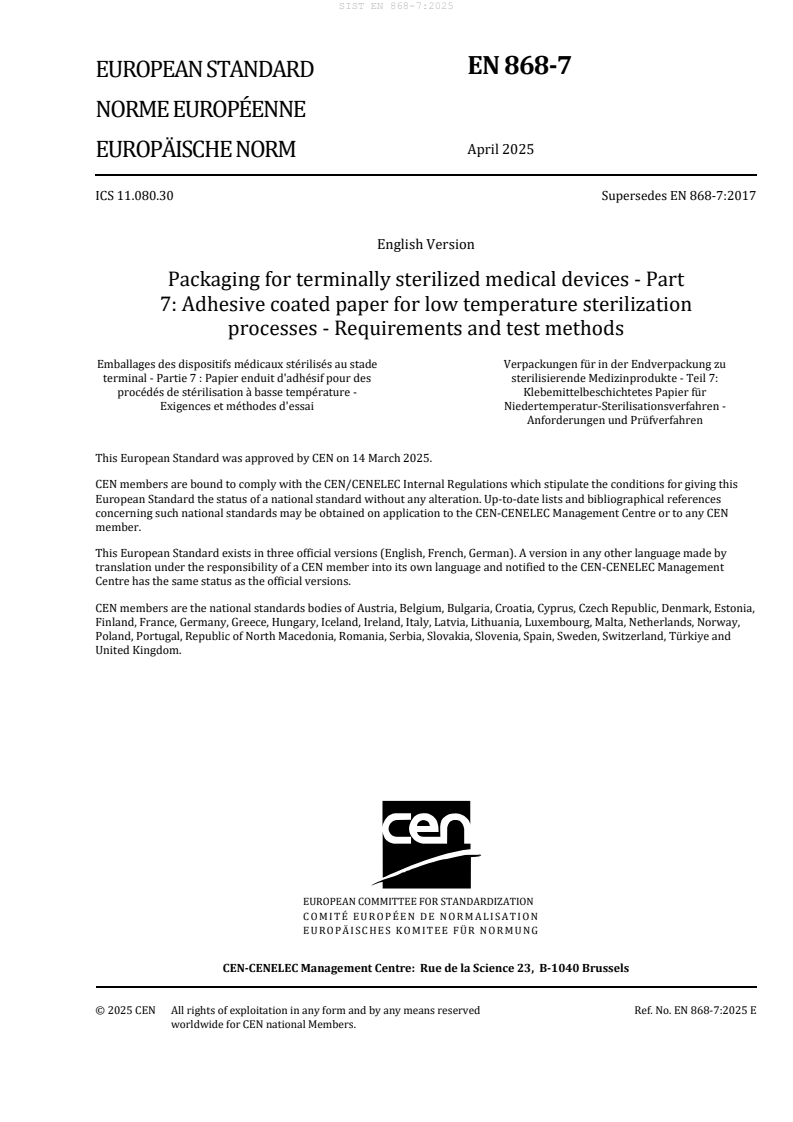
EN 868-7
EUROPEAN STANDARD
NORME EUROPÉENNE
April 2025
EUROPÄISCHE NORM
ICS 11.080.30 Supersedes EN 868-7:2017
English Version
Packaging for terminally sterilized medical devices - Part
7: Adhesive coated paper for low temperature sterilization
processes - Requirements and test methods
Emballages des dispositifs médicaux stérilisés au stade Verpackungen für in der Endverpackung zu
terminal - Partie 7 : Papier enduit d'adhésif pour des sterilisierende Medizinprodukte - Teil 7:
procédés de stérilisation à basse température - Klebemittelbeschichtetes Papier für
Exigences et méthodes d'essai Niedertemperatur-Sterilisationsverfahren -
Anforderungen und Prüfverfahren
This European Standard was approved by CEN on 14 March 2025.
CEN members are bound to comply with the CEN/CENELEC Internal Regulations which stipulate the conditions for giving this
European Standard the status of a national standard without any alteration. Up-to-date lists and bibliographical references
concerning such national standards may be obtained on application to the CEN-CENELEC Management Centre or to any CEN
member.
This European Standard exists in three official versions (English, French, German). A version in any other language made by
translation under the responsibility of a CEN member into its own language and notified to the CEN-CENELEC Management
Centre has the same status as the official versions.
CEN members are the national standards bodies of Austria, Belgium, Bulgaria, Croatia, Cyprus, Czech Republic, Denmark, Estonia,
Finland, France, Germany, Greece, Hungary, Iceland, Ireland, Italy, Latvia, Lithuania, Luxembourg, Malta, Netherlands, Norway,
Poland, Portugal, Republic of North Macedonia, Romania, Serbia, Slovakia, Slovenia, Spain, Sweden, Switzerland, Türkiye and
United Kingdom.
EUROPEAN COMMITTEE FOR STANDARDIZATION
COMITÉ EUROPÉEN DE NORMALISATION
EUROPÄISCHES KOMITEE FÜR NORMUNG
CEN-CENELEC Management Centre: Rue de la Science 23, B-1040 Brussels
© 2025 CEN All rights of exploitation in any form and by any means reserved Ref. No. EN 868-7:2025 E
worldwide for CEN national Members.
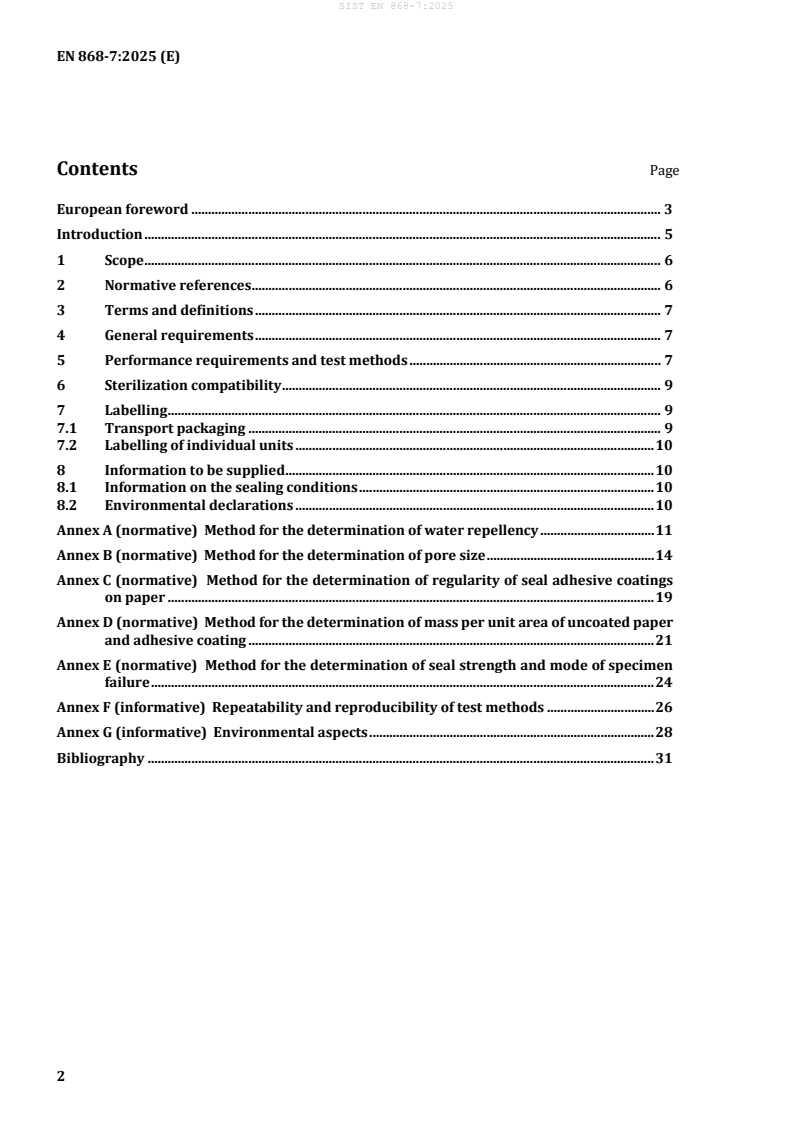
Contents Page
European foreword . 3
Introduction . 5
1 Scope . 6
2 Normative references . 6
3 Terms and definitions . 7
4 General requirements . 7
5 Performance requirements and test methods . 7
6 Sterilization compatibility . 9
7 Labelling . 9
7.1 Transport packaging . 9
7.2 Labelling of individual units . 10
8 Information to be supplied . 10
8.1 Information on the sealing conditions . 10
8.2 Environmental declarations . 10
Annex A (normative) Method for the determination of water repellency . 11
Annex B (normative) Method for the determination of pore size . 14
Annex C (normative) Method for the determination of regularity of seal adhesive coatings
on paper . 19
Annex D (normative) Method for the determination of mass per unit area of uncoated paper
and adhesive coating . 21
Annex E (normative) Method for the determination of seal strength and mode of specimen
failure . 24
Annex F (informative) Repeatability and reproducibility of test methods . 26
Annex G (informative) Environmental aspects . 28
Bibliography . 31
European foreword
This document (EN 868-7:2025) has been prepared by Technical Committee CEN/TC 102 “Sterilizers and
associated equipment for processing of medical devices”, the secretariat of which is held by DIN.
This European Standard shall be given the status of a national standard, either by publication of an
identical text or by endorsement, at the latest by October 2025, and conflicting national standards shall
be withdrawn at the latest by October 2025.
Attention is drawn to the possibility that some of the elements of this document may be the subject of
patent rights. CEN shall not be held responsible for identifying any or all such patent rights.
This document supersedes EN 868-7:2017.
a) The scope of the document was amended for clarity and alignment with other parts of EN 868.
b) The document was renumbered to limit the list numbering to 3 levels only for better readability.
c) Clause 4 “General requirements” was slightly revised for clarity and aligned with the other parts of
EN 868 series and a statement was added clarifying when requirements apply.
d) Clause 6 “Sterilization compatibility” was added, aligned with the other parts of EN 868 series.
e) Subclause 8.2 “Environmental declarations” was added and aligned with the other parts of EN 868
series.
f) The list of major changes was moved to the Foreword, thus the Annex with “Details of significant
technical changes between this European Standard and the previous edition” (former Annex A) was
deleted.
g) A new Clause “Environmental aspects of testing” was added to each test method in Annexes A – E.
h) A new Annex G regarding environmental aspects was added.
EN 868 consists of the following parts, under the general title Packaging for terminally sterilized medical
devices:
— Part 2: Sterilization wrap — Requirements and test methods;
— Part 3: Paper for use in the manufacture of paper bags (specified in EN 868-4) and in the manufacture
of pouches and reels (specified in EN 868-5) — Requirements and test methods;
— Part 4: Paper bags — Requirements and test methods;
— Part 5: Sealable pouches and reels of porous materials and plastic film construction — Requirements
and test methods;
— Part 6: Paper for low temperature sterilization processes — Requirements and test methods;
— Part 7: Adhesive coated paper for low temperature sterilization processes — Requirements and test
methods;
— Part 8: Re-usable sterilization containers for steam sterilizers conforming to EN 285 — Requirements
and test methods;
— Part 9: Uncoated nonwoven materials of polyolefines — Requirements and test methods;
— Part 10: Adhesive coated nonwoven materials of polyolefines — Requirements and test methods.
Any feedback and questions on this document should be directed to the users’ national standards body.
A complete listing of these bodies can be found on the CEN website.
According to the CEN-CENELEC Internal Regulations, the national standards organisations of the
following countries are bound to implement this European Standard: Austria, Belgium, Bulgaria, Croatia,
Cyprus, Czech Republic, Denmark, Estonia, Finland, France, Germany, Greece, Hungary, Iceland, Ireland,
Italy, Latvia, Lithuania, Luxembourg, Malta, Netherlands, Norway, Poland, Portugal, Republic of North
Macedonia, Romania, Serbia, Slovakia, Slovenia, Spain, Sweden, Switzerland, Türkiye and the United
Kingdom.
Introduction
The EN ISO 11607 series of standards consists of two parts under the general title “Packaging for
terminally sterilized medical devices”. EN ISO 11607-1 specifies general requirements and test methods
for materials, preformed sterile barrier systems, sterile barrier systems and packaging systems that are
intended to maintain sterility of terminally sterilized medical devices to the point of use. EN ISO 11607-
2 specifies validation requirements for forming, sealing and assembly processes.
General requirements for all types of sterile barrier systems are provided by EN ISO 11607-1.
The EN 868 series of standards have been developed mainly for materials and sterile barrier systems
used in health care facilities sterilization processes. Materials complying with part 7 of the EN 868 series
can also be used for industrial sterilization. The EN 868 series of standards can be used to demonstrate
compliance with one or more of the requirements specified in EN ISO 11607-1.
Considering CEN Guide 4 [1] and the CEN environmental checklists, this revision has been complemented
with a new annex with guidance to encourage users to also include environmental aspects when applying
the EN 868 series of standards with the objective to minimize the environmental impact. Environmental
aspects have also been included into the description of test methods with the same objective.
1 Scope
This document specifies test methods and values for sealable adhesive coated paper manufactured from
paper complying with EN 868-6, used as single-use sterile barrier systems and/or single-use packaging
systems for terminally sterilized medical devices by the means of low temperature sterilization
processes.
Other than the general requirements as specified in EN ISO 11607-1 and EN ISO 11607-2 [2], this part of
EN 868 specifies materials, test methods and values that are specific to the products covered by this
document.
2 Normative references
The following documents are referred to in the text in such a way that some or all of their content
constitutes requirements of this document. For dated references, only the edition cited applies. For
undated references, the latest edition of the referenced document (including any amendments) applies.
EN ISO 187, Paper, board and pulps — Standard atmosphere for conditioning and testing and procedure
for monitoring the atmosphere and conditioning of samples (ISO 187)
EN ISO 535, Paper and board — Determination of water absorptiveness — Cobb method (ISO 535)
EN ISO 536, Paper and board — Determination of grammage (ISO 536)
EN ISO 1924-2, Paper and board — Determination of tensile properties — Part 2: Constant rate of
elongation method (20 mm/min) (ISO 1924-2)
EN ISO 1974, Paper — Determination of tearing resistance — Elmendorf method (ISO 1974)
EN ISO 2758, Paper — Determination of bursting strength (ISO 2758)
EN ISO 11607-1:2020, Packaging for terminally sterilized medical devices — Part 1: Requirements for
materials, sterile barrier systems and packaging systems (ISO 11607-1:2019)
EN ISO 14021, Environmental labels and declarations — Self-declared environmental claims (Type II
environmental labelling) (ISO 14021)
EN ISO 14025, Environmental labels and declarations — Type III environmental declarations — Principles
and procedures (ISO 14025)
ISO 2470-2, Paper, board and pulps — Measurement of diffuse blue reflectance factor — Part 2: Outdoor
daylight conditions (D65 brightness)
ISO 3689, Paper and board — Determination of bursting strength after immersion in water
ISO 3781, Paper and board — Determination of tensile strength after immersion in water
ISO 5636-3, Paper and board — Determination of air permeance (medium range) — Part 3: Bendtsen
method
ISO 6588-2:2021, Paper, board and pulps — Determination of pH of aqueous extracts — Part 2: Hot
extraction
ISO 8601-1, Date and time — Representations for information interchange — Part 1: Basic rules
ISO 9197, Paper, board and pulps — Determination of water-soluble chlorides
ISO 9198, Paper, board and pulp — Determination of water-soluble sulfates
ASTM F88/F88M:2023, Standard Test Method for Seal Strength of Flexible Barrier Materials
3 Terms and definitions
For the purposes of this document, the terms and definitions given in EN ISO 11607-1 apply.
ISO and IEC maintain terminology databases for use in standardization at the following addresses:
— ISO Online browsing platform: available at https://www.iso.org/obp/
— IEC Electropedia: available at https://www.electropedia.org/
4 General requirements
4.1 For any material, preformed sterile barrier system or sterile barrier system, the requirements of
EN ISO 11607-1 shall apply.
NOTE When additional materials are used inside the sterile barrier system in order to ease the organization,
drying or aseptic presentation (e.g. inner wrap, container filter, indicators, packing lists, mats, instrument organizer
sets, tray liners or an additional envelope around the medical device) then other requirements, including the
determination of the acceptability of these materials during validation activities, can apply.
4.2 This part of EN 868 only introduces performance requirements and test methods that are specific
to the products covered by this part of EN 868 but does not add or modify the general requirements
specified in EN ISO 11607-1.
As such, the particular requirements in Clause 5 can be used to demonstrate compliance with one or more
but not all of the requirements of EN ISO 11607-1.
NOTE 1 Compliance to EN 868-7 does not automatically mean compliance to EN ISO 11607-1.
NOTE 2 This document introduces test methods in Annexes A, B, C, D and E. Annex F provides a statement on
repeatability and reproducibility of the test methods for pore diameters, sulfate content, chloride content and water
repellency. For information on statement of precision and/or bias, repeatability and reproducibility of other test
methods, see EN ISO 11607-1:2020, Table B.1.
NOTE 3 Test methods included in Annex C “regularity of seal adhesive coatings on paper”, Annex D
“Determination of mass per unit area of uncoated paper and adhesive coating” and Annex E “Determination of seal
strength and visual inspection of adhesive coating” have no statement of precision and bias or repeatability and
reproducibility, yet.
4.3 All requirements in Clause 5 shall be applied for testing materials before sterilization.
4.4 A confirmation of compliance to EN 868-7 shall contain a statement whether EN ISO 11607-1 is
covered.
5 Performance requirements and test methods
5.1 No colour shall leach out of the paper. Compliance shall be tested by visual examination of a hot
aqueous extract prepared in accordance with the method given in ISO 6588-2.
5.2 The average mass of 1 m of the conditioned coated paper when tested in accordance with
EN ISO 536 shall be within ± 7,5 % of the nominal value stated by the manufacturer.
5.3 The pH of an aqueous extract of the coated paper shall be not less than 5 or greater than 8 when
tested in accordance with ISO 6588-2, hot extraction method.
5.4 The chloride content of the paper, calculated as sodium chloride, shall not exceed 0,05 % when
tested in accordance with ISO 9197 using a hot extract prepared in accordance with ISO 6588-2:2021, 7.2
except that 2 ml of potassium chloride solution is not added.
5.5 The sulfate content of the paper, calculated as sodium sulfate, shall not exceed 0,25 % when tested
in accordance with ISO 9198, using a hot extract prepared in accordance with ISO 6588-2:2021, 7.2
except that 2 ml of potassium chloride solution is not added.
5.6 When tested in accordance with ISO 2470-2 the material shall not exhibit an increase in D65
brightness, due to the optical brightener agents, of more than 1 %; calculated as the ratio of the D65
brightness measured with the 420 nm UV-cut-off filter in place to the D65 brightness measured without
420 nm UV-cut-off filter.
5.7 When exposed at (25,0 ± 1,0) cm from a UV light source, the material shall not have per 0,01 m
more than five fluorescent spots, each having an axis greater than 1 mm.
The UV light to be used is the one described as per Annex A.
5.8 The internal tearing resistance of the conditioned paper shall be not less than 300 mN in both
machine and cross directions when tested in accordance with EN ISO 1974.
5.9 The air permeance of the conditioned coated paper shall be not less than 0,2 µm/Pa ⋅ s and not
more than 6,0 µm/Pa × s when tested in accordance with ISO 5636-3. For materials solely used for
irradiation sterilization, this requirement may be excluded.
5.10 The bursting strength of the conditioned paper shall be not less than 200 kPa when tested in
accordance with EN ISO 2758.
5.11 The wet bursting strength of the paper shall be not less than 35 kPa when tested in accordance with
ISO 3689 using an immersion time of 10 min. For materials solely used for irradiation sterilization, this
requirement may be excluded.
5.12 The water repellency of the paper shall be such that the penetration time is not less than 20 s when
tested in accordance with Annex A.
5.13 When tested in accordance with Annex B, the average of the pore diameters of the ten test coated
pieces shall be lower than or equal to 20 µm. No value shall be greater than 30 µm.
5.14 The coating shall be continuous and regular with no uncoated areas or discontinuity in the coating
pattern which could provide gaps or channels in a seal when tested and examined in accordance with
Annex C.
5.15 The tensile strength of the conditioned paper shall be not less than 4,0 kN/m in machine direction
and not less than 2,0 kN/m in cross direction when tested in accordance with EN ISO 1924-2.
5.16 The wet tensile strength of the paper shall be not less than 0,80 kN/m in machine direction and not
less than 0,40 kN/m in cross direction when tested in accordance with ISO 3781. For materials solely
used for irradiation sterilization, this requirement may be excluded.
5.17 The surface absorbency of each side of the paper shall be not more than 20 g/m when tested in
accordance with EN ISO 535 using a 60 s exposure time (Cobb method).
5.18 The mass per unit area of seal adhesive coating shall be within ± 2 g/m of that stated by the
manufacturer when tested in accordance with Annex D.
5.19 The seal strength of the coated paper shall be greater than 0,08 kN/m (1,20 N/15 mm) but not so
strong as to cause fibre tear when tested in accordance with Annex E. Report whether the tail was
supported or unsupported, see E.5.
6 Sterilization compatibility
6.1 The sterilization processes applicable to the packaging materials under the scope of this document
shall be defined.
6.2 The sterilization compatibility of the packaging materials shall be evaluated following the
requirements of EN ISO 11607-1. The effects shall be evaluated considering the intended sterilization
process(es) and intended number of cycles.
NOTE Sterilization processes generally have an effect on material properties, therefore evaluation of
sterilization compatibility involves a risk-based assessment considering the characteristics of the material and its
application to define the properties to be evaluated, which typically include material strength properties relevant
for maintenance of sterility after sterilization.
7 Labelling
7.1 Transport packaging
The transport packaging shall be legibly and durably labelled. For industrial applications, the customer
and the supplier should agree on the required label information. For deliveries to health care facilities,
the label shall include at least the following information:
a) reference, stock or catalogue number;
b) quantity;
c) the name or trade name and address of the manufacturer;
d) date of manufacture in accordance with ISO 8601-1;
e) lot number ;
f) nominal sheet size or nominal width of rolls in millimetres and length in metres;
g) the recommended storage conditions;
h) nominal mass in grams per square metre;
i) intended for single use only.
A reference number in order to trace the manufacturing history of the product.
7.2 Labelling of individual units
Individual units shall be legibly and durably labelled with the information a), b), d), e) and name or trade
name according to 7.1.
NOTE Examples for individual units are reels or stacks of sheet material.
8 Information to be supplied
8.1 Information on the sealing conditions
The manufacturer shall supply instructions for recommended sealing conditions and for the monitoring
of critical parameters of seal integrity.
NOTE 1 For validation of closure and sealing conditions, see EN ISO 11607-2 [2].
NOTE 2 For heat seals these parameters include the range of temperature, pressure and time.
NOTE 3 For general information supplied by the manufacturer, see EN ISO 20417 [3].
8.2 Environmental declarations
8.2.1 Environmental labels and declarations, as applicable, shall be made in accordance with
EN ISO 14021 or EN ISO 14025.
NOTE Guidance on environmental aspects is provided in Annex G.
8.2.2 End-of-life treatment recommendations should be provided.
8.2.3 If an assessment of recyclability is performed, the following information shall be provided:
— information about the assessment methodology
— product reference under assessment
— standards and regulations used
— overall results and any additional information to be provided as required by the assessment
methodology.
Annex A
(normative)
Method for the determination of water repellency
A.1 Apparatus
A.1.1 An ultraviolet light source and light meter with a range of wavelength of 315 nm to 390 nm.
A.1.2 Flat dish, approximately 200 mm x 150 mm x 15 mm.
A.1.3 Desiccator.
A.1.4 Stopwatch.
A.1.5 Powder dispenser, with a sieve of nominal aperture size between 0,125 mm and 0,150 mm at one
end and closed at the other.
A.1.6 Lux meter, calibrated to a known standard.
A.1.7 Room or chamber that can be sufficiently darkened.
A.2 Reagent
Dry indicator powder should be prepared as described below.
Grind (20,0 ± 1,0) g of sucrose in a mortar and pass through a sieve of nominal aperture size 0,063 mm
to 0,075 mm. Dry the sieved sucrose in a desiccator over silica gel or in an oven at 105 °C to 110 °C,
nominal 108,0 °C, for a minimum of 24 h or until equilibrium is reached. Mix (10,0 ± 1,0) g sucrose with
(10,0 ± 1,0) mg sodium fluorescein and pass the mixture 5 times through a sieve of nominal aperture size
0,063 mm to 0,075 mm and finally transfer the dry indicator powder to the powder dispenser.
The dry indicator powder in the powder dispenser should be stored either in a desiccator or in an oven
at 105 °C to 110 °C until used or a maximum of 30 days.
A.3 Environmental aspects of testing
A.3.1 Product samples
The number of samples and dimensions of the samples necessary should be carefully defined to avoid
over sampling and unnecessary waste. Number of samples should be based on a risk level with realistic
confidence and reliability levels.
NOTE Carefully defined sample dimensions reduce waste when preparing (cutting) of samples.
Unnecessary samples should be disposed of per manufacturers’ instructions (waste or recycled as
applicable).
A.3.2 Testing agents and materials
To avoid unnecessary waste, the shelf life and the amount of testing planned to define the necessary
amount of testing agent should be considered.
Only necessary amount should be used when applying testing agents/material item under test.
Testing agents should be disposed of per manufacturers’ instructions.
NOTE Local regulations and requirements can also apply.
A.3.3 Use and cleaning of testing equipment
The testing time should be minimized by considering energy use as applicable.
Equipment should be cleaned and cleaning agents should be disposed of per manufacturers’ instructions.
NOTE Local regulations and requirements can also apply.
A.4 Procedure
A.4.1 Take 10 test pieces of paper conditioned in accordance with EN ISO 187, each of size (60,0 ± 5,0)
mm x (60,0 ± 5,0) mm. Separate the samples into two groups of five, one group with the 'wire-side'
uppermost and the other with the 'top-side' uppermost.
A.4.2 For each sample, make ‘boats’ by applying two folds (see Figure A.1), each (10,0 ± 3,0) mm high at
right angles along two edges.
Dimensions in millimetres
Figure A.1 — Folding of the sample
A.4.3 Fill the flat dish with purified water (use of distilled or deionized water is permitted) at the
conditioning temperature of (23,0 ± 1,0) °C to a depth of 10 mm to 20 mm.
A.4.4 Switch on the UV lamp and allow it to develop full output and adjust the distance of the lamp so that
the irradiance at the level of the water in the dish is (300 ± 20) µW/cm .
A.4.5 Sprinkle the upper surface of a test piece thinly with indicator powder from the dispenser.
A.4.6 Set up the test environment with dark conditions up to 10 lux.
A.4.7 Float the test piece on the water under the UV light source and note the time taken for evenly spread
fluorescence to appear over at least 80 % of the surface. This is not necessarily the maximum fluorescence
level.
A.4.8 Repeat the procedure with the remaining nine test pieces.
A.4.9 The water repellency of the paper is considerably influenced by the temperature of the water which
shall be maintained within the specified limits (23 ± 1) °C.
A.5 Repeatability and reproducibility
See Annex F for repeatability and reproducibility of the test method.
A.6 Test report
The test report shall include at least the following information:
a) the identification of the product and the sample under test;
b) the date of the test;
c) the normative reference of the test method including its year of publication and reference to this
annex;
d) the results expressed as the average penetration time in seconds for each side of the tested
material including a reference to the clause which explains how the results were calculated;
e) any deviations from the procedure; and
f) any unusual features observed.
Annex B
(normative)
Method for the determination of pore size
B.1 Principle
The pressure required to force air bubbles through the interstices of a material, wetted by a liquid and
having a film of the same liquid applied to its upper surface, is observed. This pressure, together with the
known surface tension of the liquid, is used to estimate the size of the interstices in the material.
B.2 Test liquid
The test liquid used should allow the paper to be wetted completely, have low solvent power for proofing
materials, cause no swelling of the fibres, have constancy of surface tension, non-toxicity, low
flammability, freedom from foaming, and moderate cost.
NOTE Ethanol with the purity between 95 % and 96 % has been found to be suitable, because of the adequate
surface tension and the ability to wet the material completely.
B.3 Apparatus
B.3.1 The apparatus is shown diagrammatically in Figure B.1. The principal parts a
...
Questions, Comments and Discussion
Ask us and Technical Secretary will try to provide an answer. You can facilitate discussion about the standard in here.
Loading comments...