


SIST EN 12542:2020
(Main)LPG equipment and accessories - Static welded steel cylindrical tanks, serially produced for the storage of Liquefied Petroleum Gas (LPG) having a volume not greater than 13 m³ - Design and manufacture
LPG equipment and accessories - Static welded steel cylindrical tanks, serially produced for the storage of Liquefied Petroleum Gas (LPG) having a volume not greater than 13 m³ - Design and manufacture
This document specifies requirements for the design and manufacture of static welded steel cylindrical pressure vessels, serially produced for the storage of liquefied petroleum gas (LPG) with a volume not greater than 13 m3 and for installation above or below ground.
Flüssiggas-Geräte und Ausrüstungsteile - Ortsfeste, geschweißte zylindrische Behälter aus Stahl, die serienmäßig für die Lagerung von Flüssiggas (LPG) hergestellt werden, mit einem Fassungsvermögen bis 13 m³ - Gestaltung und Herstellung
Dieses Dokument legt Anforderungen hinsichtlich der Auslegung und Herstellung orts¬fester, geschweißter zylindrischer Druckbehälter aus Stahl fest, die in Serie für die Lagerung von Flüssiggas (LPG) gefertigt werden, mit einem Fassungsraum bis zu 13 m3 für oberirdische Aufstellung oder den Einbau im Untergrund.
Équipements pour gaz de pétrole liquéfié et leurs accessoires - Réservoirs cylindriques fixes, aériens, en acier soudé, fabriqués en série pour le stockage de gaz de pétrole liquéfié (GPL) ayant un volume inférieur ou égal à 13 m³ - Conception et fabrication
Le présent document spécifie les exigences pour la conception et la fabrication en série des récipients sous pression cylindriques fixes, en acier soudé, d’un volume inférieur ou égal à 13 m³, destinés au stockage aérien ou enterré de gaz de pétrole liquéfié (GPL).
Oprema in pribor za utekočinjeni naftni plin (UNP) - Nepremične varjene valjaste posode iz jekla, serijske izdelave za skladiščenje utekočinjenega naftnega plina s prostornino do vključno 13 m3 - Konstruiranje in izdelava
General Information
- Status
- Published
- Public Enquiry End Date
- 31-Jan-2017
- Publication Date
- 14-Sep-2020
- Technical Committee
- TLP - Pressure vessels
- Current Stage
Relations
- Effective Date
- 01-Oct-2020
Overview
SIST EN 12542:2020 (EN 12542:2020) is the European standard adopted by SIST that specifies requirements for the design and manufacture of static, welded steel cylindrical pressure vessels serially produced for the storage of Liquefied Petroleum Gas (LPG) with a volume not greater than 13 m³. It covers tanks intended for installation above ground or below ground, and that are used as stationary LPG storage.
This standard supersedes EN 12542:2010 and is published in the three official CEN languages (English, French, German). It is intended to harmonize technical requirements for small to medium-capacity LPG tanks across CEN member countries.
Key Topics and Requirements
The standard addresses technical and quality-control topics essential to LPG tank safety and reliability:
- Scope & terminology – definitions specific to LPG equipment and welded cylindrical pressure vessels.
- Materials – selection and documentation for shells, ends, welded attachments, welding consumables and non-metallic gaskets; environmental considerations.
- Design – rules for pressure, temperature, vacuum conditions, support and lifting loads, and filling conditions (Annex A).
- Openings and reinforcements – design and placement of nozzles, openings and welded branches, including reinforcement rules.
- Workmanship & welding – manufacturing tolerances, acceptable weld details, welding procedures, post-weld heat treatment and repair controls.
- Inspection & testing – visual inspection, non-destructive testing (NDT) methods and acceptance criteria, qualification of personnel, production test plates and final assessment.
- Hydraulic testing & tolerances – hydraulic pressure test procedures (Annex C) and dimensional tolerances (Annex B).
- Surface treatment & finishing – requirements for above-ground vs underground vessels and environmental considerations for coatings.
- Marking, certification & documentation – mandatory marking, records to be kept by the manufacturer, certificates and traceability.
- Design formulae – prescriptive calculation methods and allowable stresses for shells, ends and nozzle reinforcement (Annex E).
Practical Applications and Users
Who uses EN 12542:2020 and why:
- Tank manufacturers of serially produced LPG cylinders - to ensure compliant design and production processes.
- Design engineers - for calculation rules, allowable stresses and nozzle reinforcement methods.
- Quality & inspection personnel - to apply NDT, hydraulic testing and acceptance criteria.
- Installers and operators - to understand installation limits for above-ground and underground LPG storage.
- Regulators and certification bodies - to verify conformity, marking and documentation requirements.
Keywords: LPG tanks, welded steel cylindrical tanks, pressure vessels, EN 12542, design and manufacture, LPG storage, hydraulic test, NDT, surface treatment.
Related Standards (if applicable)
- EN 12542:2010 - previous edition (superseded by EN 12542:2020)
- CEN/CENELEC internal regulations referenced for national adoption
For compliance and safe deployment of small-capacity LPG storage tanks, EN 12542:2020 provides the standardized technical framework manufacturers, engineers and inspectors rely upon.




Frequently Asked Questions
SIST EN 12542:2020 is a standard published by the Slovenian Institute for Standardization (SIST). Its full title is "LPG equipment and accessories - Static welded steel cylindrical tanks, serially produced for the storage of Liquefied Petroleum Gas (LPG) having a volume not greater than 13 m³ - Design and manufacture". This standard covers: This document specifies requirements for the design and manufacture of static welded steel cylindrical pressure vessels, serially produced for the storage of liquefied petroleum gas (LPG) with a volume not greater than 13 m3 and for installation above or below ground.
This document specifies requirements for the design and manufacture of static welded steel cylindrical pressure vessels, serially produced for the storage of liquefied petroleum gas (LPG) with a volume not greater than 13 m3 and for installation above or below ground.
SIST EN 12542:2020 is classified under the following ICS (International Classification for Standards) categories: 23.020.10 - Stationary containers and tanks. The ICS classification helps identify the subject area and facilitates finding related standards.
SIST EN 12542:2020 has the following relationships with other standards: It is inter standard links to SIST EN 12542:2010. Understanding these relationships helps ensure you are using the most current and applicable version of the standard.
SIST EN 12542:2020 is associated with the following European legislation: EU Directives/Regulations: 2014/68/EU, 97/23/EC; Standardization Mandates: M/071. When a standard is cited in the Official Journal of the European Union, products manufactured in conformity with it benefit from a presumption of conformity with the essential requirements of the corresponding EU directive or regulation.
SIST EN 12542:2020 is available in PDF format for immediate download after purchase. The document can be added to your cart and obtained through the secure checkout process. Digital delivery ensures instant access to the complete standard document.
Standards Content (Sample)
SLOVENSKI STANDARD
01-oktober-2020
Nadomešča:
SIST EN 12542:2010
Oprema in pribor za utekočinjeni naftni plin (UNP) - Nepremične varjene valjaste
posode iz jekla serijske proizvodnje za skladiščenje utekočinjenega naftnega plina
s prostornino do vključno 13 m³ - Konstruiranje in proizvodnja
LPG equipment and accessories - Static welded steel cylindrical tanks, serially produced
for the storage of Liquefied Petroleum Gas (LPG) having a volume not greater than 13
m³ - Design and manufacture
Flüssiggas-Geräte und Ausrüstungsteile - Ortsfeste, geschweißte zylindrische Behälter
aus Stahl, die serienmäßig für die Lagerung von Flüssiggas (LPG) hergestellt werden,
mit einem Fassungsvermögen bis 13 m³ - Gestaltung und Herstellung
Équipements pour gaz de pétrole liquéfié et leurs accessoires - Réservoirs cylindriques
fixes, aériens, en acier soudé, fabriqués en série pour le stockage de gaz de pétrole
liquéfié (GPL) ayant un volume inférieur ou égal à 13 m³ - Conception et fabrication
Ta slovenski standard je istoveten z: EN 12542:2020
ICS:
23.020.10 Nepremične posode in Stationary containers and
rezervoarji tanks
2003-01.Slovenski inštitut za standardizacijo. Razmnoževanje celote ali delov tega standarda ni dovoljeno.
EN 12542
EUROPEAN STANDARD
NORME EUROPÉENNE
August 2020
EUROPÄISCHE NORM
ICS 23.020.30 Supersedes EN 12542:2010
English Version
LPG equipment and accessories - Static welded steel
cylindrical pressure vessels, serially produced for the
storage of Liquefied Petroleum Gas (LPG) having a volume
not greater than 13 m³ - Design and manufacture
Équipements pour gaz de pétrole liquéfié et leurs Flüssiggas-Geräte und Ausrüstungsteile - Ortsfeste,
accessoires - Réservoirs cylindriques fixes, aériens, en geschweißte zylindrische Behälter aus Stahl, die
acier soudé, fabriqués en série pour le stockage de gaz serienmäßig für die Lagerung von Flüssiggas (LPG)
de pétrole liquéfié (GPL) ayant un volume inférieur ou hergestellt werden, mit einem Fassungsvermögen bis
égal à 13 m³ - Conception et fabrication 13 m³ - Gestaltung und Herstellung
This European Standard was approved by CEN on 15 June 2020.
CEN members are bound to comply with the CEN/CENELEC Internal Regulations which stipulate the conditions for giving this
European Standard the status of a national standard without any alteration. Up-to-date lists and bibliographical references
concerning such national standards may be obtained on application to the CEN-CENELEC Management Centre or to any CEN
member.
This European Standard exists in three official versions (English, French, German). A version in any other language made by
translation under the responsibility of a CEN member into its own language and notified to the CEN-CENELEC Management
Centre has the same status as the official versions.
CEN members are the national standards bodies of Austria, Belgium, Bulgaria, Croatia, Cyprus, Czech Republic, Denmark, Estonia,
Finland, France, Germany, Greece, Hungary, Iceland, Ireland, Italy, Latvia, Lithuania, Luxembourg, Malta, Netherlands, Norway,
Poland, Portugal, Republic of North Macedonia, Romania, Serbia, Slovakia, Slovenia, Spain, Sweden, Switzerland, Turkey and
United Kingdom.
EUROPEAN COMMITTEE FOR STANDARDIZATION
COMITÉ EUROPÉEN DE NORMALISATION
EUROPÄISCHES KOMITEE FÜR NORMUNG
CEN-CENELEC Management Centre: Rue de la Science 23, B-1040 Brussels
© 2020 CEN All rights of exploitation in any form and by any means reserved Ref. No. EN 12542:2020 E
worldwide for CEN national Members.
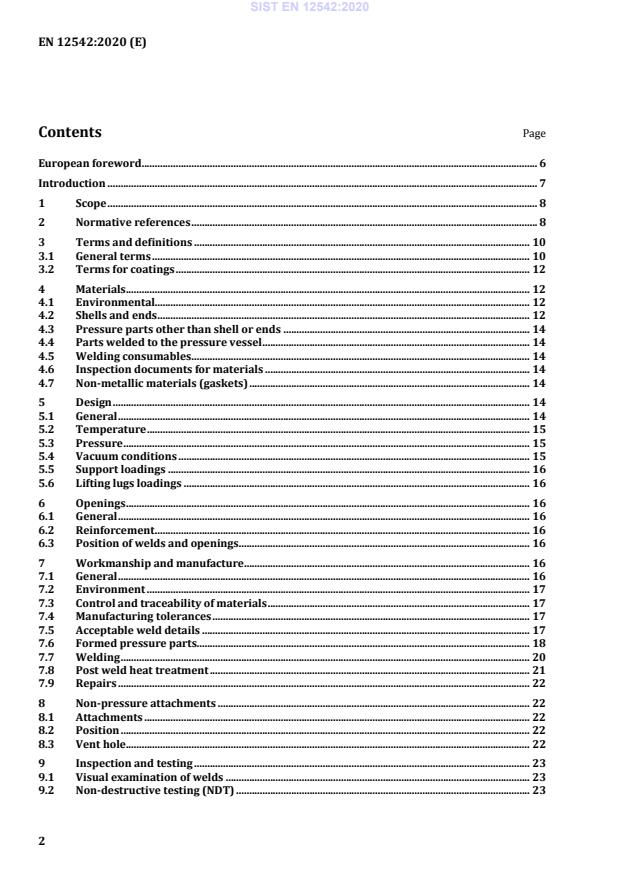
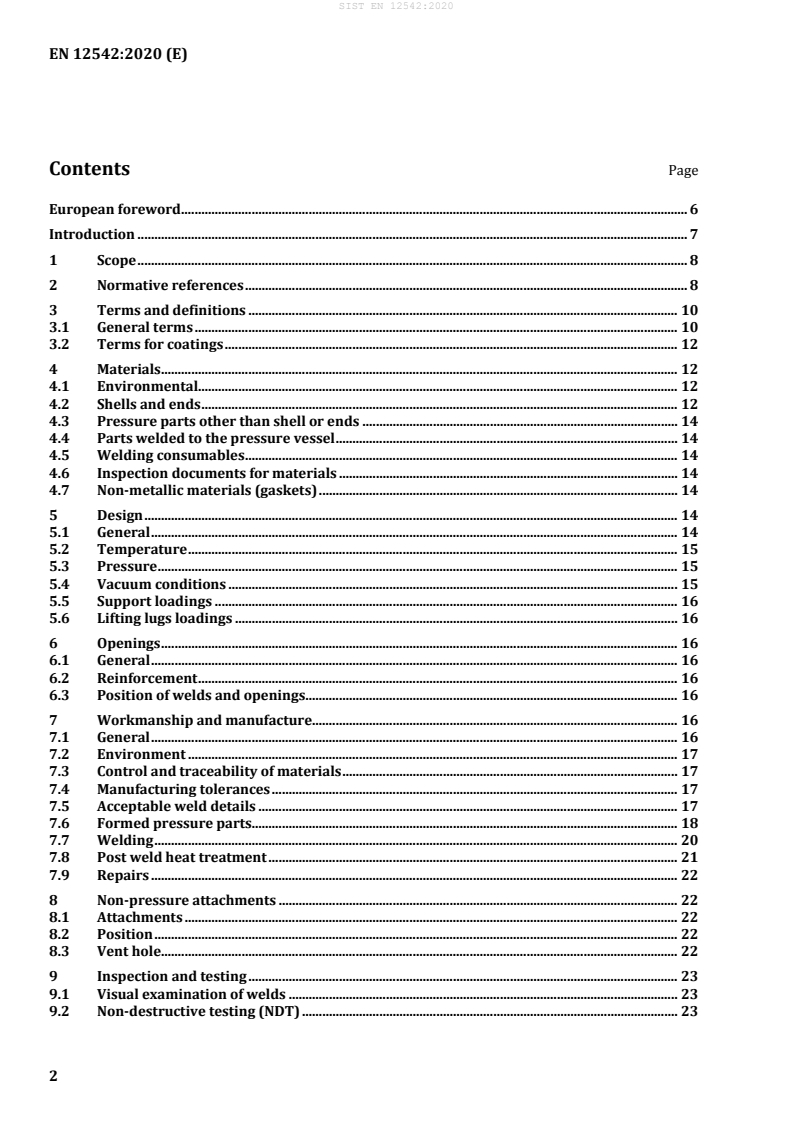
Contents Page
European foreword . 6
Introduction . 7
1 Scope . 8
2 Normative references . 8
3 Terms and definitions . 10
3.1 General terms . 10
3.2 Terms for coatings . 12
4 Materials . 12
4.1 Environmental. 12
4.2 Shells and ends . 12
4.3 Pressure parts other than shell or ends . 14
4.4 Parts welded to the pressure vessel . 14
4.5 Welding consumables . 14
4.6 Inspection documents for materials . 14
4.7 Non-metallic materials (gaskets) . 14
5 Design . 14
5.1 General . 14
5.2 Temperature . 15
5.3 Pressure . 15
5.4 Vacuum conditions . 15
5.5 Support loadings . 16
5.6 Lifting lugs loadings . 16
6 Openings . 16
6.1 General . 16
6.2 Reinforcement . 16
6.3 Position of welds and openings . 16
7 Workmanship and manufacture . 16
7.1 General . 16
7.2 Environment . 17
7.3 Control and traceability of materials . 17
7.4 Manufacturing tolerances . 17
7.5 Acceptable weld details . 17
7.6 Formed pressure parts. 18
7.7 Welding . 20
7.8 Post weld heat treatment . 21
7.9 Repairs . 22
8 Non-pressure attachments . 22
8.1 Attachments . 22
8.2 Position . 22
8.3 Vent hole . 22
9 Inspection and testing . 23
9.1 Visual examination of welds . 23
9.2 Non-destructive testing (NDT) . 23
9.3 Non-destructive testing techniques . 24
9.4 Marking for non-destructive testing . 25
9.5 Qualification of personnel . 25
9.6 Acceptance criteria . 25
9.7 Production test plates (coupon plates) . 26
9.8 Final assessment . 27
10 Surface treatment and finishing . 28
10.1 Environmental considerations . 28
10.2 Above ground pressure vessels . 28
10.3 Underground pressure vessels . 29
10.4 Finishing operations . 29
11 Marking and certification . 29
12 Records and documentation . 30
12.1 Records to be obtained by the manufacturer . 30
12.2 Documents to be prepared by the manufacturer . 30
Annex A (informative) Design pressure and filling conditions . 31
A.1 Above ground pressure vessels . 31
A.1.1 Design pressure (p) . 31
A.1.2 Filling conditions . 31
A.1.3 Calculation of maximum fill . 32
A.2 Underground pressure vessels — Design pressure . 32
Annex B (normative) Tolerances on pressure vessels . 33
B.1 Mean external diameter . 33
B.2 Out of roundness . 33
B.3 Deviation from the straight line . 33
B.4 Irregularities in circular profile . 33
B.5 Thickness tolerance . 34
B.6 Profile. 34
B.7 Surface alignment . 35
B.8 Attachments, nozzles and fittings . 35
Annex C (normative) Hydraulic pressure test . 36
C.1 Temporary fittings . 36
C.2 Pressure gauges . 36
C.3 Pressurizing agent . 36
C.4 Avoidance of shocks . 36
C.5 Test procedure . 36
Annex D (normative) Imperfections . 37
Annex E (normative) Design formulae for pressure vessels . 39
E.1 Allowable stresses . 39
E.2 Design formulae . 39
E.2.1 General . 39
E.2.2 Cylindrical shell calculation . 39
E.2.3 Torispherical end calculation . 39
E.2.4 Ellipsoidal end calculation . 40
E.2.5 Hemispherical ends . 42
E.2.6 Equations for calculating β . 42
E.3 Nozzle reinforcement . 43
E.3.1 General . 43
E.3.2 Size of openings . 43
E.3.3 Distance between openings or branches . 43
E.3.4 Openings and branches . 44
E.3.5 Cylindrical shells and ends with openings . 44
E.3.6 Shell reinforcement . 44
E.3.7 Extent of reinforcement . 44
E.3.8 Elliptical openings . 44
E.3.9 Welded branches . 45
E.3.10 Compensating plates . 45
E.3.11 Reinforcement − General . 45
E.3.12 Reinforcement by pads . 45
E.3.13 Reinforcement by branches . 46
E.3.14 Branch connections normal to the pressure vessel wall . 46
Annex F (informative) Measurement of shell peaking . 50
F.1 Profile gauge . 50
F.2 Peaking survey . 50
Annex G (informative) Examples of joints . 53
Annex H (informative) Method of determining reflectivity indices (above ground pressure
vessels). 57
Annex I (normative) External protection of underground pressure vessels . 58
I.1 General . 58
I.2 Unmonitored protection systems . 58
I.3 Monitored protection systems . 58
I.3.1 Systems incorporating cathodic protection . 58
I.3.2 Systems incorporating a protective envelope . 59
I.3.3 Other systems . 59
Annex J (informative) Exterior corrosion protective coating with special performance
against chemical and mechanical attacks . 60
J.1 General . 60
J.2 Requirements . 60
J.2.1 General requirements . 60
J.2.2 Requirements for the coating material . 60
J.2.3 Requirements for the coating . 61
J.2.4 Requirements for the coating process . 62
J.3 Testing . 62
J.3.1 Testing for the coating material . 62
J.3.2 Testing for the coating . 63
J.3.3 Documentation of the coating procedure . 64
J.3.4 Test reports and certificates. 65
J.4 Supervision during production . 65
Annex ZA (informative) Relationship between this European Standard and the essential
requirements of EU Directive 2014/68/EU . 66
Bibliography . 68
European foreword
This document (EN 12542:2020) has been prepared by Technical Committee CEN/TC 286 “Liquefied
petroleum gas equipment and accessories”, the secretariat of which is held by NSAI.
This European Standard shall be given the status of a national standard, either by publication of an
identical text or by endorsement, at the latest by February 2021, and conflicting national standards shall
be withdrawn at the latest by February 2021.
Attention is drawn to the possibility that some of the elements of this document may be the subject of
patent rights. CEN shall not be held responsible for identifying any or all such patent rights.
This document has been prepared under a standardization request given to CEN by the European
Commission and the European Free Trade Association, and supports essential requirements of
EU Directive(s).
For relationship with EU Directive(s), see informative Annex ZA, which is an integral part of this
document.
This document supersedes EN 12542:2010.
The following main changes have been introduced during the revision of EN 12542:2010:
— a reference to “CEN/TS 16765 LPG equipment and accessories - Environmental considerations for
CEN/TC 286 standards” has been added and the existing wording has been amended (including the
deletion of environmental references throughout this document);
— Annex J Environmental checklist has been deleted;
— inclusion of the use of compensation calculations from EN 13445-3:2014, in order to reduce the
distance between openings or branches;
— a new informative Annex J Exterior corrosion protective coating with special performance against
chemical and mechanical attacks has been added.
According to the CEN-CENELEC Internal Regulations, the national standards organisations of the
following countries are bound to implement this European Standard: Austria, Belgium, Bulgaria, Croatia,
Cyprus, Czech Republic, Denmark, Estonia, Finland, France, Germany, Greece, Hungary, Iceland, Ireland,
Italy, Latvia, Lithuania, Luxembourg, Malta, Netherlands, Norway, Poland, Portugal, Republic of North
Macedonia, Romania, Serbia, Slovakia, Slovenia, Spain, Sweden, Switzerland, Turkey and the United
Kingdom.
Introduction
This document calls for the use of substances and procedures that may be injurious to health and/or the
environment if adequate precautions are not taken. It refers only to technical suitability and does not
absolve the user from legal obligations at any stage.
Protection of the environment is a key political issue in Europe and elsewhere; for CEN/TC 286 this is
covered in CEN/TS 16765, LPG equipment and accessories — Environmental considerations for
CEN/TC 286 standards, and this Technical Specification should be read in conjunction with this document.
This Technical Specification provides guidance on the environmental aspects to be considered regarding
equipment and accessories produced for the LPG industry and the following is addressed:
a) design;
b) manufacture;
c) packaging;
d) use and operation;
e) disposal.
Provisions should be restricted to a general guidance. Limit values are specified in national laws.
It is recommended that manufacturers develop an environmental management policy. For guidance
see the ISO 14000 series.
It has been assumed in the drafting of this document that the execution of its provisions is entrusted to
appropriately qualified and experienced people.
All pressures are gauge pressures unless otherwise stated.
NOTE This document requires measurement of material properties, dimensions and pressures. All such
measurements are subject to a degree of uncertainty due to tolerances in measuring equipment, etc. It may be
beneficial to refer to the leaflet “Measurement Uncertainty Leaflet (SP INFO 2000 27 uncertainty.pdf )”.
1 Scope
This document specifies requirements for the design and manufacture of static welded steel cylindrical
pressure vessels, serially produced for the storage of liquefied petroleum gas (LPG) with a volume not
greater than 13 m and for installation above or below ground.
2 Normative references
The following documents are referred to in the text in such a way that some or all of their content
constitutes requirements of this document. For dated references, only the edition cited applies. For
undated references, the latest edition of the referenced document (including any amendments) applies.
EN 764-5:2014, Pressure equipment — Part 5: Inspection documentation of metallic materials and
compliance with the material specification
EN 837-2:1997, Pressure gauges — Part 2: Selection and installation recommendations for pressure gauges
EN 1708-1:2010, Welding — Basic welded joint details in steel — Part 1: Pressurized components
EN 10025-2:2019, Hot rolled products of structural steels — Part 2: Technical delivery conditions for non-
alloy structural steels
EN 10028-2:2017, Flat products made of steels for pressure purposes — Part 2: Non-alloy and alloy steels
with specified elevated temperature properties
EN 10028-3:2017, Flat products made of steels for pressure purposes — Part 3: Weldable fine grain steels,
normalized
EN 10028-5:2017, Flat products made of steels for pressure purposes — Part 5: Weldable fine grain steels,
thermomechanically rolled
EN 10204:2004, Metallic products — Types of inspection documents
EN 13445-2:2014, Unfired pressure vessels — Part 2: Materials
EN 13445-3:2014, Unfired pressure vessels — Part 3: Design
EN 13636:2004, Cathodic protection of buried metallic tanks and related piping
EN 14717:2005, Welding and allied processes — Environmental check list
EN 14784-1:2005, Non-destructive testing — Industrial computed radiography with storage phosphor
imaging plates — Part 1: Classification of systems
EN ISO 16371-2:2017, Non-destructive testing — Industrial computed radiography with storage phosphor
imaging plates — Part 2: General principles for testing of metallic materials using X-rays and gamma rays
(ISO 16371-2:2017, Corrected version 2018-05)
EN ISO 636:2017, Welding consumables — Rods, wires and deposits for tungsten inert gas welding of non-
alloy and fine-grain steels — Classification (ISO 636:2017)
EN ISO 2560:2009, Welding consumables — Covered electrodes for manual metal arc welding of non-alloy
and fine grain steels — Classification (ISO 2560:2009)
EN ISO 3452-1:2013, Non-destructive testing — Penetrant testing — Part 1: General principles
(ISO 3452-1:2013, Corrected version 2014-05-01)
EN ISO 5173:2010, Destructive tests on welds in metallic materials — Bend tests (ISO 5173:2009)
EN ISO 5178:2019, Destructive tests on welds in metallic materials — Longitudinal tensile test on weld
metal in fusion welded joints (ISO 5178:2019)
EN ISO 5817:2014, Welding — Fusion-welded joints in steel, nickel, titanium and their alloys (beam welding
excluded) — Quality levels for imperfections (ISO 5817:2014)
EN ISO 6520-1:2007, Welding and allied processes — Classification of geometric imperfections in metallic
materials — Part 1: Fusion welding (ISO 6520-1:2007)
EN ISO 9016:2012, Destructive tests on welds in metallic materials — Impact tests — Test specimen
location, notch orientation and examination (ISO 9016:2012)
EN ISO 9606-1:2017, Qualification testing of welders — Fusion welding — Part 1: Steels (ISO 9606-1: 2012
including Cor 1:2012 and Cor 2:2013)
EN ISO 9712:2012, Non-destructive testing — Qualification and certification of NDT personnel
(ISO 9712:2012)
EN ISO 10675-1:2016, Non-destructive testing of welds — Acceptance levels for radiographic testing —
Part 1: Steel, nickel, titanium and their alloys (ISO 10675-1:2016)
EN ISO 11666:2018, Non-destructive testing of welds — Ultrasonic testing — Acceptance levels
(ISO 11666:2018)
EN ISO 4136:2012, Destructive tests on welds in metallic materials — Transverse tensile test (ISO
4136:2012)
EN ISO 14171:2016, Welding consumables — Solid wire electrodes, tubular cored electrodes and
electrode/flux combinations for submerged arc welding of non alloy and fine grain steels — Classification
(ISO 14171:2016)
EN ISO 14732:2013, Welding personnel — Qualification testing of welding operators and weld setters for
mechanized and automatic welding of metallic materials (ISO 14732:2013)
EN ISO 15609-1:2019, Specification and qualification of welding procedures for metallic materials —
Welding procedure specification — Part 1: Arc welding (ISO 15609-1:2019)
EN ISO 15613:2004, Specification and qualification of welding procedures for metallic materials —
Qualification based on pre-production welding test (ISO 15613:2004)
EN ISO 15614-1:2017, Specification and qualification of welding procedures for metallic materials —
Welding procedure test — Part 1: Arc and gas welding of steels and arc welding of nickel and nickel alloys
(ISO 15614-1:2017, Corrected version 2017-10-01)
EN ISO 17632:2015, Welding consumables — Tubular cored electrodes for gas shielded and non-gas
shielded metal arc welding of non-alloy and fine grain steels — Classification (ISO 17632:2015)
EN ISO 17635:2016, Non-destructive testing of welds — General rules for metallic materials
(ISO 17635:2016)
EN ISO 17636-1:2013, Non-destructive testing of welds — Radiographic testing — Part 1: X- and gamma-
ray techniques with film (ISO 17636-1:2013)
EN ISO 17636-2:2013, Non-destructive testing of welds — Radiographic testing — Part 2: X- and gamma-
ray techniques with digital detectors (ISO 17636-2:2013)
EN ISO 17637:2016, Non-destructive testing of welds — Visual testing of fusion-welded joints
(ISO 17637:2016)
EN ISO 17638:2016, Non-destructive testing of welds — Magnetic particle testing (ISO 17638:2016)
EN ISO 17639:2013, Destructive tests on welds in metallic materials — Macroscopic and microscopic
examination of welds (ISO 17639:2003)
EN ISO 17640:2018, Non-destructive testing of welds — Ultrasonic testing — Techniques, testing levels, and
assessment (ISO 17640:2018)
EN ISO 19232-1:2013, Non-destructive testing — Image quality of radiographs — Part 1: Determination of
the image quality value using wire-type image quality indicators (ISO 19232-1:2013)
EN ISO 19232-2:2013, Non-destructive testing — Image quality of radiographs — Part 2: Determination of
the image quality value using step/hole-type image quality indicators (ISO 19232-2:2013)
EN ISO 23277:2015, Non-destructive testing of welds — Penetrant testing — Acceptance levels
(ISO 23277:2015)
EN ISO 23278:2015, Non-destructive testing of welds — Magnetic particle testing — Acceptance levels
(ISO 23278:2015)
EN ISO 23279:2017, Non-destructive testing of welds — Ultrasonic testing — Characterization of
discontinuities in welds (ISO 23279:2017)
ISO 9162:2013, Petroleum products — Fuels (class F) — Liquefied petroleum gases — Specifications
3 Terms and definitions
For the purposes of this document, the following terms and definitions apply.
ISO and IEC maintain terminological databases for use in standardization at the following addresses:
— IEC Electropedia: available at http://www.electropedia.org/
— ISO Online browsing platform: available at https://www.iso.org/obp/ui
Note 1 to entry: See CEN/TS 16769.
3.1 General terms
3.1.1
Liquefied Petroleum Gas
LPG
low pressure liquefied gas composed of one or more light hydrocarbons which are assigned to UN 1011,
UN 1075, UN 1965, UN 1969 or UN 1978 only and which consists mainly of propane, propene, butane,
butane isomers, butene with traces of other hydrocarbon gases
3.1.2
serially produced pressure vessels
more than one vessel manufactured in the same factory to a common design using the same material and
manufacturing procedure and produced with no major interruption within a given period of time
3.1.3
manufacturer
individual or organization responsible for the design, fabrication, testing, installation where relevant, and
compliance with the requirements of the relevant product standard, whether executed by him or a
subcontractor
Note 1 to entry: The manufacturer can subcontract one or more of the abovementioned tasks under its
responsibility.
Note 2 to entry: In EU member states the manufacturer is responsible for compliance with the Pressure
Equipment Directive 2014/68/EU. For those manufacturers outside of the EU their authorized representative
inside the EU assumes this responsibility.
3.1.4
yield strength
upper yield strength R or, for steels that do not exhibit a definite yield, the 0,2 % proof strength R
eH p0,2
3.1.5
design pressure
pressure used for the calculation of the minimum wall thickness
3.1.6
climatic area
geographic area agreed or defined by the relevant national authorities, or other bodies, responsible for
defining the design conditions for LPG storage pressure vessels, in the country(ies) where the pressure
vessel is intended to be operated
Note 1 to entry: The area is used to define the reference temperature for design pressure and filling.
3.1.7
hot forming
forming at temperatures above the maximum permissible temperature for stress relieving in accordance
with the material specification
3.1.8
cold forming
forming at temperatures not less than 25 °C below the maximum permissible temperature for stress
relieving, in accordance with the applicable material specifications
3.1.9
Ar
critical point, on the iron-iron carbide equilibrium diagram, representing the temperature at the end of
transformation of austenite to ferrite on cooling of the steel
Note 1 to entry: The actual temperature varies with composition of the steel.
3.1.10
production-batch
group of pressure parts or finished pressure vessels, made consecutively by the same manufacturer using
the same manufacturing techniques to the same design, nominal size and material specifications on the
same production machinery and subject to the same heat treatment conditions
Note 1 to entry: In this context, consecutively need not imply continuous production.
3.2 Terms for coatings
3.2.1
coating material
product, in liquid, paste or powder form, that, when applied to a substrate, forms a layer possessing
protective, decorative and/or other specific properties
[SOURCE: EN ISO 4618:2014, 2.51, modified – The original Note 1 to entry is not reproduced here.]
3.2.2
coating
layer formed from a single or multiple application of a coating material to a substrate
[SOURCE: EN ISO 4618:2014, 2.50.1]
3.2.3
coating process
method of application of a coating material to a substrate
[SOURCE: EN ISO 4618:2014, 2.53]
4 Materials
4.1 Environmental
The manufacturer shall endeavour to acquire materials and components from suppliers who have a
declared environmental policy; see CEN/TS 16765, EN ISO 14021, EN ISO 14024 and EN ISO 14025.
4.2 Shells and ends
4.2.1 Materials for shells and ends shall be selected from the range of steels specified in EN 10028-
2:2017, EN 10028-3:2017 or EN 10028-5:2017.
Other equivalent material specifications which have either European materials approval or have been
subjected to a particular material appraisal may be used.
4.2.2 In all cases the materials used shall comply with the following:
— the chemical composition and mechanical properties shall meet the requirements of either Group 1
or Group 2, as defined in Table 1 — Material grouping;
— the minimum specified ultimate tensile strength shall not exceed 700 MPa;
— the minimum elongation after fracture shall be 14 %;
— the impact properties shall be not less than 27 J at the minimum design temperature or shall meet
the requirements for low temperature design as detailed in EN 13445-2.
4.2.3 Steels shall be grouped in accordance with Table 1 — Material grouping.
4.2.4 Where materials subject to particular material appraisal have been used, satisfactory properties
following welding shall be demonstrated by production weld test plates, see 9.7.
Table 1 — Material grouping
Group Sub- Type of steel
group
a
1 Steels with a specified minimum yield strength R ≤ 460 MPa and with
eH
analysis in percent:
C ≤ 0,25
Si ≤ 0,60
Mn ≤ 1,70
b
Mo ≤ 0,70
S ≤ 0,045
P ≤ 0,045
b
Cu ≤ 0,40
b
Ni ≤ 0,5
b
Cr ≤ 0,3 (0,4 for castings)
Nb ≤ 0,05
b
V ≤ 0,12
Ti ≤ 0,05
1.1 Steels with a specified minimum yield strength R ≤ 275 MPa
eH
1.2 Steels with a specified minimum yield strength 275 MPa < R ≤ 360 MPa
eH
1.3 Normalized fine grain steels with a specified minimum yield strength
ReH > 360 MPa
2 Thermomechanically treated fine grain steels and cast steels with a specified
minimum yield strength R > 360 MPa
eH
2.1 Thermomechanically treated fine grain steels and cast steels with a specified
minimum yield strength 360 MPa < R ≤ 460 MPa
eH
a
In accordance with the specification of the steel product standards, ReH may be replaced by Rp0,2.
b
A higher value is accepted provided that Cr + Mo + Ni + Cu + V ≤ 0,75 %.
NOTE This table is based on CEN ISO/TR 15608.
4.3 Pressure parts other than shell or ends
Materials for pressure parts, other than shells and ends, shall comply with the appropriate harmonized
European Standard for the material, or a similar specification which has European materials approval or
particular material appraisal.
Examples of standards which may be used include EN 10222-2 (Forgings), EN 10216-2 (Seamless tubes),
EN 10217 series (Welded tubes) and EN 10273 (Bars).
Materials shall also meet the requirements of 4.2.2 and 4.2.3 and 4.2.4.
4.4 Parts welded to the pressure vessel
Non-pressure retaining parts that are directly welded to the pressure retaining parts shall be made from
suitable materials selected from EN 10025-2:2019 or a material which is compatible with the pressure
retaining part material.
In all cases, the material shall meet the requirements of 4.2.
4.5 Welding consumables
The welding consumables shall be such that they are capable of giving consistent welds with properties
at least equal to those specified for the parent materials of the finished pressure vessel.
The welding consumables shall be selected from EN ISO 2560:2009, EN ISO 14171:2016,
EN ISO 17632:2015 or EN ISO 636:2017, as appropriate. Suitability of the chosen consumables shall be
demonstrated in accordance with 7.7.3.
4.6 Inspection documents for materials
The pressure vessel manufacturer shall obtain inspection documents showing the chemical analysis and
details of the mechanical properties of the steel supplied for the construction of the pressure vessel, the
documents shall be in accordance with EN 764-5:2014. The documents shall include, or be supplemented
by, the material manufacturer's documented affirmation of compliance to the material specification.
NOTE Annex 1 Essential Safety Requirement 4.3 of the PED gives specific requirements for material
manufacturers and their quality management systems.
4.7 Non-metallic materials (gaskets)
Non-metallic materials shall be compatible with both phases of LPG over the full range of
...
SLOVENSKI STANDARD
01-oktober-2020
Nadomešča:
SIST EN 12542:2010
Oprema in pribor za utekočinjeni naftni plin (UNP) - Nepremične varjene valjaste
posode iz jekla, serijske izdelave za skladiščenje utekočinjenega naftnega plina s
prostornino do vključno 13 m3 - Konstruiranje in izdelava
LPG equipment and accessories - Static welded steel cylindrical tanks, serially produced
for the storage of Liquefied Petroleum Gas (LPG) having a volume not greater than 13
m³ - Design and manufacture
Flüssiggas-Geräte und Ausrüstungsteile - Ortsfeste, geschweißte zylindrische Behälter
aus Stahl, die serienmäßig für die Lagerung von Flüssiggas (LPG) hergestellt werden,
mit einem Fassungsvermögen bis 13 m³ - Gestaltung und Herstellung
Équipements pour gaz de pétrole liquéfié et leurs accessoires - Réservoirs cylindriques
fixes, aériens, en acier soudé, fabriqués en série pour le stockage de gaz de pétrole
liquéfié (GPL) ayant un volume inférieur ou égal à 13 m³ - Conception et fabrication
Ta slovenski standard je istoveten z: EN 12542:2020
ICS:
23.020.10 Nepremične posode in Stationary containers and
rezervoarji tanks
2003-01.Slovenski inštitut za standardizacijo. Razmnoževanje celote ali delov tega standarda ni dovoljeno.
EN 12542
EUROPEAN STANDARD
NORME EUROPÉENNE
August 2020
EUROPÄISCHE NORM
ICS 23.020.30 Supersedes EN 12542:2010
English Version
LPG equipment and accessories - Static welded steel
cylindrical pressure vessels, serially produced for the
storage of Liquefied Petroleum Gas (LPG) having a volume
not greater than 13 m³ - Design and manufacture
Équipements pour gaz de pétrole liquéfié et leurs Flüssiggas-Geräte und Ausrüstungsteile - Ortsfeste,
accessoires - Réservoirs cylindriques fixes, aériens, en geschweißte zylindrische Behälter aus Stahl, die
acier soudé, fabriqués en série pour le stockage de gaz serienmäßig für die Lagerung von Flüssiggas (LPG)
de pétrole liquéfié (GPL) ayant un volume inférieur ou hergestellt werden, mit einem Fassungsvermögen bis
égal à 13 m³ - Conception et fabrication 13 m³ - Gestaltung und Herstellung
This European Standard was approved by CEN on 15 June 2020.
CEN members are bound to comply with the CEN/CENELEC Internal Regulations which stipulate the conditions for giving this
European Standard the status of a national standard without any alteration. Up-to-date lists and bibliographical references
concerning such national standards may be obtained on application to the CEN-CENELEC Management Centre or to any CEN
member.
This European Standard exists in three official versions (English, French, German). A version in any other language made by
translation under the responsibility of a CEN member into its own language and notified to the CEN-CENELEC Management
Centre has the same status as the official versions.
CEN members are the national standards bodies of Austria, Belgium, Bulgaria, Croatia, Cyprus, Czech Republic, Denmark, Estonia,
Finland, France, Germany, Greece, Hungary, Iceland, Ireland, Italy, Latvia, Lithuania, Luxembourg, Malta, Netherlands, Norway,
Poland, Portugal, Republic of North Macedonia, Romania, Serbia, Slovakia, Slovenia, Spain, Sweden, Switzerland, Turkey and
United Kingdom.
EUROPEAN COMMITTEE FOR STANDARDIZATION
COMITÉ EUROPÉEN DE NORMALISATION
EUROPÄISCHES KOMITEE FÜR NORMUNG
CEN-CENELEC Management Centre: Rue de la Science 23, B-1040 Brussels
© 2020 CEN All rights of exploitation in any form and by any means reserved Ref. No. EN 12542:2020 E
worldwide for CEN national Members.
Contents Page
European foreword . 6
Introduction . 7
1 Scope . 8
2 Normative references . 8
3 Terms and definitions . 10
3.1 General terms . 10
3.2 Terms for coatings . 12
4 Materials . 12
4.1 Environmental. 12
4.2 Shells and ends . 12
4.3 Pressure parts other than shell or ends . 14
4.4 Parts welded to the pressure vessel . 14
4.5 Welding consumables . 14
4.6 Inspection documents for materials . 14
4.7 Non-metallic materials (gaskets) . 14
5 Design . 14
5.1 General . 14
5.2 Temperature . 15
5.3 Pressure . 15
5.4 Vacuum conditions . 15
5.5 Support loadings . 16
5.6 Lifting lugs loadings . 16
6 Openings . 16
6.1 General . 16
6.2 Reinforcement . 16
6.3 Position of welds and openings . 16
7 Workmanship and manufacture . 16
7.1 General . 16
7.2 Environment . 17
7.3 Control and traceability of materials . 17
7.4 Manufacturing tolerances . 17
7.5 Acceptable weld details . 17
7.6 Formed pressure parts. 18
7.7 Welding . 20
7.8 Post weld heat treatment . 21
7.9 Repairs . 22
8 Non-pressure attachments . 22
8.1 Attachments . 22
8.2 Position . 22
8.3 Vent hole . 22
9 Inspection and testing . 23
9.1 Visual examination of welds . 23
9.2 Non-destructive testing (NDT) . 23
9.3 Non-destructive testing techniques . 24
9.4 Marking for non-destructive testing . 25
9.5 Qualification of personnel . 25
9.6 Acceptance criteria . 25
9.7 Production test plates (coupon plates) . 26
9.8 Final assessment . 27
10 Surface treatment and finishing . 28
10.1 Environmental considerations . 28
10.2 Above ground pressure vessels . 28
10.3 Underground pressure vessels . 29
10.4 Finishing operations . 29
11 Marking and certification . 29
12 Records and documentation . 30
12.1 Records to be obtained by the manufacturer . 30
12.2 Documents to be prepared by the manufacturer . 30
Annex A (informative) Design pressure and filling conditions . 31
A.1 Above ground pressure vessels . 31
A.1.1 Design pressure (p) . 31
A.1.2 Filling conditions . 31
A.1.3 Calculation of maximum fill . 32
A.2 Underground pressure vessels — Design pressure . 32
Annex B (normative) Tolerances on pressure vessels . 33
B.1 Mean external diameter . 33
B.2 Out of roundness . 33
B.3 Deviation from the straight line . 33
B.4 Irregularities in circular profile . 33
B.5 Thickness tolerance . 34
B.6 Profile. 34
B.7 Surface alignment . 35
B.8 Attachments, nozzles and fittings . 35
Annex C (normative) Hydraulic pressure test . 36
C.1 Temporary fittings . 36
C.2 Pressure gauges . 36
C.3 Pressurizing agent . 36
C.4 Avoidance of shocks . 36
C.5 Test procedure . 36
Annex D (normative) Imperfections . 37
Annex E (normative) Design formulae for pressure vessels . 39
E.1 Allowable stresses . 39
E.2 Design formulae . 39
E.2.1 General . 39
E.2.2 Cylindrical shell calculation . 39
E.2.3 Torispherical end calculation . 39
E.2.4 Ellipsoidal end calculation . 40
E.2.5 Hemispherical ends . 42
E.2.6 Equations for calculating β . 42
E.3 Nozzle reinforcement . 43
E.3.1 General . 43
E.3.2 Size of openings . 43
E.3.3 Distance between openings or branches . 43
E.3.4 Openings and branches . 44
E.3.5 Cylindrical shells and ends with openings . 44
E.3.6 Shell reinforcement . 44
E.3.7 Extent of reinforcement . 44
E.3.8 Elliptical openings . 44
E.3.9 Welded branches . 45
E.3.10 Compensating plates . 45
E.3.11 Reinforcement − General . 45
E.3.12 Reinforcement by pads . 45
E.3.13 Reinforcement by branches . 46
E.3.14 Branch connections normal to the pressure vessel wall . 46
Annex F (informative) Measurement of shell peaking . 50
F.1 Profile gauge . 50
F.2 Peaking survey . 50
Annex G (informative) Examples of joints . 53
Annex H (informative) Method of determining reflectivity indices (above ground pressure
vessels). 57
Annex I (normative) External protection of underground pressure vessels . 58
I.1 General . 58
I.2 Unmonitored protection systems . 58
I.3 Monitored protection systems . 58
I.3.1 Systems incorporating cathodic protection . 58
I.3.2 Systems incorporating a protective envelope . 59
I.3.3 Other systems . 59
Annex J (informative) Exterior corrosion protective coating with special performance
against chemical and mechanical attacks . 60
J.1 General . 60
J.2 Requirements . 60
J.2.1 General requirements . 60
J.2.2 Requirements for the coating material . 60
J.2.3 Requirements for the coating . 61
J.2.4 Requirements for the coating process . 62
J.3 Testing . 62
J.3.1 Testing for the coating material . 62
J.3.2 Testing for the coating . 63
J.3.3 Documentation of the coating procedure . 64
J.3.4 Test reports and certificates. 65
J.4 Supervision during production . 65
Annex ZA (informative) Relationship between this European Standard and the essential
requirements of EU Directive 2014/68/EU . 66
Bibliography . 68
European foreword
This document (EN 12542:2020) has been prepared by Technical Committee CEN/TC 286 “Liquefied
petroleum gas equipment and accessories”, the secretariat of which is held by NSAI.
This European Standard shall be given the status of a national standard, either by publication of an
identical text or by endorsement, at the latest by February 2021, and conflicting national standards shall
be withdrawn at the latest by February 2021.
Attention is drawn to the possibility that some of the elements of this document may be the subject of
patent rights. CEN shall not be held responsible for identifying any or all such patent rights.
This document has been prepared under a standardization request given to CEN by the European
Commission and the European Free Trade Association, and supports essential requirements of
EU Directive(s).
For relationship with EU Directive(s), see informative Annex ZA, which is an integral part of this
document.
This document supersedes EN 12542:2010.
The following main changes have been introduced during the revision of EN 12542:2010:
— a reference to “CEN/TS 16765 LPG equipment and accessories - Environmental considerations for
CEN/TC 286 standards” has been added and the existing wording has been amended (including the
deletion of environmental references throughout this document);
— Annex J Environmental checklist has been deleted;
— inclusion of the use of compensation calculations from EN 13445-3:2014, in order to reduce the
distance between openings or branches;
— a new informative Annex J Exterior corrosion protective coating with special performance against
chemical and mechanical attacks has been added.
According to the CEN-CENELEC Internal Regulations, the national standards organisations of the
following countries are bound to implement this European Standard: Austria, Belgium, Bulgaria, Croatia,
Cyprus, Czech Republic, Denmark, Estonia, Finland, France, Germany, Greece, Hungary, Iceland, Ireland,
Italy, Latvia, Lithuania, Luxembourg, Malta, Netherlands, Norway, Poland, Portugal, Republic of North
Macedonia, Romania, Serbia, Slovakia, Slovenia, Spain, Sweden, Switzerland, Turkey and the United
Kingdom.
Introduction
This document calls for the use of substances and procedures that may be injurious to health and/or the
environment if adequate precautions are not taken. It refers only to technical suitability and does not
absolve the user from legal obligations at any stage.
Protection of the environment is a key political issue in Europe and elsewhere; for CEN/TC 286 this is
covered in CEN/TS 16765, LPG equipment and accessories — Environmental considerations for
CEN/TC 286 standards, and this Technical Specification should be read in conjunction with this document.
This Technical Specification provides guidance on the environmental aspects to be considered regarding
equipment and accessories produced for the LPG industry and the following is addressed:
a) design;
b) manufacture;
c) packaging;
d) use and operation;
e) disposal.
Provisions should be restricted to a general guidance. Limit values are specified in national laws.
It is recommended that manufacturers develop an environmental management policy. For guidance
see the ISO 14000 series.
It has been assumed in the drafting of this document that the execution of its provisions is entrusted to
appropriately qualified and experienced people.
All pressures are gauge pressures unless otherwise stated.
NOTE This document requires measurement of material properties, dimensions and pressures. All such
measurements are subject to a degree of uncertainty due to tolerances in measuring equipment, etc. It may be
beneficial to refer to the leaflet “Measurement Uncertainty Leaflet (SP INFO 2000 27 uncertainty.pdf )”.
1 Scope
This document specifies requirements for the design and manufacture of static welded steel cylindrical
pressure vessels, serially produced for the storage of liquefied petroleum gas (LPG) with a volume not
greater than 13 m and for installation above or below ground.
2 Normative references
The following documents are referred to in the text in such a way that some or all of their content
constitutes requirements of this document. For dated references, only the edition cited applies. For
undated references, the latest edition of the referenced document (including any amendments) applies.
EN 764-5:2014, Pressure equipment — Part 5: Inspection documentation of metallic materials and
compliance with the material specification
EN 837-2:1997, Pressure gauges — Part 2: Selection and installation recommendations for pressure gauges
EN 1708-1:2010, Welding — Basic welded joint details in steel — Part 1: Pressurized components
EN 10025-2:2019, Hot rolled products of structural steels — Part 2: Technical delivery conditions for non-
alloy structural steels
EN 10028-2:2017, Flat products made of steels for pressure purposes — Part 2: Non-alloy and alloy steels
with specified elevated temperature properties
EN 10028-3:2017, Flat products made of steels for pressure purposes — Part 3: Weldable fine grain steels,
normalized
EN 10028-5:2017, Flat products made of steels for pressure purposes — Part 5: Weldable fine grain steels,
thermomechanically rolled
EN 10204:2004, Metallic products — Types of inspection documents
EN 13445-2:2014, Unfired pressure vessels — Part 2: Materials
EN 13445-3:2014, Unfired pressure vessels — Part 3: Design
EN 13636:2004, Cathodic protection of buried metallic tanks and related piping
EN 14717:2005, Welding and allied processes — Environmental check list
EN 14784-1:2005, Non-destructive testing — Industrial computed radiography with storage phosphor
imaging plates — Part 1: Classification of systems
EN ISO 16371-2:2017, Non-destructive testing — Industrial computed radiography with storage phosphor
imaging plates — Part 2: General principles for testing of metallic materials using X-rays and gamma rays
(ISO 16371-2:2017, Corrected version 2018-05)
EN ISO 636:2017, Welding consumables — Rods, wires and deposits for tungsten inert gas welding of non-
alloy and fine-grain steels — Classification (ISO 636:2017)
EN ISO 2560:2009, Welding consumables — Covered electrodes for manual metal arc welding of non-alloy
and fine grain steels — Classification (ISO 2560:2009)
EN ISO 3452-1:2013, Non-destructive testing — Penetrant testing — Part 1: General principles
(ISO 3452-1:2013, Corrected version 2014-05-01)
EN ISO 5173:2010, Destructive tests on welds in metallic materials — Bend tests (ISO 5173:2009)
EN ISO 5178:2019, Destructive tests on welds in metallic materials — Longitudinal tensile test on weld
metal in fusion welded joints (ISO 5178:2019)
EN ISO 5817:2014, Welding — Fusion-welded joints in steel, nickel, titanium and their alloys (beam welding
excluded) — Quality levels for imperfections (ISO 5817:2014)
EN ISO 6520-1:2007, Welding and allied processes — Classification of geometric imperfections in metallic
materials — Part 1: Fusion welding (ISO 6520-1:2007)
EN ISO 9016:2012, Destructive tests on welds in metallic materials — Impact tests — Test specimen
location, notch orientation and examination (ISO 9016:2012)
EN ISO 9606-1:2017, Qualification testing of welders — Fusion welding — Part 1: Steels (ISO 9606-1: 2012
including Cor 1:2012 and Cor 2:2013)
EN ISO 9712:2012, Non-destructive testing — Qualification and certification of NDT personnel
(ISO 9712:2012)
EN ISO 10675-1:2016, Non-destructive testing of welds — Acceptance levels for radiographic testing —
Part 1: Steel, nickel, titanium and their alloys (ISO 10675-1:2016)
EN ISO 11666:2018, Non-destructive testing of welds — Ultrasonic testing — Acceptance levels
(ISO 11666:2018)
EN ISO 4136:2012, Destructive tests on welds in metallic materials — Transverse tensile test (ISO
4136:2012)
EN ISO 14171:2016, Welding consumables — Solid wire electrodes, tubular cored electrodes and
electrode/flux combinations for submerged arc welding of non alloy and fine grain steels — Classification
(ISO 14171:2016)
EN ISO 14732:2013, Welding personnel — Qualification testing of welding operators and weld setters for
mechanized and automatic welding of metallic materials (ISO 14732:2013)
EN ISO 15609-1:2019, Specification and qualification of welding procedures for metallic materials —
Welding procedure specification — Part 1: Arc welding (ISO 15609-1:2019)
EN ISO 15613:2004, Specification and qualification of welding procedures for metallic materials —
Qualification based on pre-production welding test (ISO 15613:2004)
EN ISO 15614-1:2017, Specification and qualification of welding procedures for metallic materials —
Welding procedure test — Part 1: Arc and gas welding of steels and arc welding of nickel and nickel alloys
(ISO 15614-1:2017, Corrected version 2017-10-01)
EN ISO 17632:2015, Welding consumables — Tubular cored electrodes for gas shielded and non-gas
shielded metal arc welding of non-alloy and fine grain steels — Classification (ISO 17632:2015)
EN ISO 17635:2016, Non-destructive testing of welds — General rules for metallic materials
(ISO 17635:2016)
EN ISO 17636-1:2013, Non-destructive testing of welds — Radiographic testing — Part 1: X- and gamma-
ray techniques with film (ISO 17636-1:2013)
EN ISO 17636-2:2013, Non-destructive testing of welds — Radiographic testing — Part 2: X- and gamma-
ray techniques with digital detectors (ISO 17636-2:2013)
EN ISO 17637:2016, Non-destructive testing of welds — Visual testing of fusion-welded joints
(ISO 17637:2016)
EN ISO 17638:2016, Non-destructive testing of welds — Magnetic particle testing (ISO 17638:2016)
EN ISO 17639:2013, Destructive tests on welds in metallic materials — Macroscopic and microscopic
examination of welds (ISO 17639:2003)
EN ISO 17640:2018, Non-destructive testing of welds — Ultrasonic testing — Techniques, testing levels, and
assessment (ISO 17640:2018)
EN ISO 19232-1:2013, Non-destructive testing — Image quality of radiographs — Part 1: Determination of
the image quality value using wire-type image quality indicators (ISO 19232-1:2013)
EN ISO 19232-2:2013, Non-destructive testing — Image quality of radiographs — Part 2: Determination of
the image quality value using step/hole-type image quality indicators (ISO 19232-2:2013)
EN ISO 23277:2015, Non-destructive testing of welds — Penetrant testing — Acceptance levels
(ISO 23277:2015)
EN ISO 23278:2015, Non-destructive testing of welds — Magnetic particle testing — Acceptance levels
(ISO 23278:2015)
EN ISO 23279:2017, Non-destructive testing of welds — Ultrasonic testing — Characterization of
discontinuities in welds (ISO 23279:2017)
ISO 9162:2013, Petroleum products — Fuels (class F) — Liquefied petroleum gases — Specifications
3 Terms and definitions
For the purposes of this document, the following terms and definitions apply.
ISO and IEC maintain terminological databases for use in standardization at the following addresses:
— IEC Electropedia: available at http://www.electropedia.org/
— ISO Online browsing platform: available at https://www.iso.org/obp/ui
Note 1 to entry: See CEN/TS 16769.
3.1 General terms
3.1.1
Liquefied Petroleum Gas
LPG
low pressure liquefied gas composed of one or more light hydrocarbons which are assigned to UN 1011,
UN 1075, UN 1965, UN 1969 or UN 1978 only and which consists mainly of propane, propene, butane,
butane isomers, butene with traces of other hydrocarbon gases
3.1.2
serially produced pressure vessels
more than one vessel manufactured in the same factory to a common design using the same material and
manufacturing procedure and produced with no major interruption within a given period of time
3.1.3
manufacturer
individual or organization responsible for the design, fabrication, testing, installation where relevant, and
compliance with the requirements of the relevant product standard, whether executed by him or a
subcontractor
Note 1 to entry: The manufacturer can subcontract one or more of the abovementioned tasks under its
responsibility.
Note 2 to entry: In EU member states the manufacturer is responsible for compliance with the Pressure
Equipment Directive 2014/68/EU. For those manufacturers outside of the EU their authorized representative
inside the EU assumes this responsibility.
3.1.4
yield strength
upper yield strength R or, for steels that do not exhibit a definite yield, the 0,2 % proof strength R
eH p0,2
3.1.5
design pressure
pressure used for the calculation of the minimum wall thickness
3.1.6
climatic area
geographic area agreed or defined by the relevant national authorities, or other bodies, responsible for
defining the design conditions for LPG storage pressure vessels, in the country(ies) where the pressure
vessel is intended to be operated
Note 1 to entry: The area is used to define the reference temperature for design pressure and filling.
3.1.7
hot forming
forming at temperatures above the maximum permissible temperature for stress relieving in accordance
with the material specification
3.1.8
cold forming
forming at temperatures not less than 25 °C below the maximum permissible temperature for stress
relieving, in accordance with the applicable material specifications
3.1.9
Ar
critical point, on the iron-iron carbide equilibrium diagram, representing the temperature at the end of
transformation of austenite to ferrite on cooling of the steel
Note 1 to entry: The actual temperature varies with composition of the steel.
3.1.10
production-batch
group of pressure parts or finished pressure vessels, made consecutively by the same manufacturer using
the same manufacturing techniques to the same design, nominal size and material specifications on the
same production machinery and subject to the same heat treatment conditions
Note 1 to entry: In this context, consecutively need not imply continuous production.
3.2 Terms for coatings
3.2.1
coating material
product, in liquid, paste or powder form, that, when applied to a substrate, forms a layer possessing
protective, decorative and/or other specific properties
[SOURCE: EN ISO 4618:2014, 2.51, modified – The original Note 1 to entry is not reproduced here.]
3.2.2
coating
layer formed from a single or multiple application of a coating material to a substrate
[SOURCE: EN ISO 4618:2014, 2.50.1]
3.2.3
coating process
method of application of a coating material to a substrate
[SOURCE: EN ISO 4618:2014, 2.53]
4 Materials
4.1 Environmental
The manufacturer shall endeavour to acquire materials and components from suppliers who have a
declared environmental policy; see CEN/TS 16765, EN ISO 14021, EN ISO 14024 and EN ISO 14025.
4.2 Shells and ends
4.2.1 Materials for shells and ends shall be selected from the range of steels specified in EN 10028-
2:2017, EN 10028-3:2017 or EN 10028-5:2017.
Other equivalent material specifications which have either European materials approval or have been
subjected to a particular material appraisal may be used.
4.2.2 In all cases the materials used shall comply with the following:
— the chemical composition and mechanical properties shall meet the requirements of either Group 1
or Group 2, as defined in Table 1 — Material grouping;
— the minimum specified ultimate tensile strength shall not exceed 700 MPa;
— the minimum elongation after fracture shall be 14 %;
— the impact properties shall be not less than 27 J at the minimum design temperature or shall meet
the requirements for low temperature design as detailed in EN 13445-2.
4.2.3 Steels shall be grouped in accordance with Table 1 — Material grouping.
4.2.4 Where materials subject to particular material appraisal have been used, satisfactory properties
following welding shall be demonstrated by production weld test plates, see 9.7.
Table 1 — Material grouping
Group Sub- Type of steel
group
a
1 Steels with a specified minimum yield strength R ≤ 460 MPa and with
eH
analysis in percent:
C ≤ 0,25
Si ≤ 0,60
Mn ≤ 1,70
b
Mo ≤ 0,70
S ≤ 0,045
P ≤ 0,045
b
Cu ≤ 0,40
b
Ni ≤ 0,5
b
Cr ≤ 0,3 (0,4 for castings)
Nb ≤ 0,05
b
V ≤ 0,12
Ti ≤ 0,05
1.1 Steels with a specified minimum yield strength R ≤ 275 MPa
eH
1.2 Steels with a specified minimum yield strength 275 MPa < R ≤ 360 MPa
eH
1.3 Normalized fine grain steels with a specified minimum yield strength
ReH > 360 MPa
2 Thermomechanically treated fine grain steels and cast steels with a specified
minimum yield strength R > 360 MPa
eH
2.1 Thermomechanically treated fine grain steels and cast steels with a specified
minimum yield strength 360 MPa < R ≤ 460 MPa
eH
a
In accordance with the specification of the steel product standards, ReH may be replaced by Rp0,2.
b
A higher value is accepted provided that Cr + Mo + Ni + Cu + V ≤ 0,75 %.
NOTE This table is based on CEN ISO/TR 15608.
4.3 Pressure parts other than shell or ends
Materials for pressure parts, other than shells and ends, shall comply with the appropriate harmonized
European Standard for the material, or a similar specification which has European materials approval or
particular material appraisal.
Examples of standards which may be used include EN 10222-2 (Forgings), EN 10216-2 (Seamless tubes),
EN 10217 series (Welded tubes) and EN 10273 (Bars).
Materials shall also meet the requirements of 4.2.2 and 4.2.3 and 4.2.4.
4.4 Parts welded to the pressure vessel
Non-pressure retaining parts that are directly welded to the pressure retaining parts shall be made from
suitable materials selected from EN 10025-2:2019 or a material which is compatible with the pressure
retaining part material.
In all cases, the material shall meet the requirements of 4.2.
4.5 Welding consumables
The welding consumables shall be such that they are capable of giving consistent welds with properties
at least equal to those specified for the parent materials of the finished pressure vessel.
The welding consumables shall be selected from EN ISO 2560:2009, EN ISO 14171:2016,
EN ISO 17632:2015 or EN ISO 636:2017, as appropriate. Suitability of the chosen consumables shall be
demonstrated in accordance with 7.7.3.
4.6 Inspection documents for materials
The pressure vessel manufacturer shall obtain inspection documents showing the chemical analysis and
details of the mechanical properties of the steel supplied for the construction of the pressure vessel, the
documents shall be in accordance with EN 764-5:2014. The documents shall include, or be supplemented
by, the material manufacturer's documented affirmation of compliance to the material specification.
NOTE Annex 1 Essential Safety Requirement 4.3 of the PED gives specific requirements for material
manufacturers and their quality management systems.
4.7 Non-metallic materials (gaskets)
Non-metallic materials shall be compatible with both phases of LPG over the full range of pres
...
Questions, Comments and Discussion
Ask us and Technical Secretary will try to provide an answer. You can facilitate discussion about the standard in here.
Loading comments...