


SIST EN ISO 10319:2024
(Main)Geosynthetics - Wide-width tensile test (ISO 10319:2024)
Geosynthetics - Wide-width tensile test (ISO 10319:2024)
This document specifies an index test method for the determination of the tensile properties of geosynthetics (polymeric, glass and metallic), using a wide-width strip. This document is applicable to most geosynthetics, including woven geotextiles, nonwoven geotextiles, geocomposites, knitted geotextiles, geonets, geomats and metallic products. It is also applicable to geogrids and similar open-structure geotextiles, but specimen dimensions will possibly need to be altered. It is not applicable to polymeric or bituminous geosynthetic barriers, but it is applicable to clay geosynthetic barriers.
This document specifies a tensile test method that covers the measurement of tensile force, elongation characteristics and includes procedures for the calculation of secant stiffness, maximum load per unit width and strain at maximum force. Singular points on the tensile force-extension curve are also indicated.
Procedures for measuring the tensile properties of both conditioned and wet specimens are included in this document.
Geokunststoffe - Zugversuch am breiten Streifen (ISO 10319:2024)
Dieses Dokument legt ein Indexprüfverfahren für die Bestimmung der Zugeigenschaften von Geokunststoffen (Kunststoff, Glas und Metall) unter Verwendung eines breiten Streifens fest. Dieses Dokument ist auf die meisten Geokunststoffe, einschließlich Geogewebe, Geovliesstoffe, Geoverbundstoffe, Geomaschenwaren, Geonetze, Geomatten und metallische Produkte anwendbar. Es ist auch auf Geogitter und ähnliche offen strukturierte Geotextilien anwendbar, jedoch ist es möglicherweise erforderlich, die Messprobenabmessungen zu ändern. Es gilt nicht für geosynthetische Kunststoff- oder Bitumendichtungsbahnen, ist jedoch für geosynthetische Tondichtungsbahnen anwendbar.
Dieses Dokument legt ein Zugprüfverfahren fest, das die Messung der Zugkraft- und Dehnungs-Eigenschaften umfasst und Verfahren zur Berechnung der Sekantensteifigkeit, der Höchstkraft je Breiteneinheit und der Dehnung bei der Höchstzugkraft einschließt. Einzelne Punkte der Zugkraft-Dehnungs-Kurve sind ebenfalls angegeben.
Verfahren zur Messung der Zugeigenschaften sowohl von konditionierten Messproben als auch von nassen Messproben sind in diesem Dokument enthalten.
Géosynthétiques - Essai de traction des bandes larges (ISO 10319:2024)
Le présent document décrit une méthode d’essai de référence pour la détermination des propriétés mécaniques en traction des géosynthétiques (à base de polymère, de verre et de métal) à l’aide d’une bande de grande largeur. Ce document est applicable à la plupart des géosynthétiques, notamment les géotextiles tissés, les géotextiles non tissés, les géocomposites, les géotextiles maillés, les géofilets, les géomatelas et les produits métalliques. Il s’applique également aux géogrilles et aux géotextiles à structure ouverte similaires, mais il pourra s’avérer nécessaire de modifier les dimensions de l’éprouvette. Cet essai n’est pas applicable aux géomembranes polymériques ou bitumineuses, mais il est applicable aux géosynthétiques bentonitiques.
Le présent document spécifie une méthode d’essai de traction qui couvre le mesurage des caractéristiques de force de traction et d’élongation et comprend les modes opératoires de calcul de la raideur sécante, de la force maximale par unité de largeur et de la déformation à la force maximale. Des points singuliers sont également indiqués sur la courbe de force de traction/extension.
Le présent document fournit en outre des modes opératoires de mesure des propriétés mécaniques en traction d’éprouvettes conditionnées et d’éprouvettes humides.
Geotekstilije - Natezni preskus na širokih preskušancih (ISO 10319:2024)
Ta dokument določa indeksno preskusno metodo za določanje nateznih lastnosti geotekstilij (polimernih, steklenih in kovinskih) z uporabo širokega traku. Ta dokument se uporablja za večino geotekstilij, vključno s tkanimi in netkanimi geotekstilijami, geokompoziti, pletenimi geotekstilijami, geomrežami, geokoprenami ter kovinskimi izdelki. Uporablja se tudi za georešetke in podobne geotekstilije z odprto strukturo, pri čemer bo morda treba spremeniti mere preskušanca. Ne uporablja se za polimerne ali bitumenske geosintetične pregrade, uporablja pa se za glinene geosintetične pregrade.
Ta dokument določa natezno preskusno metodo, ki zajema merjenje natezne sile, značilnosti raztezka ter vključuje postopke za izračun sekantne togosti, največje obremenitve na širino enote in deformacije pri največji sili. Navedene so tudi singularne točke na krivulji natezna sila-raztezek.
Ta dokument vključuje postopke za merjenje nateznih lastnosti tako kondicioniranih kot mokrih preskušancev.
General Information
- Status
- Published
- Public Enquiry End Date
- 09-Oct-2023
- Publication Date
- 04-Nov-2024
- Technical Committee
- ITEK - Textile and textile products
- Current Stage
- 6060 - National Implementation/Publication (Adopted Project)
- Start Date
- 24-Oct-2024
- Due Date
- 29-Dec-2024
- Completion Date
- 05-Nov-2024
Relations
- Effective Date
- 19-Jan-2023
Overview
EN ISO 10319:2024 - Geosynthetics: Wide‑width tensile test (ISO 10319:2024) is the CEN-endorsed international standard that defines an index method for determining the tensile properties of most geosynthetic products using a wide‑width strip. Published October 2024 and superseding EN ISO 10319:2015, this fourth edition clarifies terminology (force vs. load), refines strain definitions, and adds procedures for temperature conditioning and additional specimen types. The standard applies to polymeric, glass and metallic geosynthetics including woven and nonwoven geotextiles, geocomposites, geonets, geomats, geogrids (with possible specimen-dimension changes) and clay geosynthetic barriers. It excludes polymeric and bituminous geosynthetic barriers.
Key Topics
- Test principle: Wide‑width strip tensile test to measure tensile force and elongation characteristics.
- Measured parameters:
- Maximum tensile force (Fmax) and maximum load per unit width
- Tensile strain and strain at maximum force
- Secant tensile stiffness (force per unit width divided by associated strain)
- Identification of singular points on the tensile force–extension curve
- Specimen preparation & dimensions: Nominal gauge length is normally 60 mm (30 mm on either side of the specimen center); open-structure products (e.g., geogrids) may require altered specimen dimensions.
- Pre‑tension and origin: Elongation at a pre‑tension force (1% of expected maximum tensile force) is used to set the strain origin.
- Conditioning: Procedures for standard atmosphere conditioning, wet specimen testing, and conditioning for tests at lower or elevated temperatures (Annex A).
- Apparatus & measurement: Requirements for tensile testing machines, grips/jaws and extensometers; calibration references (e.g., ISO 7500-1).
- Reporting & calculations: Formulae for strain and tensile strength (including for products narrower than 200 mm), and updated test-report requirements.
Applications
EN ISO 10319:2024 is used by:
- Manufacturers for product development and quality control (QC)
- Independent testing laboratories performing conformity and performance tests
- Project engineers and specifiers assessing material tensile performance for roadworks, embankments, retaining structures and erosion control
- Contractors and asset owners verifying delivered geosynthetics meet contractual tensile criteria
- R&D teams comparing materials and optimizing composite designs
The standard provides repeatable, comparable tensile data that support design decisions, material selection and compliance with procurement specifications.
Related Standards
Relevant referenced documents include:
- ISO 10318-1 (terms and definitions)
- ISO 9862 (sampling and specimen preparation)
- ISO 9863-1 (thickness determination)
- ISO 7500-1 (machine calibration)
- ISO 10321 (tensile test for joints/seams by wide‑width strip method)
For implementation details and national adoption dates, consult your national standards body or the CEN/ISO publications.
Frequently Asked Questions
SIST EN ISO 10319:2024 is a standard published by the Slovenian Institute for Standardization (SIST). Its full title is "Geosynthetics - Wide-width tensile test (ISO 10319:2024)". This standard covers: This document specifies an index test method for the determination of the tensile properties of geosynthetics (polymeric, glass and metallic), using a wide-width strip. This document is applicable to most geosynthetics, including woven geotextiles, nonwoven geotextiles, geocomposites, knitted geotextiles, geonets, geomats and metallic products. It is also applicable to geogrids and similar open-structure geotextiles, but specimen dimensions will possibly need to be altered. It is not applicable to polymeric or bituminous geosynthetic barriers, but it is applicable to clay geosynthetic barriers. This document specifies a tensile test method that covers the measurement of tensile force, elongation characteristics and includes procedures for the calculation of secant stiffness, maximum load per unit width and strain at maximum force. Singular points on the tensile force-extension curve are also indicated. Procedures for measuring the tensile properties of both conditioned and wet specimens are included in this document.
This document specifies an index test method for the determination of the tensile properties of geosynthetics (polymeric, glass and metallic), using a wide-width strip. This document is applicable to most geosynthetics, including woven geotextiles, nonwoven geotextiles, geocomposites, knitted geotextiles, geonets, geomats and metallic products. It is also applicable to geogrids and similar open-structure geotextiles, but specimen dimensions will possibly need to be altered. It is not applicable to polymeric or bituminous geosynthetic barriers, but it is applicable to clay geosynthetic barriers. This document specifies a tensile test method that covers the measurement of tensile force, elongation characteristics and includes procedures for the calculation of secant stiffness, maximum load per unit width and strain at maximum force. Singular points on the tensile force-extension curve are also indicated. Procedures for measuring the tensile properties of both conditioned and wet specimens are included in this document.
SIST EN ISO 10319:2024 is classified under the following ICS (International Classification for Standards) categories: 59.080.70 - Geotextiles. The ICS classification helps identify the subject area and facilitates finding related standards.
SIST EN ISO 10319:2024 has the following relationships with other standards: It is inter standard links to SIST EN ISO 10319:2015. Understanding these relationships helps ensure you are using the most current and applicable version of the standard.
SIST EN ISO 10319:2024 is available in PDF format for immediate download after purchase. The document can be added to your cart and obtained through the secure checkout process. Digital delivery ensures instant access to the complete standard document.
Standards Content (Sample)
SLOVENSKI STANDARD
01-december-2024
Geotekstilije - Natezni preskus na širokih preskušancih (ISO 10319:2024)
Geosynthetics - Wide-width tensile test (ISO 10319:2024)
Geokunststoffe - Zugversuch am breiten Streifen (ISO 10319:2024)
Géosynthétiques - Essai de traction des bandes larges (ISO 10319:2024)
Ta slovenski standard je istoveten z: EN ISO 10319:2024
ICS:
59.080.70 Geotekstilije Geotextiles
2003-01.Slovenski inštitut za standardizacijo. Razmnoževanje celote ali delov tega standarda ni dovoljeno.
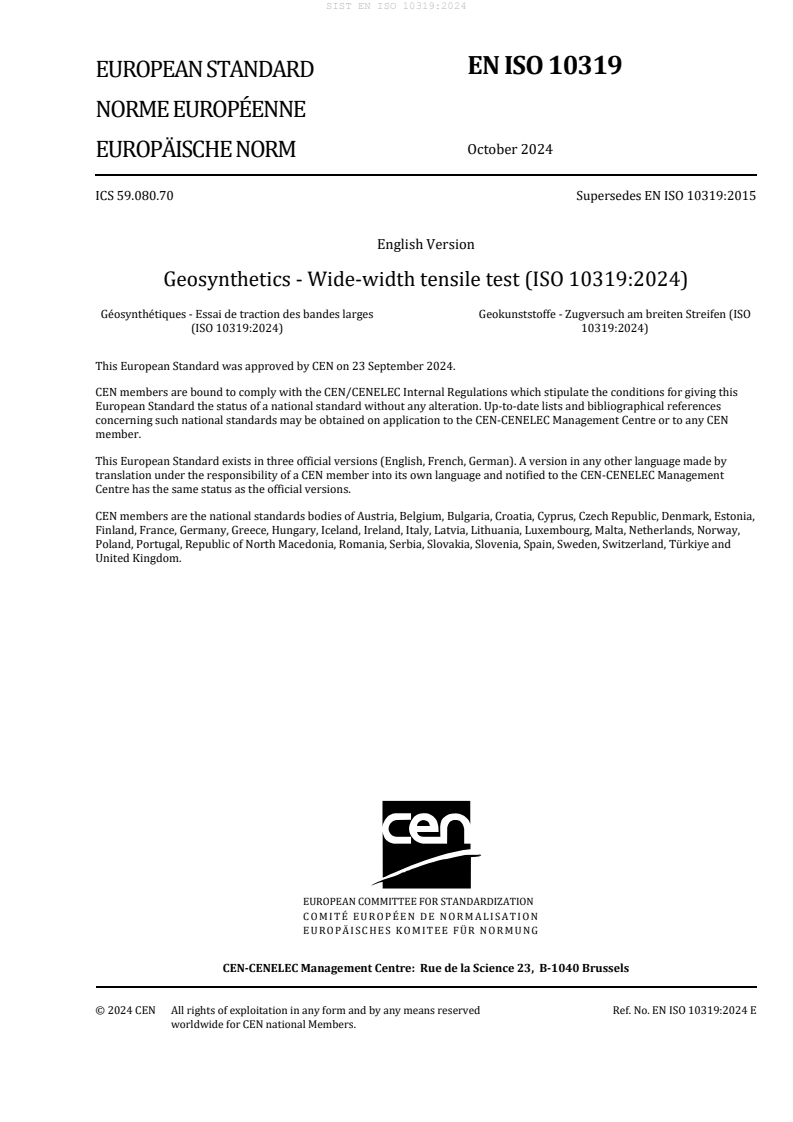
EN ISO 10319
EUROPEAN STANDARD
NORME EUROPÉENNE
October 2024
EUROPÄISCHE NORM
ICS 59.080.70 Supersedes EN ISO 10319:2015
English Version
Geosynthetics - Wide-width tensile test (ISO 10319:2024)
Géosynthétiques - Essai de traction des bandes larges Geokunststoffe - Zugversuch am breiten Streifen (ISO
(ISO 10319:2024) 10319:2024)
This European Standard was approved by CEN on 23 September 2024.
CEN members are bound to comply with the CEN/CENELEC Internal Regulations which stipulate the conditions for giving this
European Standard the status of a national standard without any alteration. Up-to-date lists and bibliographical references
concerning such national standards may be obtained on application to the CEN-CENELEC Management Centre or to any CEN
member.
This European Standard exists in three official versions (English, French, German). A version in any other language made by
translation under the responsibility of a CEN member into its own language and notified to the CEN-CENELEC Management
Centre has the same status as the official versions.
CEN members are the national standards bodies of Austria, Belgium, Bulgaria, Croatia, Cyprus, Czech Republic, Denmark, Estonia,
Finland, France, Germany, Greece, Hungary, Iceland, Ireland, Italy, Latvia, Lithuania, Luxembourg, Malta, Netherlands, Norway,
Poland, Portugal, Republic of North Macedonia, Romania, Serbia, Slovakia, Slovenia, Spain, Sweden, Switzerland, Türkiye and
United Kingdom.
EUROPEAN COMMITTEE FOR STANDARDIZATION
COMITÉ EUROPÉEN DE NORMALISATION
EUROPÄISCHES KOMITEE FÜR NORMUNG
CEN-CENELEC Management Centre: Rue de la Science 23, B-1040 Brussels
© 2024 CEN All rights of exploitation in any form and by any means reserved Ref. No. EN ISO 10319:2024 E
worldwide for CEN national Members.
Contents Page
European foreword . 3
European foreword
This document (EN ISO 10319:2024) has been prepared by Technical Committee ISO/TC 221
"Geosynthetics" in collaboration with Technical Committee CEN/TC 189 “Geosynthetics” the secretariat
of which is held by NBN.
This European Standard shall be given the status of a national standard, either by publication of an
identical text or by endorsement, at the latest by April 2025, and conflicting national standards shall be
withdrawn at the latest by April 2025.
Attention is drawn to the possibility that some of the elements of this document may be the subject of
patent rights. CEN shall not be held responsible for identifying any or all such patent rights.
This document supersedes EN ISO 10319:2015.
Any feedback and questions on this document should be directed to the users’ national standards
body/national committee. A complete listing of these bodies can be found on the CEN website.
According to the CEN-CENELEC Internal Regulations, the national standards organizations of the
following countries are bound to implement this European Standard: Austria, Belgium, Bulgaria,
Croatia, Cyprus, Czech Republic, Denmark, Estonia, Finland, France, Germany, Greece, Hungary, Iceland,
Ireland, Italy, Latvia, Lithuania, Luxembourg, Malta, Netherlands, Norway, Poland, Portugal, Republic of
North Macedonia, Romania, Serbia, Slovakia, Slovenia, Spain, Sweden, Switzerland, Türkiye and the
United Kingdom.
Endorsement notice
The text of ISO 10319:2024 has been approved by CEN as EN ISO 10319:2024 without any modification.
International
Standard
ISO 10319
Fourth edition
Geosynthetics — Wide-width tensile
2024-10
test
Géosynthétiques — Essai de traction des bandes larges
Reference number
ISO 10319:2024(en) © ISO 2024
ISO 10319:2024(en)
© ISO 2024
All rights reserved. Unless otherwise specified, or required in the context of its implementation, no part of this publication may
be reproduced or utilized otherwise in any form or by any means, electronic or mechanical, including photocopying, or posting on
the internet or an intranet, without prior written permission. Permission can be requested from either ISO at the address below
or ISO’s member body in the country of the requester.
ISO copyright office
CP 401 • Ch. de Blandonnet 8
CH-1214 Vernier, Geneva
Phone: +41 22 749 01 11
Email: copyright@iso.org
Website: www.iso.org
Published in Switzerland
ii
ISO 10319:2024(en)
Contents Page
Foreword .iv
1 Scope . 1
2 Normative references . 1
3 Terms and definitions . 1
4 Principle . 5
5 Reagents . 5
6 Apparatus . 5
7 Conditioning atmosphere .12
7.1 General . 12
7.2 Conditioning for testing in wet condition . 13
7.3 Conditioning for testing at lower or higher temperatures . 13
8 Test procedure .13
8.1 Setting up the tensile testing machine . 13
8.2 Insertion of the test specimen in the jaws . 13
8.3 Installation of the extensometer . 13
8.4 Measurement of tensile properties . 13
8.5 Measurement of strain .14
9 Calculations . 14
9.1 Strain .14
9.2 Tensile strength . 15
9.3 Tensile strain at maximum tensile force .16
9.4 Tensile strain at nominal tensile strength .16
9.5 Secant tensile stiffness .16
10 Test report .16
Annex A (normative) Procedure for tests at low and elevated temperatures .18
iii
ISO 10319:2024(en)
Foreword
ISO (the International Organization for Standardization) is a worldwide federation of national standards
bodies (ISO member bodies). The work of preparing International Standards is normally carried out through
ISO technical committees. Each member body interested in a subject for which a technical committee
has been established has the right to be represented on that committee. International organizations,
governmental and non-governmental, in liaison with ISO, also take part in the work. ISO collaborates closely
with the International Electrotechnical Commission (IEC) on all matters of electrotechnical standardization.
The procedures used to develop this document and those intended for its further maintenance are described
in the ISO/IEC Directives, Part 1. In particular, the different approval criteria needed for the different types
of ISO document should be noted. This document was drafted in accordance with the editorial rules of the
ISO/IEC Directives, Part 2 (see www.iso.org/directives).
ISO draws attention to the possibility that the implementation of this document may involve the use of (a)
patent(s). ISO takes no position concerning the evidence, validity or applicability of any claimed patent
rights in respect thereof. As of the date of publication of this document, ISO had not received notice of (a)
patent(s) which may be required to implement this document. However, implementers are cautioned that
this may not represent the latest information, which may be obtained from the patent database available at
www.iso.org/patents. ISO shall not be held responsible for identifying any or all such patent rights.
Any trade name used in this document is information given for the convenience of users and does not
constitute an endorsement.
For an explanation of the voluntary nature of standards, the meaning of ISO specific terms and expressions
related to conformity assessment, as well as information about ISO's adherence to the World Trade
Organization (WTO) principles in the Technical Barriers to Trade (TBT), see www.iso.org/iso/foreword.html.
This document was prepared by Technical Committee ISO/TC 221, Geosynthetics, in collaboration with
the European Committee for Standardization (CEN) Technical Committee CEN/TC 189, Geosynthetics, in
accordance with the Agreement on technical cooperation between ISO and CEN (Vienna Agreement).
This fourth edition cancels and replaces the third edition (ISO 10319:2015), which has been technically
revised.
The main changes are as follows:
— the term “load” changed to “force” in all instances;
— difference between strain and elongation clarified in Clause 3 and Figure 1 modified accordingly;
— difference between tensile strength at first and second peak clarified in Clause 3 and 9.2;
— illustration of suitable jaws and grips introduced in Figure 3;
— testing of metallic products limited to woven steel wire meshes in 6.4.6;
— testing products narrower than 200 mm introduced in 6.4.7;
— testing at lower or higher temperatures introduced, with the related conditioning in 7.3 and the related
procedure added in Annex A;
— formulae for strain calculation introduced in 9.1;
— formulae for tensile strength of products narrower than 200 mm introduced in 9.2;
— test report requirements updated in Clause 10.
Any feedback or questions on this document should be directed to the user’s national standards body. A
complete listing of these bodies can be found at www.iso.org/members.html.
iv
International Standard ISO 10319:2024(en)
Geosynthetics — Wide-width tensile test
1 Scope
This document specifies an index test method for the determination of the tensile properties of geosynthetics
(polymeric, glass and metallic), using a wide-width strip. This document is applicable to most geosynthetics,
including woven geotextiles, nonwoven geotextiles, geocomposites, knitted geotextiles, geonets, geomats
and metallic products. It is also applicable to geogrids and similar open-structure geotextiles, but specimen
dimensions will possibly need to be altered. It is not applicable to polymeric or bituminous geosynthetic
barriers, but it is applicable to clay geosynthetic barriers.
This document specifies a tensile test method that covers the measurement of tensile force, elongation
characteristics and includes procedures for the calculation of secant stiffness, maximum load per unit width
and strain at maximum force. Singular points on the tensile force-extension curve are also indicated.
Procedures for measuring the tensile properties of both conditioned and wet specimens are included in this
document.
2 Normative references
The following documents are referred to in the text in such a way that some or all of their content constitutes
requirements of this document. For dated references, only the edition cited applies. For undated references,
the latest edition of the referenced document (including any amendments) applies.
ISO 554, Standard atmospheres for conditioning and/or testing — Specifications
ISO 3696, Water for analytical laboratory use — Specification and test methods
ISO 7500-1, Metallic materials — Calibration and verification of static uniaxial testing machines — Part 1:
Tension/compression testing machines — Calibration and verification of the force-measuring system
ISO 9862, Geosynthetics — Sampling and preparation of test specimens
ISO 9863-1, Geosynthetics — Determination of thickness at specified pressures — Part 1: Single layers
ISO 10318-1, Geosynthetics — Part 1: Terms and definitions
ISO 10321, Geosynthetics — Tensile test for joints/seams by wide-width strip method
EN 10223-3, Steel wire and wire products for fencing and netting — Part 3: Hexagonal steel wire mesh products
for civil engineering purposes
3 Terms and definitions
For the purposes of this document, the terms and definitions given in ISO 10318-1and the following apply.
ISO and IEC maintain terminology databases for use in standardization at the following addresses:
— ISO Online browsing platform: available at https:// www .iso .org/ obp
— IEC Electropedia: available at https:// www .electropedia .org/
ISO 10319:2024(en)
3.1
nominal gauge length
L
n
initial distance between two reference points located on the specimen parallel to the applied force direction
Note 1 to entry: The nominal gauge length is normally 60 mm (30 mm on either side of the specimen symmetrical
centre).
3.2
elongation at pre-tension force
ΔL
p
measured increase in gauge length (mm) corresponding to an applied pre-tension force of 1 % of the
expected maximum tensile force (3.4)
Note 1 to entry: The elongation at pre-tension force is indicated in Figure 1.
Key
F tensile force, in kN
F maximum tensile force, in kN
max
F pre-tension force, in kN
F tensile force for secant stiffness calculation at point C
c
F tensile force at strain ε
x x
C selected point for the stiffness calculation
ε tensile strain, in per cent
ε tensile strain at pre-tension force set as the origin of the abscissa, in per cent
ε tensile strain at maximum tensile force, in per cent
max
ε tensile strain corresponding to the generic length L , in per cent
x x
ε tensile strain for secant stiffness calculation at point C, in per cent
c
L length, equal to the distance between the two reference points measured during the test, in mm
L nominal gauge length, in mm
n
ISO 10319:2024(en)
L true gauge length, in mm
L generic length measured during the test, in mm
x
ΔL elongation at pre-tension force, in mm
p
Figure 1 — Typical tensile force–strain curve
3.3
true gauge length
L
nominal gauge length (3.1) in millimetres plus the elongation at pre-tension force (3.2) in millimetres
3.4
maximum tensile force
F
max
maximum value obtained during a test
Note 1 to entry: The maximum tensile force is expressed in kilonewtons (kN).
3.5
tensile strain
ε
increase in true gauge length (3.3) of a specimen during a test divided by true gauge length
Note 1 to entry: Tensile strain is expressed as a percentage of the true gauge length.
3.6
tensile strain at maximum tensile force
ε
max
tensile strain (3.5) exhibited by the specimen under maximum tensile force (3.4)
Note 1 to entry: Tensile strain at maximum tensile force is expressed in per cent.
3.7
tensile strain at nominal tensile strength
ε
nom
value at the nominal tensile strength (3.9) as defined by the manufacturer
3.8
secant tensile stiffness
J
ratio of tensile force per unit width to an associated value of strain
Note 1 to entry: Secant tensile stiffness is expressed in kilonewtons per metre (kN/m).
3.9
tensile strength
T
max
maximum force per unit width observed during a test in which the specimen is stretched to rupture
Note 1 to entry: Tensile strength is expressed in kilonewtons per metre (kN/m).
Note 2 to entry: For products exhibiting a second peak on the tensile force per unit width-strain curves, the tensile
strength is defined as the highest value between the two peaks, as shown in Figure 2.
ISO 10319:2024(en)
Key
T tensile strength at first peak, in kN/m
max
Ɛ tensile strain at first peak, in per cent
max
T’ tensile strength at second peak (kN/m)
max
Ɛ’ tensile strain at second peak, in per cent
max
Figure 2 — Typical tensile force per unit width-strain curves of two geosynthetics showing a second
peak
3.10
strain rate
strain at maximum force, divided by the duration of the test, i.e. the time to attainment of maximum tensile
force (3.4) from pre-tension force
Note 1 to entry: Strain rate is expressed in percentage per minute.
3.11
tensile strength at second peak
T’
max
maximum force per unit width observed during a test in which the specimen is stretched to rupture, at the
second peak observed on the tensile force per unit width–strain curve, occurring at a higher strain than that
corresponding to the first peak
Note 1 to entry: Tensile strength at second peak is expressed in kilonewtons per metre (kN/m).
3.12
tensile strain at second peak
Ɛ’
max
tensile strain (3.5) exhibited by the specimen at the second peak observed on the tensile force per unit
width–strain curve, occurring at a higher strain than that corresponding to the first peak
Note 1 to entry: Tensile strain at second peak is expressed in per cent.
3.13
pre-tension force
F
tensile force equal to 1 % of the expected maximum tensile force (3.4), applied at the beginning of the test
Note 1 to entry: The pre-tension force is expressed in kilonewtons (kN).
ISO 10319:2024(en)
3.14
tensile strain at pre-tension force
ε
tensile strain (3.5) corresponding to the pre-tension force, set as the origin of the abscissa in Figure 1, in per
cent
Note 1 to entry: Tensile strain at pre-tension force is equal to zero based on Formulae (1) and (2), as shown in Figure 1.
4 Principle
A specimen is held across its entire width in a set of clamps or jaws (see Figure 3) of a tensile testing
machine operated at a constant cross-head speed. A longitudinal force is applied to the specimen until the
specimen ruptures. The type of jaws used are selected according to the type and tensile strength of the
tested product; compressive hydraulic jaws [Figure 3 a), c), d)] and capstan grips [Figure 3 b), e), f)] may be
used. For capstan grips, it can be useful to wind the specimen in an “S-shape” scheme around the capstan
clamps or in a “B-shape” scheme, as shown in Figure 3 f).
The tensile properties of the specimen are calculated from machine scales, dials, autographic recording
charts or an interfaced computer. A constant test speed is selected so as to give a strain rate of (20 ± 5) % per
minute in the true gauge length of the specimen, except for products that exhibit a low strain, i.e. less than
or equal to 5 %. For these products, e.g. glass, the speed is reduced so that the specimen breaks in (30 ± 5) s.
The basic distinction between the current method and other methods for measuring tensile properties of
products is the width of the specimen. In the current method, the width is greater than the length of the
specimen, as some geosynthetics have a tendency to contract (neck down) under tensile force in the gauge
length area [see Figure 3 c)].
Greater width reduces the contraction effect of such products and provides a relationship closer to the
expected product behaviour in the field, as well as a standard for comparison of geosynthetics.
For information on strain, extension measurements are made by means of an extensometer, which follows
the movement of two reference points on the specimen. These reference points are situated on the specimen
symmetry axis, which is parallel to the applied tensile force, and are separated by a distance of 60 mm
(30 mm on each side of the specimen symmetry centre). This distance can be adapted for some types of
geosynthetics, like geogrid, in order to include at least one row of nodes or internal junctions.
5 Reagents
The usual laboratory apparatus and, in particular, the following shall be used.
— Use only reagents of recognized analytical grade and only distilled water or water of equivalent purity.
— Distilled water, for wet specimens only, conforming to Grade 3 of ISO 3696.
— Non-ionic wetting agent, for wet specimens only.
— The wetting agent used shall be a general purpose polyoxyethylene glycol alkyl ether at 0,05 % volume.
6 Apparatus
The usual laboratory apparatus and, in particular, the following shall be used.
6.1 Tensile testing machine (constant cross-head speed), conforming to ISO 7500-1, Class 1 or better, in
which the rate of increase of specimen length is uniform with time, fitted with a set of clamps or jaws which
are sufficiently wide to hold the entire width of the specimen and equipped with appropriate means to limit
slippage or damage.
NOTE 1 It is useful if one clamp is supported by a free swivel or universal joint to compensate for uneven distribution
of force across the specimen.
ISO 10319:2024(en)
Compressive jaws or
...
Questions, Comments and Discussion
Ask us and Technical Secretary will try to provide an answer. You can facilitate discussion about the standard in here.
Loading comments...