


SIST EN 50491-12-2:2022
(Main)General requirements for Home and Building Electronic Systems (HBES) and Building Automation and Control Systems (BACS) - Part 12-2: Smart grid - Application specification - Interface and framework for customer - Interface between the Home / Building CEM and Resource manager(s) - Data model and messaging
General requirements for Home and Building Electronic Systems (HBES) and Building Automation and Control Systems (BACS) - Part 12-2: Smart grid - Application specification - Interface and framework for customer - Interface between the Home / Building CEM and Resource manager(s) - Data model and messaging
This document specifies the fundamental aspects of semantic interoperability for the S2 interface and the related data exchange between a CEM and the Resource Managers within the premises. It provides a technology independent set of data models and interaction patterns in order to enable applications for Energy Management within the premises. This document does not include:
— mappings to concrete data representations (XML, JSON and similar);
— mappings to application protocols for the message passing;
— security related aspects.
Allgemeine Anforderungen an die Elektrische Systemtechnik für Heim und Gebäude (ESHG) und an Systeme der Gebäudeautomation (GA) – Teil 12-2: Smart grid – Anwendungsspezifikation – Schnittstelle und Modell für Anwender – Schnittstelle zwischen dem Heim-/Gebäude CEM und den Ressourcenmanagern – Datenmodell und Informationsaustausch
Exigences générales relatives aux systèmes électroniques pour les foyers domestiques et les bâtiments (HBES) et aux systèmes de gestion technique du bâtiment (SGTB) - Partie 12-2 : Réseau intelligent - Spécification d'application - Interface entre le gestionnaire d'énergie pour le client (CEM, Customer Energy Manager) et le gestionnaire de ressources pour foyers domestiques/bâtiments - Modèle de données et échange de messages
Le présent document spécifie les aspects fondamentaux de l'interopérabilité sémantique de l'interface S2 et l'échange de données connexe entre un CEM et les gestionnaires de ressources à l'intérieur des locaux. Elle fournit un ensemble de modèles de données et de modèles d'interaction indépendant de la technologie afin de prévoir des applications de gestion de l'énergie à l'intérieur des locaux. Le présent document n'inclut pas:
— les mappings vers les représentations de données concrètes (XML, JSON et apparentés);
— les mappings vers des protocoles d'application pour l'envoi de messages;
— les aspects relatifs à la sécurité.
Splošne zahteve za stanovanjske in stavbne elektronske sisteme (HBES) in sisteme za avtomatizacijo in krmiljenje stavb (BACS) - 12-2. del: Pametno omrežje - Aplikacijske specifikacije - Vmesnik in okvir za odjemalca - Vmesnik med upravljalcem stanovanjskih in stavbnih virov (CEM) - Podatkovni model in izmenjava podatkov
Ta dokument določa temeljne vidike semantične interoperabilnosti za vmesnik S2 in s tem povezane izmenjave podatkov med CEM in upravljavci virov v prostorih. Zagotavlja tehnološko neodvisen nabor podatkovnih modelov in vzorcev interakcije, ki v prostorih omogočajo aplikacije za upravljanje z energijo. Ta dokument ne vključuje:
– preslikav v konkretne predstavitve podatkov (XML, JSON in podobno);
– preslikav v aplikacijske protokole za posredovanje sporočil;
– vidikov, povezanih z varnostjo.
General Information
- Status
- Published
- Public Enquiry End Date
- 29-Oct-2020
- Publication Date
- 08-Jun-2022
- Technical Committee
- ELI - Electrical and communication installations
- Current Stage
- 6060 - National Implementation/Publication (Adopted Project)
- Start Date
- 02-Jun-2022
- Due Date
- 07-Aug-2022
- Completion Date
- 09-Jun-2022
Overview
SIST EN 50491-12-2:2022 defines a technology‑neutral data model and messaging framework for semantic interoperability on the S2 interface between a Customer Energy Manager (CEM) and on‑premises Resource Manager(s). It is part of the HBES/BACS (Home and Building Electronic Systems / Building Automation and Control Systems) smart‑grid application specifications and provides the building blocks needed to enable energy management applications inside homes and buildings without prescribing concrete encodings or transport protocols.
Key keywords: HBES, BACS, smart grid, S2 interface, Customer Energy Manager (CEM), Resource Manager, data model, messaging, semantic interoperability, energy management.
Key topics and technical requirements
Scope and approach
- Technology‑independent specification of data models and interaction patterns for energy management between CEM and Resource Managers.
- Explicit exclusions: no mappings to concrete data representations (XML/JSON), no protocol bindings, and no security specifications.
Energy management architecture
- Roles and responsibilities: CEM, Resource Manager, energy producer/consumer/storage roles.
- Local optimization, implicit and explicit control models for on‑site coordination.
Control types / interaction patterns
- Power Envelope Based Control (limits/constraints)
- Power Profile Based Control (schedules and sequences)
- Operation Mode Based Control (mode/state commands)
- Fill Rate Based Control (storage/fill-level management)
- Demand Driven Based Control (average demand/consumption steering)
Data models
- Basic data types (time, identifiers, strings, optionality)
- ResourceManagerDetails, PowerValue, PowerForecastValue, PowerMeasurement, PowerRange, Timers, Transition and InstructionStatus structures
- PowerForecast and PowerForecastElement types
- Enumerations for roles, commodities, instruction statuses and control types
Communication tasks
- Generic tasks: update details, activate/update control type, communicate measurements, update/revoke forecasts
- Control‑specific tasks: update/revoke constraints, process/revoke instructions, update/revoke profiles, update leakage/usage forecasts, fill level targets, etc.
- Informative annex with use cases to illustrate typical message flows
Practical applications and users
This standard is intended for:
- System integrators and HVAC/energy systems designers implementing CEM-to-resource manager interactions.
- Device and gateway manufacturers developing Resource Manager components for HBES/BACS.
- Software developers building energy‑management platforms, controllers, or simulation tools.
- Energy service providers and utilities coordinating demand response or local flexibility with building systems.
- Standards implementers creating protocol mappings, API schemas, or interoperability test suites (note: mappings and security must be defined separately).
Practical uses include coordinating local generation, storage and loads; enforcing power envelopes and schedules; exchanging reliable power forecasts; and enabling interoperable demand response and flexibility services inside buildings.
Related standards
- Part of the EN 50491 family for HBES/BACS smart‑grid application specifications. Implementers should combine this semantic model with appropriate protocol and security standards (e.g., protocol bindings, transport, and cybersecurity frameworks) when producing interoperable products and services.



Frequently Asked Questions
SIST EN 50491-12-2:2022 is a standard published by the Slovenian Institute for Standardization (SIST). Its full title is "General requirements for Home and Building Electronic Systems (HBES) and Building Automation and Control Systems (BACS) - Part 12-2: Smart grid - Application specification - Interface and framework for customer - Interface between the Home / Building CEM and Resource manager(s) - Data model and messaging". This standard covers: This document specifies the fundamental aspects of semantic interoperability for the S2 interface and the related data exchange between a CEM and the Resource Managers within the premises. It provides a technology independent set of data models and interaction patterns in order to enable applications for Energy Management within the premises. This document does not include: — mappings to concrete data representations (XML, JSON and similar); — mappings to application protocols for the message passing; — security related aspects.
This document specifies the fundamental aspects of semantic interoperability for the S2 interface and the related data exchange between a CEM and the Resource Managers within the premises. It provides a technology independent set of data models and interaction patterns in order to enable applications for Energy Management within the premises. This document does not include: — mappings to concrete data representations (XML, JSON and similar); — mappings to application protocols for the message passing; — security related aspects.
SIST EN 50491-12-2:2022 is classified under the following ICS (International Classification for Standards) categories: 35.240.67 - IT applications in building and construction industry; 97.120 - Automatic controls for household use. The ICS classification helps identify the subject area and facilitates finding related standards.
SIST EN 50491-12-2:2022 is available in PDF format for immediate download after purchase. The document can be added to your cart and obtained through the secure checkout process. Digital delivery ensures instant access to the complete standard document.
Standards Content (Sample)
SLOVENSKI STANDARD
01-julij-2022
Splošne zahteve za stanovanjske in stavbne elektronske sisteme (HBES) in
sisteme za avtomatizacijo in krmiljenje stavb (BACS) - 12-2. del: Pametno omrežje
- Aplikacijske specifikacije - Vmesnik in okvir za odjemalca - Vmesnik med
upravljalcem stanovanjskih in stavbnih virov (CEM) - Podatkovni model in
izmenjava podatkov
General requirements for Home and Building Electronic Systems (HBES) and Building
Automation and Control Systems (BACS) - Part 12-2: Smart grid - Application
specification - Interface and framework for customer - Interface between the Home /
Building CEM and Resource manager(s) - Data model and messaging
Exigences générales relatives aux systèmes électroniques pour les foyers domestiques
et les bâtiments (HBES) et aux systèmes de gestion technique du bâtiment (SGTB) -
Partie 12-2 : Réseau intelligent - Spécification d'application - Interface entre le
gestionnaire d'énergie pour le client (CEM, Customer Energy Manager) et le
gestionnaire de ressources pour foyers domestiques/bâtiments - Modèle de données et
échange de messages
Ta slovenski standard je istoveten z: EN 50491-12-2:2022
ICS:
35.240.67 Uporabniške rešitve IT v IT applications in building
gradbeništvu and construction industry
97.120 Avtomatske krmilne naprave Automatic controls for
za dom household use
2003-01.Slovenski inštitut za standardizacijo. Razmnoževanje celote ali delov tega standarda ni dovoljeno.
EUROPEAN STANDARD EN 50491-12-2
NORME EUROPÉENNE
EUROPÄISCHE NORM
April 2022
ICS 91.140.50; 97.120
English Version
General requirements for Home and Building Electronic Systems
(HBES) and Building Automation and Control Systems (BACS) -
Part 12-2: Smart grid - Application specification - Interface and
framework for customer - Interface between the Home / Building
CEM and Resource manager(s) - Data model and messaging
Exigences générales relatives aux systèmes électroniques Allgemeine Anforderungen an die Elektrische
pour les foyers domestiques et les bâtiments (HBES) et aux Systemtechnik für Heim und Gebäude (ESHG) und an
systèmes de gestion technique du bâtiment (SGTB) - Partie Systeme der Gebäudeautomation (GA) - Teil 12-2: Smart
12-2: Réseau intelligent - Spécification d'application - grid - Anwendungsspezifikation - Schnittstelle und Modell
Interface et cadre pour le client - Interface entre le für Anwender - Schnittstelle zwischen dem Heim-/Gebäude
gestionnaire d'énergie pour le client (CEM, Customer CEM und den Ressourcenmanagern - Datenmodell und
Energy Manager) et le gestionnaire de ressources pour Informationsaustausch
foyers domestiques/bâtiments - Modèle de données et
échange de messages
This European Standard was approved by CENELEC on 2022-02-17. CENELEC members are bound to comply with the CEN/CENELEC
Internal Regulations which stipulate the conditions for giving this European Standard the status of a national standard without any alteration.
Up-to-date lists and bibliographical references concerning such national standards may be obtained on application to the CEN-CENELEC
Management Centre or to any CENELEC member.
This European Standard exists in three official versions (English, French, German). A version in any other language made by translation
under the responsibility of a CENELEC member into its own language and notified to the CEN-CENELEC Management Centre has the
same status as the official versions.
CENELEC members are the national electrotechnical committees of Austria, Belgium, Bulgaria, Croatia, Cyprus, the Czech Republic,
Denmark, Estonia, Finland, France, Germany, Greece, Hungary, Iceland, Ireland, Italy, Latvia, Lithuania, Luxembourg, Malta, the
Netherlands, Norway, Poland, Portugal, Republic of North Macedonia, Romania, Serbia, Slovakia, Slovenia, Spain, Sweden, Switzerland,
Turkey and the United Kingdom.
European Committee for Electrotechnical Standardization
Comité Européen de Normalisation Electrotechnique
Europäisches Komitee für Elektrotechnische Normung
CEN-CENELEC Management Centre: Rue de la Science 23, B-1040 Brussels
© 2022 CENELEC All rights of exploitation in any form and by any means reserved worldwide for CENELEC Members.
Ref. No. EN 50491-12-2:2022 E
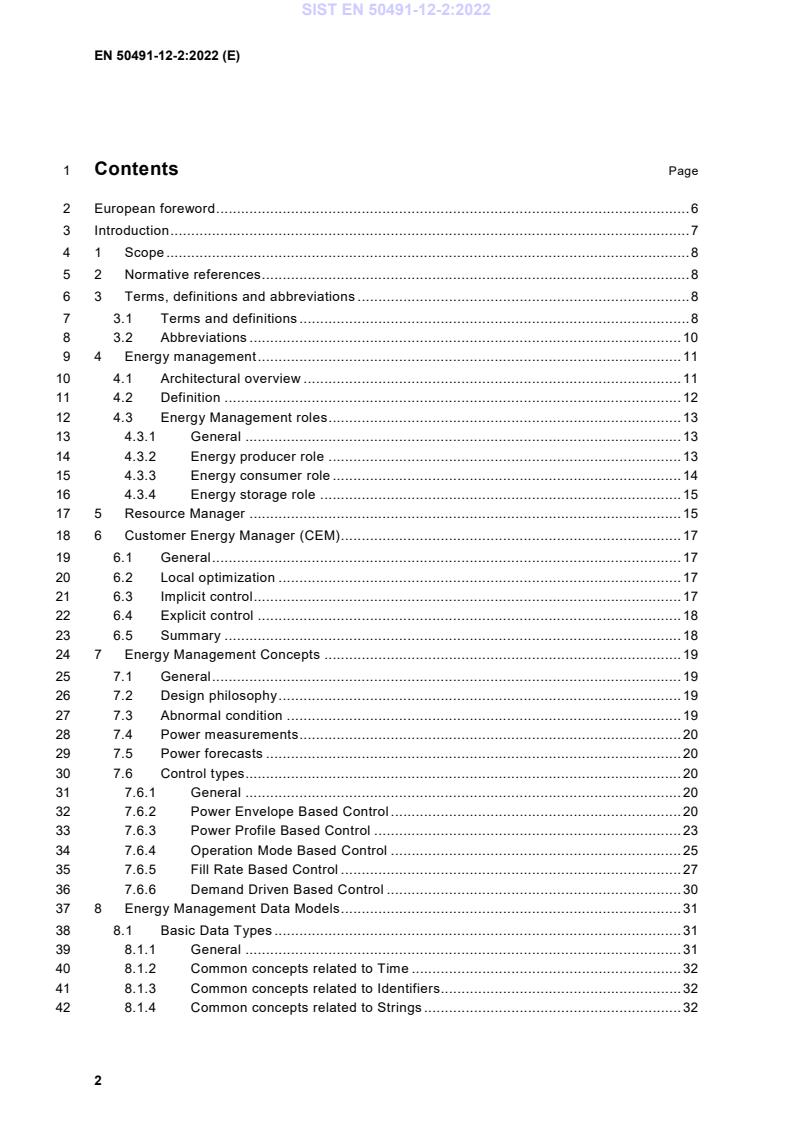
1 Contents Page
2 European foreword . 6
Introduction . 7
4 1 Scope . 8
5 Normative references . 8
6 3 Terms, definitions and abbreviations . 8
7 Terms and definitions . 8
3.1
8 3.2 Abbreviations . 10
9 4 Energy management . 11
10 4.1 Architectural overview . 11
11 Definition . 12
4.2
12 4.3 Energy Management roles . 13
13 4.3.1 General . 13
14 4.3.2 Energy producer role . 13
15 4.3.3 Energy consumer role . 14
16 4.3.4 Energy storage role . 15
17 Resource Manager . 15
18 6 Customer Energy Manager (CEM) . 17
19 General . 17
6.1
20 6.2 Local optimization . 17
21 6.3 Implicit control . 17
22 6.4 Explicit control . 18
23 6.5 Summary . 18
24 7 Energy Management Concepts . 19
25 7.1 General . 19
26 7.2 Design philosophy . 19
27 7.3 Abnormal condition . 19
28 7.4 Power measurements . 20
29 Power forecasts . 20
7.5
30 7.6 Control types. 20
31 7.6.1 General . 20
32 7.6.2 Power Envelope Based Control . 20
33 7.6.3 Power Profile Based Control . 23
34 7.6.4 Operation Mode Based Control . 25
35 Fill Rate Based Control . 27
7.6.5
36 7.6.6 Demand Driven Based Control . 30
37 8 Energy Management Data Models . 31
38 8.1 Basic Data Types . 31
39 General . 31
8.1.1
40 8.1.2 Common concepts related to Time . 32
41 8.1.3 Common concepts related to Identifiers . 32
42 8.1.4 Common concepts related to Strings . 32
43 8.1.5 Meaning of optionality . 32
44 8.2 Resource Manager . 33
45 8.2.1 ResourceManagerDetails . 33
46 8.2.2 PowerValue . 34
47 8.2.3 PowerForecastValue . 34
48 PowerRange . 35
8.2.4
49 8.2.5 NumberRange. 35
50 8.2.6 PowerMeasurement . 35
51 8.2.7 Role . 36
52 8.2.8 ReceptionStatus . 36
53 8.2.9 Transition . 36
54 Timer . 37
8.2.10
55 8.2.11 InstructionStatusUpdate . 37
56 8.3 Power Forecast . 38
57 8.3.1 Description . 38
58 8.3.2 PowerForecast . 38
59 8.3.3 PowerForecastElement . 39
60 Control Types . 40
8.4
61 8.4.1 Power Envelope Based Control . 40
62 8.4.2 Power Profile Based Control . 43
63 8.4.3 Operation Mode Based Control . 48
64 8.4.4 Fill Rate Based Control . 50
65 8.4.5 Demand Driven Based Control . 57
66 Enumerations . 61
8.5
67 8.5.1 RoleType . 61
68 8.5.2 Commodity . 61
69 8.5.3 CommodityQuantity . 61
70 8.5.4 Currency . 62
71 8.5.5 InstructionStatus . 62
72 ControlType . 64
8.5.6
73 8.5.7 PEBC.PowerEnvelopeLimitType . 65
74 8.5.8 PEBC.PowerEnvelopeConsequenceType . 65
75 8.5.9 ReceptionStatusValues . 65
76 8.5.10 PPBC.PowerSequenceStatus . 66
77 9 Communication . 66
78 9.1 Introduction . 66
79 9.2 Generic tasks . 67
80 9.2.1 Update Resource Manager Details . 67
81 9.2.2 Activate Control Type . 67
82 Update Active Control Type . 68
9.2.3
83 9.2.4 Communicate Power Measurement . 68
84 9.2.5 Update Power Forecast . 69
85 9.2.6 Revoke Power Forecast . 69
86 9.3 Power Envelope Based Control Tasks . 70
87 9.3.1 Update Power Constraints . 70
88 Revoke Power Constraints . 70
9.3.2
89 9.3.3 Update Energy Constraints . 71
90 9.3.4 Revoke Energy Constraints . 72
91 9.3.5 Process Instruction . 72
92 9.3.6 Revoke Instruction . 73
93 9.4 Power Profile Based Control Tasks . 73
94 9.4.1 Update Power Profile Definition . 73
95 Revoke Power Profile Definition . 74
9.4.2
96 9.4.3 Process Schedule Instruction . 74
97 9.4.4 Revoke Schedule Instruction . 75
98 9.4.5 Process Start Interruption Instruction . 76
99 9.4.6 Revoke Start Interruption Instruction . 76
100 9.4.7 Process End Interruption Instruction . 77
101 Revoke End Interruption Instruction . 78
9.4.8
102 9.5 Operation Mode Based Control Tasks . 78
103 9.5.1 Update System Description . 78
104 9.5.2 Revoke System Description . 79
105 9.5.3 Process Instruction . 79
106 9.5.4 Revoke Instruction . 80
107 Fill Rate Based Control Tasks . 81
9.6
108 9.6.1 Update System Description . 81
109 9.6.2 Revoke System Description . 81
110 9.6.3 Update Leakage Behaviour . 82
111 9.6.4 Revoke Leakage Behaviour. 82
112 9.6.5 Update Usage Forecast . 83
113 Revoke Usage Forecast . 83
9.6.6
114 9.6.7 Update Fill Level Target Profile . 84
115 9.6.8 Revoke Fill Level Target Profile . 84
116 9.6.9 Process Instruction . 85
117 9.6.10 Revoke Instruction . 85
118 9.7 Demand Driven Based Control Tasks . 86
119 Update System Description . 86
9.7.1
120 9.7.2 Revoke System Description . 87
121 9.7.3 Update Average Demand Rate Forecast . 87
122 9.7.4 Revoke Average Demand Rate Forecast . 88
123 9.7.5 Process Instruction . 88
124 9.7.6 Revoke Instruction . 89
Annex A (informative) Use Cases . 90
126 A.1 Overview . 90
127 A.2 Organizing . 91
128 A.2.1 UC_EM_O100: Configuring CEM in network . 91
129 UC_EM_O101: Configuring master CEM with Smart Grid Operator Credentials91
A.2.2
130 A.3 Scheduling . 92
131 A.3.1 UC_EM_S200: CEM collects Energy Profiles, Tariff Profiles and Storage Details
132 92
133 A.4 Management . 93
134 A.4.1 UC_EM_M300: CEM selects alternative Energy Sequences by energy costs . 93
135 UC_EM_M301 CEM modifies start time of Energy Sequence . 93
A.4.2
136 A.4.3 UC_EM_M302: CEM changes an Energy Profile to make temporary use of stored
137 energy . 94
138 A.4.4 UC_EM_M303: Demanded power cannot be delivered by domestic grid . 94
139 A.4.5 UC_EM_M304: Two electric vehicles conflicting in their power load . 94
140 A.4.6 UC_EM_M305: EMG requests temporarily energy saving . 95
141 UC_EM_M306: Energy Storage requests high priority . 96
A.4.7
142 A.5 Case studies . 97
143 A.5.1 UC_EM_M307 Charging an EV in the context of JWG4 (“Power Limitation PV”)
144 with the dynamic control mode of ISO/DIS 15118-20 . 97
145 A.5.2 UC_EM_M308: Charging an EV in the context of JWG4 (“Power Limitation PV”)
146 with the scheduled control mode of ISO 15118 series and monetary incentives98
Bibliography . 100
149 European foreword
150 This document (EN 50491-12-2:2022) has been prepared by CLC/TC TC 205, “Home and Building Electronic
151 Systems (HBES)”.
152 The following dates are fixed:
• latest date by which this document has to be (dop) 2023-02-17
implemented at national level by publication of
an identical national standard or by
endorsement
• latest date by which the national standards (dow) 2025-02-17
conflicting with this document have to be
withdrawn
153 Any feedback and questions on this document should be directed to the users’ national committee. A
154 complete listing of these bodies can be found on the CENELEC website.
155 Attention is drawn to the possibility that some of the elements of this document may be the subject of patent
156 rights. CENELEC shall not be held responsible for identifying any or all such patent rights.
157 This document is part of the EN 50491 series of European Standards — General requirements for Home and
158 Building Electronic Systems (HBES) and Building Automation and Control Systems (BACS), which will
159 comprise the following parts:
160 — Part 1: General requirements;
161 — Part 2: Environmental Conditions;
162 — Part 3: Electric Safety Requirements;
163 — Part 4-1: General functional safety requirements for products intended to be integrated in Building
164 Electronic Systems (HBES) and Building Automation and Control Systems (BACS);
165 — Part 5-1: EMC requirements, conditions and test set-up;
166 — Part 5-2: EMC requirements for HBES/BACS used in residential, commercial and light industry
167 environment;
168 — Part 5-3: EMC requirements for HBES/BACS used in industry environment;
169 — Part 6-1: HBES installations — Installation and planning;
170 — Part 6-3: HBES installations — Assessment and definition of levels;
171 — Part 11: Smart Metering — Application Specification — Simple External Consumer Display;
172 — Part 12: Smart grid — Application specification — Interface and framework for customer;
173 — Part 12-1: Interface between the CEM and Home/Building Resource manager– General Requirements
174 and Architecture;
175 — Part 12-2: Interface between the Home/Building CEM and Resource manager(s)– Data model and
176 messaging;
177 — Future Part 12-3: Home/Building Customer Energy Manager (CEM);
178 — Future Part 12-4: Resource Manager.
179 Introduction
180 Over recent decades, energy production and its consumption patterns have changed dramatically. Although
181 central energy production is still dominant, the trend for distributed production is distinctive following an
182 increasing number of renewables. Alternative energy sources are highly fluctuating in their production
183 capabilities, which may result in the grid operators having difficulty to keep a balance between energy
184 production and consumption. The complexity of keeping the grid reliable is further increased by the change in
185 the electric energy consumption and production of the customer itself, e.g. the use of electric vehicles and
186 personal generation facilities.
187 A Smart Grid that allows the grid operator to be flexible and reactive is needed. Such reactivity requires a
188 communication flow between energy consuming and producing entities, from single family houses to large
189 factories.
190 The EN 50491-12 series describes aspects of the smart grid that relate specifically to the premises
191 (home/building) part of the smart grid and describes the common interface between equipment in the
192 premises and the smart grid. This part 2 of the series defines the fundamental aspects of semantic
193 interoperability for the S2 interface and the related data exchange between a CEM and the Resource
194 Managers within the premises.
195 Different use cases are explained in Annex A, which should help to understand the philosophy of this
196 document.
197 1 Scope
198 This document specifies the fundamental aspects of semantic interoperability for the S2 interface and the
199 related data exchange between a CEM and the Resource Managers within the premises. It provides a
200 technology independent set of data models and interaction patterns in order to enable applications for Energy
201 Management within the premises. This document does not include:
202 — mappings to concrete data representations (XML, JSON and similar);
203 — mappings to application protocols for the message passing;
204 — security related aspects.
205 2 Normative references
206 The following documents are referred to in the text in such a way that some or all of their content constitutes
207 requirements of this document. For dated references, only the edition cited applies. For undated references,
208 the latest edition of the referenced document (including any amendments) applies.
209 ISO/DIS 15118-20, Road vehicles — Vehicle to grid communication interface
210 ISO 4217, Codes for the representation of currencies
211 3 Terms, definitions and abbreviations
212 3.1 Terms and definitions
213 For the purposes of this document, the following terms and definitions apply.
214 ISO and IEC maintain terminological databases for use in standardization at the following addresses:
215 — ISO Online browsing platform: available at https://www.iso.org/obp
216 — IEC Electropedia: available at https://www.electropedia.org/
217 3.1.1
218 Power Envelope Based Control
219 coordination of the CEM based on limitations to the device
220 Note 1 to entry: The CEM can set minimum and maximum values for the power that shall not be exceeded by the
221 device.
222 3.1.2
223 Power Profile Based Control
224 control type where coordination from the CEM is based on profile modification, including concepts of
225 sequence shifting, sequence selection
226 3.1.3
227 Operation Mode Based Control
228 control type where the resource manager offers the CEM multiple operation modes that the CEM could
229 choose from
230 Note 1 to entry: The behaviour of the device will be modified by selecting operation modes.
231 3.1.4
232 Fill Rate Based Control
233 control type based on measurements indicating the fill level and the fill rate
234 3.1.5
235 Demand Driven Based Control
236 control type where the CEM can decide how a given demand should be fulfilled
237 3.1.6
238 resource manager
239 software component that exclusively represents a logical group of devices or a single smart device, and is
240 responsible for sending unambiguous instructions to the logical group of devices or to a single device,
241 typically using a device-specific protocol
242 Note 1 to entry: In the context of this document the Resource Manager manages the energy flexibility of a logical group of
243 devices or a single smart device.
244 Note 2 to entry: The Resource Manager may be implemented in a special device, in the smart device itself or outside of
245 the device.
246 Note 3 to entry: The Resource Manager typically consist of a communication handler (information layer, strictly related to
247 data format and protocol handling) and an application handler (application layer, related to functional extensions of the
248 CEM).
249 3.1.7
250 role
251 categorization of the behaviour of a participant by its capabilities related to energy management, each
252 participant at least supporting one
253 3.1.8
254 S1 communication
255 interface between CEM and energy management gateway
256 3.1.9
257 S2 communication
258 interface between CEM and resource manager
259 3.1.10
260 smart grid
261 electric grid including a variety of operational and energy measures as well as control of the production and
262 distribution of electricity
263 3.1.11
264 smart grid operator
265 instance requesting energy profiles from the CEM in order to keep the grid stable and reliable
266 3.1.12
267 tariff based energy management
268 optimization strategy for energy management based on variable tariffs according to user’s requirements
269 3.1.13
270 time slot
271 fixed period of time with a specific duration
272 3.1.14
273 use case
274 describes interactions between an actor and another actor or a system to achieve a specific goal, either very
275 abstract or very detailed; can be nested
276 3.1.15
277 user
278 either a person (e.g. installer or resident) or surrogate service
279 3.1.16
280 prosumer
281 household or device that produces and consumes energy of the same commodity
282 3.1.17
283 single application smart system
284 group of devices having a communication interface for a single application such as heating or lighting, that
285 consume, produce or store energy (or a combination thereof) and that can be controlled by a resource
286 manager for the purpose of energy management
287 3.1.18
288 home and building electronic system
289 building automation control system
290 logical group of devices which uses a multi-application communication system where the functions are
291 distributed and linked through a common communication process
292 Note 1 to entry: HBES/BACS is used in homes and buildings plus their surroundings. Functions of the system are e.g.:
293 switching, open loop controlling, closed loop controlling, monitoring and supervising.
294 Note 2 to entry: In literature, HBES/BACS could also be referred to as “home control system/network“, “home electronic
295 system” “building automation system”, etc.
296 Note 3 to entry: Examples of HBES/BACS applications are the management of lighting, heating, energy, water, fire
297 alarms, blinds, different forms of security, etc. See introduction in EN 50491-4-1.
298 3.1.19
299 abnormal condition
300 situation in which a Resource Manager shall sacrifice user comfort when requested by the CEM
301 3.2 Abbreviations
Abbreviation Description
API Application Programmable Interface
BACS Building Automation Control Systems
CEM Customer Energy Management
CHP Combined Heat and Power
DDBC Demand Driven Based Control
EM Energy Management
EMG Energy Management Gateway
EV Electric Vehicle
FRBC Fill Rate Based Control
HBES Home and Building Electronic Systems
HMI Human-Machine Interface
Abbreviation Description
I/F Interface
M/O Mandatory / Optional
M Mandatory
O Optional
OMBC Operation Mode Based Control
PEBC Power Envelope Based Control
PPBC Power Profile Based Control
PV Photovoltaics
RM Resource Manager
RTP Real Time Pricing
SASS Single Application Smart System
SG Smart Grid
TBEM Tariff Based Energy Management
TOU Time Of Use
95PPR 95 Percent Probability Range
68PPR 68 Percent Probability Range
302 4 Energy management
303 4.1 Architectural overview
304 In EN 50491-12-1, the system architecture of the Smart Grid premises side is described. It includes the
305 common interface between the equipment in the home/building, referred to as the Customer Energy Manager
306 (CEM), and the Smart Grid (SG), referred to as the Energy Management Gateway (EMG). The
307 communication between the EMG and the CEM is referred to as the S1 communication whereas the
308 communication between the CEM and the Resource Manager on the premises side is referred to as the S2
309 communication.
311 Figure 1 — Architectural overview of Premises smart grid system
312 Although the solution specified in this document mainly refers to S2 Communication, data that will be
313 transmitted via S1 needs to be considered as well. However, this document does not specify S1
314 Communication.
315 4.2 Definition
316 A HBES/BACS/SASS or (Smart) device is usually purchased to fulfil a goal of the end user of the device or
317 devices. For example, the goal of the end user of an electric boiler is to have hot tap water, and the goal of the
318 end user of a heat pump is to have a comfortable room temperature. Meeting these goals is what is defined
319 as user comfort.
320 Although these goals shape the behaviour of a Smart Device, they do not completely define it. There might be
321 multiple ways in which the goal of the end user can be achieved. For example, when there is still enough hot
322 water in the electric boiler, the heating of the water could be postponed. In other words, there is some
323 flexibility in achieving the goal of the end user. This is illustrated by Figure 2.
324 A battery or electric vehicle has a particular target state of charge at a particular moment in time. There are
325 multiple ways to achieve this target, each with their own associated power profile. While all power profiles
326 achieve the target state, these profiles can have a big impact on the power grid. Influencing how a device
327 achieves its targets is what is defined as Energy Management. However, not all HBES / BACS /SASS or
328 (Smart) devices have an explicit goal. For example, the sole purpose of a stationary battery might be to
329 perform Energy Management; there is no other goal from the end user.
331 Figure 2 — Example of how different power profiles can achieve the same target state
332 Energy Management always involves one or multiple types of energy which are exchanged with the grid, such
333 as electricity (exchanged with a power grid), natural gas (exchanged with a gas grid) or heat (exchanged with
334 a heat grid). These types of energy might be interconnected in the behaviour of the device.
335 For example, a (micro) CHP typically consumes natural gas, but at the same time produces electricity. For
336 Energy Management purposes, it is necessary to know the behaviour of HBES / BACS /SASS or (Smart)
337 devices with respect to these types of energy. These different energy types that are exchanged with a grid are
338 referred to as commodities.
339 4.3 Energy Management roles
340 4.3.1 General
341 In the S2 ecosystem, there are multiple entities fulfilling roles. This subclause gives an overview of these roles
342 and gives concrete examples. Each role assumes a specific functionality and behaviour for a specific
343 Commodity and is attributed to the entity by the entity itself. Entities referred to with roles are defined as EM
344 (Energy Management) Participants. EM participants can fulfil one or multiple of these roles:
345 — energy management;
346 — energy producer;
347 — energy consumer;
348 — energy storage.
349 4.3.2 Energy producer role
350 4.3.2.1 Description
351 An Energy Producer is an EM participant that produces energy. It can operate under specific capabilities and
352 constraints such as additional costs or the maximum amount of energy. As other EM participants, especially
353 the CEM, need to know these capabilities and constraints, each Energy producer shall provide a control type
354 that contains those capabilities and constraints.
355 In general, all Energy Producers are categorized by their flexibility of energy production. Controlled Producers
356 are able to adapt their production whereas Uncontrolled Producers do not have that capability.
357 4.3.2.2 Controlled Producers
358 Controlled Producers can adjust the amount of energy they are producing according to their capabilities and
359 constraints (e.g. max power). They need to communicate the flexibility of energy production behaviour to the
360 CEM, which in turn will send instructions to trigger changes.
361 4.3.2.3 Uncontrolled Producers
362 Uncontrolled producers are those energy generating EM participants that do not offer a way to influence their
363 mode of operation and thus cannot offer flexibility of power to the CEM.
364 Photovoltaics can be an example of an uncontrolled producer, if for example the inverter does not offer any
365 curtailment functionality. In case such curtailment options are available, the device should expose the
366 controlled producer role. This example shows that, ultimately, it is not the type of device but its feature set that
367 determines which role (controlled or uncontrolled producer) applies.
368 Additionally, Uncontrolled Producers will typically be less predictable than controlled producers, because they
369 offer much less control over when they are able to operate in a specific range of their operational parameters.
370 In those cases, it is especially important for the CEM that Uncontrolled Producers can provide a power
371 forecast of expected power levels and their probabilistic variations.
372 4.3.3 Energy consumer role
373 4.3.3.1 Description
374 All EM participants that consume energy and utilize the provided energy to conduct some form of work are
375 grouped as Energy Consumers. The fed energy is thus transformed to work, heat, etc. and can generally not
376 be regained from the EM participant. This role includes standard home EM participants that participate
377 actively in the EM network. Examples include water heaters, air conditioner or electric vehicles.
378 Every Energy Consumer can support the CEM by providing measurements, forecasts and/or control options.
379 4.3.3.2 Water heater
380 A water heater is an EM participant that utilizes power to heat water. Flow heaters are heating water while it
381 flows through and thus need to react on demand and are out of scope here. Water heaters with storage
382 capability form the relevant use case from a demand side management perspective as they can operate in
383 flexible boundaries to keep the stored water at a given level and temperature.
384 Water heaters are usually categorized by their maximum capacity in litres and the energy they need to heat
385 water and to keep it at a given temperature. During operation time, the operational mode of the water heater is
386 influenced by the water capacity and the minimum temperature required for the stored water.
387 Depending on the use of water heaters, the needed energy for heating water as well as the possibility to store
388 hot water, water heaters are well suited to support efficient Energy Management.
389 4.3.3.3 Air Condition
390 Air conditions are EM participants that utilize energy to cool down the air in a building. In contrast to water
391 heaters, they typically do not have any storage capabilities themselves, but the room may be used as a buffer
392 if a certain bandwidth in temperature is allowed.
393 In this way, an air condition is also able to shift the power load in time in order to fulfil energy management
394 requirements.
395 4.3.4 Energy storage role
396 4.3.4.1 Description
397 Furthermore, EM participants that can store energy play an important role in managing energetic
398 environments as they are able to take energy in when it is abundant (or cheap) and release energy when it is
399 scarce (or expensive). It has to be noted that this capability comes with consequences, e.g. storing energy
400 requires more energy than what can be released at a later point. Every Energy storage shall be able to
401 declare its storage capacity including any consequences.
402 4.3.4.2 Stationary battery
403 Batteries are the standard EM participants when it comes to storing electricity. They are available with various
404 capacities and can greatly contribute to balancing loads for premises, on grid level or in other environments.
405 While a battery is mainly defined by its capacity, charging time, required current and efficiency (ratio of
406 consumed energy to released energy), which also play an important role in utilizing this EM participant
407 optimally.
408 4.3.4.3 Electric vehicle
409 In addition to fixed batteries installed at a fixed location, mobile batteries (usually stored in electric vehicles)
410 shall be considered as well.
411 Mobile batteries share all properties and operational parameters of stationary batteries, however, they have
412 the added property of mobility, which means a mobile battery can appear in or disappear from a system at any
413 point in time. They are thus less reliable than stationary batteries.
414 Furthermore, to use mobile batteries to optimize the utilization of energy in a system, the mobility
415 requirements shall be considered. I.e. an electric vehicle shall be charged at a given (scheduled) time and
416 should sometimes not be drained below a certain level, which would render the vehicle immobile.
417 5 Resource Manager
418 The Resource Manager has a gateway function with embedded intelligence. It is a software component that
419 represents a single energy flexibility. This specification does not define where the Resource Manager runs
420 physically. This could for example be on the Smart Device itself, on a separate device or in the environment of
421 the manufacturer (e.g. Cloud services).
422 The Resource Manager connects on one side with the CEM using S2, and on the other side with a HBES /
423 BACS / SASS or (Smart) device. How the Resource Manager communicates with the HBES / BACS / SASS
424 or (Smart) device is out of scope for this document.
425 For example, when a Resource Manager is implemented on the Smart Device itself, a local API can be used.
426 It could also communicate through another device or a domain specific protocol.
428 Figure 3 — Example Resource Manager and HBES/BACS/smart appliance/device combinations
429 Figure 3 shows a number of possible combinations which are typical in a real-world installation. Annex A
430 provides detailed examples that help to better understand this conceptual architecture
431 Fundamentally, the RM exchanges information with the CEM to fulfil the needs of energy management. On its
432 other side, the RM exchanges information with t
...
Questions, Comments and Discussion
Ask us and Technical Secretary will try to provide an answer. You can facilitate discussion about the standard in here.
Loading comments...