


SIST EN 50090-6-3:2023
(Main)Home and Building Electronic Systems (HBES)- Part 6-3 -3rd Party HBES IoT API
Home and Building Electronic Systems (HBES)- Part 6-3 -3rd Party HBES IoT API
This document defines a 3rd Party API for the Home and Building HBES Open Communication System.
Elektrische Systemtechnik für Heim und Gebäude (ESHG) – Teil 6-3: Drittanbieter ESGH IoT API
Systèmes électroniques pour les foyers domestiques et les bâtiments (HBES) - Partie 6-3 : API tierce IdO HBES
Le présent document définit une API tierce pour le Système ouvert de communication pour les foyers domestiques et les bâtiments HBES.
Stanovanjski in stavbni elektronski sistemi (HBES) - 6-3. del: Tretja zveza HBES Iot API
Ta dokument opredeljuje vmesnik za aplikacijsko programiranje (API) tretje strani za odprti stanovanjski in stavbni komunikacijski sistem HBES.
General Information
- Status
- Published
- Public Enquiry End Date
- 28-Feb-2023
- Publication Date
- 16-Aug-2023
- Technical Committee
- ELI - Electrical and communication installations
- Current Stage
- 6060 - National Implementation/Publication (Adopted Project)
- Start Date
- 12-Jul-2023
- Due Date
- 16-Sep-2023
- Completion Date
- 17-Aug-2023
Overview
EN 50090-6-3:2023 - Home and Building Electronic Systems (HBES) Part 6-3: 3rd Party HBES IoT API (CLC / CENELEC) defines a standardised 3rd Party API for accessing HBES Open Communication Systems. It specifies how external IoT 3rd Party Clients interact with an IoT 3rd Party Server to read and control building automation data (Datapoints, Function Points, IoT Functions) using RESTful principles (CoAP/HTTP) and a Point API approach.
Key topics and technical requirements
- Scope & Mapping: Aligns HBES concepts (Device, Datapoint, Functional Block, Function Point, Group Address) with IoT resources and ontology terms.
- API specification: Detailed requirements for server and client behaviour, including message data structure, URL structure, resource path definitions, and discovery mechanisms.
- Data format & examples: Rules for payload formats and example conventions to ensure consistent implementations and testability.
- Conformance, versioning, availability: Requirements for API conformance statements, version handling, and service availability semantics.
- IoT primitives: Definitions for IoT Datapoint (endpoint representing state), IoT Function (collection of datapoints), and Feature of Interest semantics.
- Interoperability with HBES Information Model (KIM): Uses the HBES ontology and semantic dictionary (see EN 50090-6-2) to categorise datapoints and functions.
- Client/Server roles: Clarifies responsibilities of IoT 3rd Party Client (mobile apps, cloud services) and IoT 3rd Party Server (gateway, HBES device function).
- Integration notes: References to device individualization, device linking, and potential authorization mechanisms for secure access.
Practical applications and who uses it
- Device manufacturers: implement the IoT 3rd Party Server to expose device runtime data and control endpoints in a standardised way.
- System integrators and installers: use the API to commission, configure and link devices into installations and MaC Projects.
- Software developers / cloud and mobile app vendors: build interoperable smart home and building-management applications that discover and operate HBES resources.
- Building automation architects & BIM integrators: map HBES data into Building Information Models (IFC/BIM) and enterprise systems via standard endpoints.
- Management Client (MaC) vendors: align catalog entries, MaC Functions and MaC Projects with IoT resources for configuration workflows.
Related standards
- EN 50090-1:2011 - HBES standardization structure
- EN 50090-3-3 - HBES Interworking model and common data types
- EN 50090-6-2 - HBES IoT Semantic Ontology (KIM)
EN 50090-6-3:2023 is essential for anyone implementing interoperable HBES IoT interfaces, enabling third-party apps and services to safely and consistently access building and home automation functions.



Frequently Asked Questions
SIST EN 50090-6-3:2023 is a standard published by the Slovenian Institute for Standardization (SIST). Its full title is "Home and Building Electronic Systems (HBES)- Part 6-3 -3rd Party HBES IoT API". This standard covers: This document defines a 3rd Party API for the Home and Building HBES Open Communication System.
This document defines a 3rd Party API for the Home and Building HBES Open Communication System.
SIST EN 50090-6-3:2023 is classified under the following ICS (International Classification for Standards) categories: 35.240.67 - IT applications in building and construction industry; 97.120 - Automatic controls for household use. The ICS classification helps identify the subject area and facilitates finding related standards.
SIST EN 50090-6-3:2023 is available in PDF format for immediate download after purchase. The document can be added to your cart and obtained through the secure checkout process. Digital delivery ensures instant access to the complete standard document.
Standards Content (Sample)
SLOVENSKI STANDARD
01-september-2023
Stanovanjski in stavbni elektronski sistemi (HBES) - 6-3. del: Tretja zveza HBES Iot
API
Home and Building Electronic Systems (HBES)- Part 6-3 -3rd Party HBES IoT API
Elektrische Systemtechnik für Heim und Gebäude (ESHG) – Teil 6-3: Drittanbieter ESGH
IoT API
Systèmes électroniques pour les foyers domestiques et les bâtiments (HBES) - Partie 6-
3 : API tierce IdO HBES
Ta slovenski standard je istoveten z: EN 50090-6-3:2023
ICS:
35.240.67 Uporabniške rešitve IT v IT applications in building
gradbeništvu and construction industry
97.120 Avtomatske krmilne naprave Automatic controls for
za dom household use
2003-01.Slovenski inštitut za standardizacijo. Razmnoževanje celote ali delov tega standarda ni dovoljeno.
EUROPEAN STANDARD EN 50090-6-3
NORME EUROPÉENNE
EUROPÄISCHE NORM July 2023
ICS 35.240.67; 97.120
English Version
Home and Building Electronic Systems (HBES) - Part 6-3: 3rd
Party HBES IoT API
Systèmes électroniques pour les foyers domestiques et les Elektrische Systemtechnik für Heim und Gebäude (ESHG) -
bâtiments (HBES) - Partie 6-3 : API tierce IdO HBES Teil 6-3: Drittanbieter ESGH IoT API
This European Standard was approved by CENELEC on 2022-12-22. CENELEC members are bound to comply with the CEN/CENELEC
Internal Regulations which stipulate the conditions for giving this European Standard the status of a national standard without any alteration.
Up-to-date lists and bibliographical references concerning such national standards may be obtained on application to the CEN-CENELEC
Management Centre or to any CENELEC member.
This European Standard exists in three official versions (English, French, German). A version in any other language made by translation
under the responsibility of a CENELEC member into its own language and notified to the CEN-CENELEC Management Centre has the
same status as the official versions.
CENELEC members are the national electrotechnical committees of Austria, Belgium, Bulgaria, Croatia, Cyprus, the Czech Republic,
Denmark, Estonia, Finland, France, Germany, Greece, Hungary, Iceland, Ireland, Italy, Latvia, Lithuania, Luxembourg, Malta, the
Netherlands, Norway, Poland, Portugal, Republic of North Macedonia, Romania, Serbia, Slovakia, Slovenia, Spain, Sweden, Switzerland,
Türkiye and the United Kingdom.
European Committee for Electrotechnical Standardization
Comité Européen de Normalisation Electrotechnique
Europäisches Komitee für Elektrotechnische Normung
CEN-CENELEC Management Centre: Rue de la Science 23, B-1040 Brussels
© 2023 CENELEC All rights of exploitation in any form and by any means reserved worldwide for CENELEC Members.
Ref. No. EN 50090-6-3:2023 E
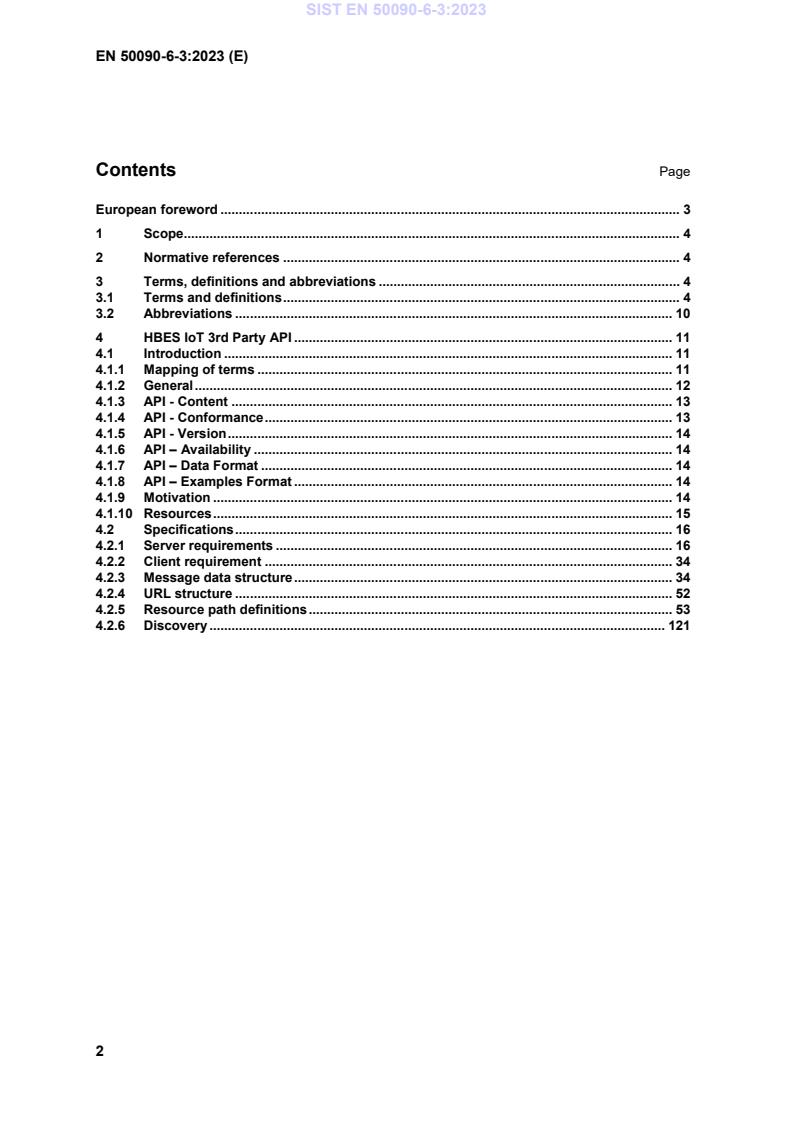
Contents Page
European foreword . 3
1 Scope. 4
2 Normative references . 4
3 Terms, definitions and abbreviations . 4
3.1 Terms and definitions . 4
3.2 Abbreviations . 10
4 HBES IoT 3rd Party API . 11
4.1 Introduction . 11
4.1.1 Mapping of terms . 11
4.1.2 General . 12
4.1.3 API - Content . 13
4.1.4 API - Conformance . 13
4.1.5 API - Version . 14
4.1.6 API – Availability . 14
4.1.7 API – Data Format . 14
4.1.8 API – Examples Format . 14
4.1.9 Motivation . 14
4.1.10 Resources . 15
4.2 Specifications . 16
4.2.1 Server requirements . 16
4.2.2 Client requirement . 34
4.2.3 Message data structure . 34
4.2.4 URL structure . 52
4.2.5 Resource path definitions . 53
4.2.6 Discovery . 121
European foreword
This document (EN 50090-6-3:2023) has been prepared by CLC/TC 205 “Home and Building
Electronic Systems (HBES)”.
The following dates are fixed:
• latest date by which this document has to be (dop) 2024-01-07
implemented at national level by publication of
an identical national standard or by
endorsement
• latest date by which the national standards (dow) 2026-07-07
conflicting with this document have to be
withdrawn
Attention is drawn to the possibility that some of the elements of this document may be the subject of
patent rights. CENELEC shall not be held responsible for identifying any or all such patent rights.
Any feedback and questions on this document should be directed to the users’ national committee. A
complete listing of these bodies can be found on the CENELEC website.
1 Scope
This document defines a 3rd Party API for the Home and Building HBES Open Communication
System.
2 Normative references
The following documents are referred to in the text in such a way that some or all of their content
constitutes requirements of this document. For dated references, only the edition cited applies. For
undated references, the latest edition of the referenced document (including any amendments)
applies.
EN 50090-1:2011, Home and Building Electronic Systems (HBES) - Part 1: Standardization structure
EN 50090-3-3, Home and Building Electronic Systems (HBES) - Part 3-3: Aspects of application -
HBES Interworking model and common HBES data types
EN 50090-6-2, Home and Building Electronic Systems (HBES)- Part 6-2 IoT Semantic Ontology
model description
3 Terms, definitions and abbreviations
3.1 Terms and definitions
For the purposes of this document, the terms and definitions given in EN 50090-1:2011 and the
following apply.
ISO and IEC maintain terminological databases for use in standardization at the following addresses:
— IEC Electropedia: available at https://www.electropedia.org/
— ISO Online browsing platform: available at https://www.iso.org/obp
3.1.1
actuator
point performing an actuation (executed by a specific procedure, with an expected result) that
changes an Installation state during Runtime
Note 1 to entry:
— The term Actuator can be mapped to sosa:Actuator in the SSN Ontology.
— The subject actuation can be mapped to sosa:Actuation in the SSN Ontology.
— The subject procedure can be mapped to sosa:Procedure in the SSN Ontology.
— The subject result can be mapped to sosa:Result in the SSN Ontology.
3.1.2
Application Function
function that uses a set of Functions to achieve the desired behaviour of a technical system, typically
using a combination of devices exchanging information via their input and output Datapoints
Note 1 to entry: An Application Function may be split into several Functional Blocks with their input and
output Datapoints that are logically connected to each other. The Functional Blocks may be located in one or
more devices.
EXAMPLE Application Functions examples are “direct electrical heating”, “electrical heating with
accumulators”, “warm water heating”, “fan coil air-conditioning” …
Note 2 to entry: The Application Function and Application are meant to be the same. Reason to introduce an
alias term is to use a clear (understandable) reference from Application/ Application Function to the
corresponding KIM class:ApplicationFunction or to the Function in the Management Client.
3.1.3
aspect
generally, a specific perspective on a system that contains things with different properties; a
referencing mechanism to organize KIM elements in a specific perspective
EXAMPLE A Function Point is an ex officio Aspect with an important specific perspective. It is a referencing
mechanism to organize together all to a Function Point interoperating Points (all GOs linked to a GA).
3.1.4
BIM
Building Information Model
digital process to describe and document a building in all its life cycle phases, from its planning,
construction, operation up to its demolition
3.1.5
channel
collection of Datapoints of a device that are logically related to each other typically by association with
a hardware feature or a specific function of that device
Note 1 to entry: These Datapoints may be derived from one or more defined Functional Blocks or may be an
expansion above and beyond defined Functional Blocks or may be independent of a Functional Block if none is
defined for the function associated with the Channel. The concept of a Channel is well-understood by the market
participant, e.g. installers.
3.1.6
datapoint
represents a logical input entity of a device acting as recipient of Installation state data, whereas a
logical output of a device acts as source of Installation state data
Note 1 to entry: In case of implementation as a Group Object, state data are communicated with the use of
Function Points.
Note 2 to entry: The term Datapoint is the common term; to specifically denote a Datapoint available on an
IoT 3rd Party API, the term IoT Datapoint is used.
3.1.7
device
physical element that is part of the network; it is a physical, concrete object that a customer can buy
3.1.8
endpoint
entry point to a service, a process, or a queue or topic destination in service-oriented architecture
3.1.9
Feature of Interest
abstraction of a real-world thing (phenomenon, equipment, person, event…) defined by its observable
or actuatable properties
Note 1 to entry: In colloquial terms, a FOI is a property carrier.
Note 2 to entry: A Sensor operates on a FOI with observable properties, an Actuator with actuatable
properties.
Note 3 to entry: A FOI is not a “classification/type” tag itself; the “classification/ type” is accomplished with
the help of tags. Examples are defined in 4.5.1.4.
3.1.10
function
describes a part of the intended behaviour of a FB in a building context
3.1.11
Functional Block
consists of one or more Functions that belong together and that cannot be separated across two
devices but big enough that a device with only one such Functional Block could be marketed
Note 1 to entry: A Functional Block has a well-defined black box behaviour.
3.1.12
Function Point
runtime system state information of a specific Application Function
Note 1 to entry: Shared by at least two Datapoints.
Note 2 to entry: Has a unique identifier that addresses a group of controlled objects. This identifier is called
a Group Address.
EXAMPLE < Light Switch > in living room on/off, whereas the < … > is the Function Point name
3.1.13
Group Address
numerical identifier of a Function Point
3.1.14
Group Communication
communication model in which one sender communicates information to one and typically more
receivers
Note 1 to entry: In IoT, this can be realized by simple UDP communication or by using a message broker
system or other.
3.1.15
Group Object
foreseen for Group Communication using Group Address(es)
Note 1 to entry: May be accessed via point-to-point communication without an assigned Group
Address. With assigned Group Address, it becomes a member of that Function Point represented by
the Group Address.
3.1.16
HBES Information Model
ontology based model of HBES System relevant parts, including additional semantic (dictionary)
information
Note 1 to entry: It is managed by the HBES Association, hence the abbreviation KIM.
3.1.17
Industry Foundation Classes
open standard to describe BIM data in a digital way
Note 1 to entry: IFC data and models are specified in ISO 16739-1.
3.1.18
installation
assembly of materials and components (devices) placed in position to provide a service
Note 1 to entry: An Installation is a deployed system (e.g. HVAC system or fire protection system) and
consists of equipment and Functions that are used for a particular purpose.
Note 2 to entry: In relation to this term created data correlates to the installation model, described in 4.2.
[SOURCE: ISO 6707-1:2020, modified – added “(devices)” and Notes to entry.]
3.1.19
IoT Datapoint
represents an Endpoint at an IoT 3rd Party API that:
a) corresponds to one or more Function Points, such as a state data representation of a discrete
state in a building context:
EXAMPLE 1 brightness → discrete state “brightness” is represented by the value 65 (percent)
b) is a fully qualified URL e.g. provided by an IoT 3rd Party Server
EXAMPLE 2 https://gateway.knx.local/knx/api/v1/datapoints/{Id}
3.1.20
IoT Function
represents a Function at an IoT 3rd Party API that:
— is as a collection of IoT Datapoints that fulfils a – by the user – intended behaviour
EXAMPLE “living room – rear light dimming”, “kitchen – floor heating”
Note 1 to entry: In a Mac, an IoT Function is instantiated data of a MaC Function in an Installation
respectively MaC project. The MaC Function itself may base on an Application Function.
3.1.21
IoT 3rd Party API
set of requirements and regulations through which partial access to an Installation can be gained by
offering a collection of Endpoints
3.1.22
IoT 3rd Party Client
device or service interacting with the Installation from outside using the IoT 3rd Party API
Note 1 to entry: The IoT 3rd Party Client connects to a single device that provides the IoT 3rd Party API and
can use this single device to fully interact with the Installation, possibly depending on a specified authorization
mechanism.
EXAMPLE 1 A mobile phone (from inside the network, or from an Internet connection) with typically short
period connections.
EXAMPLE 2 A weather service permanently feeding in its weather information using the IoT 3rd Party API.
3.1.23
IoT 3rd Party Server
device that implements the IoT 3rd Party API
Note 1 to entry: This can be a dedicated device; this can be a function of a device that supports other HBES
IoT and non HBES functionalities; it may be located within the local LAN of the IoT installation or outside.
3.1.24
MaC Catalog Entry
created management client data correlating to the product model, described in 4.2
3.1.25
MaC Function
Application Function created by the MaC and assigned to a building structure element, grouping
several Group Addresses
3.1.26
MaC Project
project created by a MaC documenting the Configuration of an Installation
3.1.27
Management Client
means to configure and commission Devices as well as to plan, design and diagnose an entire
Installation
Note 1 to entry: The MaC is used to configure and commission Devices, as well as to plan, design and
diagnose an entire Installation. As a final step the MaC writes specific configuration data such as Device
parameters to the Devices.
3.1.28
ontology
conceptual descriptions of things that have a real-world commonality sharing the knowledge of a
domain, mainly expressed with OWL
Note 1 to entry: Ontologies are a structured way to describe the meaning of data in ontology classes and
should not be mixed up with common data model structures.
3.1.29
Object Property
in OWL a built-in concept that connects pairs of individuals, an object property expression
represents the (entire) relationship between the pairs of individuals
3.1.30
OWL
OWL 2 Web Ontology Language, informally OWL 2, specified by the World Wide Web Consortium
(W3C), mainly serialized with XML syntax for RDF (RDF/XML)
Note 1 to entry: In this document the abbreviation OWL is always an explicit reference to OWL 2.
3.1.31
point
represents an interface to data in the system
Note 1 to entry: This document uses the term Point as an umbrella for data that can be accessed from
outside of the Device, for instance to interact with other Points from other Devices. Consequently, term Point is a
generic superset of the term Datapoint (which describes more precisely the technics how the “data” in the system
are structured and/or coded).
3.1.32
Point API
simple RESTful (CoAP or HTTP) application programming interface designed for, but not limited to,
constrained class 2 devices [RFC7228] supporting device individualization, device linking and
accessing device runtime data (e.g. Functional Block or Channel Datapoints)
3.1.33
Quality Kind
represents a certain combination of observable or actuatable properties, available as predefined parts
of the Semantic Dictionary or created individually during Configuration; the latter is the case when a
Quality Kind with the intended combination of properties respectively tags is not (yet) part of the
dictionary
Note 1 to entry: A QK is not a “classification/type” tag itself; the “classification/ type” is accomplished with
the help of tags. Examples are defined in 4.5.1.4.
3.1.34
RDF
Resource Description Framework, as specified by the https://www.w3.org/RDF/
Note 1 to entry: RDF is a framework to represent information in the web by using triples. The information
can be serialized and stored in many formats such as the TURTLE or JSON(-LD) format. The general RDF
concept description can be found under https://www.w3.org/TR/rdf11-concepts/
3.1.35
runtime
process-to-process communication of data between devices, opposing to Configuration
Note 1 to entry: This concerns mainly the communication of Datapoint values (control and status
information).
3.1.36
Semantic Export
project exported by the MaC reflecting an Installation in a linked data format
Note 1 to entry: The exported data are:
— structured according to the KIM, such as using Object Properties defined in KIM;
— annotated with additional semantic information from the Semantic Dictionary;
— referencing concepts of external Ontologies.
3.1.37
semantic dictionary
set of standardized terms allowing to annotate required parts of an Installation
Note 1 to entry: For details, see 4.2.8.
3.1.38
sensor
point performing an observation (executed by a specific procedure, triggered by a stimulus),
responding a result as an Installation state during Runtime
Note 1 to entry:
— The term Sensor can be mapped to sosa:Sensor in the SSN Ontology.
— The subject observation can be mapped to sosa:Observation in the SSN Ontology.
— The subject stimulus can be mapped to ssn:Stimulus in the SSN Ontology.
— The subject procedure can be mapped to sosa:Procedure in the SSN Ontology.
— The subject result can be mapped to sosa:Result in the SSN Ontology.
3.1.39
tag
kind of annotation term used to extend available data with (in most cases) well known standardized
information from a dictionary (in contrast to user defined, arbitrary term)
Note 1 to entry: A Tag is a concept-less term, without an integration in a broader concept such as the
concept of a Datapoint (used in an Application Function), it has a limited semantic meaning.
EXAMPLE Term “flow” has a weak meaning on its own, but if you relate it in a FOI with the other term
“water” this expresses at least that you observe/ actuate the water flow.
In this document a Tag is almost exclusively a term from the Semantic Dictionary.
3.1.40
thing description
semantic metadata model to describe (abstract or physical) things, as specified by the thing
description https://www.w3.org/TR/wot-thing-description/ and thing Ontology
https://www.w3.org/2019/wot/td
Note 1 to entry: TD relevant relations are described in the clause of Semantic Export.
3.2 Abbreviations
For the purposes of this document, the following abbreviations apply.
API Application Programming Interface
GA Group Address
GO Group Object
FB Functional Block
FP Function Point
HBES Home and Building Electronic Systems
IFC Industry Foundation Classes
IOO Info On off
IO Input Output
IoT Internet of Things
KIM KNX Information Model managed by KNX Association and described in
EN 50090-6-2
KNXA KNX Association
M Mandatory
MaC Management Client
OP Object Property
O Optional
TD Thing Description
4 HBES IoT 3rd Party API
4.1 Introduction
4.1.1 Mapping of terms
The KNX Information Model expresses things that correspond to or reflect the wording and meaning
used in the IoT world.
NOTE In the HBES community, the terminology has evolved and was developed over time having its origins
more than 20 years ago. By making HBES IoT Installations accessible for customers via an open API, there is a
need to intuitively adapt the language to make it understandable and usable by IoT developers. Unfortunately, it
is not possible to preserve the historical HBES terminology and use it “as is“ when addressing external non-
HBES developers.
The following Table 1 provides a mapping of terms used in the KNX Information Model, HBES IoT 3rd
Party API and comparing it to the HBES-internal naming convention.
Table 1 — Mapping of terms
Customer HBES IoT KIM HBES Classic
API Client Development Server Development Installer
:ApplicationFunction
Function IoT Function Function
:FunctionPoint/:Datap
Datapoint0F IoT Datapoint Group
oint
Address/Group
Object
loc:Building/
building/floor/room/site building/floor/room/site Building/Floor/
loc:Floor/ loc:Room/
Room/-
loc:Site
:Channel
NA NA Channel
:Device
Device Device Device
— The Customer terminology is relevant for an HBES IoT 3rd Party Client respectively for a
developer building such a client based on the HBES IoT 3rd Party API. This developer is typically
HBES agnostic.
— The HBES IoT and KIM terminology addresses the HBES manufacturer, building a HBES IoT 3rd
Party Server, respectively is relevant for KNX Association itself specifying the Ontology.
— The HBES Classic terminology is well known for an installer of HBES S-Mode installations.
For a server development it is of essence to understand how to differentiate the terms from the table
above from a technical perspective, for this see below.
Relations
HBES Classic makes use of the concept of a Group Address and Group Object: a Group Address
links several Group Objects (a Function groups at least one Group Address, a Device has at least
one Group Object assigned).
However, both a GA and GO are represented with a Datapoint/ IoT Datapoint.
Possibility to distinguish between a GA/ GO at the level of a Datapoint/ IoT Datapoint,
a) At level of the HBES IoT Server Development
Use of the corresponding KIM concepts for a GA or GO according the table above. Moreover, a
Function Point also contains a property for the GA value.
b) At the level of the API Client Development
In the case where the server includes as part of the response the type information from the KIM
concepts above and/or the optional property for the GA, with this it will be possible to distinguish
a Datapoint/IoT Datapoint as being a GA or a GO in a KNX Classic Installation.
For details on how these relations are semantically expressed, refer to EN 50090-6-2.
4.1.2 General
The HBES IoT 3rd Party API shall support the following features:
— discovery of the HBES IoT 3rd Party Server
— reading and writing of End points
— setup notifications on End points
— access permission control of End points
Information about reliability and freshness of the Installation state data are not dealt with in this
version of the HBES IoT 3rd Party API.
The HBES IoT 3rd Party API hosts in the HBES IoT 3rd Party Server the main server project and
Installation concepts as depicted in Figure 1. The picture expresses the following aspects:
— with red dotted lines: the available relations in the API (which are fewer than the EN 50090
System or KIM describe, see explanation on D below)
— the item cardinality at the end of every relation (in UML notation)
Figure 1 — Project elements in the HBES IoT 3rd Party Server
The letters in the above Figure denote the following:
A. when a Device does not support a Point (plain hardware like power supply, without any
application) or when the IoT Datapoint represents a Function Point
B. when an IoT Datapoint represents a Function Point
C. includes floors/rooms/… and other
D. an Installation to location relation is not an explicit relationship in the API; it is expected that the
resource path definitions of the category location (or similar) are always the known and fixed
entry point for one (or more) Installations. In case of more installations, all content is merged, the
API end points delivers a common perspective, see also 4.2.5.1.3.
E. when an IoT Datapoint represents a Point
Server Project - Node Information
Provides node meta information assigned to the server: geographically assigned location address,
node (firmware) version and more
Server Project - Installation Information
Is the MaC project assigned to the server, in the form of the Semantic Export.
— Functions, Datapoints, Devices or Location elements such as a Building, Floor or Room.
— The version of the MaC Project, to track changes of the server project configuration. To identify a
change the OP :lastModified of the :Installation can be used, see “Installation” in
EN 50090-6-2).
— The HBES Information Model version (see the “Introduction” in EN 50090-6-2), as part of the
Semantic Export.
NOTE Data and users are added to the actual server project in the HBES IoT 3rd Party Server in a plug-
and-play way. Consequently, the server project is a superset/ extension of the original MaC project. Therefore,
any additional data of the server project needs to be maintained by the HBES IoT 3rd Party Server and not by the
MaC.
4.1.3 API - Content
The HBES IoT 3rd Party API consists of:
— Resource access methods (to set or retrieve Installation state data).
— End points hosting concepts comprising the Runtime communication or representing the
Configuration of a (HBES Classic) Installation, additionally end points allowing to setup
notifications on changes of Installation state data, provided to subscribers that are clients to the
Installation.
— Methods to filter for specific resource items from a collection of resource items.
— Methods for authorization by an HBES IoT 3rd Party Client including a secure client/server
communication.
— Access (permission) scopes, for security reasons the actual access to some end points (such as
writing a Datapoint) is gated by the HBES IoT 3rd Party Server, this access will be granted as
part of the authorization.
For all End points, their expected request/ response document formats, and their content is not
described to the full extend in this document. Whether an element is mandatory or optional can be
found in the electronic document (see 4.1.6). If an End point is mandatory or not, refer to 4.2.5.
NOTE Except by means of written text, Open API does not allow to define with a statement that an End
point is optional.
4.1.4 API - Conformance
The HBES IoT 3rd Party API includes the above-described content and consists of the following:
— The API electronic document content is described with Open API (OAS3).
— The API concepts are described according JSON API, in case of deviations compared to the
JSON API this is mentioned in this document. As a rule, an HBES IoT 3rd Party Server shall
— ignore any valid JSON API content that is not supported or expected by the server;
— respect the JSON API standard when supporting other members, even if they are not
detailed in this document.
EXAMPLE JSON API top-level members not mandated or described in this document, such as top-level
links or included member.
EXAMPLE HBES manufacturer attributes not defined in this document, as part of the attributes member of
a certain resource object.
EXAMPLE Providing a single JSON object or an array of JSON objects, including if no resource items are
available.
4.1.5 API - Version
The HBES IoT 3rd Party API shall be versioned to allow compatibility between communication peers,
however only as a whole and not in parts, even if several elements of the API are unchanged
between different API versions.
The version of this document (see clause document updates) relates to the version 2.0.0 of the
electronic document (see 4.1.6). For details how to handle API versioning see 4.2.5.1.1.1.
4.1.6 API – Availability
The URL https://schema.knx.org allows to retrieve the most recent electronic document of the HBES
IoT 3rd Party API. Older versions are also available.
The above-mentioned URL has no relationship to the common HBES IoT 3rd Party API URL
structure, for this see 4.2.4.
4.1.7 API – Data Format
The HBES IoT 3rd Party API electronic document is available as a YAML file.
4.1.8 API – Examples Format
For readability, in this document all HBES IoT 3rd Party API code (snippet) examples are in the YAML
format, regardless of the actual format at Runtime.
4.1.9 Motivation
The motivation of this document is to ensure that the HBES IoT 3rd Party API
— can be easily and consistently consumed by clients with basic HTTP support;
— provide smooth developers experience, in this way making use easy and intuitive.
Services typically provide language-specific frameworks to wrap their APIs, most of their operations
eventually boil down to requests/ responses with JSON payload.
Most modern APIs use HTTP protocol concepts, blended with some concepts from other computing
technologies.
NOTE A lot of web APIs are defined in terms of End points that have parameters. End point and parameters
are not terms or concepts that are native to HTTP or REST- they are concepts carried over from Remote
Procedure Call (RPC) and related technologies.
An API should focus on the underlying entities of the “domain of interest” it exposes, rather than a
large set of functions that manipulate those entities. Fewer unique features of the API have to be
managed over time. This belief is really an expression of the more fundamental idea to specify only
the fewest number of concepts necessary to solve the problem.
Fewer concepts result in increased consistency, allowing teams to leverage common code, patterns,
documentation, and design decisions. These guidelines aim to achieve the following:
— Allowing 3rd parties to integrate service solutions with the products of HBES manufacturers
implementing the HBES IoT 3rd Party API.
— Providing easy access to the HBES IoT services via REST interfaces for application developers.
— Making the integration of the HBES IoT 3rd Party API easy for device developers.
4.1.10 Resources
4.1.10.1 General
A resource is the nucleus of any rest-oriented API design, it models and represents the intended
Application’s Domain. With an URI, a resource is uniquely defined, an URL defines a method to
access the resource.
Resources shall generally be described with an URI.
4.1.10.2 Items, collections and relationships
An API is typically designed by dividing resource types (naming schemes) into documents,
collections, stores and controllers. In this document the focus lies on documents and collections.
— A document (from now on called item) is one single or individual “object of interest”.
— A collection is a directory of singular items, hosted in a server.
Items, and collections (of items) are the first fundamental concept.
In addition to simple items, most “domains of interest” include conceptual relationships. The natural
construct for representing relationships in HTTP is the link. Links indicate where you can go from
where you are. They are the signposts for the paved paths to traverse the system.
Relationships (linked data) are the second fundamental concept.
Examples can be found further down.
4.1.10.3 Resource path
The following path structure to a resource should be defined, a path to retrieve an individual item of a
specific resource using a resource {id}and one path to retrieve a collection of such items.
…/item/{id}
— item path
— collection path: …/item (same resource path principle is …/item/{id}/item)
Hyphens shall be used to separate path segments, such as …/segment1-segment2/.
4.1.10.4 Resource names
The use of a domain specific nomenclature for resource names helps developers understand the
functionality and basic semantics of resources. It also reduces effort to document the API.
A collection provides usually multiple items, such resource names should be pluralized.
/buildings
/buildings/{id}
URLs are often treated case sensitive, therefore lowercase shall be used.
4.1.10.5 Resource IDs
JSON API requires for the {id} a string format, it is recommended for the {id} to use the UUID
format.
To simplify the encoding of a resource id in URLs the {id} shall not use reserved characters as
specified in [RFC 3986] section 2.2.
In case the resource {id} is represented by a UUID the above rule is fulfilled automatically, as a
UUID never uses any reserved character specified above.
4.1.10.6 Examples
The resource path examples below show a path to a single location and function item and a resource
path for a collection of locations, ids are formatted as UUID resource {id}.
/locations/{id} A specific location item as part of the locations
collection in an Installation,
https://…/locations/3a19fee4-ba8a-4fd2-ba10-42b7f40f5acf
/functions/{id} A specific function item as part of the functions
collection in an Installation,
https://…/functions/7e1418b3-58cb-43dc-a743-1280bc2c6bd7
/locations A collection of all locations in an Installation,
https:// …/locations
The resource path example below shows a relationship of a location to its functions included there.
/locations/{id}/functions A collection of all function items in a specific
location, https://…/locations/3a19fee4-ba8a-4fd2-ba10-
42b7f40f5acf/functions
4.2 Specifications
4.2.1 Server requirements
Use of common web techniques (e.g. additional HTTP header tags, used cypher suites on TLS, …)
that go beyond those that are specified in this clause and in 4.2.5.8 are acceptable, provided they do
not violate any of the explicit protocol and security requirements.
4.2.1.1 Protocols
4.2.1.1.1 IP
The HBES IoT 3rd Party API communication shall be possible on both IPv4 as well as on IPv6. The
implementer is free to choose the version; dual stack implementations are possible as well.
4.2.1.1.2 HTTP
A HBES IoT 3rd Party Server shall support HTTP/1.1 as documented in the following RFCs:
— [RFC 7230] – Message Syntax and Routing → general purpose
— [RFC 7231] – Semantic and Content → Content-Type header
A HBES IoT 3rd Party Server may support HTTP/1.1 as documented in the following RFCs:
— [RFC 7232] – Conditional Requests → ETag header
HTTP/2 with [RFC 7540] is recommended but optional.
This document lists some of the required elements of the above mentioned Semantic and Content
elements below.
— handle different HTTP resource access methods;
— handle different (URL) resource paths;
— handle possible (URL) resource path query parameters;
— handle possible request/ response headers;
— handle a HTTP version number.
Even if requirements laid down further in this document may refer to HTTP/1.1, it is explicitly
supposed that such requirements are platform-agnostic to HTTP/2 or HTTP/1.1.
NOTE In this document further used examples use HTTP/1.1.
4.2.1.2 Access Method
Resources can be accessed with the standard HTTP access methods for restful services.
Readable resources can be fetched by sending a GET request to its corresponding End point.
Writable resources can be updated by sending a PUT request to its corresponding End point. In
specific cases a writable resource can be accessed also with POST(create), PATCH (update) and
DELETE requests.
Which HTTP methods are used in which use case,
consult the HBES IoT 3rd Party API standard in 4.2.5. In case a client is using an access method not
defined for an individual End point, the HBES IoT 3rd Party Server shall respond with error code 405.
4.2.1.3 Header
The HBES IoT 3rd Party Server shall support to handle the following headers specified in HTTP.
— Accept
Client request header, containing a specific requested Content-Type respectively media-
type.
— Accept–Charset
Client request header, containing a specific requested Accept-Charset.
NOTE Well known browser clients generally omit this header.
Above-described header behaviour is closely related to the content negotiation handling, see 4.2.1.7.
— Authorization
Client request header, containing specific user authorization credentials.
— Host, Content-Length, Date
Used for subscription post notifications, see 4.2.5.6.4.6.
The HBES IoT 3rd Party Server may support handling of the following header specified in HTTP.
— ETag
Server response header, as described in 2.3 in [RFC7232]
NOTE ETag is a caching mechanism for reliability and scalability and an indicator for domain respectively
application data freshness/validity. It affects the server response, containing a specific resource identifier (version
or fingerprint).
Client requests to specific End points of the HBES IoT 3rd Party API with other request headers as
specified above (such as If-None-Match) are out of scope of this document.
4.2.1.4 Query parameters
This document uses the following parameter types:
— query (parameter is part of the URL, see clauses below)
— path (parameter is part of the URL, described as part of the resource path, see 4.2.5)
— header (parameter is part of a HTTP header)
This document describes optional and mandatory query parameters, the used query parameter
names fulfil the JSON API. Other (vendor specific) query parameters are optional.
In case square brackets “[ ]” and the colon “”: are used as part query parameter names, they shall
be %-encoded. For the general name definition for query parameters see JSON API, section Query
Parameters.
The HBES IoT 3rd Party API Server shall support a query parameter string according to [RFC 3986],
section 3.4. For examples, see in next clauses.
— Several query parameters shall be concatenated with an ampersand “&” separator, each query
parameter shall be handled by the server. The concatenation shall not be handled with any
logical operation for the parameters, for this see 4.2.1.4.1 and 4.2.1.4.2 below.
— Several query parameter values for the same query parameter shall be supported as a comma
separated list. The list shall not be handled with any logical operation for the values, for this see
4.2.1.4.2 below.
The query parameter consists of a parameter name and a parameter value, separated by a “=”.
Technically this is a key/value pair used to search for resources related to the key, also matching the
requested (parameter) value.
NOTE The server technology to define such relations is out of scope here (SQL database, triple store, …).
1. The query parameter name (key) is defined as a string, covering a set of terms, see next
clauses.
2. The query parameter value is defined as a string, covering any term including timestamps and
numbers. Depending on the related resource item member the value needs to be interpreted in
different ways. The parameter value may be surrounded with quotes, which needs to be ignored
by the HBES IoT 3rd Party Server.
NOTE The Datapoint attributes member value is a possible query parameter, see also examples in
the next clauses below. It is defined as a JSON string, see 4.2.5.4. A query parameter value 4.10 is interpreted
on a string-based DPT as a string 4.10, on a number-based DPT as a number 4.1.
String
String values are interpreted by %-decoding the given value.
Number
Numbers are interpreted according to JSON, Clause 6.
Time
Time is interpreted according to the API reference member timestamp.
IRI
IRI is interpreted the same as for String above. They cover KIM properties, optionally external
ontology properties. Using a full IRI as value is not recommended, for this the RDF namespace IRI
concept should be used (further called namespace prefix).
The corresponding namespace prefix can be omitted as part of the client request. The HBES IoT 3rd
Party API Server shall always prioritize the KIM properties (see examples in next clauses).
NOTE The option to omit a namespace prefix such as dic-tag:, dic:, loc: or unit: means that the
HBES IoT 3rd Party API Server shall implement different priorities to search for related content.
1. in KIM included properties, with and without namespace prefix
2. Vendor specific properties
When a vendor specific or external Ontology (non-KIM) property has the same value as in the KIM, a
client shall indicate this with the corresponding namespace prefix. Otherwise, it is handled by the
server as the KIM property (in such a case the server does not realize that the query parameter was
intended to be a
...
Questions, Comments and Discussion
Ask us and Technical Secretary will try to provide an answer. You can facilitate discussion about the standard in here.
Loading comments...