


ISO/IEC 19513:2017
(Main)Information technology — Object Management Group Unified Profile for DoDAF and MODAF (UPDM), 2.1.1
Information technology — Object Management Group Unified Profile for DoDAF and MODAF (UPDM), 2.1.1
This International Standard provides a specification language, UPDM, that is readily understandable not only by the community of architects of information technology systems but also by a wide range of end users including executives and enterprise management that sponsor such systems, program managers that oversee their development, developers of supporting hardware and software (design, implementation, and testing), subject matter experts, and end users. UPDM bridges the gap from setting of requirements to high level system design and to visualization for practitioners. While designed in the context of military organizations and their procurement processes, UPDM can also be applied in entirely civilian industrial and service organization contexts. UPDM 2.1.1 supports the capability to: ? model architectures for a broad range of complex systems, which may include hardware, software, data, personnel, and facility elements; ? model consistent architectures for system-of-systems down to lower levels of design and implementation; ? model service oriented architectures; ? support the analysis, specification, design, and verification of complex systems; and ? improve the ability to exchange architecture information among related tools that are UML based and tools that are based on other standards. The profile provides the modeling of operational capabilities, services, system activities, nodes, system functions, ports, protocols, interfaces, performance, and physical properties and units of measure. In addition, the profile enables the modeling of related architecture concepts such as DoD's doctrine, organization, training material, leadership & education, personnel, and facilities (DOTMLPF) and the equivalent UK Ministry of Defence Lines of Development (DLOD) elements. UPDM 2.1.1, as illustrated in Figure 1.1, addresses DoDAF and MODAF Viewpoints as well as enabling extensions to new architecture perspectives (e.g., Services views, Custom views, Logistics views cost views, etc.). MODAF terminology has been used for simplicity.
Technologies de l'information — Profil unifié pour DoDAF et MODAF (UPDM) de l'OMG, 2.1.1
General Information
- Status
- Published
- Publication Date
- 09-Nov-2017
- Technical Committee
- ISO/IEC JTC 1 - Information technology
- Drafting Committee
- ISO/IEC JTC 1 - Information technology
- Current Stage
- 9093 - International Standard confirmed
- Start Date
- 10-May-2025
- Completion Date
- 14-Feb-2026
Overview
ISO/IEC 19513:2017 - UPDM 2.1.1 defines the Object Management Group Unified Profile for DoDAF and MODAF (UPDM). The standard provides a UML-based specification language intended to make architecture descriptions understandable across stakeholders - from enterprise executives and program managers to architects, developers, subject-matter experts, and end users. While rooted in military architecture frameworks (DoDAF, MODAF), UPDM 2.1.1 is applicable to civilian industrial and service organizations and supports model-driven engineering and visualization across the system lifecycle.
Key topics and technical requirements
- Profile-based modeling (UML/SysML/SoaML): UPDM is a UML profile that supports reuse of SysML and SoaML constructs. The standard defines compliance levels (e.g., Level 0: UML2 + partial SoaML import; Level 1: UML2 + full SysML import).
- Support for DoDAF and MODAF viewpoints: The profile maps DoDAF/MODAF viewpoints into UML constructs and enables extensions for additional perspectives (services, logistics, cost, custom views).
- Comprehensive architecture elements: Includes modeling of operational capabilities, services, system activities, nodes, system functions, ports, protocols, interfaces, performance measures, and physical properties/units of measure.
- DOTMLPF / DLOD modeling: Enables modeling of doctrine, organization, training, leadership & education, personnel, facilities (DOTMLPF) and equivalent UK Lines of Development (DLOD).
- Interoperability and model exchange: Specified to improve exchange of architecture information among UML-based tools and tools based on other standards.
- Lifecycle support: Facilitates analysis, specification, design, verification and visualization of systems and system-of-systems down to detailed design and implementation levels.
Practical applications
- Model-driven systems engineering (MBSE) for complex systems that combine hardware, software, data, personnel, and facilities.
- Enterprise and defense architecture definition and communication using DoDAF and MODAF views.
- Designing and documenting service-oriented architectures (SOA) and service interfaces.
- Traceability from requirements to high-level design, implementation, and verification artifacts.
- Tool interoperability and model exchange workflows between UML/SysML tools and other architecture tools.
Who should use this standard
- Enterprise and solution architects, systems engineers, MBSE practitioners
- Program and project managers overseeing complex system development
- Defense planners and procurement organizations using DoDAF/MODAF
- Software and hardware developers integrating architecture models into design and test
- Tool vendors implementing UPDM-compliant modeling and exchange features
Related standards
- UML 2.x (foundation for the profile)
- SysML and SoaML (reused/imported modeling languages)
- DoDAF and MODAF architecture framework specifications
Keywords: ISO/IEC 19513:2017, UPDM 2.1.1, DoDAF, MODAF, UML profile, SysML, SoaML, enterprise architecture, MBSE, model exchange, service-oriented architecture.



Get Certified
Connect with accredited certification bodies for this standard

BSI Group
BSI (British Standards Institution) is the business standards company that helps organizations make excellence a habit.

BSCIC Certifications Pvt. Ltd.
Established 2006, accredited by NABCB, JAS-ANZ, EIAC, IAS. CDSCO Notified Body.

Intertek India Pvt. Ltd.
Delivers Assurance, Testing, Inspection & Certification since 1993 with 26 labs and 32 offices.
Sponsored listings
Frequently Asked Questions
ISO/IEC 19513:2017 is a standard published by the International Organization for Standardization (ISO). Its full title is "Information technology — Object Management Group Unified Profile for DoDAF and MODAF (UPDM), 2.1.1". This standard covers: This International Standard provides a specification language, UPDM, that is readily understandable not only by the community of architects of information technology systems but also by a wide range of end users including executives and enterprise management that sponsor such systems, program managers that oversee their development, developers of supporting hardware and software (design, implementation, and testing), subject matter experts, and end users. UPDM bridges the gap from setting of requirements to high level system design and to visualization for practitioners. While designed in the context of military organizations and their procurement processes, UPDM can also be applied in entirely civilian industrial and service organization contexts. UPDM 2.1.1 supports the capability to: ? model architectures for a broad range of complex systems, which may include hardware, software, data, personnel, and facility elements; ? model consistent architectures for system-of-systems down to lower levels of design and implementation; ? model service oriented architectures; ? support the analysis, specification, design, and verification of complex systems; and ? improve the ability to exchange architecture information among related tools that are UML based and tools that are based on other standards. The profile provides the modeling of operational capabilities, services, system activities, nodes, system functions, ports, protocols, interfaces, performance, and physical properties and units of measure. In addition, the profile enables the modeling of related architecture concepts such as DoD's doctrine, organization, training material, leadership & education, personnel, and facilities (DOTMLPF) and the equivalent UK Ministry of Defence Lines of Development (DLOD) elements. UPDM 2.1.1, as illustrated in Figure 1.1, addresses DoDAF and MODAF Viewpoints as well as enabling extensions to new architecture perspectives (e.g., Services views, Custom views, Logistics views cost views, etc.). MODAF terminology has been used for simplicity.
This International Standard provides a specification language, UPDM, that is readily understandable not only by the community of architects of information technology systems but also by a wide range of end users including executives and enterprise management that sponsor such systems, program managers that oversee their development, developers of supporting hardware and software (design, implementation, and testing), subject matter experts, and end users. UPDM bridges the gap from setting of requirements to high level system design and to visualization for practitioners. While designed in the context of military organizations and their procurement processes, UPDM can also be applied in entirely civilian industrial and service organization contexts. UPDM 2.1.1 supports the capability to: ? model architectures for a broad range of complex systems, which may include hardware, software, data, personnel, and facility elements; ? model consistent architectures for system-of-systems down to lower levels of design and implementation; ? model service oriented architectures; ? support the analysis, specification, design, and verification of complex systems; and ? improve the ability to exchange architecture information among related tools that are UML based and tools that are based on other standards. The profile provides the modeling of operational capabilities, services, system activities, nodes, system functions, ports, protocols, interfaces, performance, and physical properties and units of measure. In addition, the profile enables the modeling of related architecture concepts such as DoD's doctrine, organization, training material, leadership & education, personnel, and facilities (DOTMLPF) and the equivalent UK Ministry of Defence Lines of Development (DLOD) elements. UPDM 2.1.1, as illustrated in Figure 1.1, addresses DoDAF and MODAF Viewpoints as well as enabling extensions to new architecture perspectives (e.g., Services views, Custom views, Logistics views cost views, etc.). MODAF terminology has been used for simplicity.
ISO/IEC 19513:2017 is classified under the following ICS (International Classification for Standards) categories: 35.080 - Software. The ICS classification helps identify the subject area and facilitates finding related standards.
ISO/IEC 19513:2017 is available in PDF format for immediate download after purchase. The document can be added to your cart and obtained through the secure checkout process. Digital delivery ensures instant access to the complete standard document.
Standards Content (Sample)
INTERNATIONAL ISO/IEC
STANDARD 19513
First edition
2017-10
Information technology — Object
Management Group Unified Profile for
DoDAF and MODAF (UPDM), 2.1.1
Technologies de l'information — Profil unifié pour DoDAF et MODAF
(UPDM) de l'OMG, 2.1.1
Reference number
©
ISO/IEC 2017
© ISO/IEC 2017, Published in Switzerland
All rights reserved. Unless otherwise specified, no part of this publication may be reproduced or utilized otherwise in any form
or by any means, electronic or mechanical, including photocopying, or posting on the internet or an intranet, without prior
written permission. Permission can be requested from either ISO at the address below or ISO’s member body in the country of
the requester.
ISO copyright office
Ch. de Blandonnet 8 • CP 401
CH-1214 Vernier, Geneva, Switzerland
Tel. +41 22 749 01 11
Fax +41 22 749 09 47
copyright@iso.org
www.iso.org
ii © ISO/IEC 2017 – All rights reserved
Table of Contents
Foreword . x
Introduction .xi
1 Scope . 3
2 Compliance . 4
2.1 Compliance Levels .4
2.1.1 Level 0 : Based on UML 2 and Partial SoaML Import . 6
2.1.2 Level 1 : Based on UML 2 and Full SysML Import . 7
2.2 Compliance to DoDAF 2.0.2 .7
3 Normative References . 7
3.1 Overview .7
3.2 References .7
4 Terms and Definitions . 8
5 Symbols and Acronyms . 8
6 Additional Information . 9
6.1 Additional Materials .9
6.2 Overview of this International Standard .10
6.2.1 Intended Audience . 10
6.2.2 Organization . 10
7 Language Architecture . 13
7.1 Introduction .13
7.2 Philosophy .13
7.3 Core Principles .13
7.4 Representing Stereotype Constraints .14
7.5 UML Constraint Representation .18
7.6 Important Areas of the Architecture .18
7.6.1 Aliases .18
7.6.2 SoaML Reuse in L0 . 19
7.6.3 SysML Reuse in L1 . 19
7.6.4 SOPES Reuse in L1 . 19
8 UPDM Profile . 21
8.1 Introduction .21
8.2 DoDAF Class Library .21
iii
© ISO/IEC 2017 – All rights reserved
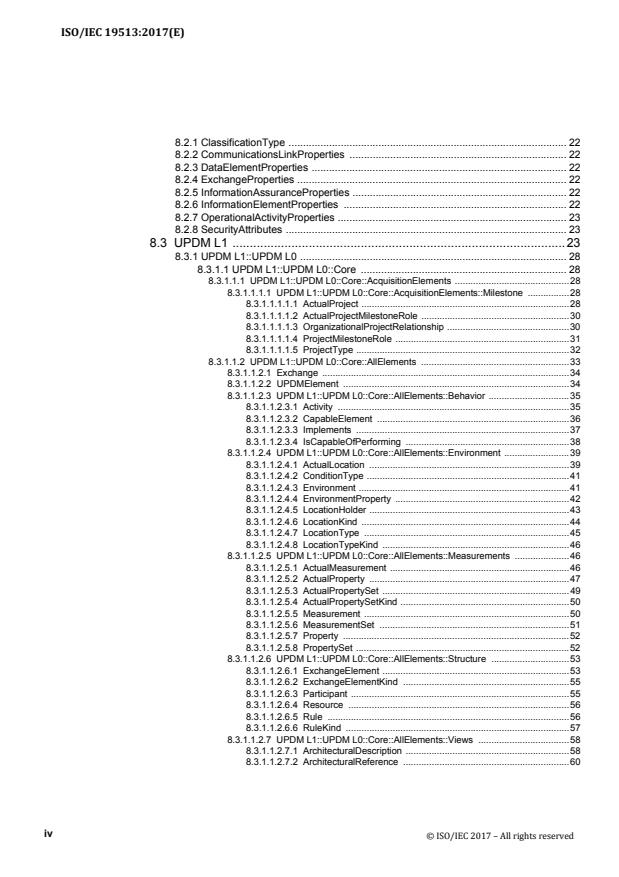
8.2.1 ClassificationType . 22
8.2.2 CommunicationsLinkProperties . 22
8.2.3 DataElementProperties . 22
8.2.4 ExchangeProperties . 22
8.2.5 InformationAssuranceProperties . 22
8.2.6 InformationElementProperties . 22
8.2.7 OperationalActivityProperties . 23
8.2.8 SecurityAttributes . 23
8.3 UPDM L1 .23
8.3.1 UPDM L1::UPDM L0 . 28
8.3.1.1 UPDM L1::UPDM L0::Core . 28
8.3.1.1.1 UPDM L1::UPDM L0::Core::AcquisitionElements .28
8.3.1.1.1.1 UPDM L1::UPDM L0::Core::AcquisitionElements::Milestone .28
8.3.1.1.1.1.1 ActualProject .28
8.3.1.1.1.1.2 ActualProjectMilestoneRole .30
8.3.1.1.1.1.3 OrganizationalProjectRelationship .30
8.3.1.1.1.1.4 ProjectMilestoneRole .31
8.3.1.1.1.1.5 ProjectType .32
8.3.1.1.2 UPDM L1::UPDM L0::Core::AllElements .33
8.3.1.1.2.1 Exchange .34
8.3.1.1.2.2 UPDMElement .34
8.3.1.1.2.3 UPDM L1::UPDM L0::Core::AllElements::Behavior .35
8.3.1.1.2.3.1 Activity .35
8.3.1.1.2.3.2 CapableElement .36
8.3.1.1.2.3.3 Implements .37
8.3.1.1.2.3.4 IsCapableOfPerforming .38
8.3.1.1.2.4 UPDM L1::UPDM L0::Core::AllElements::Environment .39
8.3.1.1.2.4.1 ActualLocation .39
8.3.1.1.2.4.2 ConditionType .41
8.3.1.1.2.4.3 Environment .41
8.3.1.1.2.4.4 EnvironmentProperty .42
8.3.1.1.2.4.5 LocationHolder .43
8.3.1.1.2.4.6 LocationKind .44
8.3.1.1.2.4.7 LocationType .45
8.3.1.1.2.4.8 LocationTypeKind .46
8.3.1.1.2.5 UPDM L1::UPDM L0::Core::AllElements::Measurements .46
8.3.1.1.2.5.1 ActualMeasurement .46
8.3.1.1.2.5.2 ActualProperty .47
8.3.1.1.2.5.3 ActualPropertySet .49
8.3.1.1.2.5.4 ActualPropertySetKind .50
8.3.1.1.2.5.5 Measurement .50
8.3.1.1.2.5.6 MeasurementSet .51
8.3.1.1.2.5.7 Property .52
8.3.1.1.2.5.8 PropertySet .52
8.3.1.1.2.6 UPDM L1::UPDM L0::Core::AllElements::Structure .53
8.3.1.1.2.6.1 ExchangeElement .53
8.3.1.1.2.6.2 ExchangeElementKind .55
8.3.1.1.2.6.3 Participant .55
8.3.1.1.2.6.4 Resource .56
8.3.1.1.2.6.5 Rule .56
8.3.1.1.2.6.6 RuleKind .57
8.3.1.1.2.7 UPDM L1::UPDM L0::Core::AllElements::Views .58
8.3.1.1.2.7.1 ArchitecturalDescription .58
8.3.1.1.2.7.2 ArchitecturalReference .60
iv
© ISO/IEC 2017 – All rights reserved
8.3.1.1.2.7.3 ArchitectureFrameworkKind .60
8.3.1.1.2.7.4 ArchitectureMetadata .61
8.3.1.1.2.7.5 Metadata .61
8.3.1.1.2.7.6 View .62
8.3.1.1.2.7.7 Viewpoint .63
8.3.1.1.3 UPDM L1::UPDM L0::Core::ExternalTypes .64
8.3.1.1.3.1 ISO8601DateTime .64
8.3.1.1.4 UPDM L1::UPDM L0::Core::OperationalElements .65
8.3.1.1.4.1 UPDM L1::UPDM L0::Core::OperationalElements::Behavior .65
8.3.1.1.4.1.1 NodeOperation .65
8.3.1.1.4.1.2 OperationalActivity .66
8.3.1.1.4.1.3 OperationalActivityAction .68
8.3.1.1.4.1.4 OperationalActivityEdge .69
8.3.1.1.4.1.5 OperationalEventTrace .70
8.3.1.1.4.1.6 OperationalMessage .71
8.3.1.1.4.1.7 OperationalParameter .72
8.3.1.1.4.1.8 OperationalState .72
8.3.1.1.4.1.9 OperationalStateDescription .73
8.3.1.1.4.1.10 SubjectOfOperationalStateMachine .74
8.3.1.1.4.2 UPDM L1::UPDM L0::Core::OperationalElements::Data .75
8.3.1.1.4.2.1 LogicalDataModel .75
8.3.1.1.4.3 UPDM L1::UPDM L0::Core::OperationalElements::Flows .75
8.3.1.1.4.3.1 Command .75
8.3.1.1.4.3.2 OperationalExchange .76
8.3.1.1.4.3.3 OperationalExchangeItem .78
8.3.1.1.4.3.4 OperationalExchangeKind .79
8.3.1.1.4.4 UPDM L1::UPDM L0::Core::OperationalElements::Structure .80
8.3.1.1.4.4.1 ArbitraryConnector .80
8.3.1.1.4.4.2 Competence .81
8.3.1.1.4.4.3 ConceptItem .81
8.3.1.1.4.4.4 ConceptRole .82
8.3.1.1.4.4.5 HighLevelOperationalConcept .83
8.3.1.1.4.4.6 KnownResource .84
8.3.1.1.4.4.7 LogicalArchitecture .85
8.3.1.1.4.4.8 Specializations .86
8.3.1.1.4.4.9 Mission .86
8.3.1.1.4.4.10 Needline .87
8.3.1.1.4.4.11 Node . 88
8.3.1.1.4.4.12 NodeParent .89
8.3.1.1.4.4.13 NodePort .90
8.3.1.1.4.4.14 NodeRole .91
8.3.1.1.4.4.15 OperationalConstraint .92
8.3.1.1.4.4.16 SecurityDomain .93
8.3.1.1.4.4.17 SubjectOfOperationalConstraint .93
8.3.1.1.4.4.18 UPDM L1::UPDM L0::Core::OperationalElements::
Structure::Organizational .94
8.3.1.1.5 UPDM L1::UPDM L0::Core::ServiceElements .110
8.3.1.1.5.1 UPDM L1::UPDM L0::Core::ServiceElements::Behavior .110
8.3.1.1.5.1.1 ServiceFeature .110
8.3.1.1.5.1.2 ServiceFunction .111
8.3.1.1.5.1.3 ServiceFunctionAction .112
8.3.1.1.5.1.4 ServiceFunctionEdge .112
8.3.1.1.5.1.5 ServiceInteraction .113
8.3.1.1.5.1.6 ServiceMessage .114
8.3.1.1.5.1.7 ServiceMessageHandler .115
v
© ISO/IEC 2017 – All rights reserved
8.3.1.1.5.1.8 ServiceOperation .116
8.3.1.1.5.1.9 ServiceParameter . 117
8.3.1.1.5.1.10 ServiceStateMachine .118
8.3.1.1.5.2 UPDM L1::UPDM L0::Core::ServiceElements::Structure .119
8.3.1.1.5.2.1 AsynchronousMessage .119
8.3.1.1.5.2.2 Request .120
8.3.1.1.5.2.3 Service .121
8.3.1.1.5.2.4 ServiceAttribute .121
8.3.1.1.5.2.5 ServiceInterface .122
8.3.1.1.5.2.6 ServiceLevelValue .124
8.3.1.1.5.2.7 ServiceLevelValueSet .125
8.3.1.1.5.2.8 ServicePolicy .125
8.3.1.1.5.2.9 ServicePort .126
8.3.1.1.6 UPDM L1::UPDM L0::Core::StrategicElements .128
8.3.1.1.6.1 UPDM L1::UPDM L0::Core::StrategicElements::Structure .128
8.3.1.1.6.1.1 Capability .128
8.3.1.1.6.1.2 CapabilityProperty .129
8.3.1.1.6.1.3 DesiredState .130
8.3.1.1.6.1.4 Desirer .130
8.3.1.1.6.1.5 EnterpriseGoal .131
8.3.1.1.6.1.6 EnterprisePhase .132
8.3.1.1.6.1.7 EnterpriseVision .133
8.3.1.1.6.1.8 Exhibits .134
8.3.1.1.6.1.9 MapsToCapability .135
8.3.1.1.6.1.10 StructuralPart .136
8.3.1.1.6.1.11 TemporalPart .137
8.3.1.1.6.1.12 VisionStatement .137
8.3.1.1.7 UPDM L1::UPDM L0::Core::SystemsElements .138
8.3.1.1.7.1 UPDM L1::UPDM L0::Core::SystemsElements::Behavior .138
8.3.1.1.7.1.1 Function .138
8.3.1.1.7.1.2 FunctionAction .140
8.3.1.1.7.1.3 FunctionEdge .140
8.3.1.1.7.1.4 ResourceEventTrace .141
8.3.1.1.7.1.5 ResourceMessage .142
8.3.1.1.7.1.6 ResourceOperation .143
8.3.1.1.7.1.7 ResourceParameter .144
8.3.1.1.7.1.8 ResourceState .145
8.3.1.1.7.1.9 ResourceStateMachine .146
8.3.1.1.7.2 UPDM L1::UPDM L0::Core::SystemsElements::Data .147
8.3.1.1.7.2.1 DataModel .147
8.3.1.1.7.2.2 PhysicalDataModel .148
8.3.1.1.7.3 UPDM L1::UPDM L0::Core::SystemsElements::Flows .148
8.3.1.1.7.3.1 ResourceInteraction .148
8.3.1.1.7.3.2 ResourceInteractionItem .150
8.3.1.1.7.4 UPDM L1::UPDM L0::Core::SystemsElements::Structure .151
8.3.1.1.7.4.1 CapabilityConfiguration .151
8.3.1.1.7.4.2 FieldedCapability .151
8.3.1.1.7.4.3 Forecast .152
8.3.1.1.7.4.4 Materiel .153
8.3.1.1.7.4.5 PhysicalArchitecture .154
8.3.1.1.7.4.6 PhysicalResource .154
8.3.1.1.7.4.7 ResourceArtifact .155
8.3.1.1.7.4.8 ResourceConnector .156
8.3.1.1.7.4.9 ResourceConstraint .158
8.3.1.1.7.4.10 ResourceInterface .158
vi
© ISO/IEC 2017 – All rights reserved
8.3.1.1.7.4.11 ResourcePort .159
8.3.1.1.7.4.12 ResourceRole .160
8.3.1.1.7.4.13 RoleKind .162
8.3.1.1.7.4.14 Software .162
8.3.1.1.7.4.15 SubjectOfForecast .163
8.3.1.1.7.4.16 SubjectOfResourceConstraint .164
8.3.1.1.7.4.17 SystemResource .164
8.3.1.1.7.4.18 VersionOfConfiguration .166
8.3.1.1.7.4.19 WholeLifeConfiguration .167
8.3.1.1.8 UPDM L1::UPDM L0::Core::TechnicalStandardsElements .167
8.3.1.1.8.1 Protocol .168
8.3.1.1.8.2 ProtocolImplementation .168
8.3.1.1.8.3 Standard .169
8.3.1.1.8.4 StandardConfiguration .171
8.3.1.1.8.5 UPDM L1::UPDM L0::Core::TechnicalStandardsElements::Data .171
8.3.1.1.8.5.1 Details .171
8.3.1.1.8.5.2 EntityAttribute .172
8.3.1.1.8.5.3 EntityItem .173
8.3.1.1.8.5.4 EntityRelationship .174
8.3.1.2 UPDM L1::UPDM L0::DoDAF . 175
8.3.1.2.1 UPDM L1::UPDM L0::DoDAF::AcquisitionElements .175
8.3.1.2.1.1 ActivityPartOfProject .175
8.3.1.2.1.2 Project .176
8.3.1.2.1.3 ProjectActivity .177
8.3.1.2.1.4 ProjectActivityAction .178
8.3.1.2.1.5 ProjectActivityEdge .178
8.3.1.2.2 UPDM L1::UPDM L0::DoDAF::AllElements . 179
8.3.1.2.2.1 Information .179
8.3.1.2.2.2 InformationKind .180
8.3.1.2.2.3 UPDM L1::UPDM L0::DoDAF::AllElements::Behavior .181
8.3.1.2.2.3.1 ActivityPerformedByPerformer .181
8.3.1.2.2.4 UPDM L1::UPDM L0::DoDAF::AllElements::Environment .181
8.3.1.2.2.4.1 Condition .182
8.3.1.2.2.4.2 ConditionProperty .182
8.3.1.2.2.4.3 GeoPoliticalExtent .183
8.3.1.2.2.4.4 GeoPoliticalExtentKind .185
8.3.1.2.2.4.5 GeoPoliticalExtentType .185
8.3.1.2.2.4.6 GeoPoliticalExtentTypeKind .187
8.3.1.2.2.4.7 Location .187
8.3.1.2.2.5 UPDM L1::UPDM L0::DoDAF::AllElements::Measurements .187
8.3.1.2.2.5.1 Measure .188
8.3.1.2.2.5.2 MeasureType .188
8.3.1.2.3 UPDM L1::UPDM L0::DoDAF::OperationalElements .189
8.3.1.2.3.1 UPDM L1::UPDM L0::DoDAF::OperationalElements::Structure .189
8.3.1.2.3.1.1 Performer .189
8.3.1.2.3.1.2 UPDM L1::UPDM L0::DoDAF::OperationalElements::
Structure::Organizational .189
8.3.1.2.4 UPDM L1::UPDM L0::DoDAF::ServiceElements .192
8.3.1.2.4.1 ServiceAccess .192
8.3.1.2.4.2 ServiceDescription .193
8.3.1.2.5 UPDM L1::UPDM L0::DoDAF::StrategicElements .194
8.3.1.2.5.1 ActivityPartOfCapability .194
8.3.1.2.5.2 CapabilityOfPerformer .194
8.3.1.2.5.3 DesiredEffect .195
8.3.1.2.5.4 Vision .196
vii
© ISO/IEC 2017 – All rights reserved
8.3.1.2.6 UPDM L1::UPDM L0::DoDAF::SystemElements .196
8.3.1.2.6.1 UPDM L1::UPDM L0::DoDAF::SystemElements::Structure .197
8.3.1.2.6.1.1 System .197
8.3.1.2.7 UPDM L1::UPDM L0::DoDAF::TechnicalStandardsElements .197
8.3.1.2.7.1 FunctionalStandard .197
8.3.1.2.7.2 TechnicalStandard .198
8.3.1.2.7.3 UPDM L1::UPDM L0::DoDAF::TechnicalStandardsElements::Data .198
8.3.1.2.7.3.1 AssociationOfInformation .198
8.3.1.2.7.3.2 SecurityAttributesGroup .199
8.3.1.3 UPDM L1::UPDM L0::MODAF . 200
8.3.1.3.1 UPDM L1::UPDM L0::MODAF::AcquisitionElements .200
8.3.1.3.1.1 UPDM L1::UPDM L0::MODAF::AcquisitionElements::Milestones .200
8.3.1.3.1.1.1 ActualProjectMilestone .200
8.3.1.3.1.1.2 IncrementMilestone .201
8.3.1.3.1.1.3 MilestoneSequence .202
8.3.1.3.1.1.4 OutOfServiceMilestone .202
8.3.1.3.1.1.5 ProjectMilestone .203
8.3.1.3.1.1.6 ProjectOwnership .204
8.3.1.3.1.1.7 ProjectSequence .204
8.3.1.3.1.2 UPDM L1::UPDM L0::MODAF::AcquisitionElements::Structure .205
8.3.1.3.1.2.1 ProjectStatus .205
8.3.1.3.1.2.2 ProjectTheme .206
8.3.1.3.1.2.3 StatusIndicators .207
8.3.1.3.2 UPDM L1::UPDM L0::MODAF::AllElements .208
8.3.1.3.2.1 UPDM L1::UPDM L0::MODAF::AllElements::Environment .208
8.3.1.3.2.1.1 Climate .208
8.3.1.3.2.1.2 LightCondition .209
8.3.1.3.2.2 UPDM L1::UPDM L0::MODAF::AllElements::Ontology .210
8.3.1.3.2.2.1 Alias .210
8.3.1.3.2.2.2 Definition .211
8.3.1.3.2.2.3 ExternalIndividual .211
8.3.1.3.2.2.4 ExternalTuple .212
8.3.1.3.2.2.5 ExternalTupleType .212
8.3.1.3.2.2.6 ExternalType .213
8.3.1.3.2.2.7 OntologyReference .213
8.3.1.3.2.2.8 Overlap .214
8.3.1.3.2.2.9 SameAs .215
8.3.1.3.2.2.10 StereotypeExtension. 216
8.3.1.3.3 UPDM L1::UPDM L0::MODAF::OperationalElements .216
8.3.1.3.3.1 UPDM L1::UPDM L0::MODAF::OperationalElements::Behavior .217
8.3.1.3.3.1.1 ActivitySubject .217
8.3.1.3.3.1.2 OwnsProcess .217
8.3.1.3.3.1.3 Process .218
8.3.1.3.3.1.4 StandardOperationalActivity .219
8.3.1.3.3.2 UPDM L1::UPDM L0::MODAF::OperationalElements::Flows.220
8.3.1.3.3.2.1 Control .220
8.3.1.3.3.3 UPDM L1::UPDM L0::MODAF::OperationalElements::Structure .221
8.3.1.3.3.3.1 Energy .221
8.3.1.3.3.3.2 ProblemDomain .222
8.3.1.3.3.3.3 Trustline .222
8.3.1.3.3.3.4 UPDM L1::UPDM L0::MODAF::OperationalElements::
Structure::Organizational .223
8.3.1.3.4 UPDM L1::UPDM L0::MODAF::StrategicElements .224
8.3.1.3.4.1 UPDM L1::UPDM L0::MODAF::StrategicElements::Milestones .224
8.3.1.3.4.1.1 DeployedMilestone .224
viii © ISO/IEC 2017 – All rights reserved
8.3.1.3.4.1.2 NoLongerUsedMilestone .225
8.3.1.3.4.2 UPDM L1::UPDM L0::MODAF::StrategicElements::Structure .226
8.3.1.3.4.2.1 EnduringTask .226
8.3.1.3.4.2.2 WholeLifeEnterprise .227
8.3.1.3.5 UPDM L1::UPDM L0::MODAF::TechnicalStandardsElements .228
8.3.1.3.5.1 ProtocolLayer .228
8.3.1.4 UPDM L1::UPDM L0::SOPES . 229
8.3.1.4.1 Contract .229
8.3.1.4.2 Semantic .230
8.3.1.4.3 SemanticAttribute .230
8.3.1.4.4 Transactional .231
8.3.1.4.5 TransactionalAttribute .231
8.3.1.4.6 Wrapper .232
8.3.1.4.7 WrapperAttribute .232
8.3.1.5 UPDM L1::UPDM L0::SwAF . 232
8.3.1.5.1 DesignRule .233
8.3.1.5.2 DevelopmentStatus .234
Annex A: Domain Metamodel (DMM). 237
Annex B: UPDM views (Profile). 291
Annex C: UPDM Elements Traceability. 333
Annex D: Sample Problem. 353
Annex E: Bibliography. 411
Annex F: Legal Information . 413
© ISO/IEC 2017 – All rights reserved ix
Foreword
ISO (the International Organization for Standardization) and IEC (the International Electrotechnical Commission) form
the specialized system for worldwide standardization. National bodies that are members of ISO or IEC participate in the
development of International Standards through technical committees established by the respective organization to deal
with particular fields of technical activity. ISO and IEC technical committees collaborate in fields of mutual interest.
Other international organizations, governmental and non-governmental, in liaison with ISO and IEC, also take part in the
work. In the field of information technology, ISO and IEC have established a joint technical committee, ISO/IEC JTC 1.
The procedures used to develop this document and those intended for its further maintenance are described in the ISO/
IEC Directives, Part 1. In particular the different approval criteria needed for the different types of document should be
noted. This document was drafted in accordance with the editorial rules of the ISO/IEC Directives, Part 2 (see
www.iso.org/directives).
Attention is drawn to the possibility that some of the elements of this document may be the subject of patent rights. ISO
and IEC shall not be held responsible for identifying any or all such patent rights. Details of any patent rights identified
during the development of the document will be in the Introduction and/or on the ISO list of patent declarations received
(see www.iso.org/patents).
Any trade name used in this document is information given for the convenience of users and does not constitute an
endorsement.
For an explanation on the voluntary nature of standards, the meaning of ISO specific terms and expressions related to
conformity assessment, as well as information about ISO's adherence to the World Trade Organization (WTO) principles
in the Technical Barriers to Trade (TBT) see the following URL: www.iso.org/iso/foreword.html.
This document was prepared by the Object Management Group (OMG) and was adopted, under the PAS procedure, by
Joint Technical Committee ISO/IEC JTC 1, Information technology, in parallel with its approval by national bodies of
ISO and IEC.
This document is related to:
• ITU-T Recommendation X.902 (1995) | ISO/IEC 10746-2:1995, Information Technology - Open Distributed
Processing - Reference Model: Foundations
• ITU-T Recommendation X.903 (1995) | ISO/IEC 10746-3:1995, Information Technology - Open Distributed
Processing - Reference Model: Architecture
• ITU-T Recommendation X.920 (1997) | ISO/IEC 14750:1997, Information Technology - Open Distributed
Processing - Interface Definition Language
Apart from this Foreword, the text of this document is identical with that for the OMG specification for Unified Profile
for DoDAF and MODAF (UPDM), v2.1.1.
x
© ISO/IEC 2017 – All rights reserved
Introduction
The rapid growth of distributed processing has led to a need for a coordinating framework for this standardization and
ITU-T Recommendations X.901-904 | ISO/IEC 10746, the Reference Model of Open Distributed Processing (RM-ODP)
provides such a framework. It defines an architecture within which support of distribution, interoperability and portability
can be integrated.
RM-ODP Part 2 (ISO/IEC 10746-2) defines the foundational concepts and modeling framework for describing distributed
systems. The scopes and objectives of the RM-ODP Part 2 and the UML, while related, are not the same and, in a number
of cases, the RM-ODP Part 2 and the UML specification use the same term for concepts which are related but not
identical (e.g., interface). Nevertheless, a specification using the Part 2 modeling concepts can be expressed using UML
with appropriate extensions (using stereotypes, tags, and constraints).
RM-ODP Part 3 (ISO/IEC 10746-3) specifies a generic architecture of open distributed systems, expressed using the
foundational concepts and framework defined in Part 2. Given the relation between UML as a modeling language and Part
3 of the RM-ODP standard, it is easy to show that UML is suitable as a notation for the individual viewpoint
specifications defined by the RM-ODP.
This International Standard for Unified Profile for DoDAF and MODAF (UPDM) is a standard for the technology
specification of an ODP system. It defines a technology to provide the infrastructure required to support functional
distribution of an ODP system, specifying functions required to manage physical distribution, communications,
processing and storage, and the roles of different technology objects in supporting those functions.
xi
© ISO/IEC 2017 – All rights reserved
Subpart I - Introduction
This subpart contains the following clauses and sub clauses:
1 Scope
2 Compliance
• 2.1 Compliance Levels
• 2.1.1 Level 0 : Based on UML 2 and Partial SoaML Import
• 2.1.2 Level 1 : Based on UML 2 and Full SysML Import
• 2.2 Compliance to DoDAF 2.0.2
3 Normative References
• 3.1 Overview
• 3.2 References
4 Terms and Definitions
5 Symbols and Acronyms
6 Additional Information
• 6.1 Additional Materials
• 6.2 Overview of this International Standard
• 6.2.1 Intended Audience
• 6.2.2 Organization
© ISO/IEC 2017 – All rights reserved
2 2
© ISO/IEC 2017 – All rights reserved
INTERNATIONAL STANDARD
Information technology - Object Management Group
Unified Profile for DoDAF and MODAF (UPDM 2.1.1)
1Scope
This International Standard provides a specification language, UPDM, that is readily understandable not only by the
community of architects of information technology systems but also by a wide range of end users including executives
and enterprise management that sponsor such systems, program managers that oversee their development, developers of
supporting hardware and software (design, implementation, and testing), subject matter experts, and end users. UPDM
bridges the gap from setting of requirements to high level system design and to visualization for practitioners. While
designed in the context of military organizations and their procurement processes, UPDM can also be applied in entirely
civilian industrial and service organization contexts.
UPDM 2.1.1 supports the capability to:
• model architectures for a broad range of complex systems, which may include hardware, software, data, personnel, and
facility elements;
• model consistent architectures for system-of-systems down to lower levels of design and implementation;
• model service oriented architectures;
• support the analysis, specification, design, and verification of complex systems; and
• improve the ability to exchange architecture information among related tools that are UML based and tools that are
based on other standards.
The profile provides the modeling of operational capabilities, services, system activities, nodes, system functions, ports,
protocols, interfaces, performance, and physical properties and units of measure. In addition, the profile enables the
modeling of related architecture concepts such as DoD’s doctrine, organization, training material, leadership & education,
personnel, and facilities (DOTMLPF) and the equivalent UK Ministry of Defence Lines of Development (DLOD)
elements.
UPDM 2.1.1, as illustrated in Figure 1.1, addresses DoDAF and MODAF Viewpoints as well as enabling extensions to
new architecture perspectives (e.g., Services views, Custom views, Logistics views cost views, etc.). MODAF
terminolo
...
Questions, Comments and Discussion
Ask us and Technical Secretary will try to provide an answer. You can facilitate discussion about the standard in here.
Loading comments...