


ISO/IEC 40500:2025
(Main)Information technology — W3C Web Content Accessibility Guidelines (WCAG) 2.2
Information technology — W3C Web Content Accessibility Guidelines (WCAG) 2.2
Web Content Accessibility Guidelines (WCAG) 2.2 defines how to make Web content more accessible to people with disabilities. Accessibility involves a wide range of disabilities, including visual, auditory, physical, speech, cognitive, language, learning, and neurological disabilities. Although these guidelines cover a wide range of issues, they are not able to address the needs of people with all types, degrees, and combinations of disability. These guidelines also make Web content more usable by older individuals with changing abilities due to aging and often improve usability for users in general. WCAG 2.2 success criteria are written as testable statements that are not technology-specific. Guidance about satisfying the success criteria in specific technologies, as well as general information about interpreting the success criteria, is provided in separate documents. The WCAG 2.2 standard, technical and educational material supporting implementation of WCAG 2.2, and translations of WCAG 2.2 are available from the Web Content Accessibility Guidelines (WCAG) Overview.
Technologies de l'information — Règles pour l'accessibilité des contenus Web (WCAG) 2.2
General Information
- Status
- Published
- Publication Date
- 23-Sep-2025
- Technical Committee
- ISO/IEC JTC 1 - Information technology
- Drafting Committee
- ISO/IEC JTC 1 - Information technology
- Current Stage
- 9092 - International Standard to be revised
- Start Date
- 05-Feb-2026
- Completion Date
- 14-Feb-2026
Relations
- Revises
ISO/IEC 40500:2012 - Information technology — W3C Web Content Accessibility Guidelines (WCAG) 2.0 - Effective Date
- 07-Jan-2025
Overview
ISO/IEC 40500:2025 - W3C Web Content Accessibility Guidelines (WCAG) 2.2 defines how to make web content more accessible to people with a wide range of disabilities (visual, auditory, physical, speech, cognitive, language, learning and neurological). WCAG 2.2 is an international standard that presents testable, technology‑agnostic success criteria and layered guidance to help creators design, evaluate and claim conformance for accessible web content. The standard is published by ISO as the formal international edition of the W3C WCAG 2.2 specification.
Key topics and technical requirements
- Principles and structure: Organized under the four core principles - Perceivable, Operable, Understandable, Robust - each with guidelines and numbered success criteria.
- Testable success criteria: WCAG 2.2 success criteria are written as measurable statements that do not prescribe specific technologies, enabling application across HTML, PDF, mobile apps and more.
- New and updated criteria: WCAG 2.2 includes additions and clarifications beyond WCAG 2.1 to address emerging accessibility gaps (see the standard for detailed differences).
- Conformance rules: Requirements cover conformance levels, how to evaluate full pages and complete processes, and how to make valid conformance claims.
- Support documents: The standard is supported by separate W3C documents (techniques, understanding, and implementation resources) that provide practical ways to satisfy success criteria.
- Accessibility testing considerations: Covers requirements for accessible names/roles/values, focus management, keyboard support, timing controls, media alternatives (captions, audio descriptions), text alternatives, contrast and input modalities.
Practical applications
- Ensure public websites, web applications, and online services meet international web accessibility expectations.
- Provide a benchmark for accessibility audits, testing, and remediation workflows.
- Support procurement specifications, compliance reporting and accessibility policy development.
- Guide front‑end developers, UX designers and QA engineers on implementing accessible components and interactions.
- Inform training materials and organizational accessibility roadmaps.
Who uses this standard
- Web developers, UX/UI designers, and QA/testers
- Accessibility consultants and auditors
- Compliance officers, procurement teams and policy makers
- Content authors and product managers seeking inclusive design
Related resources
- W3C WCAG 2.2 specification and supporting techniques (implementation guidance and examples)
- National/regional accessibility regulations and procurement standards that reference WCAG
Keywords: WCAG 2.2, ISO/IEC 40500:2025, web accessibility, success criteria, conformance, accessible web content, accessibility testing, assistive technologies.
Get Certified
Connect with accredited certification bodies for this standard

BSI Group
BSI (British Standards Institution) is the business standards company that helps organizations make excellence a habit.

BSCIC Certifications Pvt. Ltd.
Established 2006, accredited by NABCB, JAS-ANZ, EIAC, IAS. CDSCO Notified Body.

Intertek India Pvt. Ltd.
Delivers Assurance, Testing, Inspection & Certification since 1993 with 26 labs and 32 offices.
Sponsored listings
Frequently Asked Questions
ISO/IEC 40500:2025 is a draft published by the International Organization for Standardization (ISO). Its full title is "Information technology — W3C Web Content Accessibility Guidelines (WCAG) 2.2". This standard covers: Web Content Accessibility Guidelines (WCAG) 2.2 defines how to make Web content more accessible to people with disabilities. Accessibility involves a wide range of disabilities, including visual, auditory, physical, speech, cognitive, language, learning, and neurological disabilities. Although these guidelines cover a wide range of issues, they are not able to address the needs of people with all types, degrees, and combinations of disability. These guidelines also make Web content more usable by older individuals with changing abilities due to aging and often improve usability for users in general. WCAG 2.2 success criteria are written as testable statements that are not technology-specific. Guidance about satisfying the success criteria in specific technologies, as well as general information about interpreting the success criteria, is provided in separate documents. The WCAG 2.2 standard, technical and educational material supporting implementation of WCAG 2.2, and translations of WCAG 2.2 are available from the Web Content Accessibility Guidelines (WCAG) Overview.
Web Content Accessibility Guidelines (WCAG) 2.2 defines how to make Web content more accessible to people with disabilities. Accessibility involves a wide range of disabilities, including visual, auditory, physical, speech, cognitive, language, learning, and neurological disabilities. Although these guidelines cover a wide range of issues, they are not able to address the needs of people with all types, degrees, and combinations of disability. These guidelines also make Web content more usable by older individuals with changing abilities due to aging and often improve usability for users in general. WCAG 2.2 success criteria are written as testable statements that are not technology-specific. Guidance about satisfying the success criteria in specific technologies, as well as general information about interpreting the success criteria, is provided in separate documents. The WCAG 2.2 standard, technical and educational material supporting implementation of WCAG 2.2, and translations of WCAG 2.2 are available from the Web Content Accessibility Guidelines (WCAG) Overview.
ISO/IEC 40500:2025 is classified under the following ICS (International Classification for Standards) categories: 35.080 - Software. The ICS classification helps identify the subject area and facilitates finding related standards.
ISO/IEC 40500:2025 has the following relationships with other standards: It is inter standard links to ISO/IEC 40500:2012. Understanding these relationships helps ensure you are using the most current and applicable version of the standard.
ISO/IEC 40500:2025 is available in PDF format for immediate download after purchase. The document can be added to your cart and obtained through the secure checkout process. Digital delivery ensures instant access to the complete standard document.
Standards Content (Sample)
International
Standard
ISO/IEC 40500
Second edition
Information technology — W3C Web
Content Accessibility Guidelines
(WCAG) 2.2
Technologies de l'information — Règles pour l'accessibilité des
contenus Web (WCAG) 2.2
PROOF/ÉPREUVE
Reference number
© ISO/IEC 2025
All rights reserved. Unless otherwise specified, or required in the context of its implementation, no part of this publication may
be reproduced or utilized otherwise in any form or by any means, electronic or mechanical, including photocopying, or posting on
the internet or an intranet, without prior written permission. Permission can be requested from either ISO at the address below
or ISO’s member body in the country of the requester.
ISO copyright office
CP 401 • Ch. de Blandonnet 8
CH-1214 Vernier, Geneva
Phone: +41 22 749 01 11
Email: copyright@iso.org
Website: www.iso.org
Published in Switzerland
PROOF/ÉPREUVE
© ISO/IEC 2025 – All rights reserved
ii
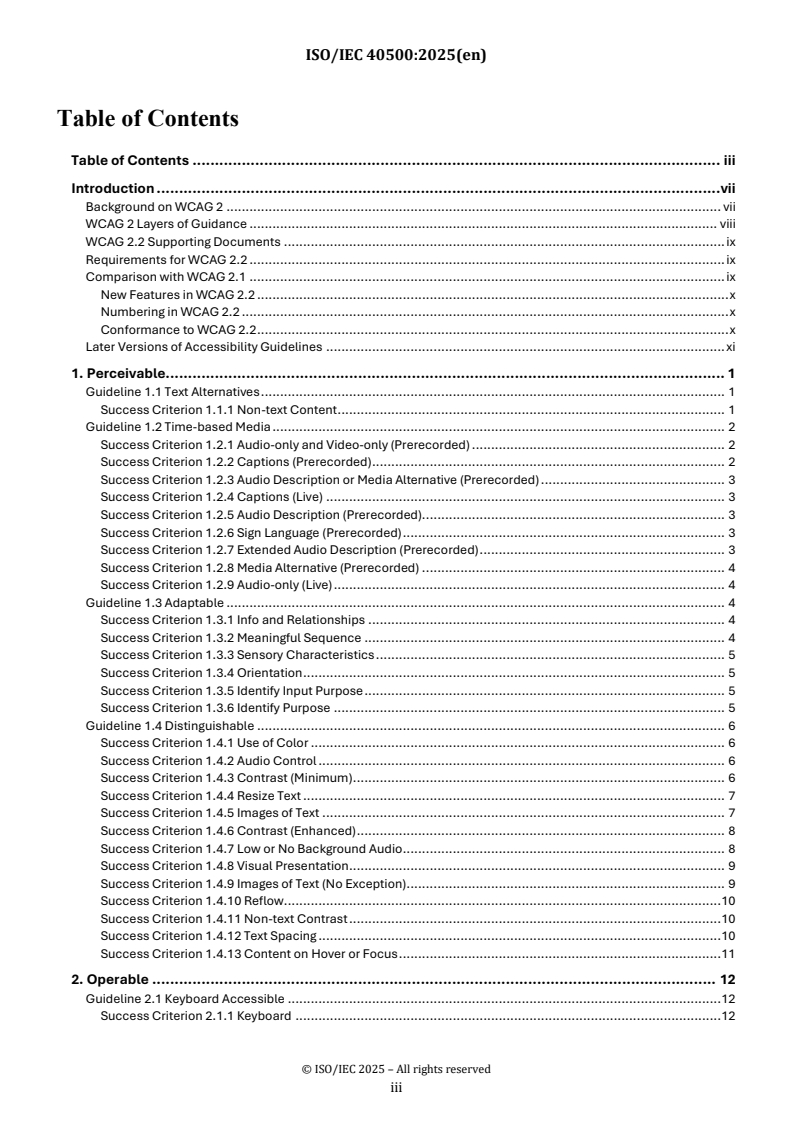
Table of Contents
Table of Contents . iii
Introduction . vii
Background on WCAG 2 . vii
WCAG 2 Layers of Guidance . viii
WCAG 2.2 Supporting Documents . ix
Requirements for WCAG 2.2 . ix
Comparison with WCAG 2.1 . ix
New Features in WCAG 2.2 . x
Numbering in WCAG 2.2 . x
Conformance to WCAG 2.2 . x
Later Versions of Accessibility Guidelines . xi
1. Perceivable. 1
Guideline 1.1 Text Alternatives . 1
Success Criterion 1.1.1 Non-text Content . 1
Guideline 1.2 Time-based Media . 2
Success Criterion 1.2.1 Audio-only and Video-only (Prerecorded) . 2
Success Criterion 1.2.2 Captions (Prerecorded) . 2
Success Criterion 1.2.3 Audio Description or Media Alternative (Prerecorded) . 3
Success Criterion 1.2.4 Captions (Live) . 3
Success Criterion 1.2.5 Audio Description (Prerecorded). 3
Success Criterion 1.2.6 Sign Language (Prerecorded) . 3
Success Criterion 1.2.7 Extended Audio Description (Prerecorded) . 3
Success Criterion 1.2.8 Media Alternative (Prerecorded) . 4
Success Criterion 1.2.9 Audio-only (Live) . 4
Guideline 1.3 Adaptable . 4
Success Criterion 1.3.1 Info and Relationships . 4
Success Criterion 1.3.2 Meaningful Sequence . 4
Success Criterion 1.3.3 Sensory Characteristics . 5
Success Criterion 1.3.4 Orientation . 5
Success Criterion 1.3.5 Identify Input Purpose . 5
Success Criterion 1.3.6 Identify Purpose . 5
Guideline 1.4 Distinguishable . 6
Success Criterion 1.4.1 Use of Color . 6
Success Criterion 1.4.2 Audio Control . 6
Success Criterion 1.4.3 Contrast (Minimum) . 6
Success Criterion 1.4.4 Resize Text . 7
Success Criterion 1.4.5 Images of Text . 7
Success Criterion 1.4.6 Contrast (Enhanced) . 8
Success Criterion 1.4.7 Low or No Background Audio . 8
Success Criterion 1.4.8 Visual Presentation . 9
Success Criterion 1.4.9 Images of Text (No Exception) . 9
Success Criterion 1.4.10 Reflow. 10
Success Criterion 1.4.11 Non-text Contrast . 10
Success Criterion 1.4.12 Text Spacing . 10
Success Criterion 1.4.13 Content on Hover or Focus . 11
2. Operable . 12
Guideline 2.1 Keyboard Accessible . 12
Success Criterion 2.1.1 Keyboard . 12
© ISO/IEC 2025 – All rights reserved
iii
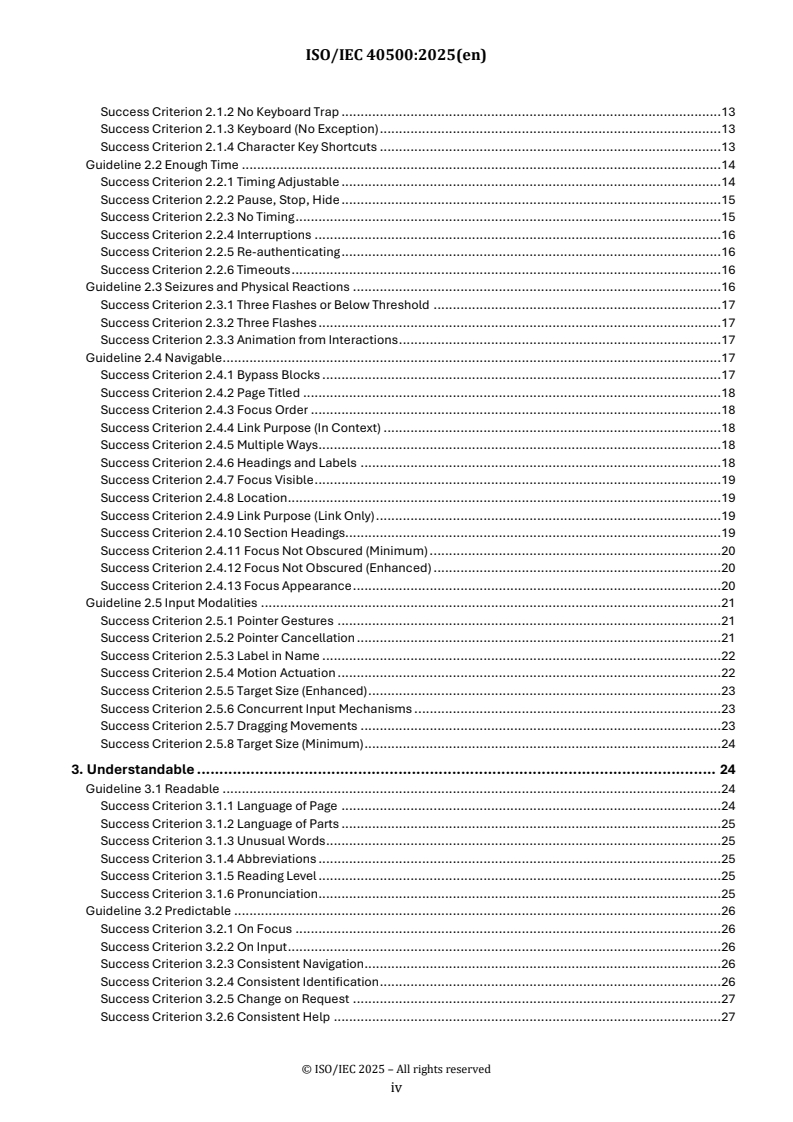
Success Criterion 2.1.2 No Keyboard Trap . 13
Success Criterion 2.1.3 Keyboard (No Exception) . 13
Success Criterion 2.1.4 Character Key Shortcuts . 13
Guideline 2.2 Enough Time . 14
Success Criterion 2.2.1 Timing Adjustable . 14
Success Criterion 2.2.2 Pause, Stop, Hide . 15
Success Criterion 2.2.3 No Timing . 15
Success Criterion 2.2.4 Interruptions . 16
Success Criterion 2.2.5 Re-authenticating . 16
Success Criterion 2.2.6 Timeouts . 16
Guideline 2.3 Seizures and Physical Reactions . 16
Success Criterion 2.3.1 Three Flashes or Below Threshold . 17
Success Criterion 2.3.2 Three Flashes . 17
Success Criterion 2.3.3 Animation from Interactions . 17
Guideline 2.4 Navigable . 17
Success Criterion 2.4.1 Bypass Blocks . 17
Success Criterion 2.4.2 Page Titled . 18
Success Criterion 2.4.3 Focus Order . 18
Success Criterion 2.4.4 Link Purpose (In Context) . 18
Success Criterion 2.4.5 Multiple Ways . 18
Success Criterion 2.4.6 Headings and Labels . 18
Success Criterion 2.4.7 Focus Visible . 19
Success Criterion 2.4.8 Location . 19
Success Criterion 2.4.9 Link Purpose (Link Only) . 19
Success Criterion 2.4.10 Section Headings. 19
Success Criterion 2.4.11 Focus Not Obscured (Minimum) . 20
Success Criterion 2.4.12 Focus Not Obscured (Enhanced) . 20
Success Criterion 2.4.13 Focus Appearance . 20
Guideline 2.5 Input Modalities . 21
Success Criterion 2.5.1 Pointer Gestures . 21
Success Criterion 2.5.2 Pointer Cancellation . 21
Success Criterion 2.5.3 Label in Name . 22
Success Criterion 2.5.4 Motion Actuation . 22
Success Criterion 2.5.5 Target Size (Enhanced) . 23
Success Criterion 2.5.6 Concurrent Input Mechanisms . 23
Success Criterion 2.5.7 Dragging Movements . 23
Success Criterion 2.5.8 Target Size (Minimum) . 24
3. Understandable . 24
Guideline 3.1 Readable . 24
Success Criterion 3.1.1 Language of Page . 24
Success Criterion 3.1.2 Language of Parts . 25
Success Criterion 3.1.3 Unusual Words . 25
Success Criterion 3.1.4 Abbreviations . 25
Success Criterion 3.1.5 Reading Level . 25
Success Criterion 3.1.6 Pronunciation . 25
Guideline 3.2 Predictable . 26
Success Criterion 3.2.1 On Focus . 26
Success Criterion 3.2.2 On Input . 26
Success Criterion 3.2.3 Consistent Navigation. 26
Success Criterion 3.2.4 Consistent Identification . 26
Success Criterion 3.2.5 Change on Request . 27
Success Criterion 3.2.6 Consistent Help . 27
© ISO/IEC 2025 – All rights reserved
iv
Guideline 3.3 Input Assistance . 27
Success Criterion 3.3.1 Error Identification . 28
Success Criterion 3.3.2 Labels or Instructions . 28
Success Criterion 3.3.3 Error Suggestion . 28
Success Criterion 3.3.4 Error Prevention (Legal, Financial, Data) . 28
Success Criterion 3.3.5 Help. 29
Success Criterion 3.3.6 Error Prevention (All) . 29
Success Criterion 3.3.7 Redundant Entry . 29
Success Criterion 3.3.8 Accessible Authentication (Minimum) . 30
Success Criterion 3.3.9 Accessible Authentication (Enhanced). 30
4. Robust. 31
Guideline 4.1 Compatible . 31
Success Criterion 4.1.1 Parsing (Obsolete and removed) . 31
Success Criterion 4.1.2 Name, Role, Value . 31
Success Criterion 4.1.3 Status Messages . 31
5. Conformance . 32
5.1 Interpreting Normative Requirements . 32
5.2 Conformance Requirements . 32
5.2.1 Conformance Level . 32
5.2.2 Full pages . 33
5.2.3 Complete processes . 33
5.2.4 Only Accessibility-Supported Ways of Using Technologies . 33
5.2.5 Non-Interference . 33
5.3 Conformance Claims (Optional) . 34
5.3.1 Required Components of a Conformance Claim . 34
5.3.2 Optional Components of a Conformance Claim . 35
5.4 Statement of Partial Conformance - Third Party Content . 35
5.5 Statement of Partial Conformance - Language . 36
5.6 Privacy Considerations . 36
5.7 Security Considerations . 36
6. Glossary . 37
7. Input Purposes for User Interface Components . 65
A. Change Log . 67
B. Acknowledgments . 68
B.1 Participants of the AG WG active in the development of this document: . 68
B.2 Other previously active WCAG WG participants and other contributors to WCAG 2.0, WCAG 2.1, or supporting
resources . 70
B.3 Enabling funders . 71
C. References . 71
C.1 Informative references . 71
© ISO/IEC 2025 – All rights reserved
v
Foreword
ISO (the International Organization for Standardization) and IEC (the International Electrotechnical
Commission) form the specialized system for worldwide standardization. National bodies that are members
of ISO or IEC participate in the development of International Standards through technical committees
established by the respective organization to deal with particular fields of technical activity. ISO and IEC
technical committees collaborate in fields of mutual interest. Other international organizations, governmental
and non-governmental, in liaison with ISO and IEC, also take part in the work.
The procedures used to develop this document and those intended for its further maintenance are described
in the ISO/IEC Directives, Part 1. In particular, the different approval criteria needed for the different types of
).
document should be noted (see www.iso.org/directives or www.iec.ch/members_experts/refdocs
ISO and IEC draw attention to the possibility that the implementation of this document may involve the use of
(a) patent(s). ISO and IEC take no position concerning the evidence, validity or applicability of any claimed
patent rights in respect thereof. As of the date of publication of this document, ISO and IEC had not received
notice of (a) patent(s) which may be required to implement this document. However, implementers are
cautioned that this may not represent the latest information, which may be obtained from the patent database
available at www.iso.org/patents and https://patents.iec.ch. ISO and IEC shall not be held responsible for
identifying any or all such patent rights.
Any trade name used in this document is information given for the convenience of users and does not
constitute an endorsement.
For an explanation of the voluntary nature of standards, the meaning of ISO specific terms and expressions
related to conformity assessment, as well as information about ISO's adherence to the World Trade
Organization (WTO) principles in the Technical Barriers to Trade (TBT), see www.iso.org/iso/foreword.html.
In the IEC, see www.iec.ch/understanding-standards.
This document was prepared by W3C (as WCAG 2.2) and drafted in accordance with its editorial rules. It was
adopted, under the JTC 1 PAS procedure, by Joint Technical Committee ISO/IEC JTC 1, Information technology.
This second edition cancels and replaces the first edition (ISO/IEC 40500:2012), which has been technically
revised.
The main changes are as follows:
— see the full commit history to WCAG 2.2.
Any feedback or questions on this document should be directed to the user’s national standards body. A
complete listing of these bodies can be found at www.iso.org/members.html and www.iec.ch/national-
committees.
© ISO/IEC 2025 – All rights reserved
vi
Introduction
This section is non-normative.
Background on WCAG 2
Web Content Accessibility Guidelines (WCAG) 2.2 defines how to make Web content more accessible to
people with disabilities. Accessibility involves a wide range of disabilities, including visual, auditory,
physical, speech, cognitive, language, learning, and neurological disabilities. Although these guidelines
cover a wide range of issues, they are not able to address the needs of people with all types, degrees, and
combinations of disability. These guidelines also make Web content more usable by older individuals
with changing abilities due to aging and often improve usability for users in general.
WCAG 2.2 is developed through the W3C process in cooperation with individuals and organizations
around the world, with a goal of providing a shared standard for Web content accessibility that meets the
needs of individuals, organizations, and governments internationally. WCAG 2.2 builds on WCAG 2.0
[WCAG20] and WCAG 2.1 [WCAG21], which in turn built on WCAG 1.0 [WAI-WEBCONTENT] and is
designed to apply broadly to different Web technologies now and in the future, and to be testable with a
combination of automated testing and human evaluation. For an introduction to WCAG, see the Web
Content Accessibility Guidelines (WCAG) Overview.
Significant challenges were encountered in defining additional criteria to address cognitive, language, and
learning disabilities, including a short timeline for development as well as challenges in reaching
consensus on testability, implementability, and international considerations of proposals. Work will carry
on in this area in future versions of WCAG. We encourage authors to refer to our supplemental guidance
on improving inclusion for people with disabilities, including learning and cognitive disabilities, people
with low-vision, and more.
Web accessibility depends not only on accessible content but also on accessible Web browsers and other
user agents. Authoring tools also have an important role in Web accessibility. For an overview of how
these components of Web development and interaction work together, see:
● Essential Components of Web Accessibility
● User Agent Accessibility Guidelines (UAAG) Overview
● Authoring Tool Accessibility Guidelines (ATAG) Overview
Where this document refers to WCAG 2 it is intended to mean any and all versions of WCAG that start
with 2.
© ISO/IEC 2025 – All rights reserved
vii
WCAG 2 Layers of Guidance
The individuals and organizations that use WCAG vary widely and include Web designers and
developers, policy makers, purchasing agents, teachers, and students. In order to meet the varying needs
of this audience, several layers of guidance are provided including overall principles, general guidelines,
testable success criteria and a rich collection of sufficient techniques, advisory techniques, and
documented common failures with examples, resource links and code.
● Principles - At the top are four principles that provide the foundation for Web accessibility:
perceivable, operable, understandable, and robust. See also Understanding the Four Principles of
Accessibility.
● Guidelines - Under the principles are guidelines. The 13 guidelines provide the basic goals that
authors should work toward in order to make content more accessible to users with different
disabilities. The guidelines are not testable, but provide the framework and overall objectives to
help authors understand the success criteria and better implement the techniques.
● Success Criteria - For each guideline, testable success criteria are provided to allow WCAG 2.2
to be used where requirements and conformance testing are necessary such as in design
specification, purchasing, regulation, and contractual agreements. In order to meet the needs of
different groups and different situations, three levels of conformance are defined: A (lowest), AA,
and AAA (highest). Additional information on WCAG levels can be found in Understanding
Levels of Conformance.
● Sufficient and Advisory Techniques - For each of the guidelines and success criteria in the
WCAG 2.2 document itself, the working group has also documented a wide variety of techniques.
The techniques are informative and fall into two categories: those that are sufficient for meeting
the success criteria and those that are advisory. The advisory techniques go beyond what is
required by the individual success criteria and allow authors to better address the guidelines. Some
advisory techniques address accessibility barriers that are not covered by the testable success
criteria. Where common failures are known, these are also documented. See also Sufficient and
Advisory Techniques in Understanding WCAG 2.2.
All of these layers of guidance (principles, guidelines, success criteria, and sufficient and advisory
techniques) work together to provide guidance on how to make content more accessible. Authors are
encouraged to view and apply all layers that they are able to, including the advisory techniques, in order
to best address the needs of the widest possible range of users.
Note that even content that conforms at the highest level (AAA) will not be accessible to individuals with
all types, degrees, or combinations of disability, particularly in the cognitive, language, and learning
areas. Authors are encouraged to consider the full range of techniques, including the advisory techniques,
Making Content Usable for People with Cognitive and Learning Disabilities, as well as to seek relevant
advice about current best practice to ensure that Web content is accessible, as far as possible, to this
community. Metadata may assist users in finding content most suitable for their needs.
© ISO/IEC 2025 – All rights reserved
viii
WCAG 2.2 Supporting Documents
The WCAG 2.2 document is designed to meet the needs of those who need a stable, referenceable
technical standard. Other documents, called supporting documents, are based on the WCAG 2.2
document and address other important purposes, including the ability to be updated to describe how
WCAG would be applied with new technologies. Supporting documents include:
1. How to Meet WCAG 2.2 - A customizable quick reference to WCAG 2.2 that includes all of the
guidelines, success criteria, and techniques for authors to use as they are developing and
evaluating Web content. This includes content from WCAG 2.0, 2.1 2.2 and can be filtered in
many ways to help authors focus on relevant content.
2. Understanding WCAG 2.2 - A guide to understanding and implementing WCAG 2.2. There is a
short "Understanding" document for each guideline and success criterion in WCAG 2.2 as well as
key topics.
3. Techniques for WCAG 2.2 - A collection of techniques and common failures, each in a separate
document that includes a description, examples, code and tests.
4. The WCAG 2 Documents - A brief introduction to the WCAG 2 supporting documents and
supplemental guidance.
5. What's New in WCAG 2.2 introduces the new success criteria with persona quotes that illustrate
the accessibility issues.
See Web Content Accessibility Guidelines (WCAG) Overview for a description of the WCAG 2.2
supporting material, including education resources related to WCAG 2. Additional resources covering
topics such as the business case for Web accessibility, planning implementation to improve the
accessibility of Web sites, and accessibility policies are listed in WAI Resources.
Requirements for WCAG 2.2
WCAG 2.2 meets a set of requirements for WCAG 2.2 which, in turn, inherit requirements from previous
WCAG 2 versions. Requirements structure the overall framework of guidelines and ensure backwards
compatibility. The Working Group also used a less formal set of acceptance criteria for success criteria, to
help ensure success criteria are similar in style and quality to those in WCAG 2.0. These requirements
constrained what could be included in WCAG 2.2. This constraint was important to preserve its nature as
a dot-release of WCAG 2.
Comparison with WCAG 2.1
WCAG 2.2 was initiated with the goal to continue the work of WCAG 2.1: Improving accessibility
guidance for three major groups: users with cognitive or learning disabilities, users with low vision, and
users with disabilities on mobile devices. Many ways to meet these needs were proposed and evaluated,
and a set of these were refined by the Working Group. Structural requirements inherited from WCAG 2.0,
clarity and impact of proposals, and timeline led to the final set of success criteria included in this
version. The Working Group considers that WCAG 2.2 incrementally advances web content accessibility
guidance for all these areas, but underscores that not all user needs are met by these guidelines.
WCAG 2.2 builds on and is backwards compatible with WCAG 2.1, meaning web pages that conform to
WCAG 2.2 are at least as accessible as pages that conform to WCAG 2.1. Requirements have been added
that build on 2.1 and 2.0. WCAG 2.2 has removed one success criterion, 4.1.1 Parsing. Authors that are
required by policy to conform with WCAG 2.0 or 2.1 will be able to update content to WCAG 2.2, but
© ISO/IEC 2025 – All rights reserved
ix
may need to continue to test and report 4.1.1. Authors following more than one version of the guidelines
should be aware of the following additions.
New Features in WCAG 2.2
WCAG 2.2 extends WCAG 2.1 by adding new success criteria, definitions to support them, and
guidelines to organize the additions. This additive approach helps to make it clear that sites which
conform to WCAG 2.2 also conform to WCAG 2.1. The Accessibility Guidelines Working Group
recommends that sites adopt WCAG 2.2 as their new conformance target, even if formal obligations
mention previous versions, to provide improved accessibility and to anticipate future policy changes.
The following success criteria are new in WCAG 2.2:
● 2.4.11 Focus Not Obscured (Minimum) (AA)
● 2.4.12 Focus Not Obscured (Enhanced) (AAA)
● 2.4.13 Focus Appearance (AAA)
● 2.5.7 Dragging Movements (AA)
● 2.5.8 Target Size (Minimum) (AA)
● 3.2.6 Consistent Help (A)
● 3.3.7 Redundant Entry (A)
● 3.3.8 Accessible Authentication (Minimum) (AA)
● 3.3.9 Accessible Authentication (Enhanced) (AAA)
The new success criteria may reference new terms that have also been added to the glossary and form part
of the normative requirements of the success criteria.
WCAG 2.2 also introduces new sections detailing aspects of the specification which may impact privacy
and security.
Numbering in WCAG 2.2
In order to avoid confusion for implementers for whom backwards compatibility to WCAG 2 versions is
important, new success criteria in WCAG 2.2 have been appended to the end of the set of success criteria
within their guideline. This avoids the need to change the section number of success criteria from WCAG
2, which would be caused by inserting new success criteria between existing success criteria in the
guideline, but it means success criteria in each guideline are no longer grouped by conformance level.
The order of success criteria within each guideline does not imply information about conformance level;
only the conformance level indicator (A / AA / AAA) on the success criterion itself indicates this. The
WCAG 2.2 Quick Reference will provide a way to view success criteria grouped by conformance level,
along with many other filter and sort options.
Conformance to WCAG 2.2
WCAG 2.2 uses the same conformance model as WCAG 2.0. It is intended that sites that conform to
WCAG 2.2 also conform to WCAG 2.0 and WCAG 2.1, which means they meet the requirements of any
policies that reference WCAG 2.0 or WCAG 2.1, while also better meeting the needs of users on the
current Web.
© ISO/IEC 2025 – All rights reserved
x
Later Versions of Accessibility Guidelines
In parallel with WCAG 2.2, the Accessibility Guidelines Working Group is developing another major
version of accessibility guidelines. The result of this work is expected to be a more substantial
restructuring of web accessibility guidance than would be realistic for dot-releases of WCAG 2. The work
follows a research-focused, user-centered design methodology to produce the most effective and flexible
outcome, including the roles of content authoring, user agent support, and authoring tool support. This is
a multi-year effort, so WCAG 2.2 is needed as an interim measure to provide updated web accessibility
guidance to reflect changes on the web since the publication of WCAG 2.0. The Working Group might
also develop additional interim versions, continuing with WCAG 2.2, on a similar short timeline to
provide additional support while the major version is completed.
© ISO/IEC 2025 – All rights reserved
xi
FINAL DRAFT International Standard ISO/IEC 40500:2025(en)
Information technology — W3C Web Content Accessibility
Guidelines (WCAG) 2.2
1. Perceivable
Information and user interface components must be presentable to users in ways they can perceive.
Guideline 1.1 Text Alternatives
Understanding Text Alternatives |
How to Meet Text Alternatives
Provide text alternatives for any non-text content so that it can be changed into other forms people need,
such as large print, braille, speech, symbols or simpler language.
Success Criterion 1.1.1 Non-text Content
Understanding Non-text Content |
How to Meet Non-text Content
(Level A)
All non-text content that is presented to the user has a text alternative that serves the equivalent purpose,
except for the situations listed below.
Controls, Input
If non-text content is a control or accepts user input, then it has a name that describes its purpose.
(Refer to Success Criterion 4.1.2 for additional requirements for controls and content that accepts
user input.)
Time-Based Media
If non-text content is time-based media, then text alternatives at least provide descriptive
identification of the non-text content. (Refer to Guideline 1.2 for additional requirements for
media.)
Test
If non-text content is a test or exercise that would be invalid if presented in text, then text
alternatives at least provide descriptive identification of the non-text content.
© ISO/IEC 2025 – All rights reserved
Sensory
If non-text content is primarily intended to create a specific sensory experience, then text
alternatives at least provide descriptive identification of the non-text content.
CAPTCHA
If the purpose of non-text content is to confirm that content is being accessed by a person rather
than a computer, then text alternatives that identify and describe the purpose of the non-text
content are provided, and alternative forms of CAPTCHA using output modes for different types
of sensory perception are provided to accommodate different disabilities.
Decoration, Formatting, Invisible
If non-text content is pure decoration, is used only for visual formatting, or is not presented to
users, then it is implemented in a way that it can be ignored by assistive technology.
Guideline 1.2 Time-based Media
Understanding Time-based Media |
How to Meet Time-based Media
Provide alternatives for time-based media.
Success Criterion 1.2.1 Audio-only and Video-only (Prerecorded)
Understanding Audio-only and Video-only (Prerecorded) |
How to Meet Audio-only and Video-only (Prerecorded)
(Level A)
For prerecorded audio-only and prerecorded video-only media, the following are true, except when the
audio or video is a media alternative for text and is clearly labeled as such:
Prerecorded Audio-only
An alternative for time-based media is provided that presents equivalent information for
prerecorded audio-only content.
Prerecorded Video-only
Either an alternative for time-based media or an audio track is provided that presents equivalent
information for prerecorded video-only content.
Success Criterion 1.2.2 Captions (Prerecorded)
Understanding Captions (Prerecorded) |
How to Meet Captions (Prerecorded)
(Level A)
© ISO/IEC 2025 – All rights reserved
Captions are provided for all prerecorded audio content in synchronized media, except when the media is
a media alternative for text and is clearly labeled as such.
Success Criterion 1.2.3 Audio Description or Media Alternative (Prerecorded)
Understanding Audio Description or Media Alternative (Prerecorded) |
How to Meet Audio Description or Media Alternative (Prerecorded)
(Level A)
An alternative for time-based media or audio description of the prerecorded video content is provided for
synchronized media, except when the media is a media alternative for text and is clearly labeled as such.
Success Criterion 1.2.4 Captions (Live)
Understanding Captions (Live) |
How to Meet Captions (Live)
(Level AA)
Captions are provided for all live audio content in synchronized media.
Success Criterion 1.2.5 Audio Description (Prerecorded)
Understanding Audio Description (Prerecorded) |
How to Meet Audio Description (Prerecorded)
(Level AA)
Audio description is provided for all prerecorded video content in synchronized media.
Success Criterion 1.2.6 Sign Language (Prerecorded)
Understanding Sign Language (Prerecorded) |
How to Meet Sign Language (Prerecorded)
(Level AAA)
Sign language interpretation is provided for all prerecorded audio content in synchronized media.
Success Criterion 1.2.7 Extended Audio Description (Prerecorded)
Understanding Extended Audio Description (Prerecorded) |
How to Meet Extended Audio Description (Prerecorded)
(Level AAA)
Where pauses in foreground audio are insufficient to allow audio descriptions to convey the sense of the
video, extended audio description is provided for all prerecorded video content in synchronized media.
© ISO/IEC 2025 – All rights reserved
Success Criterion 1.2.8 Media Alternative (Prerecorded)
Understanding Media Alternative (Prerecorded) |
How to Meet Media Alternative (Prerecorded)
(Level AAA)
An alternative for time-based media is provided for all prerecorded synchronized media and for all
prerecorded video-only media.
Success Criterion 1.2.9 Audio-only (Live)
Understanding Audio-only (Live) |
How to Meet Audio-only (Live)
(Level AAA)
An alternative for time-based media that presents equivalent information for live audio-only content is
provided.
Guideline 1.3 Adaptable
Understanding Adaptable |
How to Meet Adaptable
Create content that can be presented in different ways (for example simpler layout) without losing
information or structure.
Success Criterion 1.3.1 Info and Relationships
Understanding Info and Relationships |
How to Meet Info and Relationships
(Level A)
Information, structure, and relationships conveyed through presentation can be programmatically
determined or are available in text.
Success Criterion 1.3.2 Meaningful Sequence
Understanding Meaningful Sequence |
How to Meet Meaningful Sequence
(Level A)
When the sequence in which content is presented affects its meaning, a correct reading sequence can be
programmatically determined.
© ISO/IEC 2025 – All rights reserved
Success Criterion 1.3.3 Sensory Characteristics
Understanding Sensory Characteristics |
How to Meet Sensory Characteristics
(Level
...
Questions, Comments and Discussion
Ask us and Technical Secretary will try to provide an answer. You can facilitate discussion about the standard in here.
Loading comments...