


ISO/IEC 19500-1:2012
(Main)Information technology — Object Management Group — Common Object Request Broker Architecture (CORBA) — Part 1: Interfaces
Information technology — Object Management Group — Common Object Request Broker Architecture (CORBA) — Part 1: Interfaces
ISO/IEC 19500-1:2012 specifies the CORBA Object Model and uses concepts from that model to define the operation of the Object Request Broker (ORB). The ORB is the basic mechanism by which objects transparently make requests to, and receive responses from, each other on the same machine or across a network. A client need not be aware of the mechanisms used to communicate with or activate an object, how the object is implemented, or where the object is located.
Technologies de l'information — OMG (Object Management Group) — CORBA (Common Object Request Broker Architecture) — Partie 1: Interfaces
General Information
- Status
- Published
- Publication Date
- 19-Apr-2012
- Technical Committee
- ISO/IEC JTC 1 - Information technology
- Drafting Committee
- ISO/IEC JTC 1 - Information technology
- Current Stage
- 9093 - International Standard confirmed
- Start Date
- 13-Feb-2025
- Completion Date
- 14-Feb-2026
Overview
ISO/IEC 19500-1:2012 defines the CORBA (Common Object Request Broker Architecture) Object Model and the core behaviour of the Object Request Broker (ORB). The standard specifies how objects make transparent requests of one another and receive responses whether they run on the same machine or across a network. It emphasizes interface-based interaction, location and implementation transparency, and mechanisms that let clients invoke services without knowing how or where those services are provided.
Key Topics and Requirements
- CORBA Object Model: Defines the conceptual model for objects, interfaces and their relationships used by CORBA-compliant systems.
- ORB operation: Describes the ORB as the fundamental mechanism that routes requests between clients and objects and manages request/response semantics.
- Interface-driven interaction: Specifies how object interfaces are exposed and consumed to enable decoupled, interoperable communication.
- Transparency requirements: Covers location transparency (clients need not know object location), implementation transparency (clients need not know how objects are implemented) and activation/communication transparency.
- Communication semantics: Establishes the expectations for request invocation, response handling and the orchestration of distributed object interactions.
- Interoperability and portability: Sets a baseline for different implementations to interoperate in heterogeneous environments.
Practical Applications
ISO/IEC 19500-1:2012 is applicable where robust, standardized distributed object interaction is required:
- Enterprise middleware and legacy systems that rely on standardized remote invocation patterns.
- Systems requiring interoperability across diverse platforms, languages and vendor ORBs.
- Distributed applications where location and implementation transparency simplify client code and deployment.
- Integration projects that need well-defined interface contracts to connect disparate software components.
Who Would Use This Standard
- Software architects and system integrators designing distributed systems and middleware.
- Middleware and platform vendors implementing ORB functionality or CORBA-compliant products.
- Enterprise IT teams maintaining legacy CORBA-based systems that require standard-conformant behaviour.
- Technical leads evaluating standards for cross-language, cross-platform interoperability.
Related Standards
- Other parts of the ISO/IEC 19500 series and corresponding Object Management Group (OMG) CORBA specifications that extend the architecture for additional services and mappings.
- Industry middleware and interoperability specifications that rely on standard object models and ORB semantics.
Keywords: ISO/IEC 19500-1:2012, CORBA, Object Request Broker, ORB, object model, interfaces, distributed systems, interoperability, location transparency, remote invocation.
Buy Documents



ISO/IEC 19500-1:2012 - Information technology -- Object Management Group -- Common Object Request Broker Architecture (CORBA)



ISO/IEC 19500-1:2012 - Information technology -- Object Management Group -- Common Object Request Broker Architecture (CORBA)
Get Certified
Connect with accredited certification bodies for this standard

BSI Group
BSI (British Standards Institution) is the business standards company that helps organizations make excellence a habit.

BSCIC Certifications Pvt. Ltd.
Established 2006, accredited by NABCB, JAS-ANZ, EIAC, IAS. CDSCO Notified Body.

Intertek India Pvt. Ltd.
Delivers Assurance, Testing, Inspection & Certification since 1993 with 26 labs and 32 offices.
Sponsored listings
Frequently Asked Questions
ISO/IEC 19500-1:2012 is a standard published by the International Organization for Standardization (ISO). Its full title is "Information technology — Object Management Group — Common Object Request Broker Architecture (CORBA) — Part 1: Interfaces". This standard covers: ISO/IEC 19500-1:2012 specifies the CORBA Object Model and uses concepts from that model to define the operation of the Object Request Broker (ORB). The ORB is the basic mechanism by which objects transparently make requests to, and receive responses from, each other on the same machine or across a network. A client need not be aware of the mechanisms used to communicate with or activate an object, how the object is implemented, or where the object is located.
ISO/IEC 19500-1:2012 specifies the CORBA Object Model and uses concepts from that model to define the operation of the Object Request Broker (ORB). The ORB is the basic mechanism by which objects transparently make requests to, and receive responses from, each other on the same machine or across a network. A client need not be aware of the mechanisms used to communicate with or activate an object, how the object is implemented, or where the object is located.
ISO/IEC 19500-1:2012 is classified under the following ICS (International Classification for Standards) categories: 35.080 - Software. The ICS classification helps identify the subject area and facilitates finding related standards.
ISO/IEC 19500-1:2012 is available in PDF format for immediate download after purchase. The document can be added to your cart and obtained through the secure checkout process. Digital delivery ensures instant access to the complete standard document.
Standards Content (Sample)
INTERNATIONAL ISO/IEC
STANDARD 19500-1
First edition
2012-04-15
Information technology — Object
Management Group — Common Object
Request Broker Architecture (CORBA) —
Part 1:
Interfaces
Technologies de l'information — OMG (Object Management Group) —
CORBA (Common Object Request Broker Architecture) —
Partie 1: Interfaces
Reference number
©
ISO/IEC 2012
This CD-ROM contains the publication ISO/IEC 19500-1:2012 in portable document format (PDF), which can
be viewed using Adobe® Acrobat® Reader.
Adobe and Acrobat are trademarks of Adobe Systems Incorporated.
© ISO/IEC 2012
All rights reserved. Unless required for installation or otherwise specified, no part of this CD-ROM may be reproduced, stored in a retrieval
system or transmitted in any form or by any means without prior permission from ISO. Requests for permission to reproduce this product
should be addressed to
ISO copyright office Case postale 56 CH-1211 Geneva 20 Switzerland
Internet copyright@iso.org
Reproduction may be subject to royalty payments or a licensing agreement.
Violators may be prosecuted.
Published in Switzerland
ii © ISO/IEC 2012 – All rights reserved
Installation
If this publication has been packaged as a zipped file, do NOT open the file from the CD-ROM, but copy it to
the desired location in your local enviro
...
INTERNATIONAL ISO/IEC
STANDARD 19500-1
First edition
2012-04-15
Information technology — Object
Management Group — Common Object
Request Broker Architecture (CORBA) —
Part 1:
Interfaces
Technologies de l'information — OMG (Object Management Group) —
CORBA (Common Object Request Broker Architecture) —
Partie 1: Interfaces
Reference number
©
ISO/IEC 2012
© ISO/IEC 2012
All rights reserved. Unless otherwise specified, no part of this publication may be reproduced or utilized in any form or by any means,
electronic or mechanical, including photocopying and microfilm, without permission in writing from either ISO at the address below or
ISO's member body in the country of the requester.
ISO copyright office
Case postale 56 CH-1211 Geneva 20
Tel. + 41 22 749 01 11
Fax + 41 22 749 09 47
E-mail copyright@iso.org
Web www.iso.org
Published in Switzerland
ii © ISO/IEC 2012 – All rights reserved
Table of Contents
Foreword .xvii
Introduction .xix
1 Scope . 1
2 Conformance and Compliance . 1
3 Normative References . 1
4 Additional Information . 2
4.1 Outline of Contents. 2
4.2 Keywords for Requirement Statements. 3
5 The Object Model . 5
5.1 General. 5
5.2 Overview. 5
5.3 Object Semantics . 6
5.3.1 Objects .6
5.3.2 Requests .6
5.3.3 Object Creation and Destruction .7
5.3.4 Types .7
5.3.5 Interfaces .8
5.3.6 Value Types .9
5.3.7 Abstract Interfaces .9
5.3.8 Operations .9
5.3.9 Attributes .11
5.4 Object Implementation. 11
5.4.1 The Execution Model: Performing Services .11
5.4.2 The Construction Model .12
6 CORBA Overview . 13
6.1 General. 13
© ISO/IEC 2012 - All rights reserved iii
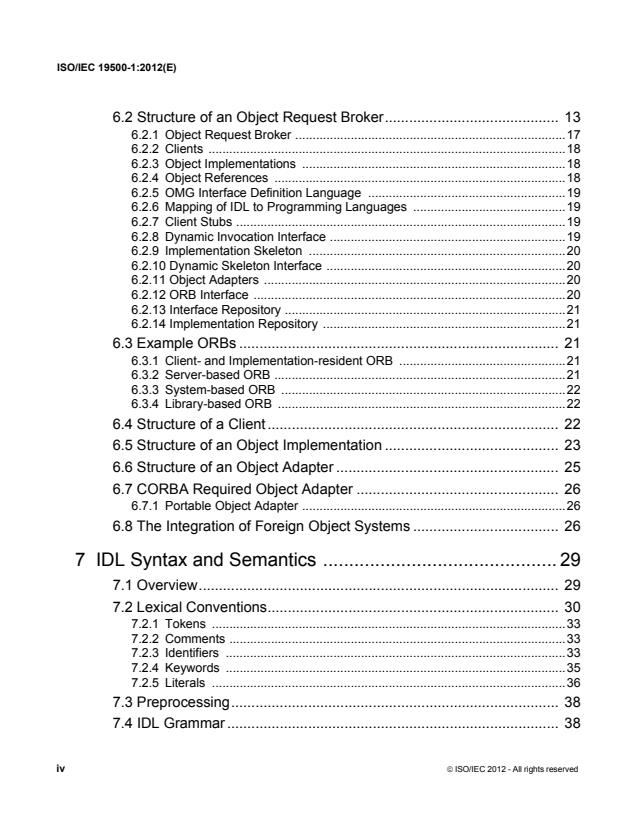
6.2 Structure of an Object Request Broker. 13
6.2.1 Object Request Broker .17
6.2.2 Clients .18
6.2.3 Object Implementations .18
6.2.4 Object References .18
6.2.5 OMG Interface Definition Language .19
6.2.6 Mapping of IDL to Programming Languages .19
6.2.7 Client Stubs .19
6.2.8 Dynamic Invocation Interface .19
6.2.9 Implementation Skeleton .20
6.2.10 Dynamic Skeleton Interface .20
6.2.11 Object Adapters .20
6.2.12 ORB Interface .20
6.2.13 Interface Repository .21
6.2.14 Implementation Repository .21
6.3 Example ORBs . 21
6.3.1 Client- and Implementation-resident ORB .21
6.3.2 Server-based ORB .21
6.3.3 System-based ORB .22
6.3.4 Library-based ORB .22
6.4 Structure of a Client. 22
6.5 Structure of an Object Implementation . 23
6.6 Structure of an Object Adapter . 25
6.7 CORBA Required Object Adapter . 26
6.7.1 Portable Object Adapter .26
6.8 The Integration of Foreign Object Systems . 26
7 IDL Syntax and Semantics . 29
7.1 Overview. 29
7.2 Lexical Conventions. 30
7.2.1 Tokens .33
7.2.2 Comments .33
7.2.3 Identifiers .33
7.2.4 Keywords .35
7.2.5 Literals .36
7.3 Preprocessing. 38
7.4 IDL Grammar. 38
iv © ISO/IEC 2012 - All rights reserved
7.5 IDL Specification. 45
7.6 Import Declaration . 45
7.7 Module Declaration. 46
7.8 Interface Declaration . 47
7.8.1 Interface Header .47
7.8.2 Interface Inheritance Specification .47
7.8.3 Interface Body .48
7.8.4 Forward Declaration .48
7.8.5 Interface Inheritance .49
7.8.6 Abstract Interface .51
7.8.7 Local Interface .51
7.9 Value Declaration . 52
7.9.1 Regular Value Type .52
7.9.2 Boxed Value Type .54
7.9.3 Abstract Value Type .55
7.9.4 Value Forward Declaration .55
7.9.5 Valuetype Inheritance .55
7.10 Constant Declaration . 57
7.10.1 Syntax .57
7.10.2 Semantics .58
7.11 Type Declaration . 61
7.11.1 Basic Types .62
7.11.2 Constructed Types .64
7.11.3 Template Types .68
7.11.4 Complex Declarator .69
7.11.5 Native Types .69
7.11.6 Deprecated Anonymous Types .70
7.12 Exception Declaration. 73
7.13 Operation Declaration. 73
7.13.1 Operation Attribute .74
7.13.2 Parameter Declarations .74
7.13.3 Raises Expressions .74
7.13.4 Context Expressions .75
7.14 Attribute Declaration . 76
7.15 Repository Identity Related Declarations . 77
7.15.1 Repository Identity Declaration .77
7.15.2 Repository Identifier Prefix Declaration .78
7.15.3 Repository Id Conflict .79
© ISO/IEC 2012 - All rights reserved v
7.16 Event Declaration . 79
7.16.1 Regular Event Type .79
7.16.2 Abstract Event Type .80
7.16.3 Event Forward Declaration .80
7.16.4 Eventtype Inheritance .80
7.17 Component Declaration. 80
7.17.1 Component .80
7.17.2 Component Header .81
7.17.3 Component Body .82
7.17.4 Event Sources—publishers and emitters .84
7.17.5 Event Sinks .84
7.17.6 Basic and Extended Components .85
7.18 Home Declaration. 85
7.18.1 Home .85
7.18.2 Home Header .86
7.18.3 Home Body .87
7.19 CORBA Module . 88
7.20 Names and Scoping . 89
7.20.1 Qualified Names .89
7.20.2 Scoping Rules and Name Resolution .90
7.20.3 Special Scoping Rules for Type Names .93
8 ORB Interface . 95
8.1 Overview. 95
8.2 The ORB Operations . 95
8.2.1 ORB Identity .101
8.2.2 Converting Object References to Strings .101
8.2.3 Getting Service Information .102
8.2.4 Creating a New Context .102
8.2.5 Thread-Related Operations .102
8.3 Object Reference Operations . 105
8.3.1 Determining the Object Interface .107
8.3.2 Duplicating and Releasing Copies of Object References .107
8.3.3 Nil Object References .107
8.3.4 Equivalence Checking Operation .108
8.3.5 Probing for Object Non-Existence .108
8.3.6 Object Reference Identity .108
8.3.7 Type Coercion Considerations .110
8.3.8 Getting Policy Associated with the Object .110
vi © ISO/IEC 2012 - All rights reserved
8.3.9 Overriding Associated Policies on an Object Reference .111
8.3.10 Validating Connection .112
8.3.11 Getting the Domain Managers Associated with the Object .112
8.3.12 Getting Component Associated with the Object .113
8.3.13 Getting the ORB .113
8.3.14 LocalObject Operations .113
8.4 ValueBase Operations. 114
8.5 ORB and OA Initialization and Initial References . 115
8.5.1 ORB Initialization .115
8.5.2 Obtaining Initial Object References .117
8.5.3 Configuring Initial Service References . 120
8.6 Context Object. 122
8.6.1 Introduction .122
8.6.2 Context Object Operations .122
8.7 Current Object . 125
8.8 Policy Object. 126
8.8.1 Definition of Policy Object .126
8.8.2 Creation of Policy Objects .127
8.8.3 Usages of Policy Objects .129
8.8.4 Policy Associated with the Execution Environment .129
8.8.5 Specification of New Policy Objects .130
8.8.6 Standard Policies .131
8.9 Management of Policies . 131
8.9.1 Client Side Policy Management .131
8.9.2 Server Side Policy Management .132
8.9.3 Policy Management Interfaces .132
8.10 Management of Policy Domains. 134
8.10.1 Basic Concepts .134
8.10.2 Domain Management Operations .136
8.11 TypeCodes . 138
8.11.1 The TypeCode Interface .138
8.11.2 TypeCode Constants .142
8.11.3 Creating TypeCodes .143
8.12 Exceptions . 148
8.12.1 Definition of Terms .148
8.12.2 System Exceptions .148
8.12.3 Standard System Exception Definitions .150
8.12.4 Standard Minor Exception Codes .156
© ISO/IEC 2012 - All rights reserved vii
9 Value Type Semantics . 157
9.1 Overview. 157
9.2 Architecture. 157
9.2.1 Abstract Values .158
9.2.2 Operations .158
9.2.3 Value Type vs. Interfaces .159
9.2.4 Parameter Passing .159
9.2.5 Substitutability Issues .160
9.2.6 Widening/Narrowing .161
9.2.7 Value Base Type .161
9.2.8 Life Cycle issues .161
9.2.9 Security Considerations .162
9.3 Standard Value Box Definitions. 162
9.4 Language Mappings . 163
9.4.1 General Requirements .163
9.4.2 Language Specific Marshaling .163
9.4.3 Language Specific Value Factory Requirements .163
9.4.4 Value Method Implementation .164
9.5 Custom Marshaling. 164
9.5.1 Implementation of Custom Marshaling .164
9.5.2 Marshaling Streams .165
9.6 Access to the Sending Context Run Time. 171
10 Abstract Interface Semantics . 173
10.1 Overview. 173
10.2 Semantics of Abstract Interfaces. 173
10.3 Usage Guidelines . 174
10.4 Example. 174
10.5 Security Considerations. 175
10.5.1 Passing Values to Trusted Domains .175
11 Dynamic Invocation Interface . 177
11.1 Overview. 177
11.1.1 Common Data Structures .177
11.1.2 Memory Usage .179
11.1.3 Return Status and Exceptions .179
viii © ISO/IEC 2012 - All rights reserved
11.2 Request Operations. 179
11.2.1 create_request .180
11.2.2 add_arg .182
11.2.3 invoke .182
11.2.4 delete .183
11.2.5 send .183
11.2.6 poll_response .183
11.2.7 get_response .183
11.2.8 sendp .184
11.2.9 prepare .184
11.2.10 sendc .184
11.3 ORB Operations . 185
11.3.1 send_multiple_requests .185
11.3.2 get_next_response and poll_next_response .185
11.4 Polling. 186
11.4.1 Abstract Valuetype Pollable .187
11.4.2 Abstract Valuetype DIIPollable .188
11.4.3 interface PollableSet .188
11.5 List Operations . 189
11.5.1 create_list .190
11.5.2 add_item .190
11.5.3 free .191
11.5.4 free_memory .191
11.5.5 get_count .191
11.5.6 create_operation_list .191
12 Dynamic Skeleton Interface . 193
12.1 Introduction. 193
12.2 Overview. 193
12.3 ServerRequestPseudo-Object. 194
12.3.1 ExplicitRequest State: ServerRequestPseudo-Object .194
12.4 DSI: Language Mapping. 195
12.4.1 ServerRequest’s Handling of Operation Parameters .195
12.4.2 Registering Dynamic Implementation Routines .195
13 Dynamic Management of Any Values . 197
13.1 General. 197
13.2 Overview. 197
© ISO/IEC 2012 - All rights reserved ix
13.3 DynAny API . 198
13.3.1 Creating a DynAny Object .204
13.3.2 The DynAny Interface .206
13.3.3 The DynFixed Interface .210
13.3.4 The DynEnum Interface .210
13.3.5 The DynStruct Interface .211
13.3.6 The DynUnion Interface .212
13.3.7 The DynSequence Interface .214
13.3.8 The DynArray Interface .215
13.3.9 The DynValueCommon Interface .216
13.3.10 The DynValue Interface .216
13.3.11 The DynValueBox Interface .217
13.4 Usage in C++ Language. 218
13.4.1 Dynamic Creation of CORBA::Any values .218
13.4.2 Dynamic Interpretation of CORBA::Any values .219
14 The Interface Repository . 221
14.1 Overview. 221
14.2 Scope of an Interface Repository . 221
14.3 Implementation Dependencies . 223
14.3.1 Managing Interface Repositories .223
14.4 Basics . 224
14.4.1 Names and Identifiers .224
14.4.2 Types and TypeCodes .225
14.4.3 Interface Repository Objects .225
14.4.4 Structure and Navigation of the Interface Repository .226
14.5 Interface Repository Interfaces. 228
14.5.1 Supporting Type Definitions .229
14.5.2 IRObject .230
14.5.3 Contained .231
14.5.4 Container .233
14.5.5 IDLType .238
14.5.6 Repository .238
14.5.7 ModuleDef .240
14.5.8 ConstantDef .240
14.5.9 TypedefDef .241
14.5.10 StructDef .241
14.5.11 UnionDef .242
14.5.12 EnumDef .243
14.5.13 AliasDef .243
x © ISO/IEC 2012 - All rights reserved
14.5.14 PrimitiveDef .244
14.5.15 StringDef .244
14.5.16 WstringDef .244
14.5.17 FixedDef .245
14.5.18 SequenceDef .245
14.5.19 ArrayDef .245
14.5.20 ExceptionDef .246
14.5.21 AttributeDef .247
14.5.22 ExtAttributeDef .247
14.5.23 OperationDef .248
14.5.24 InterfaceDef .250
14.5.25 ExtInterfaceDef .252
14.5.26 AbstractInterfaceDef .253
14.5.27 ExtAbstractInterfaceDef .254
14.5.28 LocalInterfaceDef .255
14.5.29 ExtLocalInterfaceDef .256
14.5.30 ValueMemberDef .256
14.5.31 ValueDef .257
14.5.32 ExtValueDef .260
14.5.33 ValueBoxDef .262
14.5.34 NativeDef .262
14.6 Component Interface Repository Interfaces . 262
14.6.1 ComponentIR::Container .262
14.6.2 ComponentIR::Repository .264
14.6.3 ComponentIR::ProvidesDef .265
14.6.4 ComponentIR::UsesDef .265
14.6.5 ComponentIR::EventDef .266
14.6.6 ComponentIR::EventPortDef .266
14.6.7 ComponentIR::EmitsDef .267
14.6.8 ComponentIR::PublishesDef .268
14.6.9 ComponentIR::ConsumesDef .268
14.6.10 ComponentIR::ComponentDef .268
14.6.11 ComponentIR::FactoryDef .271
14.6.12 ComponentIR::FinderDef .272
14.6.13 ComponentIR::HomeDef .272
14.7 RepositoryIds. 274
14.7.1 IDL Format .275
14.7.2 RMI Hashed Format .275
14.7.3 DCE UUID Format .277
14.7.4 LOCAL Format .277
14.7.5 Pragma Directives for RepositoryId .277
14.7.6 For More Information .282
© ISO/IEC 2012 - All rights reserved xi
14.7.7 RepositoryIDs for OMG-Specified Types .282
14.7.8 Uniqueness Constraints on Repository IDs .283
14.8 IDL for Interface Repository. 284
15 The Portable Object Adapter . 303
15.1 Overview. 303
15.2 Abstract Model Description. 303
15.2.1 Model Components .303
15.2.2 Model Architecture .305
15.2.3 POA Creation .306
15.2.4 Reference Creation .307
15.2.5 Object Activation States .308
15.2.6 Request Processing .308
15.2.7 Implicit Activation .309
15.2.8 Multi-threading .310
15.2.9 Dynamic Skeleton Interface .311
15.2.10 Location Transparency .312
15.3 Interfaces. 312
15.3.1 The Servant IDL Type .313
15.3.2 POAManager Interface .314
15.3.3 POAManagerFactory Interface .318
15.3.4 AdapterActivator Interface .319
15.3.5 ServantManager Interface .320
15.3.6 ServantActivator Interface .321
15.3.7 ServantLocator Interface .323
15.3.8 POA Policy Objects .325
15.3.9 POA Interface .328
15.3.10 Current Operations .337
15.4 IDL for PortableServer Module . 338
15.5 UML Description of PortableServer . 344
15.6 Usage Scenarios . 346
15.6.1 Getting the Root POA .346
15.6.2 Creating a POA .347
15.6.3 Explicit Activation with POA-assigned Object Ids .347
15.6.4 Explicit Activation with User-assigned Object Ids .348
15.6.5 Creating References before Activation .349
15.6.6 Servant Manager Definition and Creation .349
15.6.7 Object Activation on Demand .351
15.6.8 Persistent Objects with POA-assigned Ids .352
xii © ISO/IEC 2012 - All rights reserved
15.6.9 Multiple Object Ids Mapping to a Single Servant .352
15.6.10 One Servant for All Objects .352
15.6.11 Single Servant, Many Objects and Types, Using DSI .355
16 Portable Interceptors . 359
16.1 Introduction. 359
16.1.1 Object Creation .359
16.1.2 Client Sends Request .360
16.1.3 Server Receives Request .361
16.1.4 Server Sends Reply .361
16.1.5 Client Receives Reply .362
16.2 General Behavior of Local Objects. 362
16.3 Interceptor Interface . 362
16.4 Request Interceptors . 363
16.4.1 Design Principles .363
16.4.2 General Flow Rules .364
16.4.3 The Flow Stack Visual Model .364
16.4.4 The Request Interceptor Points .365
16.4.5 Client-Side Interceptor .365
16.4.6 Client-Side Interception Points .365
16.4.7 Client-Side Interception Point Flow .367
16.4.8 Server-Side Interceptor .370
16.4.9 Server-Side Interception Points .370
16.4.10 Server-Side Interception Point Flow .372
16.4.11 Request Information .375
16.4.12 RequestInfo Interface .375
16.4.13 ClientRequestInfo Interface .379
16.4.14 ServerRequestInfo Interface .382
16.4.15 ForwardRequest Exception .386
16.5 Portable Interceptor Current . 386
16.5.1 Overview .386
16.5.2 Obtaining the Portable Interceptor Current .386
16.5.3 Portable Interceptor Current Interface .387
16.5.4 Use of Portable Interceptor Current .388
16.6 IOR Interceptor . 392
16.6.1 Overview .392
16.6.2 An Abstract Model for Object Adapters .392
16.6.3 Object Reference Template .394
16.6.4 IORInterceptor Interface .396
16.6.5 IORInfo Interface .397
© ISO/IEC 2012 - All rights reserved xiii
16.7 Interceptor Policy Objects. 400
16.7.1 ProcessingMode Policy .400
16.8 PolicyFactory . 401
16.8.1 PolicyFactory Interface .
...
Questions, Comments and Discussion
Ask us and Technical Secretary will try to provide an answer. You can facilitate discussion about the standard in here.
Loading comments...