


ISO 27145-6:2023
(Main)Road vehicles — Implementation of World-Wide Harmonized On-Board Diagnostics (WWH-OBD) communication requirements — Part 6: External test equipment
Road vehicles — Implementation of World-Wide Harmonized On-Board Diagnostics (WWH-OBD) communication requirements — Part 6: External test equipment
This document defines the requirements for the external test equipment as: — a means of establishing communications between a WWH-OBD-equipped vehicle and external test equipment; — a set of diagnostic services, including addressing methods, to be provided by the external test equipment in order to exercise the services defined in ISO 27145‑3. This document describes the minimum capabilities or functions in the external test equipment. Additional functionalities, for example, non WWH-OBD protocols or retrieval of repair and maintenance information, can be integrated into the external test equipment according to the test equipment manufacturer needs. The external test equipment designer ensures that no such capability or function can adversely affect either a WWH-OBD-equipped vehicle connected to the equipment, or the equipment itself. When the external test equipment implements functionality, which is not covered by ISO 27145‑3, this functionality is not linked to the timing requirements defined in this document.
Véhicules routiers — Mise en application des exigences de communication pour le diagnostic embarqué harmonisé à l'échelle mondiale (WWH-OBD) — Partie 6: Équipement d'essai externe
General Information
- Status
- Published
- Publication Date
- 04-May-2023
- Technical Committee
- ISO/TC 22/SC 31 - Data communication
- Drafting Committee
- ISO/TC 22/SC 31/WG 5 - Test equipment/Data eXchange Formats
- Current Stage
- 6060 - International Standard published
- Start Date
- 05-May-2023
- Due Date
- 20-Nov-2022
- Completion Date
- 05-May-2023
Relations
- Effective Date
- 26-Nov-2021
Overview - ISO 27145-6:2023 (WWH-OBD External Test Equipment)
ISO 27145-6:2023 specifies the requirements for external test equipment used to communicate with World‑Wide Harmonized On‑Board Diagnostics (WWH‑OBD) equipped vehicles. It defines the minimum capabilities and diagnostic services that external tools must provide to exercise the application‑layer services in ISO 27145‑3 (based on ISO 14229 UDS). The 2023 second edition updates and clarifies requirements (for example, cable length and wording) and ensures safe integration of optional, non‑WWH‑OBD functions without adversely affecting vehicles or equipment.
Key technical topics and requirements
- Communication architecture: Aligns services with the OSI model; maps application, presentation, session, transport, network, data link and physical layers to WWH‑OBD references (ISO 27145‑2/3/4, ISO 14229, ISO 15765, ISO 13400, ISO 11898, IEEE 802.3).
- Diagnostic services and addressing: Defines how external test equipment shall implement UDS‑based diagnostic services and addressing methods to exercise vehicle functions in ISO 27145‑3.
- Clusters of requirements: Minimum capabilities grouped into clusters such as mechanical, electrical, communication setup and connections, and diagnostic messages (including timing, negative response handling, no‑response error handling).
- ECU and DTC handling: Requirements for setting up ECU lists, reading and clearing DTCs, and organizing data information lists.
- Use‑case specific tools: Separate implementation considerations for roadside check, inspection & maintenance (I/M), and repair‑shop test equipment.
- Safety and interoperability: External functions not covered by ISO 27145‑3 must not interfere with WWH‑OBD timing requirements or vehicle safety; applicability may vary by local legislation.
- Multiple tool interactions: Behavioural rules when several test devices communicate with a vehicle.
Practical applications and who uses ISO 27145-6
- Diagnostic tool manufacturers designing external test equipment for passenger cars, commercial vehicles and heavy‑duty applications.
- Automotive OEMs and Tier‑1 suppliers validating OBD communication and interoperability.
- Repair shops, I/M centres and roadside inspection services implementing compliant diagnostic workflows.
- Regulators and test labs verifying conformance to WWH‑OBD Global Technical Regulations.
- Software developers of diagnostic applications (DoCAN, DoIP) ensuring correct session, transport and application‑layer behavior.
Related standards (select)
- ISO 27145 series (Parts 2, 3, 4, 6)
- ISO 14229‑1/‑2 (UDS)
- ISO 15765 (CAN transport)
- ISO 13400 (DoIP)
- ISO 11898 (CAN)
- SAE J1939, SAE J1979, SAE J2012
Keywords: ISO 27145-6, WWH‑OBD, external test equipment, vehicle diagnostics, on‑board diagnostics, diagnostic services, DoIP, DoCAN, UDS.



Get Certified
Connect with accredited certification bodies for this standard

TÜV Rheinland
TÜV Rheinland is a leading international provider of technical services.

TÜV SÜD
TÜV SÜD is a trusted partner of choice for safety, security and sustainability solutions.

AIAG (Automotive Industry Action Group)
American automotive industry standards and training.
Sponsored listings
Frequently Asked Questions
ISO 27145-6:2023 is a standard published by the International Organization for Standardization (ISO). Its full title is "Road vehicles — Implementation of World-Wide Harmonized On-Board Diagnostics (WWH-OBD) communication requirements — Part 6: External test equipment". This standard covers: This document defines the requirements for the external test equipment as: — a means of establishing communications between a WWH-OBD-equipped vehicle and external test equipment; — a set of diagnostic services, including addressing methods, to be provided by the external test equipment in order to exercise the services defined in ISO 27145‑3. This document describes the minimum capabilities or functions in the external test equipment. Additional functionalities, for example, non WWH-OBD protocols or retrieval of repair and maintenance information, can be integrated into the external test equipment according to the test equipment manufacturer needs. The external test equipment designer ensures that no such capability or function can adversely affect either a WWH-OBD-equipped vehicle connected to the equipment, or the equipment itself. When the external test equipment implements functionality, which is not covered by ISO 27145‑3, this functionality is not linked to the timing requirements defined in this document.
This document defines the requirements for the external test equipment as: — a means of establishing communications between a WWH-OBD-equipped vehicle and external test equipment; — a set of diagnostic services, including addressing methods, to be provided by the external test equipment in order to exercise the services defined in ISO 27145‑3. This document describes the minimum capabilities or functions in the external test equipment. Additional functionalities, for example, non WWH-OBD protocols or retrieval of repair and maintenance information, can be integrated into the external test equipment according to the test equipment manufacturer needs. The external test equipment designer ensures that no such capability or function can adversely affect either a WWH-OBD-equipped vehicle connected to the equipment, or the equipment itself. When the external test equipment implements functionality, which is not covered by ISO 27145‑3, this functionality is not linked to the timing requirements defined in this document.
ISO 27145-6:2023 is classified under the following ICS (International Classification for Standards) categories: 43.040.10 - Electrical and electronic equipment; 43.180 - Diagnostic, maintenance and test equipment. The ICS classification helps identify the subject area and facilitates finding related standards.
ISO 27145-6:2023 has the following relationships with other standards: It is inter standard links to ISO 27145-6:2015. Understanding these relationships helps ensure you are using the most current and applicable version of the standard.
ISO 27145-6:2023 is available in PDF format for immediate download after purchase. The document can be added to your cart and obtained through the secure checkout process. Digital delivery ensures instant access to the complete standard document.
Standards Content (Sample)
INTERNATIONAL ISO
STANDARD 27145-6
Second edition
2023-05
Road vehicles — Implementation
of World-Wide Harmonized On-
Board Diagnostics (WWH-OBD)
communication requirements —
Part 6:
External test equipment
Véhicules routiers — Mise en application des exigences de
communication pour le diagnostic embarqué harmonisé à l'échelle
mondiale (WWH-OBD) —
Partie 6: Équipement d'essai externe
Reference number
© ISO 2023
All rights reserved. Unless otherwise specified, or required in the context of its implementation, no part of this publication may
be reproduced or utilized otherwise in any form or by any means, electronic or mechanical, including photocopying, or posting on
the internet or an intranet, without prior written permission. Permission can be requested from either ISO at the address below
or ISO’s member body in the country of the requester.
ISO copyright office
CP 401 • Ch. de Blandonnet 8
CH-1214 Vernier, Geneva
Phone: +41 22 749 01 11
Email: copyright@iso.org
Website: www.iso.org
Published in Switzerland
ii
Contents Page
Foreword .v
Introduction . vi
1 Scope . 1
2 Normative references . 1
3 Terms, definitions and abbreviated terms . 2
3.1 Terms and definitions . 2
3.2 Abbreviated terms . 2
4 Conventions . 3
5 Document overview .3
6 Requirements overview and principles . 5
6.1 Basic principles for the graphical notation . 5
6.2 Requirements clustering . 5
6.2.1 Overview . 5
6.2.2 Main requirements clusters . 5
7 External test equipment requirements . 7
7.1 General . 7
7.2 Applicability of requirements according to local legislation . 8
7.3 User instructions and guidelines . 8
7.4 Cluster “Mechanical requirements” . 8
7.5 Cluster “Electrical requirements and recommendations” . 9
7.6 Cluster “Communication setup” and connections . 9
7.6.1 Connections . 9
7.6.2 Communication setup . 10
7.7 Cluster “Diagnostic messages” .12
7.7.1 Overview . 12
7.7.2 Timing .12
7.7.3 Negative response handling .12
7.7.4 Error handling of no response from the vehicle . 14
7.7.5 Setup of ECU list . 15
7.7.6 Setting up ECU communication list . 16
7.7.7 Setting up data information list . . 16
7.7.8 Reading DTCs . 17
7.7.9 Setting up DTC information list . 17
7.7.10 Clear diagnostic information. 22
7.7.11 Continuously reading ECU data . 22
8 Roadside check test equipment .23
8.1 Definition . 23
8.2 Related use cases . 23
8.3 Implementation requirements . 24
8.3.1 Overview . 24
8.3.2 Application layer . 24
9 Inspection and maintenance (I/M) test equipment .25
9.1 Definition . 25
9.2 Related use cases . 25
9.3 Implementation requirements .25
9.3.1 General . 25
9.3.2 Application layer . 25
10 Repair shop test equipment .27
10.1 Definition . 27
10.2 Related use cases . 27
iii
10.3 Implementation requirements . 27
10.3.1 Overview . 27
10.3.2 Application layer .28
11 Multiple test equipment communication .31
11.1 General . 31
11.2 Behaviour of external test equipment . 31
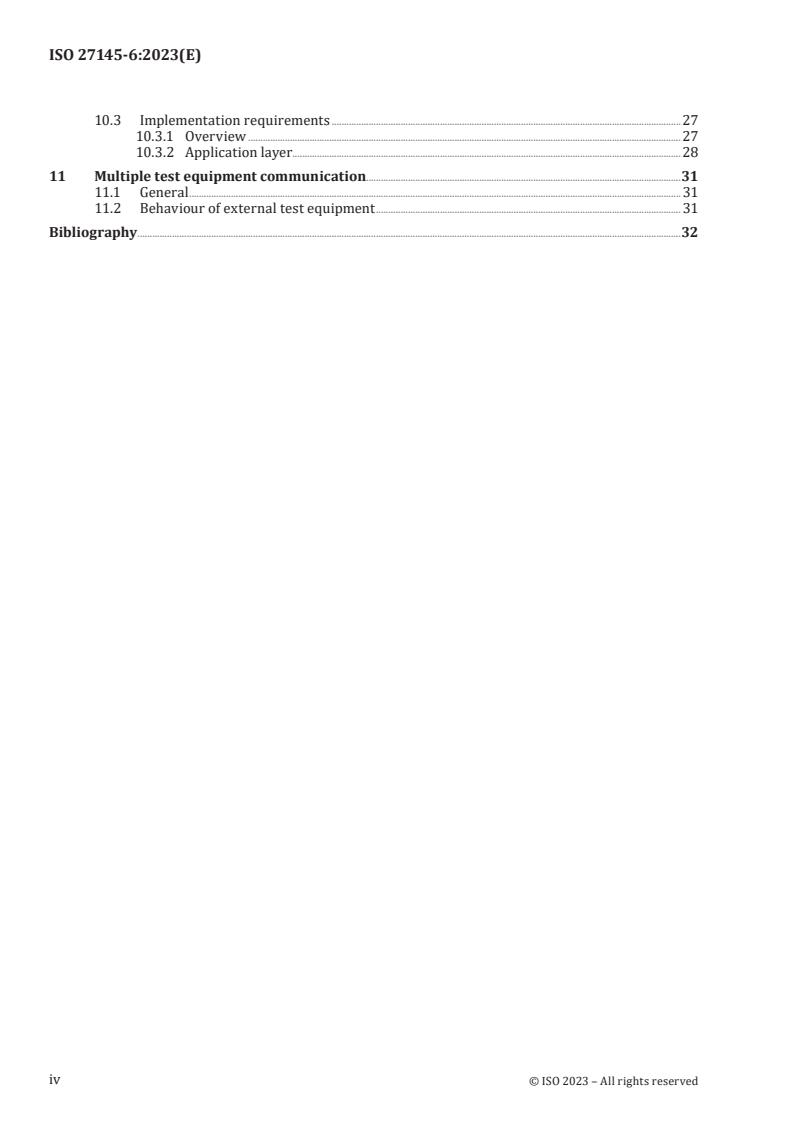
Bibliography .32
iv
Foreword
ISO (the International Organization for Standardization) is a worldwide federation of national standards
bodies (ISO member bodies). The work of preparing International Standards is normally carried out
through ISO technical committees. Each member body interested in a subject for which a technical
committee has been established has the right to be represented on that committee. International
organizations, governmental and non-governmental, in liaison with ISO, also take part in the work.
ISO collaborates closely with the International Electrotechnical Commission (IEC) on all matters of
electrotechnical standardization.
The procedures used to develop this document and those intended for its further maintenance are
described in the ISO/IEC Directives, Part 1. In particular, the different approval criteria needed for the
different types of ISO document should be noted. This document was drafted in accordance with the
editorial rules of the ISO/IEC Directives, Part 2 (see www.iso.org/directives).
ISO draws attention to the possibility that the implementation of this document may involve the use
of (a) patent(s). ISO takes no position concerning the evidence, validity or applicability of any claimed
patent rights in respect thereof. As of the date of publication of this document, ISO had not received
notice of (a) patent(s) which may be required to implement this document. However, implementers are
cautioned that this may not represent the latest information, which may be obtained from the patent
database available at www.iso.org/patents. ISO shall not be held responsible for identifying any or all
such patent rights.
Any trade name used in this document is information given for the convenience of users and does not
constitute an endorsement.
For an explanation of the voluntary nature of standards, the meaning of ISO specific terms and
expressions related to conformity assessment, as well as information about ISO's adherence to
the World Trade Organization (WTO) principles in the Technical Barriers to Trade (TBT), see
www.iso.org/iso/foreword.html.
This document was prepared by Technical Committee ISO/TC 22, Road vehicles, Subcommittee SC 31,
Data communication.
This second edition cancels and replaces the first edition (ISO 27145-6:2015), which has been
technically revised.
The main changes are as follows:
— clarification about cable length;
— rewording for a better clarification of requirements.
A list of all parts in the ISO 27145 series can be found on the ISO website.
Any feedback or questions on this document should be directed to the user’s national standards body. A
complete listing of these bodies can be found at www.iso.org/members.html.
v
Introduction
Overview
This document includes the communication between the vehicle's on-board diagnostics (OBD) systems
and external test equipment within the scope of the World-Wide Harmonized On-Board Diagnostics
Global Technical Regulations (WWH-OBD GTR).
This document has been established in order to apply the unified diagnostic services (specified in
ISO 14229-1) to WWH-OBD systems.
This document includes the communication between the vehicle's WWH-OBD systems and external
(off-board) “generic” test equipment within the scope of the country-specific regulatory requirements.
To achieve this, it is based on the Open Systems Interconnection (OSI) Basic Reference Model specified
in ISO/IEC 7498-1 and ISO/IEC 10731, which structures communication systems into seven layers.
When mapped on this model, the services specified by this document are broken into:
— diagnostic services (layer 7), specified in ISO 27145-3 with reference to ISO 14229-1,
— presentation layer (layer 6), specified in ISO 27145-2 with reference to SAE J1930-DA, SAE J1939-
DA, SAE J1939-73:2022, Appendix A (FMIs), SAE J1979-DA, and SAE J2012-DA,
— session layer services (layer 5), specified in ISO 14229-2,
— transport layer services (layer 4), specified in ISO 27145-4 with reference to ISO 13400-2,
ISO 15765-2, and ISO 15765-4,
— network layer services (layer 3), specified in ISO 27145-4 with reference to ISO 13400-2, ISO 15765-2,
and ISO 15765-4,
— data link layer (layer 2), specified in ISO 27145-4 with reference to ISO 11898-1, ISO 11898-2,
ISO 13400-3, ISO 15765-4, and IEEE 802.3, and
— physical layer (layer 1), specified in ISO 27145-4 with reference to ISO 11898-1, ISO 11898-2,
ISO 13400-3, ISO 15765-4, and IEEE 802.3,
in accordance with Table 1.
Table 1 — WWH-OBD specification reference applicable to the OSI layer
Applicability OSI seven layer WWH-OBD document reference
Application (layer 7) ISO 14229-1, ISO 27145-3
ISO 27145-2,
this doc-
SAE J1930-DA, SAE J1939-DA, SAE J1939-73:2022, Appendix A
ument
Presentation (layer 6)
(FMIs),
Seven layers
SAE J1979-DA, SAE J2012-DA
according to
Session (layer 5) ISO 14229-2
ISO/IEC 7498-1
and
Transport (layer 4)
ISO 15765-2 DoCAN, ISO 13400-2 DoIP
ISO/IEC 10731
ISO 15765-4 DoCAN TCP and IP
Network (layer 3)
—
ISO 27145-4
Data link (layer 2) ISO 11898-1 CAN DLL,
ISO 13400-3 DoIP,
ISO 11898-2 CAN HS,
IEEE 802.3
Physical (layer 1)
ISO 15765-4 DoCAN
SAE document reference concept
This document references several SAE documents which contain all terms, data and diagnostic trouble
code (DTC) definitions.
vi
ISO 27145-2 defines a common data dictionary for this document, according to the definitions in the
following documents (Figure 1):
— SAE J1930-DA: this digital annex contains all standardized naming objects, terms, and abbreviated
terms;
— SAE J1939-DA and SAE J1939-73: the digital annex indexes names for suspect parameter numbers
(SPNs) that provide an alternative presentation format for SAE J2012-DA DTCs. SPNs are combined
with failure mode indicators (FMIs) to form the full alternative presentation. These FMIs are
described in SAE J1939-73:2022, Appendix A;
— SAE J1979-DA: this digital annex contains all standardized data items such as data identifiers (DIDs),
test identifiers (TIDs), monitor identifiers (MIDs) and infotype identifiers (ITIDs);
— SAE J2012-DA: this digital annex contains all standardized data items such as DTC definitions and
FTB (failure type byte) definitions.
Key
1 SAE digital annexes: data definitions
2 SAE J1939 series of documents: DTC definitions
Figure 1 — SAE digital annex document reference
vii
INTERNATIONAL STANDARD ISO 27145-6:2023(E)
Road vehicles — Implementation of World-Wide
Harmonized On-Board Diagnostics (WWH-OBD)
communication requirements —
Part 6:
External test equipment
1 Scope
This document defines the requirements for the external test equipment as:
— a means of establishing communications between a WWH-OBD-equipped vehicle and external test
equipment;
— a set of diagnostic services, including addressing methods, to be provided by the external test
equipment in order to exercise the services defined in ISO 27145-3.
This document describes the minimum capabilities or functions in the external test equipment.
Additional functionalities, for example, non WWH-OBD protocols or retrieval of repair and maintenance
information, can be integrated into the external test equipment according to the test equipment
manufacturer needs. The external test equipment designer ensures that no such capability or function
can adversely affect either a WWH-OBD-equipped vehicle connected to the equipment, or the equipment
itself.
When the external test equipment implements functionality, which is not covered by ISO 27145-3, this
functionality is not linked to the timing requirements defined in this document.
2 Normative references
The following documents are referred to in the text in such a way that some or all of their content
constitutes requirements of this document. For dated references, only the edition cited applies. For
undated references, the latest edition of the referenced document (including any amendments) applies.
ISO 13400-3, Road vehicles — Diagnostic communication over Internet Protocol (DoIP) — Part 3: Wired
vehicle interface based on IEEE 802.3
ISO 14229-1, Road vehicles — Unified diagnostic services (UDS) — Part 1: Application layer
ISO 14229-2, Road vehicles — Unified diagnostic services (UDS) — Part 2: Session layer services
ISO 15031-3, Road vehicles — Communication between vehicle and external equipment for emissions-
related diagnostics — Part 3: Diagnostic connector and related electrical circuits: Specification and use
ISO 15765-4, Road vehicles — Diagnostic communication over Controller Area Network (DoCAN) — Part 4:
Requirements for emissions-related systems
ISO 27145-1, Road vehicles — Implementation of World-Wide Harmonized On-Board Diagnostics (WWH-
OBD) communication requirements — Part 1: General information and use case definition
ISO 27145-2, Road vehicles — Implementation of World-Wide Harmonized On-Board Diagnostics (WWH-
OBD) communication requirements — Part 2: Common data dictionary
ISO 27145-3, Road vehicles — Implementation of World-Wide Harmonized On-Board Diagnostics (WWH-
OBD) communication requirements — Part 3: Common message dictionary
ISO 27145-4, Road vehicles — Implementation of World-Wide Harmonized On-Board Diagnostics (WWH-
OBD) communication requirements — Part 4: Connection between vehicle and test equipment
3 Terms, definitions and abbreviated terms
3.1 Terms and definitions
For the purposes of this document, the terms and definitions given in ISO 27145-1, ISO 27145-2 and
ISO 14229-1 apply.
ISO and IEC maintain terminology databases for use in standardization at the following addresses:
— ISO Online browsing platform: available at https:// www .iso .org/ obp
— IEC Electropedia: available at https:// www .electropedia .org/
3.2 Abbreviated terms
CALID calibration identification
CAN Controller Area Network
d.c. direct current
DoCAN Diagnostics over CAN
DoIP Diagnostics over IP
DTC Diagnostic Trouble Code
EMC electromagnetic compatibility
ESD electrostatic discharge
ETEREC external test equipment recommendation
ETEREQ external test equipment requirement
FMI Failure Mode Identifier
GTR Global Technical Regulations
HMI Human-Machine Interface
IP Internet Protocol
IUPR In Use (Monitor) Performance Ratio
MVCI Modular Vehicle Communication Interface
MI Malfunction Indication
MIL Malfunction Indication Lamp
NRC Negative Response Code
ODX Open Diagnostic data eXchange
VIN vehicle identification number
4 Conventions
This document is based on the conventions discussed in the OSI service conventions (ISO/IEC 10731) as
they apply to diagnostic services.
5 Document overview
Figure 2 shows the reference documents for this document.
This document specifies the following references:
a) ISO 27145-1 specifies the general structure of this document and the use cases applicable to WWH-
OBD GTR;
b) ISO 27145-2 specifies the common data dictionary with references to the following:
1) SAE J1930-DA defines the terms, definitions, abbreviated terms, etc.;
2) SAE J1939-DA contains all SPNs (parameters), PGNs (messages), and other SAE J1939 data
previously published in the SAE J1939 top level document;
NOTE The SAE J1939 series of documents presents the definition of emissions-related SPNs and FMIs
for use as DTCs.
3) SAE J1939 -73: 2022, Appendix A specifies the FMIs;
4) SAE 1979-DA specifies all data items;
5) SAE J2012-DA specifies the DTC definitions and failure type byte definitions;
c) This document specifies the diagnostic services defined in ISO 14229-1 that are applicable to
WWH-OBD GTR;
d) ISO 14229-2 specifies the standardized service primitive interface to separate application and
session layers from protocol transport and network layers;
e) ISO 27145-4 specifies the initialization procedure and includes references to:
1) ISO 15765-4 DoCAN;
2) the ISO 13400 series DoIP.
Key
1 The standardized service primitive interface is specified in ISO 14229-2.
Figure 2 — Reference documents for implementation of WWH-OBDonCAN
and WWH-OBDonIP according to the OSI model
6 Requirements overview and principles
6.1 Basic principles for the graphical notation
The flow graphs show the behaviour of the external test equipment. Hierarchical references, e.g. are
shown using round edged transparent rectangles. Figure 3 shows the notation semantics.
Figure 3 — Flow graph notation semantics used in this document
6.2 Requirements clustering
6.2.1 Overview
Each requirement in this document is assigned to one requirements cluster. The clusters cover technical
areas where the assigned requirements apply for.
Table 2 lists the technical requirements clusters. The table provides an overview of all requirements
clusters and the associated technical requirements. This list is a summary of the requirements included
in this document.
Each technical requirement is identified by the mnemonic “ETEREQ-” and an alpha-numeric number.
In addition, the alpha-numeric number includes the requirement cluster classifier according to Table 2.
Recommendations intended to guide the implementation are identified by the mnemonic “ETEREC-”.
6.2.2 Main requirements clusters
Table 2 provides an overview of the main clusters of external test equipment requirements. A
requirement cluster has at least one requirement and optional recommendations.
Table 2 — Main requirements clusters
# Main title of Classifier Brief description Related
cluster requirements
and recommen-
dations
1 Mechanical M Requirements to mechanically connect the external ETEREQ-M01,
requirements test equipment
ETEREQ-M02,
ETEREQ-M03,
ETEREQ-M04,
ETEREQ-M05,
ETEREQ-M06
2 Electrical E Electrical hardware related requirements and recom- ETEREQ-E01,
requirements mendations
ETEREC-E02,
ETEREQ-E03,
ETEREQ-E04,
ETEREQ-E05
3 Communication S Automatic hands-off determination of the communica- ETEREQ-S01,
setup and session tion interface
ETEREQ-S02,
— hands-free DoCAN protocol initialization
ETEREC-S03,
— hands-free DoIP protocol initialization and setup
ETEREQ-S04,
initialization
ETEREQ-S05,
ETEREQ-S06,
ETEREQ-S07,
ETEREQ-S08,
ETEREQ-S09,
ETEREQ-S10,
ETEREQ-S11
4 Diagnostic D Requirements and recommendations related to the ETEREQ-D01,
messages diagnostic messages, like addressing information,
ETEREQ-D02,
sequences, dependencies
ETEREC-D03,
ETEREQ-D04,
ETEREQ-D05,
ETEREQ-D06,
ETEREQ-D07,
ETEREQ-D08
TTaabbllee 22 ((ccoonnttiinnueuedd))
# Main title of Classifier Brief description Related
cluster requirements
and recommen-
dations
ETEREQ-D09,
ETEREQ-D10,
ETEREQ-D11,
ETEREQ-D12,
ETEREQ-D13,
ETEREQ-D14,
ETEREQ-D15,
ETEREQ-D16,
ETEREQ-D17,
ETEREQ-D18,
ETEREQ-D19,
ETEREQ-D20,
ETEREQ-D21,
ETEREQ-D22,
ETEREQ-D23,
ETEREQ-D24,
ETEREQ-D25,
ETEREQ-D26,
ETEREQ-D27,
ETEREQ-D28,
ETEREQ-D29,
ETEREQ-D30,
ETEREQ-D31
5 Error handling F Requirements to have a proper communication error ETEREQ-F01,
handling
ETEREQ-F02,
ETEREQ-F03,
ETEREQ-F04
6 Use case specific U Requirements only related to specific use cases ETEREQ-U01,
requirements
ETEREQ-U02,
ETEREQ-U03,
ETEREQ-U04,
ETEREC-U05,
ETEREQ-U06
7 External test equipment requirements
7.1 General
This clause specifies all requirements which are applicable to the external test equipment. The
Introduction, Clause 9, and Clause 10 (respectively use cases 1, 2, and 3 as specified in ISO 27145-1)
include references to the requirements stated in this clause. The term ‘external test equipment’
addresses all equipment that will be used in compliance with the use cases stated in this document, e.g.
a repair shop external test equipment or an installed diagnostic data recorder. As the test equipment is
to be used for legislated OBD, it can be mounted in the car and attached to the OBD diagnostic interface,
but not integrated into the internal network. Figure 4 shows the general behaviour of the external text
equipment.
Figure 4 — General behaviour of external test equipment
7.2 Applicability of requirements according to local legislation
This document is based on the requirements established by the GTR #5, only. Local legislation can
require additional data to be supported for each use case as specified in this document. The additional
data are defined in SAE J1979-DA and SAE J1939-DA.
7.3 User instructions and guidelines
ETEREQ-M01 If the chosen connector supports detection of ignition/run status, the external test
equipment shall verify that the ignition is active before starting any action.
ETEREQ-M02 If the chosen connector does not support the detection of ignition/run status, the ex-
ternal test equipment shall ask the user to confirm ignition/run status active before
starting any action.
7.4 Cluster “Mechanical requirements”
ETEREQ-M03 To connect the external test equipment to the vehicle, one of the following ISO 15031-3
type connectors shall be used:
— type A (12 V d.c.), or
— type B (12 V d.c. or 24 V d.c.).
ETEREQ-M04 The length of the cable (from external test equipment interface transceiver to diagnos-
tic connector) shall not exceed the maximum length of 2 m (twisted and unshielded)
and the maximum length of 5 m (twisted and shielded).
NOTE More restrictive requirements always supersede less restrictive requirements.
ETEREQ-M05 If the external test equipment supports the DoCAN protocol, the cable mechanical (and
electrical) configuration and characteristics shall be in accordance with ISO 15765-4.
ETEREQ-M06 If the external test equipment supports the DoIP protocol, the cable mechanical (and
electrical) configuration and characteristics shall be in accordance with ISO 13400-3.
7.5 Cluster “Electrical requirements and recommendations”
ETEREQ-E01 If the external test equipment is powered from the vehicle diagnostic connector, it shall
comply with the electrical characteristics of either 12 V d.c. or 24 V d.c. vehicle battery
systems. The external test equipment shall comply with the ISO 15031-3 diagnostic
link connector specification and requirements detailed in Table 3.
Table 3 — Additional interface requirements
Requirement definition 12 V d.c. 24 V d.c. Unit
Survive a vehicle battery voltage for at least 10 min 24 36 V
Survive a reverse vehicle battery voltage for at least 10 min 24 36 V
ETEREC-E02 During engine crank event, the external test equipment should withstand crank-
ing so that communications and data are not lost during vehicle battery voltage
reductions as specified in ISO 16750-2 or ISO 7637-2.
ETEREQ-E03 In regards to the EMC, the external test equipment shall not interfere with the
normal operation of the vehicle electrical system.
ETEREQ-E04 In regards to the EMC, the normal operation of the external test equipment shall
be immune from conducted and radiated emissions present in a service environ-
ment and when connected to a vehicle.
ETEREQ-E05 The external test equipment shall meet the electrical requirements specified in
ISO 15031-3.
7.6 Cluster “Communication setup” and connections
7.6.1 Connections
A connection ends when the external test equipment does not communicate with any ECU for the time
specified below.
ETEREQ-S01 The connection ends when the external test equipment does not send any request
to the vehicle for more than 5 min.
ETEREQ-S02 If communication is to be performed after the connection has ended, the external
test equipment shall restart with the communication setup process.
ETEREC-S03 If the external test equipment can be sure to be connected to the same vehicle,
it can bypass the following steps asking for static information:
— Connector determination:
— ISO 15765-4:
— Bitrate detection
— 11 bit or 29 bit CANID support
— ISO 13400-3:
— Ethernet pin assignment option 1 or option 2 support
— The external test equipment shall build an ECU table by sending a request
message with a functionally addressed service ReadDataByIdentifier, DID
F810 to request the protocol identification of all supporting ECUs.
— Read GTR (SAE J1979-DA specifies an InfoType to retrieve the WWH-OBD
GTR number)
— Read Vehicle Identification Number (SAE J1979-DA specifies an InfoType to
retrieve the VIN)
— Read the software calibration identification number (CALID) (SAE J1979-DA
specifies an InfoType to retrieve the CALID number)
— Read the calibration verification number (CVN) (SAE J1979-DA specifies an
InfoType to retrieve the CVN number)
7.6.2 Communication setup
Figure 5 shows the communication setup.
Key
1 see ISO 27145-1
Communication identification, e.g. DoCAN or DoIP, shall be done sequentially in any order wished by the test
equipment supplier.
Figure 5 — Communication setup
The communication setup defines the different steps needed to initialize communication to the vehicle.
At first, the external test equipment shall determine the interface to be used, either by selection by
the user or by probing the available interfaces using the respective initialization procedure (either
DoCAN or DoIP). As a result, it constructs the ECU table, including the ECU names, which the external
test equipment needs to perform the use case specific communications. Use cases 2 and 3 need ECU
addressing information for the subsequent physical communication with the ECUs. Use case 1, which
uses only functional requests, can bypass this step.
The communication setup shall be executed just once per connection; it queries only static information
that does not change. This sequence is not to be part of any cyclic measurements.
ETEREQ-S04 The external test equipment shall employ an “Automatic Protocol Determination”
feature to determine the communication protocol used in a given vehicle. No user
intervention shall be required during this phase.
ETEREQ-S05 The external test equipment shall allow the user to select the protocol for WWH OBD,
either before automatic interface determination or after the determination, when the
detection process received an ambiguous result.
ETEREQ-S06 The connected external test equipment shall not cause failures on the in-vehicle net-
work, e.g. CAN bus off.
ETEREQ-S07 The external test equipment shall perform an automatic DoCAN protocol initialization
according to ISO 27145-4.
ETEREQ-S08 The external test equipment shall perform an automatic DoIP protocol initialization
according to ISO 27145-4.
ETEREQ-S09 The external test equipment shall inform the user that initialization is occurring.
ETEREQ-S10 The external test equipment shall inform the user about the selected protocol in use.
7.7 Cluster “Diagnostic messages”
7.7.1 Overview
All ECU communication is done by diagnostic messages. To retrieve the information from the ECUs,
the following diagnostic messages are used. Subclause 7.7 is divided into the different communication
phases.
7.7.2 Timing
ETEREQ-D01 The client shall utilize the P reload mechanism as described in ISO 14229-2 for
Client
DoCAN and ISO 27145-3 for DoIP.
7.7.3 Negative response handling
Besides the standard response codes that indicate non-conformant communication, like missing
parameters, unsupported functions, etc., there are two responses that have to be handled in a special
way. For details, refer to ISO 14229-1.
Figure 6 shows the response handling.
Key
n 5 loops
t 200 ms
Figure 6 — Response handling
ETEREQ-D02 When the external test equipment receives an NRC 21 (busyRepeatRequest), it shall
retry to request the information. Between each retry, it shall wait for a minimum of
200 ms.
ETEREC-D03 When the external test equipment receives an NRC 21 (busyRepeatRequest), the
test equipment should use a 1 s interval between retries.
ETEREQ-D04 After receiving five consecutive NRC 21 (busyRepeatRequest) or 1 s after the first
NRC 21 received, the external test equipment shall indicate to the user that the ECU
is busy [e.g. “wait (busy)”].
ETEREQ-D05 When the external test equipment receives an NRC 78 (requestCorrectlyReceived-Re-
sponsePending), it shall wait for the specified time (ISO 27145-3:2012, Table 13) to
receive a further response.
ETEREQ-D06 After receiving two consecutive NRC 78 (requestCorrectlyReceived-ResponsePend-
ing), the external test equipment shall indicate to the user that the response from the
respective ECU is pending [e.g. “wait (response pending)”].
7.7.4 Error handling of no response from the vehicle
An ECU can fail to respond to a request message from the external test equipment because of incorrect
transmission or because the module does not support that message. There can be several other reasons
for an ECU to not respond to a request.
Figure 7 shows the no response handling.
Figure 7 — No response handling
ETEREQ-F01 If a response is not received within the P2 /P6 timeout period pre-
Client_max Client_max
scribed by the protocol, the test equipment shall:
— retransmit the request message one more time after 200 ms;
— if there is still no response, transmit a service 22 DID F810 request message in
16 16
order to determine if communication with the vehicle is still possible;
— if a service 22 DID F810 = 1 response is received, retransmit the original re-
16 16
quest one more time;
— if the previous step fails again then indicate to the user, as appropriate, that com-
munication with the vehicle cannot be performed, that communication with the
module cannot be performed or that the information the user has selected is not
available.
ETEREQ-F02 If the server indicates that the information is supported (i.e. by setting the corresponding
bit in the DID supported, i.e. F400 - F5C0 , F800 - F8C0 ) but does not respond to
16 16 16 16
a physical request or responds with a negative response code, then the data shall be
presented as “Failed”.
ETEREQ-F03 The external test equipment shall inform the user about any communication errors
that prevent the external test equipment from reading out information.
ETEREQ-F04 Communication errors, which the error handling process was not able to rectify, shall
be reported to the user.
7.7.5 Setup of ECU list
ETEREQ-D07 For use case 2 or 3, the external test equipment shall use the responses of functional
service 22 , F810 to collect the ECU addresses and store them in a list. Only those
16 16
responses that indicate ISO 27145 series compliance shall be stored.
Table 4 defines the external test equipment initialization message sequence. For details
refer to ISO 14229-1.
Table 4 — External test equipment initialization message sequence
Msg# Description Addressing Application message name PDU message
type content
1 Read protocol functional ReadDataByIdentifier(ITID(F810)) 22
identification.
F8
2 PositiveResponse physical Read protocol identification – positive 62
to F810 . response
F8
ITID (high byte = F8 )
ITID (low byte = 10 )
only accept 01 (see ISO 27145-4)
OR
2 NegativeResponse physical NRC 7F
to F810 .
Request service ID: ReadDataByIdentifier 22
Negative response code < NRC >
7.7.6 Setting up ECU communication list
ETEREQ-D08 The client shall build a list of all ECUs responding to the functional service 22 F810
16 16
request and use this information for physical requests. This step is not necessary for
use case 1, “roadside inspection”, and can be bypassed there. Figure 8 shows the build
ECU communication and data information lists.
Figure 8 — Build ECU communication and data information lists
ETEREQ-D09 The external test equipment shall store the address of each ECU responding to service
22 F810 with a result of 01 (=WWH-OBD).
16 16 16
ETEREQ-D10 For each ECU, the external test equipment shall query the ECU’s name using service
22 F80A . Finally, the table has, as a minimum, the following data entries:
16 16
— ECU address,
— ECU name.
This information is static, so it is not necessary to have this as part of a cyclic reading.
ETEREQ-D11 The ECU table shall be built only once after communication setup.
7.7.7 Setting up data information list
ETEREQ-D12 The client shall send physically addressed service 22 ReadDataByIdentifier requests
to gather all supported DIDs (PIDs, MIDs and ITIDs). It shall query those ECUs that
have responded to the service 22 F810 request during initialization (SAE J1979- DA:
16 16
2021, Appendix A). This step is not necessary for use case 1, “roadside check”, and can
be bypassed there. The range values for PIDs, MIDs, and ITIDs that may be requested
by the test equipment are defined in SAE J1979 -DA: 2021, Appendix A.
ETEREQ-D13 Based on the results, the external test equipment shall store the information about
the supported DIDs for each ECU.
ETEREQ-D14 The external test equipment shall only query those DIDs that have been marked to be
supported by the respective ECU.
ETEREQ-D15 When the external test equipment requests DID data, it shall not mix different DID
ranges in one request, i.e. it shall send separate requests for PIDs, for MIDs, and for
ITIDs.
ETEREQ-D16 When the external test equipment requests ITID data, it shall request one ITID value
per request.
ETEREQ-D17 The external test equipment shall send a maximum of six DIDs (PIDs or MIDs, not
mixed) in one physical request (refer to ISO 27145-3).
7.7.8 Reading DTCs
DTCs can be read at any time after the communication setup, either once after setup, continuously, or
on user request.
ETEREQ-D18 The client shall send physically addressed requests to all ECUs to read the applicable
DTCs per class of DTC.
ETEREQ-D19 The client shall retrieve the class A, B1, B2, and C DTCs which are pending, confirmed,
and active or previously active.
ETEREQ-D20 The client can request DTCs from all classes and at all stages, but shall sort the DTCs
into the different classes and states.
7.7.9 Setting up DTC information list
Figures 9 and 10 show the read DTC information and the updating of snapshot and extended data
support. See definition in ISO 14229-1.
Figure 9 — Read DTC information
Figure 10 — Updating snapshot and extended data support
ETEREQ-D21 The external test equipment shall construct lists of all emissions-related DTCs for
retrieving snapshot data and extended data. It shall use the following request given
in Table 6 for all relevant ECUs (for details refer to ISO 14229-1), with the DTCSever-
ityMask set according to the use case, as defined in Table 5.
Table 5 — Use case related DTCSeverityMask
Use case # Relevant severity classes DTCSeverityMask value
1 not applicable not applicable
2 A, B1, B2 0E
3 A, B1, B2, C 1E
Table 6 — External test equipment DTC reading message sequence
Msg# Description Addressing Application message name
...
Questions, Comments and Discussion
Ask us and Technical Secretary will try to provide an answer. You can facilitate discussion about the standard in here.
Loading comments...