


ISO/TR 25901-1:2016
(Main)Welding and allied processes — Vocabulary — Part 1: General terms
Welding and allied processes — Vocabulary — Part 1: General terms
ISO/TR 25901-1:2016 contains general terms and definitions applicable to welding and allied processes. It does not contain terms and definitions related to specific processes or particular aspects of welding and allied processes that are covered in other parts of this Technical Report (see Foreword) or in other ISO standards. In the main body of this part of ISO/TR 25901, terms are arranged in a systematic order. Annex A provides an index in which all terms are listed alphabetically with reference to the appropriate subclause. In addition, it provides French translations, covering two of the three official ISO languages (English, French and Russian). German translations are also provided; these are published under the responsibility of the member body for Germany (DIN), and are given for information only. NOTE 1 Only the terms given in the official languages (English, French and Russian) are to be considered as ISO terms and definitions. NOTE 2 All these terms and definitions are also available on the ISO Online Browsing Platform (OBP): https://www.iso.org/obp/ui/
Soudage et techniques connexes — Vocabulaire — Partie 1: Termes généraux
ISO/TR 25901-1:2016 fournit les termes généraux applicables au soudage et aux techniques connexes ainsi que leurs définitions. Elle ne fournit pas les termes et définitions relatifs à des procédés spécifiques ou à des aspects particuliers du soudage et des techniques connexes qui sont couverts par d'autres parties du présent Rapport Technique (voir Avant-propos) ou par d'autres normes ISO. Dans la section principale de cette partie de l'ISO/TR 25901, les termes sont classés selon un ordre systématique. L'Annexe A fournit un index alphabétique dans lequel les termes sont énumérés avec un renvoi aux paragraphes appropriés. Elle fournit en outre la traduction des termes en langue anglaise, couvrant ainsi deux des trois langues officielles de l'ISO (anglais, français et russe). Des traductions en langue allemande sont également fournies; celles-ci sont publiées sous la responsabilité du comité membre de l'Allemagne (DIN), et sont données uniquement pour information. NOTE 1 Seuls les termes dans les langues officielles (anglais, français et russe) peuvent être considérés comme étant des termes et définitions de l'ISO. NOTE 2 Tous ces termes et définitions sont également disponibles sur la plateforme de consultation en ligne (OBP) de l'ISO: https://www.iso.org/obp/ui/
Varjenje in sorodni postopki - Slovar - 1. del: Splošni izrazi
General Information
- Status
- Published
- Publication Date
- 16-Mar-2016
- Technical Committee
- ISO/TC 44/SC 7 - Representation and terms
- Drafting Committee
- ISO/TC 44/SC 7 - Representation and terms
- Current Stage
- 9093 - International Standard confirmed
- Start Date
- 01-Dec-2022
- Completion Date
- 14-Feb-2026
Relations
- Referred By
EN ISO 18785-1:2021 - Friction stir spot welding - Aluminium - Part 1: Vocabulary (ISO 18785-1:2018) - Effective Date
- 11-Feb-2026
- Effective Date
- 09-Feb-2026
- Effective Date
- 09-Feb-2026
- Effective Date
- 09-Feb-2026
- Effective Date
- 09-Feb-2026
- Effective Date
- 09-Feb-2026
- Effective Date
- 09-Feb-2026
- Effective Date
- 09-Feb-2026
- Effective Date
- 09-Feb-2026
- Effective Date
- 09-Feb-2026
- Effective Date
- 09-Feb-2026
- Effective Date
- 09-Feb-2026
- Effective Date
- 09-Feb-2026
- Effective Date
- 09-Feb-2026
- Referred By
EN ISO 25239-1:2020 - Friction stir welding - Aluminium - Part 1: Vocabulary (ISO 25239-1:2020) - Effective Date
- 09-Feb-2026
Overview
ISO/TR 25901-1:2016 - Welding and allied processes - Vocabulary - Part 1: General terms defines the core terminology used across welding and allied processes. This Technical Report provides standardized English, French and Russian terms and definitions for general welding concepts (weld, weld metal, heat‑affected zone, joint types, imperfections, etc.), arranged systematically with an alphabetical index (Annex A). The official terms are also available on the ISO Online Browsing Platform (OBP).
Key topics
ISO/TR 25901-1 organizes and defines essential vocabulary that supports clear technical communication. Major topic areas include:
- General welding terms (welding, fusion welding, weld, weldment, parent material)
- Characterization of welds (weld metal, heat‑affected zone, fusion line, dilution)
- Imperfections and defects (hot cracks, cold cracks, porosity, internal imperfections)
- Types of joints and joint preparations (butt, lap, T‑joint, edge preparation)
- Types of welds and weld details (weld pool, deposited metal, all‑weld metal)
- Welding execution and parameters (manual, mechanized, automatic, welding parameters)
- Surfacing, consumables and materials (filler metals, deposited metal)
- Testing and inspection terminology (weldability tests, mechanical tests, non‑destructive tests)
- Welding equipment, management and personnel terms
Annex A provides an alphabetical index with French translations and German translations (informative, published by DIN). NOTE: only English, French and Russian are official ISO terms.
Practical applications
- Ensures consistent terminology in specifications, welding procedures (WPS), inspection reports, and contracts.
- Helps quality assurance and NDT inspectors interpret and report defects and acceptance criteria unambiguously.
- Supports welding engineers and designers in creating clear documentation and material/joint selection.
- Aids training providers, educators and certification bodies by standardizing teaching material and exam content.
- Useful for technical translators and multinational projects because of multilingual index and formal ISO definitions.
Who should use it
- Welding engineers, inspectors and NDT technicians
- QA/QC managers and manufacturing engineers
- Standards committees, technical authors and specifiers
- Welding educators and vocational trainers
- Procurement and contract specialists in fabrication and construction
Related standards
- ISO/TR 25901 parts on specific processes (Part 3: Welding processes; Part 4: Arc welding)
- Replaces ISO 857‑1:1998 and ISO/TR 25901:2007
- Available on ISO OBP for reference and integration into specifications
Keywords: ISO/TR 25901-1, welding vocabulary, welding terms, weld defects, weld joint types, heat-affected zone, welding standards.
Buy Documents

ISO/TR 25901-1:2016 - Welding and allied processes -- Vocabulary
ISO/TR 25901-1:2016 - Soudage et techniques connexes -- Vocabulaire
Get Certified
Connect with accredited certification bodies for this standard

National Aerospace and Defense Contractors Accreditation Program (NADCAP)
Global cooperative program for special process quality in aerospace.
CARES (UK Certification Authority for Reinforcing Steels)
UK certification for reinforcing steels and construction.
DVS-ZERT GmbH
German welding certification society.
Sponsored listings
Frequently Asked Questions
ISO/TR 25901-1:2016 is a technical report published by the International Organization for Standardization (ISO). Its full title is "Welding and allied processes — Vocabulary — Part 1: General terms". This standard covers: ISO/TR 25901-1:2016 contains general terms and definitions applicable to welding and allied processes. It does not contain terms and definitions related to specific processes or particular aspects of welding and allied processes that are covered in other parts of this Technical Report (see Foreword) or in other ISO standards. In the main body of this part of ISO/TR 25901, terms are arranged in a systematic order. Annex A provides an index in which all terms are listed alphabetically with reference to the appropriate subclause. In addition, it provides French translations, covering two of the three official ISO languages (English, French and Russian). German translations are also provided; these are published under the responsibility of the member body for Germany (DIN), and are given for information only. NOTE 1 Only the terms given in the official languages (English, French and Russian) are to be considered as ISO terms and definitions. NOTE 2 All these terms and definitions are also available on the ISO Online Browsing Platform (OBP): https://www.iso.org/obp/ui/
ISO/TR 25901-1:2016 contains general terms and definitions applicable to welding and allied processes. It does not contain terms and definitions related to specific processes or particular aspects of welding and allied processes that are covered in other parts of this Technical Report (see Foreword) or in other ISO standards. In the main body of this part of ISO/TR 25901, terms are arranged in a systematic order. Annex A provides an index in which all terms are listed alphabetically with reference to the appropriate subclause. In addition, it provides French translations, covering two of the three official ISO languages (English, French and Russian). German translations are also provided; these are published under the responsibility of the member body for Germany (DIN), and are given for information only. NOTE 1 Only the terms given in the official languages (English, French and Russian) are to be considered as ISO terms and definitions. NOTE 2 All these terms and definitions are also available on the ISO Online Browsing Platform (OBP): https://www.iso.org/obp/ui/
ISO/TR 25901-1:2016 is classified under the following ICS (International Classification for Standards) categories: 01.040.25 - Manufacturing engineering (Vocabularies); 25.160.10 - Welding processes. The ICS classification helps identify the subject area and facilitates finding related standards.
ISO/TR 25901-1:2016 has the following relationships with other standards: It is inter standard links to EN ISO 18785-1:2021, EN ISO 3834-1:2021, EN 13479:2017, EN ISO 15609-1:2019, EN ISO 15609-2:2019, EN ISO 14731:2019, EN ISO 17779:2025, EN ISO 13585:2024, EN ISO 17279-1:2018, EN ISO 15614-7:2016, EN ISO 15614-1:2017, EN ISO 15614-9:2025, EN ISO 25239-2:2020, EN 17149-2:2024, EN ISO 25239-1:2020. Understanding these relationships helps ensure you are using the most current and applicable version of the standard.
ISO/TR 25901-1:2016 is available in PDF format for immediate download after purchase. The document can be added to your cart and obtained through the secure checkout process. Digital delivery ensures instant access to the complete standard document.
Standards Content (Sample)
TECHNICAL ISO/TR
REPORT 25901-1
First edition
2016-03-15
Welding and allied processes —
Vocabulary —
Part 1:
General terms
Soudage et techniques connexes — Vocabulaire —
Partie 1: Termes généraux
Reference number
©
ISO 2016
© ISO 2016, Published in Switzerland
All rights reserved. Unless otherwise specified, no part of this publication may be reproduced or utilized otherwise in any form
or by any means, electronic or mechanical, including photocopying, or posting on the internet or an intranet, without prior
written permission. Permission can be requested from either ISO at the address below or ISO’s member body in the country of
the requester.
ISO copyright office
Ch. de Blandonnet 8 • CP 401
CH-1214 Vernier, Geneva, Switzerland
Tel. +41 22 749 01 11
Fax +41 22 749 09 47
copyright@iso.org
www.iso.org
ii © ISO 2016 – All rights reserved
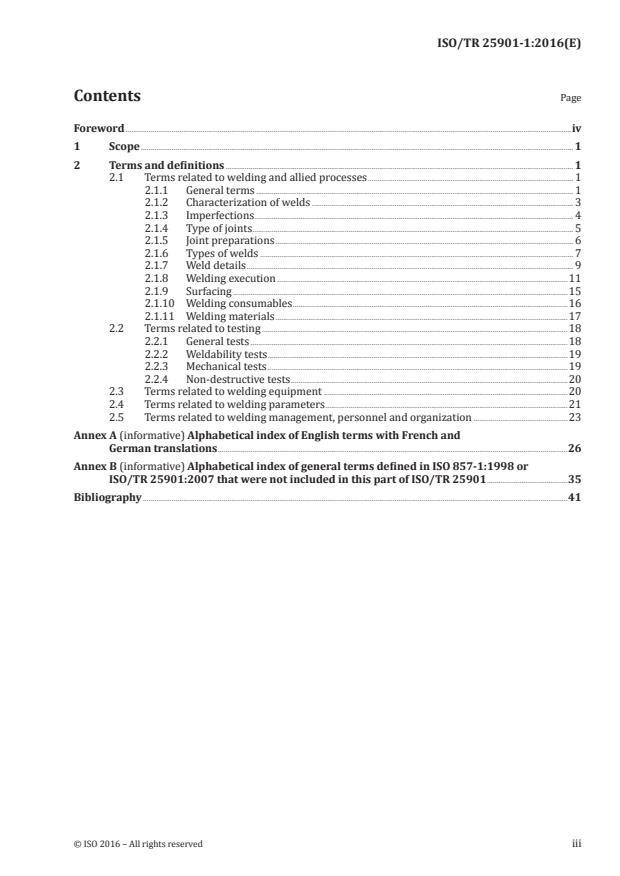
Contents Page
Foreword .iv
1 Scope . 1
2 Terms and definitions . 1
2.1 Terms related to welding and allied processes . 1
2.1.1 General terms . 1
2.1.2 Characterization of welds . 3
2.1.3 Imperfections . 4
2.1.4 Type of joints . 5
2.1.5 Joint preparations . 6
2.1.6 Types of welds . 7
2.1.7 Weld details . 9
2.1.8 Welding execution .11
2.1.9 Surfacing .15
2.1.10 Welding consumables .16
2.1.11 Welding materials .17
2.2 Terms related to testing .18
2.2.1 General tests .18
2.2.2 Weldability tests .19
2.2.3 Mechanical tests .19
2.2.4 Non-destructive tests .20
2.3 Terms related to welding equipment .20
2.4 Terms related to welding parameters .21
2.5 Terms related to welding management, personnel and organization .23
Annex A (informative) Alphabetical index of English terms with French and
German translations .26
Annex B (informative) Alphabetical index of general terms defined in ISO 857-1:1998 or
ISO/TR 25901:2007 that were not included in this part of ISO/TR 25901 .35
Bibliography .41
Foreword
ISO (the International Organization for Standardization) is a worldwide federation of national standards
bodies (ISO member bodies). The work of preparing International Standards is normally carried out
through ISO technical committees. Each member body interested in a subject for which a technical
committee has been established has the right to be represented on that committee. International
organizations, governmental and non-governmental, in liaison with ISO, also take part in the work.
ISO collaborates closely with the International Electrotechnical Commission (IEC) on all matters of
electrotechnical standardization.
The procedures used to develop this document and those intended for its further maintenance are
described in the ISO/IEC Directives, Part 1. In particular the different approval criteria needed for the
different types of ISO documents should be noted. This document was drafted in accordance with the
editorial rules of the ISO/IEC Directives, Part 2 (see www.iso.org/directives).
Attention is drawn to the possibility that some of the elements of this document may be the subject of
patent rights. ISO shall not be held responsible for identifying any or all such patent rights. Details of
any patent rights identified during the development of the document will be in the Introduction and/or
on the ISO list of patent declarations received (see www.iso.org/patents).
Any trade name used in this document is information given for the convenience of users and does not
constitute an endorsement.
For an explanation on the meaning of ISO specific terms and expressions related to conformity
assessment, as well as information about ISO’s adherence to the WTO principles in the Technical
Barriers to Trade (TBT), see the following URL: Foreword — Supplementary information.
The committee responsible for this document is ISO/TC 44, Welding and allied processes, Subcommittee
SC 7, Representation and terms, in collaboration with Commission VI, Terminology, of the International
Institute of Welding (IIW).
This first edition of ISO/TR 25901—1, together with the other parts of ISO/TR 25901, cancels and
replaces ISO 857—1:1998 and ISO/TR 25901:2007, of which it constitutes a revision.
ISO/TR 25901 consists of the following parts, under the general title Welding and allied
processes — Vocabulary:
— Part 1: General terms [Technical Report]
— Part 3: Welding processes [Technical Report]
— Part 4: Arc welding [Technical Report]
The following parts are under preparation:
— Part 2: Safety and health [Technical Report]
Friction welding is to form the subject of a future part 5.
Requests for official interpretations of any aspect of this International Standard should be directed to
the Secretariat of ISO/TC 44/SC 7 via your national standards body. A complete listing of these bodies
can be found at www.iso.org.
iv © ISO 2016 – All rights reserved
TECHNICAL REPORT ISO/TR 25901-1:2016(E)
Welding and allied processes — Vocabulary —
Part 1:
General terms
1 Scope
This part of ISO/TR 25901 contains general terms and definitions applicable to welding and allied
processes.
It does not contain terms and definitions related to specific processes or particular aspects of welding
and allied processes that are covered in other parts of this Technical Report (see Foreword) or in other
ISO standards.
In the main body of this part of ISO/TR 25901, terms are arranged in a systematic order. Annex A
provides an index in which all terms are listed alphabetically with reference to the appropriate
subclause. In addition, it provides French translations, covering two of the three official ISO languages
(English, French and Russian). German translations are also provided; these are published under the
responsibility of the member body for Germany (DIN), and are given for information only.
NOTE 1 Only the terms given in the official languages (English, French and Russian) are to be considered as
ISO terms and definitions.
NOTE 2 All these terms and definitions are also available on the ISO Online Browsing Platform (OBP): https://
www.iso.org/obp/ui/
2 Terms and definitions
For the purposes of this document, the following terms and definitions apply.
2.1 Terms related to welding and allied processes
2.1.1 General terms
2.1.1.1
welding
joining process in which two or more parts are united producing a continuity in the nature of the
workpiece material(s) by means of heat or pressure or both, and with or without the use of filler material
(2.1.10.4)
Note 1 to entry: Welding processes may be used also for surfacing (2.1.9.1) and remelting.
2.1.1.2
fusion welding
welding (2.1.1.1) involving localized melting without the application of external force in which the
fusion surface(s) has (have) to be melted with or without addition of filler material (2.1.10.4)
2.1.1.3
weld
result of welding (2.1.1.1)
Note 1 to entry: The weld includes the weld metal (2.1.2.1) and the heat-affected zone (2.1.2.2).
2.1.1.4
weldment
assembly incorporating one or more welded joint(s) (2.1.4.2)
2.1.1.5
parent material
base material
material to be joined, or surfaced, by welding (2.1.1.1), braze welding or brazing
2.1.1.6
parent material thickness
material thickness
nominal thickness (2.1.7.7) of the materials to be welded
2.1.1.7
parent metal
base metal
metallic parent material (2.1.1.5)
2.1.1.8
manual welding
welding (2.1.1.1) in which the electrode (2.3.8) holder, gun, torch (2.3.9) or blowpipe is manipulated by
hand
2.1.1.9
partly mechanized welding
semiautomatic welding
manual welding (2.1.1.8) where wire feed is mechanized
2.1.1.10
mechanized welding
fully mechanized welding
welding (2.1.1.1) where the required welding parameters (2.4.1) are maintained by mechanical or
electronic means
Note 1 to entry: Manual adjustment of welding parameters by the welding operator (2.5.25) during welding is
possible.
2.1.1.11
automatic welding
welding (2.1.1.1) in which all operations are performed without welding operator (2.5.25) intervention
during the process
Note 1 to entry: Manual adjustment of welding parameters (2.4.1) by the welding operator during welding is not
possible.
2.1.1.12
robotic welding
welding (2.1.1.1) that is performed and controlled by robotic equipment
2.1.1.13
gouging
thermal cutting process variation that forms a groove by melting or burning
2.1.1.14
arc gouging
gouging (2.1.1.13) using an arc cutting process variation
2.1.1.15
air-arc gouging
gouging (2.1.1.13) using a carbon electrode (2.3.8) and compressed air
2 © ISO 2016 – All rights reserved
2.1.2 Characterization of welds
2.1.2.1
weld metal
all metal melted during welding (2.1.1.1) and retained in the weld (2.1.1.3)
2.1.2.2
heat-affected zone
HAZ
portion of non-melted parent metal (2.1.1.7) whose microstructure has been affected
2.1.2.3
weld zone
zone containing the weld metal (2.1.2.1) and the heat-affected zones (2.1.2.2)
2.1.2.4
deposited metal
filler metal that has been added during welding (2.1.1.1)
2.1.2.5
fusion line
interface between the weld metal (2.1.2.1) and the non-melted parent metal (2.1.1.7) as determined on
the cross section of a weld (2.1.1.3)
2.1.2.6
fusion zone
in the weld metal (2.1.2.1), part of the parent metal (2.1.1.7) that has been melted, as determined on the
cross section of a weld (2.1.1.3)
2.1.2.7
all-weld metal
weld metal (2.1.2.1) consisting of deposited metal (2.1.2.4) without dilution (2.1.2.12)
2.1.2.8
weld pool
molten pool
pool of liquid metal formed during fusion welding (2.1.1.2)
Note 1 to entry: In electroslag welding, the term includes the slag (2.1.10.9) bath.
2.1.2.9
as welded
condition of the weld (2.1.1.3) after welding (2.1.1.1), prior to any subsequent thermal, mechanical, or
chemical treatments
Note 1 to entry: For alloys that may undergo natural ageing (e.g. some aluminium alloys), the as welded condition
lasts only for a limited period of time.
2.1.2.10
ferrite number
FN
arbitrary standardized value designating the ferrite content of nominally austenitic or austenitic-
ferritic (duplex) type stainless steel weld metal (2.1.2.1) based on its magnetic properties
2.1.2.11
metallurgical deviation
changes in the mechanical properties and/or metallurgical structure of the weld metal
(2.1.2.1) or heat-affected zone (2.1.2.2) compared to the properties of the parent metal (2.1.1.7)
2.1.2.12
dilution
mixing of melted parent metal (2.1.1.7) and deposited metal (2.1.2.4) expressed as a ratio of the melted
parent metal to the total melted mass
2.1.2.13
dilution rate
dilution (2.1.2.12) expressed as a percentage
2.1.2.14
residual welding stress
stress remaining in a metal part or structure as a result of welding (2.1.1.1)
2.1.2.15
strength weld
weld (2.1.1.3) designed to withstand stress
2.1.2.16
joint efficiency
ratio of strength of a joint (2.1.4.1) to the strength of the parent metal (2.1.1.7), expressed as a percentage
2.1.3 Imperfections
2.1.3.1
imperfection
discontinuity in the weld (2.1.1.3) or a deviation from the intended geometry
Note 1 to entry: Imperfections are cracks, lack of penetration, porosity, slag (2.1.10.9) inclusions.
2.1.3.2
internal imperfection
imperfection (2.1.3.1) that is not open to a surface or not directly accessible
2.1.3.3
systematic imperfection
imperfections (2.1.3.1) that are repeatedly distributed in the weld (2.1.1.3) over the weld lengths to be
examined
2.1.3.4
projected area
area where imperfections (2.1.3.1) distributed along the volume of the weld (2.1.1.3) under consideration
are imaged two-dimensionally
2.1.3.5
hot crack(s)
material separations occurring at high temperatures along the grain boundaries (dendrite boundaries)
when the level of strain and the strain rate exceed a certain level
Note 1 to entry: Small cracks visible only at magnifications greater than 50×, are often described as microcracks.
2.1.3.6
solidification crack
hot crack (2.1.3.5) formed during solidification from the liquid phase of weld metals (2.1.2.1)
Note 1 to entry: It usually extends up to the surface of the weld metal, but sometimes can be subsurface.
2.1.3.7
liquation crack
hot crack (2.1.3.5) formed by liquation in the heat-affected zone (2.1.2.2) of the parent material (2.1.1.5)
or in multirun welds where weld metal (2.1.2.1) is reheated by subsequent runs (2.1.8.4)
4 © ISO 2016 – All rights reserved
2.1.3.8
ductility dip crack
hot crack (2.1.3.5) formed during welding (2.1.1.1) by a reduction in hot ductility
Note 1 to entry: As with a liquation crack (2.1.3.7), it can occur in the heat-affected zone (2.1.2.2) of the parent
material (2.1.1.5) or in multirun welds.
2.1.3.9
cold crack(s)
local rupture (intergranular or transgranular) appearing in a weld (2.1.1.3) as a result of a critical
combination of microstructure, stress and hydrogen content
2.1.4 Type of joints
2.1.4.1
joint
junction of workpieces or the edges of workpieces that are to be joined or have been joined
2.1.4.2
welded joint
assembly that is produced by welding (2.1.1.1) together two or more parts
2.1.4.3
multiple joint
type of joint (2.1.4.1) where three or more parts meet at any required angles to each other
2.1.4.4
parallel joint
type of joint (2.1.4.1) where the parts lie parallel to each other
EXAMPLE In explosive cladding.
2.1.4.5
butt joint
type of joint (2.1.4.1) where the parts lie in the same plane and against one another at an angle of
135° to 180°
2.1.4.6
T-joint
angle joint (2.1.4.8) where the parts meet each other forming a T-shape
2.1.4.7
lap joint
type of joint (2.1.4.1) where the parts lie parallel to each other (0° to 5°) and overlap each other
2.1.4.8
angle joint
type of joint (2.1.4.1) where one part meets the other at an acute angle greater than 5° but not more
than 90°
Note 1 to entry: For a fillet weld (2.1.6.11), the angle is over 5° and less than 45°.
Note 2 to entry: For a butt weld (2.1.6.3), the angle is between 45° to 90° inclusive.
2.1.4.9
corner joint
type of joint (2.1.4.1) where two parts meet at their edges at an angle between 30° and 135° to each other
2.1.4.10
edge joint
type of joint (2.1.4.1) where two parts meet at their edges at an angle of 0° to 30°
2.1.4.11
cross joint
type of joint (2.1.4.1) where two parts lie crossing over each other
EXAMPLE Wires that cross over each other.
2.1.4.12
cruciform joint
type of joint (2.1.4.1) where two parts lying in the same plane each meet, at right angles, a third part
lying between them
2.1.4.13
homogeneous joint
welded joint (2.1.4.2) in which the weld metal (2.1.2.1) and parent material (2.1.1.5) have no significant
differences in mechanical properties and/or chemical composition
Note 1 to entry: A welded joint (2.1.4.2) made of similar parent materials (2.1.1.5) without filler metal is considered
homogeneous.
2.1.4.14
heterogeneous joint
welded joint (2.1.4.2) in which the weld metal (2.1.2.1) and parent material (2.1.1.5) have significant
differences in mechanical properties and/or chemical composition
2.1.4.15
dissimilar material joint
welded joint (2.1.4.2) in which the parent materials (2.1.1.5) have significant differences in mechanical
properties and/or chemical composition
2.1.5 Joint preparations
2.1.5.1
edge preparation
surface prepared on the edges of a part to be welded
2.1.5.2
joint preparation
weld preparation
configuration of the workpieces to be joined after each individual part has been suitably prepared and
assembled
2.1.5.3
fusion face
surface of the parent metal (2.1.1.7) to be melted during welding (2.1.1.1)
2.1.5.4
feather edge
complete absence of a root face (2.1.5.10)
2.1.5.5
gap
air gap
distance at any cross section between edges, ends or surfaces to be joined
2.1.5.6
edge distance
distance between the centre of a weld (2.1.1.3) and the nearest edge of the workpiece
6 © ISO 2016 – All rights reserved
2.1.5.7
root
DEPRECATED: root of weld
zone on the opposite side from where the welding (2.1.1.1) was performed
2.1.5.8
root gap
gap (2.1.5.5) between the root faces (2.1.5.10)
2.1.5.9
root radius
radius of the curved portion of the fusion face (2.1.5.3) in a part prepared for a single-J, single-U, double-J
or double-U weld
2.1.5.10
root face
portion of a fusion face (2.1.5.3) that is not beveled or grooved
2.1.5.11
land
part of a fusion face (2.1.5.3) that supports the weld pool (2.1.2.8)
Note 1 to entry: An example is the horizontal area between the root face (2.1.5.10) and the curved part of a J or U
preparation.
2.1.5.12
bevel angle
angle between the bevel of a joint (2.1.4.1) member and a plane perpendicular to the surface of the member
2.1.5.13
included angle
groove angle
angle between the planes of the fusion faces (2.1.5.3) of parts to be welded
2.1.6 Types of welds
2.1.6.1
full penetration weld
weld (2.1.1.3) with a complete fusion penetration (2.1.7.3)
2.1.6.2
partial penetration weld
weld (2.1.1.3) in which the fusion penetration (2.1.7.3) is intentionally less than full penetration
2.1.6.3
butt weld
groove weld
weld (2.1.1.3) other than a fillet weld (2.1.6.11) made in a groove or in a square preparation
2.1.6.4
single-J butt weld
butt weld (2.1.6.3) in a single-J preparation
2.1.6.5
double-J butt weld
butt weld (2.1.6.3) in a double-J preparation
2.1.6.6
single-U butt weld
butt weld (2.1.6.3) in a single-U preparation
2.1.6.7
double-U butt weld
butt weld (2.1.6.3) in a double-U preparation
2.1.6.8
single-V butt weld
butt weld (2.1.6.3) in a single-V preparation
2.1.6.9
double-V butt weld
butt weld (2.1.6.3) in a double-V preparation
2.1.6.10
square butt weld
butt weld (2.1.6.3) in a square preparation
2.1.6.11
fillet weld
triangular weld (2.1.1.3) between two or more parts for joining a T-joint (2.1.4.6), corner joint (2.1.4.9)
or lap joint (2.1.4.7)
2.1.6.12
plug weld
weld (2.1.1.3) made by filling a circular or elongated hole in one part of a workpiece with filler metal so
as to join it to the surface of an overlapping part exposed through the hole
2.1.6.13
seal weld
weld (2.1.1.3) intended primarily to provide tightness against leakage of gas or fluid
2.1.6.14
slot weld
weld (2.1.1.3) between two overlapping parts made by depositing a fillet weld (2.1.6.11) round the
periphery of a hole in one part so as to join it to the surface of the other part exposed through the hole
2.1.6.15
intermittent weld
series of weld elements made at intervals along a joint (2.1.4.1)
2.1.6.16
staggered intermittent weld
intermittent weld (2.1.6.15) on each side of a joint (2.1.4.1) arranged so that the welds on one side lie
opposite to the spaces on the other side along the joint
Note 1 to entry: These are usually fillet welds (2.1.6.11) in T-joints (2.1.4.8) and lap joints (2.1.4.7).
Note 2 to entry: A staggered intermittent weld is illustrated in Figure 1.
8 © ISO 2016 – All rights reserved
1 1
2 2
Key
1 weld
2 workpiece
Figure 1 — Staggered intermittent weld
2.1.6.17
chain intermittent weld
intermittent weld (2.1.6.15) on each side of a joint (2.1.4.1) arranged so that the welds lie opposite to one
another along the joint
Note 1 to entry: These are usually fillet welds (2.1.6.11) in T-joints (2.1.4.8) and lap joints (2.1.4.7).
Note 2 to entry: A chain intermittent weld is illustrated in Figure 2.
2 2
Key
1 weld
2 workpiece
Figure 2 — Chain intermittent weld
2.1.6.18
flare-bevel weld
butt weld (2.1.6.3) between a joint member with a curved surface and another with a planar surface
2.1.6.19
flare-V weld
butt weld (2.1.6.3) between two members with curved surfaces
2.1.7 Weld details
2.1.7.1
weld width
shortest distance between the outer toes of the surface of a weld (2.1.1.3)
2.1.7.2
weld thickness
thickness of the weld metal (2.1.2.1), including any reinforcements
2.1.7.3
fusion penetration
depth to which the fusion face (2.1.5.3) of the parent metal (2.1.1.7) has been fused
2.1.7.4
penetration depth
deposit thickness
DEPRECATED: weld metal thickness
thickness of the weld metal (2.1.2.1), excluding any reinforcement
2.1.7.5
leg length
distance from the actual or projected intersection of the fusion faces (2.1.5.3) and the toe of a fillet weld
(2.1.6.11), measured across the fusion face
2.1.7.6
throat thickness
thickness of a fillet weld (2.1.6.11)
2.1.7.7
nominal thickness
thickness specified in material standards without tolerances
2.1.7.8
nominal throat thickness
design value of the height of the largest isosceles triangle that can be inscribed in the section of a fillet
weld (2.1.6.11)
Note 1 to entry: Nominal throat thickness is illustrated in Figure 3 as item 1.
Key
1 nominal throat thickness
2 deep penetration throat thickness
Figure 3 — Nominal throat thickness
10 © ISO 2016 – All rights reserved
2.1.7.9
deep penetration throat thickness
nominal throat thickness (2.1.7.8) or effective throat thickness (2.1.7.10) to which a certain amount of
fusion penetration (2.1.7.3) is added
Note 1 to entry: Deep penetration throat thickness is illustrated in Figures 3 and 4 as item 2.
2.1.7.10
effective throat thickness
design value of the height of the largest triangle that can be inscribed in the section of a fillet weld
(2.1.6.11)
Note 1 to entry: Effective throat thickness is illustrated in Figure 4 as item 1.
Key
1 effective throat thickness
2 deep penetration throat thickness
Figure 4 — Effective throat thickness
2.1.7.11
actual throat thickness
throat thickness (2.1.7.6) of the finalized weld (2.1.1.3)
Note 1 to entry: Actual throat thickness depends on the chosen design throat thickness (2.1.7.12).
2.1.7.12
design throat thickness
throat thickness (2.1.7.6) specified by the designer
2.1.8 Welding execution
2.1.8.1
welding process
particular method of welding (2.1.1.1) involving the application of certain metallurgical, electrical,
physical, chemical or mechanical principles
2.1.8.2
welding technique
manner in which an electrode (2.3.8), a blowpipe or a similar appliance is manipulated
2.1.8.3
keyhole technique
welding technique (2.1.8.2) in which concentrated heat source penetrates through a workpiece, forming
a hole (keyhole) at the leading edge of the weld pool (2.1.2.8)
Note 1 to entry: As the heat source progresses, the hole moves with it.
2.1.8.4
run
pass
bead
metal melted or deposited during one passage of an electrode (2.3.8), torch (2.3.9) or blowpipe
Note 1 to entry: The term pass is commonly used in beam welding.
2.1.8.5
stringer bead
run (2.1.8.4) formed without appreciable weaving
2.1.8.6
temper bead
run which normalizes the runs (2.1.8.4) below and provides preheating (2.4.13) for
the successive runs
2.1.8.7
bead on plate
single run (2.1.8.4) made with filler material (2.1.10.4) on the surface of a parent material (2.1.1.5)
2.1.8.8
melt run
line of parent material (2.1.1.5) that has been melted by passing a welding heat source such as a flame,
arc, electron or laser beam along the surface of the material
Note 1 to entry: No filler material (2.1.10.4) is used.
2.1.8.9
melting rate
burn-off rate
mass or length of electrode (2.3.8) consumed per unit of time
2.1.8.10
deposition rate
mass of metal deposited per unit of productive weld time
2.1.8.11
capping run
run(s) (2.1.8.4) visible on the weld face(s) after completion of welding (2.1.1.1)
2.1.8.12
cosmetic run
cosmetic pass
run (2.1.8.4) for superficial remelting of the weld (2.1.1.3) in order to enhance appearance
2.1.8.13
layer
stratum of weld metal (2.1.2.1) consisting of one or more runs (2.1.8.4)
12 © ISO 2016 – All rights reserved
2.1.8.14
finishing welding
production welding (2.5.15) carried out in order to remove casting defects and core openings to ensure
the agreed quality of castings
2.1.8.15
overlap
minimum distance between the edges of overlap plates
Note 1 to entry: The term “overlap” also represents the concept defined in 2.1.8.16.
2.1.8.16
overlap
portion of the welding run (2.1.8.4) remelted by the adjoining run
Note 1 to entry: The term “overlap” also represents the concept defined in 2.1.8.15.
2.1.8.17
bead toe
longitudinal boundary line between the runs (2.1.8.4), or between a run and the parent material (2.1.1.5)
2.1.8.18
weld toe
boundary between the surface of the weld (2.1.1.3) and the parent metal (2.1.1.7)
2.1.8.19
root run
root pass
first run (2.1.8.4) deposited in the root (2.1.5.7) of a multirun weld (2.1.1.3)
2.1.8.20
filling run
run(s) (2.1.8.4) deposited after the root run(s) (2.1.8.19) and before the capping
run(s) (2.1.8.11)
2.1.8.21
back run
DEPRECATED: sealing run
final run (2.1.8.4) deposited on the root (2.1.5.7) side of a fusion weld (2.1.1.3)
2.1.8.22
continuous weld
weld (2.1.1.3) extending along the entire length of a joint (2.1.4.1)
2.1.8.23
single-run welding
welding (2.1.1.1) in which the weld (2.1.1.3) is made in one run (2.1.8.4)
2.1.8.24
single-side welding
one side welding
welding (2.1.1.1) in which the weld (2.1.1.3) is made from one side of the workpiece
2.1.8.25
both-side welding
double-side welding
two side welding
welding (2.1.1.1) in which the weld (2.1.1.3) is made from both sides of the workpiece
2.1.8.26
both-side single-run welding
both-side welding (2.1.8.25) in which the weld (2.1.1.3) is made by single runs (2.1.8.4) from each side
2.1.8.27
both-side multirun welding
multirun welding from both sides
both-side welding (2.1.8.25) in which the weld (2.1.1.3) is made by multiruns from each side
2.1.8.28
multirun welding
welding (2.1.1.1) in which the run (2.1.8.4) is made on a previous run
2.1.8.29
back-step sequence
weld sequence (2.1.8.36) in which short lengths of run (2.1.8.4) are deposited in a direction opposite to
the general progress of welding (2.1.1.1) the joint (2.1.4.1)
Note 1 to entry: The short lengths eventually produce a continuous weld (2.1.8.22) or an intermittent weld
(2.1.6.15).
2.1.8.30
back-step welding
welding technique (2.1.8.2) in which short lengths of weld (2.1.1.3) are deposited in a direction opposite
to the general progress of welding (2.1.1.1) the joint (2.1.4.1), in such a way that the end of one length
overlaps the beginning of the previous length
2.1.8.31
tack weld
weld (2.1.1.3) used to fix the workpieces or assemblies to be joined in their proper position for welding
(2.1.1.1)
2.1.8.32
tack welding
making of a tack weld (2.1.8.31)
2.1.8.33
tacking run
tacking pass
run (2.1.8.4) made to hold the parts to be welded in proper alignment until the final welds (2.1.1.3)
are made
2.1.8.34
welding cycle
complete series of events involved in the making of a weld
2.1.8.35
workplace
area(s) in which the worker’s activities are carried out
2.1.8.36
weld sequence
order in which welds (2.1.1.3) are made on a workpiece
2.1.8.37
weld run sequence
order in which the runs (2.1.8.4) of a weld (2.1.1.3) are made
14 © ISO 2016 – All rights reserved
2.1.8.38
temporary weld
weld (2.1.1.3) made to attach a piece(s) to a weldment (2.1.1.4) for temporary use in handling, shipping
or working on the weldment
2.1.8.39
stud welding
joining of a metal stud or similar part to a workpiece
Note 1 to entry: Welding (2.1.1.1) may be accomplished by arc, resistance, friction or other suitable process with
or without external gas shielding.
2.1.8.40
field weld
site weld
weld (2.1.1.3) made outside workshops usually at the place of final installation
2.1.9 Surfacing
2.1.9.1
surfacing
deposition of material on a surface to obtain desired properties and/or dimensions
2.1.9.2
overlay welding
surfacing (2.1.9.1) by means of welding (2.1.1.1)
2.1.9.3
heat resistant overlay welding
overlay welding (2.1.9.2) in which the cladding (2.1.9.10) is used to obtain improved heat resistance
2.1.9.4
corrosion resistant overlay welding
overlay welding (2.1.9.2) in which the cladding (2.1.9.10) is used to obtain improved corrosion resistance
2.1.9.5
buttering
overlay welding (2.1.9.2) to provide a suitable transition between the parent material (2.1.1.5) and
subsequent welds (2.1.1.3)
2.1.9.6
buffering
buttering (2.1.9.5) prior to welding (2.1.1.1) together of highly dissimilar materials
2.1.9.7
building up
build up
overlay welding (2.1.9.2) to obtain or restore required dimensions
2.1.9.8
hardfacing
overlay welding (2.1.9.2) to increase wear and/or impact resistance
2.1.9.9
strip surfacing
strip cladding
overlay welding (2.1.9.2) with a strip electrode (2.3.8)
2.1.9.10
cladding
material deposited on the parent material (2.1.1.5) in order to produce a clad material
2.1.9.11
cladding process
surfacing (2.1.9.1) used for applying cladding (2.1.9.10)
Note 1 to entry: Cladding processes are overlay welding (2.1.9.2), hot rolling, explosive welding, etc.
2.1.10 Welding consumables
2.1.10.1
welding consumable
material consumed in the making of a weld (2.1.1.3)
Note 1 to entry: The term includes filler material (2.1.10.4) and auxiliary material (2.1.11.1).
2.1.10.2
consumable insert
fusible insert
filler material (2.1.10.4) that is placed at the root (2.1.5.7) of the joint (2.1.4.1) before welding (2.1.1.1) to
be completely fused into the weld metal (2.1.2.1)
2.1.10.3
consumable electrode
electrode (2.3.8) that is consumed during welding (2.1.1.1) and forms a part of the weld (2.1.1.3)
2.1.10.4
filler material
welding consumable (2.1.10.1) added during welding (2.1.1.1) to form the weld (2.1.1.3)
2.1.10.5
filler rod
rod
welding rod
filler material (2.1.10.4) in the form of a rod which can be a part of the welding (2.1.1.1) circuit
2.1.10.6
solid rod
filler rod (2.1.10.5) that is solid, not being a part of the welding (2.1.1.1) circuit
2.1.10.7
filler wire
filler material (2.1.10.4) in the form of a wire which can be a part of the welding (2.1.1.1) circuit
2.1.10.8
flux
welding flux
substantially non-metallic auxiliary material (2.1.11.1) used to clean the surfaces of the joint (2.1.4.1)
chemically, to prevent atmospheric oxidation, and to reduce impurities or float them to the surface in
the form of slag (2.1.10.9)
2.1.10.9
slag
non-metallic substance that results from fusion of an electrode (2.3.8) covering or a flux (2.1.10.8), and
which, after solidification, partly or totally covers the weld metal (2.1.2.1)
2.1.10.10
shielding gas
protective gas used to prevent or reduce atmospheric contamination
16 © ISO 2016 – All rights reserved
2.1.10.11
clad steel
combination of two or more dissimilar metals bonded inseparably together by a cladding process
(2.1.9.11)
Note 1 to entry: The parent metal (2.1.1.7) is always steel.
2.1.10.12
baking
heating of welding consumables (2.1.10.1) to produce a specific diffusible hydrogen level in the weld
metal (2.1.2.1)
Note 1 to entry: Baking is usually carried out by the consumable manufacturer.
2.1.10.13
drying
heating of welding consumables (2.1.10.1) to remove moisture
2.1.10.14
drying oven
heated receptacle in which the welding consumables (2.1.10.1) are dried to remove or keep out all the
moisture
2.1.11 Welding materials
2.1.11.1
auxiliary material
welding consumable (2.1.10.1) not part of the finished weld (2.1.1.3)
Note 1 to entry: Auxiliary materials are shielding gases (2.1.10.10), fluxes (2.1.10.8), etc.
2.1.11.2
gas shield
shroud of gas surrounding the weld zone (2.1.2.3) to protect the weld pool (2.1.2.8) from chemical
reaction with the surrounding atmosphere
2.1.11.3
trailing gas shield
additional supply of shielding gas (2.1.10.10) protecting the weld (2.1.1.3) and the weld area during cooling
2.1.11.4
carrier gas
gas used to transport metal powder to the weld pool (2.1.2.8)
Note 1 to entry: Typical carrier gases are nitrogen, helium and argon.
2.1.11.5
backing
material, flux (2.1.10.8) or gas in contact with the reverse side of a joint preparation (2.1.5.2)
2.1.11.6
backing gas
root gas
gas used for gas backing (2.1.11.7)
2.1.11.7
gas backing
backing (2.1.11.5) using gas primarily for the purpose of preventing atmospheric reaction
2.1.11.8
purging gas
gas used for the purpose of replacing the atmosphere in a hollow section and subsequently for gas
backing (2.1.11.7)
2.1.11.9
backing flux
flux (2.1.10.8) used for flux backing (2.1.11.10)
2.1.11.10
flux backing
backing (2.1.11.5) using flux (2.1.10.8) primarily for the purpose of preventing atmospheric reaction
Note 1 to entry: In submerged arc welding flux backing may also reduce the risk of a weld pool (2.1.2.8) collapse.
2.1.11.11
material backing
backing (2.1.11.5) using material for the purpose of supporting molten weld metal (2.1.2.1)
2.1.11.12
permanent backing
material backing (2.1.11.11) that is not intended to be removed from the workpiece after welding
(2.1.1.1)
Note 1 to entry: It may be partially fused or remain unfused.
2.1.11.13
temporary backing
material backing (2.1.11.11) intended to be removed from the workpiece after welding (2.1.1.1)
2.1.11.14
run-on plate
piece of material that extends beyond the beginning of the joint (2.1.4.1), enabling the full section of
weld (2.1.1.3) to be obtained at the beginning of a joint
2.1.11.15
run-off plate
piece of material that extends beyond the end of the joint (2.1.4.1), enabling the full section of weld
(2.1.1.3) to be maintained up to the end of a joint
2.2 Terms related to testing
2.2.1 General tests
2.2.1.1
macroscopic examination
examination of a test specimen (2.2.1.6) by the naked eye, or under low magnification (generally less
than 50×), with or without etching
2.2.1.2
microscopic examination
examination of a test specimen (2.2.1.6) by a microscope with a magnification of generally 50× to 500×,
with or without etching
2.2.1.3
all-weld metal test
test to determine the properties of all-weld metal (2.1.2.7)
18 © ISO 2016 – All rights reserved
2.2.1.4
all-weld metal test specimen
test specimen (2.2.1.6) that is composed of all-weld metal (2.1.2.7) over the portion to be tested
2.2.1.5
test piece
welded assembly which is used for testing purposes
2.2.1.6
test specimen
part or portion cut from the test piece (2.2.1.5) in order to perform specified destructive testing (2.2.3.1)
2.2.1.7
testing organization
internal or external organization carrying out destructive testing (2.2.3.1) or non-destructive testing
(2.2.4.1)
2.2.2 Weldability tests
2.2.2.1
cracking test
test to determine the susceptibility to cracking of the weld metal (2.1.2.1) or parent metal (2.1.1.7)
2.2.2.2
cold cracking test
cracking test (2.2.2.1) to determine the susceptibility to cold cracking of a welded joint (2.1.4.2)
2.2.2.3
hot cracking test
cracking test (2.2.2.1) to determine the susceptibility to hot cracking of a welded joint (2.1.4.2)
2.2.2.4
tested welding consumable
welding consumable (2.1.10.1) or consumable combination tested in accordance with appropriate
standards for the testing of welding consumables
2.2.3 Mechanical tests
2.2.3.1
destructive testing
testing to detect internal or external imperfections (2.1.3.1), or assess mechanical or metallurgical
properties by mechanical means, which generally result in the destruction of the material
2.2.3.2
face bend test
bend test where the surface of the weld (2.1.1.3) is in tension
2.2.3.3
face bend test specimen
test specimen (2.2.1.6) used in a face bend test (2.2.3.2)
2.2.3.4
root bend test
bend test where the root (2.1.5.7) of the weld (2.1.1.3) is in tension
2.2.3.5
root bend test specimen
test specimen (2.2.1.6) used in a root bend test (2.2.3.4)
2.2.3.6
side bend test
bend test in which the face of the transverse section of the weld (2.1.1.3) is in tension
2.2.3.7
side bend test specimen
test specimen (2.2.1.6) used in a side bend test (2.2.3.6)
2.2.3.8
longitudinal bend test specimen
test specimen (2.2.1.6) for a bend test that is longitudinally bisected by the portion of the weld (2.1.1.3)
included in it
2.2.3.9
transverse bend test specimen
test specimen (2.2.1.6) for a bend test that is transversely bisected by the portion of the weld (2.1.1.3)
included in it
2.2.4 Non-destructive tests
2.2.4.1
non-destructive testing
act of determining the suitability of some material or component for its intended purpose using
techniques that to do not affect its serviceability
2.2.4.2
indication
representation or signal from a discontinuity
2.2.4.3
linear indication
indication (2.2.4.2) having a length greater than three times its width
2.2.4.4
non-linear indication
indication (2.2.4.2) having a length less than, or equal to three times its width
2.2.4.5
testing level
degree of thoroughness and selection of parameter settings with which a non-destructive testing
(2.2.4.1) method is applied
2.2.4.6
evaluation level
test level above which an indication (2.2.4.2) is evaluated
2.2.4.7
recording level
evaluation level (2.2.4.6) from which an indication (2.2.4.2) is recorded
2.3 Terms related to welding equipment
2.3.1
welding equipment
individual apparatus used in welding (2.1.1.1)
EXAMPLE Power source, wire feeder, etc.
20 © ISO 2016 – All rights reserved
2.3.2
welding unit
welding installation (2.3.3) including auxiliary apparatus
EXAMPLE Jigs and fixtures, robot(s), manipulators (2.3.4) and rotating devices.
2.3.3
welding installation
DEPRECATED: welding plant
complete apparatus used in welding (2.1.1.1) consisting of welding equipment (2.3.1) and welding
accessories (2.3.5)
2.3.4
manipulator
device to hold, tilt and rotate the workpiece to the desired position
2.3.5
welding accessories
auxiliary items used in welding (2.1.1.1)
EXAMPLE Welding guns, welding heads, gas cylinders, cables, torches (2.3.9), safety equipment, etc
2.3.6
a.c. welding generator
welding (2.1.1.1) generator producing alternating current
2.3.7
d.c. welding generator
welding (2.1.1.1) generator producing a direct current
2.3.8
electrode
component that transfers electrical energy to the metal in order to form a weld (2.1.1.3) or make a cut
2.3.9
torch
device that conveys all services necessary to the arc for welding (2.1.1.1), cutting or allied processes
EXAMPLE Current, gas, coolant or wire electrode (2.3.8)
2.4 Terms related to welding parameters
2.4.1
welding parameters
information needed for the performance of welding (2.1.1.1) with a specified welding procedure (2.5.3)
Note 1 to entry: Examples of welding parameters are: welding consumables (2.1.10.1), welding current, welding
voltage, travel speed (2.4.7), pre- and post-heating times and temperatures, interpass temperatures (2.4.12), and
weld sequence (2.1.8.36).
2.4.2
welding variable
variable which influences the characteristics of the welded joint (2.1.4.2)
2.4.3
welding data
numerical values for welding variables (2.4.2)
2.4.4
essential variable
welding parameter (2.4.1) that requires qualification
2.4.5
non-essential variable
welding parameter (2.4.1) addressed in the welding procedure specification (2.5.4)
...
RAPPORT ISO/TR
TECHNIQUE 25901-1
Première édition
2016-03-15
Soudage et techniques connexes —
Vocabulaire —
Partie 1:
Termes généraux
Welding and allied processes — Vocabulary —
Part 1: General terms
Numéro de référence
©
ISO 2016
DOCUMENT PROTÉGÉ PAR COPYRIGHT
© ISO 2016, Publié en Suisse
Droits de reproduction réservés. Sauf indication contraire, aucune partie de cette publication ne peut être reproduite ni utilisée
sous quelque forme que ce soit et par aucun procédé, électronique ou mécanique, y compris la photocopie, l’affichage sur
l’internet ou sur un Intranet, sans autorisation écrite préalable. Les demandes d’autorisation peuvent être adressées à l’ISO à
l’adresse ci-après ou au comité membre de l’ISO dans le pays du demandeur.
ISO copyright office
Ch. de Blandonnet 8 • CP 401
CH-1214 Vernier, Geneva, Switzerland
Tel. +41 22 749 01 11
Fax +41 22 749 09 47
copyright@iso.org
www.iso.org
ii © ISO 2016 – Tous droits réservés
Sommaire Page
Avant-propos .iv
1 Domaine d’application . 1
2 Termes et définitions . 1
2.1 Termes relatifs au soudage et aux techniques connexes . 1
2.1.1 Termes généraux. 1
2.1.2 Caractérisation des soudures. 3
2.1.3 Défauts . 4
2.1.4 Types d’assemblages . 5
2.1.5 Préparation des joints . 6
2.1.6 Types de soudures . 7
2.1.7 Description géométrique des soudures .10
2.1.8 Réalisation des soudures .12
2.1.9 Rechargement .16
2.1.10 Produits consommables pour le soudage .16
2.1.11 Matériel auxiliaire .18
2.2 Termes relatifs aux essais .19
2.2.1 Essais généraux .19
2.2.2 Essais de soudabilité .20
2.2.3 Essais mécaniques .20
2.2.4 Contrôles non destructifs .21
2.3 Termes relatifs au matériel de soudage .21
2.4 Termes relatifs aux paramètres de soudage .22
2.5 Termes relatifs au management, au personnel et à l’organisation des opérations
de soudage .23
Annexe A (informative) Index alphabétique des termes français avec traductions anglaises
et allemandes .27
Annexe B (informative) Index alphabétique des termes généraux définis dans l’ISO 857-
1:1998 ou l’ISO/TR 25901:2007 qui n’ont pas été repris dans la présente de l’ISO/
TR 25901 .36
Bibliographie .42
Avant-propos
L’ISO (Organisation internationale de normalisation) est une fédération mondiale d’organismes
nationaux de normalisation (comités membres de l’ISO). L’élaboration des Normes internationales est
en général confiée aux comités techniques de l’ISO. Chaque comité membre intéressé par une étude
a le droit de faire partie du comité technique créé à cet effet. Les organisations internationales,
gouvernementales et non gouvernementales, en liaison avec l’ISO participent également aux travaux.
L’ISO collabore étroitement avec la Commission électrotechnique internationale (IEC) en ce qui
concerne la normalisation électrotechnique.
Les procédures utilisées pour élaborer le présent document et celles destinées à sa mise à jour sont
décrites dans les Directives ISO/IEC, Partie 1. Il convient, en particulier de prendre note des différents
critères d’approbation requis pour les différents types de documents ISO. Le présent document a été
rédigé conformément aux règles de rédaction données dans les Directives ISO/IEC, Partie 2 (voir www.
iso.org/directives).
L’attention est appelée sur le fait que certains des éléments du présent document peuvent faire l’objet de
droits de propriété intellectuelle ou de droits analogues. L’ISO ne saurait être tenue pour responsable
de ne pas avoir identifié de tels droits de propriété et averti de leur existence. Les détails concernant
les références aux droits de propriété intellectuelle ou autres droits analogues identifiés lors de
l’élaboration du document sont indiqués dans l’Introduction et/ou dans la liste des déclarations de
brevets reçues par l’ISO (voir www.iso.org/brevets).
Les appellations commerciales éventuellement mentionnées dans le présent document sont données
pour information, par souci de commodité, à l’intention des utilisateurs et ne sauraient constituer un
engagement.
Pour une explication de la signification des termes et expressions spécifiques de l’ISO liés à
l’évaluation de la conformité, ou pour toute information au sujet de l’adhésion de l’ISO aux principes
de l’OMC concernant les obstacles techniques au commerce (OTC), voir le lien suivant: Avant-propos —
Informations supplémentaires.
Le comité responsable du présent document est l’ISO/TC 44, Soudage et Techniques Connexes, Sous
Comité SC 7, Représentation et terminologie, en collaboration avec la Commission VI, Terminologie, de
l’International Institute of Welding (IIW).
Cette première édition de l’ISO/TR 25901-1, avec les autres parties de l’ISO/TR 25901, annule et
remplace l’ISO 857-1:1998 et l’ISO/TR 25901:2007, dont il constitue une révision.
L’ISO/TR 25901 comprend les parties suivantes, présentées sous le titre général Soudage et techniques
connexes — Vocabulaire:
— Part 1: Termes généraux [Rapport Technique]
— Part 3: Procédés de soudage [Rapport Technique]
— Part 4: Soudage à l’arc [Rapport Technique]
Les parties suivantes sont en cours de préparation:
— Part 2: Santé et Sécurité [Rapport Technique]
Le soudage par friction formera le sujet de la future partie 5.
Les demandes d’interprétations officielles d’un quelconque aspect de la présente Norme Internationale
devraient être adressées directement au Secrétariat de l’ISO/TC 44/SC 7 par l’intermédiaire de son
comité membre national. Une liste complète de ces comités peut être trouvée sur www.iso.org.
iv © ISO 2016 – Tous droits réservés
RAPPORT TECHNIQUE ISO/TR 25901-1:2016(F)
Soudage et techniques connexes — Vocabulaire —
Partie 1:
Termes généraux
1 Domaine d’application
La présente partie de l’ISO/TR 25901 fournit les termes généraux applicables au soudage et aux
techniques connexes ainsi que leurs définitions.
Elle ne fournit pas les termes et définitions relatifs à des procédés spécifiques ou à des aspects
particuliers du soudage et des techniques connexes qui sont couverts par d’autres parties du présent
Rapport Technique (voir Avant-propos) ou par d’autres normes ISO.
Dans la section principale de cette partie de l’ISO/TR 25901, les termes sont classés selon un ordre
systématique. L’Annexe A fournit un index alphabétique dans lequel les termes sont énumérés avec un
renvoi aux paragraphes appropriés. Elle fournit en outre la traduction des termes en langue anglaise,
couvrant ainsi deux des trois langues officielles de l’ISO (anglais, français et russe). Des traductions
en langue allemande sont également fournies; celles-ci sont publiées sous la responsabilité du comité
membre de l’Allemagne (DIN), et sont données uniquement pour information.
NOTE 1 Seuls les termes dans les langues officielles (anglais, français et russe) peuvent être considérés comme
étant des termes et définitions de l’ISO.
NOTE 2 Tous ces termes et définitions sont également disponibles sur la plateforme de consultation en ligne
(OBP) de l’ISO: https://www.iso.org/obp/ui/
2 Termes et définitions
Pour les besoins du présent document, les termes et définitions suivants s’appliquent.
2.1 Termes relatifs au soudage et aux techniques connexes
2.1.1 Termes généraux
2.1.1.1
soudage
procédé d’assemblage au cours duquel deux ou plusieurs pièces sont réunies en produisant une
continuité du ou des matériaux au moyen de chaleur, de pression ou des deux, et en utilisant ou non un
produit d’apport (2.1.10.4)
Note 1 à l’article: Le soudage peut également être utilisé pour le rechargement (2.1.9.1) ou la refusion.
2.1.1.2
soudage par fusion
soudage (2.1.1.1) avec fusion locale sans application d’effort extérieur, au cours duquel la (les) face(s) à
souder doit (doivent) être fondue(s) avec ou sans utilisation d’un produit d’apport (2.1.10.4)
2.1.1.3
soudure
résultat du soudage (2.1.1.1)
Note 1 à l’article: La soudure inclut le métal fondu (2.1.2.1) et la zone affectée thermiquement (2.1.2.2).
2.1.1.4
construction soudée
construction constitué d’un ou de plusieurs assemblage(s) soudé(s) (2.1.4.2)
2.1.1.5
matériau de base
matériau à assembler ou à recharger par soudage (2.1.1.1), soudobrasage ou brasage
2.1.1.6
épaisseur du matériau de base
épaisseur nominale (2.1.7.7) des matériaux à souder
2.1.1.7
métal de base
matériau de base (2.1.1.5) de nature métallique
2.1.1.8
soudage manuel
soudage (2.1.1.1) au cours duquel le porte-électrode (2.3.8), le pistolet, la torche (2.3.9) ou le chalumeau
sont guidés manuellement
2.1.1.9
soudage semi-automatique
soudage partiellement mécanisé
soudage manuel (2.1.1.8) au cours duquel l’alimentation en fil est mécanisée
2.1.1.10
soudage mécanisé
soudage totalement mécanisé
soudage (2.1.1.1) au cours duquel les paramètres de soudage (2.4.1) sont maintenus par des moyens
mécaniques ou électroniques
Note 1 à l’article: Un ajustement manuel des paramètres de soudage par l’opérateur soudeur (2.5.25) durant le
soudage est possible.
2.1.1.11
soudage automatique
soudage (2.1.1.1) au cours duquel toutes les opérations sont réalisées sans l’intervention d’un opérateur
soudeur (2.5.25)
Note 1 à l’article: Un ajustement manuel des paramètres de soudage (2.4.1) par l’opérateur soudeur durant le
soudage n’est pas possible.
2.1.1.12
soudage robotisé
soudage (2.1.1.1) exécuté et contrôlé par un équipement robotisé
2.1.1.13
gougeage
variante du coupage thermique qui permet de réaliser un chanfrein par fusion ou par combustion
2.1.1.14
gougeage à l’arc
gougeage (2.1.1.13) au moyen d’une variante d’un procédé de coupage à l’arc
2.1.1.15
gougeage air-arc
gougeage (2.1.1.13) au moyen d’une électrode (2.3.8) en carbone et d’air comprimé
2 © ISO 2016 – Tous droits réservés
2.1.2 Caractérisation des soudures
2.1.2.1
métal fondu
totalité du métal qui a été fondu pendant le soudage (2.1.1.1) et qui demeure dans la soudure (2.1.1.3)
2.1.2.2
zone affectée thermiquement
ZAT
portion de métal de base (2.1.1.7) non fondue mais dont la microstructure a été affectée
2.1.2.3
zone fondue
zone constituée du métal fondu (2.1.2.1) et de la zone affectée thermiquement (2.1.2.2)
2.1.2.4
métal déposé
métal d’apport qui a été ajouté pendant le soudage (2.1.1.1)
2.1.2.5
zone de liaison
interface entre le métal fondu (2.1.2.1) et le métal de base (2.1.1.7) non fondu, telle que pouvant être
déterminé sur la coupe transversale d’une soudure (2.1.1.3)
2.1.2.6
zone de dilution
dans le métal fondu (2.1.2.1), partie du métal de base (2.1.1.7) qui a été fondue, telle que pouvant être
déterminée sur la coupe transversale d’une soudure (2.1.1.3)
2.1.2.7
métal fondu hors dilution
métal fondu (2.1.2.1) constitué du métal déposé (2.1.2.4) mais excluant la dilution (2.1.2.12)
2.1.2.8
bain de fusion
bain de métal liquide formé durant le soudage par fusion (2.1.1.2)
Note 1 à l’article: En soudage sous laitier ce terme inclut le bain de laitier (2.1.10.9).
2.1.2.9
brut de soudage
état de la soudure (2.1.1.3) après soudage (2.1.1.1), et avant tout traitement thermique, mécanique ou
chimique subséquent
Note 1 à l’article: Pour les alliages sensibles au vieillissement naturel (par exemple, certains alliages d’aluminium),
l’état brut de soudage est limité dans le temps.
2.1.2.10
indice de ferrite
FN
valeur arbitraire normalisée désignant la teneur nominale en ferrite du métal fondu (2.1.2.1) des
aciers inoxydables austénitiques ou austéno-ferritiques (duplex), et qui est basée sur ses propriétés
magnétiques
2.1.2.11
altération métallurgique
modifications des caractéristiques mécaniques et/ou de la structure métallurgique du
métal fondu (2.1.2.1) ou de la zone affectée thermiquement (2.1.2.2) par rapport à celles du métal de base
(2.1.1.7)
2.1.2.12
dilution
mélange formé par le métal de base (2.1.1.7) fondu et le métal déposé (2.1.2.4), exprimé comme le rapport
de métal de base fondu à la masse fondue totale
2.1.2.13
taux de dilution
dilution (2.1.2.12) exprimée en pourcentage
2.1.2.14
contrainte résiduelle de soudage
contrainte subsistant dans une pièce ou une construction métallique et qui résulte du soudage (2.1.1.1)
2.1.2.15
soudure résistante
soudure (2.1.1.3) conçue pour supporter des contraintes
2.1.2.16
coefficient de joint
rapport entre la résistance mécanique de l’assemblage (2.1.4.1) et celle du métal de base (2.1.1.7),
exprimé en pourcentage
2.1.3 Défauts
2.1.3.1
défaut
discontinuité dans une soudure (2.1.1.3) ou écart par rapport à la géométrie voulue
Note 1 à l’article: Les défauts comprennent les fissures, le manque de pénétration, les soufflures et les inclusions
de laitier (2.1.10.9).
2.1.3.2
défaut interne
défaut (2.1.3.1) qui ne débouche pas en surface ou qui n’est pas directement accessible
2.1.3.3
défaut systématique
défauts (2.1.3.1) répartis de manière répétée dans la soudure (2.1.1.3) sur toutes les portions de soudure
à examiner
2.1.3.4
surface projetée
surface sur laquelle les défauts (2.1.3.1) répartis dans le volume de la soudure (2.1.1.3) considérée sont
représentés en deux dimensions
2.1.3.5
fissure à chaud
décohésion du matériau survenant à hautes températures le long des joints de grains (joints de
dendrites) lorsque le niveau de déformation et la vitesse de déformation dépassent un certain niveau
Note 1 à l’article: Les petites fissures qui ne sont visibles qu’avec des grossissements supérieurs à ×50 sont
souvent désignées microfissures.
2.1.3.6
fissure de solidification
fissure à chaud (2.1.3.5) formée durant la solidification de la phase liquide du métal fondu (2.1.2.1)
Note 1 à l’article: Elle se propage habituellement jusqu’à la surface du métal fondu mais peut parfois rester non
débouchante.
4 © ISO 2016 – Tous droits réservés
2.1.3.7
fissure par liquation
fissure à chaud (2.1.3.5) formée par liquation de la zone affectée thermiquement (2.1.2.2) du matériau de
base (2.1.1.5) ou, dans le cas de soudures multipasses, lorsque le métal fondu (2.1.2.1) est réchauffé par
les passes (2.1.8.4) subséquentes
2.1.3.8
fissure par manque de ductilité
fissure due à une baisse de ductilité
fissure à chaud (2.1.3.5) formée au cours du soudage (2.1.1.1) du fait de la diminution de la ductilité à chaud
Note 1 à l’article: Comme la fissure de liquation (2.1.3.7), elle peut se produire dans la zone affectée thermiquement
(2.1.2.2) du matériau de base (2.1.1.5) ou dans les soudures multipasses.
2.1.3.9
fissure(s) à froid
rupture locale (intergranulaire ou transgranulaire), survenant dans une soudure (2.1.1.3) et résultant
d’une combinaison critique entre microstructure, contraintes et teneur en hydrogène
2.1.4 Types d’assemblages
2.1.4.1
assemblage
joint
disposition relative des pièces ou des bords des pièces à assembler ou qui ont été assemblées
2.1.4.2
assemblage soudé
assemblage obtenu en soudant ensemble deux ou plusieurs pièces
2.1.4.3
assemblage à joints multiples
type d’assemblage (2.1.4.1) dans lequel trois pièces ou plus forment entre elles des angles de valeur
quelconque
2.1.4.4
assemblage à recouvrement total
type d’assemblage (2.1.4.1) dans lequel les pièces sont situées dans des plans parallèles en se recouvrant
totalement
EXEMPLE En placage par explosion.
2.1.4.5
assemblage bout à bout
type d’assemblage (2.1.4.1) dans lequel les pièces sont situées dans un même plan et sont en contact
entre elles en formant un angle compris entre 135° et 180°
2.1.4.6
assemblage en T
assemblage en angle (2.1.4.8) dans lequel les pièces sont en contact entre elles et forment un T
2.1.4.7
assemblage à recouvrement
type d’assemblage (2.1.4.1) dans lequel les pièces sont disposées dans des plans parallèles (de 0° à 5°) en
se recouvrant partiellement
2.1.4.8
assemblage en angle
type d’assemblage (2.1.4.1) dans lequel les pièces forment entre elles un angle aigu supérieur à 5° et
inférieur ou égal à 90°
Note 1 à l’article: Pour une soudure d’angle (2.1.6.11), l’angle est supérieur à 5° et inférieur à 45°.
Note 2 à l’article: Pour une soudure bout à bout (2.1.6.3), l’angle est compris entre 45° et 90° inclus.
2.1.4.9
assemblage en angle extérieur
type d’assemblage (2.1.4.1) dans lequel deux pièces en contact par un chant ou par leurs arêtes forment
entre elles un angle compris entre 30° et 135°
2.1.4.10
assemblage sur chant
type d’assemblage (2.1.4.1) dans lequel deux pièces en contact par leurs arêtes forment entre elles un
angle compris entre 0 et 30°
2.1.4.11
assemblage de fils (ou de ronds) en croix
type d’assemblage (2.1.4.1) dans lequel deux pièces se croisent l’une l’autre
EXEMPLE Fils qui se croisent l’un l’autre.
2.1.4.12
assemblage en croix
type d’assemblage (2.1.4.1) dans lequel deux pièces situées dans un même plan sont perpendiculaires à
une troisième, située entre elles
2.1.4.13
assemblage homogène
assemblage soudé (2.1.4.2) dans lequel le métal fondu (2.1.2.1) et le matériau de base (2.1.1.5) ne
présentent pas de différences significatives de caractéristiques mécaniques et/ou de composition
chimique
Note 1 à l’article: Un assemblage soudé (2.1.4.2) réalisé avec des matériaux de base (2.1.1.5) de nuances similaires
et sans métal d’apport est considéré comme homogène.
2.1.4.14
assemblage hétérogène
assemblage soudé (2.1.4.2) dans lequel le métal fondu (2.1.2.1) et le matériau de base (2.1.1.5) présentent
des différences significatives de caractéristiques mécaniques et/ou de composition chimique
2.1.4.15
assemblage mixte
assemblage de matériaux dissemblables
assemblage soudé (2.1.4.2) dans lequel les matériaux de base (2.1.1.5) présentent des différences
significatives de caractéristiques mécaniques et/ou de composition chimique
2.1.5 Préparation des joints
2.1.5.1
préparation de bords
surface préparée au niveau des bords d’une pièce à souder
2.1.5.2
préparation de joint
configuration des pièces à assembler après que chacune d’entre elles ait été convenablement préparée
et positionnée
6 © ISO 2016 – Tous droits réservés
2.1.5.3
face à souder
surface du métal de base (2.1.1.7) destinée à être fondue durant le soudage (2.1.1.1)
2.1.5.4
arête vive du chanfrein
absence totale de méplat (2.1.5.10)
2.1.5.5
écartement des bords
jeu
distance, sur une section transversale quelconque, entre les bords, les extrémités ou les surfaces à
assembler
2.1.5.6
distance au bord (de la pièce)
distance entre l’axe central d’une soudure (2.1.1.3) et le bord le plus proche de la pièce
2.1.5.7
racine
zone située du côté opposé à celui d’où le soudage (2.1.1.1) est effectué
2.1.5.8
écartement à la racine
écartement (2.1.5.5) entre les méplats (2.1.5.10)
2.1.5.9
rayon à fond de chanfrein
rayon de la partie curviligne de la face à souder (2.1.5.3) d’une pièce disposant d’une préparation en J,
en U, en double J ou en double U
2.1.5.10
méplat
portion d’une face à souder (2.1.5.3) n’ayant pas été chanfreinée
2.1.5.11
lèvre
partie de la face à souder (2.1.5.3) qui supporte le bain de fusion (2.1.2.8)
Note 1 à l’article: Un exemple est la surface horizontale comprise entre le méplat (2.1.5.10) et la partie curviligne
d’une préparation en J ou en U.
2.1.5.12
angle du chanfrein
angle entre le chanfrein d’une partie de l’assemblage (2.1.4.1) et un plan perpendiculaire à la surface de
cette partie
2.1.5.13
angle d’ouverture
angle compris entre les plans des faces à souder (2.1.5.3) des éléments à souder
2.1.6 Types de soudures
2.1.6.1
soudure à pleine pénétration
soudure (2.1.1.3) avec une pénétration (2.1.7.3) totale
2.1.6.2
soudure à pénétration partielle
soudure (2.1.1.3) dans laquelle la pénétration (2.1.7.3) est intentionnellement inférieure à la pleine
pénétration
2.1.6.3
soudure bout à bout
soudure (2.1.1.3) autre qu’une soudure d’angle (2.1.6.11) exécutée sur chanfrein ou sur bords droits
2.1.6.4
soudure en J
soudure en demi U
soudure bout à bout (2.1.6.3) sur une préparation en J
2.1.6.5
soudure en double J
soudure bout à bout (2.1.6.3) sur une préparation en double J
2.1.6.6
soudure en U
soudure bout à bout (2.1.6.3) sur une préparation en U
2.1.6.7
soudure en double U
soudure bout à bout (2.1.6.3) sur une préparation en double U
2.1.6.8
soudure en V
soudure bout à bout (2.1.6.3) sur une préparation en V
2.1.6.9
soudure en X
soudure bout à bout (2.1.6.3) sur une préparation en X
2.1.6.10
soudure bout à bout sur bords droits
soudure bout à bout (2.1.6.3) sur une préparation à bords droits
2.1.6.11
soudure d’angle
soudure (2.1.1.3) triangulaire entre deux ou plusieurs pièces permettant de réaliser un assemblage en T
(2.1.4.6), un assemblage en angle extérieur (2.1.4.9) ou un assemblage à recouvrement (2.1.4.7)
2.1.6.12
soudure en bouchon
soudure (2.1.1.3) obtenue en remplissant de métal d’apport un trou circulaire ou oblong situé dans l’une
des pièces, afin de l’assembler à la surface de l’autre pièce qui transparaît au travers du trou
2.1.6.13
soudure d’étanchéité
soudure (2.1.1.3) destinée principalement à empêcher les fuites de gaz ou de fluides
2.1.6.14
soudure sur entaille
soudure (2.1.1.3) sur deux pièces qui se recouvrent, réalisée en déposant une soudure d’angle (2.1.6.11)
sur le pourtour d’un trou situé dans l’une des pièces, afin de l’assembler à la surface de l’autre pièce qui
transparaît au travers du trou
2.1.6.15
soudure discontinue
série de soudures exécutées de façon intermittente le long d’un assemblage (2.1.4.1)
8 © ISO 2016 – Tous droits réservés
2.1.6.16
soudure discontinue alternée
soudure discontinue (2.1.6.15) de chaque côté d’un assemblage (2.1.4.1) réalisée de telle sorte que, le long
de l’assemblage, les passes (2.1.8.4) sont disposées vis à vis d’une partie non soudées de l’autre côté de
l’assemblage
Note 1 à l’article: Il s’agit généralement de soudures d’angle (2.1.6.11) sur assemblage en T (2.1.4.8) ou à
recouvrement (2.1.4.7).
Note 2 à l’article: Une soudure discontinue alternée est illustrée à la Figure 1.
1 1
2 2
Légende
1 passes
2 pièces
Figure 1 — Soudure discontinue alternée
2.1.6.17
soudure discontinue symétrique
soudure discontinue (2.1.6.15) de chaque côté d’un assemblage (2.1.4.1) réalisée de telle sorte que, le long
de l’assemblage, les passes (2.1.8.4) sont disposées vis à vis les unes des autres
Note 1 à l’article: Il s’agit généralement de soudures d’angle (2.1.6.11) sur assemblage en T (2.1.4.8) ou à
recouvrement (2.1.4.7).
Note 2 à l’article: Une soudure discontinue symétrique est illustrée à la Figure 2.
1 1
2 2
Légende
1 passes
2 pièces
Figure 2 — Soudure discontinue symétrique
2.1.6.18
soudure en demi-V à bord évasé
soudure évasée à chanfrein
soudure bout à bout (2.1.6.3) entre une pièce présentant une surface courbe et une pièce présentant une
surface plane
2.1.6.19
soudure en V à bords évasés
soudure évasée en V
soudure bout à bout (2.1.6.3) entre deux pièces présentant des surfaces courbes
2.1.7 Description géométrique des soudures
2.1.7.1
largeur de la soudure
distance la plus courte entre les raccordements extérieurs de la surface d’une soudure (2.1.1.3)
2.1.7.2
épaisseur de la soudure
épaisseur du métal fondu (2.1.2.1), toutes surépaisseurs comprises
2.1.7.3
pénétration
profondeur jusqu’à laquelle la face à souder (2.1.5.3) du métal de base (2.1.1.7) est fondu
2.1.7.4
profondeur de pénétration
épaisseur du métal fondu (2.1.2.1) à l’exclusion de toute surépaisseur
2.1.7.5
côté
distance entre l’intersection réelle ou projetée des faces à souder (2.1.5.3) et le pied de cordon d’une
soudure d’angle (2.1.6.11), mesurée à travers de la face à souder
2.1.7.6
gorge
épaisseur d’une soudure d’angle (2.1.6.11)
2.1.7.7
épaisseur nominale
épaisseur spécifiée dans les normes matériaux, sans tolérance
2.1.7.8
gorge nominale
valeur de conception de la hauteur du plus grand triangle isocèle pouvant être inscrit dans la section
d’une soudure d’angle (2.1.6.11)
Note 1 à l’article: La gorge nominale est illustrée au 1 de la Figure 3.
10 © ISO 2016 – Tous droits réservés
Légende
1 gorge nominale
2 gorge à pénétration profonde
Figure 3 — Gorge nominale
2.1.7.9
gorge à pénétration profonde
gorge nominale (2.1.7.8) ou gorge effective (2.1.7.10) à laquelle est ajoutée une certaine quantité de
pénétration (2.1.7.3)
Note 1 à l’article: la gorge à pénétration profonde est illustrée au 2 des Figures 3 et 4.
2.1.7.10
gorge efficace
valeur de conception de la hauteur du plus grand triangle pouvant être inscrit dans la section d’une
soudure d’angle (2.1.6.11)
Note 1 à l’article: La gorge efficace est illustrée au 1 de la Figure 4.
Légende
1 gorge efficace
2 gorge à pénétration profonde
Figure 4 — Gorge efficace
2.1.7.11
gorge réelle
gorge (2.1.7.6) de la soudure (2.1.1.3) finie
Note 1 à l’article: La gorge réelle dépend de la gorge théorique (2.1.7.12) choisie.
2.1.7.12
gorge théorique
gorge (2.1.7.6) spécifiée par le concepteur
2.1.8 Réalisation des soudures
2.1.8.1
procédé de soudage
méthode particulière de soudage (2.1.1.1) impliquant l’application de certains principes métallurgiques,
électriques, physiques, chimiques ou mécaniques
2.1.8.2
technique de soudage
manière dont une électrode (2.3.8), un chalumeau ou un matériel similaire est manipulé
2.1.8.3
soudage en trou de serrure
soudage en mode keyhole
technique de soudage (2.1.8.2) au cours de laquelle une chaleur concentrée pénètre au travers d’une
pièce, formant un trou (trou de serrure) sur l’avant du bain de fusion (2.1.2.8)
Note 1 à l’article: Au fur et à mesure que la source de chaleur progresse, le trou se déplace de manière
concomitante.
12 © ISO 2016 – Tous droits réservés
2.1.8.4
passe
cordon de soudure
métal fondu ou déposé durant un passage d’une électrode (2.3.8), d’une torche (2.3.9) ou d’un chalumeau
Note 1 à l’article: En anglais, le terme «run» est généralement privilégié, mais le terme «pass» est
préférentiellement utilisé en soudage par faisceau à haute densité d’énergie.
2.1.8.5
passe étroite
passe (2.1.8.4) réalisée sans balayage notable
2.1.8.6
passe d’autorevenu
passe qui permet de normaliser les passes (2.1.8.4) précédentes et assure le
préchauffage (2.4.13) pour les passes suivantes
2.1.8.7
cordon déposé
soudage monopasse (2.1.8.4) exécuté avec un matériau d’apport (2.1.10.4) à la surface d’un matériau de
base (2.1.1.5)
2.1.8.8
ligne de fusion
ligne de matériau de base (2.1.1.5) fondue en faisant passer à sa surface une source de chaleur de
soudage telle qu’une flamme, un arc électrique, un faisceau d’électrons, un faisceau laser
Note 1 à l’article: Aucun matériau d’apport (2.1.10.4) n’est utilisé.
2.1.8.9
vitesse de fusion
masse ou longueur d’électrode (2.3.8) consommée par unité de temps
2.1.8.10
vitesse de dépôt
masse de métal déposé par unité de temps de soudage effectif
2.1.8.11
passe terminale
passe(s) (2.1.8.4) visible(s) sur la (les) surface(s) de la soudure (2.1.1.1) après
achèvement du soudage (2.1.1.1)
2.1.8.12
passe de lissage
passe (2.1.8.4) visant à générer une refusion superficielle de la soudure (2.1.1.3) afin d’en améliorer
l’aspect
2.1.8.13
couche
strate de métal fondu (2.1.2.1) constituée d’une ou de plusieurs passes (2.1.8.4)
2.1.8.14
soudage de finition
soudage de production (2.5.15) visant à supprimer les défauts débouchant ou dus au moulage afin
d’assurer le degré de qualité convenu des pièces moulées
2.1.8.15
recouvrement
distance minimale entre les bords des tôles se recouvrant
Note 1 à l’article: Le terme «recouvrement» couvre également la notion définie à l’article 2.1.8.16.
2.1.8.16
recouvrement
portion d’une passe (2.1.8.4) refondue par la passe adjacente
Note 1 à l’article: Le terme «recouvrement» couvre également la notion définie à l’article 2.1.8.15.
2.1.8.17
raccordement
ligne de séparation longitudinale située entre les passes (2.1.8.4), ou entre une passe et le matériau de
base (2.1.1.5)
2.1.8.18
pied de cordon
limite entre la surface de la soudure (2.1.1.3) et le métal de base (2.1.1.7)
2.1.8.19
passe de fond
première passe (2.1.8.4) déposée à la racine (2.1.5.7) d’une soudure (2.1.1.3) multipasse
2.1.8.20
passe de remplissage
passe(s) (2.1.8.4) déposée(s) après la (les) passe(s) de fond (2.1.8.19) et avant la
(les) passe(s) terminale(s) (2.1.8.11)
2.1.8.21
reprise à l’envers
passe (2.1.8.4) finale déposée du côté racine (2.1.5.7) d’une soudure (2.1.1.3) par fusion
2.1.8.22
soudure continue
soudure (2.1.1.3) s’étendant sur toute la longueur d’un assemblage (2.1.4.1)
2.1.8.23
soudage monopasse
soudage (2.1.1.1) au cours duquel la soudure (2.1.1.3) est effectuée en une seule passe (2.1.8.4)
2.1.8.24
soudage d’un seul côté
soudage (2.1.1.1) au cours duquel la soudure (2.1.1.3) est effectuée depuis un seul côté de la pièce
2.1.8.25
soudage des deux côtés
soudage (2.1.1.1) consistant à réaliser une soudure (2.1.1.3) des deux côtés de la pièce
2.1.8.26
soudage monopasse des deux côtés
soudage des deux côtés (2.1.8.25) consistant à effectuer un soudage (2.1.1.3) monopasse (2.1.8.4) de
chaque côté de la pièce
2.1.8.27
soudage multipasse des deux côtés
soudage des deux côtés (2.1.8.25) consistant à effectuer un soudage (2.1.1.3) multipasse de chaque côté
de la pièce
2.1.8.28
soudage multipasse
soudage (2.1.1.1) au cours duquel une passe (2.1.8.4) est effectuée sur une passe déjà réalisée
précédemment
14 © ISO 2016 – Tous droits réservés
2.1.8.29
séquence à pas de pèlerin
séquence de soudage (2.1.8.36) au cours de laquelle des passes (2.1.8.4) de faible longueur sont déposées
dans un sens opposé au sens général d’avance du soudage (2.1.1.1) de l’assemblage (2.1.4.1)
Note 1 à l’article: Ces passes courtes peuvent finalement former soit une soudure continue (2.1.8.22), soit une
soudure discontinue (2.1.6.15).
2.1.8.30
soudage à pas de pèlerin
technique de soudage (2.1.8.2) au cours de laquelle des passes (2.1.8.4) de faible longueur sont déposées
en sens opposé au sens général d’avance du soudage (2.1.1.1) de l’assemblage (2.1.4.1), de telle façon que
la fin d’une section recouvre le début de la section précédente
2.1.8.31
soudure de pointage
soudure (2.1.1.3) destinée à maintenir les pièces ou les assemblages (2.1.4.1) à souder dans la position
voulue lors du soudage (2.1.1.1)
2.1.8.32
pointage
réalisation d’une soudure de pointage (2.1.8.31)
2.1.8.33
passe de pointage
passe (2.1.8.4) destinée à assurer l’alignement correct des pièces à souder avant l’exécution des soudures
(2.1.1.3) définitives
2.1.8.34
cycle de soudage
ensemble des opérations successives impliquées dans la réalisation d’une soudure (2.1.1.3)
2.1.8.35
poste de travail
zone(s) dans laquelle (lesquelles) se déroulent les activités du travailleur
2.1.8.36
séquence de soudage
ordre dans lequel les soudures (2.1.1.3) sont effectuées sur une pièce
2.1.8.37
séquence des passes de soudage
ordre dans lequel sont effectuées les passes (2.1.8.4) d’une soudure (2.1.1.3)
2.1.8.38
soudure provisoire
soudure (2.1.1.3) réalisée pour fixer une ou des pièces à une construction soudée (2.1.1.4), afin de permettre
provisoirement sa manipulation, son expédition ou tout autre travail sur cette construction soudée
2.1.8.39
soudage de goujon
assemblage d’un goujon métallique, ou d’un composant similaire, à une pièce
Note 1 à l’article: Le soudage (2.1.1.1) peut être réalisé à l’arc, par résistance, par friction ou tout autre procédé
approprié, avec ou sans protection gazeuse (2.1.11.2) externe.
2.1.8.40
soudure sur chantier
soudure sur site
soudure (2.1.1.3) réalisée en dehors de l’atelier en général sur le lieu final d’installation
2.1.9 Rechargement
2.1.9.1
rechargement
dépôt d’un matériau sur une surface afin d’obtenir des propriétés ou des dimensions définies
2.1.9.2
rechargement par soudage
rechargement (2.1.9.1) réalisé par soudage (2.1.1.1)
2.1.9.3
rechargement réfractaire
rechargement par soudage (2.1.9.2) formant un placage (2.1.9.10) visant à améliorer la résistance à
la chaleur
2.1.9.4
rechargement anticorrosion
rechargement par soudage (2.1.9.2) formant un placage (2.1.9.10) visant à améliorer la résistance à la
corrosion
2.1.9.5
beurrage
rechargement par soudage (2.1.9.2) visant à assurer une transition adéquate entre le matériau de base
(2.1.1.5) et les soudures (2.1.1.3) subséquentes
2.1.9.6
exécution d’une couche tampon
beurrage (2.1.9.5) préalable au soudage (2.1.1.1) de matériaux très différents
2.1.9.7
soudage de reconstitution
rechargement par soudage (2.1.9.2) visant à obtenir ou à rétablir des dimensions requises
2.1.9.8
rechargement dur
rechargement par soudage (2.1.9.2) visant à accroître la résistance à l’usure et/ou aux chocs
2.1.9.9
placage avec électrode en feuillard
rechargement par soudage (2.1.9.2) avec une électrode (2.3.8) en feuillard
2.1.9.10
placage
matériau déposé sur un matériau de base (2.1.1.5) afin d’obtenir un matériau plaqué
2.1.9.11
procédé de placage
rechargement (2.1.9.1) visant à appliquer un placage (2.1.9.10)
Note 1 à l’article: Les procédés de placage comprennent le rechargement par soudage (2.1.9.2), le placage avec
laminage à chaud, le soudage par explosion, etc.
2.1.10 Produits consommables pour le soudage
2.1.10.1
produit consommable de soudage
matière consommé lors de la réalisation d’une soudure (2.1.1.3)
Note 1 à l’article: Le terme comprend les produits d’apport (2.1.10.4) et les produits consommables auxiliaires
(2.1.11.1).
16 © ISO 2016 – Tous droits réservés
2.1.10.2
insert consommable
insert fusible
produit d’apport (2.1.10.4) placé en racine (2.1.5.7) du joint (2.1.4.1) avant soudage (2.1.1.1) et qui est
complètement fondu dans la racine
2.1.10.3
électrode fusible
électrode consommable
électrode (2.3.8) qui est fondue durant le soudage (2.1.1.1) et constitue une partie de la soudure (2.1.1.3)
2.1.10.4
produit d’apport
matériau d’apport
produit consommable de soudage (2.1.10.1) ajouté pendant le soudage (2.1.1.1) pour former la soudure
(2.1.1.3)
2.1.10.5
baguette d’apport
produit d’apport (2.1.10.4) sous forme de baguette qui peut faire partie du circuit de soudage (2.1.1.1)
2.1.10.6
baguette pleine
baguette d’apport (2.1.10.5) pleine, ne faisant pas partie du circuit de soudage (2.1.1.1)
2.1.10.7
fil d’apport
produit d’apport (2.1.10.4) sous forme de fil qui peut faire partie du circuit de soudage (2.1.1.1)
2.1.10.8
flux
produit consommable auxiliaire (2.1.11.1), généralement non-métallique, visant à effectuer un décapage
chimique des faces de l’assemblage (2.1.4.1), à éviter l’oxydation atmosphérique, et à réduire les
impuretés ou à les faire remonter vers la surface sous forme de laitier (2.1.10.9)
2.1.10.9
laitier
substance non métallique qui résulte de la fusion d’un enrobage d’électrode (2.3.8) ou d’un flux (2.1.10.8),
et qui, après solidification, recouvre partiellement ou totalement le métal fondu (2.1.2.1)
2.1.10.10
gaz de protection
gaz protecteur utilisé pour prévenir ou réduire le risque de contamination atmosphérique
2.1.10.11
acier plaqué
combinaison de deux ou de plusieurs métaux dissemblables assemblés de façon permanente à l’aide
d’un procédé de placage (2.1.9.11)
Note 1 à l’article: Le métal de base (2.1.1.7) est toujours de l’acier.
2.1.10.12
étuvage
chauffage des produits consommables pour le soudage (2.1.10.1) visant à obtenir un niveau spécifique
d’hydrogène diffusible dans le métal fondu (2.1.2.1)
Note 1 à l’article: L’étuvage est habituellement réalisé par le fabricant de consommables.
2.1.10.13
séchage
chauffage de produits consommables pour le soudage (2.1.10.1) visant à en extraire l’humidité
2.1.10.14
four de séchage
réceptacle chauffé dans lequel les produits consommables pour le soudage (2.1.10.1) sont séchés afin
d’extraire ou de prévenir l’humidité
2.1.11 Matériel auxiliaire
2.1.11.1
produit consommable auxiliaire
produit consommable de soudage (2.1.10.1) ne constituant pas une partie de la soudure (2.1.1.3) finie
Note 1 à l’article: Les produits consommables auxiliaires sont par exemple les gaz de protection (2.1.10.10), les
flux (2.1.10.8), etc.
2.1.11.2
protection gazeuse
écoulement de gaz entourant la zone fondue (2.1.2.3) pour protéger le bain de fusion (2.1.2.8) des
réactions chimiques avec l’atmosphère environnante
2.1.11.3
protection gazeuse arrière
traînard
amenée supplémentaire de gaz de protection (2.1.10.10) protégeant la soudure (2.1.1.3) et la zone soudée
durant le refroidissement
2.1.11.4
gaz vecteur
gaz utilisé pour acheminer de la poudre métallique vers le bain de fusion (2.1.2.8)
Note 1 à l’article: Les gaz vecteurs typiquement utilisés sont l’azote, l’hélium et l’argon.
2.1.11.5
dispositif envers
matériau, flux (2.1.10.8) ou gaz en contact avec le côté envers d’une préparation de joint (2.1.5.2)
2.1.11.6
gaz envers
gaz utilisé pour la protection gazeuse envers (2.1.11.7)
2.1.11.7
protection gazeuse envers
dispositif envers (2.1.11.5) constitué de gaz, visant principalement à prévenir les réactions
atmosphériques
2.1.11.8
gaz de purge
gaz utilisé pour remplacer l’atmosphère dans une section creuse et faisant ainsi office de protection
gazeuse envers (2.1.11.7)
2.1.11.9
flux envers
flux (2.1.10.8) utilisé pour la protection envers par flux (2.1.11.10)
2.1.11.10
protection envers par flux
dispositif envers (2.1.11.5) constitué de flux (2.1.10.8) visant principalement à éviter les réactions
atmosphériques
Note 1 à l’article: En soudage à l’arc sous flux, la présence de flux peut également réduire le risque d’effondrement
du bain de fusion (2.1.2.8).
18 © ISO 2016 – Tous droits réservés
2.1.11.11
support envers
dispositif envers (2.1.11.5) constitué d’un matériau visant à soutenir le métal fondu (2.1.2.1) en fusion
2.1.11.12
support envers subsistant
support envers (2.1.11.11) qui n’est pas destiné à être retiré de la pièce après soudage (2.1.1.1)
Note 1 à l’article: Il peut être partiellement fondu ou rester intact.
2.1.11.13
support envers temporaire
support envers (2.1.11.11) destiné à être retiré de la pièce après soudage (2.1.1.1)
2.1.11.14
appendice de début de cordon
pièce dépassant l’extrémité initiale de l’assemblage (2.1.4.1) et permettant d’obtenir la totalité de la
section de la soudure (2.1.1.3) dès le début de l’assemblage
2.1.11.15
appendice de fin de cordon
pièce dépassant de l’extrémité finale de l’assemblage (2.1.4.1) et permettant de conserver la totalité de
la section de la soudure (2.1.1.3) jusqu’au bout de l’assemblage
2.2 Termes relatifs aux essais
2.2.1 Essais généraux
2.2.1.1
examen macroscopique
examen à l’œil nu ou sous faible grossissement (généralement inférieur à ×50) d’une éprouvette (2.2.1.6)
ayant ou non subi une attaque chimique
2.2.1.2
examen microscopique
examen au microscope avec un grossissement généralement compris entre ×50 et ×500 d’une éprouvette
(2.2.1.6) ayant ou non subi une attaque chimique
2.2.1.3
essai du métal fondu hors dilution
essai visant à déterminer les propriétés du métal fondu hors dilution (2.1.2.7)
2.2.1.4
éprouvette d’essai du métal fondu hors dilution
éprouvette (2.2.1.6) dont la portion à évaluer est constituée de métal fondu hors dilution (2.1.2.7)
2.2.1.5
assemblage de qualification
assemblage soudé utilisé pour des essais
2.2.1.6
éprouvette
...
Questions, Comments and Discussion
Ask us and Technical Secretary will try to provide an answer. You can facilitate discussion about the standard in here.
Loading comments...