


ISO 17607-1:2023
(Main)Steel structures — Execution of structural steelwork — Part 1: General requirements and terms and definitions
Steel structures — Execution of structural steelwork — Part 1: General requirements and terms and definitions
This document defines general requirements for the execution of structural steelwork for: — structural steel buildings; — general structures, designed, fabricated, and erected in a manner similar to buildings with building-like load-resisting elements, e.g. support framing for equipment, tanks, vessels, and pipelines; — crane-supporting structures; — typical roadway and pedestrian bridges including those constructed using rolled sections, welded plate girders, or trusses (lattices). This document applies to structures or fabricated components that are produced from: — hot-rolled and cold-formed structural steel products up to and including a nominal yield strength of 700 MPa with a thickness of 3 mm and above; — hot-finished and cold-formed structural steel hollow sections, up to and including a nominal yield strength of 700 MPa, including standard range and custom-made rolled products and hollow sections manufactured by welding. This document also applies to steel components in composite steel and concrete structures, and in structures combining steel with other materials. This document defines requirements independent of the type and shape of the steel structure, including structures subjected to fatigue or seismic loading. The requirements are expressed in terms of execution levels. This document does not define all requirements for other types of fabricated steel structures (e.g. railway bridges, roadway and pedestrian bridges using welded box sections or arch boxes, cable-supported bridges over 100 m span, moving bridges, monorails, steel towers, masts, chimneys, silos, tanks, pipelines, antennae, offshore platforms). However, this document provides general guidance regarding fabrication and erection practices that may be used together with the appropriate ISO, regional or national design standards for such structures. This document does not cover requirements for the following: — sheeting; — fabrication of stainless steels. This document does not apply to design of steel structures. NOTE Design is inextricably a part of the design-fabrication-erection sequence, including the application of tolerances, and cannot be considered in isolation. This document is intended to be used, as appropriate, together with national standards and other documents, observing the provisions in this document concerning such use.
Structures en acier – Exécution des charpentes et ossatures en acier — Partie 1: Exigences générales et termes et définitions
General Information
- Status
- Published
- Publication Date
- 07-Dec-2023
- Technical Committee
- ISO/TC 167 - Steel and aluminium structures
- Drafting Committee
- ISO/TC 167/WG 3 - Execution of steel structures
- Current Stage
- 6060 - International Standard published
- Start Date
- 08-Dec-2023
- Due Date
- 11-Nov-2023
- Completion Date
- 08-Dec-2023
Relations
- Effective Date
- 16-Oct-2025
- Effective Date
- 24-Dec-2022
Overview
ISO 17607-1:2023 - "Steel structures - Execution of structural steelwork - Part 1: General requirements and terms and definitions" establishes the general execution requirements and common terminology for fabrication and erection of structural steelwork. It applies to structural steel buildings, building-like general structures (e.g., equipment support frames, tanks, pipelines), crane-supporting structures, and typical roadway/pedestrian bridges built from rolled sections, welded plate girders, or trusses. The standard covers steel products (hot-rolled, cold-formed, hollow sections) with nominal yield strength up to 700 MPa and thicknesses from 3 mm and above. Design rules are excluded - the document focuses on execution, not structural design.
Key topics and technical requirements
- Terms and definitions: Unified vocabulary for fabrication, erection, components, AESS (architecturally exposed structural steel), suppliers, manufacturers, and constructors.
- Execution specification: Framework for project-specific documents that define technical data, execution levels, and options.
- Execution levels: Requirements expressed in graded execution levels to suit different project complexity and quality needs (see annexes for guidance).
- Quality management and documentation: Requirements for quality systems, quality plans, execution documentation and traceability/identification of constituent products.
- Geometrical tolerances and AESS: Tolerances for fabricated and erected components and special provision for architecturally exposed steel finishes and appearance.
- Inspection, testing and correction: Procedures for inspecting constituent products and components, managing non-conformances, and documentation needed to claim conformity.
- Scope limits and exclusions: Does not cover stainless steel fabrication, sheeting, nor full requirements for specialized structures (e.g., long-span cable-stayed bridges, offshore platforms).
Applications and who uses it
ISO 17607-1:2023 is intended for:
- Specifiers and owners preparing execution specifications for projects without a governing national/regional standard.
- Fabricators and erectors implementing quality plans, traceability and inspection procedures.
- Designers, project engineers and contractors coordinating fabrication/erection practices with tolerances and execution levels.
- Inspectors and certification bodies assessing conformity and reviewing execution documentation.
Practical applications include building frames, crane runways, equipment support structures, and many bridge types using conventional steel sections. The standard is especially useful for international projects and to reduce trade barriers by harmonizing execution practices.
Related standards
- ISO 17607 series: Parts 2 (Steels), 3 (Fabrication), 4 (Erection), 5 (Welding), 6 (Bolting)
- ISO 6707-1 / ISO 6707-2 (vocabulary for buildings)
- ISO/TR 25901-1 (welding vocabulary)
- ISO 7976 (tolerances for building measurements)
Keywords: ISO 17607-1:2023, steel structures, execution of structural steelwork, execution levels, AESS, fabrication, erection, quality plan, inspection, traceability.


Get Certified
Connect with accredited certification bodies for this standard

ICC Evaluation Service
Building products evaluation and certification.

QAI Laboratories
Building and construction product testing and certification.

Aboma Certification B.V.
Specialized in construction, metal, and transport sectors.
Sponsored listings
Frequently Asked Questions
ISO 17607-1:2023 is a standard published by the International Organization for Standardization (ISO). Its full title is "Steel structures — Execution of structural steelwork — Part 1: General requirements and terms and definitions". This standard covers: This document defines general requirements for the execution of structural steelwork for: — structural steel buildings; — general structures, designed, fabricated, and erected in a manner similar to buildings with building-like load-resisting elements, e.g. support framing for equipment, tanks, vessels, and pipelines; — crane-supporting structures; — typical roadway and pedestrian bridges including those constructed using rolled sections, welded plate girders, or trusses (lattices). This document applies to structures or fabricated components that are produced from: — hot-rolled and cold-formed structural steel products up to and including a nominal yield strength of 700 MPa with a thickness of 3 mm and above; — hot-finished and cold-formed structural steel hollow sections, up to and including a nominal yield strength of 700 MPa, including standard range and custom-made rolled products and hollow sections manufactured by welding. This document also applies to steel components in composite steel and concrete structures, and in structures combining steel with other materials. This document defines requirements independent of the type and shape of the steel structure, including structures subjected to fatigue or seismic loading. The requirements are expressed in terms of execution levels. This document does not define all requirements for other types of fabricated steel structures (e.g. railway bridges, roadway and pedestrian bridges using welded box sections or arch boxes, cable-supported bridges over 100 m span, moving bridges, monorails, steel towers, masts, chimneys, silos, tanks, pipelines, antennae, offshore platforms). However, this document provides general guidance regarding fabrication and erection practices that may be used together with the appropriate ISO, regional or national design standards for such structures. This document does not cover requirements for the following: — sheeting; — fabrication of stainless steels. This document does not apply to design of steel structures. NOTE Design is inextricably a part of the design-fabrication-erection sequence, including the application of tolerances, and cannot be considered in isolation. This document is intended to be used, as appropriate, together with national standards and other documents, observing the provisions in this document concerning such use.
This document defines general requirements for the execution of structural steelwork for: — structural steel buildings; — general structures, designed, fabricated, and erected in a manner similar to buildings with building-like load-resisting elements, e.g. support framing for equipment, tanks, vessels, and pipelines; — crane-supporting structures; — typical roadway and pedestrian bridges including those constructed using rolled sections, welded plate girders, or trusses (lattices). This document applies to structures or fabricated components that are produced from: — hot-rolled and cold-formed structural steel products up to and including a nominal yield strength of 700 MPa with a thickness of 3 mm and above; — hot-finished and cold-formed structural steel hollow sections, up to and including a nominal yield strength of 700 MPa, including standard range and custom-made rolled products and hollow sections manufactured by welding. This document also applies to steel components in composite steel and concrete structures, and in structures combining steel with other materials. This document defines requirements independent of the type and shape of the steel structure, including structures subjected to fatigue or seismic loading. The requirements are expressed in terms of execution levels. This document does not define all requirements for other types of fabricated steel structures (e.g. railway bridges, roadway and pedestrian bridges using welded box sections or arch boxes, cable-supported bridges over 100 m span, moving bridges, monorails, steel towers, masts, chimneys, silos, tanks, pipelines, antennae, offshore platforms). However, this document provides general guidance regarding fabrication and erection practices that may be used together with the appropriate ISO, regional or national design standards for such structures. This document does not cover requirements for the following: — sheeting; — fabrication of stainless steels. This document does not apply to design of steel structures. NOTE Design is inextricably a part of the design-fabrication-erection sequence, including the application of tolerances, and cannot be considered in isolation. This document is intended to be used, as appropriate, together with national standards and other documents, observing the provisions in this document concerning such use.
ISO 17607-1:2023 is classified under the following ICS (International Classification for Standards) categories: 01.040.91 - Construction materials and building (Vocabularies); 91.080.13 - Steel structures. The ICS classification helps identify the subject area and facilitates finding related standards.
ISO 17607-1:2023 has the following relationships with other standards: It is inter standard links to ISO 10721-2:1999/Cor 1:1999, ISO 10721-2:1999. Understanding these relationships helps ensure you are using the most current and applicable version of the standard.
ISO 17607-1:2023 is available in PDF format for immediate download after purchase. The document can be added to your cart and obtained through the secure checkout process. Digital delivery ensures instant access to the complete standard document.
Standards Content (Sample)
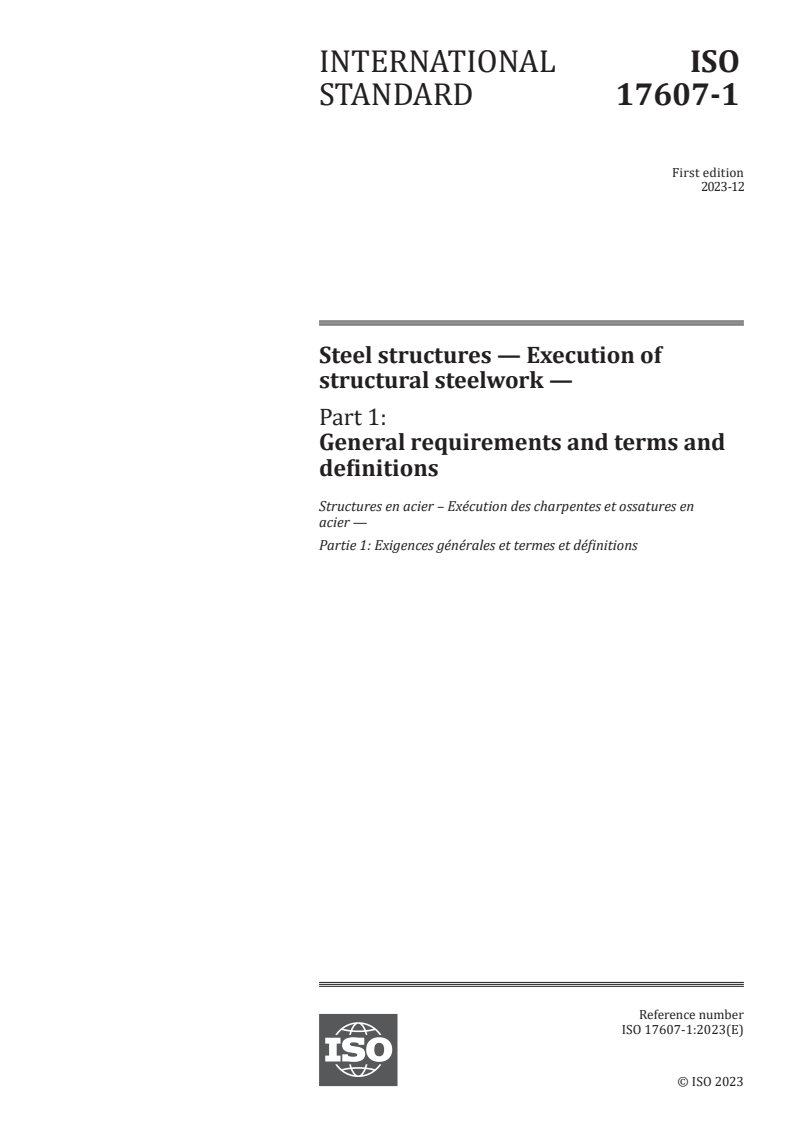
INTERNATIONAL ISO
STANDARD 17607-1
First edition
2023-12
Steel structures — Execution of
structural steelwork —
Part 1:
General requirements and terms and
definitions
Structures en acier – Exécution des charpentes et ossatures en
acier —
Partie 1: Exigences générales et termes et définitions
Reference number
© ISO 2023
All rights reserved. Unless otherwise specified, or required in the context of its implementation, no part of this publication may
be reproduced or utilized otherwise in any form or by any means, electronic or mechanical, including photocopying, or posting on
the internet or an intranet, without prior written permission. Permission can be requested from either ISO at the address below
or ISO’s member body in the country of the requester.
ISO copyright office
CP 401 • Ch. de Blandonnet 8
CH-1214 Vernier, Geneva
Phone: +41 22 749 01 11
Email: copyright@iso.org
Website: www.iso.org
Published in Switzerland
ii
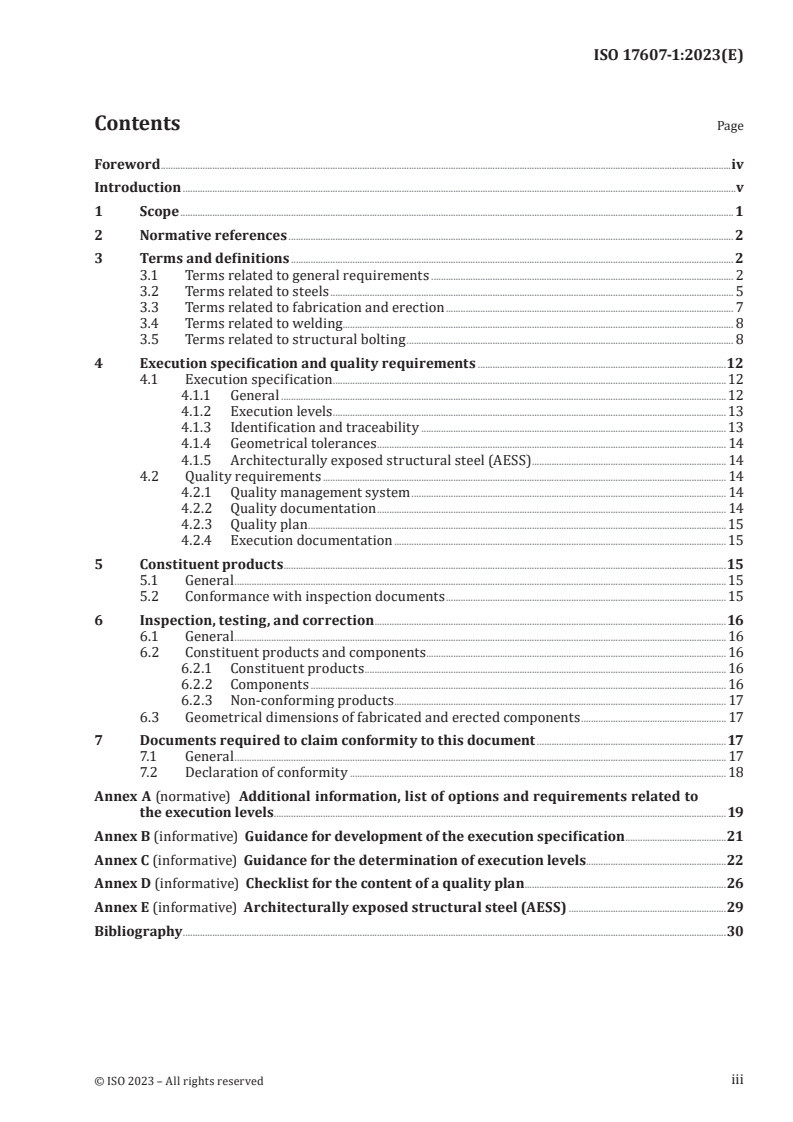
Contents Page
Foreword .iv
Introduction .v
1 Scope . 1
2 Normative references . 2
3 Terms and definitions . 2
3.1 Terms related to general requirements . 2
3.2 Terms related to steels . 5
3.3 Terms related to fabrication and erection . 7
3.4 Terms related to welding. 8
3.5 Terms related to structural bolting . 8
4 Execution specification and quality requirements .12
4.1 Execution specification .12
4.1.1 General .12
4.1.2 Execution levels . 13
4.1.3 Identification and traceability . 13
4.1.4 Geometrical tolerances . 14
4.1.5 Architecturally exposed structural steel (AESS) . 14
4.2 Quality requirements . 14
4.2.1 Quality management system . 14
4.2.2 Quality documentation . 14
4.2.3 Quality plan .15
4.2.4 Execution documentation . 15
5 Constituent products .15
5.1 General . 15
5.2 Conformance with inspection documents . 15
6 Inspection, testing, and correction .16
6.1 General . 16
6.2 Constituent products and components . 16
6.2.1 Constituent products . 16
6.2.2 Components . 16
6.2.3 Non-conforming products . 17
6.3 Geometrical dimensions of fabricated and erected components . 17
7 Documents required to claim conformity to this document .17
7.1 General . 17
7.2 Declaration of conformity . 18
Annex A (normative) Additional information, list of options and requirements related to
the execution levels.19
Annex B (informative) Guidance for development of the execution specification .21
Annex C (informative) Guidance for the determination of execution levels.22
Annex D (informative) Checklist for the content of a quality plan .26
Annex E (informative) Architecturally exposed structural steel (AESS) .29
Bibliography .30
iii
Foreword
ISO (the International Organization for Standardization) is a worldwide federation of national standards
bodies (ISO member bodies). The work of preparing International Standards is normally carried out
through ISO technical committees. Each member body interested in a subject for which a technical
committee has been established has the right to be represented on that committee. International
organizations, governmental and non-governmental, in liaison with ISO, also take part in the work.
ISO collaborates closely with the International Electrotechnical Commission (IEC) on all matters of
electrotechnical standardization.
The procedures used to develop this document and those intended for its further maintenance are
described in the ISO/IEC Directives, Part 1. In particular, the different approval criteria needed for the
different types of ISO documents should be noted. This document was drafted in accordance with the
editorial rules of the ISO/IEC Directives, Part 2 (see www.iso.org/directives).
ISO draws attention to the possibility that the implementation of this document may involve the use
of (a) patent(s). ISO takes no position concerning the evidence, validity or applicability of any claimed
patent rights in respect thereof. As of the date of publication of this document, ISO had not received
notice of (a) patent(s) which may be required to implement this document. However, implementers are
cautioned that this may not represent the latest information, which may be obtained from the patent
database available at www.iso.org/patents. ISO shall not be held responsible for identifying any or all
such patent rights.
Any trade name used in this document is information given for the convenience of users and does not
constitute an endorsement.
For an explanation of the voluntary nature of standards, the meaning of ISO specific terms and
expressions related to conformity assessment, as well as information about ISO's adherence to
the World Trade Organization (WTO) principles in the Technical Barriers to Trade (TBT), see
www.iso.org/iso/foreword.html.
This document was prepared by Technical Committee ISO/TC 167, Steel and aluminium structures.
This first edition cancels and replaces ISO 10721-2:1999, which has been technically revised.
A list of all parts in the ISO 17607 series can be found on the ISO website.
Any feedback or questions on this document should be directed to the user’s national standards body. A
complete listing of these bodies can be found at www.iso.org/members.html.
iv
Introduction
Specific requirements for the achievement of structures that are optimal with respect to safety, the
state of the economy, development and general values of a nation are given in the appropriate regional
or national standards, if they exist.
Many nations do not have their own standards for structural steelwork. Some refer to other national
or regional standards. Some permit the project’s standard to be selected by the owner, designer or
constructor of the structure. Some do not require any standards to be followed.
The ISO 17607 series of standards on the execution of structural steelwork was developed to serve
as a means to provide a set of requirements and guidance for projects that are constructed without a
governing regional or national standard. The ISO 17607 series can also serve to reduce trade barriers.
Additional requirements to be addressed in the execution of structural steelwork, as structures or as
fabricated components, can be found in the other parts of the series:
— ISO 17607-2 (Steels);
— ISO 17607-3 (Fabrication);
— ISO 17607-4 (Erection);
— ISO 17607-5 (Welding);
— ISO 17607-6 (Bolting).
v
INTERNATIONAL STANDARD ISO 17607-1:2023(E)
Steel structures — Execution of structural steelwork —
Part 1:
General requirements and terms and definitions
1 Scope
This document defines general requirements for the execution of structural steelwork for:
— structural steel buildings;
— general structures, designed, fabricated, and erected in a manner similar to buildings with building-
like load-resisting elements, e.g. support framing for equipment, tanks, vessels, and pipelines;
— crane-supporting structures;
— typical roadway and pedestrian bridges including those constructed using rolled sections, welded
plate girders, or trusses (lattices).
This document applies to structures or fabricated components that are produced from:
— hot-rolled and cold-formed structural steel products up to and including a nominal yield strength of
700 MPa with a thickness of 3 mm and above;
— hot-finished and cold-formed structural steel hollow sections, up to and including a nominal yield
strength of 700 MPa, including standard range and custom-made rolled products and hollow
sections manufactured by welding.
This document also applies to steel components in composite steel and concrete structures, and in
structures combining steel with other materials.
This document defines requirements independent of the type and shape of the steel structure,
including structures subjected to fatigue or seismic loading. The requirements are expressed in terms
of execution levels.
This document does not define all requirements for other types of fabricated steel structures (e.g.
railway bridges, roadway and pedestrian bridges using welded box sections or arch boxes, cable-
supported bridges over 100 m span, moving bridges, monorails, steel towers, masts, chimneys, silos,
tanks, pipelines, antennae, offshore platforms). However, this document provides general guidance
regarding fabrication and erection practices that may be used together with the appropriate ISO,
regional or national design standards for such structures.
This document does not cover requirements for the following:
— sheeting;
— fabrication of stainless steels.
This document does not apply to design of steel structures.
NOTE Design is inextricably a part of the design-fabrication-erection sequence, including the application of
tolerances, and cannot be considered in isolation.
This document is intended to be used, as appropriate, together with national standards and other
documents, observing the provisions in this document concerning such use.
2 Normative references
The following documents are referred to in the text in such a way that some or all of their content
constitutes requirements of this document. For dated references, only the edition cited applies. For
undated references, the latest edition of the referenced document (including any amendments) applies.
ISO 6707-1, Buildings and civil engineering works — Vocabulary — Part 1: General terms
ISO 6707-2, Buildings and civil engineering works — Vocabulary — Part 2: Contract and communication
terms
ISO 7976-1, Tolerances for building — Methods of measurement of buildings and building products — Part
1: Methods and instruments
ISO 7976-2, Tolerances for building — Methods of measurement of buildings and building products — Part
2: Position of measuring points
ISO/TR 25901-1, Welding and allied processes — Vocabulary — Part 1: General terms
3 Terms and definitions
For the purposes of this document, the terms and definitions given in ISO 6707-1, ISO 6707-2 and
ISO/TR 25901-1 and the following apply.
ISO and IEC maintain terminology databases for use in standardization at the following addresses:
— ISO Online browsing platform: available at https:// www .iso .org/ obp
— IEC Electropedia: available at https:// www .electropedia .org/
3.1 Terms related to general requirements
3.1.1
structure
organized combination of connected parts designed to carry loads and provide rigidity, redundancy,
and structural stability
3.1.2
structural steelwork
steel structures or fabricated steel components used in construction works (3.1.4)
3.1.3
architecturally exposed structural steel
AESS
structural steelwork (3.1.2) exposed to view with additional requirements specified to achieve
designated aesthetic qualities
3.1.4
construction works
everything that is constructed or results from construction operations
Note 1 to entry: This term covers both building and civil engineering works. It refers to the complete construction
comprising both structural and non-structural components.
3.1.5
constructor
person or organization executing the structural steelwork (3.1.2)
Note 1 to entry: Multiple constructors may be involved in a project.
Note 2 to entry: The term constructor includes fabricator and erector.
Note 3 to entry: In ISO 9000, the term "supplier" (3.1.7) is used.
3.1.6
manufacturer
organization that manufactures the respective products according to the requirements of the order
and to properties specified in the referenced product specification or execution specification (3.1.10)
Note 1 to entry: As used in this document, the term manufacturer does not include the organization performing
fabrication (3.1.9), which is termed the constructor (3.1.5).
[SOURCE: ISO 10474:2013, 3.4, modified, — Added reference to execution specification.]
3.1.7
supplier
organization that is supplied with products by the manufacturers (3.1.6) and that then, in turn, supplies
them without further processing or after processing without changing the properties specified in the
purchase order, the referenced product specification or execution specification (3.1.10)
Note 1 to entry: Examples of suppliers can be steel service centres and stockists.
[SOURCE: ISO 10474:2013, 3.5, modified — Changed term from intermediary to supplier, added
reference to execution specification.]
3.1.8
execution
all activities performed for the physical completion of the structural steelwork (3.1.2), i.e. procurement,
fabrication (3.1.9), welding, bolting, transportation, erection, and the inspection and documentation
thereof
3.1.9
fabrication
DEPRECATED: manufacturing
all activities required to produce and deliver a component
Note 1 to entry: As relevant, this comprises, e.g. procurement, preparation (3.3.9) and assembly, welding, bolting,
transportation, and the inspection and documentation thereof.
3.1.10
execution specification
set of documents covering technical data and requirements for a particular steel structure, including
those specified to supplement and qualify the rules of this document
Note 1 to entry: Execution specification includes requirements where this document identifies items to be
specified.
3.1.11
specifier
organization, firm, agency, or individual responsible for development and maintenance of the execution
specification (3.1.10)
3.1.12
execution level
classified set of requirements specified for the execution of the structural steelwork (3.1.2) as a whole,
of an individual component or a detail of a component
Note 1 to entry: Execution level is similar to, but not necessarily identical to, execution classes in other standards.
Note 2 to entry: Execution levels are described in Annex A and Annex C, Table C.1 and Table C.2.
3.1.13
constituent product
material and product used for fabricating a sub-component (3.1.18) or component (3.1.16) and which
remains as part of it
EXAMPLE Steel product (3.1.14), bolting product, welding consumable.
3.1.14
steel product
constituent product (3.1.13) supplied as hot-rolled or cold-formed steel shapes, plates or bars, or as hot-
finished or cold-formed steel hollow sections
3.1.15
inspection document
document, issued by the manufacturer (3.1.6), or supplier (3.1.7) if applicable, and supplied to the
purchaser, of the constituent product (3.1.13) that describes properties of supplied constituent product
in a way that enables it to be compared to the specified properties
Note 1 to entry: For further information, see ISO 10474 for steels and steel products (3.1.14) and ISO 16228 for
bolting and fastener products.
EXAMPLE 1 Manufacturer's certificate of compliance, manufacturer's test report, material test report.
EXAMPLE 2 Declaration of compliance 2.1, test report 2.2, or inspection certificates 3.1 and 3.2 for the
material.
3.1.16
component
shipping piece
shipping member
erectable part of a steel structure, which can itself be an assembly of several sub-components (3.1.18)
3.1.17
main component
primary load-carrying steel component
Note 1 to entry: Main components can be identified in the execution specification (3.1.10).
Note 2 to entry: This excludes sub-components.
EXAMPLE Beam, girder. column, bracing, truss.
3.1.18
sub-component
constituent product (3.1.13) that is transformed or fabricated to be incorporated into a fabricated
component or into the erected steel structure
EXAMPLE Connection (3.5.14) detail, stiffener, curb angle.
3.1.19
identification
ability of recognizing, by way of suitable tagging, tracking, marking or other means, the identity of a
specific piece or pieces, products, processes, procedures or personnel
3.1.20
identification means
descriptive matter, including tags, words, particulars, trademarks, brand name, pictorial matter,
symbols, or other methods referring to constituent product (3.1.13), process, or personnel, written,
printed, stencilled, marked, embossed or impressed on, or attached to a piece or component and
referenced in the constructor's (3.1.5) documentation
3.1.21
identification document
set of data enabling the identity of constituent product (3.1.13), process, or personnel
EXAMPLE Inspection documents (3.1.15), material test reports, heat treatment documents, welding
procedure specifications, welder and welding operator certificates.
3.1.22
traceability
process and ability of associating product, process, procedure, or personnel back to non-specific data
related to the respective family of either products or relevant fabrication (3.1.9) processes, or both, e.g.
inspection documents (3.1.15) or identification marks
Note 1 to entry: Additional information and levels of traceability are given in C.3.
3.1.23
lot traceability
process and ability of associating product, process, procedure, or personnel back to specific data related
to an individual lot of either products or individual fabrication (3.1.9) processes, or both, e.g. specific
inspection documents (3.1.15) or individual lot identification marks
3.1.24
quality plan
document or set of documents that describes the standards, quality practices, resources and processes
pertinent to a specific product, service or project
3.1.25
inspection and test plan
ITP
document providing the type and sequence of inspections and tests, including appropriate resources,
procedures and other relevant information
Note 1 to entry: Inspection and test plans may be presented as a single document or as a series of interdependent
or supporting documents.
3.1.26
inspector
party responsible to ensure that the constructor (3.1.5) has satisfied the requirements stated in the
execution specification (3.1.10) in the work
3.1.27
inspection report
document prepared by an inspector (3.1.26) of materials, fabrication (3.1.9), erection, welding, or bolting,
according to an inspection and test plan (3.1.25) that describes conformance or non-conformance with
specified requirements
3.1.28
nonconformity
non-fulfilment of a requirement
[SOURCE: ISO 9000:2015, 3.6.9, modified — Deleted Note 1 to entry.]
3.2 Terms related to steels
3.2.1
as-rolled steel
steel without any special rolling and/or heat treatment condition
Note 1 to entry: Adapted from ISO 630-6:2014, 3.1.
3.2.2
normalized steel
steel produced by heating to a suitable temperature above the transformation range and then cooling in
air to a temperature substantially below the transformation range
Note 1 to entry: For structural steel hollow sections, the definition for normalizing in ISO 4885 may be used.
Note 2 to entry: Adapted from ISO 630-6:2014, 3.2.
3.2.3
quenched steel
steel subjected to cooling more rapidly than in still air from a high temperature above Ac1
Note 1 to entry: Ac1 is the temperature at which austenite begins to form during heating.
Note 2 to entry: Adapted from ISO 630-6:2014, 3.3.
3.2.4
tempered steel
steel subjected to heat treatment, generally after quench hardening or another heat treatment to bring
the properties to the required level, and consisting of heating to specific temperatures (< Ac1) and
soaking for an appropriate duration followed by cooling at an appropriate rate
Note 1 to entry: Additionally, the following may apply: processes of direct quenching plus tempering.
Note 2 to entry: Adapted from ISO 630-6:2014, 3.4.
3.2.5
thermomechanical processed steel
steel rolled with a process in which the final deformation is carried out in a certain temperature range
leading to a material condition with certain properties which cannot be achieved or repeated by heat
treatment alone
Note 1 to entry: Hot forming or post-weld heat treatment above 580 °C can lower the strength values and should
not be performed. Flame straightening may be applied in accordance with relevant technical recommendations.
Note 2 to entry: Thermomechanical rolling can include processes with an increasing cooling rate with or without
tempering, including self-tempering but excluding direct quenching and quenching and tempering.
Note 3 to entry: In some publications, the term “Thermomechanical Control Process” is also used.
Note 4 to entry: Adapted from ISO 630-6:2014, 3.5.
3.2.6
atmospheric corrosion resistant steel
steel with the ability to resist degradation or alteration of material through chemical reaction with the
surrounding atmosphere
Note 1 to entry: Adapted from ASTM A941: 2017, 3, atmospheric corrosion resistance.
3.2.7
cold formed component
cold formed long products or profiled sheet having various cross-section shapes, either open or with
edges abutting, constant along their length, made from coated or uncoated hot or cold rolled flat
products whose thicknesses are only slightly modified by the cold forming process (e.g. profiling,
drawing, press forming, flanging)
[SOURCE: EN 1090-2:2018, 3.9.1]
3.3 Terms related to fabrication and erection
3.3.1
tolerance
difference between the upper limit of size and the lower limit of size
Note 1 to entry: Tolerance is an absolute value without sign.
Note 2 to entry: In building construction, tolerance is commonly expressed by “± permitted deviation” so that the
value of the tolerance is implicit.
[SOURCE: EN 1090-2:2018, 3.15, modified — Note 2 to entry was added.]
3.3.2
fabrication tolerance
manufacturing tolerance
permitted range in the size or dimensions of a component resulting from component fabrication
3.3.3
erection tolerance
permitted range in the position of an erected component
3.3.4
essential tolerance
basic limits for a geometrical tolerance necessary to satisfy the design assumptions for structures in
terms of mechanical resistance and stability
[SOURCE: EN 1090-2:2018, 3.15.1]
3.3.5
functional tolerance
geometrical tolerance which may be specified to meet a function other than mechanical resistance and
stability, e.g. appearance or fit up
[SOURCE: EN 1090-2:2018, 3.15.2]
3.3.6
special tolerance
geometrical tolerance which is not covered by the tabulated types or values of tolerances given in this
document, and which needs to be specified in a particular case
[SOURCE: EN 1090-2:2018, 3,15,3, modified — Removed reference to European standard.]
3.3.7
limit tolerance
maximum or minimum value for the acceptance criteria that shall not be exceeded
[40]
[SOURCE: JASS 6, Appendix 6]
3.3.8
control tolerance
target value used as a criterion for fabrication or erection so that 95% or more of the products can be
accepted based on receiving inspection for dimensional accuracy
Note 1 to entry: An accepted value used to judge whether the inspection lot can be accepted or rejected.
[40]
[SOURCE: JASS 6, Appendix 6]
3.3.9
preparation
all activities performed on the constituent steel products (3.1.14) to produce the parts ready for
assembly and inclusion in components
Note 1 to entry: As relevant, this comprises, e.g. identification, handling and storage, cutting, shaping and holing.
Note 2 to entry: Not as applied to preparation of steel substrates for the application of coatings.
3.3.10
design basis procedure for erection
design erection sequence
outline of a procedure for erection upon which the design of the structure is based
3.3.11
erection procedure
documentation describing the procedures to be used to erect a structure
3.3.12
trial assembly
putting together sufficient components of a whole structure to check that they fit
3.4 Terms related to welding
3.4.1
prefabrication primer
shop primer
primer that is applied to materials and may or may not be removed prior to any fabrication activities
(e.g. cutting, welding) being performed
3.4.2
supplementary non-destructive testing
supplementary NDT
non-destructive testing (NDT) technique which is other than visual inspection (VT)
EXAMPLE Magnetic particle (MT), penetrant (PT), eddy current (ET), ultrasonic (UT) or radiographic (RT)
testing.
Note 1 to entry: VT, MT, PT, ET, UT, RT are defined in ISO 17635.
3.5 Terms related to structural bolting
3.5.1
high-strength bolt
bolt with a property class of 8.8 or higher, or with a tensile strength of 830 MPa or higher, used for
structural purposes
3.5.2
washer
component of a bolting assembly (3.5.4) that accepts a bolt through its centre hole
Note 1 to entry: A washer is typically plain or chamfered.
Note 2 to entry: A washer provides a surface to distribute bearing stress and provides a hardened surface for
head or nut rotation during tightening.
Note 3 to entry: Adapted from ASTM F1789 -17a: 2017, 3, plain washer.
3.5.3
pin
unthreaded fastener
3.5.4
bolting assembly
bolt, nut and washer(s) as necessary, that is installed as a unit
Note 1 to entry: The bolt, nut and washer(s) may be sourced from different manufacturers (3.1.6).
3.5.5
matched bolting assembly
matching bolt, nut and washer(s) as necessary, that is supplied, tested and installed as a unit
Note 1 to entry: The bolt, nut and washer(s) may be sourced from different manufacturers (3.1.6).
3.5.6
manufacturing lot
quantity of structural bolting components of a single designation including product grade, property
class and size, manufactured from bar, wire, rod or flat product from a single cast, processed through
the same or similar steps at the same time or over a continuous time period, and through the same heat
treatment or coating process, if any
3.5.7
assembly lot
bolting assemblies supplied together as a set comprising:
— bolts from a single manufacturing lot (3.5.6);
— nuts from a single manufacturing lot;
— washers from a single manufacturing lot.
3.5.8
extended assembly lot
assembly lot containing the component with the main influence on the result of the suitability test from
a single manufacturing lot (3.5.6) and the other components from several manufacturing lots
Note 1 to entry: The component having the main influence (either nut or direct tension indicator) is determined
on the basis of test results.
Note 2 to entry: An extended bolting assembly lot contains bolts, nuts and washers and, if relevant, direct tension
indicators and nut face washers or bolt face washers.
3.5.9
bolt group
bolting assemblies of the same origin in similar connections (3.5.14) with the bolting assemblies of the
same size and property class
Note 1 to entry: This term is used for purposes of inspection.
3.5.10
special fastener
fastener that is not covered by international or national standards
3.5.11
non-slip fastener
fastener that does not allow slip to occur between connected plates or members at the serviceability
limit state so that the original alignment and relative positions are maintained, even without pretension
EXAMPLE Pins (3.5.3), fit bolts.
3.5.12
k-factor
relationship between the applied tightening torque, M, and the achieved pretension, F
k = M / (F × d)
where d is the nominal diameter of the bolting assembly (3.5.4)
3.5.13
k-class
value used to express the ability of a bolting assembly to be pretensioned by a method that relies upon
the application of a specific torque
Note 1 to entry: k-class is as specified in EN 14399-1:2015, 4, 5, and Table 1.
Note 2 to entry: k-class K0 indicates no requirements for k-factor (3.5.12); K1 indicates individual test value
between 0,10 and 0,16, inclusive; K2 indicates mean test value between 0,10 and 0,23, inclusive, and coefficient of
variation of k-factor (3.5.12) less than or equal to 0,06.
3.5.14
connection
joint
location where sub-components (3.1.18) and components are joined
Note 1 to entry: The term joint is more commonly used to describe the type or behaviour of a connection.
3.5.15
bearing-type joint
shear/bearing joint
joint using either non-pretensioned bolts, or high-strength bolts (3.5.1) tightened to induce a specified
minimum bolt pretension, in which the design action is transferred by shear in the bolts and bearing on
the connected parts at the strength limit state
3.5.16
pretensioned joint
joint that transmits shear or tensile loads, or both, in which the bolts have been installed to provide a
specified pretension in the installed bolt
3.5.17
non-pretensioned joint
snug-tight joint
joint in which the bolts have been installed to achieve the snug-tight condition, without requirements to
provide a specified pretension in the bolt, in which the design action is transferred by shear in the bolts
and bearing on the connected parts at the strength limit state
3.5.18
snug-tight condition
condition that exists when all of the plies in a connection (3.5.14) have been pulled into firm contact
(3.5.26) by the bolts in the joint and all of the bolts in the joint have been tightened sufficiently to
prevent the removal of the nuts without the use of a wrench
Note 1 to entry: For pretensioned (3.5.16) and slip-resistant joints (3.5.19), it is additionally the tightness of a bolt
achieved by a few impacts of an impact wrench or by the full effort of a person using a standard podger spanner
(3.5.37).
3.5.19
slip-resistant joint
slip-critical joint
friction-type joint
friction-grip joint
connection (3.5.14) using high-strength bolts (3.5.1) tightened to induce a specified minimum bolt
pretension so that the resultant clamping action transfers the design shear forces acting in the plane of
the common contact surfaces by the friction developed between the contact surfaces
3.5.20
faying surface
plane of contact between two plies of a bolted joint
3.5.21
uncoated faying surface
faying surface (3.5.20) that has neither been primed, painted, nor galvanized and is free of loose scale,
dirt and other foreign material
3.5.22
coated faying surface
faying surface (3.5.20) that has been primed, primed and painted or protected against corrosion, except
by hot-dip galvanizing
3.5.23
galvanized faying surface
faying surface (3.5.20) that has been hot-dip galvanized
3.5.24
friction surface
faying surface (3.5.20) that provides a specific slip resistance in a slip-resistant joint (3.5.19)
3.5.25
slip factor
ratio of the frictional shear load at the faying surface (3.5.20) to the total normal force when slip occurs
3.5.26
firm contact
condition that exists on a faying surface (3.5.20) when the plies are solidly seated against each other,
but not necessarily in continuous contact
3.5.27
packing
filler plate
plate used to build up the thickness of one component
3.5.28
grip
plies of a joint through which the bolt passes, exclusive of washers or direct-tension indicators
3.5.29
protected storage
continuous protection of structural bolting components in closed containers in a protected shelter
3.5.30
pretensioning
DEPRECATED: preloading
installing and applying a specified pretension in a bolt
Note 1 to entry: Methods for pretensioning are provided in ISO 17607-6.
3.5.31
bolt tension measurement device
calibrated tension-indicating device that is used to verify the acceptability of the pretensioning (3.5.30)
method when a pretensioned joint (3.5.16) or slip-critical joint (3.5.19) is specified
3.5.32
torque method
method of pretensioning (3.5.30) that relies upon the application of a specific torque to the designated
part of the bolting assembly (3.5.4)
3.5.33
combined method
method of pretensioning (3.5.30) that relies upon the application of a specific torque to the designated
part of the bolting assembly (3.5.4), followed by the application of a specific relative rotation between
bolt and nut
3.5.34
spline-drive twist-off method
method of pretensioning (3.5.30) that relies upon the application of a torque to the nut that causes, from
the torsional shear applied to the spline by the wrench, the removal of the spline from the end of the
bolt
3.5.35
direct tension indicator method
method of pretensioning (3.5.30) that relies upon specific deformation of the protrusions of the direct
tension indicator
3.5.36
turn-of-nut method
method of pretensioning (3.5.30) that relies upon application of a specific relative rotation between bolt
and nut, starting from the snug-tight condition (3.5.18)
3.5.37
podger spanner
spud wrench
hand tool for aligning bolt holes and tightening bolts using the manual effort of the installer
3.5.38
twist-off shear wrench
electric or manual tool equipped with two co-axial sockets which react by torque one against the other,
the outer socket which engages the nut rotating clockwise, the inner socket which engages the spline-
end of the bolt (i.e. bi-hexagonal) rotating anticlockwise
3.5.39
routine observation
periodic monitoring of the work in progress
4 Execution specification and quality requirements
4.1 Execution specification
4.1.1 General
The specifier shall develop and maintain an execution specification for the structural steelwork.
National standards and documents that provide technically equivalent conditions may be used, in
whole or in part, in place of referenced ISO standards or requirements of this document. In these cases,
the technically equivalent national standards and documents, and deviations from the requirements of
this document, shall be referenced in the execution specification.
The necessary information and technical requirements for execution of each part of the structural
steelwork shall be agreed and completed before commencement of execution of that part of the
structural steelwork.
The execution specification shall include the following items as relevant:
a) additional information, see A.1;
b) options, see A.2;
c) execution levels, see 4.1.2;
d) identification and traceability requirements, see 4.1.3;
e) geometrical tolerances, see 4.1.4;
f) requirements for architecturally exposed structural steel (AESS), see 4.1.5;
g) requirement for a quality plan, see 4.2.3;
h) inspection, testing and corrections to be undertaken, see 6.1;
i) requirements specified on behalf of the purchaser/client.
Other items may be included in the execution specification, e.g. which components are designated as
main components.
There shall be procedures for making alterations to a previously agreed execution specification.
Guidance on the development of the execution specification is given in Annex B.
4.1.2 Execution levels
Four execution levels, denoted EXL1 to EXL4, are given, for which the required strictness increases
from EXL1 to EXL4. A description of the requirements is given in Table 1.
Execution levels for fabrication and erection shall be included in the execution specification.
Execution levels may apply to the whole structure or to a part of the structure or to specific details. A
structure can include several execution levels. A detail or group of details will normally be ascribed one
execution level. However, the choice of an execution level does not necessarily have to be the same for
all requirements.
The list of quality requirements related to execution levels is given in A.3.
Recommendations concerning the choice of execution levels are given in Annex C.
4.1.3 Identification and traceability
4.1.3.1 Identification
The requirements for identification shall be specified in the execution specification.
For identification requirements for steels, castings, high-strength cables, and structural bearings, see
ISO 17607-2.
For identification requirements for fabrication and for expansion joints for bridges, see ISO 17607-3.
For identification requirements for erection, see ISO 17607-4.
For identification requirements for welding consumables, shielding gases, and studs, see ISO 17607-5.
For identification requirements for bolting products and assemblies, see ISO 17607-6.
Identification documents shall be retained for all constituent products. The retention period shall be
specified in the execution specification.
For marking using steel stamps, see ISO 17607-3.
4.1.3.2 Traceability
The level of traceability shall be as required in Table 1 unless otherwise specified in the execution
specification. If required, the execution specification shall also identify and specify additional
traceability requirements for processes, procedures, operators, welders, machines, constituent
products, inspection records, or other factors in addition to those specified.
Table 1 — Traceability requirements
Execution Traceability
Requirement
level level
Traceability to the inspection documents for steel products is not
EXL1 T1
required.
Lot traceability to the inspection documents for steel products shall
EXL2 T2
be performed for main components.
Lot traceability to the inspection documents for steel products shall
EXL3 T3 be performed for main components and for steel sub-component
connections between main components.
Lot traceability to the inspection documents for all constituent
EXL4 T4
products is required.
4.1.4 Geometrical tolerances
The selection or designation of geometrical tolerances shall consider requirements for structural
stability for individual elements and for the structural system as a whole.
Geometrical tolerances for fabrication and erection shall be included in the execution specification.
Geometrical tolerances for fabrication are addressed in ISO 17607-3. Geometrical tolerances for
erection are addressed in ISO 17607-4.
NOTE Tolerances for constituent products are addressed in their applicable product standards.
4.1.5 Architecturally exposed structural steel (AESS)
If the structural steelwork includes items that are designated as architecturally exposed, the location
and requirements shall be included in the execution specification.
Natio
...
Questions, Comments and Discussion
Ask us and Technical Secretary will try to provide an answer. You can facilitate discussion about the standard in here.
Loading comments...