


ISO 18953:2025
(Main)Steel structures — Structural bolting — Test methods to determine loss of pretension from faying surface coatings
Steel structures — Structural bolting — Test methods to determine loss of pretension from faying surface coatings
This document specifies test methods to determine loss of pretension in high-strength bolts due to the presence of coatings on the faying surface(s) of a bolted joint to be used in structural steelwork, when any of the coatings are thick enough to affect the pretension in a bolt in the short term, or can show significant deformation over time under sustained loads (creep-prone materials). The presence within the grip of the bolt of other materials having considerably smaller stiffness than steel, such as insulation, is not included in this test method.
Structures en acier — Boulonnerie de construction métallique — Méthodes d’essai pour déterminer la perte de précontrainte due aux revêtements de surface
General Information
- Status
- Published
- Publication Date
- 11-Dec-2025
- Technical Committee
- ISO/TC 167 - Steel and aluminium structures
- Drafting Committee
- ISO/TC 167 - Steel and aluminium structures
- Current Stage
- 6060 - International Standard published
- Start Date
- 12-Dec-2025
- Due Date
- 29-Nov-2025
- Completion Date
- 12-Dec-2025
Overview
ISO 18953:2025 - "Steel structures - Structural bolting - Test methods to determine loss of pretension from faying surface coatings" specifies laboratory test methods to quantify loss of pretension in high‑strength bolts caused by coatings on faying surfaces. It applies when coatings are thick enough (typically > 100 μm) or are creep‑prone and can deform under sustained load. The standard excludes effects from soft materials inside the bolt grip (e.g., insulation).
Key topics and requirements
- Scope and applicability: Focused on pretensioned bolted joints in structural steelwork where coatings (liquid‑applied, galvanizing, thermal spray, duplex systems, etc.) may reduce bolt pretension.
- Significant variables to control and report:
- Surface treatment and coating composition
- Coating thickness and layer treatment
- Curing parameters and time between coating and pretensioning
- Bolt, nut and washer properties, and pretensioning sequence
- Bolt spacing and joint geometry
- Test assemblies: Defines single‑bolt (Test A) and multiple‑bolt (Test B) configurations and related geometric/bolting requirements.
- Measurement methods: Acceptable instruments include bolt strain gages and donut (through‑hole) load cells; devices must meet calibration standards (ISO 376 or ASTM E4). Other methods can be used if validated against these.
- Pretension loss vs log(time): Tests produce a pretension‑loss vs log(time) curve for extrapolation to design life. Minimum test duration is 14 days; results can be extrapolated to the expected service life.
- Limitations: The method relates pretension loss to coating thickness/characteristics but does not assess effects on friction coefficients for slip‑resistant connections.
Practical applications
- Evaluating whether a protective coating or coating system is suitable for use in pretensioned structural bolted joints.
- Verifying pretension losses for coatings thicker than 100 μm or for coatings likely to creep under sustained load.
- Supporting design decisions, acceptance criteria, and quality control for structural fabricators, coating manufacturers, and testing laboratories.
- Informing maintenance, inspection, and durability assessments by estimating long‑term pretension loss.
Who should use this standard
- Structural and civil engineers specifying bolted connections
- Fabrication and erection contractors
- Coating formulators and applicators
- Materials and structural testing laboratories
- Quality assurance/inspection bodies and certification organizations
Related standards
- ISO 17607‑1 and ISO 17607‑6:2023 (execution and bolting of structural steelwork)
- ISO 376 (force calibration)
- ISO 8503‑1 (surface roughness for blast‑cleaned steel)
- ASTM B659, ASTM E4, SSPC‑PA 2
Keywords: ISO 18953, structural bolting, loss of pretension, faying surface coatings, test methods, pretension measurement, high‑strength bolts, bolt strain gages, donut load cell.

Get Certified
Connect with accredited certification bodies for this standard

ICC Evaluation Service
Building products evaluation and certification.

QAI Laboratories
Building and construction product testing and certification.

Aboma Certification B.V.
Specialized in construction, metal, and transport sectors.
Sponsored listings
Frequently Asked Questions
ISO 18953:2025 is a standard published by the International Organization for Standardization (ISO). Its full title is "Steel structures — Structural bolting — Test methods to determine loss of pretension from faying surface coatings". This standard covers: This document specifies test methods to determine loss of pretension in high-strength bolts due to the presence of coatings on the faying surface(s) of a bolted joint to be used in structural steelwork, when any of the coatings are thick enough to affect the pretension in a bolt in the short term, or can show significant deformation over time under sustained loads (creep-prone materials). The presence within the grip of the bolt of other materials having considerably smaller stiffness than steel, such as insulation, is not included in this test method.
This document specifies test methods to determine loss of pretension in high-strength bolts due to the presence of coatings on the faying surface(s) of a bolted joint to be used in structural steelwork, when any of the coatings are thick enough to affect the pretension in a bolt in the short term, or can show significant deformation over time under sustained loads (creep-prone materials). The presence within the grip of the bolt of other materials having considerably smaller stiffness than steel, such as insulation, is not included in this test method.
ISO 18953:2025 is classified under the following ICS (International Classification for Standards) categories: 91.080.13 - Steel structures. The ICS classification helps identify the subject area and facilitates finding related standards.
ISO 18953:2025 is available in PDF format for immediate download after purchase. The document can be added to your cart and obtained through the secure checkout process. Digital delivery ensures instant access to the complete standard document.
Standards Content (Sample)
International
Standard
ISO 18953
First edition
Steel structures — Structural
2025-12
bolting — Test methods to
determine loss of pretension from
faying surface coatings
Structures en acier — Boulonnerie de construction métallique —
Méthodes d’essai pour déterminer la perte de précontrainte due
aux revêtements de surface
Reference number
© ISO 2025
All rights reserved. Unless otherwise specified, or required in the context of its implementation, no part of this publication may
be reproduced or utilized otherwise in any form or by any means, electronic or mechanical, including photocopying, or posting on
the internet or an intranet, without prior written permission. Permission can be requested from either ISO at the address below
or ISO’s member body in the country of the requester.
ISO copyright office
CP 401 • Ch. de Blandonnet 8
CH-1214 Vernier, Geneva
Phone: +41 22 749 01 11
Email: copyright@iso.org
Website: www.iso.org
Published in Switzerland
ii
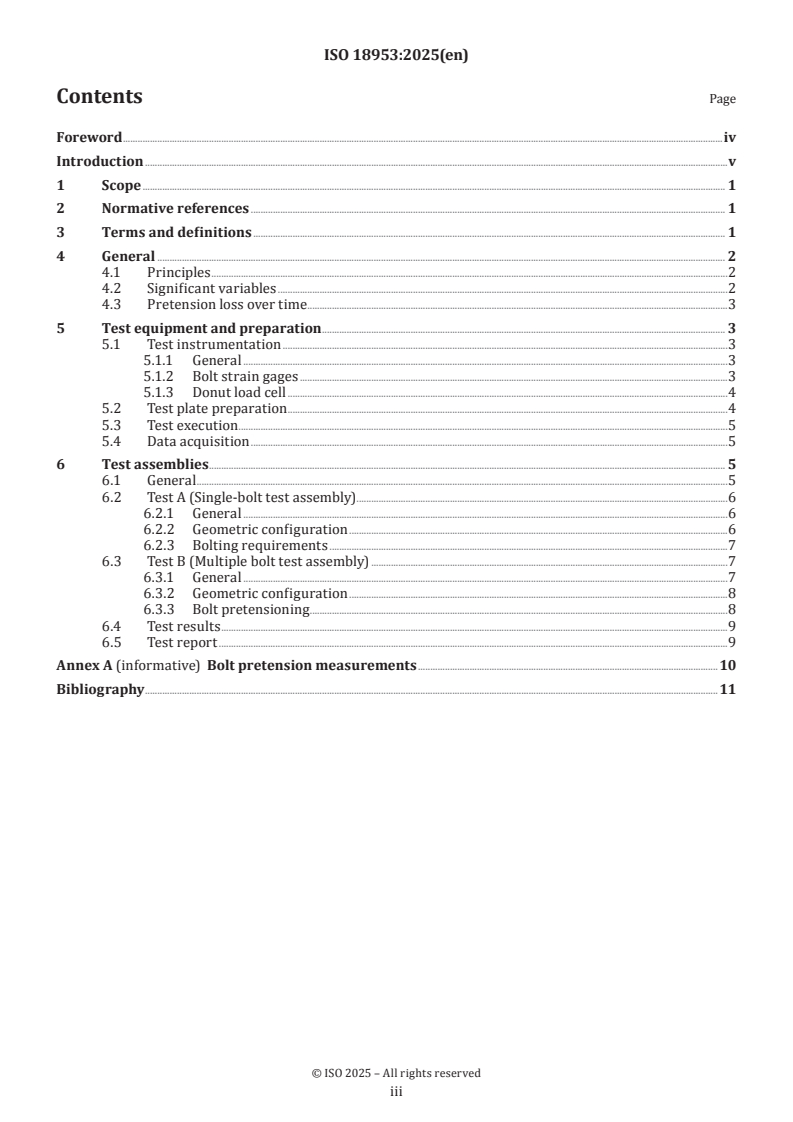
Contents Page
Foreword .iv
Introduction .v
1 Scope . 1
2 Normative references . 1
3 Terms and definitions . 1
4 General . 2
4.1 Principles .2
4.2 Significant variables .2
4.3 Pretension loss over time .3
5 Test equipment and preparation . 3
5.1 Test instrumentation .3
5.1.1 General .3
5.1.2 Bolt strain gages .3
5.1.3 Donut load cell .4
5.2 Test plate preparation .4
5.3 Test execution . .5
5.4 Data acquisition .5
6 Test assemblies . 5
6.1 General .5
6.2 Test A (Single-bolt test assembly) . .6
6.2.1 General .6
6.2.2 Geometric configuration .6
6.2.3 Bolting requirements .7
6.3 Test B (Multiple bolt test assembly) .7
6.3.1 General .7
6.3.2 Geometric configuration .8
6.3.3 Bolt pretensioning . .8
6.4 Test results .9
6.5 Test report .9
Annex A (informative) Bolt pretension measurements . 10
Bibliography .11
iii
Foreword
ISO (the International Organization for Standardization) is a worldwide federation of national standards
bodies (ISO member bodies). The work of preparing International Standards is normally carried out through
ISO technical committees. Each member body interested in a subject for which a technical committee
has been established has the right to be represented on that committee. International organizations,
governmental and non-governmental, in liaison with ISO, also take part in the work. ISO collaborates closely
with the International Electrotechnical Commission (IEC) on all matters of electrotechnical standardization.
The procedures used to develop this document and those intended for its further maintenance are described
in the ISO/IEC Directives, Part 1. In particular, the different approval criteria needed for the different types
of ISO document should be noted. This document was drafted in accordance with the editorial rules of the
ISO/IEC Directives, Part 2 (see www.iso.org/directives).
ISO draws attention to the possibility that the implementation of this document may involve the use of (a)
patent(s). ISO takes no position concerning the evidence, validity or applicability of any claimed patent
rights in respect thereof. As of the date of publication of this document, ISO had not received notice of (a)
patent(s) which may be required to implement this document. However, implementers are cautioned that
this may not represent the latest information, which may be obtained from the patent database available at
www.iso.org/patents. ISO shall not be held responsible for identifying any or all such patent rights.
Any trade name used in this document is information given for the convenience of users and does not
constitute an endorsement.
For an explanation of the voluntary nature of standards, the meaning of ISO specific terms and expressions
related to conformity assessment, as well as information about ISO's adherence to the World Trade
Organization (WTO) principles in the Technical Barriers to Trade (TBT), see www.iso.org/iso/foreword.html.
This document was prepared by Technical Committee ISO/TC 167, Steel and aluminium structures.
Any feedback or questions on this document should be directed to the user’s national standards body. A
complete listing of these bodies can be found at www.iso.org/members.html.
iv
Introduction
This document has been prepared to provide provisions and guidance in the determination of the loss of
pretension of bolts in the presence of coatings on the faying surface of a joint. For pretensioned bolted joints,
the potential loss of pretension can be checked when the coatings applied to any of the individual coated
faying surfaces are thick or consist of a creep-prone material. In this context, coatings exclude adherent mill
scale, and include liquid applied coatings as well as coatings that are the result of a galvanizing or metallizing
process. Examples of coatings include duplex coating and thermal spray coating. Loss of pretension due to
other material, such as insulation, in the grip of a bolt is not considered in this document.
This document provides provisions and guidance on the measurement of pretension loss, considering that
the suitability of the protective coatings or coating systems for use in pretensioned bolted joints depends
on the extent of the possible system reserves due to the tightening procedure, the target of pretensioning,
and the losses over the service life of a structure. The test methods in this document can be also applied to
uncoated faying surfaces.
v
International Standard ISO 18953:2025(en)
Steel structures — Structural bolting — Test methods to
determine loss of pretension from faying surface coatings
1 Scope
This document specifies test methods to determine loss of pretension in high-strength bolts due to the
presence of coatings on the faying surface(s) of a bolted joint to be used in structural steelwork, when any
of the coatings are thick enough to affect the pretension in a bolt in the short term, or can show significant
deformation over time under sustained loads (creep-prone materials).
The presence within the grip of the bolt of other materials having considerably smaller stiffness than steel,
such as insulation, is not included in this test method.
2 Normative references
The following documents are referred to in the text in such a way that some or all of their content constitutes
requirements of this document. For dated references, only the edition cited applies. For undated references,
the latest edition of the referenced document (including any amendments) applies.
ISO 17607-1, Steel structures — Execution of structural steelwork — Part 1: General requirements and terms
and definitions
ISO 17607-6:2023, Steel structures — Execution of structural steelwork — Part 6: Bolting
ISO 376, Metallic materials — Calibration of force-proving instruments used for the verification of uniaxial
testing machines
ISO 8503-1, Preparation of steel substrates before application of paints and related products — Surface
roughness characteristics of blast-cleaned steel substrates — Part 1: Specifications and definitions for ISO
surface profile comparators for the assessment of abrasive blast-cleaned surfaces
ASTM B659, Standard Guide for Measuring Thickness of Metallic and Inorganic Coatings
ASTM E4, Standard Practices for Force Calibration and Verification of Testing Machines
SSPC-PA 2, Procedure for Determining Conformance to Dry Coating Thickness Requirements
3 Terms and definitions
For the purposes of this document, the terms and definitions given in ISO 17607-1 and the following apply.
ISO and IEC maintain terminology databases for use in standardization at the following addresses:
— ISO Online browsing platform: available at https:// www .iso .org/ obp
— IEC Electropedia: available at https:// www .electropedia .org/
3.1
duplex coating
combination of two layers of different materials to give higher corrosion resistance
Note 1 to entry: The layers can be two layers of electroplated metals or can be a plated metal followed by an organic
layer.
[SOURCE: ISO 2080:2022, 3.2.109]
3.2
thermal spray coating
high-temperature process by which finely divided metallic or nonmetallic materials are deposited in a
molten or semi-molten condition to form a coating on a surface when cooled
[SOURCE: ISO 17945:2015, 3.12]
4 General
4.1 Principles
Steel surfaces of pretensioned bolted connections can be coated to protect them against corrosion, to change
the appearance of the surfaces, or to achieve an increased slip resistance.
The suitability for use of the chosen coatings or coating systems in pretensioned bolted connections depends
on the extent of the possible system reserves due to the tightening procedure used (i.e. the actual pretension
level in relation to the nominal minimum pretension force) and on the pretension losses over the service life
of a structure.
EXAMPLE If pretensioning is performed by the combined method (see ISO 17607-6:2023, Annex J) or turn-of-
nut method (see ISO 17607-6:2023, Annex M), a system reserve of approximately 30 % (1,3 × nominal minimum
pretension) can be expected.
The test method relates the loss of pretension to the thickness and characteristics of the coating. This
test method does not assess the effects of the thickness and characteristics of the coating on the friction
coefficient of the faying surfaces of slip-resistant connections.
For pretensioned bolted connections, the potential loss of pretension should be checked when the coatings
applied to any of the faying surfaces are thicker than 100 μm or consist of a creep-prone material.
4.2 Significant variables
The applicability of the test results is limited to cases where all significant variables are consistent with the
test specimens. The following variables shall be considered as significant for the test results:
a) the surface treatment of the faying surface(s);
b) the composition of the coating;
c) the treatment of each coating layer in the case of multi-layer systems;
d) the thickness of the coating, or of the coating layers in the case of multi-layer systems for each coated
surface;
e) the curing procedure and parameters;
f) the minimum time interval between application of the coating and the pretensioning of the bolts in the
connection;
g) the dimensions, coating characteristics, and property class of the bolt, the nut, and the washer(s);
h) the number and configuration of washers, if needed;
i) the gage and spacing of the bolts in the connection, as applicable;
j) the pretension level from initial tensioning until completion of test (see 5.4 for frequency of
measurement);
k) the pretensioning sequence used, if applicable.
NOTE In some cases, the contact surface under either the head or the nut, or both, can vary, affecting the pressure
intensity and distribution.
4.3 Pretension loss over time
The test methods described in this document result, as a minimum, in the establishment of the pretension
loss vs. logarithm of time diagram that can be extrapolated to the expected lifespan of the joint, as shown
in Figure 1. The minimum duration of a test is 14 days, after which an extrapolation to the design life of the
structure can be permitted.
Key
X time (log time)
Y loss of pretension
1 measurement data
2 linear extrapolation of measurement data
t design life of structure
Ld
t minimum duration of the test
14d
Figure 1 — Use of the loss of pretension-log time curve for determination of the expected loss of
pretension
5 Test equipment and preparation
5.1 Test instrumentation
5.1.1 General
Acceptable methods to measure the bolt tension over a prolonged amount of time in a bolting assembly
include bolt strain gages and donut load cells (also known as load washers or through-hole load cells). Other
bolt tension measurement methods are permitted provided that a comparison is made using either bolt
strain gages or a donut load cell. Further considerations to this test method are presented in Annex A.
The devices used for bolt tension measurement shall meet the requirements of ISO 376 or ASTM E4.
NOTE Ultrasonic sensors and other load indicating technologies are more suitable for bolt force measurements in
the elastic range and are not practical for a fully pretensioned bolt, that is past its yielding condition.
5.1.2 Bolt strain gages
A concentric hole of a diameter recommended by the strain gage manufacturer shall be drilled through the
head of the bolt along the bolt ax
...
Questions, Comments and Discussion
Ask us and Technical Secretary will try to provide an answer. You can facilitate discussion about the standard in here.
Loading comments...