


ISO 18893:2024
(Main)Mobile elevating work platforms — Safety principles, inspection, maintenance and operation
Mobile elevating work platforms — Safety principles, inspection, maintenance and operation
This document applies to all mobile elevating work platforms (MEWPs) intended for moving a person(s) along with their necessary tools and materials at an elevated work location. This document specifies the requirements for selection, inspection, training, maintenance, repair and safe operation of MEWPs to achieve the following objectives: a) eliminate or reduce accidents, personal injuries and property damage; b) establish criteria for selection, inspection, training, maintenance, repair and safe operation; c) help manufacturers, dealers, owners, users, operators, occupants and qualified persons to understand their responsibilities; d) establish a process for reviews to verify compliance with this document; e) provide a guide for governmental authorities desiring to formulate safety rules and regulations. In this document, MEWP classifications comprise a MEWP group (platform location in reference to tipping line) with an associated MEWP type (reference to travelling). This document is applicable to both new MEWPs put on the market and those MEWPs currently in service.
Plates-formes élévatrices mobiles de personnel — Principes de sécurité, inspection, entretien, mise en oeuvre et utilisation
General Information
- Status
- Published
- Publication Date
- 03-Oct-2024
- Technical Committee
- ISO/TC 214 - Elevating work platforms
- Drafting Committee
- ISO/TC 214 - Elevating work platforms
- Current Stage
- 6060 - International Standard published
- Start Date
- 04-Oct-2024
- Due Date
- 03-Jun-2025
- Completion Date
- 04-Oct-2024
Relations
- Effective Date
- 06-Jun-2022
Overview
ISO 18893:2024 - "Mobile elevating work platforms - Safety principles, inspection, maintenance and operation" provides internationally recognized requirements for the safe selection, inspection, maintenance, repair, training and operation of mobile elevating work platforms (MEWPs). Applicable to both new and in-service MEWPs, the standard covers MEWP classifications (group and type) and aims to eliminate or reduce accidents, injuries and property damage, clarify responsibilities, enable compliance verification and guide regulators.
Key topics and requirements
The standard addresses practical safety controls and lifecycle activities for MEWPs, including:
- Scope and objectives - Requirements for selection, inspection, training, maintenance, repair and operation to reduce risk and support regulatory development.
- General requirements - Basic safety principles, safe use planning, operator and service manuals, record retention, and rules for manufacturer or owner modifications.
- Maintenance - Preventive maintenance programs, maintenance inspections (pre-delivery, pre-start, frequent and annual inspections), training of maintenance personnel, safe repair practices and use of replacement parts.
- Qualification and training - Authorization to operate, user conformance evaluations, retraining, assessment of personnel, occupant awareness, supervisor training and familiarization.
- Operation and risk management - Pre-operation checks, site risk assessment stages, rescue-from-height planning (including rescue using another MEWP), procedures for system failures and emergency response.
- Operational safety specifics - Weather, ground and slope considerations, travel and transport, stability-enhancing means, load distribution, fall protection, electrocution hazards, battery charging/fuelling, hazardous locations, and reporting of safety issues.
- Documentation and compliance - Manufacturer safety bulletins, inspection records and review processes to verify compliance.
Practical applications
ISO 18893:2024 is designed for stakeholders involved with MEWPs:
- Operators and occupants - For safe daily operation, pre-start checks, and occupant responsibilities.
- Owners, fleet managers and employers - To implement preventive maintenance, inspection schedules, training programs and record-keeping.
- Maintenance personnel and dealers - For standardized maintenance, safe repair practices and use of approved replacement parts.
- Manufacturers - To align manuals, service information and modification controls with safety expectations.
- Regulators and safety authorities - As a technical basis for local rules, inspection schemes and certification requirements.
Keywords: ISO 18893:2024, mobile elevating work platforms, MEWPs, safety principles, inspection, maintenance, operation, training, risk assessment, rescue plan.
Related standards
ISO 18893 complements design and certification standards for MEWPs and broader machinery safety regulations. Organizations should implement ISO 18893 alongside applicable national laws and equipment design standards to ensure comprehensive MEWP safety and compliance.


Frequently Asked Questions
ISO 18893:2024 is a standard published by the International Organization for Standardization (ISO). Its full title is "Mobile elevating work platforms — Safety principles, inspection, maintenance and operation". This standard covers: This document applies to all mobile elevating work platforms (MEWPs) intended for moving a person(s) along with their necessary tools and materials at an elevated work location. This document specifies the requirements for selection, inspection, training, maintenance, repair and safe operation of MEWPs to achieve the following objectives: a) eliminate or reduce accidents, personal injuries and property damage; b) establish criteria for selection, inspection, training, maintenance, repair and safe operation; c) help manufacturers, dealers, owners, users, operators, occupants and qualified persons to understand their responsibilities; d) establish a process for reviews to verify compliance with this document; e) provide a guide for governmental authorities desiring to formulate safety rules and regulations. In this document, MEWP classifications comprise a MEWP group (platform location in reference to tipping line) with an associated MEWP type (reference to travelling). This document is applicable to both new MEWPs put on the market and those MEWPs currently in service.
This document applies to all mobile elevating work platforms (MEWPs) intended for moving a person(s) along with their necessary tools and materials at an elevated work location. This document specifies the requirements for selection, inspection, training, maintenance, repair and safe operation of MEWPs to achieve the following objectives: a) eliminate or reduce accidents, personal injuries and property damage; b) establish criteria for selection, inspection, training, maintenance, repair and safe operation; c) help manufacturers, dealers, owners, users, operators, occupants and qualified persons to understand their responsibilities; d) establish a process for reviews to verify compliance with this document; e) provide a guide for governmental authorities desiring to formulate safety rules and regulations. In this document, MEWP classifications comprise a MEWP group (platform location in reference to tipping line) with an associated MEWP type (reference to travelling). This document is applicable to both new MEWPs put on the market and those MEWPs currently in service.
ISO 18893:2024 is classified under the following ICS (International Classification for Standards) categories: 53.020.99 - Other lifting equipment. The ICS classification helps identify the subject area and facilitates finding related standards.
ISO 18893:2024 has the following relationships with other standards: It is inter standard links to ISO 18893:2014. Understanding these relationships helps ensure you are using the most current and applicable version of the standard.
ISO 18893:2024 is available in PDF format for immediate download after purchase. The document can be added to your cart and obtained through the secure checkout process. Digital delivery ensures instant access to the complete standard document.
Standards Content (Sample)
International
Standard
ISO 18893
Third edition
Mobile elevating work platforms —
2024-10
Safety principles, inspection,
maintenance and operation
Plates-formes élévatrices mobiles de personnel — Principes de
sécurité, inspection, entretien, mise en oeuvre et utilisation
Reference number
© ISO 2024
All rights reserved. Unless otherwise specified, or required in the context of its implementation, no part of this publication may
be reproduced or utilized otherwise in any form or by any means, electronic or mechanical, including photocopying, or posting on
the internet or an intranet, without prior written permission. Permission can be requested from either ISO at the address below
or ISO’s member body in the country of the requester.
ISO copyright office
CP 401 • Ch. de Blandonnet 8
CH-1214 Vernier, Geneva
Phone: +41 22 749 01 11
Email: copyright@iso.org
Website: www.iso.org
Published in Switzerland
ii
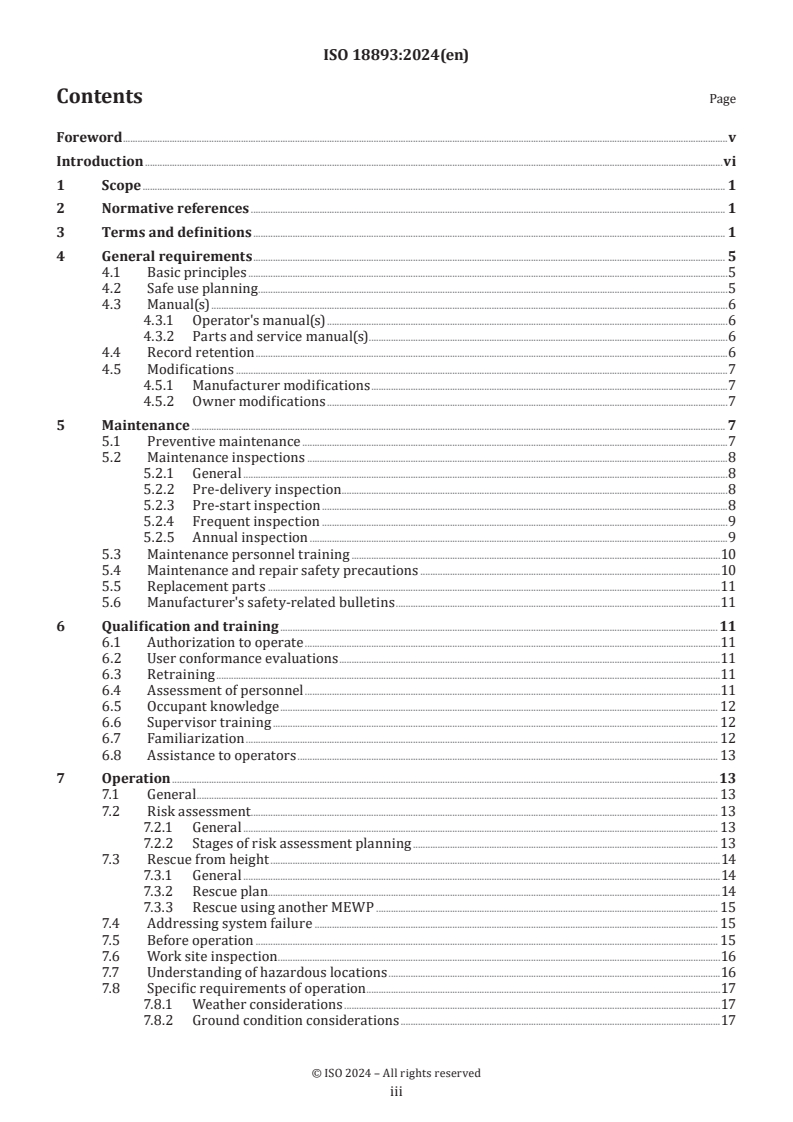
Contents Page
Foreword .v
Introduction .vi
1 Scope . 1
2 Normative references . 1
3 Terms and definitions . 1
4 General requirements . 5
4.1 Basic principles .5
4.2 Safe use planning . .5
4.3 Manual(s) .6
4.3.1 Operator's manual(s) .6
4.3.2 Parts and service manual(s) . .6
4.4 Record retention .6
4.5 Modifications .7
4.5.1 Manufacturer modifications .7
4.5.2 Owner modifications .7
5 Maintenance . 7
5.1 Preventive maintenance .7
5.2 Maintenance inspections .8
5.2.1 General .8
5.2.2 Pre-delivery inspection .8
5.2.3 Pre-start inspection .8
5.2.4 Frequent inspection .9
5.2.5 Annual inspection .9
5.3 Maintenance personnel training .10
5.4 Maintenance and repair safety precautions .10
5.5 Replacement parts .11
5.6 Manufacturer's safety-related bulletins .11
6 Qualification and training .11
6.1 Authorization to operate .11
6.2 User conformance evaluations .11
6.3 Retraining .11
6.4 Assessment of personnel .11
6.5 Occupant knowledge . 12
6.6 Supervisor training . 12
6.7 Familiarization . 12
6.8 Assistance to operators . 13
7 Operation .13
7.1 General . 13
7.2 Risk assessment . 13
7.2.1 General . 13
7.2.2 Stages of risk assessment planning . 13
7.3 Rescue from height .14
7.3.1 General .14
7.3.2 Rescue plan.14
7.3.3 Rescue using another MEWP . 15
7.4 Addressing system failure . 15
7.5 Before operation . 15
7.6 Work site inspection .16
7.7 Understanding of hazardous locations .16
7.8 Specific requirements of operation .17
7.8.1 Weather considerations .17
7.8.2 Ground condition considerations .17
iii
7.8.3 Transporting and travelling on public roads .18
7.8.4 Slope and grade .18
7.8.5 Deployment of stability enhancing means .18
7.8.6 Fall protection .18
7.8.7 Distribution of load .18
7.8.8 MEWP movement .18
7.8.9 Electrocution hazards .19
7.8.10 Footing for personnel . 20
7.8.11 Precaution for other moving equipment . 20
7.8.12 Reporting safety-related problems or malfunctions . 20
7.8.13 Reporting potentially hazardous locations . 20
7.8.14 Hazardous location operation .21
7.8.15 Entanglement .21
7.8.16 Load transfer .21
7.8.17 Work area . . .21
7.8.18 Fuelling .21
7.8.19 Battery charging .21
7.8.20 Improper MEWP stabilisation .21
7.8.21 Misuse as a crane or elevator .21
7.8.22 Use of MEWP for grounding .21
7.8.23 Climbing the extending structure .21
7.8.24 Unusual operating support conditions .21
7.8.25 Travelling . 22
7.8.26 Stunt driving . 22
7.8.27 Securing the MEWP . 22
7.8.28 Interference with safety devices . 22
7.8.29 Snagged MEWP . 22
7.8.30 Vacating (or entering) a MEWP at height . 22
7.8.31 Carrying materials larger than the work platform . 23
7.8.32 Carrying materials outside the work platform . 23
7.8.33 Rated manual forces and special forces . 23
7.8.34 Protection against unauthorized use . 23
7.8.35 Misuse as a jack . 23
7.8.36 Moving overhead obstructions . 23
7.8.37 Parking of MEWP . 23
7.8.38 Transport .24
7.8.39 Ventilation .24
7.8.40 Allowable rated forces.24
Annex A (informative) Examples of MEWP types and groups.25
Bibliography .28
iv
Foreword
ISO (the International Organization for Standardization) is a worldwide federation of national standards
bodies (ISO member bodies). The work of preparing International Standards is normally carried out through
ISO technical committees. Each member body interested in a subject for which a technical committee
has been established has the right to be represented on that committee. International organizations,
governmental and non-governmental, in liaison with ISO, also take part in the work. ISO collaborates closely
with the International Electrotechnical Commission (IEC) on all matters of electrotechnical standardization.
The procedures used to develop this document and those intended for its further maintenance are described
in the ISO/IEC Directives, Part 1. In particular, the different approval criteria needed for the different types
of ISO document should be noted. This document was drafted in accordance with the editorial rules of the
ISO/IEC Directives, Part 2 (see www.iso.org/directives).
ISO draws attention to the possibility that the implementation of this document may involve the use of (a)
patent(s). ISO takes no position concerning the evidence, validity or applicability of any claimed patent
rights in respect thereof. As of the date of publication of this document, ISO had not received notice of (a)
patent(s) which may be required to implement this document. However, implementers are cautioned that
this may not represent the latest information, which may be obtained from the patent database available at
www.iso.org/patents. ISO shall not be held responsible for identifying any or all such patent rights.
Any trade name used in this document is information given for the convenience of users and does not
constitute an endorsement.
For an explanation of the voluntary nature of standards, the meaning of ISO specific terms and expressions
related to conformity assessment, as well as information about ISO's adherence to the World Trade
Organization (WTO) principles in the Technical Barriers to Trade (TBT), see www.iso.org/iso/foreword.html.
This document was prepared by Technical Committee ISO/TC 214, Elevating work platforms.
This third edition cancels and replaces the second edition (ISO 18893:2014), which has been technically
revised.
The main changes are as follows:
— the Scope was updated to clarify the purpose of the document and its applicability to both new MEWPs
on the market and those currently in service;
— in Clause 3, additional terms were added to support the clarifications on MEWP groups and types
throughout the document;
— in Clause 4, changes were made to the modification requirements (manufacturer modifications versus
owner modifications);
— in Clause 6, requirements were broadened for operator training to include topics such as authorization,
supervisor training and operator retraining;
— the original Annex containing examples of misuse was deleted, and a new Annex A was added to show
examples of each group and type MEWP.
Any feedback or questions on this document should be directed to the user’s national standards body. A
complete listing of these bodies can be found at www.iso.org/members.html.
v
Introduction
This document, as other documents on mobile elevating work platforms (MEWPs), is part of a programme
of work regarding standardization of terminology, ratings, general principles (technical performance
requirements and risk assessment), safety requirements, test methods, maintenance, and operation for
MEWPs used to raise (elevate) and position personnel (and related work tools and materials).
MEWPs are machines/devices which provide protection from falling when working at height.
The entities with responsibilities related to safe use of a MEWP are established by law in some countries.
This document provides guidance in the identification of those responsible entities.
The responsibility for safe operation of a MEWP lies with employers, managers, supervisors, operators, and
others using these machines/devices. This document provides requirements so that appropriate MEWPs are
selected for use and positioned, used, maintained and inspected for safe use.
The use of competent authorized persons and trained operators (see ISO 18878) is critical to the safe
operation of a MEWP.
vi
International Standard ISO 18893:2024(en)
Mobile elevating work platforms — Safety principles,
inspection, maintenance and operation
1 Scope
This document applies to all mobile elevating work platforms (MEWPs) intended for moving a person(s)
along with their necessary tools and materials at an elevated work location.
This document specifies the requirements for selection, inspection, training, maintenance, repair and safe
operation of MEWPs to achieve the following objectives:
a) eliminate or reduce accidents, personal injuries and property damage;
b) establish criteria for selection, inspection, training, maintenance, repair and safe operation;
c) help manufacturers, dealers, owners, users, operators, occupants and qualified persons to understand
their responsibilities;
d) establish a process for reviews to verify compliance with this document;
e) provide a guide for governmental authorities desiring to formulate safety rules and regulations.
In this document, MEWP classifications comprise a MEWP group (platform location in reference to tipping
line) with an associated MEWP type (reference to travelling).
This document is applicable to both new MEWPs put on the market and those MEWPs currently in service.
2 Normative references
The following documents are referred to in the text in such a way that some or all of their content constitutes
requirements of this document. For dated references, only the edition cited applies. For undated references,
the latest edition of the referenced document (including any amendments) applies.
ISO 18878, Mobile elevating work platforms — Operator (driver) training
3 Terms and definitions
For the purposes of this document, the following terms and definitions apply.
ISO and IEC maintain terminology databases for use in standardization at the following addresses:
— ISO Online browsing platform: available at https:// www .iso .org/ obp
— IEC Electropedia: available at https:// www .electropedia .org/
3.1
anchorage
designated point of attachment utilized with a personal fall protection system
3.2
authorized person
person approved or assigned to perform a specific type of duty or duties at a specific location or locations at
a work site
3.3
configuration
positions in which a MEWP (3.13), chassis, extending structure (3.5), or work platform can be placed within
intended operating limits, including creating variable rated loads
3.4
delivery
transfer of custody, care, and control of a MEWP (3.13) from a person or entity to another person or entity
3.5
extending structure
structure that is connected to the chassis and supports the work platform and allows movement of the work
platform to its required position
1)
[SOURCE: ISO 16368:2024 , 3.8]
3.6
fall arrest system
personal fall protection system designed to arrest the fall of an operator (3.17) or occupant(s) (3.15)
[SOURCE: ISO 16368:2024, 3.9]
3.7
fall restraint system
personal fall protection system that restrains or prevents an operator (3.17) or occupant(s) (3.15) from
reaching a fall hazard
[SOURCE: ISO 16368:2024, 3.10]
3.8
familiarization
provision of the necessary information to a qualified person (3.20) or trained operator (3.17) regarding
the features, functions, devices, limitations, and operating characteristics, as defined by the manufacturer
(3.12), in order to properly use a specific model of MEWP (3.13)
3.9
hazardous atmosphere
location that contains, or has the potential to contain, an explosive or flammable atmosphere
3.10
load-sensing system
system of monitoring the vertical load and vertical forces on the work platform
[SOURCE: ISO 16368:2024, 3.19]
3.11
maintenance
act of upkeep such as inspection, lubrication, refuelling, cleaning, adjustment, and scheduled parts
replacement
3.12
manufacturer
person or entity that makes, builds, or produces a MEWP (3.13)
1) Under preparation. Stage at the time of publication: ISO/FDIS 16368:2024.
3.13
mobile elevating work platform
MEWP
machine/device intended for moving a person(s), along with their necessary tools and material, to an
elevated work location, consisting of at least a work platform with controls, an extending structure (3.5), and
a chassis
[SOURCE: ISO 16368:2024, 3.22]
3.13.1
group A MEWP
MEWP (3.13) on which the vertical projection of the centre of the work platform area, in all work platform
configurations (3.3) at the maximum chassis inclination specified by the manufacturer (3.12), is always
inside the tipping lines
[SOURCE: ISO 16368:2024, 3.23]
3.13.2
group B MEWP
MEWP (3.13) that is not in group A
[SOURCE: ISO 16368:2024, 3.24]
3.13.3
type 1 MEWP
MEWP (3.13) for which travelling is only allowed when in the stowed position
[SOURCE: ISO 16368:2024, 3.25]
3.13.4
type 2 MEWP
MEWP (3.13) for which travelling with the work platform in the elevated travel position is controlled from a
point on the chassis
Note 1 to entry: Type 2 and type 3 MEWPs can be combined.
[SOURCE: ISO 16368:2024, 3.26]
3.13.5
type 3 MEWP
MEWP (3.13) for which travelling with the work platform in the elevated travel position is controlled from a
point on the work platform
Note 1 to entry: Type 2 and type 3 MEWPs can be combined.
[SOURCE: ISO 16368:2024, 3.27]
3.14
modification
change or addition to a MEWP (3.13) as originally manufactured which affects the operation (3.16), stability,
safety factors, rated load, or safety of the MEWP
3.15
occupant
person in the MEWP (3.13) work platform other than the operator (3.17)
[SOURCE: ISO 16368:2024, 3.35, modified — “MEWP” was added before “work platform”.]
3.16
operation
performance of functions of a MEWP (3.13) within the scope of its specifications and in accordance with the
manufacturer's (3.12) instructions, work rules and applicable governmental regulations
3.17
operator
person who controls the operation (3.16) of a MEWP (3.13)
3.18
operator’s manual
manual provided by the manufacturer (3.12) and intended to be a part of the MEWP (3.13) which includes
information to allow for safe operation (3.16) of the MEWP
3.19
owner
person or entity that has possession of a MEWP (3.13) by virtue of proof of purchase or legal possession of
the MEWP
3.20
qualified person
person who, by possession of a recognized degree, certificate or professional standing, or by extensive
knowledge, training (3.26) and experience, has successfully demonstrated their ability to solve or resolve
problems related to the subject matter, the work or the project
3.21
repair
act of restoring to good condition that which has been broken, damaged or worn due to use, abuse or
other reasons
3.22
retraining
required instruction based on the user's observations or evaluations to maintain a previously trained
person's status as qualified for the task
3.23
risk assessment
process to identify potential hazards associated with a task and the work environment where the task is to be
performed, and the development of methods to remove or control the risk to workers from identified hazards
3.24
safety-related bulletin
publication from the manufacturer (3.12) of a MEWP (3.13) that needs attention to ensure safe operation
(3.16) of the MEWP
3.25
stabilising device
device or system used to stabilise a MEWP (3.13) by supporting and/or levelling the complete MEWP or the
extending structure (3.5)
EXAMPLE Outrigger, jack, suspension-locking device, extending axle, torsion bar.
[SOURCE: ISO 16368:2024, 3.50]
3.26
training
instruction to enable the trainee to become a qualified person (3.20) regarding the tasks to be performed,
including knowledge regarding potential hazards
3.27
transport
movement of the MEWP (3.13) outside the boundaries of the work site
3.28
travelling
movement of the chassis, except when the MEWP (3.13) is being transported
[SOURCE: ISO 16368:2024, 3.53]
3.29
user
person or entity that has care, control, and custody of the MEWP (3.13)
Note 1 to entry: The user can be more than one person or entity.
4 General requirements
4.1 Basic principles
4.1.1 The information in this document shall be supplemented by good job management, while applying
sound principles of safe use planning, safe operation, training, inspection, maintenance, repair, and MEWP
selection. All data available regarding the parameters of intended use and expected environment shall be
considered. Decisions on the use and operation of the MEWPs shall always be made with due consideration
for the fact that the machine will be carrying persons whose safety is dependent on those decisions as well
as others in the operating vicinity.
4.1.2 The operation of any MEWP is subject to certain hazards that can be protected against only by the
exercise of intelligence, care, and common sense and not by any device. It is essential to have persons who
are medically and physically fit for the task selected to be trained and qualified in the intended use, safe
operation, maintenance, and repair of this type of equipment.
4.1.3 It is an essential requirement that:
a) the selection, positioning, operation, maintenance and inspections of a MEWP are properly planned,
appropriately supervised by qualified persons and carried out in a safe manner;
b) qualified person(s) evaluate the risks associated with the use of a MEWP and puts appropriate control
measures and safe work procedures in place;
c) all MEWP operators be trained in accordance with ISO 18878;
d) all MEWP maintenance and repair work be performed by a qualified person in accordance with the
manufacturer’s recommendations, having regard to the environment and the severity of use.
NOTE National or local requirements can apply which can be more stringent.
4.2 Safe use planning
A safe use plan specific to MEWPs shall be developed by the user. It shall include, but not be limited to:
a) performing a site risk assessment to:
1) identify hazards;
2) evaluate risks;
3) develop control measures;
4) identify safe work procedures;
5) communicate with affected persons;
b) selecting, provisioning and using of a suitable MEWP and work equipment associated with it;
c) accessing, preparing and maintaining the work site, as required, to include an assessment of the support
surface to ensure that it:
1) is adequate to support the loads imposed by the use of the MEWP;
2) does not exceed the inclination/slope limits for safe MEWP operation;
d) maintaining the MEWP, including inspection(s) and repairs as required by this document and as
recommended by the manufacturer;
e) ensuring that only authorized personnel are allowed to operate or occupy the MEWP;
f) familiarizing authorized MEWP operator(s) with the specific MEWP to be used;
g) informing the operator of local site requirements;
h) monitoring the performance of the operator by a trained and qualified supervisor(s) to ensure
compliance with the provisions of this document;
i) preventing unauthorized use of the MEWP;
j) safeguarding of persons not involved in the operation of the MEWP;
k) developing and communicating a rescue plan;
l) recording of information as required by 4.4.
4.3 Manual(s)
4.3.1 Operator's manual(s)
4.3.1.1 The operator's manual(s) which is intended to be readily available and which is necessary for the
operation and daily inspection/maintenance of the MEWP shall be provided with each rental, lease, or sale
delivery.
4.3.1.2 The user shall ensure that the operator reads and understands the operator’s manual(s) or have it
(them) explained.
4.3.1.3 In case the manufacturer no longer exists, and the operator's manual(s) are not available from
other sources, equivalent manual(s) shall be provided by a qualified person.
4.3.1.4 The operator’s manual(s) shall be stored in the weather-resistant storage compartment provided
by the manufacturer.
4.3.2 Parts and service manual(s)
The manufacturer's parts and service manual(s) shall be made available for use by trained personnel of the
entity responsible for servicing the MEWP.
4.4 Record retention
The following records shall be created and retained by the owner of each MEWP for a minimum of four
years after the sale of the MEWP or until the MEWP is permanently removed from service:
a) name and address of each owner of the MEWP by serial number and date of delivery;
b) written records of the pre-delivery, frequent, and annual inspections on the MEWP, including the date
of inspection, deficiencies found, corrective action accomplished and identification of the person(s)
performing the inspection;
c) written records of all repairs, manufacturer recalls, upgrades and approved modifications accomplished
on the MEWP, including the date work is completed, a description of the work accomplished, and
identification of the person(s) performing the repair.
4.5 Modifications
4.5.1 Manufacturer modifications
Except as provided in 4.5.2, modifications or alterations to a MEWP that can affect the capacity, stability or
safe operations of the MEWP shall only be made with prior written permission of the original manufacturer
or its successor thereof. When the manufacturer or its successor approves a modification or alteration,
appropriate changes shall be made to capacity plates, decals, tags, and manufacturer's operator’s manual(s)
(or supplementary documentation can be provided if appropriate) and stored with the manufacturer's
operator’s manual(s) on the MEWP.
4.5.2 Owner modifications
4.5.2.1 In the event that the manufacturer is no longer in business and there is no successor, or it is not
possible to obtain a response from the manufacturer or successor, the owner may arrange for modifications
or alterations to the MEWP, and shall:
a) arrange for the modification or alteration to be designed, tested and implemented by a qualified
person(s);
b) maintain a permanent record of the design, test(s) and implementation of the modification or alteration;
c) make appropriate changes to the capacity plate(s), decals, tags, and operator’s manual(s);
d) affix a permanent and readily visible label on the MEWP stating the manner in which the MEWP has
been modified or altered, together with the date of the modification or alteration, and the name and
address of the organization that accomplished the tasks;
e) be responsible for all aspects of the modification.
NOTE Supplementary documentation can be provided, if appropriate, and stored with the operator’s manual(s)
on the MEWP.
4.5.2.2 The user shall ensure that MEWP supervisors and operators are aware and comply with the
requirement that only the MEWP owner can authorize a modification to a MEWP.
5 Maintenance
5.1 Preventive maintenance
5.1.1 A preventive maintenance programme shall be established in accordance with the manufacturer's
recommendations. The preventive maintenance programme shall be increased based on the environment
and severity of use of the MEWP. The manufacturer’s recommendations shall be the minimum requirements.
5.1.2 The scheduled maintenance programme shall include inspections as defined in 5.2 and by the
manufacturer’s recommendations and bulletins. All malfunctions and problems identified that affect the
safe operation shall be corrected by a qualified person before the MEWP is placed or returned to service.
Repairs or adjustments shall not be made unless specifically authorized by the MEWP owner.
5.2 Maintenance inspections
5.2.1 General
5.2.1.1 The MEWP shall have maintenance inspections as required to ensure proper operation. The
frequency of maintenance inspections shall be determined by the manufacturer's recommendations and
the operating conditions. The frequency of the maintenance inspections can be increased to be compatible
with operating conditions and the severity of the operating environment, but the manufacturer’s
recommendations shall be the minimum requirements. MEWPs that are not in proper operating condition
shall be corrected by a qualified person and the repairs shall be in conformance with the manufacturer's
recommendations.
5.2.1.2 The MEWP shall not be placed into service until all malfunctions and safety-related problems have
been corrected.
5.2.2 Pre-delivery inspection
The MEWP shall be inspected, repaired, and adjusted in accordance with the manufacturer’s specifications
prior to each delivery by sale, lease, rental or loan.
5.2.3 Pre-start inspection
The user shall ensure before use each day or at the beginning of each shift, that the MEWP has been given a
visual inspection and functional test by the operator, including but not limited to the following:
a) operating, emergency and auxiliary controls;
b) safety devices;
c) personal protective equipment;
d) air, hydraulic and fuel system for leaks;
e) cables and wiring harness;
f) loose, damaged, worn, or missing guards or parts;
g) tyres (where applicable, tyre pressure), wheels, wheel fasteners and tracks (if equipped);
h) instructions, warnings, control markings and operating manual(s);
i) structural items, extending structure and stabilising devices;
j) work platform, including guardrail system, floor, anchorage and mounting;
k) cleanliness and general signs of damage;
l) brake operation and performance;
m) verification that fuel or battery power level are adequate for intended operation;
n) lights (when applicable);
o) fluid levels including engine coolant, engine oil and hydraulic oil;
p) pins and pin-securing devices and visible damage to the prime means of support for the work platform
and extending structure;
q) operation of stabilising devices (if equipped);
r) other items specified by the manufacturer in the operator's manual.
5.2.4 Frequent inspection
5.2.4.1 The MEWP owner shall ensure that a frequent inspection has been performed in accordance with
the manufacturer's instructions:
a) on a MEWP that has been in service for three months or 150 hours, whichever comes first;
b) before putting back into service a MEWP which has been out-of-service for a period longer than three
months of time.
5.2.4.2 The frequent inspection shall be made by a qualified person to inspect the specific make and model
of the MEWP. This inspection shall include all items specified by the manufacturer for a frequent inspection
and shall include but not be limited to the following:
a) all functions and their controls, including controls for emergency operation, for speed(s), smoothness,
and limits of motion;
b) base-level or ground-level controls, including the provisions for overriding of work platform controls;
c) all chain and wire rope mechanisms, for adjustment and worn or damaged parts;
d) verification that all emergency controls, guards, and safety devices are in place and in good working order;
e) lubrication of all moving parts, inspection and replacement of filter element(s) if required, hydraulic oil,
engine oil and coolant;
f) visual inspection of structural components and other critical components such as fasteners, pins, shafts,
turntable attachment devices and locking devices;
g) verification that instructions, warnings and control markings are in place and legible;
h) hydraulic or pneumatic systems:
1) for proper fluid or pressure levels;
2) for proper operation, damage, leaks or external wear;
i) electrical systems, for signs of damage, deterioration, dirt or moisture accumulation;
j) pneumatic tyres, if applicable, for proper inflation and damage;
k) verification that wheel nuts and bolts are in place and properly tightened;
l) lights, if applicable, for proper operation and illumination;
m) batteries, checked for adequate fluid level and connections free from corrosion, if applicable, before use
of the MEWP and before recharging;
n) drive systems, brakes, steering and speed controls for proper operation;
o) audible or light alarms, if applicable, for proper operation;
p) communication system, if any, between platform and ground level is working properly.
5.2.5 Annual inspection
5.2.5.1 The MEWP owner shall ensure that an annual inspection be performed no later than 13 months
from the initial in-service date or from the prior annual inspection. The inspection shall be performed by a
qualified person for the specific make and model of MEWP.
...
Questions, Comments and Discussion
Ask us and Technical Secretary will try to provide an answer. You can facilitate discussion about the standard in here.
Loading comments...