


ISO 16368:2024
(Main)Mobile elevating work platforms — Design, calculations, safety requirements and test methods
Mobile elevating work platforms — Design, calculations, safety requirements and test methods
This document specifies safety requirements and protective/risk reduction measures, and the means for their verification, for all types and sizes of mobile elevating work platforms (MEWPs) intended for moving a person(s) along with their necessary tools and materials at an elevated work location. This document also applies to MEWPs designed for applications requiring special access to specific work areas. These MEWPs can be either self-propelled or manually propelled and are used to elevate personnel to a level at which they can place, install, or retrieve objects or material on a routine basis. To facilitate operator access to the work area, the retraction of a portion of the MEWP's work platform guardrail system(s) can be necessary. This document is intended to serve as a guide for manufacturers and remanufacturers of MEWPs to achieve the following objectives: — elimination or reduction of accidents and personal injuries; — establishment of criteria for design, manufacture, remanufacture, rebuild/recondition, testing and performance; — establishment and understanding by manufacturers and remanufacturers of their responsibilities. The design and manufacturing requirements of this document apply to all MEWPs manufactured or remanufactured on or after the effective date, but it is not applicable to rebuilt or reconditioned MEWPs. It identifies the hazards arising from the use of MEWPs and describes methods for the elimination or reduction of these hazards. This document is not applicable to a) permanently installed personnel-lifting appliances serving defined levels, b) firefighting and fire rescue appliances (see for example, EN 1777), c) unguided work cages suspended from lifting appliances (see for example, EN 1808), d) elevating operator position on rail-dependent storage and retrieval equipment (see for example, EN 528), e) tail lifts (see for example, EN 1756-1:2001+A1:2008, EN 1756-2:2004+A1:2009), f) mast-climbing work platforms (see ISO 16369), g) fairground equipment, h) lifting tables with a lifting height of less than 2 m (see for example, EN 1570-1:2011+A1:2014), i) builder's hoists for persons and materials, j) aircraft ground-support equipment (see for example, EN-1915-1:2013, EN-1915-2:2001+A1:2009), k) digger derricks, l) elevating operator positions on industrial trucks (see for example, ISO 3691-3), m) elevating operator positions on cranes, n) certain requirements for insulating aerial devices on a chassis for use in live work on electrical installations (see Note 1), o) multi-purpose elevating platform powered industrial trucks (MPEPs) controlled by a single stand-up riding operator and intended to be used for manually picking and transporting small items at height, p) powered industrial trucks used to pick and place stock or inventory. NOTE 1 For requirements for use near live electrical installations, see ISO 16653-2. For requirements for use on live electrical installations, see IEC 61057. It does not cover hazards arising from: — use in potentially explosive atmospheres, — use of compressed gases for load-bearing components, — derailment and runaway of rail-mounted MEWPs, — work on live electrical systems (see Note 2 and Note 3). NOTE 2 Hazards arising from work on live electrical systems are addressed in IEC 61057. NOTE 3 For MEWPs that employ aerial devices used for live working, this document is to be used in conjunction with IEC 61057, taking into consideration the potential exceptions from this document that are specified in IEC 61057.
Plates-formes élévatrices mobiles de personnel — Conception, calculs, exigences de sécurité et méthodes d'essai
L'ISO 16368:2010 spécifie des exigences de sécurité et des mesures de prévention, ainsi que les moyens de les vérifier, pour tous les types et tailles de plates-formes élévatrices mobiles de personnel (PEMP) destinées à déplacer des personnes vers une position de travail. Elle fournit les calculs de conception de la structure et les critères de stabilité, la construction, les examens et les essais de sécurité à appliquer avant la première mise en service des PEMP. Elle identifie les phénomènes dangereux résultant de l'utilisation des PEMP et décrit des méthodes pour éliminer ou réduire ces phénomènes.
General Information
- Status
- Published
- Publication Date
- 15-Aug-2024
- Technical Committee
- ISO/TC 214 - Elevating work platforms
- Drafting Committee
- ISO/TC 214 - Elevating work platforms
- Current Stage
- 6060 - International Standard published
- Start Date
- 16-Aug-2024
- Due Date
- 08-Jun-2024
- Completion Date
- 16-Aug-2024
Relations
- Effective Date
- 06-Jun-2022
Overview
ISO 16368:2024 - Mobile elevating work platforms (MEWPs) - specifies design, calculation, safety requirements and test methods for all types and sizes of MEWPs intended to lift personnel with tools and materials to elevated work locations. The standard provides safety measures and verification methods for self‑propelled or manually propelled MEWPs, including those used for special access tasks. It is a design and manufacturing guidance for manufacturers and remanufacturers, intended to reduce accidents, define design and performance criteria, and clarify responsibilities. The requirements apply to MEWPs manufactured or remanufactured on or after the standard’s effective date; rebuilt or reconditioned MEWPs are excluded.
Key topics and technical requirements
ISO 16368:2024 covers comprehensive technical areas and test methods, including:
- Design and stability calculations
- Rated load determination, loads and forces acting on the structure, stability calculations and structural analyses.
- Chassis and stabilising devices
- Travel prevention, levelling, locking devices, and ground contact requirements.
- Extending structures and drive systems
- Overturn prevention, sequencing, trapping/shearing avoidance, and requirements for wire‑rope, chain, lead‑screw and rack‑and‑pinion drives.
- Work platform and guardrails
- Platform materials, anchorage, access/egress, trapdoors, retractable guardrails and platform floor integrity.
- Controls and safety systems
- Location and protection of controls, emergency stops, auxiliary lowering, sustained involuntary operation protection and function overriding.
- Electrical and hydraulic systems
- Main switch and battery protection, EMC, cable protection, hydraulic pressure limiting, hose strength, fluid cleanliness and accumulator considerations.
- Hydraulic cylinders and load‑holding
- Structural design and prevention of unintended movement.
- Safety devices and verification
- Prescribed test methods, performance checks and verification of protective measures.
The standard also identifies hazards not covered (e.g., explosive atmospheres, live electrical work) and cross‑references other standards for those specific domains.
Applications and who uses it
ISO 16368:2024 is essential for:
- MEWP manufacturers, designers and engineers for product design, validation and certification
- Remanufacturers applying design and safety requirements to refurbished units
- Test laboratories and conformity assessment bodies conducting safety tests and verifications
- Health & safety professionals, fleet managers and site operators responsible for procurement and safe use of MEWPs
- Regulators and standards writers aligning national rules with international best practice
Related standards
The document references and is intended to be used alongside standards addressing specific exclusions or interactions - for example, standards for live electrical work (IEC 61057), mast‑climbing work platforms (ISO 16369), and various EN standards covering specialized lifting equipment.
For full technical details and official test procedures, obtain ISO 16368:2024 from ISO (www.iso.org).

Frequently Asked Questions
ISO 16368:2024 is a standard published by the International Organization for Standardization (ISO). Its full title is "Mobile elevating work platforms — Design, calculations, safety requirements and test methods". This standard covers: This document specifies safety requirements and protective/risk reduction measures, and the means for their verification, for all types and sizes of mobile elevating work platforms (MEWPs) intended for moving a person(s) along with their necessary tools and materials at an elevated work location. This document also applies to MEWPs designed for applications requiring special access to specific work areas. These MEWPs can be either self-propelled or manually propelled and are used to elevate personnel to a level at which they can place, install, or retrieve objects or material on a routine basis. To facilitate operator access to the work area, the retraction of a portion of the MEWP's work platform guardrail system(s) can be necessary. This document is intended to serve as a guide for manufacturers and remanufacturers of MEWPs to achieve the following objectives: — elimination or reduction of accidents and personal injuries; — establishment of criteria for design, manufacture, remanufacture, rebuild/recondition, testing and performance; — establishment and understanding by manufacturers and remanufacturers of their responsibilities. The design and manufacturing requirements of this document apply to all MEWPs manufactured or remanufactured on or after the effective date, but it is not applicable to rebuilt or reconditioned MEWPs. It identifies the hazards arising from the use of MEWPs and describes methods for the elimination or reduction of these hazards. This document is not applicable to a) permanently installed personnel-lifting appliances serving defined levels, b) firefighting and fire rescue appliances (see for example, EN 1777), c) unguided work cages suspended from lifting appliances (see for example, EN 1808), d) elevating operator position on rail-dependent storage and retrieval equipment (see for example, EN 528), e) tail lifts (see for example, EN 1756-1:2001+A1:2008, EN 1756-2:2004+A1:2009), f) mast-climbing work platforms (see ISO 16369), g) fairground equipment, h) lifting tables with a lifting height of less than 2 m (see for example, EN 1570-1:2011+A1:2014), i) builder's hoists for persons and materials, j) aircraft ground-support equipment (see for example, EN-1915-1:2013, EN-1915-2:2001+A1:2009), k) digger derricks, l) elevating operator positions on industrial trucks (see for example, ISO 3691-3), m) elevating operator positions on cranes, n) certain requirements for insulating aerial devices on a chassis for use in live work on electrical installations (see Note 1), o) multi-purpose elevating platform powered industrial trucks (MPEPs) controlled by a single stand-up riding operator and intended to be used for manually picking and transporting small items at height, p) powered industrial trucks used to pick and place stock or inventory. NOTE 1 For requirements for use near live electrical installations, see ISO 16653-2. For requirements for use on live electrical installations, see IEC 61057. It does not cover hazards arising from: — use in potentially explosive atmospheres, — use of compressed gases for load-bearing components, — derailment and runaway of rail-mounted MEWPs, — work on live electrical systems (see Note 2 and Note 3). NOTE 2 Hazards arising from work on live electrical systems are addressed in IEC 61057. NOTE 3 For MEWPs that employ aerial devices used for live working, this document is to be used in conjunction with IEC 61057, taking into consideration the potential exceptions from this document that are specified in IEC 61057.
This document specifies safety requirements and protective/risk reduction measures, and the means for their verification, for all types and sizes of mobile elevating work platforms (MEWPs) intended for moving a person(s) along with their necessary tools and materials at an elevated work location. This document also applies to MEWPs designed for applications requiring special access to specific work areas. These MEWPs can be either self-propelled or manually propelled and are used to elevate personnel to a level at which they can place, install, or retrieve objects or material on a routine basis. To facilitate operator access to the work area, the retraction of a portion of the MEWP's work platform guardrail system(s) can be necessary. This document is intended to serve as a guide for manufacturers and remanufacturers of MEWPs to achieve the following objectives: — elimination or reduction of accidents and personal injuries; — establishment of criteria for design, manufacture, remanufacture, rebuild/recondition, testing and performance; — establishment and understanding by manufacturers and remanufacturers of their responsibilities. The design and manufacturing requirements of this document apply to all MEWPs manufactured or remanufactured on or after the effective date, but it is not applicable to rebuilt or reconditioned MEWPs. It identifies the hazards arising from the use of MEWPs and describes methods for the elimination or reduction of these hazards. This document is not applicable to a) permanently installed personnel-lifting appliances serving defined levels, b) firefighting and fire rescue appliances (see for example, EN 1777), c) unguided work cages suspended from lifting appliances (see for example, EN 1808), d) elevating operator position on rail-dependent storage and retrieval equipment (see for example, EN 528), e) tail lifts (see for example, EN 1756-1:2001+A1:2008, EN 1756-2:2004+A1:2009), f) mast-climbing work platforms (see ISO 16369), g) fairground equipment, h) lifting tables with a lifting height of less than 2 m (see for example, EN 1570-1:2011+A1:2014), i) builder's hoists for persons and materials, j) aircraft ground-support equipment (see for example, EN-1915-1:2013, EN-1915-2:2001+A1:2009), k) digger derricks, l) elevating operator positions on industrial trucks (see for example, ISO 3691-3), m) elevating operator positions on cranes, n) certain requirements for insulating aerial devices on a chassis for use in live work on electrical installations (see Note 1), o) multi-purpose elevating platform powered industrial trucks (MPEPs) controlled by a single stand-up riding operator and intended to be used for manually picking and transporting small items at height, p) powered industrial trucks used to pick and place stock or inventory. NOTE 1 For requirements for use near live electrical installations, see ISO 16653-2. For requirements for use on live electrical installations, see IEC 61057. It does not cover hazards arising from: — use in potentially explosive atmospheres, — use of compressed gases for load-bearing components, — derailment and runaway of rail-mounted MEWPs, — work on live electrical systems (see Note 2 and Note 3). NOTE 2 Hazards arising from work on live electrical systems are addressed in IEC 61057. NOTE 3 For MEWPs that employ aerial devices used for live working, this document is to be used in conjunction with IEC 61057, taking into consideration the potential exceptions from this document that are specified in IEC 61057.
ISO 16368:2024 is classified under the following ICS (International Classification for Standards) categories: 53.020.99 - Other lifting equipment. The ICS classification helps identify the subject area and facilitates finding related standards.
ISO 16368:2024 has the following relationships with other standards: It is inter standard links to ISO 16368:2010. Understanding these relationships helps ensure you are using the most current and applicable version of the standard.
ISO 16368:2024 is available in PDF format for immediate download after purchase. The document can be added to your cart and obtained through the secure checkout process. Digital delivery ensures instant access to the complete standard document.
Standards Content (Sample)
International
Standard
ISO 16368
Third edition
Mobile elevating work platforms —
2024-08
Design, calculations, safety
requirements and test methods
Plates-formes élévatrices mobiles de personnel — Conception,
calculs, exigences de sécurité et méthodes d'essai
Reference number
© ISO 2024
All rights reserved. Unless otherwise specified, or required in the context of its implementation, no part of this publication may
be reproduced or utilized otherwise in any form or by any means, electronic or mechanical, including photocopying, or posting on
the internet or an intranet, without prior written permission. Permission can be requested from either ISO at the address below
or ISO’s member body in the country of the requester.
ISO copyright office
CP 401 • Ch. de Blandonnet 8
CH-1214 Vernier, Geneva
Phone: +41 22 749 01 11
Email: copyright@iso.org
Website: www.iso.org
Published in Switzerland
ii
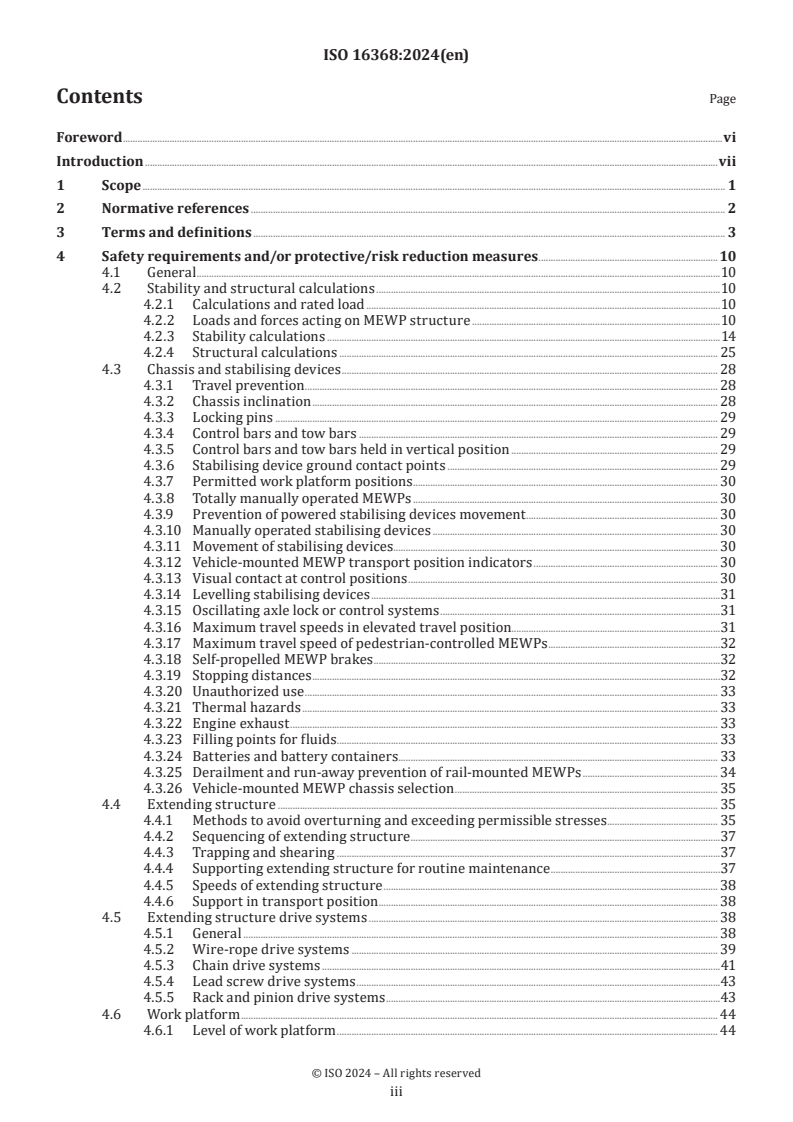
Contents Page
Foreword .vi
Introduction .vii
1 Scope . 1
2 Normative references . 2
3 Terms and definitions . 3
4 Safety requirements and/or protective/risk reduction measures .10
4.1 General .10
4.2 Stability and structural calculations .10
4.2.1 Calculations and rated load .10
4.2.2 Loads and forces acting on MEWP structure .10
4.2.3 Stability calculations .14
4.2.4 Structural calculations . 25
4.3 Chassis and stabilising devices . 28
4.3.1 Travel prevention . 28
4.3.2 Chassis inclination . 28
4.3.3 Locking pins . 29
4.3.4 Control bars and tow bars . 29
4.3.5 Control bars and tow bars held in vertical position . 29
4.3.6 Stabilising device ground contact points . 29
4.3.7 Permitted work platform positions . 30
4.3.8 Totally manually operated MEWPs . 30
4.3.9 Prevention of powered stabilising devices movement . 30
4.3.10 Manually operated stabilising devices . 30
4.3.11 Movement of stabilising devices. 30
4.3.12 Vehicle-mounted MEWP transport position indicators . 30
4.3.13 Visual contact at control positions . 30
4.3.14 Levelling stabilising devices .31
4.3.15 Oscillating axle lock or control systems .31
4.3.16 Maximum travel speeds in elevated travel position.31
4.3.17 Maximum travel speed of pedestrian-controlled MEWPs .32
4.3.18 Self-propelled MEWP brakes .32
4.3.19 Stopping distances .32
4.3.20 Unauthorized use . 33
4.3.21 Thermal hazards . 33
4.3.22 Engine exhaust . 33
4.3.23 Filling points for fluids . . . 33
4.3.24 Batteries and battery containers . 33
4.3.25 Derailment and run-away prevention of rail-mounted MEWPs . 34
4.3.26 Vehicle-mounted MEWP chassis selection . 35
4.4 Extending structure . 35
4.4.1 Methods to avoid overturning and exceeding permissible stresses . 35
4.4.2 Sequencing of extending structure .37
4.4.3 Trapping and shearing .37
4.4.4 Supporting extending structure for routine maintenance .37
4.4.5 Speeds of extending structure . 38
4.4.6 Support in transport position . 38
4.5 Extending structure drive systems . 38
4.5.1 General . 38
4.5.2 Wire-rope drive systems . 39
4.5.3 Chain drive systems .41
4.5.4 Lead screw drive systems .43
4.5.5 Rack and pinion drive systems .43
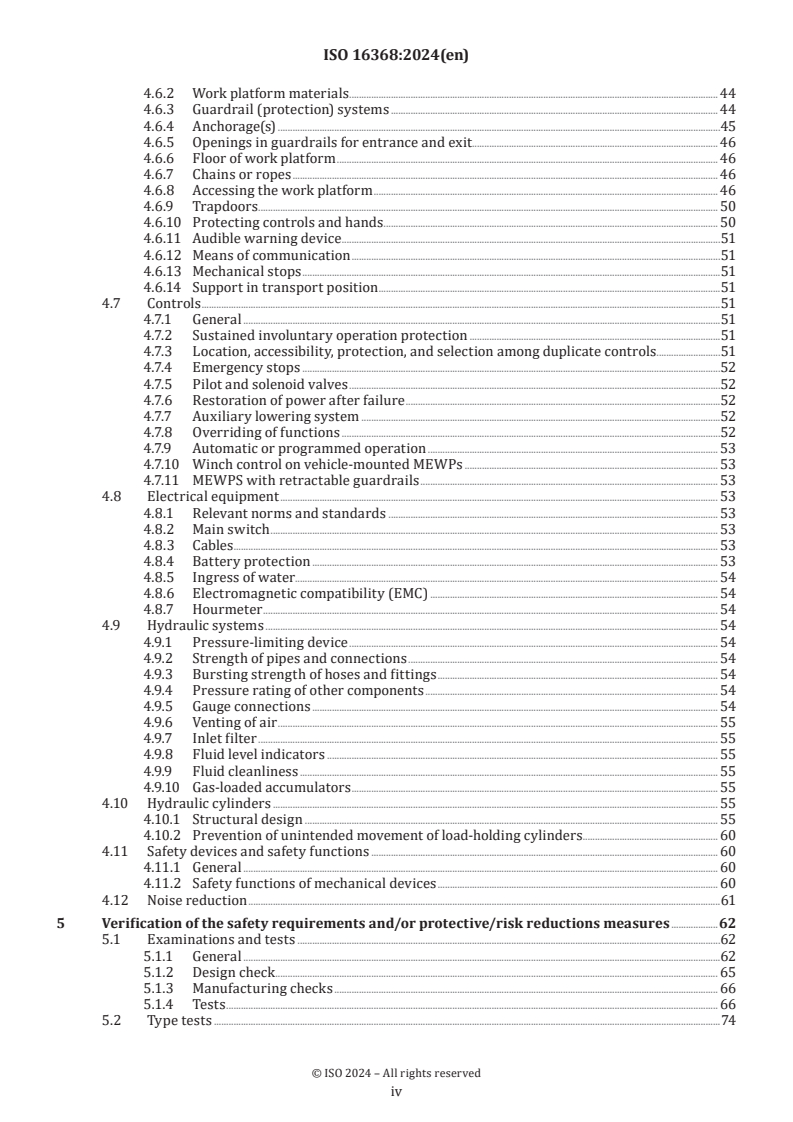
4.6 Work platform . 44
4.6.1 Level of work platform . 44
iii
4.6.2 Work platform materials . . 44
4.6.3 Guardrail (protection) systems . 44
4.6.4 Anchorage(s) .45
4.6.5 Openings in guardrails for entrance and exit . 46
4.6.6 Floor of work platform . 46
4.6.7 Chains or ropes . 46
4.6.8 Accessing the work platform . 46
4.6.9 Trapdoors . . 50
4.6.10 Protecting controls and hands . 50
4.6.11 Audible warning device .51
4.6.12 Means of communication .51
4.6.13 Mechanical stops .51
4.6.14 Support in transport position .51
4.7 Controls .51
4.7.1 General .51
4.7.2 Sustained involuntary operation protection .51
4.7.3 Location, accessibility, protection, and selection among duplicate controls.51
4.7.4 Emergency stops .52
4.7.5 Pilot and solenoid valves .52
4.7.6 Restoration of power after failure .52
4.7.7 Auxiliary lowering system .52
4.7.8 Overriding of functions .52
4.7.9 Automatic or programmed operation . 53
4.7.10 Winch control on vehicle-mounted MEWPs . 53
4.7.11 MEWPS with retractable guardrails . 53
4.8 Electrical equipment . 53
4.8.1 Relevant norms and standards . 53
4.8.2 Main switch . 53
4.8.3 Cables . . 53
4.8.4 Battery protection . 53
4.8.5 Ingress of water . . 54
4.8.6 Electromagnetic compatibility (EMC) . 54
4.8.7 Hourmeter . 54
4.9 Hydraulic systems . 54
4.9.1 Pressure-limiting device . 54
4.9.2 Strength of pipes and connections . 54
4.9.3 Bursting strength of hoses and fittings . 54
4.9.4 Pressure rating of other components . 54
4.9.5 Gauge connections . 54
4.9.6 Venting of air . 55
4.9.7 Inlet filter . 55
4.9.8 Fluid level indicators . 55
4.9.9 Fluid cleanliness . 55
4.9.10 Gas-loaded accumulators . 55
4.10 Hydraulic cylinders . 55
4.10.1 Structural design . 55
4.10.2 Prevention of unintended movement of load-holding cylinders . 60
4.11 Safety devices and safety functions . 60
4.11.1 General . 60
4.11.2 Safety functions of mechanical devices . 60
4.12 Noise reduction .61
5 Verification of the safety requirements and/or protective/risk reductions measures .62
5.1 Examinations and tests .62
5.1.1 General .62
5.1.2 Design check . 65
5.1.3 Manufacturing checks . 66
5.1.4 Tests . 66
5.2 Type tests .74
iv
5.3 Production tests .74
5.3.1 MEWPs not vehicle-mounted .74
5.3.2 Vehicle-mounted MEWPs .74
6 Information for use .75
6.1 General . 75
6.2 Operator's manual . 75
6.2.1 Content . 75
6.2.2 Modification or repair .76
6.3 Parts and service manuals .76
6.4 Marking . 77
6.4.1 Responsible entity's plate . 77
6.4.2 Work platform . 77
6.4.3 Multiple rated loads . 78
6.4.4 Auxiliary systems . 78
6.4.5 Overriding of functions . 78
6.4.6 Work platform rated loads . 78
6.4.7 MEWPs designated for indoor use . 79
6.4.8 External power supply connections . 79
6.4.9 Detachable parts . 79
6.4.10 Instructions . 79
6.4.11 Projecting extremities . . . 79
6.4.12 Wheel/stabilising device load . 79
6.4.13 Tyre pressure . 79
6.4.14 Clearances . 79
6.4.15 Maintenance . 79
6.4.16 Stabilising device use . 79
6.4.17 Levelling instructions . 80
6.4.18 Pressurized vessel . 80
6.4.19 Annual Inspection . 80
Annex A (informative) Use of MEWPs in wind speeds greater than 12,5 m/s — Beaufort scale 6 .81
Annex B (normative) Additional requirements for wireless controls and control systems .82
Annex C (normative) Calculation of wire-rope drive systems .84
Annex D (informative) Calculation example — Wire-rope drive systems .91
Annex E (informative) Kerb test calculations .96
Annex F (informative) List of significant hazards .102
Bibliography .105
v
Foreword
ISO (the International Organization for Standardization) is a worldwide federation of national standards
bodies (ISO member bodies). The work of preparing International Standards is normally carried out through
ISO technical committees. Each member body interested in a subject for which a technical committee
has been established has the right to be represented on that committee. International organizations,
governmental and non-governmental, in liaison with ISO, also take part in the work. ISO collaborates closely
with the International Electrotechnical Commission (IEC) on all matters of electrotechnical standardization.
The procedures used to develop this document and those intended for its further maintenance are described
in the ISO/IEC Directives, Part 1. In particular, the different approval criteria needed for the different types
of ISO document should be noted. This document was drafted in accordance with the editorial rules of the
ISO/IEC Directives, Part 2 (see www.iso.org/directives).
ISO draws attention to the possibility that the implementation of this document may involve the use of (a)
patent(s). ISO takes no position concerning the evidence, validity or applicability of any claimed patent
rights in respect thereof. As of the date of publication of this document, ISO had not received notice of (a)
patent(s) which may be required to implement this document. However, implementers are cautioned that
this may not represent the latest information, which may be obtained from the patent database available at
www.iso.org/patents. ISO shall not be held responsible for identifying any or all such patent rights.
Any trade name used in this document is information given for the convenience of users and does not
constitute an endorsement.
For an explanation of the voluntary nature of standards, the meaning of ISO specific terms and expressions
related to conformity assessment, as well as information about ISO's adherence to the World Trade
Organization (WTO) principles in the Technical Barriers to Trade (TBT), see www.iso.org/iso/foreword.html.
This document was prepared by Technical Committee ISO/TC 214, Elevating work platforms.
This third edition cancels and replaces the second edition (ISO 16368:2010), which has been technically
revised.
The main changes are as follows:
— all requirements from ISO 16653-1 have been integrated into this document;
— in the Scope, additional details have been added included intended use and objectives;
— the normative references have been updated;
— in Clause 3, seven new definitions have been added to support their use in the text;
— Clause 4 has been updated to include a new figure for the rated load of tools and materials; Table 1 and
Figure 3 have been revised to show load-sensing and enhanced stability examples separately and to
include more working configurations; verification methods have been removed from each clause and
placed in new Table 7 in Clause 5; access system requirements have been revised to include Table 4 and
Table 5;
— in Clause 6, the contents of Annex F have been merged into 6.2.1 and the previous Annex F has been
deleted.
Any feedback or questions on this document should be directed to the user’s national standards body. A
complete listing of these bodies can be found at www.iso.org/members.html.
vi
Introduction
This document is a type-C standard as stated in ISO 12100:2010.
This document is of relevance, in particular, for the following stakeholder groups representing the market
players with regard to machinery safety:
— machine manufacturers (small, medium and large enterprises);
— health and safety bodies (regulators, accident prevention organisations, market surveillance, etc.).
Others can be affected by the level of machinery safety achieved with the means of the document by the
above-mentioned stakeholder groups:
— machine users/employers (small, medium and large enterprises);
— machine users/employees (e.g. trade unions, organizations for people with disabilities);
— service providers, e.g. for maintenance (small, medium and large enterprises);
— consumers (in the case of machinery intended for use by consumers).
The above-mentioned stakeholder groups have been given the possibility to participate at the drafting
process of this document.
The machinery concerned and the extent to which hazards, hazardous situations or hazardous events are
covered, are indicated in the Scope of this document.
When requirements of this type-C standard are different from those which are stated in type-A or type-B
standards, the requirements of this type-C standard take precedence over the requirements of the other
standards for machines that have been designed and built according to the requirements of this type-C
standard.
The objective of this document is to establish rules for safeguarding persons and objects against the risk of an
accident associated with the operation of mobile elevating work platforms (MEWPs). MEWPs are assemblies
of one or more sub-assemblies produced by one or more manufacturers. A MEWP is the product of activities
that include design, production, and testing, as well as the provision of information on the MEWP itself.
This document does not repeat all the general technical rules applicable to every electrical, mechanical,
or structural component. Its safety requirements have been developed on the basis that MEWPs are
periodically maintained according to given instructions, working conditions, frequency of use and national
or other regulations. It is assumed that MEWPs are checked for function before start of work, whether used
daily or seldom used, and are not put into operation unless all the required control and safety devices are
available and in working order. Where, for clarity, an example of a safety measure is given in the text, it is not
intended as the only possible solution. Any other solution leading to the same risk reduction is permissible if
an equivalent level of safety is achieved.
Annex A explains the choice of Beaufort Scale 6 as the maximum wind speed.
Annex B specifies additional requirements for wireless controls and control systems.
Annex C provides, in addition to those found in the body of this document, appropriate extracts from
DIN 15020 (all parts) to avoid the unexplained inconsistencies in coefficients of utilization for wire ropes
found in other standards for lifting devices.
Annex D provides a worked example of the provisions given in Annex C.
Annex E gives kerb test calculations.
Annex F presents the list of significant hazards dealt with by this document.
vii
International Standard ISO 16368:2024(en)
Mobile elevating work platforms — Design, calculations,
safety requirements and test methods
1 Scope
This document specifies safety requirements and protective/risk reduction measures, and the means for
their verification, for all types and sizes of mobile elevating work platforms (MEWPs) intended for moving a
person(s) along with their necessary tools and materials at an elevated work location.
This document also applies to MEWPs designed for applications requiring special access to specific work
areas. These MEWPs can be either self-propelled or manually propelled and are used to elevate personnel to
a level at which they can place, install, or retrieve objects or material on a routine basis. To facilitate operator
access to the work area, the retraction of a portion of the MEWP's work platform guardrail system(s) can be
necessary.
This document is intended to serve as a guide for manufacturers and remanufacturers of MEWPs to achieve
the following objectives:
— elimination or reduction of accidents and personal injuries;
— establishment of criteria for design, manufacture, remanufacture, rebuild/recondition, testing and
performance;
— establishment and understanding by manufacturers and remanufacturers of their responsibilities.
The design and manufacturing requirements of this document apply to all MEWPs manufactured or
remanufactured on or after the effective date, but it is not applicable to rebuilt or reconditioned MEWPs.
It identifies the hazards arising from the use of MEWPs and describes methods for the elimination or
reduction of these hazards.
This document is not applicable to
a) permanently installed personnel-lifting appliances serving defined levels,
b) firefighting and fire rescue appliances (see for example, EN 1777),
c) unguided work cages suspended from lifting appliances (see for example, EN 1808),
d) elevating operator position on rail-dependent storage and retrieval equipment (see for example, EN 528),
e) tail lifts (see for example, EN 1756-1:2001+A1: 2008, EN 1756-2:2004+A1: 2009),
f) mast-climbing work platforms (see ISO 16369),
g) fairground equipment,
h) lifting tables with a lifting height of less than 2 m (see for example, EN 1570-1:2011+A1: 2014),
i) builder's hoists for persons and materials,
j) aircraft ground-support equipment (see for example, EN -1915 -1: 2013, EN -1915 -2: 2001+ A1: 2009),
k) digger derricks,
l) elevating operator positions on industrial trucks (see for example, ISO 3691-3),
m) elevating operator positions on cranes,
n) certain requirements for insulating aerial devices on a chassis for use in live work on electrical
installations (see Note 1),
o) multi-purpose elevating platform powered industrial trucks (MPEPs) controlled by a single stand-up
riding operator and intended to be used for manually picking and transporting small items at height,
p) powered industrial trucks used to pick and place stock or inventory.
NOTE 1 For requirements for use near live electrical installations, see ISO 16653-2. For requirements for use on live
electrical installations, see IEC 61057.
It does not cover hazards arising from:
— use in potentially explosive atmospheres,
— use of compressed gases for load-bearing components,
— derailment and runaway of rail-mounted MEWPs,
— work on live electrical systems (see Note 2 and Note 3).
NOTE 2 Hazards arising from work on live electrical systems are addressed in IEC 61057.
NOTE 3 For MEWPs that employ aerial devices used for live working, this document is to be used in conjunction
with IEC 61057, taking into consideration the potential exceptions from this document that are specified in IEC 61057.
2 Normative references
The following documents are referred to in the text in such a way that some or all of their content constitutes
requirements of this document. For dated references, only the edition cited applies. For undated references,
the latest edition of the referenced document (including any amendments) applies.
ISO 3864 (all parts), Graphical symbols — Safety colours and safety signs
ISO 4305, Mobile cranes — Determination of stability
ISO 7000, Graphical symbols for use on equipment — Registered symbols
ISO 12100, Safety of machinery — General principles for design — Risk assessment and risk reduction
ISO 13849-1, Safety of machinery — Safety-related parts of control systems — Part 1: General principles for design
ISO 13850, Safety of machinery — Emergency stop function — Principles for design
ISO 13854, Safety of machinery — Minimum gaps to avoid crushing of parts of the human body
1)
ISO 18893:— , Mobile elevating work platforms — Safety principles, inspection, maintenance, and operation
ISO 20332, Cranes — Proof of competence of steel structures
ISO 21455, Mobile elevating work platforms — Operator's controls — Actuation, displacement, location and
method of operation
IEC 60068-2-64, Environmental testing — Part 2-64: Tests — Test Fh: Vibration, broadband random and
guidance
IEC 60204-1, Safety of machinery — Electrical equipment of machines — Part 1: General requirements
IEC 60204-32:2023, Safety of machinery — Electrical equipment of machines — Part 32: Requirements for
hoisting machines
1) Under preparation. Stage at the time of publication: ISO/FDIS 18893:2024.
IEC 60529, Degrees of protection provided by enclosures (IP Code)
IEC 61310-1, Safety of machinery — Indication, marking and actuation — Part 1: Requirements for visual,
acoustic and tactile signals
3 Terms and definitions
For the purposes of this document, the terms and definitions given in ISO 12100 and the following apply.
ISO and IEC maintain terminology databases for use in standardization at the following addresses:
— ISO Online browsing platform: available at https:// www .iso .org/ obp
— IEC Electropedia: available at https:// www .electropedia .org/
3.1
access position
position(s) to provide access to and from the work platform (3.58)
Note 1 to entry: The access position, lowered travel position (3.21), stowed position (3.51) and transport position (3.52)
can be identical.
3.2
aerial device
device, extensible, articulating or both, which is primarily designed and used to position personnel
Note 1 to entry: This does not include the chassis (3.5). When an aerial device is mounted on a mobile chassis (3.5) it
becomes a component of a MEWP. This device can also be used to handle material, if designed and equipped for that
purpose.
3.3
anchorage
designated point of attachment utilized with a personal fall protection system
3.4
chain drive system
system that comprises one or more chains running on chain sprockets or over chain pulleys, as well as any
associated chain sprockets, chain pulleys and compensating pulleys
3.5
chassis
base of a MEWP
Note 1 to entry: See Figure 1.
Note 2 to entry: The chassis can be pulled, pushed, self-propelled, etc.
3.6
ductile materials
materials that have a minimum elongation at fracture of 10 % in a gauge length of 51 mm of a standard
tensile test specimen
3.7
elevated travel position
configuration(s) of the MEWP for travel outside of the lowered travel position (3.21)
3.8
extending structure
structure which is connected to the chassis (3.5) and supports the work platform (3.58) and which allows
movement of the work platform (3.58) to its required position
Note 1 to entry: See Figure 1.
3.9
fall arrest system
personal fall protection system designed to arrest the fall of an operator (3.36) or occupant(s) (3.35)
3.10
fall restraint system
personal fall protection system that restrains or prevents an operator (3.36) or occupant(s) (3.35) from
reaching a fall hazard
3.11
finite element analysis
FEA
computerized method of idealizing a real model for the purposes of performing structural analysis
3.12
folding guardrails
guardrails capable of being reduced in height
Note 1 to entry: For facilitating MEWP movement under obstructions and ease of transport.
3.13
handhold
device for single hand placement that aids body support and balance
3.14
handrail
device for hand placement that aids body support and balance and permits hand movement on the device
Note 1 to entry: A handrail can be part of a guardrail.
3.15
indoor use
operation in areas shielded from wind so that there is no wind force acting on the MEWP being operated
3.16
instability
condition of a MEWP in which the sum of the moments which tend to overturn the MEWP exceeds the sum
of the moments which tend to resist overturning
3.17
installer
entity that installs an aerial device (3.2) on a chassis (3.5)
Note 1 to entry: The installer can also be the responsible entity (3.43).
3.18
load cycle
cycle starting from an access position (3.1) and completed by the carrying out of work and return to the
same access position (3.1)
3.19
load-sensing system
system of monito
...
Questions, Comments and Discussion
Ask us and Technical Secretary will try to provide an answer. You can facilitate discussion about the standard in here.
Loading comments...