


ISO 7856:2025
(Main)Intelligent transport systems — Remote support for low speed automated driving systems (RS-LSADS) — Performance requirements, system requirements and performance test procedures
Intelligent transport systems — Remote support for low speed automated driving systems (RS-LSADS) — Performance requirements, system requirements and performance test procedures
This document describes remote support provided to LSADS operated at Level 4 automation on predefined routes by a remotely located human in order to facilitate safe trip continuation. "Remote support" refers to the provision of information, or temporary performance of the dynamic driving task (DDT), and remote monitoring required for these functions. This document is applicable to RS-LSADS in vehicles that provide passenger transport or logistics services on predefined routes. This document specifies: — the terms and definitions related to RS-LSADS and the system architecture of RS-LSADS; — functions of RS-LSADS, which are: remote monitoring, remote assistance and remote driving that is operated under very limited conditions, and conditions under which they need to be activated; — the performance requirements, system requirements and performance test procedures of RS-LSADS; — the data to be communicated between vehicles and the remote support facility (but not protocols or other aspects of communication system). This document is applicable to remote support of operational and tactical functions during continuous operations, but does not apply to strategic functions or to RS-LSADS daily startup or shutdown.
Systèmes de transport intelligents — Téléassistance pour les systèmes de conduite automatisée à basse vitesse (RS-LSADS) — Exigences de performance, exigences du système et procédures d'essai de performance
General Information
- Status
- Published
- Publication Date
- 02-Jun-2025
- Technical Committee
- ISO/TC 204 - Intelligent transport systems
- Drafting Committee
- ISO/TC 204 - Intelligent transport systems
- Current Stage
- 6060 - International Standard published
- Start Date
- 03-Jun-2025
- Due Date
- 15-Jan-2026
- Completion Date
- 03-Jun-2025
Overview - ISO 7856:2025 (RS‑LSADS, remote support for low speed ADS)
ISO 7856:2025 defines requirements for remote support for Low Speed Automated Driving Systems (RS‑LSADS) operating at Level 4 automation on predefined routes. The standard specifies terminology, system architecture, functional scenarios and the performance requirements, system requirements, and performance test procedures needed to enable a remotely located human to monitor, assist, or temporarily perform the dynamic driving task to facilitate safe trip continuation. ISO 7856 applies to vehicles providing passenger transport or logistics services and covers continuous operational and tactical remote support - not strategic planning or daily startup/shutdown activities.
Key topics and technical requirements
- Functions and scenarios
- Defines three primary functions: remote monitoring, remote assistance, and remote driving (under limited conditions).
- Includes scenario examples (e.g., re‑starting at bus bays, entering signalized/unsignalized intersections, bypassing obstacles, out‑of‑ODD due to environmental conditions).
- System architecture and states
- Terminology and a state‑transition model for RS‑LSADS operation and transitions between automated, remote‑assisted, and remotely driven states.
- Performance and system requirements
- Performance metrics and limits for remote monitoring, remote assistance and remote driving (including HMI, video/audio fields of view, response expectations).
- Data storage and logging requirements for remote support activities.
- Communication performance
- Requirements for end‑to‑end information latency, information update rates, and allowable distance error due to latency for safe remote interventions.
- Lists data types to be exchanged between vehicle and remote support facility (vehicle telemetry, LSADS state, environment sensors, audio/video, passenger status) - protocols are not specified.
- Test procedures
- Scenario evaluation methods, test conditions (vehicle, target objects, environment), and communication setup requirements to validate RS‑LSADS performance.
Applications and who should use this standard
ISO 7856 is intended for:
- Vehicle OEMs and integrators developing Level 4 LSADS for passenger or logistics services on predefined routes
- Mobility service operators and fleet managers implementing remote support centers
- Remote support system suppliers (HMI, video/audio, teleoperation consoles)
- Communications and sensor vendors designing components to meet latency and update rate requirements
- Test laboratories and regulatory bodies evaluating RS‑LSADS safety and compliance
Practical benefits include a harmonized baseline for designing safe remote‑support workflows, verifying performance through standardized tests, and supporting deployment of Level 4 low‑speed automated mobility services.
Related standards
- ISO 22737 (external entity input) - complements RS‑LSADS requirements
- ISO/SAE PAS 22736 (SAE J3016) - definitions of remote assistance and remote driving
Keywords: ISO 7856, RS‑LSADS, remote support, low speed automated driving systems, Level 4 automation, performance requirements, communication latency, predefined routes.
Get Certified
Connect with accredited certification bodies for this standard

BSI Group
BSI (British Standards Institution) is the business standards company that helps organizations make excellence a habit.

Great Wall Tianjin Quality Assurance Center
Established 1993, first batch to receive national accreditation with IAF recognition.
Hong Kong Quality Assurance Agency (HKQAA)
Hong Kong's leading certification body.
Sponsored listings
Frequently Asked Questions
ISO 7856:2025 is a standard published by the International Organization for Standardization (ISO). Its full title is "Intelligent transport systems — Remote support for low speed automated driving systems (RS-LSADS) — Performance requirements, system requirements and performance test procedures". This standard covers: This document describes remote support provided to LSADS operated at Level 4 automation on predefined routes by a remotely located human in order to facilitate safe trip continuation. "Remote support" refers to the provision of information, or temporary performance of the dynamic driving task (DDT), and remote monitoring required for these functions. This document is applicable to RS-LSADS in vehicles that provide passenger transport or logistics services on predefined routes. This document specifies: — the terms and definitions related to RS-LSADS and the system architecture of RS-LSADS; — functions of RS-LSADS, which are: remote monitoring, remote assistance and remote driving that is operated under very limited conditions, and conditions under which they need to be activated; — the performance requirements, system requirements and performance test procedures of RS-LSADS; — the data to be communicated between vehicles and the remote support facility (but not protocols or other aspects of communication system). This document is applicable to remote support of operational and tactical functions during continuous operations, but does not apply to strategic functions or to RS-LSADS daily startup or shutdown.
This document describes remote support provided to LSADS operated at Level 4 automation on predefined routes by a remotely located human in order to facilitate safe trip continuation. "Remote support" refers to the provision of information, or temporary performance of the dynamic driving task (DDT), and remote monitoring required for these functions. This document is applicable to RS-LSADS in vehicles that provide passenger transport or logistics services on predefined routes. This document specifies: — the terms and definitions related to RS-LSADS and the system architecture of RS-LSADS; — functions of RS-LSADS, which are: remote monitoring, remote assistance and remote driving that is operated under very limited conditions, and conditions under which they need to be activated; — the performance requirements, system requirements and performance test procedures of RS-LSADS; — the data to be communicated between vehicles and the remote support facility (but not protocols or other aspects of communication system). This document is applicable to remote support of operational and tactical functions during continuous operations, but does not apply to strategic functions or to RS-LSADS daily startup or shutdown.
ISO 7856:2025 is classified under the following ICS (International Classification for Standards) categories: 03.220.20 - Road transport; 35.240.60 - IT applications in transport. The ICS classification helps identify the subject area and facilitates finding related standards.
ISO 7856:2025 is available in PDF format for immediate download after purchase. The document can be added to your cart and obtained through the secure checkout process. Digital delivery ensures instant access to the complete standard document.
Standards Content (Sample)
International
Standard
ISO 7856
First edition
Intelligent transport systems —
2025-06
Remote support for low speed
automated driving systems
(RS-LSADS) — Performance
requirements, system requirements
and performance test procedures
Systèmes de transport intelligents — Téléassistance pour les
systèmes de conduite automatisée à basse vitesse (RS-LSADS) —
Exigences de performance, exigences du système et procédures
d'essai de performance
Reference number
© ISO 2025
All rights reserved. Unless otherwise specified, or required in the context of its implementation, no part of this publication may
be reproduced or utilized otherwise in any form or by any means, electronic or mechanical, including photocopying, or posting on
the internet or an intranet, without prior written permission. Permission can be requested from either ISO at the address below
or ISO’s member body in the country of the requester.
ISO copyright office
CP 401 • Ch. de Blandonnet 8
CH-1214 Vernier, Geneva
Phone: +41 22 749 01 11
Email: copyright@iso.org
Website: www.iso.org
Published in Switzerland
ii
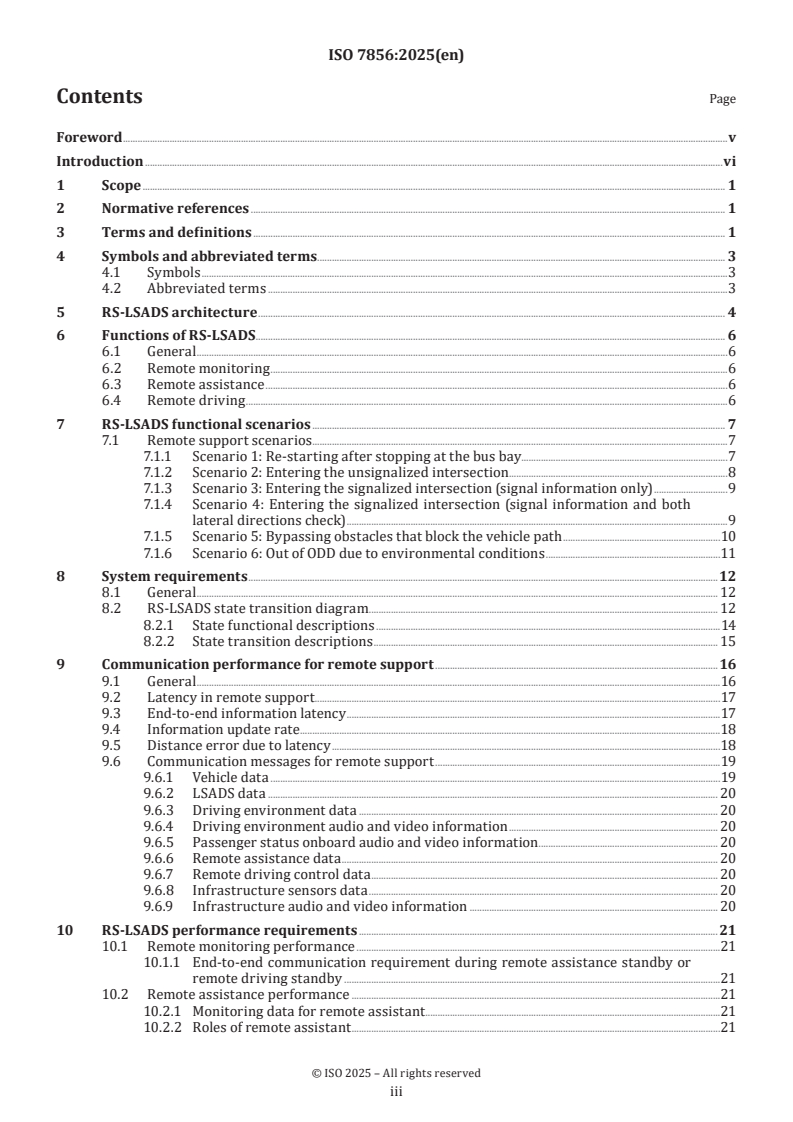
Contents Page
Foreword .v
Introduction .vi
1 Scope . 1
2 Normative references . 1
3 Terms and definitions . 1
4 Symbols and abbreviated terms. 3
4.1 Symbols .3
4.2 Abbreviated terms .3
5 RS-LSADS architecture . 4
6 Functions of RS-LSADS . 6
6.1 General .6
6.2 Remote monitoring .6
6.3 Remote assistance .6
6.4 Remote driving .6
7 RS-LSADS functional scenarios . 7
7.1 Remote support scenarios .7
7.1.1 Scenario 1: Re-starting after stopping at the bus bay.7
7.1.2 Scenario 2: Entering the unsignalized intersection . .8
7.1.3 Scenario 3: Entering the signalized intersection (signal information only) .9
7.1.4 Scenario 4: Entering the signalized intersection (signal information and both
lateral directions check) .9
7.1.5 Scenario 5: Bypassing obstacles that block the vehicle path .10
7.1.6 Scenario 6: Out of ODD due to environmental conditions .11
8 System requirements .12
8.1 General . 12
8.2 RS-LSADS state transition diagram . 12
8.2.1 State functional descriptions .14
8.2.2 State transition descriptions . 15
9 Communication performance for remote support .16
9.1 General .16
9.2 Latency in remote support . .17
9.3 End-to-end information latency .17
9.4 Information update rate .18
9.5 Distance error due to latency .18
9.6 Communication messages for remote support .19
9.6.1 Vehicle data .19
9.6.2 LSADS data . 20
9.6.3 Driving environment data . 20
9.6.4 Driving environment audio and video information . 20
9.6.5 Passenger status onboard audio and video information . 20
9.6.6 Remote assistance data . 20
9.6.7 Remote driving control data . 20
9.6.8 Infrastructure sensors data . 20
9.6.9 Infrastructure audio and video information . 20
10 RS-LSADS performance requirements .21
10.1 Remote monitoring performance .21
10.1.1 End-to-end communication requirement during remote assistance standby or
remote driving standby .21
10.2 Remote assistance performance .21
10.2.1 Monitoring data for remote assistant .21
10.2.2 Roles of remote assistant .21
iii
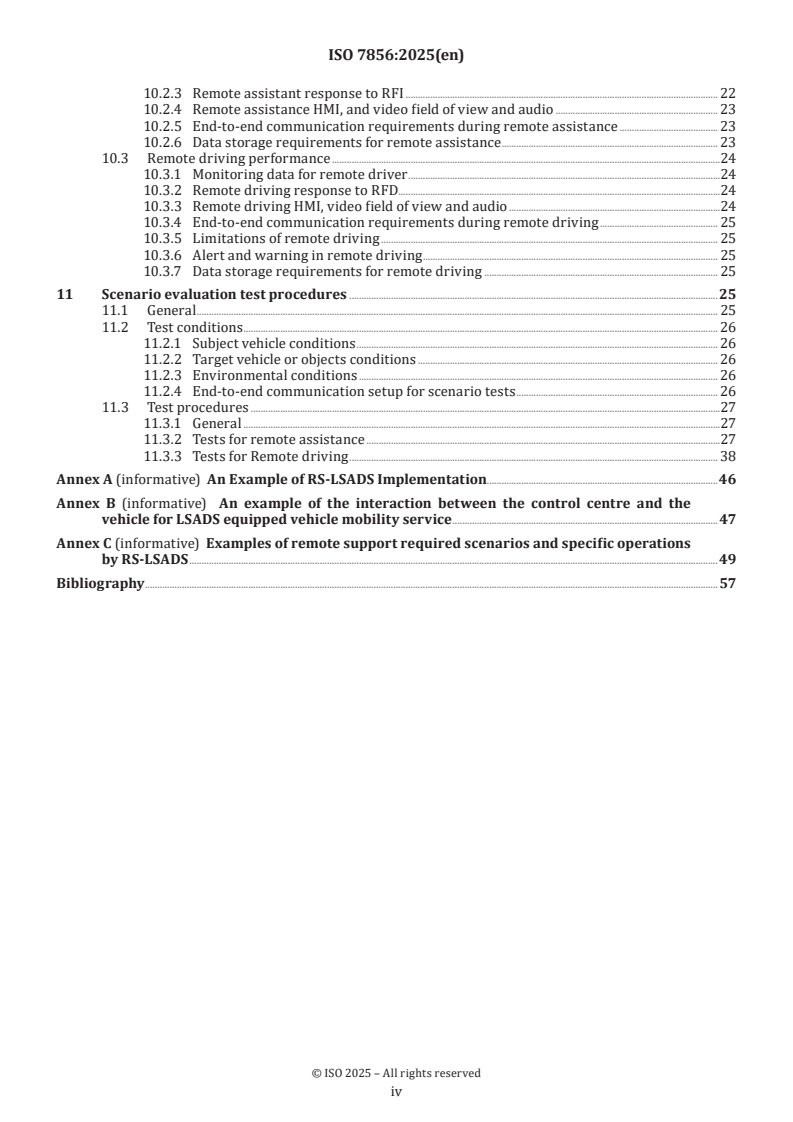
10.2.3 Remote assistant response to RFI . 22
10.2.4 Remote assistance HMI, and video field of view and audio . 23
10.2.5 End-to-end communication requirements during remote assistance . 23
10.2.6 Data storage requirements for remote assistance . 23
10.3 Remote driving performance .24
10.3.1 Monitoring data for remote driver .24
10.3.2 Remote driving response to RFD.24
10.3.3 Remote driving HMI, video field of view and audio .24
10.3.4 End-to-end communication requirements during remote driving . 25
10.3.5 Limitations of remote driving . 25
10.3.6 Alert and warning in remote driving . 25
10.3.7 Data storage requirements for remote driving . 25
11 Scenario evaluation test procedures .25
11.1 General . 25
11.2 Test conditions . 26
11.2.1 Subject vehicle conditions . 26
11.2.2 Target vehicle or objects conditions . 26
11.2.3 Environmental conditions . 26
11.2.4 End-to-end communication setup for scenario tests . 26
11.3 Test procedures .27
11.3.1 General .27
11.3.2 Tests for remote assistance .27
11.3.3 Tests for Remote driving . 38
Annex A (informative) An Example of RS-LSADS Implementation.46
Annex B (informative) An example of the interaction between the control centre and the
vehicle for LSADS equipped vehicle mobility service . 47
Annex C (informative) Examples of remote support required scenarios and specific operations
by RS-LSADS .49
Bibliography .57
iv
Foreword
ISO (the International Organization for Standardization) is a worldwide federation of national standards
bodies (ISO member bodies). The work of preparing International Standards is normally carried out through
ISO technical committees. Each member body interested in a subject for which a technical committee
has been established has the right to be represented on that committee. International organizations,
governmental and non-governmental, in liaison with ISO, also take part in the work. ISO collaborates closely
with the International Electrotechnical Commission (IEC) on all matters of electrotechnical standardization.
The procedures used to develop this document and those intended for its further maintenance are described
in the ISO/IEC Directives, Part 1. In particular, the different approval criteria needed for the different types
of ISO document should be noted. This document was drafted in accordance with the editorial rules of the
ISO/IEC Directives, Part 2 (see www.iso.org/directives).
ISO draws attention to the possibility that the implementation of this document may involve the use of (a)
patent(s). ISO takes no position concerning the evidence, validity or applicability of any claimed patent
rights in respect thereof. As of the date of publication of this document, ISO had not received notice of (a)
patent(s) which may be required to implement this document. However, implementers are cautioned that
this may not represent the latest information, which may be obtained from the patent database available at
www.iso.org/patents. ISO shall not be held responsible for identifying any or all such patent rights.
Any trade name used in this document is information given for the convenience of users and does not
constitute an endorsement.
For an explanation of the voluntary nature of standards, the meaning of ISO specific terms and expressions
related to conformity assessment, as well as information about ISO's adherence to the World Trade
Organization (WTO) principles in the Technical Barriers to Trade (TBT), see www.iso.org/iso/foreword.html.
This document was prepared by Technical Committee ISO/TC 204, Intelligent transport systems.
Any feedback or questions on this document should be directed to the user’s national standards body. A
complete listing of these bodies can be found at www.iso.org/members.html.
v
Introduction
For the sustainable operation of mobility services using automated driving systems (ADS), it can be necessary
to provide additional support for the functioning of the ADS in order to enable mobility services to continue
beyond the constraints of the operational design domain (ODD). Such additional support can include human
remote support, i.e. actions by humans outside the vehicle. The low speed of low speed automated driving
systems (LSADS) equipped vehicles simplifies the provision of remote support.
In this document, remote support is defined as a combination of remote assistance and remote driving.
Currently, individual development and demonstration projects for remote support of LSADS are implemented
in several regions and countries, including UK, US, CA, DE, FR, AU, KR, and JP, amongst others. One example
of such an implementation is given in Annex A.
This document indicates the technical requirements of remote support for LSADS (RS-LSADS) and is
intended to provide a common basis for RS-LSADS development.
ISO/SAE PAS 22736 (SAE J3016) defines remote assistance and remote driving. In addition, in ISO 22737
external entity input is described. This document is intended to complement ISO 22737 by defining scenarios
and requirements for remote assistance and remote driving.
vi
International Standard ISO 7856:2025(en)
Intelligent transport systems — Remote support for low
speed automated driving systems (RS-LSADS) — Performance
requirements, system requirements and performance test
procedures
1 Scope
This document describes remote support provided to LSADS operated at Level 4 automation on predefined
routes by a remotely located human in order to facilitate safe trip continuation. "Remote support" refers
to the provision of information, or temporary performance of the dynamic driving task (DDT), and remote
monitoring required for these functions.
This document is applicable to RS-LSADS in vehicles that provide passenger transport or logistics services
on predefined routes.
This document specifies:
— the terms and definitions related to RS-LSADS and the system architecture of RS-LSADS;
— functions of RS-LSADS, which are: remote monitoring, remote assistance and remote driving that is
operated under very limited conditions, and conditions under which they need to be activated;
— the performance requirements, system requirements and performance test procedures of RS-LSADS;
— the data to be communicated between vehicles and the remote support facility (but not protocols or
other aspects of communication system).
This document is applicable to remote support of operational and tactical functions during continuous
operations, but does not apply to strategic functions or to RS-LSADS daily startup or shutdown.
2 Normative references
The following documents are referred to in the text in such a way that some or all of their content constitutes
requirements of this document. For dated references, only the edition cited applies. For undated references,
the latest edition of the referenced document (including any amendments) applies.
ISO/SAE PAS 22736, Taxonomy and definitions for terms related to driving automation systems for on-road
motor vehicles
ISO 22737, Intelligent transport systems — Low-speed automated driving (LSAD) systems for predefined routes
— Performance requirements, system requirements and performance test procedures
ISO/SAE 21434, Road vehicles — Cybersecurity engineering
3 Terms and definitions
For the purposes of this document, the terms and definitions given in ISO/SAE PAS 22736, ISO 22737 and the
followings apply.
ISO and IEC maintain terminological databases for use in standardization at the following addresses:
— ISO Online browsing platform: available at https:// www .iso .org/ obp
— IEC Electropedia: available at https:// www .electropedia .org/
3.1
low speed automated driving system (LSADS) equipped vehicle
vehicle which is equipped with a Level 4 automated driving system that has a maximum speed not exceeding
8,89 m/s, and is operated driverless on a pre-defined route
3.2
remote support
remote monitoring (3.3), remote assistance and remote driving through a communication system by a
remotely located human
3.3
remote monitoring
monitoring of the end-to-end communication status, driving environment, vehicle status, low speed
automated driving system status, and passenger status through a communication system by a remotely
located human
3.4
request for information
alert provided by low speed automated driving system to a remote assistant indicating that s/he need to
provide information or advice
3.5
request for driving
alert provided by low speed automated driving system to a remote driver indicating that s/he need to take
over the dynamic driving task temporarily
3.6
vehicle path
line to be traversed by the vehicle driven by the low speed automated driving system (LSADS)
3.7
communication data rate
rate of data transfer (in bits per second) between two entities using a communication system link
Note 1 to entry: This is also known as "baud rate".
3.8
information update rate
number of times per second that each kind of information is updated at the receiver
3.9
remote support for low speed automated driving system (RS-LSADS) stakeholder
organization that is related to remote support (3.2) for low speed automated driving system such as a local
authority, service provider, manufacturer, operating organization and other road users
3.10
distance error due to latency
maximum error between the actual and remotely observed distance between the subject vehicle and the
fastest-moving other road user
3.11
glass to glass
path from the camera lens to the display screen, which is mainly the video data transfer
4 Symbols and abbreviated terms
4.1 Symbols
S Longitudinal distance of evaluation path (m)
long
S Lateral distance between SV and target (m)
lat
S Distance error due to latency (m)
err
T One second average control system latency (s)
cs
T
One second average end-to-end latency (s)
ee
T Time to collision (s)
ttc
R Information update rate (1/s)
iu
V Speed of subject vehicle (m/s)
S
V Speed of target vehicle (m/s)
tv
V Speed of target entity (pedal cyclist, pedestrian or target vehicle) (m/s)
T
V Maximum speed of other road users in the location where the SV is operating (m/s)
emax
d Deceleration rate of the LSADS equipped vehicle while performing MRM (m/s )
LSADS
W Width of subject vehicle (m)
sv
L Length of target vehicle (m)
tv
4.2 Abbreviated terms
ADS automated driving system
DDT dynamic driving task
DEDTL distance error due to latency
e-stop emergency stop
HMI human machine interface
I2V infrastructure to vehicles
G2G glass to glass
LKAS lane keeping assistance systems
LSADS low speed automated driving system
MRC minimal risk condition
MRM minimal risk manoeuvre
ODD operational design domain
RS-LSADS remote support for low speed automated driving system
RFI request for information
RFD request for driving
SOC state of charge
SOTIF safety of the intended functionality as specified in ISO 21448
SPaT Signal Phase and Timing as specified in ISO/TS 19091
SV subject vehicle
TTC time to collision
TV target vehicle
5 RS-LSADS architecture
RS-LSADS consists of one or several L4 LSADS-equipped vehicles, server(s) and operator(s), belonging to a
control centre. Operators have various roles, such as dispatching vehicles. An example of the data exchanges
between the control centre and the vehicle for LSADS equipped vehicle mobility service is given in Annex B.
However, the scope of this document concerns the remote assistance and the remote driving. Remote support
is performed when the ADS cannot be operated by itself, e.g. due to insufficient information or operational
conditions. Remote support has three functions: remote monitoring, remote assistance with information
provisions, and remote driving for temporary remote performance of the DDT. Figure 1 depicts an example
of RS-LSADS operational architecture.
Figure 1 — An example of RS-LSADS operational architecture and scope
Figure 2 represents the functional architecture of an individual RS-LSADS. Generally, remote support
systems consist of both remote and onboard systems. Figure 2 also highlights the functional components
from the RS-LSADS architecture that are specified within the scope of this document. This functional
architecture is made based on the architecture of ISO 22737, with necessary functional components for
RS-LSADS. In addition to the primary functions such as remote monitoring, remote assistance, and remote
driving for LSADS, the supporting functions such as end-to-end monitoring of the status of communications
and transmission of audio and video information to the control centre are added. Input to the control centre
from infrastructure sensors can also optionally be added as in ISO 21734-1, ISO/TS 5255-1 or ISO 23374-1.
Key
functional requirements defined in this document
optional features requirement defined in this document
functional requirements defined in ISO 22737
functional requirements not defined in ISO 22737
optional features not defined in ISO 22737
Figure 2 — RS-LSADS functional architecture
6 Functions of RS-LSADS
6.1 General
This clause describes the three functions of remote support: remote monitoring, remote assistance and
remote driving.
6.2 Remote monitoring
This document describes the remote monitoring required for standby and execution of remote assistance or
remote driving. Remote monitoring is the task of monitoring the data from the vehicles and infrastructure
described in Clause 9.6 by the system, remote assistant and/or remote driver. The remote system constantly
receives the data and displays to the remote assistant and/or remote driver while the system is active. The
remote assistant and/or remote driver monitors the data as required.
Remote monitoring is also a part of remote assistance and remote driving.
6.3 Remote assistance
The remote assistance function provides information to the LSADS and provides event-driven information
to facilitate the continuation of the trip if the LSADS encounters a situation that is difficult to deal with. The
remote assistance does not perform the DDT but provides information on whether the situation is safe to
proceed, information on signals, and/or information about the vehicle path within the drivable area in order
to avoid obstacles. Remote assistance may provide the LSADS with revised goals and/or tasks.
The remote assistance provides inputs to the LSADS controller, which then combines this information with
the other sensing information to perform DDT.
The remote assistance is provided during normal LSADS operation, when no fallback occurs. Therefore, the
level of automation of the LSADS does not change.
6.4 Remote driving
The remote driving function in this document is limited to supporting the continuation of the LSADS trip
over short times and distances at low speed in cases where remote assistance is insufficient. Remote driving
is only invoked in very limited conditions, outside the LSADS active state.
The remote driving system consists of a remote side and an on-board side that receives commands from
the remote side. The on-board side continuously verifies if the end-to-end communication requirements are
met. If they are not met, the vehicle transitions to MRC or a standstill.
The remote driver temporarily performs the DDT on behalf of LSADS in response to RFD from LSADS. The
remote driver is provided with the information and images through remote monitoring. Using control input
devices installed in the control centre, the remote driver provides remote input commands to the vehicle
such as accelerating, braking, shifting and steering for manoeuvres through a communication system. The
remote driver also operates the turn signals and horn. During remote driving the LSADS is not performing
the DDT.
7 RS-LSADS functional scenarios
7.1 Remote support scenarios
The remote support function is needed in the case of situations when LSADS cannot perform level 4
automated driving (cannot complete the DDT).
The remote assistance is applied within the scope of the requirements of ISO 22737 and interacts with other
road users driving at speed up to the speed limit along LSADS’ predefined route and its connected road
segments according to LSADS’ ODD.
For the remote driving described in this document, the available scenarios are limited, and the maximum
speed of the SV is limited to 1,67 m/s (6 km/h) and the duration of the remote driving is limited to 60 s.
Table 1 lists possible scenarios in which remote support is used to extend the LSADS operation.
Detailed examples of scenarios are given in Annex C.
Table 1 — Remote support required functional scenarios
Functional scenarios Attribute of scenario Recommended support Scenario
Planned scenarios Re-starting after stopping at the bus bay Remote assistance Scenario 1
Entering the unsignalized intersection Remote assistance Scenario 2
Entering the signalized intersection (no Remote assistance Scenario 3
signal information from roadside to vehicle
Signal information
via I2V)
check
Remote assistance Scenario 4
Signal information and
both lateral directions
check
Unplanned scenarios Existence of unrecognized or unplanned ob- Remote assistance or Scenario 5
stacles on the route remote driving
Out of ODD due to environmental conditions Remote driving Scenario 6
7.1.1 Scenario 1: Re-starting after stopping at the bus bay
The SV using LSADS automatically drives to the bus bay and stops. When the SV intends to depart, after
passengers board and alight, the SV sends a support request of re-start to the control centre (Figure 3).
In this scenario, the SV has insufficient rearward and periphery detection capability to ensure a safe start
by using its onboard ADS sensors. However, it is possible for the remote assistant to recognize relevant other
road users using additional onboard cameras and/or roadside camera images.
On receipt of the request, the remote assistant uses onboard cameras or roadside cameras to confirm the
rearward and periphery situation and supports the SV by advising that it is safe to start when there are
no vehicles approaching close enough from behind and no objects on the periphery of the SV to create a
hazardous condition for its departure from the bus bay.
Key
1 SV
Figure 3 — Scenario 1 (Re-starting after stopping at the bus bay)
7.1.2 Scenario 2: Entering the unsignalized intersection
The SV using LSADS automatically drives and stops at the stop line in front of an intersection that has no
traffic signal. The SV sends a support request to the control centre to advise the LSADS when to turn and
merge into the priority road or to cross the priority road (Figure 4).
In this scenario, if the SV has insufficient lateral detection capability by use of its onboard sensors, it is
possible for the remote assistant to recognize relevant other road users approaching from the lateral
directions on the priority road by using additional onboard cameras and/or roadside camera images.
On receipt of the request, the remote assistant uses onboard or roadside cameras to support the SV by
advising its LSADS whether or not it is safe to proceed into the priority road to turn or cross the priority
road. In case the remote assistant provides information that it is not safe to proceed, the remote assistant
will then inform the SV that it is safe to proceed when the situation turns safe.
a) Right turn and merge into the road b) Cross the road
Key
1 SV
Figure 4 — Scenario 2 (Entering unsignalized intersection)
NOTE Left turns at intersections are not included in the scenarios in this document due to the complexity and
variety of the scenarios when crossing oncoming traffic and the high workload on the remote assistant.
7.1.3 Scenario 3: Entering the signalized intersection (signal information only)
If a LSADS is driving automatically but has insufficient capability to detect the traffic signal condition, the
SV sends a support request to the control centre to provide the traffic signal information.
In this scenario, the remote assistant checks the signal phase and provides information to the LSADS
on whether it is safe to proceed or not. To improve safety, it is assumed that the SV always stops before
entering the intersection, regardless of the signal phase, and waits for support from the remote assistant,
or the remote assistant is in a situation where the phase and remaining time of the signal is provided by the
infrastructure as in SPaT.
The SV approaches the signalized intersection and sends a support request to the control centre for advice
about traffic signal information (see Figure 5).
On receipt of the request, the remote assistant uses onboard cameras or roadside cameras, or traffic signal
information provided by infrastructure systems and transmits information to the LSADS on whether it is
safe to proceed or not. The SV stops at the stop line of the intersection and re-starts to enter the intersection,
or the SV enters the intersection without stopping, based on the provided information.
a) Right turn and merge into the road b) Cross the road
Key
1 SV
Figure 5 — Scenario 3 (Entering the signalised intersection)
NOTE Left turns at intersections are not included in the scenarios in this document due to the complexity and
variety of the scenarios when crossing oncoming traffic and the high workload on the remote assistant.
NOTE SPaT as described in ISO TS 19091 is a direct I2V communication between the signal controller and the
vehicle. The environment here assumes that data equivalent to that provided by the SPaT is communicated to the
remote assistant.
7.1.4 Scenario 4: Entering the signalized intersection (signal information and both lateral
directions check)
If an SV using LSADS drives automatically but its LSADS has insufficient capability to detect the traffic signal
condition and to detect crossing traffic by use of its onboard sensors, the SV sends a support request to the
control centre to provide the traffic signal information and information about crossing traffic hazards.
In this scenario, the remote assistant checks the signal phase and the remaining time of that phase and
relevant other road users approaching on the crossing road, and then provides information to the LSADS
on whether it is safe to proceed or not. To improve safety, it is assumed that the SV always stops before
entering the intersection, regardless of the signal phase, and waits for support from the remote assistant,
or the remote assistant is in a situation where the phase and remaining time of the signal is provided by the
infrastructure as in SPaT.
SV approaches the signalized intersection and sends a support request to the control centre for advice about
signal information and lateral direction other road users’ situation. (Figure 6)
On receipt of the request, the remote assistant uses onboard cameras or roadside cameras, or traffic signal
information provided by infrastructure systems and supports the SV by advising its LSADS whether or not
it is safe to proceed. SV stops at the stop line of the intersection and re-starts to enter the intersection, or SV
enters the intersection without stopping, based on the information provided by remote assistance.
a) Right turn and merge into the road b) Cross the road
Key
1 SV
Figure 6 — Scenario 4 (Entering the signalised intersection)
NOTE Left turns at intersections are not included in the scenarios in this document due to the complexity and
variety of the scenarios when crossing oncoming traffic and the high workload on the remote assistant.
NOTE SPaT as described in ISO TS 19091 is a direct I2V communication between the signal controller and the
vehicle. The environment here assumes that data equivalent to that provided by the SPaT is communicated to the
remote assistant.
7.1.5 Scenario 5: Bypassing obstacles that block the vehicle path
The SV approaches an obstacle that blocks the intended path of the vehicle, preventing the continuation of
the trip (Figure 7). In this scenario, the SV sends a support request to the control centre for advice about
how to bypass the obstacle safely after stopping in front of the obstacle.
On receipt of the request, the remote assistant provides a new vehicle path within the drivable area that has
no oncoming traffic for the LSADS to take to avoid the obstacle.
In cases when the LSADS is operating on a road without other oncoming traffic and it is unable to respond
to changes in the vehicle path or it does not receive a new vehicle path, or there is no feasible vehicle path
within the driveable area, the SV requests the remote driver to operate the SV.
On receipt of the request, the remote driver performs the avoidance manoeuvre based on their decision that
remote driving is viable in the current environment.
Key
1 SV
NOTE Obstacle could be road construction, fallen material or parked car etc.
Figure 7 — Scenario 5 (Bypassing obstacles that block the vehicle path)
7.1.6 Scenario 6: Out of ODD due to environmental conditions
In this scenario, LSADS drives automatically, but its ODD restrictions are violated due to sudden changes in
environmental conditions such as fog and rainfall. (Figure 8)
LSADS automatically stops the SV because the conditions impair the ability of the sensors to detect hazards
in the driving environment and sends a support request to the control centre.
On receipt of the request, the remote driver confirms whether the cameras available on the SV provide
sufficient visibility for him or her to safely perform the DDT. If the visibility is sufficient, the remote driver
drives the SV to the nearest available road shoulder or turnout area.
Key
1 SV
2 fog
Figure 8 — Scenario 6 (Out of ODD due to environmental conditions)
8 System requirements
8.1 General
RS-LSADS have remote assistance or remote driving, or both of them. In case the system has both remote
assistance and remote driving, if LSADS is not able to decide which is appropriate, remote assistance is
requested first, in which the ADS can remain active, and in case the remote assistance does not settle the
situation, remote driving is subsequently requested.
Remote monitoring shall provide the remote assistant and/or the remote driver with information of the vehicle
status, LSADS status, the driving environment, passenger status, and the end-to-end communication status.
In addition, infrastructure supports such as roadside cameras and other sensors may be utilized by RS-
LSADS. Systems that provide information directly from infrastructure cameras and/or sensors to LSADS
could also be considered, however, these are outside the scope of this document. In this document,
infrastructure facilities are assumed to be those used to provide information on the traffic environment to
the remote assistant and/or the remote driver.
Vehicles managed by the control centre shall be time synchronized with the control centre to an accuracy of
less than ±0,05 s. Infrastructure sensors and cameras, if used, shall also be synchronized with the control
centre to an accuracy of less than ±0,05 s.
Specific requirements for remote monitoring, remote assistance, remote driving and end-to-end
communication performance, such as latency, are described in Clause 10.
RS-LSADS should be developed using functional safety methodologies such as ISO 26262 and IEC 61508, and
SOTIF methodologies such as ISO 21448.
As the RS-LSADS is based on connecting LSADS equipped vehicles with the control centre using wireless
communication systems, the RS-LSADS shall be developed, managed and maintained according to
ISO/SAE 21434.
8.2 RS-LSADS state transition diagram
RS-LSADS state transition diagram is shown in Figure 9. The state transitions in RS-LSADS are linked to
the state transitions in LSADS. A diagram of the relationship between the state of LSADS and the state of
RS-LSADS is shown in Figure 10. Figure 10 shows that the remote driving becomes active only when LSADS
is in standby state. Therefore, the remote driving and LSADS cannot be active at the same time. In addition,
remote driving starts when the vehicle is in standstill and ends when the vehicle is in standstill. The remote
assistance can only be activated when LSADS is active.
Key
A1 power on by the remote despatcher commands and self-test passed
B1 power off by the remote commands
C1 LSADS resumes performance of the DDT
C2 LSADS issues an RFD, and the remote driver has responded
D1 remote assistant cannot resolve the problem, so remote assistant requests transition to remote driving
D2 LSADS issues an RFI, and the remote assistant has responded
E1 remote assistant completes the information provision or communication failure between vehicle and control
centre or vehicle system failure.
...
Questions, Comments and Discussion
Ask us and Technical Secretary will try to provide an answer. You can facilitate discussion about the standard in here.
Loading comments...