


ISO/TS 14198:2019
(Main)Road vehicles — Ergonomic aspects of transport information and control systems — Calibration tasks for methods which assess driver demand due to the use of in-vehicle systems
Road vehicles — Ergonomic aspects of transport information and control systems — Calibration tasks for methods which assess driver demand due to the use of in-vehicle systems
This document provides procedures that can be used as a secondary task in a dual task setting to determine whether that evaluation setting is standardized and valid for purposes of assessing driver attentional demand due to the use of an in-vehicle system. This document does not define calibration procedures for other evaluation activities that a laboratory might undertake. This document provides guidance on selecting a calibration task given a specific primary task. The primary tasks of interest include those that would be used in the evaluation of attentional demand. Such primary tasks are defined in other documents. The description of a calibration task includes its application, experimental setup, data collection, and procedures for analysis of results. The purpose of this document is not to define a reference criterion as to whether a given secondary task is suitable for use while driving. Although specific settings of parameters of a calibration task might be used to realize such a predefined pass/fail criterion, this document does not provide such a criterion for a given level of attentional demand.
Véhicules routiers — Aspects ergonomiques des systèmes d'information et de contrôle du transport — Tâches de calibration pour méthodes qui évaluent la distraction du conducteur due à l'utilisation des systèmes embarqués
General Information
- Status
- Published
- Publication Date
- 31-Mar-2019
- Technical Committee
- ISO/TC 22/SC 39 - Ergonomics
- Drafting Committee
- ISO/TC 22/SC 39/WG 8 - TICS on-board-MMI
- Current Stage
- 9093 - International Standard confirmed
- Start Date
- 25-Jun-2024
- Completion Date
- 12-Feb-2026
Relations
- Effective Date
- 04-Jun-2016
Overview
ISO/TS 14198:2019 - Road vehicles - Ergonomic aspects of transport information and control systems - Calibration tasks for methods which assess driver demand due to the use of in-vehicle systems - provides standardized procedures for secondary (calibration) tasks used in dual-task evaluations. The technical specification helps determine whether a laboratory evaluation setting is standardized and valid for assessing driver attentional demand caused by interaction with in-vehicle systems. It describes task selection, experimental setup, data collection and analysis procedures, but does not prescribe pass/fail criteria for acceptable attentional demand.
Key Topics and Requirements
- Purpose and scope
- Calibration tasks used as secondary tasks in dual-task paradigms to assess attentional demand.
- Guidance on selecting a calibration task for a given primary task (e.g., driving-like tests).
- Specified calibration tasks
- Critical Tracking Task (CTT) - description, operation, setup, test conditions, participants, instructions, practice trials, and metrics.
- Surrogate Reference Task (SURT) - full task description and test procedures.
- n-back task - added in the 2019 edition as a cognitive calibration option.
- Primary tasks referenced
- Lane Change Test (LCT) and Detection Response Task (DRT) are treated as primary tasks of interest and are addressed via referenced standards.
- Experimental protocol elements
- Detailed requirements for experimental setup, participant selection, participant instruction, practice trials, metrics for performance, and data collection.
- Annexes providing setup details and multi-lab reference data (e.g., for LCT and DRT).
- Calibration criterion
- Procedure guidance for establishing calibration; standard explicitly does not define a universal pass/fail threshold for task suitability.
Applications and Who Uses It
ISO/TS 14198:2019 is practical for:
- Human factors and ergonomics researchers conducting driver distraction and workload studies.
- Automotive HMI designers and UX teams validating in-vehicle information and control systems.
- Test laboratories and simulators standardizing dual-task protocols across sites and over time.
- Regulatory bodies and safety engineers seeking repeatable, comparable measures of secondary task demand. Practical benefits include improved inter-lab comparability, repeatable quantitative results, sensitivity to unwanted variability, and guidance for driving-like test contexts.
Related Standards
- ISO 26022:2010 - Simulated Lane Change Test (LCT)
- ISO 17488 - Detection Response Task (DRT)
- ISO/IEC 7498-1 - Basic Reference Model (terminology) These referenced documents define primary tasks and terms used by ISO/TS 14198:2019.
Keywords: ISO/TS 14198:2019, calibration tasks, driver attentional demand, in-vehicle systems, critical tracking task, SURT, n-back, DRT, Lane Change Test, ergonomic assessment, driver distraction.

ISO/TS 14198:2019 - Road vehicles — Ergonomic aspects of transport information and control systems — Calibration tasks for methods which assess driver demand due to the use of in-vehicle systems Released:1. 04. 2019
Get Certified
Connect with accredited certification bodies for this standard

TÜV Rheinland
TÜV Rheinland is a leading international provider of technical services.

TÜV SÜD
TÜV SÜD is a trusted partner of choice for safety, security and sustainability solutions.

AIAG (Automotive Industry Action Group)
American automotive industry standards and training.
Sponsored listings
Frequently Asked Questions
ISO/TS 14198:2019 is a technical specification published by the International Organization for Standardization (ISO). Its full title is "Road vehicles — Ergonomic aspects of transport information and control systems — Calibration tasks for methods which assess driver demand due to the use of in-vehicle systems". This standard covers: This document provides procedures that can be used as a secondary task in a dual task setting to determine whether that evaluation setting is standardized and valid for purposes of assessing driver attentional demand due to the use of an in-vehicle system. This document does not define calibration procedures for other evaluation activities that a laboratory might undertake. This document provides guidance on selecting a calibration task given a specific primary task. The primary tasks of interest include those that would be used in the evaluation of attentional demand. Such primary tasks are defined in other documents. The description of a calibration task includes its application, experimental setup, data collection, and procedures for analysis of results. The purpose of this document is not to define a reference criterion as to whether a given secondary task is suitable for use while driving. Although specific settings of parameters of a calibration task might be used to realize such a predefined pass/fail criterion, this document does not provide such a criterion for a given level of attentional demand.
This document provides procedures that can be used as a secondary task in a dual task setting to determine whether that evaluation setting is standardized and valid for purposes of assessing driver attentional demand due to the use of an in-vehicle system. This document does not define calibration procedures for other evaluation activities that a laboratory might undertake. This document provides guidance on selecting a calibration task given a specific primary task. The primary tasks of interest include those that would be used in the evaluation of attentional demand. Such primary tasks are defined in other documents. The description of a calibration task includes its application, experimental setup, data collection, and procedures for analysis of results. The purpose of this document is not to define a reference criterion as to whether a given secondary task is suitable for use while driving. Although specific settings of parameters of a calibration task might be used to realize such a predefined pass/fail criterion, this document does not provide such a criterion for a given level of attentional demand.
ISO/TS 14198:2019 is classified under the following ICS (International Classification for Standards) categories: 13.180 - Ergonomics; 43.040.15 - Car informatics. On board computer systems. The ICS classification helps identify the subject area and facilitates finding related standards.
ISO/TS 14198:2019 has the following relationships with other standards: It is inter standard links to ISO/TS 14198:2012. Understanding these relationships helps ensure you are using the most current and applicable version of the standard.
ISO/TS 14198:2019 is available in PDF format for immediate download after purchase. The document can be added to your cart and obtained through the secure checkout process. Digital delivery ensures instant access to the complete standard document.
Standards Content (Sample)
TECHNICAL ISO/TS
SPECIFICATION 14198
Second edition
2019-04
Road vehicles — Ergonomic aspects
of transport information and control
systems — Calibration tasks for
methods which assess driver demand
due to the use of in-vehicle systems
Véhicules routiers — Aspects ergonomiques des systèmes
d'information et de contrôle du transport — Tâches de calibration
pour méthodes qui évaluent la distraction du conducteur due à
l'utilisation des systèmes embarqués
Reference number
©
ISO 2019
© ISO 2019
All rights reserved. Unless otherwise specified, or required in the context of its implementation, no part of this publication may
be reproduced or utilized otherwise in any form or by any means, electronic or mechanical, including photocopying, or posting
on the internet or an intranet, without prior written permission. Permission can be requested from either ISO at the address
below or ISO’s member body in the country of the requester.
ISO copyright office
CP 401 • Ch. de Blandonnet 8
CH-1214 Vernier, Geneva
Phone: +41 22 749 01 11
Fax: +41 22 749 09 47
Email: copyright@iso.org
Website: www.iso.org
Published in Switzerland
ii © ISO 2019 – All rights reserved
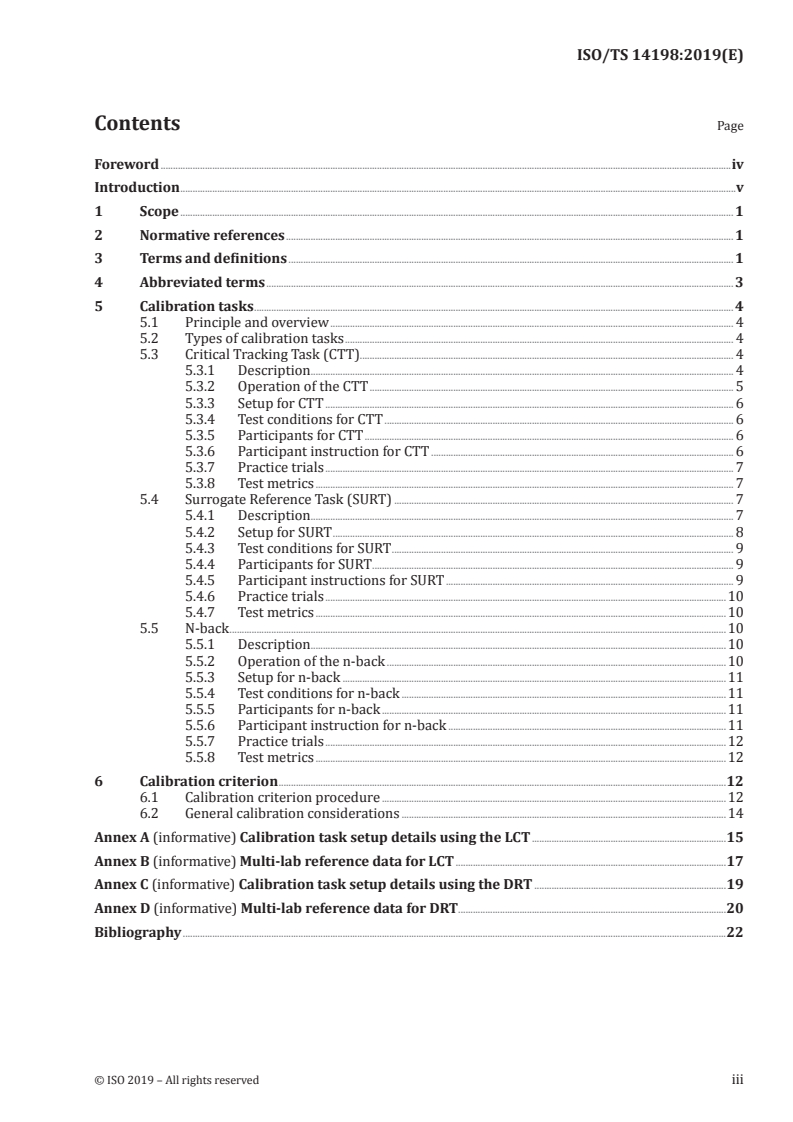
Contents Page
Foreword .iv
Introduction .v
1 Scope . 1
2 Normative references . 1
3 Terms and definitions . 1
4 Abbreviated terms . 3
5 Calibration tasks . 4
5.1 Principle and overview . 4
5.2 Types of calibration tasks . 4
5.3 Critical Tracking Task (CTT). 4
5.3.1 Description . . . 4
5.3.2 Operation of the CTT . 5
5.3.3 Setup for CTT . 6
5.3.4 Test conditions for CTT . 6
5.3.5 Participants for CTT . 6
5.3.6 Participant instruction for CTT . 6
5.3.7 Practice trials . 7
5.3.8 Test metrics . 7
5.4 Surrogate Reference Task (SURT) . 7
5.4.1 Description . . . 7
5.4.2 Setup for SURT . 8
5.4.3 Test conditions for SURT . 9
5.4.4 Participants for SURT . . 9
5.4.5 Participant instructions for SURT . 9
5.4.6 Practice trials .10
5.4.7 Test metrics .10
5.5 N-back .10
5.5.1 Description . . .10
5.5.2 Operation of the n-back .10
5.5.3 Setup for n-back .11
5.5.4 Test conditions for n-back .11
5.5.5 Participants for n-back .11
5.5.6 Participant instruction for n-back .11
5.5.7 Practice trials .12
5.5.8 Test metrics .12
6 Calibration criterion .12
6.1 Calibration criterion procedure .12
6.2 General calibration considerations .14
Annex A (informative) Calibration task setup details using the LCT .15
Annex B (informative) Multi-lab reference data for LCT .17
Annex C (informative) Calibration task setup details using the DRT .19
Annex D (informative) Multi-lab reference data for DRT .20
Bibliography .22
Foreword
ISO (the International Organization for Standardization) is a worldwide federation of national standards
bodies (ISO member bodies). The work of preparing International Standards is normally carried out
through ISO technical committees. Each member body interested in a subject for which a technical
committee has been established has the right to be represented on that committee. International
organizations, governmental and non-governmental, in liaison with ISO, also take part in the work.
ISO collaborates closely with the International Electrotechnical Commission (IEC) on all matters of
electrotechnical standardization.
The procedures used to develop this document and those intended for its further maintenance are
described in the ISO/IEC Directives, Part 1. In particular, the different approval criteria needed for the
different types of ISO documents should be noted. This document was drafted in accordance with the
editorial rules of the ISO/IEC Directives, Part 2 (see www .iso .org/directives).
Attention is drawn to the possibility that some of the elements of this document may be the subject of
patent rights. ISO shall not be held responsible for identifying any or all such patent rights. Details of
any patent rights identified during the development of the document will be in the Introduction and/or
on the ISO list of patent declarations received (see www .iso .org/patents).
Any trade name used in this document is information given for the convenience of users and does not
constitute an endorsement.
For an explanation of the voluntary nature of standards, the meaning of ISO specific terms and
expressions related to conformity assessment, as well as information about ISO's adherence to the
World Trade Organization (WTO) principles in the Technical Barriers to Trade (TBT) see www .iso
.org/iso/foreword .html.
This document was prepared by Technical Committee ISO/TC 22, Road vehicles, Subcommittee SC 39,
Ergonomics.
This second edition cancels and replaces the first edition (ISO/TS 14198:2012), which has been
technically revised. The main changes compared to the previous edition are as follows:
— in addition to the Lane Change Test (LCT), the Detection Response Task (DRT) is added as a
primary task;
— in addition to the Critical Tracking Task (CTT) and Surrogate Reference Task (SURT), the n-back
task is added as calibration task.
Any feedback or questions on this document should be directed to the user’s national standards body. A
complete listing of these bodies can be found at www .iso .org/members .html.
iv © ISO 2019 – All rights reserved
Introduction
The number of standardized methods to assess driver attentional demand due to the use of in-vehicle
information and communication devices is continuing to increase. In applying these methodologies, it is
important to understand and document variability in participants’ performance of standard calibration
tasks and procedures across laboratories and/or time.
A suitable calibration task should have the following attributes:
— It should be robust against the variations in cultural background of participants.
— Properly applied, the task should give repeatable quantitative results. It should be sensitive to
inappropriate variations in participants, equipment, location, experimenter and instruction.
— It should use durable and readily available equipment for conducting the task.
— It should apply to the driver population and be usable in a driving-like context.
A standardized calibration task can be used to produce a range of statistically stable, repeatable and
comparable secondary task demands for a participant in an experimental setting. This setting can be
used to assess the effect on driving performance of the attentional demand due to driver interaction
with an information, entertainment, and control or communication system while a vehicle is in motion.
Different calibration tasks are specified in this document to cover calibration manual, visual, and
cognitive aspects of various secondary task characteristics.
TECHNICAL SPECIFICATION ISO/TS 14198:2019(E)
Road vehicles — Ergonomic aspects of transport
information and control systems — Calibration tasks for
methods which assess driver demand due to the use of in-
vehicle systems
1 Scope
This document provides procedures that can be used as a secondary task in a dual task setting to
determine whether that evaluation setting is standardized and valid for purposes of assessing driver
attentional demand due to the use of an in-vehicle system. This document does not define calibration
procedures for other evaluation activities that a laboratory might undertake.
This document provides guidance on selecting a calibration task given a specific primary task. The
primary tasks of interest include those that would be used in the evaluation of attentional demand.
Such primary tasks are defined in other documents.
The description of a calibration task includes its application, experimental setup, data collection, and
procedures for analysis of results.
The purpose of this document is not to define a reference criterion as to whether a given secondary task
is suitable for use while driving. Although specific settings of parameters of a calibration task might be
used to realize such a predefined pass/fail criterion, this document does not provide such a criterion for
a given level of attentional demand.
2 Normative references
The following documents are referred to in the text in such a way that some or all of their content
constitutes requirements of this document. For dated references, only the edition cited applies. For
undated references, the latest edition of the referenced document (including any amendments) applies.
ISO 26022:2010, Road vehicles — Ergonomic aspects of transport information and control systems —
Simulated lane change test to assess in-vehicle secondary task demand
ISO 17488, Road vehicles — Transport information and control systems — detection-response-task (DRT)
for assessing attentional effects of cognitive load in driving
ISO/IEC 7498-1, Information technology — Open Systems Interconnection — Basic Reference Model: The
Basic Model
3 Terms and definitions
For the purposes of this document, the terms and definitions given in ISO/IEC 7498-1 and the
following apply.
ISO and IEC maintain terminological databases for use in standardization at the following addresses:
— ISO Online browsing platform: available at https: //www .iso .org/obp
— IEC Electropedia: available at http: //www .electropedia .org/
3.1
calibration task
type of reference task used for the purpose of comparing different tests or test results between sites, or
over time at a given site
3.2
criterion
threshold or value of a variable to be met
3.3
demand
total visual, auditory, cognitive, or physical resources required of the driver to accomplish the primary
task and interact with a Transport Information and Control System (TICS) in a dual task setting
3.4
dual task
two tasks concurrently performed, typically the primary task plus the secondary task
3.5
environment
physical surroundings in which data are captured and collected, consequently, the level of control over
the independent variables in a study
EXAMPLE Laboratory, simulator, test track, real road.
3.6
evaluation
procedure in which the effect of a Transport Information and Control System (TICS) or another device
is assessed
Note 1 to entry: It may be undertaken retrospectively after the TICS has been in use for a considerable time as a
product.
Note 2 to entry: The results of the evaluation will depend on the HMI, but also on the equipment reliability and
subsequent behavioural changes which may affect driving performance.
3.7
method
high-level approach to an assessment, based on theory and principles, which implies an underlying
rationale in the choice of assessment techniques
EXAMPLE Behaviour analysis, workload assessment, and analysis of psycho-physiological responses.
3.8
metric
quantitative measure of driver behaviour independent of the tool used to measure it
EXAMPLE Eye glance duration and vehicle speed.
3.9
performance
result of skill application demonstrated by a participant in performing a driving task or Transport
Information and Control System (TICS) related task
3.10
primary task
task to be calibrated
Note 1 to entry: The Lane Change Test in ISO 26022 is one example a task that simulates or approximates a
primary driving task.
Note 2 to entry: This document considers the Detection Response Task (ISO 17488) is the primary task to be
calibrated even if performed with or without driving.
2 © ISO 2019 – All rights reserved
3.11
primary driving task
activities that the driver must undertake while driving including navigating, path following,
manoeuvring, avoiding obstacles, and controlling speed; and which a participant may perform through
the duration of a test (simulated substitute for driving)
3.12
secondary task
non-driving related additional task
Note 1 to entry: A calibration task for the purpose of this document.
3.13
secondary task demand
sum of visual, auditory, cognitive, motor, and speech resource demands required by a non-driving
related task
3.14
system paced secondary task
activity in which the change from the current to the next state in the interaction between user and
system is initiated by the system
Note 1 to entry: The pace can be fixed or variable.
3.15
target bar
moving line on the critical tracking task display which indicates the task error
3.16
task
process of achieving a specific and measureable goal using a prescribed method
3.17
user paced secondary task
activity in which the change from the current to the next state in the interaction between user and
system is initiated by the user
4 Abbreviated terms
CI Confidence Interval
CTT Critical Tracking Task
DRT Detection Response Task
LCT Lane Change Test
MDEV Mean Deviation (According to ISO 26022)
SURT Surrogate Reference Task
a
TICS Transport Information and Control System
a
A list of TICS fundamental services has been defined by ISO/TC 204/WG 1.
5 Calibration tasks
5.1 Principle and overview
For calibration purposes, a standardized calibration task shall be used as a secondary task in a dual
task setting in combination with a method to assess attentional demand due to the use of an in-vehicle
system. The dual task setting shall include a primary task and the secondary calibration task.
Examples for driving-like dual task settings may include the operation of a TICS secondary task in the
Lane Change Test (LCT), in a driving simulator environment, or the Detection Response Task (DRT).
The calibration shall be performed in a setting that is intended for the assessment of secondary tasks
and follow the training and experimental procedures of that method for assessing attentional demand.
Development of the calibration tasks and associated procedures have used the ISO 26022 LCT, and
ISO 17488 DRT to represent the primary task. While the calibration tasks described herein are intended
to be applicable to other primary task implementations and dual task settings, care shall be taken
to ensure that the conditions are sufficiently similar to those of ISO 26022 or ISO 17488 considering
equipment and instructions to ensure a valid application of this document and its procedures.
5.2 Types of calibration tasks
There are various possibilities to realize a calibration task. In the following subclauses, three example
alternatives are specified in detail. These alternatives include a system-paced secondary task (critical
tracking task, CTT), a user-paced secondary task (surrogate reference task, SURT), and an auditory-
vocal delayed digit recall task (n-back). Both the CTT and SURT alternatives represent visual-manual
tasks that can be used in a dual task setting and are recommended as calibration tasks while using the
LCT as the primary task. Whereas the n-back is a cognitive task that can be used in a dual task setting
and is recommended as a calibration task while using the DRT as the primary task.
5.3 Critical Tracking Task (CTT)
5.3.1 Description
The CTT is a visual-manual task, which requires continuous control activity by the participant.
The participant controls the position of a vertically moving target bar with respect to a fiducial line
(centreline) within a target area by manipulating up and down arrow keys. The arrow key control gives
discrete commands to the target bar which moves it up and down. The up key moves the target bar up,
and the down key moves it down.
The dynamics of the motion of the target bar are a first order instability. If the participant does nothing,
the target bar moves (divergently) towards the edge of the display. The participant then has to make
suitable corrective arrow key inputs to bring the target bar back towards the centre (the red dashed
line in Figure 1).
A control system block diagram of the CTT is shown in Figure 2.
4 © ISO 2019 – All rights reserved
Key
1 target bar
2 centreline
Figure 1 — Typical screen of the CTT with target bar above the centreline
Key
λ Level of instability or rate of divergence (adjustable).
s Laplace transform variable.
Figure 2 — Control system block diagram of the CTT
5.3.2 Operation of the CTT
When the program is first started, the screen will look like Figure 1. Nothing will happen initially.
The centreline is displayed as a red dashed horizontal line in the centre of the display. The target bar
is displayed as a black line. The target bar will start to move away from the centreline showing an
increasing error. Two short blue reference lines are shown above and below the centre to subdivide the
screen for better orientation. The instruction to the participant is to control the position of the target
bar with the arrow keys (arrow up key and arrow down key) and keep it as close to the centreline as
possible so as to minimize the errors.
5.3.3 Setup for CTT
The setup consists of a screen with SVGA resolution plus keyboard should be as follows:
— The subtended vision angle (width) of the display area relative to participant's eyes shall be 13° ± 1°
horizontally.
— 19 inch (483 mm) screen for a width to height ratio of display area of 4:3. For a display with a width
to height ratio of 16:9 (and equivalent to a 19 inch screen), one should use a setup of with a 23 inch
(584 mm) screen.
— The centre of the secondary display shall be positioned 28° ± 2° horizontally (right or left depending
on the intended display position in the vehicle, LHD or RHD) and 20° ± 2° vertically from participant's
straight ahead line of sight. For further details see Annex A.
— To control the target bar movement, the arrow key of a standard PC keyboard (or an equivalent
arrangement of keys, for example Figure 3) shall be used. Participants are allowed to place the
keyboard in a comfortable position on the same side of the steering wheel as the CTT display on a
table or console aside but not connected to their body.
Figure 3 — Example of key-pad to move the highlight and confirm target location result
5.3.4 Test conditions for CTT
The test in the dual task setting shall include one specified level of λ, 0,5, the CTT easy condition. The λ
level shall be set prior to each run and kept constant during the run. In each run the primary task and
the CTT task shall be performed for at least 2 min.
5.3.5 Participants for CTT
The CTT as a calibration task shall be performed in a dual task setting by at least 16 [n = 16] participants
who are licensed drivers. Participants should be familiar with the primary task as well as operation
of the CTT. The level of participant familiarity shall be documented in the protocol. In the case of
calibration using an LCT setting, it is recommended to select the participants according to ISO 26022,
and following the sample description regarding age, gender and familiarity with primary and secondary
[2]
task in Bengler, K., Mattes, S., Hamm, O., Hensel, M., 2010 . Typically, this was an average age of 32 to
45, gender balanced, and instructed and practiced in both the primary and secondary tasks.
5.3.6 Participant instruction for CTT
The following verbal/written instructions for CTT shall be given to the participant:
“A horizontal black target bar is displayed on the secondary task screen. There is also a red dashed
horizontal line in the centre of the screen. When the task is started, the black target bar will tend to
6 © ISO 2019 – All rights reserved
move away from the red centreline. The motion of the black target bar can be controlled by the arrow-
up- and arrow-down keys in order to bring the target bar back to the centre. These keys give discrete
commands to the target. (The down arrow key moves the target bar down; the up arrow key moves the
target bar up.) The goal is to control the motion of the black target bar to keep it as close as possible to
the red dashed centre line.”
The λ level is set to a fixed value at the beginning of a run and defines the secondary task difficulty.
If the participant does nothing, the target bar moves towards the edge of the display. The further the
black target bar is away from the centre line, the faster it will move, so a larger (longer duration) input
is needed, to bring it back to the centreline.
The difficulty of controlling the black target bar can vary with the size of the error. The participant will
need to work quickly and correctly in order to keep the target bar near the centreline.
5.3.7 Practice trials
Participants shall practice the CTT secondary task alone at λ levels of 0,5 and 1,0. Before proceeding to
the dual task conditions, participants shall be able to perform the CTT alone at a level of λ = 1,0 for one
minute successfully (i.e. without the target bar hitting the upper or lower limit of the display). Only the
λ value of 0,5 is used in the dual task trials.
Primary task and dual task practice trials shall be conducted as prescribed in the corresponding
standard or other procedures.
5.3.8 Test metrics
The primary task measures shall be those prescribed for the primary task. If the Lane Change Test is
used, these are in ISO 26022.
Participants’ performance in the CTT is measured using:
— CTT root mean square deviation of the target bar from the centreline in pixels.
— CTT percentage of time with target bar at the upper or lower limit.
5.4 Surrogate Reference Task (SURT)
5.4.1 Description
The Surrogate Reference Task (SURT) is both visually and manually demanding. The level of demand
can be varied.
The SURT is a visual search paradigm. In a typical visual search paradigm, participants are asked to
report whether or not a pre-specified target is embedded in a multi-item display, usually comprised of
an array of alphanumeric symbols, forms, colours or words. The non-target items are called distractors.
To vary the time the participant will need to identify the target and to answer (reaction time), the
similarity between target and distractors can be manipulated. The more similar the distractors are
to the target the more time is typically needed to identify the target. Unless these distractors have
no unique feature distinguishing them from the target (feature with a visual “pop out” character),
the number of distractors can also increase the time participants will need for search (Treisman and
[36]
Gelade, 1980 ). An example for the task is shown in Figure 4.
For the SURT, participants shall locate a pre-specified target circle which is either larger or smaller than
the distractor circles (i.e., the visual component). Participants then shall manually select the region in
which the target circle is located (i.e., the manual component). The distractor circles are of a uniform
size compared to the target circle, which is distinguishable from the distractors based on its size. The
diameter of the target remains consistent over the course of the trials. The thickness of the circle shall
be equal for both the target and distractors.
For the participant to be able to indicate the position of the target, the display is divided into evenly
distributed vertically arranged rectangular areas. During search none of these areas is marked and no
highlight is visible. Once the participant visually locates the target, the participant should press the left
or right key (indicated by graphics on the keys) depending on the position of the target on the display,
and the highlight (as in Figure 4) will appear immediately to the left or right of the centreline of the
display. Consecutive presses on the keys moves the highlight to the left or right. The participant uses
the keys to move the highlight until it is positioned over the target. Finally, the participant shall confirm
completion of the task by pressing a third key (confirmation key).
The response time is defined as the time from stimulus onset to the keypress of the confirmation key.
The task is participant paced, i.e., after confirmation the next stimulus will appear without any time
out. If the target is within the highlighted area when the confirmation key is pressed, the answer is
recorded as correct, otherwise as incorrect. Response times are measured to estimate the participant’s
performance with different difficulty levels of the calibration task, and to confirm increasing calibration
task difficulty.
NOTE Here the target is the right circle in the upper area marked by the arrow. The visual display of SURT in
operation does not include the marking arrow
Figure 4 — Visual display of SURT distractors and target setup for SURT
5.4.2 Setup for SURT
Calibration task display setup should be as follows, in order to make all values consistent between tests
or sites:
— Vision angle of the display area from participant's eyes shall be 13° ± 1° horizontally;
— 19 inch (483 mm) screen for a width to height ratio of display area of 4:3. Or 23 inch (584 mm) for a
width to height ratio of display area of 16:9;
— Centre of display shall be positioned 28° ± 2° horizontally (right or left depending expected position
of system to be tested) and 20° ± 2° vertically from participant's straight-ahead line of sight;
— Line thickness of target and distractors: 0,07° corresponding to approximately 1 mm when viewed
at a distance of 800 mm;
— Target size: 0,7° corresponding to approximately 10 mm when viewed at a distance of 800 mm;
— Background colour: black (RGB-Values: 0, 0, 0);
— Target and distractor colours: light grey (RGB-Value: 192, 192, 192);
— Highlighting colour: medium grey (RGB-Value: 160, 160, 160);
8 © ISO 2019 – All rights reserved
— Minimum contrast (light/dark), target and distractors to background: 8:1 (ISO 15008).
An example setup is shown in Annex A.
The stimuli for targets and distractors are circles. Only the size of the circles distinguishes between
target and distractors, while the size of the target remains constant (see Table 1). The three (3)
difficulties of the SuRT include:
— Target is easy to find.
— Target is moderate to find.
— Target is hard to find.
Table 1 — Calibration task setup
Calibration task difficul- Number of distractors Size of distractors Number of rectangular
ty level areas
Easy 50 0,36° 2
Moderate 50 0,57° 6
Hard 50 0,64 ° 8
Once the target circle is located, the manual answer is given using the arrow key of a standard PC
keyboard or an equivalent keypad. The arrangement of the keys shown in Figure 3 may be used. The
left/right keys move the shaded area over the target circle. Either up/down key can be used to enter
the answer. Participants can place the keyboard at their own comfort on the same side of the steering
wheel as the Calibration task display. Alternatively, the keyboard may be part of the Calibration task
display unit (lap-top computer).
The background colour of the Calibration task display is black (RGB-Values: 0, 0, 0). Each display
consists of one target and 50 distractors. Targets and distractors are randomly distributed over the
whole display. The items should not intersect with each other.
To control the visual demand of the Calibration task it is possible to manipulate the size of the distractors
(e.g. diameter). Distractor size closer to target size will result in higher visual demand. The more the
distractor size differs from the target size the less visual demanding the Calibration task will be.
5.4.3 Test conditions for SURT
The test shall include one level of difficulty. The test duration should be approximately 2 min.
Figure 4 shows an example for the SURT hard condition to be used. Using a display distance of 78,5 cm,
– the target size is 61 arcmin (14 mm); the distractor 53 arcmin (12 mm).
5.4.4 Participants for SURT
The SURT as a calibration task shall be performed in a dual task setting by at least 16 participants
[n = 16]. Participants shall be familiar with the primary task as well as the SURT. The level of participants’
familiarity with the primary task and the SURT shall be documented in the protocol. For example, by
stating that the participant performed this secondary task previously in a dual task condition. In the
case of calibration using the LCT procedure, it is recommended to select the participants following
the protocols in ISO 26022 and the sample description in Bengler, K., Mattes, S., Hamm, O., Hensel, M.,
[2]
2010 . For LCT being the primary task, the number of n = 16 participants is based on the experience of
[2]
Bengler et al. 2010 .
5.4.5 Participant instructions for SURT
All participants should be instructed the same way as follows:
An array of circles is displayed on the secondary task screen which is down and to the right of the
driving simulation scene. One of these circles is bigger than the other ones. The position of this circle is
randomly varying, but the positioning should not influence the difficulty to detect the difference. The
participant task is to find the bigger circle and decide whether it is located in the left or in the right
part of the screen. Accordingly, the participant has to press the left or right arrow key. Sometimes the
decision is just left or right to highlight the bigger circle and sometimes the participant has to press the
left or right key several times to highlight the bigger circle depending on the width of the highlighted
area. To confirm the decision the participant has to press the [arrow-up/confirmation] key. The next
trial starts automatically without any delay.
Instructions on dual task attention allocation should be those for the dual task procedure being used.
In the case of the LCT procedure as one realization of a primary task, those instructions are given in
ISO 26022:2010, 3.6 and Annex A.
5.4.6 Practice trials
Primary task and dual task practice trials shall be conducted as prescribed in the primary task settings
and procedures.
Participants shall be able to perform the so called “hard” level of the SURT under a single task condition
before going to the dual task condition.
5.4.7 Test metrics
The primary task performance measures shall be those prescribed for the primary task. If the Lane
Change Test is used, these are in ISO 26022.
Participants’ performance in the SURT is measured using:
— Percentage of correctly solved screens;
— Mean response time per SURT screen in seconds.
5.5 N-back
5.5.1 Description
The n-back is most frequently an auditory-vocal task where a participant listens to a continuous
sequence of numbers and responds with the appropriate number back in the sequence. Additional
versions of the n-back with a combination of visual, auditory, manual, and verbal have also been used.
An example of the n-back is, during a “1-back” if the numbers 5, 7, and 3 are presented through audio, a
participant would say nothing when 5 is presented, 5 when 7 is presented, and 7 when 3 is presented.
Table 2 shows examples of 0-back, 1-back, and 2-back using this example; these are the most common
versions used.
Table 2 — Examples of the 0-back, 1-back, and 2-back tasks
0-back 1-back 2-back
Presented 2 6 7 1 Presented 2 6 7 1 Presented 2 6 7 1
Response 2 6 7 1 Response − 2 6 7 Response − − 2 6
5.5.2 Operation of the n-back
The n-back is a simple auditory-vocal task where an audio file is played with numbers being presented
at a fixed interval. The participant shall respond during the intervals depending on which version
of the n-back is being used. Participants are instructed to perform the task as accurately as possible
10 © ISO 2019 – All rights reserved
with the experimenter recording response accuracy. The task is started by the experimenter when the
participant is prepared to perform the task.
The n-back task can be used in a dual task setting with the DRT as the primary task. Example setups for
the DRT are shown in Annex C.
For the calibration task purpose, the DRT shall not be used in a non-driving set up. The DRT shall be
used in combination with a driving task. The driving task can be either a surrogate-driving task, a
simulator-driving task or an on-road driving task.
5.5.3 Setup for n-back
The n-back is presented through speakers or headphones. Care should be taken that the volume of the
n-back task is sufficiently higher than other tasks being performed in order for the participant to hear
it. The numbers are presented every 2,25 s from the beginning of the stimulus presentation (Mehler &
[24]
Reimer, 2013 ). The total amount of time that the n-back occurs can be dependent on the research
question being answer. A typical time used for the n-back is 2 min ± 1 min.
5.5.4 Test conditions for n-back
The test in a dual task setting may include any of the versions of the n-back task. For comparison
purposes, use of the 0-back and 1-back is encouraged. N-back versions should be counterbalanced in
order to prevent learning effects when performing multiple tasks. There should be no additional audio
cues between sequences within the n-back stream.
5.5.5 Participants for n-back
The n-back as a calibration task shall be performed in a dual task setting by at least 16 [n = 16]
participants who are licensed drivers. There are no specific ages, gender, or task familiarity
requirements but these variables should be recorded.
5.5.6 Participant instruction for n-back
The following is an example of verbal/written instructions for the n-back to be given to the participants
[26]
(Mehler, Reimer, & Dusek, 2011 ):
0-back (see Table 3): “The first version of the task is called the 0-back task, which simply means, that
as I read each list of ten numbers, you are to repeat out loud the last number that you’ve heard. For
example, if I were to say the number three, you would say three; then if I said two, you would say two;
then if I said six, you would say six, and so on. Try to be as accurate as you can be.”
Table 3 — 0-back
Presented: 3 2 6 7 1
Response: 3 2 6 7 1
1-back (see Table 4): “The second version of the task is called the 1-back task, which simply means that
as I read each list of ten numbers, you are to repeat out loud the number before the last number that you
heard. For example, if I said 3, you would say nothing, then if I said 2, you would say 3, then if I said 6,
you would say 2, and so on. Try to be as accurate as you can be.”
Table 4 — 1-back
Presented: 3 2 6 7 1
Response: 3 2 6 7
2-back (see Table 5): “The final version of the task is called the 2-back task, which simply means that as
I read each list of ten numbers, you are to repeat out loud the number that was read two numbers ago.
For example, if I were to say the number 3, you would say nothing, then if I said the number 2, you would
say nothing, then if I said 6, you would say 3, if I say 7, you would say 2, and so on. Try to be as accurate
as you can be.”
Table 5 — 2-back
Presented: 3 2 6 7 1
Response: 3 2 6
5.5.7 Practice trials
Participants shall practice the n-back task alone prior to performing it in dual task conditions.
Performance criteria should adhere to ISO 17488 to determine if participants are comfortable with the
task and capable of completing it in dual task conditions.
Primary task and dual task practice trials shall be conducted as prescribed in the corresponding
standard or other procedures.
5.5.8 Test metrics
The primary task measures shall be those prescribed for the primary task.
Participants’ performance in the n-back is measured by calculating response accuracy (e.g., number of
accurate responses divided by total responses).
6 Calibration criterion
6.1 Calibration criterion procedure
The calibration assessment shall be performed using a primary task performance measure, and
confidence intervals for the respective metric. The performance values in the primary task and the
secondary tasks of the laboratory under calibration shall be compared to a confidence interval based
on the data provided in Annexes B and D as a reference zone of indifference.
Key
1 99 % CI
2 treatment effect
Figure 5 — Possible outcomes for six different laboratory values (A to F) and zone of
indifference calibration data
12 © ISO 2019 – All rights reserved
Figure 5 illustrates how the performance values of a laboratory under calibration might correspond to
a calibration data set.
A laboratory setting shall be called calibrated if the values of the test sample are within a one-sided
99 % CI (or two-sided 98 % CI) of the calibration data set for their corresponding values.
For the purpose of calibration, case A or B is desired, whereas cases C, D are clear indications of an
absence of equivalence. Cases E and F are acceptable for calibration, but it is strongly recommended to
check the data set and laboratory situation.
If the E or F case occurs:
— In the case of LCT, it shall be checked using the primary task performance measure in the baseline
single task condition, and the SURT hard and CTT (λ level = 0,5) dual task conditions. At the same
time,
...
Questions, Comments and Discussion
Ask us and Technical Secretary will try to provide an answer. You can facilitate discussion about the standard in here.
Loading comments...