


ISO/TS 16951:2021
(Main)Road vehicles — Ergonomic aspects of transport information and control systems (TICS) — Procedures for determining priority of on-board messages presented to drivers
Road vehicles — Ergonomic aspects of transport information and control systems (TICS) — Procedures for determining priority of on-board messages presented to drivers
This document provides formal procedures and two, alternative, methods (users are advised to choose whichever of the two suits their individual requirements) for determining the priority of on-board messages presented to drivers of road vehicles by transport information and control systems (TICS) and other systems. It is applicable to the whole range of TICS in-vehicle messages, including traveller information, navigation, travel and traffic advisories, "yellow pages" information, warnings, systems status, emergency calling system information, and electronic toll/fee collection, as well as to messages from non-TICS sources such as telephone, warnings and telltales. Although applicable to systems that allow the free generation of messages, it neither provides guidance on how to use the messages deriving from its procedures nor is it applicable to mandatory or legally required messages.
Véhicules routiers — Aspects ergonomiques des systèmes de commande et d'information du transport (TICS) — Modes opératoires pour la détermination de la priorité des messages embarqués présentés aux conducteurs
General Information
- Status
- Published
- Publication Date
- 30-Mar-2021
- Technical Committee
- ISO/TC 22/SC 39 - Ergonomics
- Drafting Committee
- ISO/TC 22/SC 39/WG 8 - TICS on-board-MMI
- Current Stage
- 9093 - International Standard confirmed
- Start Date
- 19-Jun-2026
- Completion Date
- 20-Jun-2026
Buy Documents


ISO/TS 16951:2021 - Road vehicles — Ergonomic aspects of transport information and control systems (TICS) — Procedures for determining priority of on-board messages presented to drivers Released:3/31/2021


ISO/TS 16951:2021 - Road vehicles — Ergonomic aspects of transport information and control systems (TICS) — Procedures for determining priority of on-board messages presented to drivers/31/2021
Relations
- Effective Date
- 09-May-2020
Overview
ISO/TS 16951:2021 - Road vehicles - Ergonomic aspects of transport information and control systems (TICS) - Procedures for determining priority of on‑board messages presented to drivers - defines formal procedures for prioritizing in‑vehicle messages. It provides two alternative methods (a priority index method and a priority matrix method) to rank messages from TICS and other on‑board systems so that the most important information reaches the driver without compromising safety or increasing workload. The specification applies to traveler information, navigation prompts, traffic advisories, warnings, system status, emergency calling information, toll messages and non‑TICS sources (e.g., phone, telltale alerts), but excludes mandatory or legally required messages.
Key topics and technical requirements
- Two prioritization methods: a mathematically based priority index method (uses evaluator ratings, weighting factors and statistical analysis) and an alternative paired‑comparison priority matrix method (Annex A).
- Data collection process: appoint an examiner, identify and assemble candidate messages, define driving context and scenarios, and select evaluators.
- Evaluation criteria: messages are assessed for criticality (severity if ignored) and urgency (time available for driver action). Weighting factors (k_c and k_u) are used when computing priority indexes.
- Calculation and analysis: procedures for calculating message priority p, computing means and standard deviations across evaluators, selecting weights, verifying data quality and determining priority order.
- Documentation and application: guidance on reporting results, handling additional/new messages, and using priority outputs in message management and HMI behaviour (Annex H - sample report).
- Supportive annexes: system reaction matrix (Annex B), evaluator profiles and recommended evaluator numbers (Annex C), driving scenarios (Annex E), rationale for evaluation criteria (Annex F) and acceptable standard deviations (Annex I).
Applications and who should use it
ISO/TS 16951:2021 is intended for professionals involved with in‑vehicle information and human‑machine interface (HMI) design:
- Vehicle manufacturers and OEM system architects
- TICS suppliers and aftermarket device developers
- HMI / UX and ergonomics engineers assessing driver workload
- Safety engineers integrating warning and alert systems
- Test laboratories and evaluators performing message prioritization studies
Practical applications include integrating message priority into message management systems, designing alert presentation strategies (timing, modality, suppression), and evaluating competing messages to avoid driver distraction while ensuring critical messages are delivered.
Related standards
- ISO 15005 - Dialogue management for in‑vehicle systems (complements message presentation strategy)
- ISO 14813‑1 - Reference for TICS services (describes TICS service categories)
Keywords: ISO/TS 16951:2021, TICS, in‑vehicle messages, message prioritization, priority index, ergonomics, HMI, message management systems.
Buy Documents
ISO/TS 16951:2021 - Road vehicles — Ergonomic aspects of transport information and control systems (TICS) — Procedures for determining priority of on-board messages presented to drivers Released:3/31/2021
ISO/TS 16951:2021 - Road vehicles — Ergonomic aspects of transport information and control systems (TICS) — Procedures for determining priority of on-board messages presented to drivers/31/2021
Get Certified
Connect with accredited certification bodies for this standard

BSI Group
BSI (British Standards Institution) is the business standards company that helps organizations make excellence a habit.

TÜV Rheinland
TÜV Rheinland is a leading international provider of technical services.

TÜV SÜD
TÜV SÜD is a trusted partner of choice for safety, security and sustainability solutions.
Sponsored listings
Frequently Asked Questions
ISO/TS 16951:2021 is a technical specification published by the International Organization for Standardization (ISO). Its full title is "Road vehicles — Ergonomic aspects of transport information and control systems (TICS) — Procedures for determining priority of on-board messages presented to drivers". This standard covers: This document provides formal procedures and two, alternative, methods (users are advised to choose whichever of the two suits their individual requirements) for determining the priority of on-board messages presented to drivers of road vehicles by transport information and control systems (TICS) and other systems. It is applicable to the whole range of TICS in-vehicle messages, including traveller information, navigation, travel and traffic advisories, "yellow pages" information, warnings, systems status, emergency calling system information, and electronic toll/fee collection, as well as to messages from non-TICS sources such as telephone, warnings and telltales. Although applicable to systems that allow the free generation of messages, it neither provides guidance on how to use the messages deriving from its procedures nor is it applicable to mandatory or legally required messages.
This document provides formal procedures and two, alternative, methods (users are advised to choose whichever of the two suits their individual requirements) for determining the priority of on-board messages presented to drivers of road vehicles by transport information and control systems (TICS) and other systems. It is applicable to the whole range of TICS in-vehicle messages, including traveller information, navigation, travel and traffic advisories, "yellow pages" information, warnings, systems status, emergency calling system information, and electronic toll/fee collection, as well as to messages from non-TICS sources such as telephone, warnings and telltales. Although applicable to systems that allow the free generation of messages, it neither provides guidance on how to use the messages deriving from its procedures nor is it applicable to mandatory or legally required messages.
ISO/TS 16951:2021 is classified under the following ICS (International Classification for Standards) categories: 13.180 - Ergonomics; 35.240.60 - IT applications in transport; 43.040.15 - Car informatics. On board computer systems. The ICS classification helps identify the subject area and facilitates finding related standards.
ISO/TS 16951:2021 has the following relationships with other standards: It is inter standard links to ISO/TS 16951:2004. Understanding these relationships helps ensure you are using the most current and applicable version of the standard.
ISO/TS 16951:2021 is available in PDF format for immediate download after purchase. The document can be added to your cart and obtained through the secure checkout process. Digital delivery ensures instant access to the complete standard document.
Standards Content (Sample)
TECHNICAL ISO/TS
SPECIFICATION 16951
Second edition
2021-03
Road vehicles — Ergonomic aspects
of transport information and control
systems (TICS) — Procedures for
determining priority of on-board
messages presented to drivers
Véhicules routiers — Aspects ergonomiques des systèmes de
commande et d'information du transport (TICS) — Modes opératoires
pour la détermination de la priorité des messages embarqués
présentés aux conducteurs
Reference number
©
ISO 2021
© ISO 2021
All rights reserved. Unless otherwise specified, or required in the context of its implementation, no part of this publication may
be reproduced or utilized otherwise in any form or by any means, electronic or mechanical, including photocopying, or posting
on the internet or an intranet, without prior written permission. Permission can be requested from either ISO at the address
below or ISO’s member body in the country of the requester.
ISO copyright office
CP 401 • Ch. de Blandonnet 8
CH-1214 Vernier, Geneva
Phone: +41 22 749 01 11
Email: copyright@iso.org
Website: www.iso.org
Published in Switzerland
ii © ISO 2021 – All rights reserved
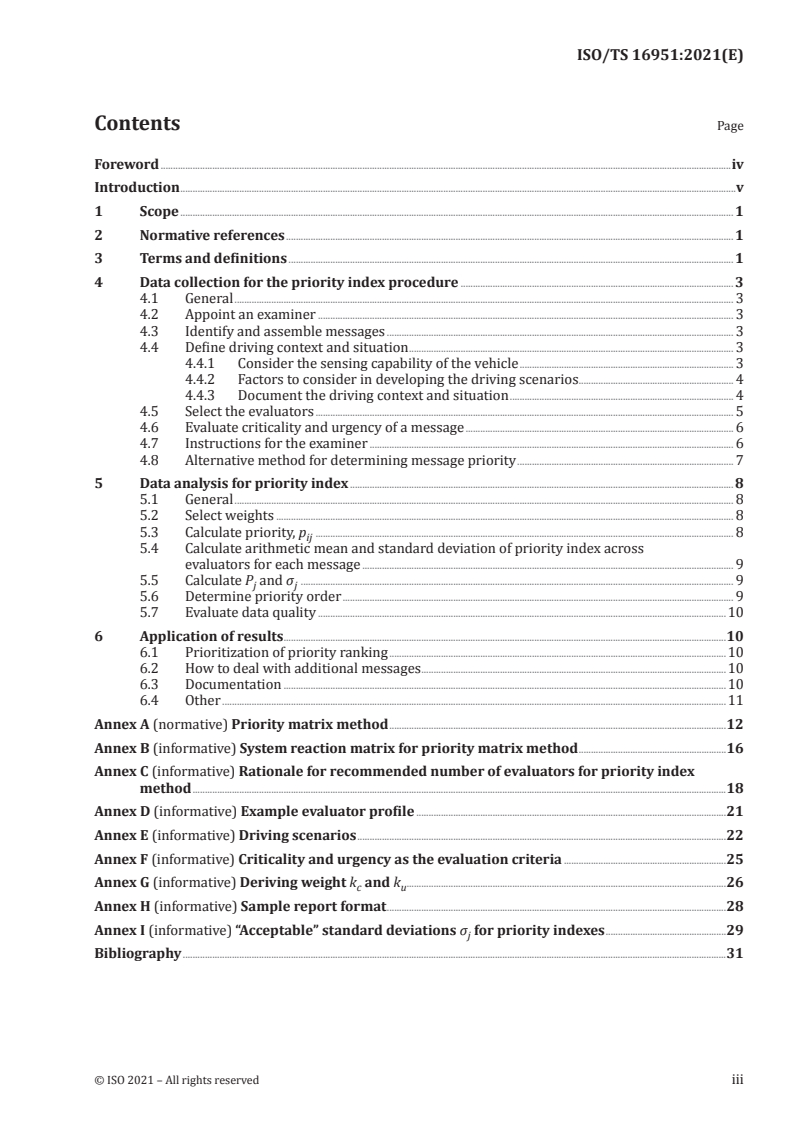
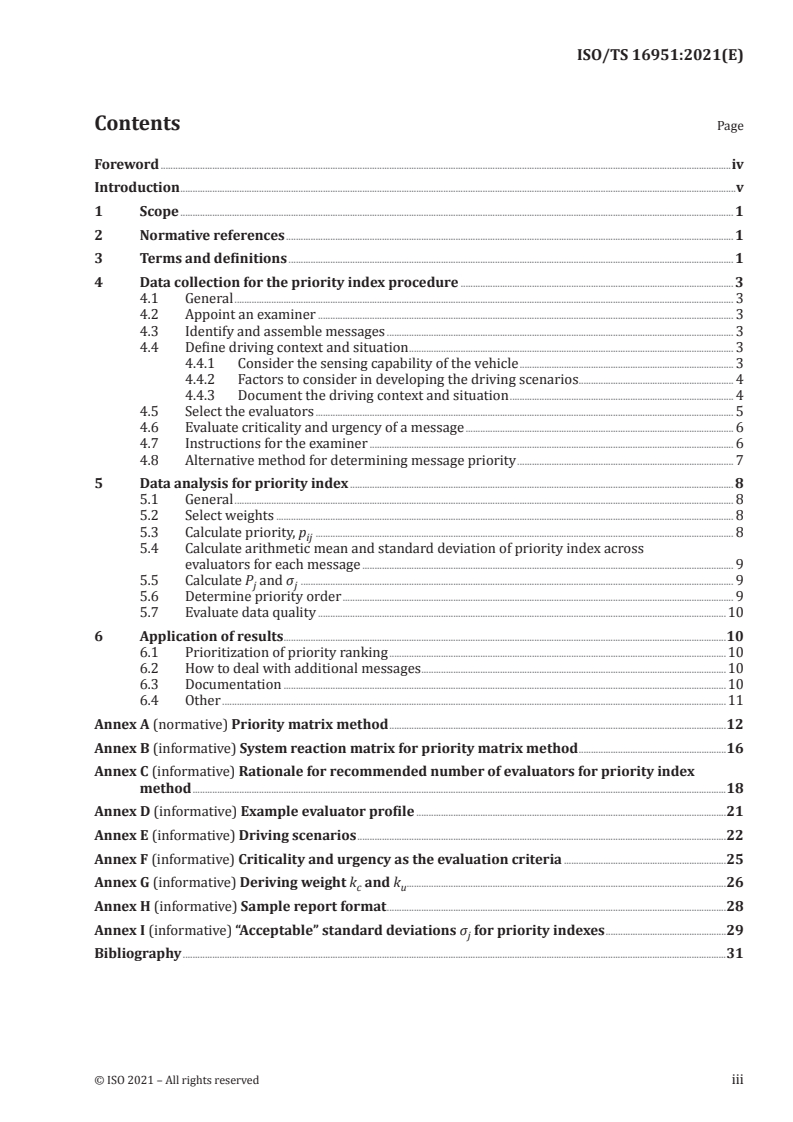
Contents Page
Foreword .iv
Introduction .v
1 Scope . 1
2 Normative references . 1
3 Terms and definitions . 1
4 Data collection for the priority index procedure . 3
4.1 General . 3
4.2 Appoint an examiner . 3
4.3 Identify and assemble messages . 3
4.4 Define driving context and situation . 3
4.4.1 Consider the sensing capability of the vehicle . 3
4.4.2 Factors to consider in developing the driving scenarios . 4
4.4.3 Document the driving context and situation . 4
4.5 Select the evaluators . 5
4.6 Evaluate criticality and urgency of a message . 6
4.7 Instructions for the examiner . 6
4.8 Alternative method for determining message priority . 7
5 Data analysis for priority index . 8
5.1 General . 8
5.2 Select weights . 8
5.3 Calculate priority, p . 8
ij
5.4 Calculate arithmetic mean and standard deviation of priority index across
evaluators for each message . 9
5.5 Calculate P and σ . 9
j j
5.6 Determine priority order . 9
5.7 Evaluate data quality .10
6 Application of results .10
6.1 Prioritization of priority ranking .10
6.2 How to deal with additional messages .10
6.3 Documentation .10
6.4 Other .11
Annex A (normative) Priority matrix method .12
Annex B (informative) System reaction matrix for priority matrix method .16
Annex C (informative) Rationale for recommended number of evaluators for priority index
method .18
Annex D (informative) Example evaluator profile .21
Annex E (informative) Driving scenarios .22
Annex F (informative) Criticality and urgency as the evaluation criteria .25
Annex G (informative) Deriving weight k and k .26
c u
Annex H (informative) Sample report format .28
Annex I (informative) “Acceptable” standard deviations σ for priority indexes .29
j
Bibliography .31
Foreword
ISO (the International Organization for Standardization) is a worldwide federation of national standards
bodies (ISO member bodies). The work of preparing International Standards is normally carried out
through ISO technical committees. Each member body interested in a subject for which a technical
committee has been established has the right to be represented on that committee. International
organizations, governmental and non-governmental, in liaison with ISO, also take part in the work.
ISO collaborates closely with the International Electrotechnical Commission (IEC) on all matters of
electrotechnical standardization.
The procedures used to develop this document and those intended for its further maintenance are
described in the ISO/IEC Directives, Part 1. In particular, the different approval criteria needed for the
different types of ISO documents should be noted. This document was drafted in accordance with the
editorial rules of the ISO/IEC Directives, Part 2 (see www .iso .org/ directives).
Attention is drawn to the possibility that some of the elements of this document may be the subject of
patent rights. ISO shall not be held responsible for identifying any or all such patent rights. Details of
any patent rights identified during the development of the document will be in the Introduction and/or
on the ISO list of patent declarations received (see www .iso .org/ patents).
Any trade name used in this document is information given for the convenience of users and does not
constitute an endorsement.
For an explanation of the voluntary nature of standards, the meaning of ISO specific terms and
expressions related to conformity assessment, as well as information about ISO's adherence to the
World Trade Organization (WTO) principles in the Technical Barriers to Trade (TBT), see www .iso .org/
iso/ foreword .html.
This document was prepared by Technical Committee ISO/TC 22, Road vehicles, Subcommittee SC 39,
Ergonomics.
This second edition cancels and replaces the first edition (ISO/TS 16951:2004), which has been
technically revised.
The main changes compared to the previous edition are as follows:
— formulae and other errors corrected;
— editorial updates.
Any feedback or questions on this document should be directed to the user’s national standards body. A
complete listing of these bodies can be found at www .iso .org/ members .html.
iv © ISO 2021 – All rights reserved
Introduction
When multiple in-vehicle information systems are present, including both transport information and
control systems (TICS) and non-TICS, various kinds of messages will be presented to drivers from these
systems and displayed at various times. If these messages are not managed properly, drivers could fail
to obtain critical information, which may degrade safety. This document establishes two prioritization
methods for TICS and other system-initiated messages or driver-requested messages presented to
drivers while driving. Other prioritization methods are possible. The primary method given in this
document takes criticality and urgency ratings of such messages into consideration when calculating
a priority index. If the mathematical calculations are avoided for some reason, an alternative method
presented in Annex A is applied. The alternative method involves paired comparisons of all possible
messages to form a priority matrix. Its relative advantages and disadvantages are discussed in Annex A.
Annex B presents one way of managing messages using the priority obtained by Annex A.
Priority is one of the parameters to consider in determining when, where and how system messages are
displayed. As TICS applications are deployed, the number and frequency of TICS messages presented to
drivers can be expected to increase. This document will provide road vehicle manufacturers and TICS
suppliers with a consistent basis for the management of messages competing for the driver’s limited
information processing capability. This, in turn, will reduce the driver’s workload and help ensure that
[3]
the most important messages reach the driver. This document complements ISO 15005 , a dialogue
management standard.
This document is intended for those involved in the design of message management systems that
integrate in-vehicle messages. It describes how to establish message priorities. It also specifies criteria
for message prioritization and, therefore, serves as an evaluation tool for TICS installed in vehicles as
standard equipment and for after-market TICS devices.
TECHNICAL SPECIFICATION ISO/TS 16951:2021(E)
Road vehicles — Ergonomic aspects of transport
information and control systems (TICS) — Procedures
for determining priority of on-board messages presented
to drivers
1 Scope
This document provides formal procedures and two, alternative, methods (users are advised to choose
whichever of the two suits their individual requirements) for determining the priority of on-board
messages presented to drivers of road vehicles by transport information and control systems (TICS)
and other systems. It is applicable to the whole range of TICS in-vehicle messages, including traveller
information, navigation, travel and traffic advisories, “yellow pages” information, warnings, systems
status, emergency calling system information, and electronic toll/fee collection, as well as to messages
from non-TICS sources such as telephone, warnings and telltales. Although applicable to systems that
allow the free generation of messages, it neither provides guidance on how to use the messages deriving
from its procedures nor is it applicable to mandatory or legally required messages.
2 Normative references
There are no normative references in this document.
3 Terms and definitions
For the purposes of this document, the following terms and definitions apply.
ISO and IEC maintain terminological databases for use in standardization at the following addresses:
— ISO Online browsing platform: available at https:// www .iso .org/ obp
— IEC Electropedia: available at http:// www .electropedia .org/
3.1
contents of message
information presented to a user by the TICS (3.14) or other on-board system
EXAMPLE A message containing system status information, warnings or alarms presented using characters,
symbols, figures, audible tones, voices or other means.
3.2
criticality
severity of the impact of the most likely accident or malfunction that can occur when the message is not
received or is ignored by the driver
3.3
display
device that allows the presentation of visual, auditory, or haptic dynamic information to a driver
3.4
driving
activities undertaken by the driver to navigate, manœuvre and handle the vehicle to achieve lateral and
longitudinal control
3.5
evaluator
person who judges the contents of a message from the point of view of criticality (3.2) and urgency
(3.15) to the driver
3.6
examiner
person who manages and conducts the use of this document for determining priority (3.10)
3.7
weighting factor of criticality
k
c
factor used to calculate the priority index (3.11)
3.8
weighting factor of urgency
k
u
factor used to calculate the priority index (3.11)
3.9
message management system
system that controls and evaluates a wide range of information and presents it ergonomically to drivers,
allowing them to cope with the information while driving (3.4) and assisting them in driving safely and
comfortably
3.10
priority
relative importance of two or more messages which determines their ranking in a time sequence or
emphasis of presentation
Note 1 to entry: The message with the highest priority is assigned first place (larger priority ratings correspond
to higher priority items).
3.11
priority index
index used to determine which messages should be given precedence when two or more messages are
available for presentation
3.12
scenario
explanation of the driving (3.4) context and situation for the message presented to evaluators (3.5)
3.13
system-initiated message
message provided by a TICS (3.14) or conventional system (both inside and outside of the vehicle)
without a specific request from the driver
3.14
transport information and control system
TICS
system comprised of an advanced information and telecommunications network for users, roads and
vehicles that contributes to solving problems such as traffic accidents and congestion
[1]
Note 1 to entry: See ISO 14813-1 for a list of TICS services .
3.15
urgency
time within which driver action or decision is expected to be taken if the benefit intended by the system
is derived from the message
2 © ISO 2021 – All rights reserved
4 Data collection for the priority index procedure
4.1 General
This clause presents the steps for collecting the data used to calculate a priority index for each message.
See the example outputs given in Annex E and Annex H.
4.2 Appoint an examiner
The priority index procedure requires an examiner to coordinate the data preparation, analysis, and
reporting. The role of the examiner is detailed in 4.7.
The examiner shall be familiar with the prioritization process, knowledgeable on message management,
and have automotive experience.
If the examiner has similar qualifications to that of the evaluators, the examiner may participate as
both an examiner and evaluator.
4.3 Identify and assemble messages
It is necessary for the examiner to identify in advance messages that are to be presented to drivers.
The messages represent the aggregate output given by the TICS and non-TICS connected to a message
management system. The examiner shall collect these messages and prepare them for presentation to
the evaluators.
4.4 Define driving context and situation
For each message, the examiner shall define, or assist in defining, a driving context and situation in
terms of the road environment and the traffic condition in which the message is likely to be presented.
The contextual and situational factors should be defined at the moment when the message is presented
because the priority (assignment of criticality and urgency ratings) depends heavily on the driving
context. Particular attention should be given to the presentation of messages in potentially hazardous
situations. All hazardous situations should be considered, except for highly unlikely possibilities. Based
on these situations the examiner may define one or more (normally not more than four) scenarios for a
particular message.
The same message in two different scenarios shall be regarded as two different information items to be
evaluated. This is because messages may occur in several different driving contexts, and each context
could yield a different message priority. For example, the priority given to a message pertaining to a
system malfunction will be different depending on whether the driver is starting the car or is relying
on the system whilst driving.
If only one scenario is used for a given message, that scenario should represent a reasonable “worst-
case” situation. At minimum, a TICS or non-TICS expert and the examiner should agree on the worst-
case driving scenario. A traffic safety expert may also be consulted.
4.4.1 Consider the sensing capability of the vehicle
In practice the messages that are provided to the driver will depend on the capability of the vehicle to
sense or detect various relevant situations. For example, if the vehicle can detect the driver’s state of
arousal, then the driver’s state can be considered in describing the driving scenario.
For situations in which the vehicle is incapable of sensing, the message priority should be determined
for a scenario representing a “reasonable” worst-case situation for the factors listed in 4.4.2.
4.4.2 Factors to consider in developing the driving scenarios
Table 1 is provided to assist the examiner in developing driving context and relevant situations. A
sample of situation and context factors is given in the rightmost column. The examiner may use these or
other factors to define driving scenarios. If the context cannot be categorized into one of the candidate
factors listed in Table 1, it should be clearly described within the “Other” parentheses. If neither the
context nor situation is defined for one of the factors, select “not defined (N-D)” from the list of the
candidates.
The following factors should be considered in developing the driving contexts and situations for
evaluators to consider when making their ratings.
4.4.2.1 Trip context
The trip context is a factor that considers the aim of the trip (e.g. commuting, leisure), the timing or
position along the route (e.g. relative position between start and destination), and the preparatory
distance to the next manœuvre.
EXAMPLE “Close (e.g. 20 m) to turn (or merge)”.
4.4.2.2 Road environment
The road environment is a static factor related to road structure that affects driving. Considerations
shall include the road type (e.g. highway, urban road, country road), the speed limit, the number of
lanes, and the road width. Consideration shall also be given to the effect on driving of the surrounding
environment, including weather conditions and time of day (e.g. morning, daytime, night-time, raining).
4.4.2.3 Traffic situation
The traffic situation is a dynamically changing factor related to traffic or obstacles on the road that
affect driving. Considerations here include the relationship to other vehicles, such as headway distance
and speed difference to the lead vehicle.
EXAMPLE 1 Headway distance.
EXAMPLE 2 Lateral vehicle exists.
EXAMPLE 3 Speed difference to the lead vehicle.
4.4.2.4 Vehicle condition
This factor originates from the vehicle itself and derives from the relationship between the vehicle and
the road. Vehicle condition can be separated into “vehicle type” and “vehicle state”.
EXAMPLE 1 Vehicle type: “passenger vehicle”, “heavy vehicle”.
EXAMPLE 2 Vehicle state: “driving speed”, “driving in left [right] lane”, “negotiating curve [intersection]”,
position of the vehicle within a lane.
4.4.3 Document the driving context and situation
The defined driving context, situation, appropriate driver behaviours and/or cognitive demands
associated with each message shall be documented. An example for a specific configuration is given in
Annex E.
4 © ISO 2021 – All rights reserved
Table 1 — Factors to consider in developing driving scenarios
Driving context/situation Candidate situational or contextual factors
Close to turn (or merge, or diverge)
Trip context Other (……)
N-D
Highway / urban / country / curve / icy / wet
Speed limit (…)
Road Number of lanes (…)
Other (……)
Road environment:
N-D
Rain / fog
Time of day (morning / daytime / night-time)
Weather
Other (……)
N-D
Headway distance is approx. (…) m or (…) s
Lateral vehicle(s) exists (yes or no, approximately
(…) m or (…) s)
Traffic situation
Speed difference to the lead vehicle is approximately
(…) km/h
N-D
Passenger vehicle / heavy vehicle
Type Other (……)
N-D
Driving speed (…) km/h (mph)
Driving in left (or right) lane
Status on roadway /
Curve (intersection) negotiation
manœuvre
Vehicle condition
Other (……)
N-D
Systems check after start-up shows all systems are
normal
Status of vehicle
Malfunction of system (……) — provide relevant details
subsystem(s)
Other (……)
N-D
Driver’s state of arousal
Miscellaneous
N-D
N-D Not defined.
4.5 Select the evaluators
The examiner shall select a minimum of 5 evaluators (see 5.1 and Annex C).
Evaluators should include experienced human factors and road safety practitioners and others who
possess a good understanding of the functions of the subject TICS system. They shall be well-informed
of the traffic environment and road environment of the subject country/region and have the ability
to evaluate and take into account the safe presentation of messages. Actual use of the system is
recommended for all evaluators.
The profile of each evaluator should be recorded. Profiles should include field of expertise, knowledge
of road safety, human factors, and knowledge of the systems producing messages that are prioritized
(see Annex D).
4.6 Evaluate criticality and urgency of a message
The contents of messages and the driving scenarios shall be explained by the examiner so that the
evaluators have a common understanding of the scenario, the functions of the system, and the contents
of messages being examined.
Examiners shall ensure that evaluators understand the definitions of criticality and urgency, the two
evaluation criteria composing the priority index. For this, evaluators shall understand the four-category
ordinal evaluation scales used to assign criticality and urgency values (see Table 2 and Table 3).
Each evaluator shall assign a criticality and urgency rating for each message assuming he/she is the driver.
In general, urgency will be time dependent. Controllability is one of the important factors that shall be
considered in determining urgency. If the situation is uncontrollable, no action shall be expected from
drivers. However, if there is a possibility of controlling the situation, then urgency shall be determined
[4]
depending on when the system expects drivers to take an action to handle it .
If the examiner has not fully defined the driving context and situation, evaluators shall be instructed
to consider all hazardous situations, except for highly unlikely possibilities. They should assume a
reasonable worst-case scenario when determining their criticality and urgency ratings.
4.7 Instructions for the examiner
The role of the examiner is to
a) record information about each evaluator in the evaluator profile (see Annex D),
b) create the questionnaire according to Annex E for the vehicle and system to be evaluated, and
distribute the questionnaire and Table 2 and Table 3 to each evaluator (definitions of criticality and
urgency should be provided with the questionnaire),
c) explain the evaluation items and the contents of the message(s) in the questionnaire, while
providing a means for evaluators to record the driving context and situation they used in making
their evaluations, whenever the examiner’s description was not clear or enough,
d) explain the classification of criticality and urgency according to Table 2 and Table 3,
e) explain how to record the rating for criticality and urgency in the appropriate column of the
questionnaire,
f) collect the questionnaire, and
g) analyse the data and report the results.
6 © ISO 2021 – All rights reserved
Table 2 — Criticality rating scale
Risk to vehicle,
Rating occupants and/or Examples
pedestrians
Ignoring speed warning when driving significantly above the speed limit.
Collision as a result of loss of braking due to ignoring the brake failure
warning.
Departing roadway due to ignoring lane departure warning.
3 Severe or fatal injury
Collision at high speed.
Leaving the roadway, head-on collision and collision with structures at
intermediate speed.
Following vehicle ahead too closely at high speed.
Risk of collision due to following a vehicle ahead too closely at intermedi-
ate speed.
Injury or possible
Vehicle(side)-to-vehicle(side) collision due to ignoring collision warning at
injury
intermediate or low speed, vehicle leaving the road, head-on collision and
collision with structures at intermediate or low speed.
Vehicle-to-vehicle collision except head-on collision at low speed.
No injury (vehicle
1 Following vehicle ahead too closely at low speed.
damaged)
Collision with structures at low speed.
Vehicle-to-vehicle contact at very low speed.
No injury (no vehicle
damage)
Collision with structures at very low speed.
NOTE 1 Initially, three ratings scales were used in calculating a priority index. See Annex F for the reason for reducing the
number of rating scales to two.
NOTE 2 Only a few examples are shown above. These can be expected to vary in criticality from region to region depending
on the road environment and other situational and contextual factors. Therefore, examiners are able to alter them at their
discretion.
NOTE 3 The examples shown here illustrate that a warning message can be assigned a high criticality rating, even if
failure to respond to the warning does not result in a crash.
NOTE 4 Driving speeds vary by country. The speed values (km/h) for “very low”, “low,” “intermediate”, and “high” speed
will depend on the country and on elements of the driving scenario such as urban, suburban, or expressway roads.
Table 3 — Urgency rating scale
Rating Description Examples
Respond immediately
Obstacle immediately in the vehicle path. Brake
Take immediate action or decision (within zero
immediately. Steer to avoid dangerous situations.
to three seconds) according to the displayed
ACC malfunctioning.
information.
Respond within a few seconds Obstacle within a few seconds in the vehicle path.
2 Take action or decision according to the informa- Brake in a few seconds. Steer away from danger as
[3]
tion within 3 s to 10 s . required.
Response preparation
1 Prepare to take action or decision according to Onset of detection of an obstacle.
the information within 10 s to 2 min.
Information only
0 System on.
No direct action or decision required by driver
4.8 Alternative method for determining message priority
An alternative method for determining message priority, the priority matrix method, is given in
Annex A. This method determines priority subjectively by having subject matter experts make pair-
wise comparisons of all messages. It involves neither the steps of rating criticality and urgency based
on Table 2 and Table 3 nor the calculation of a priority index according to Clause 5.
5 Data analysis for priority index
5.1 General
This clause provides a method for calculating the message priority index based on evaluator ratings of
criticality, c , and urgency, u .
i i
Since the priority index for each message is obtained by averaging the priority indexes of each evaluator,
the number of evaluators affects the reliability of the overall index. Therefore, ten or more evaluators
are recommended in order to make the priority index reliable (see Annex C). However, fewer than ten
1)
evaluators are acceptable if the standard deviation across evaluators is small enough Annex I contains
an example procedure for determining acceptable standard deviations. In all cases, the minimum
number of evaluators should be five, to avoid bias by the selection of evaluators.
5.2 Select weights
To use this document, those involved in the design of the message management system need numerical
values of k and k as the first step. When there is no established rule to determine k and k , one way is
c u c u
to assign 1,0 to k and k making criticality and urgency equally important. Another way is to obtain k
c u, u
and k based on empirical data. An example of the method is shown in Annex G. This example indicates
c
that k = k = 1 can be used as rounded values for the weight factors. The evaluator’s ratings of criticality,
u c
c , and urgency, u , given in Clause 3 are used to calculate priority index P in 4.5 [see Formula (2)]. As
i i j
the ratings range between 0 and 3 for both criticality and urgency (see Tables 2 and 3), k = k = 1 means
c u
that the contribution of criticality and urgency to the priority index would be the same.
5.3 Calculate priority, p
ij
th th
Priority, p , indicates the relative importance of the i evaluator and j message and is calculated
ij
according to the following Formula (1).
pk=+ck u (1)
ij ciju ij
where
p is the individual value for priority index;
ij
c , u are the individual scores, respectively, of criticality and urgency;
ij ij
k , k are weight factors respectively of criticality and urgency against p (see 5.2).
c u j
1) The definition of “small enough” variance is still being investigated.
8 © ISO 2021 – All rights reserved
5.4 Calculate arithmetic mean and standard deviation of priority index across
evaluators for each message
The arithmetic mean P , given by Formula (2), is the priority index, which indicates the relative
j
th
importance of the j message:
n
Pp= n
∑
jij
i=1
n
=+kc ku n (2)
()
∑
ciju ij
i=1
=+kC kU
cj uj
where
th
P is the priority index of the j message;
j
th
C , U are the mean score across evaluators, respectively, of criticality and urgency of the j message;
j j
n is the number of evaluators.
Standard deviation σ , given by Formula (3), indicates the relative confidence of the priority index of
j
th
the j message.
n
pP−
()
∑
ij j
i=1
σ ==V (3)
jj
n
p
n n
ij
p −
∑∑
ij
i==11 i
n
=
n
kc +ku
()
n n c u
ij ij
kc +ku −
()
∑∑
c ij u ij
i==11i
n
=
n
where
th
σ is the standard deviation of the priority index of the j message;
j
th
V is the variance of the priority index of the j message.
j
5.5 Calculate P and σ
j j
Repeat Formulae (2) and (3), calculating P and σ for each of the j messages.
j j
5.6 Determine priority order
Rank the messages in terms of their P values; then list the messages in descending order (larger values
j
correspond to higher priority items). When items have the same numerical P values, priority should go
j
to the message whose mean criticality score C is higher.
i
Prepare a priority order table that lists the numerical values C and U , and P and σ , for each message
j j j j
evaluated.
An empty table for displaying an example of a priority index calculated by assigning 1,0 to k and k is
u c
shown in Annex H.
5.7 Evaluate data quality
For the evaluators’ priority ratings of each message, verify that a sufficient level of agreement among
evaluators was achieved to ensure sufficiently high data quality. This can be done using either of two
different methods. The agreement is sufficient if
a) more than half the number of evaluators agree on the criticality and urgency ratings of a message, or
b) the standard deviation of priority index is less than 1,0 (see Annex I).
If neither was the case, the examiners shall interview the evaluators to ask if the explanation of message
context was ambiguous. If so, the examiners shall clarify or provide additional details of the driving
context and situation to the evaluators, and the evaluators shall re-evaluate the messages.
NOTE In cases where re-evaluation takes place, messages that in the first evaluation achieved an average
criticality of less than 0,5 and an average urgency of less than 1,5 need not be considered in the re-evaluation.
6 Application of results
6.1 Prioritization of priority ranking
As a general principle, designers should use the priority rankings to avoid the simultaneous
presentation of messages. This is particularly important with auditory messages. If two or more
in-vehicle messages need to be displayed to the driver at the same time, those with larger priority
rankings should be emphasized. After the message(s) has been presented to the driver, the driver
should be in control of selecting, deactivating, and cancelling messages, independent of priority, except
for messages regulated by law.
Even if the process for determining a priority index is performed adequately in accordance with
Clauses 4 to 6, it can sometimes happen that the standard deviation of one message is extremely
large compared with those of other messages. This might be caused by differences in evaluators’
understanding of the criticality and urgency of messages. Therefore, due attention should be paid to
handling such messages by, for example, devising special means of message presentation.
6.2 How to deal with additional messages
When new TICS systems or messages are developed, it is necessary to establish the priority for such
new messages. If any evaluator is replaced with a new evaluator, he/she should be selected from a
similar discipline as the previous evaluator (see 4.5).
The procedures according to 4.3 to 5.5 shall be performed only when additional messages are added.
The values obtained by these procedures shall be put into the appropriate position of the priority order
table already obtained according to 5.6 to determine the priority orders of the new messages.
6.3 Documentation
The examiner shall issue a report containing the following topics:
a) evaluators’ profiles (see Annex D);
b) list of messages with driving situations (see Annex E) and consequences if a message is ignored;
c) priority index of each message (see Annex H).
10 © ISO 2021 – All rights reserved
6.4 Other
The installed priority ranking should be communicated to the driver by appropriate means (e.g.
operator’s manual).
Annex A
(normative)
Priority matrix method
A.1 Overview of method
The priority matrix is an alternative method for determining priority when there are competing TICS
and non-TICS messages. It can be used in lieu of the method according to Clauses 4 and 5. The basic
idea is to avoid the mathematical formulation of an abstract criterion (index) based on criticality and
urgency and instead list all the messages that will be presented to the driver in a matrix format with
n (i.e. number of all the messages) columns and rows. Messages are formulated exactly as they would
be displayed in the vehicle. Each message should clearly describe the behaviour or malfunction of the
system. Experts then compare each pair of messages, and the message with higher priority is recorded.
The procedure is repeated until all possible pairs of messages are compared.
A.2 Advantages and disadvantages of method
This method has been chosen because it fits well into the engineering process of the human-machine
interface (HMI) development.
a) Main advantages
— The method can be performed with the existing experts for the respective systems, there being
no need to involve persons with an in-depth knowledge of all warning messages in the car (who
could be hard to find, even in an automotive company).
— Optimisation of system reaction is rather easy (see Annex B), with any necessary adjustment
able to be done in the respective cell without influencing any other parts of the system.
b) Main disadvantages
— All possible pairs of messages should be evaluated, which can result in a large number of
evaluations.
— System reactions based on the priority matrix require more device memory space to implement.
A.3 Requirements for examiner and evaluators
A.3.1 Examiner
The examiner shall be expert in the TICS systems being evaluated and have HMI experience, or shall
be an HMI expert with a good understanding of the TICS systems being evaluated. The examiner shall
also be familiar with the prioritization process, knowledgeable on message management, and have
automotive experience. The role of the examiner is detailed in A.5.
A.3.2 Expert evaluators
Evaluators shall be selected from experts (specialists) of the respective TICS and non-TICS systems.
HMI experts may also serve as evaluators. At minimum there should be one such expert evaluator
representing each TICS.
The expert evaluator should possess a good understanding of the functions of the subject TICS or non-
TICS system, be well informed of the traffic environment and road environment of the subject country/
12 © ISO 2021 – All rights reserved
region and have the ability to evaluate and take into account the safe presentation of messages. Actual
use of the system is recommended for all expert evaluators.
The profile of each expert evaluator should be recorded. Profiles should include age, gender, expertise,
experience in terms of years in his or her field of expertise, and experience in terms of years in the
study of TICS human interfaces (see Annex D).
A.3.2.1 Expert opinion
The expert evaluator determines the priority for each individual message on the basis of his or her good
knowledge of the system or of all the messages that can be displayed.
Criticality and urgency are considerations to be discussed when making the priority judgment for
each pair of messages. The criteria of criticality and urgency are implicitly included in every priority
decision. There is no need to explicitly rate criticality and urgency in order to determine priority, as is
done in the priority index method.
A.4 Procedure
A.4.1 Identify and assemble messages
The examiner shall collect in advance messages that are to be presented to drivers. The messages
represent the aggregate output given by the TICS and non-TICS systems connected to the message
management system. The examiner shall prepare the priority matrix for presentation to the expert
evaluators. All the messages that can be displayed are entered into the matrix, with each message
appearing in a column and in a row (see Table A.1).
A.4.2 Define driving context and situation
For each message, the examiner shall define, or assist in defining, a driving context and situation in
terms of the road environment and the traffic condition in which the message is likely to be presented.
This definition serves two purposes. It clarifies the driving context and it distinguishes between
different situations, when those situations could influence the message priority and/or the system
reaction.
A.4.2.1 Clarify driving context
Driving context and situation can be classified into “trip context”, “road environment”, “traffic
situation”, and “vehicle condition” (see 4.4.2). For each message, these contextual and situational
factors should be defined at the moment when the message is presented because the priority depends
heavily on the driving context. Particular attention should be given to the presentation of messages
in potentially hazardous situations. All hazardous situations should be considered, except for highly
unlikely possibilities. Based on these situations the examiner may define one or more (normally not
more than four) scenarios for a particular message.
If only one scenario is used for a given message, that scenario should represent a reasonable “worst-
case” situation. At minimum, a TICS or non-TICS expert and the examiner should agree on the worst-
case driving scenario. A traffic safety expert may also be consulted.
A.4.2.2 Differentiate between situations
Messages occur in several different driving contexts, and in some cases each context yields a different
message priority. For example, the priority given to a message pertaining to a system malfunction
will be different depending on whether the driver is starting the car or is relying on the s
...
TECHNICAL ISO/TS
SPECIFICATION 16951
Second edition
2021-03
Road vehicles — Ergonomic aspects
of transport information and control
systems (TICS) — Procedures for
determining priority of on-board
messages presented to drivers
Véhicules routiers — Aspects ergonomiques des systèmes de
commande et d'information du transport (TICS) — Modes opératoires
pour la détermination de la priorité des messages embarqués
présentés aux conducteurs
Reference number
©
ISO 2021
© ISO 2021
All rights reserved. Unless otherwise specified, or required in the context of its implementation, no part of this publication may
be reproduced or utilized otherwise in any form or by any means, electronic or mechanical, including photocopying, or posting
on the internet or an intranet, without prior written permission. Permission can be requested from either ISO at the address
below or ISO’s member body in the country of the requester.
ISO copyright office
CP 401 • Ch. de Blandonnet 8
CH-1214 Vernier, Geneva
Phone: +41 22 749 01 11
Email: copyright@iso.org
Website: www.iso.org
Published in Switzerland
ii © ISO 2021 – All rights reserved
Contents Page
Foreword .iv
Introduction .v
1 Scope . 1
2 Normative references . 1
3 Terms and definitions . 1
4 Data collection for the priority index procedure . 3
4.1 General . 3
4.2 Appoint an examiner . 3
4.3 Identify and assemble messages . 3
4.4 Define driving context and situation . 3
4.4.1 Consider the sensing capability of the vehicle . 3
4.4.2 Factors to consider in developing the driving scenarios . 4
4.4.3 Document the driving context and situation . 4
4.5 Select the evaluators . 5
4.6 Evaluate criticality and urgency of a message . 6
4.7 Instructions for the examiner . 6
4.8 Alternative method for determining message priority . 7
5 Data analysis for priority index . 8
5.1 General . 8
5.2 Select weights . 8
5.3 Calculate priority, p . 8
ij
5.4 Calculate arithmetic mean and standard deviation of priority index across
evaluators for each message . 9
5.5 Calculate P and σ . 9
j j
5.6 Determine priority order . 9
5.7 Evaluate data quality .10
6 Application of results .10
6.1 Prioritization of priority ranking .10
6.2 How to deal with additional messages .10
6.3 Documentation .10
6.4 Other .11
Annex A (normative) Priority matrix method .12
Annex B (informative) System reaction matrix for priority matrix method .16
Annex C (informative) Rationale for recommended number of evaluators for priority index
method .18
Annex D (informative) Example evaluator profile .21
Annex E (informative) Driving scenarios .22
Annex F (informative) Criticality and urgency as the evaluation criteria .25
Annex G (informative) Deriving weight k and k .26
c u
Annex H (informative) Sample report format .28
Annex I (informative) “Acceptable” standard deviations σ for priority indexes .29
j
Bibliography .31
Foreword
ISO (the International Organization for Standardization) is a worldwide federation of national standards
bodies (ISO member bodies). The work of preparing International Standards is normally carried out
through ISO technical committees. Each member body interested in a subject for which a technical
committee has been established has the right to be represented on that committee. International
organizations, governmental and non-governmental, in liaison with ISO, also take part in the work.
ISO collaborates closely with the International Electrotechnical Commission (IEC) on all matters of
electrotechnical standardization.
The procedures used to develop this document and those intended for its further maintenance are
described in the ISO/IEC Directives, Part 1. In particular, the different approval criteria needed for the
different types of ISO documents should be noted. This document was drafted in accordance with the
editorial rules of the ISO/IEC Directives, Part 2 (see www .iso .org/ directives).
Attention is drawn to the possibility that some of the elements of this document may be the subject of
patent rights. ISO shall not be held responsible for identifying any or all such patent rights. Details of
any patent rights identified during the development of the document will be in the Introduction and/or
on the ISO list of patent declarations received (see www .iso .org/ patents).
Any trade name used in this document is information given for the convenience of users and does not
constitute an endorsement.
For an explanation of the voluntary nature of standards, the meaning of ISO specific terms and
expressions related to conformity assessment, as well as information about ISO's adherence to the
World Trade Organization (WTO) principles in the Technical Barriers to Trade (TBT), see www .iso .org/
iso/ foreword .html.
This document was prepared by Technical Committee ISO/TC 22, Road vehicles, Subcommittee SC 39,
Ergonomics.
This second edition cancels and replaces the first edition (ISO/TS 16951:2004), which has been
technically revised.
The main changes compared to the previous edition are as follows:
— formulae and other errors corrected;
— editorial updates.
Any feedback or questions on this document should be directed to the user’s national standards body. A
complete listing of these bodies can be found at www .iso .org/ members .html.
iv © ISO 2021 – All rights reserved
Introduction
When multiple in-vehicle information systems are present, including both transport information and
control systems (TICS) and non-TICS, various kinds of messages will be presented to drivers from these
systems and displayed at various times. If these messages are not managed properly, drivers could fail
to obtain critical information, which may degrade safety. This document establishes two prioritization
methods for TICS and other system-initiated messages or driver-requested messages presented to
drivers while driving. Other prioritization methods are possible. The primary method given in this
document takes criticality and urgency ratings of such messages into consideration when calculating
a priority index. If the mathematical calculations are avoided for some reason, an alternative method
presented in Annex A is applied. The alternative method involves paired comparisons of all possible
messages to form a priority matrix. Its relative advantages and disadvantages are discussed in Annex A.
Annex B presents one way of managing messages using the priority obtained by Annex A.
Priority is one of the parameters to consider in determining when, where and how system messages are
displayed. As TICS applications are deployed, the number and frequency of TICS messages presented to
drivers can be expected to increase. This document will provide road vehicle manufacturers and TICS
suppliers with a consistent basis for the management of messages competing for the driver’s limited
information processing capability. This, in turn, will reduce the driver’s workload and help ensure that
[3]
the most important messages reach the driver. This document complements ISO 15005 , a dialogue
management standard.
This document is intended for those involved in the design of message management systems that
integrate in-vehicle messages. It describes how to establish message priorities. It also specifies criteria
for message prioritization and, therefore, serves as an evaluation tool for TICS installed in vehicles as
standard equipment and for after-market TICS devices.
TECHNICAL SPECIFICATION ISO/TS 16951:2021(E)
Road vehicles — Ergonomic aspects of transport
information and control systems (TICS) — Procedures
for determining priority of on-board messages presented
to drivers
1 Scope
This document provides formal procedures and two, alternative, methods (users are advised to choose
whichever of the two suits their individual requirements) for determining the priority of on-board
messages presented to drivers of road vehicles by transport information and control systems (TICS)
and other systems. It is applicable to the whole range of TICS in-vehicle messages, including traveller
information, navigation, travel and traffic advisories, “yellow pages” information, warnings, systems
status, emergency calling system information, and electronic toll/fee collection, as well as to messages
from non-TICS sources such as telephone, warnings and telltales. Although applicable to systems that
allow the free generation of messages, it neither provides guidance on how to use the messages deriving
from its procedures nor is it applicable to mandatory or legally required messages.
2 Normative references
There are no normative references in this document.
3 Terms and definitions
For the purposes of this document, the following terms and definitions apply.
ISO and IEC maintain terminological databases for use in standardization at the following addresses:
— ISO Online browsing platform: available at https:// www .iso .org/ obp
— IEC Electropedia: available at http:// www .electropedia .org/
3.1
contents of message
information presented to a user by the TICS (3.14) or other on-board system
EXAMPLE A message containing system status information, warnings or alarms presented using characters,
symbols, figures, audible tones, voices or other means.
3.2
criticality
severity of the impact of the most likely accident or malfunction that can occur when the message is not
received or is ignored by the driver
3.3
display
device that allows the presentation of visual, auditory, or haptic dynamic information to a driver
3.4
driving
activities undertaken by the driver to navigate, manœuvre and handle the vehicle to achieve lateral and
longitudinal control
3.5
evaluator
person who judges the contents of a message from the point of view of criticality (3.2) and urgency
(3.15) to the driver
3.6
examiner
person who manages and conducts the use of this document for determining priority (3.10)
3.7
weighting factor of criticality
k
c
factor used to calculate the priority index (3.11)
3.8
weighting factor of urgency
k
u
factor used to calculate the priority index (3.11)
3.9
message management system
system that controls and evaluates a wide range of information and presents it ergonomically to drivers,
allowing them to cope with the information while driving (3.4) and assisting them in driving safely and
comfortably
3.10
priority
relative importance of two or more messages which determines their ranking in a time sequence or
emphasis of presentation
Note 1 to entry: The message with the highest priority is assigned first place (larger priority ratings correspond
to higher priority items).
3.11
priority index
index used to determine which messages should be given precedence when two or more messages are
available for presentation
3.12
scenario
explanation of the driving (3.4) context and situation for the message presented to evaluators (3.5)
3.13
system-initiated message
message provided by a TICS (3.14) or conventional system (both inside and outside of the vehicle)
without a specific request from the driver
3.14
transport information and control system
TICS
system comprised of an advanced information and telecommunications network for users, roads and
vehicles that contributes to solving problems such as traffic accidents and congestion
[1]
Note 1 to entry: See ISO 14813-1 for a list of TICS services .
3.15
urgency
time within which driver action or decision is expected to be taken if the benefit intended by the system
is derived from the message
2 © ISO 2021 – All rights reserved
4 Data collection for the priority index procedure
4.1 General
This clause presents the steps for collecting the data used to calculate a priority index for each message.
See the example outputs given in Annex E and Annex H.
4.2 Appoint an examiner
The priority index procedure requires an examiner to coordinate the data preparation, analysis, and
reporting. The role of the examiner is detailed in 4.7.
The examiner shall be familiar with the prioritization process, knowledgeable on message management,
and have automotive experience.
If the examiner has similar qualifications to that of the evaluators, the examiner may participate as
both an examiner and evaluator.
4.3 Identify and assemble messages
It is necessary for the examiner to identify in advance messages that are to be presented to drivers.
The messages represent the aggregate output given by the TICS and non-TICS connected to a message
management system. The examiner shall collect these messages and prepare them for presentation to
the evaluators.
4.4 Define driving context and situation
For each message, the examiner shall define, or assist in defining, a driving context and situation in
terms of the road environment and the traffic condition in which the message is likely to be presented.
The contextual and situational factors should be defined at the moment when the message is presented
because the priority (assignment of criticality and urgency ratings) depends heavily on the driving
context. Particular attention should be given to the presentation of messages in potentially hazardous
situations. All hazardous situations should be considered, except for highly unlikely possibilities. Based
on these situations the examiner may define one or more (normally not more than four) scenarios for a
particular message.
The same message in two different scenarios shall be regarded as two different information items to be
evaluated. This is because messages may occur in several different driving contexts, and each context
could yield a different message priority. For example, the priority given to a message pertaining to a
system malfunction will be different depending on whether the driver is starting the car or is relying
on the system whilst driving.
If only one scenario is used for a given message, that scenario should represent a reasonable “worst-
case” situation. At minimum, a TICS or non-TICS expert and the examiner should agree on the worst-
case driving scenario. A traffic safety expert may also be consulted.
4.4.1 Consider the sensing capability of the vehicle
In practice the messages that are provided to the driver will depend on the capability of the vehicle to
sense or detect various relevant situations. For example, if the vehicle can detect the driver’s state of
arousal, then the driver’s state can be considered in describing the driving scenario.
For situations in which the vehicle is incapable of sensing, the message priority should be determined
for a scenario representing a “reasonable” worst-case situation for the factors listed in 4.4.2.
4.4.2 Factors to consider in developing the driving scenarios
Table 1 is provided to assist the examiner in developing driving context and relevant situations. A
sample of situation and context factors is given in the rightmost column. The examiner may use these or
other factors to define driving scenarios. If the context cannot be categorized into one of the candidate
factors listed in Table 1, it should be clearly described within the “Other” parentheses. If neither the
context nor situation is defined for one of the factors, select “not defined (N-D)” from the list of the
candidates.
The following factors should be considered in developing the driving contexts and situations for
evaluators to consider when making their ratings.
4.4.2.1 Trip context
The trip context is a factor that considers the aim of the trip (e.g. commuting, leisure), the timing or
position along the route (e.g. relative position between start and destination), and the preparatory
distance to the next manœuvre.
EXAMPLE “Close (e.g. 20 m) to turn (or merge)”.
4.4.2.2 Road environment
The road environment is a static factor related to road structure that affects driving. Considerations
shall include the road type (e.g. highway, urban road, country road), the speed limit, the number of
lanes, and the road width. Consideration shall also be given to the effect on driving of the surrounding
environment, including weather conditions and time of day (e.g. morning, daytime, night-time, raining).
4.4.2.3 Traffic situation
The traffic situation is a dynamically changing factor related to traffic or obstacles on the road that
affect driving. Considerations here include the relationship to other vehicles, such as headway distance
and speed difference to the lead vehicle.
EXAMPLE 1 Headway distance.
EXAMPLE 2 Lateral vehicle exists.
EXAMPLE 3 Speed difference to the lead vehicle.
4.4.2.4 Vehicle condition
This factor originates from the vehicle itself and derives from the relationship between the vehicle and
the road. Vehicle condition can be separated into “vehicle type” and “vehicle state”.
EXAMPLE 1 Vehicle type: “passenger vehicle”, “heavy vehicle”.
EXAMPLE 2 Vehicle state: “driving speed”, “driving in left [right] lane”, “negotiating curve [intersection]”,
position of the vehicle within a lane.
4.4.3 Document the driving context and situation
The defined driving context, situation, appropriate driver behaviours and/or cognitive demands
associated with each message shall be documented. An example for a specific configuration is given in
Annex E.
4 © ISO 2021 – All rights reserved
Table 1 — Factors to consider in developing driving scenarios
Driving context/situation Candidate situational or contextual factors
Close to turn (or merge, or diverge)
Trip context Other (……)
N-D
Highway / urban / country / curve / icy / wet
Speed limit (…)
Road Number of lanes (…)
Other (……)
Road environment:
N-D
Rain / fog
Time of day (morning / daytime / night-time)
Weather
Other (……)
N-D
Headway distance is approx. (…) m or (…) s
Lateral vehicle(s) exists (yes or no, approximately
(…) m or (…) s)
Traffic situation
Speed difference to the lead vehicle is approximately
(…) km/h
N-D
Passenger vehicle / heavy vehicle
Type Other (……)
N-D
Driving speed (…) km/h (mph)
Driving in left (or right) lane
Status on roadway /
Curve (intersection) negotiation
manœuvre
Vehicle condition
Other (……)
N-D
Systems check after start-up shows all systems are
normal
Status of vehicle
Malfunction of system (……) — provide relevant details
subsystem(s)
Other (……)
N-D
Driver’s state of arousal
Miscellaneous
N-D
N-D Not defined.
4.5 Select the evaluators
The examiner shall select a minimum of 5 evaluators (see 5.1 and Annex C).
Evaluators should include experienced human factors and road safety practitioners and others who
possess a good understanding of the functions of the subject TICS system. They shall be well-informed
of the traffic environment and road environment of the subject country/region and have the ability
to evaluate and take into account the safe presentation of messages. Actual use of the system is
recommended for all evaluators.
The profile of each evaluator should be recorded. Profiles should include field of expertise, knowledge
of road safety, human factors, and knowledge of the systems producing messages that are prioritized
(see Annex D).
4.6 Evaluate criticality and urgency of a message
The contents of messages and the driving scenarios shall be explained by the examiner so that the
evaluators have a common understanding of the scenario, the functions of the system, and the contents
of messages being examined.
Examiners shall ensure that evaluators understand the definitions of criticality and urgency, the two
evaluation criteria composing the priority index. For this, evaluators shall understand the four-category
ordinal evaluation scales used to assign criticality and urgency values (see Table 2 and Table 3).
Each evaluator shall assign a criticality and urgency rating for each message assuming he/she is the driver.
In general, urgency will be time dependent. Controllability is one of the important factors that shall be
considered in determining urgency. If the situation is uncontrollable, no action shall be expected from
drivers. However, if there is a possibility of controlling the situation, then urgency shall be determined
[4]
depending on when the system expects drivers to take an action to handle it .
If the examiner has not fully defined the driving context and situation, evaluators shall be instructed
to consider all hazardous situations, except for highly unlikely possibilities. They should assume a
reasonable worst-case scenario when determining their criticality and urgency ratings.
4.7 Instructions for the examiner
The role of the examiner is to
a) record information about each evaluator in the evaluator profile (see Annex D),
b) create the questionnaire according to Annex E for the vehicle and system to be evaluated, and
distribute the questionnaire and Table 2 and Table 3 to each evaluator (definitions of criticality and
urgency should be provided with the questionnaire),
c) explain the evaluation items and the contents of the message(s) in the questionnaire, while
providing a means for evaluators to record the driving context and situation they used in making
their evaluations, whenever the examiner’s description was not clear or enough,
d) explain the classification of criticality and urgency according to Table 2 and Table 3,
e) explain how to record the rating for criticality and urgency in the appropriate column of the
questionnaire,
f) collect the questionnaire, and
g) analyse the data and report the results.
6 © ISO 2021 – All rights reserved
Table 2 — Criticality rating scale
Risk to vehicle,
Rating occupants and/or Examples
pedestrians
Ignoring speed warning when driving significantly above the speed limit.
Collision as a result of loss of braking due to ignoring the brake failure
warning.
Departing roadway due to ignoring lane departure warning.
3 Severe or fatal injury
Collision at high speed.
Leaving the roadway, head-on collision and collision with structures at
intermediate speed.
Following vehicle ahead too closely at high speed.
Risk of collision due to following a vehicle ahead too closely at intermedi-
ate speed.
Injury or possible
Vehicle(side)-to-vehicle(side) collision due to ignoring collision warning at
injury
intermediate or low speed, vehicle leaving the road, head-on collision and
collision with structures at intermediate or low speed.
Vehicle-to-vehicle collision except head-on collision at low speed.
No injury (vehicle
1 Following vehicle ahead too closely at low speed.
damaged)
Collision with structures at low speed.
Vehicle-to-vehicle contact at very low speed.
No injury (no vehicle
damage)
Collision with structures at very low speed.
NOTE 1 Initially, three ratings scales were used in calculating a priority index. See Annex F for the reason for reducing the
number of rating scales to two.
NOTE 2 Only a few examples are shown above. These can be expected to vary in criticality from region to region depending
on the road environment and other situational and contextual factors. Therefore, examiners are able to alter them at their
discretion.
NOTE 3 The examples shown here illustrate that a warning message can be assigned a high criticality rating, even if
failure to respond to the warning does not result in a crash.
NOTE 4 Driving speeds vary by country. The speed values (km/h) for “very low”, “low,” “intermediate”, and “high” speed
will depend on the country and on elements of the driving scenario such as urban, suburban, or expressway roads.
Table 3 — Urgency rating scale
Rating Description Examples
Respond immediately
Obstacle immediately in the vehicle path. Brake
Take immediate action or decision (within zero
immediately. Steer to avoid dangerous situations.
to three seconds) according to the displayed
ACC malfunctioning.
information.
Respond within a few seconds Obstacle within a few seconds in the vehicle path.
2 Take action or decision according to the informa- Brake in a few seconds. Steer away from danger as
[3]
tion within 3 s to 10 s . required.
Response preparation
1 Prepare to take action or decision according to Onset of detection of an obstacle.
the information within 10 s to 2 min.
Information only
0 System on.
No direct action or decision required by driver
4.8 Alternative method for determining message priority
An alternative method for determining message priority, the priority matrix method, is given in
Annex A. This method determines priority subjectively by having subject matter experts make pair-
wise comparisons of all messages. It involves neither the steps of rating criticality and urgency based
on Table 2 and Table 3 nor the calculation of a priority index according to Clause 5.
5 Data analysis for priority index
5.1 General
This clause provides a method for calculating the message priority index based on evaluator ratings of
criticality, c , and urgency, u .
i i
Since the priority index for each message is obtained by averaging the priority indexes of each evaluator,
the number of evaluators affects the reliability of the overall index. Therefore, ten or more evaluators
are recommended in order to make the priority index reliable (see Annex C). However, fewer than ten
1)
evaluators are acceptable if the standard deviation across evaluators is small enough Annex I contains
an example procedure for determining acceptable standard deviations. In all cases, the minimum
number of evaluators should be five, to avoid bias by the selection of evaluators.
5.2 Select weights
To use this document, those involved in the design of the message management system need numerical
values of k and k as the first step. When there is no established rule to determine k and k , one way is
c u c u
to assign 1,0 to k and k making criticality and urgency equally important. Another way is to obtain k
c u, u
and k based on empirical data. An example of the method is shown in Annex G. This example indicates
c
that k = k = 1 can be used as rounded values for the weight factors. The evaluator’s ratings of criticality,
u c
c , and urgency, u , given in Clause 3 are used to calculate priority index P in 4.5 [see Formula (2)]. As
i i j
the ratings range between 0 and 3 for both criticality and urgency (see Tables 2 and 3), k = k = 1 means
c u
that the contribution of criticality and urgency to the priority index would be the same.
5.3 Calculate priority, p
ij
th th
Priority, p , indicates the relative importance of the i evaluator and j message and is calculated
ij
according to the following Formula (1).
pk=+ck u (1)
ij ciju ij
where
p is the individual value for priority index;
ij
c , u are the individual scores, respectively, of criticality and urgency;
ij ij
k , k are weight factors respectively of criticality and urgency against p (see 5.2).
c u j
1) The definition of “small enough” variance is still being investigated.
8 © ISO 2021 – All rights reserved
5.4 Calculate arithmetic mean and standard deviation of priority index across
evaluators for each message
The arithmetic mean P , given by Formula (2), is the priority index, which indicates the relative
j
th
importance of the j message:
n
Pp= n
∑
jij
i=1
n
=+kc ku n (2)
()
∑
ciju ij
i=1
=+kC kU
cj uj
where
th
P is the priority index of the j message;
j
th
C , U are the mean score across evaluators, respectively, of criticality and urgency of the j message;
j j
n is the number of evaluators.
Standard deviation σ , given by Formula (3), indicates the relative confidence of the priority index of
j
th
the j message.
n
pP−
()
∑
ij j
i=1
σ ==V (3)
jj
n
p
n n
ij
p −
∑∑
ij
i==11 i
n
=
n
kc +ku
()
n n c u
ij ij
kc +ku −
()
∑∑
c ij u ij
i==11i
n
=
n
where
th
σ is the standard deviation of the priority index of the j message;
j
th
V is the variance of the priority index of the j message.
j
5.5 Calculate P and σ
j j
Repeat Formulae (2) and (3), calculating P and σ for each of the j messages.
j j
5.6 Determine priority order
Rank the messages in terms of their P values; then list the messages in descending order (larger values
j
correspond to higher priority items). When items have the same numerical P values, priority should go
j
to the message whose mean criticality score C is higher.
i
Prepare a priority order table that lists the numerical values C and U , and P and σ , for each message
j j j j
evaluated.
An empty table for displaying an example of a priority index calculated by assigning 1,0 to k and k is
u c
shown in Annex H.
5.7 Evaluate data quality
For the evaluators’ priority ratings of each message, verify that a sufficient level of agreement among
evaluators was achieved to ensure sufficiently high data quality. This can be done using either of two
different methods. The agreement is sufficient if
a) more than half the number of evaluators agree on the criticality and urgency ratings of a message, or
b) the standard deviation of priority index is less than 1,0 (see Annex I).
If neither was the case, the examiners shall interview the evaluators to ask if the explanation of message
context was ambiguous. If so, the examiners shall clarify or provide additional details of the driving
context and situation to the evaluators, and the evaluators shall re-evaluate the messages.
NOTE In cases where re-evaluation takes place, messages that in the first evaluation achieved an average
criticality of less than 0,5 and an average urgency of less than 1,5 need not be considered in the re-evaluation.
6 Application of results
6.1 Prioritization of priority ranking
As a general principle, designers should use the priority rankings to avoid the simultaneous
presentation of messages. This is particularly important with auditory messages. If two or more
in-vehicle messages need to be displayed to the driver at the same time, those with larger priority
rankings should be emphasized. After the message(s) has been presented to the driver, the driver
should be in control of selecting, deactivating, and cancelling messages, independent of priority, except
for messages regulated by law.
Even if the process for determining a priority index is performed adequately in accordance with
Clauses 4 to 6, it can sometimes happen that the standard deviation of one message is extremely
large compared with those of other messages. This might be caused by differences in evaluators’
understanding of the criticality and urgency of messages. Therefore, due attention should be paid to
handling such messages by, for example, devising special means of message presentation.
6.2 How to deal with additional messages
When new TICS systems or messages are developed, it is necessary to establish the priority for such
new messages. If any evaluator is replaced with a new evaluator, he/she should be selected from a
similar discipline as the previous evaluator (see 4.5).
The procedures according to 4.3 to 5.5 shall be performed only when additional messages are added.
The values obtained by these procedures shall be put into the appropriate position of the priority order
table already obtained according to 5.6 to determine the priority orders of the new messages.
6.3 Documentation
The examiner shall issue a report containing the following topics:
a) evaluators’ profiles (see Annex D);
b) list of messages with driving situations (see Annex E) and consequences if a message is ignored;
c) priority index of each message (see Annex H).
10 © ISO 2021 – All rights reserved
6.4 Other
The installed priority ranking should be communicated to the driver by appropriate means (e.g.
operator’s manual).
Annex A
(normative)
Priority matrix method
A.1 Overview of method
The priority matrix is an alternative method for determining priority when there are competing TICS
and non-TICS messages. It can be used in lieu of the method according to Clauses 4 and 5. The basic
idea is to avoid the mathematical formulation of an abstract criterion (index) based on criticality and
urgency and instead list all the messages that will be presented to the driver in a matrix format with
n (i.e. number of all the messages) columns and rows. Messages are formulated exactly as they would
be displayed in the vehicle. Each message should clearly describe the behaviour or malfunction of the
system. Experts then compare each pair of messages, and the message with higher priority is recorded.
The procedure is repeated until all possible pairs of messages are compared.
A.2 Advantages and disadvantages of method
This method has been chosen because it fits well into the engineering process of the human-machine
interface (HMI) development.
a) Main advantages
— The method can be performed with the existing experts for the respective systems, there being
no need to involve persons with an in-depth knowledge of all warning messages in the car (who
could be hard to find, even in an automotive company).
— Optimisation of system reaction is rather easy (see Annex B), with any necessary adjustment
able to be done in the respective cell without influencing any other parts of the system.
b) Main disadvantages
— All possible pairs of messages should be evaluated, which can result in a large number of
evaluations.
— System reactions based on the priority matrix require more device memory space to implement.
A.3 Requirements for examiner and evaluators
A.3.1 Examiner
The examiner shall be expert in the TICS systems being evaluated and have HMI experience, or shall
be an HMI expert with a good understanding of the TICS systems being evaluated. The examiner shall
also be familiar with the prioritization process, knowledgeable on message management, and have
automotive experience. The role of the examiner is detailed in A.5.
A.3.2 Expert evaluators
Evaluators shall be selected from experts (specialists) of the respective TICS and non-TICS systems.
HMI experts may also serve as evaluators. At minimum there should be one such expert evaluator
representing each TICS.
The expert evaluator should possess a good understanding of the functions of the subject TICS or non-
TICS system, be well informed of the traffic environment and road environment of the subject country/
12 © ISO 2021 – All rights reserved
region and have the ability to evaluate and take into account the safe presentation of messages. Actual
use of the system is recommended for all expert evaluators.
The profile of each expert evaluator should be recorded. Profiles should include age, gender, expertise,
experience in terms of years in his or her field of expertise, and experience in terms of years in the
study of TICS human interfaces (see Annex D).
A.3.2.1 Expert opinion
The expert evaluator determines the priority for each individual message on the basis of his or her good
knowledge of the system or of all the messages that can be displayed.
Criticality and urgency are considerations to be discussed when making the priority judgment for
each pair of messages. The criteria of criticality and urgency are implicitly included in every priority
decision. There is no need to explicitly rate criticality and urgency in order to determine priority, as is
done in the priority index method.
A.4 Procedure
A.4.1 Identify and assemble messages
The examiner shall collect in advance messages that are to be presented to drivers. The messages
represent the aggregate output given by the TICS and non-TICS systems connected to the message
management system. The examiner shall prepare the priority matrix for presentation to the expert
evaluators. All the messages that can be displayed are entered into the matrix, with each message
appearing in a column and in a row (see Table A.1).
A.4.2 Define driving context and situation
For each message, the examiner shall define, or assist in defining, a driving context and situation in
terms of the road environment and the traffic condition in which the message is likely to be presented.
This definition serves two purposes. It clarifies the driving context and it distinguishes between
different situations, when those situations could influence the message priority and/or the system
reaction.
A.4.2.1 Clarify driving context
Driving context and situation can be classified into “trip context”, “road environment”, “traffic
situation”, and “vehicle condition” (see 4.4.2). For each message, these contextual and situational
factors should be defined at the moment when the message is presented because the priority depends
heavily on the driving context. Particular attention should be given to the presentation of messages
in potentially hazardous situations. All hazardous situations should be considered, except for highly
unlikely possibilities. Based on these situations the examiner may define one or more (normally not
more than four) scenarios for a particular message.
If only one scenario is used for a given message, that scenario should represent a reasonable “worst-
case” situation. At minimum, a TICS or non-TICS expert and the examiner should agree on the worst-
case driving scenario. A traffic safety expert may also be consulted.
A.4.2.2 Differentiate between situations
Messages occur in several different driving contexts, and in some cases each context yields a different
message priority. For example, the priority given to a message pertaining to a system malfunction
will be different depending on whether the driver is starting the car or is relying on the s
...