


ISO 18184:2025
(Main)Textiles — Determination of antiviral activity of textile products
Textiles — Determination of antiviral activity of textile products
This document specifies testing methods for the determination of the antiviral activity of the textile products. The textile products include woven and knitted fabrics and non-woven fabrics, cotton, fibres, yarns, braids, feathers, etc.
Textiles — Détermination de l’activité virucide de produits textiles
Le présent document spécifie des méthodes d’essai permettant d’évaluer l’activité virucide des produits textiles. Les produits textiles incluent les étoffes tissées et tricotées ainsi que les étoffes non tissées, le coton, les fibres, les fils, les tresses, les plumes, etc.
General Information
- Status
- Published
- Publication Date
- 02-Mar-2025
- Technical Committee
- ISO/TC 38 - Textiles
- Drafting Committee
- ISO/TC 38 - Textiles
- Current Stage
- 6060 - International Standard published
- Start Date
- 03-Mar-2025
- Due Date
- 09-Jan-2025
- Completion Date
- 03-Mar-2025
Relations
- Effective Date
- 14-Jan-2023
Overview
ISO 18184:2025 - Textiles - Determination of antiviral activity of textile products (3rd edition) specifies standardized, quantitative laboratory methods for measuring the antiviral activity of textile products. It applies to woven, knitted and non‑woven fabrics, cotton, fibres, yarns, braids, feathers and related textile materials. This edition updates the antiviral‑activity calculation, adds a dedicated SARS‑CoV‑2 test method (Annex B) and expands guidance on media and virus/host cell examples.
Key topics and technical requirements
- Scope and biosafety: Defines the scope and warns that infectious viruses are used; appropriate biosafety and legal obligations apply.
- Principle and test flow: Procedures cover specimen preparation, virus deposition, defined contacting time, wash‑out of virus, serial dilution and measurement of remaining infective virus.
- Infectivity titre determination: Two principal quantification methods are specified - plaque assay and TCID (tissue culture infectious dose). Annexes provide detailed plaque and TCID procedures and alternatives (e.g., SPF embryonated hen’s eggs).
- Virus and host‑cell guidance: Examples and recommended virus/host cell systems are listed (Annex A, F) and Annex B provides a SARS‑CoV‑2 method.
- Apparatus, sterilization and reagents: Requirements for equipment, sterilization and media composition (Annex E includes DMEM) are provided.
- Data analysis and reporting: Methods for calculating infectivity titres (including Behrens and Karber for TCID) and the calculation of antiviral activity value are specified; interlaboratory results and performance guidance are given (Annexes H, I–K).
- Test documentation: Mandatory reporting items and criteria for judging antiviral efficacy are described.
Practical applications - who uses ISO 18184:2025
- Textile manufacturers and R&D teams validating antiviral finishes, coatings or inherent antiviral fibres.
- Independent testing laboratories performing standardized antiviral assays for product claims and regulatory compliance.
- Brand owners and retailers needing objective performance data for marketing and procurement decisions.
- Regulators and certification bodies assessing manufacturer claims for health‑protective textile products.
- Healthcare and institutional procurement teams evaluating antiviral textiles for use in clinical or high‑risk environments.
Related standards and context
- Prepared by ISO/TC 38 (Textiles) and aligned with ISO/IEC Directives for standards development.
- Implementers should also consult national biosafety regulations and applicable textile testing standards when applying ISO 18184:2025.
Keywords: ISO 18184:2025, antiviral textile testing, antiviral activity of textiles, plaque assay, TCID, SARS‑CoV‑2 textile test, textile testing standard.

ISO 18184:2025 - Textiles — Determination of antiviral activity of textile products Released:3. 03. 2025

ISO 18184:2025 - Textiles — Détermination de l’activité virucide de produits textiles Released:3. 03. 2025
Get Certified
Connect with accredited certification bodies for this standard

Control Union Certifications
Global certification for agriculture and sustainability.

Bureau Veritas Bangladesh
Bureau Veritas certification services in Bangladesh.

ECOCERT France
Leader in organic and sustainability certification worldwide.
Sponsored listings
Frequently Asked Questions
ISO 18184:2025 is a standard published by the International Organization for Standardization (ISO). Its full title is "Textiles — Determination of antiviral activity of textile products". This standard covers: This document specifies testing methods for the determination of the antiviral activity of the textile products. The textile products include woven and knitted fabrics and non-woven fabrics, cotton, fibres, yarns, braids, feathers, etc.
This document specifies testing methods for the determination of the antiviral activity of the textile products. The textile products include woven and knitted fabrics and non-woven fabrics, cotton, fibres, yarns, braids, feathers, etc.
ISO 18184:2025 is classified under the following ICS (International Classification for Standards) categories: 59.080.01 - Textiles in general. The ICS classification helps identify the subject area and facilitates finding related standards.
ISO 18184:2025 has the following relationships with other standards: It is inter standard links to ISO 18184:2019. Understanding these relationships helps ensure you are using the most current and applicable version of the standard.
ISO 18184:2025 is available in PDF format for immediate download after purchase. The document can be added to your cart and obtained through the secure checkout process. Digital delivery ensures instant access to the complete standard document.
Standards Content (Sample)
International
Standard
ISO 18184
Third edition
Textiles — Determination of
2025-03
antiviral activity of textile products
Textiles — Détermination de l’activité virucide de produits
textiles
Reference number
© ISO 2025
All rights reserved. Unless otherwise specified, or required in the context of its implementation, no part of this publication may
be reproduced or utilized otherwise in any form or by any means, electronic or mechanical, including photocopying, or posting on
the internet or an intranet, without prior written permission. Permission can be requested from either ISO at the address below
or ISO’s member body in the country of the requester.
ISO copyright office
CP 401 • Ch. de Blandonnet 8
CH-1214 Vernier, Geneva
Phone: +41 22 749 01 11
Email: copyright@iso.org
Website: www.iso.org
Published in Switzerland
ii
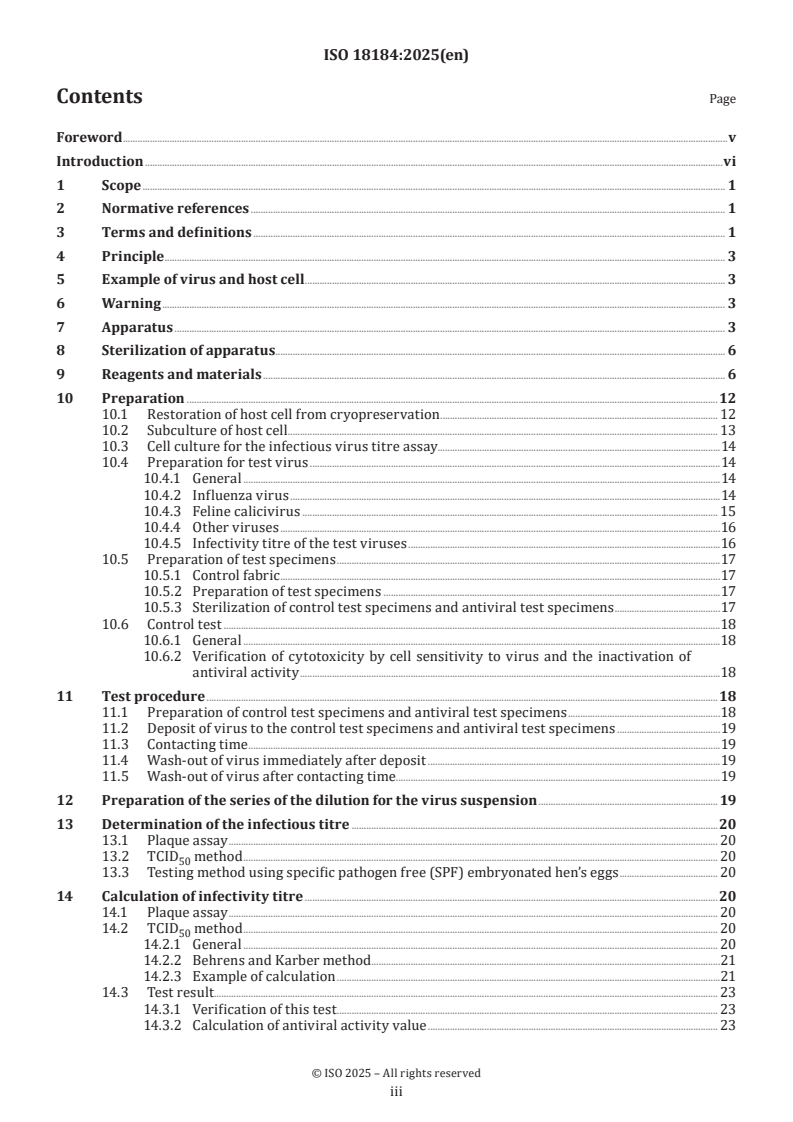
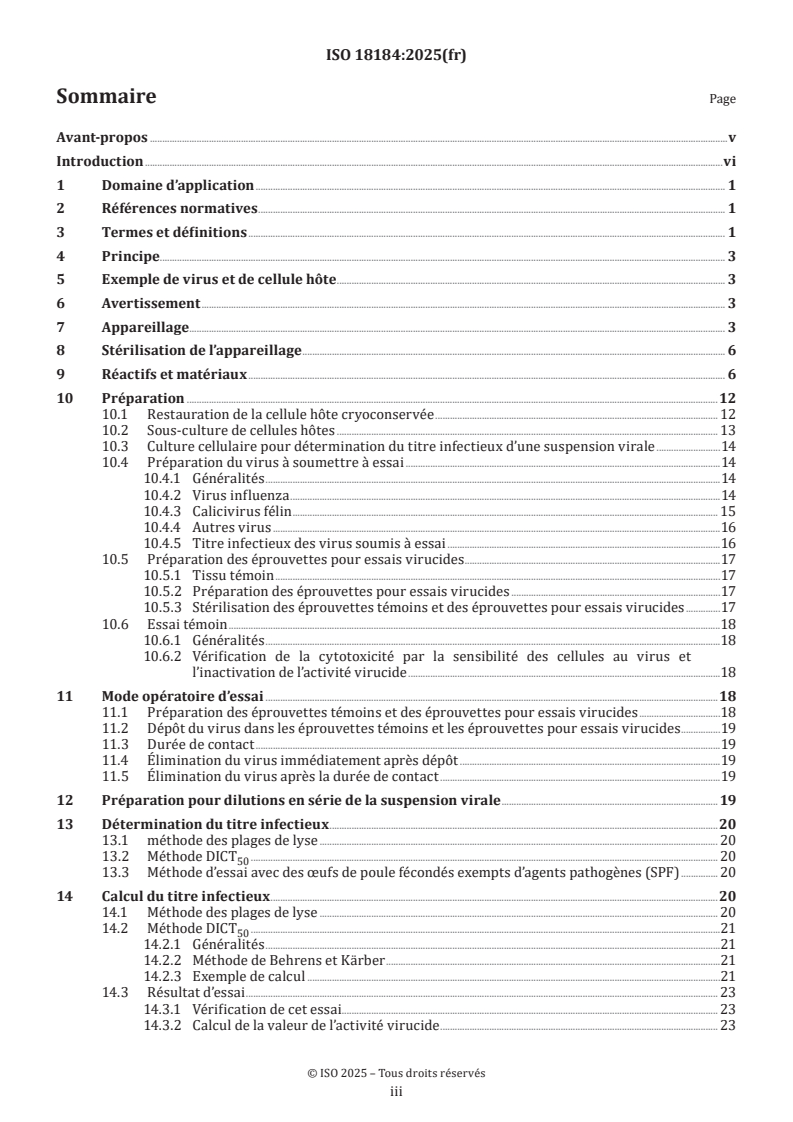
Contents Page
Foreword .v
Introduction .vi
1 Scope . 1
2 Normative references . 1
3 Terms and definitions . 1
4 Principle . 3
5 Example of virus and host cell . 3
6 Warning . 3
7 Apparatus . 3
8 Sterilization of apparatus. 6
9 Reagents and materials . 6
10 Preparation .12
10.1 Restoration of host cell from cryopreservation . 12
10.2 Subculture of host cell. 13
10.3 Cell culture for the infectious virus titre assay.14
10.4 Preparation for test virus .14
10.4.1 General .14
10.4.2 Influenza virus .14
10.4.3 Feline calicivirus . 15
10.4.4 Other viruses .16
10.4.5 Infectivity titre of the test viruses .16
10.5 Preparation of test specimens .17
10.5.1 Control fabric .17
10.5.2 Preparation of test specimens .17
10.5.3 Sterilization of control test specimens and antiviral test specimens .17
10.6 Control test .18
10.6.1 General .18
10.6.2 Verification of cytotoxicity by cell sensitivity to virus and the inactivation of
antiviral activity .18
11 Test procedure .18
11.1 Preparation of control test specimens and antiviral test specimens .18
11.2 Deposit of virus to the control test specimens and antiviral test specimens .19
11.3 Contacting time .19
11.4 Wash-out of virus immediately after deposit .19
11.5 Wash-out of virus after contacting time . .19
12 Preparation of the series of the dilution for the virus suspension . 19
13 Determination of the infectious titre .20
13.1 Plaque assay . 20
13.2 TCID method . 20
13.3 Testing method using specific pathogen free (SPF) embryonated hen’s eggs . 20
14 Calculation of infectivity titre .20
14.1 Plaque assay . 20
14.2 TCID method . 20
14.2.1 General . 20
14.2.2 Behrens and Karber method.21
14.2.3 Example of calculation .21
14.3 Test result. 23
14.3.1 Verification of this test . 23
14.3.2 Calculation of antiviral activity value . 23
iii
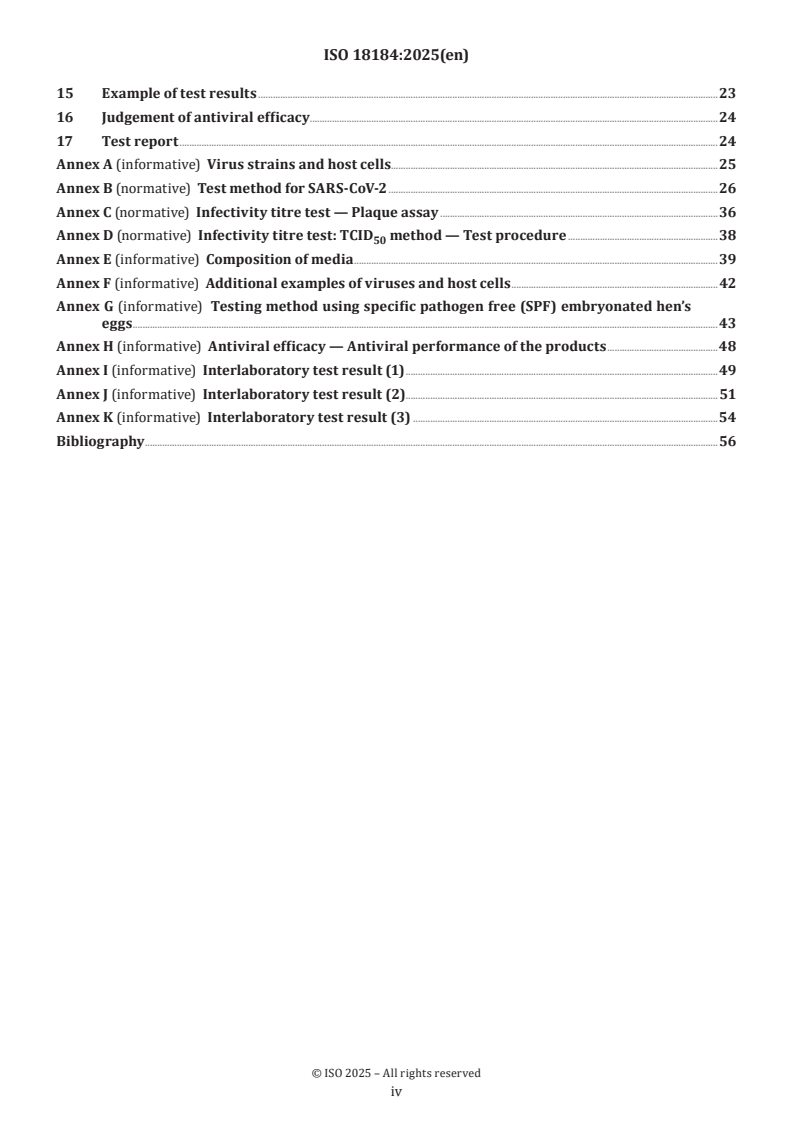
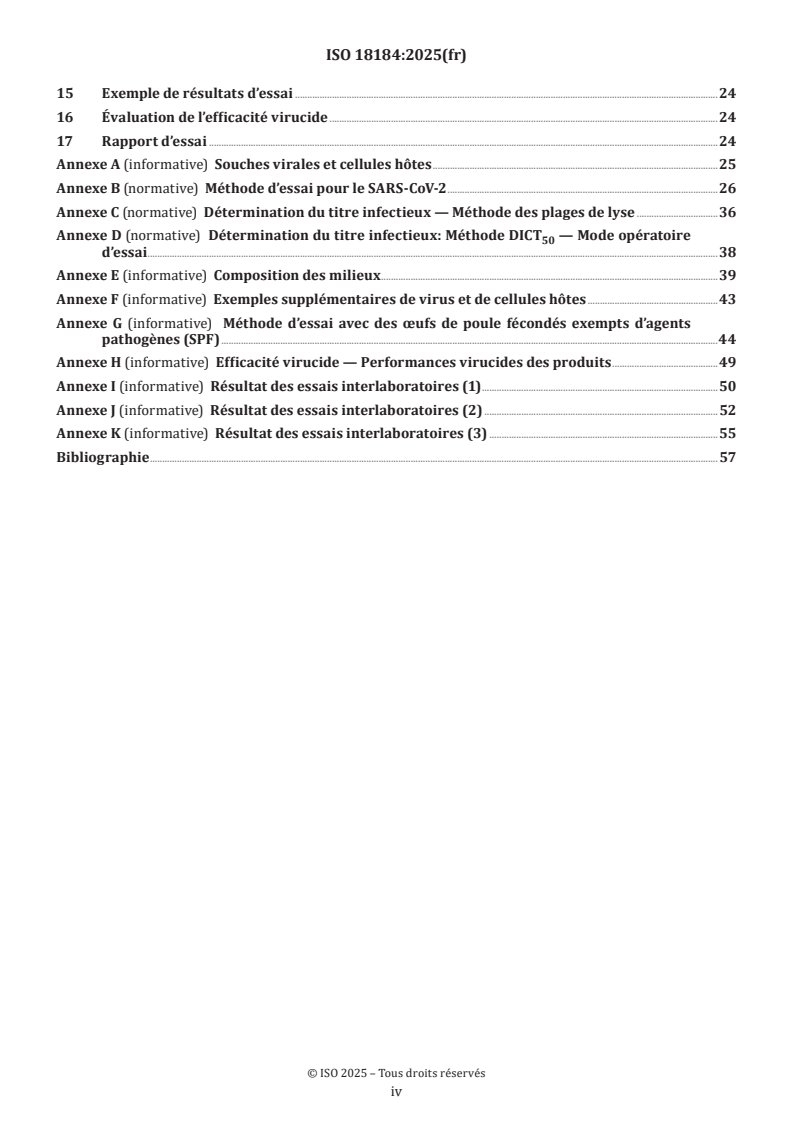
15 Example of test results .23
16 Judgement of antiviral efficacy.24
17 Test report .24
Annex A (informative) Virus strains and host cells.25
Annex B (normative) Test method for SARS-CoV-2 .26
Annex C (normative) Infectivity titre test — Plaque assay .36
Annex D (normative) Infectivity titre test: TCID method — Test procedure .38
Annex E (informative) Composition of media .39
Annex F (informative) Additional examples of viruses and host cells .42
Annex G (informative) Testing method using specific pathogen free (SPF) embryonated hen’s
eggs .43
Annex H (informative) Antiviral efficacy — Antiviral performance of the products .48
Annex I (informative) Interlaboratory test result (1) .49
Annex J (informative) Interlaboratory test result (2). 51
Annex K (informative) Interlaboratory test result (3) .54
Bibliography .56
iv
Foreword
ISO (the International Organization for Standardization) is a worldwide federation of national standards
bodies (ISO member bodies). The work of preparing International Standards is normally carried out through
ISO technical committees. Each member body interested in a subject for which a technical committee
has been established has the right to be represented on that committee. International organizations,
governmental and non-governmental, in liaison with ISO, also take part in the work. ISO collaborates closely
with the International Electrotechnical Commission (IEC) on all matters of electrotechnical standardization.
The procedures used to develop this document and those intended for its further maintenance are described
in the ISO/IEC Directives, Part 1. In particular, the different approval criteria needed for the different types
of ISO document should be noted. This document was drafted in accordance with the editorial rules of the
ISO/IEC Directives, Part 2 (see www.iso.org/directives).
ISO draws attention to the possibility that the implementation of this document may involve the use of (a)
patent(s). ISO takes no position concerning the evidence, validity or applicability of any claimed patent
rights in respect thereof. As of the date of publication of this document, ISO had not received notice of (a)
patent(s) which may be required to implement this document. However, implementers are cautioned that
this may not represent the latest information, which may be obtained from the patent database available at
www.iso.org/patents. ISO shall not be held responsible for identifying any or all such patent rights.
Any trade name used in this document is information given for the convenience of users and does not
constitute an endorsement.
For an explanation of the voluntary nature of standards, the meaning of ISO specific terms and expressions
related to conformity assessment, as well as information about ISO's adherence to the World Trade
Organization (WTO) principles in the Technical Barriers to Trade (TBT), see www.iso.org/iso/foreword.html.
This document was prepared by Technical Committee ISO/TC 38, Textiles.
This third edition cancels and replaces the second edition (ISO 18184:2019), which has been technically
revised.
The main changes are as follows:
— in 14.3.2, the calculation of antiviral activity has been updated;
— a new Annex B has been added for test method for SARS-CoV-2, and subsequent annexes have been moved;
— in Annex E, E.4 has been added for the composition of DMEM medium;
— a new Annex F has been added to give additional examples of the virus strain and host cells.
Any feedback or questions on this document should be directed to the user’s national standards body. A
complete listing of these bodies can be found at www.iso.org/members.html.
v
Introduction
Recently, along with the global improvement in the level of living, consumers are showing the trend to
seek healthcare or health protective products. Also, an increase in the people’s interest for protection
against epidemic diseases has been noted, as the overcrowded commuting train car where the commuters
experience every day, the hospitals, nursing homes, etc.
Being supported by the processing technology of textile products to provide a high performance which has
been highly developed recently, the health protective and hygiene relating products have been advancing
into the market.
Because those products are relatively new and included the technical aspects out of textile technology, the
testing methods have been developed by the individual producers to evaluate the product performance.
That has resulted in inexistence of a unified test method, hindering for both consumers and producers a true
explanation or understanding of those high functional products.
The antiviral textile product is one of those products and includes the technical fields of the textile
technology and the biotechnology.
The demand to establish an international standard has been growing in the consumers, retailers, producers,
etc. as the stakeholders in the market.
Antiviral textile products are textiles capable of reducing the number of infective virus particles that
contact the surface of the textile. This document provides a quantitative test method to assess the antiviral
performance of such products.
The data obtained in an objective manner by this document give the common knowledge to all the stake
holders such as consumers, producers, retailers, etc. to understand the correct performance of the antiviral
textile products.
There are two methods to quantify the number of infective virus, as infective virus titre in this document,
which are the plaque method and the TCID method. The method used can be selected by the experience
and the convenience of each testing house. Any appropriate cellular system can be used and that the testing
conditions when used should be reported.
See Annexes I, J and K for interlaboratory test results.
vi
International Standard ISO 18184:2025(en)
Textiles — Determination of antiviral activity of textile
products
WARNING — This document calls for use of the infectious viruses or substances/procedures that
may be injurious to the health/environment if appropriate conditions are not observed. It refers only
to technical suitability and does not absolve the user from legal obligations relating to health and
safety/environment at any stage.
1 Scope
This document specifies testing methods for the determination of the antiviral activity of the textile
products.
The textile products include woven and knitted fabrics and non-woven fabrics, cotton, fibres, yarns, braids,
feathers, etc.
2 Normative references
The following documents are referred to in the text in such a way that some or all of their content constitutes
requirements of this document. For dated references, only the edition cited applies. For undated references,
the latest edition of the referenced document (including any amendments) applies.
ISO 105-F02, Textiles — Tests for colour fastness — Part F02: Specification for cotton and viscose adjacent fabrics
ISO 3696, Water for analytical laboratory use — Specification and test methods
ISO 20743:2021, Textiles — Determination of antibacterial activity of textile products
3 Terms and definitions
For the purposes of this document, the following terms and definitions apply.
ISO and IEC maintain terminological databases for use in standardization at the following addresses:
— ISO Online browsing platform: available at https:// www .iso .org/ obp
— IEC Electropedia: available at https:// www .electropedia .org/
3.1
virus
original biological entity which has a single type of nucleic acid (DNA or RNA), specific structure that opposes
the virus to living organisms with a cellular structure (prokaryotes and eukaryotes), and reproduces from
its genetic material by replication within the host cell, and leads to absolute intracellular parasitism
Note 1 to entry: The virion is the infectious viral particle.
3.2
virus activity
ability to replicate in the susceptible and permissive host cells
3.3
antiviral activity
property of any substance (chemical or otherwise) producing a modification of one of the elements of the
virion structure which induces the latter's inability to replicate
Note 1 to entry: Property that reduces the viral activity, generally through morphological change or structural damage
to the surface protein of the virus.
Note 2 to entry: It is not necessarily to imply that the change of antigenic response or the change of constituent element
is the reduction of virus infectivity.
3.4
antiviral chemicals
inorganic or organic chemicals able to reduce virus activity (3.2)
Note 1 to entry: The organic antiviral chemicals give the change to the surface protein of virus by the chemical
adsorption. The inorganic metallic antiviral substances destroy or change the morphology of the virus by the
extraction of hydrogen atom in the virus protein by OH radicals which are generated by the radical reaction.
3.5
control fabric
fabric used to verify the stability of the test virus on a textile fabric
Note 1 to entry: The fabrics before the antivirus treatment should be used as a control fabric with the same condition
described in 3.5.
Note 2 to entry: When the fabrics before the antivirus treatment is not applicable, in Note to entry 1, the 100 % cotton
cloth described in ISO 105-F02 should be used without any chemical treatments such as the fluorescent bleach, etc.
3.6
control test
test to confirm that a test specimen does not affect the host cell
Note 1 to entry: This test is performed as same as actual test, but without virus.
3.7
cytopathic effect
cytopathic effect (CPE) caused by virus
effect appears as morphological change or destruction of the host cells as a result of the virus multiplication
3.8
infectivity titre of virus
number of infectious viral particles present per unit volume in a cell lysate or in viral suspension
3.9
plaque
area of lysed cells in a monolayer cell culture
3.10
plaque forming units
PFU
unit expressed as the concentration of the infectious virus per unit volume
3.11
plaque assay
assay to determine the infectivity titre of virus (3.8) from PFU by using the series of dilution
3.12
TCID
50 % infectious dose of a wash-out virus suspension or the dilution of the virus suspension that induces a
CPE in 50 % of cell culture units
Note 1 to entry: See 3.7.
3.13
TCID method
assay to determine the infectivity titre of virus (3.8) from TCID by using the series of dilution
3.14
cytotoxicity
morphological alteration of cells and/or their destruction or the reduction of their sensitivity to the
multiplication of viruses induced by a product
3.15
antiviral textile product
fabric treated with antiviral chemicals
4 Principle
The viruses are deposited onto an antiviral test specimen and control test specimen. After specific contact
time, the remaining infectious virus is counted, and the reduction rate is calculated by the comparison
between the antiviral test specimen and the control test specimen by common logarithm. There are two
methods to quantify the infectious virus titre. One method is the plaque assay and the other is the TCID
method. The selection of the method depends on the convenience and experience of the testing organization.
Due to the individual sensitivities, the results of one test virus cannot be transposed to other viruses.
5 Example of virus and host cell
Examples of species of viruses and host cells are shown in Annex A, Annex B and Annex F.
Other species of viruses and host cells can be used after appropriate validations, as the important virus may
differ depending on target application. If the other species are used, the name of the species and the specific
reason for their use shall be included in the test report.
NOTE Reference viruses are listed in EN 14476 and EN 14675.
6 Warning
Handling and manipulation of viruses and host cells which are potentially hazardous requires a high degree
of technical competence and can be subject to current national legislation and regulations. Appropriate
safety precautions should be observed with due consideration given to country-specific regulations. Only
personnel trained in biological techniques should carry out such tests. Appropriate practices for disinfection,
sterilization and personal hygiene shall be strictly observed.
7 Apparatus
7.1 High pressure steam sterilizer, such as autoclave, capable of operating at a temperature of
(121 ± 2) °C, in accordance with ISO 20743:2021, 5.28.
7.2 Dry heat sterilizer, such as ovens, capable of operating at a temperature of (180 ± 2) °C and
(160 ± 2) °C.
7.3 Measuring flask, with capacity of 1 l.
7.4 Balance, with the available range of 0,01 g to 100 g with accuracy of 1,0 % in accordance with
ISO 20743:2021, 5.13.
7.5 Pipette, of various capacities with accuracy of 10 % of the nominal volume.
7.6 Washing machine.
7.7 Pipetter, capable of mounting the glass or plastic pipettes.
7.8 Micropipette, having the most suitable volume for each use, with a tip made of glass or plastic, and
with a tolerance of 0,5 % or less.
7.9 Water bath, capable of maintaining at a temperature of (37 ± 1) °C, (50 ± 1) °C and (56 ± 1) °C.
7.10 Mixer, producing a vortex shaking action in accordance with ISO 20743:2021, 5.4.
7.11 Freezer, capable of operating at a temperature of (–80 ± 2) °C or (–20 ± 2) °C.
7.12 Liquid nitrogen bath, for the preservation at approximately −196 °C.
7.13 Membrane filtration device, with a pore size of 0,22 μm.
7.14 Refrigerator, capable of operating at a temperature between [2 °C, 8 °C].
7.15 pH meter, having an inaccuracy of calibration ±0,1 pH units at (20 ± 1) °C in accordance with ISO 20743.
7.16 Inverted microscope, capable of being used for cultured cells observation.
7.17 Tweezers, capable of being sterilized.
7.18 Centrifuge, capable of being operated at a temperature of (4 ± 2) °C, and relative centrifugal force of
approximately 1 000 g.
7.19 Biological safety cabinet, class II.
7.20 Vial container, with a capacity of 30 ml and closed with the screw cap. The gasket is made of
perfluoroethylene or silicone and the cap is made of polypropylene.
7.21 96 wells microplate with the gamma radiation sterilization, for TCID method.
96 wells microplates with other sterilization finish may be used after appropriate validation for the growth
of cells. See Figure 1.
Figure 1 — 96 wells microplate for TCID method
7.22 6 wells plastic plate with the gamma radiation sterilization, for plaque assay.
Six wells plates with other sterilization finish may be used after appropriate validation for the growth of
cells. See Figure 2.
Figure 2 — 6 wells plastic plate for plaque assay
7.23 Flask, for cell culture use with the gamma radiation sterilization finish, with an adherent type, a cell
culture area of 75 cm and with the vent cap. The vent cap can exchange bacterial air through 0,2 μm filter.
See Figure 3.
Flask with other sterilization finish may be used after appropriate validation for the growth of cells.
Figure 3 — Flask for cell culture use
7.24 CO incubator, capable of maintaining an atmosphere with 5 % CO , at a temperature of (34 ± 1) °C
2 2
and (37 ± 1) °C.
7.25 Incubator, capable of maintaining at a temperature of (25 ± 1) °C, (35 ± 1) °C and (37 ± 1) °C.
7.26 Centrifuge tube.
7.27 Culture container.
7.28 Test tube.
7.29 Beaker.
7.30 Glass rod, with approximately 18 mm in diameter.
7.31 Mixer, producing spinning action by a stir bar with a rotating magnetic field.
8 Sterilization of apparatus
Sterilize all apparatus which come in contact with the cells, the chemicals, or test specimen. The sterilization
method shall be used by high pressure steam or dry heat method.
— High pressure steam sterilization: by an autoclave (7.1) at a temperature of 121 °C and a pressure of
103 kPa for 15 min.
— Dry-heat sterilization: by a dry heat sterilizer (7.2) at a temperature of 180 °C for 30 min or 160 °C for 2 h.
In case of plastics products, heat-resistant plastics products or sterilization finish plastics products may be used.
9 Reagents and materials
All reagents shall have the quality suitable for virological needs, i.e. free of toxic substances for testing
microorganisms. Some of the media are available in the market.
9.1 Water, which shall be analytical-grade water for microbiological media preparation, which is ion-
exchanged and/or freshly distilled and/or ultra-filtered and/or filtered with RO (reverse osmosis) or grade
3 water in accordance with ISO 3696.
9.2 Eagle's minimum essential medium (EMEM) or Roswell Park Memorial Institute medium
(RPMI), available in the market. The composition is described in Annex E. If there are any components
missing from the composition, add them according to the composition table.
9.3 sodium bicarbonate solution
Prepare the solution at the concentration of 7,5 % according to the method 1 or method 2, and mix well just
before using.
9.3.1 Method 1
9.3.1.1 Sterilize sodium bicarbonate, 75 g in autoclave in a culture container (7.27) with a cap closed
tightly.
9.3.1.2 Water (9.1) is also sterilized by autoclave.
9.3.1.3 Dissolve sodium bicarbonate in the sterilized water (9.3.1.2) of 1 000 ml well.
9.3.2 Method 2
9.3.2.1 Prepare 7,5 % sodium bicarbonate solution by dissolving 75 g of sodium bicarbonate in 1 000 ml of
water (9.1).
9.3.2.2 Sterilize the solution by using 0,22 μm membrane filter (7.13).
9.4 Formaldehyde solution
Prepare a formaldehyde solution at the concentration of 3,7 % in water as follows.
9.4.1 Prepare 100 ml of a 37 % formaldehyde solution.
9.4.2 Add 900 ml of water (9.1) into the solution of 9.4.1.
The other solution for cell fixation may be used after appropriate validation for the cell fixation.
9.5 Methylene blue solution
9.5.1 Prepare a measuring flask (7.3) of 1 l, then, put the following materials in the flask (7.3):
— Water (9.1), 1 000 ml;
— Methylene blue, 0,375 g;
— 1 mol/l sodium hydroxide solutions 62,5 μl.
9.5.2 Dissolve and mix well.
9.6 Inactivated fetal bovine serum (FBS)
9.6.1 Put the frozen cryopreserved fetal bovine serum in a package in the water bath (7.9) at a temperature
of 37 °C and keep it until defrosting.
9.6.2 Then, raise the temperature of the water bath to 56 °C and keep it for 30 min to inactivate.
9.6.3 Divide it into several tubes. Put them in the freezer (7.11) at a temperature lower than –20 °C until
use for testing.
9.6.4 Just before use, put it in the water bath at a temperature of 37 °C and keep it until defrosting.
9.7 Growth medium.
9.7.1 Influenza virus and feline calicivirus
9.7.1.1 Prepare a measuring flask (7.3) of 1 l, and put the following materials into the flask (7.3):
— water (9.1), 800 ml;
— kanamycin sulfate, 60 mg;
— Eagle’s minimum essential medium (EMEM) (E.2), 9,53 g, or RPMI 1640 medium (E.3), 10,4 g.
9.7.1.2 Dissolve and mix well and make up whole solution to 1 000 ml by water (9.1).
9.7.1.3 Sterilize the mixed solution from 9.7.2 by using filter (7.13).
9.7.1.4 Add 15 ml of 7,5 % sodium bicarbonate solution (9.3) and 100 ml of the inactivated fetal bovine
serum (9.6) in the solution from 9.7.1.3.
9.7.2 Other viruses
In case of SARS-CoV-2, prepare the growth medium according to Annex B. In case of additional example of
viruses described in Annex F, select the appropriate growth medium for host cells of each virus.
9.8 Maintenance medium.
9.8.1 Influenza virus and feline calicivirus
9.8.1.1 Prepare a measuring flask (7.3) of 1 l, then, put the following materials in the flask:
— water (9.1), 800 ml;
— kanamycin sulfate, 60 mg;
— Eagle's minimum essential medium, 9,53 g.
9.8.1.2 Dissolve them well, then, make up the whole amount to 1 000 ml by adding water (9.1).
9.8.1.3 Sterilize the mix solution from 9.8.1.2 by using the filter (7.13) with a pore size of 0,22 μm.
9.8.1.4 Add 15 ml of 7,5 % sodium bicarbonate solution (9.3) in the mix solution of 9.8.1.3.
9.8.2 Other viruses
In case of SARS-CoV-2, prepare the maintenance medium according to Annex B. In case of additional example
of viruses described in Annex F, select the appropriate maintenance medium for host cells of each virus.
9.9 Double concentration of the maintenance medium.
9.9.1 Prepare a measuring flask (7.3) of 1 l, then, put the following materials in the flask (7.3):
— water (9.1), 800 ml;
— kanamycin sulfate, 120 mg;
— Eagle’s minimum essential medium, 19,06 g.
9.9.2 Dissolve them well, then, make up the whole amount to 1 000 ml by adding water (9.1).
9.9.3 Sterilize the mixed solution from 9.9.2 by using the filter (7.13) with a pore size of 0,22 μm.
9.10 0,01 mol/l phosphate buffered saline (PBS (-)).
9.10.1 Prepare a measuring flask (7.3) of 1 l, then, put the following materials in the flask (7.3):
— water (9.1), 800 ml;
— sodium chloride, 8 g;
— potassium chloride, 0,2 g;
— disodium hydrogen phosphate 12 H O, 2,9 g;
— potassium dihydrogen phosphate, 0,2 g.
9.10.2 Dissolve the materials of 9.10.1 and mix well and add water (9.1) by making up the whole amount to
1 000 ml and dissolve well.
9.10.3 Then, transfer the mix solution of 9.10.2 into a culture container (7.27), then sterilize the mix
solution by using an autoclave (7.1) at a temperature of 121 °C for 15 min.
9.11 Trypsin derived from beef pancreas and (PBS (-)) mix solution.
9.11.1 Prepare a beaker (7.29), then, put the following materials in the beaker:
— 0,01 mol/l phosphate buffered saline (PBS (-)) (9.10), 100 ml;
— Trypsin derived from beef pancreas, 1,0 g.
9.11.2 Dissolve the materials of 9.11.1 and mix well by using a mixer (7.31) for 2 h.
9.11.3 Then, sterilize the mix solution 9.11.2 by using the filter (7.13) with a pore size of 0,22 μm.
The divided mix solution in tubes that are not used immediately are preserved in the freezer (7.11) at a
temperature of lower than −80 °C until usage for testing.
9.11.4 Prepare a test tube (7.28) and put the following solutions in the test tube (7.28):
— 0,01 mol/l phosphate buffered saline PBS (-) (9.10), 9 ml;
— Trypsin derived from beef pancreas and PBS (-) mix solution of 9.11.3, 1 ml.
9.11.5 Dissolve the solutions of 9.11.4 and mix them well.
9.11.6 Divide the mix solution of 9.11.5 in test tubes (7.28) and preserve in the freezer (7.11) at a
temperature of lower than −20 °C until usage for testing.
9.11.7 Just before using, put the mix solution in test tube of 9.11.6 in the water bath (7.9) at a temperature
of 37 °C and keep the mix solution in the tube until defrosting.
9.12 Trypsin and ethylenediaminetetraacetic acid (EDTA) solution.
9.12.1 Prepare a measuring flask (7.3) of 1 l, then, put the following materials in the measuring flask (7.3):
— 0,01 mol/l phosphate buffered saline PBS (-) (9.10), 800 ml;
— trypsin, 2,5 g;
— kanamycin sulfate, 0,1 g;
— streptomycin sulfate, 0,1 g;
— amphotericin B, 2 mg;
— ethylenediaminetetraacetic acid (EDTA), 0,014 mol.
9.12.2 Dissolve the materials of 9.12.1 and mix well. Add 0,01 mol/l phosphate buffered saline (PBS (-))
(9.10) into the mix solution of 9.12.1 and make up the total amount to 1 000 ml.
9.12.3 Then, sterilize the mix solution of 9.12.2 by using the filter (7.13) with a pore size of 0,22 μm.
9.12.4 Divide the mix solution of 9.12.3 in test tubes (7.28) and preserve in the freezer (7.11) at a
temperature lower than −20 °C until use for testing.
9.12.5 Before use, place the test tube of 9.12.4 in a water bath (7.9) at 37 °C until fully defrosted.
Trypsin EDTA solution is available in the market. The products with the different components from 9.12.1,
may be used after proper validation.
9.13 Diethylaminoethyl (DEAE)-dextran solution.
9.13.1 Prepare a measuring flask (7.3) of 1 l, then, put the following materials in the measuring flask (7.3):
— water (9.1), 1 000 ml;
— diethylaminoethyl (DEAE)-dextran, 20 g.
9.13.2 Dissolve the materials of 9.13.1 and mix well. Add water (9.1) and make up the total amount to
1 000 ml.
9.13.3 Sterilize the mix solution of 9.13.2 by using the filter (7.13) with a pore size of 0,22 μm.
9.14 Agar medium preparation.
9.14.1 Influenza virus and feline calicivirus
9.14.1.1 Liquid A.
9.14.1.1.1 Prepare a sterilized culture container (7.27) of 1 l, then, put the following materials in the culture
container:
— double concentration of maintenance medium (9.9) 1 000 ml;
— DEAE-dextran solution (9.13) 10 ml;
— 7,5 % sodium bicarbonate solution (9.3) 40 ml.
Dissolve the materials of 9.14.1 and mix well.
9.14.1.1.2 Only for the plaque assay of the influenza virus test, add 3,0 ml of the trypsin derived from beef
pancreas and (PBS (-)) mix solution (9.11).
9.14.1.1.3 Put the mix solution of 9.14.1.1 and 9.14.1.2 in the water bath (7.9) at a temperature of 37 °C and
keep it until using.
9.14.1.2 Liquid B.
9.14.1.2.1 Prepare a culture container (7.27) of 2 l, then, put the following materials in the culture
container (7.27):
— water (9.1), 1 000 ml;
— cell culture agar, 15 g.
Dissolve the materials and mix well.
9.14.1.2.2 Sterilize the mix solution of 9.14.1.2.1 by using autoclave (7.1) at a temperature of 121 °C and a
pressure of 103 kPa for 15 min.
9.14.1.2.3 Put the mix solution of 9.14.1.2.2 in the water bath (7.9) at a temperature of 50 °C and keep it
until using.
9.14.1.3 Mix liquid A and liquid B at 50 : 50 (% volume fraction).
9.14.2 Other viruses
In case of SARS-CoV-2, prepared the agar medium according to Annex B. In case of additional examples of
viruses described in Annex F, select the appropriate agar medium for each virus.
9.15 Wash-out solution
9.15.1 General
The wash-out solution is used for the wash-out of the virus from the antiviral test specimens and control
test specimens and for suppression of anti-virus activity of the chemicals treated on the anti-virus textile
product and prepared as the following.
Other wash-out solution may be used after appropriate validation.
9.15.2 Influenza virus and feline calicivirus
9.15.2.1 Prepare a culture container (7.27) of 1 l, then, put the following materials in the culture
container (7.27):
— water (9.1), 1 000 ml;
— peptone made of casein, 17,0 g;
— peptone made of soybean, 3,0 g;
— sodium chloride, 5,0 g;
— dipotassium hydrogen phosphate, 2,5 g;
— d-glucose, 2,5 g;
— lecithin, 1,0 g.
Mix above materials together and dissolve well, then, add:
— Nonionic surfactant (Tween 80), 7,0 g.
Dissolve the materials all together and mix well.
9.15.2.2 Adjust pH of the mix solution from 9.15.2.1 to pH 7,0 ± 0,2 by the sodium hydroxide solution or the
hydrochloric acid solution in the water bath (7.9) at a temperature of 25 °C.
9.15.2.3 Sterilize the mix solution from 9.15.2.2 by using autoclave (7.1) at a temperature of 121 °C and a
pressure of 103 kPa for 15 min.
9.15.3 Other viruses
In case of SARS-CoV-2, prepared the wash-out solution according to Annex B. In case of additional examples
of viruses described in Annex F, select the appropriate wash-out solution for each virus and the host cell.
9.16 Maintenance medium with trypsin.
9.16.1 Prepare a sterilized culture container (7.27) of 1 l, then, put the following materials in the culture
container (7.27):
— maintenance medium, (9.8), 1 000 ml;
— trypsin from beef pancreas and (PBS (-)) mix solution (9.11), 1,5 ml.
9.16.2 Dissolve the materials of 9.16.1 and mix well.
9.17 Control fabric, or 100 % cotton woven fabric as specified in ISO 105-F02.
10 Preparation
10.1 Restoration of host cell from cryopreservation
10.1.1 Put the cryopreserved host cell in the water bath (7.9) at a temperature of 37 °C and keep it for rapid
defrosting.
10.1.2 Prepare a new flask (7.23) for cell culture with a vent cap lid and put 20 ml of growth medium (9.7)
in the flask.
10.1.3 Put whole ampule of the defrosted host cell of 10.1.1 in the flask.
10.1.4 Put the flask of 10.1.3 in the CO incubator (7.24) at a temperature of 37 °C and keep it for (24 ± 2) h
to culture the host cell.
10.1.5 Then, observe the flask of 10.1.4 by a microscope (7.16) if the cells are attached on the bottom of
the flask.
If the growth is confirmed, then, go to next step of 10.1.6. If not, continue to culture the host cell in the
incubator.
10.1.6 Drain the remaining growth medium from the flask of 10.1.5.
10.1.7 Add 20 ml of the new growth medium (9.7) to the flask of 10.1.6.
10.1.8 Put the flask of 10.1.7 in the CO incubator (7.24) at a temperature of 37 °C for (48 ± 2) h.
10.1.9 Observe the flask of 10.1.8 using a microscope (7.16) and confirm if the cells are cultured as a
confluent growth on the bottom of the flask. If the growth of cells is not enough, continue the step of 10.1.8
until the sufficient growth is confirmed.
10.1.10 Then, proceed to the serial subcultivation by taking the following steps of 10.2.
10.2 Subculture of host cell
10.2.1 Observe the flask of 10.1.8 by using a microscope (7.16). If the confluent growth of host cell on the
bottom of the flask is confirmed, then, drain an extra growth medium of the flask.
10.2.2 Add 5 ml of 0,01 mol/l phosphate buffered saline (PBS (-)) (9.10) and wash the surface of the grown
cells on the bottom of the flask by the solution, then drain the extra (PBS (-)).
Repeat 3 times of this washing procedure.
10.2.3 Add 1 ml of trypsin EDTA solution (9.12) in the flask of 10.2.2 and spread the solution over the whole
surface. After this, remove the excess trypsin EDTA solution from the flask.
10.2.4 Put the flask of 10.2.3 in the CO incubator (7.24) at a temperature of 37 °C for 10 min ± 1 min to
keep warm.
10.2.5 Observe visually the flask of 10.2.4 if the grown cells are starting to come off, if confirmed, tap the
side of the flask and disperse the cells.
10.2.6 Add 5 ml of the growth medium (9.7) in the flask of 10.2.5 and disperse the cells by pipetting by
using pipette (7.5) the medium to make it mild. Mix well so as to avoid the damage to the cells.
10.2.7 Prepare a new flask (7.23) for cell culture and add 20 ml of the growth medium (9.7).
10.2.8 Add 1 ml of the cell suspension of 10.2.6 by using the pipette (7.5) to the flask of 10.2.7.
The amount of the cell suspension of 10.2.6 added in 10.2.8 may be changed as needed.
----
...
Norme
internationale
ISO 18184
Troisième édition
Textiles — Détermination de
2025-03
l’activité virucide de produits
textiles
Textiles — Determination of antiviral activity of textile products
Numéro de référence
DOCUMENT PROTÉGÉ PAR COPYRIGHT
© ISO 2025
Tous droits réservés. Sauf prescription différente ou nécessité dans le contexte de sa mise en œuvre, aucune partie de cette
publication ne peut être reproduite ni utilisée sous quelque forme que ce soit et par aucun procédé, électronique ou mécanique,
y compris la photocopie, ou la diffusion sur l’internet ou sur un intranet, sans autorisation écrite préalable. Une autorisation peut
être demandée à l’ISO à l’adresse ci-après ou au comité membre de l’ISO dans le pays du demandeur.
ISO copyright office
Case postale 401 • Ch. de Blandonnet 8
CH-1214 Vernier, Genève
Tél.: +41 22 749 01 11
E-mail: copyright@iso.org
Web: www.iso.org
Publié en Suisse
ii
Sommaire Page
Avant-propos .v
Introduction .vi
1 Domaine d’application . 1
2 Références normatives . 1
3 Termes et définitions . 1
4 Principe. 3
5 Exemple de virus et de cellule hôte . 3
6 Avertissement . 3
7 Appareillage . 3
8 Stérilisation de l’appareillage . 6
9 Réactifs et matériaux . 6
10 Préparation .12
10.1 Restauration de la cellule hôte cryoconservée . 12
10.2 Sous-culture de cellules hôtes . 13
10.3 Culture cellulaire pour détermination du titre infectieux d’une suspension virale .14
10.4 Préparation du virus à soumettre à essai .14
10.4.1 Généralités .14
10.4.2 Virus influenza .14
10.4.3 Calicivirus félin . 15
10.4.4 Autres virus .16
10.4.5 Titre infectieux des virus soumis à essai .16
10.5 Préparation des éprouvettes pour essais virucides .17
10.5.1 Tissu témoin .17
10.5.2 Préparation des éprouvettes pour essais virucides .17
10.5.3 Stérilisation des éprouvettes témoins et des éprouvettes pour essais virucides .17
10.6 Essai témoin .18
10.6.1 Généralités .18
10.6.2 Vérification de la cytotoxicité par la sensibilité des cellules au virus et
l’inactivation de l’activité virucide .18
11 Mode opératoire d’essai .18
11.1 Préparation des éprouvettes témoins et des éprouvettes pour essais virucides .18
11.2 Dépôt du virus dans les éprouvettes témoins et les éprouvettes pour essais virucides .19
11.3 Durée de contact .19
11.4 Élimination du virus immédiatement après dépôt .19
11.5 Élimination du virus après la durée de contact .19
12 Préparation pour dilutions en série de la suspension virale . 19
13 Détermination du titre infectieux .20
13.1 méthode des plages de lyse . 20
13.2 Méthode DICT . 20
13.3 Méthode d’essai avec des œufs de poule fécondés exempts d’agents pathogènes (SPF) . 20
14 Calcul du titre infectieux .20
14.1 Méthode des plages de lyse . 20
14.2 Méthode DICT .21
14.2.1 Généralités .21
14.2.2 Méthode de Behrens et Kärber .21
14.2.3 Exemple de calcul .21
14.3 Résultat d’essai . 23
14.3.1 Vérification de cet essai. 23
14.3.2 Calcul de la valeur de l’activité virucide . 23
iii
15 Exemple de résultats d’essai .24
16 Évaluation de l’efficacité virucide .24
17 Rapport d’essai .24
Annexe A (informative) Souches virales et cellules hôtes .25
Annexe B (normative) Méthode d’essai pour le SARS-CoV-2 .26
Annexe C (normative) Détermination du titre infectieux — Méthode des plages de lyse .36
Annexe D (normative) Détermination du titre infectieux: Méthode DICT — Mode opératoire
d’essai .38
Annexe E (informative) Composition des milieux .39
Annexe F (informative) Exemples supplémentaires de virus et de cellules hôtes .43
Annexe G (informative) Méthode d’essai avec des œufs de poule fécondés exempts d’agents
pathogènes (SPF) .44
Annexe H (informative) Efficacité virucide — Performances virucides des produits .49
Annexe I (informative) Résultat des essais interlaboratoires (1) .50
Annexe J (informative) Résultat des essais interlaboratoires (2) .52
Annexe K (informative) Résultat des essais interlaboratoires (3) .55
Bibliographie .57
iv
Avant-propos
L'ISO (Organisation internationale de normalisation) est une fédération mondiale d'organismes nationaux
de normalisation (comités membres de l'ISO). L'élaboration des Normes internationales est en général
confiée aux comités techniques de l'ISO. Chaque comité membre intéressé par une étude a le droit de faire
partie du comité technique créé à cet effet. Les organisations internationales, gouvernementales et non
gouvernementales, en liaison avec l'ISO participent également aux travaux. L'ISO collabore étroitement avec
la Commission électrotechnique internationale (IEC) en ce qui concerne la normalisation électrotechnique.
Les procédures utilisées pour élaborer le présent document et celles destinées à sa mise à jour sont
décrites dans les Directives ISO/IEC, Partie 1. Il convient, en particulier, de prendre note des différents
critères d'approbation requis pour les différents types de documents ISO. Le présent document a
été rédigé conformément aux règles de rédaction données dans les Directives ISO/IEC, Partie 2 (voir
www.iso.org/directives).
L’ISO attire l’attention sur le fait que la mise en application du présent document peut entraîner l’utilisation
d’un ou de plusieurs brevets. L’ISO ne prend pas position quant à la preuve, à la validité et à l’applicabilité de
tout droit de brevet revendiqué à cet égard. À la date de publication du présent document, l’ISO n'avait pas
reçu notification qu’un ou plusieurs brevets pouvaient être nécessaires à sa mise en application. Toutefois,
il y a lieu d’avertir les responsables de la mise en application du présent document que des informations
plus récentes sont susceptibles de figurer dans la base de données de brevets, disponible à l'adresse
www.iso.org/brevets. L’ISO ne saurait être tenue pour responsable de ne pas avoir identifié tout ou partie de
tels droits de propriété.
Les appellations commerciales éventuellement mentionnées dans le présent document sont données pour
information, par souci de commodité, à l’intention des utilisateurs et ne sauraient constituer un engagement.
Pour une explication de la nature volontaire des normes, la signification des termes et expressions
spécifiques de l'ISO liés à l'évaluation de la conformité, ou pour toute information au sujet de l'adhésion de
l'ISO aux principes de l’Organisation mondiale du commerce (OMC) concernant les obstacles techniques au
commerce (OTC), voir www.iso.org/avant-propos.
Le présent document a été élaboré par le comité technique ISO/TC 38, Textiles.
Cette troisième édition annule et remplace la deuxième édition (ISO 18184:2019), qui a fait l’objet d’une
révision technique.
Les principales modifications sont les suivantes:
— en 14.3.2, le calcul de l’activité virucide a été mis à jour;
— une nouvelle Annexe B a été ajoutée pour la méthode d’essai avec le SARS-CoV-2, et les annexes suivantes
ont été déplacées;
— à l’Annexe E, l’Article E.4 a été ajouté pour la composition du milieu DMEM;
— une nouvelle Annexe F a été ajoutée pour donner des exemples supplémentaires de souches virales et de
cellules hôtes.
Il convient que l’utilisateur adresse tout retour d’information ou toute question concernant le présent
document à l’organisme national de normalisation de son pays. Une liste exhaustive desdits organismes se
trouve à l’adresse www.iso.org/fr/members.html.
v
Introduction
Au cours de ces dernières années, le niveau de vie de la population mondiale a connu une nette amélioration
et les consommateurs tendent aujourd’hui à rechercher des produits de soin ou de protection de la santé.
Cette tendance s’accompagne d’un intérêt accru de la population pour la protection contre des maladies
épidémiques, notamment dans les trains de banlieue bondés que les voyageurs empruntent quotidiennement,
dans les hôpitaux, dans les maisons médicalisées, etc.
Grâce à la récente accélération du développement de techniques ultra performantes pour le traitement
des produits textiles, les produits d’hygiène et de protection de la santé occupent une place de plus en plus
importante sur le marché.
Ces produits relativement nouveaux ont bénéficié des avancées techniques réalisées dans le domaine des
technologies textiles et les fabricants ont individuellement développé des méthodes d’essai afin d’évaluer les
performances des produits. Cependant, aucune méthode d’essai unifiée n’a été élaborée et les consommateurs
et les fabricants ne disposent à ce jour d’aucune information claire sur ces produits hautement fonctionnels.
Les produits textiles à propriétés virucides figurent parmi ces produits et intègrent les domaines techniques
des technologies textiles et des biotechnologies.
Dans ce contexte, la nécessité d’élaborer une Norme internationale s’impose aux consommateurs,
distributeurs, fabricants ou autres intervenants, en tant que parties prenantes de ce marché.
Les produits textiles à propriétés virucides sont des textiles capables de réduire le nombre de virus infectieux
qui entrent en contact avec leur surface. Le présent document établit une méthode d’essai quantitative
permettant d’évaluer les performances virucides de ces produits.
Les données objectives obtenues grâce au présent document permettent à tous les acteurs (consommateurs,
fabricants, distributeurs, etc.) de déterminer de manière correcte la performance des produits textiles à
propriétés virucides.
Deux méthodes permettent de quantifier le nombre de virus infectieux (titre infectieux dans le présent
document): la méthode directe des plages de lyse et la méthode DICT . La méthode utilisée peut être choisie
en fonction de l’expertise et des capacités techniques de chaque centre d’essai. Tout système cellulaire
approprié peut être utilisé et il convient de consigner les conditions d’essai dans le rapport d’essai.
Voir les Annexes I, J et K pour les résultats des essais interlaboratoires.
vi
Norme internationale ISO 18184:2025(fr)
Textiles — Détermination de l’activité virucide de produits
textiles
AVERTISSEMENT — Le présent document nécessite l’utilisation de virus infectieux ou de substances
et/ou modes opératoires qui peuvent être préjudiciables à la santé et à l’environnement si les
conditions appropriées ne sont pas respectées. Elle se réfère uniquement à l’aptitude technique et ne
dispense nullement l’utilisateur de satisfaire, à tout moment, aux obligations légales en matière de
santé, de sécurité et d’environnement.
1 Domaine d’application
Le présent document spécifie des méthodes d’essai permettant d’évaluer l’activité virucide des produits
textiles.
Les produits textiles incluent les étoffes tissées et tricotées ainsi que les étoffes non tissées, le coton, les
fibres, les fils, les tresses, les plumes, etc.
2 Références normatives
Les documents suivants sont cités dans le texte de sorte qu’ils constituent, pour tout ou partie de leur
contenu, des exigences du présent document. Pour les références datées, seule l’édition citée s’applique. Pour
les références non datées, la dernière édition du document de référence s'applique (y compris les éventuels
amendements).
ISO 105-F02, Textiles — Essais de solidité des teintures — Partie F02: Spécifications pour les tissus témoins en
coton et en viscose
ISO 3696, Eau pour laboratoire à usage analytique — Spécification et méthodes d'essai
ISO 20743:2021, Textiles — Détermination de l'activité antibactérienne des produits textiles
3 Termes et définitions
Pour les besoins du présent document, les termes et définitions suivants s’appliquent.
L’ISO et l’IEC tiennent à jour des bases de données terminologiques destinées à être utilisées en normalisation,
consultables aux adresses suivantes:
— ISO Online browsing platform: disponible à l’adresse https:// www .iso .org/ obp
— IEC Electropedia: disponible à l’adresse https:// www .electropedia .org/
3.1
virus
entité biologique originale qui possède un unique type d’acide nucléique (ADN ou ARN), une structure
spécifique qui oppose le virus aux organismes vivants possédant une structure cellulaire (procaryotes et
eucaryotes) et qui se reproduit par réplication à partir de son matériel génétique à l’intérieur de la cellule
hôte pour conduire à un parasitisme intracellulaire absolu
Note 1 à l'article: La particule virale infectieuse est appelée virion.
3.2
activité virale
capacité d’un virus à se répliquer dans les cellules hôtes sensibles et permissives
3.3
activité virucide
propriété de toute substance (chimique ou non) entraînant une modification d’un des éléments de la
structure du virion qui induit l’incapacité de ce dernier à se répliquer
Note 1 à l'article: Il s’agit d’une propriété qui réduit l’activité virale, généralement par une modification morphologique
ou une altération structurelle de la surface protéique du virus.
Note 2 à l'article: La modification de la réponse antigénique ou la modification d’un élément constitutif n’implique pas
nécessairement une diminution de la virulence d’un virus.
3.4
substances chimiques virucides
substances chimiques inorganiques ou organiques capables de réduire l’activité virale (3.2)
Note 1 à l'article: Les substances chimiques virucides organiques modifient la surface protéique du virus par
adsorption chimique. Les substances virucides métalliques inorganiques détruisent ou modifient la morphologie du
virus par arrachement d’un atome d’hydrogène de la protéine virale, grâce à des radicaux OH générés par réaction
radicalaire.
3.5
tissu témoin
tissu utilisé pour vérifier la stabilité du virus soumis à essai sur une étoffe textile
Note 1 à l'article: Il convient d’utiliser les tissus avant traitement virucide comme tissu témoin dans les mêmes
conditions que celles décrites en 3.5.
Note 2 à l'article: Lorsque les tissus avant traitement virucide ne sont pas utilisables, dans la Note 1 à l’article, il convient
d’utiliser le tissu 100 % coton décrit dans l’ISO 105-F02 sans traitement chimique (blanchiment optique, etc.).
3.6
essai témoin
essai destiné à vérifier qu’une éprouvette n’a aucune influence sur la cellule hôte
Note 1 à l'article: Cet essai est effectué dans les mêmes conditions que l’essai réel, mais sans le virus.
3.7
effet cytopathogène
effet cytopathogène (ECP) du virus
effet qui se manifeste sous la forme d’une altération morphologique ou d’une destruction des cellules hôtes
provoquée par la multiplication des virus
3.8
titre infectieux du virus
nombre de particules virales infectieuses présent par unité de volume dans un lysat cellulaire ou dans une
suspension virale
3.9
plage de lyse
surface de cellules lysées dans une culture cellulaire monocouche
3.10
unité formant plage
UFP
unité exprimée en concentration de virus infectieux par unité de volume
3.11
méthode des plages de lyse
méthode destinée à déterminer le titre infectieux du virus (3.8) à partir du nombre d’UFP en utilisant des
dilutions successives
3.12
DICT
dose infectieuse à 50 % d’une suspension virale de rinçage ou d’une dilution de suspension virale qui induit
un ECP dans 50 % des cultures cellulaires
Note 1 à l'article: Voir 3.7.
3.13
méthode DICT
méthode destinée à déterminer le titre infectieux du virus (3.8) à partir de la DICT en utilisant des dilutions
successives
3.14
cytotoxicité
altération morphologique des cellules et/ou leur destruction ou la réduction de leur sensibilité à la
multiplication de virus induite par un produit
3.15
produit textile à propriétés virucides
étoffe traitée avec des substances chimiques virucides
4 Principe
Les virus sont déposés sur une éprouvette pour essais virucides et une éprouvette témoin. Une fois le temps
de contact écoulé, la quantité restante du virus infectieux est déterminée et le taux de réduction est calculé
en comparant l’éprouvette pour essais virucides et l’éprouvette témoin sur une échelle logarithmique
décimale. Deux méthodes permettent de quantifier le titre infectieux d’un virus. La première est la méthode
des plages de lyse et l’autre la méthode DICT . Le choix de la méthode est fonction de l’expertise et des
capacités du centre d’essai.
En raison des différences de sensibilité, les résultats obtenus avec un virus d’essai ne peuvent pas être
transposés à d’autres virus.
5 Exemple de virus et de cellule hôte
L’Annexe A, l’Annexe B et l’Annexe F donnent des exemples d’espèces virales et de cellules hôtes.
Il est possible d’employer d’autres espèces virales et d’autres cellules hôtes après validation appropriées car
le virus important peut changer en fonction de l’application cible. Si d’autres espèces sont utilisées, le nom de
l’espèce et la raison spécifique de son utilisation doivent être consignés dans le rapport d’essai.
NOTE La liste des virus de référence est donnée dans l’EN 14476 et dans l’EN 14675.
6 Avertissement
La manipulation de virus et de cellules hôtes potentiellement dangereux nécessite un haut degré de
compétence technique et peut être soumise à la législation et aux réglementations nationales en vigueur.
Il convient de prendre les précautions de sécurité appropriées en tenant compte des réglementations
spécifiques au pays. Il convient que seul un personnel formé aux techniques biologiques réalise de tels essais.
Les pratiques appropriées en matière de désinfection, de stérilisation et d’hygiène personnelle doivent être
strictement respectées.
7 Appareillage
7.1 Stérilisateur sous vapeur à haute pression, tel qu’un autoclave, capable de fonctionner à une
température de (121 ± 2) °C, conformément à l’ISO 20743:2021, 5.28.
7.2 Stérilisateur à chaleur sèche, tel que des fours, capables de fonctionner à des températures de
(180 ± 2) °C et de (160 ± 2) °C.
7.3 Fiole jaugée d’une capacité de 1 l.
7.4 Balance offrant une plage de mesure de 0,01 g à 100 g avec une précision de 1,0 % conformément à
l’ISO 20743:2021, 5.13.
7.5 Pipettes de différents volumes avec une précision de 10 % du volume nominal.
7.6 Machine à laver.
7.7 Pipeteur capable de recevoir les pipettes en verre ou en plastique.
7.8 Micropipette de volume parfaitement adapté à chaque utilisation, à extrémité en verre ou en
plastique, avec une tolérance inférieure ou égale à 0,5 %.
7.9 Bain-marie capable de maintenir des températures de (37 ± 1) °C, (50 ± 1) °C et (56 ± 1) °C.
7.10 Agitateur produisant une agitation de type vortex conformément à l’ISO 20743:2021, 5.4.
7.11 Congélateur réglable à une température de (–80 ± 2) °C ou (–20 ± 2) °C.
7.12 Bain d’azote liquide pour la conservation à –196 °C environ.
7.13 Appareil de filtration sur membrane avec un diamètre de pore de 0,22 μm.
7.14 Réfrigérateur réglable à une température comprise entre 2 °C et 8 °C.
7.15 pH-mètre avec incertitude d’étalonnage ± 0,1 unité de pH à (20 ± 1) °C conformément à l’ISO 20743.
7.16 Microscope inversé pour l’observation des cultures cellulaires.
7.17 Pinces stérilisables.
7.18 Centrifugeuse réglable à une température de (4 ± 2) °C et générant une force centrifuge relative
d’environ 1 000 g.
7.19 Poste de sécurité biologique de classe II.
7.20 Flacon d’une capacité de 30 ml avec bouchon à vis. Le joint est en tétrafluoroéthylène ou en silicone,
et le bouchon en polypropylène.
7.21 Microplaque à 96 puits à stérilisation par rayonnement gamma pour la méthode DICT .
Des microplaques à 96 puits avec d’autres traitements de stérilisation peuvent être utilisées après validation
appropriée de la croissance cellulaire. Voir Figure 1.
Figure 1 — Microplaque à 96 puits pour la méthode DICT
7.22 Plaque en plastique à 6 puits à stérilisation par rayonnement gamma pour la méthode des plages
de lyse.
Des plaques à 6 puits avec d’autres traitements de stérilisation peuvent être utilisées après validation
appropriée de la croissance cellulaire. Voir Figure 2.
Figure 2 — Plaque en plastique à 6 puits pour la méthode des plages de lyse
7.23 Fiole pour la culture cellulaire, stérilisée aux rayonnements gamma, traitée pour faciliter l’adhérence
cellulaire, avec une zone de culture cellulaire de 75 cm et un bouchon d’aération. Le bouchon d’aération
peut laisser passer de l’air bactérien par un filtre à pores de 0,2 μm. Voir Figure 3.
Une fiole avec d’autres traitements de stérilisation peut être utilisée après validation appropriée de la
croissance cellulaire.
Figure 3 — Fiole pour culture cellulaire
7.24 Incubateur à CO capable de maintenir une atmosphère contenant 5 % de CO à une température de
2 2
(34 ± 1) °C et de (37 ± 1) °C.
7.25 Incubateur capable de maintenir une température de (25 ± 1) °C, (35 ± 1) °C et (37 ± 1) °C.
7.26 Tube à centrifuger.
7.27 Boîte de culture cellulaire.
7.28 Tube à essai.
7.29 Bécher.
7.30 Tige de verre d’environ 18 mm de diamètre.
7.31 Agitateur produisant une action de rotation par une barre d’agitation avec un champ magnétique
rotatif.
8 Stérilisation de l’appareillage
Stériliser tous les équipements destinés à entrer en contact avec les cellules, les substances chimiques ou les
éprouvettes. La stérilisation doit être effectuée à la vapeur d’eau ou par chaleur sèche.
— Stérilisation à la vapeur d’eau: en autoclave (7.1) à une température de 121 °C et une pression de 103 kPa
pendant 15 min.
— Stérilisation par chaleur sèche: en stérilisateur à chaleur sèche (7.2) à une température de 180 °C pendant
30 min ou à 160 °C pendant 2 h.
Pour les produits en plastique, des articles résistants à la chaleur ou stérilisés peuvent être utilisés.
9 Réactifs et matériaux
Tous les réactifs doivent être d’une qualité adaptée aux besoins virologiques, c’est-à-dire sans substance
toxique pour les essais microbiens. Certains milieux de culture sont disponibles dans le commerce.
9.1 Eau qui doit être de qualité analytique pour la préparation de milieux de culture microbiologiques,
qui est fraîchement distillée ou traitée par échange d’ions, par ultrafiltration ou par osmose inverse ou toute
combinaison de ces méthodes, ou eau de qualité 3 conformément à l’ISO 3696.
9.2 Milieu minimum essentiel de Eagle (EMEM) ou milieu du Roswell Park Memorial Institute
(RPMI), disponible dans le commerce. La composition de ce milieu est décrite à l’Annexe E. Si des composants
du milieu sont manquants, les ajouter conformément au tableau présentant la composition.
9.3 Solution de bicarbonate de sodium
Préparer la solution à 7,5 % conformément à la méthode 1 ou à la méthode 2 et bien mélanger juste avant
utilisation.
9.3.1 Méthode 1
9.3.1.1 Stériliser à l’autoclave 75 g de bicarbonate de sodium dans une boîte de culture cellulaire (7.27)
fermée par un bouchon étanche.
9.3.1.2 Stériliser également l’eau (9.1) à l’autoclave.
9.3.1.3 Dissoudre correctement le bicarbonate de sodium dans 1 000 ml d’eau stérilisée (9.3.1.2).
9.3.2 Méthode 2
9.3.2.1 Préparer la solution de bicarbonate de sodium à 7,5 % par dissolution de 75 g de bicarbonate
sodium dans 1 000 ml d’eau (9.1).
9.3.2.2 Stériliser la solution par filtration sur membrane de 0,22 μm (7.13).
9.4 Solution de formaldéhyde
Préparer une solution aqueuse de formaldéhyde à 3,7 % comme suit.
9.4.1 Préparer 100 ml d’une solution de formaldéhyde à 37 %.
9.4.2 Ajouter 900 ml d’eau (9.1) dans la solution de 9.4.1.
L’autre solution de fixation cellulaire peut être utilisée après validation appropriée de la fixation cellulaire.
9.5 Solution de bleu de méthylène
9.5.1 Préparer une fiole jaugée (7.3) de 1 l puis y ajouter les substances suivantes:
— eau (9.1), 1 000 ml;
— bleu de méthylène, 0,375 g;
— solution d’hydroxyde de sodium à 1 mol/l, 62,5 μl.
9.5.2 Dissoudre et bien mélanger.
9.6 Sérum de veau fœtal (SVF) inactivé
9.6.1 Plonger le sérum de veau fœtal congelé cryoconservé, encore dans son emballage, dans un bain-
marie (7.9) maintenu à 37 °C, jusqu’à décongélation.
9.6.2 Relever ensuite la température du bain-marie à 56 °C et maintenir pendant 30 min pour inactiver.
9.6.3 Répartir le sérum dans plusieurs tubes. Placer les tubes dans le congélateur (7.11) à une température
inférieure à –20 °C jusqu’à l’utilisation pour les essais.
9.6.4 Juste avant utilisation, placer le sérum dans un bain-marie à 37 °C et l’y maintenir jusqu’à
décongélation.
9.7 Milieu de croissance
9.7.1 Virus influenza et calicivirus félin
9.7.1.1 Préparer une fiole jaugée (7.3) de 1 l puis y ajouter les substances suivantes:
— eau (9.1), 800 ml;
— sulfate de kanamycine, 60 mg;
— milieu minimum essentiel d’Eagle (EMEM) (E.2), 9,53 g, ou milieu RPMI 1640 (E.3), 10,4 g.
9.7.1.2 Dissoudre et bien mélanger, puis compléter le volume total de la solution à 1 000 ml avec de l’eau (9.1).
9.7.1.3 Stériliser la solution mélangée de 9.7.2 à l’aide d’un filtre (7.13).
9.7.1.4 Ajouter 15 ml de solution de bicarbonate de sodium à 7,5 % (9.3) et 100 ml de sérum de veau fœtal
inactivé (9.6) à la solution de 9.7.1.3.
9.7.2 Autres virus
Dans le cas du SARS-CoV-2, préparer le milieu de croissance conformément à l’Annexe B. Dans le cas d’un
autre exemple de virus décrit à l’Annexe F, sélectionner le milieu de croissance approprié pour les cellules
hôtes de chaque virus.
9.8 Milieu de conservation
9.8.1 Virus influenza et calicivirus félin
9.8.1.1 Préparer une fiole jaugée (7.3) de 1 l puis y ajouter les substances suivantes:
— eau (9.1), 800 ml;
— sulfate de kanamycine, 60 mg;
— milieu minimum essentiel d’Eagle, 9,53 g.
9.8.1.2 Bien dissoudre les différents composants, puis compléter le volume total de la solution à 1 000 ml
avec de l’eau (9.1).
9.8.1.3 Stériliser la solution mélangée de 9.8.1.2 à l’aide d’un filtre 0,22 µm (7.13).
9.8.1.4 Ajouter 15 ml de solution de bicarbonate de sodium à 7,5 % (9.3) à la solution mélangée de 9.8.1.3.
9.8.2 Autres virus
Dans le cas du SARS-CoV-2, préparer le milieu de conservation conformément à l’Annexe B. Dans le cas d’un
autre exemple de virus décrit à l’Annexe F, sélectionner le milieu de conservation approprié pour les cellules
hôtes de chaque virus.
9.9 Double concentration du milieu de conservation
9.9.1 Préparer une fiole jaugée (7.3) de 1 l puis y ajouter les substances suivantes:
— eau (9.1), 800 ml;
— sulfate de kanamycine, 120 mg;
— milieu minimum essentiel d’Eagle, 19,06 g.
9.9.2 Bien dissoudre les différents composants, puis compléter le volume total de la solution à 1 000 ml
avec de l’eau (9.1).
9.9.3 Stériliser la solution mélangée de 9.9.2 à l’aide d’un filtre 0,22 µm (7.13).
9.10 Solution saline tamponnée au phosphate (STP (-)) 0,01 mol/l
9.10.1 Préparer une fiole jaugée (7.3) de 1 l puis y ajouter les substances suivantes:
— eau (9.1), 800 ml;
— chlorure de sodium, 8 g;
— chlorure de potassium, 0,2 g;
— hydrogénophosphate disodique 12 H O, 2,9 g;
— dihydrogénophosphate de potassium, 0,2 g.
9.10.2 Dissoudre les matériaux de 9.10.1 et bien mélanger, puis ajouter de l’eau (9.1) pour compléter le
volume total à 1 000 ml et bien dissoudre.
9.10.3 Transvaser ensuite la solution mélangée de 9.10.2 dans une boîte de culture cellulaire (7.27)
puis stériliser la solution mélangée à l’autoclave (7.1) à la température de 121 °C pendant 15 min.
9.11 Solution mélangée de trypsine pancréatique bovine et (STP (-))
9.11.1 Préparer un bécher (7.29), puis y placer les substances suivantes:
— solution saline tamponnée au phosphate (STP (-)) 0,01 mol/l (9.10), 100 ml;
— trypsine pancréatique bovine, 1,0 g.
9.11.2 Dissoudre les matériaux de 9.11.1 et bien mélanger à l’aide d’un agitateur (7.31) pendant 2 h.
9.11.3 Stériliser ensuite la solution mélangée 9.11.2 avec un filtre 0,22 µm (7.13).
Les tubes dans lesquels la solution mélangée a été répartie et qui ne sont pas utilisés immédiatement sont
conservés dans le congélateur (7.11) à une température inférieure à −80 °C jusqu’à leur utilisation pour les essais.
9.11.4 Préparer un tube à essai (7.28) et y ajouter les solutions suivantes:
— solution saline tamponnée au phosphate (STP) (-) 0,01 mol/l (9.10), 9 ml;
— solution mélangée contenant de la trypsine pancréatique bovine et la solution STP (-) de 9.11.3, 1 ml.
9.11.5 Dissoudre les solutions de 9.11.4 et les mélanger soigneusement.
9.11.6 Répartir la solution mélangée de 9.11.5 dans plusieurs tubes à essai (7.28) et conserver ces tubes
dans le congélateur (7.11) à une température inférieure à −20 °C jusqu’à leur utilisation pour les essais.
9.11.7 Juste avant utilisation, placer la solution mélangée dans le tube à essai de 9.11.6 au bain-marie (7.9)
à 37 °C et conserver la solution mélangée dans le tube jusqu’à décongélation.
9.12 Solution de trypsine et d’acide éthylènediaminetétraacétique (EDTA)
9.12.1 Préparer une fiole jaugée (7.3) de 1 l puis y ajouter les substances suivantes:
— solution saline tamponnée au phosphate (STP) (-) 0,01 mol/l (9.10), 800 ml;
— trypsine, 2,5 g;
— sulfate de kanamycine, 0,1 g;
— sulfate de streptomycine, 0,1 g;
— amphotéricine B, 2 mg;
— acide éthylènediaminetétraacétique (EDTA), 0,014 mol.
9.12.2 Dissoudre les matériaux de 9.12.1 et bien mélanger. Ajouter 0,01 mol/l de solution saline tamponnée
au phosphate (STP (-)) (9.10) dans la solution mélangée de 9.12.1 et compléter le volume total à 1 000 ml.
9.12.3 Stériliser ensuite la solution mélangée de 9.12.2 avec un filtre 0,22 µm (7.13).
9.12.4 Répartir la solution mélangée de 9.12.3 dans plusieurs tubes à essai (7.28) et conserver ces tubes
dans le congélateur (7.11) à une température inférieure à −20 °C jusqu’à leur utilisation pour les essais.
9.12.5 Avant utilisation, placer le tube à essai 9.12.4 au bain-marie (7.9) à 37 °C jusqu’à décongélation
complète.
La solution de trypsine/EDTA est disponible dans le commerce. Les produits contenant les différents
composants de 9.12.1 peuvent être employés à l’issue d’un processus de validation adapté.
9.13 Solution de diéthylaminoéthyl (DEAE)/dextrane
9.13.1 Préparer une fiole jaugée (7.3) de 1 l puis y ajouter les substances suivantes:
— eau (9.1), 1 000 ml;
— diéthylaminoéthyl (DEAE)/dextrane, 20 g.
9.13.2 Dissoudre les matériaux de 9.13.1 et bien mélanger. Ajouter de l’eau (9.1) et compléter le volume total
à 1 000 ml.
9.13.3 Stériliser la solution mélangée de 9.13.2 avec un filtre 0,22 µm (7.13).
9.14 Préparation du milieu gélosé
9.14.1 Virus influenza et calicivirus félin
9.14.1.1 Liquide A
9.14.1.1.1 Préparer une boîte de culture cellulaire stérilisée (7.27) de 1 l puis y ajouter les composants
suivants:
— double concentration du milieu de conservation (9.9) 1 000 ml;
— solution de DEAE/dextrane (9.13) 10 ml;
— solution de bicarbonate de sodium à 7,5 % (9.3) 40 ml.
Dissoudre les matériaux de 9.14.1 et bien mélanger.
9.14.1.1.2 Uniquement pour la méthode des plages de lyse de l’essai avec le virus influenza, ajouter 3,0 ml
de la solution mélangée de trypsine pancréatique bovine et de (STP (-)) (9.11).
9.14.1.1.3 Placer la solution mélangée de 9.14.1.1 et de 9.14.1.2 dans le bain-marie (7.9) à 37 °C et l’y
maintenir jusqu’à utilisation.
9.14.1.2 Liquide B
9.14.1.2.1 Préparer une boîte de culture cellulaire (7.27) de 2 l puis y ajouter les composants suivants:
— eau (9.1), 1 000 ml;
— agar pour culture cellulaire, 15 g.
Dissoudre les matériaux et bien mélanger.
9.14.1.2.2 Stériliser la solution mélangée de 9.14.1.2.1 dans l’autoclave (7.1) à 121 °C et à une pression de
103 kPa pendant 15 min.
9.14.1.2.3 Placer la solution mélangée de 9.14.1.2.2 dans le bain-marie (7.9) à 50 °C et l’y maintenir jusqu’à
utilisation.
9.14.1.3 Mélanger le liquide A et le liquide B à 50:50 (% de fraction volumique).
9.14.2 Autres virus
Dans le cas du SARS-CoV-2, préparer le milieu gélosé conformément à l’Annexe B. Dans le cas d’autres
exemples de virus décrits à l’Annexe F, sélectionner le milieu gélosé approprié pour chaque virus.
9.15 Solution de rinçage
9.15.1 Généralités
La solution de rinçage est utilisée pour éliminer le virus des éprouvettes pour essais virucides et des
éprouvettes témoins et pour supprimer l’activité virucide des produits chimiques traités sur le produit
textile virucide. Elle est préparée comme suit.
Une autre solution de rinçage peut être utilisée après validation appropriée.
9.15.2 Virus influenza et calicivirus félin
9.15.2.1 Préparer une boîte de culture cellulaire (7.27) de 1 l puis y ajouter les composants suivants:
— eau (9.1), 1 000 ml;
— peptone de caséine, 17,0 g;
— peptone de soja, 3,0 g;
— chlorure de sodium, 5,0 g;
— hydrogénophosphate dipotassique, 2,5 g;
— d-glucose, 2,5 g;
— lécithine, 1,0 g.
Mélanger les matériaux ci-dessus et bien dissoudre, puis ajouter:
— tensioactif non ionique (Tween 80), 7,0 g.
Dissoudre tous les matériaux et bien mélanger.
9.15.2.2 Ajuster ensuite le pH de la solution mélangée de 9.15.2.1 à 7,0 ± 0,2 en ajoutant la solution
d’hydroxyde de sodium ou d’acide chlorhydrique dans le bain-marie (7.9) à 25 °C.
9.15.2.3 Stériliser la solution mélangée de 9.15.2.2 dans l’autoclave (7.1) à 121 °C et à une pression de
103 kPa pendant 15 min.
9.15.3 Autres virus
Dans le cas du SARS-CoV-2, préparer la solution de rinçage conformément à l’Annexe B. Dans le cas d’autres
exemples de virus décrits à l’Annexe F, sélectionner la solution de rinçage appropriée pour chaque virus et la
cellule hôte.
9.16 Milieu de conservation avec trypsine
9.16.1 Préparer une boîte de culture cellulaire stérilisée (7.27) de 1 l puis y ajouter les composants suivants:
— milieu de conservation (9.8), 1 000 ml;
— solution mélangée de trypsine pancréatique bovine et de (STP (-)) (9.11), 1,5 ml.
9.16.2 Dissoudre les matériaux de 9.16.1 et bien mélanger.
9.16.3 Tissu témoin, ou tissu 100 % coton tel que spécifié dans l’ISO 105-F02.
10 Préparation
10.1 Restauration de la cellule hôte cryoconservée
10.1.1 Placer la cellule hôte cryoconservée au bain-marie (7.9) à 37 °C et l’y maintenir pour une
décongélation rapide.
10.1.2 Préparer une nouvelle fiole (7.23) pour cultures cellulaires avec bouchon d’aération et verser 20 ml
de milieu de croissance (9.7) dans la fiole.
ISO 18184:
...
Questions, Comments and Discussion
Ask us and Technical Secretary will try to provide an answer. You can facilitate discussion about the standard in here.
Loading comments...