


ISO 17987-7:2025
(Main)Road vehicles — Local Interconnect Network (LIN) — Part 7: Electrical physical layer (EPL) conformance test specification
Road vehicles — Local Interconnect Network (LIN) — Part 7: Electrical physical layer (EPL) conformance test specification
This document specifies the conformance test for the electrical physical layer (EPL) of the LIN communications system. The purpose of this document is to provide a standardised way to verify whether a LIN bus driver conforms to ISO 17987-4. The primary motivation is to ensure a level of interoperability of LIN bus drivers from different sources in a system environment. This document provides all the necessary technical information to ensure that test results are consistent even on different test systems, provided that the particular test suite and the test system are conformant to the content of this document.
Véhicules routiers — Réseau Internet local (LIN) — Partie 7: Spécification d'essai de conformité de la couche électrique physique (EPL)
General Information
- Status
- Published
- Publication Date
- 27-May-2025
- Technical Committee
- ISO/TC 22/SC 31 - Data communication
- Drafting Committee
- ISO/TC 22/SC 31 - Data communication
- Current Stage
- 6060 - International Standard published
- Start Date
- 28-May-2025
- Due Date
- 30-May-2025
- Completion Date
- 28-May-2025
Relations
- Effective Date
- 06-Jun-2022
Overview - ISO 17987-7:2025 (LIN EPL conformance test specification)
ISO 17987-7:2025 specifies a standardized conformance test suite for the Electrical Physical Layer (EPL) of the Local Interconnect Network (LIN) used in road vehicles. Its purpose is to provide a repeatable, vendor-neutral method to verify whether a LIN bus driver (transceiver/ECU node) conforms to ISO 17987-4, ensuring interoperability of LIN bus drivers from different suppliers and consistent test results across compliant test systems.
Key topics and technical requirements
The standard organizes a comprehensive set of test cases and measurement requirements covering multiple EPL variants and operating scenarios:
- Device classes & voltages: Test specifications for EPL 12 V (class A, B, C) and EPL 24 V implementations, including devices with and without RX/TX access.
- Test case organization: Clear grouping of static and dynamic tests, calibration, operation modes, and failure modes to ensure reproducible outcomes.
- Measurement and signal generation: Requirements for signal sources and measurement equipment to produce consistent test stimuli across laboratories.
- Electrical operating conditions: Tests for operating voltage range, voltage variation (e.g., ranges listed for various tests), and supply voltage offset to validate behaviour under real-world supply conditions.
- Threshold and timing: Verification of threshold voltages, slope control, propagation delay, and timing margins critical to LIN frame integrity.
- Passive characteristics: Measuring internal resistors, internal capacitance, and assessing dynamic interference and EMI-related effects.
- Failure and robustness tests: Evaluations for abnormal conditions, fault injection and device response to ensure safe degradation and system stability.
- Calibration & conformance of test systems: Rules to ensure that different test systems produce comparable results when implementing the standard.
Practical applications and intended users
ISO 17987-7:2025 is intended for professionals involved in the development, validation and certification of LIN hardware and systems:
- Vehicle OEMs and system integrators validating multi-vendor LIN networks
- Tier‑1 suppliers and ECU/transceiver manufacturers proving compliance during design and production
- Independent test laboratories and certification bodies running official EPL conformance tests
- Test equipment vendors who implement compliant test suites and automated bench solutions
- Quality and validation engineers using the specification for supplier audits, interoperability testing, and pre-compliance verification
Benefits include improved interoperability, reduced integration risk, and consistent acceptance criteria for LIN bus drivers across projects and suppliers.
Related standards
- ISO 17987-4 - referenced for LIN bus driver electrical requirements (this document verifies conformance to Part 4)
- Other parts of the ISO 17987 series covering LIN architecture, protocol and higher-layer conformance
Keywords: ISO 17987-7:2025, LIN, Local Interconnect Network, Electrical Physical Layer (EPL), conformance test, LIN bus driver, interoperability, EPL 12 V, EPL 24 V, test specification.
Get Certified
Connect with accredited certification bodies for this standard

TÜV Rheinland
TÜV Rheinland is a leading international provider of technical services.

TÜV SÜD
TÜV SÜD is a trusted partner of choice for safety, security and sustainability solutions.

AIAG (Automotive Industry Action Group)
American automotive industry standards and training.
Sponsored listings
Frequently Asked Questions
ISO 17987-7:2025 is a standard published by the International Organization for Standardization (ISO). Its full title is "Road vehicles — Local Interconnect Network (LIN) — Part 7: Electrical physical layer (EPL) conformance test specification". This standard covers: This document specifies the conformance test for the electrical physical layer (EPL) of the LIN communications system. The purpose of this document is to provide a standardised way to verify whether a LIN bus driver conforms to ISO 17987-4. The primary motivation is to ensure a level of interoperability of LIN bus drivers from different sources in a system environment. This document provides all the necessary technical information to ensure that test results are consistent even on different test systems, provided that the particular test suite and the test system are conformant to the content of this document.
This document specifies the conformance test for the electrical physical layer (EPL) of the LIN communications system. The purpose of this document is to provide a standardised way to verify whether a LIN bus driver conforms to ISO 17987-4. The primary motivation is to ensure a level of interoperability of LIN bus drivers from different sources in a system environment. This document provides all the necessary technical information to ensure that test results are consistent even on different test systems, provided that the particular test suite and the test system are conformant to the content of this document.
ISO 17987-7:2025 is classified under the following ICS (International Classification for Standards) categories: 43.040.15 - Car informatics. On board computer systems. The ICS classification helps identify the subject area and facilitates finding related standards.
ISO 17987-7:2025 has the following relationships with other standards: It is inter standard links to ISO 17987-7:2016. Understanding these relationships helps ensure you are using the most current and applicable version of the standard.
ISO 17987-7:2025 is available in PDF format for immediate download after purchase. The document can be added to your cart and obtained through the secure checkout process. Digital delivery ensures instant access to the complete standard document.
Standards Content (Sample)
International
Standard
ISO 17987-7
Second edition
Road vehicles — Local Interconnect
2025-05
Network (LIN) —
Part 7:
Electrical physical layer (EPL)
conformance test specification
Véhicules routiers — Réseau Internet local (LIN) —
Partie 7: Spécification d'essai de conformité de la couche
électrique physique (EPL)
Reference number
© ISO 2025
All rights reserved. Unless otherwise specified, or required in the context of its implementation, no part of this publication may
be reproduced or utilized otherwise in any form or by any means, electronic or mechanical, including photocopying, or posting on
the internet or an intranet, without prior written permission. Permission can be requested from either ISO at the address below
or ISO’s member body in the country of the requester.
ISO copyright office
CP 401 • Ch. de Blandonnet 8
CH-1214 Vernier, Geneva
Phone: +41 22 749 01 11
Email: copyright@iso.org
Website: www.iso.org
Published in Switzerland
ii
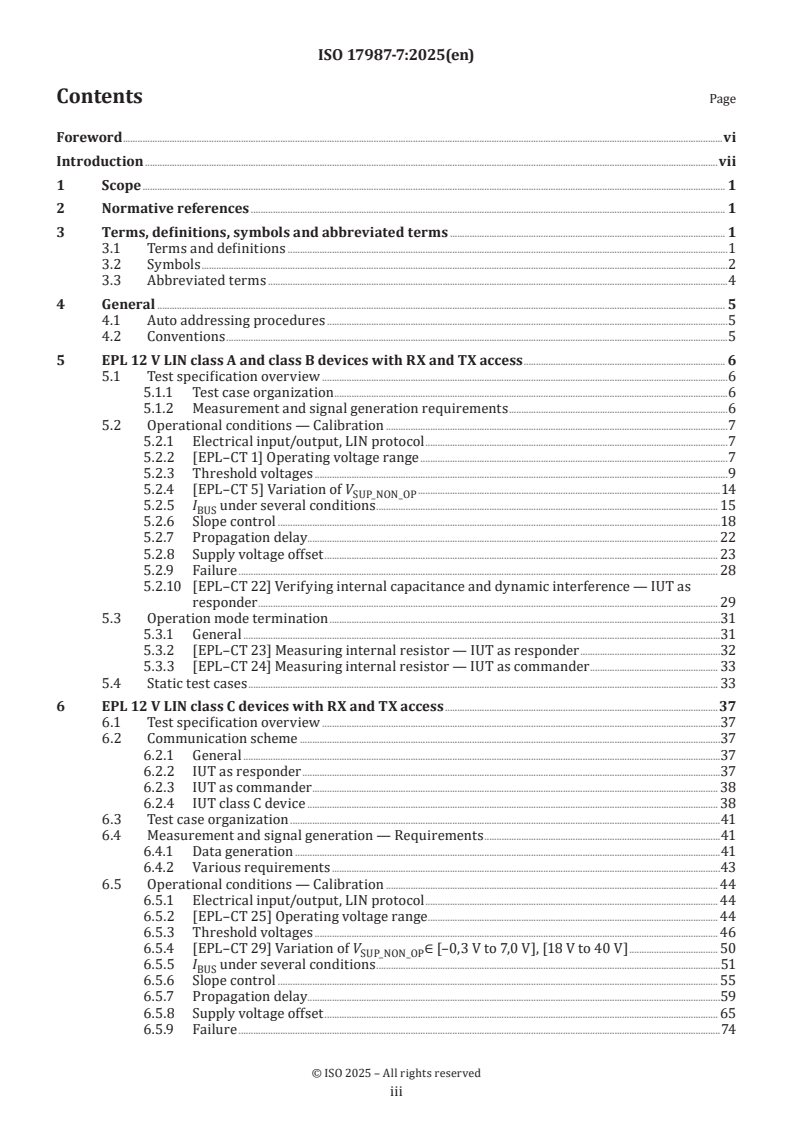
Contents Page
Foreword .vi
Introduction .vii
1 Scope . 1
2 Normative references . 1
3 Terms, definitions, symbols and abbreviated terms . 1
3.1 Terms and definitions .1
3.2 Symbols .2
3.3 Abbreviated terms .4
4 General . 5
4.1 Auto addressing procedures .5
4.2 Conventions .5
5 EPL 12 V LIN class A and class B devices with RX and TX access . 6
5.1 Test specification overview .6
5.1.1 Test case organization .6
5.1.2 Measurement and signal generation requirements .6
5.2 Operational conditions — Calibration .7
5.2.1 Electrical input/output, LIN protocol .7
5.2.2 [EPL–CT 1] Operating voltage range .7
5.2.3 Threshold voltages .9
5.2.4 [EPL–CT 5] Variation of V .14
SUP_NON_OP
5.2.5 I under several conditions . 15
BUS
5.2.6 Slope control .18
5.2.7 Propagation delay . . . 22
5.2.8 Supply voltage offset . 23
5.2.9 Failure . 28
5.2.10 [EPL–CT 22] Verifying internal capacitance and dynamic interference — IUT as
responder . 29
5.3 Operation mode termination .31
5.3.1 General .31
5.3.2 [EPL–CT 23] Measuring internal resistor — IUT as responder .32
5.3.3 [EPL–CT 24] Measuring internal resistor — IUT as commander . 33
5.4 Static test cases . 33
6 EPL 12 V LIN class C devices with RX and TX access .37
6.1 Test specification overview .37
6.2 Communication scheme .37
6.2.1 General .37
6.2.2 IUT as responder .37
6.2.3 IUT as commander . 38
6.2.4 IUT class C device . 38
6.3 Test case organization .41
6.4 Measurement and signal generation — Requirements .41
6.4.1 Data generation .41
6.4.2 Various requirements .43
6.5 Operational conditions — Calibration . 44
6.5.1 Electrical input/output, LIN protocol . 44
6.5.2 [EPL–CT 25] Operating voltage range . 44
6.5.3 Threshold voltages . 46
6.5.4 [EPL–CT 29] Variation of V ∈ [–0,3 V to 7,0 V], [18 V to 40 V] . 50
SUP_NON_OP
6.5.5 I under several conditions .51
BUS
6.5.6 Slope control . 55
6.5.7 Propagation delay . . .59
6.5.8 Supply voltage offset . 65
6.5.9 Failure .74
iii
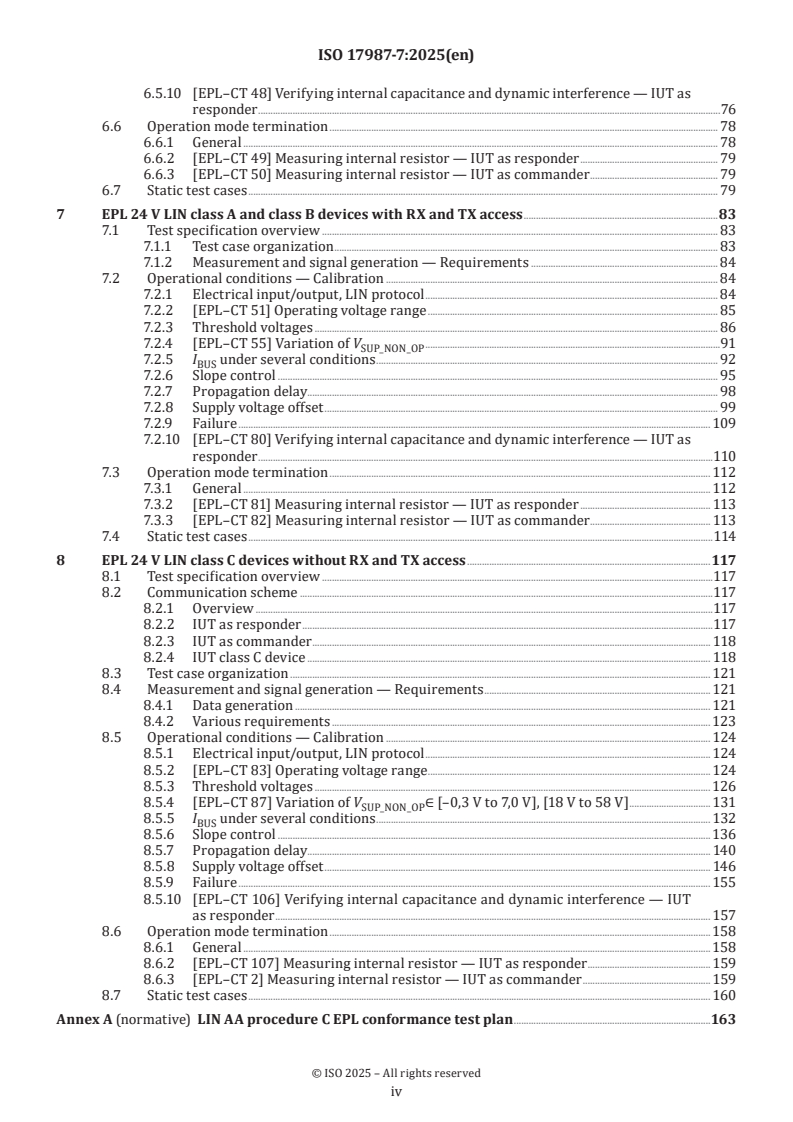
6.5.10 [EPL–CT 48] Verifying internal capacitance and dynamic interference — IUT as
responder .76
6.6 Operation mode termination . 78
6.6.1 General . 78
6.6.2 [EPL–CT 49] Measuring internal resistor — IUT as responder . 79
6.6.3 [EPL–CT 50] Measuring internal resistor — IUT as commander . 79
6.7 Static test cases . 79
7 EPL 24 V LIN class A and class B devices with RX and TX access .83
7.1 Test specification overview . 83
7.1.1 Test case organization . 83
7.1.2 Measurement and signal generation — Requirements . 84
7.2 Operational conditions — Calibration . 84
7.2.1 Electrical input/output, LIN protocol . 84
7.2.2 [EPL–CT 51] Operating voltage range . 85
7.2.3 Threshold voltages . 86
7.2.4 [EPL–CT 55] Variation of V .91
SUP_NON_OP
7.2.5 I under several conditions . 92
BUS
7.2.6 Slope control . 95
7.2.7 Propagation delay . . . 98
7.2.8 Supply voltage offset . 99
7.2.9 Failure . 109
7.2.10 [EPL–CT 80] Verifying internal capacitance and dynamic interference — IUT as
responder .110
7.3 Operation mode termination . 112
7.3.1 General . 112
7.3.2 [EPL–CT 81] Measuring internal resistor — IUT as responder . 113
7.3.3 [EPL–CT 82] Measuring internal resistor — IUT as commander . 113
7.4 Static test cases .114
8 EPL 24 V LIN class C devices without RX and TX access .117
8.1 Test specification overview .117
8.2 Communication scheme .117
8.2.1 Overview .117
8.2.2 IUT as responder .117
8.2.3 IUT as commander . 118
8.2.4 IUT class C device . 118
8.3 Test case organization . 121
8.4 Measurement and signal generation — Requirements . 121
8.4.1 Data generation . 121
8.4.2 Various requirements . 123
8.5 Operational conditions — Calibration . 124
8.5.1 Electrical input/output, LIN protocol . 124
8.5.2 [EPL–CT 83] Operating voltage range . 124
8.5.3 Threshold voltages . 126
8.5.4 [EPL–CT 87] Variation of V ∈ [–0,3 V to 7,0 V], [18 V to 58 V] . 131
SUP_NON_OP
8.5.5 I under several conditions . 132
BUS
8.5.6 Slope control . 136
8.5.7 Propagation delay . . . 140
8.5.8 Supply voltage offset . 146
8.5.9 Failure . 155
8.5.10 [EPL–CT 106] Verifying internal capacitance and dynamic interference — IUT
as responder . 157
8.6 Operation mode termination .158
8.6.1 General .158
8.6.2 [EPL–CT 107] Measuring internal resistor — IUT as responder . 159
8.6.3 [EPL–CT 2] Measuring internal resistor — IUT as commander . 159
8.7 Static test cases . 160
Annex A (normative) LIN AA procedure C EPL conformance test plan .163
iv
Annex B (normative) LIN AA procedure D EPL conformance test plan .175
Annex C (normative) LIN AA procedure E EPL conformance test plan . 188
Bibliography .195
v
Foreword
ISO (the International Organization for Standardization) is a worldwide federation of national standards
bodies (ISO member bodies). The work of preparing International Standards is normally carried out through
ISO technical committees. Each member body interested in a subject for which a technical committee
has been established has the right to be represented on that committee. International organizations,
governmental and non-governmental, in liaison with ISO, also take part in the work. ISO collaborates closely
with the International Electrotechnical Commission (IEC) on all matters of electrotechnical standardization.
The procedures used to develop this document and those intended for its further maintenance are described
in the ISO/IEC Directives, Part 1. In particular, the different approval criteria needed for the different types
of ISO documents should be noted. This document was drafted in accordance with the editorial rules of the
ISO/IEC Directives, Part 2 (see www.iso.org/directives).
ISO draws attention to the possibility that the implementation of this document may involve the use of (a)
patent(s). ISO takes no position concerning the evidence, validity or applicability of any claimed patent
rights in respect thereof. As of the date of publication of this document, ISO had received notice of (a)
patent(s) which may be required to implement this document. However, implementers are cautioned that
this may not represent the latest information, which may be obtained from the patent database available at
www.iso.org/patents. ISO shall not be held responsible for identifying any or all such patent rights.
Any trade name used in this document is information given for the convenience of users and does not
constitute an endorsement.
For an explanation of the voluntary nature of standards, the meaning of ISO specific terms and expressions
related to conformity assessment, as well as information about ISO's adherence to the World Trade
Organization (WTO) principles in the Technical Barriers to Trade (TBT), see www.iso.org/iso/foreword.html.
This document was prepared by Technical Committee ISO/TC 22, Road vehicles, Subcommittee SC 31, Data
communication.
This second edition cancels and replaces the first edition (ISO 17987-7:2016), which has been technically
revised.
The main changes are as follows:
— master and slave terms used for the LIN node types in ISO 17987:2016 (all parts) are replaced within this
standard with inclusive language terms commander and responder. This also applies for abbreviations
and file formats NCF and LDF;
— adoptions based on updates in the corresponding requirement document (ISO 17987-4);
— EPL–CT 35 and EPL–CT 93 withdrawn;
— Electrical parameters for ECU low supply operation voltage range considered in test cases;
— editorial updates and several statements improved to avoid ambiguities.
A list of all parts in the ISO 17987 series can be found on the ISO website.
Any feedback or questions on this document should be directed to the user’s national standards body. A
complete listing of these bodies can be found at www.iso.org/members.html.
vi
Introduction
The LIN protocol as proposed is an automotive focused low-speed universal asynchronous receiver
transmitter (UART)-based network. Some of the key characteristics of the Local Interconnect Network (LIN)
protocol are signal-based communication, schedule table-based frame transfer, commander/responder
communication with error detection, node configuration and diagnostic service transportation.
The LIN protocol is for low-cost automotive control applications as, for example, door module and air
condition systems. It serves as a communication infrastructure for low-speed control applications in vehicles
by providing
— signal-based communication to exchange information between applications in different nodes,
— bitrate support from 1 kbit/s to 20 kbit/s,
— deterministic schedule table-based frame communication,
— network management that wakes up and puts the LIN cluster into sleep mode in a controlled manner,
— status management that provides error handling and error signalling,
— transport layer that allows large amount of data to be transported (such as diagnostic services),
— specification of how to handle diagnostic services,
— electrical physical layer specifications,
— node description language describing properties of responder nodes,
— network description file describing behaviour of communication, and
— application programming interface.
The ISO 17987 series is based on the open systems interconnection (OSI) basic reference model as specified
in ISO/IEC 7498–1 which structures communication systems into seven layers.
The OSI model structures data communication into seven layers called (top down) application layer (layer 7),
presentation layer, session layer, transport layer, network layer, data link layer and physical layer (layer 1). A
subset of these layers is used in the ISO 17987 series.
The ISO 17987 series distinguishes between the services provided by a layer to the layer above it and the
protocol used by the layer to send a message between the peer entities of that layer. The reason for this
distinction is to make the services, especially the application layer services and the transport layer services,
reusable also for other types of networks than LIN. In this way, the protocol is hidden from the service user
and it is possible to change the protocol if special system requirements demand it.
The ISO 17987 series provides all documents and references required to support the implementation of the
requirements related to the following:
— ISO 17987–1: provides an overview of the ISO 17987 series and structure along with the use case
definitions and a common set of resources (definitions, references) for use by all subsequent parts.
— ISO 17987–2: specifies the requirements related to the transport protocol and the network layer
requirements to transport the PDU of a message between LIN nodes.
— ISO 17987–3: specifies the requirements for implementations of the LIN protocol on the logical level of
abstraction. Hardware related properties are hidden in the defined constraints.
— ISO 17987–4: specifies the requirements for implementations of active hardware components which are
necessary to interconnect the protocol implementation.
vii
— ISO/TR 17987–5: specifies the LIN application programming interface (API) and the node configuration
and identification services. The node configuration and identification services are specified in the API
and define how a responder node is configured and how a responder node uses the identification service.
— ISO 17987–6: specifies tests to check the conformance of the LIN protocol implementation according
to ISO 17987–2 and ISO 17987–3. This comprises tests for the data link layer, the network layer and the
transport layer.
— ISO 17987–7 (this document): specifies tests to check the conformance of the LIN electrical physical layer
implementation (logical level of abstraction) according to ISO 17987–4.
viii
International Standard ISO 17987-7:2025(en)
Road vehicles — Local Interconnect Network (LIN) —
Part 7:
Electrical physical layer (EPL) conformance test specification
1 Scope
This document specifies the conformance test for the electrical physical layer (EPL) of the LIN
communications system.
The purpose of this document is to provide a standardised way to verify whether a LIN bus driver conforms
to ISO 17987-4. The primary motivation is to ensure a level of interoperability of LIN bus drivers from
different sources in a system environment.
This document provides all the necessary technical information to ensure that test results are consistent
even on different test systems, provided that the particular test suite and the test system are conformant to
the content of this document.
2 Normative references
The following documents are referred to in text in such a way that some or all of their content constitutes
requirements of this document. For dated references, only the edition cited applies. For undated references,
the latest edition of the referenced document (including any amendments) applies.
ISO 17987-4:2025, Road vehicles — Local Interconnect Network (LIN) — Part 4: Electrical physical layer (EPL)
specification 12 V/24 V
ISO 17987-6, Road vehicles — Local Interconnect Network (LIN) — Part 6: Protocol conformance test
specification
3 Terms, definitions, symbols and abbreviated terms
3.1 Terms and definitions
For the purposes of this document, the terms and definitions given in ISO 17987-4 and ISO 17987-6 apply.
ISO and IEC maintain terminology databases for use in standardization at the following addresses:
— ISO Online browsing platform: available at https:// www .iso .org/ obp
— IEC Electropedia: available at https:// www .electropedia .org/
3.2 Symbols
µs microsecond
C capacitance
1/2
C capacitance in the communication line
COMMON
C` line capacitance
LINE
C total bus capacitance
BUS
C capacitance of commander node
COMMANDER
C reference capacitance
REF
C RXD capacitance (LIN receiver, RXD capacitive load condition)
RXD
C capacitance of responder node
RESPONDER
∈ mathematical symbol: replacement for “is an element of”
2 2 2 2
d V/dt second derivative of Voltage (Volt per second )
di/dt instantaneous rate of current change (amps per second)
D diode
1/2/3/4
D reference diode according to ISO 17987-4:2025, parameter 21
REF
D serial internal diode at transceiver IC
ser_int
D serial commander diode
ser_commander
f frequency
F IUT bit rate
IUT
F frequency tolerance to force the maximum propagation delays
TOL
F test system bit rate
TS
I current into the ECU bus line
BUS
I current limitation for driver dominant state driver on V = V into ECU bus line
BUS_LIM BUS BAT_max
I current at ECU bus line when V is disconnected
BUS_NO_BAT BAT
I current at ECU bus line when V is disconnected
BUS_NO_GND GND_ECU
I current at ECU bus line when driver off (passive) at dominant LIN-bus-level (12 V LIN
BUS_PAS_dom
devices: V = 0 V and V = 12 V; 24 V LIN devices: V = 0 V and V = 24 V)
BUS BAT BUS BAT
I current at ECU bus line when driver off (passive) at recessive LIN-bus-level (12 V
BUS_PAS_rec
LIN devices: 8 V < V < 18 V; 8 V < V < 18 V; V ≥ V ; 24 V LIN devices:
BAT BUS BUS BAT
16 V < V < 36 V; 16 V < V < 36 V; V ≥ V )
BAT BUS BUS BAT
I Current of current source, I = -I in ISO 17987-4:2025, Table C.1
Lincs Lincs PU,AA,SEL
GND GND of ECU
Device
kΩ kilo ohm
kbit/s kilo bit per second
LIN LIN network
Bus
ms millisecond
nF nano farad
pF pico farad
pF/m pico farad per meter (line capacitance)
R resistor
1/2
R resistor in the communication line
COMMON
R total bus-resistor including all responder and commander resistors R = R
BUS BUS COMMANDER
|| R || R ||to|| R
RESPONDER_1 RESPONDER_2 RESPONDER_N
R reference resistor
REF
R commander resistor
COMMANDER
R responder resistor
RESPONDER
R precise responder resistor with small range
RESPONDER_SMALL
t byte field synchronization time
BFS
t basic bit times
BIT
t earliest bit sample time
EBS
t propagation delay of receiver
rx_pd
t symmetry of receiver propagation delay rising edge propagation delay of receiver
rx_sym
t latest bit sample time
LBS
t propagation delay time of receiving node 1 at falling (recessive to dominant) LIN bus
rx_pdf(1)
edge
t propagation delay time of receiving node 2 at falling (recessive to dominant) LIN bus
rx_pdf(2)
edge
t propagation delay time of receiving node 1 at rising (dominant to recessive) LIN bus edge
rx_pdr(1)
t propagation delay time of receiving node 2 at rising (dominant to recessive) LIN bus edge
rx_pdr(2)
V voltage
V voltage across the ECU supply connectors
BAT
V voltage across the vehicle battery connectors
BATTERY
V battery shift
BS1/2
V voltage on the LIN bus
BUS
V centre point of receiver threshold
BUS_CNT
V receiver dominant voltage
BUS_dom
V receiver recessive voltage
BUS_rec
V positive power supply voltage (e.g. 5 V)
CC1/2
V voltage at diode between anode and cathode
D1/2
V dominant voltage
DOM
V ground shift
GND1/2
V battery ground voltage
GND_BATTERY
V voltage on the local ECU ground connector with respect to vehicle battery ground
GND_ECU
connector (V )
GND_BATTERY
V receiver hysteresis voltage
HYS
V voltage at IUT supply pins
IUT
V voltage at remote power supply no. 1/no. 2
PS1/2
V recessive voltage
REC
V voltage at transceiver supply pins
SUP
V voltage which the device is not destroyed; no guarantee of correct operation
SUP_NON_OP
V receiver threshold voltage of the recessive to dominant LIN bus edge
TH_Dom
V receiver threshold voltage of the dominant to recessive LIN bus edge
TH_Rec
V maximum dominant threshold of receiving node (volt)
TH_Dom(max)
V minimum dominant threshold of receiving node (volt)
TH_Dom(min)
V maximum recessive threshold of receiving node (volt)
TH_Rec(max)
V minimum recessive threshold of receiving node (volt)
TH_Rec(min)
τ time constant
Ω ohm
3.3 Abbreviated terms
AC alternate current
API application programming interface
ASIC application specific integrated circuit
BFS byte field synchronization
DC direct current
EBS earliest bit sample
EMC electromagnetic compatibility
EMI electromagnetic interference
EPL electrical physical layer
ESD electrostatic discharge
GND ground
IUT implementation under test
LBS latest bit sample
Max. maximum
Min. minimum
no. number
OSI open systems interconnection
Param parameter
PDU protocol data unit
RC RC time constant τ (τ = C × R )
BUS BUS
RX RX pin of the transceiver
RXD receive data
SBC system basis chip
SR sample window repetition
TRX transceiver
TX TX pin of the transceiver
TXD transmit data
Typ typical
UART universal asynchronous receiver transmitter
4 General
4.1 Auto addressing procedures
Annex A, Annex B and Annex C shall specify the EPL conformance test plans for responder nodes supporting
auto addressing procedures according to procedure C, procedure D or procedure E (see ISO 17987-3:2025,
Annex C).
4.2 Conventions
The ISO 17987 series is based on the conventions specified in the OSI service conventions (ISO/IEC 10731)
as they apply for physical layer, data link layer, network and transport protocol and diagnostic services.
5 EPL 12 V LIN class A and class B devices with RX and TX access
5.1 Test specification overview
5.1.1 Test case organization
The intention of each test case is described at first, with a short textual explanation. Before tests are
executed, the test system shall be set to its initial state as described in 5.2.
The test procedure and the expected results are described in the form of a chart for each test case. Table 1 is
a typical test description and defines the test case organization.
Table 1 — Test case organization
IUT node as Class A/B/C IUT and transceiv- Corresponding test number TC x, TC y, where x, y are the test
er type devices as command- case number
er or responder or both, see
ISO 17987-6:2025, 5.6
Initial state Parameters:
Number of nodes Number of nodes in the test implementation
Bus loads In order to simulate a LIN network
Operational conditions:
IUT mode Operation mode for the IUT (e.g. normal mode, low power
mode, …)
TX signal State of TX pin at the beginning of the test
RX signal Logical output voltages of the RX pin corresponding to
recessive/dominant level at the LIN pin are taken from the
datasheet of the IUT.
V , V , V V , V , V Value in volt
BAT SUP IUT, CC PS1/2 BUS
Failure In order to set failure at
GND Shift Value in volt
Test steps Describe the test stages.
Response Describe the result expected in order to decide if the test passed or failed.
Reference Corresponding number in ISO 17987–4.
The IUT may be a commander or responder ECU or an individual transceiver chip. The RX, TX and V
SUP
signals shall be accessible for proper test execution. It is recommended to test with RX/TX access, if not
possible, testing according to the specification without RX/TX access (see Clause 6) is accepted. Depending
on the type of IUT, the supply voltage is V for ECU or V for a chip, referred to as V in this description.
BAT SUP IUT
5.1.2 Measurement and signal generation requirements
Table 2 defines the requirements in measurement and signal generation.
Table 2 — Measurement and signal generation requirements
Signal generation: Rise/fall time <20 ns (square wave)
<40 ns (triangle)
Frequency 20 ppm
Jitter <25 ns
Signal measurement: Dynamic signals: Oscilloscope 100 MHz rise time ≤3,5 ns
Static signals: DC voltage 0,5 %
DC current 0,6 %
TTaabblle 2 e 2 ((ccoonnttiinnueuedd))
Resistance 0,5 %
Power supply Resolution 10 mV/1 mA
(V , V , V , V , V V )
BAT SUP IUT CC PS1/2, BUS
Accuracy 0,2 % of value
5.2 Operational conditions — Calibration
5.2.1 Electrical input/output, LIN protocol
The initial configuration for each test case is defined here. Any requirements for individual tests are
specified with the test case.
Table 3 defines the initial state of electrical input/output.
Table 3 — Initial state of electrical input/output
Parameters:
Number of nodes 1
Bus loads —
Operational conditions:
Initial state IUT mode Set to normal/active mode
TX signal Recessive
V , V , V V , V , V Specified for each test
BAT SUP IUT, CC PS1/2 BUS
Failure No failure
GND shift 0 V
5.2.2 [EPL–CT 1] Operating voltage range
This test shall ensure the correct operation in the valid supply voltage ranges, by correct reception of
dominant bits. The IUT is therefore supplied with an increasing/decreasing voltage ramp.
Figure 1 shows the test configuration of the test system "Operating voltage range with RX and TX access".
Figure 1 — Test system: Operating voltage range with RX and TX access
Table 4 defines the test system "Operating voltage range with RX and TX access".
Table 4 — Test system: Operating voltage range with RX and TX access
IUT node as Class B device as commander or responder [EPL–CT 1].1, [EPL–CT 1].2, [EPL–CT 1].3, [EPL–
CT 1].4
Class A device
[EPL–CT 1].3, [EPL–CT 1].4 applicable for devices
with low supply voltage operation range in ac-
cordance with parameter 92 and parameter 93.
Initial state Operational conditions:
V : [V /V ] Table 5
IUT SUP BAT
Test steps A voltage ramp is set on the V /V as defined in Table 5. The LIN signal is driven with a
SUP BAT
10 kHz rectangular signal with a duty cycle of 50 % and a voltage swing of 18 V. The IUT shall be
in operational/active mode.
Response The RX pin of the IUT shall show the 10 kHz signal. A maximum deviation of 10 % (time, voltage)
is allowed (see Figure 2).
Reference ISO 17987-4:2025, Table 10, parameters 9, 10, 92, 93
Figure 2 shows the RX response of the test system "Operating voltage range".
Figure 2 — RX response of test system: Operating voltage range
Table 5 defines the test cases for "Operating voltage ramp".
Table 5 — Test cases: Operating voltage ramp
EPL–CT–TC V range: [V range/V range] Signal ramp
IUT SUP BAT
[EPL–CT 1].1 [7,0 V to 18,0 V]/[8,0 V to 18 V] 0,1 V/s
[EPL–CT 1].2 [18,0 V to 7,0 V]/[18 V to 8,0 V] 0,1 V/s
[EPL–CT 1].3 [5,5 V to 8,0 V]/[6,5 V to 8,0 V] 0,1 V/s
[EPL–CT 1].4 [8,0 V to 5,5 V]/[8,0 V to 6,5 V] 0,1 V/s
5.2.3 Threshold voltages
5.2.3.1 General
This group of tests checks whether the receiver threshold voltages of the IUT are implemented correctly
within the entire specified operating supply voltage range. The LIN bus voltage is driven with a voltage
ramp checking the entire dominant and recessive signal area with respect to the applied supply voltage. In
5.2.3.2 and 5.2.3.3, the signal shall stay continuously on recessive or dominant level depending on the test
case. In 5.2.3.4, the RX output transition is detected. Figure 3 shows the triangle signal on the LIN bus.
Figure 3 — Triangle signal on the LIN bus
5.2.3.2 [EPL–CT 2] IUT as receiver: V at V (down)
SUP BUS_dom
Figure 4 shows the test configuration of the test system "IUT as receiver V at V (down)".
SUP BUS_dom
Figure 4 — Test system: IUT as receiver V at V (down)
SUP BUS_dom
Table 6 defines the test system "IUT as receiver V at V (down)".
SUP BUS_dom
Table 6 — Test system: IUT as receiver V at V (down)
SUP BUS_dom
IUT node as Class A device [EPL–CT 2].1, [EPL–CT 2].2, [EPL–CT 2].3, [EPL–CT 2].4
[EPL–CT 2].4 applicable for devices with low supply voltage
operation range in accordance with parameter 92 and
parameter 93.
Initial state Operational conditions:
V : [V ] Table 7
IUT SUP
Test steps A triangle signal with f = 20 Hz and symmetry of 50 % is set on the LIN bus (see Figure 3).
Response The IUT shall generate a dominant or recessive value on RX as defined on Table 7 during the
falling slope of the triangle signal.
Reference ISO 17987-4:2025, Table 10, parameters 17, 18, 92, 93
ISO 17987-4:2025, Figure 4
Table 7 defines the test cases for the falling slope of the triangle signal on the LIN bus.
Table 7 — Test cases: Falling slope of the triangle signal on the LIN bus
EPL–CT–TC V : [V ] Signal range Expected RX signal
IUT SUP
[8,05 V to 4,2 V] Recessive
[EPL–CT 2].1 7 V
[2,8 V to –1,05 V] Dominant
[16,1 V to 8,4 V] Recessive
[EPL–CT 2].2 14 V
[5,6 V to –2,1 V] Dominant
[20,7 V to 10,8 V] Recessive
[EPL–CT 2].3 18 V
[7,2 V to –2,7 V] Dominant
[6,325 V to 3,3 V] Recessive
[EPL–CT 2].4 5,5 V
[2,2 V to –0,825 V] Dominant
5.2.3.3 [EPL–CT 3] IUT as receiver: V at V (up)
SUP BUS_rec
Figure 5 shows the test configuration of
...
Questions, Comments and Discussion
Ask us and Technical Secretary will try to provide an answer. You can facilitate discussion about the standard in here.
Loading comments...