


ISO 17987-3:2025
(Main)Road vehicles — Local Interconnect Network (LIN) — Part 3: Protocol specification
Road vehicles — Local Interconnect Network (LIN) — Part 3: Protocol specification
This document specifies the LIN protocol including the signal management, frame transfer, schedule table handling, task behaviour, status management, and commander and responder node. It contains also OSI layer 5 properties according to ISO 14229-7 UDSonLIN-based node configuration and identification services (SID: B016 to B816) belonging to the core protocol specification. A node (normally a commander node) that is connected to more than one LIN network is handled by higher layers (i.e. the application) not within the scope of this document.
Véhicules routiers — Réseau Internet local (LIN) — Partie 3: Spécification du protocole
General Information
- Status
- Published
- Publication Date
- 24-Jul-2025
- Technical Committee
- ISO/TC 22/SC 31 - Data communication
- Drafting Committee
- ISO/TC 22/SC 31 - Data communication
- Current Stage
- 6060 - International Standard published
- Start Date
- 25-Jul-2025
- Due Date
- 30-May-2025
- Completion Date
- 25-Jul-2025
Relations
- Revises
ISO 17987-3:2016 - Road vehicles — Local Interconnect Network (LIN) — Part 3: Protocol specification - Effective Date
- 06-Jun-2022
Overview
ISO 17987-3:2025 - "Road vehicles - Local Interconnect Network (LIN) - Part 3: Protocol specification" defines the logical protocol requirements for LIN, the low-cost UART-based in-vehicle network used for low-speed control functions. The standard specifies signal management, frame transfer, schedule table handling, task behaviour, status management and the roles of commander and responder nodes. It also includes OSI layer 5 properties for UDS-on-LIN node configuration and identification services (per ISO 14229-7). Hardware-specific details are addressed in other parts of the ISO 17987 series.
Key topics and requirements
- Signal management: definition, types, packing, consistency, and transmission/reception rules for LIN signals.
- Frame transfer and structure: frame types, identifiers, transfer mechanics and frame length constraints.
- Schedule tables: deterministic, time-defined frame scheduling and slot handling for predictable communication.
- Task behaviour models: commander and responder state machines and task-level interactions.
- Status management: error detection, reporting, event-triggered frames and cluster reporting.
- Node configuration and identification: LIN product IDs (supplier, function, variant), serial numbers, memory model, responder configuration variants, PDU structure and services for node configuration.
- Transport and diagnostics: transport-layer support for larger PDUs and handling of diagnostic services (UDSonLIN).
- Auto-addressing: normative procedures for automatic node addressing (Annexes C–F).
- Standards alignment: OSI model mapping (ISO/IEC 7498-1) and interaction with ISO 14229-7 for UDS services.
- Inclusive terminology: replaces “master/slave” with commander/responder; updated from the 2016 edition.
Applications and users
ISO 17987-3:2025 is targeted at automotive and embedded-systems professionals implementing LIN-based communication for low-cost control modules such as:
- Door modules, window lifts and central locking
- HVAC and climate control units
- Seat control and mirror adjustment systems
- Body electronics and simple actuator/sensor clusters
Primary users:
- ECU firmware engineers and system architects
- Automotive communication-stack and tool vendors (LIN stack, diagnostics, node configuration tools)
- Test engineers and integrators validating schedule tables, frame timing and diagnostics
- OEMs and tier-1 suppliers specifying network behaviour and node conformance
Related standards
- ISO 17987-1: LIN series overview and resources
- ISO 17987-2: Transport protocol and network layer requirements
- ISO 17987-4: Physical and hardware component requirements
- ISO/TR 17987-5: LIN API guidance
- ISO 14229-7: UDS-on-LIN diagnostic services
- ISO/IEC 7498-1: OSI reference model
This standard provides the protocol-level foundation for deterministic, low-speed in-vehicle networks and is essential for implementing interoperable LIN nodes, diagnostics and configuration in modern automotive architectures.


Get Certified
Connect with accredited certification bodies for this standard

TÜV Rheinland
TÜV Rheinland is a leading international provider of technical services.

TÜV SÜD
TÜV SÜD is a trusted partner of choice for safety, security and sustainability solutions.

AIAG (Automotive Industry Action Group)
American automotive industry standards and training.
Sponsored listings
Frequently Asked Questions
ISO 17987-3:2025 is a standard published by the International Organization for Standardization (ISO). Its full title is "Road vehicles — Local Interconnect Network (LIN) — Part 3: Protocol specification". This standard covers: This document specifies the LIN protocol including the signal management, frame transfer, schedule table handling, task behaviour, status management, and commander and responder node. It contains also OSI layer 5 properties according to ISO 14229-7 UDSonLIN-based node configuration and identification services (SID: B016 to B816) belonging to the core protocol specification. A node (normally a commander node) that is connected to more than one LIN network is handled by higher layers (i.e. the application) not within the scope of this document.
This document specifies the LIN protocol including the signal management, frame transfer, schedule table handling, task behaviour, status management, and commander and responder node. It contains also OSI layer 5 properties according to ISO 14229-7 UDSonLIN-based node configuration and identification services (SID: B016 to B816) belonging to the core protocol specification. A node (normally a commander node) that is connected to more than one LIN network is handled by higher layers (i.e. the application) not within the scope of this document.
ISO 17987-3:2025 is classified under the following ICS (International Classification for Standards) categories: 43.040.15 - Car informatics. On board computer systems. The ICS classification helps identify the subject area and facilitates finding related standards.
ISO 17987-3:2025 has the following relationships with other standards: It is inter standard links to ISO 17987-3:2016. Understanding these relationships helps ensure you are using the most current and applicable version of the standard.
ISO 17987-3:2025 is available in PDF format for immediate download after purchase. The document can be added to your cart and obtained through the secure checkout process. Digital delivery ensures instant access to the complete standard document.
Standards Content (Sample)
International
Standard
ISO 17987-3
Second edition
Road vehicles — Local Interconnect
2025-07
Network (LIN) —
Part 3:
Protocol specification
Véhicules routiers — Réseau Internet local (LIN) —
Partie 3: Spécification du protocole
Reference number
© ISO 2025
All rights reserved. Unless otherwise specified, or required in the context of its implementation, no part of this publication may
be reproduced or utilized otherwise in any form or by any means, electronic or mechanical, including photocopying, or posting on
the internet or an intranet, without prior written permission. Permission can be requested from either ISO at the address below
or ISO’s member body in the country of the requester.
ISO copyright office
CP 401 • Ch. de Blandonnet 8
CH-1214 Vernier, Geneva
Phone: +41 22 749 01 11
Email: copyright@iso.org
Website: www.iso.org
Published in Switzerland
ii
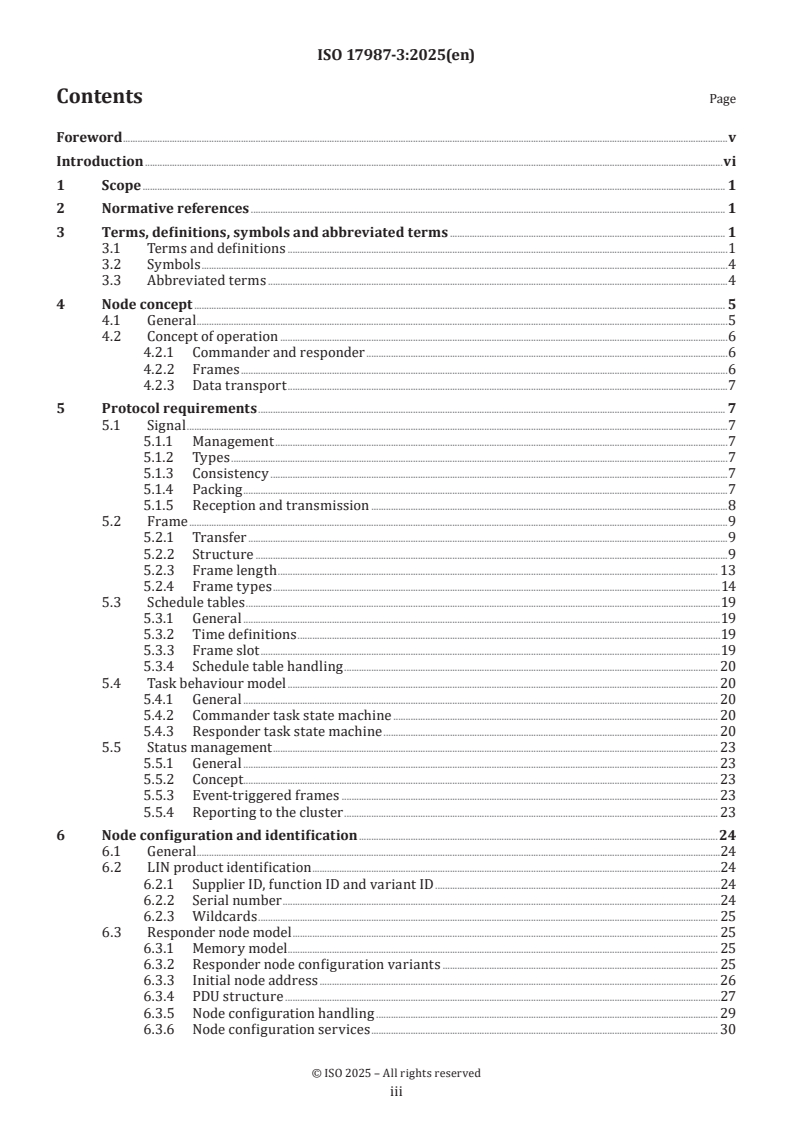
Contents Page
Foreword .v
Introduction .vi
1 Scope . 1
2 Normative references . 1
3 Terms, definitions, symbols and abbreviated terms . 1
3.1 Terms and definitions .1
3.2 Symbols .4
3.3 Abbreviated terms .4
4 Node concept . 5
4.1 General .5
4.2 Concept of operation .6
4.2.1 Commander and responder .6
4.2.2 Frames .6
4.2.3 Data transport .7
5 Protocol requirements . 7
5.1 Signal .7
5.1.1 Management .7
5.1.2 Types .7
5.1.3 Consistency .7
5.1.4 Packing .7
5.1.5 Reception and transmission .8
5.2 Frame .9
5.2.1 Transfer .9
5.2.2 Structure .9
5.2.3 Frame length . 13
5.2.4 Frame types .14
5.3 Schedule tables .19
5.3.1 General .19
5.3.2 Time definitions .19
5.3.3 Frame slot .19
5.3.4 Schedule table handling . 20
5.4 Task behaviour model . 20
5.4.1 General . 20
5.4.2 Commander task state machine . 20
5.4.3 Responder task state machine . 20
5.5 Status management . 23
5.5.1 General . 23
5.5.2 Concept . . 23
5.5.3 Event-triggered frames . 23
5.5.4 Reporting to the cluster . 23
6 Node configuration and identification .24
6.1 General .24
6.2 LIN product identification .24
6.2.1 Supplier ID, function ID and variant ID .24
6.2.2 Serial number .24
6.2.3 Wildcards . 25
6.3 Responder node model . 25
6.3.1 Memory model . 25
6.3.2 Responder node configuration variants . 25
6.3.3 Initial node address . 26
6.3.4 PDU structure .27
6.3.5 Node configuration handling . 29
6.3.6 Node configuration services . 30
iii
Annex A (normative) Definition of properties, frame identifiers and various examples .35
Annex B (informative) LIN history and version compatibility .39
Annex C (normative) LIN auto addressing procedures .43
Annex D (normative) LIN AA Procedure C .45
Annex E (normative) LIN AA Procedure D .53
Annex F (normative) LIN AA Procedure E .59
Bibliography . 74
iv
Foreword
ISO (the International Organization for Standardization) is a worldwide federation of national standards
bodies (ISO member bodies). The work of preparing International Standards is normally carried out through
ISO technical committees. Each member body interested in a subject for which a technical committee
has been established has the right to be represented on that committee. International organizations,
governmental and non-governmental, in liaison with ISO, also take part in the work. ISO collaborates closely
with the International Electrotechnical Commission (IEC) on all matters of electrotechnical standardization.
The procedures used to develop this document and those intended for its further maintenance are described
in the ISO/IEC Directives, Part 1. In particular, the different approval criteria needed for the different types
of ISO documents should be noted. This document was drafted in accordance with the editorial rules of the
ISO/IEC Directives, Part 2 (see www.iso.org/directives).
ISO draws attention to the possibility that the implementation of this document may involve the use of (a)
patent(s). ISO takes no position concerning the evidence, validity or applicability of any claimed patent
rights in respect thereof. As of the date of publication of this document, ISO had received notice of (a)
patent(s) which may be required to implement this document. However, implementers are cautioned that
this may not represent the latest information, which may be obtained from the patent database available at
www.iso.org/patents. ISO shall not be held responsible for identifying any or all such patent rights.
Any trade name used in this document is information given for the convenience of users and does not
constitute an endorsement.
For an explanation of the voluntary nature of standards, the meaning of ISO specific terms and expressions
related to conformity assessment, as well as information about ISO's adherence to the World Trade
Organization (WTO) principles in the Technical Barriers to Trade (TBT), see www.iso.org/iso/foreword.html.
This document was prepared by Technical Committee ISO/TC 22, Road vehicles, Subcommittee SC 31, Data
communication.
This second edition cancels and replaces the first edition (ISO 17987-3:2016), which has been technically
revised.
The main changes are as follows:
— master and slave terms used for the LIN node types in ISO 17987:2016 (all parts) are replaced within this
document with inclusive language terms commander and responder. This also applies for abbreviations
and file formats NCF and LDF;
— auto addressing added;
— editorial updates.
A list of all parts in the ISO 17987 series can be found on the ISO website.
Any feedback or questions on this document should be directed to the user’s national standards body. A
complete listing of these bodies can be found at www.iso.org/members.html.
v
Introduction
The LIN protocol as proposed is an automotive focused low speed UART-based network (Universal
Asynchronous Receiver Transmitter). Some of the key characteristics of the LIN protocol are signal-based
communication, schedule table-based frame transfer, commander/responder communication with error
detection, node configuration and diagnostic service communication.
The LIN protocol is for low-cost automotive control applications as, for example, door module and air
conditioning systems (see also history described in Annex B). It serves as a communication infrastructure
for low-speed control applications in vehicles by providing the following:
— signal-based communication to exchange information between applications in different nodes;
— bit rate support from 1 kbit/s to 20 kbit/s;
— deterministic schedule table-based frame communication;
— network management that wakes up and puts the LIN cluster into sleep mode in a controlled manner;
— status management that provides error handling and error signalling;
— transport layer that allows large amount of data to be transmitted (such as diagnostic services);
— specification of how to handle diagnostic services;
— electrical physical layer specifications;
— node description language describing properties of responder nodes;
— network description file describing behaviour of communication;
— application programming interface.
The ISO 17987 series is based on the open systems interconnection (OSI) basic reference model as specified
in ISO/IEC 7498-1 which structures communication systems into seven layers.
The OSI model structures data communication into seven layers called (top down) application layer (layer 7),
presentation layer, session layer, transport layer, network layer, data link layer and physical layer (layer 1). A
subset of these layers is used in the ISO 17987 series.
The ISO 17987 series distinguish between the services provided by a layer to the layer above it and the
protocol used by the layer to send a message between the peer entities of that layer. The reason for this
distinction is to make the services, especially the application layer services and the transport layer services,
reusable also for other types of networks than LIN. In this way, the protocol is hidden from the service user
and it is possible to change the protocol if special system requirements demand it.
The ISO 17987 series provides all documents and references required to support the implementation of the
requirements related to.
— ISO 17987-1: provides an overview of the ISO 17987 series and structure along with the use case
definitions and a common set of resources (definitions, references) for use by all subsequent parts.
— ISO 17987-2: specifies the requirements related to the transport protocol and the network layer
requirements to transport the PDU of a message between LIN nodes.
— ISO 17987-3 (this document): specifies the requirements for implementations of the LIN protocol on the
logical level of abstraction. Hardware related properties are hidden in the defined constraints.
— ISO 17987-4: specifies the requirements for implementations of active hardware components which are
necessary to interconnect the protocol implementation.
vi
— ISO/TR 17987-5: specifies the LIN API (Application Programming Interface) and the node configuration
and identification services. The node configuration and identification services are specified in the API
and define how a responder node is configured and how a responder node uses the identification service.
— ISO 17987-6: specifies tests to check the conformance of the LIN protocol implementation according
to ISO 17987-2 and ISO 17987-3. This comprises tests for the data link layer, the network layer and the
transport layer.
— ISO 17987-7: specifies tests to check the conformance of the LIN electrical physical layer implementation
(logical level of abstraction) according to ISO 17987-4.
vii
International Standard ISO 17987-3:2025(en)
Road vehicles — Local Interconnect Network (LIN) —
Part 3:
Protocol specification
1 Scope
This document specifies the LIN protocol including the signal management, frame transfer, schedule table
handling, task behaviour, status management, and commander and responder node. It contains also OSI
layer 5 properties according to ISO 14229-7 UDSonLIN-based node configuration and identification services
(SID: B0 to B8 ) belonging to the core protocol specification.
16 16
A node (normally a commander node) that is connected to more than one LIN network is handled by higher
layers (i.e. the application) not within the scope of this document.
2 Normative references
The following documents are referred to in the text in such a way that some or all of their content constitutes
requirements of this document. For dated references, only the edition cited applies. For undated references,
the latest edition of the referenced document (including any amendments) applies.
ISO 17987-1, Road vehicles — Local Interconnect Network (LIN) — Part 1: General information and use case
definition
ISO 17987-2:2025, Road vehicles — Local Interconnect Network (LIN) — Part 2: Transport protocol and network
layer services
ISO 17987-4:2025, Road vehicles — Local Interconnect Network (LIN) — Part 4: Electrical physical layer (EPL)
specification 12 V/24 V
3 Terms, definitions, symbols and abbreviated terms
3.1 Terms and definitions
For the purposes of this document, the terms and definitions given in ISO 17987-1 and the following apply.
ISO and IEC maintain terminology databases for use in standardization at the following addresses:
— ISO Online browsing platform: available at https:// www .iso .org/ obp
— IEC Electropedia: available at https:// www .electropedia .org/
3.1.1
big-endian
method of storage of multi-byte numbers with the most significant bytes at the lowest memory addresses
3.1.2
break field
pattern indicating the start of a LIN frame
3.1.3
broadcast NAD
addressing every responder node on LIN
3.1.4
bus interface
hardware (transceiver, UART, etc.) of a node that is connected to the physical bus wire in a cluster (3.1.8)
3.1.5
bus sleep state
state in which a node only expects an internal or external wake up
Note 1 to entry: The nodes switch output level to the recessive state.
Note 2 to entry: Adapted from ISO 17987-2:2025, 5.2.
3.1.6
classic checksum
checksum type considering data bytes (3.1.10) only
Note 1 to entry: Used for diagnostic frames (3.1.11) and frames (3.1.15) processed by nodes according to protocol
version 1.x.
3.1.7
commander request frame
CRF
diagnostic frames (3.1.11) issued by the commander node frame identifier (3.1.16)
3.1.8
cluster
communication system comprising the LIN wire and all connected nodes
3.1.9
data
response (3.1.29) part of a frame (3.1.15) carrying one to eight data bytes (3.1.10)
3.1.10
data byte
single byte in the response (3.1.29)
3.1.11
diagnostic frame
commander request frame (3.1.7) and the responder response frame (3.1.28)
3.1.12
diagnostic trouble code
DTC
value referring to a specific fault in a system implemented in the server
3.1.13
enhanced checksum
checksum model used for all non-diagnostic frames (3.1.11), except for legacy LIN slave nodes of protocol
version 1.x
3.1.14
event-triggered frame
frame type allowing multiple responder nodes to provide their response (3.1.29) to the same header (3.1.19)
3.1.15
frame
communication entity consisting of a header (3.1.19) and response (3.1.29)
3.1.16
frame identifier
unique value identifier of a frame (3.1.15)
3.1.17
frame slot
time period reserved for the transfer of a specific frame (3.1.15) on LIN
Note 1 to entry: This corresponds to one entry in the schedule table.
3.1.18
go-to-sleep command
special commander request frame (3.1.7) issued to force responder nodes to bus sleep state (3.1.5)
Note 1 to entry: Adapted from ISO 17987-2:2025, 5.4.
3.1.19
header
first part of a frame (3.1.15) consisting of the break field (3.1.2), sync byte field (3.1.31) and protected identifier
(3.1.25); always sent by the commander
3.1.20
LIN description file
file format describing a LIN network with one commander and at least one responder node
3.1.21
LIN product identification
number containing the supplier, function and variant identification in a responder node
3.1.22
little-endian
method of storage of multi-byte numbers with the least significant bytes at the lowest memory addresses
3.1.23
node capability file
NCF
file format that describes a responder node as seen from the LIN network
3.1.24
operational state
state in which the responder node may transmit/receive frames (3.1.15)
Note 1 to entry: Adapted from ISO 17987-2:2025, 5.2.
3.1.25
protected identifier
PID
8-bit value consisting of a unique 6-bit frame identifier (3.1.16) and 2-bit parity
3.1.26
publisher
node providing a frame response (3.1.29) containing signals (3.1.32)
3.1.27
request
diagnostic frame (3.1.11) transmitted by the commander node requesting data (3.1.9) from a responder node
3.1.28
responder response frame
RRF
frame (3.1.15) used for diagnostic communication sent by one of the responder nodes
3.1.29
response
answer sent by a responder node on a diagnostic request (3.1.27), or part of the LIN frame following the
header (3.1.19)
3.1.30
service
combination of a diagnostic request (3.1.27) and response (3.1.29)
3.1.31
sync byte field
byte field with fixed value of 55
3.1.32
signal
value or byte array transmitted in the cluster (3.1.8) using a signal-carrying frame (3.1.15)
3.1.33
sporadic frame
group of unconditional frames (3.1.35) assigned to a schedule slot published by the commander node
3.1.34
subscriber
commander or responder node that receives the data (3.1.9) within a LIN frame
3.1.35
unconditional frame
frame (3.1.15) carrying signals (3.1.32) that is always sent in its allocated frame slot (3.1.17)
3.2 Symbols
⊕ exclusive disjunction (exclusive or)
EXAMPLE a ⊕ b; exclusive or. True if exactly one of 'a' or 'b' is true.
¬ negation
∈ element of
EXAMPLE f ∈ S; belongs to. True if 'f' is in the set 'S'.
3.3 Abbreviated terms
AA auto addressing
API application programming interface
ASIC application specific integrated circuit
CRF commander request frame
DTC diagnostic trouble code
IDn protected identifier bit n, n = {0, 1, …, 5} (see 5.2.2.5.4)
LDF LIN description file
LIN Local Interconnect Network
LSB least significant bit
MSB most significant bit
NAD node address
NCF node capability file
NRC negative response code
NVRAM non-volatile random access memory
OSI Open Systems Interconnection
PCI protocol control information
PDU protocol data unit
PID protected identifier
Pn parity bit n, n = {0, 1} (see 5.2.2.5.4)
ROM read only memory
RRF responder response frame
RSID response service identifier
SID service identifier
TL transport layer
VRAM volatile RAM
4 Node concept
4.1 General
The LIN specifications assume a software implementation of most functions, alternative realizations are
promoted.
A node in the cluster connects to the physical bus wire via the transceiver. The frames are not accessed
directly by the application; a signal-based interaction layer is added in between. As a complement, a
transport layer (TL) interface exists between the application and the frame handler, see Figure 1.
Figure 1 — Node concept
4.2 Concept of operation
4.2.1 Commander and responder
A cluster consists of one commander node and several responder nodes. A commander node contains a
commander task as well as a responder task. All responder nodes contain a responder task only.
NOTE The responder task in the commander node and in the responder node is not identical due to differences in
PID handling.
A commander node may participate in more than one cluster with one dedicated bus interfaces for each
cluster. A sample cluster with one commander node and two responder nodes is shown in Figure 2.
Figure 2 — Commander and responder tasks
The commander task decides when and which frame shall be transferred on the bus. The responder tasks
provide the data transmitted by each frame. Both, the commander task and the responder task are parts of
the frame handler.
4.2.2 Frames
A frame consists of a header (provided by the commander task) and a response (provided by a responder task).
The header consists of a break field and sync byte field followed by a protected identifier. The protected
identifier uniquely defines the purpose of the frame and node providing the response. The responder task
of the node assigned as a response transmitter provides the response. In case of diagnostic frames, not only
the frame identifier but also the NAD assign the transmitting node.
The response consists of a data field and a checksum field. The responder tasks interested in the data
associated with the frame identifier receives the response, verifies the checksum and uses the data
transmitted.
Figure 3 shows the LIN frame header and response fields.
Figure 3 — LIN frame header and response fields
This results in the following desired features.
— System flexibility: nodes can be added to the LIN cluster without requiring hardware or software changes
in other responder nodes.
— Message routing: the content of a message is defined by the frame identifier (similar to CAN).
— Multicast: any number of nodes can simultaneously receive and act upon a single frame.
4.2.3 Data transport
The following two types of data may be transmitted in a frame.
— Signals:
Signals are scalar values or byte arrays that are packed into the data field of a frame. A signal is always
present at the same position of the data field for all frames with the same frame identifier.
— Diagnostic messages:
Diagnostic messages are transmitted in frames with two reserved frame identifiers. The interpretation
of the data field depends on the data field itself as well as the state of the communicating nodes.
5 Protocol requirements
5.1 Signal
5.1.1 Management
A signal is transmitted in the data field of a frame.
5.1.2 Types
A signal is either a scalar value or a byte array.
A scalar signal is between 1 bit and 16 bit long (see Table A.1). Scalar signals are treated as unsigned integers.
A 1-bit scalar signal is called a Boolean signal.
A byte array is an array of one up to eight bytes (see Table A.1).
Each signal shall have one publisher, i.e. it shall be always sent by the same node in the cluster. Zero, one or
multiple nodes may subscribe to the signal.
All signals shall have initial values. The initial value for a published signal should be valid until the node
writes a new value to this signal. The initial value for a subscribed signal should be valid until a new updated
value is received from another node.
5.1.3 Consistency
Scalar signal writing or reading shall be atomic operations, i.e. it shall not be possible for an application to
receive a signal value that is partly updated. This shall also apply to byte arrays. However, no consistency is
guaranteed between any signals.
5.1.4 Packing
There is no restriction on packing scalar signals over byte boundaries. Each byte in a byte array shall map to
a single frame byte starting with the lowest numbered data byte with LIN default (little-endianness) signal
mapping and the highest number in case of big-endianness, see 5.2.2.6.
Several signals may be packed into one frame as long as they do not overlap each other.
NOTE Signal packing/unpacking is implemented more efficiently in software-based nodes if signals are byte
aligned and/or if they do not cross byte boundaries.
All bits not used/defined in a frame shall be recessive (ones).
The same signal may be packed into multiple frames as long as the publisher of the signal is the same. If a
node is receiving one signal packed into multiple frames, the latest received signal value is valid. Handling
the same signal packed into frames on different LIN clusters is out of the scope.
5.1.5 Reception and transmission
The point in time when a signal is transmitted/received needs to be defined to help design tools and testing
tools to analyse timing of signals. This means that all implementations behave in a predictable way.
The definitions below do not contain factors such as bit rate tolerance, jitter, buffer copy execution time, etc.
These factors need be taken into account to get a more detailed analysis. The intention for the definitions
below is to have a basis for such analysis.
The timing is different for a commander node and a responder node. The reason is that the commander node
controls the schedule and is aware of the due frame. A responder node gets this information first when the
header is received.
The time base and time base tick is defined in 5.3.
A signal is considered received and available to the application as shown in Figure 4.
— Commander node: after the maximum frame length expires and reception is successful, the signals
received are updated at task level in the next time base tick.
— Responder node: if the checksum of the frame received is successfully validated at interrupt level, or in
polling mode in the subsequent cycle, the signals are updated directly.
Key
Y frame on bus
t time
1 time base tick
2 responder node – signal is available to the application
3 commander node – time the signal is available to the application
Figure 4 — Timing of signal reception
A signal is considered transmitted (latest point in time when the application may write to the signal).
— Commander node – before the frame transmission is initiated.
— Responder node – when the ID for the frame is received.
Figure 5 shows the timing of signal transmission.
Key
Y frame on bus
t time
1 time base tick
2 commander – latest point the application can update the signal
3 responder – latest point the application can update the signal
Figure 5 — Timing of signal transmission
5.2 Frame
5.2.1 Transfer
The entities that are transferred on the LIN network are frames.
5.2.2 Structure
5.2.2.1 Definition of fields
The frame consists of a number of fields, one break field followed by 4 – 11 byte fields, labelled as in Figure 6.
The time it takes to send a frame is the sum of the time to send each byte plus the response space and the
inter-byte spaces.
The header starts at the falling edge of the break field and ends after the end of the stop bit of the protected
identifier (PID) field. The response starts at the end of the stop bit of the PID field and ends at the after the
stop bit of the checksum field.
The inter-byte space is defined to be the time between the end of the stop bit of the preceding field and the
start bit of the following byte. The response space is defined to be the inter-byte space between the PID field
and the first data field in the data. Both shall be non-negative.
Figure 6 — Structure of a frame
5.2.2.2 Byte field
Each byte field, except the break field, is transmitted as the byte field as specified in Figure 7. The LSB of the
data is sent first and the MSB last. The start bit shall be encoded as a bit with value zero (dominant) and the
stop bit shall be encoded as a bit with value one (recessive).
Figure 7 — Structure of a byte field
5.2.2.3 Break field
The break field is used to signal the beginning of a new frame. It is the only field that does not comply with
Figure 7. A break field is always generated by the commander task (in the commander node) and it shall be at
least 13 nominal bit times of dominant value, followed by a break delimiter, as shown in Figure 8. The break
delimiter shall be at least one nominal bit time long. It should be sent with 2 bit length in order to avoid
misinterpretation at receiving responder nodes (for details see Table A.1).
NOTE A UART can only handle complete bits, so it can occur on the physical layer that the break delimiter is
shorter than one bit time.
A responder node shall use a break detection threshold of 11 dominant local responder bit times (see also
Table A.1). However, responder nodes without specific break field detection capabilities use a detection
threshold of 9,5 t on the Rx pin. A responder node shall not check that the break delimiter is at least one
BIT
nominal bit time long. A responder node shall be capable of detecting a break delimiter of at least 9/16 of a
bit in length on the Rx line.
Figure 8 — Break field
5.2.2.4 Sync byte field
A responder task shall always be able to detect the break/sync byte field sequence, even if it expects a byte
field (assuming the byte fields are separated from each other). When a break/sync byte field sequence
occurs, the transfer in progress shall be aborted and processing of the new frame shall commence.
Sync byte field is a byte field with the data value 55 , as shown in Figure 9.
Figure 9 — Sync byte field
5.2.2.5 PID field
5.2.2.5.1 General
A protected identifier field consists of two subfields:
— the frame identifier;
— the parity.
Bit 0 to bit 5 are the frame identifier and bit 6 and bit 7 are the parity.
5.2.2.5.2 Frame identifier
Six bits (ID0 to ID5) are reserved for the frame identifier and values in the range of 0 to 63 shall be used.
10 10
The frame identifiers are split into three categories:
— values 0 to 59 are used for signal carrying frames;
10 10
— values 60 (3C ) and 61 (3D ) are used to carry diagnostic and node configuration data;
10 16 10 16
— values 62 (3E ) and 63 (3F ) are reserved for future protocol enhancements.
10 16 10 16
5.2.2.5.3 Parity
The parity (P0 and P1) is calculated on the frame identifier bits as shown in Formula (1) and Formula (2):
P0 = ID0 ⊕ ID1 ⊕ ID2 ⊕ ID4 (1)
P1 = ¬(ID1 ⊕ ID3 ⊕ ID4 ⊕ ID5) (2)
Valid frame identifiers are listed in Table A.2.
5.2.2.5.4 Mapping
The mapping of the bits (ID0 to ID5 and P0 and P1) is shown in Figure 10.
Figure 10 — Mapping of frame identifier and parity to the protected identifier field
5.2.2.6 Data
A frame carries between one and eight bytes of data. The number of data contained in a frame with a specific
frame identifier shall be agreed by the publisher and all subscribers. A data byte is transmitted as part of a
byte field, see Figure 7.
The data fields are labelled Data 1, Data 2, . up to maximum Data 8, see Figure 11.
Figure 11 — Numbering of the data bytes in a frame with eight data bytes
How signals are mapped into frames is a decision that shall affect at least the whole LIN cluster.
Beside the default signal mapping used in LIN clusters since its founding, an optional signal mapping variant
is specified that allows to keep the big-endian signal encoding when routing frames from a backbone bus to
a LIN cluster.
The two possible encodings are described in the following subclauses.
5.2.2.6.1 LIN default signal mapping to data bytes
For signals longer than one byte, the LSB signal entity is contained in the byte sent first and the MSB signal
entity in the byte sent last (little-endian).
Figure 12 provides an example of the LIN default signal mapping into frame response data bytes with four
signals.
Key
1 see parameter signal_offset in ISO 17987-2:2025, 12.3.4.2
2 transmission order is starting from least significant bit in least significant data byte
Figure 12 — LIN default signal mapping into frame response data bytes
The LSB of each signal is referenced in the LDF and NCF frame definition as offset of the signal position. Key
1 values (Sig_A: 1, Sig_B: 7, Sig_C: 21 and Sig_D: 27) mark the offset for the four signals in the example.
5.2.2.6.2 Optional big-endian LIN signal mapping to data bytes variant
For signals longer than one byte, the MSB signal entity is contained in the byte sent first and the LSB signal
entity in the byte sent last (big-endian).
Data byte transmission order, as well as the bit transmission order on LIN, is not changed due to big-endian
signal encoding.
Figure 13 provides an example of the LIN big-endian signal mapping into frame response data bytes with
four signals.
Key
1 see parameter signal_offset in ISO 17987-2:2025, 12.3.4.2
2 transmission order is starting from least significant bit in least significant data byte
Figure 13 — LIN big-endian signal mapping into frame response data bytes
The most significant bit of each signal is referenced in the LDF and NCF frame definition as offset of the
signal position. Key 1 values (Sig_A: 6, Sig_B: 0, Sig_C: 18 and Sig_D: 28) mark the offset for the four signals
in the example.
LIN node configuration commands and belonging responder responses use the signals supplier_id,
function_id and Serial number (response for RDBI ID = 1 ). As those commands have a LIN specific fixed
format, they shall not be affected by this big-endian signal encoding variant.
5.2.2.7 Checksum
The last field of a frame is the checksum. The checksum contains the inverted eight bit sum with carry over
all data bytes (classic checksum) or all data bytes and the protected identifier (enhanced checksum).
Eight bit sum with carry is equivalent to the sum of all values and substract 255 every time the sum is
greater or equal to 256 . See A.3 for examples how to calculate the checksum.
Checksum calculation over the data bytes and the protected identifier byte is called enhanced checksum
and it is used for non-diagnostic communication.
The checksum is transmitted in a byte field, see Figure 7.
Use of classic or enhanced checksum is managed by the commander node and it is determined per frame
identifier.
Frame identifiers 60 (3C ) to 61 (3D ) shall always use classic checksum. Examples of checksum
10 16 10 16
calculations can be found in A.3.
5.2.3 Frame length
The nominal value for transmission of a frame exactly matches the number of bits sent (no response space
and no inter-byte spaces). The nominal break field is 14 nominal bits long (break is 13 nominal bits and
break delimiter is 1 nominal bit).
Formula (3) defines t
HEADER_MIN.
t = 34 t (3)
HEADER_MIN BIT
where t is the nominal time required to transmit a bit.
BIT
Formula (4) defines the t
RESPONSE_MIN.
t = 10 * (N + 1) * t (4)
RESPONSE_MIN Data BIT
where N is the number of response data bytes.
Data
Formula (5) defines t
FRAME_MIN.
t = t + t (5)
FRAME_MIN HEADER_MIN RESPONSE_MIN
The break field is 14 nominal bits or longer, see 5.2.2.3. This means that t puts a requirement on
HEADER_MAX
the maximum length of the break field.
The maximum space between the bytes is an additional 40 % duration compared to the nominal transmission
time. The additional duration is split between the header (the commander task) and the frame response (a
responder task).
Formula (6) defines t :
HEADER_MAX
t = 1,4 * t = 47,6 t (6)
HEADER_MAX HEADER_MIN BIT
Formula (7) defines t :
RESPONSE_MAX
t = 1,4 * t (7)
RESPONSE_MAX RESPONSE_MIN
Formula (8) defines t :
...
Questions, Comments and Discussion
Ask us and Technical Secretary will try to provide an answer. You can facilitate discussion about the standard in here.
Loading comments...