


ISO 15765-5:2023
(Main)Road vehicles — Diagnostic communication over Controller Area Network (DoCAN) — Part 5: Specification for an in-vehicle network connected to the diagnostic link connector
Road vehicles — Diagnostic communication over Controller Area Network (DoCAN) — Part 5: Specification for an in-vehicle network connected to the diagnostic link connector
This document specifies the OSI layers 4 to 1 (transport layer, network layer, data link layer and physical layer) requirements related to the connection between the external test equipment externally connected to the diagnostic link connector and the in-vehicle CAN network to successfully establish and maintain communication utilizing the communication parameters (communication profile) specified in (application-type) standards referencing this document. The SIC (signal improvement capability) transceiver options, as specified in ISO 11898-2, are out of scope in this document.
Véhicules routiers — Communication de diagnostic sur gestionnaire de réseau de communication (DoCAN) — Partie 5: spécification pour un réseau véhicule connecté sur la prise de diagnostic
General Information
- Status
- Published
- Publication Date
- 09-Nov-2023
- Technical Committee
- ISO/TC 22/SC 31 - Data communication
- Drafting Committee
- ISO/TC 22/SC 31 - Data communication
- Current Stage
- 6060 - International Standard published
- Start Date
- 10-Nov-2023
- Due Date
- 19-May-2023
- Completion Date
- 10-Nov-2023
Relations
- Effective Date
- 06-Jun-2022
Overview
ISO 15765-5:2023 - part of the ISO 15765 series for Diagnostic communication over Controller Area Network (DoCAN) - specifies the OSI layers 4 to 1 (transport, network, data link and physical) requirements for the connection between external test equipment (via the diagnostic link connector, DLC) and the in‑vehicle CAN network. The standard defines how an external tester and the vehicle CAN/CAN FD network establish, maintain and terminate diagnostic communication using communication profiles referenced by application‑type standards. Signal improvement capability (SIC) transceiver options from ISO 11898-2 are explicitly out of scope.
Key technical topics and requirements
- OSI layer mapping (TL → PHY): Detailed mapping of service primitives and interface parameters for the Transport Layer (ISO 15765-2), Network Layer, Data Link Layer (ISO 11898-1) and Physical Layer (ISO 11898-2).
- Transport layer (TL): T_Data primitive parameter mapping, message segmentation and ISO 15765-2 segment flow control rules (REQ examples: OSI4.1, OSI4.2, OSI4.3).
- Network layer (NL): Network services, timing parameters, uniqueness of diagnostic node addresses and supported addressing formats (REQ examples: OSI3.1–OSI3.7).
- Data link layer (DLL): Mapping of network addressing into 11‑bit and 29‑bit CAN identifiers, device acceptance filters and DLL service interface requirements (REQ examples: OSI2.1–OSI2.5).
- Physical layer (PHY): Classical CAN and CAN FD requirements, PCS/PMA/PMD sub‑layer constraints, bit timing and sampling methods, and PMA/connector/cable requirements (REQ examples: OSI1.1–OSI1.5).
- Compatibility and backward compatibility: Annex A describes compatibility between external test equipment and in‑vehicle networks, including backward compatibility to classical CAN.
- Document provenance: Second edition (2023), replacing ISO 15765-5:2021; main changes include clarifications on network address translation between OSI layers and editorial corrections.
Practical applications and who uses it
ISO 15765-5:2023 is essential for:
- Vehicle OEMs and system integrators who must ensure vehicle diagnostic ports comply with CAN/CAN FD diagnostic access rules.
- Diagnostic tool and external test equipment manufacturers designing hardware and firmware that connect to the DLC.
- ECU and transceiver developers implementing compliant PCS/PMA/PMD interfaces and CAN controller behavior.
- Workshop and repair environments deploying diagnostic scanners and service tools that rely on standardized communication profiles.
- Vehicle network architects and safety engineers ensuring robust diagnostic connectivity and address mapping across OSI layers.
This standard enables reliable diagnostics, emissions testing, repair workflows and aftermarket tool interoperability across modern CAN FD vehicle architectures.
Related standards
- ISO 15765-2 (Transport protocol and network layer services)
- ISO 11898 (all parts) (Controller Area Network - PCS, PMA, PMD)
- ISO 15031-3 (Diagnostic connector and electrical circuits)
- ISO 15765-4 (Requirements for emissions-related systems)
Keywords: ISO 15765-5:2023, DoCAN, diagnostic link connector, CAN FD, transport layer, network layer, data link layer, physical layer, vehicle diagnostics.
Get Certified
Connect with accredited certification bodies for this standard

TÜV Rheinland
TÜV Rheinland is a leading international provider of technical services.

TÜV SÜD
TÜV SÜD is a trusted partner of choice for safety, security and sustainability solutions.

AIAG (Automotive Industry Action Group)
American automotive industry standards and training.
Sponsored listings
Frequently Asked Questions
ISO 15765-5:2023 is a standard published by the International Organization for Standardization (ISO). Its full title is "Road vehicles — Diagnostic communication over Controller Area Network (DoCAN) — Part 5: Specification for an in-vehicle network connected to the diagnostic link connector". This standard covers: This document specifies the OSI layers 4 to 1 (transport layer, network layer, data link layer and physical layer) requirements related to the connection between the external test equipment externally connected to the diagnostic link connector and the in-vehicle CAN network to successfully establish and maintain communication utilizing the communication parameters (communication profile) specified in (application-type) standards referencing this document. The SIC (signal improvement capability) transceiver options, as specified in ISO 11898-2, are out of scope in this document.
This document specifies the OSI layers 4 to 1 (transport layer, network layer, data link layer and physical layer) requirements related to the connection between the external test equipment externally connected to the diagnostic link connector and the in-vehicle CAN network to successfully establish and maintain communication utilizing the communication parameters (communication profile) specified in (application-type) standards referencing this document. The SIC (signal improvement capability) transceiver options, as specified in ISO 11898-2, are out of scope in this document.
ISO 15765-5:2023 is classified under the following ICS (International Classification for Standards) categories: 43.040.15 - Car informatics. On board computer systems; 43.180 - Diagnostic, maintenance and test equipment. The ICS classification helps identify the subject area and facilitates finding related standards.
ISO 15765-5:2023 has the following relationships with other standards: It is inter standard links to ISO 15765-5:2021. Understanding these relationships helps ensure you are using the most current and applicable version of the standard.
ISO 15765-5:2023 is available in PDF format for immediate download after purchase. The document can be added to your cart and obtained through the secure checkout process. Digital delivery ensures instant access to the complete standard document.
Standards Content (Sample)
INTERNATIONAL ISO
STANDARD 15765-5
Second edition
2023-11
Road vehicles — Diagnostic
communication over Controller Area
Network (DoCAN) —
Part 5:
Specification for an in-vehicle network
connected to the diagnostic link
connector
Véhicules routiers — Communication de diagnostic sur gestionnaire
de réseau de communication (DoCAN) —
Partie 5: spécification pour un réseau véhicule connecté sur la prise
de diagnostic
Reference number
© ISO 2023
All rights reserved. Unless otherwise specified, or required in the context of its implementation, no part of this publication may
be reproduced or utilized otherwise in any form or by any means, electronic or mechanical, including photocopying, or posting on
the internet or an intranet, without prior written permission. Permission can be requested from either ISO at the address below
or ISO’s member body in the country of the requester.
ISO copyright office
CP 401 • Ch. de Blandonnet 8
CH-1214 Vernier, Geneva
Phone: +41 22 749 01 11
Email: copyright@iso.org
Website: www.iso.org
Published in Switzerland
ii
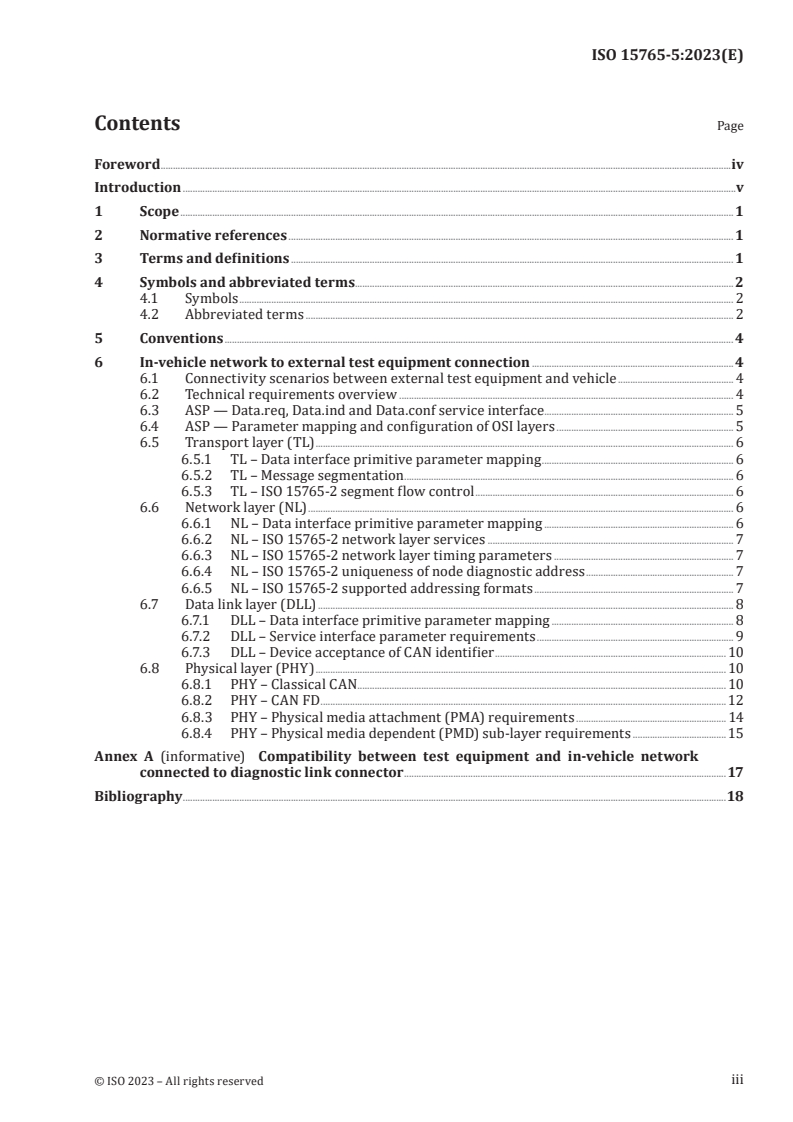
Contents Page
Foreword .iv
Introduction .v
1 Scope . 1
2 Normative references . 1
3 Terms and definitions . 1
4 Symbols and abbreviated terms.2
4.1 Symbols . 2
4.2 Abbreviated terms . 2
5 Conventions . 4
6 In-vehicle network to external test equipment connection . 4
6.1 Connectivity scenarios between external test equipment and vehicle . 4
6.2 Technical requirements overview . 4
6.3 ASP — Data.req, Data.ind and Data.conf service interface . 5
6.4 ASP — Parameter mapping and configuration of OSI layers . 5
6.5 Transport layer (TL) . 6
6.5.1 TL – Data interface primitive parameter mapping . 6
6.5.2 TL – Message segmentation . 6
6.5.3 TL – ISO 15765-2 segment flow control . 6
6.6 Network layer (NL) . 6
6.6.1 NL – Data interface primitive parameter mapping . 6
6.6.2 NL – ISO 15765-2 network layer services . 7
6.6.3 NL – ISO 15765-2 network layer timing parameters . 7
6.6.4 NL – ISO 15765-2 uniqueness of node diagnostic address . 7
6.6.5 NL – ISO 15765-2 supported addressing formats . 7
6.7 Data link layer (DLL) . 8
6.7.1 DLL – Data interface primitive parameter mapping . 8
6.7.2 DLL – Service interface parameter requirements . 9
6.7.3 DLL – Device acceptance of CAN identifier . 10
6.8 Physical layer (PHY) . 10
6.8.1 PHY – Classical CAN. 10
6.8.2 PHY – CAN FD .12
6.8.3 PHY – Physical media attachment (PMA) requirements . 14
6.8.4 PHY – Physical media dependent (PMD) sub-layer requirements .15
Annex A (informative) Compatibility between test equipment and in-vehicle network
connected to diagnostic link connector .17
Bibliography .18
iii
Foreword
ISO (the International Organization for Standardization) is a worldwide federation of national standards
bodies (ISO member bodies). The work of preparing International Standards is normally carried out
through ISO technical committees. Each member body interested in a subject for which a technical
committee has been established has the right to be represented on that committee. International
organizations, governmental and non-governmental, in liaison with ISO, also take part in the work.
ISO collaborates closely with the International Electrotechnical Commission (IEC) on all matters of
electrotechnical standardization.
The procedures used to develop this document and those intended for its further maintenance are
described in the ISO/IEC Directives, Part 1. In particular, the different approval criteria needed for the
different types of ISO document should be noted. This document was drafted in accordance with the
editorial rules of the ISO/IEC Directives, Part 2 (see www.iso.org/directives).
ISO draws attention to the possibility that the implementation of this document may involve the use
of (a) patent(s). ISO takes no position concerning the evidence, validity or applicability of any claimed
patent rights in respect thereof. As of the date of publication of this document, ISO had not received
notice of (a) patent(s) which may be required to implement this document. However, implementers are
cautioned that this may not represent the latest information, which may be obtained from the patent
database available at www.iso.org/patents. ISO shall not be held responsible for identifying any or all
such patent rights.
Any trade name used in this document is information given for the convenience of users and does not
constitute an endorsement.
For an explanation of the voluntary nature of standards, the meaning of ISO specific terms and
expressions related to conformity assessment, as well as information about ISO's adherence to
the World Trade Organization (WTO) principles in the Technical Barriers to Trade (TBT), see
www.iso.org/iso/foreword.html.
This document was prepared by Technical Committee ISO/TC 22, Road vehicles, Subcommittee SC 31,
Data communication.
This second edition cancels and replaces the first edition (ISO 15765-5:2021), which has been technically
revised.
The main changes are as follows:
— clarification on network address translation between OSI-layers;
— editorial corrections.
A list of all parts in the ISO 15765 series can be found on the ISO website.
Any feedback or questions on this document should be directed to the user’s national standards body. A
complete listing of these bodies can be found at www.iso.org/members.html.
iv
Introduction
The ISO 15765 series defines common requirements for vehicle diagnostic systems using the controller
area network (CAN), as specified in the ISO 11898 series.
The ISO 15765 series presumes the use of external test equipment for inspection, diagnostics, repair
and other possible use cases connected to the vehicle.
This document defines the requirements to enable the in-vehicle CAN network to successfully establish,
maintain and terminate communication with the devices externally connected to the diagnostic link
connector.
This document has been structured according to the open systems interconnection (OSI) basic reference
model, in accordance with ISO/IEC 7498-1 and ISO/IEC 10731, which structures communication systems
into seven layers. When mapped on this model, the OSI layer 4 to OSI layer 1 framework requirements
specified or referenced in the ISO 15765 series are structured according to Figure 1, which shows the
related documents of OSI layer 4 to OSI layer 1.
Figure 1 — CAN documents reference according to OSI model
The documents include the following content:
— transport layer (TL) -related requirements with reference to ISO 15765-2;
— network layer (NL) -related requirements with reference to ISO 15765-2;
— data link layer (DLL) -related requirements with reference to ISO 11898-1, which are composed of:
— DLL protocol entity requirements;
— DLL device interface requirements;
— DLL network system requirements;
— physical layer (PHY) -related requirements with reference to ISO 11898-2, which are composed of:
— physical coding sub-layer (PCS) requirements, which are composed of:
— PCS entity requirements;
v
— PCS interface requirements;
— PCS network system requirements;
— physical media attachment (PMA) requirements, which are composed of:
— PMA protocol entity requirements;
— PMA device interface requirements;
— physical media dependent (PMD) requirements, which are composed of:
— PMD entity requirements;
— PMD device interface requirements;
— PMD network system requirements.
The PCS is implemented in the CAN protocol controller. The PMA sub-layer is implemented normally in
the CAN transceiver or the system base chip (SBC). Optionally it can comprise also additional protection
circuitry. The media-dependent sub-layer comprises the connectors and the cabling.
Figure 2 shows an implementation example of the data link and physical layers block diagram.
Figure 2 — Implementation example of lower OSI layers block diagram
The above structure is chosen to provide the following implementers with relevant requirements:
— transceiver developers;
— device (e.g. electronic control unit) developers;
— system network developers.
All requirements are numbered and headlined uniquely, so that each implementer can reference them.
Annex A provides a description of the compatibility between test equipment and in-vehicle network
connected to the diagnostic link connector.
vi
INTERNATIONAL STANDARD ISO 15765-5:2023(E)
Road vehicles — Diagnostic communication over
Controller Area Network (DoCAN) —
Part 5:
Specification for an in-vehicle network connected to the
diagnostic link connector
1 Scope
This document specifies the OSI layers 4 to 1 (transport layer, network layer, data link layer and
physical layer) requirements related to the connection between the external test equipment externally
connected to the diagnostic link connector and the in-vehicle CAN network to successfully establish and
maintain communication utilizing the communication parameters (communication profile) specified in
(application-type) standards referencing this document.
The SIC (signal improvement capability) transceiver options, as specified in ISO 11898-2, are out of
scope in this document.
2 Normative references
The following documents are referred to in the text in such a way that some or all of their content
constitutes requirements of this document. For dated references, only the edition cited applies. For
undated references, the latest edition of the referenced document (including any amendments) applies.
ISO 11898 (all parts), Road vehicles — Controller area network (CAN)
ISO 15031-3, Road vehicles — Communication between vehicle and external equipment for emissions-
related diagnostics — Part 3: Diagnostic connector and related electrical circuits: Specification and use
ISO 15765-2, Road vehicles — Diagnostic communication over Controller Area Network (DoCAN) — Part 2:
Transport protocol and network layer services
ISO 15765-4, Road vehicles — Diagnostic communication over Controller Area Network (DoCAN) — Part 4:
Requirements for emissions-related systems
3 Terms and definitions
For the purposes of this document, the terms and definitions given in the ISO 11898 series, ISO 15765-2,
ISO 15765-4 and the following apply.
ISO and IEC maintain terminology databases for use in standardization at the following addresses:
— ISO Online browsing platform: available at https:// www .iso .org/ obp
— IEC Electropedia: available at https:// www .electropedia .org/
3.1
segment
TL_PDU which consists of the TL_PCI and TL_DATA
3.2
application-type standard
standard which specifies application-related use cases, requirements and communication profile
parameter values of the protocol stack
4 Symbols and abbreviated terms
4.1 Symbols
– empty table cell or feature undefined
Δf oscillator tolerance
f nominal arbitration bit rate
Ba
f data bit rate
Bd
l cable length between in-vehicle CAN node and diagnostic link connector
CABLE
t arbitration bit time
Ba
t data bit time
Bd
t bit time
BIT
t receive bit time
BIT_RX
t transmit bit time
BIT_TX
t nominal arbitration bit time quantum length
Qa
t nominal data bit time quantum length
Qd
t arbitration bit synchronisation jump width
SJWa
t data bit synchronisation jump width
SJWd
t time quantum
Q
t nominal arbitration bit sample point position
SPa
t nominal data bit sample point position
SPd
X table cell selected or feature defined
4.2 Abbreviated terms
AE address extension
AL application layer
ASP abstract service primitive
CAN controller area network
CAN FD controller area network flexible data-rate
CBFF classical base frame format
CEFF classical extended frame format
DCC diagnostic communication channel
DiagNormAddr diagnostic message with normal addressing
DiagNormFixAddr diagnostic message with normal fixed addressing
DiagExtAddr diagnostic message with extended addressing
DLL data link layer
DoCAN diagnostic communication over controller area network
Ftype frame type
FBFF FD base frame format
FEFF FD extended frame format
L_ data link
MSb most significant bit
Mtype message type
N_ network
NL network layer
N_PDU network protocol data unit
OSI open system interconnection
PDU protocol data unit
PCS physical coding sub-layer
PHY physical layer
PMA physical media attachment
PMD physical media dependent
Ptype packet type
RDiagMixAddr remote diagnostic message with mixed addressing
SA source address
SIC signal improvement capability
SJW synchronisation jump width
SP sample point
T_Data T_Data interface
TA target address
TAtype target address type
TL transport layer
T_PDU transport protocol data unit
5 Conventions
This document is based on OSI service conventions as specified in ISO/IEC 10731.
6 In-vehicle network to external test equipment connection
6.1 Connectivity scenarios between external test equipment and vehicle
This document specifies the requirements for the diagnostic link connector providing access to CAN FD
network. A backward compatibility to classical CAN is described in Annex A.
6.2 Technical requirements overview
Table 1 provides an overview of the technical requirements and associated requirement numbers.
Table 1 — Technical requirements overview
REQ # Technical requirement title
OSI4 Transport layer (TL)
OSI4.1 TL – ISO 15765-2 T_Data interface primitive parameter mapping
OSI4.2 TL – ISO 15765-2 TX_DL = 8
OSI4.3 TL – ISO 15765-2 TX_DL > 8
OSI3 Network layer (NL)
OSI3.1 NL – ISO 15765-2 N_Data interface primitive parameter mapping
OSI3.2 NL – ISO 15765-2 network layer services
OSI3.3 NL – ISO 15765-2 network layer timing parameters
OSI3.4 NL – ISO 15765-2 uniqueness of node diagnostic address
OSI3.5 NL – ISO 15765-2 supported addressing formats
OSI3.6 NL – ISO 15765-2 functional addressing
OSI3.7 NL – ISO 15765-2 reception of N_PDU
OSI2 Data link layer (DLL)
OSI2.1 DLL – Data interface primitive parameter mapping – Mapping of upper OSI layer service inter-
face parameters
OSI2.2 DLL – Data interface primitive parameter mapping – ISO 11898-1
OSI2.3 DLL – Mapping of N_AI into the 11-bit CAN identifier
OSI2.4 DLL – Mapping of N_AI into the 29-bit CAN identifier
OSI2.5 DLL – Device acceptance of CAN identifier
OSI1 Physical layer (PHY)
OSI1.1 PHY – PCS entity requirements – ISO 11898-1 conformance
OSI1.2 PHY – PCS interface requirements – Classical CAN bit timing parameters
OSI1.3 PHY – PCS interface requirements – CAN FD sampling method
OSI1.4 PHY – PCS interface requirements – CAN FD bit timing parameters
OSI1.5 PHY – PCS interface requirements – CAN FD transmitter delay compensation
OSI1.6 PHY – PCS interface requirements – Termination resistance
OSI1.7 PHY – PMA entity requirements – ISO 11898-2 conformance
TTabablele 1 1 ((ccoonnttiinnueuedd))
REQ # Technical requirement title
OSI1.8 PHY – PMA entity requirements – Qualification
OSI1.9 PHY – PMD entity requirements – Diagnostic link connector
OSI1.10 PHY – PMD entity requirements – DoCAN pin assignment on diagnostic link connector
OSI1.11 PHY – PMD entity requirements – Cable characteristics between vehicle network connected to
the diagnostic link connector for data bit rates > 500 kbit/s
OSI1.12 PHY – PMD network system requirements
OSI1.13 PHY – PMD network system requirements – Cable length between single CAN node and diagnos-
tic link connector
6.3 ASP — Data.req, Data.ind and Data.conf service interface
The abstract service primitive interface defines the service and parameter mapping from the application
layer (AL) to the session layer.
Figure 3 shows the Data.req (request), Data.ind (indication) and Data.conf (confirmation) abstract
service primitive interface.
Key
1 service access point
2 read back from N-layer service provider
Figure 3 — Data.req, Data.ind and Data.conf abstract service primitive interface
6.4 ASP — Parameter mapping and configuration of OSI layers
Each OSI layer contains layer-specific information to manipulate or edit the PDU depending on whether
the PDU is provided as a Data.req (sender node), Data.ind (receiver node) or Data.conf (sender node).
A PDU, which is sent by an application (service user), is assembled by each applicable OSI-layer based
on PDU identification information. A PDU, which is received by the OSI-layers (service provider), has
PDU identification information used by each applicable OSI layer to disassemble the PDU before it is
transferred to the application (service user).
A specific implementation of the abstract service primitive interface parameter management for each
OSI-layer is not specified in this document.
6.5 Transport layer (TL)
6.5.1 TL – Data interface primitive parameter mapping
This requirement specifies the A_Data to T_Data interface primitive parameter mapping.
REQ OSI4.1 TL – ISO 15765-2 T_Data interface primitive parameter mapping
The T_Data service primitive shall use the service primitive parameters as specified in Table 2.
Table 2 — T_Data service primitive parameter mapping
TL .req .ind .conf Description
T_Ptype
X X X packet type: (DiagNormAddr, DiagNormFixAddr, DiagExtAddr,
RDiagMixAddr)
T_TAtype functional, physical
X X X
T_Length
X X — length of PDU
T_Data
X X — transport layer data
T_Result
— X X result
Key
X supported
— not supported
6.5.2 TL – Message segmentation
The TL performs message segmentation into segments of 8 byte. The support of the ISO 15765-2
transport protocol is determined by the client communication interface.
REQ OSI4.2 TL – ISO 15765-2 TX_DL = 8
The TL shall support the transport protocol feature TX_DL = 8 as specified in ISO 15765-2.
The TL performs message segmentation into segments greater than 8 byte. The support of the
ISO 15765-2 transport protocol is determined by the client communication interface.
REQ OSI4.3 TL – ISO 15765-2 TX_DL > 8
The TL shall support the transport protocol feature TX_DL > 8 as specified in ISO 15765-2.
6.5.3 TL – ISO 15765-2 se
...
Questions, Comments and Discussion
Ask us and Technical Secretary will try to provide an answer. You can facilitate discussion about the standard in here.
Loading comments...