


ISO/FDIS 11133
(Main)Microbiology of the food chain, animal feed and water — Preparation, production, storage and performance testing of culture media and reagents
General Information
- Abstract
- Status
- Not Published
- Technical Committee
- ISO/TC 34/SC 9 - Microbiology
- Current Stage
- 5020 - FDIS ballot initiated: 2 months. Proof sent to secretariat
- Start Date
- 20-Aug-2026
- Completion Date
- 20-Aug-2026
Buy Documents
ISO/FDIS 11133 - Microbiology of the food chain, animal feed and water — Preparation, production, storage and performance testing of culture media and reagents
REDLINE ISO/FDIS 11133 - Microbiology of the food chain, animal feed and water — Preparation, production, storage and performance testing of culture media and reagents
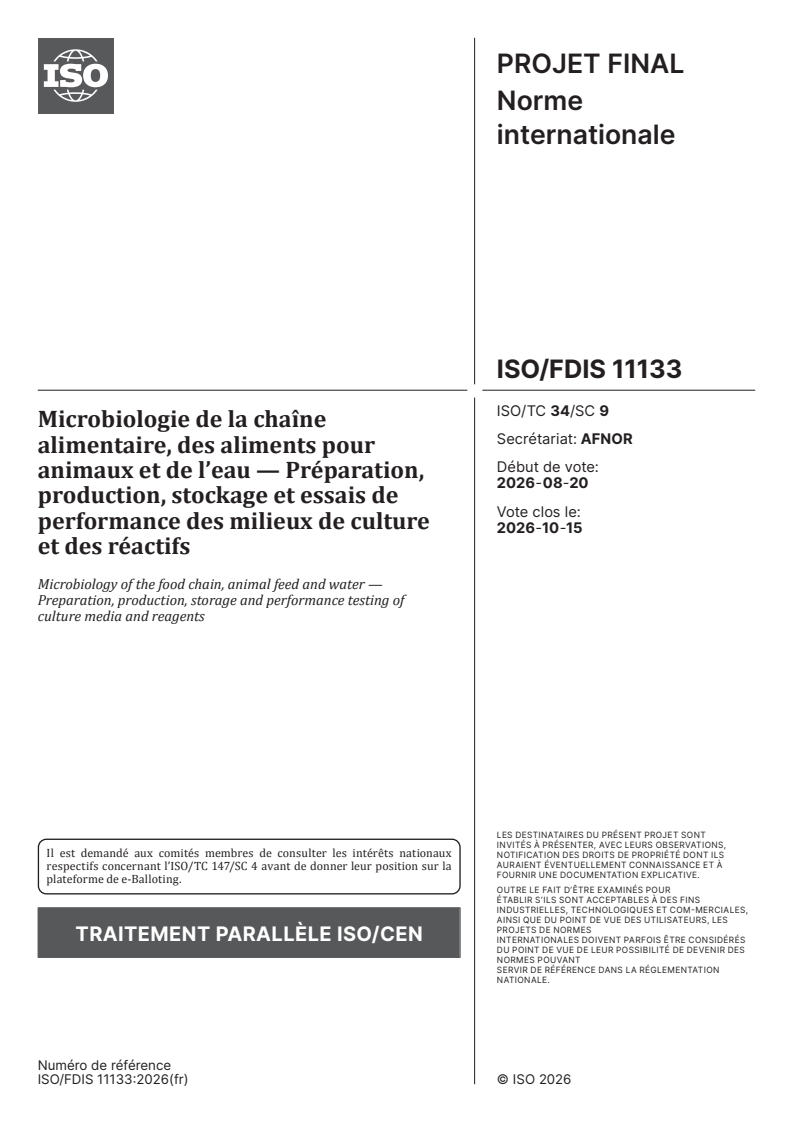
ISO/FDIS 11133 - Microbiologie de la chaîne alimentaire, des aliments pour animaux et de l’eau — Préparation, production, stockage et essais de performance des milieux de culture et des réactifs
Overview
ISO/FDIS 11133 is an international standard developed by ISO, titled Microbiology of the food chain, animal feed and water - Preparation, production, storage and performance testing of culture media and reagents. This standard provides comprehensive requirements for the preparation, production, storage, and performance testing of culture media and reagents used in microbiological analyses of samples from the food chain, animal feed, and all types of water. The document ensures that culture media and reagents are fit for their intended purpose and able to deliver consistent, reliable results in laboratory testing.
The standard is relevant to both commercial and non-commercial laboratories, including those preparing their own media, as well as users of ready-made products. It applies to all categories and formats of microbiological culture media and reagents, including proprietary and non-standardized formulations.
Key Topics
Quality Assurance
The standard covers systematic documentation, traceability, and management practices required to maintain the integrity and quality of both prepared and commercially produced culture media and reagents.Preparation and Production
Guidelines for preparing culture media and reagents from both individual components and commercial dehydrated formulations are provided, ensuring consistency and suitability for laboratory use.Storage and Shelf Life
Recommendations on proper storage conditions and shelf life determination help maintain the effectiveness and reliability of culture media and reagents over time.Performance Testing
The document outlines methods for performance testing of culture media and reagents, including physical, chemical, and microbiological quality control measures. It details how to demonstrate that culture media support growth, selective inhibition, and identification of microorganisms as required.Test Microorganisms
Criteria for selection, preservation, and maintenance of test microorganisms are provided, along with guidance on the use of reference strains for quality control and performance testing.Documentation and Traceability
Requirements for maintaining complete documentation of batch records, test results, and traceability information are included, supporting quality management and compliance.
Applications
ISO/FDIS 11133 is essential for laboratories involved in:
Food Microbiology
Ensuring reliable detection and enumeration of microorganisms in food and animal feed, supporting food safety and quality programs.Water Quality Testing
Preparation and testing of culture media used in water microbiology, critical for public health monitoring and compliance with water quality standards.Internal Quality Control
Establishing, maintaining, and improving in-house quality control systems for microbiology labs, regardless of whether media are prepared in-house or sourced externally.Regulatory Compliance
Supporting compliance with international regulations and industry requirements where validated microbiological analyses are mandatory.Manufacturer and Supplier Operations
Commercial producers of ready-to-use or dehydrated culture media rely on the standard to ensure product consistency and demonstrate batch acceptability to clients.
Related Standards
ISO/FDIS 11133 references and complements several other important ISO standards, including:
- ISO 6887 – Preparation of test samples, initial suspension, and decimal dilutions for microbiological examination.
- ISO 7218 – General requirements and guidance for microbiological examinations in the food chain.
- ISO 7704 – Requirements for the performance testing of membrane filters used for microorganism enumeration in water.
- ISO 8199 – General requirements for water quality microbiological examinations by culture.
Practical Value
Adopting ISO/FDIS 11133 enhances the reliability and comparability of microbiological results across various sectors, including food safety, animal feed production, and water testing laboratories. By adhering to this standard, organizations can assure clients and regulators of the competence and consistency of their microbiological analyses, while streamlining internal quality assurance processes and reducing the risk of inconsistent testing outcomes.
Relations
- Effective Date
- 12-Feb-2026
- Effective Date
- 20-Aug-2022
- Effective Date
- 10-Jul-2021
- Effective Date
- 18-Apr-2021
- Effective Date
- 23-Apr-2020
Buy Documents
ISO/FDIS 11133 - Microbiology of the food chain, animal feed and water — Preparation, production, storage and performance testing of culture media and reagents
REDLINE ISO/FDIS 11133 - Microbiology of the food chain, animal feed and water — Preparation, production, storage and performance testing of culture media and reagents
ISO/FDIS 11133 - Microbiologie de la chaîne alimentaire, des aliments pour animaux et de l’eau — Préparation, production, stockage et essais de performance des milieux de culture et des réactifs
Frequently Asked Questions
ISO/FDIS 11133 is a draft published by the International Organization for Standardization (ISO). Its full title is "Microbiology of the food chain, animal feed and water — Preparation, production, storage and performance testing of culture media and reagents". This standard covers: Microbiology of the food chain, animal feed and water — Preparation, production, storage and performance testing of culture media and reagents
Microbiology of the food chain, animal feed and water — Preparation, production, storage and performance testing of culture media and reagents
ISO/FDIS 11133 is classified under the following ICS (International Classification for Standards) categories: 07.100.20 - Microbiology of water; 07.100.30 - Food microbiology. The ICS classification helps identify the subject area and facilitates finding related standards.
ISO/FDIS 11133 has the following relationships with other standards: It is inter standard links to FprEN ISO 11133, ISO/IEC 23643:2020, ISO 11133:2014/Amd 1:2018, ISO 11133:2014/Amd 2:2020, ISO 11133:2014. Understanding these relationships helps ensure you are using the most current and applicable version of the standard.
ISO/FDIS 11133 is available in PDF format for immediate download after purchase. The document can be added to your cart and obtained through the secure checkout process. Digital delivery ensures instant access to the complete standard document.
Standards Content (Sample)
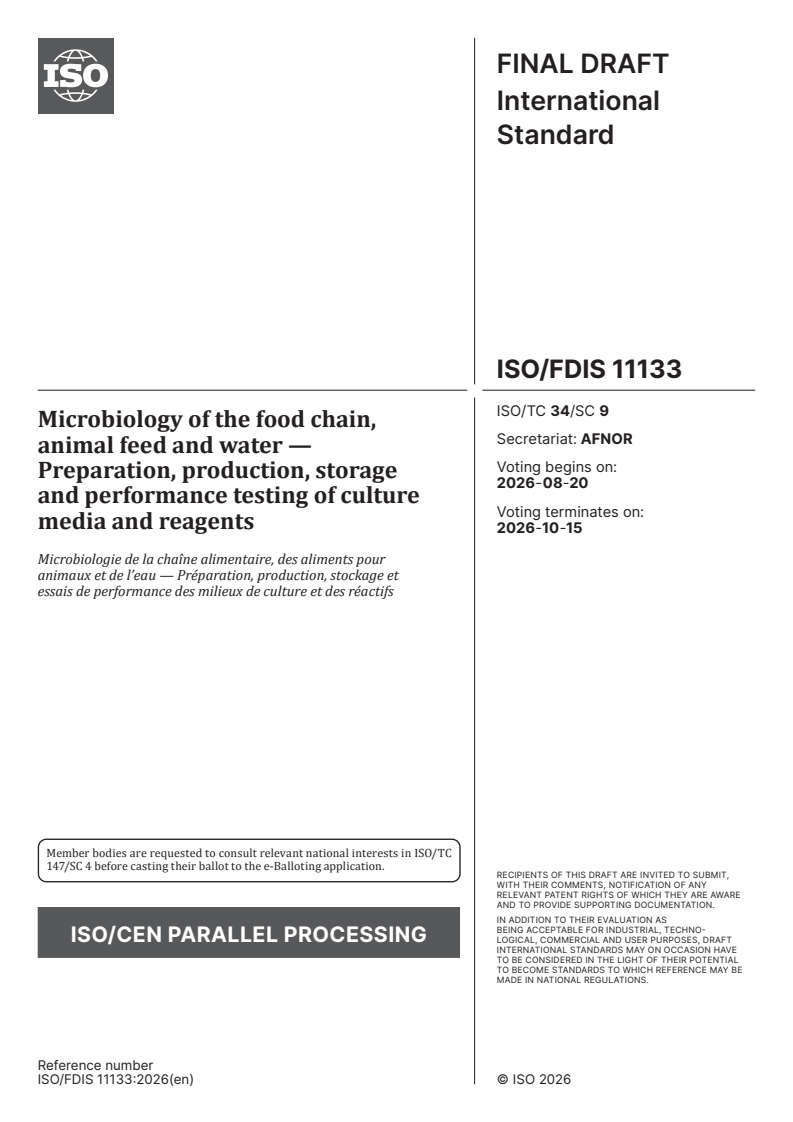
FINAL DRAFT
International
Standard
ISO/TC 34/SC 9
Microbiology of the food chain,
Secretariat: AFNOR
animal feed and water —
Voting begins on:
Preparation, production, storage
2026-08-20
and performance testing of culture
Voting terminates on:
media and reagents
2026-10-15
Microbiologie de la chaîne alimentaire, des aliments pour
animaux et de l’eau — Préparation, production, stockage et
essais de performance des milieux de culture et des réactifs
Member bodies are requested to consult relevant national interests in ISO/TC
147/SC 4 before casting their ballot to the e-Balloting application.
RECIPIENTS OF THIS DRAFT ARE INVITED TO SUBMIT,
WITH THEIR COMMENTS, NOTIFICATION OF ANY
RELEVANT PATENT RIGHTS OF WHICH THEY ARE AWARE
AND TO PROVIDE SUPPOR TING DOCUMENTATION.
IN ADDITION TO THEIR EVALUATION AS
BEING ACCEPTABLE FOR INDUSTRIAL, TECHNO
ISO/CEN PARALLEL PROCESSING LOGICAL, COMMERCIAL AND USER PURPOSES, DRAFT
INTERNATIONAL STANDARDS MAY ON OCCASION HAVE
TO BE CONSIDERED IN THE LIGHT OF THEIR POTENTIAL
TO BECOME STAN DARDS TO WHICH REFERENCE MAY BE
MADE IN NATIONAL REGULATIONS.
Reference number
FINAL DRAFT
International
Standard
ISO/TC 34/SC 9
Microbiology of the food chain,
Secretariat: AFNOR
animal feed and water —
Voting begins on:
Preparation, production, storage
and performance testing of culture
Voting terminates on:
media and reagents
Microbiologie de la chaîne alimentaire, des aliments pour
animaux et de l’eau — Préparation, production, stockage et
essais de performance des milieux de culture et des réactifs
Member bodies are requested to consult relevant national interests in ISO/TC
147/SC 4 before casting their ballot to the e-Balloting application.
RECIPIENTS OF THIS DRAFT ARE INVITED TO SUBMIT,
WITH THEIR COMMENTS, NOTIFICATION OF ANY
RELEVANT PATENT RIGHTS OF WHICH THEY ARE AWARE
AND TO PROVIDE SUPPOR TING DOCUMENTATION.
© ISO 2026
IN ADDITION TO THEIR EVALUATION AS
All rights reserved. Unless otherwise specified, or required in the context of its implementation, no part of this publication may
BEING ACCEPTABLE FOR INDUSTRIAL, TECHNO
ISO/CEN PARALLEL PROCESSING
LOGICAL, COMMERCIAL AND USER PURPOSES, DRAFT
be reproduced or utilized otherwise in any form or by any means, electronic or mechanical, including photocopying, or posting on
INTERNATIONAL STANDARDS MAY ON OCCASION HAVE
the internet or an intranet, without prior written permission. Permission can be requested from either ISO at the address below
TO BE CONSIDERED IN THE LIGHT OF THEIR POTENTIAL
or ISO’s member body in the country of the requester.
TO BECOME STAN DARDS TO WHICH REFERENCE MAY BE
MADE IN NATIONAL REGULATIONS.
ISO copyright office
CP 401 • Ch. de Blandonnet 8
CH-1214 Vernier, Geneva
Phone: +41 22 749 01 11
Email: copyright@iso.org
Website: www.iso.org
Published in Switzerland Reference number
ii
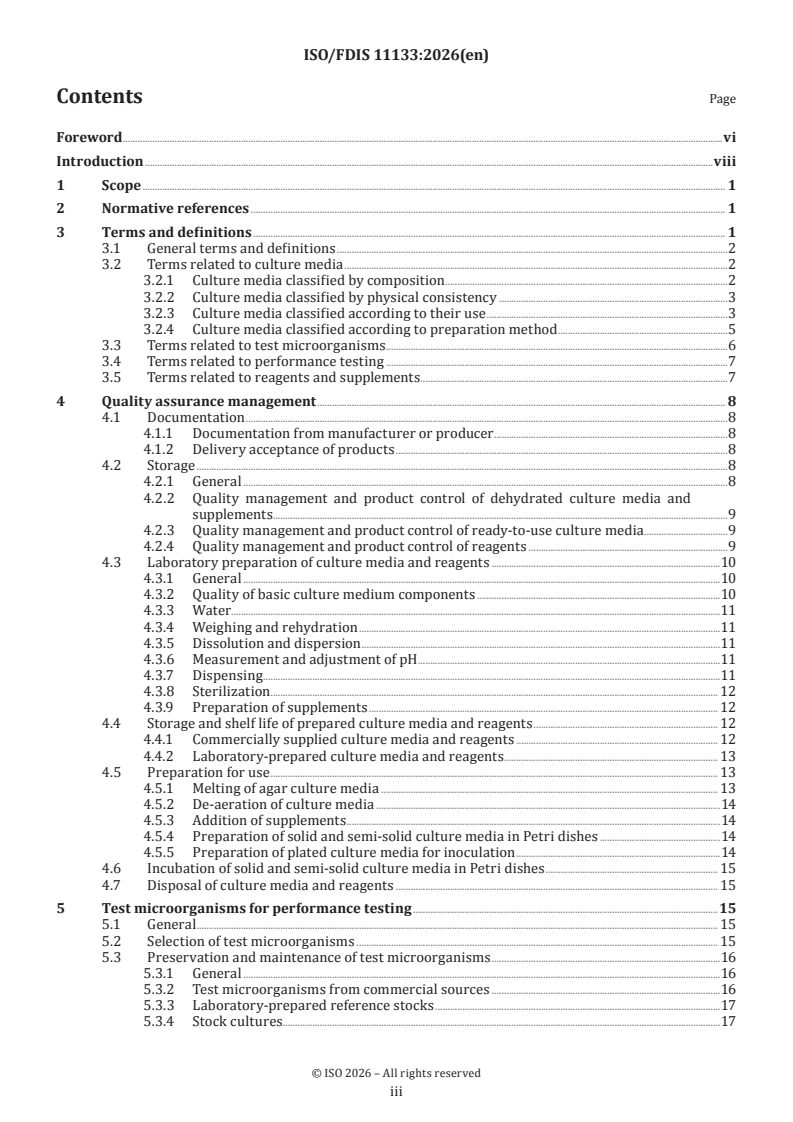
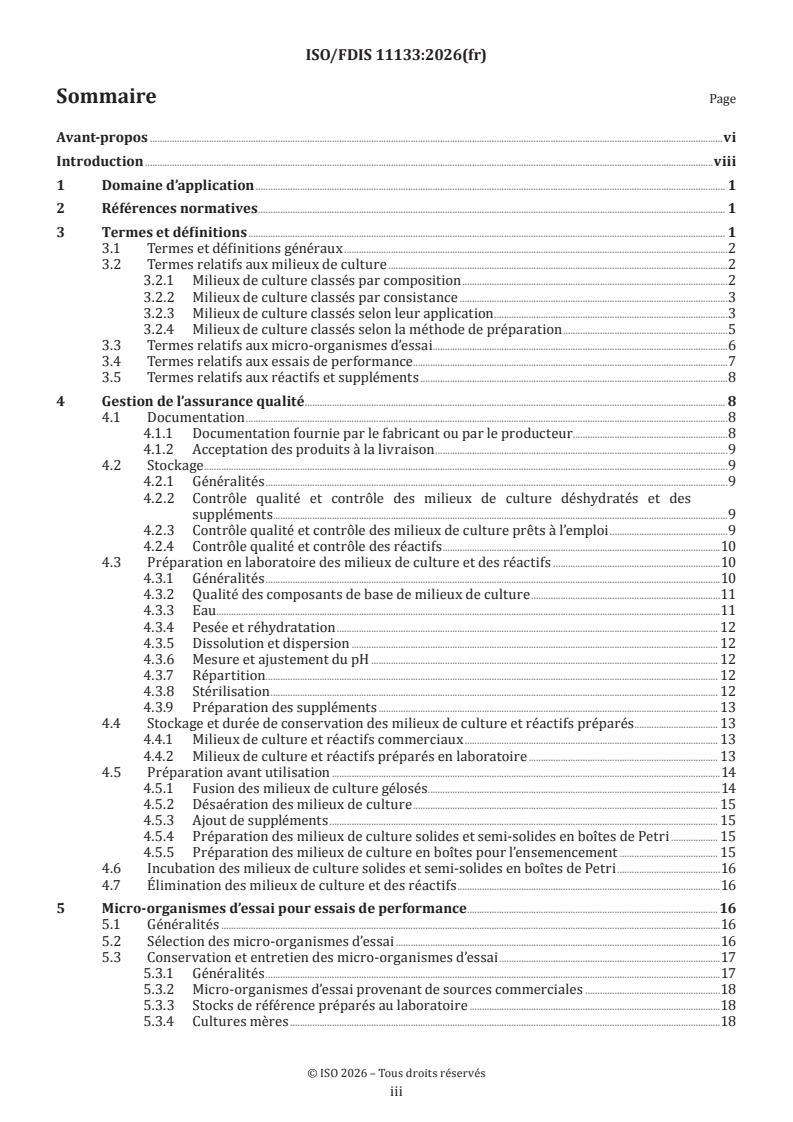
Contents Page
Foreword .vi
Introduction .viii
1 Scope . 1
2 Normative references . 1
3 Terms and definitions . 1
3.1 General terms and definitions .2
3.2 Terms related to culture media .2
3.2.1 Culture media classified by composition .2
3.2.2 Culture media classified by physical consistency .3
3.2.3 Culture media classified according to their use .3
3.2.4 Culture media classified according to preparation method .5
3.3 Terms related to test microorganisms .6
3.4 Terms related to performance testing .7
3.5 Terms related to reagents and supplements .7
4 Quality assurance management . 8
4.1 Documentation .8
4.1.1 Documentation from manufacturer or producer .8
4.1.2 Delivery acceptance of products .8
4.2 Storage .8
4.2.1 General .8
4.2.2 Quality management and product control of dehydrated culture media and
supplements.9
4.2.3 Quality management and product control of ready-to-use culture media .9
4.2.4 Quality management and product control of reagents .9
4.3 Laboratory preparation of culture media and reagents .10
4.3.1 General .10
4.3.2 Quality of basic culture medium components .10
4.3.3 Water .11
4.3.4 Weighing and rehydration .11
4.3.5 Dissolution and dispersion .11
4.3.6 Measurement and adjustment of pH .11
4.3.7 Dispensing .11
4.3.8 Sterilization . . . 12
4.3.9 Preparation of supplements . 12
4.4 Storage and shelf life of prepared culture media and reagents . 12
4.4.1 Commercially supplied culture media and reagents . 12
4.4.2 Laboratory-prepared culture media and reagents . 13
4.5 Preparation for use . 13
4.5.1 Melting of agar culture media . 13
4.5.2 De-aeration of culture media .14
4.5.3 Addition of supplements .14
4.5.4 Preparation of solid and semi-solid culture media in Petri dishes .14
4.5.5 Preparation of plated culture media for inoculation .14
4.6 Incubation of solid and semi-solid culture media in Petri dishes . 15
4.7 Disposal of culture media and reagents . 15
5 Test microorganisms for performance testing .15
5.1 General . 15
5.2 Selection of test microorganisms . 15
5.3 Preservation and maintenance of test microorganisms .16
5.3.1 General .16
5.3.2 Test microorganisms from commercial sources .16
5.3.3 Laboratory-prepared reference stocks .17
5.3.4 Stock cultures.17
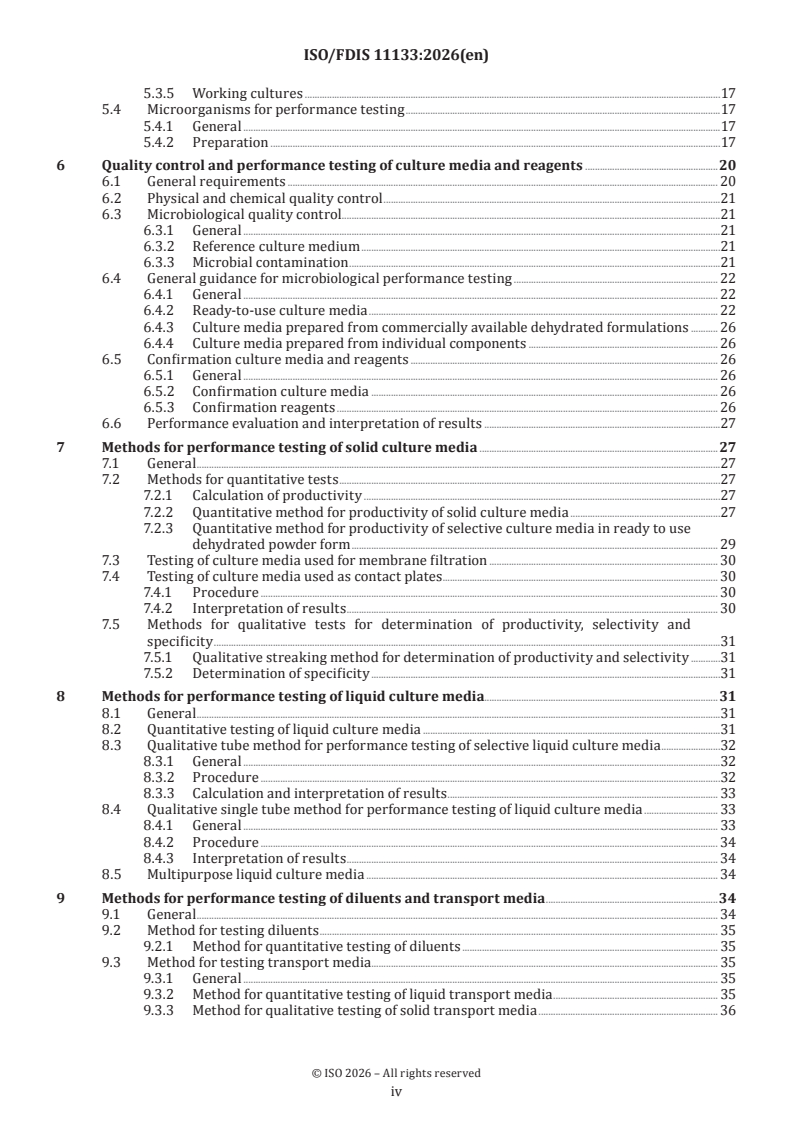
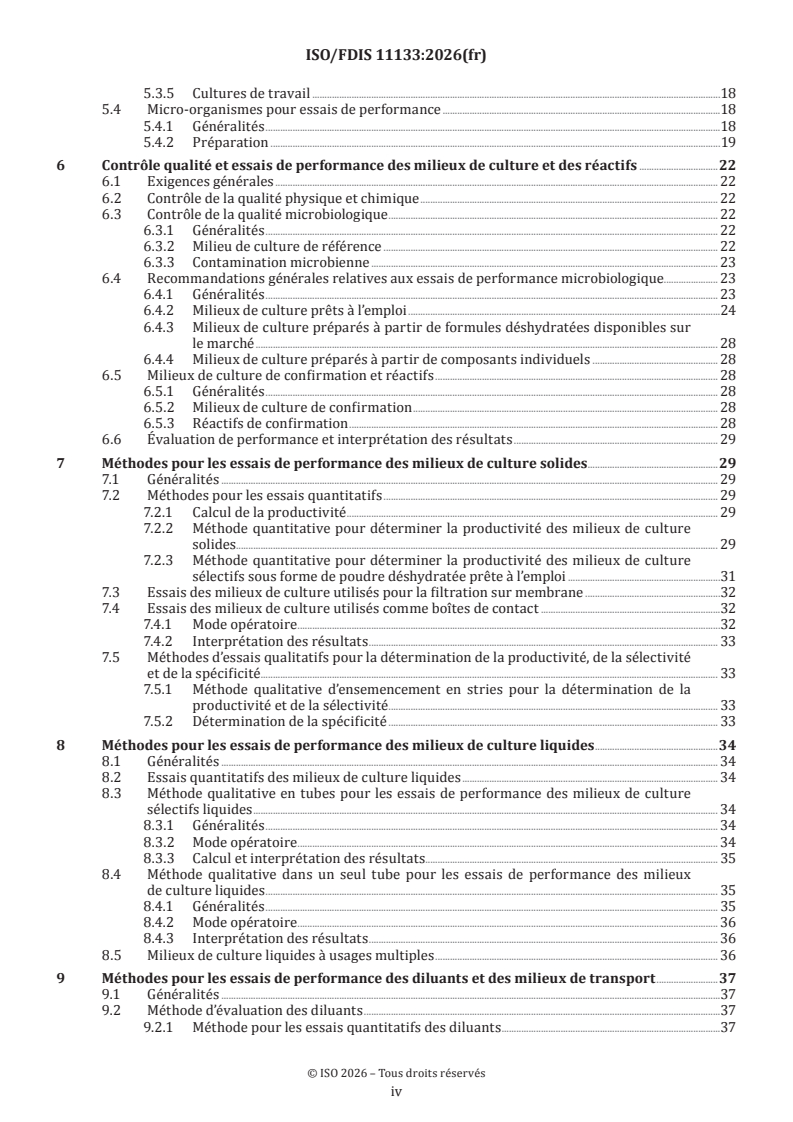
iii
5.3.5 Working cultures .17
5.4 Microorganisms for performance testing .17
5.4.1 General .17
5.4.2 Preparation .17
6 Quality control and performance testing of culture media and reagents .20
6.1 General requirements . 20
6.2 Physical and chemical quality control .21
6.3 Microbiological quality control.21
6.3.1 General .21
6.3.2 Reference culture medium .21
6.3.3 Microbial contamination .21
6.4 General guidance for microbiological performance testing . 22
6.4.1 General . 22
6.4.2 Ready-to-use culture media . 22
6.4.3 Culture media prepared from commercially available dehydrated formulations . 26
6.4.4 Culture media prepared from individual components . 26
6.5 Confirmation culture media and reagents . 26
6.5.1 General . 26
6.5.2 Confirmation culture media . 26
6.5.3 Confirmation reagents . 26
6.6 Performance evaluation and interpretation of results .27
7 Methods for performance testing of solid culture media .27
7.1 General .27
7.2 Methods for quantitative tests .27
7.2.1 Calculation of productivity .27
7.2.2 Quantitative method for productivity of solid culture media .27
7.2.3 Quantitative method for productivity of selective culture media in ready to use
dehydrated powder form . 29
7.3 Testing of culture media used for membrane filtration . 30
7.4 Testing of culture media used as contact plates . 30
7.4.1 Procedure . 30
7.4.2 Interpretation of results . 30
7.5 Methods for qualitative tests for determination of productivity, selectivity and
specificity .31
7.5.1 Qualitative streaking method for determination of productivity and selectivity .31
7.5.2 Determination of specificity .31
8 Methods for performance testing of liquid culture media.31
8.1 General .31
8.2 Quantitative testing of liquid culture media .31
8.3 Qualitative tube method for performance testing of selective liquid culture media .32
8.3.1 General .32
8.3.2 Procedure .32
8.3.3 Calculation and interpretation of results . 33
8.4 Qualitative single tube method for performance testing of liquid culture media . 33
8.4.1 General . 33
8.4.2 Procedure . 34
8.4.3 Interpretation of results . 34
8.5 Multipurpose liquid culture media . 34
9 Methods for performance testing of diluents and transport media .34
9.1 General . 34
9.2 Method for testing diluents . 35
9.2.1 Method for quantitative testing of diluents . 35
9.3 Method for testing transport media. 35
9.3.1 General . 35
9.3.2 Method for quantitative testing of liquid transport media . 35
9.3.3 Method for qualitative testing of solid transport media . 36
iv
10 Documentation of test results .36
10.1 Information provided by the manufacturer . 36
10.2 Traceability . 36
Annex A (informative) Designation of the components of culture media and reagents in
International Standards on microbiological analysis of the food chain and water .37
Annex B (informative) Preparation of reference stock and working culture .39
Annex C (informative) Flowcharts of methods for performance testing .43
Annex D (informative) Example of card for recording test results of culture media .46
Annex E (normative) Test microorganisms and performance criteria for culture media and
reagents . 47
Annex F (normative) Reference culture media .65
Annex G (informative) Use of control charts to monitor quantitative testing of solid culture
media .68
Annex H (informative) Quality assurance of culture media and reagents — Troubleshooting . 74
Annex I (informative) Quantitative testing of liquid culture media . 76
Annex J (informative) Guidance on microbiological performance tests for standardized culture
media and reagents . .80
Annex K (informative) Procedures for the preparation of standardized test suspensions
(inocula) and preservation by ultra-low freezing .84
Annex L (informative) pH measurement of culture media .98
Annex M (informative) Protocol for the evaluation of non-selective pre-enrichment culture
medium .101
Bibliography .108
v
Foreword
ISO (the International Organization for Standardization) is a worldwide federation of national standards
bodies (ISO member bodies). The work of preparing International Standards is normally carried out through
ISO technical committees. Each member body interested in a subject for which a technical committee
has been established has the right to be represented on that committee. International organizations,
governmental and non-governmental, in liaison with ISO, also take part in the work. ISO collaborates closely
with the International Electrotechnical Commission (IEC) on all matters of electrotechnical standardization.
The procedures used to develop this document and those intended for its further maintenance are described
in the ISO/IEC Directives, Part 1. In particular, the different approval criteria needed for the different types
of ISO document should be noted. This document was drafted in accordance with the editorial rules of the
ISO/IEC Directives, Part 2 (see www.iso.org/directives).
ISO draws attention to the possibility that the implementation of this document may involve the use of (a)
patent(s). ISO takes no position concerning the evidence, validity or applicability of any claimed patent
rights in respect thereof. As of the date of publication of this document, ISO had not received notice of (a)
patent(s) which may be required to implement this document. However, implementers are cautioned that
this may not represent the latest information, which may be obtained from the patent database available at
www.iso.org/patents. ISO shall not be held responsible for identifying any or all such patent rights.
Any trade name used in this document is information given for the convenience of users and does not
constitute an endorsement.
For an explanation of the voluntary nature of standards, the meaning of ISO specific terms and expressions
related to conformity assessment, as well as information about ISO’s adherence to the World Trade
Organization (WTO) principles in the Technical Barriers to Trade (TBT), see www.iso.org/iso/foreword.html.
This document was prepared by Technical Committee ISO/TC 34, Food products, Subcommittee SC 9,
Microbiology, in collaboration with Technical Committee ISO/TC 147, Water quality, Subcommittee SC 4,
Microbiological methods, and in collaboration with the European Committee for Standardization (CEN)
Technical Committee CEN/TC 463, Microbiology of the food chain, in accordance with the Agreement on
technical cooperation between ISO and CEN (Vienna Agreement).
This second edition cancels and replaces the first edition (ISO 11133:2014), which has been technically
revised. It also incorporates the Amendments ISO 11133:2014/Amd 1:2018 and ISO 11133:2014/Amd 2:2020.
The main changes are as follows:
— exclusion of those culture media (and their performance testing details) which have been now detailed
within International Standards (see Introduction);
— amalgamation of Annexes E, F and K for those media and reagents not yet detailed within specific
International Standards;
— inclusion of performance tests for liquid transport media with neutralizers for quantitative and
qualitative testing in Annex E;
— inclusion of new Annex F on reference culture media;
— Annex G is now informative, with new content;
— inclusion of new Annex K on procedures for the preparation of standardized test suspensions (inocula)
and preservation by ultra-low freezing;
— inclusion of new Annex L on pH measurement of culture media;
— inclusion of new Annex M on a protocol for the evaluation of buffered peptone water (BPW);
— inclusion of performance testing for contact plates;
— inclusion of distinguishable target microorganisms.
vi
Any feedback or questions on this document should be directed to the user’s national standards body. A
complete listing of these bodies can be found at www.iso.org/members.html.
vii
Introduction
In laboratories carrying out microbiological examinations, the main objectives are to maintain, resuscitate,
grow, detect and/or enumerate a wide variety of microorganisms. Culture media are used in all traditional
microbiological culture techniques and also for many alternative techniques. Many formulae of culture
media are commercially available and many more, designed for specific growth purposes, are described in
the literature.
Many tests and procedures depend upon culture media being capable of providing consistent and
reproducible results. The requirements for culture media can be specific to both the sample and the
microorganisms to be detected. Culture media meeting established performance criteria are therefore a
pre-requisite for any reliable microbiological work. Sufficient testing should be carried out to demonstrate:
a) the acceptability of each batch of culture medium;
b) that the culture medium is “fit for purpose”;
c) that the culture medium can produce consistent results.
These three criteria are an essential part of internal quality control procedures and, with appropriate
documentation, will permit effective monitoring of culture media and contribute to the production of
both accurate and reliable data. For reliable microbiological analysis, it is essential to use culture media
of proven quality. For all culture media described in International Standard methods, it is essential to
define the minimum acceptance criteria required to ensure their reliability. It is recommended that in the
determination of the performance characteristics of a culture medium tests are carried out that are in
accordance with this document (see Table 1).
Table 1 — Culture media and reagents type in relation to criteria and section of this document
Criteria and section of this document
Culture media and
reagents type
Productivity Selectivity Specificity
Solid non-selective culture media Quantitative 7.2.2
Solid selective culture media for
Quantitative 7.2.2 Qualitative 7.5.1 Qualitative 7.5.2
enumeration
Solid selective culture media for
Qualitative 7.5.1 Qualitative 7.5.1 Qualitative 7.5.2
isolation
Solid non-selective culture media
Qualitative 7.5.1
for isolation
Solid reference culture media Quantitative 7.2.2
Selective culture media in ready-
Quantitative 7.2.3 Qualitative 7.5.1 Qualitative 7.5.2
to-use dehydrated powder form
Liquid non-selective enrichment
Qualitative 8.4.2.1
culture media
Liquid selective enrichment cul-
Qualitative 8.3 Qualitative 8.3
ture media
Liquid selective culture media for
Qualitative 8.4.2.2 Qualitative 8.4.2.2
confirmation
Liquid selective culture media for
Quantitative Annex I Qualitative 8.3
enumeration
Diluents Quantitative 9.2
Liquid transport media Quantitative 9.3.2
Solid transport media Qualitative 9.3.3
Contact plates Quantitative 7.4
The widespread adoption of minimum performance criteria for culture media will lead to products with
more consistent quality and thus reduce the extent of testing necessary in the user’s laboratory.
viii
In addition, the acceptance criteria measured by the methods defined in this document can be used by all
microbiological laboratories to evaluate the productive and selective properties of a culture medium. This
includes culture media not described in International Standards, including proprietary culture media, or
other methods.
Since 2014, all new and revised International Standards now specify the performance testing of culture
media and reagents including the specification of test microorganisms in the International Standard itself.
When specific International Standards are revised and new International Standards developed, they will
include a paragraph for performance testing of the culture media used in the standard, and will refer to
this document for detailed methods (or detailed protocols). To ensure performance testing is to the latest
requirements, the ISO webpage enables a rapid cross-check between this document and the International
Standards published. Refer to the link: https://committee.iso.org/sites/tc34sc9/home/general-standards/
content-left-area/culture-media/iso-11133-on-culture-media.html, where the spreadsheet link shown will
be updated at least annually.
ix
FINAL DRAFT International Standard ISO/FDIS 11133:2026(en)
Microbiology of the food chain, animal feed and water —
Preparation, production, storage and performance testing of
culture media and reagents
1 Scope
This document relates to quality assurance of culture media and reagents, and specifies requirements for
the preparation, production and storage of culture media and reagents intended for the microbiological
analysis of samples from the food chain as well as all kinds of water.
This document is applicable to all categories of culture media and reagents prepared and produced for use
in laboratories performing microbiological analyses.
This document also sets criteria and describes methods for the performance testing of culture media and
reagents.
This document is applicable to end-users, commercial bodies, non-commercial bodies and laboratories
preparing their own media.
This document is applicable to all formats of culture media and reagents.
The principles covered in this document can be equally applied to the preparation, production, storage and
performance testing of culture media and reagents (used in the intended analysis as described above) that
are not captured in International Standards; this includes proprietary culture media, or other methods for
which the criteria for the performance of those culture media and reagents are described within those other
methods or in the manufacturers’ certificates.
2 Normative references
The following documents are referred to in the text in such a way that some or all of their content constitutes
requirements of this document. For dated references, only the edition cited applies. For undated references,
the latest edition of the referenced document (including any amendments) applies.
ISO 6887 (all parts), Microbiology of the food chain — Preparation of test samples, initial suspension and
decimal dilutions for microbiological examination
ISO 7218, Microbiology of the food chain — General requirements and guidance for microbiological examinations
ISO 7704, Water quality — Requirements for the performance testing of membrane filters used for direct
enumeration of microorganisms by culture methods
ISO 8199, Water quality — General requirements and guidance for microbiological examinations by culture
3 Terms and definitions
For the purposes of this document, the following terms and definitions apply.
ISO and IEC maintain terminology databases for use in standardization at the following addresses:
— ISO Online browsing platform: available at https:// www .iso .org/ obp
— IEC Electropedia: available at https:// www .electropedia .org/
3.1 General terms and definitions
3.1.1
quality control
part of quality management focused on fulfilling quality requirements
[SOURCE: ISO 9000:2026, 3.2.8]
3.1.2
culture medium
formulation of substances, in liquid, semi-solid or solid form, which contain natural and/or synthetic
constituents intended to support the multiplication (with or without inhibition of certain microorganisms),
identification or preservation of viability of microorganisms
Note 1 to entry: Some culture media also contain one or more chromogenic/fluorogenic substrates. Chromogenic
substrates facilitate the identification of microorganisms by means of defined colour and morphological
characteristics. Fluorogenic substrates require visualization using a UV lamp. The biochemical reaction products,
which are necessary for the efficiency of chromogenic/fluorogenic culture media, are normally the result of the
enzymatic activity of certain microorganisms, which in turn depends greatly on the precise maintenance of specific
conditions (e.g. temperature, pH value, concentrations of substrate).
3.1.3
batch of culture medium
lot of culture medium
homogeneous and fully traceable unit of a culture medium referring to a defined amount of bulk, semi-
finished product or end product, which is consistent in type and quality and which has been produced within
one defined production period, having been assigned the same batch (or lot) number
Note 1 to entry: This applies to the unit produced, whether from individual components or from commercial blend.
3.1.4
user laboratory preparation
culture medium prepared in-house from basic individual components or from a commercial batch
of dehydrated culture medium that requires treatment and rehydration before use, according to the
manufacturer's instructions, resulting in one of two types of media: a finished culture medium; or a semi-
finished culture medium
3.2 Terms related to culture media
3.2.1 Culture media classified by composition
3.2.1.1
culture media with defined non-proprietary formula
culture media with a known formulation that do not contain any proprietary ingredient or formulation,
and includes a description of all natural and/or synthetic constituents, concentration (including active
component from biological origin when appropriate) and preparation protocol
Note 1 to entry: Chemical substances may be defined by Chemical Abstracts Service (CAS) numbers.
Note 2 to entry: Harmonized designations for natural or chemically undefined components are specified in Annex A.
3.2.1.2
widely available ingredients
natural and/or synthetic constituents publicly available to be sourced from several countries, suppliers or
origins with non-restrictive terms of use
Note 1 to entry: Availability should be assessed, not exclusively, considering ingredient conditions associated to price,
toxicity, quality, animal welfare, export quotas or bans, ethical practices, regulatory compliance, and logistics.
3.2.2 Culture media classified by physical consistency
3.2.2.1
liquid culture medium
culture medium consisting of an aqueous solution of one or more constituents, such as buffered peptone
water
Note 1 to entry: In some cases, solid particles are added to the liquid culture medium, such as cooked meat medium.
Note 2 to entry: Liquid culture media in tubes, flasks or bottles are commonly called “broths”.
Note 3 to entry: In some cases, a liquid culture medium is created by adding a culture medium in ready-to-use powder
form to a water sample.
3.2.2.2
solid culture medium
semi-solid culture medium
liquid culture medium containing solidifying substances (e.g. agar-agar, gelatin) in different concentrations
Note 1 to entry: Due to the worldwide use of culture media solidified with agar-agar, the shortened term “agar” is
often used synonymously for solid culture media and therefore in connection with nouns, e.g. “plate count agar”.
Note 2 to entry: Solid culture media poured into Petri dishes are commonly called “plates”. Solid culture media poured
into tubes or small bottles that are kept in slanted positions while the culture media are solidifying are often called
“slants” or “slopes”. If the culture medium is dispensed to fill the bottom of the container, this forms a “butt”.
3.2.3 Culture media classified according to their use
3.2.3.1
transport medium
culture medium designed to preserve and maintain the viability of microorganisms whilst minimizing
numerical change in the time period between sample collection and laboratory processing of the sample
EXAMPLE Stuart or Amies transport medium.
3.2.3.2
diluent
suspension
culture medium designed to separate microorganisms from a solid test product into a liquid phase and/or to
reduce their concentration by dilution without multiplication or inhibition during the time of contact
EXAMPLE Peptone salt solution.
3.2.3.3
pre-enrichment culture medium
resuscitation culture medium
culture medium enabling stressed and damaged microorganisms to repair and recover their capacity for
normal growth without necessarily promoting their multiplication
EXAMPLE Buffered peptone water.
3.2.3.4
enrichment culture medium
generally liquid culture medium which, due to its composition, provides particularly favourable conditions
for multiplication of microorganisms
EXAMPLE Nutrient broth, tryptone soya broth.
3.2.3.4.1
selective enrichment culture medium
enrichment culture medium that allows the multiplication of specific microorganisms whilst partially or
totally inhibiting the growth of other microorganisms
EXAMPLE Rappaport-Vassiliadis soya peptone medium (RVS), Half Fraser broth.
3.2.3.4.2
non-selective enrichment culture medium
enrichment culture medium that allows the growth of a wide variety of microorganisms
EXAMPLE Heart infusion broth.
3.2.3.5
isolation culture medium
solid or semi-solid culture medium that allows the growth of microorganisms with the formation of distinct
colonies
EXAMPLE Yeast extract agar.
3.2.3.5.1
selective culture medium
isolation culture medium that allows growth of specific target microorganisms, while inhibiting, totally or
partially, other microorganisms
EXAMPLE 1 Modified charcoal cefoperazone deoxycholate agar (mCCD agar), modified semi-solid Rappaport-
Vassiliadis (MSRV) agar.
EXAMPLE 2 Agar Listeria according to Ottaviani and Agosti, modified lauryl sulfate tryptose broth (LST + MUG),
chromogenic coliform agar (CCA), MUG/EC medium (4-methylumbelliferyl-β-D glucuronide /EC medium).
Note 1 to entry: Some selective chromogenic/fluorogenic culture media also contain chromogenic/fluorogenic
selective compounds which inhibit, totally or partially, accompanying flora occurring in test materials and thus
support the targeted detection of microorganisms
3.2.3.5.2
non-selective culture medium
isolation culture medium that
...
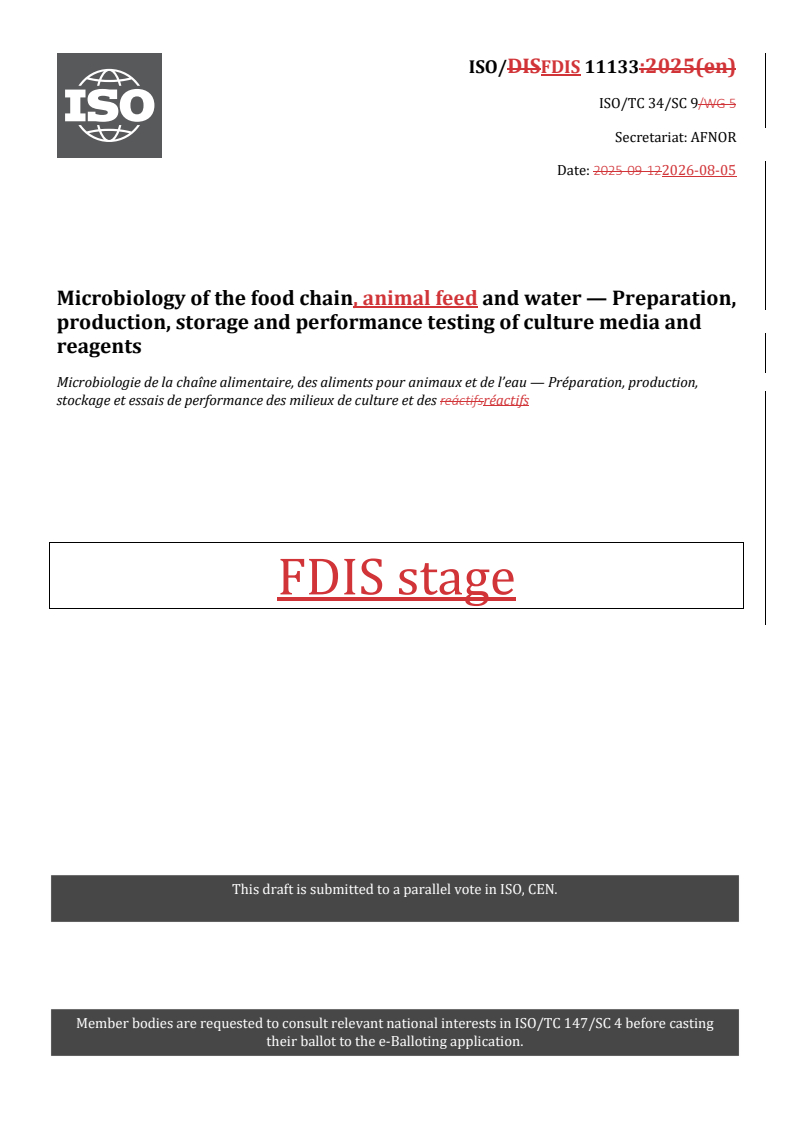
ISO/DISFDIS 11133:2025(en)
ISO/TC 34/SC 9/WG 5
Secretariat: AFNOR
Date: 2025-09-122026-08-05
Microbiology of the food chain, animal feed and water — Preparation,
production, storage and performance testing of culture media and
reagents
Microbiologie de la chaîne alimentaire, des aliments pour animaux et de l’eau — Préparation, production,
stockage et essais de performance des milieux de culture et des reáctifsréactifs
FDIS stage
TThhiiss d drraftaft i iss s suubbmmiitttteded t too a pa pararallel vallel vootte e iinn I ISSOO,, C CEENN.
MMemembberer b booddiieess ar are re reqequueesstteded t too ccoonnssuultlt r relevelevanantt n natatiioonnal al iinntterereessttss iinn I ISSOO//TTCC 1 14477//SSCC 4 4 b befefoorre ce casasttiinngg
ththeeiir br baalllloot tot to th thee e e--BBallalloottiinngg ap appplliiccatatiioonn.
All rights reserved. Unless otherwise specified, or required in the context of its implementation, no part of this publication
may be reproduced or utilized otherwise in any form or by any means, electronic or mechanical, including photocopying,
or posting on the internet or an intranet, without prior written permission. Permission can be requested from either ISO
at the address below or ISO’s member body in the country of the requester.
ISO Copyright Office copyright office
CP 401 • Ch. de Blandonnet 8
CH-1214 Vernier, Geneva
Phone: + 41 22 749 01 11
Email: E-mail: copyright@iso.org
Website: www.iso.org
Published in Switzerland.
ii
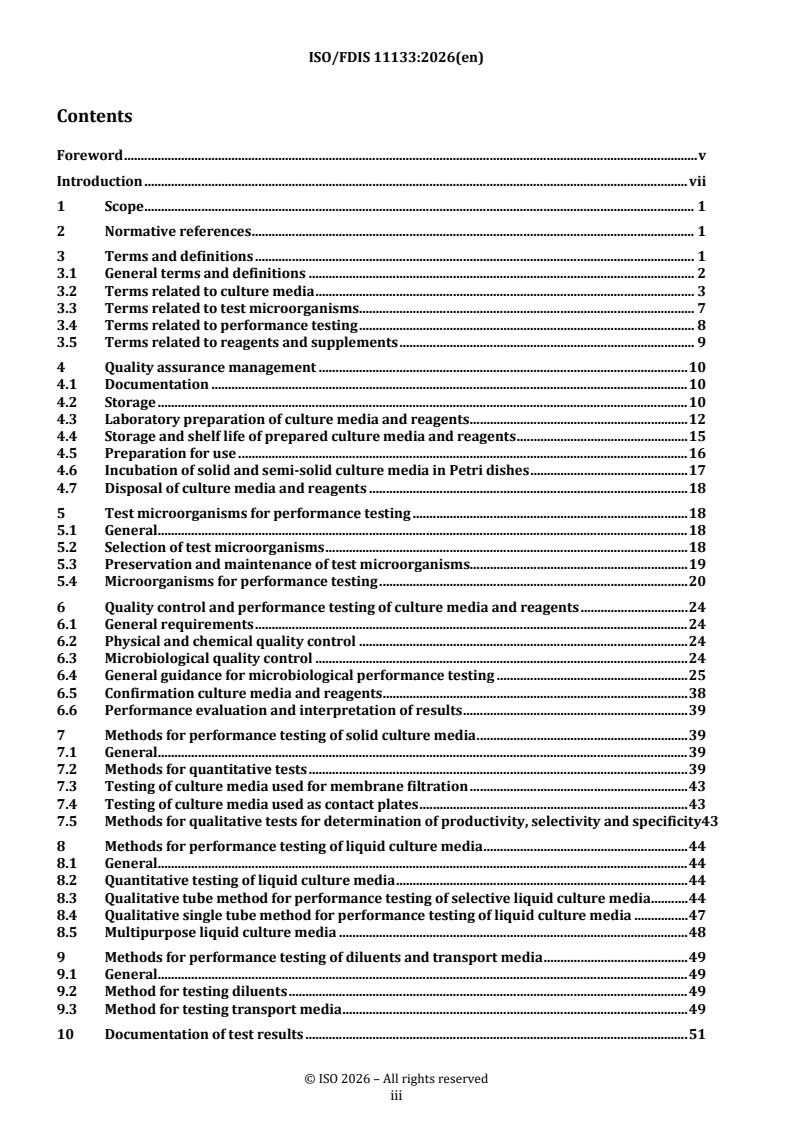
Contents
Foreword . v
Introduction . vii
1 Scope . 1
2 Normative references . 1
3 Terms and definitions . 1
3.1 General terms and definitions . 2
3.2 Terms related to culture media . 3
3.3 Terms related to test microorganisms. 7
3.4 Terms related to performance testing . 8
3.5 Terms related to reagents and supplements . 9
4 Quality assurance management . 10
4.1 Documentation . 10
4.2 Storage . 10
4.3 Laboratory preparation of culture media and reagents . 12
4.4 Storage and shelf life of prepared culture media and reagents . 15
4.5 Preparation for use . 16
4.6 Incubation of solid and semi-solid culture media in Petri dishes . 17
4.7 Disposal of culture media and reagents . 18
5 Test microorganisms for performance testing . 18
5.1 General. 18
5.2 Selection of test microorganisms . 18
5.3 Preservation and maintenance of test microorganisms. 19
5.4 Microorganisms for performance testing . 20
6 Quality control and performance testing of culture media and reagents . 24
6.1 General requirements . 24
6.2 Physical and chemical quality control . 24
6.3 Microbiological quality control . 24
6.4 General guidance for microbiological performance testing . 25
6.5 Confirmation culture media and reagents . 38
6.6 Performance evaluation and interpretation of results . 39
7 Methods for performance testing of solid culture media . 39
7.1 General. 39
7.2 Methods for quantitative tests . 39
7.3 Testing of culture media used for membrane filtration . 43
7.4 Testing of culture media used as contact plates . 43
7.5 Methods for qualitative tests for determination of productivity, selectivity and specificity43
8 Methods for performance testing of liquid culture media . 44
8.1 General. 44
8.2 Quantitative testing of liquid culture media . 44
8.3 Qualitative tube method for performance testing of selective liquid culture media . 44
8.4 Qualitative single tube method for performance testing of liquid culture media . 47
8.5 Multipurpose liquid culture media . 48
9 Methods for performance testing of diluents and transport media . 49
9.1 General. 49
9.2 Method for testing diluents . 49
9.3 Method for testing transport media . 49
10 Documentation of test results . 51
iii
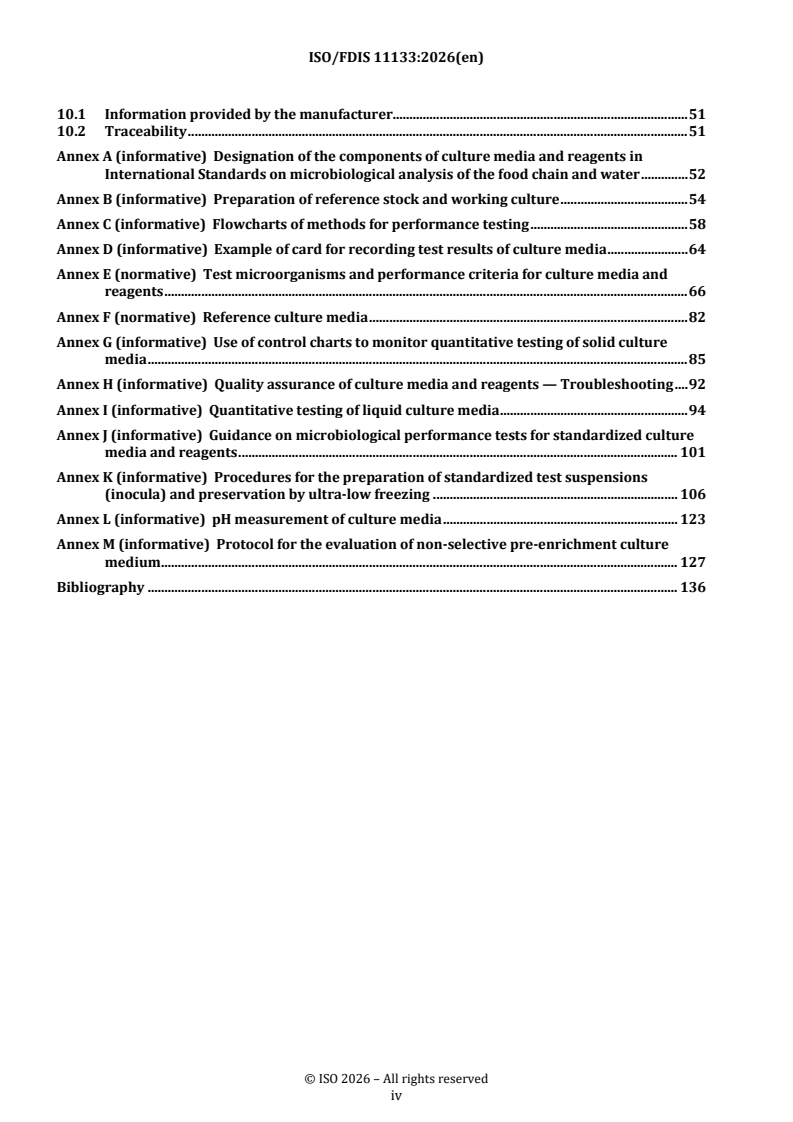
10.1 Information provided by the manufacturer. 51
10.2 Traceability . 51
Annex A (informative) Designation of the components of culture media and reagents in
International Standards on microbiological analysis of the food chain and water . 52
Annex B (informative) Preparation of reference stock and working culture . 54
Annex C (informative) Flowcharts of methods for performance testing . 58
Annex D (informative) Example of card for recording test results of culture media . 64
Annex E (normative) Test microorganisms and performance criteria for culture media and
reagents . 66
Annex F (normative) Reference culture media . 82
Annex G (informative) Use of control charts to monitor quantitative testing of solid culture
media . 85
Annex H (informative) Quality assurance of culture media and reagents — Troubleshooting . 92
Annex I (informative) Quantitative testing of liquid culture media . 94
Annex J (informative) Guidance on microbiological performance tests for standardized culture
media and reagents . 101
Annex K (informative) Procedures for the preparation of standardized test suspensions
(inocula) and preservation by ultra-low freezing . 106
Annex L (informative) pH measurement of culture media . 123
Annex M (informative) Protocol for the evaluation of non-selective pre-enrichment culture
medium . 127
Bibliography . 136
iv
Foreword
ISO (the International Organization for Standardization) is a worldwide federation of national standards
bodies (ISO member bodies). The work of preparing International Standards is normally carried out through
ISO technical committees. Each member body interested in a subject for which a technical committee has been
established has the right to be represented on that committee. International organizations, governmental and
non-governmental, in liaison with ISO, also take part in the work. ISO collaborates closely with the
International Electrotechnical Commission (IEC) on all matters of electrotechnical standardization.
The procedures used to develop this document and those intended for its further maintenance are described
in the ISO/IEC Directives, Part 1. In particular, the different approval criteria needed for the different types of
ISO document should be noted. This document was drafted in accordance with the editorial rules of the
ISO/IEC Directives, Part 2 (see www.iso.org/directives).
ISO draws attention to the possibility that the implementation of this document may involve the use of (a)
patent(s). ISO takes no position concerning the evidence, validity or applicability of any claimed patent rights
in respect thereof. As of the date of publication of this document, ISO had not received notice of (a) patent(s)
which may be required to implement this document. However, implementers are cautioned that this may not
represent the latest information, which may be obtained from the patent database available at
www.iso.org/patents. ISO shall not be held responsible for identifying any or all such patent rights.
Any trade name used in this document is information given for the convenience of users and does not
constitute an endorsement.
For an explanation of the voluntary nature of standards, the meaning of ISO specific terms and expressions
related to conformity assessment, as well as information about ISO’s adherence to the World Trade
Organization (WTO) principles in the Technical Barriers to Trade (TBT), see www.iso.org/iso/foreword.html.
This document was prepared by Technical Committee ISO/TC 34, Food products, Subcommittee SC 9,
Microbiology, in collaboration with Technical Committee ISO/TC 147, Water quality, Subcommittee SC 4,
Microbiological methods, and in collaboration with the European Committee for Standardization (CEN)
Technical Committee CEN/TC 463, Microbiology of the food chain, in accordance with the Agreement on
technical cooperation between ISO and CEN (Vienna Agreement).
This second edition cancels and replaces the first edition (ISO 11133:2014), which has been technically
revised. It also incorporates the Amendments ISO 11133:2014/Amd 1:2018 and ISO 11133:2014/Amd
2:2020.
The main changes are as follows:
— — exclusion of those culture media (and their performance testing details) which have been now detailed
within International Standards, refer to: https://committee.iso.org/sites/tc34sc9/home/general-
standards/content-left-area/culture-media/iso-11133-on-culture-media.html (see Introduction);
— — amalgamation of Annexes EAnnexes E, F, F and KK for those media and reagents not yet detailed within
specific International Standards;
— inclusion of performance tests for liquid transport media with neutralizers for quantitative and qualitative
testing in Annex EAnnex E;
— — inclusion of new Annex FAnnex F on reference culture media;
— Annex G— Annex G is now informative, with new content;
v
— — inclusion of new Annex KAnnex K on procedures for the preparation of standardized test suspensions
(inocula) and preservation by ultra-low freezing;
— — inclusion of new Annex LAnnex L on pH measurement of culture media;
— — inclusion of new Annex MAnnex M on a protocol for the evaluation of buffered peptone water (BPW);
— — inclusion of performance testing for contact plates;
— — inclusion of distinguishable target microorganisms;
— — inclusion of other amendments and improvements as determined through the technical committees.
— These changes listed above are considered as minor according to ISO17468.
Any feedback or questions on this document should be directed to the user’s national standards body. A
complete listing of these bodies can be found at www.iso.org/members.html.
vi
Introduction
In laboratories carrying out microbiological examinations, the main objectives are to maintain, resuscitate,
grow, detect and/or enumerate a wide variety of microorganisms. Culture media are used in all traditional
microbiological culture techniques and also for many alternative techniques. Many formulae of culture media
are commercially available and many more, designed for specific growth purposes, are described in the
literature.
Many tests and procedures depend upon culture media being capable of providing consistent and
reproducible results. The requirements for culture media can be specific to both the sample and the
microorganisms to be detected. Culture media meeting established performance criteria are therefore a pre-
requisite for any reliable microbiological work. Sufficient testing should be carried out to demonstrate:
a) a) the acceptability of each batch of culture medium;
b) b) that the culture medium is “fit for purpose”;
c) c) that the culture medium can produce consistent results.
These three criteria are an essential part of internal quality control procedures and, with appropriate
documentation, will permit effective monitoring of culture media and contribute to the production of both
accurate and reliable data. For reliable microbiological analysis, it is essential to use culture media of proven
quality. For all culture media described in International Standard methods, it is essential to define the
minimum acceptance criteria required to ensure their reliability. It is recommended that in the determination
of the performance characteristics of a culture medium tests are carried out that are in accordance with this
document (see Table 1.).
Table 1 — Culture media and reagents type in relation to criteria and section of this document
Criteria and section of this document
Culture media and
reagents type
Productivity Selectivity Specificity
Solid non-selective culture
Quantitative 7.2.2
media
Solid selective culture media for
Quantitative 7.2.2 Qualitative 7.5.1 Qualitative 7.5.2
enumeration
Solid selective culture media for
Qualitative 7.5.1 Qualitative 7.5.1 Qualitative 7.5.2
isolation
Solid non-selective culture
Qualitative 7.5.1
media for isolation
Solid reference culture media Quantitative 7.2.2
Selective culture media in ready-
Quantitative 7.2.3 Qualitative 7.5.1 Qualitative 7.5.2
to-use dehydrated powder form
Liquid non-selective enrichment
Qualitative 8.4.2.1
culture media
Liquid selective enrichment
Qualitative 8.3 Qualitative 8.3
culture media
Liquid selective culture media
Qualitative 8.4.2.2 Qualitative 8.4.2.2
for confirmation
Liquid selective culture media
Quantitative Annex I Qualitative 8.3
for enumeration
vii
Criteria and section of this document
Culture media and
reagents type
Productivity Selectivity Specificity
Diluents Quantitative 9.2
Liquid transport media Quantitative 9.3.2
Solid transport media Qualitative 9.3.3
Contact plates Quantitative 7.4
The widespread adoption of minimum performance criteria for culture media will lead to products with more
consistent quality and thus reduce the extent of testing necessary in the user’s laboratory.
In addition, the acceptance criteria measured by the methods defined in this document can be used by all
microbiological laboratories to evaluate the productive and selective properties of a culture medium. This
includes culture media not described in International Standards, including proprietary culture media, or other
methods.
Since 2014, all new and revised International Standards now specify the performance testing of culture media
and reagents including the specification of test microorganisms in the International Standard itself. When
specific International Standards are revised and new International Standards developed, they will include a
paragraph for performance testing of the culture media used in the standard, and will refer to this document
for detailed methods (or detailed protocols). To ensure performance testing is to the latest requirements, the
ISO webpage enables a rapid cross-check between this document and the International Standards published.
Refer to the link: https://committee.iso.org/sites/tc34sc9/home/general-standards/content-left-
area/culture-media/iso-11133-on-culture-media.html, where the spreadsheet link shown will be updated at
least annually.
viii
Microbiology of the food chain, animal feed and water — Preparation,
production, storage and performance testing of culture media and
reagents
1 Scope
This document relates to quality assurance of culture media and reagents, and specifies requirements for the
preparation, production and storage of culture media and reagents intended for the microbiological analysis
of samples from the food chain as well as all kinds of water.
This document is applicable to all categories of culture media and reagents prepared and produced for use in
laboratories performing microbiological analyses.
This document also sets criteria and describes methods for the performance testing of culture media and
reagents.
This document is applicable to end-users, commercial bodies, non-commercial bodies and laboratories
preparing their own media.
This document is applicable to all formats of culture media and reagents.
The principles covered in this document can be equally applied to the preparation, production, storage and
performance testing of culture media and reagents (used in the intended analysis as described above) that are
not captured in International Standards; this includes proprietary culture media, or other methods for which
the criteria for the performance of those culture media and reagents are described within those other methods
or in the manufacturers’ certificates.
2 Normative references
The following documents are referred to in the text in such a way that some or all of their content constitutes
requirements of this document. For dated references, only the edition cited applies. For undated references,
the latest edition of the referenced document (including any amendments) applies.
ISO 6887 (all parts), Microbiology of the food chain — Preparation of test samples, initial suspension and decimal
dilutions for microbiological examination
ISO 7218, Microbiology of the food chain — General requirements and guidance for microbiological
examinations
ISO 7704, Water quality — Requirements for the performance testing of membrane filters used for direct
enumeration of microorganisms by culture methods
ISO 8199, Water quality — General requirements and guidance for microbiological examinations by culture
3 Terms and definitions
For the purposes of this document, the following terms and definitions apply.
ISO and IEC maintain terminology databases for use in standardization at the following addresses:
— — ISO Online browsing platform: available at https://www.iso.org/obp
— — IEC Electropedia: available at https://www.electropedia.org/
—
3.1 General terms and definitions
3.1.1 3.1.1
quality control
part of quality management focused on fulfilling quality requirements
[SOURCE: ISO 9000:[18],:2026, 3.3.13].
3.1.2.8]
3.1.2
culture medium
formulation of substances, in liquid, semi-solid or solid form, which contain natural and/or synthetic
constituents intended to support the multiplication (with or without inhibition of certain microorganisms),
identification or preservation of viability of microorganisms
3.1.3Note 1 to entry: Some culture media also contain one or more chromogenic/fluorogenic substrates. Chromogenic
substrates facilitate the identification of microorganisms by means of defined colour and morphological characteristics.
Fluorogenic substrates require visualization using a UV lamp. The biochemical reaction products, which are necessary
for the efficiency of chromogenic/fluorogenic culture media, are normally the result of the enzymatic activity of certain
microorganisms, which in turn depends greatly on the precise maintenance of specific conditions (e.g. temperature, pH
value, concentrations of substrate).
3.1.3
batch of culture medium
lot of culture medium
homogeneous and fully traceable unit of a culture medium referring to a defined amount of bulk, semi- finished
product or end product, which is consistent in type and quality and which has been produced within one
defined production period, having been assigned the same batch (or lot) number
Note 1 to entry: This applies to the unit produced, whether from individual components or from commercial blend.
3.1.4 3.1.4
user laboratory preparation
culture medium prepared in-house from basic individual components or from a commercial batch of
dehydrated culture medium that requires treatment and rehydration before use, according to the
manufacturer's instructions, resulting in one of two types of media: a finished culture medium; or a semi-
finished culture medium
• a finished culture medium (3.2.4.1); or
• a semi-finished culture medium (3.2.4.3)
3.2 Terms related to culture media
3.2.1 Culture media classified by composition
3.2.1.1
3.2.1.1 Culture
culture media with defined non-proprietary formula
culture media with a known formulation that do not contain any proprietary ingredient or formulation, and
includes a description of all natural and/or synthetic constituents, concentration (including active component
from biological origin when appropriate) and preparation protocol
Note 1 to entry: Chemical substances may be defined by Chemical Abstracts Service (CAS) numbers.
Note 2 to entry: Harmonized designations for natural or chemically undefined components are specified in Annex
AAnnex A.
3.2.1.13.2.1.2
3.2.1.2
Widelywidely available ingredients
natural and/or synthetic constituents publicly available to be sourced from several countries, suppliers or
origins with non-restrictive terms of use.
Note 1 to entry: Availability should be assessed, not exclusively, considering ingredient conditions associated to price,
toxicity, quality, animal welfare, export quotas or bans, ethical practices, regulatory compliance, and logistics.
3.2.1.3
chromogenic culture medium
fluorogenic culture medium
culture medium containing one or more chromogenic/fluorogenic substrates
Note 1 to entry: Chromogenic culture media facilitate the identification of microorganisms by means of defined colour and
morphological characteristics (culture medium typical growth). Fluorogenic culture media require visualization using a UV lamp.
The biochemical reaction products, which are necessary for the efficiency of chromogenic/fluorogenic culture media, are
normally the result of the enzymatic activity of certain microorganisms, which in turn depends greatly on the precise
maintenance of specific conditions (e.g. temperature, pH value, concentrations of substrate).
EXAMPLE TBX agar, Colilert 18
3.2.2 Culture media classified by physical consistency
3.2.2.1 3.2.2.1
liquid culture medium
culture medium consisting of an aqueous solution of one or more constituents, such as buffered peptone water
Note 1 to entry: In some cases, solid particles are added to the liquid culture medium, such as cooked meat medium.
Note 2 to entry: Liquid culture media in tubes, flasks or bottles are commonly called “broths”.
Note 3 to entry: In some cases, a liquid culture medium is created by adding a culture medium in ready-to-use powder
form to a water sample.
3.2.2.2 3.2.2.2
solid culture medium
semi-solid culture medium
liquid culture medium containing solidifying substances (e.g. agar-agar, gelatin) in different concentrations
Note 1 to entry: Due to the worldwide use of culture media solidified with agar-agar, the shortened term “agar” is often
used synonymously for solid culture media and therefore in connection with nouns, e.g. “plate count agar”.
Note 2 to entry: Solid culture media poured into Petri dishes are commonly called “plates”. Solid culture media poured
into tubes or small bottles that are kept in slanted positions while the culture media are solidifying are often called
“slants” or “slopes”. If the culture medium is dispensed to fill the bottom of the container, this forms a “butt”.
3.2.3 Culture media classified according to their use
3.2.3.1 3.2.3.1
transport medium
culture medium designed to preserve and maintain the viability of microorganisms whilst minimizing
numerical change in the time period between sample collection and laboratory processing of the sample
EXAMPLE Stuart or Amies transport medium.
3.2.3.2 3.2.3.2
diluent
suspension
culture medium designed to separate microorganisms from a solid test product into a liquid phase and/or to
reduce their concentration by dilution without multiplication or inhibition during the time of contact
EXAMPLE Peptone salt solution.
3.2.3.3 3.2.3.3
pre-enrichment culture medium
resuscitation culture medium
culture medium enabling stressed and damaged microorganisms to repair and recover their capacity for
normal growth without necessarily promoting their multiplication
EXAMPLE Buffered peptone water.
3.2.3.4 3.2.3.4
enrichment culture medium
generally liquid culture medium which, due to its composition, provides particularly favourable conditions for
multiplication of microorganisms
EXAMPLE Nutrient broth, tryptone soya broth.
3.2.3.4.1 3.2.3.4.1
selective enrichment culture medium
enrichment culture medium that allows the multiplication of specific microorganisms whilst partially or
totally inhibiting the growth of other microorganisms
EXAMPLE Rappaport-Vassiliadis soya peptone medium (RVS), Half Fraser broth.
3.2.3.4.2 3.2.3.4.2
non-selective enrichment culture medium
enrichment culture medium that allows the growth of a wide variety of microorganisms
EXAMPLE Heart infusion broth.
3.2.3.5 3.2.3.5
isolation culture medium
solid or semi-solid culture medium that allows the growth of microorganisms with the formation of distinct
colonies
EXAMPLE Yeast extract agar.
3.2.3.5.1
3.2.3.5.1
selective culture medium
isolation culture medium that allows growth of specific target microorganisms, while inhibiting, totally or
partially, other microorganisms
EXAMPLE 1 Modified charcoal cefoperazone deoxycholate agar (mCCD agar), modified semi-solid Rappaport-
Vassiliadis (MSRV) agar.
3.2.3.5.2
non-selective culture medium
isolation culture medium that is not intended to selectively inhibit microorganisms
EXAMPLE Nutrient agar.
3.2.3.5.3
chromogenic selective culture medium
fluorogenic selective culture medium
chromogenic/fluorogenic culture medium that also contains selective compounds which inhibit, totally or partially,
accompanying flora occurring in test materials and thus support the targeted detection of microorganisms
EXAMPLE Agar Listeria according to Ottaviani and Agosti, modified lauryl sulfate tryptose broth (LST + MUG),
chromogenic coliform agar (CCA), MUG/EC medium (4-methylumbelliferyl-β-D glucuronide /EC medium).
3.2.3.6
Note 1 to entry: Some selective chromogenic/fluorogenic culture media also contain chromogenic/fluorogenic selective
compounds which inhibit, totally or partially, accompanying flora occurring in test materials and thus support the
targeted detection of microorganisms
3.2.3.5.2
non-selective culture medium
isolation culture medium that is not intended to selectively inhibit microorganisms
EXAMPLE Nutrient agar.
3.2.3.6
differential culture medium
culture medium that permits the testing of one or more physiological/biochemical characteristics of the
microorganisms for their identification
EXAMPLE Tryptone bile X-glucuronide (TBX) agar, Xylose lysine deoxycholate (XLD) agar, blood agar.
Note 1 to entry: Differential culture media that can be used as isolation culture media are referred to as
isolation/differential culture media, e.g. Xylose lysine deoxycholate (XLD) agar.
3.2.3.63.2.3.7 3.2.3.7
enumeration culture medium
selective or non-selective culture medium for quantitative methods
EXAMPLE Baird-Parker agar, Yeast extract agar
3.2.3.73.2.3.8 3.2.3.8
confirmation culture medium
culture medium that contributes to the identification or characterization of the microorganism following a
preliminary resuscitation and/or enrichment and/or isolation step
EXAMPLE Triple sugar iron (TSI) agar.
3.2.3.83.2.3.9
3.2.3.9
culture medium containing neutralizers
transport medium, diluent, or culture medium containing neutralizing ingredients to inactivate
detergents/disinfectants or other biocidal agents
EXAMPLE non Non-selective contact plate with added neutralizers.
3.2.3.93.2.3.10 3.2.3.10
multipurpose culture medium
culture medium assigned to several categories
EXAMPLE Blood agar is a resuscitation culture medium according to enrichment culture medium (3.2.3.43.2.3.4,), an
isolation culture medium (3.2.3.5according to 3.2.3.5) and a differential culture medium (3.2.3.6according to 3.2.3.6) used
for detection of haemolysis. Buffered peptone water is a diluent (3.2.3.2according to 3.2.3.2, a resuscitation culture medium
according to 3.2.3.3, and a ), a pre-enrichment culture medium (3.2.3.3according to 3.2.3.3) and a resuscitation culture
medium.
3.2.3.103.2.3.11 3.2.3.11
reference culture medium
culture medium (3.1.2(3.1.2),), usually non-selective, for determination of the reference count (3.3.6(3.3.6))
Note 1 to entry: The reference culture medium is usually a non-selective culture medium (3.2.3.5.2),, which is different to
the culture medium under test and has been demonstrated to be suitable for use in the performance testing.
EXAMPLE Tryptone soya agar (TSA); Sabouraud dextrose agar (SDA)
3.2.4 Culture media classified according to preparation method
3.2.4.1 3.2.4.1
finished culture medium
culture medium in a form that is ready for inoculation
3.2.4.2 3.2.4.2
ready-to-use culture medium
liquid, solid or semi-solid culture medium that is supplied in plates, bottles, tubes or other containers, in ready-
to-use form; or ready-to-use after addition of a water sample
3.2.4.2.1
3.2.4.2.1
ready-to-use culture medium after remelting
culture medium to be remelted, for instance for use in the pour-plate technique or to be poured into Petri
dishes
3.2.4.2.2 3.2.4.2.2
ready-to-use culture medium after remelting and/or supplementing
culture medium to be remelted, supplemented, or be remelted and supplemented, and dispensed before use
(incomplete ready-to-use culture medium)
EXAMPLE Tryptose sulphite cycloserine (TSC) agar, Baird-Parker or Rabbit Plasma Fibrinogen (RPF) agar,
Fraser/Half Fraser broth.
3.2.4.2.3 3.2.4.2.3
ready-to-use culture medium in dehydrated powder form
culture medium in powder form, to become a liquid growth medium after addition of a water sample
3.2.4.3
3.2.4.3
culture medium prepared from commercially dehydrated formulations
culture medium in dry form which requires rehydration and processing before use, resulting in one of two
kinds of culture media:
— — a complete culture medium;
— — an incomplete culture medium to which supplements are added before use
EXAMPLE Powders, compacted granules, lyophilized products.
3.2.4.4 3.2.4.4
culture medium prepared from individual components
culture medium produced by a microbiology laboratory entirely from its individual ingredients
3.3 Terms related to test microorganisms
3.3.1 3.3.1
test microorganism
control strain
microorganism generally used for performance testing of culture media
Note 1 to entry: Test microorganisms and control strains are chosen to produce either a known positive test result or a
known negative test result
3.3.2 3.3.2
reference strain
microorganism obtained directly from a reference culture collection and defined to at least the species level
Note 1 to entry: A reference culture collection is a culture collection which is a member of the World Federation of Culture
[84] [66]
Collections (WFCC)[84])84 or the European Culture Collections’ Organization (ECCO)66 )[66].
Note 2 to entry: A reference strain is catalogued and described according to its characteristics and preferably originating
from the food chain or water as applicable.
3.3.3 3.3.3
reference stock
set of separate identical cultures obtained by a single subculture from the reference strain either in the
laboratory or from a supplier
3.3.4 3.3.4
stock culture
primary subculture from a reference stock
3.3.5 3.3.5
working culture
subculture from a reference stock or stock culture or a reference material, certified or not
3.3.6 3.3.6
reference count
inoculum level total count of colonies on a reference culture medium (3.2.3.11(3.2.3.11))
3.3.7 3.3.7
reference material
RM
microbiological material containing a quantity of revivable microorganisms, sufficiently homogenous and
stable with respect to the quantity of revivable microorganisms, which has been established to be fit for its
intended use in a measurement process
Note 1 to entry: See ISO 33400 [48].
Note 2 to entry: For in-house prepared quality control reference materials (QRMs), often so-called “in-house reference
materials” or “internal RM”, see ISO/TR 33402[50].
3.3.8 3.3.8
certified reference material
CRM
microbiological reference material (3.3.7(3.3.7)) characterized by a metrologically valid procedure for the
quantity of revivable microorganisms
Note 1 to entry: See ISO 33400 [48].
Note 2 to entry: Metrologically valid procedures for the production and certification of RMs are given in, among others,
ISO 17034[34],, ISO 33401[49] and ISO 33405[51].
Note 3 to entry: A microbiological CRM is accompanied by a certificate that provides the value of the specified quantity
of revivable microorganisms, its associated uncertainty and a statement of metrological traceability. A CRM is certified
only for the method/methods and media that were included in the certification process, otherwise its function is like an
(ordinary) reference material.
3.3.9 3.3.9
passage
transfer of microorganism, from a viable culture to fresh culture medium, with successful growth of the
microorganism. Any form of sub-culturing is considered to be a form of passage
Note 1 to entry: Any form of sub-culturing is considered to be a transfer/passage.
3.4 Terms related to performance testing
3.4.1 3.4.1
performance
response of a culture medium or reagent after inoculation by test microorganisms under defined conditions
3.4.2 3.4.2
target microorganism
microorganism or group of microorganisms to be detected, enumerated or confirmed which can be expected
to grow under defined conditions
3.4.3 3.4.3
non-target microorganism
microorganism that is suppressed by the culture medium and/or conditions of incubation or does not show
expected characteristics of the target microorganism
3.4.4 3.4.4
productivity
measure of the recovery of a target microorganism from the culture medium under defined conditions
3.4.5 3.4.5
selectivity
degree of inhibition of a non-target microorganism on or in a selective culture medium under defined
conditions
3.4.6 3.4.6
specificity
demonstration that non-target microorganisms do not show the same visual characteristics as target
microorganisms under defined conditions
3.5 Terms related to reagents and supplements
3.5.1 3.5.1
reagent
compound or mixture added to a known culture medium to start or test a biochemical reaction
3.5.2 3.5.2
batch of reagent
lot of reagent
homogeneous and fully traceable unit of a reagent referring to a defined amount of bulk, semi- finished
product or end product, which is consistent in type and quality and which has been produced within one
defined production period, having been assigned the same batch (or lot) number
3.5.3
3.5.3
confirmation reagent
compound or mixture, when added to a known culture medium to start or test a biochemical reaction, where
the identity of the organism is already presumptively known from earlier results
3.5.4 3.5.4
supplement
ingredient which is necessary to the formula of a given culture medium, but is not included in the initial
dehydrated formulation, and is added prior to, or at the time of, final dispense or prior to use
EXAMPLE defibrinatedDefibrinated blood, antibiotics, egg yolk emulsion.
4 Quality assurance management
4.1 Documentation
4.1.1 Documentation from manufacturer or producer
The following information shall be available from the manufacturer or producer (commercial or non-
commercial bodies supplying culture media or reagent to third parties):
— — name of the culture medium or reagent, individual components and any supplements and, if possible,
their product codes;
— — technical data sheet (e.g. formulation, intended use, preparation, filling quantity if applicable,
references);
— — safety and/or hazard data where needed;
— — date of production;
— — batch number and expiry date;
— — target pH of the complete culture medium at time of manufacture or preparation;
— — storage information;
— — quality control certificate showing test microorganisms used and results of performance testing with
criteria of acceptance.
4.1.2 Delivery acceptance of products
For each batch of product (ingredient or culture medium or reagent), check the following:
— — identification of the product;
— — integrity of packaging received, transportation and in transit storage;
— — expiry date of the product;
— — documentation supplied;
— — number of units received.
Record the date of receipt.
4.2 Storage
4.2.1 General
In all cases, follow the manufacturer’s instructions.
4.2.2 Quality management and product control of dehydrated culture media and supplements
Culture media are delivered as dehydrated powders or in compacted granular form in sealed containers.
Supplements of different selective or diagnostic substances are supplied in either the lyophilized, powder or
liquid state. Plan purchases to encourage a regular turnover of stock (i.e. first in, first out). When a new
container is opened:
— — check the seal;
— — record date of first opening;
— — visually assess the contents of opened containers.
After opening a new container, the quality of the culture medium will depend on the storage environment.
Loss of quality of dehydrated culture media is shown by change in flow characteristics of the product,
homogeneity, caking, colour changes, etc. Discard any dehydrated culture medium that has absorbed moisture
or shows obvious changes in physical appearance.
When a container of dehydrated culture medium is opened, date the container and indicate a maximum
storage time.
4.2.3 Quality management and product control of ready-to-use culture media
Follow the manufacturer’s instructions.
Users of ready-to-use culture media should undertake a brief inspection of the media on receipt in their
laboratory.
Examination should include:
— — integrity of packaging;
— — broken or cracked Petri dishes/bottles/tubes;
— — quality and accuracy of labelling;
— — expiry date;
— — dehydration;
— — discolouration;
— — sloped or uneven filling of Petri dishes;
— — contamination;
— — crystalline pattern on surface of culture medium (indicative of freezing);
— — presence of bubbles;
— — presence of leakage.
4.2.
...
PROJET FINAL
Norme
internationale
ISO/TC 34/SC 9
Microbiologie de la chaîne
Secrétariat: AFNOR
alimentaire, des aliments pour
Début de vote:
animaux et de l’eau — Préparation,
2026-08-20
production, stockage et essais de
Vote clos le:
performance des milieux de culture
2026-10-15
et des réactifs
Microbiology of the food chain, animal feed and water —
Preparation, production, storage and performance testing of
culture media and reagents
LES DESTINATAIRES DU PRÉSENT PROJET SONT
INVITÉS À PRÉSENTER, AVEC LEURS OBSERVATIONS,
Il est demandé aux comités membres de consulter les intérêts nationaux NOTIFICATION DES DROITS DE PROPRIÉTÉ DONT ILS
AURAIENT ÉVENTUELLEMENT CONNAISSANCE ET À
respectifs concernant l’ISO/TC 147/SC 4 avant de donner leur position sur la
FOURNIR UNE DOCUMENTATION EXPLICATIVE.
plateforme de e-Balloting.
OUTRE LE FAIT D’ÊTRE EXAMINÉS POUR
ÉTABLIR S’ILS SONT ACCEPTABLES À DES FINS
INDUSTRIELLES, TECHNOLOGIQUES ET COM-MERCIALES,
AINSI QUE DU POINT DE VUE DES UTILISATEURS, LES
PROJETS DE NORMES
TRAITEMENT PARALLÈLE ISO/CEN
INTERNATIONALES DOIVENT PARFOIS ÊTRE CONSIDÉRÉS
DU POINT DE VUE DE LEUR POSSI BILITÉ DE DEVENIR DES
NORMES POUVANT
SERVIR DE RÉFÉRENCE DANS LA RÉGLEMENTATION
NATIONALE.
Numéro de référence
PROJET FINAL
Norme
internationale
ISO/TC 34/SC 9
Microbiologie de la chaîne
Secrétariat: AFNOR
alimentaire, des aliments pour
Début de vote:
animaux et de l’eau — Préparation,
2026-08-20
production, stockage et essais de
Vote clos le:
performance des milieux de culture
2026-10-15
et des réactifs
Microbiology of the food chain, animal feed and water —
Preparation, production, storage and performance testing of
culture media and reagents
LES DESTINATAIRES DU PRÉSENT PROJET SONT
INVITÉS À PRÉSENTER, AVEC LEURS OBSERVATIONS,
Il est demandé aux comités membres de consulter les intérêts nationaux
NOTIFICATION DES DROITS DE PROPRIÉTÉ DONT ILS
AURAIENT ÉVENTUELLEMENT CONNAISSANCE ET À
respectifs concernant l’ISO/TC 147/SC 4 avant de donner leur position sur la
FOURNIR UNE DOCUMENTATION EXPLICATIVE.
plateforme de e-Balloting.
DOCUMENT PROTÉGÉ PAR COPYRIGHT
OUTRE LE FAIT D’ÊTRE EXAMINÉS POUR
ÉTABLIR S’ILS SONT ACCEPTABLES À DES FINS
© ISO 2026 INDUSTRIELLES, TECHNOLOGIQUES ET COM-MERCIALES,
AINSI QUE DU POINT DE VUE DES UTILISATEURS, LES
Tous droits réservés. Sauf prescription différente ou nécessité dans le contexte de sa mise en œuvre, aucune partie de cette
PROJETS DE NORMES
TRAITEMENT PARALLÈLE ISO/CEN
INTERNATIONALES DOIVENT PARFOIS ÊTRE CONSIDÉRÉS
publication ne peut être reproduite ni utilisée sous quelque forme que ce soit et par aucun procédé, électronique ou mécanique,
DU POINT DE VUE DE LEUR POSSI BILITÉ DE DEVENIR DES
y compris la photocopie, ou la diffusion sur l’internet ou sur un intranet, sans autorisation écrite préalable. Une autorisation peut
NORMES POUVANT
être demandée à l’ISO à l’adresse ci-après ou au comité membre de l’ISO dans le pays du demandeur.
SERVIR DE RÉFÉRENCE DANS LA RÉGLEMENTATION
NATIONALE.
ISO copyright office
Case postale 401 • Ch. de Blandonnet 8
CH-1214 Vernier, Genève
Tél.: +41 22 749 01 11
E-mail: copyright@iso.org
Web: www.iso.org
Publié en Suisse Numéro de référence
ii
Sommaire Page
Avant-propos .vi
Introduction .viii
1 Domaine d’application . 1
2 Références normatives . 1
3 Termes et définitions . 1
3.1 Termes et définitions généraux .2
3.2 Termes relatifs aux milieux de culture .2
3.2.1 Milieux de culture classés par composition .2
3.2.2 Milieux de culture classés par consistance .3
3.2.3 Milieux de culture classés selon leur application .3
3.2.4 Milieux de culture classés selon la méthode de préparation .5
3.3 Termes relatifs aux micro-organismes d’essai .6
3.4 Termes relatifs aux essais de performance .7
3.5 Termes relatifs aux réactifs et suppléments .8
4 Gestion de l’assurance qualité . 8
4.1 Documentation .8
4.1.1 Documentation fournie par le fabricant ou par le producteur .8
4.1.2 Acceptation des produits à la livraison .9
4.2 Stockage .9
4.2.1 Généralités .9
4.2.2 Contrôle qualité et contrôle des milieux de culture déshydratés et des
suppléments.9
4.2.3 Contrôle qualité et contrôle des milieux de culture prêts à l’emploi .9
4.2.4 Contrôle qualité et contrôle des réactifs .10
4.3 Préparation en laboratoire des milieux de culture et des réactifs .10
4.3.1 Généralités .10
4.3.2 Qualité des composants de base de milieux de culture .11
4.3.3 Eau . .11
4.3.4 Pesée et réhydratation . 12
4.3.5 Dissolution et dispersion . 12
4.3.6 Mesure et ajustement du pH . 12
4.3.7 Répartition. 12
4.3.8 Stérilisation . 12
4.3.9 Préparation des suppléments . 13
4.4 Stockage et durée de conservation des milieux de culture et réactifs préparés . 13
4.4.1 Milieux de culture et réactifs commerciaux . 13
4.4.2 Milieux de culture et réactifs préparés en laboratoire . 13
4.5 Préparation avant utilisation .14
4.5.1 Fusion des milieux de culture gélosés .14
4.5.2 Désaération des milieux de culture . 15
4.5.3 Ajout de suppléments . 15
4.5.4 Préparation des milieux de culture solides et semi-solides en boîtes de Petri . 15
4.5.5 Préparation des milieux de culture en boîtes pour l’ensemencement . 15
4.6 Incubation des milieux de culture solides et semi-solides en boîtes de Petri .16
4.7 Élimination des milieux de culture et des réactifs .16
5 Micro-organismes d’essai pour essais de performance .16
5.1 Généralités .16
5.2 Sélection des micro-organismes d’essai .16
5.3 Conservation et entretien des micro-organismes d’essai .17
5.3.1 Généralités .17
5.3.2 Micro-organismes d’essai provenant de sources commerciales .18
5.3.3 Stocks de référence préparés au laboratoire .18
5.3.4 Cultures mères .18
iii
5.3.5 Cultures de travail .18
5.4 Micro-organismes pour essais de performance .18
5.4.1 Généralités .18
5.4.2 Préparation .19
6 Contrôle qualité et essais de performance des milieux de culture et des réactifs .22
6.1 Exigences générales . 22
6.2 Contrôle de la qualité physique et chimique . 22
6.3 Contrôle de la qualité microbiologique . 22
6.3.1 Généralités . 22
6.3.2 Milieu de culture de référence . 22
6.3.3 Contamination microbienne . 23
6.4 Recommandations générales relatives aux essais de performance microbiologique. 23
6.4.1 Généralités . 23
6.4.2 Milieux de culture prêts à l’emploi .24
6.4.3 Milieux de culture préparés à partir de formules déshydratées disponibles sur
le marché . 28
6.4.4 Milieux de culture préparés à partir de composants individuels . 28
6.5 Milieux de culture de confirmation et réactifs . 28
6.5.1 Généralités . 28
6.5.2 Milieux de culture de confirmation . 28
6.5.3 Réactifs de confirmation . 28
6.6 Évaluation de performance et interprétation des résultats . 29
7 Méthodes pour les essais de performance des milieux de culture solides .29
7.1 Généralités . 29
7.2 Méthodes pour les essais quantitatifs . 29
7.2.1 Calcul de la productivité . 29
7.2.2 Méthode quantitative pour déterminer la productivité des milieux de culture
solides. 29
7.2.3 Méthode quantitative pour déterminer la productivité des milieux de culture
sélectifs sous forme de poudre déshydratée prête à l’emploi .31
7.3 Essais des milieux de culture utilisés pour la filtration sur membrane .32
7.4 Essais des milieux de culture utilisés comme boîtes de contact .32
7.4.1 Mode opératoire . .32
7.4.2 Interprétation des résultats . 33
7.5 Méthodes d’essais qualitatifs pour la détermination de la productivité, de la sélectivité
et de la spécificité. 33
7.5.1 Méthode qualitative d’ensemencement en stries pour la détermination de la
productivité et de la sélectivité . 33
7.5.2 Détermination de la spécificité . 33
8 Méthodes pour les essais de performance des milieux de culture liquides .34
8.1 Généralités . 34
8.2 Essais quantitatifs des milieux de culture liquides . 34
8.3 Méthode qualitative en tubes pour les essais de performance des milieux de culture
sélectifs liquides . 34
8.3.1 Généralités . 34
8.3.2 Mode opératoire . . 34
8.3.3 Calcul et interprétation des résultats . . 35
8.4 Méthode qualitative dans un seul tube pour les essais de performance des milieux
de culture liquides . 35
8.4.1 Généralités . 35
8.4.2 Mode opératoire . . 36
8.4.3 Interprétation des résultats . 36
8.5 Milieux de culture liquides à usages multiples . 36
9 Méthodes pour les essais de performance des diluants et des milieux de transport .37
9.1 Généralités .37
9.2 Méthode d’évaluation des diluants .37
9.2.1 Méthode pour les essais quantitatifs des diluants .37
iv
9.3 Méthode d’évaluation des milieux de transport .37
9.3.1 Généralités .37
9.3.2 Méthode pour les essais quantitatifs des milieux de transport liquides . 38
9.3.3 Méthode pour les essais qualitatifs des milieux de transport solides . 38
10 Documentation des résultats d’essai .39
10.1 Informations fournies par le fabricant. 39
10.2 Traçabilité . 39
Annexe A (informative) Dénomination des composants des milieux de culture et des
réactifsdans les Normes internationales d’analyse microbiologiquede la chaîne
alimentaire et des eaux .40
Annexe B (informative) Préparation du stock de référence et de la culture de travail .42
Annexe C (informative) Logigrammes des méthodes pour les essais de performance .46
Annexe D (informative) Exemple de fiche de contrôle pour l’enregistrement des résultats des
essais des milieux de culture.49
Annexe E (normative) Micro-organismes d’essai et critères de performance pour les milieux de
culture et les réactifs.50
Annexe F (normative) Milieux de culture de référence .69
Annexe G (informative) Utilisation de cartes de contrôle pour le suivi des essais quantitatifs
des milieux de culture solides .72
Annexe H (informative) Assurance qualité des milieux de culture et des réactifs —Diagnostic
d’anomalie .78
Annexe I (informative) Essais quantitatifs des milieux de culture liquides.80
Annexe J (informative) Recommandations relatives aux essais de performance microbiologique
pour les milieux de culture et réactifs normalisés .84
Annexe K (informative) Modes opératoires pour la préparation de suspensions d’essai
normalisées (inoculums) et la conservation par congélation à très basse température .89
Annexe L (informative) Mesure du pH des milieux de culture .104
Annexe M (informative) Protocole pour l’évaluation d’un milieu de culture de pré-
enrichissement non sélectif .108
Bibliographie .115
v
Avant-propos
L’ISO (Organisation internationale de normalisation) est une fédération mondiale d’organismes nationaux
de normalisation (comités membres de l’ISO). L’élaboration des Normes internationales est en général
confiée aux comités techniques de l’ISO. Chaque comité membre intéressé par une étude a le droit de faire
partie du comité technique créé à cet effet. Les organisations internationales, gouvernementales et non
gouvernementales, en liaison avec l’ISO participent également aux travaux. L’ISO collabore étroitement avec
la Commission électrotechnique internationale (IEC) en ce qui concerne la normalisation électrotechnique.
Les procédures utilisées pour élaborer le présent document et celles destinées à sa mise à jour sont
décrites dans les Directives ISO/IEC, Partie 1. Il convient, en particulier, de prendre note des différents
critères d’approbation requis pour les différents types de documents ISO. Le présent document
a été rédigé conformément aux règles de rédaction données dans les Directives ISO/IEC, Partie 2
(voir www.iso.org/directives).
L’ISO attire l’attention sur le fait que la mise en application du présent document peut entraîner l’utilisation
d’un ou de plusieurs brevets. L’ISO ne prend pas position quant à la preuve, à la validité et à l’applicabilité
de tout droit de brevet revendiqué à cet égard. À la date de publication du présent document, l’ISO n’avait pas
reçu notification qu’un ou plusieurs brevets pouvaient être nécessaires à sa mise en application. Toutefois,
il y a lieu d’avertir les responsables de la mise en application du présent document que des informations
plus récentes sont susceptibles de figurer dans la base de données de brevets, disponible à l’adresse
www.iso.org/brevets. L’ISO ne saurait être tenue pour responsable de ne pas avoir identifié tout ou partie
de tels droits de brevet.
Les appellations commerciales éventuellement mentionnées dans le présent document sont données pour
information, par souci de commodité, à l’intention des utilisateurs et ne sauraient constituer un engagement.
Pour une explication de la nature volontaire des normes, la signification des termes et expressions
spécifiques de l’ISO liés à l’évaluation de la conformité, ou pour toute information au sujet de l’adhésion de
l’ISO aux principes de l’Organisation mondiale du commerce (OMC) concernant les obstacles techniques au
commerce (OTC), voir www.iso.org/avant-propos.
Le présent document a été élaboré par le comité ISO/TC 34, Produits alimentaires, sous-comité SC 9,
Microbiologie, en collaboration avec le comité technique ISO/TC 147, Qualité de l’eau, sous-comité SC 4,
Méthodes microbiologiques, et en collaboration avec le comité technique CEN/TC 463, Microbiologie de la
chaîne alimentaire, du Comité européen de normalisation (CEN), conformément à l’Accord de coopération
technique entre l’ISO et le CEN (Accord de Vienne).
Cette deuxième édition annule et remplace la première édition (ISO 11133:2014), qui a fait l’objet d’une
révision technique. Elle intègre également les amendements ISO 11133:2014/Amd 1:2018 et ISO 11133:2014/
Amd 2:2020.
Les principales modifications sont les suivantes:
— exclusion des milieux de culture (et des détails concernant leurs essais de performance) qui sont
désormais détaillés dans des Normes internationales (voir l’Introduction);
— fusion des Annexe E, Annexe F et Annexe K pour les milieux et les réactifs qui ne sont pas encore détaillés
dans des Normes internationales;
— inclusion d’essais de performance pour les milieux de transport liquides avec neutralisants pour les
essais quantitatifs et qualitatifs à l’Annexe E;
— inclusion de la nouvelle Annexe F sur les milieux de culture de référence;
— l’Annexe G est désormais informative et son contenu a été renouvelé;
— inclusion de la nouvelle Annexe K sur les modes opératoires pour la préparation de suspensions d’essai
normalisées (inoculums) et la conservation par congélation à très basse température;
— inclusion de la nouvelle Annexe L sur la mesure du pH des milieux de culture;
vi
— inclusion de la nouvelle Annexe M sur un protocole d’évaluation de l’eau peptonée tamponnée (EPT);
— inclusion d’essais de performance pour les boîtes de contact;
— inclusion de micro-organismes cibles reconnaissables.
Il convient que l’utilisateur adresse tout retour d’information ou toute question concernant le présent
document à l’organisme national de normalisation de son pays. Une liste exhaustive desdits organismes
se trouve à l’adresse www.iso.org/fr/members.html.
vii
Introduction
Dans les laboratoires pratiquant des examens microbiologiques, les principaux objectifs sont la
conservation, la revivification, la croissance, la recherche et/ou le dénombrement d’une grande variété de
micro-organismes. Les milieux de culture sont utilisés dans toutes les méthodes de culture microbiologique
traditionnelles comme dans de nombreuses autres méthodes alternatives. Il existe de nombreuses formules
de milieux de culture disponibles sur le marché et un plus grand nombre encore, destinées à des utilisations
spécifiques, sont décrites dans la littérature.
De nombreux essais et modes opératoires dépendent de l’aptitude des milieux de culture à donner des
résultats homogènes et reproductibles. Les exigences relatives aux milieux de culture peuvent être
spécifiques à la fois à l’échantillon et aux micro-organismes à rechercher. Des milieux de culture satisfaisant
à des critères de performance établis constituent donc un préalable à toute analyse microbiologique fiable. Il
convient d’effectuer un nombre suffisant d’essais afin de démontrer que:
a) chaque lot de milieu de culture est acceptable;
b) le milieu de culture répond aux besoins;
c) le milieu de culture peut donner des résultats homogènes.
Ces trois critères constituent une part essentielle des procédures internes de contrôle qualité et, avec la
documentation appropriée, permettent une surveillance efficace des milieux de culture, contribuant ainsi
à l’obtention de données exactes et fiables. Pour une analyse microbiologique fiable, il est essentiel d’utiliser
des milieux de culture de qualité reconnue. Pour tous les milieux de culture décrits dans les méthodes
des Normes internationales, il est indispensable de définir les critères d’acceptation minimaux requis pour
garantir leur fiabilité. Il est recommandé, pour la détermination des caractéristiques de performance d’un
milieu de culture, de procéder à des essais conformes au présent document (voir le Tableau 1).
Tableau 1 — Types de milieux de culture et de réactifs en fonction des critères
et de la section du présent document
Critères et section du présent document
Type de milieux de culture et de réactifs
Productivité Sélectivité Spécificité
Milieux de culture non sélectifs solides Quantitative 7.2.2
Milieux de culture sélectifs solides pour
Quantitative 7.2.2 Qualitative 7.5.1 Qualitative 7.5.2
le dénombrement
Milieux de culture sélectifs solides pour
Qualitative 7.5.1 Qualitative 7.5.1 Qualitative 7.5.2
l’isolement
Milieux de culture non sélectifs solides pour
Qualitative 7.5.1
l’isolement
Milieux de culture solides de référence Quantitative 7.2.2
Milieux de culture sélectifs sous forme
Quantitative 7.2.3 Qualitative 7.5.1 Qualitative 7.5.2
de poudre déshydratée prête à l’emploi
Milieux de culture d’enrichissement non sé-
Qualitative 8.4.2.1
lectifs liquides
Milieux de culture d’enrichissement sélectifs
Qualitative 8.3 Qualitative 8.3
liquides
Milieux de culture de confirmation sélectifs
Qualitative 8.4.2.2 Qualitative 8.4.2.2
liquides
Milieux de culture sélectifs liquides pour
Quantitative Annexe I Qualitative 8.3
dénombrement
Diluants Quantitative 9.2
Milieux de transport liquides Quantitative 9.3.2
Milieux de transport solides Qualitative 9.3.3
Boîtes de contact Quantitative 7.4
viii
L’adoption généralisée de critères de performance minimaux pour les milieux de culture conduit à des
produits de qualité plus homogène, et réduit le nombre d’essais dans le laboratoire utilisateur.
En outre, les critères d’acceptation mesurés selon des méthodes définies dans le présent document peuvent
être utilisés par tous les laboratoires de microbiologie pour évaluer le caractère productif et sélectif d’un
milieu de culture. Cela inclut les milieux de culture non décrits dans les Normes internationales, y compris
les milieux de culture propriétaires, ou d’autres méthodes.
Depuis 2014, toutes les nouvelles Normes internationales et Normes internationales révisées spécifient
désormais les essais de performance des milieux de culture et des réactifs, y compris les micro-organismes
d’essai dans la Norme internationale à proprement parler. Lorsque des Normes internationales spécifiques
sont révisées et que de nouvelles Normes internationales sont élaborées, elles comprennent un alinéa sur
les essais de performance des milieux de culture utilisés dans la norme et se réfèrent au présent document
pour les méthodes détaillées (ou les protocoles détaillés). Pour s’assurer que les essais de performance sont
conformes aux exigences les plus récentes, la page Web de l’ISO permet une vérification croisée rapide entre
le présent document et les Normes internationales publiées. Consulter l’adresse: https://committee.iso.org/
sites/tc34sc9/home/general-standards/content-left-area/culture-media/iso-11133-on-culture-media.html,
où le lien vers le tableur est mis à jour au moins une fois par an.
ix
PROJET FINAL Norme internationale ISO/FDIS 11133:2026(fr)
Microbiologie de la chaîne alimentaire, des aliments pour
animaux et de l’eau — Préparation, production, stockage et
essais de performance des milieux de culture et des réactifs
1 Domaine d’application
Le présent document définit les termes relatifs à l’assurance qualité des milieux de culture et des réactifs
et spécifie les exigences relatives à la préparation, à la production et au stockage des milieux de culture
et réactifs destinés à être appliqués pour l’analyse microbiologique d’échantillons provenant de la chaîne
alimentaire et de tous les types d’eau.
Le présent document est applicable à toutes les catégories de milieux de culture et de réactifs préparés
et produits pour être utilisés dans les laboratoires qui réalisent des analyses microbiologiques.
Le présent document définit également des critères et décrit des méthodes pour les essais de performance
des milieux de culture et des réactifs.
Il s’applique aux utilisateurs finaux, aux organismes commerciaux, aux organismes non commerciaux et
aux laboratoires qui préparent leurs propres milieux.
Le présent document s’applique à tous les formats de milieux de culture et de réactifs.
Les principes couverts par le présent document peuvent également être appliqués à la préparation, à la
production, au stockage et aux essais de performance des milieux de culture et des réactifs (utilisés dans
l’analyse prévue, telle que décrite ci-dessus) qui ne sont pas pris en compte dans les Normes internationales.
Cela inclut les milieux de culture propriétaires ou d’autres méthodes pour lesquels les critères de
performance de ces milieux de culture et réactifs sont décrits dans ces autres méthodes ou dans les
certificats des fabricants.
2 Références normatives
Les documents suivants sont cités dans le texte de sorte qu’ils constituent, pour tout ou partie de leur
contenu, des exigences du présent document. Pour les références datées, seule l’édition citée s’applique. Pour
les références non datées, la dernière édition du document de référence s’applique (y compris les éventuels
amendements).
ISO 6887 (toutes les parties), Microbiologie de la chaîne alimentaire — Préparation des échantillons, de la
suspension mère et des dilutions décimales en vue de l’examen microbiologique
ISO 7218, Microbiologie de la chaîne alimentaire — Exigences générales et recommandations pour les examens
microbiologiques
ISO 7704, Qualité de l'eau — Exigences relatives aux essais de performance des membranes filtrantes utilisées
pour le dénombrement direct des micro-organismes par des méthodes de culture
ISO 8199, Qualité de l’eau — Exigences et lignes directrices générales pour les examens microbiologiques sur
milieu de culture
3 Termes et définitions
Pour les besoins du présent document, les termes et définitions suivants s’appliquent.
L’ISO et l’IEC tiennent à jour des bases de données terminologiques destinées à être utilisées en normalisation,
consultables aux adresses suivantes:
— ISO Online browsing platform: disponible à l’adresse https:// www .iso .org/ obp
— IEC Electropedia: disponible à l’adresse https:// www .electropedia .org/
3.1 Termes et définitions généraux
3.1.1
maîtrise de la qualité
partie du management de la qualité axée sur la satisfaction des exigences pour la qualité
[SOURCE: ISO 9000:2026, 3.2.8]
3.1.2
milieu de culture
mélange de substances, sous forme liquide, semi-solide ou solide, qui contient des constituants naturels et/
ou synthétiques permettant la croissance des micro-organismes (avec ou sans inhibition de certains d’entre
eux), leur identification ou leur conservation
Note 1 à l'article: Certains milieux de culture contiennent également un ou plusieurs substrats chromogènes/
fluorogènes. Les substrats chromogènes facilitent l’identification des micro-organismes au moyen de couleurs et
de caractéristiques morphologiques définies. Les substrats fluorogènes nécessitent d’être interprétés à l’aide d’une
lampe UV. Les produits issus de réactions biochimiques nécessaires à l’efficacité des milieux de culture chromogènes/
fluorogènes sont normalement le résultat de l’activité enzymatique de certains micro-organismes, laquelle dépend
grandement du maintien précis de conditions spécifiques (par exemple, température, valeur de pH, concentrations du
substrat).
3.1.3
lot de milieu de culture
unité de milieu de culture homogène et conforme aux exigences de traçabilité, correspondant à une quantité
définie de produits en vrac, de produits semi-finis ou finis, de type et de qualité homogènes, qui a été
produite au cours d’une période définie et identifiée sous un même numéro de lot
Note 1 à l'article: Cela s’applique à l’unité produite, que ce soit à partir de composants individuels ou d’un mélange
commercial.
3.1.4
préparation par le laboratoire utilisateur
milieu de culture préparé en interne à partir de composants individuels de base ou à partir d’un lot
commercial de milieu de culture déshydraté qui nécessite un traitement et une réhydratation avant
utilisation, conformément aux instructions du fabricant, pour obtenir l’un des deux types de milieu: un
milieu de culture fini ou un milieu de culture semi-fini
3.2 Termes relatifs aux milieux de culture
3.2.1 Milieux de culture classés par composition
3.2.1.1
milieux de culture avec formule définie non propriétaire
milieux de culture dont la formulation est connue et qui ne contiennent aucun ingrédient ou formulation
propriétaire, et qui comprennent une description de tous les constituants naturels et/ou synthétiques,
la concentration (y compris le composant actif d’origine biologique, le cas échéant) et le protocole de
préparation
Note 1 à l'article: Les substances chimiques peuvent être définies par les numéros de registre du Chemical Abstracts
Service (CAS).
Note 2 à l'article: Les désignations harmonisées pour les composants naturels ou chimiquement non définis sont
spécifiées à l’Annexe A.
3.2.1.2
ingrédients largement disponibles
constituants naturels et/ou synthétiques accessibles au public provenant de plusieurs pays, fournisseurs
ou origines avec des conditions d’utilisation non restrictives
Note 1 à l'article: Il convient d’évaluer la disponibilité, de manière non exclusive, en tenant compte des conditions
d’ingrédients associées au prix, à la toxicité, à la qualité, au bien-être animal, aux quotas ou interdictions d’exportation,
aux pratiques éthiques, à la conformité réglementaire et à la logistique.
3.2.2 Milieux de culture classés par consistance
3.2.2.1
milieu de culture liquide
milieu de culture consistant en une solution aqueuse d’un ou de plusieurs constituants, tel que l’eau peptonée
tamponnée
Note 1 à l'article: Dans certains cas, des particules solides sont ajoutées au milieu de culture liquide, tel que le milieu
de viande cuite.
Note 2 à l'article: Les milieux de culture liquides répartis dans des tubes, des fioles ou des flacons sont couramment
appelés “bouillons”.
Note 3 à l'article: Dans certains cas, un milieu de culture liquide est créé en ajoutant un milieu de culture sous forme
de poudre prête à l’emploi à un échantillon d’eau.
3.2.2.2
milieu de culture solide
milieu de culture semi-solide
milieu de culture liquide contenant des produits gélifiants (par exemple, agar-agar, gélatine) à différentes
concentrations
Note 1 à l'article: Étant donné que les milieux de culture gélosés par de l’agar-agar sont utilisés dans le monde entier,
le terme “gélose” est souvent utilisé comme synonyme de milieu de c
...