


ISO/TS 9491-2:2026
(Main)Biotechnology — Predictive computational models in personalized medicine research — Part 2: Requirements and recommendations for implementing computational models in clinical integrated decision support systems
General Information
- Abstract
This document specifies requirements and recommendations for designing, developing, and establishing integrated clinical decision support systems (CDSS) for research purposes in personalized medicine. This document can be used as an implementation guideline for setting up computational modelling workflows to enable such systems. It addresses data quality, formatting and handling, as well as the processes generating such data, and the set-up, validation, simulation, storing and sharing of computational models used for this specific purpose in personalized medicine. This includes recommendations and rules for configuration, descriptions, annotations, interoperability, integration, access and provenance of such data and derived models in an interpretable and evidence-based manner. This document also specifies how to integrate these rules with clinical trials execution applying standard operating procedures. Furthermore, requirements and recommendations for data used to construct or required for validating such models are addressed. This document does not apply for computational models used for diagnostic or therapeutic purposes in standard clinical practice, outside of a formal research or investigational setting.
- Status
- Published
- Publication Date
- 17-Sep-2026
- Technical Committee
- ISO/TC 276 - Biotechnology
- Drafting Committee
- ISO/TC 276 - Biotechnology
- Current Stage
- 6060 - International Standard published
- Start Date
- 18-Sep-2026
- Due Date
- 04-Oct-2026
- Completion Date
- 18-Sep-2026
Buy Documents


ISO/TS 9491-2:2026 - Biotechnology — Predictive computational models in personalized medicine research — Part 2: Requirements and recommendations for implementing computational models in clinical integrated decision support systems
Overview
ISO/TS 9491-2:2026 sets forth comprehensive requirements and recommendations for the implementation of predictive computational models in clinical integrated decision support systems (CDSS) focused on personalized medicine research. Developed by ISO, this technical specification guides users through the design, development, establishment, and integration of computational modelling workflows crucial for advanced, individualized healthcare research applications.
The standard ensures that CDSS for research in personalized medicine are robust, interoperable, and evidence-based. It provides recommendations for high-quality data handling, model validation, simulation, interoperability, storage, and sharing-ensuring traceable provenance and facilitating multidisciplinary collaboration and transparent research output.
Importantly, ISO/TS 9491-2:2026 targets research and investigational settings, excluding routine clinical diagnostic or therapeutic applications.
Key Topics
- Data Quality and Handling
Addresses rigorous data collection, cleaning, pre-processing, post-processing, and analytics to ensure that patient-derived and population data meet the demands of personalized medicine research. - Computational Modelling Workflow
Specifies requirements for the setup, validation, simulation, reporting, and storage of in silico models used within integrated CDSS. - Integration with Clinical Research Practice
Outlines procedures for aligning computational models with clinical trial execution, utilizing established standard operating procedures (SOPs) and regulatory guidelines. - Interoperability and Integration
Recommends best practices for system configuration, data formatting, annotation, description, and interoperability to ensure seamless integration across multiple healthcare and research platforms. - Provenance and Access Control
Details methods for ensuring reliable data access, traceability, user role management, and protection of personal and health data. - Validation and Quality Assessment
Emphasizes internal and external model validation, assessment of data availability, and continuous quality control-critical for trustworthy, generalizable research outputs. - Ethical, Legal, and Multidisciplinary Considerations
Suggests guidance for addressing ethical, legal, and cross-jurisdictional data challenges, promoting patient involvement and reinforcing multidisciplinary decision-making.
Applications
- Personalized Medicine Research
Facilitates the design and implementation of advanced CDSS that leverage multi-modal data sources (e.g., genomics, imaging, EHRs, lifestyle) for research into individualized therapies and patient management. - Clinical Trials and Investigational Studies
Provides foundational guidance for the application of computational models to support evidence-based decisions during clinical research studies, ensuring compliance with international standards and good clinical practice. - Healthcare IT and Data Integration
Guides developers and institutions in integrating sophisticated in silico models within research environments, supporting enhanced data integration, analytics, and interoperability across disparate data systems and teams. - Regulatory and Quality Management
Supplies frameworks for maintaining data integrity, traceability, and compliance with SOPs and international reference standards throughout research activities.
Related Standards
For comprehensive implementation, ISO/TS 9491-2:2026 should be considered alongside the following standards:
- ISO 9491-1: Biotechnology - Predictive computational models in personalized medicine research - Part 1: Constructing, verifying, and validating models
- ISO/IEEE 11073: Standards for health informatics and device interoperability
- ISO 13119: Health informatics - Clinical knowledge resources
- ISO 22857: Personal health data protection
- ISO/IEC 22989: Artificial intelligence - Concepts and terminology
- ISO 23903: Health informatics - Interoperability and integration
- ISO/TS 22756: Clinical decision support system requirements
- ISO 9001: Quality management systems
By adopting ISO/TS 9491-2:2026 within research-focused personalized medicine, organizations can ensure the development of high-quality, reproducible, and interoperable CDSS, bolstering the advancement of evidence-based, precision healthcare.
Buy Documents
ISO/TS 9491-2:2026 - Biotechnology — Predictive computational models in personalized medicine research — Part 2: Requirements and recommendations for implementing computational models in clinical integrated decision support systems
Frequently Asked Questions
ISO/TS 9491-2:2026 is a technical specification published by the International Organization for Standardization (ISO). Its full title is "Biotechnology — Predictive computational models in personalized medicine research — Part 2: Requirements and recommendations for implementing computational models in clinical integrated decision support systems". This standard covers: This document specifies requirements and recommendations for designing, developing, and establishing integrated clinical decision support systems (CDSS) for research purposes in personalized medicine. This document can be used as an implementation guideline for setting up computational modelling workflows to enable such systems. It addresses data quality, formatting and handling, as well as the processes generating such data, and the set-up, validation, simulation, storing and sharing of computational models used for this specific purpose in personalized medicine. This includes recommendations and rules for configuration, descriptions, annotations, interoperability, integration, access and provenance of such data and derived models in an interpretable and evidence-based manner. This document also specifies how to integrate these rules with clinical trials execution applying standard operating procedures. Furthermore, requirements and recommendations for data used to construct or required for validating such models are addressed. This document does not apply for computational models used for diagnostic or therapeutic purposes in standard clinical practice, outside of a formal research or investigational setting.
This document specifies requirements and recommendations for designing, developing, and establishing integrated clinical decision support systems (CDSS) for research purposes in personalized medicine. This document can be used as an implementation guideline for setting up computational modelling workflows to enable such systems. It addresses data quality, formatting and handling, as well as the processes generating such data, and the set-up, validation, simulation, storing and sharing of computational models used for this specific purpose in personalized medicine. This includes recommendations and rules for configuration, descriptions, annotations, interoperability, integration, access and provenance of such data and derived models in an interpretable and evidence-based manner. This document also specifies how to integrate these rules with clinical trials execution applying standard operating procedures. Furthermore, requirements and recommendations for data used to construct or required for validating such models are addressed. This document does not apply for computational models used for diagnostic or therapeutic purposes in standard clinical practice, outside of a formal research or investigational setting.
ISO/TS 9491-2:2026 is classified under the following ICS (International Classification for Standards) categories: 07.080 - Biology. Botany. Zoology. The ICS classification helps identify the subject area and facilitates finding related standards.
ISO/TS 9491-2:2026 is available in PDF format for immediate download after purchase. The document can be added to your cart and obtained through the secure checkout process. Digital delivery ensures instant access to the complete standard document.
Standards Content (Sample)
Technical
Specification
ISO/TS 9491-2
First edition
Biotechnology — Predictive
2026-09
computational models in
personalized medicine research —
Part 2:
Requirements and
recommendations for implementing
computational models in clinical
integrated decision support systems
Biotechnologie — Modèles informatiques prédictifs dans la
recherche sur la médecine personnalisée —
Partie 2: Exigences et recommandations pour la mise en œuvre
de modèles informatiques dans les systèmes d'aide à la décision
clinique intégrés
Reference number
© ISO 2026
All rights reserved. Unless otherwise specified, or required in the context of its implementation, no part of this publication may
be reproduced or utilized otherwise in any form or by any means, electronic or mechanical, including photocopying, or posting on
the internet or an intranet, without prior written permission. Permission can be requested from either ISO at the address below
or ISO’s member body in the country of the requester.
ISO copyright office
CP 401 • Ch. de Blandonnet 8
CH-1214 Vernier, Geneva
Phone: +41 22 749 01 11
Email: copyright@iso.org
Website: www.iso.org
Published in Switzerland
ii
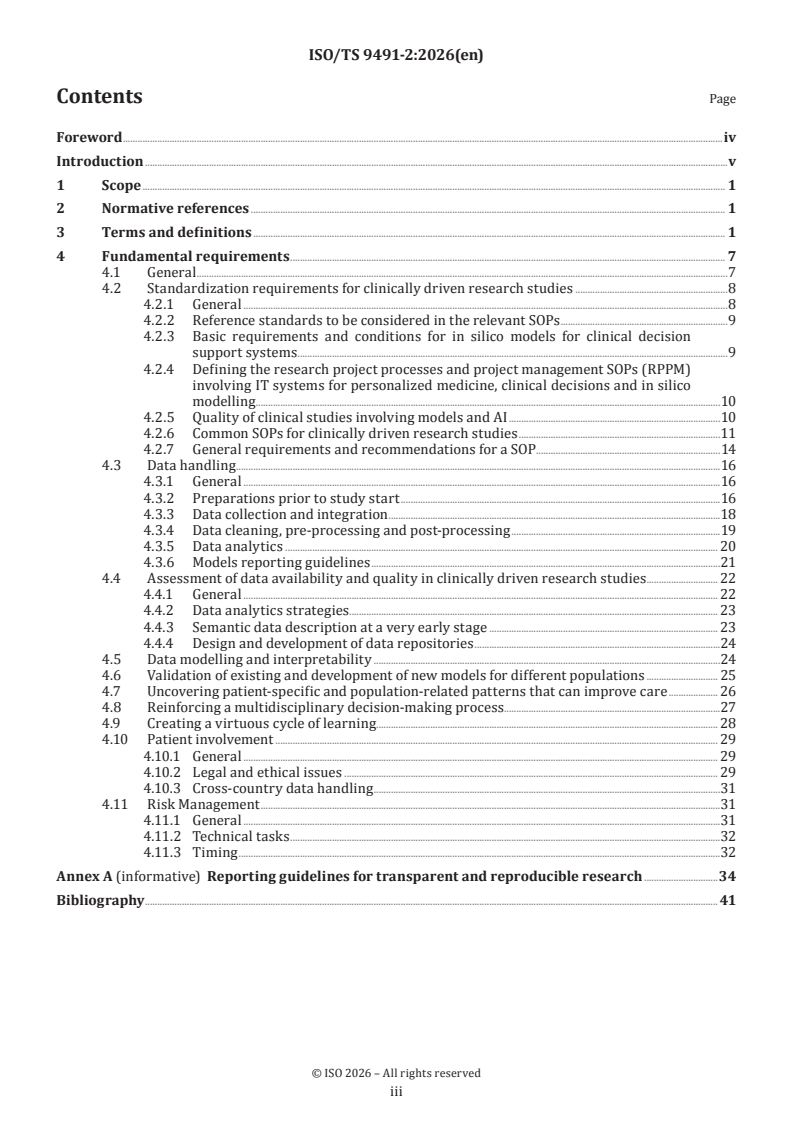
Contents Page
Foreword .iv
Introduction .v
1 Scope . 1
2 Normative references . 1
3 Terms and definitions . 1
4 Fundamental requirements . 7
4.1 General .7
4.2 Standardization requirements for clinically driven research studies .8
4.2.1 General .8
4.2.2 Reference standards to be considered in the relevant SOPs .9
4.2.3 Basic requirements and conditions for in silico models for clinical decision
support systems .9
4.2.4 Defining the research project processes and project management SOPs (RPPM)
involving IT systems for personalized medicine, clinical decisions and in silico
modelling . .10
4.2.5 Quality of clinical studies involving models and AI .10
4.2.6 Common SOPs for clinically driven research studies .11
4.2.7 General requirements and recommendations for a SOP .14
4.3 Data handling .16
4.3.1 General .16
4.3.2 Preparations prior to study start .16
4.3.3 Data collection and integration .18
4.3.4 Data cleaning, pre-processing and post-processing .19
4.3.5 Data analytics . 20
4.3.6 Models reporting guidelines .21
4.4 Assessment of data availability and quality in clinically driven research studies . 22
4.4.1 General . 22
4.4.2 Data analytics strategies. 23
4.4.3 Semantic data description at a very early stage . 23
4.4.4 Design and development of data repositories .24
4.5 Data modelling and interpretability .24
4.6 Validation of existing and development of new models for different populations . 25
4.7 Uncovering patient-specific and population-related patterns that can improve care . 26
4.8 Reinforcing a multidisciplinary decision-making process .27
4.9 Creating a virtuous cycle of learning. 28
4.10 Patient involvement . 29
4.10.1 General . 29
4.10.2 Legal and ethical issues . 29
4.10.3 Cross-country data handling .31
4.11 Risk Management .31
4.11.1 General .31
4.11.2 Technical tasks .32
4.11.3 Timing .32
Annex A (informative) Reporting guidelines for transparent and reproducible research .34
Bibliography . 41
iii
Foreword
ISO (the International Organization for Standardization) is a worldwide federation of national standards
bodies (ISO member bodies). The work of preparing International Standards is normally carried out through
ISO technical committees. Each member body interested in a subject for which a technical committee
has been established has the right to be represented on that committee. International organizations,
governmental and non-governmental, in liaison with ISO, also take part in the work. ISO collaborates closely
with the International Electrotechnical Commission (IEC) on all matters of electrotechnical standardization.
The procedures used to develop this document and those intended for its further maintenance are described
in the ISO/IEC Directives, Part 1. In particular, the different approval criteria needed for the different types
of ISO document should be noted. This document was drafted in accordance with the editorial rules of the
ISO/IEC Directives, Part 2 (see www.iso.org/directives).
ISO draws attention to the possibility that the implementation of this document may involve the use of (a)
patent(s). ISO takes no position concerning the evidence, validity or applicability of any claimed patent
rights in respect thereof. As of the date of publication of this document, ISO had not received notice of (a)
patent(s) which may be required to implement this document. However, implementers are cautioned that
this may not represent the latest information, which may be obtained from the patent database available at
www.iso.org/patents. ISO shall not be held responsible for identifying any or all such patent rights.
Any trade name used in this document is information given for the convenience of users and does not
constitute an endorsement.
For an explanation of the voluntary nature of standards, the meaning of ISO specific terms and expressions
related to conformity assessment, as well as information about ISO's adherence to the World Trade
Organization (WTO) principles in the Technical Barriers to Trade (TBT), see www.iso.org/iso/foreword.html.
This document was prepared by Technical Committee ISO/TC 276, Biotechnology.
A list of all parts in the ISO 9491 series can be found on the ISO website.
Any feedback or questions on this document should be directed to the user’s national standards body. A
complete listing of these bodies can be found at www.iso.org/members.html.
iv
Introduction
The combination of patient-derived data, such as genomics and lifestyle information, with patient registries
and databases holds immense potential for improving medical care. One such potential lies in computer-
based personalized models capable of providing precise, patient specific, predictions. Predictive and
prognostic models hold great potential to support clinical decision making in personalized medicine
[1]
and could ultimately facilitate a paradigm shift to a more personalized form of treatment. Various
computational models (see 3.10) have been devised to assist with the decision-making process.
Prognostic models are mathematical tools that relate a person's current characteristics and individual risk
factors to the likelihood of a particular future outcome or disease course. Examples include estimating the
probability of disease progression in an already ill patient or predicting whether an individual is likely to
develop a disease in the future based on its own risk profile (risk stratification). Prognostic models can
incorporate one or many current characteristics (multivariable). When validated, these models provide
clinicians with objective estimates of the probability of treatment response, possible complications or
quality-of-life-evolution that complements other clinical information.
Predictive modelling, on the other hand, uses available data to forecast likely future responses and effects
of a specific treatment or intervention. This can be used to identify patients at high risk for adverse events
(such as hospital re-admission) as well as those with a high probability of responding positively to a specific
treatment. By providing individualized information on prognosis and potential response to therapy,
predictive models are increasingly valuable tools for personalized, patient-centred medicine. Examples
include identifying patients at high risk of readmission after a particular treatment or in silico modelling of
[1]
therapy effects in specific patients or cohorts .
The assessment of computational models (e.g., statistical models, mechanistic models, machine learning
and deep learning models) is done in the context of clinically driven research studies. Nevertheless, these
studies are complex and challenging both from the clinical and the technological side. For complex diseases,
such as certain cancer types, very often, only a few prognostic bioprofiles and even fewer, if any, multiscale
prognostic models (models that include biological data ranging from the molecular scale to the entire organs
and human organism, such as multi-scale models) are available on which to base personalized treatment
decisions.
In most cases, available models lack robust validation in which: a) the predicted risks are compared to the
actual observed outcomes in a patient population, and b) the model is validated in patient cohorts different
[2]
from those used for developing the model and quality controls. These controls include the internal and
external validation of the computational models. Internal validation is needed during the model development
to quantify any optimism in the predictive performance whereas external validation is needed for model
[3]
generalization and require new data sets. This causes a gap where important information becomes
unavailable for optimal treatment decision making.
More prognostic predictions than those available from current clinical guidelines-based systems (such as
Tumor-Lymphnode-Metastasis staging for cancer) are often needed to implement the first-line treatment that
maximizes the therapeutic result and minimizes the impacts of therapy in terms of functional impairment
and toxicity. Providing clinicians with the prognostic and predictive models supporting clinical decisions
and providing all the necessary information to tailor treatment and care delivery pathways to each patient
during their usual practice, in contrast to the current "one-size-fits-all approach", is an unmet need.
[4][5][6]
The development of clinical decision support system (CDSS) could be achieved by combining
[5] [6] [7]
"traditional" statistical models with artificial intelligence (AI) algorithms driven by the manifold
[1]
of health and other person-related data (big data) collected from patients, as well as the integration of
big data results with the statistical models. Moreover, it is necessary to validate the existing and newly
developed models in different individuals and several populations and either adjust the person-related
[1]
models accordingly or develop generally applicable models. This process will create a virtuous cycle of
learning between research and clinical practice, through the mutual feeding of external population data and
patient-specific clinical data.
Improving the clinical decision process by implementing a prognostic system based on personalized
computational models that increases the accuracy and reinforcement of a multidisciplinary decision-making
would help define the optimal treatment for a particular patient. In addition, uncovering patient-specific and
v
population-related patterns can improve care and pave the way for better-tailored treatment guidelines, by
assessing the importance (scoring) of new prognostic markers for outcome prediction, finally improving the
patient's quality of life.
vi
Technical Specification ISO/TS 9491-2:2026(en)
Biotechnology — Predictive computational models in
personalized medicine research —
Part 2:
Requirements and recommendations for implementing
computational models in clinical integrated decision support
systems
1 Scope
This document specifies requirements and recommendations for designing, developing, and establishing
integrated clinical decision support systems (CDSS) for research purposes in personalized medicine.
This document can be used as an implementation guideline for setting up computational modelling
workflows to enable such systems. It addresses data quality, formatting and handling, as well as the
processes generating such data, and the set-up, validation, simulation, storing and sharing of computational
models used for this specific purpose in personalized medicine. This includes recommendations and rules
for configuration, descriptions, annotations, interoperability, integration, access and provenance of such
data and derived models in an interpretable and evidence-based manner. This document also specifies how
to integrate these rules with clinical trials execution applying standard operating procedures. Furthermore,
requirements and recommendations for data used to construct or required for validating such models are
addressed.
This document does not apply for computational models used for diagnostic or therapeutic purposes in
standard clinical practice, outside of a formal research or investigational setting.
2 Normative references
The following documents are referred to in the text in such a way that some or all of their content constitutes
requirements of this document. For dated references, only the edition cited applies. For undated references,
the latest edition of the referenced document (including any amendments) applies.
ISO 9491-1, Biotechnology — Predictive computational models in personalized medicine research — Part 1:
Constructing, verifying and validating models
3 Terms and definitions
For the purposes of this document, the following terms and definitions apply.
ISO and IEC maintain terminological databases for use in standardization at the following addresses:
— ISO Online browsing platform: available at https:// www .iso .org/ obp
— IEC Electropedia: available at https:// www .electropedia .org/
3.1
artificial intelligence
AI
research and development of mechanisms and applications of AI systems (3.2)
Note 1 to entry: Research and development can take place across any number of fields such as computer science, data
science, humanities, mathematics and natural sciences.
[SOURCE: ISO/IEC 22989:2022, 3.1.3]
3.2
artificial intelligence system
AI system
engineered system that generates outputs such as content, forecasts, recommendations or decisions for a
given set of human-defined objectives
Note 1 to entry: The engineered system can use various techniques and approaches related to artificial intelligence to
develop a model to represent data, knowledge, processes, etc. which can be used to conduct tasks.
Note 2 to entry: AI systems are designed to operate with varying levels of automation.
[SOURCE: ISO/IEC 22989:2022, 3.1.4]
3.3
big data
extensive datasets — primarily in the data characteristics of volume, variety, velocity, and/or variability —
that require a scalable technology for efficient storage, manipulation, management, and analysis
Note 1 to entry: Big data is commonly used in many different ways, for example as the name of the scalable technology
used to handle big data extensive datasets.
EXAMPLE High volume, high diversity biological, clinical, environmental, and lifestyle information collected from
single individuals to large cohorts, in relation to their health and wellness status, at one or several time points
[SOURCE: ISO 9491-1:2026, 3.3, modified — “(see reference [8] for additional information)” in EXAMPLE
removed.]
3.4
bioprofile
objective ‘fingerprint’ or ‘pattern’ in the data (3.12) that provides phenotypic information, e.g. about a
complex underlying disease that evolves with time
3.5
black box
idealized mechanism that accepts inputs and produces outputs, but is designed such that an observer cannot
see inside the box or determine exactly what is happening inside that box
[SOURCE: ISO/IEC 18367:2016, 3.4, modified — Note 1 to entry removed.]
3.6
clinical decision support
type of service that assists healthcare providers in making medical decisions, which typically require input
of patient-specific clinical variables and provide patient-specific recommendations
[SOURCE: ISO/TR 14639-2:2014, 2.8, modified — “system” replaced by “service”; Note 1 to entry removed
and “which typically require input of patient-specific clinical variables and provide patient-specific
recommendations” from Note 1 added to the definition]
3.7
clinical decision support system
CDSS
software designed to be a direct aid to clinical decision-making, in which the characteristics of an individual
patient are matched to a computerized clinical knowledge base, whereafter patient-specific assessments
or recommendations are presented to the clinician or the patient to aid in the process of making evidence
based clinical decisions
Note 1 to entry: This definition was derived from Reference [26].
Note 2 to entry: In this document, we use “system” as an abbreviation of clinical decision support system.
[SOURCE: ISO/TS 22756:2020, 3.2, modified — “CDSS“ and Notes 1 and 2 to entry added.]
3.8
clinical study
any investigation in relation to humans intended:
a) to discover or verify the clinical, pharmacological or other pharmacodynamic effects of one or more
medicinal products;
b) to identify any adverse reactions to one or more medicinal products; or
c) to study the absorption, distribution, metabolism and excretion of one or more medicinal products;
with the objective of ascertaining the safety or efficacy, or both of those medicinal products
[20]
Note 1 to entry: This definition is derived from Article 2(2) (2) of the European Union Clinical Trials Regulation .
3.9
clinical trial
clinical study (3.8) which fulfils any of the following conditions:
a) the assignment of the subject to a particular therapeutic strategy is decided in advance and does not fall
within normal clinical practice of the country concerned;
b) the decision to prescribe that the investigational medicinal product is taken together with the decision
to include the subject in the clinical study; or
c) have diagnostic or monitoring procedures in addition
Note 1 to entry: In general, a clinical trial is a research investigation involving human subjects that is designed to
answer specific questions about the safety and efficacy of a biomedical intervention (drug, treatment, device) or new
ways of using a known drug, treatment, or device) (see [28])
Note 2 to entry: In this document we refer to interventional clinical performance study (3.16) for the first design
purpose, and observational study for the second design purpose (see [29]).
Note 3 to entry: An observational (non-interventional) study refers to a study in which test results obtained during
the study are not used for patient management and do not impact treatment decisions (see [29]).
[20]
Note 4 to entry: This definition is derived from Article 2(2) (2) of the European Union Clinical Trials Regulation .
3.10
computational model
in silico model
description of a biological system in either a mathematical expression or graphical form, or both, that is
implemented and studied with a computer highlighting objects and their interactions
[SOURCE: ISO 9491-1:2026, 3.5, modified — Note 1 to entry removed.]
3.11
computational modelling
setting up, developing, formatting, refining, parameterizing, validating, handling, simulating and analysing
computational models (3.10)
Note 1 to entry: Simulation-based analysis to test hypotheses within in silico experiments, providing predictions to be
tested by in vitro and in vivo studies
3.12
data
reinterpretable representation of information in a formalized manner suitable for communication,
interpretation or processing
Note 1 to entry: Data can be processed by humans or by automatic means.
[SOURCE: ISO/IEC 2382:2015, 2121272, modified — Notes 2 and 3 to entry removed.]
3.13
data integration
systematic combining of data from different independent and potentially heterogeneous sources, to create a
more compatible, unified view of these data for research purpose
[SOURCE: ISO 5127:2017, 3.1.11.24]
3.14
deviation
departure from an approved standard operating procedure (SOP) (3.32) or established standard
[SOURCE: ISO 15378:2017, 3.7.5]
3.15
interoperability
ability of two or more systems or components to exchange information and to use the information that has
been exchanged
[SOURCE: ISO/TS 27790:2009, 3.39]
3.16
interventional clinical performance study
study in which test results obtained during the study can influence patient management decisions and might
be used to guide treatments
EXAMPLE Studies for companion diagnostics.
[SOURCE: ISO 20916:2019, 3.21]
3.17
machine learning
ML
computer technology with the ability to automatically learn and improve from experience without being
explicitly programmed
EXAMPLE Speech recognition, predictive text, spam detection, or optimizing model parameters through
computational techniques, such that the model's behaviour reflects the data or experience.
[SOURCE: ISO 9491-1:2026, 3.12]
3.18
model
abstract description of reality in any form (including concepts, data (3.12) elements, terms, and their
relationships, statistical, theoretical, mathematical, physical, symbolic, graphical or descriptive form of a
domain) that presents a certain aspect of that reality
Note 1 to entry: It is often further specified to distinguish between conceptual, logical and computational models
(3.10).
[SOURCE: ISO/TR 23087:2018, 3.5, modified — "concepts, data (3.12) elements, terms, and their relationships,
statistical, theoretical" and Note 1 to entry have been added.]
3.19
modelling
construction of abstract representations in the course of design, for example, to represent the logical
structure of software applications before coding
[SOURCE: ISO 13972:2022, 3.1.6]
3.20
model validation
validation
comparison between the output of the calibrated model and the measured data, independent of the data set
used for calibration
[SOURCE: ISO 14837-1:2005, 3.7, modified — Synonym ‘validation’ added]
3.21
natural language
language which is or was in active use in a community of people, and the rules of which are mainly deduced
from the usage
[SOURCE: ISO/IEC 15944-8:2012, 3.82]
3.22
natural language generation
NLG
task of converting data (3.12) carrying semantics into natural language (3.21)
[SOURCE: ISO/IEC 22989:2022, 3.6.8]
3.23
natural language processing
NLP
information processing based upon natural language understanding (3.24) or natural language generation
(3.22)
[SOURCE: ISO/IEC 22989:2022, 3.6.9, modified — ”” removed from entry]
3.24
natural language understanding
NLU
natural language comprehension
extraction of information, by a functional unit, from text or speech communicated to it in a natural language
(3.21), and the production of a description for both the given text or speech and what it represents
[SOURCE: ISO/IEC 22989:2022, 3.6.11]
3.25
personal data
any information relating to an identified or identifiable natural person
[SOURCE: ISO 22857:2013, 3.9]
3.26
personal health data
any personal data (3.25) relevant to the health of an identified or identifiable natural person
[SOURCE: ISO 22857:2013, 3.10]
3.27
personalized medicine
precision medicine
medical model (3.18) using characterization of individuals’ phenotypes and genotypes for tailoring the right
therapeutic strategy for the right person at the right time, and/or to determine the predisposition to disease
and/or to deliver timely and targeted prevention
Note 1 to entry: Examples for individuals’ phenotypes and genotypes are molecular profiling, medical imaging and
lifestyle data (3.12).
Note 2 to entry: Medical decisions, prevention strategies and therapies in personalized medicine are based on this
individuality.
[SOURCE: ISO 9491-1:2026, 3.18]
3.28
registry
information system for registration
[SOURCE: ISO/IEC 11179-1: 2023, 3.2.34]
3.29
risk analysis
systematic use of available information to identify hazards and to estimate the risk
[SOURCE: ISO/IEC Guide 51:1999, 3.10]
3.30
risk assessment
overall process comprising a risk analysis (3.29) and a risk evaluation (3.31)
[SOURCE: ISO/IEC Guide 51:1999, 3.12]
3.31
risk evaluation
procedure based on the risk analysis (3.29) to determine whether the tolerable risk (3.34) has been achieved
[SOURCE: ISO/IEC Guide 51:1999, 3.11]
3.32
standard operating procedure
SOP
authorized, documented procedure or set of procedures, work instructions and test instructions for
production and control
[SOURCE: ISO 15378:2017, 3.7.10]
3.33
statistical method
statistical technique
methodology for the analysis of quantitative data (3.12) associated with variation in products, processes,
services and phenomena under study to provide information on the object of the study
[SOURCE: ISO 10017:2021, 3.1]
3.34
tolerable risk
risk which is accepted in a given context based on the current values of society
[SOURCE: ISO/IEC Guide 51:1999, 3.7]
3.35
usability
extent to which a system, product or service can be used by specified users to achieve specified goals with
effectiveness, efficiency and satisfaction in a specified context of use
Note 1 to entry: The “specified” users, goals and context of use refer to the particular combination of users, goals and
context of use for which usability is being considered.
Note 2 to entry: The word “usability” is also used as a qualifier to refer to the design knowledge, competencies,
activities and design attributes that contribute to usability, such as usability expertise, usability professional, usability
engineering, usability method, usability evaluation, usability heuristic.
[SOURCE: ISO 9241-11:2018, 3.1]
4 Fundamental requirements
4.1 General
Clinical decision support systems (CDSS) are software tools including algorithms that link together and
analyse multisource and multiscale patients’ data from Electronic Health Records (EHRs) including
laboratory data, patient history, risk factors, behavioural data and socio-economic indicators if available,
multi-omics (e.g. genomics, transcriptomics, radiomics, metabolomics, etc.), pathology, and imaging data,
with available multiscale prognostic models and graphical visualization tools that assist healthcare providers
in clinical decisions. CDSS may also include population-based epidemiologic, behavioural and environmental
data. CDSS aid physicians in integrating almost all-available information to allow the best possible treatment
and therapy decisions. To support healthcare professionals in their daily practice, aggregated knowledge
shall be displayed in user-friendly formats so that physicians, non-technical laboratory personnel, nurses,
data/research coordinators, and end-users can enter data, access information, and understand the output
in the clinical setting. CDSS are tools that incorporate established clinical knowledge and updated patient
information to enhance patient care; they encompass an array of strategies supporting a variety of topics.
[9]
Patient data require sequential processing to reach correct clinical conclusions, and then to become
knowledge. EHR-based CDSS promise to translate clinical data into knowledge that can be readily used by
physicians for decision-making and that can decrease the incidence of errors.
The system should intrinsically allow collaborative analysis, enabling multiple users to work on the same
research objects and studies, reinforcing multidisciplinary decision-making. Insights from different
collaborators shall be visible to all other cooperation partners to be used, for instance, for other studies
focused on different cancer types. Users shall be able to define their role and activities assignments, being
managed for the principal investigator of each study.
Data collection functionality shall be readily available when new data is collected, following the Clinical
Record Forms (CRF), defined in the data layer. Data quality reports shall also be accessible from this
functionality, and data correction shall be allowed. The user should access the data by selecting it following
the standard nomenclature defined in the data layer. Data queries should be delivered through an
understandable and easy-to-use interface, enabling the management of extensive heterogeneous data. The
users shall be able to export the data and visualize it. For each individual patient’s EHR, direct visualization
and a descriptive way to allow first data exploration should be provided.
Population data or other public data should be delivered - whenever available - to provide context and
reference indicators. Existing preliminary analysis, evidence criteria and researchers’ insights shall be
available when accessing a particular manuscript.
4.2 Standardization requirements for clinically driven research studies
4.2.1 General
Scientific managers and clinical trials responsible are experiencing increasing regulations such as Good
clinical practice (GCP) regulations or some European and international guidelines and directives. Still,
limited discussions have been conducted to formalize and define the adequate quality of a standard
operating procedure (SOP) system.
Since data represent a key aspect for sound and trustable research in clinical trials and digital health studies,
data sharing and (re)use procedures are fundamental. Consequently, a high level of rigorous standards
and semantic specificity is required not just for humans, but also for computational analysis. In particular,
standardization can improve clinical research through increased data quality, better data integration and
reusability, facilitation of data exchange with collaborating institutions, increased use of software tools,
improvements in team communication, and simplification of regulatory reviews and audits. Similarly, trial
execution procedures, processes, documentation, and reporting shall be ruled by well-defined SOPs relying
on acknowledged standards and guidelines.
The user should not need to search for relevant standards or guidelines to select the appropriate ones,
as this is time-consuming and error prone. On the contrary, the system shall propose the necessary
information and the appropriate SOPs to guide the research and elaborate on the reporting results. Annex A
includes a map of the existing guidelines to report clinical trial results when dealing with personalized
systems and computational models. Considering these guidelines in Annex A and the Good Clinical Practice
recommendations, Figure 1 represents the clinical research process. First, a CDSS should collect from the
clinical researchers and provide the rational, goals and setting of the study. If the study is interventional,
then details on the intervention (whether it is a drug administration or a computational model-driven
intervention) shall be provided by the clinical researchers. Then, in all studies, clinical researchers and their
teams should perform and document carefully data collection and data management processes to make sure
that the data quality is sufficient to allow performing modelling (either standard statistics or computational
models) and ensure interpretability of the results.
Limitations of the clinical research study shall be reported and taken into account, including:
a) populations representativeness: inclusion criteria limiting the population of interest to specific
subgroups (e.g., non-considering gender/ethnicity/etc. in the study as compared to real-world prevalence
fractions);
b) selection bias: systematic differences between baseline characteristics of the compared groups;
c) performance bias: systematic differences between groups in the care that is provided, or in exposure to
factors other than the interventions of interest;
d) detection bias: systematic differences between groups in how outcomes are determined;
e) attrition bias: systematic differences between groups in withdrawals from a study.
Methodologies and guidelines exist to address such biases, which shall be implemented and reported with
the study results.
Ethical and legal considerations applied in the trial shall also be considered, addressed, and reported by the
study team as they can influence study subject inclusion criteria and/or data collection.
Figure 1 — Overview of the clinical trial process
4.2.2 Reference standards to be considered in the relevant SOPs
Any developed and implemented IT solutions in the healthcare delivery pathway should conform with
reference standards, including but not limited to:
[42]
a) ISO/IEEE 11073 ;
[29]
b) ISO 13119 ;
[43]
c) ISO 22857 ;
[44]
d) ISO/IEC 22989 ;
[45]
e) ISO 23903 ;
[46]
f) ISO 30401 ;
[47]
g) ISO/IEC 38500 ;
[48]
h) ISO 80000 ;
[49]
i) ISO 9001 ;
[50]
j) ISO/TS 22756 ;
[51]
k) ISO/TS 5346 ;
l) ISO 9491-1;
[52]
m) ISO 29585 .
4.2.3 Basic requirements and conditions for in silico models for clinical decision support systems
In silico models and associated CDSS shall be flexible and adaptable to the specific clinical care workflows to
which they are applied.
In silico models shall be conceived in a way to be easily integrated as part of the IT-supported care delivery,
that is making them act as useful and time-saving tools connected to the usual practice
In silico models’ simulations/predictions shall be sufficiently transparent (e.g., through supporting data,
description of the data analysis processes and data pipelines, data selection criteria, biases, confidence
intervals and other evaluation parameters) so that they can be discussed among physicians and also with
patients.
[10][11][12][13]
In silico models shall be developed considering usability aspects, including flexibility and
efficiency of use, user-friendly and understandable interfaces. Usability assessment methods for CDSS
[11] [14]
Models are published , .
4.2.4 Defining the research project processes and project management SOPs (RPPM) involving IT
systems for personalized medicine, clinical decisions and in silico modelling
Defining research project processes and project management procedures (RPPM) involves establishing a
structured framework to establish policies, plans, operational procedures and workflows assuring the
fulfilment of the project objectives, the execution of the associated trials (if any) and the quality of the results
through accurate planning, monitoring, risk assessment, reporting of deviations and recovery of all activities
and standard operating procedures (SOPs) from the very start of the study throughout its implementation
and continuous monitoring. The workflow for RPPM management and monitoring is illustrated in Figure 2.
Figure 2 — Workflow of RPPM
Specific SOPs shall rule the different activities of a research study. SOPs shall support physicians in the
effortless design and reporting of clinical trial results, providing a clinical research group with clear roles,
responsibilities, and processes to ensure conformance, accuracy, and timeliness of data.
SOPs shall ensure matching in silico modelling vs. clinical guidelines for treatment decision and
administration and considering treatment side effects.
4.2.5 Quality of clinical studies involving models and AI
The quality of a study and the trustworthiness of its findings, starts at the design phase. The study protocol
shall contain all elements of the study design, sufficient for independent groups to carry out the study and
expect replicability. Guidance for recommended items to include in a trial protocol are provided by the
[8] [15]
SPIRIT Statement and its SPIRIT-AI extension and the CONSORT guidelines and their CONSORT-AI
[16]
checklist extension .
In case these guidelines do not cover specific aspects of the study, other guidelines such as EQUATOR
[17] [36]
guideline (e.g., Standards for Reporting of Diagnostic Accuracy Studies (STARD ) for diagnostic
accuracy studies) shall be used.
An early-stage clinical AI evaluation shall consider the potential for iterative modification of the interventions
and the characteristics and expertise (e.g. training) of the operators performing them. Aspects such as
training of medical and clinical staff involved in the use and interpretation of results from clinical decision
support systems are fundamental for proper clinical evaluation and for appropriate and safe use of such
complex tools for personalized medicine.
[19]
The DECIDE-AI checklist for early clinical evaluation of AI-supported CDSS and results reporting shall
be adopted. All items in the checklist shall be fulfilled, included in the study master file and used for study
reporting, early evaluation and clinical assessment.
NOTE 1 Examples for use are:
a) CHARMS, Checklist for critical appraisal and data extraction for systematic reviews of prediction modelling
[41]
studies ;
[53]
b) CLAIM, Checklist for artificial intelligence in medical imaging ;
c) DECIDE-AI, Developmental and Exploratory Clinical Investigation of Decision-support systems driven by artificial
[19]
intelligence ;
[54]
d) DTA, Diagnostic Test Accuracy ;
[55]
e) MINIMAR, Minimum Information for Medical AI Reporting ;
[39]
f) PRISMA, Preferred Reporting Items for Systematic Review and Meta-analysis ;
[38]
g) PROBAST, Prediction model Risk Of Bias Assessment Tool ;
[3]
h) TRIPOD, Transparent reporting of a multivariable prediction model for individual prognosis or diagnosis .
The checklists included in the above guidelines are expected to cover the key aspects of clinical research
studies involving CDSS and AI. Annex A includes more details for the checklist
...