


ISO 10840
(Main)Plastics — Specifications and guidance for the use of standard fire tests
General Information
- Abstract
This document provides specifications and guidance for the use of standard fire testing for plastics and the products in the following aspects: — selection of appropriate tests that reflect realistic end-use conditions; — grouping of the reaction-to-fire characteristics that any given test or tests can measure; — assessment of tests as to their relevance in areas such as material characterisation, quality control, pre-selection, end-product testing, environmental profiling and design for the environment (DfE); — definition of potential problems that can arise when plastics are tested in standard fire tests. This document does not include specifications for the development or design of new fire tests for plastics.
- Status
- Not Published
- Technical Committee
- ISO/TC 61/SC 4 - Burning behaviour
- Drafting Committee
- ISO/TC 61/SC 4/WG 9 - Composites and semi-finished products
- Current Stage
- 6000 - International Standard under publication
- Start Date
- 01-Sep-2026
- Completion Date
- 19-Sep-2026
Buy Documents
ISO/FDIS 10840 - Plastics — Specifications and guidance for the use of standard fire tests
REDLINE ISO/FDIS 10840 - Plastics — Specifications and guidance for the use of standard fire tests
ISO/FDIS 10840 - Plastiques — Spécifications et lignes directrices pour l'utilisation d'essais au feu normalisés
Overview
ISO 10840: Plastics - Specifications and Guidance for the Use of Standard Fire Tests provides vital recommendations for using standard fire tests in the evaluation of plastics and products containing plastics. Published by the International Organization for Standardization (ISO), this standard aims to ensure the selection of fire testing procedures that accurately reflect real end-use scenarios and aid in properly evaluating fire performance. ISO 10840 is essential for manufacturers, quality control specialists, and fire engineers who need to assess the reaction-to-fire characteristics, predict behavior under fire conditions, and address regulatory or safety requirements for plastics.
This standard offers:
- Guidance on selecting suitable standard fire tests for plastics
- Grouping of reaction-to-fire characteristics assessed by specific tests
- Assessment of the relevance of different tests for material characterization, quality control, product selection, and environmental profiling
- Identification and explanation of common issues encountered when testing plastics
Key Topics
ISO 10840 covers several critical aspects of fire testing for plastic materials and products:
- Appropriate Test Selection: Helps users decide on fire tests that best mirror the intended application, whether for construction, transportation, electronics, or consumer goods.
- Test Categories: Distinguishes between material characterization tests, quality-control tests, pre-selection tests, and end-product tests, emphasizing their relevance in various stages of product development.
- Reaction-to-Fire Characteristics: Clarifies which fire properties can be measured by different tests, such as ignition, flame spread, heat release, smoke production, and burning droplets.
- Practical Considerations: Discusses specimen preparation, the influence of test procedures, equipment calibration, operator skills, and test repeatability.
- Problematic Behaviors in Testing: Identifies potential issues with plastics under fire tests, such as material shrinking, bubbling, formation of burning drips, and effects like intumescence or slumping.
- Environmental Impact Assessment: Includes guidance on analyzing combustion products and heat release for holistic environmental and life-cycle evaluations.
Applications
ISO 10840 is widely deployed across multiple sectors and use cases:
- Building and Construction: To evaluate plastic components’ fire safety, ensure regulatory compliance, and inform environmental and hazard analyses.
- Transport Industry: For quality assurance and the development of safe interior and exterior plastic parts in automotive, rail, marine, and aerospace sectors.
- Product Design and Innovation: Supports design for the environment (DfE) by integrating fire safety engineering principles and environmentally conscious material selection.
- Quality Control: Assists manufacturers in maintaining consistent fire performance through routine quality-control tests.
- Environmental Profiling: Offers methods to assess and reduce the environmental impact of plastic products throughout their lifecycle, particularly their behavior and emissions during fires.
- Fire Safety Engineering: Guides engineers applying fire safety models and advanced polymer technologies for challenging environments.
Related Standards
For a comprehensive fire safety framework, ISO 10840 should be used in conjunction with these key standards:
- ISO 10093, Plastics - Fire Tests - Standard Ignition Sources: Defines standard sources for fire tests on plastics.
- ISO 13943, Fire Safety - Vocabulary: Provides essential terms and definitions for fire safety.
- ISO 23932 series, Fire Safety Engineering: Offers methodologies for fire safety engineering which are referenced for test selection in ISO 10840.
- IEC 60695 series, Fire Hazard Testing: Relevant for electronics and electrical applications involving plastics.
Keywords
- ISO 10840
- Plastics fire testing standard
- Standard fire tests for plastics
- Reaction-to-fire characteristics
- Quality control in plastics fire safety
- Environmental impact plastics combustion
- Plastics fire performance testing
- Fire safety engineering plastics
- Material characterisation fire tests
By implementing ISO 10840, organizations can achieve safer, more sustainable, and better-performing plastic products through reliable and relevant fire testing practices.
Relations
- Effective Date
- 12-Feb-2026
- Effective Date
- 08-Feb-2025
- Effective Date
- 01-Oct-2024
Buy Documents
ISO/FDIS 10840 - Plastics — Specifications and guidance for the use of standard fire tests
REDLINE ISO/FDIS 10840 - Plastics — Specifications and guidance for the use of standard fire tests
ISO/FDIS 10840 - Plastiques — Spécifications et lignes directrices pour l'utilisation d'essais au feu normalisés
Get Certified
Connect with accredited certification bodies for this standard

DIN CERTCO
DIN Group product certification.
CIS Institut d.o.o.
Personal Protective Equipment (PPE) certification body. Notified Body NB-2890 for EU Regulation 2016/425 PPE.

Kiwa BDA Testing
Building and construction product certification.
Sponsored listings
Frequently Asked Questions
ISO 10840 is a draft published by the International Organization for Standardization (ISO). Its full title is "Plastics — Specifications and guidance for the use of standard fire tests". This standard covers: This document provides specifications and guidance for the use of standard fire testing for plastics and the products in the following aspects: — selection of appropriate tests that reflect realistic end-use conditions; — grouping of the reaction-to-fire characteristics that any given test or tests can measure; — assessment of tests as to their relevance in areas such as material characterisation, quality control, pre-selection, end-product testing, environmental profiling and design for the environment (DfE); — definition of potential problems that can arise when plastics are tested in standard fire tests. This document does not include specifications for the development or design of new fire tests for plastics.
This document provides specifications and guidance for the use of standard fire testing for plastics and the products in the following aspects: — selection of appropriate tests that reflect realistic end-use conditions; — grouping of the reaction-to-fire characteristics that any given test or tests can measure; — assessment of tests as to their relevance in areas such as material characterisation, quality control, pre-selection, end-product testing, environmental profiling and design for the environment (DfE); — definition of potential problems that can arise when plastics are tested in standard fire tests. This document does not include specifications for the development or design of new fire tests for plastics.
ISO 10840 is classified under the following ICS (International Classification for Standards) categories: 13.220.40 - Ignitability and burning behaviour of materials and products; 83.080.01 - Plastics in general. The ICS classification helps identify the subject area and facilitates finding related standards.
ISO 10840 has the following relationships with other standards: It is inter standard links to FprEN ISO 10840, ISO/TS 5346:2022, ISO 10840:2008. Understanding these relationships helps ensure you are using the most current and applicable version of the standard.
ISO 10840 is available in PDF format for immediate download after purchase. The document can be added to your cart and obtained through the secure checkout process. Digital delivery ensures instant access to the complete standard document.
Standards Content (Sample)
FINAL DRAFT
International
Standard
ISO/FDIS 10840
ISO/TC 61/SC 4
Plastics — Specifications and
Secretariat: BSI
guidance for the use of standard fire
Voting begins on:
tests
2026-07-06
Voting terminates on:
2026-08-31
RECIPIENTS OF THIS DRAFT ARE INVITED TO SUBMIT,
WITH THEIR COMMENTS, NOTIFICATION OF ANY
RELEVANT PATENT RIGHTS OF WHICH THEY ARE AWARE
AND TO PROVIDE SUPPOR TING DOCUMENTATION.
IN ADDITION TO THEIR EVALUATION AS
BEING ACCEPTABLE FOR INDUSTRIAL, TECHNO
ISO/CEN PARALLEL PROCESSING LOGICAL, COMMERCIAL AND USER PURPOSES, DRAFT
INTERNATIONAL STANDARDS MAY ON OCCASION HAVE
TO BE CONSIDERED IN THE LIGHT OF THEIR POTENTIAL
TO BECOME STAN DARDS TO WHICH REFERENCE MAY BE
MADE IN NATIONAL REGULATIONS.
Reference number
ISO/FDIS 10840:2026(en) © ISO 2026
FINAL DRAFT
ISO/FDIS 10840:2026(en)
International
Standard
ISO/FDIS 10840
ISO/TC 61/SC 4
Plastics — Specifications and
Secretariat: BSI
guidance for the use of standard fire
Voting begins on:
tests
Voting terminates on:
RECIPIENTS OF THIS DRAFT ARE INVITED TO SUBMIT,
WITH THEIR COMMENTS, NOTIFICATION OF ANY
RELEVANT PATENT RIGHTS OF WHICH THEY ARE AWARE
AND TO PROVIDE SUPPOR TING DOCUMENTATION.
© ISO 2026
IN ADDITION TO THEIR EVALUATION AS
All rights reserved. Unless otherwise specified, or required in the context of its implementation, no part of this publication may
BEING ACCEPTABLE FOR INDUSTRIAL, TECHNO
ISO/CEN PARALLEL PROCESSING
LOGICAL, COMMERCIAL AND USER PURPOSES, DRAFT
be reproduced or utilized otherwise in any form or by any means, electronic or mechanical, including photocopying, or posting on
INTERNATIONAL STANDARDS MAY ON OCCASION HAVE
the internet or an intranet, without prior written permission. Permission can be requested from either ISO at the address below
TO BE CONSIDERED IN THE LIGHT OF THEIR POTENTIAL
or ISO’s member body in the country of the requester.
TO BECOME STAN DARDS TO WHICH REFERENCE MAY BE
MADE IN NATIONAL REGULATIONS.
ISO copyright office
CP 401 • Ch. de Blandonnet 8
CH-1214 Vernier, Geneva
Phone: +41 22 749 01 11
Email: copyright@iso.org
Website: www.iso.org
Published in Switzerland Reference number
ISO/FDIS 10840:2026(en) © ISO 2026
ii
ISO/FDIS 10840:2026(en)
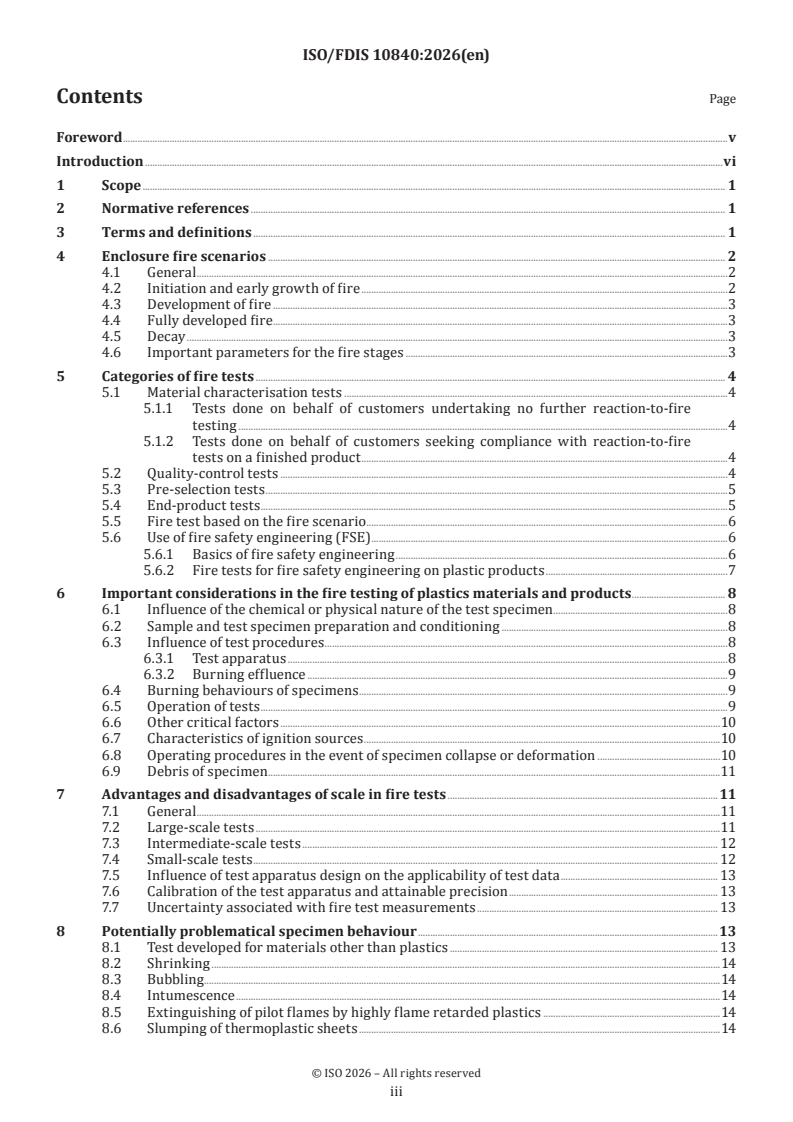
Contents Page
Foreword .v
Introduction .vi
1 Scope . 1
2 Normative references . 1
3 Terms and definitions . 1
4 Enclosure fire scenarios . 2
4.1 General .2
4.2 Initiation and early growth of fire .2
4.3 Development of fire .3
4.4 Fully developed fire .3
4.5 Decay .3
4.6 Important parameters for the fire stages .3
5 Categories of fire tests . 4
5.1 Material characterisation tests .4
5.1.1 Tests done on behalf of customers undertaking no further reaction-to-fire
testing .4
5.1.2 Tests done on behalf of customers seeking compliance with reaction-to-fire
tests on a finished product .4
5.2 Quality-control tests .4
5.3 Pre-selection tests .5
5.4 End-product tests .5
5.5 Fire test based on the fire scenario .6
5.6 Use of fire safety engineering (FSE) .6
5.6.1 Basics of fire safety engineering .6
5.6.2 Fire tests for fire safety engineering on plastic products .7
6 Important considerations in the fire testing of plastics materials and products . 8
6.1 Influence of the chemical or physical nature of the test specimen .8
6.2 Sample and test specimen preparation and conditioning .8
6.3 Influence of test procedures .8
6.3.1 Test apparatus .8
6.3.2 Burning effluence .9
6.4 Burning behaviours of specimens .9
6.5 Operation of tests .9
6.6 Other critical factors .10
6.7 Characteristics of ignition sources .10
6.8 Operating procedures in the event of specimen collapse or deformation .10
6.9 Debris of specimen .11
7 Advantages and disadvantages of scale in fire tests .11
7.1 General .11
7.2 Large-scale tests .11
7.3 Intermediate-scale tests . 12
7.4 Small-scale tests . 12
7.5 Influence of test apparatus design on the applicability of test data . 13
7.6 Calibration of the test apparatus and attainable precision . 13
7.7 Uncertainty associated with fire test measurements . 13
8 Potentially problematical specimen behaviour .13
8.1 Test developed for materials other than plastics . 13
8.2 Shrinking .14
8.3 Bubbling . .14
8.4 Intumescence .14
8.5 Extinguishing of pilot flames by highly flame retarded plastics .14
8.6 Slumping of thermoplastic sheets .14
iii
ISO/FDIS 10840:2026(en)
8.7 Detection of flaming drips . 15
8.8 Edge effects . 15
8.9 Profiles products . 15
Annex A (informative) End-user relevant preparation of test specimens .16
Annex B (informative) Environmental-impact assessment .25
Bibliography .27
iv
ISO/FDIS 10840:2026(en)
Foreword
ISO (the International Organization for Standardization) is a worldwide federation of national standards
bodies (ISO member bodies). The work of preparing International Standards is normally carried out through
ISO technical committees. Each member body interested in a subject for which a technical committee
has been established has the right to be represented on that committee. International organizations,
governmental and non-governmental, in liaison with ISO, also take part in the work. ISO collaborates closely
with the International Electrotechnical Commission (IEC) on all matters of electrotechnical standardization.
The procedures used to develop this document and those intended for its further maintenance are described
in the ISO/IEC Directives, Part 1. In particular, the different approval criteria needed for the different types
of ISO document should be noted. This document was drafted in accordance with the editorial rules of the
ISO/IEC Directives, Part 2 (see www.iso.org/directives).
ISO draws attention to the possibility that the implementation of this document may involve the use of (a)
patent(s). ISO takes no position concerning the evidence, validity or applicability of any claimed patent
rights in respect thereof. As of the date of publication of this document, ISO had not received notice of (a)
patent(s) which may be required to implement this document. However, implementers are cautioned that
this may not represent the latest information, which may be obtained from the patent database available at
www.iso.org/patents. ISO shall not be held responsible for identifying any or all such patent rights.
Any trade name used in this document is information given for the convenience of users and does not
constitute an endorsement.
For an explanation of the voluntary nature of standards, the meaning of ISO specific terms and expressions
related to conformity assessment, as well as information about ISO's adherence to the World Trade
Organization (WTO) principles in the Technical Barriers to Trade (TBT), see www.iso.org/iso/foreword.html.
This document was prepared by Technical Committee ISO/TC 61, Plastics, Subcommittee SC 4, Burning
behavior, in collaboration with the European Committee for Standardization (CEN) Technical Committee
CEN/TC 249, Plastics, in accordance with the Agreement on technical cooperation between ISO and CEN
(Vienna Agreement).
This third edition cancels and replaces the second edition (ISO 10840:2008), which has been technically
revised.
The main changes are as follows:
— the reference documents have been reviewed and updated;
— the terms and definitions have been reviewed and updated;
— a new subclause 5.5 for fire safety engineering has been added.
Any feedback or questions on this document should be directed to the user’s national standards body. A
complete listing of these bodies can be found at www.iso.org/members.html.
v
ISO/FDIS 10840:2026(en)
Introduction
Many of the current reaction-to-fire tests were developed, prior to the widespread use of synthetic polymers,
to assess products incorporating materials such as wood (in the building industry), paper (in electrical wires
and cables), and naturally occurring fibres such as cotton, wool and horsehair (in many textile, furniture
and electrical applications). The reaction-to-fire characteristics of these so-cold traditional materials are
often very different from those of synthetic materials, especially thermoplastics.
ISO/TC 61/SC4 recognises the need for guidance for users of fire-test standards commonly applied to
materials and products made of, or incorporating, plastics. In 2003, the first edition of ISO 10840 was
published, based on the now withdrawn ISO TR 10840:1993 (Plastics – Burning behaviour – Guidance for
development and use of fire test), which listed a series of potential problems associated with the reaction-to-
fire testing of plastics materials and products. ISO TR 10840, however, provided users of the test methods
with no practical assistance on how to cope with the listed difficulties.
This document provides detailed information about how to conduct standard fire tests which are more
relatable to the real conditions of plastics products in a variety of applications.
With more concerns expressed about the environmental impact of fires involving plastics, additional
guidance has been included in the second edition, and extended in this third edition.
Particular attention is given to the provision of guidance for inexperienced users who need to assess the
fire performance of materials or products made of, or incorporating, plastics. This document also provides
answers to frequently asked questions concerning fire tests; these cover factors such as cost, duration,
complexity, required operator skills, quality of the data produced, relevance to fire hazard assessment as
well as test repeatability and reproducibility. This document contains a bibliography of the most frequently
used fire tests applied to the materials and products within the scope of ISO/TC 61/SC 4.
The main focus of this document is on reaction-to-fire testing. Fire resistance testing has also been
considered, in particular for the use of plastic construction of small ships, to take account of the widespread
use of advanced polymer composites and related materials with superior thermo-mechanical stability which
can be used in applications where there is a demand for some degree of fire resistance.
This document provides specifications and guidance for use of fire test of plastics based on the fire
[45] [46]
safety engineering (FSE) using methodologies prescribed in ISO 23932-1, IEC 60695-1-11 and
[47]
IEC 60695-1-12 .
This document also provides guidance on some standard fire tests which give data that is applicable for
assessment of the potentially adverse environmental impact of combustion products that can be generated
in large-scale fires involving plastics materials and products (see Annex B).
NOTE The term, ‘adverse environmental impact’, covers undesirable direct effects on the environment as well as
indirect effects on people of ISO 10840 through environmental exposure.
vi
FINAL DRAFT International Standard ISO/FDIS 10840:2026(en)
Plastics — Specifications and guidance for the use of standard
fire tests
1 Scope
This document provides specifications and guidance for the use of standard fire testing for plastics and the
products in the following aspects:
— selection of appropriate tests that reflect realistic end-use conditions;
— grouping of the reaction-to-fire characteristics that any given test or tests can measure;
— assessment of tests as to their relevance in areas such as material characterisation, quality control, pre-
selection, end-product testing, environmental profiling and design for the environment (DfE);
— definition of potential problems that can arise when plastics are tested in standard fire tests.
This document does not include specification for development or design of new fire-tests for plastics.
2 Normative references
The following documents are referred to in the text in such a way that some or all of their content constitutes
requirements of this document. For dated references, only the edition cited applies. For undated references,
the latest edition of the referenced document (including any amendments) applies.
ISO 10093, Plastics — Fire tests — Standard ignition sources
ISO 13943, Fire safety — Vocabulary
3 Terms and definitions
For the purposes of this document, the terms and definitions given in ISO 13943 and the following apply.
ISO and IEC maintain terminology databases for use in standardization at the following addresses:
— ISO Online browsing platform: available at https:// www .iso .org/ obp
— IEC Electropedia: available at https:// www .electropedia .org/
3.1
end-product test
fire hazard assessment test on a complete product, piece, part component or sub-assembly
3.2
pre-selection test
combustion characteristic test made on a standardized shape, for the process of assessing and choosing
candidate materials, components or subassemblies for making an end product
3.3
spalling
breaking off of fragments or solid articles from a heated surface
ISO/FDIS 10840:2026(en)
4 Enclosure fire scenarios
4.1 General
A number of fire parameters influence the development of a fire. The fire parameters measured during the
pre-flash-over and the post-flash-over conditions differ greatly.
There are four main stages of fire development within an enclosure (i.e. pre-ignition, fire growth, flash-
over and fully developed fire), which are assessed using measurements of temperature and heat release rate
in terms of time. Figure 1 shows the different phases in the development of fires, (see Table 1), within an
[3]
enclosure space (see ISO/TS 3814 ).
In Figure 1, the pre-ignition stage is in the duration from the start until ignition time. The fire growth stage
starts at the ignition and continue until flash-over (see 4.2). The fully developed fire stage starts at the flash-
over (see 4.4) followed by fire decade stage (see 4.5).
Sometimes, fire does not reach flash-over due to limited combustibles present or due to the intervention of
active firefighting measures (e.g. sprinklers, fire brigades).
Key
X time
Y1 heat release rate (kW)
o
Y2 temperature ( C)
1 ignition
2 flash-over
3 heat release rate curve
4 temperature curve
Figure 1 — Development of fire in terms of temperature and heat release rate
4.2 Initiation and early growth of fire
This stage of fire includes the exposure of a product to a heat source, ignition and early development of a fire.
[6] [7]
ISO 871 gives a test method to determine the ignition temperature of plastic materials. ISO 3582, ISO 4589
[8][9][10][11] [31] [12] [13] [33][34][35] [14]
series, ISO 9239-1, ISO 9772, ISO 9773, ISO 11925 series and ISO 12992 specify
ISO/FDIS 10840:2026(en)
fire test method for determination of ignitability of plastics and building materials which contain plastics
[28]
by small heat sources. ISO 10093 specifies ignition sources for use in fire tests. ISO 1182 specifies the
[23] [24] [25]
test methods for non-combustibility (no-ignition). IEC 60695-11-2, IEC 60695-11-5, IEC 60695-11-10
[27]
and IEC 60695-11-20 specify various test methods for determination of ignitability and flame spread of
materials used in electrotechnical products (in many cases, plastics).
Two types of combustion can exist at this stage, smouldering and flaming. Smouldering is a slow, flameless
combustion producing very little heat, but having the potential to fill an enclosure with smoke and toxic
[60]
gases. A test method for measuring toxic gases in fire efluents is given in ISO/TS 19700 .
After ignition, the development of a flaming fire will depend on the following effects:
— fire growth on first ignited item;
— fire spread to other items;
— the effect of intervention (portable extinguishers, sprinklers, fire brigades);
— the ventilation conditions.
4.3 Development of fire
As a fire develops, a hot smoke and gas layer usually builds up below the ceiling. The radiant heat transfer
to combustible items accelerates the thermal decomposition of material below the smoke layer, and the
[30] [19] [21]
rate of fire spread increases. ISO 5658-2, ISO 21367 and ISO 23949 specify test methods for the
[48]
determination of flame spread capability. ISO 5659 provides test method for smoke generation.
[29]
Heat release from burning materials and products governs the fire growth. ISO 1716, ISO 5660 series
[49][50][51][52] [36] [15] [37] [53]
, ISO 12136, ISO 13927, ISO 14696 and ISO 24473 give fire test methods for
measurement of heat release from burning materials and products.
Flash-over, which usually occurs at temperatures around 600 °C, corresponds to an abrupt sudden transition
from a localised fire to the ignition of the gas layer and to the sudden subsequent ignition of all exposed
flammable surfaces, leading to a fully developed fire. The rate of heat release increases rapidly, and this
leads to a rapid temperature rise within the enclosure. However, Temperature at flash-over is not always the
maximum temperature in the compartment of the fire. Flash-over is uncommon in large enclosures, as the
required temperature conditions are not often reached.
4.4 Fully developed fire
A fire is regarded as fully developed when all fuel within an enclosure is burning. This stage usually follows
flash-over, but some fires can become fully developed without passing through the flash-over phase.
4.5 Decay
The decay stage of a fire is reached when the fire load or available air has been consumed, or when the fire
is suppressed. In the pre-flash-over phase reaction to fire characteristics of products are important, while in
the post-flash-over phase resistance to fire parameters of complete assemblies apply.
4.6 Important parameters for the fire stages
Fire building regulations make a distinction between these two conditions. Table 1 summarises the important
[48]
fire parameters associated with reaction to fire and resistance to fire. ISO 5659 gives specification of test
[55][56]
method for measuring generation of smoke. ISO 11907 series give specifications for corrosivity tests.
[57] [58] [59]
Some literatures , , also give guidedance for consideration on corrosivity.
ISO/FDIS 10840:2026(en)
Table 1 — Phases of fire
Phase Stage Parameters
Pre-flashover Fire initiation Ignitability
Developing fire Fire growth (ignitability,
flame spread, heat-, smoke- and toxic effluent
release)
Post-flash-over Developed fire Resistance to fire (load-bearing, integrity,
insulation)
5 Categories of fire tests
5.1 Material characterisation tests
5.1.1 Tests done on behalf of customers undertaking no further reaction-to-fire testing
This type of testing imposes an obligation on the material supplier to assess reaction-to-fire characteristics
of the material likely to be of relevance to the application of the customer’s product, or foreseeable misuse
of the product as imposed by product stewardship aspects of Responsible Care programmes, or product
liability litigation, or both. The objective should be to provide answers to questions such as:
a) Do the properties of the thermal decomposition products (heat release, smoke density, toxicity or
corrosivity) pose a foreseeable problem?
b) Is the thermomechanical response of the material (e.g. melting or retreating from the heat source) likely
to constitute a hazard or an advantage in the customer’s product application, or in foreseeable misuse
scenarios?
5.1.2 Tests done on behalf of customers seeking compliance with reaction-to-fire tests on a finished
product
In this case, the test method(s) used by the material manufacturer should provide an indication of the likely
influence on the product test result of material characteristics such as melting, dripping, or retreat from
heat source.
5.2 Quality-control tests
Quality control fire tests can be conducted at manufacturers of materials and products for the purpose of
examining that the quality of the products is maintained.
In order to select a quality control test, it is important to:
— decide which characteristics should be checked by the test;
— select or develop the appropriate test methodology;
— specify the required performance criteria;
— compare test result to ensure that the parameter measured by the quality-control test correlates with
the key performance parameter being investigated.
It is necessary to specify:
— the characteristics which have to be checked by test;
— the appropriate test procedure;
— the required pass (acceptance) and fail (rejection) criteria of the test;
ISO/FDIS 10840:2026(en)
and then to compare test result with the specified criterion/criteria (acceptance level).
Repeatability is of crucial importance in tests selected for the purpose of quality control; in this context the
relevance of the test to any given application of the material is of secondary importance.
5.3 Pre-selection tests
Data developed using pre-selection tests requires careful consideration to ensure their relevance in relation
to the intended application and to avoid misuse and erroneous interpretation.
The actual fire performance of a product is affected by its surroundings, design variables such as shape and
size, fabrication techniques, heat -transfer effects, the type of potential ignition source and the length of
exposure to it.
The advantages of pre-selection testing are as follows.
a) To a first approximation a material which reacts more favourably than another when tested as a
standard test specimen will usually also react more favourably when used as a finished part in the
product. This will be valid provided that no overriding, interactive, product-specific effects are present.
b) Data concerning relevant combustion characteristics can aid the selection of materials, components and
sub-assemblies during the design stage.
c) The precision of pre-selection tests is usually higher, and their sensitivity can be superior when
compared with end-product tests.
d) Pre-selection tests can be used in a decision-making process directed to minimize the fire hazard.
Where applicable for the purpose of fire hazard assessment, they can lead to a reduction in the number
of end-product tests with a consequent reduction in the total testing effort.
e) When fire hazard requirements need to be upgraded quickly, it can be possible to do this by upgrading
the requirements of a pre-selection test before modifying the end-product test.
f) The grading and classification obtained from the pre-selection test results can be used to specify a basic
minimum performance of materials used in product specifications.
It should be noted that when pre-selection testing is used to replace some of the end-product testing, it
is necessary to fix an increased margin of safety in an attempt to ensure satisfactory performance of the
end product. Following a pre-selection procedure, it is necessary to implement a value analysis on the end
product, in order not to over-specify materials where a more economical material can be used. In this case,
[5]
an end-product test is necessary. IEC 60695-1-30 gives guidance for preselection process.
5.4 End-product tests
These tests should reflect the end-use application scenario as far as is possible. Important factors to consider
include relevance of configuration, orientation, ventilation and the nature of the ignition source.
Reaction-to-fire testing for fire safety and for fire hazard assessment of products should be programmed as
follows:
a) specify the fire hazard to be assessed (e.g. vision impairment by smoke);
b) define the relevant product-application (or misuse) scenario and specify the required safety criterion;
c) select the appropriate test method and specify the pass/fail criterion;
d) conduct the tests and analyse the data;
e) select acceptable or reject unacceptable candidate materials or products.
ISO/FDIS 10840:2026(en)
In case fire safety of a large constructions made of plastics must be considered within a scope of overall fire
safety of the constructions, fire resistance of such product might need to be evaluated.
[38]
NOTE 1 ISO 30021 gives fire resistance test method on plastics including fibre reinforced plastics (FRP) for
evaluation of fire safety of such product in small ships (crafts).
It is also possible to develop an intermediate scale reaction-to-fire test that has close relationship to large
scale reaction-to-fire test used for regulatory purposes.
[16] [17]
NOTE 2 ISO 15791-1 and ISO/TS 15791-2 have been developed for application of intermediate-scale reaction-
to-fire tests.
5.5 Fire test based on the fire scenario
In case it becomes necessary to evaluate fire performance of plastics and/or product made of plastics in
anticipated condition of use, fire scenario-based approach can be utilized. The fire scenario-based fire
hazard assessment can be conducted in the process as described below:
a) define the target of the evaluation, i.e. plastic materials, product made of plastics;
b) identify conditions where the target is used;
c) establish fire scenario that realize the identifies conditions and existence of the target;
d) identify fire performance parameters to evaluate fire performance of the target;
e) establish criteria to decide acceptability of the target in the fire conditions;
f) develop or choose fire test method(s) that realize the identified fire conditions and provide the results
in terms of identified fire performance parameters
g) evaluate the test results in light of established criteria.
[46]
Detailed process of scenario based fore hazard assessment is given in IEC 60695-1-11 .
NOTE A fire test method of plastic materials in a condition of micro gravity is given in ISO 4589-4.
Basic and overall approach fire safety evaluation based on the fire scenario and fire safety engineering is
[45] [47]
given in ISO 23932-1 and IEC 60695-1-12 .
5.6 Use of fire safety engineering (FSE)
5.6.1 Basics of fire safety engineering
[45] [42] [43]
Basic approach on fire safety engineering is given in ISO 23932-1. ISO 16732-1, ISO 16733-1 and
[44]
ISO/TR 16738 give various specifications and information for the use of FSE.
Additional fire safety engineering approach for electrotechnical products, which in most cases contain
[46] [47] [26]
plastics, is given in IEC 60695-1-11, IEC 60695-1-12 and IEC 60695-11-11 .
Fire safety engineering was developed and is continuing to develop to enable the design, implementation and
maintenance of objects and structures in the built environment, using scientific principles, so that defined
fire safety engineering objectives can be met. In order to do this, quantitative fire tests are used to provide
input data for the necessary calculations.
When applied to a major project in the built environment, the fire engineering process is both complex
and comprehensive. A flow chart illustrating such a fire safety engineering process is shown in Figure 2.
Fire safety engineering should be used when safety objectives cannot adequately be met by prescriptive
requirements, and can also be used in parallel with prescriptive requirements, e.g. to support, from a
scientific point of view, that such requirements are valid, or to further improve the fire safety of the product.
ISO/FDIS 10840:2026(en)
5.6.2 Fire tests for fire safety engineering on plastic products
Any physical or chemical tests on plastics products, to be used in fire safety engineering, should provide data
appropriate to enable ‘in-use’ plastics product performance to be assessed through utilization of predictive
methods.
It follows that:
— performance of plastic products in a fire test shall be provided in quantitative terms for known, controlled
and varied exposure conditions over continuous intervals of time;
— exposure conditions shall be provided in quantitative form and must be representative of the fire
scenario, and actual installation and use practices;
— thermal, chemical and physical processes in the test shall be able to be well understood and prescribed
that they can be validated and modelled theoretically; and
— performance of the plastics products in the particular conditions of the test shall then be translatable by
predictive methods to design environments representative of ‘in-use’ behaviour.
[45]
NOTE SOURCE: ISO 23932-1:2018, Figure 1
Figure 2 — Typical process of fire safety engineering approach
ISO/FDIS 10840:2026(en)
6 Important considerations in the fire testing of plastics materials and products
6.1 Influence of the chemical or physical nature of the test specimen
Various chemical and/or physical aspects of the material affect the performance of the specimen at the high
temperatures encountered in standard fire testing procedures. These can be categorised under various
headings, depending on whether the observed phenomena are associated with the specimen itself, and/or
the test apparatus, and/or the execution of the test procedure and/or the interpretation of the test results.
Annex A provides information on basic rules which are generally valid for the mounting and fixing of plastics
products in reaction-to-fire test standards.
6.2 Sample and test specimen preparation and conditioning
The preparation of material samples and test specimens can be of extreme importance in fire-testing of
plastics materials and products; preparation covers selection, sampling, cutting-out and conditioning of
specimens. Conditioning is important because variations in moisture content of a specimen will affect test
results.
It is important to remove moulding flash and other similar residues from surfaces and edges of specimens.
The initial temperature of specimen influences its ease of ignition in the test.
Particular attention should be paid to thermo-formed test specimens. The conditions of the thermo-forming
operation, such as injection moulding or extrusion, should be rigorously controlled to minimize and, if
possible, eliminate any specimen-to-specimen variations in residual stress, anisotropy, specific gravity and
degree of crystallinity. All of these variables influence the thermos-mechanical properties of the specimen
and, consequently, its response to the application of heat from the fire-test ignition source.
Material inhomogeneities (e.g. distribution of additives, such as flame retardant, fibres, and morphological
inhomogeneities) influence the test results.
6.3 Influence of test procedures
6.3.1 Test apparatus
When an ignition source is applied to any plastic test specimen made from pure, compounded or laminated
material, thermal decomposition products will be generated. The ignition source to be used for appropriate
testing is one that has an intensity that is relevant to the scenario in which the material or product is to be
used.
The nature of the decomposition products is not determined exclusively by the chemical composition of the
test specimen. Other determinant factors are:
a) the energy output of the ignition source;
b) the nature and intensity of the ignition source;
— flaming or non-flaming;
— impingement or non-impingement on the specimen;
c) the nature of the test apparatus;
— high or low ventilation
— high or low thermal inertia (i.e. significance of heat-sink effects).
It is also important to measure heat release rate from the specimen during the test, since heat release during
combustion feeds heat back to the specimen. Heat release is the key parameter on fire growth. There are
[49] [32] [36]
many ISO standard fire tests that measure heat release, such as ISO 5660-1 , ISO 9705-1, ISO 12136 .
ISO/FDIS 10840:2026(en)
6.3.2 Burning effluence
These consist of:
a) toxic decomposition products;
b) corrosive decomposition products;
c) smoke and soot;
d) char and intumesced layers;
6.4 Burning behaviours of specimens
The following types of effects occur:
a) additive evaporation or sublimation;
b) out-gassing or intumescence;
c) char-layer formation;
d) delamination;
e) spalling;
f) deformation;
g) smouldering;
h) glowing combustion;
i) shrinking;
j) dripping;
k) absorption of liquified components; and
l) explosion.
6.5 Operation of tests
The following factors should be taken into account:
a) operator safety especially from fast fire-growth, as in flash-over, and from exposure to smoke and toxic
[32]
effluents, particularly in large-scale tests, such as ISO 9705-1 ;
b) effects of heat on structures in large-scale test procedures (dangers of structural collapse);
c) need for personal protective equipment;
d) local environmental impacts to air, the water and the soil (see Annex B for information);
e) any applicable local regulations;
f) avoidance of local nuisance as required by Responsible Care commitment;
g) identification and control of effluents;
h) equipment corrosion;
i) smoke or gas explosion hazard.
ISO/FDIS 10840:2026(en)
6.6 Other critical factors
It is important to define selection criteria for test specimens taken from finished products.
Influential factors include, but not limited to:
a) specimen thickness. Heat and smoke release depend on thickness; thicker specimens in many cases
release much more heat and smoke than thin specimens. Thin specimens can ignite more easily than
thick specimens because of thermal inertia effects;
b) specimen size;
c) specimen form, as determined by its structure, shape and aspect ratio;
d) edge effects: Sharp edges ignite more readily than rounded-off edges;
e) orientation and ventilation: Flame spread will depend on the air to gas ratio and flow of gaseous species
in the vicinity of the flame;
f) specimen support including substrates and air-gaps: In case not-self standing materials, specimens shall
be supported by a relevant frame. Conductive air-flow and thermal transfer between the specimen and
its support system affect temperature rise profile and, consequently, ignitability and flame-spread of
specimen. Limitation of specimen movement by its support system also affect specimen response to the
ignition source;
g) material homogeneity: material homogeneity differs in the part of the test specimen or among different
piece of specimens;
h) conditioning or ageing of the test specimen: burning behaviour differ among specimens that treated in
different conditioning or ageing.
6.7 Characteristics of ignition sources
The selection of ignition sources depends on the fire scenarios in which the product is to be evaluated for
fire hazard. Fundamentally, heat flow from the heat source to the specimen is a major parameter in such
evaluation; this also depends on the relative sizes of specimen and ignition source. Thus, the test result
depends on many design features of the test system. The following characteristics of the ignition source
should be taken into account:
a) radiant, conductive and convective effects
b) flaming or non-flaming condition;
c) impingement or non-impingement of flame;
d) precision and quantification of
...
Style Definition
...
Style Definition
...
Style Definition
...
Style Definition
...
Style Definition
...
ISO/FDIS 10840:2026(en)
Style Definition
...
ISO /TC 61/SC 4
Style Definition
...
Style Definition
...
Secretariat: BSI
Style Definition
...
Date: 2026-05-0506-22
Style Definition
...
Style Definition
...
Style Definition
...
Style Definition
...
Style Definition
...
Style Definition
...
Plastics — Specifications and Guidanceguidance for the use of
Style Definition
...
standard fire tests
Style Definition
...
Style Definition
...
Style Definition
...
Style Definition
...
Style Definition
...
Style Definition
...
Style Definition
...
Style Definition
...
FDIS stage
Style Definition
...
Style Definition
...
Style Definition
...
Style Definition
...
Style Definition
...
Style Definition
...
Style Definition
...
Style Definition
...
Style Definition
...
Style Definition
...
Style Definition
...
Style Definition
...
Style Definition
...
Style Definition
...
This draft is submitted to a parallel vote in ISO, CEN.
Style Definition
...
Style Definition
...
Style Definition
...
Style Definition
...
Style Definition
...
Style Definition
...
Style Definition
...
Style Definition
...
Style Definition
...
Style Definition
...
Style Definition
...
Style Definition
...
Style Definition
...
Style Definition
...
Style Definition
...
Style Definition
...
Style Definition
...
Style Definition
...
Style Definition
...
St l D fi iti
ISO /FDIS 10840:####(E:2026(en) Formatted: Font: 11 pt, Bold
Formatted: Font: 11 pt, Bold
Formatted: Font: 11 pt, Bold
Formatted: HeaderCentered, Space After: 0 pt, Line
spacing: single
All rights reserved. Unless otherwise specified, or required in the context of its implementation, no part of this publication
may be reproduced or utilized otherwise in any form or by any means, electronic or mechanical, including photocopying, Formatted: Default Paragraph Font
or posting on the internet or an intranet, without prior written permission. Permission can be requested from either ISO
Formatted: Indent: Left: 0 cm, Right: 0 cm, Space
at the address below or ISO’s member body in the country of the requester.
Before: 0 pt, No page break before, Adjust space
between Latin and Asian text, Adjust space between
ISO copyright office
Asian text and numbers
CP 401 • Ch. de Blandonnet 8
Formatted: Right: 1.5 cm, Bottom: 1 cm, Gutter: 0 cm,
CH-1214 Vernier, Geneva
Header distance from edge: 1.27 cm, Footer distance
Phone: + 41 22 749 01 11
from edge: 0.5 cm
EmailE-mail: copyright@iso.org
Website: www.iso.orgwww.iso.org
Formatted: French (France)
Formatted: French (France)
Published in Switzerland
Formatted: French (France)
Formatted: Font: 10 pt, Not Bold
Formatted: PAGEBREAK
Formatted: Font: 10 pt
Formatted: Font: 10 pt
Formatted: Font: 11 pt
Formatted: FooterPageRomanNumber, Space After: 0
pt, Line spacing: single
ii © ISO #### 2026 – All rights reserved
ii
ISO/FDIS 10840:20252026(en)
Formatted: Font: Bold
Formatted: Font: Bold
Formatted: Font: Bold
Contents
Formatted: Font: 11 pt, Bold
Formatted: HeaderCentered, Left, Space After: 0 pt,
Foreword . vi
Line spacing: single
Introduction . vii
1 Scope . 1
2 Normative references . 1
3 Terms and definitions . 1
4 Enclosure fire scenarios . 2
4.1 General. 2
Figure 1 — Development of fire in terms of temperature and heat release rate . 3
4.2 Initiation and early growth of fire . 3
4.3 Development of fire . 3
4.4 Fully developed fire . 4
4.5 Decay . 4
Table 1 — Phases of fire. 4
5 Categories of fire tests . 4
5.1 Material characterisation tests . 4
5.1.1 Tests done on behalf of customers undertaking no further reaction-to-fire testing . 4
5.1.2 Tests done on behalf of customers seeking compliance with reaction-to-fire tests on a
finished product . 5
5.2 Quality-control tests . 5
5.3 Pre-selection tests . 5
5.4 End-product tests . 6
5.5 Fire test based on the fire scenario . 6
5.6 Use of fire safety engineering (FSE) . 7
5.6.1 Basics of fire safety engineering . 7
5.6.2 Fire tests for fire safety engineering on plastic products . 7
Figure 2 — Typical process of Fire safety engineering approach (Figure 1 of ISO 23932-
[45]
1:2018 ) . 8
6 Important considerations in the fire testing of plastics materials and products . 9
6.1 Influence of the chemical or physical nature of the test specimen . 9
6.2 Sample and test specimen preparation and conditioning . 9
6.3 Influence of test procedures . 9
6.3.1 Test apparatus . 9
6.3.2 Burning effluence . 10
6.4 burning behaviours of specimens . 10
6.5 Operation of tests . 10
6.6 Other critical factors . 11
6.7 Characteristics of ignition sources . 11
6.8 Operating procedures in the event of specimen collapse or deformation . 12
6.9 Debris of specimen . 12
7 Advantages and disadvantages of scale in fire tests . 13
Formatted: Font: 10 pt
Formatted: Font: 10 pt
8 Potentially problematical specimen behaviour . 15
8.1 Test developed for materials other than plastics . 15
Formatted: FooterCentered, Left, Space Before: 0 pt,
Tab stops: Not at 17.2 cm
Table 2 — Potential problems with tests developed for materials other than plastics . 15
8.2 Shrinking . 15 Formatted: Font: 11 pt
8.3 Bubbling . 16
Formatted: FooterPageRomanNumber, Left, Space
8.4 Intumescence . 16
After: 0 pt, Tab stops: Not at 17.2 cm
iii
ISO /FDIS 10840:####(E:2026(en) Formatted: Font: 11 pt, Bold
Formatted: Font: 11 pt, Bold
Formatted: Font: 11 pt, Bold
8.5 Extinguishing of pilot flames by highly flame retarded plastics . 16
Formatted: HeaderCentered, Space After: 0 pt, Line
8.6 Slumping of thermoplastic sheets. 16
spacing: single
8.7 Detection of flaming drips . 16
8.8 Edge effects. 16
8.9 Profiles products . 17
Annex A (informative) End-user relevant preparation of test specimens . 18
A.1 General consideration . 18
A.2 Small-scale vertically oriented test specimens . 19
A.2.1 General. 19
A.2.2 Influence of fixings/attachments and supports . 19
A.2.3 Influence of substrates . 19
A.2.4 Influence of air gaps and cavities . 20
A.2.5 Influence of edges . 20
A.2.6 Influence of joints . 20
A.2.7 Product orientation . 20
A.2.8 Influence of exposure to thermal attack . 21
A.3 Intermediate-scale corner-shaped test specimen in EN 13823 . 21
A.3.1 General. 21
A.3.2 Influence of fixing/attachment and supports . 21
A.3.3 Substrates . 22
Table A.1 — List of standard substrates for wall and ceiling surface products . 22
A.3.4 Influence of air gaps . 23
A.3.4.1 General. 23
A.3.4.2 Types of air gap . 23
A.3.4.3 Size of air gap . 24
A.3.4.4 Ventilation of air gap . 24
A.3.5 Influence of edges . 24
A.3.6 Influence of joints . 24
A.3.6.1 General. 24
A.3.6.2 All joints . 24
A.3.6.3 Joints formed with adhesives . 25
A.3.6.4 Joints formed with sealants. 25
A.3.6.5 Butt joints . 25
A.3.6.6 Profiled or interlocking joints . 25
A.3.6.7 Metal flashings for corner joints . 25
Formatted: Font: 10 pt
A.3.6.8 Joints in substrates . 25
Formatted: Font: 10 pt
A.3.7 Description of product orientation . 25
Formatted: Font: 11 pt
A.3.8 Influence of thermal attack . 26
Formatted: FooterPageRomanNumber, Space After: 0
pt, Line spacing: single
iv © ISO #### 2026 – All rights reserved
iv
ISO/FDIS 10840:20252026(en)
Formatted: Font: Bold
Formatted: Font: Bold
Formatted: Font: Bold
Annex B (informative) Environmental-impact assessment . 27
Formatted: Font: 11 pt, Bold
B.1 General. 27
Formatted: HeaderCentered, Left, Space After: 0 pt,
B.2 Overview . 27
Line spacing: single
B.3 Stepwise procedure for the assessment of adverse environmental impact . 27
B.4 Determination of combustion conditions . 27
B.5 Combustion effluents and release of heat . 28
B.6 Life-cycle considerations . 28
Bibliography . 29
Foreword . vii
Introduction . viii
1 Scope . 1
2 Normative references . 1
3 Terms and definitions . 1
4 Enclosure fire scenarios . 2
4.1 General. 2
4.2 Initiation and early growth of fire . 4
4.3 Development of fire . 4
4.4 Fully developed fire . 4
4.5 Decay . 4
4.6 Important parameters for the fire stages . 5
5 Categories of fire tests . 5
5.1 Material characterisation tests . 5
5.2 Quality-control tests . 5
5.3 Pre-selection tests . 6
5.4 End-product tests . 7
5.5 Fire test based on the fire scenario . 7
5.6 Use of fire safety engineering (FSE) . 8
6 Important considerations in the fire testing of plastics materials and products . 10
6.1 Influence of the chemical or physical nature of the test specimen . 10
6.2 Sample and test specimen preparation and conditioning . 10
6.3 Influence of test procedures . 11
6.4 Burning behaviours of specimens . 12
6.5 Operation of tests . 12
6.6 Other critical factors . 12
6.7 Characteristics of ignition sources . 13
6.8 Operating procedures in the event of specimen collapse or deformation . 13
6.9 Debris of specimen . 14
7 Advantages and disadvantages of scale in fire tests . 14
Formatted: Font: 10 pt
7.1 General. 14
7.2 Large-scale tests . 15 Formatted: Font: 10 pt
7.3 Intermediate-scale tests . 15
Formatted: FooterCentered, Left, Space Before: 0 pt,
7.4 Small-scale tests . 15
Tab stops: Not at 17.2 cm
7.5 Influence of test apparatus design on the applicability of test data . 16
Formatted: Font: 11 pt
7.6 Calibration of the test apparatus and attainable precision . 16
7.7 Uncertainty associated with fire test measurements . 16 Formatted: FooterPageRomanNumber, Left, Space
After: 0 pt, Tab stops: Not at 17.2 cm
v
ISO /FDIS 10840:####(E:2026(en) Formatted: Font: 11 pt, Bold
Formatted: Font: 11 pt, Bold
Formatted: Font: 11 pt, Bold
8 Potentially problematical specimen behaviour . 17
Formatted: HeaderCentered, Space After: 0 pt, Line
8.1 Test developed for materials other than plastics . 17
spacing: single
8.2 Shrinking . 17
8.3 Bubbling . 17
8.4 Intumescence . 17
8.5 Extinguishing of pilot flames by highly flame retarded plastics . 18
8.6 Slumping of thermoplastic sheets. 18
8.7 Detection of flaming drips . 18
8.8 Edge effects. 18
8.9 Profiles products . 18
Annex A (informative) End-user relevant preparation of test specimens . 20
Annex B (informative) Environmental-impact assessment . 30
Bibliography . 32
Formatted: Font: 10 pt
Formatted: Font: 10 pt
Formatted: Font: 11 pt
Formatted: FooterPageRomanNumber, Space After: 0
pt, Line spacing: single
vi © ISO #### 2026 – All rights reserved
vi
ISO/FDIS 10840:20252026(en)
Formatted: Font: Bold
Formatted: Font: Bold
Formatted: Font: Bold
Foreword
Formatted: Font: 11 pt, Bold
ISO (the International Organization for Standardization) is a worldwide federation of national standards
Formatted: HeaderCentered, Left, Space After: 0 pt,
bodies (ISO member bodies). The work of preparing International Standards is normally carried out through Line spacing: single
ISO technical committees. Each member body interested in a subject for which a technical committee has been
Formatted: Adjust space between Latin and Asian text,
established has the right to be represented on that committee. International organizations, governmental and
Adjust space between Asian text and numbers
non-governmental, in liaison with ISO, also take part in the work. ISO collaborates closely with the
International Electrotechnical Commission (IEC) on all matters of electrotechnical standardization.
The procedures used to develop this document and those intended for its further maintenance are described
in the ISO/IEC Directives, Part 1. In particular, the different approval criteria needed for the different types of
ISO document should be noted. This document was drafted in accordance with the editorial rules of the
ISO/IEC Directives, Part 2 (see www.iso.org/directives).
Formatted: English (United Kingdom)
ISO draws attention to the possibility that the implementation of this document may involve the use of (a)
patent(s). ISO takes no position concerning the evidence, validity or applicability of any claimed patent rights
in respect thereof. As of the date of publication of this document, ISO had nonot received notice of (a) patent(s)
which may be required to implement this document. However, implementers are cautioned that this may not
represent the latest information, which may be obtained from the patent database available at
www.iso.org/patents.www.iso.org/patents. ISO shall not be held responsible for identifying any or all such
patent rights.
Any trade name used in this document is information given for the convenience of users and does not
constitute an endorsement.
For an explanation of the voluntary nature of standards, the meaning of ISO specific terms and expressions
related to conformity assessment, as well as information about ISO's adherence to the World Trade
Organization (WTO) principles in the Technical Barriers to Trade (TBT), see
www.iso.org/iso/foreword.htmlwww.iso.org/iso/foreword.html.
Formatted: English (United Kingdom)
This document was prepared by Technical Committee ISO/TC 61, Plastics, Subcommittee SC 4, Burning
behavior, in collaboration with the European Committee for Standardization (CEN) Technical Committee Formatted: Font: Not Italic
CEN/TC 249, Plastics, in accordance with the Agreement on technical cooperation between ISO and CEN
Formatted: Font: Not Italic
(Vienna Agreement).
Formatted: Default Paragraph Font
This third edition cancels and replaces the second edition (ISO 10840:2008), which has been technically Formatted: Default Paragraph Font
revised.
Formatted: Default Paragraph Font
Formatted: Adjust space between Latin and Asian text,
The main changes are as follows:
Adjust space between Asian text and numbers
— — the reference documents have been reviewed and updated;
Formatted: Adjust space between Latin and Asian text,
Adjust space between Asian text and numbers, Tab
— — the terms and definitions have been reviewed reviewed and updated;
stops: Not at 0.7 cm + 1.4 cm + 2.1 cm + 2.8 cm +
3.5 cm + 4.2 cm + 4.9 cm + 5.6 cm + 6.3 cm + 7 cm
— — a new subclause (5.5)a new subclause 5.5 for fire safety engineering has been added.
Formatted: English (United Kingdom)
Formatted: English (United Kingdom)
Any feedback or questions on this document should be directed to the user’s national standards body. A
complete listing of these bodies can be found at www.iso.org/members.htmlwww.iso.org/members.html.
Formatted: Font: 10 pt
Formatted: Font: 10 pt
Formatted: FooterCentered, Left, Space Before: 0 pt,
Tab stops: Not at 17.2 cm
Formatted: Font: 11 pt
Formatted: FooterPageRomanNumber, Left, Space
After: 0 pt, Tab stops: Not at 17.2 cm
vii
ISO /FDIS 10840:####(E:2026(en) Formatted: Font: 11 pt, Bold
Formatted: Font: 11 pt, Bold
Formatted: Font: 11 pt, Bold
Introduction
Formatted: HeaderCentered, Space After: 0 pt, Line
spacing: single
Many of the current reaction-to-fire tests were developed, prior to the widespread use of synthetic polymers,
Formatted: Adjust space between Latin and Asian text,
to assess products incorporating materials such as wood (in the building industry), paper (in electrical wires
Adjust space between Asian text and numbers
and cables), and naturally occurring fibres such as cotton, wool and horsehair (in many textile, furniture and
electrical applications). The reaction-to-fire characteristics of these so-cold traditional materials are often
very different from those of synthetic materials, especially thermoplastics.
ISO/TC 61/SC4 recognises the need for guidance for users of fire-test standards commonly applied to
materials and products made of, or incorporating, plastics. In 2003, the first edition of ISO 10840 was
Formatted: Default Paragraph Font
published, based on the now withdrawn ISO TR 10840:1993 (Plastics – Burning behaviour – Guidance for
Formatted: Default Paragraph Font
development and use of fire test), which listed a series of potential problems associated with the reaction-to-
Formatted: Default Paragraph Font
fire testing of plastics materials and products. ISO TR 10840, however, provided users of the test methods
with no practical assistance on how to cope with the listed difficulties.
Formatted: Default Paragraph Font
Formatted: Default Paragraph Font
This document provides detaildetailed information about how to conduct standard fire tests which are more
relatable to the real conditions of plastics products in a variety of applications. Formatted: Default Paragraph Font
With more concerns expressed about the environmental impact of fires involving plastics, additional guidance
has been included in the second edition, and extended in this third edition.
Particular attention is given to the provision of guidance for inexperienced users who need to assess the fire
performance of materials or products made of, or incorporating, plastics. This document also provides
answers to frequently asked questions concerning fire tests; these cover factors such as cost, duration,
complexity, required operator skills, quality of the data produced, relevance to fire hazard assessment as well
as test repeatability and reproducibility. This document contains a bibliography of the most frequently used
fire tests applied to the materials and products within the scope of ISO/TC 61/SC4SC 4.
The main focus of this document is on reaction-to-fire testing. Fire resistance testing has also been considered,
in particular for the use of plastic construction of small ships, to take account of the widespread use of
advanced polymer composites and related materials with superior thermo-mechanical stability which can be
used in applications where there is a demand for some degree of fire resistance.
This document provides specifications and guidance for use of fire test of plastics based on the fire safety
[45] [45]] [46][46]
engineering (FSE) using methodologies prescribed in ISO 23932-1 ,, IEC 60695-1-11 and IEC
Formatted: Superscript
[47] [47]
60695-1-12 . .
This document also provides guidance on some standard fire tests which give data that is applicable for
assessment of the potentially adverse environmental impact of combustion products that can be generated in
large-scale fires involving plastics materials and products (see Annex B).Annex B).
NOTE: The term, ‘adverse environmental impact’, covers undesirable direct effects on the environment as well as
Formatted: Adjust space between Latin and Asian text,
indirect effects on people of ISO 10840 through environmental exposure.
Adjust space between Asian text and numbers, Tab
stops: Not at 0.7 cm + 1.4 cm + 2.1 cm + 2.8 cm +
3.5 cm + 4.2 cm + 4.9 cm + 5.6 cm + 6.3 cm + 7 cm
Formatted: Default Paragraph Font
Formatted: Default Paragraph Font
Formatted: Font: 10 pt
Formatted: Font: 10 pt
Formatted: Font: 11 pt
Formatted: FooterPageRomanNumber, Space After: 0
pt, Line spacing: single
viii © ISO #### 2026 – All rights reserved
viii
DRAFT International Standard ISO/DIS 10840:2025(en)
Plastics — Specifications and guidance for the use of standard fire
tests
Formatted: Right: 1.5 cm, Bottom: 1 cm, Gutter: 0 cm,
1 Scope
Section start: New page, Header distance from edge:
1.27 cm, Footer distance from edge: 0.5 cm
This document provides specifications and guidance for the use of standard fire testing for plastics and the
products in the following aspects: -
Formatted: English (United Kingdom)
— — selection of appropriate tests that reflect realistic end-use conditions;
Formatted: Adjust space between Latin and Asian text,
Adjust space between Asian text and numbers, Tab
— — grouping of the reaction-to-fire characteristics that any given test or tests can measure;
stops: Not at 0.7 cm + 1.4 cm + 2.1 cm + 2.8 cm +
3.5 cm + 4.2 cm + 4.9 cm + 5.6 cm + 6.3 cm + 7 cm
— — assessment of tests as to their relevance in areas such as material characterisation, quality control,
pre-selection, end-product testing, environmental profiling and design for the environment (DfE);
— — definition of potential problems that can arise when plastics are tested in standard fire tests.
This document does not include specification for development or design of new fire-tests for plastics.
Formatted: Adjust space between Latin and Asian text,
Adjust space between Asian text and numbers
2 Normative references
The following documents are referred to in the text in such a way that some or all of their content constitutes
requirements of this document. For dated references, only the edition cited applies. For undated references,
the latest edition of the referenced document (including any amendments) applies.
Formatted: Default Paragraph Font
Formatted: Default Paragraph Font
Formatted: Default Paragraph Font
ISO 10093, Plastics — Fire tests — Standard ignition sources
Formatted: Adjust space between Latin and Asian text,
Adjust space between Asian text and numbers, Tab
ISO 13943, Fire safety — Vocabulary
stops: Not at 0.7 cm + 1.4 cm + 2.1 cm + 2.8 cm +
3.5 cm + 4.2 cm + 4.9 cm + 5.6 cm + 6.3 cm + 7 cm
Formatted: Default Paragraph Font
3 Terms and definitions
Formatted: Default Paragraph Font
Formatted: Default Paragraph Font
For the purposes of this document, the terms and definitions given in ISO 13943 and the following apply.
Formatted: Adjust space between Latin and Asian text,
Adjust space between Asian text and numbers
ISO and IEC maintain terminologicalterminology databases for use in standardization at the following
addresses:
Formatted: Default Paragraph Font
Formatted: Default Paragraph Font
— — ISO Online browsing platform: available at https://www.iso.org/obphttps://www.iso.org/obp
Formatted: Adjust space between Latin and Asian text,
Adjust space between Asian text and numbers, Tab
— — IEC Electropedia: available at https://www.electropedia.org/https://www.electropedia.org/
stops: Not at 0.7 cm + 1.4 cm + 2.1 cm + 2.8 cm +
3.5 cm + 4.2 cm + 4.9 cm + 5.6 cm + 6.3 cm + 7 cm
3.1 3.1
end-product test
Formatted: TermNum2, Adjust space between Latin
fire hazard assessment test on a complete product, piece, part component or sub-assembly
and Asian text, Adjust space between Asian text and
numbers
Formatted: Footer, Left, Space After: 0 pt, Line
spacing: single, Tab stops: Not at 17.2 cm
ISO /FDIS 10840:####(E:2026(en) Formatted: Font: 11 pt, Bold
Formatted: Font: 11 pt, Bold
Formatted: Font: 11 pt, Bold
3.2 3.2
Formatted: HeaderCentered, Space After: 0 pt, Line
pre-selection test
spacing: single
combustion characteristic test made on a standardized shape, for the process of assessing and choosing
candidate materials, components or subassemblies for making an end product
3.3 3.3
spalling
breaking off of fragments or solid articles from a heated surface
4 Enclosure fire scenarios
4.1 General
Formatted: Adjust space between Latin and Asian text,
Adjust space between Asian text and numbers, Tab
A number of fire parameters influence the development of a fire. The fire parameters measured during the
stops: Not at 0.71 cm
pre-flash-over and the post-flash-over conditions differ greatly.
Formatted: Adjust space between Latin and Asian text,
Adjust space between Asian text and numbers
There are four main stages of fire development within an enclosure (i.e.,. pre-ignition, fire growth, flash-over
and fully developed fire), which are assessed using measurements of temperature and heat release rate in
terms of time. Figure 1Figure 1 shows the different phases in the development of fires, (see Table 1),Table 1),
[3] [3]
within an enclosure space (see ISO/TS 3814 ). ).
Formatted: Default Paragraph Font
Formatted: Default Paragraph Font
In figure 1,In Figure 1, the pre-ignition stage is in the duration from the start until ignition time. The fire
Formatted: Default Paragraph Font
growth stage starts at the ignition and continue until flash-over (see 4,2).4.2). The fully developed fire stage
starts at the flash-over (see 4.4)4.4) followed by fire decade stage (see 4.5).4.5).
Sometimes, fire does not reach flash-over due to limited combustibles present or due to the intervention of
active firefighting measures (e.g. sprinklers, fire brigades).
Formatted: Font: 10 pt
Formatted: Font: 10 pt
Formatted: Font: 11 pt
Formatted: FooterPageNumber, Space After: 0 pt, Line
spacing: single
2 © ISO #### 2026 – All rights reserved
ISO/DIS FDIS 10840:20252026(en)
Formatted: Font: Bold
Formatted: Font: Bold
Formatted: Font: Bold
Formatted: Font: 11 pt, Bold
Formatted: HeaderCentered, Left, Space After: 0 pt,
Line spacing: single
Formatted: Key Title, Adjust space between Latin and
Asian text, Adjust space between Asian text and
numbers
Key
Formatted: Adjust space between Latin and Asian text,
1X time
Adjust space between Asian text and numbers, Tab
2Y1 heat release rate (kW)
stops: Not at 0.7 cm + 1.4 cm + 2.8 cm + 3.5 cm +
o
3Y2 temperature ( C)
4.2 cm + 4.9 cm + 5.6 cm + 6.3 cm + 7 cm
41 ignition
Formatted: None, Adjust space between Latin and
52 flash-over
Asian text, Adjust space between Asian text and
63 heat release rate curve
numbers
74 temperature curve
Formatted: Font: 10 pt
Figure 1 — Development of fire in terms of temperature and heat release rate Formatted: Font: 10 pt
Formatted: FooterCentered, Left, Space Before: 0 pt,
Line spacing: single, Tab stops: Not at 17.2 cm
Formatted: Font: 11 pt
ISO /FDIS 10840:####(E:2026(en) Formatted: Font: 11 pt, Bold
Formatted: Font: 11 pt, Bold
Formatted: Font: 11 pt, Bold
4.2 Initiation and early growth of fire
Formatted: HeaderCentered, Space After: 0 pt, Line
spacing: single
This stage of fire includes the exposure of a product to a heat source, ignition and early development of a fire.
[6][6] [7] [7]
ISO 871 gives a test method to determine the ignition temperature of plastic materials. ISO 3582 , , ISO
Formatted: Adjust space between Latin and Asian text,
[8] [9] [10] [11] [8][9][10][11] [31] [31] [12] [12] [13] [13] [33] [34]
4589 series , , ISO 9239-1 , , ISO 9772 , , ISO 9773 , , ISO 11925 series Adjust space between Asian text and numbers, Tab
[35][33][34][35] [14][14]
and ISO 12992 specify fire test method for determination of ignitability of plastics and stops: Not at 0.71 cm
building materials which contain plastics by small heat sources. ISO 10093 specifies ignition sources for use
Formatted: Adjust space between Latin and Asian text,
[28][28] [23]
in fire tests. ISO 1182 specifies the test methods for non-combustibility (no-ignition). IEC 60695-11-2 ,
Adjust space between Asian text and numbers
[23] [24] [24] [25][25] [27][27]
, IEC 60695-11-5 , , IEC 60695-11-10 and IEC 60695-11-20 specify various test methods for
determination of ignitability and flame spread of materials used in electrotechnical products (in many cases,
plastics).
Two types of combustion can exist at this stage, smouldering and flaming. Smouldering is a slow, flameless
combustion producing very little heat, but having the potential to fill an enclosure with smoke and toxic gases.
[60] [60]
A test method for measuring toxic gases in fire efluents is given buin ISO/TS 19700 . .
After ignition, the development of a flaming fire will depend on the following effects:
— — fire growth on first ignited item,;
Formatted: Adjust space between Latin and Asian text,
Adjust space between Asian text and numbers, Tab
— — fire spread to other items,;
stops: Not at 0.7 cm + 1.4 cm + 2.1 cm + 2.8 cm +
3.5 cm + 4.2 cm + 4.9 cm + 5.6 cm + 6.3 cm + 7 cm
— — the effect of intervention (portable extinguishers, sprinklers, fire brigades).);
— — the ventilation conditions.
4.3 Development of fire
Formatted: Adjust space between Latin and Asian text,
Adjust space between Asian text and numbers, Tab
As a fire develops, a hot smoke and gas layer usually builds up below the ceiling. The radiant heat transfer to
stops: Not at 0.71 cm
combustible items accelerates the thermal decomposition of material below the smoke layer, and the rate of
Formatted: Adjust space between Latin and Asian text,
[30] [30] [19][19] [21][21]
fire spread increases. ISO 5658-2 , , ISO 21367 and ISO 23949 specify
...
PROJET FINAL
Norme
internationale
ISO/FDIS 10840
ISO/TC 61/SC 4
Plastiques — Spécifications et
Secrétariat: BSI
lignes directrices pour l'utilisation
Début de vote:
d'essais au feu normalisés
2026-07-06
Plastics — Specifications and guidance for the use of standard
Vote clos le:
fire tests
2026-08-31
LES DESTINATAIRES DU PRÉSENT PROJET SONT
INVITÉS À PRÉSENTER, AVEC LEURS OBSERVATIONS,
NOTIFICATION DES DROITS DE PROPRIÉTÉ DONT ILS
AURAIENT ÉVENTUELLEMENT CONNAISSANCE ET À
FOURNIR UNE DOCUMENTATION EXPLICATIVE.
OUTRE LE FAIT D’ÊTRE EXAMINÉS POUR
ÉTABLIR S’ILS SONT ACCEPTABLES À DES FINS
INDUSTRIELLES, TECHNOLOGIQUES ET COM-MERCIALES,
AINSI QUE DU POINT DE VUE DES UTILISATEURS, LES
PROJETS DE NORMES
TRAITEMENT PARALLÈLE ISO/CEN
INTERNATIONALES DOIVENT PARFOIS ÊTRE CONSIDÉRÉS
DU POINT DE VUE DE LEUR POSSI BILITÉ DE DEVENIR DES
NORMES POUVANT
SERVIR DE RÉFÉRENCE DANS LA RÉGLEMENTATION
NATIONALE.
Numéro de référence
ISO/FDIS 10840:2026(fr) © ISO 2026
PROJET FINAL
ISO/FDIS 10840:2026(fr)
Norme
internationale
ISO/FDIS 10840
ISO/TC 61/SC 4
Plastiques — Spécifications et
Secrétariat: BSI
lignes directrices pour l'utilisation
Début de vote:
d'essais au feu normalisés
2026-07-06
Plastics — Specifications and guidance for the use of standard
Vote clos le:
fire tests
2026-08-31
LES DESTINATAIRES DU PRÉSENT PROJET SONT
INVITÉS À PRÉSENTER, AVEC LEURS OBSERVATIONS,
NOTIFICATION DES DROITS DE PROPRIÉTÉ DONT ILS
AURAIENT ÉVENTUELLEMENT CONNAISSANCE ET À
FOURNIR UNE DOCUMENTATION EXPLICATIVE.
DOCUMENT PROTÉGÉ PAR COPYRIGHT
OUTRE LE FAIT D’ÊTRE EXAMINÉS POUR
ÉTABLIR S’ILS SONT ACCEPTABLES À DES FINS
© ISO 2026 INDUSTRIELLES, TECHNOLOGIQUES ET COM-MERCIALES,
AINSI QUE DU POINT DE VUE DES UTILISATEURS, LES
Tous droits réservés. Sauf prescription différente ou nécessité dans le contexte de sa mise en œuvre, aucune partie de cette
PROJETS DE NORMES
TRAITEMENT PARALLÈLE ISO/CEN
INTERNATIONALES DOIVENT PARFOIS ÊTRE CONSIDÉRÉS
publication ne peut être reproduite ni utilisée sous quelque forme que ce soit et par aucun procédé, électronique ou mécanique,
DU POINT DE VUE DE LEUR POSSI BILITÉ DE DEVENIR DES
y compris la photocopie, ou la diffusion sur l’internet ou sur un intranet, sans autorisation écrite préalable. Une autorisation peut
NORMES POUVANT
être demandée à l’ISO à l’adresse ci-après ou au comité membre de l’ISO dans le pays du demandeur.
SERVIR DE RÉFÉRENCE DANS LA RÉGLEMENTATION
NATIONALE.
ISO copyright office
Case postale 401 • Ch. de Blandonnet 8
CH-1214 Vernier, Genève
Tél.: +41 22 749 01 11
E-mail: copyright@iso.org
Web: www.iso.org
Publié en Suisse Numéro de référence
ISO/FDIS 10840:2026(fr) © ISO 2026
ii
ISO/FDIS 10840:2026(fr)
Sommaire Page
Avant-propos .v
Introduction .vi
1 Domaine d’application . 1
2 Références normatives . 1
3 Termes et définitions . 1
4 Scénarios d’incendie en espace clos . 2
4.1 Généralités .2
4.2 Initiation et croissance précoce de l’incendie .3
4.3 Développement de l’incendie .4
4.4 Feu pleinement développé .4
4.5 Déclin .4
4.6 Paramètres importants relatifs aux étapes de l’incendie .4
5 Catégories d’essais au feu . 5
5.1 Essais de caractérisation des matériaux .5
5.1.1 Essais effectués pour le compte de clients ne réalisant pas d’essais
supplémentaires de réaction au feu .5
5.1.2 Essais effectués pour le compte de clients cherchant à obtenir la conformité
avec les essais de réaction au feu sur un produit fini .5
5.2 Essais de contrôle qualité .5
5.3 Essais de présélection .5
5.4 Essais des produits finis .6
5.5 Essai au feu basé sur le scénario d’incendie .7
5.6 Utilisation de l’ingénierie de la sécurité incendie (ISI) .7
5.6.1 Notions d’ingénierie de la sécurité incendie .7
5.6.2 Essais au feu pour l’ingénierie de la sécurité incendie sur les produits plastiques .8
6 Considérations importantes pour les essais au feu des matériaux et produits plastiques . 9
6.1 Influence de la nature chimique ou physique de l’éprouvette d’essai .9
6.2 Préparation et conditionnement des échantillons et des éprouvettes d’essai .9
6.3 Influence des modes opératoires d’essai .10
6.3.1 Appareillage d’essai .10
6.3.2 Effluents en combustion .10
6.4 Comportement au feu des éprouvettes .11
6.5 Exécution des essais .11
6.6 Autres facteurs critiques .11
6.7 Caractéristiques des sources d’allumage . 12
6.8 Modes opératoires en cas d’effondrement ou de déformation de l’éprouvette . 12
6.9 Débris d’éprouvette . 13
7 Avantages et inconvénients de l’échelle dans les essais au feu .13
7.1 Généralités . 13
7.2 Essais à grande échelle . 13
7.3 Essais à échelle intermédiaire .14
7.4 Essais à petite échelle .14
7.5 Influence de la conception de l’appareillage d’essai sur l’applicabilité des données d’essai . 15
7.6 Étalonnage de l’appareillage d’essai et précision atteignable . 15
7.7 Incertitude associée aux mesures des essais au feu . 15
8 Comportement potentiellement problématique des éprouvettes .16
8.1 Essai développé pour des matériaux autres que les plastiques .16
8.2 Retrait .16
8.3 Bullage .16
8.4 Intumescence .16
8.5 Extinction des flammes pilotes par des plastiques hautement ignifuges .17
8.6 Affaissement des feuilles thermoplastiques .17
iii
ISO/FDIS 10840:2026(fr)
8.7 Détection des gouttes enflammées .17
8.8 Effets de bord .17
8.9 Produits profilés .18
Annexe A (informative) Préparation des éprouvettes d’essai pertinentes pour l’utilisateur final . 19
Annexe B (informative) Évaluation de l’impact environnemental.29
Bibliographie .31
iv
ISO/FDIS 10840:2026(fr)
Avant-propos
L’ISO (Organisation internationale de normalisation) est une fédération mondiale d’organismes nationaux
de normalisation (comités membres de l’ISO). L’élaboration des Normes internationales est en général
confiée aux comités techniques de l’ISO. Chaque comité membre intéressé par une étude a le droit de faire
partie du comité technique créé à cet effet. Les organisations internationales, gouvernementales et non
gouvernementales, en liaison avec l’ISO participent également aux travaux. L’ISO collabore étroitement avec
la Commission électrotechnique internationale (IEC) en ce qui concerne la normalisation électrotechnique.
Les procédures utilisées pour élaborer le présent document et celles destinées à sa mise à jour sont
décrites dans les Directives ISO/IEC, Partie 1. Il convient, en particulier, de prendre note des différents
critères d’approbation requis pour les différents types de documents ISO. Le présent document a
été rédigé conformément aux règles de rédaction données dans les Directives ISO/IEC, Partie 2 (voir
www.iso.org/directives).
L’attention est attirée sur le fait que certains des éléments du présent document peuvent faire l’objet de
droits de brevet. L’ISO ne saurait être tenue pour responsable de ne pas avoir identifié tout ou partie de tels
droits de brevet. Les détails concernant les références aux droits de brevet identifiés lors de l’élaboration du
document sont indiqués dans l’Introduction et/ou dans la liste des déclarations de brevets reçues par l’ISO
(voir www.iso.org/brevets).
Les appellations commerciales éventuellement mentionnées dans le présent document sont données pour
information, par souci de commodité, à l’intention des utilisateurs et ne sauraient constituer un engagement.
Pour une explication de la nature volontaire des normes, la signification des termes et expressions
spécifiques de l’ISO liés à l’évaluation de la conformité, ou pour toute information au sujet de l’adhésion de
l’ISO aux principes de l’Organisation mondiale du commerce (OMC) concernant les obstacles techniques au
commerce (OTC), voir www.iso.org/iso/fr/avant-propos.html.
Le présent document a été élaboré par le comité technique [ou comité de projet] ISO/TC [ou ISO/PC] 61,
Plastiques, sous-comité SC 4, Comportement au feu, en collaboration avec le comité technique CEN/TC 249,
Plastiques, du Comité européen de normalisation (CEN), conformément à l’Accord de coopération technique
entre l’ISO et le CEN (Accord de Vienne).
Cette troisième édition annule et remplace la deuxième édition (ISO 10840:2008), qui a fait l’objet d’une
révision technique.
Les principales modifications sont les suivantes:
— les documents de référence ont été passés en revue et mis à jour;
— les termes et définitions ont été passés en revue et mis à jour;
— un nouveau paragraphe 5.5 concernant l’ingénierie de la sécurité incendie a été ajouté.
Il convient que l’utilisateur adresse tout retour d’information ou toute question concernant le présent
document à l’organisme national de normalisation de son pays. Une liste exhaustive desdits organismes se
trouve à l’adresse www.iso.org/fr/members.html.
v
ISO/FDIS 10840:2026(fr)
Introduction
Bon nombre des essais de réaction au feu actuels ont été développés, avant l’utilisation généralisée des
polymères synthétiques, pour évaluer les produits incorporant des matériaux tels que le bois (dans l’industrie
du bâtiment), le papier (dans les fils et câbles électriques) et les fibres naturelles comme le coton, la laine et
le crin (dans de nombreuses applications textiles, d’ameublement et électriques). Les caractéristiques de
réaction au feu de ces matériaux dits traditionnels sont souvent très différentes de celles des matériaux
synthétiques, en particulier des thermoplastiques.
L’ISO/TC 61/SC 4 reconnaît le besoin de fournir des recommandations aux utilisateurs des normes d’essais
au feu couramment appliquées aux matériaux et produits en plastiques ou contenant des plastiques. En
2003, la première édition de l’ISO 10840 a été publiée. Elle était basée sur l’ISO/TR 10840:1993 (Plastiques
— Lignes directrices pour le développement et l’utilisation d’essais au feu), désormais retiré, qui énumérait une
série de problèmes potentiels associés aux essais de réaction au feu des matériaux et produits plastiques.
Cependant, l’ISO/TR 10840 ne fournissait aux utilisateurs des méthodes d’essai aucune assistance pratique
pour faire face aux difficultés répertoriées.
Le présent document fournit des informations détaillées sur la façon de réaliser des essais au feu normalisés,
qui sont plus en rapport avec les conditions réelles des produits plastiques dans une variété d’applications.
En raison des préoccupations croissantes concernant l’impact environnemental des incendies impliquant des
plastiques, des recommandations supplémentaires ont été ajoutées dans la deuxième édition et complétées
dans cette troisième édition.
Une attention particulière est accordée à la fourniture de recommandations pour les utilisateurs
inexpérimentés qui peuvent avoir besoin d’évaluer la performance au feu des matériaux ou des produits en
plastiques ou contenant des plastiques. Le présent document fournit également des réponses aux questions
fréquemment posées concernant les essais au feu; celles-ci couvrent des facteurs tels que le coût, la durée, la
complexité, les compétences requises des opérateurs, la qualité des données produites, la pertinence pour
l’analyse du danger d’incendie ainsi que la répétabilité et la reproductibilité des essais. Le présent document
contient une bibliographie des essais au feu les plus fréquemment utilisés, appliqués aux matériaux et
produits faisant partie du domaine d’application de l’ISO/TC 61/SC 4.
Le présent document porte principalement sur les essais de réaction au feu. Les essais de résistance au feu
ont également été envisagés, en particulier pour l’utilisation de plastique pour la construction de petits
navires, afin de prendre en compte l’utilisation répandue de composites polymères avancés et de matériaux
apparentés présentant une stabilité thermo-mécanique supérieure, qui peuvent être utilisés dans des
applications où un certain degré de résistance au feu est nécessaire.
Le présent document fournit des spécifications et des recommandations pour l'utilisation d'essais au feu des
plastiques, dans le cadre de l'ingénierie de la sécurité incendie (ISI), en utilisant les méthodologies prescrites
[45] [46] [47]
dans l’ISO 23932-1, l’IEC 60695-1-11 et l’IEC 60695-1-12 .
Le présent document fournit également des recommandations relatives à certains essais au feu normalisés
qui fournissent des données applicables à l’évaluation de l’impact environnemental potentiellement négatif
des produits de combustion susceptibles d’être générés lors d’incendies de grande envergure impliquant des
matériaux et produits plastiques (voir l’Annexe B).
NOTE Le terme «impact environnemental négatif» couvre les effets directs indésirables sur l’environnement
ainsi que les effets indirects sur les personnes indiqués dans l’ISO10840 par exposition environnementale.
vi
PROJET FINAL Norme internationale ISO/FDIS 10840:2026(fr)
Plastiques — Spécifications et lignes directrices pour
l'utilisation d'essais au feu normalisés
1 Domaine d’application
Le présent document fournit des spécifications et des recommandations pour l'utilisation d'essais au feu
normalisés pour les plastiques et les produits, dans les domaines suivants:
— sélection des essais appropriés reflétant les conditions d’utilisation finales réalistes;
— regroupement des caractéristiques de réaction au feu pouvant être mesurées par un ou des essais;
— évaluation des essais quant à leur pertinence dans des domaines tels que la caractérisation des
matériaux, le contrôle qualité, la présélection, les essais des produits finis, le profilage environnemental
et la conception pour l’environnement (DfE).
— définition des problèmes potentiels qui peuvent survenir lors des essais au feu normalisés des plastiques.
Le présent document n’inclut pas de spécification pour le développement ou la conception de nouveaux
essais au feu pour les plastiques.
2 Références normatives
Les documents suivants sont cités dans le texte de sorte qu’ils constituent, pour tout ou partie de leur
contenu, des exigences du présent document. Pour les références datées, seule l’édition citée s’applique. Pour
les références non datées, la dernière édition du document de référence s’applique (y compris les éventuels
amendements).
ISO 10093, Plastiques — Essais au feu — Sources d'allumage normalisées
ISO 13943, Sécurité au feu — Vocabulaire
3 Termes et définitions
Pour les besoins du présent document, les termes et définitions donnés dans l’ISO 13943 ainsi que les
suivants, s’appliquent.
L’ISO et l’IEC tiennent à jour des bases de données terminologiques destinées à être utilisées en normalisation,
consultables aux adresses suivantes:
— ISO Online browsing platform: disponible à l’adresse https:// www .iso .org/ obp
— IEC Electropedia: disponible à l’adresse https:// www .electropedia .org/
3.1
essai du produit fini
essai d’évaluation du danger d’incendie sur un produit complet, une pièce, un composant ou un sous-
ensemble
3.2
essai de présélection
essai de caractéristique de combustion réalisé sur une forme normalisée, pour le processus d’évaluation et
de sélection des matériaux, composants ou sous-ensembles candidats pour fabriquer un produit fini
ISO/FDIS 10840:2026(fr)
3.3
éclatement
rupture de fragments ou d’articles solides à partir d’une surface chauffée
4 Scénarios d’incendie en espace clos
4.1 Généralités
Un certain nombre de paramètres d’incendie influencent le développement d’un incendie. Les paramètres
d’incendie mesurés pendant les conditions de pré-embrasement généralisé et de post-embrasement
généralisé diffèrent grandement.
Il existe quatre étapes principales de développement d’un incendie dans une enceinte fermée (à savoir le
pré-allumage, la croissance du feu, l’embrasement généralisé et le feu pleinement développé), qui sont
évaluées à l’aide de mesures de la température et du débit calorifique en fonction du temps. La Figure 1
présente les différentes phases du développement d’un incendie (voir le Tableau 1) dans un espace clos (voir
[3]
l’ISO/TS 3814 ).
Sur la Figure 1, l’étape de pré-allumage correspond à la période allant du début jusqu'au moment de
l'allumage. L’étape de croissance du feu commence au moment de l'allumage et se poursuit jusqu'au passage à
l’embrasement généralisé (voir 4.2). L’étape du feu pleinement développé commence au moment du passage à
l’embrasement généralisé (voir 4.4) et est suivie de l’étape de déclin du feu (voir 4.5).
Il arrive parfois que l’incendie n'atteigne pas l’embrasement généralisé en raison de la présence limitée de
combustibles ou de l’intervention de mesures actives de lutte contre l’incendie (par exemple, sprinklers,
brigades de pompiers).
ISO/FDIS 10840:2026(fr)
Légende
X temps
Y1 débit calorifique (kW)
Y2 température (°C)
1 allumage
2 embrasement généralisé
3 courbe de débit calorifique
4 courbe de température
Figure 1 — Développement d’un incendie en termes de température et de débit calorifique
4.2 Initiation et croissance précoce de l’incendie
Cette phase de l’incendie comprend l’exposition d’un produit à une source de chaleur, l’allumage et le
[6]
développement initial du feu. L’ISO 871 définit une méthode d'essai permettant de déterminer la
[7] [8][9][10][11] [31]
température d’allumage des matériaux plastiques. L’ISO 3582, la série ISO 4589, l’ISO 9239-1,
[12] [13] [33][34][35] [14]
l’ISO 9772, l’ISO 9773, la série ISO 11925 et l’ISO 12992 spécifient des méthodes d’essai
au feu permettant de déterminer l’allumabilité des matières plastiques et des matériaux de construction
contenant des matières plastiques, sous l’action de petites sources de chaleur. L’ISO 10093 spécifie les
[28]
sources d’allumage à utiliser lors des essais au feu. L’ISO 1182 spécifie les méthodes d'essai relatives à
[23] [24] [25]
l'incombustibilité (absence d’allumage). L’IEC 60695-11-2, l’IEC 60695-11-5, l’IEC 60695-11-10 et
[27]
l’IEC 60695-11-20 spécifient diverses méthodes d'essai permettant de déterminer l'inflammabilité et la
propagation de la flamme des matériaux utilisés dans les produits électrotechniques (dans de nombreux
cas, des matières plastiques).
Deux types de combustion peuvent exister à ce stade: le feu couvant et le flamboiement. Le feu couvant est
une combustion lente et sans flamme produisant très peu de chaleur, mais ayant le potentiel de remplir un
[60]
espace clos de fumée et de gaz toxiques. L’ISO/TS 19700 présente une méthode d'essai permettant de
mesurer les gaz toxiques présents dans les effluents d'incendie.
Après l’allumage, le développement d’un incendie avec flamboiement dépendra des effets suivants:
— croissance du feu sur le premier objet enflammé;
— propagation du feu à d’autres objets;
ISO/FDIS 10840:2026(fr)
— effet de l’intervention (extincteurs portatifs, sprinklers, brigades de pompiers);
— conditions de ventilation.
4.3 Développement de l’incendie
Au fur et à mesure qu’un incendie se développe, une couche de fumée et de gaz chauds se forme généralement
sous le plafond. Le transfert de chaleur rayonnante aux objets combustibles accélère la décomposition
thermique du matériau en dessous de la couche de fumée, et le taux de propagation du feu augmente.
[30] [19] [21]
L’ISO 5658-2, l’ISO 21367 et l’ISO 23949 définissent des méthodes d'essai permettant de déterminer
[48]
la capacité de propagation des flammes. L’ISO 5659 définit une méthode d'essai relative à la production
de fumée.
Le dégagement de chaleur provenant de la combustion des matériaux et des produits détermine la propagation
[29] [49][50][51][52] [36] [15] [37]
de l'incendie. L’ISO 1716, la série ISO 5660, l’ISO 12136, l’ISO 13927, l’ISO 14696 et
[53]
l’ISO 24473 définissent des méthodes d'essai au feu permettant de mesurer le dégagement de chaleur des
matériaux et produits en combustion.
L’embrasement généralisé, qui se produit généralement à des températures autour de 600 °C, correspond
à une transition soudaine et abrupte d’un incendie localisé à l’allumage de la couche de gaz et à l’allumage
soudain de toutes les surfaces inflammables exposées, conduisant à un feu pleinement développé. Le débit
calorifique augmente rapidement, et cela conduit à une élévation rapide de la température à l’intérieur
de l’espace clos. Toutefois, la température d’embrasement généralisé n’est pas toujours la température
maximale dans le compartiment de l’incendie. L’embrasement généralisé est rare dans les grands espaces
clos, car les conditions de température nécessaires ne sont pas souvent atteintes.
4.4 Feu pleinement développé
Un feu est considéré comme pleinement développé lorsque tous les combustibles dans un espace clos sont en
train de brûler. Cette étape suit généralement l’embrasement généralisé, mais certains feux peuvent devenir
pleinement développés sans passer par la phase d’embrasement généralisé.
4.5 Déclin
Le stade de déclin d’un feu est atteint lorsque la charge calorifique ou l’air disponible a été consommé(e), ou
lorsque le feu est supprimé. Dans la phase de pré-embrasement généralisé, les caractéristiques de réaction au
feu des produits sont importantes, tandis que dans la phase de post-embrasement généralisé, les paramètres
de résistance au feu des ensembles complets s’appliquent.
4.6 Paramètres importants relatifs aux étapes de l’incendie
La réglementation en matière de sécurité incendie dans les bâtiments établit une distinction entre ces deux
conditions. Le Tableau 1 résume les paramètres d’incendie importants associés à la réaction au feu et à la
[48]
résistance au feu. L’ISO 5659 définit les spécifications de la méthode d'essai permettant de mesurer la
[55][56]
production de fumée. La série ISO 11907 définit les spécifications relatives aux essais de corrosivité.
[57],[58],[59]
Certaines publications fournissent également des recommandations concernant la prise en
compte de la corrosivité.
Tableau 1 — Phases de l’incendie
Phase Étape Paramètres
Pré-embrasement Initiation du feu Allumabilité
généralisé
Développement du Croissance du feu (inflammabilité, propaga-
feu tion des flammes, libération de chaleur, de
fumée et d’effluents toxiques)
Post-embrasement Feu développé Résistance au feu (résistance mécanique,
généralisé étanchéité au feu, isolation thermique)
ISO/FDIS 10840:2026(fr)
5 Catégories d’essais au feu
5.1 Essais de caractérisation des matériaux
5.1.1 Essais effectués pour le compte de clients ne réalisant pas d’essais supplémentaires de
réaction au feu
Ce type d’essai impose au fournisseur du matériau l’obligation d’évaluer les caractéristiques de réaction au
feu du matériau, susceptibles d’être pertinentes pour l’application prévue du produit par le client, ou pour
une mauvaise utilisation prévisible du produit, comme cela peut être exigé dans le cadre des programmes de
gestion responsable des produits (Responsible Care), des obligations liées à la responsabilité du fournisseur,
ou des deux. Il convient que l’objectif soit de fournir des réponses aux questions telles que:
a) Les propriétés des produits de décomposition thermique (dégagement de chaleur, densité de fumée,
toxicité ou corrosivité) posent-elles un problème prévisible?
b) La réponse thermomécanique du matériau (par exemple, fusion ou retrait de la source de chaleur) est-
elle susceptible de constituer un danger ou un avantage dans l’application du produit du client, ou dans
des scénarios de mauvaise utilisation prévisible?
5.1.2 Essais effectués pour le compte de clients cherchant à obtenir la conformité avec les essais de
réaction au feu sur un produit fini
Dans ce cas, il convient que la ou les méthodes d’essai utilisées par le fabricant du matériau fournissent une
indication de l’influence probable sur le résultat d’essai du produit des caractéristiques du matériau telles
que la fusion, la formation de gouttes ou le retrait de la source de chaleur.
5.2 Essais de contrôle qualité
Les essais au feu de contrôle qualité peuvent être réalisés chez les fabricants de matériaux et de produits
afin de vérifier que la qualité des produits est maintenue.
Pour sélectionner un essai de contrôle qualité, il est important de:
— décider quelles caractéristiques il convient de vérifier par l’essai;
— sélectionner ou développer la méthodologie d’essai appropriée;
— spécifier les critères de performance requis;
— comparer les résultats d’essai pour s’assurer que le paramètre mesuré par l’essai de contrôle qualité est
en corrélation avec le paramètre de performance clé étudié.
Il est nécessaire de spécifier:
— les caractéristiques qui doivent être vérifiées par essai;
— le mode opératoire d’essai approprié;
— les critères de réussite (acceptation) et d’échec (refus) requis pour l’essai;
et ensuite de comparer le résultat d’essai avec le ou les critères spécifiés (niveau d’acceptation).
La répétabilité est d’une importance cruciale dans les essais sélectionnés aux fins du contrôle qualité; dans
ce contexte, la pertinence de l’essai pour toute application donnée du matériau est d’importance secondaire.
5.3 Essais de présélection
Les données développées à l’aide d’essais de présélection nécessitent une attention particulière pour
assurer leur pertinence par rapport à l’application prévue et pour éviter les utilisations abusives et les
interprétations erronées.
ISO/FDIS 10840:2026(fr)
La performance au feu réelle d’un produit est affectée par son environnement, les variables de conception
telles que la forme et la taille, les techniques de fabrication, les effets de transfert de chaleur, le type de
source d’allumage potentielle et la durée d’exposition à celle-ci.
Les avantages des essais de présélection sont les suivants:
a) Lors d’une première approximation, un matériau qui réagit plus favorablement qu’un autre lorsqu’il est
soumis à l’essai en tant qu’éprouvette d’essai normalisée réagira généralement aussi plus favorablement
lorsqu’il sera utilisé comme pièce finie dans le produit. Cela sera valide à condition qu’aucun effet
interactif, spécifique du produit, ne soit présent.
b) Les données concernant les caractéristiques pertinentes de la combustion peuvent aider à la sélection
des matériaux, des composants et des sous-ensembles lors de la phase de conception.
c) La précision des essais de présélection est généralement plus élevée, et leur sensibilité peut être
supérieure à celle obtenue avec les essais des produits finis.
d) Les essais de présélection peuvent être utilisés dans un processus décisionnel visant à réduire le
plus possible le danger d’incendie. Le cas échéant, pour les besoins de l’analyse du danger d’incendie,
ils peuvent conduire à une réduction du nombre d’essais des produits finis avec, par conséquent, une
réduction de l’effort total d’essai.
e) Lorsqu’il est nécessaire d’augmenter rapidement les exigences de danger d’incendie, cela peut se faire en
améliorant les exigences d’un essai de présélection avant de modifier l’essai du produit fini.
f) La notation et la classification obtenues à partir des résultats des essais de présélection peuvent être
utilisées pour spécifier une performance minimale de base des matériaux utilisés dans les spécifications
des produits.
Il convient de noter que lorsque des essais de présélection sont utilisés pour remplacer certains essais de
produits finis, il est nécessaire de fixer une marge de sécurité accrue pour tenter d’assurer une performance
satisfaisante du produit fini. Après une présélection, il peut être nécessaire de réaliser une analyse sur le
produit fini, afin de ne pas sur-spécifier les matériaux dans le cas où un matériau plus économique peut être
[5]
utilisé. Dans ce cas, un essai du produit fini est nécessaire, l'IEC 60695-1-30 fournit des recommandations
concernant le processus de présélection.
5.4 Essais des produits finis
Il convient que ces essais reflètent autant que possible le scénario d’application finale. Les facteurs
importants à considérer incluent la pertinence de la configuration, l’orientation, la ventilation et la nature de
la source d’allumage.
Il convient de programmer les essais de réaction au feu pour la sécurité incendie et pour l’analyse du danger
d’incendie des produits comme suit:
a) spécifier le danger d’incendie à évaluer (par exemple, gêne visuelle due à la fumée);
b) définir le scénario pertinent d’application (ou de mauvaise utilisation) du produit et spécifier le critère
de sécurité requis;
c) sélectionner la méthode d’essai appropriée et spécifier le critère de réussite/d’échec;
d) effectuer les essais et analyser les données;
e) sélectionner les matériaux ou produits candidats acceptables ou rejeter les matériaux ou produits
candidats inacceptables.
ISO/FDIS 10840:2026(fr)
Dans le cas où la sécurité incendie d’une grande construction en plastique doit être envisagée dans le cadre
de la sécurité incendie globale de la construction, il peut être nécessaire d’évaluer la résistance au feu de ce
produit.
[38]
NOTE 1 L’ISO 30021 fournit une méthode d’essai de résistance au feu sur les plastiques, y compris les plastiques
renforcés de fibres (PRF), pour évaluer la sécurité incendie de ce produit dans les petits navires (embarcations).
Il est également possible de développer un essai de réaction au feu à échelle intermédiaire qui a une relation
étroite avec l’essai de réaction au feu à grande échelle utilisé à des fins réglementaires.
[16] [17]
NOTE 2 L’ISO 15791-1 et l’ISO/TS 15791-2 ont été développées pour l’application des essais de réaction au feu
à échelle intermédiaire.
5.5 Essai au feu basé sur le scénario d’incendie
Lorsqu’il est nécessaire d’évaluer la performance au feu des plastiques et/ou des produits plastiques dans les
conditions d’utilisation prévues, une approche basée sur un scénario d’incendie peut être utilisée. L’analyse
du danger d’incendie basée sur un scénario d’incendie peut être réalisée dans le processus comme décrit ci-
dessous:
a) définir la cible de l’évaluation, c’est-à-dire matériaux plastiques, produit en plastiques;
b) identifier les conditions dans lesquelles la cible est utilisée;
c) établir un scénario d’incendie qui réalise les conditions identifiées et l’existence de la cible;
d) identifier les paramètres de performance au feu pour évaluer la performance au feu de la cible;
e) établir des critères pour décider de l’acceptabilité de la cible dans les conditions d’incendie;
f) développer ou choisir la ou les méthodes d’essai au feu qui réalisent les conditions d’incendie identifiées
et fournir les résultats en termes de paramètres de performance au feu identifiés;
g) évaluer les résultats d’essai à la lumière des critères établis.
[46]
L’IEC 60695-1-11 indique le processus détaillé d’analyse du danger d’incendie basé sur un scénario.
NOTE Une méthode d’essai au feu de matériaux plastiques en condition de microgravité est donnée dans
l’ISO 4589-4.
Une évaluation de base et globale de la sécurité incendie basée sur le scénario d’incendie et l’ingénierie de la
[45] [47]
sécurité incendie est donnée dans l’ISO 23932-1 et l’IEC 60695-1-12 .
5.6 Utilisation de l’ingénierie de la sécurité incendie (ISI)
5.6.1 Notions d’ingénierie de la sécurité incendie
[45] [42]
L’approche de base de l’ingénierie de la sécurité incendie est donnée dans l’ISO 23932-1. L’ISO 16732-1,
[43] [44]
l’ISO 16733-1 et l’ISO/TR 16738 fournissent diverses spécifications et informations relatives à
l'utilisation de l’ISI.
Une approche technique supplémentaire en matière de sécurité incendie pour les produits électrotechniques,
[46]
qui contiennent le plus souvent des matières plastiques, est présentée dans l’IEC 60695-1-11,
[47] [26]
l’IEC 60695-1-12 et l’IEC 60695-11-11 .
L’ingénierie de la sécurité incendie a été élaborée et continue de se développer pour permettre la conception,
la mise en œuvre et la maintenance d’objets et de structures dans l’environnement bâti, en utilisant des
principes scientifiques, afin que les objectifs définis en matière de sécurité incendie puissent être atteints.
Pour ce faire, des essais au feu quantitatifs sont utilisés pour fournir les données d’entrée nécessaires pour
les calculs.
ISO/FDIS 10840:2026(fr)
Lorsqu’il est appliqué à un projet majeur dans l’environnement bâti, le processus d’ingénierie de la sécurité
incendie est à la fois complexe et complet. Un organigramme illustrant ce processus d’ingénierie de la
sécurité incendie est illustré à la Figure 2. Il convient d’utiliser l’ingénierie de la sécurité incendie lorsque les
objectifs de sécurité ne peuvent pas être atteints de manière adéquate par des exigences prescriptives, et elle
peut également être utilisée en parallèle avec les exigences prescriptives, par exemple pour démontrer, d’un
point de vue scientifique, que ces exigences sont valides, ou pour améliorer la sécurité incendie du produit.
5.6.2 Essais au feu pour l’ingénierie de la sécurité incendie sur les produits plastiques
Il convient que tout essai physique ou chimique sur des produits plastiques, devant être utilisé pour
l’ingénierie de la sécurité incendie, fournisse des données appropriées permettant d’évaluer la performance
«en cours d’utilisation» des produits plastiques par l’utilisation de méthodes prédictives.
Il s’ensuit que:
— la performance des produits plastiques lors d’un essai au feu doit être fournie en termes quantitatifs
pour des conditions d’exposition connues, contrôlées et variées sur des intervalles de temps continus;
— les conditions d’exposition doivent être fournies sous forme quantitative et doivent être représentatives
du scénario d’incendie, ainsi que des pratiques réelles d’installation et d’utilisation;
— les processus thermiques, chimiques et physiques survenant lors de l’essai doivent pouvoir être bien
compris et prescrits afin qu’ils puissent être validés et modélisés théoriquement; et
— la performance des produits plastiques dans les conditions particulières de l’essai doit alors être
traduisible par des méthodes prédictives pour des environnements de conception représentatifs du
comportement «en cours d’utilisation».
ISO/FDIS 10840:2026(fr)
[45]
NOTE SOURCE: Figure 1 de l’ISO 23932-1:2018 .
Figure 2 — Processus type de l’approche d’ingénierie de la sécurité incendie
6 Considérations importantes pour les essais au feu des matériaux et produits
plastiques
6.1 Influence de la nature chimique ou physique de l’éprouvette d’essai
Divers aspects chimiques et/ou physiques du matériau peuvent affecter la performance de l’éprouvette aux
hautes températures rencontrées dans les modes opératoires d’essais au feu normalisés. Ceux-ci peuvent
être classés sous divers intitulés selon que les phénomènes observés sont associés à l’éprouvette elle-même
et/ou à l’appareillage d’essai et/ou à l’exécution du mode opératoire d’essai et/ou à l’interprétation des
résultats d’essai. L’Annexe A fournit des informations sur les règles de base qui sont généralement valides
pour le montage et la fixation des produits plastiques dans les normes d’essais de réaction au feu.
6.2 Préparation et conditionnement des échantillons et des éprouvettes d’essai
La préparation des échantillons de matériau et des éprouvettes d’essai peut être d’une importance
extrême dans les essais au feu des matériaux et produits plastiques; la préparation couvre la sélection,
ISO/FDIS 10840:2026(fr)
l’échantillonnage, la découpe et le conditionnement des éprouvettes. Le conditionnement est important
parce que les variations de la teneur en eau d’une éprouvette affecteront les résultats des essais.
Il est important de retirer les bavures de moulage et autres résidus similaires des surfaces et des bords des
éprouvettes.
La température initiale de l’éprouvette influence sa facilité d’allumage lors de l’essai.
Il convient de prêter une attention particulière aux éprouvettes d’essai thermoformées. Il convient de
contrôler rigoureusement les conditions de l’opération de thermoformage, telles que le moulage par injection
ou l’extrusion, afin de réduire le plus possible et, si possible, d’éliminer toute variation d’une éprouvette à
l’
...