


ISO/TS 15791-2:2022
(Main)Plastics — Development and use of intermediate-scale fire tests for plastics products — Part 2: Use of intermediate-scale tests for semi-finished and finished products
Plastics — Development and use of intermediate-scale fire tests for plastics products — Part 2: Use of intermediate-scale tests for semi-finished and finished products
This document provides guidelines and specifies requirements for the development and use of intermediate-scale fire tests applicable to semi-finished and finished products made of, or containing, plastics. This document covers typical applications of such tests, as well as methods of preparation and mounting of test specimens. This document applies to planar, linear or profiled plastics products. These products can be tested in horizontal or vertical orientation. This document defines the parameters to be measured, the way that test results are expected to be reported and explains how they can be used for direct product assessment or as input data for scaling studies.
Plastiques — Développement et utilisation des essais au feu à une échelle intermédiaire pour les produits plastiques — Partie 2: Utilisation des essais à une échelle intermédiaire pour les produits semi-finis et les produits finis
General Information
- Status
- Published
- Publication Date
- 31-Oct-2022
- Technical Committee
- ISO/TC 61/SC 4 - Burning behaviour
- Drafting Committee
- ISO/TC 61/SC 4 - Burning behaviour
- Current Stage
- 9093 - International Standard confirmed
- Start Date
- 20-Mar-2026
- Completion Date
- 21-Mar-2026
Relations
- Effective Date
- 06-Jun-2022
Overview
ISO/TS 15791-2:2022 - Plastics - Development and use of intermediate-scale fire tests for plastics products - Part 2: Use of intermediate-scale tests for semi-finished and finished products provides guidance and requirements for designing and using intermediate-scale fire tests for semi‑finished and finished plastic products. The Technical Specification covers typical applications, methods for preparation and mounting of test specimens, orientations (horizontal or vertical), and the parameters to be measured, reporting expectations and how results can be used either for direct product assessment or as input for scaling studies.
Key topics and technical requirements
- Scope and applicability: Applies to planar, linear and profiled plastics products and to specimens tested in end‑use configurations where practical.
- Specimen preparation & mounting: Guidance for finished products, substrates, backing boards, joints, fixing methods and recommended air‑gap arrangements. Annex A addresses preparation relevant to end‑use conditions.
- Measured parameters & reporting: Defines which product parameters to capture (e.g., ignitability, flame spread, flaming debris, deformation) and how test results should be reported for reproducibility and use in comparative assessments or scaling.
- Test orientations and phenomena: Guidance for horizontal and vertical testing, including handling melting/slumping of thermoplastics, intumescence, specimen collapse and flaming debris management.
- Applications of intermediate‑scale tests: Use as pre‑selection tests during product development and as end‑product tests when end‑use mounting can be reproduced. The specification also highlights limitations (effluent, cost, restricted scenario range).
- Normative references: Integrates principles from ISO 10840, ISO 13943 and references such as ISO 14697 and ISO 30021 for related test choice and substrate guidance.
Practical applications and users
ISO/TS 15791-2:2022 is intended for:
- Manufacturers of semi‑finished and finished plastic products (boards, profiled sections, composites, pipe insulation, glazing elements) for product development, production control and quality assurance.
- Test laboratories developing intermediate‑scale fire procedures or reporting fire performance data.
- Regulators and specifiers using intermediate‑scale data for regulatory assessment or as input to larger‑scale fire performance evaluations.
- R&D teams performing material selection, pre‑selection screening, or scaling studies to predict large‑scale behaviour.
Practical benefits include more representative fire behaviour than small‑scale tests, ability to include end‑use fixings and joints, and improved evaluation of flame spread and real‑world phenomena.
Related standards
- ISO 10840 (guidance for use of standard fire tests)
- ISO 13943 (fire safety - vocabulary)
- ISO 14697 (substrate guidance for building & transport products)
- ISO 25762, ISO 30021 (fibre‑reinforced composites)
- ISO 834‑12 (fire resistance elements)
Keywords: ISO/TS 15791-2:2022, intermediate-scale fire tests, plastics, semi-finished products, finished products, specimen mounting, flame spread, reaction-to-fire, scaling studies.
Buy Documents
ISO/TS 15791-2:2022 - Plastics — Development and use of intermediate-scale fire tests for plastics products — Part 2: Use of intermediate-scale tests for semi-finished and finished products Released:1. 11. 2022
Get Certified
Connect with accredited certification bodies for this standard

NSF International
Global independent organization facilitating standards development and certification.

Smithers Quality Assessments
US management systems and product certification.

CIS Institut d.o.o.
Personal Protective Equipment (PPE) certification body. Notified Body NB-2890 for EU Regulation 2016/425 PPE.
Sponsored listings
Frequently Asked Questions
ISO/TS 15791-2:2022 is a technical specification published by the International Organization for Standardization (ISO). Its full title is "Plastics — Development and use of intermediate-scale fire tests for plastics products — Part 2: Use of intermediate-scale tests for semi-finished and finished products". This standard covers: This document provides guidelines and specifies requirements for the development and use of intermediate-scale fire tests applicable to semi-finished and finished products made of, or containing, plastics. This document covers typical applications of such tests, as well as methods of preparation and mounting of test specimens. This document applies to planar, linear or profiled plastics products. These products can be tested in horizontal or vertical orientation. This document defines the parameters to be measured, the way that test results are expected to be reported and explains how they can be used for direct product assessment or as input data for scaling studies.
This document provides guidelines and specifies requirements for the development and use of intermediate-scale fire tests applicable to semi-finished and finished products made of, or containing, plastics. This document covers typical applications of such tests, as well as methods of preparation and mounting of test specimens. This document applies to planar, linear or profiled plastics products. These products can be tested in horizontal or vertical orientation. This document defines the parameters to be measured, the way that test results are expected to be reported and explains how they can be used for direct product assessment or as input data for scaling studies.
ISO/TS 15791-2:2022 is classified under the following ICS (International Classification for Standards) categories: 13.220.40 - Ignitability and burning behaviour of materials and products; 83.080.01 - Plastics in general. The ICS classification helps identify the subject area and facilitates finding related standards.
ISO/TS 15791-2:2022 has the following relationships with other standards: It is inter standard links to ISO/TS 15791-2:2017. Understanding these relationships helps ensure you are using the most current and applicable version of the standard.
ISO/TS 15791-2:2022 is available in PDF format for immediate download after purchase. The document can be added to your cart and obtained through the secure checkout process. Digital delivery ensures instant access to the complete standard document.
Standards Content (Sample)
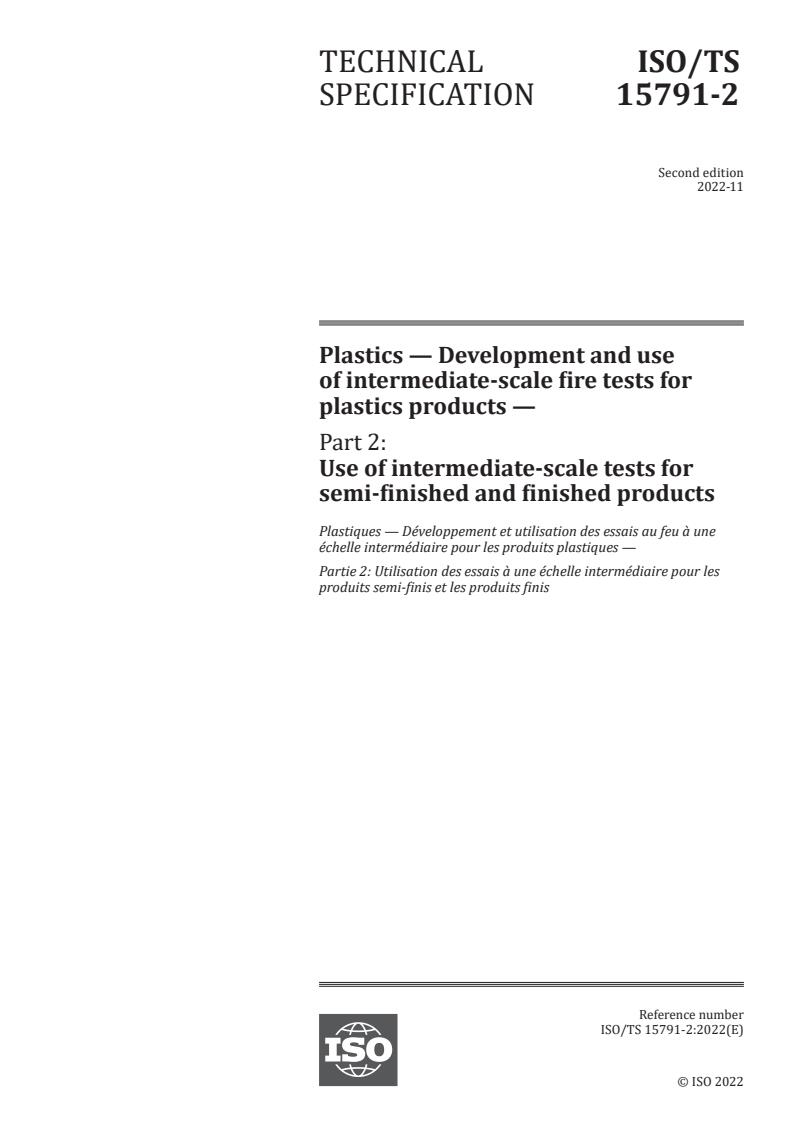
TECHNICAL ISO/TS
SPECIFICATION 15791-2
Second edition
2022-11
Plastics — Development and use
of intermediate-scale fire tests for
plastics products —
Part 2:
Use of intermediate-scale tests for
semi-finished and finished products
Plastiques — Développement et utilisation des essais au feu à une
échelle intermédiaire pour les produits plastiques —
Partie 2: Utilisation des essais à une échelle intermédiaire pour les
produits semi-finis et les produits finis
Reference number
© ISO 2022
All rights reserved. Unless otherwise specified, or required in the context of its implementation, no part of this publication may
be reproduced or utilized otherwise in any form or by any means, electronic or mechanical, including photocopying, or posting on
the internet or an intranet, without prior written permission. Permission can be requested from either ISO at the address below
or ISO’s member body in the country of the requester.
ISO copyright office
CP 401 • Ch. de Blandonnet 8
CH-1214 Vernier, Geneva
Phone: +41 22 749 01 11
Email: copyright@iso.org
Website: www.iso.org
Published in Switzerland
ii
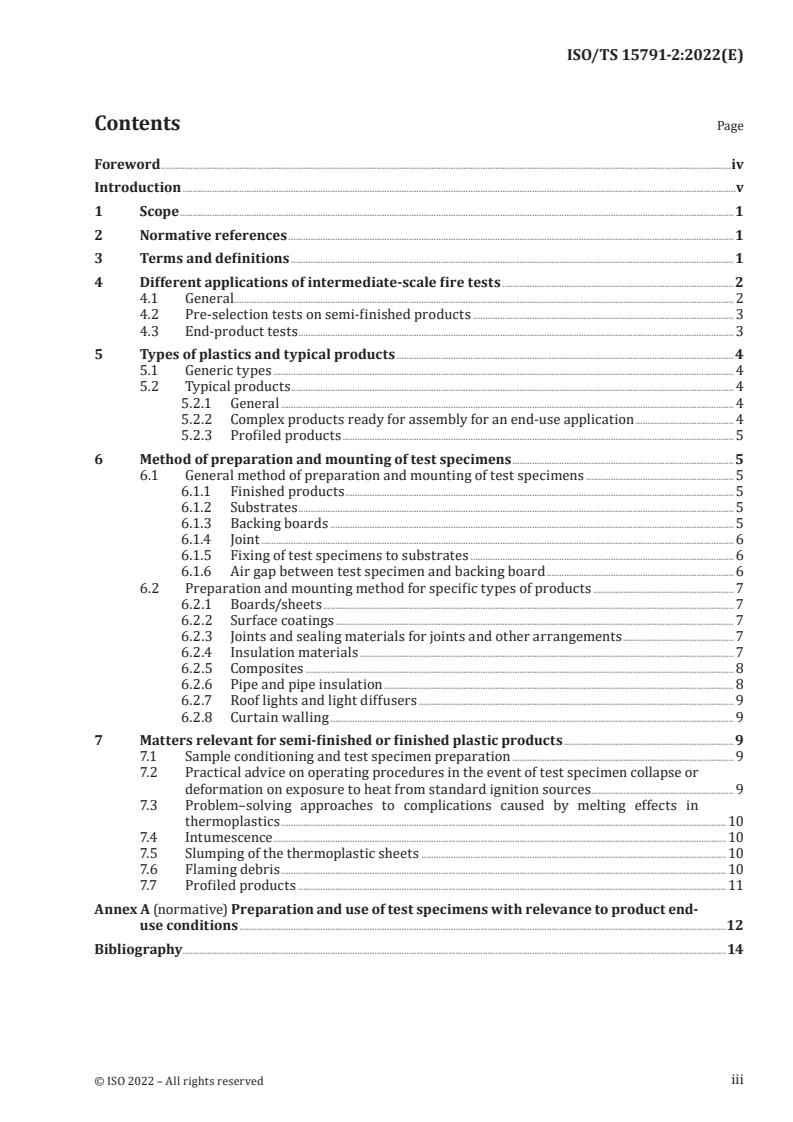
Contents Page
Foreword .iv
Introduction .v
1 Scope . 1
2 Normative references . 1
3 Terms and definitions . 1
4 Different applications of intermediate-scale fire tests . 2
4.1 General . 2
4.2 Pre-selection tests on semi-finished products . 3
4.3 End-product tests . 3
5 Types of plastics and typical products . 4
5.1 Generic types . 4
5.2 Typical products . . 4
5.2.1 General . 4
5.2.2 Complex products ready for assembly for an end-use application . 4
5.2.3 Profiled products . 5
6 Method of preparation and mounting of test specimens . 5
6.1 General method of preparation and mounting of test specimens . 5
6.1.1 Finished products . 5
6.1.2 Substrates . 5
6.1.3 Backing boards . 5
6.1.4 Joint . 6
6.1.5 Fixing of test specimens to substrates . 6
6.1.6 Air gap between test specimen and backing board . 6
6.2 Preparation and mounting method for specific types of products . 7
6.2.1 Boards/sheets . 7
6.2.2 Surface coatings . 7
6.2.3 Joints and sealing materials for joints and other arrangements . 7
6.2.4 Insulation materials . 7
6.2.5 Composites . 8
6.2.6 Pipe and pipe insulation . 8
6.2.7 Roof lights and light diffusers . 9
6.2.8 Curtain walling . 9
7 Matters relevant for semi-finished or finished plastic products .9
7.1 Sample conditioning and test specimen preparation . 9
7.2 Practical advice on operating procedures in the event of test specimen collapse or
deformation on exposure to heat from standard ignition sources . . 9
7.3 Problem–solving approaches to complications caused by melting effects in
thermoplastics . 10
7.4 Intumescence . 10
7.5 Slumping of the thermoplastic sheets . 10
7.6 Flaming debris . 10
7.7 Profiled products . 11
Annex A (normative) Preparation and use of test specimens with relevance to product end-
use conditions .12
Bibliography .14
iii
Foreword
ISO (the International Organization for Standardization) is a worldwide federation of national standards
bodies (ISO member bodies). The work of preparing International Standards is normally carried out
through ISO technical committees. Each member body interested in a subject for which a technical
committee has been established has the right to be represented on that committee. International
organizations, governmental and non-governmental, in liaison with ISO, also take part in the work.
ISO collaborates closely with the International Electrotechnical Commission (IEC) on all matters of
electrotechnical standardization.
The procedures used to develop this document and those intended for its further maintenance are
described in the ISO/IEC Directives, Part 1. In particular, the different approval criteria needed for the
different types of ISO documents should be noted. This document was drafted in accordance with the
editorial rules of the ISO/IEC Directives, Part 2 (see www.iso.org/directives).
Attention is drawn to the possibility that some of the elements of this document may be the subject of
patent rights. ISO shall not be held responsible for identifying any or all such patent rights. Details of
any patent rights identified during the development of the document will be in the Introduction and/or
on the ISO list of patent declarations received (see www.iso.org/patents).
Any trade name used in this document is information given for the convenience of users and does not
constitute an endorsement.
For an explanation of the voluntary nature of standards, the meaning of ISO specific terms and
expressions related to conformity assessment, as well as information about ISO's adherence to
the World Trade Organization (WTO) principles in the Technical Barriers to Trade (TBT), see
www.iso.org/iso/foreword.html.
This document was prepared by Technical Committee ISO/TC 61, Plastics, Subcommittee SC 4, Burning
behaviour.
This second edition cancels and replaces the first edition (ISO/TS 15791-2:2017), which has been
technically revised.
The main changes are as follows:
— technical update in Clause 4 has been updated;
— the following references have been added:
— ISO 14697 (as a normative reference);
— ISO/TS 17431 (as an informative reference).
A list of all parts in the ISO 15791 series can be found on the ISO website.
Any feedback or questions on this document should be directed to the user’s national standards body. A
complete listing of these bodies can be found at www.iso.org/members.html.
iv
Introduction
The major benefit in intermediate-scale testing is the ability to reflect more accurately the fire
conditions of real fires than small-scale tests. For example:
— Specimen mounting. Specimens can incorporate end-use fixings, joints and air-gaps (see Annex A)
in the larger test apparatus. In addition, thick and/or profiled products may be accommodated. This
capability is valuable for testing thick multilayer composites (such as sandwich structures). It is
also useful for testing profiled product such as pipes, pipe insulations, cable trays, GRP frames and
similar products.
— Test specimen size and orientation. Intermediate-scale tests allow to evaluate fire growth. The
ability to measure flame spread beyond the impingement zone of the ignition source is a desirable
feature.
— Observation of actual phenomena of products (especially thermoplastics) exposed to ignition
sources. Representative behaviour may be observed with intermediate-scale test specimens.
[11]
The test results may be useful to the manufacturers of the products and regulation authorities .
However, intermediate-scale tests may have the following disadvantages because of their large scale.
— Intermediate-scale tests may develop an increased amount of fire effluent.
— Intermediate-scale tests may require higher cost.
— An intermediate-scale test may limit the fire scenario and cannot realize a wide range of fire
behaviours.
An intermediate-scale test can be used as a screening test for large-scale tests for the purpose of
research and product development.
In addition to the usage mentioned above, this document has been prepared for manufacturers of
semi-finished plastics products. These semi-finished products may be tested for production control or
developmental reasons. They cannot always be tested in the end-use conditions (such as mounting and
fixing) that are appropriate for finished products.
This document is intended to support the information that product manufacturers may require as part
of a quality assurance scheme. In addition, it should be recognized that this document is not intended
to replace finished product technical specifications for products containing a semi-finished plastics
component.
The information given in this document is in accordance with the principles recommended in ISO 10840,
which was established to develop a general policy and philosophy for the development and use of fire
tests for plastics.
v
TECHNICAL SPECIFICATION ISO/TS 15791-2:2022(E)
Plastics — Development and use of intermediate-scale fire
tests for plastics products —
Part 2:
Use of intermediate-scale tests for semi-finished and
finished products
1 Scope
This document provides guidelines and specifies requirements for the development and use of
intermediate-scale fire tests applicable to semi-finished and finished products made of, or containing,
plastics.
This document covers typical applications of such tests, as well as methods of preparation and mounting
of test specimens.
This document applies to planar, linear or profiled plastics products. These products can be tested in
horizontal or vertical orientation.
This document defines the parameters to be measured, the way that test results are expected to be
reported and explains how they can be used for direct product assessment or as input data for scaling
studies.
2 Normative references
The following documents are referred to in the text in such a way that some or all of their content
constitutes requirements of this document. For dated references, only the edition cited applies. For
undated references, the latest edition of the referenced document (including any amendments) applies.
ISO 834-12, Fire resistance tests — Elements of building construction — Part 12: Specific requirements for
separating elements evaluated on less than full scale furnaces
ISO 10840, Plastics — Guidance for the use of standard fire tests
ISO 13943, Fire safety — Vocabulary
ISO 14697, Reaction-to-fire tests — Guidance on the choice of substrates for building and transport products
ISO 25762, Plastics — Guidance on the assessment of the fire characteristics and fire performance of fibre-
reinforced polymer composites
ISO 30021, Plastics — Burning behaviour — Intermediate-scale fire-resistance testing of fibre-reinforced
polymer composites
3 Terms and definitions
For the purposes of this document, the terms and definitions given in ISO 10840, ISO 13943 and the
following apply.
ISO and IEC maintain terminology databases for use in standardization at the following addresses:
— ISO Online browsing platform: available at https:// www .iso .org/ obp
— IEC Electropedia: available at https:// www .electropedia .org/
3.1
end-use application
real application of a product including method of installation
3.2
finished product
manufactured article ready for end-use
3.3
intermediate-scale fire test
fire test performed on a test specimen (3.9) of smaller dimensions than the final end-use product/system
3.4
pre-selection test
test which provides data for the process of assessing and choosing candidate materials, components or
subassemblies for making an end-product
3.5
product parameter
aspect of a product which may vary and which may have an influence on the product’s fire performance,
e.g. thickness, composition and density
3.6
profiled product
homogenous product with a non-planar surface
3.7
sample
representative part of a manufactured product or piece of a material or semi-finished product (3.8)
3.8
semi-finished product
manufactured article ready for assembly for an end-use application (3.1)
3.9
test specimen
test piece that may be cut from a sample of a product, or prepared by moulding or otherwise, as specified
by the test procedure, or a representative sample of the product itself
4 Different applications of intermediate-scale fire tests
4.1 General
The intermediate-scale fire test can be used for direct product assessment when a test specimen of a
finished product can be tested in end-use conditions.
Intermediate-scale tests can evaluate several parameters such as ignitability, flame spread, orientation
and the mounting effects of products. These parameters may be used to indicate the behaviour of
products in large-scale or full-scale fire tests.
An intermediate-scale tests may be used
— as a pre-selection test to evaluate the influence of product parameters on the fire behaviour of semi-
finished products and to aid the development process, and/or
— to evaluate, as far as possible, end-use conditions.
The ways in which different types of tests are used are explained in the following subclauses.
4.2 Pre-selection tests on semi-finished products
An intermediate-scale test can be used as a pre-selection test
— to aid the selection of materials, components and sub-assemblies during the design stage when
small-scale tests are not appropriate because of the complexity of the product, and/or
— to study the influence of product parameters on the fire behaviour of the products.
4.3 End-product tests
If it is possible to reproduce the end-use condition for a product, the test should be conducted in such
condition. The test should reflect the end-use application scenario as far as possible. Important factors
to consider include relevance of configuration, orientation, ventilation and the nature of the ignition
source.
Reaction-to-fire testing for fire safety and for fire hazard assessment of products should be programmed
as follows:
a) define the relevant product-application (or misuse) scenario;
b) specify the fire hazard to be assessed (e.g. vision impairment by smoke) and the required safety
criteria;
c) select the appropriate test method;
d) conduct the tests and analyse the data with respect to the defined criteria;
e) select acceptable or unacceptable for the candidate materials or products.
Intermediate-scale fire test methods permit measurements of the principal fire parameters (ignitability,
spread of flame, heat release, ignited droplets, smoke effluent gases).
NOTE A guide for extended application is found in EN/TS 15117.
Table 1 summarizes which test methods with an intermediate test specimen can be used and which
measurements are possible.
Table 1 — Examples of the applicability of intermediate-scale fire tests
Use/ Test methods
measurements
ISO 9239-1
a
ISO 5658-4 ISO 21367 ISO/TS 17431 ISO 14696
ISO 9239-2
Preselection Only for flat
Yes Yes Yes Yes
test products
Only for vertical Only for vertical Only for flat Only for vertical
product product products product
End-product Only for horizontal
Adaptation of Adaptation of Adaptation of
test flat products
test specimen for test specimen for test specimen for
profiled product profiled product profiled product
Additional pa- Possible presence Possible pres- Possible pres- Possible pres- Possible presence
rameters of joints ence of joints ence of joints ence of joints of joints
a
The standardized size of the test specimen is 1,5 m × 1,0 m. This method could apply on a test specimen with reduced
size (e.g. 1 m × 1 m).
b
Measurement using Fourier transform infrared (FTIR) spectroscopy following the guidance of ISO 19702 is technically
possible, but has not been standardized. Care should be taken concerning the dilution of the fire effluent and the limits of
quantification.
TTabablele 1 1 ((ccoonnttiinnueuedd))
Use/ Test methods
measurements
ISO 9239-1
a
ISO 5658-4 ISO 21367 ISO/TS 17431 ISO 14696
ISO 9239-2
Ignitability Yes Yes Yes No Yes
Lateral and Lateral and Lateral and
Only lateral spread Vertical spread of
Spread of flame vertical spread of vertical spread of vertical spread of
of flame flame
flame flame flame
Flash-over No No No Yes No
Ignited droplets No Yes Yes No Yes
Heat release No No Yes Yes Yes
Smoke opacity Yes No Yes Yes Yes
b b b b b
Smoke toxicity No No No No No
a
The standardized size of the test specimen is 1,5 m × 1,0 m. This method could apply on a test specimen with reduced
size (e.g. 1 m × 1 m).
b
Measurement using Fourier transform infrared (FTIR) spectroscopy following the guidance of ISO 19702 is technically
possible, but has not been standardized. Care should be taken concerning the dilution of the fire effluent and the limits of
quantification.
5 Types of plastics and typical products
5.1 Generic types
All of the following types of plastics materials or products can be involved in a fire performance
assessment:
— thermoplastics;
— thermosets;
— fibre-reinforced polymer composites;
— honeycomb composites contained plastics;
— sandwich panels contained cellular plastics.
5.2 Typical products
5.2.1 General
Some applications of plastics which present particular problems in small-scale tests for their fire
performance assessment and which may require the use of intermediate-scale fire testing are described
in 5.2.2 and 5.2.3.
5.2.2 Complex products ready for assembly for an end-use application
Composite products ready for assembly for an end-use application may be tested as semi-finished
products. They include:
— boards/sheets with coating and joints;
— insulation materials with surface covering layers;
— composites:
— laminates, e.g. melamine-formaldehyd
...
Questions, Comments and Discussion
Ask us and Technical Secretary will try to provide an answer. You can facilitate discussion about the standard in here.
Loading comments...