


ISO 10093:2020
(Main)Plastics — Fire tests — Standard ignition sources
Plastics — Fire tests — Standard ignition sources
This document describes and classifies a range of laboratory ignition sources for use in fire tests on plastics and products consisting substantially of plastics. These sources vary in intensity and area of impingement. They are suitable for use to simulate the initial thermal abuse to which plastics are potentially exposed in certain actual fire risk scenarios. This compilation of standard ignition sources describes the ignition sources used by different standards development organizations and contained in standard test methods, specifications, or regulations used to assess the fire properties or plastics and of products containing plastic materials. The ignition sources described in this document are associated with flaming and non-flaming ignition. This document describes the relevant ignition sources and references the associated standard. This compilation of ignition sources does not discuss the application of the standard referenced in any specific clause in which the ignition source is described, and this compilation is likely not to be a fully comprehensive list of ignition sources. This document does not address detailed test procedures.
Plastiques — Essais au feu — Sources d'allumage normalisées
General Information
- Status
- Published
- Publication Date
- 03-Dec-2020
- Technical Committee
- ISO/TC 61/SC 4 - Burning behaviour
- Drafting Committee
- ISO/TC 61/SC 4/WG 8 - Ignitability and fire growth
- Current Stage
- 9093 - International Standard confirmed
- Start Date
- 20-Mar-2026
- Completion Date
- 21-Mar-2026
Relations
- Effective Date
- 23-Apr-2020
Overview
ISO 10093:2020 - Plastics - Fire tests - Standard ignition sources is an ISO compilation of laboratory ignition sources used in fire testing of plastics and products made substantially of plastics. The document describes and classifies a wide range of flaming and non‑flaming ignition sources (smouldering cigarettes, glow/hot wires, radiant heaters, diffusion and premixed flames, burners, wood cribs, etc.) and references the associated test standards. It is intended to help simulate realistic initial thermal abuse scenarios while providing consistency and repeatability for laboratory assessments.
Key topics and technical coverage
- Classification of ignition sources: flaming vs non‑flaming, diffusion vs premixed flames, smouldering (cigarette) sources.
- Ignition source characteristics: intensity, area of impingement, and typical uses for different test scales.
- Catalogue of commonly used laboratory sources, with examples found in standards development and test methods, including:
- Smouldering cigarette sources (traditional and reduced‑ignition‑propensity types).
- Glow‑wire and hot‑wire electrical ignition sources (references to IEC glow‑wire methods).
- Radiant sources and cone calorimeter heaters (ISO 5660), conical radiant heaters, glowbars and LIFT radiant panels.
- Diffusion flame sources such as needle flames, burning matches, burners producing 50 W / 500 W flames.
- Premixed burners (e.g., 1 kW premixed flame), larger burners used in room‑corner and cable tray tests (20 kW venturi burners, ISO 9705 referenced).
- Other sources: wood cribs, paper bags, infrared heaters and specialized burners for cable and product tests.
- Normative referencing: the standard points to detailed test standards (e.g., ISO 5660‑1, ISO 5659‑2, ISO 11925‑2, IEC 60695 series) rather than prescribing detailed procedures itself.
- Limitations: ISO 10093 is a compilation; it does not prescribe test procedures or claim to be fully comprehensive.
Practical applications and users
- Test laboratories and standards developers - to choose and harmonize ignition sources when drafting or comparing reaction‑to‑fire test methods.
- Manufacturers of plastics, components and finished products - to select appropriate ignition scenarios for product development, conformity assessment and design for fire safety.
- Fire safety engineers and regulators - for hazard assessment, test selection and interpreting which laboratory ignition sources best simulate real‑world risks.
- Research organizations - to standardize ignition inputs when studying ignition mechanisms or comparing material behaviour.
Related standards (examples)
- ISO 5660 (cone calorimeter heat release and smoke), ISO 5659‑2 (smoke generation), ISO 11925‑2 (single‑flame source), ISO 8191 (furniture ignition sources), IEC 60695 series (glow‑wire and hot‑wire methods).
Keywords: ISO 10093:2020, standard ignition sources, plastics fire tests, cone calorimeter, glow‑wire, needle flame, smouldering cigarette, radiant heater, flame spread, fire safety.
Buy Documents
ISO 10093:2020 - Plastics -- Fire tests -- Standard ignition sources
ISO 10093:2020 - Plastics — Fire tests — Standard ignition sources/4/2020
Get Certified
Connect with accredited certification bodies for this standard
NSF International
Global independent organization facilitating standards development and certification.

Smithers Quality Assessments
US management systems and product certification.

CIS Institut d.o.o.
Personal Protective Equipment (PPE) certification body. Notified Body NB-2890 for EU Regulation 2016/425 PPE.
Sponsored listings
Frequently Asked Questions
ISO 10093:2020 is a standard published by the International Organization for Standardization (ISO). Its full title is "Plastics — Fire tests — Standard ignition sources". This standard covers: This document describes and classifies a range of laboratory ignition sources for use in fire tests on plastics and products consisting substantially of plastics. These sources vary in intensity and area of impingement. They are suitable for use to simulate the initial thermal abuse to which plastics are potentially exposed in certain actual fire risk scenarios. This compilation of standard ignition sources describes the ignition sources used by different standards development organizations and contained in standard test methods, specifications, or regulations used to assess the fire properties or plastics and of products containing plastic materials. The ignition sources described in this document are associated with flaming and non-flaming ignition. This document describes the relevant ignition sources and references the associated standard. This compilation of ignition sources does not discuss the application of the standard referenced in any specific clause in which the ignition source is described, and this compilation is likely not to be a fully comprehensive list of ignition sources. This document does not address detailed test procedures.
This document describes and classifies a range of laboratory ignition sources for use in fire tests on plastics and products consisting substantially of plastics. These sources vary in intensity and area of impingement. They are suitable for use to simulate the initial thermal abuse to which plastics are potentially exposed in certain actual fire risk scenarios. This compilation of standard ignition sources describes the ignition sources used by different standards development organizations and contained in standard test methods, specifications, or regulations used to assess the fire properties or plastics and of products containing plastic materials. The ignition sources described in this document are associated with flaming and non-flaming ignition. This document describes the relevant ignition sources and references the associated standard. This compilation of ignition sources does not discuss the application of the standard referenced in any specific clause in which the ignition source is described, and this compilation is likely not to be a fully comprehensive list of ignition sources. This document does not address detailed test procedures.
ISO 10093:2020 is classified under the following ICS (International Classification for Standards) categories: 13.220.40 - Ignitability and burning behaviour of materials and products; 83.080.01 - Plastics in general. The ICS classification helps identify the subject area and facilitates finding related standards.
ISO 10093:2020 has the following relationships with other standards: It is inter standard links to ISO/TR 10093:2018. Understanding these relationships helps ensure you are using the most current and applicable version of the standard.
ISO 10093:2020 is available in PDF format for immediate download after purchase. The document can be added to your cart and obtained through the secure checkout process. Digital delivery ensures instant access to the complete standard document.
Standards Content (Sample)
INTERNATIONAL ISO
STANDARD 10093
Third edition
2020-12
Plastics — Fire tests — Standard
ignition sources
Plastiques — Essais au feu — Sources d'allumage normalisées
Reference number
©
ISO 2020
© ISO 2020
All rights reserved. Unless otherwise specified, or required in the context of its implementation, no part of this publication may
be reproduced or utilized otherwise in any form or by any means, electronic or mechanical, including photocopying, or posting
on the internet or an intranet, without prior written permission. Permission can be requested from either ISO at the address
below or ISO’s member body in the country of the requester.
ISO copyright office
CP 401 • Ch. de Blandonnet 8
CH-1214 Vernier, Geneva
Phone: +41 22 749 01 11
Email: copyright@iso.org
Website: www.iso.org
Published in Switzerland
ii © ISO 2020 – All rights reserved
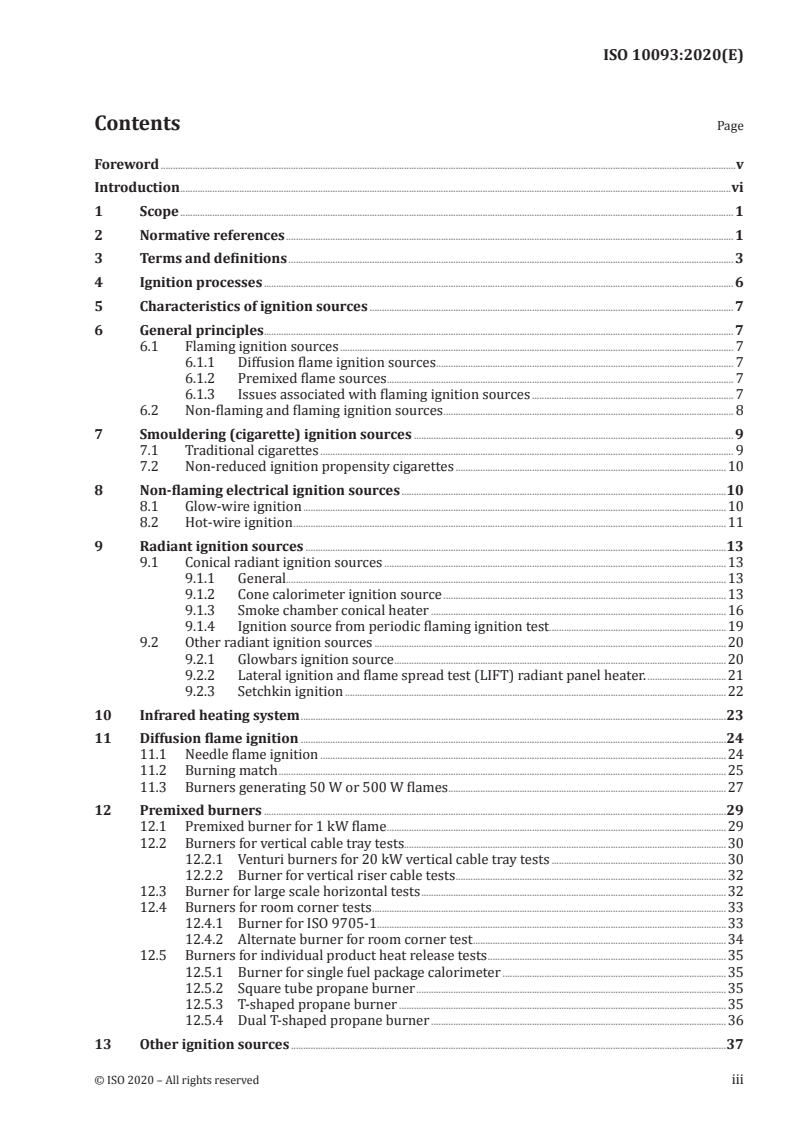
Contents Page
Foreword .v
Introduction .vi
1 Scope . 1
2 Normative references . 1
3 Terms and definitions . 3
4 Ignition processes . 6
5 Characteristics of ignition sources . 7
6 General principles . 7
6.1 Flaming ignition sources . 7
6.1.1 Diffusion flame ignition sources . 7
6.1.2 Premixed flame sources . . 7
6.1.3 Issues associated with flaming ignition sources . 7
6.2 Non-flaming and flaming ignition sources . 8
7 Smouldering (cigarette) ignition sources . 9
7.1 Traditional cigarettes . 9
7.2 Non-reduced ignition propensity cigarettes .10
8 Non-flaming electrical ignition sources .10
8.1 Glow-wire ignition .10
8.2 Hot-wire ignition .11
9 Radiant ignition sources .13
9.1 Conical radiant ignition sources .13
9.1.1 General.13
9.1.2 Cone calorimeter ignition source .13
9.1.3 Smoke chamber conical heater .16
9.1.4 Ignition source from periodic flaming ignition test . .19
9.2 Other radiant ignition sources .20
9.2.1 Glowbars ignition source .20
9.2.2 Lateral ignition and flame spread test (LIFT) radiant panel heater. .21
9.2.3 Setchkin ignition .22
10 Infrared heating system .23
11 Diffusion flame ignition .24
11.1 Needle flame ignition .24
11.2 Burning match .25
11.3 Burners generating 50 W or 500 W flames .27
12 Premixed burners .29
12.1 Premixed burner for 1 kW flame .29
12.2 Burners for vertical cable tray tests.30
12.2.1 Venturi burners for 20 kW vertical cable tray tests .30
12.2.2 Burner for vertical riser cable tests .32
12.3 Burner for large scale horizontal tests .32
12.4 Burners for room corner tests .33
12.4.1 Burner for ISO 9705-1.33
12.4.2 Alternate burner for room corner test .34
12.5 Burners for individual product heat release tests .35
12.5.1 Burner for single fuel package calorimeter .35
12.5.2 Square tube propane burner .35
12.5.3 T-shaped propane burner .35
12.5.4 Dual T-shaped propane burner .36
13 Other ignition sources .37
13.1 Wood cribs .37
13.2 Paper bags .37
iv © ISO 2020 – All rights reserved
Foreword
ISO (the International Organization for Standardization) is a worldwide federation of national standards
bodies (ISO member bodies). The work of preparing International Standards is normally carried out
through ISO technical committees. Each member body interested in a subject for which a technical
committee has been established has the right to be represented on that committee. International
organizations, governmental and non-governmental, in liaison with ISO, also take part in the work.
ISO collaborates closely with the International Electrotechnical Commission (IEC) on all matters of
electrotechnical standardization.
The procedures used to develop this document and those intended for its further maintenance are
described in the ISO/IEC Directives, Part 1. In particular, the different approval criteria needed for the
different types of ISO documents should be noted. This document was drafted in accordance with the
editorial rules of the ISO/IEC Directives, Part 2 (see www .iso .org/ directives).
Attention is drawn to the possibility that some of the elements of this document may be the subject of
patent rights. ISO shall not be held responsible for identifying any or all such patent rights. Details of
any patent rights identified during the development of the document will be in the Introduction and/or
on the ISO list of patent declarations received (see www .iso .org/ patents).
Any trade name used in this document is information given for the convenience of users and does not
constitute an endorsement.
For an explanation of the voluntary nature of standards, the meaning of ISO specific terms and
expressions related to conformity assessment, as well as information about ISO's adherence to the
World Trade Organization (WTO) principles in the Technical Barriers to Trade (TBT), see www .iso .org/
iso/ foreword .html.
This document was prepared by Technical Committee ISO/TC 61, Plastics, Subcommittee SC 4, Burning
behaviour.
This third edition cancels and replaces the second edition (ISO/TR 10093:2018), which has been
technically revised.
The main changes compared to the previous edition are as follows:
— mandatory information have been added throughout the document;
— referenced standards have been deleted from the bibliography and moved to the normative
references clause (see Clause 2).
Any feedback or questions on this document should be directed to the user’s national standards body. A
complete listing of these bodies can be found at www .iso .org/ members .html.
Introduction
Fires are caused by a wide range of possible ignition sources. Statistical analysis of fires has identified
the major primary and secondary sources, especially for fires in buildings. The most frequent sources
of fires have been found to be as follows:
a) cooking appliances;
b) space-heating appliances;
c) electric wiring, connectors and terminations;
d) other electrical appliances (such as washing machines, bedwarmers, televisions, water heaters);
e) cigarettes;
f) matches and smokers' gas lighters;
g) blow-lamps, blow-torches and welding torches;
h) rubbish burning; and
i) candles.
This list covers the major primary ignition sources for accidental fires. Other sources can be involved
in fires raised maliciously. Research into causes of fires has shown that primary ignition sources
(e.g. glowing cigarettes or dropped flaming matches) can set fire to waste paper, which then acts as a
secondary ignition source of greater intensity.
When analysing and evaluating the various ignition sources for applications involving plastics
materials, it is important to answer the following questions on the basis of detailed fire statistics.
1) What is the significance of the individual ignition sources in various fire risk situations?
2) What proportion is attributable to secondary ignition sources?
3) Where does particular attention have to be paid to secondary ignition sources?
4) To what extent are different ignition sources responsible for fatal fire accidents?
The laboratory ignition sources described in this document are intended to simulate actual ignition
sources that have been shown to be the cause of real fires involving plastics. Laboratory ignition
sources are preferred over actual ignition sources due to their consistency, which results in greater
data repeatability within a laboratory and greater reproducibility between laboratories.
These laboratory ignition sources can be used to develop new test procedures.
vi © ISO 2020 – All rights reserved
INTERNATIONAL STANDARD ISO 10093:2020(E)
Plastics — Fire tests — Standard ignition sources
1 Scope
This document describes and classifies a range of laboratory ignition sources for use in fire tests on
plastics and products consisting substantially of plastics. These sources vary in intensity and area
of impingement. They are suitable for use to simulate the initial thermal abuse to which plastics are
potentially exposed in certain actual fire risk scenarios.
This compilation of standard ignition sources describes the ignition sources used by different
standards development organizations and contained in standard test methods, specifications, or
regulations used to assess the fire properties or plastics and of products containing plastic materials.
The ignition sources described in this document are associated with flaming and non-flaming ignition.
This document describes the relevant ignition sources and references the associated standard.
This compilation of ignition sources does not discuss the application of the standard referenced in any
specific clause in which the ignition source is described, and this compilation is likely not to be a fully
comprehensive list of ignition sources.
This document does not address detailed test procedures.
2 Normative references
The following documents are referred to in the text in such a way that some or all of their content
constitutes requirements of this document. For dated references, only the edition cited applies. For
undated references, the latest edition of the referenced document (including any amendments) applies.
ISO 871, Plastics — Determination of ignition temperature using a hot-air furnace
ISO 5657, Reaction to fire tests — Ignitability of building products using a radiant heat source
ISO 5658-2, Reaction to fire tests — Spread of flame — Part 2: Lateral spread on building and transport
products in vertical configuration
ISO 5659-2, Plastics — Smoke generation — Part 2: Determination of optical density by a single-chamber test
ISO 5660-1, Reaction-to-fire tests — Heat release, smoke production and mass loss rate — Part 1: Heat
release rate (cone calorimeter method) and smoke production rate (dynamic measurement)
ISO 8191-1, Furniture — Assessment of the ignitability of upholstered furniture — Part 1: Ignition source:
smouldering cigarette
ISO 8191-2, Furniture — Assessment of ignitability of upholstered furniture — Part 2: Ignition source:
match-flame equivalent
ISO 9705-1, Reaction to fire tests — Room corner test for wall and ceiling lining products — Part 1: Test
method for a small room configuration
ISO 11925-2, Reaction to fire tests — Ignitability of products subjected to direct impingement of flame —
Part 2: Single-flame source test
ISO 12136, Reaction to fire tests — Measurement of material properties using a fire propagation apparatus
ISO 12863, Standard test method for assessing the ignition propensity of cigarettes
ISO 12949, Standard test method for measuring the heat release rate of low flammability mattresses and
mattress sets
ISO 13943, Fire safety — Vocabulary
IEC 60332-1-1, Tests on electric and optical fibre cables under fire conditions — Part 1-1 Test for vertical
flame propagation for a single insulated wire or cable — Apparatus
IEC 60332-1-2, Tests on electric and optical fibre cables under fire conditions — Part 1-2: Test for vertical
flame propagation for a single insulated wire or cable — Procedure for 1 kW pre-mixed flame
IEC 60332-3-10, Tests on electric and optical fibre cables under fire conditions — Part 3-10: Test for vertical
flame spread of vertically-mounted bunched wires or cables — Apparatus
IEC 60695-1-21, Fire hazard testing — Part 1-21: Guidance for assessing the fire hazard of electrotechnical
products – Ignitability — Summary and relevance of test methods
IEC 60695-2-10, Fire hazard testing — Part 2-10: Glowing/hot-wire based test methods — Glow–wire
apparatus and common test procedure
IEC 60695-2-11, Fire hazard testing — Part 2-11: Glowing/hot-wire based test methods — Glow-wire
flammability test method for end-products (GWEPT)
IEC 60695-2-12, Fire hazard testing — Part 2-12: Glowing/hot-wire based test methods — Glow-wire
flammability index (GWFI) test method for materials
IEC 60695-2-13, Fire hazard testing — Part 2-13: Glowing/hot-wire based test methods — Glow-wire
ignition temperature (GWIT) test method for materials
IEC/TS 60695-2-20, Fire hazard testing — Part 2-20: Glowing/hot-wire based test methods — Hot wire
ignition test — Apparatus, confirmatory test arrangement and guidance (withdrawn)
IEC/TS 60695-11-2, Fire hazard testing — Part 11-2: Test flames — 1 kW pre-mixed flame — Apparatus,
confirmatory test arrangement and guidance
IEC 60695-11-3, Fire hazard testing — Part 11-3: Test flames — 500 W flames — Apparatus and
confirmational test methods
IEC 60695-11-4, Fire hazard testing — Part 11-4: Test flames — 50 W flame — Apparatus and
confirmational test method
IEC 60695-11-5, Fire hazard testing — Part 11-4: Test flames — Needle-flame test method — Apparatus,
confirmatory test arrangement and guidance
IEC 60695-11-10, Fire hazard testing — Part 11-10: Test flames — 50 W horizontal and vertical flame
test methods
IEC 60695-11-20, Fire hazard testing — Part 11-20: Test flames — 500 W flame test method
ASTM D635, Standard Test Method for Rate of Burning and/or Extent and Time of Burning of Plastics in a
Horizontal Position
ASTM D1929, Standard Test Method for Determining Ignition Temperature of Plastics
ASTM D3874, Standard Test Method for Ignition of Materials by Hot Wire Sources
ASTM D5025, Standard specification for a laboratory burner used for small-scale burning tests on plastic
materials
ASTM D5424, Standard Test Method for Smoke Obscuration of Insulating Materials Contained in Electrical
or Optical Fiber Cables When Burning in a Vertical Cable Tray Configuration
ASTM D5537, Standard Test Method for Heat Release, Flame Spread, Smoke Obscuration, and Mass Loss
Testing of Insulating Materials Contained in Electrical or Optical Fiber Cables When Burning in a Vertical
Cable Tray Configuration
2 © ISO 2020 – All rights reserved
ASTM D6194, Standard Test Method for Glow-Wire Ignition of Materials
ASTM E84, Standard Test Method for Surface Burning Characteristics of Building Materials
ASTM E136, Standard Test Method for Behavior of Materials in a Vertical Tube Furnace at 750 °C
ASTM E662, Standard Test Method for Specific Optical Density of Smoke Generated by Solid Materials
ASTM E906/E906M, Standard Test Method for Heat and Visible Smoke Release Rates for Materials and
Products Using a Thermopile Method
ASTM E1321, Standard Test Method for Determining Material Ignition and Flame Spread Properties
ASTM E1354Standard Test Method for Heat and Visible Smoke Release Rates for Materials and Products
Using an Oxygen Consumption Calorimeter
ASTM E1537, Standard Test Method for Fire Testing of Upholstered Furniture
ASTM E1590, Standard Test Method for Fire Testing of Mattresses
ASTM E1822, Standard Test Method for Fire Testing of Stacked Chairs
ASTM E1995, Standard Test Method for Measurement of Smoke Obscuration Using a Conical Radiant Source
in a Single Closed Chamber, With the Test Specimen Oriented Horizontally
ASTM E2058, Standard Test Methods for Measurement of Material Flammability Using a Fire Propagation
Apparatus (FPA)
ASTM E2187, Standard Test Method for Measuring the Ignition Strength of Cigarettes
ASTM E2257, Standard Test Method for Room Fire Test of Wall and Ceiling Materials and Assemblies
ASTM E2574/E2574M, Standard Test Method for Fire Testing of School Bus Seat Assemblies
NFPA 260, Standard Methods of Tests and Classification System for Cigarette Ignition Resistance of
Components of Upholstered Furniture
NFPA 261, Standard Method of Test for Determining Resistance of Mock-Up Upholstered Furniture Material
Assemblies to Ignition by Smoldering Cigarettes
NFPA 262, Standard Method of Test for Flame Travel and Smoke of Wires and Cables for Use in Air-
Handling Spaces
NFPA 265, Standard Methods of Fire Tests for Evaluating Room Fire Growth Contribution of Textile or
Expanded Vinyl Wall Coverings on Full Height Panels and Walls
NFPA 270, Standard Test Method for Measurement of Smoke Obscuration Using a Conical Radiant Source in
a Single Closed Chamber
NFPA 286, Standard Methods of Fire Tests for Evaluating Contribution of Wall and Ceiling Interior Finish to
Room Fire Growth
NFPA 287, Standard Test Methods for Measurement of Flammability of Materials in Cleanrooms Using a
Fire Propagation Apparatus (FPA)
NFPA 289, Standard Method of Fire Test for Individual Fuel Packages
UL 1666, Standard for Test for Flame Propagation Height of Electrical and Optical-Fibre Cables Installed
Vertically in Shafts
3 Terms and definitions
For the purposes of this document, the terms and definitions given in ISO 13943 and the following apply.
ISO and IEC maintain terminological databases for use in standardization at the following addresses:
— ISO Online browsing platform: available at https:// www .iso .org/ obp
— IEC Electropedia: available at http:// www .electropedia .org/
3.1
afterflame
flame (3.8) that persists after the ignition source has been removed
[SOURCE: ISO 13943:2017, 3.11]
3.2
afterflame time
length of time for which an afterflame (3.1) persists under specified conditions
[SOURCE: ISO 13943:2017, 3.12]
3.3
afterglow
persistence of glowing combustion after both removal of the ignition source and the cessation of any
flaming combustion
[SOURCE: ISO 13943:2017, 3.13]
3.4
afterglow time
length of time for which an afterglow (3.3) persists under specified conditions
[SOURCE: ISO 13943:2017, 3.14]
3.5
combustion
exothermic reaction of a substance with an oxidizing agent
[SOURCE: ISO 13943:2017, 3.55, modified — note has been omitted.]
3.6
ease of ignition
measure of the ease with which a test specimen can be ignited, under specified conditions
[SOURCE: ISO 13943:2017, 3.212]
3.7
exposed surface
surface of a test specimen subjected to the heating conditions of a fire test
[SOURCE: ISO 13943:2017, 3.106]
3.8
flame, noun
rapid, self-sustaining, sub-sonic propagation of combustion (3.5) in a gaseous medium, usually with
emission of light
[SOURCE: ISO 13943:2017, 3.159]
3.9
flame, verb
produce flame (3.8)
[SOURCE: ISO 13943:2017, 3.160]
4 © ISO 2020 – All rights reserved
3.10
flaming debris
burning material separating from a burning item and continuing to flame (3.9) on the floor, during a fire
or fire test
Note 1 to entry: Alternatively, flaming debris can be burning material, other than drops, which has detached
from a test specimen during a fire or fire test and continues to burn.
Note 2 to entry: Compare with the terms flaming droplets (3.11).
[SOURCE: ISO 13943:2017, 3.176]
3.11
flaming droplets
flaming molten or flaming liquefied drops which fall from the test specimen during the fire test and
continue to burn on the floor
Note 1 to entry: Compare with the term flaming debris (3.10).
[SOURCE: ISO 13943:2017, 3.177]
3.12
glowing combustion
combustion (3.5) of a material in the solid phase without flame (3.8) but with emission of light from the
combustion zone
[SOURCE: ISO 13943:2017, 3.197]
3.13
ignitability
measure of the ease with which a specimen can be ignited (3.14), under specified conditions
[SOURCE: ISO 13943:2017, 3.212]
3.14
ignite, transitive verb
initiate combustion (3.5)
[SOURCE: ISO 13943:2017, 3.215]
3.15
ignite, intransitive verb
catch fire with or without the application of an external heat source
[SOURCE: ISO 13943:2017, 3.214]
3.16
ignition
initiation of combustion (3.5)
[SOURCE: ISO 13943:2017, 3.217]
3.17
ignition source
source of energy that initiates combustion (3.5)
[SOURCE: ISO 13943:2017, 3.219]
3.18
ignition time
duration of exposure of a test specimen to a defined ignition source (3.17) required for the initiation of
sustained combustion (3.5) under specified conditions
[SOURCE: ISO 13943:2017, 3.220]
3.19
irradiance
ratio of the radiant flux incident on a small but measurable element of surface containing the point, by
the area of that element
[SOURCE: ISO 13943:2017, 3.236]
3.20
minimum ignition temperature
minimum temperature of a material at which sustained combustion (3.5) can be initiated under
specified test conditions
[SOURCE: ISO 13943:2017, 3.327]
3.21
primary ignition source
first applied ignition source (3.17)
3.22
punking
propagation of a smouldering combustion (3.5) front after removal of the ignition source (3.17)
3.23
secondary ignition source
heat source which is activated following ignition (3.16) from a primary source
3.24
sustained flaming
flame (3.8), on or over the surface of a test specimen, which persists for longer than a defined
period of time
Note 1 to entry: Compare with the term transitory flaming (3.25).
[SOURCE: ISO 13943:2017, 3.380]
3.25
transitory flaming
flame (3.8), on or over the surface of a test specimen, which persists for a defined short period of time
Note 1 to entry: Compare with the term sustained flaming (3.24).
[SOURCE: ISO 13943:2017, 3.408]
4 Ignition processes
4.1 When plastics are exposed to thermal energy, flammable vapours are often generated from their
surface. Under suitable conditions (especially high temperatures), it is possible for a critical concentration
of flammable vapour to form and spontaneous ignition to result. If a flame is present as the sole energy
source, or as a supplementary source, the ignition process is then assisted; this mechanism is sometimes
known as piloted ignition.
4.2 A specimen of plastic is regarded as ignited when flames appear on the surface of the plastic or
when glowing combustion is evident.
6 © ISO 2020 – All rights reserved
4.3 After ignition has occurred, some burning plastics create additional fire hazards by forming flaming
debris or drips. If this flaming debris falls on to combustible material, it is possible for a secondary
ignition to occur and for the fire to spread more rapidly.
4.4 The localized application of a heat source to some plastics results in glowing combustion. With
some thermoplastic foams and foams from thermosetting materials, the localized application of a heat
source results in punking which produces a carbonaceous char.
5 Characteristics of ignition sources
5.1 The following factors are the main characteristics describing ignition sources and their relation to
the test specimen:
a) intensity of the ignition source, which is a measure of the thermal load on the specimen resulting
from the combined conduction, convection and radiation effects caused by the ignition source;
b) area of impingement of the ignition source on the specimen;
c) duration of exposure of the specimen and whether it is continuous or intermittent;
d) presentation of the ignition source to the specimen and whether or not it impinges;
e) orientation of the specimen in relation to the ignition source;
f) ventilation conditions in the vicinity of the ignition source and exposed surface of the specimen.
NOTE Factors c) to f) are often a function of the specific fire test conditions.
5.2 Several of the ignition sources provide a range of intensities and areas of impingement to be
considered for use in fire tests of plastics.
5.3 IEC 60695-1-21 provides guidance on ignition sources relevant to the fire testing of electrotechnical
products.
6 General principles
6.1 Flaming ignition sources
6.1.1 Diffusion flame ignition sources
To form a diffusion flame ignition source, a gas (usually propane, methane or butane) flows through
metallic tubes without ingress of air prior to the base of the flame. These flames simulate natural
flames well, but they often fluctuate and are not convenient to direct if it is necessary to point any
angular presentation toward the specimen.
6.1.2 Premixed flame sources
To form a premixed flame source, a gas burner (usually using propane, methane or butane) fitted with
air inlet ports or an air intake manifold is used. Premixed flame sources are typically more directional
than diffusion flame sources and are generally hotter than diffusion flame sources.
6.1.3 Issues associated with flaming ignition sources
Gas burners are always set up to conform to precise gas flow rates and/or flame heights. Periodic checks
of flame temperature or heat flux precede the setup, but criteria on these parameters are not necessarily
an essential part of the laboratory procedure. After setting up the burner for a particular test (i.e. often
at an acute angle to the test specimen), the burner shall be left in this orientation throughout a series
of experiments. This objective is conveniently satisfied if the operator simply maintains the gas flow
constant to the burner.
The gas burners are connected to the gas supply by flexible tubing via a cylinder regulator providing an
outlet pressure, on-off valve, fine-control valve and flowmeter.
Difficulties sometimes occur with the supply and measurement of butane or propane when the cylinders
have been stored in an environment cooler than the defined test conditions and/or some distance from
the test rig. When difficulties occur, a sufficient length of tubing shall be used inside the controlled
environment (15 °C to 30 °C) to ensure that the gas equilibrates to the appropriate temperature before
flow measurement.
NOTE 1 One way to facilitate this equilibration is to pass the gas (before flow measurement) through a metal
tube immersed in water maintained at 25 °C.
It is essential to exercise great care with the measurement and setting of the flow rate of the gas and to
check direct-reading flowmeters, even those obtained with a direct calibration for the gas used initially,
at regular intervals during testing, with a method capable of measuring accurately the absolute gas
flow at the burner tube.
NOTE 2 One way of doing this is to connect the burner tube with a short length of tubing (about 7 mm internal
diameter) to a soap bubble flowmeter. Passage of a soap film meniscus in a glass tube (e.g. a calibrated burette)
over a known period of time gives an absolute measurement of the flow. Also, fine-control valves that can each
be pre-set to one of the desired gas flow rates, with simple means for switching from one to the other, have been
proven helpful.
6.2 Non-flaming and flaming ignition sources
6.2.1 Non-flaming ignition sources shall be classified in the following categories: smouldering
(cigarettes; as required by Clause 7), glow-wire ignition (as required by 8.1), hot-wire ignition (as
required by 8.2), radiant ignition (as required by Clause 9) and infrared heating ignition (as required by
Clause 10). The details shall be as described in Table 1.
6.2.2 Flaming ignition sources shall be as classified in the following categories: diffusion flame ignition
(as required by Clause 11), premixed flame ignition (as required by Clause 12) and other ignition sources
(wood cribs and paper bags, as required by Clause 13). The details shall be as described in Table 1.
The ignition sources shall be as defined in Table 1.
8 © ISO 2020 – All rights reserved
Table 1 — Classification of ignition sources
Type of ignition source Standard(s) using ignition source Clause/subclause
Smouldering (cigarette) ISO 8191-1, NFPA 260, NFPA 261 Clause 7
Non-flaming electrical ignition sources Clause 8
Glow-wire ignition IEC 60695–2–10, IEC 60695–2–11, IEC 8.1
60695-2–12, IEC 60695-2–13, ASTM D6194
Hot-wire ignition IEC/TS 60695–2–20, ASTM D3874 8.2
Radiant ignition sources Clause 9
Conical radiant ignition ISO 5657, ISO 5659-2, ISO 5660-1, 9.1
ASTM E1354, ASTM E1995, NFPA 270
Other radiant ignition ISO 871, ASTM D1929, ASTM E906, 9.2
ISO 5658-2, ASTM E1321
Infrared heating ignition sources ISO 12136, ASTM E2058, NFPA 287 Clause 10
+
Diffusion flame ignition sources Clause 11
Needle flame ignition IEC 60695–11–5 11.1
Burning match ISO 8191-2, ISO 11925-2 11.2
Burners generating 50 W or 500 W flames IEC 60695–11–3, IEC 60695–11–4, 11.3
ASTM D635, ASTM D5025, UL 94
Premixed flame ignition sources Clause 12
Premixed burner for 1 kW flame IEC 60695–11–2, IEC 60332-1–1, 12.1
IEC 60332-1–2
Vertical cable tray burners IEC 60332–3–10, ASTM D5424, ASTM D5537, 12.2
UL 1666, UL 1685, UL 2556
Burners for large scale horizontal tests ASTM E84, NFPA 262 12.3
Burners for room corner tests ISO 9705,-1 ASTM E2257, NFPA 265, 12.4
NFPA 286
Burners for individual product heat release tests ASTM E1537, ASTM E1590, ASTM E1822, 12.5
NFPA 289
Other ignition sources Clause 13
Wood cribs 13.1
Paper bags 13.2
7 Smouldering (cigarette) ignition sources
7.1 Traditional cigarettes
7.1.1 This source is typical of a common commercial cigarette, which is known to cause many fires
involving upholstered furniture and bedding as discussed in ISO 8191-1. The untipped (unfiltered)
cigarette shall comply with the following requirements:
— length: (70 ± 4) mm;
— diameter: (8,0 ± 0,5) mm;
— mass: (1,0 ± 0,1) g;
— smouldering rate: (12,0 ± 3,0) min to reach from 5 mm to 50 mm mark.
7.1.2 The smouldering rate shall be verified on one specimen from each batch of 10 cigarettes used as
follows:
a) condition the cigarette before the test for 72 h in indoor ambient conditions and then for at least
16 h in an atmosphere having a temperature of (20 ± 5) °C and a relative humidity of (50 ± 20) %;
b) mark the cigarette at 5 mm and 55 mm from the end to be lit;
c) light the cigarette and draw air through it until the tip glows brightly; do not consume more than
3 mm of the cigarette in this operation;
d) impale the cigarette in draught-free air on a horizontal wire spike, inserting not more than 13 mm
of the spike into the unlit end of the cigarette;
e) record the time taken to smoulder from the 5 mm to the 55 mm mark.
7.1.3 In many countries, including in the European Union and the United States, regulations that apply
to commercial cigarettes mean that they meet the characteristics of reduced ignition propensity (RIP)
cigarettes, by being tested in accordance with ISO 12863 or ASTM E2187. Thus, such RIP cigarettes have
become replacement commercial cigarettes for the commercial cigarettes available when ISO 8191-1 was
developed. The new commercial RIP cigarettes are less likely to provide a severe smouldering ignition
source than the traditional non-RIP cigarettes.
7.2 Non-reduced ignition propensity cigarettes
Standard reference material cigarettes (SRM 1196) were designed to simulate the ignition strength of
those cigarettes that were in commercial use in the United States before the development of ISO 12863
or ASTM E2187. They have been identified as having a strong ignition potential and do not conform
to the specifications of “reduced ignition propensity cigarettes”. The cigarettes are described as NIST
1)
SRM 1196 cigarettes and they are cigarettes without filter tips, made from natural tobacco (83 ± 2) mm
long with a tobacco packing density of (0,270 ± 0,020) g/cm and a total weight of (1,1 ± 0,1) g. These
cigarettes are used in NFPA 260 and NFPA 261.
8 Non-flaming electrical ignition sources
8.1 Glow-wire ignition
8.1.1 This ignition source is referenced in IEC 60695-2-10, IEC 60695-2-11, IEC 60695-2-12,
IEC 60695-2-13 and ASTM D6194. It is called a glow-wire. This source simulates overheating of electrical
wiring, particularly within electrotechnical equipment by heating the glow-wire to temperatures in the
range of 550 °C (± 10 °C) to 950 °C (± 15 °C) or 960 °C (± 15 °C).
8.1.2 The glow-wire apparatus and ignition source are shown in Figure 1. The glow-wire itself consists
of a loop of nickel/chromium (80/20) wire 4 mm in nominal diameter.
8.1.3 The temperature of the glow-wire shall be measured by the use of a sheathed fine-wire Type K
thermocouple [Nickel–Chromium (NiCr) or Nickel–Aluminium (NiAl)] having a nominal overall diameter
of 0,5 mm or 1,0 mm. The thermocouple sheath shall be constructed of a metal with properties such
that the thermocouple is able to perform its function in air at sheath temperatures of at least 1 050 °C.
The thermocouple shall be arranged in a pocket hole, drilled in the tip of the glow-wire. The thermal
contact between the walls of the bored hole in the glow-wire shall be maintained by pinning the sheathed
thermocouple in place. The thermocouple follows the movement of the tip of the glow-wire resulting
from elongation caused by thermal heating. A temperature indicator for Type K thermocouples capable
of reading up to 1 000 °C shall be used. The supply circuit shall be capable of supplying up to 150 A at
1) Available from the US National Institute of Standards and Technology (NIST), https:// www .nist .gov/ srm/ index
.cfm.
10 © ISO 2020 – All rights reserved
2,1 V, with smooth continuous adjustment of voltage to provide the appropriate current to maintain the
required glow-wire tip temperature.
8.1.4 The test apparatus positions the glow-wire in a horizontal plane while applying a force of
(1,0 ± 0,2) N to the specimen. This force shall be maintained when the glow-wire is moved horizontally
towards the specimen or vice versa. The movement of the tip of the glow-wire into the specimen when
pressed against it shall be mechanically limited to 7 mm.
Key
1 positioning clamp 6 stop
2 carriage 7 scale to measure height of flame
3 tensioning cord 8 scale for penetration
4 baseplate 9 glow-wire
5 weight 10 cut-out in base plate for particles falling from
specimen
Figure 1 — Glow-wire ignition source
8.2 Hot-wire ignition
8.2.1 This ignition source is referenced in IEC/TS 60695-2-20 and in ASTM D3874. It is an electrically
heated hot-wire that simulates the overloading of a live part in direct contact with a test specimen.
8.2.2 The heater wire shall be a loop of iron-free nickel/chromium wire (80 % nickel and 20 %
chromium, iron-free), 0,05 mm in nominal diameter. The wire has a nominal cold resistance of 5,28 Ω/m
and has a length-to-mass ratio of 580 m/kg. The wire length for each test shall be approximately 250 mm
and it shall have been previously calibrated. Before testing, each straight length of wire shall be annealed
by energizing the wire to dissipate 0,26 W/mm of length for 8 s to 12 s to relieve internal wire stress.
8.2.3 The supply circuit used to electrically energize the heater wire shall have sufficient capacity to
maintain a continuous linear 50 Hz to 60 Hz power density of at least 0,31 W/mm over the length of the
heater wire at or near unity power factor. When the supply circuit operates at a current of 60 A with a
voltage of 1,5 V, this results in an approximate power density of 0,3 W/mm. Essential devices include
those for voltage adjustment and power measurement (within ±2 %), an easily actuated on-off switch for
the test power, and timers to record the duration of the application of test power.
8.2.4 Hot-wire ignition tests are carried out on bar-shaped specimens, of dimensions (125 ± 5) mm
long, (13,0 ± 0,3) mm wide and (3,0 ± 0,1) mm thick. Specimens are wrapped with five turns of 0,5 mm
diameter nickel/chromium (80/20) wire of approximate length 250 mm and with a nominal cold
resistance of 5,28 Ω/m, spaced (6,35 ± 0,5) mm between turns. The test apparatus and ignition source
are shown in Figure 2.
8.2.5 The specimen shall be tested in a horizontal position by heating the wire electrically so that 0,26 W
is generated per millimetre length of wire, and the wire has a temperature of approximately 930 °C.
Dimensions in millimetres
Key
1 test fixture
2 test specimen
3 hot-wire (five turns with 6,35 mm ± 0,5 mm between turns)
Figure 2 — Hot-wire ignition source
12 © ISO 2020 – All rights reserved
9 Radiant ignition sources
9.1 Conical radiant ignition sources
9.1.1 General
Table 2 compares the three conical ignition sources described in 9.1.2 to 9.1.4.
Table 2 — Details of radiant ignition sources with conical radiators
Heat flux range Specimen size
Pilot Specimen
Standard
2 2 ignition source orientation
kW/m cm
ISO 5657 10 to 50 154 Propane flame Horizontal
ISO 5659-2,
ASTM E1995, 10 to 50 56 Propane flame Horizontal
NFPA 270
ISO 5660-1,
H or i z on t a l
10 to at least 75 100 Spark igniter
or vertical
ASTM E1354
9.1.2 Cone calorimeter ignition source
9.1.2.1 This ignition source is described in ISO 5660-1 and in ASTM E1354. The ignition source is
composed of the following major components: a conical radiant electric heater (able to be used in the
horizontal or vertical orientations), a te
...
INTERNATIONAL ISO
STANDARD 10093
Third edition
2020-12
Plastics — Fire tests — Standard
ignition sources
Plastiques — Essais au feu — Sources d'allumage normalisées
Reference number
©
ISO 2020
© ISO 2020
All rights reserved. Unless otherwise specified, or required in the context of its implementation, no part of this publication may
be reproduced or utilized otherwise in any form or by any means, electronic or mechanical, including photocopying, or posting
on the internet or an intranet, without prior written permission. Permission can be requested from either ISO at the address
below or ISO’s member body in the country of the requester.
ISO copyright office
CP 401 • Ch. de Blandonnet 8
CH-1214 Vernier, Geneva
Phone: +41 22 749 01 11
Email: copyright@iso.org
Website: www.iso.org
Published in Switzerland
ii © ISO 2020 – All rights reserved
Contents Page
Foreword .v
Introduction .vi
1 Scope . 1
2 Normative references . 1
3 Terms and definitions . 3
4 Ignition processes . 6
5 Characteristics of ignition sources . 7
6 General principles . 7
6.1 Flaming ignition sources . 7
6.1.1 Diffusion flame ignition sources . 7
6.1.2 Premixed flame sources . . 7
6.1.3 Issues associated with flaming ignition sources . 7
6.2 Non-flaming and flaming ignition sources . 8
7 Smouldering (cigarette) ignition sources . 9
7.1 Traditional cigarettes . 9
7.2 Non-reduced ignition propensity cigarettes .10
8 Non-flaming electrical ignition sources .10
8.1 Glow-wire ignition .10
8.2 Hot-wire ignition .11
9 Radiant ignition sources .13
9.1 Conical radiant ignition sources .13
9.1.1 General.13
9.1.2 Cone calorimeter ignition source .13
9.1.3 Smoke chamber conical heater .16
9.1.4 Ignition source from periodic flaming ignition test . .19
9.2 Other radiant ignition sources .20
9.2.1 Glowbars ignition source .20
9.2.2 Lateral ignition and flame spread test (LIFT) radiant panel heater. .21
9.2.3 Setchkin ignition .22
10 Infrared heating system .23
11 Diffusion flame ignition .24
11.1 Needle flame ignition .24
11.2 Burning match .25
11.3 Burners generating 50 W or 500 W flames .27
12 Premixed burners .29
12.1 Premixed burner for 1 kW flame .29
12.2 Burners for vertical cable tray tests.30
12.2.1 Venturi burners for 20 kW vertical cable tray tests .30
12.2.2 Burner for vertical riser cable tests .32
12.3 Burner for large scale horizontal tests .32
12.4 Burners for room corner tests .33
12.4.1 Burner for ISO 9705-1.33
12.4.2 Alternate burner for room corner test .34
12.5 Burners for individual product heat release tests .35
12.5.1 Burner for single fuel package calorimeter .35
12.5.2 Square tube propane burner .35
12.5.3 T-shaped propane burner .35
12.5.4 Dual T-shaped propane burner .36
13 Other ignition sources .37
13.1 Wood cribs .37
13.2 Paper bags .37
iv © ISO 2020 – All rights reserved
Foreword
ISO (the International Organization for Standardization) is a worldwide federation of national standards
bodies (ISO member bodies). The work of preparing International Standards is normally carried out
through ISO technical committees. Each member body interested in a subject for which a technical
committee has been established has the right to be represented on that committee. International
organizations, governmental and non-governmental, in liaison with ISO, also take part in the work.
ISO collaborates closely with the International Electrotechnical Commission (IEC) on all matters of
electrotechnical standardization.
The procedures used to develop this document and those intended for its further maintenance are
described in the ISO/IEC Directives, Part 1. In particular, the different approval criteria needed for the
different types of ISO documents should be noted. This document was drafted in accordance with the
editorial rules of the ISO/IEC Directives, Part 2 (see www .iso .org/ directives).
Attention is drawn to the possibility that some of the elements of this document may be the subject of
patent rights. ISO shall not be held responsible for identifying any or all such patent rights. Details of
any patent rights identified during the development of the document will be in the Introduction and/or
on the ISO list of patent declarations received (see www .iso .org/ patents).
Any trade name used in this document is information given for the convenience of users and does not
constitute an endorsement.
For an explanation of the voluntary nature of standards, the meaning of ISO specific terms and
expressions related to conformity assessment, as well as information about ISO's adherence to the
World Trade Organization (WTO) principles in the Technical Barriers to Trade (TBT), see www .iso .org/
iso/ foreword .html.
This document was prepared by Technical Committee ISO/TC 61, Plastics, Subcommittee SC 4, Burning
behaviour.
This third edition cancels and replaces the second edition (ISO/TR 10093:2018), which has been
technically revised.
The main changes compared to the previous edition are as follows:
— mandatory information have been added throughout the document;
— referenced standards have been deleted from the bibliography and moved to the normative
references clause (see Clause 2).
Any feedback or questions on this document should be directed to the user’s national standards body. A
complete listing of these bodies can be found at www .iso .org/ members .html.
Introduction
Fires are caused by a wide range of possible ignition sources. Statistical analysis of fires has identified
the major primary and secondary sources, especially for fires in buildings. The most frequent sources
of fires have been found to be as follows:
a) cooking appliances;
b) space-heating appliances;
c) electric wiring, connectors and terminations;
d) other electrical appliances (such as washing machines, bedwarmers, televisions, water heaters);
e) cigarettes;
f) matches and smokers' gas lighters;
g) blow-lamps, blow-torches and welding torches;
h) rubbish burning; and
i) candles.
This list covers the major primary ignition sources for accidental fires. Other sources can be involved
in fires raised maliciously. Research into causes of fires has shown that primary ignition sources
(e.g. glowing cigarettes or dropped flaming matches) can set fire to waste paper, which then acts as a
secondary ignition source of greater intensity.
When analysing and evaluating the various ignition sources for applications involving plastics
materials, it is important to answer the following questions on the basis of detailed fire statistics.
1) What is the significance of the individual ignition sources in various fire risk situations?
2) What proportion is attributable to secondary ignition sources?
3) Where does particular attention have to be paid to secondary ignition sources?
4) To what extent are different ignition sources responsible for fatal fire accidents?
The laboratory ignition sources described in this document are intended to simulate actual ignition
sources that have been shown to be the cause of real fires involving plastics. Laboratory ignition
sources are preferred over actual ignition sources due to their consistency, which results in greater
data repeatability within a laboratory and greater reproducibility between laboratories.
These laboratory ignition sources can be used to develop new test procedures.
vi © ISO 2020 – All rights reserved
INTERNATIONAL STANDARD ISO 10093:2020(E)
Plastics — Fire tests — Standard ignition sources
1 Scope
This document describes and classifies a range of laboratory ignition sources for use in fire tests on
plastics and products consisting substantially of plastics. These sources vary in intensity and area
of impingement. They are suitable for use to simulate the initial thermal abuse to which plastics are
potentially exposed in certain actual fire risk scenarios.
This compilation of standard ignition sources describes the ignition sources used by different
standards development organizations and contained in standard test methods, specifications, or
regulations used to assess the fire properties or plastics and of products containing plastic materials.
The ignition sources described in this document are associated with flaming and non-flaming ignition.
This document describes the relevant ignition sources and references the associated standard.
This compilation of ignition sources does not discuss the application of the standard referenced in any
specific clause in which the ignition source is described, and this compilation is likely not to be a fully
comprehensive list of ignition sources.
This document does not address detailed test procedures.
2 Normative references
The following documents are referred to in the text in such a way that some or all of their content
constitutes requirements of this document. For dated references, only the edition cited applies. For
undated references, the latest edition of the referenced document (including any amendments) applies.
ISO 871, Plastics — Determination of ignition temperature using a hot-air furnace
ISO 5657, Reaction to fire tests — Ignitability of building products using a radiant heat source
ISO 5658-2, Reaction to fire tests — Spread of flame — Part 2: Lateral spread on building and transport
products in vertical configuration
ISO 5659-2, Plastics — Smoke generation — Part 2: Determination of optical density by a single-chamber test
ISO 5660-1, Reaction-to-fire tests — Heat release, smoke production and mass loss rate — Part 1: Heat
release rate (cone calorimeter method) and smoke production rate (dynamic measurement)
ISO 8191-1, Furniture — Assessment of the ignitability of upholstered furniture — Part 1: Ignition source:
smouldering cigarette
ISO 8191-2, Furniture — Assessment of ignitability of upholstered furniture — Part 2: Ignition source:
match-flame equivalent
ISO 9705-1, Reaction to fire tests — Room corner test for wall and ceiling lining products — Part 1: Test
method for a small room configuration
ISO 11925-2, Reaction to fire tests — Ignitability of products subjected to direct impingement of flame —
Part 2: Single-flame source test
ISO 12136, Reaction to fire tests — Measurement of material properties using a fire propagation apparatus
ISO 12863, Standard test method for assessing the ignition propensity of cigarettes
ISO 12949, Standard test method for measuring the heat release rate of low flammability mattresses and
mattress sets
ISO 13943, Fire safety — Vocabulary
IEC 60332-1-1, Tests on electric and optical fibre cables under fire conditions — Part 1-1 Test for vertical
flame propagation for a single insulated wire or cable — Apparatus
IEC 60332-1-2, Tests on electric and optical fibre cables under fire conditions — Part 1-2: Test for vertical
flame propagation for a single insulated wire or cable — Procedure for 1 kW pre-mixed flame
IEC 60332-3-10, Tests on electric and optical fibre cables under fire conditions — Part 3-10: Test for vertical
flame spread of vertically-mounted bunched wires or cables — Apparatus
IEC 60695-1-21, Fire hazard testing — Part 1-21: Guidance for assessing the fire hazard of electrotechnical
products – Ignitability — Summary and relevance of test methods
IEC 60695-2-10, Fire hazard testing — Part 2-10: Glowing/hot-wire based test methods — Glow–wire
apparatus and common test procedure
IEC 60695-2-11, Fire hazard testing — Part 2-11: Glowing/hot-wire based test methods — Glow-wire
flammability test method for end-products (GWEPT)
IEC 60695-2-12, Fire hazard testing — Part 2-12: Glowing/hot-wire based test methods — Glow-wire
flammability index (GWFI) test method for materials
IEC 60695-2-13, Fire hazard testing — Part 2-13: Glowing/hot-wire based test methods — Glow-wire
ignition temperature (GWIT) test method for materials
IEC/TS 60695-2-20, Fire hazard testing — Part 2-20: Glowing/hot-wire based test methods — Hot wire
ignition test — Apparatus, confirmatory test arrangement and guidance (withdrawn)
IEC/TS 60695-11-2, Fire hazard testing — Part 11-2: Test flames — 1 kW pre-mixed flame — Apparatus,
confirmatory test arrangement and guidance
IEC 60695-11-3, Fire hazard testing — Part 11-3: Test flames — 500 W flames — Apparatus and
confirmational test methods
IEC 60695-11-4, Fire hazard testing — Part 11-4: Test flames — 50 W flame — Apparatus and
confirmational test method
IEC 60695-11-5, Fire hazard testing — Part 11-4: Test flames — Needle-flame test method — Apparatus,
confirmatory test arrangement and guidance
IEC 60695-11-10, Fire hazard testing — Part 11-10: Test flames — 50 W horizontal and vertical flame
test methods
IEC 60695-11-20, Fire hazard testing — Part 11-20: Test flames — 500 W flame test method
ASTM D635, Standard Test Method for Rate of Burning and/or Extent and Time of Burning of Plastics in a
Horizontal Position
ASTM D1929, Standard Test Method for Determining Ignition Temperature of Plastics
ASTM D3874, Standard Test Method for Ignition of Materials by Hot Wire Sources
ASTM D5025, Standard specification for a laboratory burner used for small-scale burning tests on plastic
materials
ASTM D5424, Standard Test Method for Smoke Obscuration of Insulating Materials Contained in Electrical
or Optical Fiber Cables When Burning in a Vertical Cable Tray Configuration
ASTM D5537, Standard Test Method for Heat Release, Flame Spread, Smoke Obscuration, and Mass Loss
Testing of Insulating Materials Contained in Electrical or Optical Fiber Cables When Burning in a Vertical
Cable Tray Configuration
2 © ISO 2020 – All rights reserved
ASTM D6194, Standard Test Method for Glow-Wire Ignition of Materials
ASTM E84, Standard Test Method for Surface Burning Characteristics of Building Materials
ASTM E136, Standard Test Method for Behavior of Materials in a Vertical Tube Furnace at 750 °C
ASTM E662, Standard Test Method for Specific Optical Density of Smoke Generated by Solid Materials
ASTM E906/E906M, Standard Test Method for Heat and Visible Smoke Release Rates for Materials and
Products Using a Thermopile Method
ASTM E1321, Standard Test Method for Determining Material Ignition and Flame Spread Properties
ASTM E1354Standard Test Method for Heat and Visible Smoke Release Rates for Materials and Products
Using an Oxygen Consumption Calorimeter
ASTM E1537, Standard Test Method for Fire Testing of Upholstered Furniture
ASTM E1590, Standard Test Method for Fire Testing of Mattresses
ASTM E1822, Standard Test Method for Fire Testing of Stacked Chairs
ASTM E1995, Standard Test Method for Measurement of Smoke Obscuration Using a Conical Radiant Source
in a Single Closed Chamber, With the Test Specimen Oriented Horizontally
ASTM E2058, Standard Test Methods for Measurement of Material Flammability Using a Fire Propagation
Apparatus (FPA)
ASTM E2187, Standard Test Method for Measuring the Ignition Strength of Cigarettes
ASTM E2257, Standard Test Method for Room Fire Test of Wall and Ceiling Materials and Assemblies
ASTM E2574/E2574M, Standard Test Method for Fire Testing of School Bus Seat Assemblies
NFPA 260, Standard Methods of Tests and Classification System for Cigarette Ignition Resistance of
Components of Upholstered Furniture
NFPA 261, Standard Method of Test for Determining Resistance of Mock-Up Upholstered Furniture Material
Assemblies to Ignition by Smoldering Cigarettes
NFPA 262, Standard Method of Test for Flame Travel and Smoke of Wires and Cables for Use in Air-
Handling Spaces
NFPA 265, Standard Methods of Fire Tests for Evaluating Room Fire Growth Contribution of Textile or
Expanded Vinyl Wall Coverings on Full Height Panels and Walls
NFPA 270, Standard Test Method for Measurement of Smoke Obscuration Using a Conical Radiant Source in
a Single Closed Chamber
NFPA 286, Standard Methods of Fire Tests for Evaluating Contribution of Wall and Ceiling Interior Finish to
Room Fire Growth
NFPA 287, Standard Test Methods for Measurement of Flammability of Materials in Cleanrooms Using a
Fire Propagation Apparatus (FPA)
NFPA 289, Standard Method of Fire Test for Individual Fuel Packages
UL 1666, Standard for Test for Flame Propagation Height of Electrical and Optical-Fibre Cables Installed
Vertically in Shafts
3 Terms and definitions
For the purposes of this document, the terms and definitions given in ISO 13943 and the following apply.
ISO and IEC maintain terminological databases for use in standardization at the following addresses:
— ISO Online browsing platform: available at https:// www .iso .org/ obp
— IEC Electropedia: available at http:// www .electropedia .org/
3.1
afterflame
flame (3.8) that persists after the ignition source has been removed
[SOURCE: ISO 13943:2017, 3.11]
3.2
afterflame time
length of time for which an afterflame (3.1) persists under specified conditions
[SOURCE: ISO 13943:2017, 3.12]
3.3
afterglow
persistence of glowing combustion after both removal of the ignition source and the cessation of any
flaming combustion
[SOURCE: ISO 13943:2017, 3.13]
3.4
afterglow time
length of time for which an afterglow (3.3) persists under specified conditions
[SOURCE: ISO 13943:2017, 3.14]
3.5
combustion
exothermic reaction of a substance with an oxidizing agent
[SOURCE: ISO 13943:2017, 3.55, modified — note has been omitted.]
3.6
ease of ignition
measure of the ease with which a test specimen can be ignited, under specified conditions
[SOURCE: ISO 13943:2017, 3.212]
3.7
exposed surface
surface of a test specimen subjected to the heating conditions of a fire test
[SOURCE: ISO 13943:2017, 3.106]
3.8
flame, noun
rapid, self-sustaining, sub-sonic propagation of combustion (3.5) in a gaseous medium, usually with
emission of light
[SOURCE: ISO 13943:2017, 3.159]
3.9
flame, verb
produce flame (3.8)
[SOURCE: ISO 13943:2017, 3.160]
4 © ISO 2020 – All rights reserved
3.10
flaming debris
burning material separating from a burning item and continuing to flame (3.9) on the floor, during a fire
or fire test
Note 1 to entry: Alternatively, flaming debris can be burning material, other than drops, which has detached
from a test specimen during a fire or fire test and continues to burn.
Note 2 to entry: Compare with the terms flaming droplets (3.11).
[SOURCE: ISO 13943:2017, 3.176]
3.11
flaming droplets
flaming molten or flaming liquefied drops which fall from the test specimen during the fire test and
continue to burn on the floor
Note 1 to entry: Compare with the term flaming debris (3.10).
[SOURCE: ISO 13943:2017, 3.177]
3.12
glowing combustion
combustion (3.5) of a material in the solid phase without flame (3.8) but with emission of light from the
combustion zone
[SOURCE: ISO 13943:2017, 3.197]
3.13
ignitability
measure of the ease with which a specimen can be ignited (3.14), under specified conditions
[SOURCE: ISO 13943:2017, 3.212]
3.14
ignite, transitive verb
initiate combustion (3.5)
[SOURCE: ISO 13943:2017, 3.215]
3.15
ignite, intransitive verb
catch fire with or without the application of an external heat source
[SOURCE: ISO 13943:2017, 3.214]
3.16
ignition
initiation of combustion (3.5)
[SOURCE: ISO 13943:2017, 3.217]
3.17
ignition source
source of energy that initiates combustion (3.5)
[SOURCE: ISO 13943:2017, 3.219]
3.18
ignition time
duration of exposure of a test specimen to a defined ignition source (3.17) required for the initiation of
sustained combustion (3.5) under specified conditions
[SOURCE: ISO 13943:2017, 3.220]
3.19
irradiance
ratio of the radiant flux incident on a small but measurable element of surface containing the point, by
the area of that element
[SOURCE: ISO 13943:2017, 3.236]
3.20
minimum ignition temperature
minimum temperature of a material at which sustained combustion (3.5) can be initiated under
specified test conditions
[SOURCE: ISO 13943:2017, 3.327]
3.21
primary ignition source
first applied ignition source (3.17)
3.22
punking
propagation of a smouldering combustion (3.5) front after removal of the ignition source (3.17)
3.23
secondary ignition source
heat source which is activated following ignition (3.16) from a primary source
3.24
sustained flaming
flame (3.8), on or over the surface of a test specimen, which persists for longer than a defined
period of time
Note 1 to entry: Compare with the term transitory flaming (3.25).
[SOURCE: ISO 13943:2017, 3.380]
3.25
transitory flaming
flame (3.8), on or over the surface of a test specimen, which persists for a defined short period of time
Note 1 to entry: Compare with the term sustained flaming (3.24).
[SOURCE: ISO 13943:2017, 3.408]
4 Ignition processes
4.1 When plastics are exposed to thermal energy, flammable vapours are often generated from their
surface. Under suitable conditions (especially high temperatures), it is possible for a critical concentration
of flammable vapour to form and spontaneous ignition to result. If a flame is present as the sole energy
source, or as a supplementary source, the ignition process is then assisted; this mechanism is sometimes
known as piloted ignition.
4.2 A specimen of plastic is regarded as ignited when flames appear on the surface of the plastic or
when glowing combustion is evident.
6 © ISO 2020 – All rights reserved
4.3 After ignition has occurred, some burning plastics create additional fire hazards by forming flaming
debris or drips. If this flaming debris falls on to combustible material, it is possible for a secondary
ignition to occur and for the fire to spread more rapidly.
4.4 The localized application of a heat source to some plastics results in glowing combustion. With
some thermoplastic foams and foams from thermosetting materials, the localized application of a heat
source results in punking which produces a carbonaceous char.
5 Characteristics of ignition sources
5.1 The following factors are the main characteristics describing ignition sources and their relation to
the test specimen:
a) intensity of the ignition source, which is a measure of the thermal load on the specimen resulting
from the combined conduction, convection and radiation effects caused by the ignition source;
b) area of impingement of the ignition source on the specimen;
c) duration of exposure of the specimen and whether it is continuous or intermittent;
d) presentation of the ignition source to the specimen and whether or not it impinges;
e) orientation of the specimen in relation to the ignition source;
f) ventilation conditions in the vicinity of the ignition source and exposed surface of the specimen.
NOTE Factors c) to f) are often a function of the specific fire test conditions.
5.2 Several of the ignition sources provide a range of intensities and areas of impingement to be
considered for use in fire tests of plastics.
5.3 IEC 60695-1-21 provides guidance on ignition sources relevant to the fire testing of electrotechnical
products.
6 General principles
6.1 Flaming ignition sources
6.1.1 Diffusion flame ignition sources
To form a diffusion flame ignition source, a gas (usually propane, methane or butane) flows through
metallic tubes without ingress of air prior to the base of the flame. These flames simulate natural
flames well, but they often fluctuate and are not convenient to direct if it is necessary to point any
angular presentation toward the specimen.
6.1.2 Premixed flame sources
To form a premixed flame source, a gas burner (usually using propane, methane or butane) fitted with
air inlet ports or an air intake manifold is used. Premixed flame sources are typically more directional
than diffusion flame sources and are generally hotter than diffusion flame sources.
6.1.3 Issues associated with flaming ignition sources
Gas burners are always set up to conform to precise gas flow rates and/or flame heights. Periodic checks
of flame temperature or heat flux precede the setup, but criteria on these parameters are not necessarily
an essential part of the laboratory procedure. After setting up the burner for a particular test (i.e. often
at an acute angle to the test specimen), the burner shall be left in this orientation throughout a series
of experiments. This objective is conveniently satisfied if the operator simply maintains the gas flow
constant to the burner.
The gas burners are connected to the gas supply by flexible tubing via a cylinder regulator providing an
outlet pressure, on-off valve, fine-control valve and flowmeter.
Difficulties sometimes occur with the supply and measurement of butane or propane when the cylinders
have been stored in an environment cooler than the defined test conditions and/or some distance from
the test rig. When difficulties occur, a sufficient length of tubing shall be used inside the controlled
environment (15 °C to 30 °C) to ensure that the gas equilibrates to the appropriate temperature before
flow measurement.
NOTE 1 One way to facilitate this equilibration is to pass the gas (before flow measurement) through a metal
tube immersed in water maintained at 25 °C.
It is essential to exercise great care with the measurement and setting of the flow rate of the gas and to
check direct-reading flowmeters, even those obtained with a direct calibration for the gas used initially,
at regular intervals during testing, with a method capable of measuring accurately the absolute gas
flow at the burner tube.
NOTE 2 One way of doing this is to connect the burner tube with a short length of tubing (about 7 mm internal
diameter) to a soap bubble flowmeter. Passage of a soap film meniscus in a glass tube (e.g. a calibrated burette)
over a known period of time gives an absolute measurement of the flow. Also, fine-control valves that can each
be pre-set to one of the desired gas flow rates, with simple means for switching from one to the other, have been
proven helpful.
6.2 Non-flaming and flaming ignition sources
6.2.1 Non-flaming ignition sources shall be classified in the following categories: smouldering
(cigarettes; as required by Clause 7), glow-wire ignition (as required by 8.1), hot-wire ignition (as
required by 8.2), radiant ignition (as required by Clause 9) and infrared heating ignition (as required by
Clause 10). The details shall be as described in Table 1.
6.2.2 Flaming ignition sources shall be as classified in the following categories: diffusion flame ignition
(as required by Clause 11), premixed flame ignition (as required by Clause 12) and other ignition sources
(wood cribs and paper bags, as required by Clause 13). The details shall be as described in Table 1.
The ignition sources shall be as defined in Table 1.
8 © ISO 2020 – All rights reserved
Table 1 — Classification of ignition sources
Type of ignition source Standard(s) using ignition source Clause/subclause
Smouldering (cigarette) ISO 8191-1, NFPA 260, NFPA 261 Clause 7
Non-flaming electrical ignition sources Clause 8
Glow-wire ignition IEC 60695–2–10, IEC 60695–2–11, IEC 8.1
60695-2–12, IEC 60695-2–13, ASTM D6194
Hot-wire ignition IEC/TS 60695–2–20, ASTM D3874 8.2
Radiant ignition sources Clause 9
Conical radiant ignition ISO 5657, ISO 5659-2, ISO 5660-1, 9.1
ASTM E1354, ASTM E1995, NFPA 270
Other radiant ignition ISO 871, ASTM D1929, ASTM E906, 9.2
ISO 5658-2, ASTM E1321
Infrared heating ignition sources ISO 12136, ASTM E2058, NFPA 287 Clause 10
+
Diffusion flame ignition sources Clause 11
Needle flame ignition IEC 60695–11–5 11.1
Burning match ISO 8191-2, ISO 11925-2 11.2
Burners generating 50 W or 500 W flames IEC 60695–11–3, IEC 60695–11–4, 11.3
ASTM D635, ASTM D5025, UL 94
Premixed flame ignition sources Clause 12
Premixed burner for 1 kW flame IEC 60695–11–2, IEC 60332-1–1, 12.1
IEC 60332-1–2
Vertical cable tray burners IEC 60332–3–10, ASTM D5424, ASTM D5537, 12.2
UL 1666, UL 1685, UL 2556
Burners for large scale horizontal tests ASTM E84, NFPA 262 12.3
Burners for room corner tests ISO 9705,-1 ASTM E2257, NFPA 265, 12.4
NFPA 286
Burners for individual product heat release tests ASTM E1537, ASTM E1590, ASTM E1822, 12.5
NFPA 289
Other ignition sources Clause 13
Wood cribs 13.1
Paper bags 13.2
7 Smouldering (cigarette) ignition sources
7.1 Traditional cigarettes
7.1.1 This source is typical of a common commercial cigarette, which is known to cause many fires
involving upholstered furniture and bedding as discussed in ISO 8191-1. The untipped (unfiltered)
cigarette shall comply with the following requirements:
— length: (70 ± 4) mm;
— diameter: (8,0 ± 0,5) mm;
— mass: (1,0 ± 0,1) g;
— smouldering rate: (12,0 ± 3,0) min to reach from 5 mm to 50 mm mark.
7.1.2 The smouldering rate shall be verified on one specimen from each batch of 10 cigarettes used as
follows:
a) condition the cigarette before the test for 72 h in indoor ambient conditions and then for at least
16 h in an atmosphere having a temperature of (20 ± 5) °C and a relative humidity of (50 ± 20) %;
b) mark the cigarette at 5 mm and 55 mm from the end to be lit;
c) light the cigarette and draw air through it until the tip glows brightly; do not consume more than
3 mm of the cigarette in this operation;
d) impale the cigarette in draught-free air on a horizontal wire spike, inserting not more than 13 mm
of the spike into the unlit end of the cigarette;
e) record the time taken to smoulder from the 5 mm to the 55 mm mark.
7.1.3 In many countries, including in the European Union and the United States, regulations that apply
to commercial cigarettes mean that they meet the characteristics of reduced ignition propensity (RIP)
cigarettes, by being tested in accordance with ISO 12863 or ASTM E2187. Thus, such RIP cigarettes have
become replacement commercial cigarettes for the commercial cigarettes available when ISO 8191-1 was
developed. The new commercial RIP cigarettes are less likely to provide a severe smouldering ignition
source than the traditional non-RIP cigarettes.
7.2 Non-reduced ignition propensity cigarettes
Standard reference material cigarettes (SRM 1196) were designed to simulate the ignition strength of
those cigarettes that were in commercial use in the United States before the development of ISO 12863
or ASTM E2187. They have been identified as having a strong ignition potential and do not conform
to the specifications of “reduced ignition propensity cigarettes”. The cigarettes are described as NIST
1)
SRM 1196 cigarettes and they are cigarettes without filter tips, made from natural tobacco (83 ± 2) mm
long with a tobacco packing density of (0,270 ± 0,020) g/cm and a total weight of (1,1 ± 0,1) g. These
cigarettes are used in NFPA 260 and NFPA 261.
8 Non-flaming electrical ignition sources
8.1 Glow-wire ignition
8.1.1 This ignition source is referenced in IEC 60695-2-10, IEC 60695-2-11, IEC 60695-2-12,
IEC 60695-2-13 and ASTM D6194. It is called a glow-wire. This source simulates overheating of electrical
wiring, particularly within electrotechnical equipment by heating the glow-wire to temperatures in the
range of 550 °C (± 10 °C) to 950 °C (± 15 °C) or 960 °C (± 15 °C).
8.1.2 The glow-wire apparatus and ignition source are shown in Figure 1. The glow-wire itself consists
of a loop of nickel/chromium (80/20) wire 4 mm in nominal diameter.
8.1.3 The temperature of the glow-wire shall be measured by the use of a sheathed fine-wire Type K
thermocouple [Nickel–Chromium (NiCr) or Nickel–Aluminium (NiAl)] having a nominal overall diameter
of 0,5 mm or 1,0 mm. The thermocouple sheath shall be constructed of a metal with properties such
that the thermocouple is able to perform its function in air at sheath temperatures of at least 1 050 °C.
The thermocouple shall be arranged in a pocket hole, drilled in the tip of the glow-wire. The thermal
contact between the walls of the bored hole in the glow-wire shall be maintained by pinning the sheathed
thermocouple in place. The thermocouple follows the movement of the tip of the glow-wire resulting
from elongation caused by thermal heating. A temperature indicator for Type K thermocouples capable
of reading up to 1 000 °C shall be used. The supply circuit shall be capable of supplying up to 150 A at
1) Available from the US National Institute of Standards and Technology (NIST), https:// www .nist .gov/ srm/ index
.cfm.
10 © ISO 2020 – All rights reserved
2,1 V, with smooth continuous adjustment of voltage to provide the appropriate current to maintain the
required glow-wire tip temperature.
8.1.4 The test apparatus positions the glow-wire in a horizontal plane while applying a force of
(1,0 ± 0,2) N to the specimen. This force shall be maintained when the glow-wire is moved horizontally
towards the specimen or vice versa. The movement of the tip of the glow-wire into the specimen when
pressed against it shall be mechanically limited to 7 mm.
Key
1 positioning clamp 6 stop
2 carriage 7 scale to measure height of flame
3 tensioning cord 8 scale for penetration
4 baseplate 9 glow-wire
5 weight 10 cut-out in base plate for particles falling from
specimen
Figure 1 — Glow-wire ignition source
8.2 Hot-wire ignition
8.2.1 This ignition source is referenced in IEC/TS 60695-2-20 and in ASTM D3874. It is an electrically
heated hot-wire that simulates the overloading of a live part in direct contact with a test specimen.
8.2.2 The heater wire shall be a loop of iron-free nickel/chromium wire (80 % nickel and 20 %
chromium, iron-free), 0,05 mm in nominal diameter. The wire has a nominal cold resistance of 5,28 Ω/m
and has a length-to-mass ratio of 580 m/kg. The wire length for each test shall be approximately 250 mm
and it shall have been previously calibrated. Before testing, each straight length of wire shall be annealed
by energizing the wire to dissipate 0,26 W/mm of length for 8 s to 12 s to relieve internal wire stress.
8.2.3 The supply circuit used to electrically energize the heater wire shall have sufficient capacity to
maintain a continuous linear 50 Hz to 60 Hz power density of at least 0,31 W/mm over the length of the
heater wire at or near unity power factor. When the supply circuit operates at a current of 60 A with a
voltage of 1,5 V, this results in an approximate power density of 0,3 W/mm. Essential devices include
those for voltage adjustment and power measurement (within ±2 %), an easily actuated on-off switch for
the test power, and timers to record the duration of the application of test power.
8.2.4 Hot-wire ignition tests are carried out on bar-shaped specimens, of dimensions (125 ± 5) mm
long, (13,0 ± 0,3) mm wide and (3,0 ± 0,1) mm thick. Specimens are wrapped with five turns of 0,5 mm
diameter nickel/chromium (80/20) wire of approximate length 250 mm and with a nominal cold
resistance of 5,28 Ω/m, spaced (6,35 ± 0,5) mm between turns. The test apparatus and ignition source
are shown in Figure 2.
8.2.5 The specimen shall be tested in a horizontal position by heating the wire electrically so that 0,26 W
is generated per millimetre length of wire, and the wire has a temperature of approximately 930 °C.
Dimensions in millimetres
Key
1 test fixture
2 test specimen
3 hot-wire (five turns with 6,35 mm ± 0,5 mm between turns)
Figure 2 — Hot-wire ignition source
12 © ISO 2020 – All rights reserved
9 Radiant ignition sources
9.1 Conical radiant ignition sources
9.1.1 General
Table 2 compares the three conical ignition sources described in 9.1.2 to 9.1.4.
Table 2 — Details of radiant ignition sources with conical radiators
Heat flux range Specimen size
Pilot Specimen
Standard
2 2 ignition source orientation
kW/m cm
ISO 5657 10 to 50 154 Propane flame Horizontal
ISO 5659-2,
ASTM E1995, 10 to 50 56 Propane flame Horizontal
NFPA 270
ISO 5660-1,
H or i z on t a l
10 to at least 75 100 Spark igniter
or vertical
ASTM E1354
9.1.2 Cone calorimeter ignition source
9.1.2.1 This ignition source is described in ISO 5660-1 and in ASTM E1354. The ignition source is
composed of the following major components: a conical radiant electric heater (able to be used in the
horizontal or vertical orientations), a te
...
Questions, Comments and Discussion
Ask us and Technical Secretary will try to provide an answer. You can facilitate discussion about the standard in here.
Loading comments...