


ISO/TR 23750:2021
(Main)Cosmetics — Answers to frequently asked questions on ingredients and product characterization according to ISO 16128-1 and ISO 16128-2
Cosmetics — Answers to frequently asked questions on ingredients and product characterization according to ISO 16128-1 and ISO 16128-2
This document provides answers to questions which can arise when calculating indexes and contents according to ISO 16128-1 and ISO 16128-2. It clarifies conditions on process, solvents and carbon sources to qualify ingredients regarding the ISO 16128 series. Detailed examples, explaining how to use the ISO 16128 series are also provided.
Cosmétiques — Réponses aux questions fréquentes sur la caractérisation des ingrédients et produits conformément à l’ISO 16128-1 et l’ISO 16128-2
Le présent document apporte des réponses aux questions qui peuvent se poser lors du calcul des indices et contenus conformément à l’ISO 16128-1 et l’ISO 16128-2. Il clarifie les conditions relatives aux procédés, solvants et sources de carbone permettant de qualifier les ingrédients suivant la série ISO 16128. Des exemples détaillés expliquant comment utiliser la série ISO 16128 sont également présentés.
Kozmetika - Odgovori na pogosto zastavljena vprašanja o karakterizaciji sestavin in izdelkov v skladu z ISO 16128-1 in ISO 16128-2
Ta dokument podaja odgovore na pogosto zastavljena vprašanja, ki se lahko pojavijo pri izračunavanju indeksov in vsebnosti v skladu s standardom ISO 16128-1 in ISO 16128-2.
Pojasnjuje pogoje o procesih, topilih in virih ogljika za kvalificiranje sestavin glede na skupino standardov ISO 16128. Podani so tudi podrobni primeri, ki pojasnjujejo, kako uporabljati skupino standardov ISO 16128.
General Information
Standards Content (Sample)
SLOVENSKI STANDARD
01-marec-2024
Kozmetika - Odgovori na pogosto zastavljena vprašanja o karakterizaciji sestavin
in izdelkov v skladu z ISO 16128-1 in ISO 16128-2
Cosmetics - Answers to frequently asked questions on ingredients and product
characterization according to ISO 16128-1 and ISO 16128-2
Cosmétiques - Réponses aux questions fréquentes sur la caractérisation des ingrédients
et produits conformément à l’ISO 16128-1 et l’ISO 16128-2
Ta slovenski standard je istoveten z: ISO/TR 23750:2021
ICS:
71.100.70 Kozmetika. Toaletni Cosmetics. Toiletries
pripomočki
2003-01.Slovenski inštitut za standardizacijo. Razmnoževanje celote ali delov tega standarda ni dovoljeno.
TECHNICAL ISO/TR
REPORT 23750
First edition
2021-08
Cosmetics — Answers to frequently
asked questions on ingredients and
product characterization according to
ISO 16128-1 and ISO 16128-2
Cosmétiques — Réponses aux questions fréquemment posées sur la
caractérisation des ingrédients et des produits conformément à l'ISO
16128-1 et à l'ISO 16128-2
Reference number
©
ISO 2021
© ISO 2021
All rights reserved. Unless otherwise specified, or required in the context of its implementation, no part of this publication may
be reproduced or utilized otherwise in any form or by any means, electronic or mechanical, including photocopying, or posting
on the internet or an intranet, without prior written permission. Permission can be requested from either ISO at the address
below or ISO’s member body in the country of the requester.
ISO copyright office
CP 401 • Ch. de Blandonnet 8
CH-1214 Vernier, Geneva
Phone: +41 22 749 01 11
Email: copyright@iso.org
Website: www.iso.org
Published in Switzerland
ii © ISO 2021 – All rights reserved
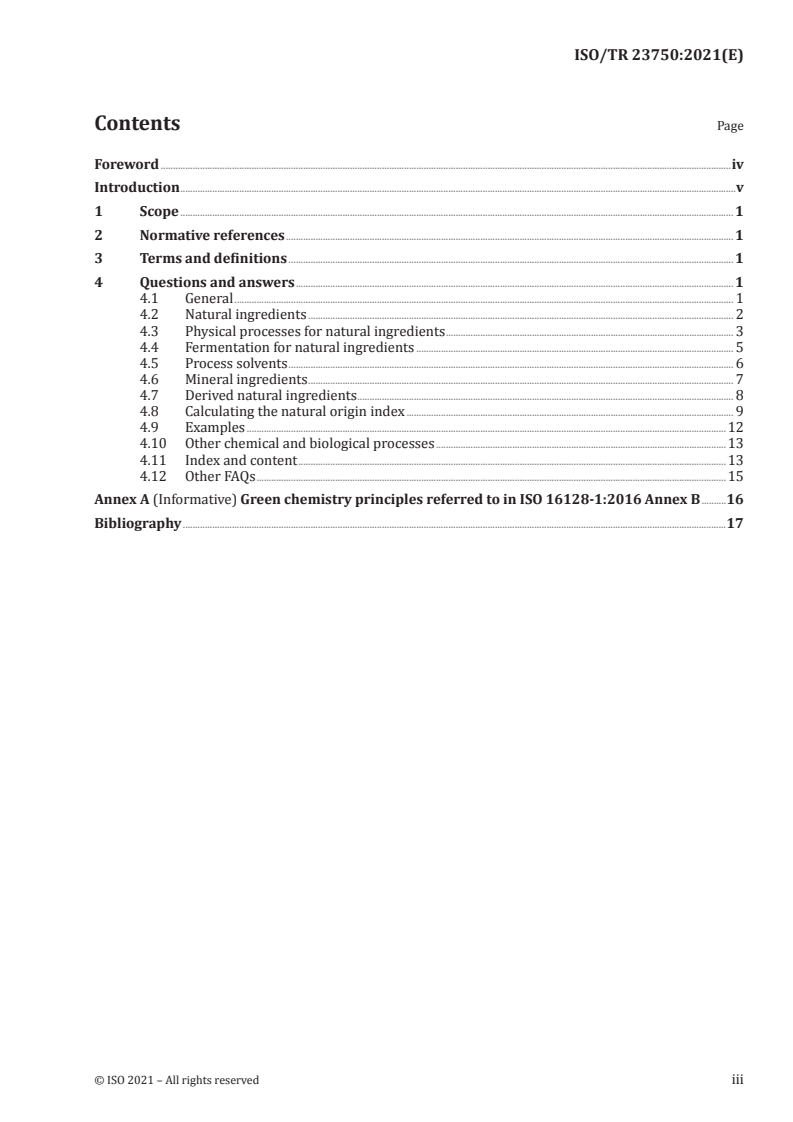
Contents Page
Foreword .iv
Introduction .v
1 Scope . 1
2 Normative references . 1
3 Terms and definitions . 1
4 Questions and answers . 1
4.1 General . 1
4.2 Natural ingredients . 2
4.3 Physical processes for natural ingredients . 3
4.4 Fermentation for natural ingredients . 5
4.5 Process solvents . 6
4.6 Mineral ingredients . 7
4.7 Derived natural ingredients . 8
4.8 Calculating the natural origin index . 9
4.9 Examples .12
4.10 Other chemical and biological processes .13
4.11 Index and content .13
4.12 Other FAQs .15
Annex A (Informative) Green chemistry principles referred to in ISO 16128-1:2016 Annex B .16
Bibliography .17
Foreword
ISO (the International Organization for Standardization) is a worldwide federation of national standards
bodies (ISO member bodies). The work of preparing International Standards is normally carried out
through ISO technical committees. Each member body interested in a subject for which a technical
committee has been established has the right to be represented on that committee. International
organizations, governmental and non-governmental, in liaison with ISO, also take part in the work.
ISO collaborates closely with the International Electrotechnical Commission (IEC) on all matters of
electrotechnical standardization.
The procedures used to develop this document and those intended for its further maintenance are
described in the ISO/IEC Directives, Part 1. In particular, the different approval criteria needed for the
different types of ISO documents should be noted. This document was drafted in accordance with the
editorial rules of the ISO/IEC Directives, Part 2 (see www .iso .org/ directives).
Attention is drawn to the possibility that some of the elements of this document may be the subject of
patent rights. ISO shall not be held responsible for identifying any or all such patent rights. Details of
any patent rights identified during the development of the document will be in the Introduction and/or
on the ISO list of patent declarations received (see www .iso .org/ patents).
Any trade name used in this document is information given for the convenience of users and does not
constitute an endorsement.
For an explanation of the voluntary nature of standards, the meaning of ISO specific terms and
expressions related to conformity assessment, as well as information about ISO's adherence to the
World Trade Organization (WTO) principles in the Technical Barriers to Trade (TBT), see www .iso .org/
iso/ foreword .html.
This document was prepared by Technical Committee ISO/TC 217, Cosmetics.
Any feedback or questions on this document should be directed to the user’s national standards body. A
complete listing of these bodies can be found at www .iso .org/ members .html.
iv © ISO 2021 – All rights reserved
Introduction
The ISO 16128 series provides guidelines on definitions and criteria for natural and organic cosmetic
ingredients and products. These guidelines are specific to the cosmetics sector, taking into account that
most existing approaches written for the agricultural and food sector are not directly transferrable to
cosmetics. They apply scientific judgment and offer principles towards a consistent logical framework
for natural and organic cosmetic ingredients and products incorporating common approaches employed
in existing references.
The purpose of the ISO 16128 series is to encourage a wider choice of natural and organic ingredients in
the formulation of a diverse variety of cosmetic products to encourage innovation.
The purpose of this document is to help ingredient manufacturers and cosmetic companies, or any
reader, to qualify cosmetic ingredients as natural, natural derived or non-natural when using the
ISO 16128 series.
TECHNICAL REPORT ISO/TR 23750:2021(E)
Cosmetics — Answers to frequently asked questions on
ingredients and product characterization according to ISO
16128-1 and ISO 16128-2
1 Scope
This document provides answers to questions which can arise when calculating indexes and contents
according to ISO 16128-1 and ISO 16128-2.
It clarifies conditions on process, solvents and carbon sources to qualify ingredients regarding the
ISO 16128 series. Detailed examples, explaining how to use the ISO 16128 series are also provided.
2 Normative references
There are no normative references in this document.
3 Terms and definitions
No terms and definitions are listed in this document.
ISO and IEC maintain terminological databases for use in standardization at the following addresses:
— ISO Online browsing platform: available at https:// www .iso .org/ obp
— IEC Electropedia: available at http:// www .electropedia .org/
4 Questions and answers
4.1 General
Table 1 — General questions
No. Question Answer
0 How can an ingredient manufacturer and/or Ingredient manufacturers are recommended to provide
a cosmetic manufacturer assign the category cosmetic manufacturers with information related to com-
and index of an ingredient? position, origin and processing of ingredients to determine
ingredient indexes. For all ingredients, cosmetic manufac-
turers verify the category and index based on information
provided. Therefore, dialogue between ingredient and
cosmetic manufacturers is encouraged.
1 What are the differences between the following A cosmetic raw material is an ingredient or a mixture of
terms: ingredient, substance, raw material, and ingredients. An ingredient is a substance, i.e. a chemical
renewable material? element and its compounds in the natural state or the result
of a manufacturing process, excluding any solvent which
may be separated without affecting the stability of the
substance or changing its composition. Certain substances
are renewable if they are replenished naturally at a rate at
least the same as their consumption.
2 How does the definition of an extract relate to An extract is a substance or a mixture of substances. In most
its INCI composition? cases, its INCI name is the same as the natural ingredient
it comes from, with, when relevant, the INCI name(s) of the
ingredient solvent(s) used for extraction.
Table 1 (continued)
No. Question Answer
3 Can the INCI ingredient lists be used to deter- No. More information is needed to make that determination.
mine if a product is natural, derived natural INCI ingredients can be produced in different ways and pro-
or non-natural? cess solvents used will not appear in the INCI ingredients
list. For example, it is possible to have two products with
the exact same INCI names list be classified differently when
using the methods set out in ISO 16128-1.
4 How do the different categories of solvents ISO 16128-1 refers to two categories of solvents: ingredient
relate to their INCI nomenclature? solvents and process solvents, which are defined in ISO
16128-1:2016, Annex A. Ingredient solvents appear in the
INCI ingredients list. Process solvents do not remain in the
ingredient (except as traces) and will not appear in the INCI
ingredient list.
4.2 Natural ingredients
Per ISO 16128-1, natural ingredients are cosmetic ingredients obtained only from plants, animals,
micro-organisms, or minerals, including those obtained from these materials by:
— physical processes (e.g. as grinding, drying, distillation);
— fermentation reactions occurring in nature and leading to molecules occurring in nature; and
— other processes of preparation, including traditional ones (e.g. extraction using solvents) without
intentional chemical modification.
See Table 2.
Table 2 — Questions on natural ingredients
No. Question Answer
5 How is water defined in ISO 16128-1? Water is defined as always natural in ISO 16128-1:2016, 2.4.
6 The definition of water of crystallization is not In chemistry, water of crystallization is water molecules that
provided in ISO 16128-1. How is it defined? are present inside crystals of minerals. It can be considered
as constitutive water in natural minerals. In the cases which
water is either added during or produced after a reaction,
it is considered as formulation water.
7 How is aromatic water obtained by distillation It is classified as extraction water.
classified in ISO 16128-1?
8 Are ingredients such as ethanol, amino acids, Yes. As long as the feedstock is natural, the reaction fermen-
or nucleic acids considered natural if obtained tation occurs in nature and the fermentation product is one
by fermentation reaction using a substance that occurs in nature, the result is natural.
occurring in nature as a starting material?
9 Can Formula (1) in ISO 16128-2:2017, 4.3.1 be Formula (1) in ISO 16128-2:2017, 4 3 1 is used only for ex-
used to calculate the natural index of an ingre- tracts when ingredient solvents are present. Otherwise, the
dient that does not contain ingredient solvents? natural index is assigned, according to the same paragraph,
is either 1 or 0.
10 Aromatic natural raw materials are defined “Fragrance/Parfum” are often mixtures including aromatic
according to ISO 9235. How are the indexes natural materials. The calculation of indexes of all ingredi-
of aromatic natural raw materials calculated ents containing aromatic natural raw materials follows ISO
per ISO 16128? 16128. The exact composition, according to ISO 16128-1, can
be obtained from the suppliers.
2 © ISO 2021 – All rights reserved
4.3 Physical processes for natural ingredients
Table 3 — Questions on physical processes for natural ingredients
No. Question Answer
11 Can “processing by micro-waves” be considered Yes. Any sort of drying process can be considered as physical
as physical process? process if it does not lead to chemical modification.
12 Are new technologies for physical extraction Yes, new technologies, such as use of micro-waves, sonication
considered as physical extraction process? and ultrasounds can be considered, as long as there is no
chemical modification. The use of solvents is defined in ISO
16128-1:2016 Table A.1.
13 In case of a plant extract extracted with a mix- If a non-natural solvent remains in the final extract as an
ture consisting of a non-natural solvent and a ingredient solvent, this extract is considered as a non-natural
natural solvent, is the final extract considered ingredient. If the non-natural solvent is eliminated, this ex-
as a natural ingredient? tract can be considered as a natural ingredient if conditions
of ISO 16128-1:2016, Table A.2 are fulfilled.
14 The value k is the dry/fresh ratio for leaves Yes.
or flowers when calculating natural/organic
index of plant extract. If a supplier can specify
the actual dry/fresh ratio and it is different
from k value, can the specified values be used
for calculation?
15 Provide index calculation examples for the EXAMPLE
extract of a dried organic plant.
5 kg of dry plant (organic flower) was extracted by 90 kg of
30 % glycerin (a derived natural solvent) aqueous solution
was obtained. (k=4,5)
— Starting materials: 5 kg of dry plant is equivalent to 5 × 4,5
= 22,5 kg of fresh plant
— Solvent: 63 kg of water, 27 kg of glycerin
— Reconstitution water: 22,5 – 5 = 17,5 kg
— Extraction water: 63 – 17,5 = 45,5 kg
NOTE Extraction water is as defined in ISO 16128-1.
Natural index of the extract: 1 − (27/(5 + 63 + 27)) = 0,71
Natural origin index of the extract: 1 as all ingredients meet
the definition of derived natural ingredients
Organic index of the extract: 1 – ((45,5+27)/ (5+63+27)) = 0,24
Organic derived index of the extract: 1 – ((45,5 + 27)/
(5 + 63 + 27)) = 0,24
16 According to ISO 16128-2:2017, 4.2: “The use The bullet from ISO 16128-2:2017, 4.2 stating that the use of
of non-natural ingredients (e.g. alcohol denatur- non-natural ingredients (e.g. alcohol denaturants) is allowed
ants) is allowed in ingredient solvent. However, in ingredient solvents means, for example, that denaturated
if the mixture contains a non-natural ingredient alcohol can be used for extraction and leads to a natural
solvent, then the entire mixture is non-natural.” extract. When phenoxyethanol is added to an extract after
filtration, this is a mixture which has no longer an index but
Does it mean, for example, that the addition of
instead has a content. The use of butylene glycol (non-natural)
phenoxyethanol to an extract is OK and only
as an extraction solvent leads to a non-natural ingredient.
affects the index value, but if an extraction
The use of polysorbate 80 during an extraction leads to a
solvent of butylene glycol (non-natural) is used,
non-natural ingredient as it is not of natural origin. But its
then the index is 0, regardless?
use after filtration leads to a mixture which has a content.
At what value does an added ingredient be-
come a solvent (i.e. polysorbate-80) or does
the definition refer only to extraction solvents?
Table 3 (continued)
No. Question Answer
17 Is a dry herbal extract or a purified compound In the extent that solvents do not remain in the final ingre-
isolated from a natural source considered as dients except as traces (process solvents), they are consid-
a natural ingredient? ered as natural ingredients according to ISO 16128-1:2016,
Table A.2 if:
— renewable solvents that pose minimal safety or environ-
mental risk are used; or
— if no physical process or no renewable solvent can be
used, a non-natural solvent that poses minimal safety or
environmental risk is used.
18 What are the indexes of a rose extract, ob- As the butylene glycol is of petrochemical origin, it is a non-nat-
tained by extraction with a mixture of water ural ingredient solvent. The rose extract is a non-natural
and butylene glycol, if the butylene glycol is of ingredient. Both natural index and natural origin index are 0.
petrochemical origin?
19 What are the indexes of a rose extract, ob- As the butylene glycol is a derived natural ingredient sol-
tained by extraction with a mixture of water vent, the natural index is determined using Formula (1) in
and butylene glycol, if the butelyne glycol is of ISO 16128-2:2017, 4.3.1.
vegetal origin?
Starting material: 10 kg of flower
Total solvent introduced: 90 kg = 67,5 kg water + 22,5 kg
butylene glycol
Mass of derived natural solvent introduced = 22,5 kg bu-
tylene glycol
Total mass introduced (natural ingredients and ingredient
solvents) = 10 + 67,5 + 22,5 = 100 kg
The natural index is = 1 – (22,5/100) = 0,775
The natural origin index is 1.
20 Is native guar gum a natural ingredient? Yes, the process of native guar gum used here is a physical
separation of the molecules present in the seeds. The natural
According to a February 2010 Opinion from
index of the native guar gum is 1, if process solvents used
AFSSA (ref. 2009-SA-0214), guar gum is ob-
respect the natural category of ISO 16128-1:2016, Table A.2.
tained, using Cyamopsis tetragonolobus seeds
through traditional methods in the grain milling
industry. Guar gum is obtained through the
following process:
— seeds extracted from dried pods are me-
chanically broken down in order to eliminate
the sprout;
— the endosperm is husked to obtain flakes;
— flakes are ground then sieved to obtain a
powder;
— powder or flakes are washed using ethanol
or isopropanol to limit the microbial load.
21 How is an extract from cell culture medium The culture and extraction of a plant callus is carried out in
defined in ISO 16128? For example, an Aloe a medium. The natural index and the natural origin index
barbadensis Callus extract is an extract obtained depend on the composition of the medium as defined in
through the culture of Aloe barbadensis Callus. ISO 16128-1.
None of the ingredients are organically produced. OI=OOI =0
4 © ISO 2021 – All rights reserved
4.4 Fermentation for natural ingredients
Table 4 — Questions on fermentation for natural ingredients
No. Question Answer
22 What is fermentation? Fermentation reactions result from a culture medium
containing micro-organisms, including bacteria, yeasts or
moulds. According to the definition of ISO 16128-1:2016 “fer-
mentation” also includes reactions generated by micro-algae
or plant cells.
23 What are the conditions for a fermentation For a fermentation process to obtain a natural ingredient,
process to obtain a natural ingredient? the process exists in nature, uses a natural substance as a
starting material and leads to molecules which occur in nature.
24 What type of carbon sources can be used to The carbon source (substrate) for the fermentation process
obtain a natural ingredient? can be a natural ingredient or mixture of natural ingredients
(sucrose for instance). See NOTE 1.
25 Are citrate salts natural? Yes, if the substrate is natural (e.g. Beetroot syrup) and as
far as the ferment: Aspergillus niger naturally produces
some citrate salt, the salt resulting from the fermentation
with Aspergillus niger and the natural substrate (as carbon
source) is natural.
26 Which type of modifications can be considered Selecting or cross-breeding native micro-organisms can be
for microorganisms? considered to obtain natural ingredients. See NOTE 2.
27 How are adjuvant in the culture medium Traces of adjuvant from the culture medium in the finished
treated? product are treated as process solvents. Adjuvant of fossil
origin can be considered provided there is no alternative.
28 Is industrial fermentation considered to be a Ingredients manufactured by industrial fermentation are
biological process? considered as natural ingredients, if the following points are
fulfilled, even if it is intentionally manufactured:
1) using a natural substance as a starting material;
2) by a fermentation reaction which exist in nature;
3) leading to molecules which occur in nature.
Ethanol for instance is natural when a native micro-organism
is used and when the carbon source is a natural ingredient
such as saccharose. See NOTE 2.
29 Is Xanthan gum a natural or derived natural Xanthan gum is obtained through the fermentation of a
ingredient? How are the indexes determined? non-genetically modified bacterium (Xanthomonas camp-
estris) using a carbohydrate substrate (corn or soy starch).
Xanthan occurs in nature, produced by micro-organisms
living in soils. As this is an ingredient - and not a mixture -
indexes are calculated, based on quantities used.
NI = 1 and NOI = 1
See NOTE 2.
NOTE 1 The fermentation substrate is natural in order to obtain a natural ingredient. This requirement is consistent with
ISO 16128-1:2016, Table A.1.
NOTE 2 Ingredients obtained by fermentation using genetically modified microorganisms can be considered as natural
ingredients in certain regions of the world and derived natural ingredients in other regions of the world.
4.5 Process solvents
Table 5 — Questions on process solvents
No. Question Answer
30 Can supercritical CO extraction be considered Yes, supercritical CO is one of the process solvents which
2 2
for obtaining natural ingredients? can be used to obtain a natural ingredient.
31 Can non-renewable solvents be used for ex- As process solvents of natural ingredients, natural mineral
traction? ingredients, derived natural ingredients and derived mineral
ingredients, renewable solvents that pose minimal safety or
environmental risk are used for the purpose of extraction or
reaction processes. If renewable alternatives are not available,
non-natural solvents that pose minimal safety or environ-
mental risk can be used, per ISO 16128-1:2016, Table A.2
32 Are vegetable oils and animal oils considered Yes, if they meet the definition of natural per ISO 16128-
as natural ingredients? 1:2016, Clause 2. Those manufactured by physically process
such as squeezing are considered as natural ingredients. For
those extracted with solvents, in case those solvents remain
in the final ingredients (ingredient solvents), it depends on
the origin of the solvents. ISO 16128-1:2016, Table A.1 is to
be used for verification.
In case solvents do not remain in the final ingredients except
as traces (process solvents), they are considered as natural
ingredients according to ISO 16128-1:2016, Table A.2 if:
— renewable solvents that pose minimal safety or environ-
mental risk are used; or
— no physical process or no renewable solvent can be used,
a non-natural solvent that poses minimal safety or environ-
mental risk is used.
33 For the manufacturing of lecithin, hexane is As the use of hexane for the manufacturing of lecithin is un-
commonly used as process solvent. Does it avoidable at the current state of art, according to ISO 16128-
impair the classification of lecithin as natural 1:2016 Table A.2 footnote “a”, the classification of lecithin is
due to its petrochemical origin? not affected by the use of hexane. Hexane concentration in the
final lecithin has to pose minimal safety or environmental risk.
6 © ISO 2021 – All rights reserved
4.6 Mineral ingredients
Table 6 — Questions on mineral ingredients
No. Question Answer
34 Does ISO 16128-1:2016, Annex D contain Yes. ISO 16128-1:2016, Annex D is an illustrative, not exhaus-
natural minerals? tive, list of reaction products that may be considered derived
mineral ingredients. Ingredients on this list which are found
in nature (i.e. not chemical reaction products) are natural
mineral ingredients.
35 Is surface-coated titanium dioxide a non-nat- When physically coated by encapsulation or electrostatic
ural ingredient? surface modification, it is considered as a mixture of titani-
um dioxide and coating agent. The titanium dioxide may be
considered as a derived mineral ingredient. The natural and
natural origin indexes of the coating are to be determined
separately.
When chemically modified with a natural (except natural
mineral ingredient) or derived natural reactant that makes
up less than or equal to 50 % by weight of the ingredient, as
a surface coating or otherwise, the result is a non-natural
ingredient.
When reacted with a natural (except natural mineral ingre-
dient) or derived natural reactant that makes up greater
than 50 % by weight of the ingredient, as a surface coating
or otherwise, the result is a derived natural ingredient.
In either case, when chemically modified with non-mineral
ingredients, the result is not considered as a derived mineral
ingredient.
36 Is nano-sized titanium dioxide, considere
...
TECHNICAL ISO/TR
REPORT 23750
First edition
2021-08
Cosmetics — Answers to frequently
asked questions on ingredients and
product characterization according to
ISO 16128-1 and ISO 16128-2
Cosmétiques — Réponses aux questions fréquemment posées sur la
caractérisation des ingrédients et des produits conformément à l'ISO
16128-1 et à l'ISO 16128-2
Reference number
©
ISO 2021
© ISO 2021
All rights reserved. Unless otherwise specified, or required in the context of its implementation, no part of this publication may
be reproduced or utilized otherwise in any form or by any means, electronic or mechanical, including photocopying, or posting
on the internet or an intranet, without prior written permission. Permission can be requested from either ISO at the address
below or ISO’s member body in the country of the requester.
ISO copyright office
CP 401 • Ch. de Blandonnet 8
CH-1214 Vernier, Geneva
Phone: +41 22 749 01 11
Email: copyright@iso.org
Website: www.iso.org
Published in Switzerland
ii © ISO 2021 – All rights reserved
Contents Page
Foreword .iv
Introduction .v
1 Scope . 1
2 Normative references . 1
3 Terms and definitions . 1
4 Questions and answers . 1
4.1 General . 1
4.2 Natural ingredients . 2
4.3 Physical processes for natural ingredients . 3
4.4 Fermentation for natural ingredients . 5
4.5 Process solvents . 6
4.6 Mineral ingredients . 7
4.7 Derived natural ingredients . 8
4.8 Calculating the natural origin index . 9
4.9 Examples .12
4.10 Other chemical and biological processes .13
4.11 Index and content .13
4.12 Other FAQs .15
Annex A (Informative) Green chemistry principles referred to in ISO 16128-1:2016 Annex B .16
Bibliography .17
Foreword
ISO (the International Organization for Standardization) is a worldwide federation of national standards
bodies (ISO member bodies). The work of preparing International Standards is normally carried out
through ISO technical committees. Each member body interested in a subject for which a technical
committee has been established has the right to be represented on that committee. International
organizations, governmental and non-governmental, in liaison with ISO, also take part in the work.
ISO collaborates closely with the International Electrotechnical Commission (IEC) on all matters of
electrotechnical standardization.
The procedures used to develop this document and those intended for its further maintenance are
described in the ISO/IEC Directives, Part 1. In particular, the different approval criteria needed for the
different types of ISO documents should be noted. This document was drafted in accordance with the
editorial rules of the ISO/IEC Directives, Part 2 (see www .iso .org/ directives).
Attention is drawn to the possibility that some of the elements of this document may be the subject of
patent rights. ISO shall not be held responsible for identifying any or all such patent rights. Details of
any patent rights identified during the development of the document will be in the Introduction and/or
on the ISO list of patent declarations received (see www .iso .org/ patents).
Any trade name used in this document is information given for the convenience of users and does not
constitute an endorsement.
For an explanation of the voluntary nature of standards, the meaning of ISO specific terms and
expressions related to conformity assessment, as well as information about ISO's adherence to the
World Trade Organization (WTO) principles in the Technical Barriers to Trade (TBT), see www .iso .org/
iso/ foreword .html.
This document was prepared by Technical Committee ISO/TC 217, Cosmetics.
Any feedback or questions on this document should be directed to the user’s national standards body. A
complete listing of these bodies can be found at www .iso .org/ members .html.
iv © ISO 2021 – All rights reserved
Introduction
The ISO 16128 series provides guidelines on definitions and criteria for natural and organic cosmetic
ingredients and products. These guidelines are specific to the cosmetics sector, taking into account that
most existing approaches written for the agricultural and food sector are not directly transferrable to
cosmetics. They apply scientific judgment and offer principles towards a consistent logical framework
for natural and organic cosmetic ingredients and products incorporating common approaches employed
in existing references.
The purpose of the ISO 16128 series is to encourage a wider choice of natural and organic ingredients in
the formulation of a diverse variety of cosmetic products to encourage innovation.
The purpose of this document is to help ingredient manufacturers and cosmetic companies, or any
reader, to qualify cosmetic ingredients as natural, natural derived or non-natural when using the
ISO 16128 series.
TECHNICAL REPORT ISO/TR 23750:2021(E)
Cosmetics — Answers to frequently asked questions on
ingredients and product characterization according to ISO
16128-1 and ISO 16128-2
1 Scope
This document provides answers to questions which can arise when calculating indexes and contents
according to ISO 16128-1 and ISO 16128-2.
It clarifies conditions on process, solvents and carbon sources to qualify ingredients regarding the
ISO 16128 series. Detailed examples, explaining how to use the ISO 16128 series are also provided.
2 Normative references
There are no normative references in this document.
3 Terms and definitions
No terms and definitions are listed in this document.
ISO and IEC maintain terminological databases for use in standardization at the following addresses:
— ISO Online browsing platform: available at https:// www .iso .org/ obp
— IEC Electropedia: available at http:// www .electropedia .org/
4 Questions and answers
4.1 General
Table 1 — General questions
No. Question Answer
0 How can an ingredient manufacturer and/or Ingredient manufacturers are recommended to provide
a cosmetic manufacturer assign the category cosmetic manufacturers with information related to com-
and index of an ingredient? position, origin and processing of ingredients to determine
ingredient indexes. For all ingredients, cosmetic manufac-
turers verify the category and index based on information
provided. Therefore, dialogue between ingredient and
cosmetic manufacturers is encouraged.
1 What are the differences between the following A cosmetic raw material is an ingredient or a mixture of
terms: ingredient, substance, raw material, and ingredients. An ingredient is a substance, i.e. a chemical
renewable material? element and its compounds in the natural state or the result
of a manufacturing process, excluding any solvent which
may be separated without affecting the stability of the
substance or changing its composition. Certain substances
are renewable if they are replenished naturally at a rate at
least the same as their consumption.
2 How does the definition of an extract relate to An extract is a substance or a mixture of substances. In most
its INCI composition? cases, its INCI name is the same as the natural ingredient
it comes from, with, when relevant, the INCI name(s) of the
ingredient solvent(s) used for extraction.
Table 1 (continued)
No. Question Answer
3 Can the INCI ingredient lists be used to deter- No. More information is needed to make that determination.
mine if a product is natural, derived natural INCI ingredients can be produced in different ways and pro-
or non-natural? cess solvents used will not appear in the INCI ingredients
list. For example, it is possible to have two products with
the exact same INCI names list be classified differently when
using the methods set out in ISO 16128-1.
4 How do the different categories of solvents ISO 16128-1 refers to two categories of solvents: ingredient
relate to their INCI nomenclature? solvents and process solvents, which are defined in ISO
16128-1:2016, Annex A. Ingredient solvents appear in the
INCI ingredients list. Process solvents do not remain in the
ingredient (except as traces) and will not appear in the INCI
ingredient list.
4.2 Natural ingredients
Per ISO 16128-1, natural ingredients are cosmetic ingredients obtained only from plants, animals,
micro-organisms, or minerals, including those obtained from these materials by:
— physical processes (e.g. as grinding, drying, distillation);
— fermentation reactions occurring in nature and leading to molecules occurring in nature; and
— other processes of preparation, including traditional ones (e.g. extraction using solvents) without
intentional chemical modification.
See Table 2.
Table 2 — Questions on natural ingredients
No. Question Answer
5 How is water defined in ISO 16128-1? Water is defined as always natural in ISO 16128-1:2016, 2.4.
6 The definition of water of crystallization is not In chemistry, water of crystallization is water molecules that
provided in ISO 16128-1. How is it defined? are present inside crystals of minerals. It can be considered
as constitutive water in natural minerals. In the cases which
water is either added during or produced after a reaction,
it is considered as formulation water.
7 How is aromatic water obtained by distillation It is classified as extraction water.
classified in ISO 16128-1?
8 Are ingredients such as ethanol, amino acids, Yes. As long as the feedstock is natural, the reaction fermen-
or nucleic acids considered natural if obtained tation occurs in nature and the fermentation product is one
by fermentation reaction using a substance that occurs in nature, the result is natural.
occurring in nature as a starting material?
9 Can Formula (1) in ISO 16128-2:2017, 4.3.1 be Formula (1) in ISO 16128-2:2017, 4 3 1 is used only for ex-
used to calculate the natural index of an ingre- tracts when ingredient solvents are present. Otherwise, the
dient that does not contain ingredient solvents? natural index is assigned, according to the same paragraph,
is either 1 or 0.
10 Aromatic natural raw materials are defined “Fragrance/Parfum” are often mixtures including aromatic
according to ISO 9235. How are the indexes natural materials. The calculation of indexes of all ingredi-
of aromatic natural raw materials calculated ents containing aromatic natural raw materials follows ISO
per ISO 16128? 16128. The exact composition, according to ISO 16128-1, can
be obtained from the suppliers.
2 © ISO 2021 – All rights reserved
4.3 Physical processes for natural ingredients
Table 3 — Questions on physical processes for natural ingredients
No. Question Answer
11 Can “processing by micro-waves” be considered Yes. Any sort of drying process can be considered as physical
as physical process? process if it does not lead to chemical modification.
12 Are new technologies for physical extraction Yes, new technologies, such as use of micro-waves, sonication
considered as physical extraction process? and ultrasounds can be considered, as long as there is no
chemical modification. The use of solvents is defined in ISO
16128-1:2016 Table A.1.
13 In case of a plant extract extracted with a mix- If a non-natural solvent remains in the final extract as an
ture consisting of a non-natural solvent and a ingredient solvent, this extract is considered as a non-natural
natural solvent, is the final extract considered ingredient. If the non-natural solvent is eliminated, this ex-
as a natural ingredient? tract can be considered as a natural ingredient if conditions
of ISO 16128-1:2016, Table A.2 are fulfilled.
14 The value k is the dry/fresh ratio for leaves Yes.
or flowers when calculating natural/organic
index of plant extract. If a supplier can specify
the actual dry/fresh ratio and it is different
from k value, can the specified values be used
for calculation?
15 Provide index calculation examples for the EXAMPLE
extract of a dried organic plant.
5 kg of dry plant (organic flower) was extracted by 90 kg of
30 % glycerin (a derived natural solvent) aqueous solution
was obtained. (k=4,5)
— Starting materials: 5 kg of dry plant is equivalent to 5 × 4,5
= 22,5 kg of fresh plant
— Solvent: 63 kg of water, 27 kg of glycerin
— Reconstitution water: 22,5 – 5 = 17,5 kg
— Extraction water: 63 – 17,5 = 45,5 kg
NOTE Extraction water is as defined in ISO 16128-1.
Natural index of the extract: 1 − (27/(5 + 63 + 27)) = 0,71
Natural origin index of the extract: 1 as all ingredients meet
the definition of derived natural ingredients
Organic index of the extract: 1 – ((45,5+27)/ (5+63+27)) = 0,24
Organic derived index of the extract: 1 – ((45,5 + 27)/
(5 + 63 + 27)) = 0,24
16 According to ISO 16128-2:2017, 4.2: “The use The bullet from ISO 16128-2:2017, 4.2 stating that the use of
of non-natural ingredients (e.g. alcohol denatur- non-natural ingredients (e.g. alcohol denaturants) is allowed
ants) is allowed in ingredient solvent. However, in ingredient solvents means, for example, that denaturated
if the mixture contains a non-natural ingredient alcohol can be used for extraction and leads to a natural
solvent, then the entire mixture is non-natural.” extract. When phenoxyethanol is added to an extract after
filtration, this is a mixture which has no longer an index but
Does it mean, for example, that the addition of
instead has a content. The use of butylene glycol (non-natural)
phenoxyethanol to an extract is OK and only
as an extraction solvent leads to a non-natural ingredient.
affects the index value, but if an extraction
The use of polysorbate 80 during an extraction leads to a
solvent of butylene glycol (non-natural) is used,
non-natural ingredient as it is not of natural origin. But its
then the index is 0, regardless?
use after filtration leads to a mixture which has a content.
At what value does an added ingredient be-
come a solvent (i.e. polysorbate-80) or does
the definition refer only to extraction solvents?
Table 3 (continued)
No. Question Answer
17 Is a dry herbal extract or a purified compound In the extent that solvents do not remain in the final ingre-
isolated from a natural source considered as dients except as traces (process solvents), they are consid-
a natural ingredient? ered as natural ingredients according to ISO 16128-1:2016,
Table A.2 if:
— renewable solvents that pose minimal safety or environ-
mental risk are used; or
— if no physical process or no renewable solvent can be
used, a non-natural solvent that poses minimal safety or
environmental risk is used.
18 What are the indexes of a rose extract, ob- As the butylene glycol is of petrochemical origin, it is a non-nat-
tained by extraction with a mixture of water ural ingredient solvent. The rose extract is a non-natural
and butylene glycol, if the butylene glycol is of ingredient. Both natural index and natural origin index are 0.
petrochemical origin?
19 What are the indexes of a rose extract, ob- As the butylene glycol is a derived natural ingredient sol-
tained by extraction with a mixture of water vent, the natural index is determined using Formula (1) in
and butylene glycol, if the butelyne glycol is of ISO 16128-2:2017, 4.3.1.
vegetal origin?
Starting material: 10 kg of flower
Total solvent introduced: 90 kg = 67,5 kg water + 22,5 kg
butylene glycol
Mass of derived natural solvent introduced = 22,5 kg bu-
tylene glycol
Total mass introduced (natural ingredients and ingredient
solvents) = 10 + 67,5 + 22,5 = 100 kg
The natural index is = 1 – (22,5/100) = 0,775
The natural origin index is 1.
20 Is native guar gum a natural ingredient? Yes, the process of native guar gum used here is a physical
separation of the molecules present in the seeds. The natural
According to a February 2010 Opinion from
index of the native guar gum is 1, if process solvents used
AFSSA (ref. 2009-SA-0214), guar gum is ob-
respect the natural category of ISO 16128-1:2016, Table A.2.
tained, using Cyamopsis tetragonolobus seeds
through traditional methods in the grain milling
industry. Guar gum is obtained through the
following process:
— seeds extracted from dried pods are me-
chanically broken down in order to eliminate
the sprout;
— the endosperm is husked to obtain flakes;
— flakes are ground then sieved to obtain a
powder;
— powder or flakes are washed using ethanol
or isopropanol to limit the microbial load.
21 How is an extract from cell culture medium The culture and extraction of a plant callus is carried out in
defined in ISO 16128? For example, an Aloe a medium. The natural index and the natural origin index
barbadensis Callus extract is an extract obtained depend on the composition of the medium as defined in
through the culture of Aloe barbadensis Callus. ISO 16128-1.
None of the ingredients are organically produced. OI=OOI =0
4 © ISO 2021 – All rights reserved
4.4 Fermentation for natural ingredients
Table 4 — Questions on fermentation for natural ingredients
No. Question Answer
22 What is fermentation? Fermentation reactions result from a culture medium
containing micro-organisms, including bacteria, yeasts or
moulds. According to the definition of ISO 16128-1:2016 “fer-
mentation” also includes reactions generated by micro-algae
or plant cells.
23 What are the conditions for a fermentation For a fermentation process to obtain a natural ingredient,
process to obtain a natural ingredient? the process exists in nature, uses a natural substance as a
starting material and leads to molecules which occur in nature.
24 What type of carbon sources can be used to The carbon source (substrate) for the fermentation process
obtain a natural ingredient? can be a natural ingredient or mixture of natural ingredients
(sucrose for instance). See NOTE 1.
25 Are citrate salts natural? Yes, if the substrate is natural (e.g. Beetroot syrup) and as
far as the ferment: Aspergillus niger naturally produces
some citrate salt, the salt resulting from the fermentation
with Aspergillus niger and the natural substrate (as carbon
source) is natural.
26 Which type of modifications can be considered Selecting or cross-breeding native micro-organisms can be
for microorganisms? considered to obtain natural ingredients. See NOTE 2.
27 How are adjuvant in the culture medium Traces of adjuvant from the culture medium in the finished
treated? product are treated as process solvents. Adjuvant of fossil
origin can be considered provided there is no alternative.
28 Is industrial fermentation considered to be a Ingredients manufactured by industrial fermentation are
biological process? considered as natural ingredients, if the following points are
fulfilled, even if it is intentionally manufactured:
1) using a natural substance as a starting material;
2) by a fermentation reaction which exist in nature;
3) leading to molecules which occur in nature.
Ethanol for instance is natural when a native micro-organism
is used and when the carbon source is a natural ingredient
such as saccharose. See NOTE 2.
29 Is Xanthan gum a natural or derived natural Xanthan gum is obtained through the fermentation of a
ingredient? How are the indexes determined? non-genetically modified bacterium (Xanthomonas camp-
estris) using a carbohydrate substrate (corn or soy starch).
Xanthan occurs in nature, produced by micro-organisms
living in soils. As this is an ingredient - and not a mixture -
indexes are calculated, based on quantities used.
NI = 1 and NOI = 1
See NOTE 2.
NOTE 1 The fermentation substrate is natural in order to obtain a natural ingredient. This requirement is consistent with
ISO 16128-1:2016, Table A.1.
NOTE 2 Ingredients obtained by fermentation using genetically modified microorganisms can be considered as natural
ingredients in certain regions of the world and derived natural ingredients in other regions of the world.
4.5 Process solvents
Table 5 — Questions on process solvents
No. Question Answer
30 Can supercritical CO extraction be considered Yes, supercritical CO is one of the process solvents which
2 2
for obtaining natural ingredients? can be used to obtain a natural ingredient.
31 Can non-renewable solvents be used for ex- As process solvents of natural ingredients, natural mineral
traction? ingredients, derived natural ingredients and derived mineral
ingredients, renewable solvents that pose minimal safety or
environmental risk are used for the purpose of extraction or
reaction processes. If renewable alternatives are not available,
non-natural solvents that pose minimal safety or environ-
mental risk can be used, per ISO 16128-1:2016, Table A.2
32 Are vegetable oils and animal oils considered Yes, if they meet the definition of natural per ISO 16128-
as natural ingredients? 1:2016, Clause 2. Those manufactured by physically process
such as squeezing are considered as natural ingredients. For
those extracted with solvents, in case those solvents remain
in the final ingredients (ingredient solvents), it depends on
the origin of the solvents. ISO 16128-1:2016, Table A.1 is to
be used for verification.
In case solvents do not remain in the final ingredients except
as traces (process solvents), they are considered as natural
ingredients according to ISO 16128-1:2016, Table A.2 if:
— renewable solvents that pose minimal safety or environ-
mental risk are used; or
— no physical process or no renewable solvent can be used,
a non-natural solvent that poses minimal safety or environ-
mental risk is used.
33 For the manufacturing of lecithin, hexane is As the use of hexane for the manufacturing of lecithin is un-
commonly used as process solvent. Does it avoidable at the current state of art, according to ISO 16128-
impair the classification of lecithin as natural 1:2016 Table A.2 footnote “a”, the classification of lecithin is
due to its petrochemical origin? not affected by the use of hexane. Hexane concentration in the
final lecithin has to pose minimal safety or environmental risk.
6 © ISO 2021 – All rights reserved
4.6 Mineral ingredients
Table 6 — Questions on mineral ingredients
No. Question Answer
34 Does ISO 16128-1:2016, Annex D contain Yes. ISO 16128-1:2016, Annex D is an illustrative, not exhaus-
natural minerals? tive, list of reaction products that may be considered derived
mineral ingredients. Ingredients on this list which are found
in nature (i.e. not chemical reaction products) are natural
mineral ingredients.
35 Is surface-coated titanium dioxide a non-nat- When physically coated by encapsulation or electrostatic
ural ingredient? surface modification, it is considered as a mixture of titani-
um dioxide and coating agent. The titanium dioxide may be
considered as a derived mineral ingredient. The natural and
natural origin indexes of the coating are to be determined
separately.
When chemically modified with a natural (except natural
mineral ingredient) or derived natural reactant that makes
up less than or equal to 50 % by weight of the ingredient, as
a surface coating or otherwise, the result is a non-natural
ingredient.
When reacted with a natural (except natural mineral ingre-
dient) or derived natural reactant that makes up greater
than 50 % by weight of the ingredient, as a surface coating
or otherwise, the result is a derived natural ingredient.
In either case, when chemically modified with non-mineral
ingredients, the result is not considered as a derived mineral
ingredient.
36 Is nano-sized titanium dioxide, considered as Since the properties other than the chemical composition,
a derived mineral ingredient, as long as it has such as crystal structure and physical properties, are not
the same chemical composition as a natural specified in the definition of derived mineral ingredient, it
mineral ingredient? may be considered as a derived mineral ingredient, as long
as the chemical composition is the same as a natural mineral
ingredient and as long as it respects the full definition of ISO
16128-1:2016, Clause 4, including process information.
37 What is the classification for KOH (potas
...
RAPPORT ISO/TR
TECHNIQUE 23750
Première édition
2021-08
Cosmétiques — Réponses aux
questions fréquentes sur la
caractérisation des ingrédients et
produits conformément à l’ISO 16128-
1 et l’ISO 16128-2
Cosmetics — Answers to frequently asked questions on ingredients
and product characterization according to ISO 16128-1 and ISO
16128-2
Numéro de référence
©
ISO 2021
DOCUMENT PROTÉGÉ PAR COPYRIGHT
© ISO 2021
Tous droits réservés. Sauf prescription différente ou nécessité dans le contexte de sa mise en œuvre, aucune partie de cette
publication ne peut être reproduite ni utilisée sous quelque forme que ce soit et par aucun procédé, électronique ou mécanique,
y compris la photocopie, ou la diffusion sur l’internet ou sur un intranet, sans autorisation écrite préalable. Une autorisation peut
être demandée à l’ISO à l’adresse ci-après ou au comité membre de l’ISO dans le pays du demandeur.
ISO copyright office
Case postale 401 • Ch. de Blandonnet 8
CH-1214 Vernier, Genève
Tél.: +41 22 749 01 11
E-mail: copyright@iso.org
Web: www.iso.org
Publié en Suisse
ii © ISO 2021 – Tous droits réservés
Sommaire Page
Avant-propos .iv
Introduction .v
1 Domaine d’application . 1
2 Références normatives . 1
3 Termes et définitions . 1
4 Questions et réponses . 1
4.1 Généralités . 1
4.2 Ingrédients naturels . 2
4.3 Procédés physiques des ingrédients naturels . 3
4.4 Fermentation d’ingrédients naturels . 6
4.5 Solvants de procédé . 7
4.6 Ingrédients minéraux . 8
4.7 Ingrédients dérivés de matériaux naturels . 9
4.8 Calcul de l’indice d’origine naturelle .11
4.9 Exemples .14
4.10 Autres procédés chimiques et biologiques .15
4.11 Indice et contenu .15
4.12 Autres FAQ .17
Annexe A (Informative) Principes de chimie verte mentionnés dans l’ISO 16128-1:2016,
Annexe B .18
Bibliographie .19
Avant-propos
L'ISO (Organisation internationale de normalisation) est une fédération mondiale d'organismes
nationaux de normalisation (comités membres de l'ISO). L'élaboration des Normes internationales est
en général confiée aux comités techniques de l'ISO. Chaque comité membre intéressé par une étude
a le droit de faire partie du comité technique créé à cet effet. Les organisations internationales,
gouvernementales et non gouvernementales, en liaison avec l'ISO participent également aux travaux.
L'ISO collabore étroitement avec la Commission électrotechnique internationale (IEC) en ce qui
concerne la normalisation électrotechnique.
Les procédures utilisées pour élaborer le présent document et celles destinées à sa mise à jour sont
décrites dans les Directives ISO/IEC, Partie 1. Il convient, en particulier, de prendre note des différents
critères d'approbation requis pour les différents types de documents ISO. Le présent document a été
rédigé conformément aux règles de rédaction données dans les Directives ISO/IEC, Partie 2 (voir www
.iso .org/ directives).
L'attention est attirée sur le fait que certains des éléments du présent document peuvent faire l'objet de
droits de propriété intellectuelle ou de droits analogues. L'ISO ne saurait être tenue pour responsable
de ne pas avoir identifié de tels droits de propriété et averti de leur existence. Les détails concernant
les références aux droits de propriété intellectuelle ou autres droits analogues identifiés lors de
l'élaboration du document sont indiqués dans l'Introduction et/ou dans la liste des déclarations de
brevets reçues par l'ISO (voir www .iso .org/ brevets).
Les appellations commerciales éventuellement mentionnées dans le présent document sont données
pour information, par souci de commodité, à l’intention des utilisateurs et ne sauraient constituer un
engagement.
Pour une explication de la nature volontaire des normes, la signification des termes et expressions
spécifiques de l'ISO liés à l'évaluation de la conformité, ou pour toute information au sujet de l'adhésion
de l'ISO aux principes de l’Organisation mondiale du commerce (OMC) concernant les obstacles
techniques au commerce (OTC), voir www .iso .org/ avant -propos.
Le présent document a été élaboré par le comité technique ISO/TC 217, Cosmétiques.
Il convient que l’utilisateur adresse tout retour d’information ou toute question concernant le présent
document à l’organisme national de normalisation de son pays. Une liste exhaustive desdits organismes
se trouve à l’adresse www .iso .org/ fr/ members .html.
iv © ISO 2021 – Tous droits réservés
Introduction
La série ISO 16128 fournit des lignes directrices relatives aux définitions et aux critères applicables
aux ingrédients et produits cosmétiques naturels et biologiques. Ces lignes directrices sont propres
au secteur des cosmétiques, la majeure partie des approches écrites existantes pour le secteur
agroalimentaire n’étant pas directement transposables aux cosmétiques. Elles reflètent un avis
scientifique et offrent des principes pour un cadre logique cohérent applicable aux ingrédients et
produits cosmétiques naturels et biologiques, et ce, en tenant compte des approches communes
adoptées dans les références existantes.
L’objet de la série ISO 16128 est d’encourager un plus large choix d’ingrédients et produits cosmétiques
naturels et biologiques dans la formulation d’une plus grande variété de produits cosmétiques afin de
favoriser l’innovation.
L’objectif du présent document est d’aider les fabricants d’ingrédients et les entreprises de cosmétiques,
voire tout lecteur, à qualifier les ingrédients cosmétiques de naturels, dérivés de matériaux naturels ou
non naturels lors de l’application de la série ISO 16128.
RAPPORT TECHNIQUE ISO/TR 23750:2021(F)
Cosmétiques — Réponses aux questions fréquentes sur la
caractérisation des ingrédients et produits conformément
à l’ISO 16128-1 et l’ISO 16128-2
1 Domaine d’application
Le présent document apporte des réponses aux questions qui peuvent se poser lors du calcul des indices
et contenus conformément à l’ISO 16128-1 et l’ISO 16128-2.
Il clarifie les conditions relatives aux procédés, solvants et sources de carbone permettant de qualifier
les ingrédients suivant la série ISO 16128. Des exemples détaillés expliquant comment utiliser la série
ISO 16128 sont également présentés.
2 Références normatives
Le présent document ne contient aucune référence normative.
3 Termes et définitions
Aucun terme n’est défini dans le présent document.
L’ISO et l’IEC tiennent à jour des bases de données terminologiques destinées à être utilisées en
normalisation, consultables aux adresses suivantes:
— ISO Online browsing platform: disponible à l’adresse https:// www .iso .org/ obp
— IEC Electropedia: disponible à l’adresse http:// www .electropedia .org/
4 Questions et réponses
4.1 Généralités
Tableau 1 — Questions générales
o
N Question Réponse
0 Comment un fabricant d’ingrédients et/ou un Il est recommandé aux fabricants d’ingrédients de fournir
fabricant de cosmétiques peuvent-ils attribuer aux fabricants de cosmétiques les informations relatives à
une catégorie et un indice à un ingrédient? la composition, à l’origine et au traitement des ingrédients,
afin qu’ils déterminent les indices d’ingrédients. Pour
chaque ingrédient, les fabricants de cosmétiques vérifient
la catégorie et l’indice d’après les informations fournies. Par
conséquent, le dialogue entre fabricants d’ingrédients et de
cosmétiques est vivement encouragé.
1 Quelles sont les différences entre les termes Une matière première cosmétique est un ingrédient ou un
suivants: ingrédient, substance, matière pre- mélange d’ingrédients. Un ingrédient est une substance, c’est-
mière et matière renouvelable? à-dire un élément chimique et ses composés à l’état naturel
ou le résultat d’un procédé de fabrication, à l’exclusion de tout
solvant qui peut être séparé sans affecter la stabilité de la
substance ou modifier sa composition. Certaines substances
sont renouvelables si elles se régénèrent naturellement à une
vitesse au moins identique à leur consommation.
Tableau 1 (suite)
o
N Question Réponse
2 Quel est le lien entre la définition d’un extrait Un extrait est une substance ou un mélange de substances.
et sa composition INCI? Dans la plupart des cas, sa désignation INCI est la même
que l’ingrédient naturel dont il provient et, le cas échéant,
la ou les désignations INCI du ou des solvants ingrédients
utilisés pour l’extraction.
3 Les listes d’ingrédients INCI peuvent-elles Non. Pour déterminer cela, plus d’informations sont né-
être utilisées pour déterminer si un produit cessaires. Les ingrédients INCI peuvent être produits de
est naturel, dérivé de matériaux naturels ou différentes façons et les solvants de procédé employés
non naturel? n’apparaissent pas dans la liste des ingrédients INCI. Par
exemple, il est possible que deux produits, dont la liste des
désignations INCI est parfaitement identique, soient classés
différemment lors de l’application des méthodes spécifiées
dans l’ISO 16128-1.
4 Quel est le lien entre les différentes catégories L’ISO 16128-1 spécifie deux catégories de solvants: les sol-
de solvants et leur nomenclature INCI? vants ingrédients et les solvants de procédé, qui sont définis
dans l’ISO 16128-1:2016, Annexe A. Les solvants ingrédients
apparaissent dans la liste des ingrédients INCI. Les solvants
de procédé ne subsistent pas dans l’ingrédient (sauf à l’état de
traces) et n’apparaissent pas dans la liste d’ingrédients INCI.
4.2 Ingrédients naturels
Selon l’ISO 16128-1, les ingrédients naturels sont des ingrédients cosmétiques obtenus exclusivement à
partir de végétaux, d’animaux, de micro-organismes ou de minéraux, y compris les ingrédients obtenus
à partir de ces matériaux résultant:
— de procédés physiques (tels que broyage, séchage, distillation);
— de réactions de fermentation existant dans la nature et conduisant à des molécules existant à l’état
naturel; et
— d’autres modes opératoires de préparation, y compris des méthodes traditionnelles (par exemple,
extraction à l’aide de solvants) sans intention de modifier chimiquement l’ingrédient.
Voir Tableau 2.
Tableau 2 — Questions sur les ingrédients naturels
o
N Question Réponse
5 Comment l’eau est-elle définie dans l’ISO 16128- L’eau est définie comme étant toujours naturelle dans
1? l’ISO 16128-1:2016, 2.4.
6 La définition de l’eau de cristallisation ne figure En chimie, l’eau de cristallisation consiste en des molécules
pas dans l’ISO 16128-1. Quelle est sa définition? d’eau présentes à l’intérieur de cristaux de minéraux. Elle peut
être considérée comme de l’eau de constitution à l’intérieur
de minéraux naturels. Dans les cas où l’eau est ou ajoutée
pendant une réaction ou produite après celle-ci, elle est
considérée comme étant de l’eau de formulation.
7 Comment l’eau florale obtenue par distillation Elle est classée comme eau d’extraction.
est-elle classée dans l’ISO 16128-1?
8 Les ingrédients comme l’éthanol, les acides Oui. Tant que la matière de base est naturelle, que la fermen-
aminés ou les acides nucléiques sont-ils consi- tation de la réaction existe dans la nature et que le produit
dérés comme naturels s’ils sont obtenus par de fermentation est un produit qui existe dans la nature, le
réaction de fermentation en utilisant une résultat est naturel.
substance qui existe dans la nature comme
matériau de départ?
2 © ISO 2021 – Tous droits réservés
Tableau 2 (suite)
o
N Question Réponse
9 La Formule (1) de l’ISO 16128-2:2017, 4.3.1 La Formule (1) de l’ISO 16128-2:2017, 4.3.1 s’utilise unique-
peut-elle être utilisée pour calculer l’indice ment pour des extraits lorsque des solvants ingrédients sont
naturel d’un ingrédient qui ne contient pas de présents. Autrement, l’indice naturel attribué, conformément
solvants ingrédients? au même paragraphe, est 1 ou 0.
10 Les matières premières aromatiques natu- Les «fragrances/parfums» sont souvent des mélanges qui
relles sont définies conformément à l’ISO 9235. contiennent des matières naturelles aromatiques. Le calcul
Comment les indices des matières premières des indices de tous les ingrédients contenant des matières
aromatiques naturelles sont-ils calculés en premières aromatiques naturelles suit l’ISO 16128. La com-
appliquant l’ISO 16128? position exacte, conformément à l’ISO 16128-1, peut être
obtenue auprès des fournisseurs.
4.3 Procédés physiques des ingrédients naturels
Tableau 3 — Questions sur les procédés physiques des ingrédients naturels
o
N Question Réponse
11 Le «traitement par micro-ondes» peut-il être Oui. Tous procédés de séchage peuvent être considérés
considéré comme un procédé physique? comme des procédés physiques dans la mesure où ils
n’entraînent pas de modification chimique.
12 Les nouvelles technologies d’extraction phy- Oui, les nouvelles technologies, comme l’utilisation des
sique sont-elles considérées comme un procédé micro-ondes, de la sonication et des ultrasons, peuvent
d’extraction physique? être considérées comme telles, tant qu’aucune modification
chimique ne s’opère. L’utilisation des solvants est définie
dans l’ISO 16128-1:2016, Tableau A.1.
13 En cas d’extraction d’un extrait végétal à l’aide Si un solvant non naturel subsiste dans l’extrait final sous
d’un mélange composé d’un solvant non natu- forme de solvant ingrédient, cet extrait est considéré comme
rel et d’un solvant naturel, l’extrait final est-il un ingrédient non naturel. Si le solvant non naturel est éli-
considéré comme un ingrédient naturel? miné, cet extrait peut être considéré comme un ingrédient
naturel si les conditions de l’ISO 16128-1:2016, Tableau A.2
sont satisfaites.
14 La valeur k est le rapport du matériau sec/frais Oui.
pour les feuilles ou les fleurs lors du calcul de
l’indice naturel/biologique d’un extrait végétal.
Si un fournisseur peut spécifier le rapport réel
du matériau sec/frais et que celui-ci est différent
de la valeur k, les valeurs spécifiées peuvent-
elles être utilisées pour le calcul?
Tableau 3 (suite)
o
N Question Réponse
15 Fournir des exemples de calcul des indices pour EXEMPLE
l’extrait d’un végétal biologique séché.
5 kg de végétal sec (fleur biologique) ont été extraits par
90 kg de glycérine à 30 % (un solvant dérivé de matériaux
naturels) et une solution aqueuse a été obtenue. (k = 4,5)
— Matériaux de départ: 5 kg de végétal sec équivaut à
5 × 4,5 = 22,5 kg de végétal frais
— Solvant: 63 kg d’eau, 27 kg de glycérine
— Eau de reconstitution: 22,5 – 5 = 17,5 kg
— Eau d’extraction: 63 – 17,5 = 45,5 kg
NOTE L’eau d’extraction est telle que définie dans l’ISO 16128-
1.
Indice naturel de l’extrait: 1 − (27/(5 + 63 + 27)) = 0,71
Indice d’origine naturelle de l’extrait: 1, car tous les ingré-
dients répondent à la définition d’ingrédients dérivés de
matériaux naturels
Indice biologique de l’extrait:
1 – ((45,5 + 27)/(5 + 63 + 27)) = 0,24
Indice de dérivé de matériaux biologiques de l’extrait:
1 – ((45,5 + 27)/(5 + 63 + 27)) = 0,24
16 Conformément à l’ISO 16128-2:2017, 4.2: «L’uti- Le tiret de l’ISO 16128-2:2017, 4.2 indiquant que l’utilisation
lisation d’ingrédients non naturels (par exemple, d’ingrédients non naturels (par exemple, des dénaturants de
des dénaturants de l’alcool) est autorisée dans les l’alcool) est autorisée dans les solvants ingrédients signifie,
solvants ingrédients. Cependant, si le mélange par exemple, que l’alcool dénaturé peut être utilisé pour
contient un solvant ingrédient non naturel, le l’extraction et donne lieu à un extrait naturel. Lorsque du
mélange entier est considéré comme non naturel.» phénoxyéthanol est ajouté à un extrait après filtration, le
mélange obtenu n’a plus d’indice, mais possède à la place
Cela signifie-t-il, par exemple, que l’ajout de
un contenu. L’utilisation de butylène glycol (ingrédient non
phénoxyéthanol à un extrait est admis et affecte
naturel) comme solvant d’extraction donne lieu à un ingré-
uniquement la valeur de l’indice, mais que si un
dient non naturel. L’utilisation de polysorbate 80 au cours
solvant d’extraction comme le butylène glycol
d’une extraction donne lieu à un ingrédient non naturel,
(ingrédient non naturel) est utilisé, alors l’indice
car il n’est pas d’origine naturelle. Toutefois, son utilisation
est 0, dans tous les cas?
après filtration produit un mélange qui a un contenu.
À quelle valeur un ingrédient ajouté devient-il
un solvant (à savoir, le polysorbate 80) ou bien
la définition renvoie-t-elle uniquement aux
solvants d’extraction?
17 Un extrait végétal sec ou un composé purifié Dans la mesure où les solvants ne subsistent pas dans les
isolé d’une source naturelle est-il considéré ingrédients finaux sauf à l’état de traces (solvants de pro-
comme un ingrédient naturel? cédé), ils sont considérés comme des ingrédients naturels
conformément à l’ISO 16128-1:2016, Tableau A.2 si:
— des solvants renouvelables qui représentent un
risque minimal pour la sécurité ou l’environnement
sont utilisés; ou
— si aucun procédé physique ou solvant renouvelable
ne peut être employé, un solvant non naturel qui
représente un risque minimal pour la sécurité ou
l’environnement est utilisé.
18 Quels sont les indices d’un extrait de rose, Puisque le butylène glycol est d’origine pétrochimique,
obtenu par extraction avec un mélange d’eau il s’agit d’un solvant ingrédient non naturel. L’extrait de
et de butylène glycol, si le butylène glycol est rose est donc un ingrédient non naturel. L’indice naturel
d’origine pétrochimique? et l’indice d’origine naturelle sont tous deux 0.
4 © ISO 2021 – Tous droits réservés
Tableau 3 (suite)
o
N Question Réponse
19 Quels sont les indices d’un extrait de rose, Puisque le butylène glycol est un solvant ingrédient dérivé
obtenu par extraction avec un mélange d’eau de matériaux naturels, l’indice naturel est déterminé à l’aide
et de butylène glycol, si le butylène glycol est de la Formule (1) de l’ISO 16128-2:2017, 4.3.1.
d’origine végétale?
Matériau de départ: 10 kg de fleur
Solvant total introduit: 90 kg = 67,5 kg d’eau + 22,5 kg de
butylène glycol
Masse du solvant d’ingrédient dérivé de matériaux naturels
introduite = 22,5 kg de butylène glycol
Masse totale introduite (ingrédients naturels et solvants
ingrédients) = 10 + 67,5 + 22,5 = 100 kg
L’indice naturel est = 1 – (22,5/100) = 0,775
L’indice d’origine naturelle est 1.
20 La gomme de guar native est-elle un ingrédient Oui, le procédé de la gomme de guar native employé ici est
naturel? une séparation physique des molécules présentes dans les
graines. L’indice naturel de la gomme de guar native est 1,
Selon l’avis de l’AFSSA émis en février 2010 (réf.
si les solvants de procédé utilisés respectent la catégorie
2009-SA-0214), la gomme de guar est obtenue
d’ingrédients naturels de l’ISO 16128-1:2016, Tableau A.2.
par des procédés traditionnels de minoterie à
partir des graines de Cyamopsis tetragonolobus.
Le procédé d’obtention de la gomme de guar
est le suivant:
— les graines extraites des gousses séchées
sont fractionnées par des procédés
mécaniques pour en éliminer le germe;
— l’endosperme est décortiqué pour obtenir
les flocons;
— les flocons, traités par meulage puis
tamisage permettent d’obtenir des
poudres;
— la poudre ou les flocons sont lavés avec
de l’éthanol ou de l’isopropanol afin de
contrôler la charge microbienne.
21 Comment un extrait provenant d’un milieu de La culture et l’extraction d’un cal végétal sont effectuées
culture cellulaire est-il défini dans l’ISO 16128? dans un milieu. L’indice naturel et l’indice d’origine naturelle
Par exemple, un extrait de cal d’Aloe barba- dépendent de la composition du milieu selon la définition
densis est obtenu par la culture de cal d’Aloe donnée dans l’ISO 16128-1.
barbadensis.
Aucun des ingrédients n’est produit de manière biologique.
Indice biologique = indice d’origine biologique = 0
4.4 Fermentation d’ingrédients naturels
Tableau 4 — Questions sur la fermentation d’ingrédients naturels
o
N Question Réponse
22 Qu’est-ce que la fermentation? Les réactions de fermentation résultent d’un milieu de culture composé
de micro-organismes, notamment des bactéries, des levures ou des moi-
sissures. Selon la définition de l’ISO 16128-1:2016, la «fermentation»
comprend également des réactions induites par des microalgues ou des
cellules végétales.
23 Quelles sont les conditions pour Pour qu’un procédé de fermentation permette d’obtenir un ingrédient
qu’un procédé de fermentation naturel, il est nécessaire que le procédé existe à l’état naturel, qu’il emploie
permette d’obtenir un ingrédient une substance naturelle comme matériau de départ et qu’il produise des
naturel? molécules qui existent dans la nature.
24 Quel type de sources de carbone La source de carbone (substrat) d’un procédé de fermentation peut être un
est-il possible d’utiliser pour ingrédient naturel ou un mélange d’ingrédients naturels (le saccharose,
obtenir un ingrédient naturel? par exemple). Voir NOTE 1.
25 Les sels de citrate sont-ils natu- Oui, si le substrat est naturel (par exemple, le sirop de betterave) et dans
rels? la mesure où le ferment: Aspergillus niger produit naturellement du sel
de citrate, le sel obtenu par la fermentation entre l’Aspergillus niger et le
substrat naturel (comme source de carbone) est naturel.
26 Quel type de modifications peut La sélection ou l’hybridation de micro-organismes natifs peut être envi-
être envisagé pour les micro- sagée pour obtenir des ingrédients naturels. Voir NOTE 2.
organismes?
27 Comment les adjuvants sont-ils Les traces d’adjuvants provenant du milieu de culture dans le produit fini
traités dans le milieu de culture? sont traitées comme des solvants de procédé. Tout adjuvant d’origine fossile
peut être envisagé sous réserve qu’il n’y ait pas d’alternative.
28 La fermentation industrielle est- Les ingrédients fabriqués par fermentation industrielle sont considérés
elle considérée comme étant un comme des ingrédients naturels, si les points suivants sont respectés, et
procédé biologique? ce même si leur fabrication est intentionnelle:
1) utilisation d’une substance naturelle comme matériau de départ;
2) par une réaction de fermentation qui existe dans la nature;
3) obtention de molécules qui existent dans la nature.
L’éthanol, par exemple, est naturel lorsqu’un micro-organisme natif est
utilisé et lorsque la source de carbone est un ingrédient naturel comme le
saccharose. Voir NOTE 2.
29 La gomme xanthane est-elle un La gomme xanthane est obtenue par la fermentation d’une bactérie non
ingrédient naturel ou un ingré- génétiquement modifiée (Xanthomonas campestris) à l’aide d’un substrat
dient dérivé de matériaux natu- d’hydrate de carbone (fécule de maïs ou de soja). Le xanthane existe dans
rels? Comment les indices sont-ils la nature, il est produit par des micro-organismes vivant dans les sols.
déterminés? Puisqu’il s’agit d’un ingrédient (et non pas d’un mélange), les indices sont
calculés d’après les quantités utilisées.
Indice naturel = 1 et indice d’origine naturelle = 1
Voir NOTE 2.
NOTE 1 Le substrat de fermentation est naturel pour obtenir un ingrédient naturel. Cette exigence est en cohérence avec
l’ISO 16128-1:2016, Tableau A.1.
NOTE 2 Les ingrédients obtenus par fermentation à l’aide de micro-organismes génétiquement modifiés peuvent
être considérés comme des ingrédients naturels dans certaines parties du monde et comme des ingrédients dérivés de
matériaux naturels dans d’autres.
6 © ISO 2021 – Tous droits réservés
4.5 Solvants de procédé
Tableau 5 — Questions sur les solvants de procédé
o
N Question Réponse
30 L’extraction au CO supercritique peut-elle Oui, le CO supercritique est un des solvants de procédé qui
2 2
être envisagée pour obtenir des ingrédients peut être utilisé pour obtenir un ingrédient naturel.
naturels?
31 Des solvants non renouvelables peuvent-ils En tant que solvants de procédé d’ingrédients naturels,
être utilisés pour une extraction? d’ingrédients minéraux naturels, d’ingrédients dérivés de
matériaux naturels et d’ingrédients dérivés de matériaux
minéraux, les solvants renouvelables qui représentent un
risque minimal pour la sécurité ou l’environnement sont
utilisés à des fins de procédés d’extraction ou de réaction. Si
d’autres solvants renouvelables ne sont pas disponibles, des
solvants non naturels qui représentent un risque minimal
pour la sécurité ou l’environnement peuvent être utilisés,
selon l’ISO 16128-1:2016, Tableau A.2.
32 Les huiles végétales et les huiles animales Oui, si elles répondent à la définition d’ingrédients naturels
sont-elles considérées comme des ingrédients selon l’ISO 16128-1:2016, Article 2. Les huiles fabriquées par
naturels? un procédé physique comme la pression sont considérées
comme des ingrédients naturels. Pour celles extraites à l’aide
de solvants, si ces solvants subsistent dans les ingrédients
finaux (solvants ingrédients), cela dépend de l’origine des
solvants. L’ISO 16128-1:2016, Tableau A.1 est à consulter
pour vérification.
Lorsque les solvants ne subsistent pas dans les ingrédients
finaux sauf à l’état de traces (solvants de procédé), ils sont
considérés comme des ingrédients naturels conformément
à l’ISO 16128-1:2016, Tableau A.2 si:
— des solvants renouvelables qui représentent un risque
minimal pour la sécurité ou l’environnement sont
utilisés; ou
— aucun autre procédé ou solvant renouvelable ne
pouvant être employé, un solvant non naturel qui
représente un risque minimal pour la sécurité ou
l’environnement est utilisé.
33 Lors de la fabrication de la lécithine, l’hexane Puisque l’utilisation d’hexane dans la fabrication de la léci-
est couramment utilisé comme solvant de pro- thine est inévitable au vu de l’état actuel de la technique,
cédé. Entrave-t-il la classification de la lécithine conformément à l’ISO 16128-1:2016, Tableau A.2, note de bas
comme un ingrédient naturel en raison de son de page «a», la classification de la lécithine n’est pas affectée
origine pétrochimique? par l’utilisation d’hexane. Il est impératif que la concentra-
tion d’hexane dans la lécithine finale représente un risque
minimal pour la sécurité de l’environnement.
4.6 Ingrédients minéraux
Tableau 6 — Questions sur les ingrédients minéraux
o
N Question Réponse
34 Des ingrédients minéraux natu- Oui. L’Annexe D de l’ISO 16128-1:2016 dresse une liste non exhaustive
rels figurent-ils dans l’ISO 16128- d’exemples de produits de réaction qui peuvent être considérés comme
1:2016, Annexe D? des ingrédients dérivés de matériaux minéraux. Les ingrédients figurant
sur cette liste qui se rencontrent dans la nature (c’est-à-dire des produits
qui ne sont pas issus d’une réaction chimique) sont des ingrédients
minéraux naturels.
35 Le dioxyde de titane avec un traite- La réalisation d’un revêtement physique par encapsulation ou modifi-
ment de surface est-il un ingrédient cation électrostatique de surface est considérée comme un mélange de
non naturel? dioxyde de titane et d’agent de revêtement. Le dioxyde de titane peut être
considéré comme un ingrédient dérivé de matériaux minéraux. L’indice
naturel et l’indice d’origine naturelle du revêtement sont à déterminer
séparément.
En cas de modification chimique avec un réactif naturel (sauf un ingré-
dient minéral naturel) ou un réactif dérivé de matériaux naturels qui
constitue 50 % ou moins de la masse de l’ingrédient, comme revêtement
de surface ou autre, le résultat obtenu est un ingrédient non naturel.
En cas de réaction avec un réactif naturel (sauf un ingrédient minéral
naturel) ou un réactif dérivé de matériaux naturels qui constitue plus
de 50 % de la masse de l’ingrédient, comme revêtement de surface ou
autre, le résultat obtenu est un ingrédient dérivé de matériaux naturels.
Dans tous les cas, en cas de modification chimique avec des ingrédients
non minéraux, le résultat obtenu n’est pas considéré comme un ingrédient
dérivé de matériaux minéraux.
36 Le dioxyde de titane nanométrique Puisque les propriétés autres que la composition chimique, comme la
est-il considéré comme un ingré- structure cristalline et les propriétés physiques, ne sont pas spécifiées
dient dérivé de matériaux miné- dans la définition d’ingrédients dérivés de matériaux minéraux, il peut
raux, dans la mesure où il présente être considéré comme un ingrédient dérivé de matériaux minéraux, dans la
la même composition chimique mesure où la composition chimique est la même qu’un ingrédient minéral
qu’un ingrédient minéral naturel? naturel et qu’il respecte parfaitement la définition de l’ISO 16128-1:2016,
Article 4, notamment quant aux informations de procédé.
37 Quelle est la classification du KOH Le KOH ne se rencontre pas dans la nature, il s’agit donc d’un ingrédient
(hydroxyde de potassium), est-ce non naturel et ce n’est en aucun cas un ingrédient dérivé de matériaux
un ingrédient dérivé de matériaux minéraux.
minéraux ou un ingrédient non
naturel?
38 Les oxydes de fer de qualité cosmé- Puisqu’ils sont d’origine minérale et non pas d’origine biologique, les
tique peuvent-ils être considérés oxydes de fer ne sont pas considérés comme des ingrédients dérivés de
comme des ingrédients dérivés de matériaux naturels. S’ils satisfont aux critères, alors les oxydes de fer de
matériaux naturels? qualité cosmétiques sont des ingrédients dérivés de matériaux minéraux
et contribuent au contenu d’origine naturelle d’un produit.
39 La silice pyrogénée peut-elle être La silice est un minéral naturel. La silice pyrogénée, qui présente la même
classée comme un ingrédient dérivé composition que la silice, peut être classée comme un ingrédient dérivé
de matériaux minéraux? de matériaux minéraux. Elle est obtenue par traitement chimique de
substances inorganiques présentes naturellement dans la terre, qui ont
la même composition chimique que des ingrédients minéraux naturels.
40 Lorsqu’un ingrédient minéral S’il présente la même composition chimique qu’un ingrédient minéral
naturel est soumis à une réaction naturel, il est considéré comme un ingrédient dérivé de matériaux
avec d’autres ingrédients, quel est minéraux. S’il ne présente pas la même composition chimique qu’un
l’indice d’origine naturelle de cet ingrédient minéral naturel et est à plus de 50 % d’origine naturelle, alors
ingrédient? cette portion de l’ingrédient peut contribuer à l’indice d’origine naturelle.
8 © ISO 2021 – Tous droits réservés
4.7 Ingrédients dérivés de matériaux naturels
Tableau 7 — Questions sur les ingrédients dérivés de matériaux naturels
o
N Question Réponse
41 Pourquoi la série ISO 16128 recommande-t-elle Bien que ce ne soit pas obligatoire, l’application des principes
les principes de chimie verte? de chimie verte (voir Annexe A et ISO 16128-1:2016, Annexe B)
est en cohérence avec l’intention de la série ISO 16128. Il
est recommandé aux fabricants d’ingrédients de fournir
aux fabricants de cosmétiques les informations relatives à
la composition, à l’origine et au traitement des ingrédients,
y compris les informations relatives à la chimie verte, afin
qu’ils déterminent les indices d’ingrédients. Pour chaque
ingrédient, les fabricants de cosmétiques déterminent la
catégorie et l’indice d’après les informations fournies.
42 Les ingrédients dérivés de matériaux naturels Oui, chaque étape de la voie de synthèse avant la dernière
peuvent être soumis à plusieurs étapes de transformation chimique est prise en compte pour obtenir
réaction. Convient-il de prendre en compte un ingrédient dérivé de matériaux naturels.
toutes les étapes de réaction pour obtenir des
ingrédients dérivés de matériaux naturels?
43 L’hydrolyse acide ou alcaline est-elle un pro- L’hydrolyse acide ou alcaline est considérée comme un pro-
cédé chimique? cédé chimique avec une intention de modification chimique.
Par exemple, lorsqu’une huile végétale, qui est un ingrédient
naturel, est hydrolysée à l’aide d’un acide ou d’un alcali,
l’ingrédient obtenu est considéré comme un ingrédient dérivé
de matériaux naturels.
44 Un ingrédient obtenu en hydrolysant un in- Un ingrédient soumis à une hydrolyse chimique est considéré
grédient naturel est-il considéré comme un comme un ingrédient dérivé de matériaux naturels. Lorsqu’une
ingrédient dérivé de matériaux naturels? Un hydrolyse est réalisée à l’aide d’enzymes isolées, l’ingrédient
ingrédient décomposé par une enzyme est-il est considéré comme un ingrédient dérivé de matériaux
considéré comme un ingrédient naturel? naturels, car les réactions enzymatiques n’existent pas dans
la nature. Seule l’hydrolyse effectuée par un procédé de fer-
mentation qui existe dans la nature permet de considérer
un ingrédient comme un ingrédient naturel.
45 Pourquoi l’utilisation des dérivés halogénés L’utilisation des dérivés halogénés non minéraux n’est pas
non minéraux n’est-elle pas recommandée recommandée selon l’ISO 16128-1, car ils ne sont pas en
dans l’ISO 16128? accord avec les principes de chimie verte.
46 Qu’en est-il des solvants et catalyseurs qui ne L’utilisation des catalyseurs est autorisée selon l’ISO 16128-
subsistent pas dans l’ingrédient fini? 1:2016, Annexe B.
Si les solvants sont utilisés pour traiter des ingrédients et
sont éliminés, consulter l’ISO 16128-1:2016, Tableau A.2.
47 Quelle serait la classification du peroxyde Puisque les réactifs sont inorganiques et que le produit est une
d’hydrogène? substance qui existe dans la nature, le peroxyde d’hydrogène
est un ingrédient dérivé de matériaux minéraux.
48 Selon la définition des ingrédients dérivés de Le persulfate de potassium est un minéral, mais il n’existe pas
matériaux minéraux, une molécule comme dans la nature. La fin de vie n’est pas prise en considération.
le persulfate de potassium serait considérée Il s’agit donc d’un ingrédient non naturel.
comme non naturelle, car elle n’existe pas dans
la nature. La fin de vie de cette molécule, après
utilisation ou de manière générale pour ce qui
est de la stabilité thermodynamique, produit
un composé naturel. Cet élément est-il pris en
considération lors des calculs des ingrédients
minéraux?
Tableau 7 (suite)
o
N Question Réponse
49 Quand la chimie devient-elle un élément impor- L’élément important ici est la source de carbone de l’alcool
tant/nécessaire à prendre en considération? laurylique. La source d’hydrogène n’est pas prise en compte
Par exemple, l’ammonium lauryl sulfate est si la méthode du carbone renouvelable est employée.
produit ou: a) par une réaction avec de l’acide
chlorosulfurique, ou par b) par une réaction avec
SO dans un réacteur à film tombant. Il s’agit de
deux empreintes chimiques très différentes. De
plus, l’ammoniac utilisé pour la neutralisation
est certainement produit par le procédé de
Haber Bosch, ce qui signifie que l’hydrogène
provient sans doute du méthane. La source
d’hydrogène est-elle prise en compte ou non?
50 Comment les indices d’un hydrolysat sont-ils L’indice de l’hydrolysat de fleurs est calculé comme suit:
déterminés en tenant compte des éléments
Matériaux de départ: 15 kg de fleurs fraîches biologiques
ci-dessous?
Solvant: 110 kg d’eau
15 kg de fleurs fraîches biologiques sont extraits
à l’aide de 110 kg d’eau pour obtenir 100 kg de
Eau de reconstitution: 0 kg, car des fleurs fraîches sont
solution d’extrait. Puis, une hydrolyse chimique
utilisées
de la solution d’extrait est effectuée à l’aide
Eau d’extraction: 110 kg (masse du solvant naturel introduite)
d’acide sulfurique. 1 % de sorbate de potassium
dérivé naturel est ensuite ajouté.
masse totale introduite (ingrédients biologiques et solvants
ingrédients): 110 + 15
Par conséquent, l’indice biologique et l’indice naturel sont
0, en raison de l’hydrolyse chimique
L’indice de dérivé de matériaux biologiques =
1 – (110/(110+15)) = 0,12
L’indice d’origine naturelle = 1, car tous les ingrédients
répondent à la définition d’ingrédients dérivés de matériaux
naturels.
L’ajout de 1 % de sorbate de potassium dérivé naturel, qui a
un indice d’origine naturelle de 1 (1 kg dans 99 kg d’extrait)
permet d’obtenir un mélange dont le contenu est le suivant:
Contenu d’origine biologique =
0,12*0,99 + 0*0,01 = 0,119 %
Contenu d’origine naturelle = 1, car les deux ingrédients
répondent à la définition d’ingrédients dérivés de matériaux
naturels.
10 © ISO 2021 – Tous droits réservés
4.8 Calcul de l’indice d’origine naturelle
Tableau 8 — Questions sur le calcul de l’indice d’origine naturelle
o
N Question Réponse
51 Quelles méthodes peuvent être envisagées L’ISO 16128-1 n’impose pas de méthode particulière pour quan-
pour calculer l’indice d’origine naturelle? tifier le degré d’origine naturelle d’un ingrédient, il est donc
parfaitement possible d’utiliser notamment les méthodes de
la masse moléculaire ou de la teneur en carbone renouvelable.
La méthode du 14C est particulièrement utile dans le sens
où elle permet de s’assurer qu’aucune matière fossile n’a été
introduite dans la matière première. Un exemple de méthode
[6]
d’essai est la méthode de l’ASTM D 6866 . Certains écarts
entre les calculs du 14C et de la masse moléculaire peuvent
être observés. Ils peuvent être liés à l’azote, à l’oxygène ou au
contenu d’autres éléments. La méthode de calcul utilisée est
par conséquent à spécifier dès que cela est demandé.
52 Qu’est-ce que «la teneur en carbone renou- «La teneur en carbone renouvelable ou les méthodes asso-
velable ou les méthodes associées» au sens ciées» est une méthode qui détermine la teneur biosourcée
de la définition des ingrédients dérivés de à l’aide d’une analyse au radiocarbone. Par exemple, il existe
[6]
matériaux naturels? les méthodes stipulées dans l’ASTM D6866 .
53 Lorsqu’un acide gras, qui est un ingrédient Puisqu’une modification chimique a été réalisée, l’indice
dérivé de matériaux naturels, est hydro- naturel est 0.
géné, comment l’acide gras hydrogéné est-il
Selon l’analyse au carbone renouvelable, l’indice d’origine
considéré?
naturelle de l’ingrédient final est 1.
Selon le calcul de la masse moléculaire, l’indice d’origine
naturelle dépend de la source d’hydrogène utilisée. L’hydro-
gène issu du craquage du pétrole, par exemple, est un réactif
non naturel, donc l’indice d’origine naturelle de l’acide gras
hydrogéné est inférieur à 1. L’hydrogène issu de l’électrolyse
de l’eau est un réactif naturel dérivé, donc l’indice d’origine
naturelle = 1.
54 L’alcool gras est généralement fabriqué par Les acides gras obtenus par hydrolyse de triglycérides animaux
estérification du méthyle et hydrogénation et végétaux sont dérivés de réactifs naturels qui subissent
d’acide gras, ou une hydrogénation directe une modification chimique supplémentaire pour donner lieu
d’acide gras. Comment l’indice naturel est-il à un mélange d’alcools gras. L’indice naturel d’un alcool gras
calculé? obtenu de cette manière est 0.
Selon l’analyse au carbone renouvelable, l’indice d’origine
naturelle de l’alcool gras est 1.
Selon le calcul de la masse moléculaire, l’indice d’origine natu-
relle dépend de la source d’hydrogène utilisée. L’hydrogène
issu du craquage du pétrole, par exemple, est un réactif non
naturel, donc l’indice d’origine naturelle de l’alcool gras est
inférieur à 1. L’hydrogène issu de l’électrolyse de l’eau est un
réactif naturel dérivé, donc l’indice d’origine naturelle = 1.
55 Les sels de sodium d’acides gras sont-ils Les sels de sodium d’acides gras ne sont pas considérés comme
considérés comme des ingrédients dérivés de des substances inorganiques. Par conséquent, ce ne sont pas
matériaux minéraux, des ingrédients dérivés des ingrédients dérivés de matériaux minéraux. Les sels de
de matériaux naturels ou des ingrédients sodium d’acides gras sont considérés comme des ingrédients
non naturels? dérivés de matériaux naturels ou des ingrédients non naturels
selon que leur part d’origine naturelle est supérieure à 50 %
ou non. En général, le sodium est considéré comme étant
d’origine naturelle, car il est dérivé d’eau de mer.
56 Lors du calcul de l’indice d’origine naturelle L’indice d’origine naturelle des ingrédients a
...
Questions, Comments and Discussion
Ask us and Technical Secretary will try to provide an answer. You can facilitate discussion about the standard in here.