


ISO 24227:2023
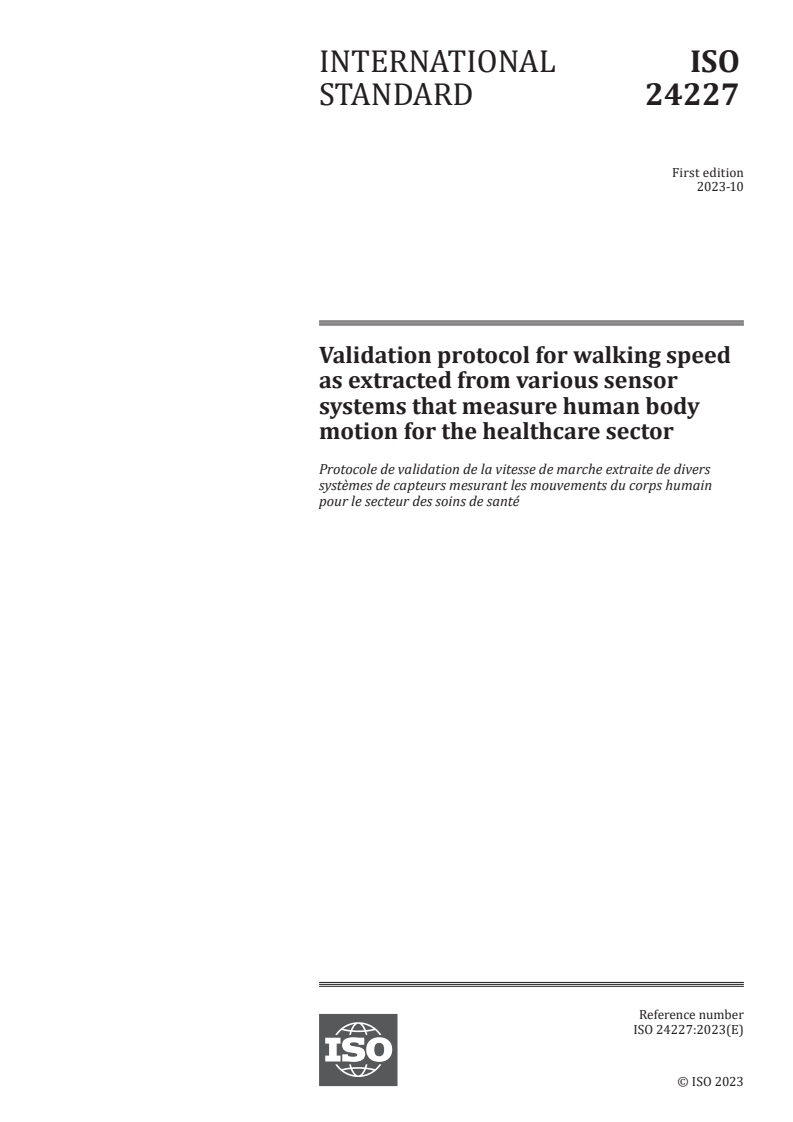
(Main)Validation protocol for walking speed as extracted from various sensor systems that measure human body motion for the healthcare sector
Validation protocol for walking speed as extracted from various sensor systems that measure human body motion for the healthcare sector
This document provides a procedure for the standard validation and reporting protocol of walking speed measurements by technological sensor systems compared with the values provided by the reference method, namely walking speed as measured by a tape measure and a stopwatch. It does not address the detailed or specific uses of various technological sensor systems in healthcare.
Protocole de validation de la vitesse de marche extraite de divers systèmes de capteurs mesurant les mouvements du corps humain pour le secteur des soins de santé
General Information
- Status
- Published
- Publication Date
- 25-Oct-2023
- Technical Committee
- ISO/TC 159/SC 3 - Anthropometry and biomechanics
- Current Stage
- 6060 - International Standard published
- Start Date
- 26-Oct-2023
- Due Date
- 24-Jun-2023
- Completion Date
- 26-Oct-2023
Overview
ISO 24227:2023 specifies a standard validation and reporting protocol for measuring walking speed extracted from various sensor systems that capture human body motion in the healthcare sector. The standard defines how to compare walking speed from technological sensor systems (e.g., wearable accelerometers, depth sensors, GPS-based systems) with the reference method - walking speed measured using a tape measure and a stopwatch - and sets out study, measurement and reporting requirements to enable consistent accuracy assessment.
Key topics and requirements
- Validation study design
- Simultaneous measurement by the sensor system and the reference method for each trial.
- Minimum of 50 data points covering the full walking-speed range of the target population (or equivalent repeated trials).
- Walkway length guidance (practical minimum about 10 m) with ~3 m acceleration/deceleration zones so steady-speed intervals are recorded.
- Measurer qualifications
- Measurers should be trained under clinical supervision and by sensor-system representatives. Preferably the same measurer for all trials; report inter-rater reliability if multiple measurers are used (e.g., intraclass correlation).
- Instrumentation and calibration
- Stopwatch and tape measure must be traceable with an individually serial-numbered calibration certificate meeting ISO/IEC 17025 requirements.
- Data analysis and metrics
- Compute per-trial difference (d) between sensor and reference speeds, root-mean-square error (RMSE), 95% confidence interval of the mean, and measurement bias.
- Provide Bland–Altman plots to characterise bias and limits of agreement.
- Reporting
- Use the provided Annex A template and sample report (Annex B). Required items include participant demographics, tested speed range, environment, sensor type/location, hardware/software versions, mean/SDs, RMSE, 95% CI, and Bland–Altman results.
Applications and who uses it
- Manufacturers of wearable and environment-embedded motion sensors use ISO 24227:2023 to validate and demonstrate walking-speed accuracy against the clinical reference method.
- Clinical researchers and rehabilitation clinicians use the protocol to evaluate sensor performance before deploying systems for patient monitoring or trials.
- Ergonomists and occupational health professionals who need validated walking-speed data for workplace assessments and fatigue indices.
- Regulators and procurement teams can rely on standardized validation reports when comparing systems.
Keywords: ISO 24227:2023, walking speed validation, sensor systems, healthcare, reference method, RMSE, Bland–Altman, accelerometer, GPS, depth sensor, validation protocol.
Related standards
- ISO/IEC 17025 (calibration laboratory competence) - referenced for traceable tape-measure calibration.

Get Certified
Connect with accredited certification bodies for this standard

NSF International
Global independent organization facilitating standards development and certification.

CIS Institut d.o.o.
Personal Protective Equipment (PPE) certification body. Notified Body NB-2890 for EU Regulation 2016/425 PPE.

Kiwa BDA Testing
Building and construction product certification.
Sponsored listings
Frequently Asked Questions
ISO 24227:2023 is a standard published by the International Organization for Standardization (ISO). Its full title is "Validation protocol for walking speed as extracted from various sensor systems that measure human body motion for the healthcare sector". This standard covers: This document provides a procedure for the standard validation and reporting protocol of walking speed measurements by technological sensor systems compared with the values provided by the reference method, namely walking speed as measured by a tape measure and a stopwatch. It does not address the detailed or specific uses of various technological sensor systems in healthcare.
This document provides a procedure for the standard validation and reporting protocol of walking speed measurements by technological sensor systems compared with the values provided by the reference method, namely walking speed as measured by a tape measure and a stopwatch. It does not address the detailed or specific uses of various technological sensor systems in healthcare.
ISO 24227:2023 is classified under the following ICS (International Classification for Standards) categories: 13.180 - Ergonomics. The ICS classification helps identify the subject area and facilitates finding related standards.
ISO 24227:2023 is available in PDF format for immediate download after purchase. The document can be added to your cart and obtained through the secure checkout process. Digital delivery ensures instant access to the complete standard document.
Standards Content (Sample)
INTERNATIONAL ISO
STANDARD 24227
First edition
2023-10
Validation protocol for walking speed
as extracted from various sensor
systems that measure human body
motion for the healthcare sector
Protocole de validation de la vitesse de marche extraite de divers
systèmes de capteurs mesurant les mouvements du corps humain
pour le secteur des soins de santé
Reference number
© ISO 2023
All rights reserved. Unless otherwise specified, or required in the context of its implementation, no part of this publication may
be reproduced or utilized otherwise in any form or by any means, electronic or mechanical, including photocopying, or posting on
the internet or an intranet, without prior written permission. Permission can be requested from either ISO at the address below
or ISO’s member body in the country of the requester.
ISO copyright office
CP 401 • Ch. de Blandonnet 8
CH-1214 Vernier, Geneva
Phone: +41 22 749 01 11
Email: copyright@iso.org
Website: www.iso.org
Published in Switzerland
ii
Contents Page
Foreword .iv
Introduction .v
1 Scope . 1
2 Normative references . 1
3 Terms and definitions . 1
4 Validation protocol of walking speed as provided by various sensor systems .1
4.1 General . 1
4.2 Qualifications of the measurer . 1
4.3 Sample size and participant selection for the validation study . 2
4.4 Validation study procedure . 2
4.4.1 Establishing walking distance . 2
4.4.2 Measurement of walking speed . 2
4.4.3 Comparison of measured walking speeds . 3
5 Validation study reporting . 3
Annex A (informative) Template to report the results of a validation study .4
Annex B (informative) Sample report of the results of a validation study .5
Bibliography . 7
iii
Foreword
ISO (the International Organization for Standardization) is a worldwide federation of national standards
bodies (ISO member bodies). The work of preparing International Standards is normally carried out
through ISO technical committees. Each member body interested in a subject for which a technical
committee has been established has the right to be represented on that committee. International
organizations, governmental and non-governmental, in liaison with ISO, also take part in the work.
ISO collaborates closely with the International Electrotechnical Commission (IEC) on all matters of
electrotechnical standardization.
The procedures used to develop this document and those intended for its further maintenance are
described in the ISO/IEC Directives, Part 1. In particular, the different approval criteria needed for the
different types of ISO document should be noted. This document was drafted in accordance with the
editorial rules of the ISO/IEC Directives, Part 2 (see www.iso.org/directives).
ISO draws attention to the possibility that the implementation of this document may involve the use
of (a) patent(s). ISO takes no position concerning the evidence, validity or applicability of any claimed
patent rights in respect thereof. As of the date of publication of this document, ISO had not received
notice of (a) patent(s) which may be required to implement this document. However, implementers are
cautioned that this may not represent the latest information, which may be obtained from the patent
database available at www.iso.org/patents. ISO shall not be held responsible for identifying any or all
such patent rights.
Any trade name used in this document is information given for the convenience of users and does not
constitute an endorsement.
For an explanation of the voluntary nature of standards, the meaning of ISO specific terms and
expressions related to conformity assessment, as well as information about ISO's adherence to
the World Trade Organization (WTO) principles in the Technical Barriers to Trade (TBT), see
www.iso.org/iso/foreword.html.
This document was prepared by Technical Committee ISO/TC 159, Ergonomics, Subcommittee SC 3,
Anthropometry and biomechanics.
Any feedback or questions on this document should be directed to the user’s national standards body. A
complete listing of these bodies can be found at www.iso.org/members.html.
iv
Introduction
Walking speed is recognized as being a reliable predictor of healthy function for people of all ages,
and in particular for the elderly, and has been referred to as one of the “vital signs” of physical health
[1]–[4]
and as one of the predictive factors of future health and death . Studies of community-dwelling
[4]
older adults (65 years and older: mean ± standard deviations age 74,2 ± 2,9 years for one study and
[5]
74,1 ± 5,7 years for another ) have shown that walking speeds faster than 1,0 m/s suggest healthier
ageing, while walking speeds slower than 0,6 m/s suggest an increased likelihood of poor health and
[4],[5]
function .
In the healthcare sector, measuring walking speed by using a stopwatch and a tape measure is the gold
[6]–[8]
standard (hereafter, reference method) . Recent new technologies enable walking speed to be
[9],[10]
measured using various sensor systems (e.g. wearable sensors, environment-embedded sensors) .
These technologies offer possible improvements on the reference method in healthcare for measuring
[10]
walking speed, such as being able to measure walking speed during daily living . Measurements taken
during daily living could produce a more accurate health index due to decreased examiner influence
and the ability to measure walking speed for longer distances and more frequently than in a clinical
setting. Further, sensor systems can be utilized to establish a fatigue index in the work environment.
There is, however, no fixed standard to validate walking speed measured by such new technologies
against the reference method. Therefore, users of such systems (e.g. physicians, therapists, ergonomists)
cannot compare the accuracy between different systems based on the same evaluation protocol.
The intent of this document is to provide manufacturers of sensor system technologies with a standard
means of validating and reporting walking speed values against the values provided by the reference
method for measuring walking speed in the healthcare sector.
There are several different fundamental technologies underlying commercially available sensor systems
that measure walking speed. This document covers these technologies, including accelerometer-based
systems, depth-sensor-based systems and global positioning system (GPS)-based systems.
v
INTERNATIONAL STANDARD ISO 24227:2023(E)
Validation protocol for walking speed as extracted from
various sensor systems that measure human body motion
for the healthcare sector
1 Scope
This document provides a procedure for the standard validation and reporting protocol of walking
speed measurements by technological sensor systems compared with the values provided by the
reference method, namely walking speed as measured by a tape measure and a stopwatch.
It does not address the detailed or specific uses of various technological sensor systems in healthcare.
2 Normative references
There are no normative references in this document.
3 Terms and definitions
For the purposes of this document, the following terms and definitions apply.
ISO and IEC maintain terminology databases for use in standardization at the following addresses:
— ISO Online browsing platform: available at https:// www .iso .org/ obp
— IEC Electropedia: available at https:// www .electropedia .org/
3.1
reference method
method to measure walking speed using a measuring tape and a stopwatch, often used in the healthcare
sector
3.2
parallax error
error that occurs when the observer’s eyes are positioned at an angle to the measurement markings
4 Validation protocol of walking speed as provided by various sensor systems
4.1 General
For a sensory system to be validated against the reference method for measuring walking speed, the
validation study procedure shall be followed. A validation study shall be done by comparing walking
speed as extracted by sensor systems and walking speed as measured by the reference method.
Each participant shall be measured by the sensor systems and reference method simultaneously.
The measurer shall use a stopwatch and a tape measure that is provided with an individually
serial-numbered traceable certificate from a calibration laboratory meeting the requirements of
[11]
ISO/IEC 17025 .
4.2 Qualifications of the measurer
The measurer should have learned and practised the measurement method under the supervision of a
person with clinical experience for the reference method and a representative from the manufacturer
or distributor of the sensor system.
It is preferable that the same measurer measures (or be present for measurements being taken) all
participant(s) for all test protocols. When there are multiple measurers, inter-measurer differences in
measurement accuracy can occur. Therefore, it is preferable to report inter-rater reliability, such as
intraclass correlation coefficients (case 2), by measuring the same subjects with multiple measurers.
4.3 Sample size and participant selection for the validation study
[12],[13]
Based on the sample size of the previous studies , the sample size of the validation study shall
be at least 50 data points, covering the entire walking speed range (i.e. mean ± 2 standard deviations)
of the target population intended by the sensor system design. These data are preferably collected
from multiple people walking several times each, because the walking speed extracted from the sensor
system can be affected by the parameters that vary from participa
...
Questions, Comments and Discussion
Ask us and Technical Secretary will try to provide an answer. You can facilitate discussion about the standard in here.
Loading comments...