


ISO/TR 7250-4:2023
(Main)Basic human body measurements for technological design — Part 4: Expected performance of skilled anthropometrists
Basic human body measurements for technological design — Part 4: Expected performance of skilled anthropometrists
This document describes the knowledge and skill required for an experienced anthropometrist who serves as a measurer in anthropometric surveys or a planner of an anthropometric survey. This document also describes methods to quantify the skill of anthropometrists and to report their performance. This document is not a textbook or manual for anthropometry but can be useful for those who plan and conduct anthropometric surveys as well as designers and technologists who utilize anthropometric data. Methods described in this document can also be applicable to measurements other than those described in ISO 7250-1.
Définitions des mesures de base du corps humain pour la conception technologique — Partie 4: Performances attendues des anthropométristes qualifiés
General Information
- Status
- Published
- Publication Date
- 24-Oct-2023
- Technical Committee
- ISO/TC 159/SC 3 - Anthropometry and biomechanics
- Drafting Committee
- ISO/TC 159/SC 3 - Anthropometry and biomechanics
- Current Stage
- 6060 - International Standard published
- Start Date
- 25-Oct-2023
- Due Date
- 13-Sep-2025
- Completion Date
- 25-Oct-2023
Overview
ISO/TR 7250-4:2023 - "Basic human body measurements for technological design - Part 4: Expected performance of skilled anthropometrists" defines the knowledge, skills and performance reporting expected of an experienced anthropometrist. It explains how to quantify and report measurer skill in anthropometric surveys and complements measurement standards (it is explicitly not a how‑to textbook). The report helps improve the quality and traceability of anthropometric data used in design, ergonomics and research.
Key topics and technical requirements
- Scope and purpose: Clarifies what constitutes a skilled anthropometrist for survey measurers and planners; provides methods to quantify measurer performance.
- Knowledge areas expected:
- Basic human anatomy relevant to landmarking.
- Correct participant posture and its effect on measurements.
- Landmarking procedures and use of removable skin markers.
- Use, care and safety of instruments (tape measures, sliding calipers, anthropometers).
- Role and coordination with assistants.
- Survey planning: Guidance on planning elements including participants, measurement items, measurers/assistants, space, schedule, clothing and ethical considerations.
- Data quality and editing: Principles for reviewing and editing anthropometric data prior to analysis.
- Quantifying measurement errors:
- Definitions and methods for intra‑observer and inter‑observer measurement error.
- Procedures to assess errors in landmarking.
- Templates and example reports (Annexes A–C) for documenting measurement error and observer performance.
- Reporting: Recommendations for reporting measurer performance and measurement‑error statistics to support database reliability.
Practical applications and users
ISO/TR 7250-4:2023 is valuable for:
- Ergonomists and human factors engineers designing products, workspaces and PPE who rely on high‑quality anthropometric data.
- Survey planners and field teams setting up anthropometric studies and training measurers.
- Research labs and institutions validating manual measurements or comparing manual vs. scan‑derived data.
- Manufacturers and standards developers seeking documented measurer competence to support conformity and design decisions.
Practical benefits include improved consistency of manual measurements, reduced landmarking bias, documented measurer precision, and clearer traceability of anthropometric databases.
Related standards
- ISO 7250-1 (basic measurement definitions) - measurements referenced by this report.
- ISO 20685-1 / ISO 20685-2 - protocols for scan‑derived measurement quality.
- ISO 15535 - population measurement standards (references to skilled anthropometrists).
- ISO 8559-1 - apparel landmarks and small articles.
Keywords: ISO/TR 7250-4:2023, anthropometrist, anthropometric surveys, landmarking, intra-observer error, inter-observer error, anthropometry, measurement error, survey planning, anthropometric data quality.

Get Certified
Connect with accredited certification bodies for this standard

NSF International
Global independent organization facilitating standards development and certification.

CIS Institut d.o.o.
Personal Protective Equipment (PPE) certification body. Notified Body NB-2890 for EU Regulation 2016/425 PPE.

Kiwa BDA Testing
Building and construction product certification.
Sponsored listings
Frequently Asked Questions
ISO/TR 7250-4:2023 is a technical report published by the International Organization for Standardization (ISO). Its full title is "Basic human body measurements for technological design — Part 4: Expected performance of skilled anthropometrists". This standard covers: This document describes the knowledge and skill required for an experienced anthropometrist who serves as a measurer in anthropometric surveys or a planner of an anthropometric survey. This document also describes methods to quantify the skill of anthropometrists and to report their performance. This document is not a textbook or manual for anthropometry but can be useful for those who plan and conduct anthropometric surveys as well as designers and technologists who utilize anthropometric data. Methods described in this document can also be applicable to measurements other than those described in ISO 7250-1.
This document describes the knowledge and skill required for an experienced anthropometrist who serves as a measurer in anthropometric surveys or a planner of an anthropometric survey. This document also describes methods to quantify the skill of anthropometrists and to report their performance. This document is not a textbook or manual for anthropometry but can be useful for those who plan and conduct anthropometric surveys as well as designers and technologists who utilize anthropometric data. Methods described in this document can also be applicable to measurements other than those described in ISO 7250-1.
ISO/TR 7250-4:2023 is classified under the following ICS (International Classification for Standards) categories: 13.180 - Ergonomics. The ICS classification helps identify the subject area and facilitates finding related standards.
ISO/TR 7250-4:2023 is available in PDF format for immediate download after purchase. The document can be added to your cart and obtained through the secure checkout process. Digital delivery ensures instant access to the complete standard document.
Standards Content (Sample)
TECHNICAL ISO/TR
REPORT 7250-4
First edition
2023-10
Basic human body measurements for
technological design —
Part 4:
Expected performance of skilled
anthropometrists
Définitions des mesures de base du corps humain pour la conception
technologique —
Partie 4: Performances attendues des anthropométristes qualifiés
Reference number
© ISO 2023
All rights reserved. Unless otherwise specified, or required in the context of its implementation, no part of this publication may
be reproduced or utilized otherwise in any form or by any means, electronic or mechanical, including photocopying, or posting on
the internet or an intranet, without prior written permission. Permission can be requested from either ISO at the address below
or ISO’s member body in the country of the requester.
ISO copyright office
CP 401 • Ch. de Blandonnet 8
CH-1214 Vernier, Geneva
Phone: +41 22 749 01 11
Email: copyright@iso.org
Website: www.iso.org
Published in Switzerland
ii
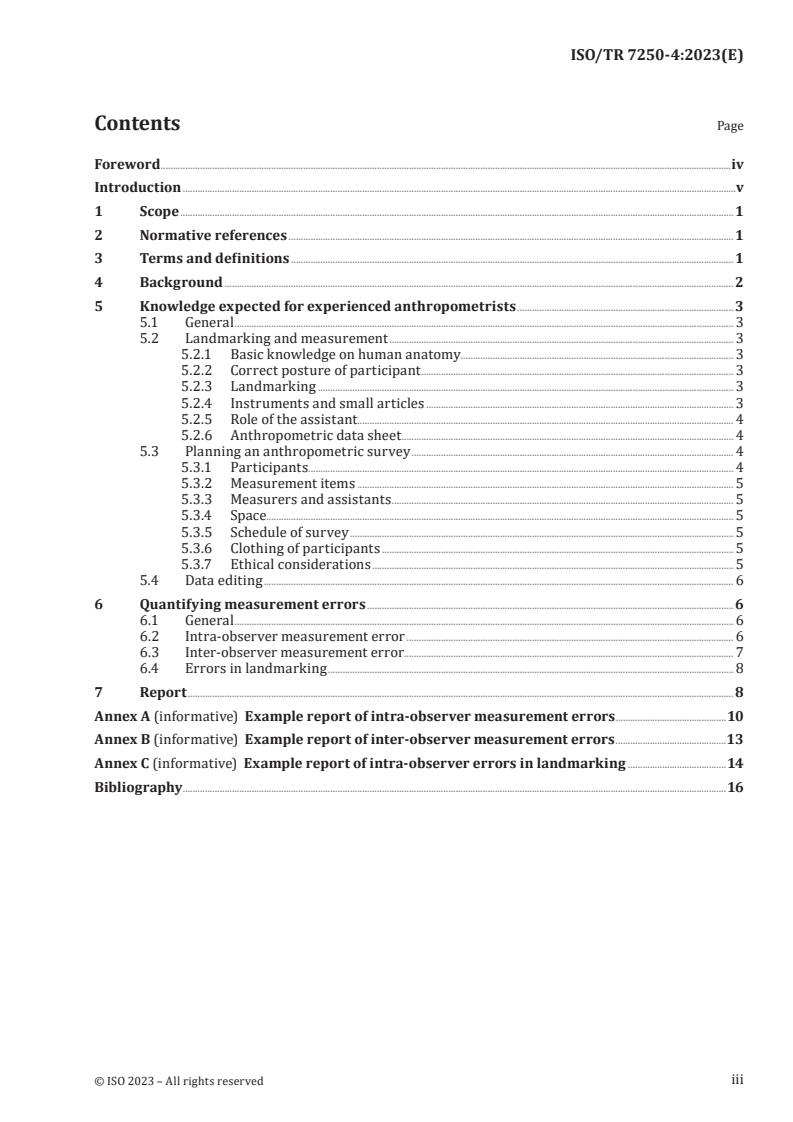
Contents Page
Foreword .iv
Introduction .v
1 Scope . 1
2 Normative references . 1
3 Terms and definitions . 1
4 Background . 2
5 Knowledge expected for experienced anthropometrists . 3
5.1 General . 3
5.2 Landmarking and measurement . 3
5.2.1 Basic knowledge on human anatomy . . 3
5.2.2 Correct posture of participant . 3
5.2.3 Landmarking . 3
5.2.4 Instruments and small articles . 3
5.2.5 Role of the assistant. 4
5.2.6 Anthropometric data sheet . 4
5.3 Planning an anthropometric survey . 4
5.3.1 Participants. 4
5.3.2 Measurement items . 5
5.3.3 Measurers and assistants . 5
5.3.4 Space . . . 5
5.3.5 Schedule of survey . 5
5.3.6 Clothing of participants . 5
5.3.7 Ethical considerations . 5
5.4 Data editing . 6
6 Quantifying measurement errors .6
6.1 General . 6
6.2 Intra-observer measurement error . 6
6.3 Inter-observer measurement error. 7
6.4 Errors in landmarking . 8
7 Report . 8
Annex A (informative) Example report of intra-observer measurement errors .10
Annex B (informative) Example report of inter-observer measurement errors .13
Annex C (informative) Example report of intra-observer errors in landmarking .14
Bibliography .16
iii
Foreword
ISO (the International Organization for Standardization) is a worldwide federation of national standards
bodies (ISO member bodies). The work of preparing International Standards is normally carried out
through ISO technical committees. Each member body interested in a subject for which a technical
committee has been established has the right to be represented on that committee. International
organizations, governmental and non-governmental, in liaison with ISO, also take part in the work.
ISO collaborates closely with the International Electrotechnical Commission (IEC) on all matters of
electrotechnical standardization.
The procedures used to develop this document and those intended for its further maintenance are
described in the ISO/IEC Directives, Part 1. In particular, the different approval criteria needed for the
different types of ISO document should be noted. This document was drafted in accordance with the
editorial rules of the ISO/IEC Directives, Part 2 (see www.iso.org/directives).
ISO draws attention to the possibility that the implementation of this document may involve the use
of (a) patent(s). ISO takes no position concerning the evidence, validity or applicability of any claimed
patent rights in respect thereof. As of the date of publication of this document, ISO had not received
notice of (a) patent(s) which may be required to implement this document. However, implementers are
cautioned that this may not represent the latest information, which may be obtained from the patent
database available at www.iso.org/patents. ISO shall not be held responsible for identifying any or all
such patent rights.
Any trade name used in this document is information given for the convenience of users and does not
constitute an endorsement.
For an explanation of the voluntary nature of standards, the meaning of ISO specific terms and
expressions related to conformity assessment, as well as information about ISO's adherence to
the World Trade Organization (WTO) principles in the Technical Barriers to Trade (TBT), see
www.iso.org/iso/foreword.html.
This document was prepared by Technical Committee ISO/TC 159, Ergonomics, Subcommittee SC 3,
Anthropometry and biomechanics.
A list of all parts in the ISO 7250 series can be found on the ISO website.
Any feedback or questions on this document should be directed to the user’s national standards body. A
complete listing of these bodies can be found at www.iso.org/members.html.
iv
Introduction
Anthropometric data used for technological design have been included in many ISO product standards.
There are several standards such as ISO 15535 that refer to a skilled or experienced anthropometrist
but give no clear information on what is a skilled or experienced anthropometrist. The skill of an
anthropometrist forms the most important part of quality control of anthropometric data. The
information provided by this document complements the lack of existing standards and can help
developers and users of anthropometric databases.
v
TECHNICAL REPORT ISO/TR 7250-4:2023(E)
Basic human body measurements for technological
design —
Part 4:
Expected performance of skilled anthropometrists
1 Scope
This document describes the knowledge and skill required for an experienced anthropometrist
who serves as a measurer in anthropometric surveys or a planner of an anthropometric survey.
This document also describes methods to quantify the skill of anthropometrists and to report their
performance.
This document is not a textbook or manual for anthropometry but can be useful for those who plan and
conduct anthropometric surveys as well as designers and technologists who utilize anthropometric
data. Methods described in this document can also be applicable to measurements other than those
described in ISO 7250-1.
2 Normative references
There are no normative references in this document.
3 Terms and definitions
For the purposes of this document, the following terms and definitions apply.
ISO and IEC maintain terminology databases for use in standardization at the following addresses:
— ISO Online browsing platform: available at https:// www .iso .org/ obp
— IEC Electropedia: available at https:// www .electropedia .org/
3.1
anthropometrist
person who takes scientifically accurate measurements of the human body according to traditional
methods
3.2
inter-observer measurement error
difference between the measurements taken on the same participant by different measurers
3.3
intra-observer measurement error
difference between the repeated measurements taken on the same participant by the same measurer
3.4
anatomical landmark
point clearly defined on the body that can be used for determining anthropometric measurements
[SOURCE: ISO 20685-1:2018, 3.6]
3.5
landmarking
placement of an anatomical landmark point on the skin of a participant by palpating the underlying
bone and/or observing the surface shape of anatomical structures
3.6
bias
systematic difference between two sets of measurements on the same participant group by different
measurers
4 Background
Different factors influence the quality of anthropometric data by the type of data as shown in Table 1.
In the traditional methods, instruments are simple and easy to calibrate. Body posture is a part of the
definition of a measurement item and is controlled by the measurer when taking measurement. Since
the time duration required for taking a manual measurement is very short, the influence of the body
sway is negligible. Therefore, the skill of the measurer in landmarking and measuring is the main cause
of errors in the traditional methods. Reducing errors in landmarking is essential for reducing errors in
measurements.
Since the human body is not a rigid object, it is impossible to give the true value to a human body.
Therefore, the accuracy of the human body measurement cannot be evaluated. Only the precision of
measurement can be evaluated for manual measurements.
Skill of anthropometry can be obtained only through training. The aim of training is to reduce intra-
and inter-observer measurement errors. The goal of training is to make a trainee into an experienced
anthropometrist. However, self-training that relies solely on textbooks, standards or other material can
lead to inaccurate landmarking procedures that result in biased landmark positions. Periodic training
with an experienced anthropometrist is necessary.
Scan-derived measurements are influenced by more factors than the 1-D measurements obtained by
the traditional methods. The protocol for quality control of scan-derived measurements is already
standardized (see ISO 20685-1 and ISO 20685-2), except for the protocol for evaluating the performance
of software for automatically calculating landmark positions or measurements.
Table 1 — Factors that can influence the quality of anthropometric data
Scan-derived measurements
Traditional body
Factor
Landmark Surface
measurement
Body measurement
coordinate shape
Accuracy of instrument N/A
Hardware
N/A Accuracy of scanner system hardware
Performance of scanner system software (e.g. data merging)
Tool
Performance of landmarking software N/A
Software N/A
Performance of measurement
N/A
calculation software
Skill of landmarking N/A
Measurer
Skill of measurement N/A
N/A Skill of deciding landmark position from a marker N/A
Human Operator
Skill of operating measure-
N/A N/A
ment calculation software
Repeatability of the posture
Participant
N/A Body sway during scan
5 Knowledge expected for experienced anthropometrists
5.1 General
Experienced anthropometrists are expected to be able to measure measurements of ISO 7250-1 with
small intra-observer measurement errors, to obtain reliable statistics from the measured data, and to
plan an anthropometric survey. Measuring, obtaining statistics and planning an anthropometric survey
require different types of knowledge. They are listed in the following clauses.
5.2 Landmarking and measurement
The knowledge required for landmarking and measurement includes definitions of landmarks,
procedure to decide positions of landmarks and place the landmarks, how to use and care for
instruments, definitions of measurement items, and procedure to take measurements. They are listed
in the following clauses. More information is available from published textbooks on anthropometry,
manual for a survey, or standards.
5.2.1 Basic knowledge on human anatomy
Basic knowledge on human anatomy is necessary for understanding the definition of landmarks and
their positions in the human body. Some landmarks are defined on a specific position on a bone (e.g.
spinous process), and some measurements are defined using names of a specific position of a bone (e.g.
styloid process).
Some landmarks defined on the tip of a bone are easier to palpate when the participant bends a joint.
However, the participant is in the posture for measurement when the measurer puts a mark on the skin.
This is because when the joint bends, the skin slides on the bone, and the relative position of the bone
and skin changes.
5.2.2 Correct posture of participant
Participant posture is part of the definition of a measurement. Correct posture is essential because
when the posture changes, the size of a dimension can also change. For example, shoulder (biacromial)
breadth becomes smaller when arms are abducted; foot dimensions are smaller when participant is
sitting rather than standing; waist circumference is smaller when the abdominal muscles are tight;
stature becomes smaller when participant is not standing erect or larger when participant is in supine
position.
The measurer needs to understand the definition of posture and to instruct the participant properly for
him or her to take the correct posture.
5.2.3 Landmarking
When plural measurements defined using the same landmark are measured, position of the landmark
is marked on the skin so that the same location is used for all measurements. An easily removable and
non-toxic marker is used. An eyeliner pencil is often used for this purpose. The size and shape of the
mark are such that it is easily recognized as a point on the skin, and clearly different from moles.
5.2.4 Instruments and small articles
Instruments used are listed in ISO 7250-1. Small articles used for defining lines or landmarks used in
the apparel are listed in ISO 8559-1:2017, 4.2.
Safety of the participant is the matter of first priority. Measurer needs to take care of the pointed tip of
the arm of anthropometer or sliding calipers.
Two arms of a large sliding caliper need to be the same length when it is used to measure a point-to-
point distance.
Measurer covers the tips of a spreading caliper with fingertips to control the pressure on the participant
skin.
Always use flat-tip-jaws of a sliding caliper. Never use pointed-tip-jaws for measuring people.
When a tape measure is wrapped around the participant, the zero point of the tape measure overlaps
the scale on the tape measure [see Figure 1 a)]. Since the circumference of the trunk influenced by
breathing, the participant is naturally breathing when measured.
When a body scanner is used for obtaining body dimensions, the accuracy of scan-derived body
dimensions needs to be evaluated according to the protocol described in ISO 20685-1:2018, Clause 5.
a) Proper b) Not proper
Figure 1 — How to wrap a tape measure around participant
5.2.5 Role of the assistant
The measurer and the assistant work together as a team. The assistant helps the measurer in many
ways as described below. The measurer needs to give proper instructions to the assistant to get
effective help from the assistant.
The measurer reads aloud a measurement value, and the assistant writes down the number on the data
sheet. In order to avoid mistakes in reading and/or hearing, the assistant repeats aloud the number
before writing it down. When the number is clearly irregular, the assistant asks the measurer to take
another measurement.
The assistant helps the measurer by watching if the anthropometer is vertical and by adjusting the
position of the anthropometer when necessary. When a large circumference of the trunk such as chest
circumference is measured, the assistant holds the tape measure at the back of the participant so that
the position of the tape measure is horizontal and to avoid the tape measure slipping down.
The assistant also watches if the posture of the participant is correct (e.g. the head is oriented in the
Frankfurt plane).
Basically, the assistant works according to the instructions of the measurer. However, it helps to reduce
the time required for measurement if he or she can act as necessary without instruction from the
measurer. If the assistant has knowledge on anthropometry, it helps to play his or her role properly.
5.2.6 Anthropometric data sheet
Anthropometric data sheets are designed so that there are blanks for all necessary information.
Measurement items are ordered to minimize the required time for measurements and to minimize the
errors due to mistakes. Recommended background data on the survey are listed in ISO 15535:2023, 7.2.
Necessary background information items on each participant are listed in ISO 15535:2023, Annex B. An
example data sheet is in ISO 15535:2023, Annex C.
5.3 Planning an anthropometric survey
5.3.1 Participants
The target population (gender, age range and other background as necessary) and the number of
participants are selected according to the purpose of the survey. A method to estimate the number
of participants required to have a particular confidence at 5th and 95th percentiles is described in
ISO 15535:2023, Annex A.
The method of recruiting participants is selected.
5.3.2 Measurement items
Measurement items are
...
Questions, Comments and Discussion
Ask us and Technical Secretary will try to provide an answer. You can facilitate discussion about the standard in here.
Loading comments...