


IEC/TS 81001-2-2:2025
(Main)Health software and health IT systems safety, effectiveness and security — Part 2-2: Guidance for the implementation, disclosure and communication of security needs, risks and controls
Health software and health IT systems safety, effectiveness and security — Part 2-2: Guidance for the implementation, disclosure and communication of security needs, risks and controls
This document presents an informative set of common, high-level security-related capabilities and additional considerations to be used across the life cycle of health software and health IT systems, for the information exchange between the health software manufacturers (including medical device manufacturers), healthcare delivery organizations (HDOs) and other stakeholders. It is applicable to health software running on any platform and in any environment such as cloud, on premise or hybrid. While important security topics, the following are outside the scope of this document: a) the security policies of the HDO, b) the product and services security policies of the manufacturer, c) determinations of risk tolerance by the HDO or manufacturer, and d) clinical studies where there is a need to secure personal data. As security risks can be caused by any product on health IT systems and health IT Infrastructure, considerations in this document can be applied for other products that are not health software. IEC TS 81001-2-2:2025 withdraws and replaces: – IEC TR 80001-2-2, Application of risk management for IT-networks incorporating medical devices – Part 2-2: Guidance for the communication of medical device security needs, risks and controls – IEC TR 80001-2-8, Application of risk management for IT-networks incorporating medical devices – Part 2-8: Application guidance – Guidance on standards for establishing the security capabilities identified in IEC TR 80001-2-2 This document includes the following significant changes: a) Combines and updates the contents of IEC TR 80001-2-2 and IEC TR 80001-2-8; b) Extends the scope to health software instead to only medical device software; c) Aligns contents and definitions to ISO 81001-1:2021 and the updated IEC 80001-1; d) Removed the Configuration of Security Features (CNFS) capability, as any configurable security capability shall be clearly communicated. e) Provide security control mappings to several new standards, e.g. IEC TR 60601-4-5, IEC 62443-4-2, ISO/IEEE 11073-40102 and the recent versions of previous standards, e.g. ISO/IEC 27002 and NIST 800-53 version 5.
Sécurité, efficacité et sûreté des logiciels de santé et des systèmes TI de santé — Partie 2-2: Recommandations pour la mise en œuvre, la divulgation et la communication des besoins, des risques et des contrôles en matière de sécurité
General Information
- Status
- Published
- Publication Date
- 02-Oct-2025
- Technical Committee
- ISO/TC 215 - Health informatics
- Drafting Committee
- ISO/TC 215 - Health informatics
- Current Stage
- 6060 - International Standard published
- Start Date
- 03-Oct-2025
- Due Date
- 17-Feb-2025
- Completion Date
- 03-Oct-2025
Relations
- Effective Date
- 08-Oct-2022
- Effective Date
- 08-Oct-2022
Overview
IEC/TS 81001-2-2:2025 - Health software and health IT systems safety, effectiveness and security (Part 2-2) provides guidance for the implementation, disclosure and communication of security needs, risks and controls across the life cycle of health software and health IT systems. This IEC Technical Specification consolidates and updates previous TRs (IEC TR 80001-2-2 and 80001-2-8), extends scope from medical device software to all health software, and aligns with ISO 81001-1:2021 and updated IEC 80001-1. It applies to software on any platform or environment (cloud, on‑premise, hybrid), and is intended for information exchange between manufacturers, healthcare delivery organizations (HDOs) and other stakeholders.
Key Topics
The document organizes a common set of high-level security capabilities and practical guidance for their use in a risk management context. Key technical topics include:
- A catalog of security capabilities such as automatic logoff, audit controls, authorization, person and node authentication, malware detection/protection, transmission confidentiality and integrity, data backup & disaster recovery, emergency access, system/application hardening, and physical locks (see Clause 5).
- Additional supporting information: connectivity capabilities, management of personally identifiable information (PII), remote services, Software Bill of Materials (SBOM), and security guides (Clause 6).
- Guidance on communication and shared responsibility between manufacturers and HDOs, and on applying these capabilities within risk management processes (Clause 4).
- Mappings to established control frameworks and standards including ISO/IEC 27002, NIST SP 800‑53 Rev 5, IEC 62443‑4‑2, IEC TR 60601‑4‑5, and ISO/IEEE 11073‑40102.
- Notable changes: consolidation of prior guidance, removal of the “Configuration of Security Features (CNFS)” capability (requiring explicit communication of configurable features), and expanded disclosure expectations (e.g., SBOM and MDS2 references).
Applications
Who uses IEC/TS 81001-2-2:2025 and why:
- Health software manufacturers and medical device manufacturers: to define, implement and disclose security capabilities and produce consistent security documentation for purchasers and regulators.
- Healthcare Delivery Organizations (HDOs): to evaluate supplier security claims, integrate products safely into clinical networks, and allocate shared security responsibilities.
- Procurement, clinical engineers, cybersecurity teams, integrators and risk managers: for vendor assessment, system integration, incident preparedness and compliance planning.
- Applicable across cloud, on‑premise and hybrid deployments and supports integration into device lifecycles, vulnerability management, and supply‑chain transparency (SBOM).
Related standards
- ISO 81001‑1:2021 (principles and definitions for health software safety, effectiveness and security)
- ISO/IEC 27002; NIST SP 800‑53 Rev 5; IEC 62443‑4‑2; IEC TR 60601‑4‑5; ISO/IEEE 11073‑40102
These mappings help implementers translate IEC/TS 81001-2-2 security capabilities into specific technical controls and organizational measures.
Keywords: IEC/TS 81001-2-2:2025, health software security, health IT systems, security capabilities, SBOM, risk management, HDO, manufacturers, cybersecurity standards.
IEC/TS 81001-2-2:2025 - Health software and health IT systems safety, effectiveness and security — Part 2-2: Guidance for the implementation, disclosure and communication of security needs, risks and controls Released:10/3/2025
Get Certified
Connect with accredited certification bodies for this standard

BSI Group
BSI (British Standards Institution) is the business standards company that helps organizations make excellence a habit.

Bureau Veritas
Bureau Veritas is a world leader in laboratory testing, inspection and certification services.

DNV
DNV is an independent assurance and risk management provider.
Sponsored listings
Frequently Asked Questions
IEC/TS 81001-2-2:2025 is a technical specification published by the International Organization for Standardization (ISO). Its full title is "Health software and health IT systems safety, effectiveness and security — Part 2-2: Guidance for the implementation, disclosure and communication of security needs, risks and controls". This standard covers: This document presents an informative set of common, high-level security-related capabilities and additional considerations to be used across the life cycle of health software and health IT systems, for the information exchange between the health software manufacturers (including medical device manufacturers), healthcare delivery organizations (HDOs) and other stakeholders. It is applicable to health software running on any platform and in any environment such as cloud, on premise or hybrid. While important security topics, the following are outside the scope of this document: a) the security policies of the HDO, b) the product and services security policies of the manufacturer, c) determinations of risk tolerance by the HDO or manufacturer, and d) clinical studies where there is a need to secure personal data. As security risks can be caused by any product on health IT systems and health IT Infrastructure, considerations in this document can be applied for other products that are not health software. IEC TS 81001-2-2:2025 withdraws and replaces: – IEC TR 80001-2-2, Application of risk management for IT-networks incorporating medical devices – Part 2-2: Guidance for the communication of medical device security needs, risks and controls – IEC TR 80001-2-8, Application of risk management for IT-networks incorporating medical devices – Part 2-8: Application guidance – Guidance on standards for establishing the security capabilities identified in IEC TR 80001-2-2 This document includes the following significant changes: a) Combines and updates the contents of IEC TR 80001-2-2 and IEC TR 80001-2-8; b) Extends the scope to health software instead to only medical device software; c) Aligns contents and definitions to ISO 81001-1:2021 and the updated IEC 80001-1; d) Removed the Configuration of Security Features (CNFS) capability, as any configurable security capability shall be clearly communicated. e) Provide security control mappings to several new standards, e.g. IEC TR 60601-4-5, IEC 62443-4-2, ISO/IEEE 11073-40102 and the recent versions of previous standards, e.g. ISO/IEC 27002 and NIST 800-53 version 5.
This document presents an informative set of common, high-level security-related capabilities and additional considerations to be used across the life cycle of health software and health IT systems, for the information exchange between the health software manufacturers (including medical device manufacturers), healthcare delivery organizations (HDOs) and other stakeholders. It is applicable to health software running on any platform and in any environment such as cloud, on premise or hybrid. While important security topics, the following are outside the scope of this document: a) the security policies of the HDO, b) the product and services security policies of the manufacturer, c) determinations of risk tolerance by the HDO or manufacturer, and d) clinical studies where there is a need to secure personal data. As security risks can be caused by any product on health IT systems and health IT Infrastructure, considerations in this document can be applied for other products that are not health software. IEC TS 81001-2-2:2025 withdraws and replaces: – IEC TR 80001-2-2, Application of risk management for IT-networks incorporating medical devices – Part 2-2: Guidance for the communication of medical device security needs, risks and controls – IEC TR 80001-2-8, Application of risk management for IT-networks incorporating medical devices – Part 2-8: Application guidance – Guidance on standards for establishing the security capabilities identified in IEC TR 80001-2-2 This document includes the following significant changes: a) Combines and updates the contents of IEC TR 80001-2-2 and IEC TR 80001-2-8; b) Extends the scope to health software instead to only medical device software; c) Aligns contents and definitions to ISO 81001-1:2021 and the updated IEC 80001-1; d) Removed the Configuration of Security Features (CNFS) capability, as any configurable security capability shall be clearly communicated. e) Provide security control mappings to several new standards, e.g. IEC TR 60601-4-5, IEC 62443-4-2, ISO/IEEE 11073-40102 and the recent versions of previous standards, e.g. ISO/IEC 27002 and NIST 800-53 version 5.
IEC/TS 81001-2-2:2025 is classified under the following ICS (International Classification for Standards) categories: 35.030 - IT Security; 35.240.80 - IT applications in health care technology. The ICS classification helps identify the subject area and facilitates finding related standards.
IEC/TS 81001-2-2:2025 has the following relationships with other standards: It is inter standard links to IEC/TR 80001-2-8:2016, IEC/TR 80001-2-2:2012. Understanding these relationships helps ensure you are using the most current and applicable version of the standard.
IEC/TS 81001-2-2:2025 is available in PDF format for immediate download after purchase. The document can be added to your cart and obtained through the secure checkout process. Digital delivery ensures instant access to the complete standard document.
Standards Content (Sample)
IEC TS 81001-2-2
Edition 1.0 2025-09
INTERNATIONAL
STANDARD
Health software and health IT systems safety, effectiveness and security -
Part 2-2: Coordination - Guidance for the implementation, disclosure and
communication of security needs, risks and controls
ICS 11.040.01; 35.240.80 ISBN 978-2-8327-0739-5
IEC TS 81001-2-2:2025-09(en)
All rights reserved. Unless otherwise specified, no part of this publication may be reproduced or utilized in any form or
by any means, electronic or mechanical, including photocopying and microfilm, without permission in writing from either
IEC or IEC's member National Committee in the country of the requester. If you have any questions about IEC copyright
or have an enquiry about obtaining additional rights to this publication, please contact the address below or your local
IEC member National Committee for further information.
IEC Secretariat Tel.: +41 22 919 02 11
3, rue de Varembé info@iec.ch
CH-1211 Geneva 20 www.iec.ch
Switzerland
About the IEC
The International Electrotechnical Commission (IEC) is the leading global organization that prepares and publishes
International Standards for all electrical, electronic and related technologies.
About IEC publications
The technical content of IEC publications is kept under constant review by the IEC. Please make sure that you have the
latest edition, a corrigendum or an amendment might have been published.
IEC publications search - IEC Products & Services Portal - products.iec.ch
webstore.iec.ch/advsearchform Discover our powerful search engine and read freely all the
The advanced search enables to find IEC publications by a
publications previews, graphical symbols and the glossary. With
variety of criteria (reference number, text, technical a subscription you will always have access to up to date content
committee, …). It also gives information on projects, replaced tailored to your needs.
and withdrawn publications.
Electropedia - www.electropedia.org
IEC Just Published - webstore.iec.ch/justpublished The world's leading online dictionary on electrotechnology,
Stay up to date on all new IEC publications. Just Published containing more than 22 500 terminological entries in English
details all new publications released. Available online and and French, with equivalent terms in 25 additional languages.
once a month by email. Also known as the International Electrotechnical Vocabulary
(IEV) online.
IEC Customer Service Centre - webstore.iec.ch/csc
If you wish to give us your feedback on this publication or need
further assistance, please contact the Customer Service
Centre: sales@iec.ch.
IEC TS 81001-2-2:2025 © IEC 2025
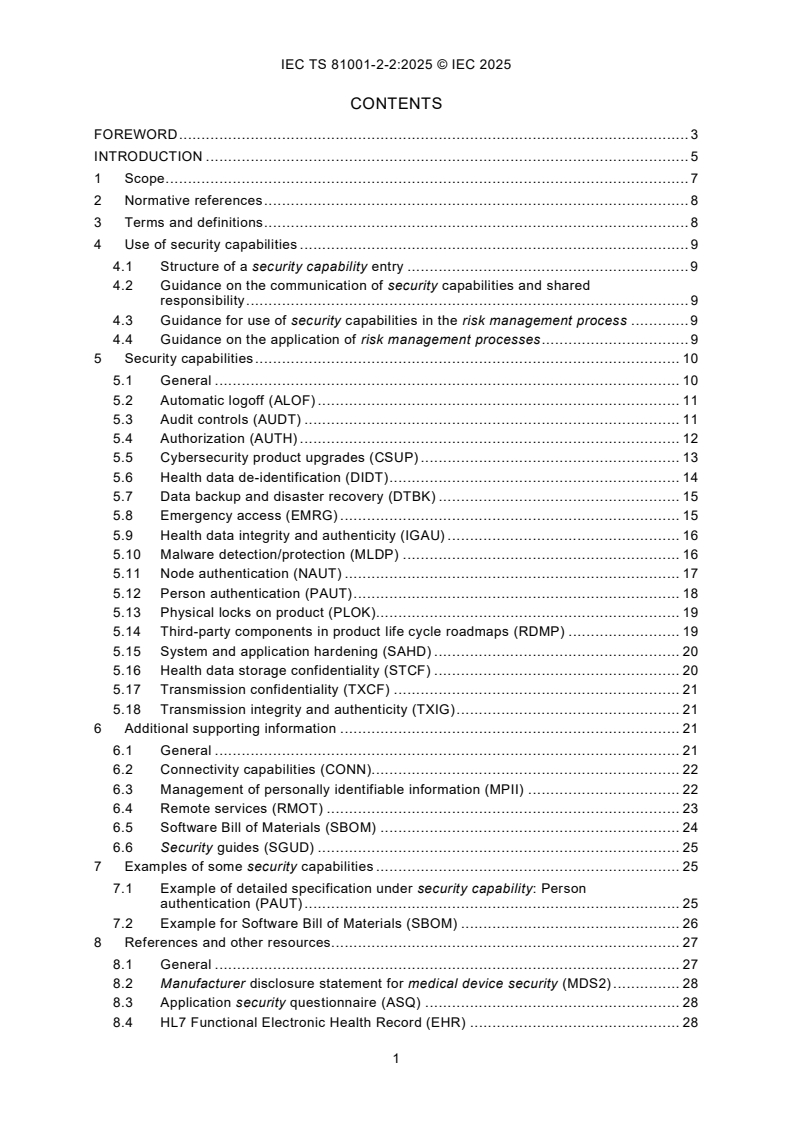
CONTENTS
FOREWORD . 3
INTRODUCTION . 5
1 Scope . 7
2 Normative references . 8
3 Terms and definitions . 8
4 Use of security capabilities . 9
4.1 Structure of a security capability entry . 9
4.2 Guidance on the communication of security capabilities and shared
responsibility . 9
4.3 Guidance for use of security capabilities in the risk management process . 9
4.4 Guidance on the application of risk management processes . 9
5 Security capabilities . 10
5.1 General . 10
5.2 Automatic logoff (ALOF) . 11
5.3 Audit controls (AUDT) . 11
5.4 Authorization (AUTH) . 12
5.5 Cybersecurity product upgrades (CSUP) . 13
5.6 Health data de-identification (DIDT) . 14
5.7 Data backup and disaster recovery (DTBK) . 15
5.8 Emergency access (EMRG) . 15
5.9 Health data integrity and authenticity (IGAU) . 16
5.10 Malware detection/protection (MLDP) . 16
5.11 Node authentication (NAUT) . 17
5.12 Person authentication (PAUT) . 18
5.13 Physical locks on product (PLOK). 19
5.14 Third-party components in product life cycle roadmaps (RDMP) . 19
5.15 System and application hardening (SAHD) . 20
5.16 Health data storage confidentiality (STCF) . 20
5.17 Transmission confidentiality (TXCF) . 21
5.18 Transmission integrity and authenticity (TXIG) . 21
6 Additional supporting information . 21
6.1 General . 21
6.2 Connectivity capabilities (CONN). 22
6.3 Management of personally identifiable information (MPII) . 22
6.4 Remote services (RMOT) . 23
6.5 Software Bill of Materials (SBOM) . 24
6.6 Security guides (SGUD) . 25
7 Examples of some security capabilities . 25
7.1 Example of detailed specification under security capability: Person
authentication (PAUT) . 25
7.2 Example for Software Bill of Materials (SBOM) . 26
8 References and other resources . 27
8.1 General . 27
8.2 Manufacturer disclosure statement for medical device security (MDS2) . 28
8.3 Application security questionnaire (ASQ) . 28
8.4 HL7 Functional Electronic Health Record (EHR) . 28
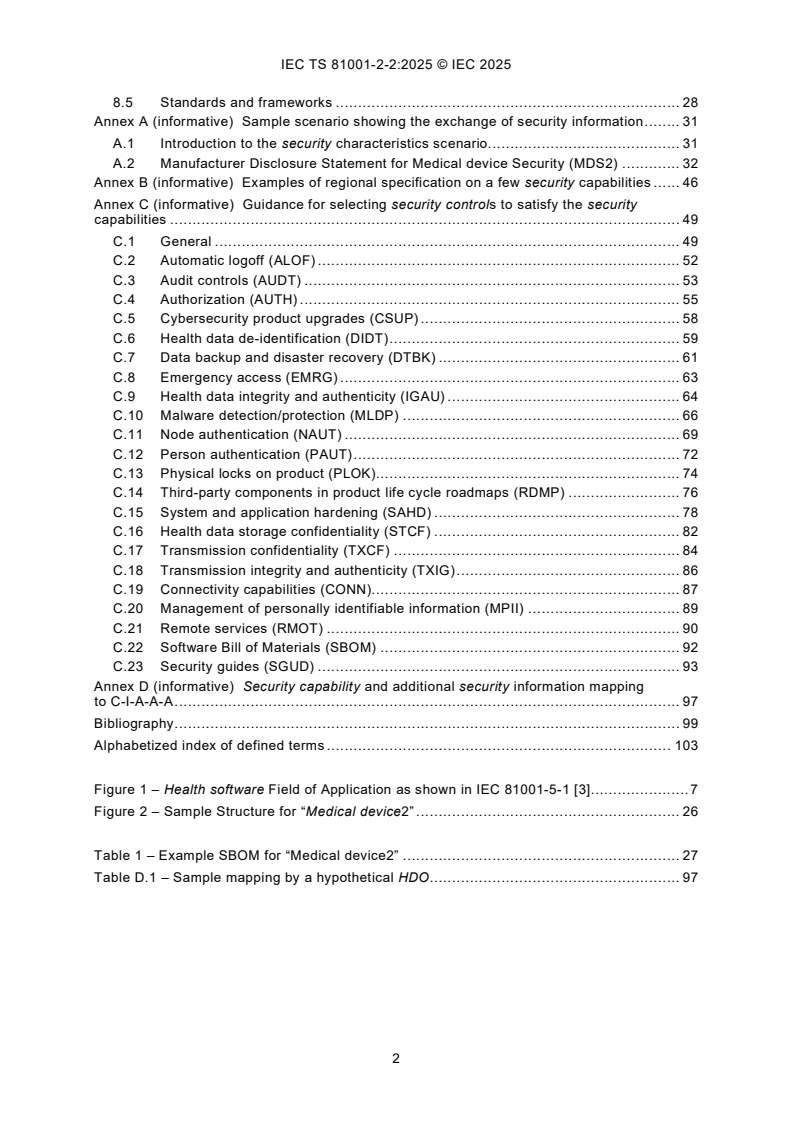
IEC TS 81001-2-2:2025 © IEC 2025
8.5 Standards and frameworks . 28
Annex A (informative) Sample scenario showing the exchange of security information . 31
A.1 Introduction to the security characteristics scenario. 31
A.2 Manufacturer Disclosure Statement for Medical device Security (MDS2) . 32
Annex B (informative) Examples of regional specification on a few security capabilities . 46
Annex C (informative) Guidance for selecting security controls to satisfy the security
capabilities . 49
C.1 General . 49
C.2 Automatic logoff (ALOF) . 52
C.3 Audit controls (AUDT) . 53
C.4 Authorization (AUTH) . 55
C.5 Cybersecurity product upgrades (CSUP) . 58
C.6 Health data de-identification (DIDT) . 59
C.7 Data backup and disaster recovery (DTBK) . 61
C.8 Emergency access (EMRG) . 63
C.9 Health data integrity and authenticity (IGAU) . 64
C.10 Malware detection/protection (MLDP) . 66
C.11 Node authentication (NAUT) . 69
C.12 Person authentication (PAUT) . 72
C.13 Physical locks on product (PLOK). 74
C.14 Third-party components in product life cycle roadmaps (RDMP) . 76
C.15 System and application hardening (SAHD) . 78
C.16 Health data storage confidentiality (STCF) . 82
C.17 Transmission confidentiality (TXCF) . 84
C.18 Transmission integrity and authenticity (TXIG) . 86
C.19 Connectivity capabilities (CONN). 87
C.20 Management of personally identifiable information (MPII) . 89
C.21 Remote services (RMOT) . 90
C.22 Software Bill of Materials (SBOM) . 92
C.23 Security guides (SGUD) . 93
Annex D (informative) Security capability and additional security information mapping
to C-I-A-A-A . 97
Bibliography . 99
Alphabetized index of defined terms . 103
Figure 1 – Health software Field of Application as shown in IEC 81001-5-1 [3] . 7
Figure 2 – Sample Structure for “Medical device2” . 26
Table 1 – Example SBOM for “Medical device2” . 27
Table D.1 – Sample mapping by a hypothetical HDO . 97
IEC TS 81001-2-2:2025 © IEC 2025
INTERNATIONAL ELECTROTECHNICAL COMMISSION
____________
Health software and health it systems safety, effectiveness and security -
Part 2-2: Coordination - Guidance for the implementation, disclosure and
communication of security needs, risks and controls
FOREWORD
1) The International Electrotechnical Commission (IEC) is a worldwide organization for standardization comprising
all national electrotechnical committees (IEC National Committees). The object of IEC is to promote international
co-operation on all questions concerning standardization in the electrical and electronic fields. To this end and
in addition to other activities, IEC publishes International Standards, Technical Specifications, Technical Reports,
Publicly Available Specifications (PAS) and Guides (hereafter referred to as “IEC Publication(s)”). Their
preparation is entrusted to technical committees; any IEC National Committee interested in the subject dealt with
may participate in this preparatory work. International, governmental and non-governmental organizations liaising
with the IEC also participate in this preparation. IEC collaborates closely with the International Organization for
Standardization (ISO) in accordance with conditions determined by agreement between the two organizations.
2) The formal decisions or agreements of IEC on technical matters express, as nearly as possible, an international
consensus of opinion on the relevant subjects since each technical committee has representation from all
interested IEC National Committees.
3) IEC Publications have the form of recommendations for international use and are accepted by IEC National
Committees in that sense. While all reasonable efforts are made to ensure that the technical content of IEC
Publications is accurate, IEC cannot be held responsible for the way in which they are used or for any
misinterpretation by any end user.
4) In order to promote international uniformity, IEC National Committees undertake to apply IEC Publications
transparently to the maximum extent possible in their national and regional publications. Any divergence between
any IEC Publication and the corresponding national or regional publication shall be clearly indicated in the latter.
5) IEC itself does not provide any attestation of conformity. Independent certification bodies provide conformity
assessment services and, in some areas, access to IEC marks of conformity. IEC is not responsible for any
services carried out by independent certification bodies.
6) All users should ensure that they have the latest edition of this publication.
7) No liability shall attach to IEC or its directors, employees, servants or agents including individual experts and
members of its technical committees and IEC National Committees for any personal injury, property damage or
other damage of any nature whatsoever, whether direct or indirect, or for costs (including legal fees) and
expenses arising out of the publication, use of, or reliance upon, this IEC Publication or any other IEC
Publications.
8) Attention is drawn to the Normative references cited in this publication. Use of the referenced publications is
indispensable for the correct application of this publication.
9) IEC draws attention to the possibility that the implementation of this document may involve the use of (a)
patent(s). IEC takes no position concerning the evidence, validity or applicability of any claimed patent rights in
respect thereof. As of the date of publication of this document, IEC had not received notice of (a) patent(s), which
may be required to implement this document. However, implementers are cautioned that this may not represent
the latest information, which may be obtained from the patent database available at https://patents.iec.ch. IEC
shall not be held responsible for identifying any or all such patent rights.
IEC TS 81001-2-2 has been prepared by subcommittee 62A: Common aspects of electrical
equipment, software, and systems, of IEC technical committee 62: Medical equipment, software,
and systems and ISO technical committee 215: Health informatics. It is a Technical
Specification.
This document withdraws and replaces:
– IEC TR 80001-2-2, Application of risk management for IT-networks incorporating medical
devices – Part 2-2: Guidance for the communication of medical device security needs, risks
and controls
– IEC TR 80001-2-8, Application of risk management for IT-networks incorporating medical
devices – Part 2-8: Application guidance – Guidance on standards for establishing the
security capabilities identified in IEC TR 80001-2-2
IEC TS 81001-2-2:2025 © IEC 2025
This document includes the following significant changes:
a) Combines and updates the contents of IEC TR 80001-2-2 and IEC TR 80001-2-8;
b) Extends the scope to health software instead to only medical device software;
c) Aligns contents and definitions to ISO 81001-1:2021 and the updated IEC 80001-1;
d) Removed the Configuration of Security Features (CNFS) capability, as any configurable
security capability shall be clearly communicated.
e) Provide security control mappings to several new standards, e.g. IEC TR 60601-4-5,
IEC 62443-4-2, ISO/IEEE 11073-40102 and the recent versions of previous standards, e.g.
ISO/IEC 27002 and NIST 800-53 version 5.
The text of this Technical Specification is based on the following documents:
Draft Report on voting
62A/1668/DTS 62A/1690/RVDTS
Full information on the voting for its approval can be found in the report on voting indicated in
the above table.
The language used for the development of this Technical Specification is English.
This document was drafted in accordance with ISO/IEC Directives, Part 2, and developed in
accordance with ISO/IEC Directives, Part 1 and ISO/IEC Directives, IEC Supplement, available
at www.iec.ch/members_experts/refdocs. The main document types developed by IEC are
described in greater detail at www.iec.ch/publications.
A list of all parts in the IEC 81001 series, published under the general title Health software and
health IT systems safety, effectiveness and security, can be found on the IEC website.
Terms used throughout this document that have been defined in Clause 3 and the terms
referenced in the alphabetical index at the end of the document appear in italics.
The committee has decided that the contents of this document will remain unchanged until the
stability date indicated on the IEC website under webstore.iec.ch in the data related to the
specific document. At this date, the document will be
– reconfirmed,
– withdrawn, or
– revised.
IEC TS 81001-2-2:2025 © IEC 2025
INTRODUCTION
ISO 81001-1 provides the principles, concepts, terms and definitions for health software and
health IT systems, key properties of safety, effectiveness and security across the life cycle.
ISO 81001-1 and all parts of the ISO 81001 and IEC 81001 series are applicable to all relevant
stakeholders including health software manufacturers (including medical device manufacturers)
and healthcare delivery organizations (HDOs). This document provides guidance on the
implementation, disclosure and communication of health software security needs, risks and
controls for both health software manufacturers (including medical device manufacturer) and
HDOs.
For this document, the term “manufacturer” refers to the health software manufacturer which
includes the medical device manufacturer. The term “user” typically refers to the HDOs for
whom the information exchange resulting from using this document can be applied for their risk
assessments and to establish a common understanding of the products security capabilities,
and to further support the shared responsibility between HDOs and manufacturers.
The informative set of security capabilities presented are intended to be the baseline for a
security-centric discussion between all stakeholders, including manufacturers, vendors, HDOs,
procurements, etc. The level of effort is scalable across organizations of all sizes and it is
crucial that it is adapted to the risk tolerance and the organizational goals. This document can
be used across the life cycle of the health IT system and health IT Infrastructure into which the
health software is incorporated, including:
a) administrative and technical security controls to protect and maintain the confidentiality,
integrity, availability, authenticity, accountability and non-repudiation of data and systems,
b) documentation,
c) risk management,
d) shared responsibility,
e) procurement, and
f) agreements.
A security capability represents broad categories of technical, administrative and organizational
security controls which are used to manage risks to confidentiality, integrity, availability,
authenticity, accountability, non-repudiation and other characteristics, such as authorization,
auditing, privacy, resilience, compliance and revocability, which are important for a
comprehensive security of data and systems. This document presents these categories of
security controls prescribed for a system and the operational environment to establish security
capabilities that protect, maintain, and ensure the confidentiality, integrity and availability of
data and systems. It is important to note that security controls for each security capability can
be added as the need arises. Controls are intended to protect both data and systems but special
attention is given to the protection of personal data and health data. Both special terms have
been defined to carefully avoid any law-specific references (e.g. European special categories
of personal data or sensitive data and Personal Health Information (PHI) in the USA).
The list is not intended to constitute or to support rigorous IT security standards-based controls
and associated programs of certification and assurance like other ISO/IEC documents (e.g.
ISO/IEC 15408 with its Common Criteria for Information Technology Security Evaluation and
IEC 62443 for Security for industrial automation and control systems). This document does not
contain sufficient detail for exact specification of requirements. However, the classification and
structure can be used to organize such requirements with underlying detail sufficient for
communication during the life cycle of health software or IT equipment component.
This document creates a framework for the disclosure of security-related capabilities necessary
for managing the risk when implementing health software as a component of health IT systems
operating on health IT infrastructures and IT Infrastructure for security dialog that supports key
properties of safety, effectiveness and security as conceptualized in ISO 81001-1 and other
relevant security standards.
IEC TS 81001-2-2:2025 © IEC 2025
In addition to providing a basis for discussing risk and respective roles and responsibilities
toward risk management, this document is intended to supply:
a) HDOs with a catalogue of management, operational and administrative security controls to
maintain the effectiveness of a security capability for a product as a component of a health
IT system being implemented on an organization’s health IT Infrastructure;
b) manufacturers with a catalogue of technical security controls for the establishment of each
of the security capabilities;
c) guidance on the communication of information on security capabilities between
manufactures and HDOs as described in a sample scenario showing the exchange of
security information (Annex A).
This document presents the security capabilities, their respective “requirement goal” and “user
need” with a corresponding mapping of security controls from a number of security standards
in Annex C.
This document remains agnostic as to the underlying controls framework. It only proposes a
structure for the implementation, disclosure and communication among the manufacturers and
other stakeholders. While this document can be used independently, it is best used in
conjunction with other documents in the ISO/IEC 80001 and ISO/IEC 81001 series.
Furthermore, the security capabilities encourage the use of more detailed security controls –
perhaps those specified in one or more security standards as followed by the HDO or the
manufacturer.
In this document, the conjunctive “or” is used as an “inclusive or” so a statement is true if any
combination of the conditions is true.
In this document, the following verbal forms are used:
– “shall” indicates a requirement;
– “should” indicates a recommendation;
– “may” indicates a permission;
– "can" is used to describe a possibility or capability.
IEC TS 81001-2-2:2025 © IEC 2025
1 Scope
This document presents an informative set of common, high-level security-related capabilities
and additional considerations to be used across the life cycle of health software and health IT
systems, for the information exchange between the health software manufacturers (including
medical device manufacturers), healthcare delivery organizations (HDOs) and other
stakeholders. It is applicable to health software running on any platform and in any environment
such as cloud, on premise or hybrid.
Figure 1 provides a graphical representation of the health software which fully includes medical
device software.
SOURCE: IEC 82304-1:2016, Figure A.1 [56]
Figure 1 – Health software Field of Application as shown in IEC 81001-5-1 [3]
While important security topics, the following are outside the scope of this document:
a) the security policies of the HDO,
b) the product and services security policies of the manufacturer,
c) determinations of risk tolerance by the HDO or manufacturer, and
d) clinical studies where there is a need to secure personal data.
As security risks can be caused by any product on health IT systems and health IT Infrastructure,
considerations in this document can be applied for other products that are not health software.
___________
Numbers in square brackets refer to the Bibliography.
IEC TS 81001-2-2:2025 © IEC 2025
2 Normative references
The following documents are referred to in the text in such a way that some or all of their content
constitutes requirements of this document. For dated references, only the edition cited applies.
For undated references, the latest edition of the referenced document (including any
amendments) applies.
ISO 81001-1:2021, Health software and health IT systems safety, effectiveness and security -
Part 1: Principles and concepts
3 Terms and definitions
All terms used in this document are provided in the Alphabetized index of defined terms. For
the purposes of this document, the terms and definitions given in ISO 81001-1:2021 and the
following apply. In this document, the term “product” is used in its general English meaning,
and generally refers to health software.
ISO and IEC maintain terminology databases for use in standardization at the following
addresses:
– IEC Electropedia: available at https://www.electropedia.org/
– ISO Online browsing platform: available at https://www.iso.org/obp
3.1
intended environment of use
conditions and settings in which users interact with the health software – as specified by the
manufacturer
[SOURCE: IEC 81001-5-1:2021 [3], 3.18]
3.2
interface
shared boundary across which products exchange information
3.3
personally identifiable information
PII
any information that (a) can be used to establish a link between the information and the natural
person to whom such information relates, or (b) is or can be directly or indirectly linked to a
natural person
[SOURCE: ISO/TS 82304-2:2021 [54], 3.1.15]
3.4
security control
measure which modifies security risk or use
Note 1 to entry: A security control can be a process, policy, device, practice, or other action.
[SOURCE: IEC Guide 120:2023 [55], 3.14]
IEC TS 81001-2-2:2025 © IEC 2025
4 Use of security capabilities
4.1 Structure of a security capability entry
Clause 4 itemizes the common security capabilities that can be included in the health software,
a medical device or health IT system component. Four letter abbreviations are suggested for
each capability as a convenience to reference and tabulation. Each sub-clause provides a broad
view of a potentially applicable security control or process category. Each security capability
description contains:
– references to source material that informs the security capability (i.e. applicable documents,
policies and reference materials – here, the HDO and manufacturer should consider
international security documents as well as applicable national documents,
– the fundamental security goal of the capability (i.e. requirement goal), and
– a statement of the user need for the capability.
4.2 Guidance on the communication of security capabilities and shared responsibility
Often, the listed security capabilities form the basis for the information exchange among
stakeholders. This communication and eventual agreement(s) are intended to address features,
roles, and responsibilities among stakeholders regarding security risks.
The Manufacturer Disclosure Statement for Medical device Security (MDS2) form [15] (Annex A)
can be used as a communication tool to document and inform the user about the properties and
security capabilities of the health software.
4.3 Guidance for use of security capabilities in the risk management process
All security capabilities are potential security risk control options. The selection of a security
risk control option follows after identifying the need for mitigation of a security risk.
The security capabilities address security risk control options as follows.
– The “requirement goal” lists the potential security risks that can be addressed using that
security capability.
– The “user need” clause contains information on possible aspects that shall be considered
when using this security capability.
The intended use and intended environment of use of the health software when incorporated
into the health IT Infrastructure informs the selection of which capabilities and at what level
they should be supported. This can lead to the inclusion of security capabilities, for example,
the use of authentication on network-connected products that contain patient data. Security
requirements applicable in the context of a specific intended use and in a specific intended
environment of use should never be adopted or tailored without consideration of their potential
impact on safety and effectiveness of the product.
4.4 Guidance on the application of risk management processes
This document uses the terms and definitions provided in ISO 81001-1:2021. As defined in
ISO 81001-1, security and cybersecurity are interchangeable terms, and refer to the process of
safeguarding assets in both physical and digital format. Furthermore, the definition of security
is risk-based, referring to ISO 14971 [23] for the concept of risk, and ISO/IEC Guide 63
definitions are referred for the purpose of maintaining the key properties of safety, effectiveness,
and security.
IEC TS 81001-2-2:2025 © IEC 2025
For medical device manufacturers, the risk management process specified in ISO 14971 has
been commonly required. In its third edition, ISO 14971 clearly describes that the processes
specified in that document are also applicable to security and provides guidance on security in
ISO/TR 24971 [24]. ISO/TR 24971 describes that ISO 14971 covers risks related to security,
as the definition of harm includes – besides damage to health – harm to property and the
environment. Indeed, it can still be applied to security risks that lead to patient harm. This
facilitates organizations to extend their existing risk management processes to take advantage
of the ISO 14971 risk management process for a comprehensive approach to address security
risks as well. In this case, security-related concepts should be appropriately mapped and
additional security-related activities should be implemented under the framework of ISO 14971.
In ISO/TR 24971, a hazard is described as, for example, a loss or degradation of confidentiality,
integrity, or availability, and in a sequence of events, it is explained that a vulnerability can be
exploited by the threats (see ISO/TR 24971:2020, Figure F.1).)
Another consideration for the application of ISO 14971 to security risk is shown in
AAMI SW96:2023, using a security risk management process in parallel to the existing safety
risk management process. However, the process steps are the same as those specified in
ISO 14971 and security-specific activities are taken into account in each process step. For
mapping the concept such as vulnerabilities, threats and exploits, several risk assessment
models shown in AAMI TIR57:2016 (R2023), Annex B, and in AAMI SW96, Annex D.5, can help.
Regardless of which approach is taken, security risks can be addressed through the ISO 14971
risk management process by appropriately considering vulnerabilities, threats, and exploits
mappings. Using the framework of ISO 14791 bears the advantage that this document
addresses mutual adverse effects from risk controls (e.g. where security controls can have an
adverse effect on usability and vice versa).
For those other than medical device manufacturers, the application of ISO 14971 is not required
but can be used. ISO 81001-1 describes risk management as the process of identifying,
assessing, controlling and monitoring risks. This can be implemented by processes other than
ISO 14971. For example, IEC 80001-1 describes the application of risk management when an
organization integrates health IT systems into its health IT Infrastructure. Its risk management
process consists of following steps of risk analysis (hazard identification, risk estimation), risk
evaluation, risk control, analysis of benefit-risk, verification of risk control measures and
residual risk evaluation and reporting. This risk management framework is also helpful to the
health software other than medical devices.
5 Security capabilities
5.1 General
Intended use, intended environment of use, health IT system, health IT Infrastructure, IT
Infrastructure and local factors should also determine which security capabilities are necessary
and which security controls most suitably assist in establishing that security capability. Security
risk assessment should be used to identify additional security capabilities beyond those listed
in this document. Standards, as listed in Annex C, provide more guidance.
Security capabilities should be in a secure state by default and configurable to support the HDO
security policy. Any configurable security capabilities shall be clearly communicated.
Often security controls are related to the impact on the key concepts of confidentiality, integrity,
availability, accountability and authenticity (C-I-A-A-A). A mapping for the security capabilities
listed below is provided in Annex D.
IEC TS 81001-2-2:2025 © IEC 2025
5.2 Automatic logoff (ALOF)
Description The ability of the product to prevent access and misuse by unauthorized users if a
session is left open for a period of time.
Applicable Standard See Annex C
Policies Local HDO IT Policies
Reference material MDS2 – 2.3.4 Automatic Logoff (ALOF)
Capability goal Reduce the risk of unauthorized access if a session is left idle for a period of time.
User need – Unauthorized users should not have access to health data at an unattended
product.
– Authorized sessions should automatically terminate or lock after a pre-set
period of time. This reduces the risk of unauthorized access to health data
when an authorized user left without logging off or locking the display or room.
– Automatic log off should include a clearing of sensitive data including health
data information from all displays as appropriate.
– The HDO should be able to disable the function and set the expiration time
(including screen saver) to be able to adhere to the HDO IT policies.
– A screen saver with short inactivity time or manually enabled by a shortcut key
can be an additional feature. This health data display clearing can be invoked
when no key is pressed for some short period (e.g. 15 s to several minutes).
This does not log out the user but reduces risk of casual viewing of information.
– It is desirable that users should not lose uncommitted work due to automatic
logoff. Consider detailing characteristics under ALOF that distinguish between
(a) logoff and (b) screen locking with resumption of session.
5.3 Audit controls (AUDT)
Description The ability to reliably audit activity on the product.
Applicable Standard See Annex C
IHE Technical Frameworks [47]
IHE ATNA profile (Audit Trail and Node Authentication Integration
Profile) [49]
Policies Local HDO IT Policies
Reference material MDS2 – 2.3.5 Audit Controls (AUDT)
Capability goal Define harmonized approach towards reliably auditing who is doing what with
health data, allowing HDO IT to monitor this using public frameworks, standards
and technology.
The IHE Audit goal is: to allow a security officer in an institution to audit activities,
to assess compliance with a secure domain’s policies, to detect instances of non-
compliant behaviour, and to facilitate detection of improper creation, access,
modification and deletion of Protected Health Information (PHI).
NOTE The IHE audit trail profile is widely supported.
User need Capability to record and examine system activity by creating audit trails on a
product to track system and health data access, modification, deletion and any
configuration changes which impact security and privacy controls.
Support for use either as a stand-alone repository (logging audit files in its own file
system) or, when configured as such, will send logged information to a separate,
HDO-managed central repository.
Audit creation and maintenance supported by appropriate audit review tools.
Securing of audit data as appropriate (especially if they contain personal data
themselves).
Audit data that cannot be edited or deleted.
Audit data likely contains personal data or health data and all processing (e.g.
access, storage and transfer) should have appropriate controls.
IEC TS 81001-2-2:2025 © IEC 2025
5.4 Authorization (AUTH)
Description The ability of the product to determine the authorization of users.
Applicable Standard See Annex C
ANSI/INCITS 359-2012 (R2022), Information Technology - Role-
Based Access Control
IHE Technical Frameworks [47], including:
– Audit Trail and Node Authentication (ATNA) [49]
– Enterprise User Authentication (EUA) [50]
– Cross-Enterprise User Assertion (XUA) [51]
IHE IT Infrastructure White Paper – Access Control [48]
ISO/TS 22600-1, Health informatics – Privilege management and
access control – Part 1: Overview and policy management [44]
ISO 13606-4, Health informatics – Electronic health record
communication – Part 4: Security [22]
Policies Local HDO IT Policies
Reference material MDS2 – 2.3.6 Authorization (AUTH)
Capability goal Control of access to sensitive data including health data and functions only as
necessary to perform the tasks required by the HDO consistent with the intended
use.
When authorization is given personnel should have appropriate qualifications, level
of access and defined responsibilities to carry out their assigned duties.
User need – Avoiding unauthorized access to data and functions in order to (1) preserve
system and data confidentiality, integrity and availability and (2) remain within
permitted uses of data and systems.
– As defined by the HDO’s IT policy and based on the authenticated individual
user’s identification, the authorization capability allows each user to only access
approved data and only perform approved functions on the product.
– Authorized users include HDO and service staff as defined by that policy.
– Health software typically support a permissions-based system providing access
to system functions and data appropriate to the role(s) of the individual in the
HDO (role-based access control, RBAC). For example:
• Users can perform their assigned tasks using all appropriate product
functions (e.g. monitor or scan patients).
• Responsibility for quality assurance testing activities in health software that
supports role-based access control typically falls to a professional or team
with expertise in both healthcare informatics and IT security.
• Service staff can access the system in a manner that supports their
preventive maintenance, problem investigation, and problem elimination
activities.
– Authorization permits the HDO to effectively deliver healthcare while (1)
maintaining system and data security and (2) following the principle of
appropriate data access minimization. Authorization can be managed locally or
enterprise-wide (e.g. via centralized directory).
NOTE Where intended use does not permit the time necessary for logging onto and
off of a product (e.g. high-throughput use), the local IT policy can permit reduced
authorization controls presuming adequacy of controlled and restricted physical
access.
IEC TS 81001-2-2:2025 © IEC 2025
5.5 Cybersecurity product upgrades (CSUP)
Description The ability to install security updates for the product.
Applicable Standard See Annex C
ISO/IEC 29147, Information technology – Security techniques –
Vulnerability disclosure [26]
ISO/IEC 30111, Information technology – Security techniques –
Vulnerability handling processes [27]
Policies Local HDO IT Policies
Reference material MDS2 – 2.3.7 Cybersecurity product updates (CSUP)
NEMA/MITA CSP 2-2021 – Lifecycle Best Practices Framework for Medical Imaging
Devices [29]
Capability goal Maintain the security of the health software.
Establish a clear agreement on who is technically responsible for the specific items
of patch management of the health software and its related environment.
User need – Establish a standardized process for patch installation and upgrades by on-site
service staff, remote service staff, and authorized HDO personnel. Installation
and upgrade of product security patches by on-site service staff, remote service
staff, and possibly authorized HDO staff (downloadable patches).
– Installation of applicable health software security patches and mitigations as
soon as possible after appropriate risk assessment for the health software in
accordance with regulations, requiring the following.
• High-risk vulnerabilities as determined by risk assessment should be
addressed with the highest priority.
• The health software vendor and the HDO are required to assure continued
safe and effective clinical functionality of their products. Understanding of
local medical device regulation (in general, medical device should not be
patched or modified without explicit written instructions from the
manufacturer).
• Adequate testing should be done to discover any unanticipated side effects
of the patch on the health software (performance or functionality) that can
endanger a patient.
• User, especially HDO IT staff and HDO service, requires proactive
information on assessed or validated patches.
– It is essential that updates and upgrades are appropriately communicated to the
end user, including:
• expected patch release schedule;
• whether manufacturer notifies the customer when updates are approved for
installation;
• if product performs automatic installation of software updates;
• if manufacturer has an approved list of third-party software that can be
installed on the product;
• whether manufacturer permits the user to install manufacturer-approved
third-party software on the product themselves;
• if p
...
Questions, Comments and Discussion
Ask us and Technical Secretary will try to provide an answer. You can facilitate discussion about the standard in here.
Loading comments...