


ISO/TS 14441:2013
(Main)Health informatics — Security and privacy requirements of EHR systems for use in conformity assessment
Health informatics — Security and privacy requirements of EHR systems for use in conformity assessment
ISO/TS 14441:2013 examines electronic patient record systems at the clinical point of care that are also interoperable with EHRs. ISO/TS 14441:2013 addresses their security and privacy protections by providing a set of security and privacy requirements, along with guidelines and best practice for conformity assessment. ISO/TS 14441:2013 includes a cross-mapping of 82 security and privacy requirements against the Common Criteria categories in ISO/IEC 15408 (all parts).
Informatique de santé — Sécurité et exigences d'intimité des systèmes de EHR pour l'évaluation de la conformité
General Information
- Status
- Published
- Publication Date
- 02-Dec-2013
- Technical Committee
- ISO/TC 215 - Health informatics
- Drafting Committee
- ISO/TC 215/WG 4 - Security, Safety and Privacy
- Current Stage
- 9599 - Withdrawal of International Standard
- Start Date
- 18-Dec-2025
- Completion Date
- 12-Feb-2026
Relations
- Effective Date
- 12-Feb-2026
- Effective Date
- 06-Jun-2022
- Revised
ISO 27799:2025 - Health informatics — Information security controls in health based on ISO/IEC 27002 - Effective Date
- 17-Dec-2022
Overview
ISO/TS 14441:2013 - "Health informatics - Security and privacy requirements of EHR systems for use in conformity assessment" defines security and privacy requirements for electronic patient record systems used at the clinical point of care (point-of-service clinical systems) that interoperate with local, regional or national EHRs. The Technical Specification provides a set of 82 security and privacy requirements, a theoretical foundation, and best-practice guidance for designing and operating conformity assessment and certification programs. It is specifically aimed at software components (POS clinical systems); hardware, procedural/administrative and physical controls are out of scope.
Key topics and technical requirements
- Scope and target systems: POS clinical systems that receive, store, process, display and exchange clinical and administrative data and identity-related information.
- Security and privacy requirements: A comprehensive set addressing confidentiality, integrity, availability, access control, accountability, audit trails, anonymization and related protections for patient data.
- Common Criteria cross‑mapping: The 82 requirements are mapped against Common Criteria categories in ISO/IEC 15408 to support formal evaluation and alignment with established assurance frameworks.
- Theoretical foundation: Risk- and requirements-driven basis for technical controls appropriate to interoperable clinical systems.
- Conformity assessment guidance: Best practice and process guidance (Clause 6, Annex A) for designing, operating and maintaining certification and attestation programs, including concepts such as accreditation, audit, attestation and statements of conformity.
- Jurisdictional comparison: Annex B provides cross-jurisdictional analysis used to derive the requirements.
Applications and who uses it
ISO/TS 14441:2013 is practical for:
- Government agencies and regulators designing national or regional EHR certification schemes.
- Conformity assessment bodies and accreditation organizations seeking criteria and process guidance for health software certification.
- Health software vendors and developers that need to demonstrate compliance with security/privacy conformity requirements for interoperable electronic patient record systems.
- Healthcare providers and purchasers who want assurance that point‑of‑care systems meet recognized security and privacy standards.
- Auditors and security assessors performing evaluations mapped to Common Criteria or other assurance frameworks.
Practical uses include defining certification test criteria, creating conformity assessment programs, preparing vendor evidence for attestation, and aligning product security requirements with national privacy rules.
Related standards
- ISO/IEC 15408 (Common Criteria) - security evaluation categories
- ISO 27799 - information security management in health
- ISO/IEC 17000 series - conformity assessment principles
- ISO/TC 215 - health informatics standards development
Keywords: ISO/TS 14441:2013, EHR security, EHR privacy requirements, conformity assessment, Common Criteria, point-of-service clinical systems, health informatics, EHR certification.

Get Certified
Connect with accredited certification bodies for this standard

BSI Group
BSI (British Standards Institution) is the business standards company that helps organizations make excellence a habit.

NYCE
Mexican standards and certification body.
Sponsored listings
Frequently Asked Questions
ISO/TS 14441:2013 is a technical specification published by the International Organization for Standardization (ISO). Its full title is "Health informatics — Security and privacy requirements of EHR systems for use in conformity assessment". This standard covers: ISO/TS 14441:2013 examines electronic patient record systems at the clinical point of care that are also interoperable with EHRs. ISO/TS 14441:2013 addresses their security and privacy protections by providing a set of security and privacy requirements, along with guidelines and best practice for conformity assessment. ISO/TS 14441:2013 includes a cross-mapping of 82 security and privacy requirements against the Common Criteria categories in ISO/IEC 15408 (all parts).
ISO/TS 14441:2013 examines electronic patient record systems at the clinical point of care that are also interoperable with EHRs. ISO/TS 14441:2013 addresses their security and privacy protections by providing a set of security and privacy requirements, along with guidelines and best practice for conformity assessment. ISO/TS 14441:2013 includes a cross-mapping of 82 security and privacy requirements against the Common Criteria categories in ISO/IEC 15408 (all parts).
ISO/TS 14441:2013 is classified under the following ICS (International Classification for Standards) categories: 35.240.80 - IT applications in health care technology. The ICS classification helps identify the subject area and facilitates finding related standards.
ISO/TS 14441:2013 has the following relationships with other standards: It is inter standard links to CEN ISO/TS 14441:2013, ISO 2066:2004, ISO 27799:2025. Understanding these relationships helps ensure you are using the most current and applicable version of the standard.
ISO/TS 14441:2013 is available in PDF format for immediate download after purchase. The document can be added to your cart and obtained through the secure checkout process. Digital delivery ensures instant access to the complete standard document.
Standards Content (Sample)
TECHNICAL ISO/TS
SPECIFICATION 14441
First edition
2013-12-15
Health informatics — Security and
privacy requirements of EHR systems
for use in conformity assessment
Informatique de santé — Sécurité et exigences d’intimité des systèmes
de EHR pour l’évaluation de la conformité
Reference number
©
ISO 2013
© ISO 2013
All rights reserved. Unless otherwise specified, no part of this publication may be reproduced or utilized otherwise in any form
or by any means, electronic or mechanical, including photocopying, or posting on the internet or an intranet, without prior
written permission. Permission can be requested from either ISO at the address below or ISO’s member body in the country of
the requester.
ISO copyright office
Case postale 56 • CH-1211 Geneva 20
Tel. + 41 22 749 01 11
Fax + 41 22 749 09 47
E-mail copyright@iso.org
Web www.iso.org
Published in Switzerland
ii © ISO 2013 – All rights reserved
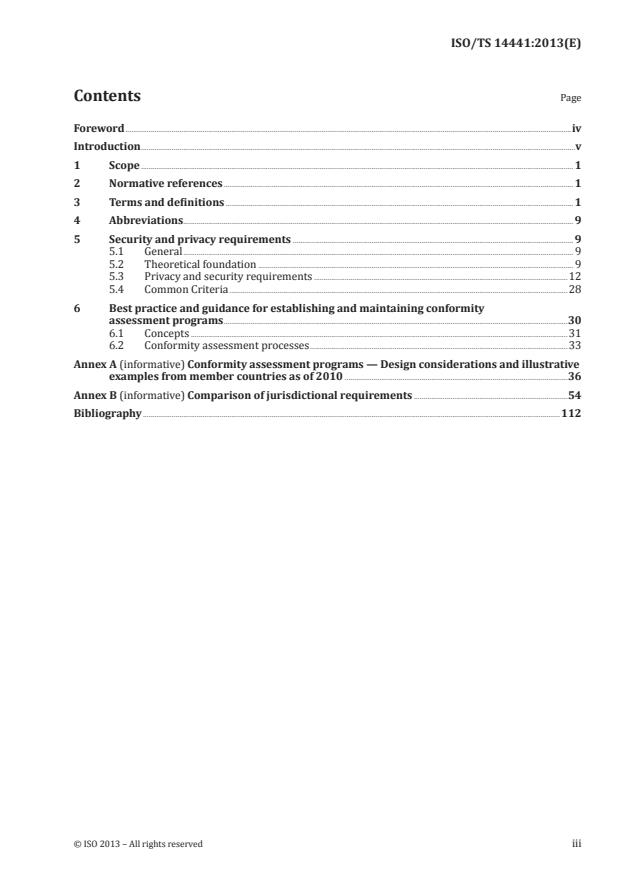
Contents Page
Foreword .iv
Introduction .v
1 Scope . 1
2 Normative references . 1
3 Terms and definitions . 1
4 Abbreviations. 9
5 Security and privacy requirements . 9
5.1 General . 9
5.2 Theoretical foundation . 9
5.3 Privacy and security requirements .12
5.4 Common Criteria .28
6 Best practice and guidance for establishing and maintaining conformity
assessment programs .30
6.1 Concepts .31
6.2 Conformity assessment processes .33
Annex A (informative) Conformity assessment programs — Design considerations and illustrative
examples from member countries as of 2010 .36
Annex B (informative) Comparison of jurisdictional requirements .54
Bibliography .112
Foreword
ISO (the International Organization for Standardization) is a worldwide federation of national standards
bodies (ISO member bodies). The work of preparing International Standards is normally carried out
through ISO technical committees. Each member body interested in a subject for which a technical
committee has been established has the right to be represented on that committee. International
organizations, governmental and non-governmental, in liaison with ISO, also take part in the work.
ISO collaborates closely with the International Electrotechnical Commission (IEC) on all matters of
electrotechnical standardization.
International Standards are drafted in accordance with the rules given in the ISO/IEC Directives, Part 2.
The main task of technical committees is to prepare International Standards. Draft International
Standards adopted by the technical committees are circulated to the member bodies for voting.
Publication as an International Standard requires approval by at least 75 % of the member bodies
casting a vote.
In other circumstances, particularly when there is an urgent market requirement for such documents, a
technical committee may decide to publish other types of document:
— an ISO Publicly Available Specification (ISO/PAS) represents an agreement between technical
experts in an ISO working group and is accepted for publication if it is approved by more than 50 %
of the members of the parent committee casting a vote;
— an ISO Technical Specification (ISO/TS) represents an agreement between the members of a
technical committee and is accepted for publication if it is approved by 2/3 of the members of the
committee casting a vote.
An ISO/PAS or ISO/TS is reviewed after three years in order to decide whether it will be confirmed for
a further three years, revised to become an International Standard, or withdrawn. If the ISO/PAS or
ISO/TS is confirmed, it is reviewed again after a further three years, at which time it must either be
transformed into an International Standard or be withdrawn.
Attention is drawn to the possibility that some of the elements of this document may be the subject of
patent rights. ISO shall not be held responsible for identifying any or all such patent rights.
ISO/TS 14441 was prepared by Technical Committee ISO/TC 215, Health informatics.
iv © ISO 2013 – All rights reserved
Introduction
As local, regional and national EHR infostructures develop, electronic patient record systems are
being implemented at the many points of care where patients are seen [point-of-service (POS) clinical
systems]. In addition to institutional settings like hospitals, where the systems in various departments
(e.g. nursing units) are typically integrated into a single patient record, smaller single purpose systems
such as electronic medical records (EMRs) are also being implemented in physician offices and other
non-institutional settings such as public health where the sophistication of the systems and the local
IT support infrastructure is much less. As countries begin to connect these POS clinical systems to
EHR infostructures (or directly exchange clinical information with other POS clinical systems through
system-to-system communications), the security and privacy of these systems becomes much more
critical and complex than when the systems operated in a disconnected or ‘stand-alone’ state. To
ensure the required standards are implemented correctly into these systems, so that they will securely
interact with EHR infostructures and maintain the privacy of patient information, many countries
are implementing certification and conformance testing programs to provide objective evidence of
conformity with these requirements.
This Technical Specification identifies the security and privacy requirements, harvested from the above
mentioned standards and international experiences, which should be in place for conformance testing
for interoperable POS clinical (electronic patient record) systems interfacing with EHRs.
The POS clinical systems profiled receive, store, process, display and communicate clinical data and
administrative actions, as well as information related to system users (demographics, personal).
The systems are always accessed by authorized and authenticated users. These users are:
— health professionals that input, access and use patient data, clinical procedures, and statistics;
— administrative users that input and read patient’s personal and demographics data, administrative
and statistical information;
— administrators that control users power, perform backups, provide system configuration, including
security ones;
— auditors that read audit trails;
— other EHR systems that input and receive data;
— subjects of care and their substitute decision makers, who may have restricted access to input and
retrieve authorized data.
Key assumptions that apply for compliant POS clinical systems are as follows:
— the Target of Evaluation (TOE) comprises commercial off the shelf (COTS), governmental, proprietary
and free and open source software;
— authenticated users recognize the need for a secure IT environment;
— authenticated users can be trusted to comply with the organization’s security policy;
— business security processes are implemented with due regard for what can (and cannot) be
reasonably accomplished in a clinical setting;
— competent security administration is carried out in relation to the system’s installation and ongoing
operations.
This Technical Specification draws from international standards, which have been developed by
ISO/TC 215 for EHRs, as well as other ISO standards such as such as ISO/IEC 27001 and the ISO/IEC 17000
series of standards developed by the ISO Committee on conformity assessment (CASCO). This Technical
Specification also reflects the experience that various countries have had to date in implementing
certification and conformance testing programs in addressing privacy and security requirements in the
context where electronic patient record (clinical) systems at the point of care are interoperable with
regional and national EHRs.
This Technical Specification includes:
— security and privacy requirements that should be met to ensure that information is protected as
well as the main categories of attack;
— discussion of the theoretical foundations underpinning the requirements;
— guidance on best practice for establishing and maintaining conformity assessment programs;
— description of the conformity assessment process, including the key concepts and processes.
Annex A provides more detailed information on conformity assessment models and processes, plus
examples of conformity assessment programs in four example countries at a point in time (2010).
Annex B provides a detailed examination of the privacy and security requirements in place in five
jurisdictions at the time that this Technical Specification was written. This analysis was used to derive
the security and privacy requirements in Clause 5.
This Technical Specification is to be used by agencies which accredit or operate programs for certifying
health software products through conformity assessment against privacy and security standards,
software suppliers demonstrating their compliance with those requirements, and purchasers of those
systems who want assurance that the requirements have been met.
vi © ISO 2013 – All rights reserved
TECHNICAL SPECIFICATION ISO/TS 14441:2013(E)
Health informatics — Security and privacy requirements of
EHR systems for use in conformity assessment
1 Scope
This Technical Specification examines electronic patient record systems at the clinical point of care that
are also interoperable with EHRs. Hardware and process controls are out of the scope. This Technical
Specification addresses their security and privacy protections by providing a set of security and privacy
requirements, along with guidelines and best practice for conformity assessment.
ISO/IEC 15408 (all parts) defines “targets of evaluation” for security evaluation of IT products. This
Technical Specification includes a cross-mapping of 82 security and privacy requirements against the
Common Criteria categories in ISO/IEC 15408 (all parts). The point-of-service (POS) clinical software is
typically part of a larger system, for example, running on top of an operating system, so it must work in
concert with other components to provide proper security and privacy. While a Protection Profile (PP)
includes requirements for component security functions to support system security services, it does not
specify protocols or standards for conformity assessment, and does not address privacy requirements.
This Technical Specification focuses on two main topics:
a) Security and privacy requirements (Clause 5). Clause 5 is technical and provides a comprehensive
set of 82 requirements necessary to protect (information, patients) against the main categories of
risks, addressing the broad scope of security and privacy concerns for point of care, interoperable
clinical (electronic patient record) systems. These requirements are suitable for conformity
assessment purposes.
b) Best practice and guidance for establishing and maintaining conformity assessment programs
(Clause 6). Clause 6 provides an overview of conformity assessment concepts and processes that can
be used by governments, local authorities, professional associations, software developers, health
informatics societies, patients’ representatives and others, to improve conformity with health
software security and privacy requirements. Annex A provides complementary information useful
to countries in designing conformity assessment programs such as further material on conformity
assessment business models, processes and other considerations, along with illustrative examples
of conformity assessment activities in four countries.
Policies that apply to a local, regional or national implementation environment, and procedural,
administrative or physical (including hardware) aspects of privacy and security management are outside
the scope of this Technical Specification. Security management is included in the scope of ISO 27799.
2 Normative references
The following documents, in whole or in part, are normatively referenced in this document and are
indispensable for its application. For dated references, only the edition cited applies. For undated
references, the latest edition of the referenced document (including any amendments) applies.
ISO/IEC 17000, Conformity assessment — Vocabulary and general principles
ISO 27799:2008, Health informatics — Information security management in health using ISO/IEC 27002
3 Terms and definitions
For the purposes of this document, the following terms and definitions apply.
3.1
accountability
principle that individuals, organizations, and the community are responsible for their actions and may
be required to explain them to others
[SOURCE: ISO 15489-1:2001, definition 3.2]
Note 1 to entry: This requires that all users of PHI be traceable.
3.2
access control
a means of ensuring that the resources of a data processing system can be accessed only by authorized
entities in authorized ways
[SOURCE: ISO/IEC 2382-8:1998, definition 08.04.01]
3.3
accreditation body
authoritative body that performs accreditation
Note 1 to entry: The authority of an accreditation body is generally derived from government.
[SOURCE: ISO/IEC 17000:2004, definition 2.6]
3.4
anonymization
process that removes the association between the identifying data set and the data subject
[SOURCE: ISO/TS 25237:2008, definition 3.2]
3.5
asset
anything that has value to the organization
Note 1 to entry: In the context of health information security, information assets include health information, IT
services, hardware, software, communications facilities, media, IT facilities, and medical devices that record or
report data.
Note 2 to entry: Adapted from ISO/IEC 27000:2012, definition 2.4.
3.6
assurance
result of a set of compliance processes through which an organization achieves confidence in the status
of its information security management
3.7
attestation
issue of a statement, based on a decision following review, that fulfilment of specified requirements has
been demonstrated
Note 1 to entry: The resulting statement, referred to in this Technical Specification as a “statement of conformity”,
conveys the assurance that the specified requirements have been fulfilled. Such an assurance does not, of itself,
afford contractual or other legal guarantees.
Note 2 to entry: See also scope of attestation.
Note 3 to entry: Adapted from ISO/IEC 17000:2004, definition 5.2.
2 © ISO 2013 – All rights reserved
3.8
audit
systematic, independent, documented process for obtaining records, statements of fact or other relevant
information and assessing them objectively to determine the extent to which specified requirements
are fulfilled
Note 1 to entry: While “audit” applies to management systems, “assessment” applies to conformity assessment
bodies as well as more generally.
[SOURCE: ISO/IEC 17000:2004, definition 4.4]
3.9
availability
property of being accessible and usable upon demand by an authorized entity
[SOURCE: ISO/IEC 27000:2012, definition 2.10]
3.10
certification
third-party attestation related to products, processes, systems or persons
Note 1 to entry: Adapted from ISO/IEC 17000:2004, definition 5.5.
3.11
compliance
the action of doing what is necessary to meet a specified requirement
3.12
confidentiality
property that information is not made available or disclosed to unauthorized individuals, entities, or
processes
[SOURCE: ISO 7498-2:1989, definition 3.3.16]
3.13
conformity assessment
demonstration that specified requirements relating to a product, process, system, person or organization
are fulfilled
Note 1 to entry: Adapted from ISO/IEC 17000:2004, definition 2.1.
3.14
conformity assessment system
rules, procedures and management for carrying out conformity assessment
Note 1 to entry: Conformity assessment systems may be operated at international, regional, national or sub-
national level.
[SOURCE: ISO/IEC 17000:2004, definition 2.7]
3.15
data subject
person to whom data refer
Note 1 to entry: In this Technical Specification, a data subject refers to a single person (versus persons).
3.16
entity
natural or legal person, public authority or agency or any other body
Note 1 to entry: In the context outside the scope of this Technical Specification, an entity may refer to a natural
person, animal, organization, active or passive object, device or group of such items that has an identity.
3.17
first-party conformity assessment activity
conformity assessment activity that is performed by the person or organization that provides the object
Note 1 to entry: See also second-party conformity assessment activity, and third-part conformity assessment
activity.
Note 2 to entry: Adapted from ISO/IEC 17000:2004, definition 2.2.
3.18
health information system
repository of information regarding the health of a subject of care in computer-processable form, stored
and transmitted securely, and accessible by multiple authorized users
[SOURCE: ISO 27799:2008, definition 3.1.2]
Note 1 to entry: It has a commonly agreed logical information model which is independent of EHR (electronic
health record) systems.
Note 2 to entry: Its primary purpose is the support of continuing, efficient and quality integrated healthcare and
it contains information which is retrospective, concurrent and prospective.
3.19
healthcare
any type of services provided by professionals or paraprofessionals with an impact on health status
[SOURCE: European Parliament, 1998, as cited by WHO]
3.20
health organization
organization involved in the direct provision of health activities
Note 1 to entry: Adapted from ISO/TR 20514:2005, definition 2.21.
3.21
health professional
person who is authorized by a recognised body to be qualified to perform certain health duties
Note 1 to entry: Adapted from ISO 17090-1:2008, definition 3.1.8.
Note 2 to entry: The defined term is often “healthcare professional”. A convention has been adopted in this
Technical Specification whereby the term “healthcare” is abbreviated to “health” when used in an adjectival form.
When used in a noun form, the word “care” is retained but as a separate word (e.g. delivery of healthcare).
3.22
identity
set of attributes which make it possible to recognize, contact or locate the subject of care
3.23
identifiable person
one who can be identified, directly or indirectly, in particular by reference to an identification number
or one or more factors specific to his physical, physiological, mental, economic, cultural or social identity
[SOURCE: Directive 95/46/EC of the European Parliament and of the Council of 24 October 1995 on the
protection of individuals with regard to the processing of personal data and on the free movement of
such data]
3.24
identification
recognition of a person in a particular domain by a set of his or her attributes
4 © ISO 2013 – All rights reserved
3.25
information governance
processes by which an organization obtains assurance that the risks to its information, and thereby the
operational capabilities and integrity of the organization, are effectively identified and managed
3.26
information privacy
rights and obligations of individuals and organizations with respect to the collection, use, retention,
disclosure and disposal of personal information
[SOURCE: Adapted from the definition of privacy in the Generally Accepted Privacy Principles of the
American Institute of Certified Public Accountants and the Chartered Accountants of Canada]
3.27
information security
preservation of confidentiality, integrity and availability of information
Note 1 to entry: In addition, other properties, such as authenticity, accountability, non-repudiation, and reliability
can also be involved.
[SOURCE: ISO/IEC 27000:2012, definition 2.30]
3.28
inspection
examination of a product design, product, process or installation and determination of its conformity
with specific requirements or, on the basis of professional judgment, with general requirements
Note 1 to entry: Inspection of a process may include inspection of persons, facilities, technology and methodology.
[SOURCE: ISO/IEC 17000:2004, definition 4.3]
3.29
personal health information
PHI
information about an identifiable person that relates to the physical or mental health of the individual,
or to provision of health services to the individual
Note 1 to entry: Such information may include a) information about the registration of the individual for the
provision of health services, b) information about payments or eligibility for health care in respect to the individual,
c) a number, symbol or particular assigned to an individual to uniquely identify the individual for health purposes,
d) any information about the individual that is collected in the course of the provision of health services to the
individual, e) information derived from the testing or examination of a body part or bodily substance, and f)
identification of a person (e.g. a health professional) as provider of healthcare to the individual.
Note 2 to entry: Personal health information does not include information that, either by itself or when combined
with other information available to the holder, is anonymized, i.e. the identity of the individual who is the subject
of the information cannot be ascertained from the information.
3.30
PHI disclosure
divulging of, or provision of access to, personal health information
Note 1 to entry: Adapted from ISO/TS 25237:2008, definition 3.20.
3.31
point-of-service (POS) clinical system
system that is used at the point of care or service in the provision of clinical services to the subject of
care
EXAMPLE Electronic Medical Record (EMR), Pharmacy Management System (PMS), Hospital Information
System (HIS), Public Health Information System (PHIS).
3.32
privacy breach
situation where PHI is processed in an unlawful manner or in violation of one or more relevant privacy
policies
3.33
privacy control
technical and organizational measures aimed at mitigating risks that could result in privacy breaches
Note 1 to entry: Privacy controls include policies, procedures, guidelines, practices or organizational structures,
which can be administrative, technical, management or legal in nature.
Note 2 to entry: Control is also used as a synonym for safeguard or countermeasure.
3.34
privacy policy
specification of objectives, rules, obligations and privacy controls with regard to the processing of PHI
in a particular setting
3.35
privacy preferences
specific or implied choices made by an individual about how his/her PHI should be processed
3.36
privacy principles
set of shared values governing the privacy protection of the PHI when processed in ICT systems
3.37
privacy risk assessment
analysis of the risks of privacy breach involved in an envisaged processing operation
Note 1 to entry: This analysis, also known as privacy impact assessment, is achieved to (a) ensure processing
conforms to applicable legal, regulatory and policy requirements regarding privacy, (b) determine the risks and
effects of processing PHI, and (c) examine and evaluate privacy controls and alternative processes for handling
PHI to mitigate identified privacy risks.
3.38
privacy safeguarding requirements
criteria to be fulfilled when implementing privacy controls designed to help mitigate risks of privacy
breaches
3.39
procedure
specified way to carry out an activity or a process
[SOURCE: ISO 9000:2005, definition 3.4.5]
3.40
processing of PHI
any operation or set of operations performed upon PHI (e.g. collection, storage, access, analysis, linkage,
communication, disclosure and retention)
3.41
profile
set of automatically generated data characterizing a category of individuals that is intended to be applied
to an individual, namely for the purpose of analysing or predicting personal preferences, behaviours
and attitudes
6 © ISO 2013 – All rights reserved
3.42
product
result of a process
Note 1 to entry: Four generic product categories are noted in ISO 9000:2005: services (e.g. transport); software
(e.g. computer program, dictionary); hardware (e.g. engine, mechanical part); processed materials (e.g. lubricant).
Many products comprise elements belonging to different generic product categories. Whether the product is then
called service, software, hardware or processed material depends on the dominant element.
Note 2 to entry: The statement of conformity can be regarded as a product of attestation.
Note 3 to entry: Adapted from ISO 9000:2005, 3.4.2.
3.43
pseudonymization
process applied to PHI which replaces identity information with an alias
Note 1 to entry: Pseudonymization allows, for example, a subject of care to use a resource or service without
disclosing his or her identity, while still being held accountable for that use. After pseudonymization, it may still
be possible to determine the subject of care’s identity based on the alias and/or to link the subject’s actions to one
another and as a consequence, to the subject of care.
3.44
review
verification of the suitability, adequacy and effectiveness of selection and determination activities,
and the results of these activities, with regard to fulfilment of specified requirements by an object of
conformity assessment
[SOURCE: ISO/IEC 17000:2004, definition 5.1]
3.45
risk
combination of the probability of an event and its consequence
Note 1 to entry: Adapted from ISO Guide 73:2009, definition 1.1.
3.46
risk assessment
overall process of risk analysis and risk evaluation
Note 1 to entry: Adapted from ISO Guide 73:2009, definition 3.4.1.
3.47
risk management
coordinated activities to direct and control an organization with regard to risk
[SOURCE: ISO Guide 73:2009, definition 2.1]
Note 1 to entry: Risk management generally includes risk assessment, risk treatment, risk acceptance, risk
communication, risk monitoring and risk review.
3.48
risk treatment
process of selection and implementation of measures to modify risk
Note 1 to entry: Adapted from ISO Guide 73:2009, definition 3.8.1.
3.49
sampling
provision of a sample of the object of conformity assessment, according to a procedure
[SOURCE: ISO/IEC 17000:2004, definition 4.1]
3.50
scope of attestation
range or characteristics of objects of conformity assessment covered by attestation
[SOURCE: ISO/IEC 17000:2004, definition 5.3]
3.51
second-party conformity assessment activity
conformity assessment activity that is performed by a person or organization that has a user interest in
the object
Note 1 to entry: Persons or organizations performing second-party conformity assessment activities include,
for example, purchasers or users of products, or potential customers seeking to rely on a supplier’s management
system, or organizations representing those interests.
[SOURCE: ISO/IEC 17000:2004, definition 2.3]
3.52
specified requirement
need or expectation that is stated
Note 1 to entry: Specified requirements may be stated in normative documents such as regulations, standards
and technical specifications.
[SOURCE: ISO/IEC 17000:2004, definition 3.1]
3.53
subject of care
patient
one or more persons scheduled to receive, receiving, or having received a health service
Note 1 to entry: Adapted from ISO 18308:2011, definition 3.47.
3.54
system integrity
property that a system performs its intended function in an unimpaired manner, free from deliberate or
accidental unauthorized manipulation of the system
[SOURCE: ISO 27799:2008, definition 3.2.14]
3.55
target of evaluation
TOE
set of software, firmware and/or hardware possibly accompanied by guidance
[SOURCE: ISO/IEC 15408-1:2009, definition 3.1.72]
3.56
testing
determination of one or more characteristics of an object of conformity assessment, according to a
procedure
Note 1 to entry: “Testing” typically applies to materials, products or processes.
[SOURCE: ISO/IEC 17000:2004, definition 4.2]
3.57
third-party conformity assessment activity
conformity assessment activity that is performed by a person or body that is independent of the person
or organization that provides the object, and of user interests in that object
Note 1 to entry: Criteria for the independence of conformity assessment bodies and accreditation bodies are
provided in the International Standards and Guides applicable to their activities (see Bibliography).
8 © ISO 2013 – All rights reserved
[SOURCE: ISO/IEC 17000:2004, definition 2.4]
3.58
threat
potential cause of an unwanted incident, which may result in harm to a system or organization
[SOURCE: ISO/IEC 27000:2012, definition 2.77]
3.59
vulnerability
weakness of an asset or control that can be exploited by a threat
4 Abbreviations
For the purposes of this document, the following abbreviations apply:
EHR Electronic Health Record
HL7 Health Level 7
PHI Personal Health Information
POS Point-of-Service
PP Protection Profile
5 Security and privacy requirements
5.1 General
This clause is technical and establishes a set of requirements; describing what is necessary to protect
(information, patients), the main categories of risks, and the broad scope of security and privacy
concerns for point of care, interoperable electronic patient record systems.
5.2 Theoretical foundation
5.2.1 Overview
With growth in the adoption of health information systems by all players in the health area, (providers,
governments, payers and patients), and the need for these systems to be able to exchange patient
information to improve the continuity and safety of patient care, it becomes essential to ensure these
computational systems are managing the security of electronic health information to ensure its integrity,
availability and confidentiality.
The migration from traditional patient record keeping processes, much based on paper, to the electronic
process, represents a completely new scenario. One professional may understand very well the security
and privacy risks of, for example, storing and transporting a paper-based health record. However, at
the moment that this information is no longer on paper and information is exchanged electronically
and accessed by multiple providers at multiple care delivery locations, a completely new set of risks
is involved. Is it clearly understandable for all users what the risks are of storage and transport of an
electronic health record? To understand requires an appreciation of all the features of the computational
systems and hardware that handle the information, plus the new processes that are performed to
manage the electronic system.
Security goals encompass confidentiality, availability and integrity of information (in this case, health
information). Some other security concepts are also included in this broad definition, like authenticity,
accountability and auditability. The consequences of security failures are diverse, and range from legal
to clinical impact, information not being available for treatment and even serious injury or death may
be the result. On the other hand, good security controls allow electronic systems to work correctly and
enable clinical activities to provide better treatment by having the right information available when and
where needed.
Many factors affect the security and privacy of health information. In the non-electronic world, paper
may be secured in locked cabinets but equally important is how securely the key to the cabinet is
stored. As a parallel in the electronic environment, there are both electronic hardware and software
components that can enhance security and privacy, but these are insufficient without the concomitant
processes that persons must follow in manipulating the electronic information and using information
systems. Robust security and privacy is the resulting combination of controls in both the electronic
components and processes. If one control fails it can risk the overall protection.
An example of a security requirement for software is that the information system must record audit
information on all patient record transactions, including those which create, read, update and archive
information. An example of a hardware requirement is that it must record evidence of tampering. An
example of a process requirement is a policy and monitoring process preventing users from leaving
passwords written down and available.
The main asset is information. Health information includes:
a) personal health and identification information,
b) pseudonymized data derived from personal health information via some methodology for
pseudonymous identification,
c) statistical and research data, including anonymized data derived from personal health information
by removal of personally identifying data,
d) clinical/medical knowledge not related to any specific subject of care, including clinical decision
support data (e.g. data on adverse drug reactions),
e) data on health professionals, staff and volunteers,
f) information related to public health surveillance,
g) audit trail data, produced by health information systems, that contain personal health information
or pseudonymous data derived from personal health information, or that contain data about the
actions of users in regard to personal health information, and
h) system security data for health information systems, including access control data and other
security related system configuration data, for health information systems.
It is important to note from the list above that patient information is not the only confidential information
in a healthcare environment. The extent to which confidentiality (and hence, patient privacy), data
integrity and system availability must be protected depends upon the nature of the information, the
uses to which it is put, and the risks to which it is exposed. For example, statistical data may not be
confidential, but protecting its integrity may be important to the organization. Likewise, audit trail data
may not require high availability but its content may be highly confidential.
The scope of this Technical Specification is focused on security and privacy requirements for health
software systems. Hardware and process controls are outside the scope.
As described in ISO 27799:2008, Annex A, the threats to the privacy, confidentiality, integrity and
availability include:
a) masquerading by insiders such as health professionals and support staff by service providers and
outsiders, including hackers,
b) unauthorized use of a health information application and data stored within,
c) introduction of damaging or disruptive software, including viruses, worms, and other “malware”,
10 © ISO 2013 – All rights reserved
d) misuse of system resources,
e) communications infiltration, such as denial of service and replay attacks,
f) communications interception,
g) repudiation of data origin or receipt,
h) connection failure,
i) accidental misrouting,
j) technical failure of the host, storage facility, or network infrastructure,
k) environmental support failure, including power failures and disruptions of service arising from
natural or man-made disasters,
l) application software failure,
m) operations error,
n) maintenance error, and
o) user error.
Although health information privacy has been widely discussed, there is a lack of systemic investigation
to identify and classify various sources of threats to information privacy. Recent policy-based studies
broadly categorize privacy threats into two areas:
— organizational threats that arise from inappropriate access of patient data by either internal agents
abusing their privileges or external agents exploiting a vulnerability of the information systems;
and
— systemic threats that arise from an agent in the information flow chain exploiting the data beyond
its intended use.
These two types of threats are described in 5.2.2 and 5.2.3.
5.2.2 Organizational threats
These threats assume different forms, such as an employee who accesses data without any legitimate
need or an outside attacker (hacker) that infiltrates an organization’s information infrastructure to
steal data or render it inoperable. The broad spectrum of organizational threats could be categorized
into five levels, listed in increasing order of sophistication:
— Accidental disclosure: healthcare personnel unintentionally disclose patient information to others
(e.g. email message sent to wrong address or inadvertent web posting of sensitive data).
— Insider curiosity: an insider with data access privilege pries upon patient’s records out of curiosity
or for their own purpose (e.g. nurse accessing information about a fellow employee to determine
possibility of a sexually transmitted disease or medical personnel accessing potentially embarrassing
health information about a celebrity and transmitting it to the media).
— Data breach by insider: insiders access patient information and then use or transmit or disclose it to
outsiders for profit or revenge.
— Data breach by outsider with physical intrusion: an outsider enters the physical facility either by
coercion or forced entry and gains access to the system.
— Unauthorized intrusion of network system: an outsider, including former employees, patients,
or hackers, intrudes into an organization’s network from the outside to gain access to patient
information or render the system inoperable.
5.2.3 Systemic threats
These threats occur, not from outside of the information flow chain, but from insiders who are privileged
to access patient information. For example, insurance firms may deny life insurance to patients based
on their medical conditions, or an employer having access to employees’ medical records may deny
promotion or terminate employment. Patients or payer organizations may incur financial losses from
fraud including rendering medically unnecessary services.
5.2.4 Applicability
As previously stated, the scope of Technical Specification is focused on security and privacy of point-of-
service patient record software; hardware and process controls are out of the scope. There are many
different security and privacy requirements developed and published around the world, this Technical
Specification does not intend to create completely new requirements, but rather it harvests the most
suitable requirements already published, and adapts them to be used for conformance testing of systems.
The most well-known international security standard is the ISO/IEC 27002. Although its focus is on
information security management in general, its controls apply to electronic systems. A health industry
specific standard, ISO 27799, is one of several standards developed through ISO/TC 215 to support the
implementation of sound security controls and practices in the health care environment.
With regard to security evaluation, one of best known standards is ISO/IEC 15408 (all parts), which
provides general concepts and principles of IT security evaluation and includes the Common Criteria
framework through which security requirements can be expressed.
At the same time, some countries are deploying health software systems certification processes, each
one with its own set of requirements. Some examples include the US, Canada, Brazil, The Netherlands,
UK, Australia and Europe.
This Technical Specification identifies the security and privacy requirements, harvested from the above
mentioned standards and international experiences, which should be in place for conformance testing
for interoperable POS clinical (electronic patient record) systems interfacing with EHRs.
A set of requirements must be clear and well expressed, in a manner that software developer can
properly deploy them in their systems, and an evaluation process can declare that all requirements are
or are not met in that specific system. This is the main reason that procedural requirements are not
included, as it is not possible to ensure that they are in place merely by evaluating the software itself: it
would be necessary to evaluate the operational environment in which this software is in use, including
the profiles of users and administrators and knowledge of the system’s use. Nevertheless, this broader
issue of administration is essential for promoting security and privacy and so it is recommended that,
in addition to the software certification and conformance, an environmental inspection of the system’s
ongoing management based on ISO 27799 be performed.
Another consideration in the process of elaboratin
...
Questions, Comments and Discussion
Ask us and Technical Secretary will try to provide an answer. You can facilitate discussion about the standard in here.
Loading comments...