


ISO/PAS 24305:2025
(Main)Health informatics — Guidelines for implementation of HL7 FHIR based on ISO 13940:2015, ISO 13606-1:2019 and ISO 13606-3:2019
Health informatics — Guidelines for implementation of HL7 FHIR based on ISO 13940:2015, ISO 13606-1:2019 and ISO 13606-3:2019
This document provides guidance on how four complementary international standards can be used in combination by developers of health ICT systems and infrastructures. These standards, three published by CEN and ISO and one by HL7, are — ISO 13940:2015, — ISO 13606-1:2019, — ISO 13606-3:2019, and — HL7 Fast Health Interoperability Resources (FHIR) Release 4. This document defines mappings between these standards: between ISO 13940 and HL7 FHIR in both directions, between ISO 13606 and HL7 FHIR in both directions, it proposes the content of an HL7 FHIR profile corresponding to the ISO 13606-1:2019 “COMPOSITION” class. It also provides guidance and worked examples of the mapping between ISO 13606-3 Reference Archetypes corresponding to ISO 13940 and HL7 FHIR. This document also summarizes the extent to which the source concept is broader than or narrower than the best fit target concept. It also highlights mapping issues that adopters will need to be mindful of, where the representation capability of the standards differs.
Informatique de santé — Lignes directrices pour l'implémentation de HL7 FHIR à partir de l'ISO 13940:2015, l'ISO 13606-1:2019 et de l'ISO 13606-3:2019
General Information
- Status
- Published
- Publication Date
- 02-Jul-2025
- Technical Committee
- ISO/TC 215 - Health informatics
- Drafting Committee
- ISO/TC 215/WG 1 - Architecture, Frameworks and Models
- Current Stage
- 6060 - International Standard published
- Start Date
- 03-Jul-2025
- Completion Date
- 03-Jul-2025
Overview
ISO/PAS 24305:2025 - Health informatics - Guidelines for implementation of HL7 FHIR based on ISO 13940:2015, ISO 13606-1:2019 and ISO 13606-3:2019 - is a Publicly Available Specification (PAS) that guides how four complementary standards can be used together for health ICT systems. The document defines bidirectional mappings between ISO 13940 (care continuity model), ISO 13606 (EHR communication), and HL7 FHIR Release 4 (FHIR R4). It proposes an HL7 FHIR profile corresponding to the ISO 13606-1 “COMPOSITION” class and provides worked examples for mapping ISO 13606-3 reference archetypes to ISO 13940 and FHIR. ISO/PAS 24305:2025 also documents where source concepts are broader or narrower than target concepts and highlights mapping issues and representation differences implementers must consider.
Key topics and technical requirements
- Bidirectional concept mapping: ISO 13940 ↔ FHIR R4 and ISO 13606 ↔ FHIR R4, with detailed mapping tables and explanations.
- FHIR profiling: proposed FHIR profile for ISO 13606-1 “COMPOSITION” to help align EHR composition constructs to FHIR resources.
- Archetype mapping: worked examples for ISO 13606-3 reference archetypes and their translation into FHIR constructs guided by ISO 13940 semantics.
- Data element coverage: guidance on mapping core EHR elements (identifiers, dates/times, attachments, coded values, demographics, clinical entries).
- Scope of fit: documentation of where a source concept is broader, narrower, or a best-fit for the target concept.
- Mapping issues and constraints: explicit discussion of differences in representation capability (extensions, slicing, terminology binding, security and conformance models).
- Roadmap recommendations: challenges, constraints and recommendations for aligning FHIR and ISO 13606-3 for improved semantic interoperability.
Applications
- Implementing interoperable EHR exchange between systems using HL7 FHIR and legacy ISO-based models.
- Designing FHIR profiles and implementation guides that reflect ISO 13606 and ISO 13940 semantics.
- Performing model-to-model transformations and data migration between EHR formats.
- Informing national/eHealth interoperability strategies and vendor integration projects.
Who should use this standard
- Health ICT developers and integrators, EHR vendors, solution architects.
- Clinical informaticians, terminologists and data modelers working on semantic interoperability.
- Standards bodies, national eHealth authorities, and implementers planning FHIR adoption alongside ISO-based EHR architectures.
Related standards
- ISO 13940:2015 (System of concepts to support continuity of care)
- ISO 13606-1:2019 / ISO 13606-3:2019 (EHR communication and archetypes)
- HL7 FHIR R4 (Fast Healthcare Interoperability Resources)
Keywords: ISO/PAS 24305:2025, HL7 FHIR, ISO 13940, ISO 13606-1, ISO 13606-3, FHIR R4, mappings, semantic interoperability, EHR integration.
Get Certified
Connect with accredited certification bodies for this standard

BSI Group
BSI (British Standards Institution) is the business standards company that helps organizations make excellence a habit.

NYCE
Mexican standards and certification body.
Sponsored listings
Frequently Asked Questions
ISO/PAS 24305:2025 is a technical specification published by the International Organization for Standardization (ISO). Its full title is "Health informatics — Guidelines for implementation of HL7 FHIR based on ISO 13940:2015, ISO 13606-1:2019 and ISO 13606-3:2019". This standard covers: This document provides guidance on how four complementary international standards can be used in combination by developers of health ICT systems and infrastructures. These standards, three published by CEN and ISO and one by HL7, are — ISO 13940:2015, — ISO 13606-1:2019, — ISO 13606-3:2019, and — HL7 Fast Health Interoperability Resources (FHIR) Release 4. This document defines mappings between these standards: between ISO 13940 and HL7 FHIR in both directions, between ISO 13606 and HL7 FHIR in both directions, it proposes the content of an HL7 FHIR profile corresponding to the ISO 13606-1:2019 “COMPOSITION” class. It also provides guidance and worked examples of the mapping between ISO 13606-3 Reference Archetypes corresponding to ISO 13940 and HL7 FHIR. This document also summarizes the extent to which the source concept is broader than or narrower than the best fit target concept. It also highlights mapping issues that adopters will need to be mindful of, where the representation capability of the standards differs.
This document provides guidance on how four complementary international standards can be used in combination by developers of health ICT systems and infrastructures. These standards, three published by CEN and ISO and one by HL7, are — ISO 13940:2015, — ISO 13606-1:2019, — ISO 13606-3:2019, and — HL7 Fast Health Interoperability Resources (FHIR) Release 4. This document defines mappings between these standards: between ISO 13940 and HL7 FHIR in both directions, between ISO 13606 and HL7 FHIR in both directions, it proposes the content of an HL7 FHIR profile corresponding to the ISO 13606-1:2019 “COMPOSITION” class. It also provides guidance and worked examples of the mapping between ISO 13606-3 Reference Archetypes corresponding to ISO 13940 and HL7 FHIR. This document also summarizes the extent to which the source concept is broader than or narrower than the best fit target concept. It also highlights mapping issues that adopters will need to be mindful of, where the representation capability of the standards differs.
ISO/PAS 24305:2025 is classified under the following ICS (International Classification for Standards) categories: 35.240.80 - IT applications in health care technology. The ICS classification helps identify the subject area and facilitates finding related standards.
ISO/PAS 24305:2025 is available in PDF format for immediate download after purchase. The document can be added to your cart and obtained through the secure checkout process. Digital delivery ensures instant access to the complete standard document.
Standards Content (Sample)
Publicly
Available
Specification
ISO/PAS 24305
First edition
Health informatics — Guidelines for
2025-07
implementation of HL7 FHIR based
on ISO 13940:2015, ISO 13606-
1:2019 and ISO 13606-3:2019
Informatique de santé — Lignes directrices pour
l'implémentation de HL7 FHIR à partir de l'ISO 13940:2015, l'ISO
13606-1:2019 et de l'ISO 13606-3:2019
Reference number
© ISO 2025
All rights reserved. Unless otherwise specified, or required in the context of its implementation, no part of this publication may
be reproduced or utilized otherwise in any form or by any means, electronic or mechanical, including photocopying, or posting on
the internet or an intranet, without prior written permission. Permission can be requested from either ISO at the address below
or ISO’s member body in the country of the requester.
ISO copyright office
CP 401 • Ch. de Blandonnet 8
CH-1214 Vernier, Geneva
Phone: +41 22 749 01 11
Email: copyright@iso.org
Website: www.iso.org
Published in Switzerland
ii
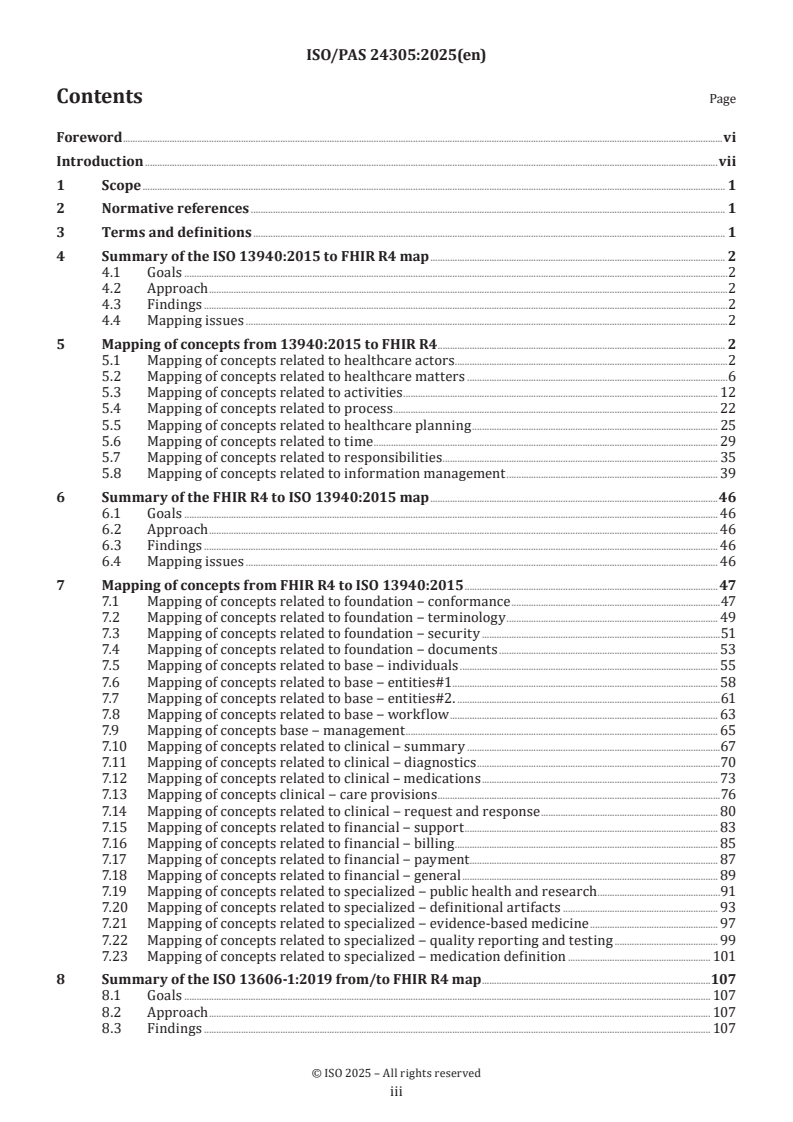
Contents Page
Foreword .vi
Introduction .vii
1 Scope . 1
2 Normative references . 1
3 Terms and definitions . 1
4 Summary of the ISO 13940:2015 to FHIR R4 map . 2
4.1 Goals .2
4.2 Approach .2
4.3 Findings .2
4.4 Mapping issues .2
5 Mapping of concepts from 13940:2015 to FHIR R4 . 2
5.1 Mapping of concepts related to healthcare actors .2
5.2 Mapping of concepts related to healthcare matters .6
5.3 Mapping of concepts related to activities . 12
5.4 Mapping of concepts related to process . 22
5.5 Mapping of concepts related to healthcare planning . 25
5.6 Mapping of concepts related to time . 29
5.7 Mapping of concepts related to responsibilities . 35
5.8 Mapping of concepts related to information management . 39
6 Summary of the FHIR R4 to ISO 13940:2015 map .46
6.1 Goals . 46
6.2 Approach . 46
6.3 Findings . 46
6.4 Mapping issues . 46
7 Mapping of concepts from FHIR R4 to ISO 13940:2015 . 47
7.1 Mapping of concepts related to foundation ‒ conformance .47
7.2 Mapping of concepts related to foundation ‒ terminology . 49
7.3 Mapping of concepts related to foundation ‒ security .51
7.4 Mapping of concepts related to foundation ‒ documents . 53
7.5 Mapping of concepts related to base ‒ individuals . 55
7.6 Mapping of concepts related to base ‒ entities#1 . 58
7.7 Mapping of concepts related to base ‒ entities#2. .61
7.8 Mapping of concepts related to base ‒ workflow . 63
7.9 Mapping of concepts base ‒ management . 65
7.10 Mapping of concepts related to clinical ‒ summary .67
7.11 Mapping of concepts related to clinical ‒ diagnostics .70
7.12 Mapping of concepts related to clinical – medications . 73
7.13 Mapping of concepts clinical ‒ care provisions .76
7.14 Mapping of concepts related to clinical ‒ request and response . 80
7.15 Mapping of concepts related to financial ‒ support . 83
7.16 Mapping of concepts related to financial ‒ billing . 85
7.17 Mapping of concepts related to financial ‒ payment . 87
7.18 Mapping of concepts related to financial ‒ general . 89
7.19 Mapping of concepts related to specialized ‒ public health and research .91
7.20 Mapping of concepts related to specialized ‒ definitional artifacts . 93
7.21 Mapping of concepts related to specialized ‒ evidence-based medicine . 97
7.22 Mapping of concepts related to specialized ‒ quality reporting and testing . 99
7.23 Mapping of concepts related to specialized ‒ medication definition . 101
8 Summary of the ISO 13606-1:2019 from/to FHIR R4 map .107
8.1 Goals . 107
8.2 Approach . 107
8.3 Findings . 107
iii
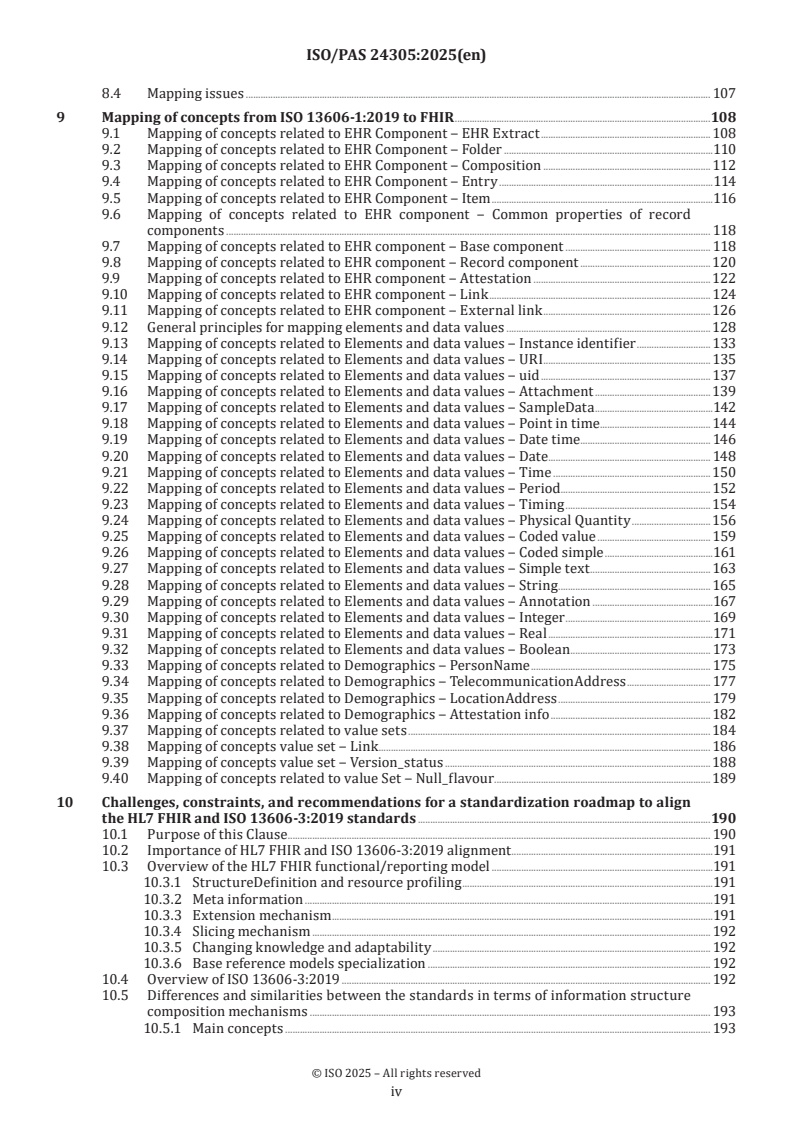
8.4 Mapping issues . 107
9 Mapping of concepts from ISO 13606-1:2019 to FHIR .108
9.1 Mapping of concepts related to EHR Component ‒ EHR Extract . 108
9.2 Mapping of concepts related to EHR Component ‒ Folder .110
9.3 Mapping of concepts related to EHR Component ‒ Composition . 112
9.4 Mapping of concepts related to EHR Component ‒ Entry .114
9.5 Mapping of concepts related to EHR Component ‒ Item .116
9.6 Mapping of concepts related to EHR component ‒ Common properties of record
components . 118
9.7 Mapping of concepts related to EHR component ‒ Base component . 118
9.8 Mapping of concepts related to EHR component ‒ Record component . 120
9.9 Mapping of concepts related to EHR component ‒ Attestation . 122
9.10 Mapping of concepts related to EHR component ‒ Link . 124
9.11 Mapping of concepts related to EHR component ‒ External link . 126
9.12 General principles for mapping elements and data values .128
9.13 Mapping of concepts related to Elements and data values ‒ Instance identifier . 133
9.14 Mapping of concepts related to Elements and data values ‒ URI . 135
9.15 Mapping of concepts related to Elements and data values ‒ uid . 137
9.16 Mapping of concepts related to Elements and data values ‒ Attachment . 139
9.17 Mapping of concepts related to Elements and data values ‒ SampleData .142
9.18 Mapping of concepts related to Elements and data values ‒ Point in time. 144
9.19 Mapping of concepts related to Elements and data values ‒ Date time. 146
9.20 Mapping of concepts related to Elements and data values ‒ Date . 148
9.21 Mapping of concepts related to Elements and data values ‒ Time . 150
9.22 Mapping of concepts related to Elements and data values ‒ Period. 152
9.23 Mapping of concepts related to Elements and data values ‒ Timing .154
9.24 Mapping of concepts related to Elements and data values ‒ Physical Quantity . 156
9.25 Mapping of concepts related to Elements and data values ‒ Coded value . 159
9.26 Mapping of concepts related to Elements and data values ‒ Coded simple .161
9.27 Mapping of concepts related to Elements and data values ‒ Simple text . 163
9.28 Mapping of concepts related to Elements and data values ‒ String . 165
9.29 Mapping of concepts related to Elements and data values ‒ Annotation .167
9.30 Mapping of concepts related to Elements and data values ‒ Integer . 169
9.31 Mapping of concepts related to Elements and data values ‒ Real .171
9.32 Mapping of concepts related to Elements and data values ‒ Boolean . 173
9.33 Mapping of concepts related to Demographics ‒ PersonName . 175
9.34 Mapping of concepts related to Demographics ‒ TelecommunicationAddress . 177
9.35 Mapping of concepts related to Demographics ‒ LocationAddress . 179
9.36 Mapping of concepts related to Demographics ‒ Attestation info . 182
9.37 Mapping of concepts related to value sets .184
9.38 Mapping of concepts value set ‒ Link . 186
9.39 Mapping of concepts value set ‒ Version_status . 188
9.40 Mapping of concepts related to value Set ‒ Null_flavour . 189
10 Challenges, constraints, and recommendations for a standardization roadmap to align
the HL7 FHIR and ISO 13606-3:2019 standards .190
10.1 Purpose of this Clause . 190
10.2 Importance of HL7 FHIR and ISO 13606-3:2019 alignment .191
10.3 Overview of the HL7 FHIR functional/reporting model .191
10.3.1 StructureDefinition and resource profiling .191
10.3.2 Meta information .191
10.3.3 Extension mechanism .191
10.3.4 Slicing mechanism . 192
10.3.5 Changing knowledge and adaptability . 192
10.3.6 Base reference models specialization . 192
10.4 Overview of ISO 13606-3:2019 . 192
10.5 Differences and similarities between the standards in terms of information structure
composition mechanisms . 193
10.5.1 Main concepts . 193
iv
10.5.2 Similarities. 193
10.5.3 Differences . 193
10.6 Benefits found from the combined use of FHIR and ISO 13606-3 . 193
10.6.1 Enhanced semantic interoperability . 193
10.6.2 Flexibility in data modeling . 194
10.6.3 Reusability and standardization . 194
10.6.4 Efficient data exchange. 194
10.6.5 Enhanced clinical validity . 194
10.6.6 Improved data governance and quality . 194
10.7 Example of a combination of the ISO 13606-3:2019 “Health Condition” reference
archetype with FHIR . 194
10.7.1 General . 194
10.7.2 Detailed example of combined specification. 195
10.7.3 Hypothetical FHIR Profile: Health Condition . 196
11 Mapping tables guiding the representation of reference archetypes as FHIR resources .198
11.1 Mapping of properties related to reference archetypes for demographic entities . 198
11.2 Mapping of properties related to reference archetypes for clinical information
specifications .200
Annex A (informative) Mapping between HL7 FHIR, the ISO 13606 series and ISO 13972 .217
Bibliography .225
v
Foreword
ISO (the International Organization for Standardization) is a worldwide federation of national standards
bodies (ISO member bodies). The work of preparing International Standards is normally carried out through
ISO technical committees. Each member body interested in a subject for which a technical committee
has been established has the right to be represented on that committee. International organizations,
governmental and non-governmental, in liaison with ISO, also take part in the work. ISO collaborates closely
with the International Electrotechnical Commission (IEC) on all matters of electrotechnical standardization.
The procedures used to develop this document and those intended for its further maintenance are described
in the ISO/IEC Directives, Part 1. In particular, the different approval criteria needed for the different types
of ISO documents should be noted. This document was drafted in accordance with the editorial rules of the
ISO/IEC Directives, Part 2 (see www.iso.org/directives).
ISO draws attention to the possibility that the implementation of this document may involve the use of (a)
patent(s). ISO takes no position concerning the evidence, validity or applicability of any claimed patent
rights in respect thereof. As of the date of publication of this document, ISO had not received notice of (a)
patent(s) which may be required to implement this document. However, implementers are cautioned that
this may not represent the latest information, which may be obtained from the patent database available at
www.iso.org/patents. ISO shall not be held responsible for identifying any or all such patent rights.
Any trade name used in this document is information given for the convenience of users and does not
constitute an endorsement.
For an explanation of the voluntary nature of standards, the meaning of ISO specific terms and expressions
related to conformity assessment, as well as information about ISO ’s adherence to the World Trade
Organization (WTO) principles in the Technical Barriers to Trade (TBT), see www.iso.org/iso/foreword.html.
This document was prepared by Technical Committee ISO/TC 215, Health informatics.
Any feedback or questions on this document should be directed to the user’s national standards body. A
complete listing of these bodies can be found at www.iso.org/members.html.
vi
Introduction
0.1 General
This document provides guidance on how four complementary international standards can be used in
combination by developers of health ICT systems and infrastructures.
The goal of these four standards is to bring consistency and to maximize the smooth use of ICT by healthcare
actors in the creation, representation, analysis and interoperable communication of health information, so
that the use made of these main standards that represent health information is as best aligned as possible.
It is therefore likely that implementers will elect to use more than one of the standards together and will
benefit from guidance in how best to achieve this.
Three international standards have been published by ISO (two of which are parts of a five-part series),
and one by HL7. The scope of each is summarized below. These standards environments are probably the
most important to align in order to allow accelerated development and adoption of sophisticated clinical
information systems and of better interoperability between them.
0.2 ISO 13940:2015
ISO 13940:2015 defines a comprehensive concept model that applies to all aspects of clinical and patient
workflows, and it can therefore be considered the overarching domain model for the development of
clinical information models. It specifies a concept model for continuity of care provided to any subject of
care by any health system. It defines concepts representing the health status of a subject, the permissions
and contractual relationships between healthcare provider organizations, plans of care and undertaken
to deliver health and care. It defines the relations between these concepts, and some important areas of
semantics for the values that can be provided for different properties.
0.3 ISO 13606-1:2019and ISO 13606-3:2019
The ISO 13606 series is a five-part standard series defining a high-level interoperability framework for
the communication of electronic health record information. This includes a logical reference model, in
ISO 13606-1, for the representation of health information within electronic health record (EHR) systems
that can be communicated between heterogeneous EHR systems and with eHealth infrastructures.
ISO 13606-2 formalizes the archetype concept, which is a dominant formalism for representing clinical
information models. ISO 13606-3 includes an intersection of the two standards ISO 13606 and ISO 13940, by
defining a set of clinical reference models as “reference archetypes” derived from ISO 13940, which are the
clinical information models corresponding to the most frequently used clinical concept models that can be
represented within persisted clinical information. This document makes particular use of ISO 13606-1 and
ISO 13606-3. (Although not specifically included in this document, the Archetype Interchange Specification
defined in ISO 13606-2 is also relevant.)
0.4 HL7 Fast Health Interoperability Resources (FHIR) Release 4
FHIR is an interoperability standard to facilitate the exchange of healthcare information between healthcare
providers, patients, caregivers, payers, researchers and other actors in the healthcare ecosystem. HL7 FHIR
defines generic and use case specific exchange models to communicate particular sets of health information
for general support of the healthcare process. HL7 FHIR is an increasingly adopted interoperability interface
specification for the communication of health information, including clinical information. It incorporates
a profiling mechanism, termed FHIR Resources, that allow for the equivalent representation to clinical
information models, as interface specifications suitable for specified business purposes. This document
utilises FHIR Release 4, which was the most recent normative edition of this standard at the time of
developing the guide. HL7 handles a wide range of healthcare exchange use cases, only some of which are
relevant to the same scope as the other two standards, dealing with EHR data. This subset was used when
developing this document.
0.5 The content of this document
This document focuses on three use cases for the combined use of the standards:
— the representation of continuity of care concepts conforming to ISO 13940:2015 within FHIR, and vice versa;
vii
— the representation of EHR extracts conforming to ISO 13606-1:2019 within FHIR, and vice versa;
— the correspondence between reference archetypes conforming to ISO 13606-3:2019 and FHIR resources.
Clause 4 summarizes the mapping from ISO 13490:2015 to HL7 FHIR, including the mapping method, findings
and mapping issues that adopters can be mindful of, where the representation capability of the standards
differs. Clause 5 presents the detailed mapping tables to use whenever developers of information systems
that manage continuity of care, including EHR systems and healthcare provider information systems, need
to generate HL7 FHIR messages to communicate certain aspects of continuity of care that are represented
in the source system using ISO 13940, to another system. The mapping tables include mapping notes to
indicate if the target representation covers a broader, or narrower, scope than the source representation,
or to indicate that no corresponding representation exists in the target and that some of the information
will not be capable of being communicated or imported. Other guidance notes are sometimes included in
the tables. Clause 6 summarizes the mapping from HL7 FHIR to ISO 13490, similarly to Clause 4. Clause 7
presents the detailed mapping tables and mapping notes in that direction, to be used when developers of
information systems dealing with managing the continuity of care to individuals need to ingest information
from HL7 FHIR messages in order to determine the aspects of continuity of care that are included with each
message.
Clause 8 summarizes the mapping in both directions between the reference model of ISO 13606-1:2019 and
HL7 FHIR. Clause 9 presents the detailed mapping tables from ISO 13606-1:2019 to HL7 FHIR, using the
same table structure as Clauses 5 and 7. These mapping tables can enable the developer of an EHR system
to communicate parts of the health information about one or more subjects of care in a way that conforms
to ISO 13606-1:2019 and manifests as HL7 FHIR messages. Clause 9 presents the detailed mapping tables
from HL7 FHIR to ISO 13606-1, to enable EHR information to be imported from clinical HL7 FHIR messages
and represented using the ISO 13606 standard series, to then be persisted or processed by the EHR system
or other receiving system in its usual way. As with the previous clause, the mapping tables indicate through
comments the level of precision of the mapping and if there are areas of information content that the other
standard cannot represent. Clause 9 also includes mapping tables for relevant term lists from ISO 13606-3.
Clause 10 provides guidance that explains how the reference archetypes defined in ISO 13606-3 correspond
with HL7 FHIR resources, and the potential benefit of using the reference archetypes (many of which are
information patterns for the continuity of care concepts that are defined in ISO 13940:2015) as the basis
for defining FHIR resources and profiles. Clause 10 documents how to create FHIR resources that represent
the clinical information structures within the Reference Archetypes in ISO 13606-3 that correspond to
ISO 13940:2015 concepts. This is a relatively complex process, and Clause 10 provides methodological
guidance on how reference archetypes can be transformed into FHIR resources, with an example FHIR
profile for Health Condition is given. Clause 11 provides detailed tables guiding the representation of several
example Reference Archetypes as FHIR resources.
Many of the tables in the above-mentioned clauses contain extracts of text quoted from the source standards.
These have been reproduced in order to make these tables meaningful to read, and to avoid the need to
frequently cross-check each row of a table with two or more source documents. Hyperlinks are provided
in some rows of the tables to specific information properties of HL7 FHIR, since this document is published
as an online resource. These links are being maintained permanently by HL7 and point specifically to the
relevant parts of the normative version of FHIR that has been used when creating this document.
An additional standards mapping relating to archetypes and FHIR is provided in Annex A, which adds a
description of the correspondence of these standards to ISO 13972. ISO 13972 is scoped on clinical
information models in general, of which archetypes and some FHIR resources are examples.
viii
Publicly Available Specification ISO/PAS 24305:2025(en)
Health informatics — Guidelines for implementation of HL7
FHIR based on ISO 13940:2015, ISO 13606-1:2019 and ISO
13606-3:2019
1 Scope
This document provides guidance on how four complementary international standards can be used in
combination by developers of health ICT systems and infrastructures. These standards, three published
by CEN and ISO and one by HL7, are
— ISO 13940:2015,
— ISO 13606-1:2019,
— ISO 13606-3:2019, and
— HL7 Fast Health Interoperability Resources (FHIR) Release 4.
This document defines mappings between these standards: between ISO 13940 and HL7 FHIR in both
directions, between ISO 13606 and HL7 FHIR in both directions, it proposes the content of an HL7 FHIR
profile corresponding to the ISO 13606-1:2019 “COMPOSITION” class. It also provides guidance and worked
examples of the mapping between ISO 13606-3 Reference Archetypes corresponding to ISO 13940 and
HL7 FHIR.
This document also summarizes the extent to which the source concept is broader than or narrower than
the best fit target concept. It also highlights mapping issues that adopters will need to be mindful of, where
the representation capability of the standards differs.
2 Normative references
The following documents are referred to in the text in such a way that some or all of their content constitutes
requirements of this document. For dated references, only the edition cited applies. For undated references,
the latest edition of the referenced document (including any amendments) applies.
ISO 13940:2015, Health informatics — System of concepts to support continuity of care
ISO 13606-1:2019, Health informatics — Electronic health record communication — Part 1: Reference model
ISO 13606-3:2019, Health informatics — Electronic health record communication — Part 3: Reference
archetypes and term lists
1)
HL7 FHIR, Glossary
3 Terms and definitions
For the purposes of this document, the terms and definitions given in ISO 13940:2015, ISO 13606-1:2019,
ISO 13606-3:2019 and in the HL7 FHIR Glossary apply.
ISO and IEC maintain terminology databases for use in standardization at the following addresses:
— ISO Online browsing platform: available at https:// www .iso .org/ obp
1) http:// hl7 .org/ fhir/ help .html
— IEC Electropedia: available at https:// www .electropedia .org/
4 Summary of the ISO 13940:2015 to FHIR R4 map
4.1 Goals
This mapping exercise has three main goals:
— to map ISO 13940:2015 concepts to FHIR R4 resource or attribute;
— to identify ISO 13940:2015 concepts that do not have a matching FHIR R4 resource, and vice versa.
4.2 Approach
The approach taken for this mapping exercise is as follows:
— The versions used for mapping are ISO 13940:2015 and FHIR R4.
— Each ISO 13940:2015 concept is mapped to an FHIR resource or attribute.
— When an ISO 13940:2015 concept does not have an exact match to an FHIR R4 based on their descriptions,
a brief description of the mapping issue is provided.
4.3 Findings
The key findings from this mapping exercise include:
— Several ISO 13940:2015 resources are identified as not supported in FHIR. Many of these are ISO 13940:2015
concepts that are deemed not expected to be instantiated in FHIR (e.g. Healthcare actor, Healthcare
provider), a few are beyond the scope of FHIR (e.g. Health record, Professional health record), while others
might in the future be supported in FHIR (e.g. Subject of care proxy, Healthcare activity delay).
— Several FHIR resources with corresponding map to ISO 13940:2015 concepts are identified as having
gaps including needing an FHIR resource with narrower scope (e.g. List) to support an ISO 13490:2015
concept (e.g. Health problem list), or an FHIR resource with a broader scope (e.g. RiskAssessment,
ClinicalImpression) to support an ISO 13940:2015 concept (e.g. Healthcare assessment).
4.4 Mapping issues
A number of mapping issues are identified and indicated in the right-hand column of each of the tables
in Clause 5. These reflect differences in the representation capability of the mapped standards and can
therefore prove to be limitations in the ability for adopters of these standards to map certain data content
between them. These issues can be resolved in future versions of the standards, and adopters therefore can
be mindful that these issues can change in the future.
5 Mapping of concepts from 13940:2015 to FHIR R4
5.1 Mapping of concepts related to healthcare actors
Table 1 maps concepts related to healthcare actors.
Table 1 — Mapping of concepts related to healthcare actors
Concept name and
ISO 13940:2015 concept FHIR resource or
corresponding subclause FHIR resource or attribute quoted description Mapping issues
quoted description attribute name
in ISO 13940:2015
5.2 Healthcare actor Organization or person participating in Not supported Not supported Not supported, and not expected
healthcare to be instantiated as an FHIR
resource
5.2.1 Subject of care Healthcare actor with a person role; who Patient N Demographics and other administrative information FHIR Patient includes animal
seeks to receive, is receiving, or has received about an individual or animal receiving care or other whereas ISO 13940:2015 Subject
Healthcare. health-related services. of Care is limited to a person.
EXAMPLES: A treated patient, a client of a
physiotherapist, each particular member of
a target population for screening, each par-
ticular member of a group of diabetic people
attending a session of medical education, a
person seeking health advice.
5.2.2 Next of kin Person role being either the closest living 1. Patient.contact 1. A contact party (e.g. guardian, partner, friend) None identified
relative of the subject of care or identified as for the patient.
Where
the one he has a close relationship with
Patient.contact.
relationship = N
(Next-of-kin)
2. RelatedPerson 2 2. Information about a person that is involved in
the care for a patient, but who is not the target
Where
of healthcare, nor has a formal responsibility in
RelatedPerson.
the care process.
relationship = N
(Next-of-kin)
5.2.3 Healthcare provider Healthcare actor that is able to be assigned Not supported. Not supported. None identified, and not expected
one or more care period mandates to be instantiated as an FHIR
resource
Note: FHIR (e.g. Practition- Note: FHIR (e.g. Practitioner 3) supports specialization
er 3) supports speciali- of ISO Healthcare provider (e.g. Healthcare profession-
zation of ISO Healthcare al)
provider (e.g. Healthcare
professional)
5.2.3.1 Healthcare Healthcare provider having an organization 1. CareTeam 2 1. The Care Team includes all the people and None identified
organization role organizations who plan to participate in the
coordination and delivery of care for a patient.
EXAMPLES: A care team, a group practice, a
2. Organization 3 2. A formally or informally recognized grouping
hospital, a hospital department, a hospital
of people or organizations formed for the
Where
care unit, self-employed GP
purpose of achieving some form of collective
Organization.type =
action. Includes companies, institutions,
‘prov’ or ‘dept’, etc.
corporations, departments, community groups,
healthcare practice groups, payer/insurer, etc.
Table 1 (continued)
Concept name and
ISO 13940:2015 concept FHIR resource or
corresponding subclause FHIR resource or attribute quoted description Mapping issues
quoted description attribute name
in ISO 13940:2015
5.2.3.2 Healthcare Contractual framework between a healthcare PractionerRole PractitionerRole covers the recording of the location The ISO 13940:2015 concept
employment personnel and a healthcare organization and types of services that Practitioners are able to pro- name is currently specific to em-
describing the roles and responsibilities as- vide for an organization. ployment, whereas contractual
signed to that healthcare personnel relationship does not necessarily
imply employment.
5.2.3.3 Healthcare personnel Individual healthcare actor having a person Practitioner 3 A person who is directly or indirectly involved in the While the ISO 13940:2015
role in a healthcare organization provisioning of healthcare. Healthcare personnel supports
roles such as receptionist, IT per-
PractitionerRole 2
sonnel, etc., the examples do not
EXAMPLES: GP, medical consultant, therapist, EXAMPLES: physicians, dentists, pharmacists, physician
currently include non-healthcare
dentist, nurse, social worker, radiographer, assistants, nurses, scribes, midwives, dietitians, thera-
professional such receptionist
nurse’s assistant, children’s nurse, nursing pists, optometrists, paramedics, receptionists handling
and IT personnel.
officer, head of department, social worker, patient registration, IT personnel merging or unmerg-
medical consultant, etc. ing patient records…
A specific set of roles/locations/specialties/services
that a practitioner may perform at an organization for a
period of time.
5.2.3.3.1 Healthcare Healthcare personnel having a healthcare 1. Practitioner 3 1. A person who is directly or indirectly involved in None identified
professional professional entitlement recognized in a given the provisioning of healthcare.
jurisdiction
2. PractitionerRole 2 EXAMPLES: physicians, dentists, pharmacists,
physician assistants, nurses, scribes, midwives,
EXAMPLES: GP, medical consultant, therapist,
dietitians, therapists, optometrists, paramed-
dentist, nurse, radiographer, etc.
ics, receptionists handling patient registration,
IT personnel merging or unmerging patient
records…
Note: Would also require 2. A specific set of roles/locations/specialties/
an FHIR Practitioner to in- services that a practitioner may perform at an
stantiate an ISO Healthcare organization for a period of time.
personnel and Healthcare
professional
5.2.3.3.2 Healthcare Registered authorization given to a person in Practitioner. qualification The official certifications, training, and licenses that None identified
professional entitlement order to allow the person to have or perform authorize or otherwise pertain to the provision of care
specific roles in healthcare by the practitioner. For example, a medical license
issued by a medical board authorizing the practitioner
to practice medicine within a certain local
...
Questions, Comments and Discussion
Ask us and Technical Secretary will try to provide an answer. You can facilitate discussion about the standard in here.
Loading comments...