


IEC 62013-2:2000
(Main)Caplights for use in mines susceptible to firedamp - Part 2: Performance and other safety-related matters
General Information
- Abstract
Part 1 of IEC 62013, but which are nevertheless important for the safety and working conditions of the user. It may also be applied to caplights for use in mines not likely to be endangered by firedamp. When this part of the Standard is used as a "standalone" document for non - gassy mines any relevant constructional requirements should be the subject of agreement between the supplier and the user and, where possible, be as described in IEC 62013-1.
- Status
- Published
- Publication Date
- 25-May-2000
- Technical Committee
- TC 31 - Equipment for explosive atmospheres
- Current Stage
- DELPUB - Deleted Publication
- Start Date
- 24-Oct-2005
- Completion Date
- 28-Aug-2026
Overview
IEC 62013-2:2000 (also referenced as IEC 62013-2:2002) is an international standard published by the International Electrotechnical Commission (IEC) that focuses on caplights used in mines susceptible to firedamp - a hazardous mixture of gases, primarily methane, commonly present in underground mining environments. This Part 2 of IEC 62013 primarily addresses performance criteria and various safety-related aspects essential for protecting miners working under potentially explosive atmospheres.
While this standard extends naturally from Part 1 of IEC 62013, it also applies to caplights used in non-gassy mines where safety and working conditions are still critical. Where used for non-firedamp environments, adaptation of constructional requirements should be agreed mutually between manufacturers and users, preferably following guidelines in IEC 62013-1.
By standardizing safety and performance requirements for mining caplights, IEC 62013-2 plays a vital role in improving worker safety, operational reliability, and ergonomic considerations in challenging underground environments.
Key Topics
Light Output and Optics:
Details on light sources used in caplights, including illumination cone angles, main and auxiliary light sources, and methods of focusing the beam to enhance miner visibility without compromising safety.Reliability and Durability:
Guidelines on lamp lifespan, battery life including charge-discharge cycle endurance, operational working periods expected from caplights, and durability under harsh mining conditions.Ergonomics:
Requirements addressing the physical mass of the caplight, ease of user operation, and maintainability to reduce miner fatigue and simplify routine servicing.Safety Testing and Type Tests:
Defined procedures for type testing, including verifying illumination cut-off angles, confirming declared useful working hours, and assessing lamp longevity to ensure equipment consistently meets safety standards.Documentation and Marking:
Specifications for manufacturer documentation including instructions for routine user testing, and requirements for marking the caplight with clear safety and performance identification.
Applications
IEC 62013-2 applies primarily to:
- Caplights intended for use in coal and other mines where firedamp (methane gas) is an ongoing hazard.
- Caplights for non-gassy mining operations where safety and operational efficiency remain a priority.
- Manufacturers producing intrinsically safe lighting equipment intended to meet or exceed international safety and performance standards for mining operations.
- Mining companies aiming to implement rigorous safety standards by ensuring lighting equipment complies with recognized international norms.
Using caplights compliant with IEC 62013-2 helps reduce the risk of ignition in explosive atmospheres, improves visibility and safety for miners, and guarantees reliable performance under demanding working environments.
Related Standards
IEC 62013-1: Caplights for use in mines susceptible to firedamp - Part 1: General constructional requirements and testing methods. This is the foundational document establishing basic requirements, complementary to Part 2.
IEC 60079 Series: Standards covering electrical apparatus for explosive atmospheres, providing guidance on safety design to prevent ignition sources, which supports the requirements for mining caplights.
ISO/IEC Guides and Directives: Frameworks that influence the development and consistency of international electrotechnical standards, supporting harmonization across global industries.
Keywords
Caplights, mining safety standards, IEC 62013-2, firedamp mines, underground mining lighting, intrinsically safe lighting, mine illumination performance, mining equipment reliability, safety-related requirements, electrical apparatus explosive atmospheres, battery life mining lamps, ergonomic caplights, caplight performance testing.
Relations
- Effective Date
- 05-Sep-2023
Get Certified
Connect with accredited certification bodies for this standard

IMQ S.p.A. (Certification)
Italian electrical product certification.

SLG Prüf- und Zertifizierungs GmbH
German testing and certification body.

UL Solutions
Global safety science company with testing, inspection and certification.
Sponsored listings
Frequently Asked Questions
IEC 62013-2:2000 is a standard published by the International Electrotechnical Commission (IEC). Its full title is "Caplights for use in mines susceptible to firedamp - Part 2: Performance and other safety-related matters". This standard covers: Part 1 of IEC 62013, but which are nevertheless important for the safety and working conditions of the user. It may also be applied to caplights for use in mines not likely to be endangered by firedamp. When this part of the Standard is used as a "standalone" document for non - gassy mines any relevant constructional requirements should be the subject of agreement between the supplier and the user and, where possible, be as described in IEC 62013-1.
Part 1 of IEC 62013, but which are nevertheless important for the safety and working conditions of the user. It may also be applied to caplights for use in mines not likely to be endangered by firedamp. When this part of the Standard is used as a "standalone" document for non - gassy mines any relevant constructional requirements should be the subject of agreement between the supplier and the user and, where possible, be as described in IEC 62013-1.
IEC 62013-2:2000 is classified under the following ICS (International Classification for Standards) categories: 29.260.20 - Electrical apparatus for explosive atmospheres. The ICS classification helps identify the subject area and facilitates finding related standards.
IEC 62013-2:2000 has the following relationships with other standards: It is inter standard links to IEC 62013-2:2005. Understanding these relationships helps ensure you are using the most current and applicable version of the standard.
IEC 62013-2:2000 is available in PDF format for immediate download after purchase. The document can be added to your cart and obtained through the secure checkout process. Digital delivery ensures instant access to the complete standard document.
Standards Content (Sample)
NORME CEI
INTERNATIONALE IEC
62013-2
INTERNATIONAL
Première édition
STANDARD
First edition
2000-05
Lampes-chapeaux utilisables dans
les mines grisouteuses –
Partie 2:
Performance et autres sujets relatifs
à la sécurité
Caplights for use in mines susceptible
to firedamp –
Part 2:
Performance and other safety-related matters
Numéro de référence
Reference number
CEI/IEC 62013-2:2002
Numérotation des publications Publication numbering
Depuis le 1er janvier 1997, les publications de la CEI As from 1 January 1997 all IEC publications are
sont numérotées à partir de 60000. Ainsi, la CEI 34-1 issued with a designation in the 60000 series. For
devient la CEI 60034-1. example, IEC 34-1 is now referred to as IEC 60034-1.
Editions consolidées Consolidated editions
Les versions consolidées de certaines publications de la The IEC is now publishing consolidated versions of its
CEI incorporant les amendements sont disponibles. Par publications. For example, edition numbers 1.0, 1.1
exemple, les numéros d’édition 1.0, 1.1 et 1.2 indiquent and 1.2 refer, respectively, to the base publication,
respectivement la publication de base, la publication de the base publication incorporating amendment 1 and
base incorporant l’amendement 1, et la publication de the base publication incorporating amendments 1
base incorporant les amendements 1 et 2. and 2.
Informations supplémentaires Further information on IEC publications
sur les publications de la CEI
Le contenu technique des publications de la CEI est The technical content of IEC publications is kept
constamment revu par la CEI afin qu'il reflète l'état under constant review by the IEC, thus ensuring that
actuel de la technique. Des renseignements relatifs à the content reflects current technology. Information
cette publication, y compris sa validité, sont dispo- relating to this publication, including its validity, is
nibles dans le Catalogue des publications de la CEI available in the IEC Catalogue of publications
(voir ci-dessous) en plus des nouvelles éditions, (see below) in addition to new editions, amendments
amendements et corrigenda. Des informations sur les and corrigenda. Information on the subjects under
sujets à l’étude et l’avancement des travaux entrepris consideration and work in progress undertaken by the
par le comité d’études qui a élaboré cette publication, technical committee which has prepared this
ainsi que la liste des publications parues, sont publication, as well as the list of publications issued,
également disponibles par l’intermédiaire de: is also available from the following:
• Site web de la CEI (www.iec.ch) • IEC Web Site (www.iec.ch)
• Catalogue des publications de la CEI • Catalogue of IEC publications
Le catalogue en ligne sur le site web de la CEI The on-line catalogue on the IEC web site
(www.iec.ch/catlg-f.htm) vous permet de faire des (www.iec.ch/catlg-e.htm) enables you to search
recherches en utilisant de nombreux critères, by a variety of criteria including text searches,
comprenant des recherches textuelles, par comité technical committees and date of publication. On-
d’études ou date de publication. Des informations line information is also available on recently
en ligne sont également disponibles sur les issued publications, withdrawn and replaced
nouvelles publications, les publications rempla- publications, as well as corrigenda.
cées ou retirées, ainsi que sur les corrigenda.
• IEC Just Published
• IEC Just Published
Ce résumé des dernières publications parues
This summary of recently issued publications
(www.iec.ch/JP.htm) est aussi disponible par
(www.iec.ch/JP.htm) is also available by email.
courrier électronique. Veuillez prendre contact
Please contact the Customer Service Centre (see
avec le Service client (voir ci-dessous) pour plus
below) for further information.
d’informations.
• Service clients
• Customer Service Centre
Si vous avez des questions au sujet de cette
If you have any questions regarding this
publication ou avez besoin de renseignements
publication or need further assistance, please
supplémentaires, prenez contact avec le Service
contact the Customer Service Centre:
clients:
Email: custserv@iec.ch
Email: custserv@iec.ch
Tél: +41 22 919 02 11
Tel: +41 22 919 02 11
Fax: +41 22 919 03 00
Fax: +41 22 919 03 00
.
NORME CEI
INTERNATIONALE IEC
62013-2
INTERNATIONAL
Première édition
STANDARD
First edition
2000-05
Lampes-chapeaux utilisables dans
les mines grisouteuses –
Partie 2:
Performance et autres sujets relatifs
à la sécurité
Caplights for use in mines susceptible
to firedamp –
Part 2:
Performance and other safety-related matters
IEC 2002 Droits de reproduction réservés Copyright - all rights reserved
Aucune partie de cette publication ne peut être reproduite ni No part of this publication may be reproduced or utilized in
utilisée sous quelque forme que ce soit et par aucun procédé, any form or by any means, electronic or mechanical,
électronique ou mécanique, y compris la photocopie et les including photocopying and microfilm, without permission in
microfilms, sans l'accord écrit de l'éditeur. writing from the publisher.
International Electrotechnical Commission 3, rue de Varembé Geneva, Switzerland
Telefax: +41 22 919 0300 e-mail: inmail@iec.ch IEC web site http://www.iec.ch
CODE PRIX
Commission Electrotechnique Internationale
L
PRICE CODE
International Electrotechnical Commission
Pour prix, voir catalogue en vigueur
For price, see current catalogue
– 2 – 62013-2 © CEI:2002
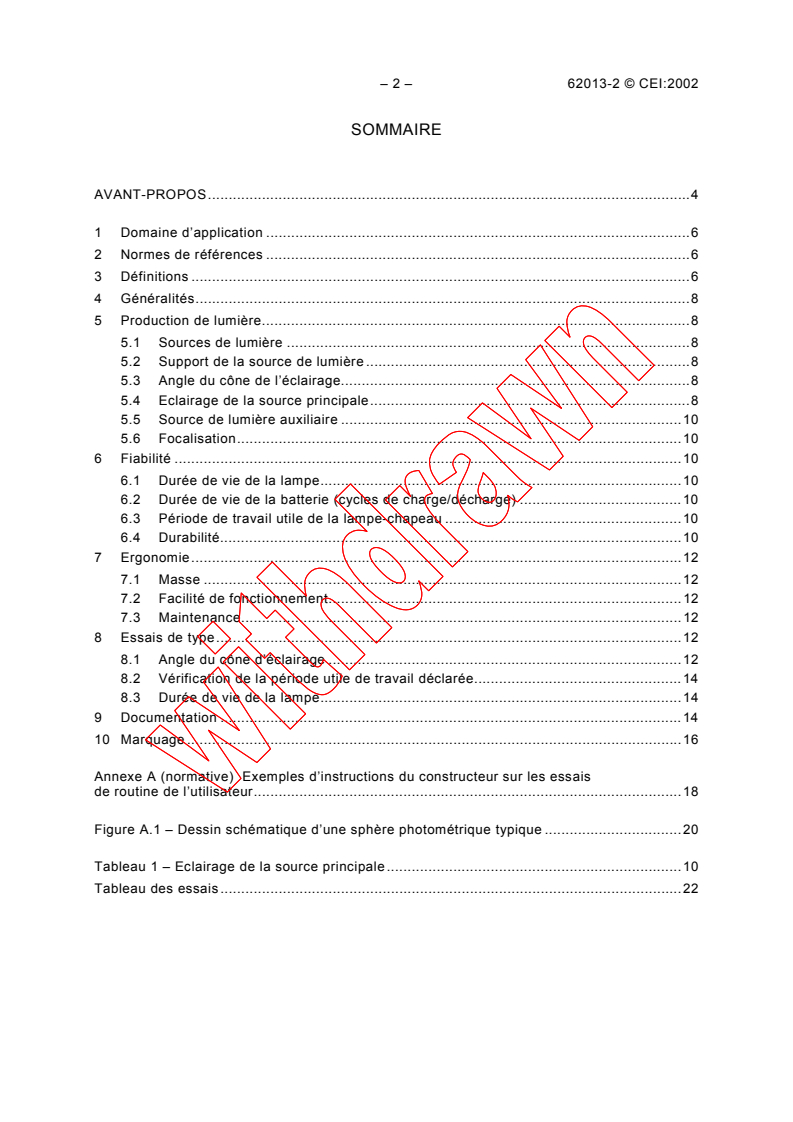
SOMMAIRE
AVANT-PROPOS.4
1 Domaine d’application .6
2 Normes de références .6
3 Définitions .6
4 Généralités.8
5 Production de lumière.8
5.1 Sources de lumière .8
5.2 Support de la source de lumière .8
5.3 Angle du cône de l’éclairage.8
5.4 Eclairage de la source principale.8
5.5 Source de lumière auxiliaire .10
5.6 Focalisation.10
6 Fiabilité .10
6.1 Durée de vie de la lampe.10
6.2 Durée de vie de la batterie (cycles de charge/décharge) .10
6.3 Période de travail utile de la lampe-chapeau .10
6.4 Durabilité.10
7 Ergonomie.12
7.1 Masse .12
7.2 Facilité de fonctionnement.12
7.3 Maintenance.12
8 Essais de type.12
8.1 Angle du cône d’éclairage .12
8.2 Vérification de la période utile de travail déclarée.14
8.3 Durée de vie de la lampe.14
9 Documentation .14
10 Marquage .16
Annexe A (normative) Exemples d’instructions du constructeur sur les essais
de routine de l’utilisateur.18
Figure A.1 – Dessin schématique d’une sphère photométrique typique .20
Tableau 1 – Eclairage de la source principale.10
Tableau des essais.22
62013-2 © IEC:2002 – 3 –
CONTENTS
FOREWORD.5
1 Scope.7
2 Normative references .7
3 Definitions .7
4 General .9
5 Light output .9
5.1 Light sources.9
5.2 Light source holder.9
5.3 Illumination cut-off angle .9
5.4 Illuminance of main source.9
5.5 Auxiliary light source .11
5.6 Focus .11
6 Reliability .11
6.1 Lamp life .11
6.2 Battery life (charge/discharge cycles) .11
6.3 Caplight useful working period.11
6.4 Durability.11
7 Ergonomics .13
7.1 Mass .13
7.2 Ease of operation .13
7.3 Maintainability .13
8 Type tests .13
8.1 Illumination cut-off angle .13
8.2 Verification of the declared useful working period.15
8.3 Lamp life .15
9 Documentation .15
10 Marking .17
Annex A (normative) Examples of the manufacturer’s instructions on user routine testing.19
Figure A.1 – Schematic drawing of a typical photometric sphere.21
Table 1 – Illuminance of the main source .11
Tabulation of tests .23
– 4 – 62013-2 © CEI:2002
INTERNATIONAL ELECTROTECHNICAL COMMISSION
____________
LAMPES-CHAPEAUX UTILISABLES
DANS LES MINES GRISOUTEUSES –
Partie 2: Performance et autres sujets relatifs à la sécurité
AVANT-PROPOS
1) La CEI (Commission Electrotechnique Internationale) est une organisation mondiale de normalisation
composée de l'ensemble des comités électrotechniques nationaux (Comités nationaux de la CEI). La CEI a
pour objet de favoriser la coopération internationale pour toutes les questions de normalisation dans les
domaines de l'électricité et de l'électronique. A cet effet, la CEI, entre autres activités, publie des Normes
internationales. Leur élaboration est confiée à des comités d'études, aux travaux desquels tout Comité national
intéressé par le sujet traité peut participer. Les organisations internationales, gouvernementales et non
gouvernementales, en liaison avec la CEI, participent également aux travaux. La CEI collabore étroitement
avec l'Organisation Internationale de Normalisation (ISO), selon des conditions fixées par accord entre les
deux organisations.
2) Les décisions ou accords officiels de la CEI en ce qui concerne les questions techniques, préparés par les
comités d'études où sont représentés tous les Comités nationaux s'intéressant à ces questions, expriment dans
la plus grande mesure possible un accord international sur les sujets examinés.
3) Les documents produits se présentent sous la forme de recommandations internationales publiées sous forme
de normes, spécifications techniques, rapports techniques ou de guides et agréées comme telles par les
Comités nationaux.
4) Dans le but d'encourager l'unification internationale, les Comités nationaux de la CEI s'engagent à appliquer de
façon transparente, dans toute la mesure possible, les Normes internationales de la CEI dans leurs normes
nationales et régionales. Toute divergence entre la norme de la CEI et la norme nationale ou régionale
correspondante doit être indiquée en termes clairs dans cette dernière.
5) La CEI n'a fixé aucune procédure concernant le marquage comme indication d'approbation et sa responsabilité
n'est pas engagée quand un matériel est déclaré conforme à l'une de ses normes.
6) L’attention est attirée sur le fait que certains des éléments de la présente Norme internationale peuvent faire
l’objet de droits de propriété intellectuelle ou de droits analogues. la CEI ne saurait être tenue pour
responsable de ne pas avoir identifié de tels droits de propriété et de ne pas avoir signalé leur existence.
La Norme internationale CEI 62013-2 a été établie par le comité 31 de la CEI: Matériel
électrique pour atmosphères explosives.
Cette version bilingue (2002-02) remplace la version monolingue anglaise.
Le texte anglais de cette norme est basé sur les documents 31/325/FDIS et 31/333/RVD.
Le rapport de vote 31/333/RVD donne toute information sur le vote ayant abouti à l'appro-
bation de cette norme.
La version française de cette norme n'a pas été soumise au vote.
Cette publication a été rédigée selon les Directives ISO/CEI, Partie 3.
L'annexe A fait partie intégrante de cette norme.
Le comité a décidé que le contenu de cette publication ne sera pas modifié avant 2003.
A cette date, la publication sera
• reconduite;
• supprimée;
• remplacée par une édition révisée, ou
• amendée.
62013-2 © IEC:2002 – 5 –
INTERNATIONAL ELECTROTECHNICAL COMMISSION
____________
CAPLIGHTS FOR USE IN MINES SUSCEPTIBLE TO FIREDAMP –
Part 2: Performance and other safety-related matters
FOREWORD
1) The IEC (International Electrotechnical Commission) is a worldwide organization for standardization comprising
all national electrotechnical committees (IEC National Committees). The object of the IEC is to promote
international co-operation on all questions concerning standardization in the electrical and electronic fields. To
this end and in addition to other activities, the IEC publishes International Standards. Their preparation is
entrusted to technical committees; any IEC National Committee interested in the subject dealt with may
participate in this preparatory work. International, governmental and non-governmental organizations liaising
with the IEC also participate in this preparation. The IEC collaborates closely with the International
Organization for Standardization (ISO) in accordance with conditions determined by agreement between the
two organizations.
2) The formal decisions or agreements of the IEC on technical matters express, as nearly as possible, an
international consensus of opinion on the relevant subjects since each technical committee has representation
from all interested National Committees.
3) The documents produced have the form of recommendations for international use and are published in the form
of standards, technical specifications, technical reports or guides and they are accepted by the National
Committees in that sense.
4) In order to promote international unification, IEC National Committees undertake to apply IEC International
Standards transparently to the maximum extent possible in their national and regional standards. Any
divergence between the IEC Standard and the corresponding national or regional standard shall be clearly
indicated in the latter.
5) The IEC provides no marking procedure to indicate its approval and cannot be rendered responsible for any
equipment declared to be in conformity with one of its standards.
6) Attention is drawn to the possibility that some of the elements of this International Standard may be the subject
of patent rights. The IEC shall not be held responsible for identifying any or all such patent rights.
International Standard IEC 62013-2 has been prepared by IEC technical committee 31:
Electrical apparatus for explosive atmospheres.
This bilingual version (2002-02) replaces the English version.
The text of this standard is based on the following documents:
FDIS Report on voting
31/325/FDIS 31/333/RVD
Full information on the voting for the approval of this standard can be found in the report on
voting indicated in the above table.
This publication has been drafted in accordance with the ISO/IEC Directives, Part 3.
Annex A forms an integral part of this standard.
The committee has decided that the contents of this publication will remain unchanged
until 2003. At this date, the publication will be
• reconfirmed;
• withdrawn;
• replaced by a revised edition, or
• amended.
– 6 – 62013-2 © CEI:2002
LAMPES-CHAPEAUX UTILISABLES
DANS LES MINES GRISOUTEUSES –
Partie 2: Performance et autres sujets relatifs à la sécurité
1 Domaine d’application
La présente partie de la CEI 62013 détaille les performances et autres caractéristiques
relatives à la sécurité non couvertes par la CEI 62013-1, mais qui sont néanmoins impor-
tantes pour la sécurité et les conditions de travail de l’utilisateur. Elle peut aussi s’appliquer
aux lampes-chapeaux utilisées dans les mines non sujettes au grisou. Lorsque cette partie
de la norme est utilisée comme document autonome pour les mines non grisouteuses,
il convient que toute prescription appropriée de construction fasse l’objet d’un accord entre
le fournisseur et l’utilisateur et, lorsque cela est possible, soit décrite conformément à
la CEI 62013-1.
2 Normes de références
Les documents de référence suivants sont indispensables pour l'application du présent
document. Pour les références datées, seule l'édition citée s'applique. Pour les références
non datées, la dernière édition du document de référence s'applique (y compris les éventuels
amendements).
CEI 60050(845):1987, Vocabulaire électrotechnique international (VEI) – Chapitre 845:
Eclairage
CEI 60983, Lampes miniatures
CEI 62013-1: Lampes-chapeaux utilisables dans les mines grisouteuses – Partie 1: Règles
générales – Construction et essais en relation avec le risque d’explosion
ISO 1000, Unités SI et recommandations pour l’emploi de leurs multiples et de certaines
autres unités
3 Définitions
Pour les besoins de la présente partie de la CEI 62013, les définitions de l’ISO 1000 et de la
CEI 60050(845) ainsi que les définitions suivantes s’appliquent:
3.1
surface d’évaluation
cercle avec un diamètre de 100 mm ± 2 mm sur un plan parallèle au couvercle de protection
du projecteur, positionné à 1 000 mm ± 5 mm de celui-ci et ayant son centre fixé par le point
d’éclairage maximal
3.2
période utile de travail
période en heures pendant laquelle la lampe-chapeau peut être utilisée en continu avec le
courant de décharge défini par le constructeur et être conforme aux prescriptions de
l’éclairage minimal de la présente partie de la CEI 62013
62013-2 © IEC:2002 – 7 –
CAPLIGHTS FOR USE IN MINES SUSCEPTIBLE TO FIREDAMP –
Part 2: Performance and other safety-related matters
1 Scope
This part of IEC 62013 details those performance and other safety features not covered in
IEC 62013-1, but which are nevertheless important for the safety and working conditions of
the user. It may also be applied to caplights for use in mines not likely to be endangered by
firedamp. When this part of the standard is used as a "stand-alone" document for non-gassy
mines, any relevant constructional requirements should be the subject of agreement between
the supplier and the user and, where possible, be as described in IEC 62013-1.
2 Normative references
The following referenced documents are indispensable for the application of this document.
For dated references, only the edition cited applies. For undated references, the latest edition
of the referenced document (including any amendments) applies.
IEC 60050(845):1987, International Electrotechnical Vocabulary (IEV) – Chapter 845: Lighting
IEC 60983, Miniature lamps
IEC 62013-1: Caplights for use in mines susceptible to firedamp – Part 1: General
requirements – Construction and testing in relation to the risk of explosion
ISO 1000, SI units and recommendations for the use of their multiples and of certain other
units
3 Definitions
For the purposes of this part of IEC 62013, the definitions of ISO 1000 and IEC 60050(845)
and the following apply:
3.1
evaluation area
circle with a diameter of 100 mm ± 2 mm on a plane parallel to the headpiece protective
cover, positioned 1 000 mm ± 5 mm from it and having its centre fixed by the point of
maximum illumination
3.2
useful working period
period in hours during which the caplight may be continuously used with the current drain
specified by the manufacturer and comply with the minimum illumination requirements of this
part of IEC 62013
– 8 – 62013-2 © CEI:2002
3.3
éclairage moyen, E
moy
valeur moyenne d’éclairage sur la surface d’évaluation
3.4
éclairage minimal, E
min
valeur la plus faible de l’éclairage mesurée dans la surface d’évaluation
3.5
éclairage maximal, E
max
valeur la plus élevée de l’éclairage mesurée dans la surface d’évaluation
3.6
angle du cône
angle solide formé par l’éclairage du projecteur
4 Généralités
La lampe-chapeau doit être conçue conformément aux bonnes pratiques d’ingénierie. Elle doit
être adaptée aux besoins et doit fournir une lumière suffisante pendant la durée de la période
de travail définie par le constructeur.
5 Production de lumière
5.1 Sources de lumière
5.1.1 Chaque projecteur doit avoir un minimum de deux sources de lumière, dont au moins
une doit être la source principale et satisfaire aux prescriptions de cette partie de la
CEI 62013.
5.1.2 Lorsqu’une lampe-chapeau est fournie avec deux lampes à filaments, chacun étant
capable d’être la source principale, le constructeur doit désigner ce qui doit être la source
principale et ce qui soit être la source auxiliaire; autrement, les deux sources doivent
satisfaire aux prescriptions relatives à la source principale.
5.1.3 Les lampes à filaments pour les sources principales et auxiliaires doivent être
conformes à la CEI 60983. Lorsque les feuilles de données appropriées ne sont pas données
dans la CEI 60983, des données équivalentes doivent être fournies par le constructeur de la
lampe-chapeau.
5.2 Support de la source de lumière
Le support de la source de lumière principale doit être capable de la positionner et de la
retenir d’une manière sûre dans une position convergente en accord avec le profil du
réflecteur conformément à 5.6.
5.3 Angle du cône de l’éclairage
L’intensité lumineuse de la source de lumière principale dans le projecteur complètement
assemblé ne doit pas être inférieure à 1 cd pour un angle solide de 120°, pendant l’essai,
conformément à 8.1.
5.4 Eclairage de la source principale
L’éclairage de la source principale au-dessus de la surface d’évaluation ne doit pas être
inférieur aux valeurs données dans le tableau 1 conformément à 8.2.
62013-2 © IEC:2002 – 9 –
3.3
average illumination, E
ave
average value of illumination on the evaluation area
3.4
minimum illumination, E
min
lowest measured value of illumination within the evaluation area
3.5
maximum illumination, E
max
highest measured value of illumination within the evaluation area
3.6
cut-off angle
solid angle formed by the illumination from the headpiece
4 General
The caplight shall be designed in accordance with good engineering practice. It shall be fit for
purpose and shall provide sufficient light for the user throughout the duration of the working
period specified by the manufacturer.
5 Light output
5.1 Light sources
5.1.1 Every headpiece shall have a minimum of two light sources, at least one of which shall
be the main source and meet the requirements of this part of IEC 62013.
5.1.2 Where a caplight is fitted with two lamps or filaments, each of which is capable of
being the main source, the manufacturer shall designate which of these shall be the main
source and which the auxiliary source; otherwise, both sources shall meet the requirements
for the main source.
5.1.3 Filament lamps for main and auxiliary sources shall comply with IEC 60983. Where the
relevant data sheet is not given in IEC 60983, an equivalent shall be provided by the caplight
manufacturer.
5.2 Light source holder
The holder for the main light source shall be capable of locating and retaining it securely in a
focused position with respect to the reflector profile in accordance with 5.6.
5.3 Illumination cut-off angle
The luminous intensity from the main light source in a fully assembled headpiece shall not be
less than 1 cd over a solid angle of 120° when tested in accordance with 8.1.
5.4 Illuminance of main source
The illuminance of the main source over the evaluation area shall not be less than the values
given in table 1 when tested in accordance with 8.2.
– 10 – 62013-2 © CEI:2002
Tableau 1 – Eclairage de la source principale
E E E
max moy min
1 500 lx 750 lx 150 lx
5.5 Source de lumière auxiliaire
La source de lumière auxiliaire est d’abord prévue pour une utilisation en cas d’urgence si la
source principale tombe en panne et est exempte des essais de type de l’article 8. Elle doit
être prévue pour supporter au minimum 1 W.
5.6 Focalisation
La source de lumière principale doit être focalisée, ou capable d’être focalisée, de manière
que le volume éclairé ne soit pas déformé par distorsion.
6 F
...