


IEC 60079-29-0:2025
(Main)Explosive atmospheres - Part 29-0: Gas detection equipment - General requirements and test methods
General Information
- Abstract
IEC 60079-29-0:2025 specifies general requirements, test methods and acceptance criteria that apply to flammable, oxygen and toxic gas detection equipment intended to detect gases and vapours and to provide an indication, alarm or other output function for personnel or property protection in industrial and commercial applications.
This document applies to the following gas detection equipment:
– Gas detection equipment Type "FL" intended for the detection of flammable gases:
• Type FL-Group I, in mines susceptible to firedamp;
• Type FL-Group II, in locations other than mines susceptible to firedamp; and
• Type FL-OP, open path gas detection equipment for flammable gases.
– Gas detection equipment Type "O2" intended for the detection of Oxygen:
• Type O2-DE, detection of oxygen deficiency or oxygen enrichment; and
• Type O2-IN, inertisation as measuring function for explosion protection.
– Gas detection equipment Type "TX" intended for the detection of toxic gases:
• Type TX-SM, detection in areas for safety monitoring applications and typically using alarm signalling;
• Type TX-HM, occupational exposure measurement in the region of occupational exposure limit values; and
• Type TX-OP, open path gas detection equipment for toxic gases.
This document is not applicable to equipment:
– used for medical applications;
– used only in laboratories for analysis or measurement;
– used only for process monitoring or control purposes (such as a gas analyser);
– used in the domestic environment;
– used in environmental air pollution monitoring;
– used for flue gas analysis;
– used for sampling systems external to the gas detection equipment;
– with samplers and concentrators such as sorbents or paper tape having an irreversible indication;
– consisting of a passive optical receiver without a dedicated optical source;
– equipment within the scope of IEC 60335-2-40 and IEC 60335-2-89.
This first edition of IEC 60079-29-0 cancels and replaces the second edition of 60079-29-1 published in 2016 and its Amendment 1:2020, and the first edition of IEC 60079-29-4 published in 2009. In addition, IEC 60079-29-0 Type TX-SM cancels and replaces Type SM of the first edition of IEC 62990-1.
- Status
- Published
- Publication Date
- 26-Nov-2025
- Technical Committee
- TC 31 - Equipment for explosive atmospheres
- Drafting Committee
- PT 60079-29-0 - TC 31/PT 60079-29-0
- Current Stage
- PPUB - Publication issued
- Start Date
- 27-Nov-2025
- Completion Date
- 28-Nov-2025
Buy Documents
IEC 60079-29-0:2025 - Explosive atmospheres - Part 29-0: Gas detection equipment - General requirements and test methods Released:11/27/2025
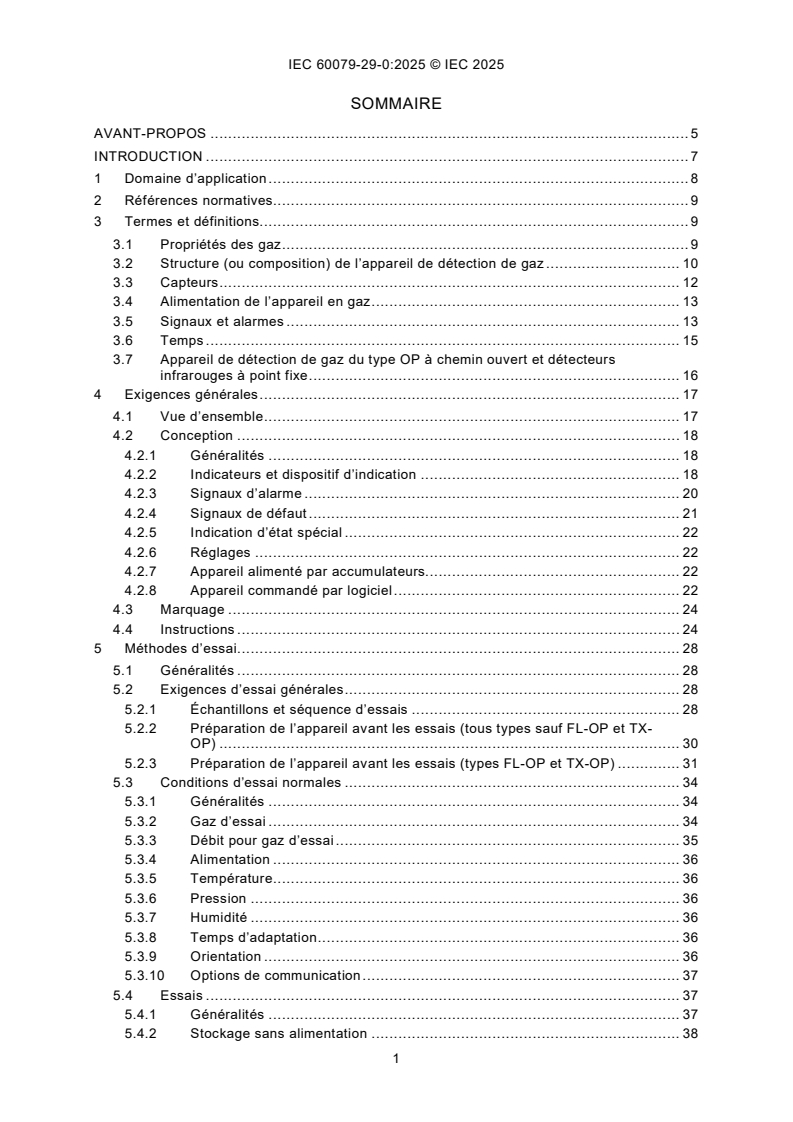
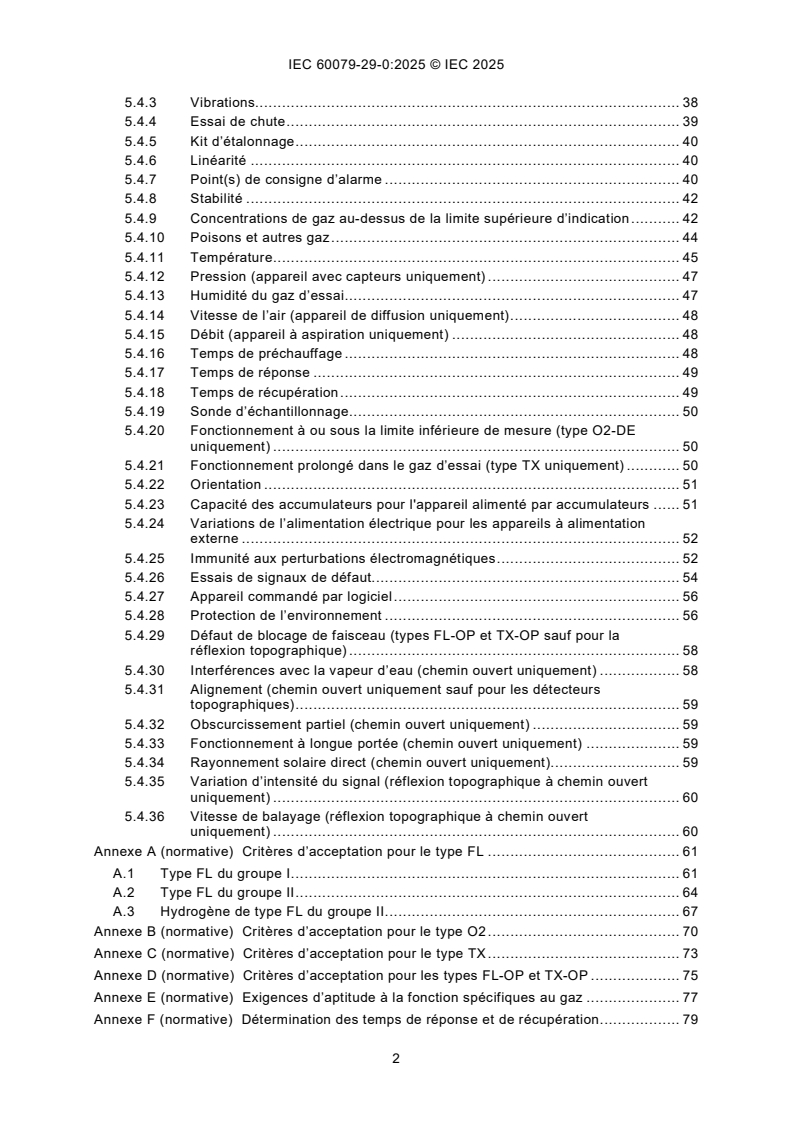
IEC 60079-29-0:2025 - Atmospheres explosives - Partie 29-0: Détecteurs de gaz - Exigences générales et méthodes d’essai Released:11/27/2025
IEC 60079-29-0:2025 - Explosive atmospheres - Part 29-0: Gas detection equipment - General requirements and test methods Released:11/27/2025
Overview
IEC 60079-29-0:2025 is an international standard developed by the International Electrotechnical Commission (IEC) that outlines the general requirements and test methods for gas detection equipment. The standard applies to equipment designed to detect flammable, oxygen, and toxic gases and vapours, providing indication, alarm, or output functions for the protection of personnel and property in industrial and commercial settings. By consolidating general requirements and test procedures into a single document, IEC 60079-29-0:2025 ensures consistency and reliability in the performance and safety of gas detection equipment used in potentially explosive atmospheres.
Key Topics
Types of Gas Detection Equipment:
- Type FL for flammable gases (including mining, general industry, and open path).
- Type O2 for detecting oxygen deficiency, enrichment, or for inerting applications.
- Type TX for monitoring toxic gases (for safety monitoring, occupational exposure, and open path detection).
General Requirements:
- Design principles for reliability, accuracy, and safety.
- Functional requirements for alarms, indications, and signal output.
- Marking and instructional labelling for end users.
- Robustness against environmental stresses like vibration, shock, temperature, humidity, and electromagnetic interference.
Test Methods and Acceptance Criteria:
- Procedures for verifying equipment performance under standardized laboratory conditions.
- Specific tests include vibration, drop, linearity, stability, environmental protection, and electromagnetic immunity.
- Acceptance criteria for each equipment type, ensuring consistency and reliability.
Scope Limitations:
- Excludes equipment for medical, laboratory, process analysis-only, domestic, or environmental air pollution purposes.
- Not applicable to gas analysers purely for process control or equipment within the scope of other specific IEC standards (such as IEC 60335-2-40/89).
Applications
IEC 60079-29-0:2025 serves as a foundational standard for manufacturers, installers, and end users of gas detection systems in industrial and commercial environments where explosive atmospheres may arise. Key applications include:
- Oil and gas facilities
- Chemical processing plants
- Mining operations, especially those susceptible to firedamp
- Industrial zones handling flammable, toxic, or oxygen-displacing gases
- Gas storage and distribution terminals
- Warehouses and logistics centers with hazardous materials
The standard aids in selecting, designing, and verifying gas detection equipment to protect workers and property, supporting compliance with international safety regulations.
Related Standards
Several key standards complement IEC 60079-29-0:2025, either by providing performance requirements for specific applications or by offering guidance on installation, operation, and maintenance:
- IEC 60079-29-2: Explosive atmospheres - Selection, installation, use and maintenance of detectors for flammable gases and oxygen.
- IEC 62990-1: Workplace atmospheres - Performance requirements of detectors for toxic gases.
- IEC 62990-2: Workplace atmospheres - Selection, installation, use, and maintenance of detectors for toxic gases and vapours.
- IEC 60079-29-3: Explosive atmospheres - Guidance on functional safety of fixed gas detection systems.
IEC 60079-29-0:2025 also supersedes previous editions, consolidating requirements and clarifying the types and use-cases for gas detection equipment in hazardous environments.
By adhering to IEC 60079-29-0:2025, organizations can ensure that their gas detection systems meet internationally recognized benchmarks for safety, performance, and reliability in explosive atmospheres. For the most up-to-date information and best practices, consult this standard in conjunction with application-specific IEC and ISO standards.
Relations
- Effective Date
- 05-Dec-2025
- Effective Date
- 05-Dec-2025
- Effective Date
- 05-Dec-2025
- Effective Date
- 05-Dec-2025
- Effective Date
- 05-Dec-2025
- Effective Date
- 05-Dec-2025
Buy Documents
IEC 60079-29-0:2025 - Explosive atmospheres - Part 29-0: Gas detection equipment - General requirements and test methods Released:11/27/2025
IEC 60079-29-0:2025 - Atmospheres explosives - Partie 29-0: Détecteurs de gaz - Exigences générales et méthodes d’essai Released:11/27/2025
IEC 60079-29-0:2025 - Explosive atmospheres - Part 29-0: Gas detection equipment - General requirements and test methods Released:11/27/2025
Get Certified
Connect with accredited certification bodies for this standard

IMQ S.p.A. (Certification)
Italian electrical product certification.

SLG Prüf- und Zertifizierungs GmbH
German testing and certification body.

UL Solutions
Global safety science company with testing, inspection and certification.
Sponsored listings
Frequently Asked Questions
IEC 60079-29-0:2025 is a standard published by the International Electrotechnical Commission (IEC). Its full title is "Explosive atmospheres - Part 29-0: Gas detection equipment - General requirements and test methods". This standard covers: IEC 60079-29-0:2025 specifies general requirements, test methods and acceptance criteria that apply to flammable, oxygen and toxic gas detection equipment intended to detect gases and vapours and to provide an indication, alarm or other output function for personnel or property protection in industrial and commercial applications. This document applies to the following gas detection equipment: – Gas detection equipment Type "FL" intended for the detection of flammable gases: • Type FL-Group I, in mines susceptible to firedamp; • Type FL-Group II, in locations other than mines susceptible to firedamp; and • Type FL-OP, open path gas detection equipment for flammable gases. – Gas detection equipment Type "O2" intended for the detection of Oxygen: • Type O2-DE, detection of oxygen deficiency or oxygen enrichment; and • Type O2-IN, inertisation as measuring function for explosion protection. – Gas detection equipment Type "TX" intended for the detection of toxic gases: • Type TX-SM, detection in areas for safety monitoring applications and typically using alarm signalling; • Type TX-HM, occupational exposure measurement in the region of occupational exposure limit values; and • Type TX-OP, open path gas detection equipment for toxic gases. This document is not applicable to equipment: – used for medical applications; – used only in laboratories for analysis or measurement; – used only for process monitoring or control purposes (such as a gas analyser); – used in the domestic environment; – used in environmental air pollution monitoring; – used for flue gas analysis; – used for sampling systems external to the gas detection equipment; – with samplers and concentrators such as sorbents or paper tape having an irreversible indication; – consisting of a passive optical receiver without a dedicated optical source; – equipment within the scope of IEC 60335-2-40 and IEC 60335-2-89. This first edition of IEC 60079-29-0 cancels and replaces the second edition of 60079-29-1 published in 2016 and its Amendment 1:2020, and the first edition of IEC 60079-29-4 published in 2009. In addition, IEC 60079-29-0 Type TX-SM cancels and replaces Type SM of the first edition of IEC 62990-1.
IEC 60079-29-0:2025 specifies general requirements, test methods and acceptance criteria that apply to flammable, oxygen and toxic gas detection equipment intended to detect gases and vapours and to provide an indication, alarm or other output function for personnel or property protection in industrial and commercial applications. This document applies to the following gas detection equipment: – Gas detection equipment Type "FL" intended for the detection of flammable gases: • Type FL-Group I, in mines susceptible to firedamp; • Type FL-Group II, in locations other than mines susceptible to firedamp; and • Type FL-OP, open path gas detection equipment for flammable gases. – Gas detection equipment Type "O2" intended for the detection of Oxygen: • Type O2-DE, detection of oxygen deficiency or oxygen enrichment; and • Type O2-IN, inertisation as measuring function for explosion protection. – Gas detection equipment Type "TX" intended for the detection of toxic gases: • Type TX-SM, detection in areas for safety monitoring applications and typically using alarm signalling; • Type TX-HM, occupational exposure measurement in the region of occupational exposure limit values; and • Type TX-OP, open path gas detection equipment for toxic gases. This document is not applicable to equipment: – used for medical applications; – used only in laboratories for analysis or measurement; – used only for process monitoring or control purposes (such as a gas analyser); – used in the domestic environment; – used in environmental air pollution monitoring; – used for flue gas analysis; – used for sampling systems external to the gas detection equipment; – with samplers and concentrators such as sorbents or paper tape having an irreversible indication; – consisting of a passive optical receiver without a dedicated optical source; – equipment within the scope of IEC 60335-2-40 and IEC 60335-2-89. This first edition of IEC 60079-29-0 cancels and replaces the second edition of 60079-29-1 published in 2016 and its Amendment 1:2020, and the first edition of IEC 60079-29-4 published in 2009. In addition, IEC 60079-29-0 Type TX-SM cancels and replaces Type SM of the first edition of IEC 62990-1.
IEC 60079-29-0:2025 is classified under the following ICS (International Classification for Standards) categories: 29.260.20 - Electrical apparatus for explosive atmospheres. The ICS classification helps identify the subject area and facilitates finding related standards.
IEC 60079-29-0:2025 has the following relationships with other standards: It is inter standard links to IEC 60079-29-4:2009/COR1:2010, IEC 60079-29-1:2016/ISH1:2019, IEC 60079-29-1:2016/AMD1:2020, IEC 60079-29-4:2009, IEC 60079-29-1:2016, IEC 60079-29-1:2016/ISH2:2019. Understanding these relationships helps ensure you are using the most current and applicable version of the standard.
IEC 60079-29-0:2025 is available in PDF format for immediate download after purchase. The document can be added to your cart and obtained through the secure checkout process. Digital delivery ensures instant access to the complete standard document.
Standards Content (Sample)
IEC 60079-29-0 ®
Edition 1.0 2025-11
INTERNATIONAL
STANDARD
Explosive atmospheres -
Part 29-0: Gas detection equipment - General requirements and test methods
ICS 29.260.20 ISBN 978-2-8327-0860-6
All rights reserved. Unless otherwise specified, no part of this publication may be reproduced or utilized in any form or
by any means, electronic or mechanical, including photocopying and microfilm, without permission in writing from either
IEC or IEC's member National Committee in the country of the requester. If you have any questions about IEC copyright
or have an enquiry about obtaining additional rights to this publication, please contact the address below or your local
IEC member National Committee for further information.
IEC Secretariat Tel.: +41 22 919 02 11
3, rue de Varembé info@iec.ch
CH-1211 Geneva 20 www.iec.ch
Switzerland
About the IEC
The International Electrotechnical Commission (IEC) is the leading global organization that prepares and publishes
International Standards for all electrical, electronic and related technologies.
About IEC publications
The technical content of IEC publications is kept under constant review by the IEC. Please make sure that you have the
latest edition, a corrigendum or an amendment might have been published.
IEC publications search - IEC Products & Services Portal - products.iec.ch
webstore.iec.ch/advsearchform Discover our powerful search engine and read freely all the
The advanced search enables to find IEC publications by a
publications previews, graphical symbols and the glossary.
variety of criteria (reference number, text, technical With a subscription you will always have access to up to date
committee, …). It also gives information on projects, content tailored to your needs.
replaced and withdrawn publications.
Electropedia - www.electropedia.org
IEC Just Published - webstore.iec.ch/justpublished The world's leading online dictionary on electrotechnology,
Stay up to date on all new IEC publications. Just Published containing more than 22 500 terminological entries in English
details all new publications released. Available online and and French, with equivalent terms in 25 additional languages.
once a month by email. Also known as the International Electrotechnical Vocabulary
(IEV) online.
IEC Customer Service Centre - webstore.iec.ch/csc
If you wish to give us your feedback on this publication or
need further assistance, please contact the Customer
Service Centre: sales@iec.ch.
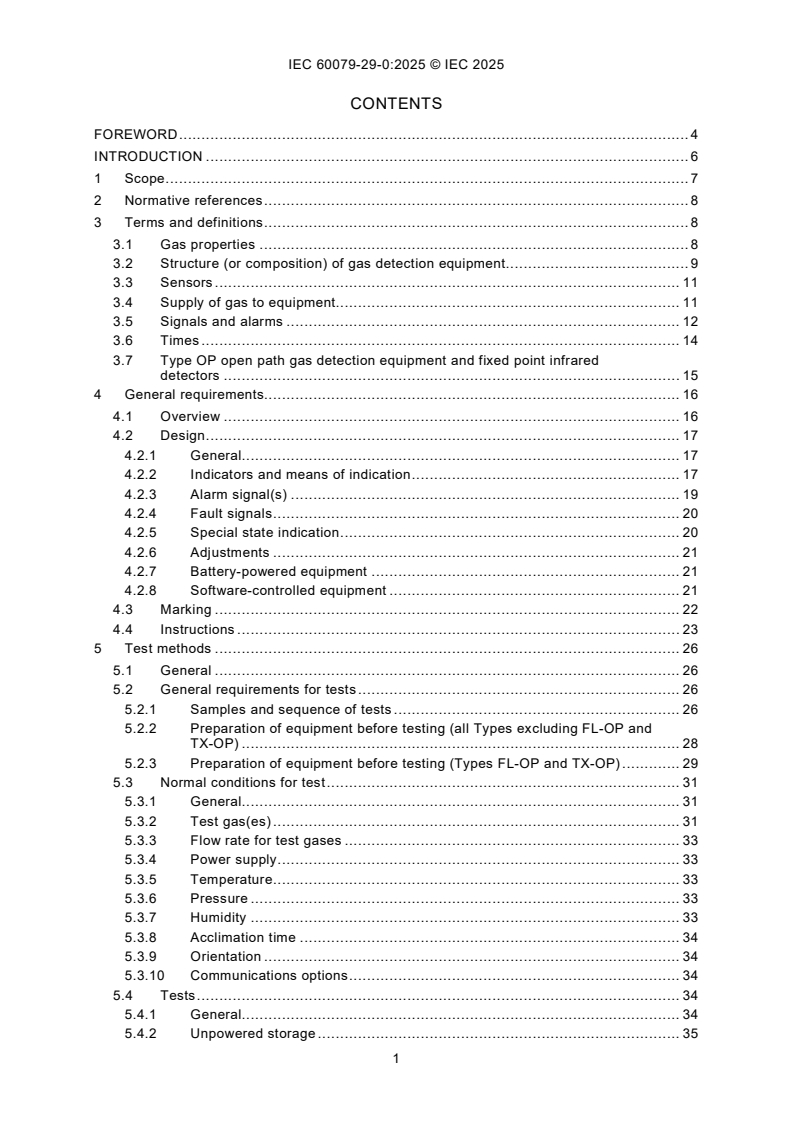
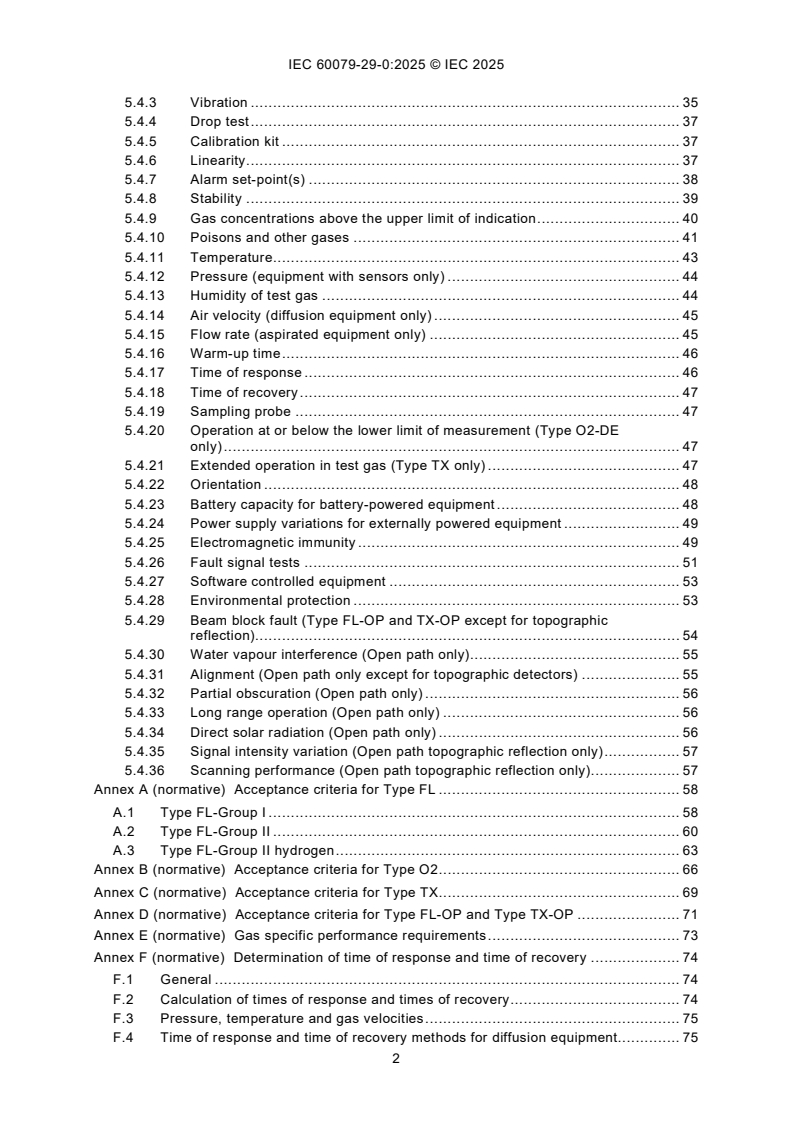
CONTENTS
FOREWORD . 4
INTRODUCTION . 6
1 Scope . 7
2 Normative references . 8
3 Terms and definitions . 8
3.1 Gas properties . 8
3.2 Structure (or composition) of gas detection equipment . 9
3.3 Sensors . 11
3.4 Supply of gas to equipment. 11
3.5 Signals and alarms . 12
3.6 Times . 14
3.7 Type OP open path gas detection equipment and fixed point infrared
detectors . 15
4 General requirements. 16
4.1 Overview . 16
4.2 Design . 17
4.2.1 General. 17
4.2.2 Indicators and means of indication . 17
4.2.3 Alarm signal(s) . 19
4.2.4 Fault signals . 20
4.2.5 Special state indication . 20
4.2.6 Adjustments . 21
4.2.7 Battery-powered equipment . 21
4.2.8 Software-controlled equipment . 21
4.3 Marking . 22
4.4 Instructions . 23
5 Test methods . 26
5.1 General . 26
5.2 General requirements for tests . 26
5.2.1 Samples and sequence of tests . 26
5.2.2 Preparation of equipment before testing (all Types excluding FL-OP and
TX-OP) . 28
5.2.3 Preparation of equipment before testing (Types FL-OP and TX-OP) . 29
5.3 Normal conditions for test . 31
5.3.1 General. 31
5.3.2 Test gas(es) . 31
5.3.3 Flow rate for test gases . 33
5.3.4 Power supply . 33
5.3.5 Temperature . 33
5.3.6 Pressure . 33
5.3.7 Humidity . 33
5.3.8 Acclimation time . 34
5.3.9 Orientation . 34
5.3.10 Communications options . 34
5.4 Tests . 34
5.4.1 General. 34
5.4.2 Unpowered storage . 35
5.4.3 Vibration . 35
5.4.4 Drop test . 37
5.4.5 Calibration kit . 37
5.4.6 Linearity . 37
5.4.7 Alarm set-point(s) . 38
5.4.8 Stability . 39
5.4.9 Gas concentrations above the upper limit of indication . 40
5.4.10 Poisons and other gases . 41
5.4.11 Temperature . 43
5.4.12 Pressure (equipment with sensors only) . 44
5.4.13 Humidity of test gas . 44
5.4.14 Air velocity (diffusion equipment only) . 45
5.4.15 Flow rate (aspirated equipment only) . 45
5.4.16 Warm-up time . 46
5.4.17 Time of response . 46
5.4.18 Time of recovery . 47
5.4.19 Sampling probe . 47
5.4.20 Operation at or below the lower limit of measurement (Type O2-DE
only) . 47
5.4.21 Extended operation in test gas (Type TX only) . 47
5.4.22 Orientation . 48
5.4.23 Battery capacity for battery-powered equipment . 48
5.4.24 Power supply variations for externally powered equipment . 49
5.4.25 Electromagnetic immunity . 49
5.4.26 Fault signal tests . 51
5.4.27 Software controlled equipment . 53
5.4.28 Environmental protection . 53
5.4.29 Beam block fault (Type FL-OP and TX-OP except for topographic
reflection) . 54
5.4.30 Water vapour interference (Open path only) . 55
5.4.31 Alignment (Open path only except for topographic detectors) . 55
5.4.32 Partial obscuration (Open path only) . 56
5.4.33 Long range operation (Open path only) . 56
5.4.34 Direct solar radiation (Open path only) . 56
5.4.35 Signal intensity variation (Open path topographic reflection only) . 57
5.4.36 Scanning performance (Open path topographic reflection only) . 57
Annex A (normative) Acceptance criteria for Type FL . 58
A.1 Type FL-Group I . 58
A.2 Type FL-Group II . 60
A.3 Type FL-Group II hydrogen . 63
Annex B (normative) Acceptance criteria for Type O2 . 66
Annex C (normative) Acceptance criteria for Type TX . 69
Annex D (normative) Acceptance criteria for Type FL-OP and Type TX-OP . 71
Annex E (normative) Gas specific performance requirements . 73
Annex F (normative) Determination of time of response and time of recovery . 74
F.1 General . 74
F.2 Calculation of times of response and times of recovery . 74
F.3 Pressure, temperature and gas velocities . 75
F.4 Time of response and time of recovery methods for diffusion equipment. 75
F.4.1 Calibration mask method 1 . 75
F.4.2 Calibration mask method 2 . 76
F.4.3 Flow method . 77
F.4.4 Injection method . 78
F.5 Time of response and time of recovery methods for aspirated equipment . 78
F.5.1 Test rig . 78
F.5.2 Equipment without internal pump . 78
F.5.3 Equipment with internal pump . 79
F.6 Open path detection equipment (Types FL-OP and TX-OP) . 80
Annex G (informative) Transient considerations . 81
G.1 Underdamped time of response . 81
G.2 Underdamped time of recovery . 83
Annex H (informative) Open path gas detection equipment water vapour test
apparatus . 86
Bibliography . 87
Figure 1 – Relationship between indication range and measuring range . 13
Figure 2 – Warm-up time in clean air (typical) . 15
Figure 3 – Warm-up time in standard test gas (typical) . 15
Figure 4 – Example of functional components of gas detection equipment . 16
Figure 5 – Gas cell for calibration and speed of response test . 30
Figure F.1 – Test chamber for calibration mask method 1 . 76
Figure F.2 – Test arrangement for calibration mask method 2 . 77
Figure F.3 – Schematic example of test chamber for flow method . 78
Figure F.4 – Schematic example of test rig for use with aspirated equipment . 79
Figure G.1 – Monotonic characteristic of overdamped or critically damped time
response . 81
Figure G.2 – Underdamped time response . 83
Figure G.3 – Determination of time of recovery for the normal case, the deadband case
and the underdamped case . 85
Figure H.1 – Example of water vapour test apparatus . 86
Table 1 – Indicators . 17
Table 2 – Test samples and sequence of tests . 26
Table A.1 – Acceptance criteria for Type FL-Group I . 58
Table A.2 – Acceptance criteria for Type FL-Group II . 60
Table A.3 – Acceptance criteria for Type FL-Group II hydrogen . 63
Table B.1 – Acceptance criteria for Type O2 equipment (Type O2-DE & Type O2-IN) . 66
Table C.1 – Acceptance criteria for Type TX equipment (Type TX-SM & Type TX-HM) . 69
Table D.1 – Acceptance criteria for Type FL-OP & Type TX-OP . 71
Table E.1 – Gas specific performance requirements . 73
INTERNATIONAL ELECTROTECHNICAL COMMISSION
____________
Explosive atmospheres -
Part 29-0: Gas detection equipment -
General requirements and test methods
FOREWORD
1) The International Electrotechnical Commission (IEC) is a worldwide organization for standardization comprising
all national electrotechnical committees (IEC National Committees). The object of IEC is to promote international
co-operation on all questions concerning standardization in the electrical and electronic fields. To this end and
in addition to other activities, IEC publishes International Standards, Technical Specifications, Technical Reports,
Publicly Available Specifications (PAS) and Guides (hereafter referred to as “IEC Publication(s)”). Their
preparation is entrusted to technical committees; any IEC National Committee interested in the subject dealt with
may participate in this preparatory work. International, governmental and non-governmental organizations liaising
with the IEC also participate in this preparation. IEC collaborates closely with the International Organization for
Standardization (ISO) in accordance with conditions determined by agreement between the two organizations.
2) The formal decisions or agreements of IEC on technical matters express, as nearly as possible, an international
consensus of opinion on the relevant subjects since each technical committee has representation from all
interested IEC National Committees.
3) IEC Publications have the form of recommendations for international use and are accepted by IEC National
Committees in that sense. While all reasonable efforts are made to ensure that the technical content of IEC
Publications is accurate, IEC cannot be held responsible for the way in which they are used or for any
misinterpretation by any end user.
4) In order to promote international uniformity, IEC National Committees undertake to apply IEC Publications
transparently to the maximum extent possible in their national and regional publications. Any divergence between
any IEC Publication and the corresponding national or regional publication shall be clearly indicated in the latter.
5) IEC itself does not provide any attestation of conformity. Independent certification bodies provide conformity
assessment services and, in some areas, access to IEC marks of conformity. IEC is not responsible for any
services carried out by independent certification bodies.
6) All users should ensure that they have the latest edition of this publication.
7) No liability shall attach to IEC or its directors, employees, servants or agents including individual experts and
members of its technical committees and IEC National Committees for any personal injury, property damage or
other damage of any nature whatsoever, whether direct or indirect, or for costs (including legal fees) and
expenses arising out of the publication, use of, or reliance upon, this IEC Publication or any other IEC
Publications.
8) Attention is drawn to the Normative references cited in this publication. Use of the referenced publications is
indispensable for the correct application of this publication.
9) IEC draws attention to the possibility that the implementation of this document may involve the use of (a)
patent(s). IEC takes no position concerning the evidence, validity or applicability of any claimed patent rights in
respect thereof. As of the date of publication of this document, IEC had not received notice of (a) patent(s), which
may be required to implement this document. However, implementers are cautioned that this may not represent
the latest information, which may be obtained from the patent database available at https://patents.iec.ch. IEC
shall not be held responsible for identifying any or all such patent rights.
IEC 60079-29-0 has been prepared by the IEC technical committee 31: Equipment for explosive
atmospheres. It is an International Standard.
This first edition of IEC 60079-29-0 cancels and replaces the second edition of 60079-29-1
published in 2016 and its Amendment 1:2020, and the first edition of IEC 60079-29-4 published
in 2009. In addition, IEC 60079-29-0 Type TX-SM cancels and replaces Type SM of the first
edition of IEC 62990-1; however, Type TX-HM will remain within the standard.
The text of this International Standard is based on the following documents:
Draft Report on voting
31/1889/FDIS 31/1935/RVD
Full information on the voting for its approval can be found in the report on voting indicated in
the above table.
The language used for the development of this International Standard is English.
This document was drafted in accordance with ISO/IEC Directives, Part 2, and developed in
accordance with ISO/IEC Directives, Part 1 and ISO/IEC Directives, IEC Supplement, available
at www.iec.ch/members_experts/refdocs. The main document types developed by IEC are
described in greater detail at www.iec.ch/publications.
Users of this document are advised that interpretation sheets clarifying the interpretation of this
document can be published. Interpretation sheets are available from the IEC webstore and can
be found in the "history" tab of the page for each document.
A list of all parts in the IEC 60079-29 series, published under the general title Explosive
atmospheres, can be found on the IEC website.
The committee has decided that the contents of this document will remain unchanged until the
stability date indicated on the IEC website under webstore.iec.ch in the data related to the
specific document. At this date, the document will be
– reconfirmed,
– withdrawn, or
– revised.
INTRODUCTION
This part of IEC 60079-29 specifies general requirements, test methods and acceptance criteria
that apply to flammable, oxygen and toxic gas detection equipment intended to detect gases
and vapours and to provide an indication, alarm or other output function for personnel or
property protection in industrial and commercial applications. This part of IEC 60079-29 was
developed for the purpose of aligning requirements and test methods of gas detection
equipment within a single consolidated document for consistency.
Although a wide range of conditions can be encountered in practice, this document specifies
requirements to be fulfilled by gas detection equipment when tested under prescribed laboratory
conditions.
General and performance requirements for Type TX-HM gas detection equipment intended for
occupational exposure measurement in the region of Occupational Exposure Limit Values are
set out in IEC 62990-1.
Consideration needs to also be given to the following relevant international standards:
IEC 60079-29-2, Explosive atmospheres - Part 29-2: Gas detectors - Selection, installation, use
and maintenance of detectors for flammable gases and oxygen
IEC 62990-2, Workplace atmospheres - Part 2: Gas detectors - Selection, installation, use and
maintenance of detectors for toxic gases and vapours
IEC 60079-29-3, Explosive atmospheres - Part 29-3: Gas detectors - Guidance on functional
safety of fixed gas detection systems
1 Scope
This part of IEC 60079-29 specifies general requirements, test methods and acceptance criteria
that apply to flammable, oxygen and toxic gas detection equipment intended to detect gases
and vapours and to provide an indication, alarm or other output function for personnel or
property protection in industrial and commercial applications.
NOTE 1 The term gas detection equipment is often referred to as the term gas detector.
NOTE 2 The terms 'gas' and 'gases' used in this document are also intended to include 'vapour' and 'vapours'.
This document applies to the following gas detection equipment:
– Gas detection equipment Type "FL" intended for the detection of flammable gases:
• Type FL-Group I, in mines susceptible to firedamp;
• Type FL-Group II, in locations other than mines susceptible to firedamp; and
• Type FL-OP, open path gas detection equipment for flammable gases.
– Gas detection equipment Type "O2" intended for the detection of oxygen:
• Type O2-DE, detection of oxygen deficiency or oxygen enrichment; and
• Type O2-IN, inertisation as measuring function for explosion protection.
NOTE 3 Inertisation is an explosion protection technique where an explosive atmosphere is purged with inert gas.
– Gas detection equipment Type "TX" intended for the detection of toxic gases:
• Type TX-SM, detection in areas for safety monitoring applications and typically using
alarm signalling;
• Type TX-HM, occupational exposure measurement in the region of occupational
exposure limit values; and
NOTE 4 Type TX-HM gas detection equipment performance requirements reside in IEC 62990-1.
• Type TX-OP, open path gas detection equipment for toxic gases.
NOTE 5 This document addresses equipment giving a level of performance suitable for general purpose
applications. Specific applications might require particular tests or evaluations that are additional to and separate
from the compliance with this document.
NOTE 6 Although the focus of this document is gas detection equipment for use in 'explosive atmospheres', this
document can be applicable to detection in areas not formally classified as 'explosive atmospheres'.
NOTE 7 Refrigerant gas detection equipment used for life, health and safety area monitoring are within the scope
of this document or IEC 62990-1.
This document is not applicable to equipment:
– used for medical applications;
– used only in laboratories for analysis or measurement;
– used only for process monitoring or control purposes (such as a gas analyser);
– used in the domestic environment;
– used in environmental air pollution monitoring;
– used for flue gas analysis;
– used for sampling systems external to the gas detection equipment;
– with samplers and concentrators such as sorbents or paper tape having an irreversible
indication;
– consisting of a passive optical receiver without a dedicated optical source;
– equipment within the scope of IEC 60335-2-40 and IEC 60335-2-89.
2 Normative references
The following documents are referred to in the text in such a way that some or all of their content
constitutes requirements of this document. For dated references, only the edition cited applies.
For undated references, the latest edition of the referenced document (including any
amendments) applies.
IEC 60079-29-2, Explosive atmospheres - Part 29-2: Gas detectors - Selection, installation, use
and maintenance of detectors for flammable gases and oxygen
IEC 62990-2, Workplace atmospheres - Part 2: Gas detectors - Selection, installation, use and
maintenance of detectors for toxic gases and vapours
IEC 60068-2-6, Environmental testing - Part 2-6: Tests - Test Fc: Vibration (sinusoidal)
IEC 60079-0, Explosive atmospheres - Part 0: Equipment - General requirements
IEC 60529, Degrees of protection provided by enclosures (IP Code)
IEC 61000-4-29, Electromagnetic compatibility (EMC) - Part 4-29: Testing and measurement
techniques - Voltage dips, short interruptions and voltage variations on d.c. input power port
immunity tests
IEC 61326-1, Electrical equipment for measurement, control and laboratory use - EMC
requirements - Part 1: General requirements
IEC 62990-1, Workplace atmospheres - Part 1: Gas detectors - Performance requirements of
detectors for toxic gases
ISO/IEC 80079-20-1, Explosive atmospheres - Part 20-1: Material characteristics for gas and
vapour classification - Test methods and data
3 Terms and definitions
For the purposes of this document, the following terms and definitions apply.
ISO and IEC maintain terminology databases for use in standardization at the following
addresses:
– IEC Electropedia: available at https://www.electropedia.org/
– ISO Online browsing platform: available at https://www.iso.org/obp
3.1 Gas properties
3.1.1
ambient air
normal atmosphere surrounding the equipment
3.1.2
clean air
air that is free of gases or vapours to which the sensor is sensitive or which
influence the performance of the sensor
3.1.3
reference air
air with an oxygen volume fraction of (21 ± 0,4) %
3.1.4
zero test gas
gas, that is free of the gas(es) to be measured and interfering and
contaminating substances, the purpose of which is calibration/adjustment of the equipment zero
3.1.5
standard test gas
test gas with a composition specified to be used for all tests unless otherwise
stated
3.1.6
flammable gas
DEPRECATED: combustible gas
gas or vapour which, when mixed with air in a certain proportion, will form an
explosive atmosphere
Note 1 to entry: For the purposes of this part of IEC 60079-29, the term "flammable gas" includes flammable
vapours.
[SOURCE: IEC 60079-10-1:2020, 3.6.4, modified – "or vapour" dropped from term and Note to
entry added. Admitted and deprecated terms also added]
3.1.7
toxic gas
gas or vapour that can be harmful to human health and/or the performance of
persons due to its physical or physico-chemical properties
3.1.8
poison
substance that leads to temporary or permanent change of performance,
particularly loss of sensitivity of the sensing element
3.1.9
volume fraction
V/V
quotient of the volume of a specified component and the sum of the volumes of all components
of a gas mixture before mixing
Note 1 to entry: The volume fraction and volume concentration take the same value if, at the same state conditions,
the sum of the component volumes before mixing and the volume of the mixture are equal. However, because the
mixing of two or more gases at the same state conditions is usually accompanied by a slight contraction or, less
frequently, a slight expansion, this is not generally the case.
Note 2 to entry: All volumes are with respect to the pressure and the temperature of the gas mixture.
3.2 Structure (or composition) of gas detection equipment
3.2.1
alarm-only equipment
equipment with an alarm but not having an indication of measured value
3.2.2
aspirated equipment
equipment that samples the gas by drawing it to the gas sensor
Note 1 to entry: A hand operated or electric pump is often used to draw gas to the sensor.
3.2.3
automatically aspirated equipment
aspirated equipment with an integral pump or separate pump, which is
connected directly to the equipment
3.2.4
diffusion equipment
equipment in which the transfer of gas from the atmosphere to the sensor takes
place without aspirated flow
3.2.5
fixed equipment
equipment fastened to a support, or otherwise secured in a specific location when energized
[SOURCE: IEC 60079-0:2017, 3.31.2]
3.2.6
portable equipment
equipment intended to be carried by a person during its operation
Note 1 to entry: Portable equipment carried by a person during its operation is sometimes referred to as hand-held
equipment. This also includes equipment which is carried when the user is not interacting directly with it (for example,
carried on a belt holster or clipped to a person's clothing).
Note 2 to entry: Examples of portable equipment include mobile phones, remote controls for in-ear or on-ear audio
devices, hearing aids, flammable / toxic gas detectors, powered tools.
Note 3 to entry: Portable gas detection equipment, typically less than 1 kg, can be operated by only one hand.
Note 4 to entry: Larger equipment can be operated by the user while it is carried either by hand, by a shoulder strap
or carrying harness.
[SOURCE: IEC 60079-0:2017, 3.31.4, modified – modification of Notes 1 and 2 to entry,
addition of Notes 3 and 4 to entry]
3.2.7
transportable equipment
equipment not intended to be carried by a person during operation, nor intended for fixed
installation
[SOURCE: IEC 60079-0:2017, 3.31.5]
3.2.8
gas detection transmitter
fixed gas detection equipment that provides a conditioned electronic signal or output indication
to a generally accepted industry standard (such as 4 to 20 mA), intended to be utilized with
separate gas detection control units or signal processing data acquisition, central monitoring
and similar systems
3.2.9
gas detection control unit
equipment intended to provide display indication, alarm functions, output contacts or alarm
signal outputs or any combination when operated with integral or remote sensor(s)
3.2.10
separate gas detection control unit
equipment intended to provide display indication, alarm functions, output contacts or alarm
signal outputs or any combination when operated with gas detection transmitter(s)
3.2.11
equipment with integral sensor(s)
equipment that provides display indication, alarm functions, output contacts or
alarm signal outputs using a sensor which is within or directly assembled to the equipment
housing
3.2.12
accessory
component which can be fitted to the equipment for a special purpose and that
is referenced in the instructions
EXAMPLE External gas pump, sampling probe, hoses, collecting cone, weather protection device.
3.3 Sensors
3.3.1
sensing element
part of the sensor that is sensitive to the gas or vapour to be measured
3.3.2
measuring principle
principle that makes the sensing element or the sensor sensitive to the gas or
vapour to be measured
3.3.3
sensor
assembly in which the sensing element is housed and that may also contain
associated circuit components
3.3.4
integral sensor
sensor that is within or directly assembled to a gas detection control unit, gas
detection transmitter, or to transportable or portable equipment
3.3.5
remote sensor
sensor that is installed separately, but is connected to a gas detection control
unit, gas detection transmitter, or to transportable or portable equipment
3.4 Supply of gas to equipment
3.4.1
sample line
means by which the gas being sampled is conveyed to the sensor
Note 1 to entry: Accessories such as filters or water traps are often included in the sample line.
3.4.2
sampling probe
separate accessory sample line that is optionally attached to the equipment
3.4.3
adjustment
procedure carried out to minimize the deviation of the indication from the test
gas concentration
Note 1 to entry: When the equipment is adjusted to give an indication of zero in zero test gas, the procedure is
called 'zero adjustment'.
3.4.4
calibration
procedure that establishes the relationship between an indication and the
concentration of a test gas
3.4.5
calibration kit
means of presenting test gas to the equipment for the purpose of calibrating,
adjusting or verifying the operation of the equipment
Note 1 to entry: The calibration kit can be used for verifying the operation of the alarms if the concentration of the
test gas is beyond the alarm set-point.
Note 2 to entry: A mask for calibration and test is an example of a calibration kit.
3.4.6
mask for calibration and test
device that can be attached to the equipment to present a test gas to the
sensor in a reproducible manner
3.5 Signals and alarms
3.5.1
measured value
calculated concentration of gas or vapour that results from processing the
sensor signal
Note 1 to entry: The measured value can be further processed before indication (for example, filtering or averaging).
3.5.2
indication
representation of the measured value on an output or display
3.5.3
indication range
range of indications over which the equipment is capable of indicating
SEE: Figure 1
3.5.4
lower limit of indication
smallest indication within the indication range
SEE: Figure 1
3.5.5
upper limit of indication
largest indication within the indication range
SEE: Figure 1
3.5.6
measuring range
range of indications of gas concentration over which the accuracy of the
equipment lies within specified limits
SEE: Figure 1
3.5.7
lower limit of measurement
smallest measured value within the measuring range
Note 1 to entry: Lower limit of measuring range can be zero.
SEE: Figure 1
3.5.8
upper limit of measurement
largest measured value within the measuring range
SEE: Figure 1
Note 1 to entry: Indications below the lower limit of measurement or above the upper limit of measurement will not
necessarily meet the requirements of this document.
Note 2 to entry: Depending upon the gas detection technology employed, the limits might exactly align.
Figure 1 – Relationship between indication range and measuring range
3.5.9
alarm set point
setting of the equipment at which the measured concentration will cause the
equipment to initiate an indication, alarm or other output function
3.5.10
latching alarm
alarm that, once activated, requires deliberate action to be deactivated
3.5.11
fault signal
audible, visible or other type of output, different from the alarm signal,
permitting, directly or indirectly, a warning or indication that the equipment is not working
satisfactorily
3.5.12
special state
state of the equipment other than that in which the intent is monitoring of gas
concentration and, if the equipment provides alarms, alarming
Note 1 to entry: Special state includes warm-up, calibration mode and fault condition.
3.6 Times
3.6.1
drift
variation in the equipment indication over time at any fixed gas volume fraction
(including clean air) under constant ambient conditions
3.6.2
final indication
indication given by the equipment after stabilization
3.6.3
time of response/recovery
t(x)
time interval, with the equipment in a warmed-up condition, between the time
when an instantaneous concentration change between two test gases is produced at the
equipment inlet or optical path, and the time when the indication reaches a stated percentage
(x) of the differences of the two indications
3.6.4
warm-up time
time interval, with the equipment in a stated atmosphere, between the time
when the equipment is switched on and the time when the indication reaches and remains within
the stated tolerances
Note 1 to entry: See equipment warm-up time in Figure 2 and Figure 3.
Figure 2 – Warm-up time in clean air (typical)
Figure 3 – Warm-up time in standard test gas (typical)
3.7 Type OP open path gas detection equipment and fixed point infrared detectors
NOTE The following definitions are specific to open path gas detection equipment and supplement other definitions
in this clause that are relevant to open path gas detection equipment and fixed point infrared detectors.
3.7.1
beam block signal
audible, visual or other type of output which provides, directly or indirectly, a
warning or indication that the optical path is obscured or misaligned such that the signal
detected is too weak to enable the equipment to function normally
3.7.2
integral concentration
integral of the gas concentration along the optical path
Note 1 to entry: It is expressed in units of concentration multiplied by distance; for example, LFL m for flammable
gases or ppm m for toxic gases.
Note 2 to entry: 100 % LFL × 1 m = 1 LFL m; 10 % LFL × 10 m = 1 LFL m.
3.7.3
open path
technique for measuring integral concentration in which the atmosphere
between a transmitter and receiver is monitored for the target gas
3.7.4
optical axis
path describing the line of greatest optical intensity
3.7.5
optical path
path traversed by optical radiation from an optical transmitter to an optical
receiver
Note 1 to entry: The radiation can traverse the open path once, twice or many times depending on the form taken
by the instrument.
3.7.6
open path transmitter
assembly in which the optical transmitting element(s) are housed and which
may contain associated optical and electrical components
3.7.7
open path transceiver
assembly in which the optical transmitting element(s) and optical receiving
element(s) are housed and which may contain associated optical and electrical components
3.7.8
open path receiver
assembly in which the optical receiving element(s) are housed and which may
contain associated optical and electrical components
4 General requirements
4.1 Overview
In addition to the requirements of this document, gas detection equipment intended for use in
explosive atmospheres shall comply with the relevant requirements of IEC 60079-0 and the
applicable Type(s) of Protection standards.
Functional components of the gas detection equipment are confirmed by testing physical
components which may be separate or combined functional components. Figure 4 provides an
example of functional components of the gas detection equipment:
Figure 4 – Example of functional components of gas detection equipment
4.2 Design
4.2.1 General
The equipment shall be constructed in such a manner that:
a) regular functional checks, calibration and adjustment can be undertaken by the user;
b) diffusion equipment can be equipped with a calibration kit;
c) materials and components which are relevant to performance of the equipment shall be
used within the ma
...
IEC 60079-29-0 ®
Edition 1.0 2025-11
NORME
INTERNATIONALE
Atmosphères explosives -
Partie 29-0: Détecteurs de gaz - Exigences générales et méthodes d’essai
ICS 29.260.20 ISBN 978-2-8327-0860-6
Droits de reproduction réservés. Sauf indication contraire, aucune partie de cette publication ne peut être reproduite ni
utilisée sous quelque forme que ce soit et par aucun procédé, électronique ou mécanique, y compris la photocopie et
les microfilms, sans l'accord écrit de l'IEC ou du Comité national de l'IEC du pays du demandeur. Si vous avez des
questions sur le copyright de l'IEC ou si vous désirez obtenir des droits supplémentaires sur cette publication, utilisez
les coordonnées ci-après ou contactez le Comité national de l'IEC de votre pays de résidence.
IEC Secretariat Tel.: +41 22 919 02 11
3, rue de Varembé info@iec.ch
CH-1211 Geneva 20 www.iec.ch
Switzerland
A propos de l'IEC
La Commission Electrotechnique Internationale (IEC) est la première organisation mondiale qui élabore et publie des
Normes internationales pour tout ce qui a trait à l'électricité, à l'électronique et aux technologies apparentées.
A propos des publications IEC
Le contenu technique des publications IEC est constamment revu. Veuillez vous assurer que vous possédez l’édition la
plus récente, un corrigendum ou amendement peut avoir été publié.
Recherche de publications IEC - IEC Products & Services Portal - products.iec.ch
webstore.iec.ch/advsearchform Découvrez notre puissant moteur de recherche et consultez
La recherche avancée permet de trouver des publications gratuitement tous les aperçus des publications, symboles
IEC en utilisant différents critères (numéro de référence, graphiques et le glossaire. Avec un abonnement, vous aurez
texte, comité d’études, …). Elle donne aussi des toujours accès à un contenu à jour adapté à vos besoins.
informations sur les projets et les publications remplacées
ou retirées. Electropedia - www.electropedia.org
Le premier dictionnaire d'électrotechnologie en ligne au
IEC Just Published - webstore.iec.ch/justpublished monde, avec plus de 22 500 articles terminologiques en
Restez informé sur les nouvelles publications IEC. Just anglais et en français, ainsi que les termes équivalents
Published détaille les nouvelles publications parues. dans 25 langues additionnelles. Egalement appelé
Disponible en ligne et une fois par mois par email. Vocabulaire Electrotechnique International (IEV) en ligne.
Service Clients - webstore.iec.ch/csc
Si vous désirez nous donner des commentaires sur cette
publication ou si vous avez des questions contactez-
nous: sales@iec.ch.
SOMMAIRE
AVANT-PROPOS . 5
INTRODUCTION . 7
1 Domaine d’application . 8
2 Références normatives . 9
3 Termes et définitions. 9
3.1 Propriétés des gaz . 9
3.2 Structure (ou composition) de l’appareil de détection de gaz . 10
3.3 Capteurs . 12
3.4 Alimentation de l’appareil en gaz . 13
3.5 Signaux et alarmes . 13
3.6 Temps . 15
3.7 Appareil de détection de gaz du type OP à chemin ouvert et détecteurs
infrarouges à point fixe . 16
4 Exigences générales . 17
4.1 Vue d’ensemble . 17
4.2 Conception . 18
4.2.1 Généralités . 18
4.2.2 Indicateurs et dispositif d’indication . 18
4.2.3 Signaux d’alarme . 20
4.2.4 Signaux de défaut . 21
4.2.5 Indication d’état spécial . 22
4.2.6 Réglages . 22
4.2.7 Appareil alimenté par accumulateurs. 22
4.2.8 Appareil commandé par logiciel . 22
4.3 Marquage . 24
4.4 Instructions . 24
5 Méthodes d’essai . 28
5.1 Généralités . 28
5.2 Exigences d’essai générales . 28
5.2.1 Échantillons et séquence d’essais . 28
5.2.2 Préparation de l’appareil avant les essais (tous types sauf FL-OP et TX-
OP) . 30
5.2.3 Préparation de l’appareil avant les essais (types FL-OP et TX-OP) . 31
5.3 Conditions d’essai normales . 34
5.3.1 Généralités . 34
5.3.2 Gaz d’essai . 34
5.3.3 Débit pour gaz d’essai . 35
5.3.4 Alimentation . 36
5.3.5 Température . 36
5.3.6 Pression . 36
5.3.7 Humidité . 36
5.3.8 Temps d’adaptation . 36
5.3.9 Orientation . 36
5.3.10 Options de communication . 37
5.4 Essais . 37
5.4.1 Généralités . 37
5.4.2 Stockage sans alimentation . 38
5.4.3 Vibrations. 38
5.4.4 Essai de chute . 39
5.4.5 Kit d’étalonnage . 40
5.4.6 Linéarité . 40
5.4.7 Point(s) de consigne d’alarme . 40
5.4.8 Stabilité . 42
5.4.9 Concentrations de gaz au-dessus de la limite supérieure d’indication . 42
5.4.10 Poisons et autres gaz . 44
5.4.11 Température . 45
5.4.12 Pression (appareil avec capteurs uniquement) . 47
5.4.13 Humidité du gaz d’essai . 47
5.4.14 Vitesse de l’air (appareil de diffusion uniquement) . 48
5.4.15 Débit (appareil à aspiration uniquement) . 48
5.4.16 Temps de préchauffage . 48
5.4.17 Temps de réponse . 49
5.4.18 Temps de récupération . 49
5.4.19 Sonde d’échantillonnage . 50
5.4.20 Fonctionnement à ou sous la limite inférieure de mesure (type O2-DE
uniquement) . 50
5.4.21 Fonctionnement prolongé dans le gaz d’essai (type TX uniquement) . 50
5.4.22 Orientation . 51
5.4.23 Capacité des accumulateurs pour l'appareil alimenté par accumulateurs . 51
5.4.24 Variations de l’alimentation électrique pour les appareils à alimentation
externe . 52
5.4.25 Immunité aux perturbations électromagnétiques . 52
5.4.26 Essais de signaux de défaut. 54
5.4.27 Appareil commandé par logiciel . 56
5.4.28 Protection de l’environnement . 56
5.4.29 Défaut de blocage de faisceau (types FL-OP et TX-OP sauf pour la
réflexion topographique) . 58
5.4.30 Interférences avec la vapeur d’eau (chemin ouvert uniquement) . 58
5.4.31 Alignement (chemin ouvert uniquement sauf pour les détecteurs
topographiques) . 59
5.4.32 Obscurcissement partiel (chemin ouvert uniquement) . 59
5.4.33 Fonctionnement à longue portée (chemin ouvert uniquement) . 59
5.4.34 Rayonnement solaire direct (chemin ouvert uniquement). 59
5.4.35 Variation d’intensité du signal (réflexion topographique à chemin ouvert
uniquement) . 60
5.4.36 Vitesse de balayage (réflexion topographique à chemin ouvert
uniquement) . 60
Annexe A (normative) Critères d’acceptation pour le type FL . 61
A.1 Type FL du groupe I . 61
A.2 Type FL du groupe II . 64
A.3 Hydrogène de type FL du groupe II . 67
Annexe B (normative) Critères d’acceptation pour le type O2 . 70
Annexe C (normative) Critères d’acceptation pour le type TX . 73
Annexe D (normative) Critères d’acceptation pour les types FL-OP et TX-OP . 75
Annexe E (normative) Exigences d’aptitude à la fonction spécifiques au gaz . 77
Annexe F (normative) Détermination des temps de réponse et de récupération . 79
F.1 Généralités . 79
F.2 Calcul des temps de réponse et des temps de récupération . 79
F.3 Pression, température et vitesses du gaz . 80
F.4 Méthodes de mesure du temps de réponse et du temps de récupération pour
les appareils de diffusion . 80
F.4.1 Méthode 1 du masque d’étalonnage . 80
F.4.2 Méthode 2 du masque d’étalonnage . 81
F.4.3 Méthode par flux . 82
F.4.4 Méthode par injection . 83
F.5 Méthodes de mesure du temps de réponse et du temps de récupération pour
les appareils à aspiration . 83
F.5.1 Montage d’essai. 83
F.5.2 Appareil sans pompe interne . 83
F.5.3 Équipement avec pompe interne . 84
F.6 Appareil de détection à chemin ouvert (types FL-OP et TX-OP) . 85
Annexe G (informatif) Facteurs à considérer pour les transitoires . 86
G.1 Temps de réponse sous-amortie . 86
G.2 Temps de récupération sous-amortie . 88
Annexe H (informative) Appareillage d’essai de vapeur d’eau de l’appareil de
détection de gaz à chemin ouvert . 91
Bibliographie . 92
Figure 1 – Relation entre plage d’indications et étendue de mesure . 14
Figure 2 – Temps de préchauffage (type) dans l’air propre . 16
Figure 3 – Temps de préchauffage (type) dans le gaz d’essai de référence . 16
Figure 4 – Exemple de composants fonctionnels d’un appareil de détection de gaz . 17
Figure 5 – Élément à gaz pour l’étalonnage et l’essai de réponse rapide . 32
Figure F.1 – Chambre d’essai pour la méthode 1 du masque d’étalonnage . 81
Figure F.2 – Montage d’essai pour la méthode 2 du masque d’étalonnage . 82
Figure F.3 – Exemple schématique de chambre d’essai pour la méthode par flux . 83
Figure F.4 – Exemple schématique de montage d’essai à utiliser avec un appareil à
aspiration . 85
Figure G.1 – Caractéristique monotone de la réponse temporelle à amortissement
excessif ou critique . 86
Figure G.2 – Réponse temporelle sous-amortie . 88
Figure G.3 – Détermination du temps de récupération pour le cas normal, le cas de la
bande morte et le cas de sous-amortissement . 90
Figure H.1 – Exemple d’appareillage d’essai de vapeur d’eau . 91
Tableau 1 – Indicateurs . 18
Tableau 2 – Échantillons d’essai et séquence d’essais . 28
Tableau A.1 – Critères d’acceptation pour le type FL du groupe I . 61
Tableau A.2 – Critères d’acceptation pour le type FL du groupe II . 64
Tableau A.3 – Critères d’acceptation pour l’hydrogène de type FL du groupe II. 67
Tableau B.1 – Critères d’acceptation pour l’appareil de type O2 (types O2-DE et
O2-IN) . 70
Tableau C.1 – Critères d’acceptation pour l’appareil de type TX (types TX-SM et
TX-HM) . 73
Tableau D.1 – Critères d’acceptation pour les types FL-OP et TX-OP . 75
Tableau E.1 – Exigences d’aptitude à la fonction spécifiques au gaz . 77
COMMISSION ÉLECTROTECHNIQUE INTERNATIONALE
____________
Atmosphères explosives -
Partie 29-0: Détecteurs de gaz -
Exigences générales et méthodes d’essai
AVANT-PROPOS
1) La Commission Électrotechnique Internationale (IEC) est une organisation mondiale de normalisation composée
de l’ensemble des comités électrotechniques nationaux (Comités nationaux de l’IEC). L’IEC a pour objet de
favoriser la coopération internationale pour toutes les questions de normalisation dans les domaines de
l’électricité et de l’électronique. À cet effet, l’IEC – entre autres activités – publie des Normes internationales,
des Spécifications techniques, des Rapports techniques, des Spécifications accessibles au public (PAS) et des
Guides (ci-après dénommés "Publication(s) de l’IEC"). Leur élaboration est confiée à des comités d’études, aux
travaux desquels tout Comité national intéressé par le sujet traité peut participer. Les organisations
internationales, gouvernementales et non gouvernementales, en liaison avec l’IEC, participent également aux
travaux. L’IEC collabore étroitement avec l’Organisation Internationale de Normalisation (ISO), selon des
conditions fixées par accord entre les deux organisations.
2) Les décisions ou accords officiels de l’IEC concernant les questions techniques représentent, dans la mesure du
possible, un accord international sur les sujets étudiés, étant donné que les Comités nationaux de l’IEC intéressés
sont représentés dans chaque comité d’études.
3) Les Publications de l’IEC se présentent sous la forme de recommandations internationales et sont agréées
comme telles par les Comités nationaux de l’IEC. Tous les efforts raisonnables sont entrepris afin que l’IEC
s’assure de l’exactitude du contenu technique de ses publications; l’IEC ne peut pas être tenue responsable de
l’éventuelle mauvaise utilisation ou interprétation qui en est faite par un quelconque utilisateur final.
4) Dans le but d’encourager l’uniformité internationale, les Comités nationaux de l’IEC s’engagent, dans toute la
mesure possible, à appliquer de façon transparente les Publications de l’IEC dans leurs publications nationales
et régionales. Toutes divergences entre toutes Publications de l’IEC et toutes publications nationales ou
régionales correspondantes doivent être indiquées en termes clairs dans ces dernières.
5) L’IEC elle-même ne fournit aucune attestation de conformité. Des organismes de certification indépendants
fournissent des services d’évaluation de conformité et, dans certains secteurs, accèdent aux marques de
conformité de l’IEC. L’IEC n’est responsable d’aucun des services effectués par les organismes de certification
indépendants.
6) Tous les utilisateurs doivent s’assurer qu’ils sont en possession de la dernière édition de cette publication.
7) Aucune responsabilité ne doit être imputée à l’IEC, à ses administrateurs, employés, auxiliaires ou mandataires,
y compris ses experts particuliers et les membres de ses comités d’études et des Comités nationaux de l’IEC,
pour tout préjudice causé en cas de dommages corporels et matériels, ou de tout autre dommage de quelque
nature que ce soit, directe ou indirecte, ou pour supporter les coûts (y compris les frais de justice) et les dépenses
découlant de la publication ou de l’utilisation de cette Publication de l’IEC ou de toute autre Publication de l’IEC,
ou au crédit qui lui est accordé.
8) L’attention est attirée sur les références normatives citées dans cette publication. L’utilisation de publications
référencées est obligatoire pour une application correcte de la présente publication.
9) L’IEC attire l’attention sur le fait que la mise en application du présent document peut entraîner l’utilisation d’un
ou de plusieurs brevets. L’IEC ne prend pas position quant à la preuve, à la validité et à l’applicabilité de tout
droit de brevet revendiqué à cet égard. À la date de publication du présent document, l’IEC n’avait pas reçu
notification qu’un ou plusieurs brevets pouvaient être nécessaires à sa mise en application. Toutefois, il y a lieu
d’avertir les responsables de la mise en application du présent document que des informations plus récentes
sont susceptibles de figurer dans la base de données de brevets, disponible à l’adresse https://patents.iec.ch.
L’IEC ne saurait être tenue pour responsable de ne pas avoir identifié de tels droits de brevet.
L’IEC 60079-29-0 a été établie par le comité d’études 31 de l’IEC: Équipements pour
atmosphères explosives. Il s’agit d’une Norme internationale.
Cette première édition de l’IEC 60079-29-0 annule et remplace la seconde édition de
l’IEC 60079-29-1 parue en 2016 et son Amendement 1:2020, ainsi que la première édition de
l’IEC 60079-29-4 parue en 2009. De plus, le type TX-SM de l’IEC 60079-29-0 annule et
remplace le type SM de la première édition de l’IEC 62990-1; cependant, le type TX-HM restera
dans le norme.
Le texte de cette Norme internationale est issu des documents suivants:
Projet Rapport de vote
31/1889/FDIS 31/1935/RVD
Le rapport de vote indiqué dans le tableau ci-dessus donne toute information sur le vote ayant
abouti à son approbation.
La langue employée pour l’élaboration de cette Norme internationale est l’anglais.
Ce document a été rédigé selon les Directives ISO/IEC, Partie 2, il a été développé selon les
Directives ISO/IEC, Partie 1 et les Directives ISO/IEC, Supplément IEC, disponibles sous
www.iec.ch/members_experts/refdocs. Les principaux types de documents développés par
l’IEC sont décrits plus en détail sous www.iec.ch/publications.
Les utilisateurs du présent document sont informés que des fiches d’interprétation clarifiant
l’interprétation de ce dernier peuvent être publiées. Ces fiches d’interprétation sont disponibles
sur le webstore de l’IEC, dans l’onglet "History" de la page de chaque document.
Une liste de toutes les parties de la série IEC 60079-29, publiée sous le titre général
Atmosphères explosives, se trouve sur le site Web de l’IEC.
Le comité a décidé que le contenu de ce document ne sera pas modifié avant la date de stabilité
indiquée sur le site Web de l’IEC sous webstore.iec.ch dans les données relatives au document
recherché. À cette date, le document sera
– reconduit,
– supprimé, ou
– révisé.
INTRODUCTION
La présente partie de l’IEC 60079-29 spécifie les exigences générales, les méthodes d’essai et
les critères d’acceptation qui s’appliquent aux appareils de détection de gaz inflammables,
d’oxygène et de gaz toxiques destinés à détecter des gaz et des vapeurs et à fournir une
indication, une alarme ou une autre fonction de sortie pour assurer la protection du personnel
ou des biens dans les applications industrielles et commerciales. La présente partie de l’IEC
60079-29 a été développée dans le but d’aligner les exigences et les méthodes d’essai des
appareils de détection de gaz dans un seul document consolidé pour des raisons de cohérence.
Bien qu’un large éventail de conditions puissent être rencontrées dans la pratique, le présent
document spécifie les exigences auxquelles les appareils de détection de gaz doivent satisfaire
lorsqu’ils sont soumis à essai dans les conditions de laboratoire prescrites.
Les exigences générales et les exigences relatives à l’aptitude à la fonction des appareils de
détection de gaz de type TX-HM destinés au mesurage de l’exposition professionnelle dans la
région des valeurs limites d’exposition professionnelle sont spécifiées dans l’IEC 62990-1.
Il faut également accorder une attention particulière aux normes pertinentes suivantes:
IEC 60079-29-2, Atmosphères explosives - Partie 29-2: Détecteurs de gaz - Sélection,
installation, utilisation et maintenance des détecteurs de gaz inflammables et d’oxygène
IEC 62990-2, Atmosphères des lieux de travail - Partie 2: Détecteurs de gaz - Sélection,
installation, utilisation et maintenance des détecteurs de gaz et de vapeurs toxiques
IEC 60079-29-3, Atmosphères explosives - Partie 29-3: Détecteurs de gaz - Recommandations
relatives à la sécurité fonctionnelle des systèmes fixes de détection de gaz
1 Domaine d’application
La présente partie de l’IEC 60079-29 spécifie les exigences générales, les méthodes d’essai et
les critères d’acceptation qui s’appliquent aux appareils de détection de gaz inflammables,
d’oxygène et de gaz toxiques destinés à détecter des gaz et des vapeurs et à fournir une
indication, une alarme ou une autre fonction de sortie pour assurer la protection du personnel
ou des biens dans les applications industrielles et commerciales.
NOTE 1 Le terme "appareil de détection de gaz" est souvent utilisé en synonyme de "détecteur de gaz".
NOTE 2 Le terme "gaz" utilisé dans le présent document sous-entend également "la vapeur" et les "vapeurs".
Le présent document s’applique aux appareils de détection de gaz suivants:
– type "FL": appareil destiné à la détection des gaz inflammables:
• type FL du groupe I, dans les mines grisouteuses;
• type FL du groupe II, dans les lieux autres que les mines grisouteuses; et
• type FL-OP: appareil de détection de gaz à chemin ouvert pour les gaz inflammables;
– type "O2": appareil destiné à la détection de l’oxygène:
• type O2-DE, détection de l’appauvrissement ou de l’enrichissement en oxygène; et
• type O2-IN, inertage comme fonction de mesure pour la protection contre l’explosion;
NOTE 3 L’inertage est une technique de protection contre l’explosion dans laquelle une atmosphère explosive est
purgée avec du gaz inerte.
– type "TX": appareil destiné à la détection des gaz toxiques:
• type TX-SM, détection dans les zones d’applications de surveillance de la sécurité et
utilisant généralement des signaux d’alarme;
• type TX-HM, mesurage de l’exposition professionnelle dans la région des valeurs limites
d’exposition professionnelle; et
NOTE 4 Les exigences relatives à l’aptitude à la fonction de l’appareil de détection de gaz de type TX-HM sont
spécifiées dans l’IEC 62990-1.
• type TX-OP: appareil de détection de gaz à chemin ouvert pour les gaz toxiques.
NOTE 5 Le présent document couvre les appareils qui offrent un niveau de performance adapté aux applications
générales. Des applications spécifiques peuvent nécessiter des évaluations ou des essais particuliers qui s’ajoutent
et sont distincts de la conformité au présent document.
NOTE 6 Bien que le présent document soit axé sur les appareils de détection de gaz destinés aux "atmosphères
explosives", il peut s’appliquer à la détection dans des zones qui ne sont pas officiellement classées comme des
"atmosphères explosives".
NOTE 7 Les appareils de détection de fluide frigorigène utilisés pour la surveillance des zones de vie, de santé et
de sécurité entrent dans le domaine d’application du présent document ou de l’IEC 62990-1.
Le présent document ne s’applique pas aux appareils:
– utilisés pour les applications médicales;
– uniquement utilisés pour les analyses ou le mesurage en laboratoire;
– uniquement utilisés à des fins de surveillance ou de contrôle des processus (tel qu’un
analyseur de gaz);
– utilisés dans l’environnement domestique;
– utilisés pour surveiller la pollution de l’air environnemental;
– utilisés pour l’analyse des effluents gazeux;
– utilisés pour les systèmes d’échantillonnage externes à l’appareil de détection de gaz;
– équipés d’échantillonneurs et de concentrateurs tels que des sorbants ou une bande de
papier portant une indication irréversible;
– constitués d’un récepteur optique passif sans source optique spécifique;
– entrant dans le domaine d’application de l’IEC 60335-2-40 et de l’IEC 60335-2-89.
2 Références normatives
Les documents suivants sont cités dans le texte de sorte qu’ils constituent, pour tout ou partie
de leur contenu, des exigences du présent document. Pour les références datées, seule
l’édition citée s’applique. Pour les références non datées, la dernière édition du document de
référence s’applique (y compris les éventuels amendements).
IEC 60079-29-2, Atmosphères explosives - Partie 29-2: Détecteurs de gaz - Sélection,
installation, utilisation et maintenance des détecteurs de gaz inflammables et d’oxygène
IEC 62990-2, Atmosphères des lieux de travail - Partie 2: Détecteurs de gaz - Sélection,
installation, utilisation et maintenance des détecteurs de gaz et de vapeurs toxiques
IEC 60068-2-6, Essais d’environnement - Partie 2-6: Essais - Essai Fc: Vibrations
(sinusoïdales)
IEC 60079-0, Atmosphères explosives - Partie 0: Matériel - Exigences générales
IEC 60529, Degrés de protection procurés par les enveloppes (Code IP)
IEC 61000-4-29, Compatibilité électromagnétique (CEM) - Partie 4-29: Techniques d’essai et
de mesure - Essais d’immunité aux creux de tension, coupures brèves et variations de tension
sur les accès d’alimentation en courant continu
IEC 61326-1, Matériel électrique de mesure, de commande et de laboratoire - Exigences
relatives à la CEM - Partie 1: Exigences générales
IEC 62990-1, Atmosphères des lieux de travail - Partie 1: Détecteurs de gaz - Exigences
d’aptitude à la fonction des détecteurs de gaz toxiques
ISO/IEC 80079-20-1, Atmosphères explosives - Partie 20-1: Caractéristiques des produits pour
le classement des gaz et des vapeurs - Méthodes et données d’essai
3 Termes et définitions
Pour les besoins du présent document, les termes et définitions suivants s’appliquent.
L’ISO et l’IEC tiennent à jour des bases de données terminologiques destinées à être utilisées
en normalisation, consultables aux adresses suivantes:
– IEC Electropedia: disponible à l’adresse https://www.electropedia.org/
– ISO Online browsing platform: disponible à l’adresse https://www.iso.org/obp
3.1 Propriétés des gaz
3.1.1
air ambiant
atmosphère normale entourant l’appareil
3.1.2
air propre
air exempt de gaz ou de vapeurs auxquels le capteur est sensible ou qui
influent sur l’aptitude à la fonction du capteur
3.1.3
air de référence
air dont le titre volumique en oxygène est de (21 ± 0,4) %
3.1.4
gaz d’essai zéro
gaz, qui est exempt du (des) gaz à mesurer et des substances interférentes
et contaminantes, dont la fonction est d’étalonner/régler le zéro de l’appareil
3.1.5
gaz d’essai de référence
gaz d’essai dont la composition spécifiée est à utiliser pour tous les essais,
sauf indication contraire
3.1.6
gaz inflammable
DÉCONSEILLÉ: gaz combustible
gaz ou vapeur qui, mélangé à l’air dans certaines proportions, forme une
atmosphère explosive
Note 1 à l’article: Pour les besoins de la présente partie de l’IEC 60079-29, le terme "gaz inflammable" englobe les
vapeurs inflammables.
[SOURCE: IEC 60079-10-1:2020, 3.6.4, modifié – "ou vapeur" a été supprimé du terme et une
Note à l’article a été ajoutée. Les termes admis et déconseillé ont également été ajoutés]
3.1.7
gaz toxique
gaz ou vapeur qui peut être nocif pour la santé humaine et/ou les
performances des personnes en raison de ses propriétés physiques ou physico-chimiques
3.1.8
poison
substance qui conduit à une modification temporaire ou permanente de
l’aptitude à la fonction, notamment la perte de la sensibilité de l’élément sensible
3.1.9
titre volumique
V/V
rapport du volume d’un composé spécifié sur la somme des volumes de tous les composés d’un
mélange gazeux avant le mélange
Note 1 à l’article: Le titre volumique et la concentration prennent la même valeur si, dans les mêmes conditions
d’état, la somme des volumes des composés avant mélange est égale au volume du mélange. Cependant, du fait
qu’un mélange de deux gaz ou plus dans les mêmes conditions d’état est généralement accompagné d’une légère
contraction, ou moins fréquemment d’une légère expansion, ce n’est généralement pas le cas.
Note 2 à l’article: Tous les volumes sont exprimés à la pression et la température du mélange gazeux.
3.2 Structure (ou composition) de l’appareil de détection de gaz
3.2.1
appareil à alarme uniquement
appareil ayant une alarme, mais n’ayant pas de dispositif d’indication de la
valeur mesurée
3.2.2
appareil à aspiration
appareil qui prélève le gaz en l’aspirant vers le capteur de gaz
Note 1 à l’article: Une pompe électrique ou mécanique est souvent utilisée pour aspirer le gaz vers le capteur.
3.2.3
appareil à aspiration automatique
appareil à aspiration avec une pompe intégrée ou une pompe séparée, qui
est directement connectée à l’appareil
3.2.4
appareil de diffusion
appareil dans lequel le transfert de gaz de l’atmosphère vers le capteur
s’effectue sans flux aspiratoire
3.2.5
appareil (installé à poste) fixe
appareil scellé à un support ou fixé d’une autre manière à un endroit précis lorsqu’il est sous
tension
[SOURCE: IEC 60079-0:2017, 3.31.2]
3.2.6
appareil portable
appareil conçu pour être porté par une personne pendant son
fonctionnement
Note 1 à l’article: Les appareils portables portés par une personne pendant leur fonctionnement sont parfois
appelés "appareil portatif". Cela inclut également l'équipement porté lorsque l'utilisateur n'interagit pas directement
avec lui (par exemple, porté dans un étui de ceinture ou accroché aux vêtements d'une personne).
Note 2 à l’article: Parmi les équipements portables, on peut citer les téléphones portables, les télécommandes pour
appareils audio intra-auriculaires ou supra-auriculaires, les appareils auditifs, les détecteurs de gaz
inflammables/toxiques et les outils électriques.
Note 3 à l’article L’appareil de détection de gaz portable, qui pèse généralement moins de 1 kg, peut être actionné
d’une seule main.
Note 4 à l’article: Un appareil de plus grandes dimensions peut être actionné par l’utilisateur tout en le portant à la
main, en bandoulière ou avec des harnais.
[SOURCE: IEC 60079-0:2017, 3.31.4, modifié – modification des Notes 1 et 2 à l'article, les
Notes 2 et 3 à l’article ont été ajoutées]
3.2.7
appareil transportable
appareil qui n’est pas prévu pour être porté par une personne pendant le fonctionnement, ni
destiné à une installation fixe
[SOURCE: IEC 60079-0:2017, 3.31.5]
3.2.8
transmetteur de détection de gaz
appareil fixe de détection de gaz qui fournit un signal électronique conditionné ou une indication
de sortie selon une norme de l’industrie généralement reconnue (telle que 4 mA à 20 mA),
destiné à une utilisation avec des unités de commande de détection de gaz séparées ou des
systèmes de traitement de signal, d’acquisition de données, des centrales de surveillance et
systèmes analogues
3.2.9
unité de commande de détection de gaz
appareil destiné à fournir des indications sur un écran, des fonctions d’alarme, des contacts de
sortie ou des signaux de sortie d’alarme ou toute combinaison de ces éléments lorsqu’il est
utilisé avec un ou plusieurs capteurs à distance ou intégrés
3.2.10
unité de commande de détection de gaz séparée
appareil destiné à fournir des indications sur un écran, des fonctions d’alarme, des contacts de
sortie ou des signaux de sortie d’alarme ou toute combinaison de ces éléments lorsqu’il est
utilisé avec un ou plusieurs transmetteurs de détection de gaz
3.2.11
appareil avec capteur(s) intégré(s)
appareil qui fournit des indications sur un écran, des fonctions d’alarme,
des contacts de sortie ou des signaux de sortie d’alarme au moyen d’un capteur intégré ou
directement assemblé sur le boîtier de l’appareil
3.2.12
accessoire
composant qui peut être monté sur l’appareil dans un but précis et qui est
mentionné dans les instructions
EXEMPLE Pompe à gaz externe, sonde d’échantillonnage, flexibles, cône collecteur, dispositif de protection contre
les intempéries.
3.3 Capteurs
3.3.1
élément sensible
partie du capteur sensible au gaz ou à la vapeur à mesurer
3.3.2
principe de mesure
principe en vertu duquel l’élément sensible ou le capteur est sensible au
gaz ou à la vapeur à mesurer
3.3.3
capteur
ensemble dans lequel est placé l’élément sensible et qui peut également
contenir des composants du circuit associés
3.3.4
capteur intégré
capteur situé dans ou directement assemblé à une unité de commande de
détection de gaz, à un transmetteur de détection de gaz ou à un appareil portable ou
transportable
3.3.5
capteur à distance
capteur installé séparément, mais raccordé à une unité de commande de
détection de gaz, à un transmetteur de détection de gaz ou à un appareil portable ou
transportable
3.4 Alimentation de l’appareil en gaz
3.4.1
ligne d’échantillonnage
dispositif par lequel le gaz échantillonné est conduit jusqu’au capteur
Note 1 à l’article: La ligne d’échantillonnage comprend souvent des accessoires tels que des filtres ou des pièges
à eau.
3.4.2
sonde d’échantillonnage
ligne d’échantillonnage auxiliaire séparée qui est éventuellement fixée à
l’appareil
3.4.3
réglage
procédure mise en œuvre afin de réduire autant que possible l’écart entre
l’indication et la concentration en gaz d’essai
Note 1 à l’article: Lorsque l’appareil est réglé pour fournir une indication du zéro dans le gaz d’essai zéro, la
procédure est appelée "réglage du zéro".
3.4.4
étalonnage
procédure permettant d’établir la relation entre une indication et la
concentration d’un gaz d’essai
3.4.5
kit d’étalonnage
dispositif de présentation du gaz d’essai à l’appareil à des fins d’étalonnage,
de réglage ou de vérification du fonctionnement de l’appareil
Note 1 à l’article: Le kit d’étalonnage peut servir à vérifier le fonctionnement des alarmes si la concentration du gaz
d’essai est supérieure au point de consigne de l’alarme.
Note 2 à l’article: Un masque d’étalonnage et d’essai est un exemple de kit d’étalonnage.
3.4.6
masque d’étalonnage et d’essai
dispositif qui peut être fixé à l’appareil afin de présenter un gaz d’essai au
capteur de manière reproductible
3.5 Signaux et alarmes
3.5.1
valeur mesurée
concentration en gaz ou vapeur calculée à partir du traitement du signal du
capteur
Note 1 à l’article: La valeur mesurée peut être traitée avant indication (par exemple, filtrage ou calcul de moyenne).
3.5.2
indication
représentation de la valeur mesurée sur une sortie ou un écran
3.5.3
plage d’indications
intervalle sur lequel l’appareil est capable de fournir des indications
VOIR: Figure 1
3.5.4
limite inférieure d’indication
la plus petite indication sur la plage d’indications
VOIR: Figure 1
3.5.5
limite supérieure d’indication
la plus grande indication sur la plage d’indications
VOIR: Figure 1
3.5.6
étendue de mesure
plage d’indications de la concentration en gaz sur laquelle l’exactitude de
l’appareil se situe dans les limites spécifiées
VOIR: Figure 1
3.5.7
limite inférieure de mesure
la plus petite valeur mesurée sur l’étendue de mesure
Note 1 à l’article: La limite inférieure de l’étendue de mesure peut être égale à zéro.
VOIR: Figure 1
3.5.8
limite supérieure de mesure
la plus grande valeur mesurée sur l’étendue de mesure
VOIR: Figure 1
Note 1 à l’article: Les indications situées en dessous de la limite inférieure de mesure ou au-dessus de la limite
supérieure de mesure ne satisfont pas nécessairement aux exigences du présent document.
Note 2 à l’article: Selon la technologie de détection de gaz utilisée, les limites peuvent être parfaitement alignées.
Figure 1 – Relation entre plage d’indications et étendue de mesure
3.5.9
point de consigne d’alarme
réglage de l’appareil auquel la concentration mesurée conduit l’appareil à
déclencher une indication, une alarme ou autre fonction de sortie
3.5.10
alarme à verrouillage
alarme qui, une fois activée, nécessite une action délibérée pour être
désactivée
3.5.11
signal de défaut
sortie sonore, visuelle ou d’autre nature, différente du signal d’alarme,
permettant de fournir, directement ou indirectement, un avertissement ou une indication de
dysfonctionnement de l’appareil
3.5.12
état spécial
état de l’appareil autre que celui ayant pour but de surveiller la
concentration en gaz et, si l’appareil fournit des alarmes, de déclencher une alarme
Note 1 à l’article: L’état spécial comprend le préchauffage, le mode d’étalonnage et la condition de défaut.
3.6 Temps
3.6.1
dérive
variation de l’indication de l’appareil dans le temps en présence d’un titre
volumique fixe de gaz (air propre inclus), dans des conditions ambiantes constantes
3.6.2
indication finale
indication donnée par l’appareil après stabilisat
...
IEC 60079-29-0 ®
Edition 1.0 2025-11
INTERNATIONAL
STANDARD
NORME
INTERNATIONALE
Explosive atmospheres -
Part 29-0: Gas detection equipment - General requirements and test methods
Atmosphères explosives -
Partie 29-0: Détecteurs de gaz - Exigences générales et méthodes d’essai
ICS 29.260.20 ISBN 978-2-8327-0860-6
All rights reserved. Unless otherwise specified, no part of this publication may be reproduced or utilized in any form or
by any means, electronic or mechanical, including photocopying and microfilm, without permission in writing from either
IEC or IEC's member National Committee in the country of the requester. If you have any questions about IEC copyright
or have an enquiry about obtaining additional rights to this publication, please contact the address below or your local
IEC member National Committee for further information.
Droits de reproduction réservés. Sauf indication contraire, aucune partie de cette publication ne peut être reproduite ni
utilisée sous quelque forme que ce soit et par aucun procédé, électronique ou mécanique, y compris la photocopie et
les microfilms, sans l'accord écrit de l'IEC ou du Comité national de l'IEC du pays du demandeur. Si vous avez des
questions sur le copyright de l'IEC ou si vous désirez obtenir des droits supplémentaires sur cette publication, utilisez
les coordonnées ci-après ou contactez le Comité national de l'IEC de votre pays de résidence.
IEC Secretariat Tel.: +41 22 919 02 11
3, rue de Varembé info@iec.ch
CH-1211 Geneva 20 www.iec.ch
Switzerland
About the IEC
The International Electrotechnical Commission (IEC) is the leading global organization that prepares and publishes
International Standards for all electrical, electronic and related technologies.
About IEC publications
The technical content of IEC publications is kept under constant review by the IEC. Please make sure that you have the
latest edition, a corrigendum or an amendment might have been published.
IEC publications search - IEC Products & Services Portal - products.iec.ch
webstore.iec.ch/advsearchform Discover our powerful search engine and read freely all the
The advanced search enables to find IEC publications by a publications previews, graphical symbols and the glossary.
variety of criteria (reference number, text, technical With a subscription you will always have access to up to date
committee, …). It also gives information on projects, content tailored to your needs.
replaced and withdrawn publications.
Electropedia - www.electropedia.org
IEC Just Published - webstore.iec.ch/justpublished The world's leading online dictionary on electrotechnology,
Stay up to date on all new IEC publications. Just Published containing more than 22 500 terminological entries in English
details all new publications released. Available online and and French, with equivalent terms in 25 additional languages.
once a month by email. Also known as the International Electrotechnical Vocabulary
(IEV) online.
IEC Customer Service Centre - webstore.iec.ch/csc
If you wish to give us your feedback on this publication or
need further assistance, please contact the Customer
Service Centre: sales@iec.ch.
A propos de l'IEC
La Commission Electrotechnique Internationale (IEC) est la première organisation mondiale qui élabore et publie des
Normes internationales pour tout ce qui a trait à l'électricité, à l'électronique et aux technologies apparentées.
A propos des publications IEC
Le contenu technique des publications IEC est constamment revu. Veuillez vous assurer que vous possédez l’édition la
plus récente, un corrigendum ou amendement peut avoir été publié.
Recherche de publications IEC - IEC Products & Services Portal - products.iec.ch
webstore.iec.ch/advsearchform Découvrez notre puissant moteur de recherche et consultez
La recherche avancée permet de trouver des publications gratuitement tous les aperçus des publications, symboles
IEC en utilisant différents critères (numéro de référence, graphiques et le glossaire. Avec un abonnement, vous aurez
texte, comité d’études, …). Elle donne aussi des toujours accès à un contenu à jour adapté à vos besoins.
informations sur les projets et les publications remplacées
ou retirées. Electropedia - www.electropedia.org
Le premier dictionnaire d'électrotechnologie en ligne au
IEC Just Published - webstore.iec.ch/justpublished monde, avec plus de 22 500 articles terminologiques en
Restez informé sur les nouvelles publications IEC. Just anglais et en français, ainsi que les termes équivalents
Published détaille les nouvelles publications parues. dans 25 langues additionnelles. Egalement appelé
Disponible en ligne et une fois par mois par email. Vocabulaire Electrotechnique International (IEV) en ligne.
Service Clients - webstore.iec.ch/csc
Si vous désirez nous donner des commentaires sur cette
publication ou si vous avez des questions contactez-
nous: sales@iec.ch.
CONTENTS
FOREWORD . 4
INTRODUCTION . 6
1 Scope . 7
2 Normative references . 8
3 Terms and definitions . 8
3.1 Gas properties . 8
3.2 Structure (or composition) of gas detection equipment . 9
3.3 Sensors . 11
3.4 Supply of gas to equipment. 11
3.5 Signals and alarms . 12
3.6 Times . 14
3.7 Type OP open path gas detection equipment and fixed point infrared
detectors . 15
4 General requirements. 16
4.1 Overview . 16
4.2 Design . 17
4.2.1 General. 17
4.2.2 Indicators and means of indication . 17
4.2.3 Alarm signal(s) . 19
4.2.4 Fault signals . 20
4.2.5 Special state indication . 20
4.2.6 Adjustments . 21
4.2.7 Battery-powered equipment . 21
4.2.8 Software-controlled equipment . 21
4.3 Marking . 22
4.4 Instructions . 23
5 Test methods . 26
5.1 General . 26
5.2 General requirements for tests . 26
5.2.1 Samples and sequence of tests . 26
5.2.2 Preparation of equipment before testing (all Types excluding FL-OP and
TX-OP) . 28
5.2.3 Preparation of equipment before testing (Types FL-OP and TX-OP) . 29
5.3 Normal conditions for test . 31
5.3.1 General. 31
5.3.2 Test gas(es) . 31
5.3.3 Flow rate for test gases . 33
5.3.4 Power supply . 33
5.3.5 Temperature . 33
5.3.6 Pressure . 33
5.3.7 Humidity . 33
5.3.8 Acclimation time . 34
5.3.9 Orientation . 34
5.3.10 Communications options . 34
5.4 Tests . 34
5.4.1 General. 34
5.4.2 Unpowered storage . 35
5.4.3 Vibration . 35
5.4.4 Drop test . 37
5.4.5 Calibration kit . 37
5.4.6 Linearity . 37
5.4.7 Alarm set-point(s) . 38
5.4.8 Stability . 39
5.4.9 Gas concentrations above the upper limit of indication . 40
5.4.10 Poisons and other gases . 41
5.4.11 Temperature . 43
5.4.12 Pressure (equipment with sensors only) . 44
5.4.13 Humidity of test gas . 44
5.4.14 Air velocity (diffusion equipment only) . 45
5.4.15 Flow rate (aspirated equipment only) . 45
5.4.16 Warm-up time . 46
5.4.17 Time of response . 46
5.4.18 Time of recovery . 47
5.4.19 Sampling probe . 47
5.4.20 Operation at or below the lower limit of measurement (Type O2-DE
only) . 47
5.4.21 Extended operation in test gas (Type TX only) . 47
5.4.22 Orientation . 48
5.4.23 Battery capacity for battery-powered equipment . 48
5.4.24 Power supply variations for externally powered equipment . 49
5.4.25 Electromagnetic immunity . 49
5.4.26 Fault signal tests . 51
5.4.27 Software controlled equipment . 53
5.4.28 Environmental protection . 53
5.4.29 Beam block fault (Type FL-OP and TX-OP except for topographic
reflection) . 54
5.4.30 Water vapour interference (Open path only) . 55
5.4.31 Alignment (Open path only except for topographic detectors) . 55
5.4.32 Partial obscuration (Open path only) . 56
5.4.33 Long range operation (Open path only) . 56
5.4.34 Direct solar radiation (Open path only) . 56
5.4.35 Signal intensity variation (Open path topographic reflection only) . 57
5.4.36 Scanning performance (Open path topographic reflection only) . 57
Annex A (normative) Acceptance criteria for Type FL . 58
A.1 Type FL-Group I . 58
A.2 Type FL-Group II . 60
A.3 Type FL-Group II hydrogen . 63
Annex B (normative) Acceptance criteria for Type O2 . 66
Annex C (normative) Acceptance criteria for Type TX . 69
Annex D (normative) Acceptance criteria for Type FL-OP and Type TX-OP . 71
Annex E (normative) Gas specific performance requirements . 73
Annex F (normative) Determination of time of response and time of recovery . 74
F.1 General . 74
F.2 Calculation of times of response and times of recovery . 74
F.3 Pressure, temperature and gas velocities . 75
F.4 Time of response and time of recovery methods for diffusion equipment. 75
F.4.1 Calibration mask method 1 . 75
F.4.2 Calibration mask method 2 . 76
F.4.3 Flow method . 77
F.4.4 Injection method . 78
F.5 Time of response and time of recovery methods for aspirated equipment . 78
F.5.1 Test rig . 78
F.5.2 Equipment without internal pump . 78
F.5.3 Equipment with internal pump . 79
F.6 Open path detection equipment (Types FL-OP and TX-OP) . 80
Annex G (informative) Transient considerations . 81
G.1 Underdamped time of response . 81
G.2 Underdamped time of recovery . 83
Annex H (informative) Open path gas detection equipment water vapour test
apparatus . 86
Bibliography . 87
Figure 1 – Relationship between indication range and measuring range . 13
Figure 2 – Warm-up time in clean air (typical) . 15
Figure 3 – Warm-up time in standard test gas (typical) . 15
Figure 4 – Example of functional components of gas detection equipment . 16
Figure 5 – Gas cell for calibration and speed of response test . 30
Figure F.1 – Test chamber for calibration mask method 1 . 76
Figure F.2 – Test arrangement for calibration mask method 2 . 77
Figure F.3 – Schematic example of test chamber for flow method . 78
Figure F.4 – Schematic example of test rig for use with aspirated equipment . 79
Figure G.1 – Monotonic characteristic of overdamped or critically damped time
response . 81
Figure G.2 – Underdamped time response . 83
Figure G.3 – Determination of time of recovery for the normal case, the deadband case
and the underdamped case . 85
Figure H.1 – Example of water vapour test apparatus . 86
Table 1 – Indicators . 17
Table 2 – Test samples and sequence of tests . 26
Table A.1 – Acceptance criteria for Type FL-Group I . 58
Table A.2 – Acceptance criteria for Type FL-Group II . 60
Table A.3 – Acceptance criteria for Type FL-Group II hydrogen . 63
Table B.1 – Acceptance criteria for Type O2 equipment (Type O2-DE & Type O2-IN) . 66
Table C.1 – Acceptance criteria for Type TX equipment (Type TX-SM & Type TX-HM) . 69
Table D.1 – Acceptance criteria for Type FL-OP & Type TX-OP . 71
Table E.1 – Gas specific performance requirements . 73
INTERNATIONAL ELECTROTECHNICAL COMMISSION
____________
Explosive atmospheres -
Part 29-0: Gas detection equipment -
General requirements and test methods
FOREWORD
1) The International Electrotechnical Commission (IEC) is a worldwide organization for standardization comprising
all national electrotechnical committees (IEC National Committees). The object of IEC is to promote international
co-operation on all questions concerning standardization in the electrical and electronic fields. To this end and
in addition to other activities, IEC publishes International Standards, Technical Specifications, Technical Reports,
Publicly Available Specifications (PAS) and Guides (hereafter referred to as “IEC Publication(s)”). Their
preparation is entrusted to technical committees; any IEC National Committee interested in the subject dealt with
may participate in this preparatory work. International, governmental and non-governmental organizations liaising
with the IEC also participate in this preparation. IEC collaborates closely with the International Organization for
Standardization (ISO) in accordance with conditions determined by agreement between the two organizations.
2) The formal decisions or agreements of IEC on technical matters express, as nearly as possible, an international
consensus of opinion on the relevant subjects since each technical committee has representation from all
interested IEC National Committees.
3) IEC Publications have the form of recommendations for international use and are accepted by IEC National
Committees in that sense. While all reasonable efforts are made to ensure that the technical content of IEC
Publications is accurate, IEC cannot be held responsible for the way in which they are used or for any
misinterpretation by any end user.
4) In order to promote international uniformity, IEC National Committees undertake to apply IEC Publications
transparently to the maximum extent possible in their national and regional publications. Any divergence between
any IEC Publication and the corresponding national or regional publication shall be clearly indicated in the latter.
5) IEC itself does not provide any attestation of conformity. Independent certification bodies provide conformity
assessment services and, in some areas, access to IEC marks of conformity. IEC is not responsible for any
services carried out by independent certification bodies.
6) All users should ensure that they have the latest edition of this publication.
7) No liability shall attach to IEC or its directors, employees, servants or agents including individual experts and
members of its technical committees and IEC National Committees for any personal injury, property damage or
other damage of any nature whatsoever, whether direct or indirect, or for costs (including legal fees) and
expenses arising out of the publication, use of, or reliance upon, this IEC Publication or any other IEC
Publications.
8) Attention is drawn to the Normative references cited in this publication. Use of the referenced publications is
indispensable for the correct application of this publication.
9) IEC draws attention to the possibility that the implementation of this document may involve the use of (a)
patent(s). IEC takes no position concerning the evidence, validity or applicability of any claimed patent rights in
respect thereof. As of the date of publication of this document, IEC had not received notice of (a) patent(s), which
may be required to implement this document. However, implementers are cautioned that this may not represent
the latest information, which may be obtained from the patent database available at https://patents.iec.ch. IEC
shall not be held responsible for identifying any or all such patent rights.
IEC 60079-29-0 has been prepared by the IEC technical committee 31: Equipment for explosive
atmospheres. It is an International Standard.
This first edition of IEC 60079-29-0 cancels and replaces the second edition of 60079-29-1
published in 2016 and its Amendment 1:2020, and the first edition of IEC 60079-29-4 published
in 2009. In addition, IEC 60079-29-0 Type TX-SM cancels and replaces Type SM of the first
edition of IEC 62990-1; however, Type TX-HM will remain within the standard.
The text of this International Standard is based on the following documents:
Draft Report on voting
31/1889/FDIS 31/1935/RVD
Full information on the voting for its approval can be found in the report on voting indicated in
the above table.
The language used for the development of this International Standard is English.
This document was drafted in accordance with ISO/IEC Directives, Part 2, and developed in
accordance with ISO/IEC Directives, Part 1 and ISO/IEC Directives, IEC Supplement, available
at www.iec.ch/members_experts/refdocs. The main document types developed by IEC are
described in greater detail at www.iec.ch/publications.
Users of this document are advised that interpretation sheets clarifying the interpretation of this
document can be published. Interpretation sheets are available from the IEC webstore and can
be found in the "history" tab of the page for each document.
A list of all parts in the IEC 60079-29 series, published under the general title Explosive
atmospheres, can be found on the IEC website.
The committee has decided that the contents of this document will remain unchanged until the
stability date indicated on the IEC website under webstore.iec.ch in the data related to the
specific document. At this date, the document will be
– reconfirmed,
– withdrawn, or
– revised.
INTRODUCTION
This part of IEC 60079-29 specifies general requirements, test methods and acceptance criteria
that apply to flammable, oxygen and toxic gas detection equipment intended to detect gases
and vapours and to provide an indication, alarm or other output function for personnel or
property protection in industrial and commercial applications. This part of IEC 60079-29 was
developed for the purpose of aligning requirements and test methods of gas detection
equipment within a single consolidated document for consistency.
Although a wide range of conditions can be encountered in practice, this document specifies
requirements to be fulfilled by gas detection equipment when tested under prescribed laboratory
conditions.
General and performance requirements for Type TX-HM gas detection equipment intended for
occupational exposure measurement in the region of Occupational Exposure Limit Values are
set out in IEC 62990-1.
Consideration needs to also be given to the following relevant international standards:
IEC 60079-29-2, Explosive atmospheres - Part 29-2: Gas detectors - Selection, installation, use
and maintenance of detectors for flammable gases and oxygen
IEC 62990-2, Workplace atmospheres - Part 2: Gas detectors - Selection, installation, use and
maintenance of detectors for toxic gases and vapours
IEC 60079-29-3, Explosive atmospheres - Part 29-3: Gas detectors - Guidance on functional
safety of fixed gas detection systems
1 Scope
This part of IEC 60079-29 specifies general requirements, test methods and acceptance criteria
that apply to flammable, oxygen and toxic gas detection equipment intended to detect gases
and vapours and to provide an indication, alarm or other output function for personnel or
property protection in industrial and commercial applications.
NOTE 1 The term gas detection equipment is often referred to as the term gas detector.
NOTE 2 The terms 'gas' and 'gases' used in this document are also intended to include 'vapour' and 'vapours'.
This document applies to the following gas detection equipment:
– Gas detection equipment Type "FL" intended for the detection of flammable gases:
• Type FL-Group I, in mines susceptible to firedamp;
• Type FL-Group II, in locations other than mines susceptible to firedamp; and
• Type FL-OP, open path gas detection equipment for flammable gases.
– Gas detection equipment Type "O2" intended for the detection of oxygen:
• Type O2-DE, detection of oxygen deficiency or oxygen enrichment; and
• Type O2-IN, inertisation as measuring function for explosion protection.
NOTE 3 Inertisation is an explosion protection technique where an explosive atmosphere is purged with inert gas.
– Gas detection equipment Type "TX" intended for the detection of toxic gases:
• Type TX-SM, detection in areas for safety monitoring applications and typically using
alarm signalling;
• Type TX-HM, occupational exposure measurement in the region of occupational
exposure limit values; and
NOTE 4 Type TX-HM gas detection equipment performance requirements reside in IEC 62990-1.
• Type TX-OP, open path gas detection equipment for toxic gases.
NOTE 5 This document addresses equipment giving a level of performance suitable for general purpose
applications. Specific applications might require particular tests or evaluations that are additional to and separate
from the compliance with this document.
NOTE 6 Although the focus of this document is gas detection equipment for use in 'explosive atmospheres', this
document can be applicable to detection in areas not formally classified as 'explosive atmospheres'.
NOTE 7 Refrigerant gas detection equipment used for life, health and safety area monitoring are within the scope
of this document or IEC 62990-1.
This document is not applicable to equipment:
– used for medical applications;
– used only in laboratories for analysis or measurement;
– used only for process monitoring or control purposes (such as a gas analyser);
– used in the domestic environment;
– used in environmental air pollution monitoring;
– used for flue gas analysis;
– used for sampling systems external to the gas detection equipment;
– with samplers and concentrators such as sorbents or paper tape having an irreversible
indication;
– consisting of a passive optical receiver without a dedicated optical source;
– equipment within the scope of IEC 60335-2-40 and IEC 60335-2-89.
2 Normative references
The following documents are referred to in the text in such a way that some or all of their content
constitutes requirements of this document. For dated references, only the edition cited applies.
For undated references, the latest edition of the referenced document (including any
amendments) applies.
IEC 60079-29-2, Explosive atmospheres - Part 29-2: Gas detectors - Selection, installation, use
and maintenance of detectors for flammable gases and oxygen
IEC 62990-2, Workplace atmospheres - Part 2: Gas detectors - Selection, installation, use and
maintenance of detectors for toxic gases and vapours
IEC 60068-2-6, Environmental testing - Part 2-6: Tests - Test Fc: Vibration (sinusoidal)
IEC 60079-0, Explosive atmospheres - Part 0: Equipment - General requirements
IEC 60529, Degrees of protection provided by enclosures (IP Code)
IEC 61000-4-29, Electromagnetic compatibility (EMC) - Part 4-29: Testing and measurement
techniques - Voltage dips, short interruptions and voltage variations on d.c. input power port
immunity tests
IEC 61326-1, Electrical equipment for measurement, control and laboratory use - EMC
requirements - Part 1: General requirements
IEC 62990-1, Workplace atmospheres - Part 1: Gas detectors - Performance requirements of
detectors for toxic gases
ISO/IEC 80079-20-1, Explosive atmospheres - Part 20-1: Material characteristics for gas and
vapour classification - Test methods and data
3 Terms and definitions
For the purposes of this document, the following terms and definitions apply.
ISO and IEC maintain terminology databases for use in standardization at the following
addresses:
– IEC Electropedia: available at https://www.electropedia.org/
– ISO Online browsing platform: available at https://www.iso.org/obp
3.1 Gas properties
3.1.1
ambient air
normal atmosphere surrounding the equipment
3.1.2
clean air
air that is free of gases or vapours to which the sensor is sensitive or which
influence the performance of the sensor
3.1.3
reference air
air with an oxygen volume fraction of (21 ± 0,4) %
3.1.4
zero test gas
gas, that is free of the gas(es) to be measured and interfering and
contaminating substances, the purpose of which is calibration/adjustment of the equipment zero
3.1.5
standard test gas
test gas with a composition specified to be used for all tests unless otherwise
stated
3.1.6
flammable gas
DEPRECATED: combustible gas
gas or vapour which, when mixed with air in a certain proportion, will form an
explosive atmosphere
Note 1 to entry: For the purposes of this part of IEC 60079-29, the term "flammable gas" includes flammable
vapours.
[SOURCE: IEC 60079-10-1:2020, 3.6.4, modified – "or vapour" dropped from term and Note to
entry added. Admitted and deprecated terms also added]
3.1.7
toxic gas
gas or vapour that can be harmful to human health and/or the performance of
persons due to its physical or physico-chemical properties
3.1.8
poison
substance that leads to temporary or permanent change of performance,
particularly loss of sensitivity of the sensing element
3.1.9
volume fraction
V/V
quotient of the volume of a specified component and the sum of the volumes of all components
of a gas mixture before mixing
Note 1 to entry: The volume fraction and volume concentration take the same value if, at the same state conditions,
the sum of the component volumes before mixing and the volume of the mixture are equal. However, because the
mixing of two or more gases at the same state conditions is usually accompanied by a slight contraction or, less
frequently, a slight expansion, this is not generally the case.
Note 2 to entry: All volumes are with respect to the pressure and the temperature of the gas mixture.
3.2 Structure (or composition) of gas detection equipment
3.2.1
alarm-only equipment
equipment with an alarm but not having an indication of measured value
3.2.2
aspirated equipment
equipment that samples the gas by drawing it to the gas sensor
Note 1 to entry: A hand operated or electric pump is often used to draw gas to the sensor.
3.2.3
automatically aspirated equipment
aspirated equipment with an integral pump or separate pump, which is
connected directly to the equipment
3.2.4
diffusion equipment
equipment in which the transfer of gas from the atmosphere to the sensor takes
place without aspirated flow
3.2.5
fixed equipment
equipment fastened to a support, or otherwise secured in a specific location when energized
[SOURCE: IEC 60079-0:2017, 3.31.2]
3.2.6
portable equipment
equipment intended to be carried by a person during its operation
Note 1 to entry: Portable equipment carried by a person during its operation is sometimes referred to as hand-held
equipment. This also includes equipment which is carried when the user is not interacting directly with it (for example,
carried on a belt holster or clipped to a person's clothing).
Note 2 to entry: Examples of portable equipment include mobile phones, remote controls for in-ear or on-ear audio
devices, hearing aids, flammable / toxic gas detectors, powered tools.
Note 3 to entry: Portable gas detection equipment, typically less than 1 kg, can be operated by only one hand.
Note 4 to entry: Larger equipment can be operated by the user while it is carried either by hand, by a shoulder strap
or carrying harness.
[SOURCE: IEC 60079-0:2017, 3.31.4, modified – modification of Notes 1 and 2 to entry,
addition of Notes 3 and 4 to entry]
3.2.7
transportable equipment
equipment not intended to be carried by a person during operation, nor intended for fixed
installation
[SOURCE: IEC 60079-0:2017, 3.31.5]
3.2.8
gas detection transmitter
fixed gas detection equipment that provides a conditioned electronic signal or output indication
to a generally accepted industry standard (such as 4 to 20 mA), intended to be utilized with
separate gas detection control units or signal processing data acquisition, central monitoring
and similar systems
3.2.9
gas detection control unit
equipment intended to provide display indication, alarm functions, output contacts or alarm
signal outputs or any combination when operated with integral or remote sensor(s)
3.2.10
separate gas detection control unit
equipment intended to provide display indication, alarm functions, output contacts or alarm
signal outputs or any combination when operated with gas detection transmitter(s)
3.2.11
equipment with integral sensor(s)
equipment that provides display indication, alarm functions, output contacts or
alarm signal outputs using a sensor which is within or directly assembled to the equipment
housing
3.2.12
accessory
component which can be fitted to the equipment for a special purpose and that
is referenced in the instructions
EXAMPLE External gas pump, sampling probe, hoses, collecting cone, weather protection device.
3.3 Sensors
3.3.1
sensing element
part of the sensor that is sensitive to the gas or vapour to be measured
3.3.2
measuring principle
principle that makes the sensing element or the sensor sensitive to the gas or
vapour to be measured
3.3.3
sensor
assembly in which the sensing element is housed and that may also contain
associated circuit components
3.3.4
integral sensor
sensor that is within or directly assembled to a gas detection control unit, gas
detection transmitter, or to transportable or portable equipment
3.3.5
remote sensor
sensor that is installed separately, but is connected to a gas detection control
unit, gas detection transmitter, or to transportable or portable equipment
3.4 Supply of gas to equipment
3.4.1
sample line
means by which the gas being sampled is conveyed to the sensor
Note 1 to entry: Accessories such as filters or water traps are often included in the sample line.
3.4.2
sampling probe
separate accessory sample line that is optionally attached to the equipment
3.4.3
adjustment
procedure carried out to minimize the deviation of the indication from the test
gas concentration
Note 1 to entry: When the equipment is adjusted to give an indication of zero in zero test gas, the procedure is
called 'zero adjustment'.
3.4.4
calibration
procedure that establishes the relationship between an indication and the
concentration of a test gas
3.4.5
calibration kit
means of presenting test gas to the equipment for the purpose of calibrating,
adjusting or verifying the operation of the equipment
Note 1 to entry: The calibration kit can be used for verifying the operation of the alarms if the concentration of the
test gas is beyond the alarm set-point.
Note 2 to entry: A mask for calibration and test is an example of a calibration kit.
3.4.6
mask for calibration and test
device that can be attached to the equipment to present a test gas to the
sensor in a reproducible manner
3.5 Signals and alarms
3.5.1
measured value
calculated concentration of gas or vapour that results from processing the
sensor signal
Note 1 to entry: The measured value can be further processed before indication (for example, filtering or averaging).
3.5.2
indication
representation of the measured value on an output or display
3.5.3
indication range
range of indications over which the equipment is capable of indicating
SEE: Figure 1
3.5.4
lower limit of indication
smallest indication within the indication range
SEE: Figure 1
3.5.5
upper limit of indication
largest indication within the indication range
SEE: Figure 1
3.5.6
measuring range
range of indications of gas concentration over which the accuracy of the
equipment lies within specified limits
SEE: Figure 1
3.5.7
lower limit of measurement
smallest measured value within the measuring range
Note 1 to entry: Lower limit of measuring range can be zero.
SEE: Figure 1
3.5.8
upper limit of measurement
largest measured value within the measuring range
SEE: Figure 1
Note 1 to entry: Indications below the lower limit of measurement or above the upper limit of measurement will not
necessarily meet the requirements of this document.
Note 2 to entry: Depending upon the gas detection technology employed, the limits might exactly align.
Figure 1 – Relationship between indication range and measuring range
3.5.9
alarm set point
setting of the equipment at which the measured concentration will cause the
equipment to initiate an indication, alarm or other output function
3.5.10
latching alarm
alarm that, once activated, requires deliberate action to be deactivated
3.5.11
fault signal
audible, visible or other type of output, different from the alarm signal,
permitting, directly or indirectly, a warning or indication that the equipment is not working
satisfactorily
3.5.12
special state
state of the equipment other than that in which the intent is monitoring of gas
concentration and, if the equipment provides alarms, alarming
Note 1 to entry: Special state includes warm-up, calibration mode and fault condition.
3.6 Times
3.6.1
drift
variation in the equipment indication over time at any fixed gas volume fraction
(including clean air) under constant ambient conditions
3.6.2
final indication
indication given by the equipment after stabilization
3.6.3
time of response/recovery
t(x)
time interval, with the equipment in a warmed-up condition, between the time
when an instantaneous concentration change between two test gases is produced at the
equipment inlet or optical path, and the time when the indication reaches a stated percentage
(x) of the differences of the two indications
3.6.4
warm-up time
time interval, with the equipment in a stated atmosphere, between the time
when the equipment is switched on and the time when the indication reaches and remains within
the stated tolerances
Note 1 to entry: See equipment warm-up time in Figure 2 and Figure 3.
Figure 2 – Warm-up time in clean air (typical)
Figure 3 – Warm-up time in standard test gas (typical)
3.7 Type OP open path gas detection equipment and fixed point infrared detectors
NOTE The following definitions are specific to open path gas detection equipment and supplement other definitions
in this clause that are relevant to open path gas detection equipment and fixed point infrared detectors.
3.7.1
beam block signal
audible, visual or other type of output which provides, directly or indirectly, a
warning or indication that the optical path is obscured or misaligned such that the signal
detected is too weak to enable the equipment to
...