


IEC 61850-6:2009
(Main)Communication networks and systems for power utility automation - Part 6: Configuration description language for communication in electrical substations related to IEDs
General Information
- Abstract
IEC 61850-6:2009 specifies a file format for describing communication-related IED (Intelligent Electronic Device) configurations and IED parameters, communication system configurations, switch yard (function) structures, and the relations between them. The main purpose of this format is to exchange IED capability descriptions, and SA system descriptions between IED engineering tools and the system engineering tool(s) of different manufacturers in a compatible way. The main changes with respect to the previous edition are as follows:
- functional extensions added based on changes in other Parts of IEC 61850, especially in IEC 61850-7-2 and IEC 61850-7-3;
- functional extensions concerning the engineering process, especially for configuration data exchange between system configuration tools, added;
- clarifications and corrections.
This publication is of core relevance for Smart Grid.
- Status
- Published
- Publication Date
- 26-Nov-2024
- Technical Committee
- TC 57 - Power systems management and associated information exchange
- Drafting Committee
- WG 10 - TC 57/WG 10
- Current Stage
- PPUB - Publication issued
- Start Date
- 17-Dec-2009
- Completion Date
- 31-Dec-2009
Buy Documents
IEC 61850-6:2009+AMD1:2018+AMD2:2024 CSV - Communication networks and systems for power utility automation - Part 6: Configuration description language for communication in electrical substations related to IEDs Released:11/27/2024
iec61850-6{ed2.0}en - IEC 61850-6:2009 - Communication networks and systems for power utility automation - Part 6: Configuration description language for communication in electrical substations related to IEDs Released:12/17/2009 Isbn:9782889105762
IEC 61850-6:2009+AMD1:2018 CSV - Communication networks and systems for power utility automation - Part 6: Configuration description language for communication in power utility automation systems related to IEDs Released:6/7/2018
Overview
IEC 61850-6:2009 defines a standardized configuration description language (commonly called SCL - Substation Configuration Language) for exchanging communication-related configuration data in electrical substations. The standard specifies an XML-based file format to describe IED (Intelligent Electronic Device) capability descriptions, IED instance parameters, communication system configurations, switchyard/function structures, and the relations between these elements. Its main purpose is vendor-neutral data exchange between IED engineering tools and system engineering tools to ensure interoperability across manufacturers - a core building block for substation automation and the Smart Grid.
Key topics and requirements
- SCL object model: standardized representation of the substation, product (IED) model, and communication system model to enable consistent data exchange.
- File types and XML schema: defines SCL file types (ICD, SCD variants) and normative XML schema for machine-readable configuration files.
- Engineering process support: mechanisms for configuration data exchange between IED configurators and system configurators, handling of IED modifications and project transfers.
- Communication and data modeling: support for communication endpoints, access points, control blocks (reports, GOOSE, sampled values), redundancy and data flow modeling.
- Data type templates: standardized templates for logical node types, data objects and data attributes to harmonize semantics.
- Security and access: schema elements for authentication and server/access-point definitions (as part of communication section).
- Conformance and tooling: includes an SCL Implementation Conformance Statement (SICS) to help test and certify tool compliance.
- Evolution and clarifications: this edition adds functional and engineering-process extensions aligned with IEC 61850‑7‑2 and IEC 61850‑7‑3 and includes clarifications and corrections.
Applications
- Exchange of IED capability descriptions between vendor tools and system integrators.
- Creation and distribution of system configuration descriptions for substation automation (SA) projects.
- Automated generation of device configuration files, commissioning workflows, and interoperability tests.
- Modeling of switchyard/function structures, communication topology and data flows for protection, control and monitoring systems.
- Enabler for Smart Grid projects requiring multi-vendor integration and lifecycle engineering.
Who uses this standard
- Utility protection and control engineers
- IED manufacturers and OEMs
- System integrators and substation automation vendors
- Tool vendors (IED configurators, system configurators)
- Commissioning and testing teams working on Smart Grid and substation automation deployments
Related standards
- IEC 61850 family (overall substation communication model)
- IEC 61850‑7‑2 and IEC 61850‑7‑3 (logical node and naming semantics) - functional extensions in IEC 61850‑6 align with changes in these parts.
Keywords: IEC 61850-6, SCL, Substation Configuration Language, IED configuration, XML schema, substation automation, Smart Grid, interoperability, engineering tools.
Relations
- Effective Date
- 05-Sep-2023
- Effective Date
- 05-Sep-2023
- Effective Date
- 05-Sep-2023
Buy Documents
IEC 61850-6:2009+AMD1:2018+AMD2:2024 CSV - Communication networks and systems for power utility automation - Part 6: Configuration description language for communication in electrical substations related to IEDs Released:11/27/2024
iec61850-6{ed2.0}en - IEC 61850-6:2009 - Communication networks and systems for power utility automation - Part 6: Configuration description language for communication in electrical substations related to IEDs Released:12/17/2009 Isbn:9782889105762
IEC 61850-6:2009+AMD1:2018 CSV - Communication networks and systems for power utility automation - Part 6: Configuration description language for communication in power utility automation systems related to IEDs Released:6/7/2018
Get Certified
Connect with accredited certification bodies for this standard

ANCE
Mexican certification and testing association.

Intertek Slovenia
Intertek testing, inspection, and certification services in Slovenia.

LNE (Laboratoire National de Métrologie et d'Essais)
French national laboratory for metrology and testing.
Sponsored listings
Frequently Asked Questions
IEC 61850-6:2009 is a standard published by the International Electrotechnical Commission (IEC). Its full title is "Communication networks and systems for power utility automation - Part 6: Configuration description language for communication in electrical substations related to IEDs". This standard covers: IEC 61850-6:2009 specifies a file format for describing communication-related IED (Intelligent Electronic Device) configurations and IED parameters, communication system configurations, switch yard (function) structures, and the relations between them. The main purpose of this format is to exchange IED capability descriptions, and SA system descriptions between IED engineering tools and the system engineering tool(s) of different manufacturers in a compatible way. The main changes with respect to the previous edition are as follows: - functional extensions added based on changes in other Parts of IEC 61850, especially in IEC 61850-7-2 and IEC 61850-7-3; - functional extensions concerning the engineering process, especially for configuration data exchange between system configuration tools, added; - clarifications and corrections. This publication is of core relevance for Smart Grid.
IEC 61850-6:2009 specifies a file format for describing communication-related IED (Intelligent Electronic Device) configurations and IED parameters, communication system configurations, switch yard (function) structures, and the relations between them. The main purpose of this format is to exchange IED capability descriptions, and SA system descriptions between IED engineering tools and the system engineering tool(s) of different manufacturers in a compatible way. The main changes with respect to the previous edition are as follows: - functional extensions added based on changes in other Parts of IEC 61850, especially in IEC 61850-7-2 and IEC 61850-7-3; - functional extensions concerning the engineering process, especially for configuration data exchange between system configuration tools, added; - clarifications and corrections. This publication is of core relevance for Smart Grid.
IEC 61850-6:2009 is classified under the following ICS (International Classification for Standards) categories: 33.200 - Telecontrol. Telemetering. The ICS classification helps identify the subject area and facilitates finding related standards.
IEC 61850-6:2009 has the following relationships with other standards: It is inter standard links to IEC 61850-6:2009/AMD2:2024, IEC 61850-6:2009/AMD1:2018, IEC 61850-6:2004. Understanding these relationships helps ensure you are using the most current and applicable version of the standard.
IEC 61850-6:2009 is available in PDF format for immediate download after purchase. The document can be added to your cart and obtained through the secure checkout process. Digital delivery ensures instant access to the complete standard document.
Standards Content (Sample)
IEC 61850-6 ®
Edition 2.2 2024-11
CONSOLIDATED VERSION
INTERNATIONAL
STANDARD
colour
inside
Communication networks and systems for power utility automation –
Part 6: Configuration description language for communication in power utility
automation systems related to IEDs
All rights reserved. Unless otherwise specified, no part of this publication may be reproduced or utilized in any form
or by any means, electronic or mechanical, including photocopying and microfilm, without permission in writing from
either IEC or IEC's member National Committee in the country of the requester. If you have any questions about IEC
copyright or have an enquiry about obtaining additional rights to this publication, please contact the address below or
your local IEC member National Committee for further information.
IEC Secretariat Tel.: +41 22 919 02 11
3, rue de Varembé info@iec.ch
CH-1211 Geneva 20 www.iec.ch
Switzerland
About the IEC
The International Electrotechnical Commission (IEC) is the leading global organization that prepares and publishes
International Standards for all electrical, electronic and related technologies.
About IEC publications
The technical content of IEC publications is kept under constant review by the IEC. Please make sure that you have the
latest edition, a corrigendum or an amendment might have been published.
IEC publications search - webstore.iec.ch/advsearchform IEC Products & Services Portal - products.iec.ch
The advanced search enables to find IEC publications by a Discover our powerful search engine and read freely all the
variety of criteria (reference number, text, technical publications previews, graphical symbols and the glossary.
committee, …). It also gives information on projects, replaced With a subscription you will always have access to up to date
and withdrawn publications. content tailored to your needs.
IEC Just Published - webstore.iec.ch/justpublished
Electropedia - www.electropedia.org
Stay up to date on all new IEC publications. Just Published
The world's leading online dictionary on electrotechnology,
details all new publications released. Available online and once
containing more than 22 500 terminological entries in English
a month by email.
and French, with equivalent terms in 25 additional languages.
Also known as the International Electrotechnical Vocabulary
IEC Customer Service Centre - webstore.iec.ch/csc
(IEV) online.
If you wish to give us your feedback on this publication or need
further assistance, please contact the Customer Service
Centre: sales@iec.ch.
IEC 61850-6 ®
Edition 2.2 2024-11
CONSOLIDATED VERSION
INTERNATIONAL
STANDARD
colour
inside
Communication networks and systems for power utility automation –
Part 6: Configuration description language for communication in power utility
automation systems related to IEDs
INTERNATIONAL
ELECTROTECHNICAL
COMMISSION
ICS 33.200 ISBN 978-2-8327-0071-6
– 2 – IEC 61850-6:2009+AMD1:2018
+AMD2:2024 CSV © IEC 2024
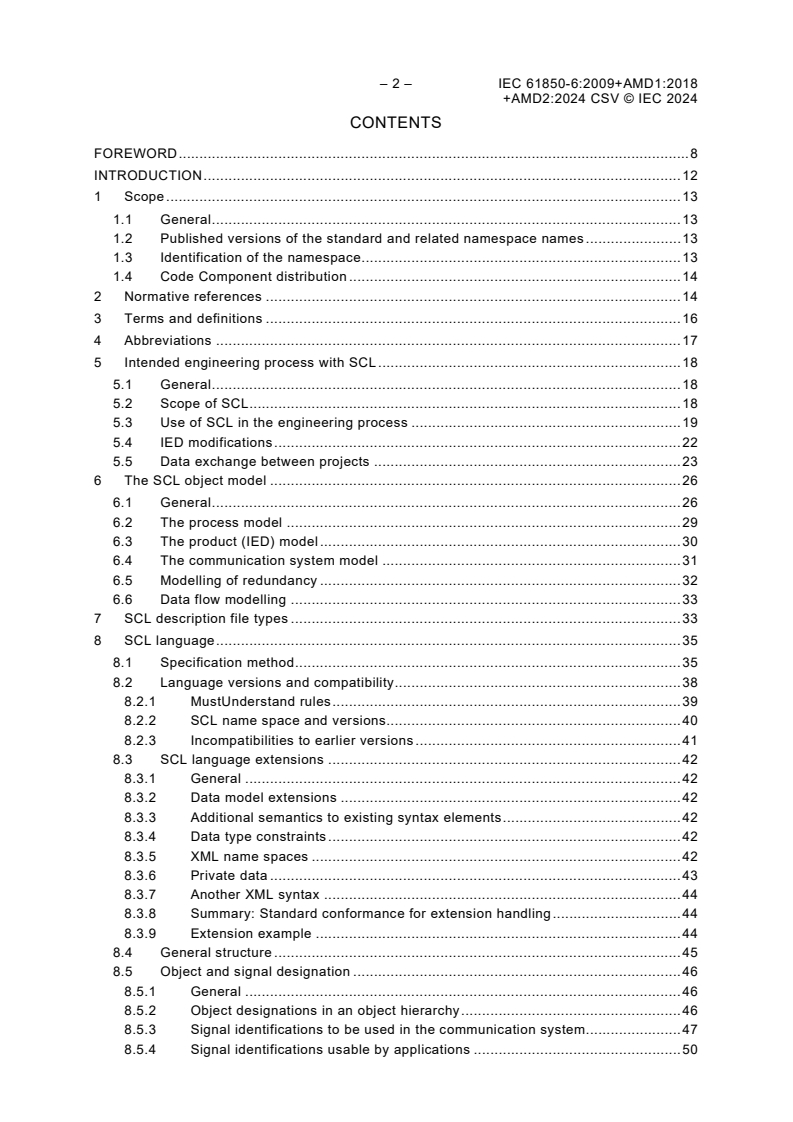
CONTENTS
FOREWORD . 8
INTRODUCTION . 12
1 Scope . 13
1.1 General . 13
1.2 Published versions of the standard and related namespace names . 13
1.3 Identification of the namespace . 13
1.4 Code Component distribution . 14
2 Normative references . 14
3 Terms and definitions . 16
4 Abbreviations . 17
5 Intended engineering process with SCL . 18
5.1 General . 18
5.2 Scope of SCL . 18
5.3 Use of SCL in the engineering process . 19
5.4 IED modifications . 22
5.5 Data exchange between projects . 23
6 The SCL object model . 26
6.1 General . 26
6.2 The process model . 29
6.3 The product (IED) model . 30
6.4 The communication system model . 31
6.5 Modelling of redundancy . 32
6.6 Data flow modelling . 33
7 SCL description file types . 33
8 SCL language . 35
8.1 Specification method . 35
8.2 Language versions and compatibility . 38
8.2.1 MustUnderstand rules . 39
8.2.2 SCL name space and versions. 40
8.2.3 Incompatibilities to earlier versions . 41
8.3 SCL language extensions . 42
8.3.1 General . 42
8.3.2 Data model extensions . 42
8.3.3 Additional semantics to existing syntax elements . 42
8.3.4 Data type constraints . 42
8.3.5 XML name spaces . 42
8.3.6 Private data . 43
8.3.7 Another XML syntax . 44
8.3.8 Summary: Standard conformance for extension handling . 44
8.3.9 Extension example . 44
8.4 General structure . 45
8.5 Object and signal designation . 46
8.5.1 General . 46
8.5.2 Object designations in an object hierarchy . 46
8.5.3 Signal identifications to be used in the communication system. 47
8.5.4 Signal identifications usable by applications . 50
+AMD2:2024 CSV © IEC 2024
8.5.5 Naming example . 50
8.5.6 Universal Unique Identifier . 51
9 The SCL syntax elements . 52
9.1 Header . 52
9.2 Process description . 58
9.2.1 General . 58
9.2.2 Voltage level . 65
9.2.3 Bay level . 67
9.2.4 Power equipment . 68
9.2.5 SubEquipment level . 78
9.2.6 Process function logical nodes . 79
9.2.7 Non power equipment . 81
9.2.8 Substation section example . 83
9.3 IED description . 86
9.3.1 General . 86
9.3.2 The IED, Services and Access Point . 90
9.3.3 The IED server . 107
9.3.4 The logical device . 109
9.3.5 LN0 and other Logical Nodes . 110
9.3.6 Data object (DOI) definition . 113
9.3.7 Data set definition . 118
9.3.8 Report control block . 120
9.3.9 Log control block . 126
9.3.10 GSE control block . 128
9.3.11 Sampled value control block . 131
9.3.12 Setting control block . 134
9.3.13 Binding to external signals . 135
9.3.15 Binding to external controls . 140
9.3.14 Associations . 141
9.4 Communication system description . 143
9.4.1 General . 143
9.4.2 Subnetwork definition . 144
9.4.3 Address definition . 146
9.4.4 GSE address definition . 147
9.4.5 SMV address definition . 149
9.4.6 Physical connection parameters . 149
9.4.7 Communication section example . 151
9.5 Data type templates . 152
9.5.1 General . 152
9.5.2 LNodeType definitions . 156
9.5.3 DO type definition . 158
9.5.4 Data attribute (DA) definition . 160
9.5.5 Data attribute structure type . 167
9.5.6 Enumeration types . 169
9.5.7 Data type template examples . 171
10 Tool and project engineering rights . 171
10.1 IED configurator . 171
10.2 System configurator . 172
10.3 Right transfer between projects . 172
– 4 – IEC 61850-6:2009+AMD1:2018
+AMD2:2024 CSV © IEC 2024
Annex A (normative) SCL syntax: XML schema definition . 175
Annex B (informative) SCL enumerations according to IEC 61850-7-3 and IEC 61850-7-4 . 176
Annex C (informative) Syntax extension examples – Extension syntax for drawing
layout coordinates. 177
Annex D (informative) Example . 180
D.1 Example specification . 180
D.1.1 General . 180
D.1.2 Substation configuration . 180
D.1.3 Communication system configuration . 181
D.1.4 Transformer IED . 181
D.2 Example SCL file contents . 182
Annex E (informative) SCL syntax: General XML schema definition . 183
E.1 General . 183
E.2 Base types . 183
E.3 Substation syntax . 214
E.4 Data type templates . 214
E.5 IED capabilities and structure . 214
E.6 Communication subnetworks. 240
E.7 Main SCL . 240
Annex F (informative) XML schema definition of SCL variants. 244
Annex G (normative) SCL Implementation Conformance Statement (SICS) . 255
Annex H (informative) ExtRef use cases . 261
Annex I (normative) SCL – mixed version projects . 267
I.1 General . 267
I.2 General mixed version projects involving different edition ICTs / SCTs –
General downgrading rules . 271
I.2.1 New SCL attributes of elements defined in edition SCL to downgrade. 271
I.2.2 New SCL elements introduced with edition SCL to downgrade . 271
I.3 Mixed version projects involving Ed1, Ed2 ICTs / SCTs . 272
I.3.1 Downgrading rules . 272
I.3.2 Upgrading rules . 279
I.4 Mixed version projects involving Ed2, Ed2.1 ICTs / SCTs. 282
I.4.1 General . 282
I.4.2 Downgrading rules . 285
I.4.3 Upgrading rules . 287
I.5 Mixed version projects involving Ed2.1, Ed2.2 ICTs / SCTs . 288
I.5.1 General . 288
I.5.2 Downgrading rules . 289
Bibliography . 291
Figure 1 – Reference model for information flow in the configuration process . 20
Figure 2 – IED type description to System Configurator . 21
Figure 3 – IED instance description to System Configurator . 22
Figure 4 – Modification process . 23
Figure 5 – Engineering right handling in projects . 25
Figure 6 – SCL substation object model . 27
Figure 7 – SA System Configuration example . 29
+AMD2:2024 CSV © IEC 2024
Figure 8 – ICD files describing implementable IED types of a general IED class . 35
Figure 9 – UML diagram overview of SCL schema . 37
Figure 10 – Elements of the signal identification as defined in IEC 61850-7-2 . 48
Figure 11 – Elements of the signal name using product naming . 48
Figure 12 – Possible elements of the signal name using functional naming . 49
Figure 13 – Names within different structures of the object model . 50
Figure 14 – UML diagram of Header section . 52
Figure 25 – SCL file references . 56
Figure 26 – IED file references . 56
Figure 15 – UML diagram of Substation section . 60
Figure 24 – UML diagram of Process and Line elements . 64
Figure 16 – UML diagrams for equipment type inheritance and relations . 69
Figure 17 – Substation section example . 83
Figure 18 – IED structure and access points . 87
Figure 19 – UML description of IED-related schema part – Base . 88
Figure 20 – UML description of IED-related schema part for Control blocks . 89
Figure 21 – UML description of IED-related schema part – LN definition . 90
Figure 22 – UML diagram overview of the Communication section . 143
Figure 23 – UML overview of DataTypeTemplate section . 153
Figure C.1 – Coordinate example . 177
Figure D.1 – T1-1 Substation configuration . 180
Figure D.2 – T1-1 Communication configuration. 181
Figure D.3 – T1-1 Transformer bay . 182
Figure I.1 – Edition 1-Edition 2 – Area of compatibility . 267
Figure I.2 – Edition 1-Edition 2 Mixed engineering with different SCL versions . 269
Figure I.3 – Edition 1-Edition 2 Mixed engineering with different SCL versions with one
SCT managing data flow restriction . 270
Figure I.4 – Edition 1-Edition 2 Mixed engineering with same SCL version – restricted
to (Ed1∩Ed2)UEd2 . 271
Figure I.5 – Workflow with SED 2007B4 import following mustUnderstand/mayIgnore
rules . 283
Figure I.6 – Workflow with ICT A imports SCD 2007B4 following the mustUnderstand
rules . 284
Figure I.7 – Workflow with SCT exports SCD 2007B following the downgrading rules . 285
Table 53 – Attributes of the IEC 61850-6 XML namespace . 14
Table 1 – The files composing the XML schema definition for SCL. 37
Table 2 – Attributes of the Private element . 44
Table 3 – Attributes of the Header element . 54
Table 53 – Attributes of the tSclFileUUIDReference element . 55
Table 4 – Attributes of the History item (Hitem) element . 58
Table 5 – Primary apparatus device type codes . 76
Table 6 – Attributes of the Terminal element . 78
Table 7 – Attributes of the SubEquipment element . 79
– 6 – IEC 61850-6:2009+AMD1:2018
+AMD2:2024 CSV © IEC 2024
Table 8 – Attributes of the LNode element . 80
Table 9 – General Equipment codes from IEC 61850-7-4 . 82
Table 10 – Attributes of the IED element . 92
Table 11 – List of service capabilities and setting elements and attributes . 96
Table 12 – Attributes of the Access point element . 103
Table 50 – Usage of Service element at IED level and Server / ServerAt level . 104
Table 13 – Attributes of the IED server element . 108
Table 14 – Attributes of the Authentication element . 108
Table 15 – Attributes of the LDevice element . 109
Table 16 – Attributes of the LN0 element . 111
Table 17 – Attributes of the LN element . 112
Table 18 – Attributes of the DOI element . 114
Table 19 – Attributes of the DAI element . 115
Table 20 – Attributes of the SDI element . 117
Table 21 – Attributes of the DataSet element . 118
Table 22 – Attributes of the FCDA element . 119
Table 23 – Attributes of the report control block element . 121
Table 24 – Attributes of the RptEnabled element . 123
Table 25 – Attributes of the ClientLN element . 125
Table 26 – Attributes of the log control block element . 127
Table 27 – Attributes of the GSE control block element . 129
Table 28 – Attributes of the IEDName element . 130
Table 29 – Attributes of the sampled value control block element . 132
Table 30 – Attributes of the Smv Options element . 133
Table 31 – Deprecated Smv options . 133
Table 32 – Attributes of the setting control block element . 134
Table 33 – Attributes of the Input/ExtRef element . 137
Table 51 – Usage of ExtRef attributes in different use cases . 139
Table 52 – Attributes of the Output/ExtCtrl element . 141
Table 34 – Attributes of the association element . 142
Table 35 – Attributes of the Subnetwork element . 145
Table 36 – Attributes of the ConnectedAP element . 146
Table 37 – Attributes of the GSE element . 148
Table 38 – Attributes of the SMV element . 149
Table 39 – PhysConn P-Type definitions . 150
Table 40 – Template definition elements . 156
Table 41 – Attributes of the LNodeType element . 157
Table 42 – Attributes of the DO element . 158
Table 43 – Attributes of the DOType element . 159
Table 44 – Attributes of the SDO element . 160
Table 45 – Data type mapping . 160
Table 46 – Attribute value kind (valKind) meaning. 162
Table 47 – Attributes of the DA element . 164
+AMD2:2024 CSV © IEC 2024
Table 48 – Attributes of the BDA element . 169
Table 49 – Attributes of the EnumType element . 170
Table 52 – Allowed SCT engineering actions . 174
Table G.1 – IED configurator conformance statement . 255
Table G.2 – System configurator conformance statement. 257
– 8 – IEC 61850-6:2009+AMD1:2018
+AMD2:2024 CSV © IEC 2024
INTERNATIONAL ELECTROTECHNICAL COMMISSION
____________
COMMUNICATION NETWORKS AND SYSTEMS
FOR POWER UTILITY AUTOMATION –
Part 6: Configuration description language for communication
in power utility automation systems related to IEDs
FOREWORD
1) The International Electrotechnical Commission (IEC) is a worldwide organization for standardization comprising
all national electrotechnical committees (IEC National Committees). The object of IEC is to promote international
co-operation on all questions concerning standardization in the electrical and electronic fields. To this end and
in addition to other activities, IEC publishes International Standards, Technical Specifications, Technical Reports,
Publicly Available Specifications (PAS) and Guides (hereafter referred to as "IEC Publication(s)"). Their
preparation is entrusted to technical committees; any IEC National Committee interested in the subject dealt with
may participate in this preparatory work. International, governmental and non-governmental organizations liaising
with the IEC also participate in this preparation. IEC collaborates closely with the International Organization for
Standardization (ISO) in accordance with conditions determined by agreement between the two organizations.
2) The formal decisions or agreements of IEC on technical matters express, as nearly as possible, an international
consensus of opinion on the relevant subjects since each technical committee has representation from all
interested IEC National Committees.
3) IEC Publications have the form of recommendations for international use and are accepted by IEC National
Committees in that sense. While all reasonable efforts are made to ensure that the technical content of IEC
Publications is accurate, IEC cannot be held responsible for the way in which they are used or for any
misinterpretation by any end user.
4) In order to promote international uniformity, IEC National Committees undertake to apply IEC Publications
transparently to the maximum extent possible in their national and regional publications. Any divergence between
any IEC Publication and the corresponding national or regional publication shall be clearly indicated in the latter.
5) IEC itself does not provide any attestation of conformity. Independent certification bodies provide conformity
assessment services and, in some areas, access to IEC marks of conformity. IEC is not responsible for any
services carried out by independent certification bodies.
6) All users should ensure that they have the latest edition of this publication.
7) No liability shall attach to IEC or its directors, employees, servants or agents including individual experts and
members of its technical committees and IEC National Committees for any personal injury, property damage or
other damage of any nature whatsoever, whether direct or indirect, or for costs (including legal fees) and
expenses arising out of the publication, use of, or reliance upon, this IEC Publication or any other IEC
Publications.
8) Attention is drawn to the Normative references cited in this publication. Use of the referenced publications is
indispensable for the correct application of this publication.
9) IEC draws attention to the possibility that the implementation of this document may involve the use of (a)
patent(s). [IEC/IEC and ISO] [takes/take] no position concerning the evidence, validity or applicability of any
claimed patent rights in respect thereof. As of the date of publication of this document, IEC had not received
notice of (a) patent(s), which may be required to implement this document. However, implementers are cautioned
that this may not represent the latest information, which may be obtained from the patent database available at
https://patents.iec.ch or www.iso.org/patents. IEC shall not be held responsible for identifying any or all such
patent rights.
This consolidated version of the official IEC Standard and its amendments has
been prepared for user convenience.
IEC 61850-6 edition 2.2 contains the second edition (2009-12) [documents 57/1025/FDIS
and 57/1041/RVD], its amendment 1 (2018-06) [documents 57/1918/FDIS and 57/1940/RVD]
and its amendment 2 (2024-11) [documents 57/2711/FDIS and 57/2733/RVD].
+AMD2:2024 CSV © IEC 2024
International Standard IEC 61850-6 has been prepared by IEC technical committee 57: Power
systems management and associated information exchange.
This second amendment constitutes a technical revision.
The main changes with respect to IEC 61850-6:2009+AMD1:2018 are as follows:
a) functional extensions concerning the engineering processto improve files exchange
followup, SCL elements identification and control configuration handling, added;
b) provision of clarifications and corrections. Issues that require clarification are published in
a database available at https://iec61850.tissue-db.com/. Arising incompatibilities are listed
in 8.2.3.
This publication has been drafted in accordance with the ISO/IEC Directives, Part 2.
A list of all the parts in the IEC 61850 series, under the general title Communication networks
and systems for power utility automation, can be found on the IEC website.
This IEC standard includes Code Components i.e. components that are intended to be directly
processed by a computer. Such content is any text found between the markers
BEGINS> and , or otherwise is clearly labelled in this standard as a Code
Component. In the current version of this document, such indication is made at the beginning
of Annex A which identifies the list of XSD files and refers to the code component definition in
Subclause 1.3.
The purchase of this IEC standard carries a copyright license for the purchaser to sell software
containing Code Components from this standard directly to end users and to end users via
distributors, subject to IEC software licensing conditions, which can be found at:
http://www.iec.ch/CCv1.
This consolidated edition brings two distinct sets of changes:
1) Resolved Interop Issues (covered by the table below) which have already followed the
technical issues ( Tissues) process as described in IEC 61850-1 and have reached the
green "status".
2) Resolved Editorial Tissues which may have led to interoperability issues.
The resolutions of these issues which lead to these changes are described in greater detail in
the Tissue database hosted at https://iec61850.tissue-db.com/.
The only new features compared to the previous IEC 61850-6:2009+AMD1:2018 are the
introduction of the UUID to identify elements and files, the modelling of controls binding from a
client perspective, and the definition of translated labels for elements which may be represented
in any user interface. Apart from this, this consolidated edition strictly respects the scope of the
original edition.
– 10 – IEC 61850-6:2009+AMD1:2018
+AMD2:2024 CSV © IEC 2024
Technical issues summary
N°, Subject, Clause and Paragraph are as they appear on the Tissue database hosted at
https://iec61850.tissue-db.com/ where all technical issues have been stored from the origin of
IEC 61850.
"Subject" defines very briefly the topic under focus.
The Tissues which have been considered are:
N° Subject Clause Paragraph
1590 RCB: Offline changes increment ConfRev by 9.3.8 Table 23
10000?
1647 SDO@count definition inconsistent 9.5.3 Table 44
1648 DA@count definition needs restriction 9.5.4.1 Table 47
1669 Incorrect example of header 9.1 1
1672 Allow connection Server and ServerAt to the same 9.3.2 Below Table 50
SCL.Subnetwork
1674 Harmonization with 62351-6 9.3.2 Services Element
1675 SCSM support capability - Harmonization with 9.3.2 Services
62351-6
1683 ICD file for IED functionality spanning for multiple 9.2.1 The name value is also a
VL and BAY global identification of
1708 Presence of Sample Mode field not controllable 9.3.11 Smv Options element
through SmvOpts
1729 Incorrect SCL example in (informative) Annex D.2 2
1734 Improved schema validation A.5 1
1740 Exceptions of enumeration types for IEC 61850-7-4 9.5.6 last in 9.5.6
1745 Definition of type and id in DataTypeTemplates not 9.5.6 Table 49
consistent
1768 Server associate-request has no SCL parameters 9.3.2 Table 11
1771 SCL Services ReportControl max vs. Indexed 9.3.8 8
1774 Missing description of KDC 9.3.2 4
1786 Downgrade of SCD Exports not Mandatory Annex G Table G.2
1787 There is no clear mapping of all 7-2 ACSI type to 9.5.4.2 1
SCL basic types
1808 Please clarify if ix first index is 0 or 1 9.3.6 Data object Table 19 and Table 20
(DOI) definition
1813 Typo "Valkind" 9.5.4.1 Table 46
1816 Add SICS statement for xsi:type usage in P 9.4.3 7
elements
Annex G Table G.1 and G.2
1818 Clarification of ExtRef attributes usage 9.3.13 Table 51
Clarify iedType attribute usage in
1823 9.5.1 2
DataTypeTemplates
1831 ldInst reference should concretized 9.3.7 Table 22
1832 SICS I45 not clear enough Annex G Table G.1
1833 Service SettingGroups.ConfSG clarification 9.3.2 Table 11
1834 SICS I211 text not inline with Service section Annex G Table G.1
1839 Not clear definition of lnInst to LN0 type elements 9.3.5 5
1843 SCT handle different OriginalSclXxx and SCL 9.3.2 G.1
version/revision/release
I.4.3.3
1854 SupSubscription 9.3.2 Table 11
1885 sAddr length I.5.3.5 1
1886 Part 6 - Typo in Abbreviation 4 ICT
+AMD2:2024 CSV © IEC 2024
The committee has decided that the contents of this document will remain unchanged until the
stability date indicated on the IEC website under webstore.iec.ch in the data related to the
specific document. At this date, the document will be
• reconfirmed,
• withdrawn, or
• revised.
IMPORTANT – The "colour inside" logo on the cover page of this document indicates
that it contains colours which are considered to be useful for the correct understanding
of its contents. Users should therefore print this document using a colour printer.
– 12 – IEC 61850-6:2009+AMD1:2018
+AMD2:2024 CSV © IEC 2024
INTRODUCTION
This part of IEC 61850 specifies a description language for the configuration of power utility
IEDs. This language is called System Configuration description Language (SCL). It is used to
describe IED configurations and communication systems according to IEC 61850-5 and
IEC 61850-7-x. It allows the formal description of the relations between the utility automation
system and the process (substation, switch yard). At the application level, the switch yard
topology itself and the relation of the switch yard structure to the SAS functions (logical nodes)
configured on the IEDs can be described.
While this part describes the language to describe the configuration of IEC 61850 systems,
other parts of the standard describe how to configure the system and possible restrictions.
Therefore implementations claiming conformance to this standard shall take into account
constraints from the other normative references. Some references to the other parts have been
included for the purpose of clarification but these references are not all inclusive.
NOTE The process description, which is in this standard restricted to switch yards and general process functions,
will be enhanced by appropriate add-ons for wind mills, hydro plants and distributed energy resources (DER).
SCL allows the description of an IED configuration to be passed to a communication and
application system engineering tool, and to pass back the whole system configuration
description to the IED configuration tool in a compatible way. Its main purpose is to allow the
interoperable exchange of communication system configuration data between an IED
configuration tool and a system configuration tool from different manufacturers.
IEC 61850-8-x and IEC 61850-9-x, which concern the mapping of IEC 61850-7-x to specific
communication stacks, may extend these definitions according to their need with additional
parts, or simply by restrictions on the way the values of objects have to be used.
+AMD2:2024 CSV © IEC 2024
COMMUNICATION NETWORKS AND SYSTEMS
FOR POWER UTILITY AUTOMATION –
Part 6: Configuration description language for communication
in power utility automation systems related to IEDs
1 Scope
1.1 General
This part of IEC 61850 specifies a file format for describing communication-related IED
(Intelligent Electronic Device) configurations and IED parameters, communication system
configurations, switch yard (function) structures, and the relations between them. The main
purpose of this format is to exchange IED capability descriptions, and SA system descriptions
between IED engineering tools and the system engineering tool(s) of different manufacturers in
a compatible way.
The defined language is called System Configuration description Language (SCL). The IED and
communication system model in SCL is according to IEC 61850-5 and IEC 61850-7-x. SCSM
specific extensions or usage rules may be required in the appropriate parts.
The configuration language is based on the Extensible Markup Language (XML) version 1.0
(see XML references in Clause 2).
This standard does not specify individual implementations o
...
IEC 61850-6 ®
Edition 2.0 2009-12
INTERNATIONAL
STANDARD
colour
inside
Communication networks and systems for power utility automation –
Part 6: Configuration description language for communication in electrical
substations related to IEDs
All rights reserved. Unless otherwise specified, no part of this publication may be reproduced or utilized in any form
or by any means, electronic or mechanical, including photocopying and microfilm, without permission in writing from
either IEC or IEC's member National Committee in the country of the requester.
If you have any questions about IEC copyright or have an enquiry about obtaining additional rights to this publication,
please contact the address below or your local IEC member National Committee for further information.
IEC Central Office
3, rue de Varembé
CH-1211 Geneva 20
Switzerland
Email: inmail@iec.ch
Web: www.iec.ch
About the IEC
The International Electrotechnical Commission (IEC) is the leading global organization that prepares and publishes
International Standards for all electrical, electronic and related technologies.
About IEC publications
The technical content of IEC publications is kept under constant review by the IEC. Please make sure that you have the
latest edition, a corrigenda or an amendment might have been published.
ƒ Catalogue of IEC publications: www.iec.ch/searchpub
The IEC on-line Catalogue enables you to search by a variety of criteria (reference number, text, technical committee,…).
It also gives information on projects, withdrawn and replaced publications.
ƒ IEC Just Published: www.iec.ch/online_news/justpub
Stay up to date on all new IEC publications. Just Published details twice a month all new publications released. Available
on-line and also by email.
ƒ Electropedia: www.electropedia.org
The world's leading online dictionary of electronic and electrical terms containing more than 20 000 terms and definitions
in English and French, with equivalent terms in additional languages. Also known as the International Electrotechnical
Vocabulary online.
ƒ Customer Service Centre: www.iec.ch/webstore/custserv
If you wish to give us your feedback on this publication or need further assistance, please visit the Customer Service
Centre FAQ or contact us:
Email: csc@iec.ch
Tel.: +41 22 919 02 11
Fax: +41 22 919 03 00
IEC 61850-6 ®
Edition 2.0 2009-12
INTERNATIONAL
STANDARD
colour
inside
Communication networks and systems for power utility automation –
Part 6: Configuration description language for communication in electrical
substations related to IEDs
INTERNATIONAL
ELECTROTECHNICAL
COMMISSION
PRICE CODE
XH
ICS 33.200 ISBN 978-2-88910-576-2
– 2 – 61850-6 © IEC:2009(E)
CONTENTS
FOREWORD.5
INTRODUCTION.7
1 Scope.8
2 Normative references.8
3 Terms and definitions .9
4 Abbreviations.10
5 Intended engineering process with SCL.11
5.1 General .11
5.2 Scope of SCL .11
5.3 Use of SCL in the Engineering process .12
5.4 IED modifications .15
5.5 Data exchange between projects .16
6 The SCL object model .18
6.1 General .18
6.2 The substation model .22
6.3 The product (IED) model.23
6.4 The communication system model .24
6.5 Modelling of redundancy .25
6.6 Data flow modelling .25
7 SCL description file types.26
8 SCL language.28
8.1 Specification method .28
8.2 Language versions and compatibility.30
8.3 SCL language extensions .33
8.4 General structure.36
8.5 Object and signal designation .37
9 The SCL syntax elements .41
9.1 Header .41
9.2 Substation description .43
9.3 IED description .56
9.4 Communication system description .87
9.5 Data type templates.94
10 Tool and project engineering rights .106
10.1 IED configurator .106
10.2 System configurator. 107
10.3 Right transfer between projects. 107
Annex A (normative) SCL syntax: XML schema definition . 109
Annex B (informative) SCL enumerations according to IEC 61850-7-3 and IEC 61850-7-4 . 147
Annex C (informative) Syntax extension examples. 153
Annex D (informative) Example . 166
Annex E (informative) SCL syntax: General XML schema definition . 180
Annex F (informative) XML schema definition of SCL variants . 204
Annex G (normative) SCL Implementation Conformance Statement (SICS). 210
Bibliography . 215
61850-6 © IEC:2009(E) – 3 –
Figure 1 – Reference model for information flow in the configuration process.13
Figure 2 – IED type description to System Configurator .14
Figure 3 – IED instance description to System Configurator .15
Figure 4 – Modification process.16
Figure 5 – Engineering right handling in projects.18
Figure 6 – SCL object model .20
Figure 7 – SA System Configuration example .22
Figure 8 – ICD files describing implementable IED types of a general IED class.28
Figure 9 – UML diagram overview of SCL schema .30
Figure 10 – Elements of the signal identification as defined in IEC 61850-7-2 .38
Figure 11 – Elements of the signal name using product naming .38
Figure 12 – Possible elements of the signal name using functional naming .39
Figure 13 – Names within different structures of the object model.40
Figure 14 – UML diagram of Header section .41
Figure 15 – UML diagram of Substation section.44
Figure 16 – UML diagram for equipment type inheritance and relations .48
Figure 17 – Substation section example .55
Figure 18 – IED structure and access points.57
Figure 19 – UML description of IED-related schema part – Base.58
Figure 20 – UML description of IED-related schema part for Control blocks .59
Figure 21 – UML description of IED-related schema part – LN definition .60
Figure 22 – UML diagram overview of the Communication section .88
Figure 23 – UML overview of DataTypeTemplate section .95
Figure C.1 – Coordinate example . 153
Figure C.2 – Schema overview . 156
Figure D.1 – T1-1 Substation configuration. 166
Figure D.2 – T1-1 Communication configuration . 167
Figure D.3 – T1-1 Transformer bay. 168
Table 1 – The files composing the XML schema definition for SCL.29
Table 2 – Attributes of the Private element .35
Table 3 – Attributes of the Header element.42
Table 4 – Attributes of the History item (Hitem) element .43
Table 5 – Primary apparatus device type codes .50
Table 6 – Attributes of the Terminal element.51
Table 7 – Attributes of the SubEquipment element.52
Table 8 – Attributes of the LNode element .53
Table 9 – General Equipment codes from IEC 61850-7-4.54
Table 10 – Attributes of the IED element .61
Table 11 – List of service capabilities and setting elements and attributes .63
Table 12 – Attributes of the Access point element.66
Table 13 – Attributes of the IED server element.68
Table 14 – Attributes of the Authentication element .69
– 4 – 61850-6 © IEC:2009(E)
Table 15 – Attributes of the LDevice element.69
Table 16 – Attributes of the LN0 element.70
Table 17 – Attributes of the LN element.71
Table 18 – Attributes of the DOI element .72
Table 19 – Attributes of the DAI element .73
Table 20 – Attributes of the SDI element .73
Table 21 – Attributes of the DataSet element.74
Table 22 – Attributes of the FCDA element.75
Table 23 – Attributes of the report control block element.76
Table 24 – Attributes of the RptEnabled element .77
Table 25 – Attributes of the ClientLN element .78
Table 26 – Attributes of the log control block element .80
Table 27 – Attributes of the GSE control block element.81
Table 28 – Attributes of the IEDName element .81
Table 29 – Attributes of the sampled value control block element.83
Table 30 – Attributes of the Smv Options element .83
Table 31 – Deprecated Smv options .84
Table 32 – Attributes of the setting control block element .84
Table 33 – Attributes of the Input/ExtRef element .86
Table 34 – Attributes of the association element.87
Table 35 – Attributes of the Subnetwork element .89
Table 36 – Attributes of the ConnectedAP element .90
Table 37 – Attributes of the GSE element .91
Table 38 – Attributes of the SMV element.92
Table 39 – PhysConn P-Type definitions .93
Table 40 – Template definition elements .97
Table 41 – Attributes of the LNodeType element.97
Table 42 – Attributes of the DO element .98
Table 43 – Attributes of the DOType element.98
Table 44 – Attributes of the SDO element.99
Table 45 – Data type mapping.99
Table 46 – Attribute value kind (Valkind) meaning . 100
Table 47 – Attributes of the DA element . 101
Table 48 – Attributes of the BDA element . 104
Table 49 – Attributes of the EnumType element. 105
Table G.1 – IED configurator conformance statement . 210
Table G.2 – System configurator conformance statement . 212
61850-6 © IEC:2009(E) – 5 –
INTERNATIONAL ELECTROTECHNICAL COMMISSION
____________
COMMUNICATION NETWORKS AND SYSTEMS
FOR POWER UTILITY AUTOMATION –
Part 6: Configuration description language for communication
in electrical substations related to IEDs
FOREWORD
1) The International Electrotechnical Commission (IEC) is a worldwide organization for standardization comprising
all national electrotechnical committees (IEC National Committees). The object of IEC is to promote
international co-operation on all questions concerning standardization in the electrical and electronic fields. To
this end and in addition to other activities, IEC publishes International Standards, Technical Specifications,
Technical Reports, Publicly Available Specifications (PAS) and Guides (hereafter referred to as “IEC
Publication(s)”). Their preparation is entrusted to technical committees; any IEC National Committee interested
in the subject dealt with may participate in this preparatory work. International, governmental and non-
governmental organizations liaising with the IEC also participate in this preparation. IEC collaborates closely
with the International Organization for Standardization (ISO) in accordance with conditions determined by
agreement between the two organizations.
2) The formal decisions or agreements of IEC on technical matters express, as nearly as possible, an international
consensus of opinion on the relevant subjects since each technical committee has representation from all
interested IEC National Committees.
3) IEC Publications have the form of recommendations for international use and are accepted by IEC National
Committees in that sense. While all reasonable efforts are made to ensure that the technical content of IEC
Publications is accurate, IEC cannot be held responsible for the way in which they are used or for any
misinterpretation by any end user.
4) In order to promote international uniformity, IEC National Committees undertake to apply IEC Publications
transparently to the maximum extent possible in their national and regional publications. Any divergence
between any IEC Publication and the corresponding national or regional publication shall be clearly indicated in
the latter.
5) IEC itself does not provide any attestation of conformity. Independent certification bodies provide conformity
assessment services and, in some areas, access to IEC marks of conformity. IEC is not responsible for any
services carried out by independent certification bodies.
6) All users should ensure that they have the latest edition of this publication.
7) No liability shall attach to IEC or its directors, employees, servants or agents including individual experts and
members of its technical committees and IEC National Committees for any personal injury, property damage or
other damage of any nature whatsoever, whether direct or indirect, or for costs (including legal fees) and
expenses arising out of the publication, use of, or reliance upon, this IEC Publication or any other IEC
Publications.
8) Attention is drawn to the Normative references cited in this publication. Use of the referenced publications is
indispensable for the correct application of this publication.
9) Attention is drawn to the possibility that some of the elements of this IEC Publication may be the subject of
patent rights. IEC shall not be held responsible for identifying any or all such patent rights.
International Standard IEC 61850-6 has been prepared by IEC technical committee 57: Power
systems management and associated information exchange.
This second edition cancels and replaces the first edition, published in 2004, and constitutes a
technical revision.
The main changes with respect to the previous edition are as follows:
• functional extensions added based on changes in other Parts, especially Parts 7-2 and 7-3;
• functional extensions concerning the engineering process, especially for configuration data
exchange between system configuration tools, added;
• provision of clarifications and corrections. Issues that require clarification are published in a
database available at www.tissue.iec61850.com. Arising incompatibilities are listed in 8.2.3.
– 6 – 61850-6 © IEC:2009(E)
The text of this standard is based on the following documents:
FDIS Report on voting
57/1025/FDIS 57/1041/RVD
Full information on the voting for the approval of this standard can be found in the report on
voting indicated in the above table.
This publication has been drafted in accordance with the ISO/IEC Directives, Part 2.
A list of all the parts in the IEC 61850 series, under the general title Communication networks
1)
and systems for power utility automation, can be found on the IEC website.
This publication contains attached .xml and .xsd files. These files are intended to be used as a
complement and do not form an integral part of this standard.
The committee has decided that the contents of this publication will remain unchanged until the
maintenance result date indicated on the IEC web site under "http://webstore.iec.ch" in the data
related to the specific publication. At this date, the publication will be
• reconfirmed,
• withdrawn,
• replaced by a revised edition, or
• amended.
A bilingual version of this standard may be issued at a later date.
IMPORTANT – The 'colour inside' logo on the cover page of this publication indicates that it
contains colours which are considered to be useful for the correct understanding of its
contents. Users should therefore print this document using a colour printer.
———————
1)
It has been decided to amend the general title of the IEC 61850 series from Communication networks and
systems in substations to Communication networks and systems for power utility automation. Henceforth, new
editions within the IEC 61850 series will adopt this new general title.
61850-6 © IEC:2009(E) – 7 –
INTRODUCTION
This part of IEC 61850 specifies a description language for the configuration of electrical
substation IEDs. This language is called System Configuration description Language (SCL). It
is used to describe IED configurations and communication systems according to IEC 61850-5
and IEC 61850-7-x. It allows the formal description of the relations between the utility
automation system and the process (substation, switch yard). At the application level, the
switch yard topology itself and the relation of the switch yard structure to the SAS functions
(logical nodes) configured on the IEDs can be described.
NOTE The process description, which is in this standard restricted to switch yards and general process functions,
will be enhanced by appropriate add-ons for wind mills, hydro plants and distributed energy resources (DER).
SCL allows the description of an IED configuration to be passed to a communication and
application system engineering tool, and to pass back the whole system configuration
description to the IED configuration tool in a compatible way. Its main purpose is to allow the
interoperable exchange of communication system configuration data between an IED
configuration tool and a system configuration tool from different manufacturers.
IEC 61850-8-1 and IEC 61850-9-2, which concern the mapping of IEC 61850-7-x to specific
communication stacks, may extend these definitions according to their need with additional
parts, or simply by restrictions on the way the values of objects have to be used.
– 8 – 61850-6 © IEC:2009(E)
COMMUNICATION NETWORKS AND SYSTEMS
FOR POWER UTILITY AUTOMATION –
Part 6: Configuration description language for communication
in electrical substations related to IEDs
1 Scope
This part of IEC 61850 specifies a file format for describing communication-related IED
(Intelligent Electronic Device) configurations and IED parameters, communication system
configurations, switch yard (function) structures, and the relations between them. The main
purpose of this format is to exchange IED capability descriptions, and SA system descriptions
between IED engineering tools and the system engineering tool(s) of different manufacturers in
a compatible way.
The defined language is called System Configuration description Language (SCL). The IED and
communication system model in SCL is according to IEC 61850-5 and IEC 61850-7-x. SCSM
specific extensions or usage rules may be required in the appropriate parts.
The configuration language is based on the Extensible Markup Language (XML) version 1.0
(see XML references in Clause 2).
This standard does not specify individual implementations or products using the language, nor
does it constrain the implementation of entities and interfaces within a computer system. This
part of the standard does not specify the download format of configuration data to an IED,
although it could be used for part of the configuration data.
2 Normative references
The following referenced documents are indispensable for the application of this document. For
dated references, only the edition cited applies. For undated references, the latest edition of
the referenced document (including any amendments) applies.
IEC 61850-2, Communication networks and systems in substations – Part 2: Glossary
IEC 61850-5, Communication networks and systems in substations – Part 5: Communication
requirements for functions and device models
IEC 61850-7-1, Communication networks and systems in substations – Part 7-1: Basic
communication structure for substation and feeder equipment – Principles and models
IEC 61850-7-2, Communication networks and systems in substations – Part 7-2: Basic
communication structure for substation and feeder equipment – Abstract communication
service interface (ACSI)
IEC 61850-7-3, Communication networks and systems in substations – Part 7-3: Basic
communication structure for substation and feeder equipment – Common data classes
IEC 61850-7-4, Communication networks and systems in substations – Part 7-4: Basic
communication structure for substation and feeder equipment – Compatible logical node
classes and data classes
IEC 61850-8-1, Communication networks and systems in substations – Part 8-1: Specific
Communication Service Mapping (SCSM) – Mappings to MMS (ISO 9506-1 and ISO 9506-2)
and to ISO/IEC 8802-3
61850-6 © IEC:2009(E) – 9 –
IEC 61850-9-2, Communication networks and systems in substations – Part 9-2: Specific
Communication Service Mapping (SCSM) – Sampled values over ISO/IEC 8802-3
IEC 81346-1, Industrial systems, installations and equipment and industrial products –
Structuring principles and reference designations – Part 1: Basic rules
ISO/IEC 8859-1, Information technology – 8-bit single-byte coded graphic character sets –
Part 1: Latin alphabet No. 1
RFC 1952, GZIP file format specification version 4.3, RFC, available at
RFC 2045, Multipurpose Internet Mail Extensions (MIME) Part One: Format of Internet
Message Bodies, RFC, available at
Extensible Markup Language (XML) 1.0, W3C, available at
xml-20001006>
XML Schema Part 1: Structures, W3C, available at <3http://www.w3.org/TR/2001/REC-
xmlschema-1-20010502>
XML Schema Part 2: Datatypes, W3C, available at <4Hhttp://www.w3.org/TR/2001/REC-
xmlschema-2-20010502/>
3 Terms and definitions
For the purposes of this document, the terms and definitions given in IEC 61850-2 apply.
Additionally the following terms are used in the context of language name spaces. Only general
meanings are given here. More details about the handling in the context of SCL can be found
later in this standard.
3.1
extensible
a language is extensible if instances of the language can include terms from other vocabularies
NOTE This is fulfilled in SCL if the other vocabularies come with their own XML name space.
3.2
language
an identifiable set of vocabulary terms that has defined constraints
NOTE This is the case with SCL, although some constraints are not definable in the XML schema.
3.3
instance
a realization by usage of a language
NOTE For example, an XML document in SCL describing an IED or a substation is an SCL instance.
3.4
sender
a tool that creates or produces an instance for processing by another application (receiver)
NOTE SCL senders are typically IED and system configuration tools; e.g. the IED tool sends (produces) ICD files,
the system tool sends SCD files.
3.5
Receiver
a tool that consumes an instance which it obtained from a sender
– 10 – 61850-6 © IEC:2009(E)
NOTE SCL receivers are IED tools and system configuration tools; e.g. the IED tool receives SCD files, the
system tool ICD, IID, SSD and SED files.
3.6
processor
a component which receives SCL instances and produces new instances, i.e. is sender and
receiver
NOTE This is typically the system configuration tool.
3.7
project
a system part with engineering responsibility for all contained IEDs
NOTE Mostly a system is a project. However, sometimes the IED engineering responsibility of different parts of a
system belong to different parties or people. Each IED responsibility area is then a separate project. An IED can
belong only to one project. It is ‘owned’ by this project.
3.8
backwards compatible
a language change is backwards compatible, if newer receivers can process all instances of
the old language
NOTE For SCL this means that tools built for newer language versions can understand instances from older
versions. Especially system tools should understand old ICD and SSD files, while IED tools should understand old
SCD files to be backward compatible.
3.9
forward compatible
a language change is forward compatible if older receivers can process all instances of the
newer language
NOTE For SCL this means that tools built according to older SCL versions can also process instances of newer
SCL versions. Especially old system tools should handle new ICD and SSD files, while old IED tools should handle
new SCD files to be forward compatible.
3.10
language version
the version of the XML schema defining the language
NOTE A language instance is produced according to a language (schema) version, which is called its assigned
version, although it may also be valid against other language versions.
4 Abbreviations
In general, the glossary and abbreviations defined in IEC 61850-2 apply. The following
abbreviations are either exclusive to this standard, or particularly useful for understanding this
standard and are repeated here for convenience.
BDA Basic DATA Attribute ( i.e. not structured)
CIM Common Information Model for energy management applications
DAI Instantiated Data Attribute
DO DATA in IEC 61850-7-2, data object type or instance, depending on the context
DOI Instantiated Data Object (DATA)
ID Identifier
IED Intelligent Electronic Device
ldInst Instance identification of a Logical Device as part of its name
lnInst Instance number of a Logical Node as part of its name
MSV Multicast Sampled Value
61850-6 © IEC:2009(E) – 11 –
MsvID ID for MSV (Multicast Sampled Value)
RCB Report Control Block
SCL System Configuration description Language
SDI Instantiated Sub-DATA; middle name part of a structured DATA name
SDO Sub-DATA within a DOType, referencing another DOType
SED System Exchange Description
UML Unified Modelling Language according to http://www.omg.org/uml
URI Universal Resource Identifier
UsvID ID for USV (Unicast Sampled Value)
XML Extensible Markup Language
5 Intended engineering process with SCL
5.1 General
Engineering of a substation automation system may start either with the allocation of
functionally pre-configured devices to switch yard parts, products or functions, or with the
design of the process functionality, where functions are allocated to physical devices later,
based on functional capabilities of devices and their configuration capabilities. Often a mixed
approach is preferred: a typical process part such as a line bay is pre-engineered, and then the
result is used within the process functionality as often as needed. For SCL, this means that it
must be capable of describing:
a) a system specification in terms of the single line diagram, and allocation of logical nodes
(LN) to parts and equipment of the single line to indicate the needed functionality;
b) pre-configured IEDs with a fixed number of logical nodes (LNs), but with no binding to a
specific process – may only be related to a very general process function part;
c) pre-configured IEDs with a pre-configured semantic for a process part of a certain
structure, for example a double busbar GIS line feeder, or for a part of an already
configured process or automation system;
d) complete process configuration with all IEDs bound to individual process functions and
primary equipment, enhanced by the access point connections and possible access paths in
for all possible clients;
subnetworks
e) as item 136H d) above, but additionally with all predefined associations and client server
connections between logical nodes on data level. This is needed if an IED is not capable of
dynamically building associations or reporting connections (either on the client or on the
server side).
Case 137H e) is the complete case. Both cases 138H d) and 139H e) are the result after SAS engineering, while
case 140H a) is a functional specification input to SAS engineering, and 141H b) and 142H c) are possible
results after IED pre-engineering either for a typical usage of the IED, or for a specific usage
within a project.
5.2 Scope of SCL
The scope of SCL as defined in this standard is clearly focussed on these purposes:
1) SAS functional specification (point 5.1 143H a) above) ,
2) IED capability description (points 5.1 144H b) and 5.1 145H c) above), and
3) SA system description (points 5.1 146H d) and 5.1 147H e) above) .
These purposes shall provide standardized support to system design, communication
engineering and to the description of readily engineered system communication for device
engineering tools.
– 12 – 61850-6 © IEC:2009(E)
For practical purposes, the following is also supported:
4) exchange of system interfacing information between two projects handling two systems,
which need to exchange data;
5) exchange of IED modifications on an IED instance engineered specifically for a project
back from the IED tool to the system tool.
This is reached by defining an object model describing the IEDs, their communication
connections, and their allocation to the switch yard, as well as a standardized way to describe
how this model shall be represented in a file to be exchanged between engineering tools. The
resulting object model could also be the base for other engineering tasks, possibly with some
additions. Therefore, and because of the additional needs of SCSMs, this standard considers
the language as defined here as the core model, and defines how extensions of this core
model for SCSMs as well as other (engineering) purposes can be carried out in a standardized
and compatible way.
5.3 Use of SCL in the Engineering process
Figure 1 explains the usage of SCL data exchange in the above-mentioned engineering
process. The text boxes above the dashed line indicate where SCL files are used. The text box
IED capabilities corresponds to a result of steps 5.1 148H b) and 5.1 149H c) above, the text box System
specification corresponds to step 5.1 a) above, the text box Associations… refers to steps
5.1 150H d) or 5.1 151H e) above.
To make the engineering tasks and responsibilities clear, tool roles are introduced for an IED
configurator and a system configurator. A ‘real’ tool can play both roles. In this case the
transfer of partly engineered data within the tool is private, but to any other (mostly to an IED
tool) it has to be seen from the role the tool has played when modifying the project data, i.e if
the modification was done in the scope of an IED tool, or in the scope of a system tool.
The IED Configurator is a manufacturer-specific, may be even IED specific, tool that shall be
able to import or export the files defined by this part of IEC 61850. The tool then provides IED-
specific settings and generates IED-specific configuration files, or it loads the IED configuration
into the IED.
An IED shall only be considered compatible in the sense of the IEC 61850 series, if:
• it is accompanied either by an (ICD) SCL file describing its capabilities, or by an (IID) SCL
file describing its project specific configuration and capabilities, or by a tool, which can
generate one or both, of these file types from or for the IED (not shown in Figure 1);
• it can directly use a system SCL (SCD) file to set its communication configuration, as far as
setting is possible in this IED (i.e. as a minimum, its needed communication addresses), or
it is accompanied by a tool which can import a system SCL file to set these parameters to
the IED.
The System Configurator is an IED independent system level tool that shall be able to import
or export configuration files defined by this part of IEC 61850. It shall be able to import
configuration files from several IEDs, as needed for system level engineering, and used by the
configuration engineer to add system information shared by different IEDs. Then the system
configurator shall generate a substation-related configuration file as defined by this part of
IEC 61850, which is fed back to the IED Configurator for system-related IED configuration. The
System Configurator should also be able to read a System specification file for example as a
base for starting system engineering, or to compare it with an engineered system for the same
substation.
61850-6 © IEC:2009(E) – 13 –
System specification
.SSD
(Single line, LNs, …)
IED Capabilities
IED
(LN, DO, … )
.SED
SySyststemem
SySyststemem
DB
ConfConfiigguurratatoorr
.ICD
ConfConfiigguurratatoorr
System Exchange
Associations,
.IID Instantiated IED
.SCD
relation to single line,
.SCD
preconfigured reports, .
Other IEC 61850 project
IED
with interfaces between
Configurator
projects
Engineering
EngEngiineerneering ing
environment WWoorkplace rkplace
File transfer
.CID remote
File transfer and
File transfer
Parametrization with
Substation
Local
SA system
IEC 61850 services
gateway
IED IED IED
Figure 1 – Reference model for information flow in the configuration process
The part of Figure 1 below the dashed line indicates the ways in which IED configuration data
produced by means of the IED configurator can be brought into the IED. This can be effected
by:
• local communication from an engineering workstation connected locally to the IED. This
data transfer is beyond the scope of this standard.
• remote file transfer, for example by the file transfer method of IEC 61850-7-2. The file
format is not defined within this standard, but SCL format is a possible choice at least of a
part of the configuration data.
• access services to parameter and configuration data defined according to IEC 61850-7-2.
In this case, the standardized methods according to IEC 61850-7-x shall be used.
NOTE It is not in the scope of this standard to define any details of concrete software tools, which support an
engineer in doing the intended engineering process with SCL as described above. Both the system configurator as
well as the IED configurator introduced above are conceptual tools, respectively tool roles to illustrate the use of
different SCL file variants in the engineering process. Each manufacturer is completely free to find the best way to
support engineers by a specific software tool. In addition, complete freedom of choice is given in the way in which
software tools for the above described engineering process with SCL will store manufacturer-specific internal
parameters for IEDs and SA system aspects not covered by the scope of IEC 61850 (e.g. the relation of logical data
to pins on a physical board), and how they relate them to the IEC 61850 data model.
The data exchange between engineering tools during the engineering process can then be as
follows (see Figure 2):
– 14 – 61850-6 © IEC:2009(E)
Figure 2 – IED type description to System Configurator
At start of system engineering the IED capability (ICD) files are used by the system
configurator as IED template (type) description to instantiate project specific IEDs as needed.
As 152HFigure 2 shows, this ICD file can be generated in advance as typical configuration of an IED
by means of the IED configurator tool, as typically done for very flexibly configurable IEDs.
Alternatively the system configurator can also import the description of an IED specifically
preconfigured with name and addresses for a concrete function in the process by importing an
Instantiated IED Description (IID) file, as indicated in 153HFigure 3.
The SCD file generated by the system configurator tool is then imported by the IED
configurator for the final IED instance configuration, as shown in 154HFigure 2 and 155HFigure 3. Any
add-ons or adapted values could then be exported by means of the IID file, and thus brought
back to the system configurator respective the next revision of the SCD file – see next
subclause on IED modifications.
g o d
Mer e r ad
61850-6 © IEC:2009(E) – 15 –
Figure 3 – IED instance description to System Configurator
5.4 IED modifications
During the engineering process it may happen that the IED-related data has to be changed.
This can in principle be done by removing the IED from the system, and reinstantiating a
modified IED description file in the system. However, in this case also all existing references
from or to the IED are lost and have to be re-established. On the other hand, tool
responsibilities shall be clarified as follows:
The IED configurator is responsible for the IEDs data model, and all its configuration values. It
is not allowed to change any data flow- and communication-related definitions. To assure this,
it shall not directly modify a system description (SCD) file.
The System configurator is responsible for the communication addressing and the data flow
be
...
IEC 61850-6 ®
Edition 2.1 2018-06
CONSOLIDATED VERSION
INTERNATIONAL
STANDARD
colour
inside
Communication networks and systems for power utility automation –
Part 6: Configuration description language for communication in power utility
automation systems related to IEDs
All rights reserved. Unless otherwise specified, no part of this publication may be reproduced or utilized in any form
or by any means, electronic or mechanical, including photocopying and microfilm, without permission in writing from
either IEC or IEC's member National Committee in the country of the requester. If you have any questions about IEC
copyright or have an enquiry about obtaining additional rights to this publication, please contact the address below or
your local IEC member National Committee for further information.
IEC Central Office Tel.: +41 22 919 02 11
3, rue de Varembé info@iec.ch
CH-1211 Geneva 20 www.iec.ch
Switzerland
About the IEC
The International Electrotechnical Commission (IEC) is the leading global organization that prepares and publishes
International Standards for all electrical, electronic and related technologies.
About IEC publications
The technical content of IEC publications is kept under constant review by the IEC. Please make sure that you have the
latest edition, a corrigenda or an amendment might have been published.
IEC Catalogue - webstore.iec.ch/catalogue Electropedia - www.electropedia.org
The stand-alone application for consulting the entire The world's leading online dictionary of electronic and
bibliographical information on IEC International Standards, electrical terms containing 21 000 terms and definitions in
Technical Specifications, Technical Reports and other English and French, with equivalent terms in 16 additional
documents. Available for PC, Mac OS, Android Tablets and languages. Also known as the International Electrotechnical
iPad. Vocabulary (IEV) online.
IEC publications search - webstore.iec.ch/advsearchform IEC Glossary - std.iec.ch/glossary
The advanced search enables to find IEC publications by a 67 000 electrotechnical terminology entries in English and
variety of criteria (reference number, text, technical French extracted from the Terms and Definitions clause of
committee,…). It also gives information on projects, replaced IEC publications issued since 2002. Some entries have been
and withdrawn publications. collected from earlier publications of IEC TC 37, 77, 86 and
CISPR.
IEC Just Published - webstore.iec.ch/justpublished
Stay up to date on all new IEC publications. Just Published IEC Customer Service Centre - webstore.iec.ch/csc
details all new publications released. Available online and If you wish to give us your feedback on this publication or
also once a month by email. need further assistance, please contact the Customer Service
Centre: sales@iec.ch.
IEC 61850-6 ®
Edition 2.1 2018-06
CONSOLIDATED VERSION
INTERNATIONAL
STANDARD
colour
inside
Communication networks and systems for power utility automation –
Part 6: Configuration description language for communication in power utility
automation systems related to IEDs
INTERNATIONAL
ELECTROTECHNICAL
COMMISSION
ICS 33.200 ISBN 978-2-8322-5802-6
– 2 – IEC 61850-6:2009+AMD1:2018 CSV
IEC 2018
CONTENTS
FOREWORD . 7
INTRODUCTION . 12
1 Scope . 13
1.1 General . 13
1.2 Namespace name and version . 13
1.3 Code Component distribution . 14
2 Normative references . 15
3 Terms and definitions . 16
4 Abbreviations . 17
5 Intended engineering process with SCL . 18
5.1 General . 18
5.2 Scope of SCL . 18
5.3 Use of SCL in the engineering process . 19
5.4 IED modifications . 22
5.5 Data exchange between projects . 23
6 The SCL object model . 26
6.1 General . 26
6.2 The process model . 29
6.3 The product (IED) model . 30
6.4 The communication system model . 31
6.5 Modelling of redundancy . 32
6.6 Data flow modelling . 33
7 SCL description file types . 33
8 SCL language . 35
8.1 Specification method . 35
8.2 Language versions and compatibility . 38
8.2.1 MustUnderstand rules . 39
8.2.2 SCL name space and versions. 40
8.2.3 Incompatibilities to earlier versions . 41
8.3 SCL language extensions . 41
8.3.1 General . 41
8.3.2 Data model extensions . 42
8.3.3 Additional semantics to existing syntax elements . 42
8.3.4 Data type constraints . 42
8.3.5 XML name spaces . 42
8.3.6 Private data . 43
8.3.7 Another XML syntax . 44
8.3.8 Summary: Standard conformance for extension handling . 44
8.3.9 Extension example . 44
8.4 General structure . 44
8.5 Object and signal designation . 45
8.5.1 General . 45
8.5.2 Object designations in an object hierarchy . 45
8.5.3 Signal identifications to be used in the communication system. 46
8.5.4 Signal identifications usable by applications . 48
IEC 2018
8.5.5 Naming example . 49
9 The SCL syntax elements . 49
9.1 Header . 49
9.2 Process description . 52
9.2.1 General . 52
9.2.2 Voltage level . 57
9.2.3 Bay level . 58
9.2.4 Power equipment . 59
9.2.5 SubEquipment level . 66
9.2.6 Process function logical nodes . 67
9.2.7 Non power equipment . 68
9.2.8 Substation section example . 69
9.3 IED description . 71
9.3.1 General . 71
9.3.2 The IED, Services and Access Point . 75
9.3.3 The IED server . 87
9.3.4 The logical device . 88
9.3.5 LN0 and other Logical Nodes . 89
9.3.6 Data object (DOI) definition . 91
9.3.7 Data set definition . 94
9.3.8 Report control block . 96
9.3.9 Log control block . 99
9.3.10 GSE control block . 100
9.3.11 Sampled value control block . 102
9.3.12 Setting control block . 104
9.3.13 Binding to external signals . 105
9.3.14 Associations . 109
9.4 Communication system description . 110
9.4.1 General . 110
9.4.2 Subnetwork definition . 111
9.4.3 Address definition . 113
9.4.4 GSE address definition . 114
9.4.5 SMV address definition . 115
9.4.6 Physical connection parameters . 115
9.4.7 Communication section example . 116
9.5 Data type templates . 117
9.5.1 General . 117
9.5.2 LNodeType definitions . 119
9.5.3 DO type definition . 120
9.5.4 Data attribute (DA) definition . 122
9.5.5 Data attribute structure type . 126
9.5.6 Enumeration types . 128
9.5.7 Data type template examples . 129
10 Tool and project engineering rights . 129
10.1 IED configurator . 129
10.2 System configurator . 130
10.3 Right transfer between projects . 130
Annex A (normative) SCL syntax: XML schema definition . 133
– 4 – IEC 61850-6:2009+AMD1:2018 CSV
IEC 2018
Annex B (informative) SCL enumerations according to IEC 61850-7-3
and IEC 61850-7-4 . 185
Annex C (informative) Syntax extension examples . 186
C.1 Extension syntax for drawing layout coordinates . 186
Annex D (informative) Example . 188
D.1 Example specification . 188
D.1.1 General . 188
D.1.2 Substation configuration . 188
D.1.3 Communication system configuration . 189
D.1.4 Transformer IED . 189
D.2 Example SCL file contents . 190
Annex E (informative) SCL syntax: General XML schema definition . 203
E.1 General . 203
E.2 Base types . 203
E.3 Substation syntax . 218
E.4 Data type templates . 218
E.5 IED capabilities and structure . 219
E.6 Communication subnetworks. 232
E.7 Main SCL . 232
Annex F (informative) XML schema definition of SCL variants. 234
Annex G (normative) SCL Implementation Conformance Statement (SICS) . 240
Annex H (informative) ExtRef use cases . 245
Annex I (normative) SCL – mixed version projects . 249
I.1 General . 249
I.2 Downgrading rules . 252
I.2.1 Data Model related downgrading rules . 252
I.2.2 SCL IED and Substation Model related compatibility rules . 256
I.2.3 Generic rules . 259
I.3 Upgrading rules . 259
I.3.1 Data Model Structure related upgrading rules . 259
I.3.2 SCL Element related upgrading rules . 261
I.4 Mixed version projects involving Ed2, Ed2.1 devices / SCTs. . 262
I.4.1 General . 262
I.4.2 Downgrading rules . 265
I.4.3 Upgrading rules . 267
Bibliography . 269
Figure 1 – Reference model for information flow in the configuration process . 20
Figure 2 – IED type description to System Configurator . 21
Figure 3 – IED instance description to System Configurator . 22
Figure 4 – Modification process . 23
Figure 5 – Engineering right handling in projects . 25
Figure 6 – SCL substation object model . 27
Figure 7 – SA System Configuration example . 29
Figure 8 – ICD files describing implementable IED types of a general IED class . 35
Figure 9 – UML diagram overview of SCL schema . 37
Figure 10 – Elements of the signal identification as defined in IEC 61850-7-2 . 46
IEC 2018
Figure 11 – Elements of the signal name using product naming . 47
Figure 12 – Possible elements of the signal name using functional naming . 48
Figure 13 – Names within different structures of the object model . 49
Figure 14 – UML diagram of Header section . 50
Figure 15 – UML diagram of Substation section . 53
Figure 16 – UML diagrams for equipment type inheritance and relations . 60
Figure 17 – Substation section example . 70
Figure 18 – IED structure and access points . 72
Figure 19 – UML description of IED-related schema part – Base . 73
Figure 20 – UML description of IED-related schema part for Control blocks . 74
Figure 21 – UML description of IED-related schema part – LN definition . 75
Figure 22 – UML diagram overview of the Communication section . 111
Figure 23 – UML overview of DataTypeTemplate section . 118
Figure 24 – UML diagram of Process and Line elements . 56
Figure C.1 – Coordinate example . 186
Figure D.1 – T1-1 Substation configuration . 188
Figure D.2 – T1-1 Communication configuration. 189
Figure D.3 – T1-1 Transformer bay . 190
Figure I.1 – Edition 1-Edition 2 – Area of compatibility . 249
Figure I.2 – Edition 1-Edition 2 Mixed engineering with different SCL versions . 250
Figure I.3 – Edition 1-Edition 2 Mixed engineering with different SCL versions with
one SCT managing data flow restriction . 251
Figure I.4 – Edition 1-Edition 2 Mixed engineering with same SCL version – restricted
to (Ed1∩Ed2)UEd2 . 252
Figure I.5 – Workflow with SED 2007B4 import following mustUnderstand/mayIgnore
rules . 263
Figure I.6 – Workflow with ICT A imports SCD 2007B4 following the mustUnderstand
rules . 264
Figure I.7 – Workflow with SCT exports SCD 2007B following the downgrading rules . 265
Table 1 – The files composing the XML schema definition for SCL. 37
Table 2 – Attributes of the Private element . 43
Table 3 – Attributes of the Header element . 51
Table 4 – Attributes of the History item (Hitem) element . 52
Table 5 – Primary apparatus device type codes . 64
Table 6 – Attributes of the Terminal element . 66
Table 7 – Attributes of the SubEquipment element . 67
Table 8 – Attributes of the LNode element . 68
Table 9 – General Equipment codes from IEC 61850-7-4 . 69
Table 10 – Attributes of the IED element . 76
Table 11 – List of service capabilities and setting elements and attributes . 78
Table 12 – Attributes of the Access point element . 84
Table 13 – Attributes of the IED server element . 88
Table 14 – Attributes of the Authentication element . 88
– 6 – IEC 61850-6:2009+AMD1:2018 CSV
IEC 2018
Table 15 – Attributes of the LDevice element . 89
Table 16 – Attributes of the LN0 element . 90
Table 17 – Attributes of the LN element . 91
Table 18 – Attributes of the DOI element . 92
Table 19 – Attributes of the DAI element . 93
Table 20 – Attributes of the SDI element . 93
Table 21 – Attributes of the DataSet element . 94
Table 22 – Attributes of the FCDA element . 95
Table 23 – Attributes of the report control block element . 96
Table 24 – Attributes of the RptEnabled element . 98
Table 25 – Attributes of the ClientLN element . 98
Table 26 – Attributes of the log control block element . 100
Table 27 – Attributes of the GSE control block element . 101
Table 28 – Attributes of the IEDName element . 102
Table 29 – Attributes of the sampled value control block element . 103
Table 30 – Attributes of the Smv Options element . 104
Table 31 – Deprecated Smv options . 104
Table 32 – Attributes of the setting control block element . 105
Table 33 – Attributes of the Input/ExtRef element . 107
Table 34 – Attributes of the association element . 110
Table 35 – Attributes of the Subnetwork element . 112
Table 36 – Attributes of the ConnectedAP element . 113
Table 37 – Attributes of the GSE element . 114
Table 38 – Attributes of the SMV element . 115
Table 39 – PhysConn P-Type definitions . 116
Table 40 – Template definition elements . 119
Table 41 – Attributes of the LNodeType element . 120
Table 42 – Attributes of the DO element . 120
Table 43 – Attributes of the DOType element . 121
Table 44 – Attributes of the SDO element . 121
Table 45 – Data type mapping . 122
Table 46 – Attribute value kind (Valkind) meaning. 123
Table 47 – Attributes of the DA element . 124
Table 48 – Attributes of the BDA element . 127
Table 49 – Attributes of the EnumType element . 128
Table 50 – Usage of Service element at IED level and Server / ServerAt level . 85
Table 51 – Usage of ExtRef attributes in different use cases . 108
Table 52 – Allowed SCT engineering actions . 132
Table G.1 – IED configurator conformance statement . 240
Table G.2 – System configurator conformance statement. 242
IEC 2018
INTERNATIONAL ELECTROTECHNICAL COMMISSION
____________
COMMUNICATION NETWORKS AND SYSTEMS
FOR POWER UTILITY AUTOMATION –
Part 6: Configuration description language for communication
in power utility automation systems related to IEDs
FOREWORD
1) The International Electrotechnical Commission (IEC) is a worldwide organization for standardization comprising
all national electrotechnical committees (IEC National Committees). The object of IEC is to promote
international co-operation on all questions concerning standardization in the electrical and electronic fields. To
this end and in addition to other activities, IEC publishes International Standards, Technical Specifications,
Technical Reports, Publicly Available Specifications (PAS) and Guides (hereafter referred to as “IEC
Publication(s)”). Their preparation is entrusted to technical committees; any IEC National Committee interested
in the subject dealt with may participate in this preparatory work. International, governmental and non-
governmental organizations liaising with the IEC also participate in this preparation. IEC collaborates closely
with the International Organization for Standardization (ISO) in accordance with conditions determined by
agreement between the two organizations.
2) The formal decisions or agreements of IEC on technical matters express, as nearly as possible, an international
consensus of opinion on the relevant subjects since each technical committee has representation from all
interested IEC National Committees.
3) IEC Publications have the form of recommendations for international use and are accepted by IEC National
Committees in that sense. While all reasonable efforts are made to ensure that the technical content of IEC
Publications is accurate, IEC cannot be held responsible for the way in which they are used or for any
misinterpretation by any end user.
4) In order to promote international uniformity, IEC National Committees undertake to apply IEC Publications
transparently to the maximum extent possible in their national and regional publications. Any divergence
between any IEC Publication and the corresponding national or regional publication shall be clearly indicated in
the latter.
5) IEC itself does not provide any attestation of conformity. Independent certification bodies provide conformity
assessment services and, in some areas, access to IEC marks of conformity. IEC is not responsible for any
services carried out by independent certification bodies.
6) All users should ensure that they have the latest edition of this publication.
7) No liability shall attach to IEC or its directors, employees, servants or agents including individual experts and
members of its technical committees and IEC National Committees for any personal injury, property damage or
other damage of any nature whatsoever, whether direct or indirect, or for costs (including legal fees) and
expenses arising out of the publication, use of, or reliance upon, this IEC Publication or any other IEC
Publications.
8) Attention is drawn to the Normative references cited in this publication. Use of the referenced publications is
indispensable for the correct application of this publication.
9) Attention is drawn to the possibility that some of the elements of this IEC Publication may be the subject of
patent rights. IEC shall not be held responsible for identifying any or all such patent rights.
This consolidated version of the official IEC Standard and its amendment has been prepared
for user convenience.
IEC 61850-6 edition 2.1 contains the second edition (2009-12) [documents 57/1025/FDIS and
57/1041/RVD] and its amendment 1 (2018-06) [documents 57/1918/FDIS and 57/1940/RVD].
– 8 – IEC 61850-6:2009+AMD1:2018 CSV
IEC 2018
International Standard IEC 61850-6 has been prepared by IEC technical committee 57: Power
systems management and associated information exchange.
This second edition constitutes a technical revision.
The main changes with respect to the previous edition are as follows:
• functional extensions added based on changes in other Parts, especially Parts 7-2
and 7-3;
• functional extensions concerning the engineering process, especially for configuration
data exchange between system configuration tools, added;
• provision of clarifications and corrections. Issues that require clarification are published in
a database available at http://tissue.iec61850.com. Arising incompatibilities are listed
in 8.2.3.
This publication has been drafted in accordance with the ISO/IEC Directives, Part 2.
A list of all the parts in the IEC 61850 series, under the general title Communication networks
and systems for power utility automation, can be found on the IEC website.
This IEC standard includes Code Components i.e. components that are intended to be directly
processed by a computer. Such content is any text found between the markers
BEGINS> and , or otherwise is clearly labeled in this standard as a Code
Component.
The purchase of this IEC standard carries a copyright license for the purchaser to sell
software containing Code Components from this standard directly to end users and to end
users via distributors, subject to IEC software licensing conditions, which can be found at:
http://www.iec.ch/CCv1.
If any updates are required to the published code component that needs to apply immediately
and can not wait for an amendment (i.e. fixing a major problem), a new release of the Code
Component will be issued and distributed through the IEC WebSite. Any new release of the
Code Component related to this part will supersede any previously published Code
Component including the one published within the current document.
The Code Component(s) included in this IEC standard are a set of .xsd. This Code
Component is published through the IEC WebSite; for details see 1.3 of the present
IEC standard.
This consolidated edition brings two distinct sets of changes:
1) Resolved Interop Issues (covered by the table below) which have already followed the
technical issues ( Tissues) process as described in IEC 61850-1 and have reached the
green “status”.
2) Resolved Editorial Tissues which may have lead to interoperability issues.
The resolutions of these issues which lead to these changes are described in greater detail in
the Tissue database hosted at http://tissue.iec61850.com.
The only new features compared to the original IEC 61850-6:2009 are the inclusion of the
Process and Line elements supporting other application areas than substations, and
necessary enhancements to fully support the amended communication related parts. Apart
from this, this consolidated edition strictly respects the scope of the original edition.
IEC 2018
Technical issues summary
N°, Subject, Cat, Clause and Paragraph are as they appear on the Tissue database hosted at
http://tissue.iec61850.com where all technical issues have been stored from the origin of
IEC 61850.
“Subject” defines very briefly the topic under focus.
“Cat” defines whether this has been considered as an Interoperability Issue (IntOp2) or just a
need for amending IEC 61850-6:2009.
The Tissues which have been considered are:
N° Subject Cat Clause Paragraph
658 Tracking related features IntOp2 Annex A
660 XML encoding header repeat Ed2 Annex A.4
663 FCDA element cannot be a IntOp2 9.3.7 Table 22
"functionally constrained logical
node"
668 Modeling of autotransformer IntOp2 9.2.4
678, 699 DO type description table Ed2 Table 43
687 ResvTms attribute at the SGCB Ed2 9.3.12
719 ConfDataSet maxAttributes defineds IntOp2 9.3.2 Table 11
FCDA elements in data set
721 Log element name IntOp2 9.3.5
731 SCL example inconsistent Ed2 9.3.4§
752 Input section naming Ed2 9.3.13
768 bType VisString65 is missing IntOp2 Annex A
779 Relative object references IntOp2 9.5.4.1
787 SICS I45 inconsistency Ed2 Annex G
788 SICS S56 from optional to IntOp2 Annex G
mandatory
789 ConfLdName for services applies to IntOp2 9.3.2 Table 11
(822) client and server
804 valKind and IED versus system IntOp2 9.5.4.1
configurator
806 Max length of log name incosnsten Ed2 Annex A SCL_BaseSimpleTypes
to part 7-2
807 Indicate if ‘owner’ is present in RCB Ed2 9.3.2 Table 11
823 valKind for structured data attributes IntOp2 9.5.4.1
824 Short addresses at structured data IntOp2 9.3.6, 9.5.4.1
attributes
825 Floating point values IntOp2 9.5.4.1 Table 45
845 SGCB ResvTms IntOp2 9.3.2 Table 11
853 SBO and ProtNs IntOp2 9.5.5
855 recursive SubFunction Ed2 9.2.7
856 Voltage level frequency and phases Ed2 9.2.2
857 Function/SubFunction for primary Ed2 9.2.4
equipment
873 Examples for “curvpts” Ed2 9.3.6 end of paragraph
886 Missing 8-1 P-Types Ed2 Annex A
– 10 – IEC 61850-6:2009+AMD1:2018 CSV
IEC 2018
N° Subject Cat Clause Paragraph
901 tServices at Ap and at IED Ed2 9.3.2 below Table 12
936 SupSubscription parameter usage is IntOp2 9.3.2 Table 11
difficult
948 Enumeration (string) value format IntOp2 9.5.6
949 type of LN inst is ambiguous Ed2 9.3.5 Table 17
1118 RptEnabled definition Ed2 9.3.8
1147 Filehandling service capability Ed2 9.3.2 Table 11
1195 Typographical error Ed2 9.3.2
1208 IP V6 address format IntOp2 A.5
1284 SCSM mapping may require a Ed2 7
communication section in an ICD file
1298 How to differentiate preconfigured Ed2 9.3.2 Table 11
Report data sets from those
generated by the system tool
1304 Error in SCL object model Ed2 Figure 6
1318 SSD will not validate against XSD Ed2 9.2.6 Note 2
1327 SICS: import of SCD by IED tool Ed2 Annex G Table G.1
1328 Limitation of the size of identifiers Ed2 9.5.2, 9.5.3, 9.5.6
1354 Changes to SICS Ed2 Annex G Tables G.1, G.2
1359 Replace “c37_238” with “61850-9-3” Ed2 9.3.2
1365 Need to tighten up the XSD in IntOp2 9.2.6 3
regards to IED name usage
1395 Client LN attributes IntOp2 9.3.8
1396 The use and configuration flow of Ed2 9.3.2 Table 11
LGOS and LSVS is Unclear
1397 Subscription limitation visible in IxD Ed2 Annex G
file
1398 originalSclVersion management in Ed2 9.3.2
SCT
1402 Extref during engineering Ed2 9.3.13, Annex
H(new)
1415 SICS-S110 IID import mandatory Ed2 Annex G Table G.2
1419 Support of ldName on other IEDs Ed2 Annex G Table G.1
1434 Add capability to change nofASDU is Ed2 9.3.2 Table 11
missing
1444 Need to support fixed and SCT Ed2
controlled data sets
1445 ConfReportControl and a fixed Ed2 9.3.2
reportSettings
1447 Restriction on EnumTypes in SCL Ed2
1448 Not possible to determine the Ed2
restriction on number of BRCBs if
rptMod=both
1450 originalSclXxx computation rules IntOp2 9.3.2
1457 Multiple DOI nodes with the same Ed2
name
1458 New ExtRef attributes for later Ed2
binding
IEC 2018
The committee has decided that the contents of the base publication and its amendment will
remain unchanged until the stability date indicated on the IEC web site under
"http://webstore.iec.ch" in the data related to the specific publication. At this date, the
publication will be
• reconfirmed,
• withdrawn,
• replaced by a revised edition, or
• amended.
IMPORTANT – The 'colour inside' logo on the cover page of this publication indicates
that it contains colours which are considered to be useful for the correct
understanding of its contents. Users should therefore print this document using a
colour printer.
– 12 – IEC 61850-6:2009+AMD1:2018 CSV
IEC 2018
INTRODUCTION
This part of IEC 61850 specifies a description language for the configuration of power utility
IEDs. This language is called System Configuration description Language (SCL). It is used to
describe IED configurations and communication systems according to IEC 61850-5 and
IEC 61850-7-x. It allows the formal description of the relations between the utility automation
system and the process (substation, switch yard). At the application level, the switch yard
topology itself and the relation of the switch yard structure to the SAS functions (logical
nodes) configured on the IEDs can be described.
While this part describes the language to describe the configuration of IEC 61850 systems,
other parts of the standard describe how to configure the system and possible restrictions.
Therefore implementations claiming conformance to this standard shall take into account
constraints from the other normative references. Some references to the other parts have
been included for the purpose of clarification but these references are not all inclusive.
NOTE The process description, which is in this standard restricted to switch yards and general process functions,
will be enhanced by appropriate add-ons for wind mills, hydro plants and distributed energy resources (DER).
SCL allows the description of an IED configuration to be passed to a communication and
application system engineering tool, and to pass back the whole system configuration
description to the IED configuration tool in a compatible way. Its main purpose is to allow the
interoperable exchange of communication system configuration data between an IED
configuration tool and a system configuration tool from different manufacturers.
IEC 61850-8-x and IEC 61850-9-x, which concern the mapping of IEC 61850-7-x to specific
communication stacks, may extend these definitions according to their need with additional
parts, or simply by restrictions on the way the values of objects have to be used.
IEC 2018
COMMUNICATION NETWORKS AND SYSTEMS
FOR POWER UTILITY AUTOMATION –
Part 6: Configuration description language for communication
in power utility automation systems related to IEDs
1 Scope
1.1 General
This part of IEC 61850 specifies a file format for describing communication-related IED
(Intelligent Electronic Device) configurations and IED parameters, communication system
configurations, switch yard (function) s
...