


IEC 61850-6:2004
(Main)Communication networks and systems in substations - Part 6: Configuration description language for communication in electrical substations related to IEDs
General Information
- Abstract
Specifies a file format for describing communication related IED (Intelligent Electronic Device) configurations and IED parameters, communication system configurations, switchyard (function) structures, and the relations between them. The purpose is to exchange IED capability descriptions, and SA system descriptions between IED engineering tools and the system engineering tool(s) of different manufacturers in a compatible way. Is to be used together with IEC 61850-5 and the IEC 61850-7 series.
- Status
- Published
- Publication Date
- 22-Mar-2004
- Technical Committee
- TC 57 - Power systems management and associated information exchange
- Current Stage
- DELPUB - Deleted Publication
- Start Date
- 17-Dec-2009
- Completion Date
- 28-Aug-2026
Buy Documents
iec61850-6{ed1.0}en - IEC 61850-6:2004 - Communication networks and systems in substations - Part 6: Configuration description language for communication in electrical substations related to IEDs Released:3/23/2004
Overview
IEC 61850-6:2004 defines the Configuration Description Language (SCL) used for communication networks and systems in electrical substations related to Intelligent Electronic Devices (IEDs). The standard specifies a machine-readable file format (based on an XML schema) to describe IED capabilities and parameters, communication system configurations, switchyard (function) structures, and the relationships between them. Its primary purpose is to enable vendor-neutral exchange of IED capability descriptions and substation automation (SA) system descriptions between IED engineering tools and system engineering tools.
Key Topics
- SCL object model and file types: Defines the structure and variants of SCL files to represent substation, IED, communication, and data-type template information.
- XML schema (normative): Annex A provides the SCL XML schema definition to ensure consistent parsing and tool interoperability.
- Sections and syntax: Standardizes Header, Substation description, IED description, Communication system description, and DataTypeTemplates.
- IED modeling: Captures IED structure, access points, logical devices/logical nodes, data objects, datasets, control blocks (Report, GSE, SMV), and settings.
- Communication modeling: Describes subnetworks, connected APs, GOOSE (GSE), Sampled Measured Values (SMV), and physical connections.
- Engineering process & interoperability: Specifies intended workflows for exchanging engineering data between manufacturer tools and system engineering tools.
- Extensions & redundancy: Provides rules for SCL extensions (informative examples) and for modeling redundancy in devices and communication.
Applications
IEC 61850-6 (SCL) is used for:
- Multi-vendor system integration - exchanging device capability and configuration data between vendor tools during design and commissioning.
- Substation engineering and commissioning - creating, validating, and deploying protection, control, and SCADA configurations.
- Tool interoperability - enabling manufacturers’ IED configuration tools and third‑party system engineering software to share consistent configuration files.
- Testing and simulation - importing/exporting device models and communication settings for lab testing and validation.
- Asset and change management - tracking configuration history and managing updates across IEDs and networks.
Typical users include substation engineers, protection & control engineers, system integrators, utility automation teams, and software/tool developers focused on IEC 61850 implementations.
Related Standards
- IEC 61850-5 - detailed communication requirements and design rules (use together with -6).
- IEC 61850-7 series - information models and data classes referenced by SCL (semantic definitions used by -6).
Keywords: IEC 61850-6, SCL, configuration description language, substation automation, IED configuration, XML schema, communication networks in substations, GOOSE, SMV, interoperability.
Relations
- Effective Date
- 05-Sep-2023
Buy Documents
iec61850-6{ed1.0}en - IEC 61850-6:2004 - Communication networks and systems in substations - Part 6: Configuration description language for communication in electrical substations related to IEDs Released:3/23/2004
Get Certified
Connect with accredited certification bodies for this standard

ANCE
Mexican certification and testing association.

Intertek Slovenia
Intertek testing, inspection, and certification services in Slovenia.

LNE (Laboratoire National de Métrologie et d'Essais)
French national laboratory for metrology and testing.
Sponsored listings
Frequently Asked Questions
IEC 61850-6:2004 is a standard published by the International Electrotechnical Commission (IEC). Its full title is "Communication networks and systems in substations - Part 6: Configuration description language for communication in electrical substations related to IEDs". This standard covers: Specifies a file format for describing communication related IED (Intelligent Electronic Device) configurations and IED parameters, communication system configurations, switchyard (function) structures, and the relations between them. The purpose is to exchange IED capability descriptions, and SA system descriptions between IED engineering tools and the system engineering tool(s) of different manufacturers in a compatible way. Is to be used together with IEC 61850-5 and the IEC 61850-7 series.
Specifies a file format for describing communication related IED (Intelligent Electronic Device) configurations and IED parameters, communication system configurations, switchyard (function) structures, and the relations between them. The purpose is to exchange IED capability descriptions, and SA system descriptions between IED engineering tools and the system engineering tool(s) of different manufacturers in a compatible way. Is to be used together with IEC 61850-5 and the IEC 61850-7 series.
IEC 61850-6:2004 is classified under the following ICS (International Classification for Standards) categories: 33.200 - Telecontrol. Telemetering. The ICS classification helps identify the subject area and facilitates finding related standards.
IEC 61850-6:2004 has the following relationships with other standards: It is inter standard links to IEC 61850-6:2009. Understanding these relationships helps ensure you are using the most current and applicable version of the standard.
IEC 61850-6:2004 is available in PDF format for immediate download after purchase. The document can be added to your cart and obtained through the secure checkout process. Digital delivery ensures instant access to the complete standard document.
Standards Content (Sample)
INTERNATIONAL IEC
STANDARD 61850-6
First edition
2004-03
Communication networks and systems
in substations –
Part 6:
Configuration description language
for communication in electrical
substations related to IEDs
Reference number
Publication numbering
As from 1 January 1997 all IEC publications are issued with a designation in the
60000 series. For example, IEC 34-1 is now referred to as IEC 60034-1.
Consolidated editions
The IEC is now publishing consolidated versions of its publications. For example,
edition numbers 1.0, 1.1 and 1.2 refer, respectively, to the base publication, the
base publication incorporating amendment 1 and the base publication incorporating
amendments 1 and 2.
Further information on IEC publications
The technical content of IEC publications is kept under constant review by the IEC,
thus ensuring that the content reflects current technology. Information relating to
this publication, including its validity, is available in the IEC Catalogue of
publications (see below) in addition to new editions, amendments and corrigenda.
Information on the subjects under consideration and work in progress undertaken
by the technical committee which has prepared this publication, as well as the list
of publications issued, is also available from the following:
• IEC Web Site (www.iec.ch)
• Catalogue of IEC publications
The on-line catalogue on the IEC web site (http://www.iec.ch/searchpub/cur_fut.htm)
enables you to search by a variety of criteria including text searches, technical
committees and date of publication. On-line information is also available on
recently issued publications, withdrawn and replaced publications, as well as
corrigenda.
• IEC Just Published
This summary of recently issued publications (http://www.iec.ch/online_news/
justpub/jp_entry.htm) is also available by email. Please contact the Customer
Service Centre (see below) for further information.
• Customer Service Centre
If you have any questions regarding this publication or need further assistance,
please contact the Customer Service Centre:
Email: custserv@iec.ch
Tel: +41 22 919 02 11
Fax: +41 22 919 03 00
INTERNATIONAL IEC
STANDARD 61850-6
First edition
2004-03
Communication networks and systems
in substations –
Part 6:
Configuration description language
for communication in electrical
substations related to IEDs
IEC 2004 Copyright - all rights reserved
No part of this publication may be reproduced or utilized in any form or by any means, electronic or
mechanical, including photocopying and microfilm, without permission in writing from the publisher.
International Electrotechnical Commission, 3, rue de Varembé, PO Box 131, CH-1211 Geneva 20, Switzerland
Telephone: +41 22 919 02 11 Telefax: +41 22 919 03 00 E-mail: inmail@iec.ch Web: www.iec.ch
PRICE CODE
Commission Electrotechnique Internationale XG
International Electrotechnical Commission
Международная Электротехническая Комиссия
For price, see current catalogue
– 2 – 61850-6 IEC:2004(E)
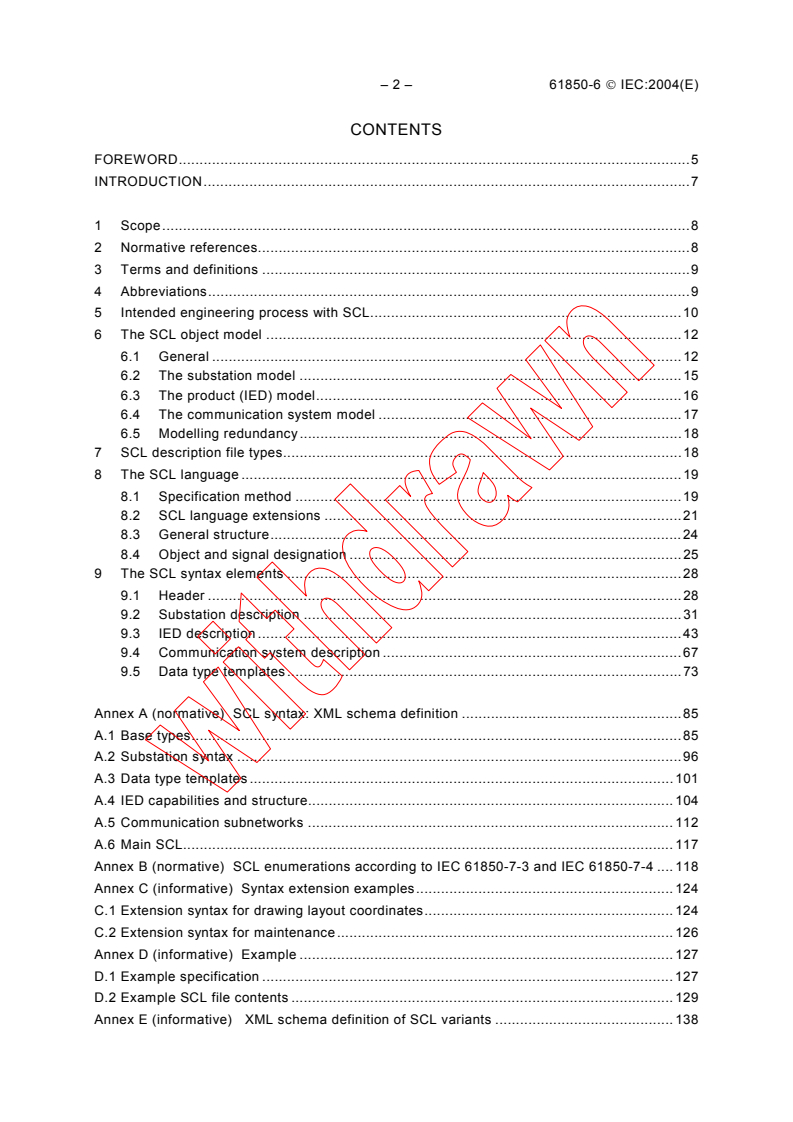
CONTENTS
FOREWORD.5
INTRODUCTION.7
1 Scope.8
2 Normative references.8
3 Terms and definitions .9
4 Abbreviations.9
5 Intended engineering process with SCL.10
6 The SCL object model .12
6.1 General.12
6.2 The substation model .15
6.3 The product (IED) model.16
6.4 The communication system model .17
6.5 Modelling redundancy.18
7 SCL description file types.18
8 The SCL language .19
8.1 Specification method.19
8.2 SCL language extensions .21
8.3 General structure.24
8.4 Object and signal designation .25
9 The SCL syntax elements .28
9.1 Header.28
9.2 Substation description.31
9.3 IED description.43
9.4 Communication system description .67
9.5 Data type templates.73
Annex A (normative) SCL syntax: XML schema definition .85
A.1 Base types.85
A.2 Substation syntax .96
A.3 Data type templates . 101
A.4 IED capabilities and structure. 104
A.5 Communication subnetworks .112
A.6 Main SCL. 117
Annex B (normative) SCL enumerations according to IEC 61850-7-3 and IEC 61850-7-4 . 118
Annex C (informative) Syntax extension examples. 124
C.1 Extension syntax for drawing layout coordinates. 124
C.2 Extension syntax for maintenance. 126
Annex D (informative) Example . 127
D.1 Example specification . 127
D.2 Example SCL file contents . 129
Annex E (informative) XML schema definition of SCL variants . 138
61850-6 © IEC:2004(E) – 3 –
Figure 1 – Reference model for information flow in the configuration process.11
Figure 2 – SCL object model .13
Figure 3 – Configuration example.15
Figure 4 – UML diagram overview of SCL schema .21
Figure 5 – Elements of the signal identification as defined in IEC 61850-7-2 .26
Figure 6 – Elements of the signal name using functional naming.27
Figure 7 – Elements of the signal name using product naming .27
Figure 8 – Names within different structures of the object model.28
Figure 9 – UML diagram of Header section.29
Figure 10 – UML diagram of Substation section.31
Figure 11 – UML diagram for equipment type inheritance and relations .36
Figure 12 – IED structure and access points.44
Figure 13 – UML description of IED related schema part – base .45
Figure 14 – UML description of IED related schema part for Control blocks.46
Figure 15 – UML description of IED related schema part – LN definition.47
Figure 16 – UML diagram overview of the Communication section .68
Figure 17 – UML overview of DataTypeTemplate section .74
Figure C.1 – Coordinate example . 124
Figure D.1 – T1-1 Substation configuration. 127
Figure D.2 – T1-1 Communication configuration . 128
Figure D.3 – T1-1 Transformer bay. 129
Table 1 – The files composing the XML schema definition for SCL.20
Table 2 – Attributes of the Private element .23
Table 3 – Attributes of the Header element.29
Table 4 – Attributes of the History item (Hitem) element .30
Table 5 – Primary apparatus device type codes .38
Table 6 – Attributes of the Terminal element.39
Table 7 – Attributes of the SubEquipment element.40
Table 8 – Attributes of the LNode element .40
Table 9 – Attributes of the IED element .48
Table 10 – List of service capabilities and setting elements and attributes .49
Table 11 – Attributes of the Access point element.51
Table 12 – Attributes of the IED server element.52
Table 13 – Attributes of the Authentication element .53
Table 14 – Attributes of the LDevice element.53
Table 15 – Attributes of the LN0 element.54
Table 16 – Attributes of the LN element.55
Table 17 – Attributes of the DOI element .56
Table 18 – Attributes of the DAI ement .56
Table 19 – Attributes of the SDI element .57
Table 20 – Attributes of the DataSet element.57
Table 21 – Attributes of the FCDA element.58
– 4 – 61850-6 IEC:2004(E)
Table 22 – Attributes of the report control block element.59
Table 23 – Attributes of the RptEnabled element .60
Table 24 – Attributes of the ClientLN element .61
Table 25 – Attributes of the log control block element .62
Table 26 – Attributes of the GSE control block element.63
Table 27 – Attributes of the sampled value control block element.64
Table 28 – Attributes of the Smv Options element .64
Table 29 – Attributes of the setting control block element .65
Table 30 – Attributes of the Input/ExtRef element .66
Table 31 – Attributes of the Association element .67
Table 32 – Attributes of the Subnetwork element .69
Table 33 – Attributes of the ConnectedAP element .70
Table 34 – Attributes of the GSE element .71
Table 35 – Attributes of the SMV element.72
Table 36 – PhysConn P-Type definitions .72
Table 37 – Template definition elements .76
Table 38 – Attributes of the LNodeType element.76
Table 39 – Attributes of the DO element .77
Table 40 – Attributes of the DOType element.77
Table 41 – Attributes of the SDO element.77
Table 42 – Data type mapping.78
Table 43 – Attribute value kind (Valkind) meaning .79
Table 44 – Attributes of the DA element .80
Table 45 – Attributes of the BDA element .82
Table 46 – Attributes of the EnumType element.83
61850-6 © IEC:2004(E) – 5 –
INTERNATIONAL ELECTROTECHNICAL COMMISSION
____________
COMMUNICATION NETWORKS AND SYSTEMS IN SUBSTATIONS –
Part 6: Configuration description language for communication
in electrical substations related to IEDs
FOREWORD
1) The International Electrotechnical Commission (IEC) is a worldwide organization for standardization comprising
all national electrotechnical committees (IEC National Committees). The object of IEC is to promote
international co-operation on all questions concerning standardization in the electrical and electronic fields. To
this end and in addition to other activities, IEC publishes International Standards, Technical Specifications,
Technical Reports, Publicly Available Specifications (PAS) and Guides (hereafter referred to as “IEC
Publication(s)”). Their preparation is entrusted to technical committees; any IEC National Committee interested
in the subject dealt with may participate in this preparatory work. International, governmental and non-
governmental organizations liaising with the IEC also participate in this preparation. IEC collaborates closely
with the International Organization for Standardization (ISO) in accordance with conditions determined by
agreement between the two organizations.
2) The formal decisions or agreements of IEC on technical matters express, as nearly as possible, an international
consensus of opinion on the relevant subjects since each technical committee has representation from all
interested IEC National Committees.
3) IEC Publications have the form of recommendations for international use and are accepted by IEC National
Committees in that sense. While all reasonable efforts are made to ensure that the technical content of IEC
Publications is accurate, IEC cannot be held responsible for the way in which they are used or for any
misinterpretation by any end user.
4) In order to promote international uniformity, IEC National Committees undertake to apply IEC Publications
transparently to the maximum extent possible in their national and regional publications. Any divergence
between any IEC Publication and the corresponding national or regional publication shall be clearly indicated in
the latter.
5) IEC provides no marking procedure to indicate its approval and cannot be rendered responsible for any
equipment declared to be in conformity with an IEC Publication.
6) All users should ensure that they have the latest edition of this publication.
7) No liability shall attach to IEC or its directors, employees, servants or agents including individual experts and
members of its technical committees and IEC National Committees for any personal injury, property damage or
other damage of any nature whatsoever, whether direct or indirect, or for costs (including legal fees) and
expenses arising out of the publication, use of, or reliance upon, this IEC Publication or any other IEC
Publications.
8) Attention is drawn to the Normative references cited in this publication. Use of the referenced publications is
indispensable for the correct application of this publication.
9) Attention is drawn to the possibility that some of the elements of this IEC Publication may be the subject of
patent rights. IEC shall not be held responsible for identifying any or all such patent rights.
International Standard IEC 61850-6 has been prepared by IEC technical committee 57: Power
systems management and associated information exchange.
The text of this standard is based on the following documents:
FDIS Report on voting
57/693/FDIS 57/713/RVD
Full information on the voting for the approval of this standard can be found in the report on
voting indicated in the above table.
This publication has been drafted in accordance with the ISO/IEC Directives, Part 2.
– 6 – 61850-6 IEC:2004(E)
IEC 61850 consists of the following parts, under the general title Communication networks and
systems in substations:
Part 1: Introduction and overview
Part 2: Glossary
Part 3: General requirements
Part 4: System and project management
Part 5: Communication requirements for functions and device models
Part 6: Configuration description language for communication in electrical substations
related to IEDs
Part 7-1: Basic communication structure for substation and feeder equipment – Principles and
models
Part 7-2: Basic communication structure for substation and feeder equipment – Abstract
communication service interface (ACSI)
Part 7-3: Basic communication structure for substation and feeder equipment – Common data
classes
Part 7-4: Basic communication structure for substation and feeder equipment – Compatible
logical node classes and data classes
Part 8-1: Specific Communication Service Mapping (SCSM) – Mappings to MMS (ISO 9506-1
and ISO 9506-2) and to ISO/IEC 8802-3
Part 9-1: Specific Communication Service Mapping (SCSM) – Sampled values over serial
unidirectional multidrop point to point link
Part 9-2: Specific Communication Service Mapping (SCSM) – Sampled values over
ISO/IEC 8802-3
Part 10: Conformance testing
The committee has decided that the contents of this publication will remain unchanged until
2006. At this date, the publication will be
• reconfirmed;
• withdrawn;
• replaced by a revised edition, or
• amended.
A bilingual version of this standard may be issued at a later date.
———————
Under consideration.
61850-6 © IEC:2004(E) – 7 –
INTRODUCTION
This part of IEC 61850 specifies a description language for the configuration of electrical
substation IEDs. This language is called Substation Configuration description Language (SCL).
It is used to describe IED configurations and communication systems according to IEC 61850-5
and IEC 61850-7-x. It allows the formal description of the relations between the substation
automation system and the substation (switchyard). At the application level, the switchyard
topology itself and the relation of the switchyard structure to the SAS functions (logical nodes)
configured on the IEDs can be described.
SCL allows the description of an IED configuration to be passed to a communication and
application system engineering tool, and to pass back the whole system configuration
description to the IED configuration tool in a compatible way. Its main purpose is to allow the
interoperable exchange of communication system configuration data between an IED
configuration tool and a system configuration tool from different manufacturers.
IEC 61850-8-x and IEC 61850-9-x, which concern the mapping of IEC 61850-7-x to specific
communication stacks, may extend these definitions according to their need with additional
parts, or just by restrictions on the way the values of objects have to be used.
– 8 – 61850-6 IEC:2004(E)
COMMUNICATION NETWORKS AND SYSTEMS IN SUBSTATIONS –
Part 6: Configuration description language for communication
in electrical substations related to IEDs
1 Scope
This part of the IEC 61850 series specifies a file format for describing communication related
IED (Intelligent Electronic Device) configurations and IED parameters, communication system
configurations, switchyard (function) structures, and the relations between them. The main
purpose of this format is to exchange IED capability descriptions, and SA system descriptions
between IED engineering tools and the system engineering tool(s) of different manufacturers in
a compatible way.
The defined language is called Substation Configuration description Language (SCL). The IED
and communication system model in SCL is according to IEC 61850-5 and IEC 61850-7-x.
SCSM specific extensions or usage rules may be required in the appropriate parts.
The configuration language is based on the Extensible Markup Language (XML) version 1.0.
This standard does not specify individual implementations or products using the language, nor
does it constrain the implementation of entities and interfaces within a computer system. This
part of the standard does not specify the download format of configuration data to an IED,
although it could be used for part of the configuration data.
2 Normative references
The following referenced documents are indispensable for the application of this document. For
dated references, only the edition cited applies. For undated references, the latest edition of
the referenced document (including any amendments) applies.
IEC 61346-1:1996, Industrial systems, installations and equipment and industrial products –
Structuring principles and reference designations – Part 1: Basic rules
IEC 61346-2:2000, Industrial systems, installations and equipment and industrial products –
Structuring principles and reference designations – Part 2: Classification of objects and codes
for classes
IEC 61850-2, Communication networks and systems in substations – Part 2: Glossary
IEC 61850-5, Communication networks and systems in substations – Part 5: Communication
requirements for functions and device models
IEC 61850-7-1, Communication networks and systems in substations – Part 7-1: Basic
communication structure for substation and feeder equipment – Principles and models
IEC 61850-7-2, Communication networks and systems in substations – Part 7-2: Basic
communication structure for substation and feeder equipment – Abstract communication
service interface (ACSI)
IEC 61850-7-3, Communication networks and systems in substations – Part 7-3: Basic
communication structure for substation and feeder equipment – Common data classes
61850-6 © IEC:2004(E) – 9 –
IEC 61850-7-4, Communication networks and systems in substations – Part 7-4: Basic
communication structure for substation and feeder equipment – Compatible logical node
classes and data classes
IEC 61850-8-1, Communication networks and systems in substations – Part 8-1: Specific
Communication Service Mapping (SCSM) – Mappings to MMS (ISO 9506-1 and ISO 9506-2)
and to ISO/IEC 8802-3
IEC 61850-9-1, Communication networks and systems in substations – Part 9-1: Specific
Communication Service Mapping (SCSM) – Sampled values over serial unidirectional
multidrop point to point link
IEC 61850-9-2, Communication networks and systems in substations – Part 9-2: Specific
Communication Service Mapping (SCSM) – Sampled values over ISO/IEC 8802-3
ISO/IEC 8859-1, Information technology – 8-bit single-byte coded graphic character sets –
Part 1: Latin alphabet No. 1
Extensible Markup Language (XML) 1.0, W3C, available at
Namespaces in XML, W3C, available at
19990114>
XML Schema Part 0: Primer, W3C, available at
xmlschema-0-20010502>
XML Schema Part 1: Structures, W3C, available at
xmlschema-1-20010502>
XML Schema Part 2: Datatypes, W3C, available at
xmlschema-2-20010502/>
RFC 1952, GZIP file format specification version 4.3, RFC, available at
RFC 2045, Multipurpose Internet Mail Extensions (MIME) Part One: Format of Internet
Message Bodies, RFC, available at
3 Terms and definitions
For the purposes of this document, the terms and definitions given in IEC 61850-2 apply.
4 Abbreviations
In general, the glossary and abbreviations defined in IEC 61850-2 apply. The following
abbreviations are either special for this part of the standard, or particularly useful for
understanding this part and are repeated here for convenience.
BDA Basic Data Attribute, that is not structured
CIM Common Information Model for energy management applications
DAI Instantiated Data Attribute
DO DATA in IEC 61850-7-2, data object type or instance, depending on the context
DOI Instantiated Data Object (DATA)
DTD Document Type Definition for an XML document
ID Identifier
IED Intelligent Electronic Device
LDInst Instantiated Logical Device
– 10 – 61850-6 IEC:2004(E)
LNInst Instantiated Logical Node
MSV Multicast Sampled Value
MsvID ID for MSV (Multicast Sampled Value)
RCB Report Control Block
SCL Substation Configuration description Language
SDI Instantiated Sub DATA; middle name part of a structured DATA name
UML Unified Modelling Language according to http://www.omg.org/uml
URI Universal Resource Identifier
UsvID ID for USV (Unicast Sampled Value)
XML Extensible Markup Language
5 Intended engineering process with SCL
Engineering of a substation automation system may start either with the allocation of
functionally pre-configured devices to switchyard parts, products or functions, or with the
design of the process functionality, where functions are allocated to physical devices later,
based on functional capabilities of devices and their configuration capabilities. Often a mixed
approach is preferred: a typical process part such as a line bay is pre-engineered, and then the
result is used within the process functionality as often as needed. For SCL, this means that it
must be capable of describing:
a) A system specification in terms of the single line diagram, and allocation of logical nodes
(LN) to parts and equipment of the single line to indicate the needed functionality.
b) Pre-configured IEDs with a fixed number of logical nodes (LNs), but with no binding to a
specific process – may only be related to a very general process function part.
c) Pre-configured IEDs with a pre-configured semantic for a process part of a certain
structure, for example a double busbar GIS line feeder.
d) Complete process configuration with all IEDs bound to individual process functions and
primary equipment, enhanced by the access point connections and possible access paths
in subnetworks for all possible clients.
e) As item d) above, but additionally with all predefined associations and client server
connections between logical nodes on data level. This is needed if an IED is not capable of
dynamically building associations or reporting connections (either on the client or on the
server side).
Case e) is the complete case. Both cases d) and e) are the result after SAS engineering, while
case a) is a functional specification input to SAS engineering, and b) and c) are possible
results after IED pre-engineering.
The scope of SCL as defined in this standard is clearly restricted to these purposes:
1) SAS functional specification (point a) above),
2) IED capability description (points b)and c) above), and
3) SA system description (points d) and e) above)
for the purpose of system design, communication engineering and the description of the
engineered system communication for the device engineering tools in a standardised way.
This is reached by defining an object model describing the IEDs, their communication
connections, and their allocation to the switchyard, and a standardized way to describe how
this model shall be represented in a file to be exchanged between engineering tools. The
resulting object model could also be the base for other engineering tasks, possibly with some
additions. Therefore, and because of the additional needs of SCSMs, this standard considers
the language as defined here as the core model, and defines how extensions of this core
model for SCSMs as well as other (engineering) purposes can be done in a standardised way.
61850-6 © IEC:2004(E) – 11 –
Figure 1 explains the usage of SCL data exchange in the above-mentioned engineering
process. The shaded text boxes above the dashed line indicate where SCL files are used. The
text box IED capabilities corresponds to a result of steps b) and c) above, the text box System
specification corresponds to step a) above, the text box Associations… at the right to steps d)
or e) above.
The IED Configurator is a manufacturer-specific tool that shall be able to import or export the
files defined by this part of IEC 61850. It provides IED-specific settings and generates IED-
specific configuration files, or it loads the IED configuration into the IED.
An IED shall only be considered compatible in the sense of the IEC 61850 series, if:
• It is accompanied either by an SCL file describing its capabilities, or by a tool, which can
generate this file from the IED.
• It can directly use a system SCL file to set its communication configuration, as far as
setting is possible in this IED (i.e. as a minimum, its needed addresses), or it is
accompanied by a tool which can import a system SCL file to set these parameters to the
IED.
The System Configurator is an IED independent system level tool that shall be able to import or
export configuration files defined by this part of IEC 61850. It shall be able to import
configuration files from several IEDs, as needed for system level engineering, and used by the
configuration engineer to add system information shared by different IEDs. Then the system
configurator shall generate a substation related configuration file as defined by this part of
IEC 61850, which may be fed back to the IED Configurator for system related IED
configuration. The System Configurator should also be able to read a System specification file
for example as a base for starting system engineering, or to compare it with an engineered
system for the same substation.
IED Capabilities
System specification
(LN, DO, …)
(Single line, LNs, …)
System
IED
Configurator
DB
Associations,
relation to single line,
preconfigured reports, .
IED
Engineering
Configurator
Workplace
Engineering environment
File transfer
remote
SA system
parameterization
File transfers and
File transfer
with IEC 61850 services
Substation
Local
gateway
IED IED IED
IEC 195/04
Figure 1 – Reference model for information flow in the configuration process
– 12 – 61850-6 IEC:2004(E)
The part of Figure 1 below the dashed line indicates the ways in which IED configuration data
produced by means of the IED configurator can be brought into the IED. This can be done by:
• local file transfer from an engineering workstation connected locally to the IED. This file
transfer is beyond the scope of this standard.
• remote file transfer for example by the file transfer method of IEC 61850-7-2. The file
format is not defined within this standard, but naturally SCL format is a possible choice.
• access services to parameter and configuration data defined according to IEC 61850-7-2.
In this case, the standardised methods according to IEC 61850-7-x shall be used.
NOTE It is not in the scope of this standard to define any details of concrete software tools, which support an
engineer in doing the intended engineering process with SCL described above. Both the system configurator as well
as the IED configurator introduced above are also conceptual tools to illustrate the use of different SCL file variants
in the engineering process. Each manufacturer is completely free to find the best way in supporting engineers by a
specific software tool. Also completely free is the way, in which software tools for the above described engineering
process with SCL will store manufacturer specific internal parameters for IEDs and SA system aspects, which are
not in the scope of IEC 61850 (e.g. the relation of logical data to pins on a physical board), and how they relate
them to the IEC 61850 data model.
6 The SCL object model
6.1 General
The SCL in its full scope describes a model of
• The primary (power) system structure: which primary apparatus functions are used, and
how the apparatus are connected. This results in a designation of all covered switchgear as
substation automation functions, structured according to IEC 61346-1.
• The communication system: how IEDs are connected to subnetworks and networks, and at
which of their communication access points (communication ports).
• The application level communication: how data is grouped into data sets for sending, how
IEDs trigger the sending and which service they choose, which input data from other IEDs
is needed.
• Each IED: the logical devices configured on the IED, the logical nodes with class and type
belonging to each logical device, the reports and their data contents, the (pre-configured)
associations available; and which data shall be logged.
• Instantiable logical node (LN) type definitions. The logical nodes as defined in IEC 61850-7-
x have mandatory, optional and user defined DATA (here abbreviated DO) as well as
optional services, and are therefore not instantiable. In this document, instantiable
LNTypes and DOTypes are defined as templates, which contain the really implemented
DOs and services.
• The relations between instantiated logical nodes and their hosting IEDs on one side and the
switchyard (function) parts on the other side.
SCL allows the specification of user defined DOs as an extension of standard LN classes as
well as completely user-defined LNs according to the rules of IEC 61850-7-4. This means that
the appropriate name space attributes shall be defined in the logical node types, and their
value shall appear in the SCL file.
A SCL file describes an instance of the model in a serialized form and standardized syntax.
However its semantic can only be fully understood by reference to the model itself, i.e. it is
independent from the syntax. This Clause therefore gives an overview of the model by using
UML notation. The next Clauses then define how an instance of the model is formally described
in SCL.
61850-6 © IEC:2004(E) – 13 –
The UML object model is contained in Figure 2. Note that it is not complete in the modelling
sense, i.e. it does not show any superclasses from which the used classes may be derived, no
attributes etc. It restricts itself to those concrete object types that are used within a SCL
instance file, in case of the substation related part, mainly for the purpose of functional
designation. Furthermore it does not contain the levels below DATA (DOs), which are
structurally defined in IEC 61850-7-2 and whose SCL description is defined in the
DataTypeTemplates Clause.
The object model has three basic parts:
1) Substation: this part describes the switchyard equipment (process devices) in the functional
view according to IEC 61346-1, their connection on single line level (topology), and the
designation of equipment and functions.
2) Product: this stands for all SA product-related objects such as IEDs and logical node
implementations.
3) Communication: this contains communication related object types such as subnetworks
and communication access points, and describes the communication connections between
IEDs as a base for communication paths between logical nodes as clients and servers.
Additionally, the data type template section allows, in a type-oriented (i.e. reusable) way, the
specification of which data and attributes really exist in an IED. A logical node type as specified
there is an instantiable template of the data of a logical node.
More model details contained in SCL, for example the structure within the logical nodes, are
described in IEC 61850-7-x.
Function
Subfunction
FFFuncuncunctttiiionalonalonal///sssubstubstubstaaatttiiion ston ston strucrucructttureureure
PPProducroducroducttt / / / I I IEEED D D ssstttrururuccctttureureure
ComComCommmmuniuniunicccaaatttiiion son son stttrururuccctttureureure
Transformer
Substation
1 SubEquipment
Equipment
Equipmen
Phase
Voltage
Voltage
Bay
Bay
level
level
0.2
CBR DIS VTR
CBR DIS VTR
Terminal
ConnectivityNode
0.*
LNode Data
LNode Data
0.*
1 1.*
Client access points
1.*
0,1
AccessPoint
Server LDevice
Server
1.*
1.*
0,1
Router
Subnetwork
Router
0,1
IED
IED Clock
Clock
0,1
IEC 196/04
Figure 2 – SCL object model
– 14 – 61850-6 IEC:2004(E)
The substation part and the product part in itself form hierarchies, which are used for naming
and can be mapped to the functional and product structures according to IEC 61346 (all parts).
The communication model part just contains the communication connection relations of IEDs to
subnetworks, between subnetworks by means of routers at an IED, and the placement of
master clocks at the subnetworks for time synchronisation. The modelling of gateways is not
especially considered here. A gateway which is an IEC 61850 server has to be modelled like
any other IEC 61850 compliant IED. The Proxy DO in the LPHD logical node allows to specify if
a hosted LD is an image of another IED, or belongs to the hosting IED. A gateway being an
IEC 61850 compliant client should host an ITCI logical node.
As can easily be seen from Figure 2, the logical node (abbreviated as LN or LNode) is the
transition object, which is used to connect the different structures. This means that the LN
instance as a product also has a functional aspect within the switchyard functionality and a
communication aspect as a client or as a server within the substation automation system.
The substation functional objects as well as the product related objects are hierarchically
structured. Each higher level object consists of lower level objects. This hierarchy is reflected
in the designation structure of the objects according to IEC 61346-1. The function structure of
IEC 61346-1 shall be used, and the designation coding of IEC 61346-2 should be used in the
substation objects, while the IEC 61346-1 product structure should be used for IED designation
structure and the IEC 61346-2 codes for the name values.
In SCL, it is foreseen that within each structure for nearly all objects, two kinds of designation
are possible:
• A name is used as (a hierarchical part of) a technical key to designate the object. Each
object within a hierarchy has an attribute name, which contains its identification within this
level of the hierarchy. Technical keys are used in technical documentation for building and
maintaining the system, or for automatic processing of engineering related information.
This designation is also used in SCL to describe links between different model objects. In
this case, as far as possible, the attribute containing the link gets a name of the form
Name, for example daName for a link to a DATA attribute. This name relates
to and is mostly identical to what is called name in IEC 61850-7-2.
• A description part is used as (a hierarchical part of) an operator- or user-related object
identification. An object within a hierarchy has an attribute desc, which contains its textual
description part within the hierarchy. Textual identifications are for example used in
operator interfaces and operator manuals.
NOTE The desc SCL attribute is used at the engineering time, and identifies a (functional) object at its hierarchy
level. The IEC 61850 d DATA attribute is used for describing data, and could also be read online. The contents of
desc attributes could be used to generate a project specific (SCD) d text from a template (ICD) d text. This is
however, not standardized.
A reference within SCL is, as defined in IEC 61850-7-2, a unique identification of an object,
containing as a path the concatenation of all names in the hierarchy levels above, up to the
level of the object. For the connection of power system equipment within a single line diagram,
this path is used explicitly, while for other references it is used implicitly by stating only missing
name parts. For forming names according to IEC 61850-7-2, the term instance with the
abbreviation inst is also used. It is a part of a IEC 61850-7-2 nam
...