


IEC 62013-1:2005
(Main)Caplights for use in mines susceptible to firedamp - Part 1: General requirements - Construction and testing in relation to the risk of explosion
General Information
- Abstract
This part of IEC 62013 specifies requirements for the construction and testing of caplights, including caplights with a point of connection for another apparatus, for use in mines susceptible to firedamp (Group I - electrical apparatus for explosive gas atmospheres as defined in IEC 60079-0). It deals only with the risk of the caplight becoming a source of ignition.
- Status
- Replaced
- Publication Date
- 23-Oct-2005
- Technical Committee
- TC 31 - Equipment for explosive atmospheres
- Current Stage
- DELPUB - Deleted Publication
- Start Date
- 26-May-2011
- Completion Date
- 28-Aug-2026
Relations
- Effective Date
- 05-Sep-2023
- Effective Date
- 05-Sep-2023
Get Certified
Connect with accredited certification bodies for this standard

IMQ S.p.A. (Certification)
Italian electrical product certification.

SLG Prüf- und Zertifizierungs GmbH
German testing and certification body.

UL Solutions
Global safety science company with testing, inspection and certification.
Sponsored listings
Frequently Asked Questions
IEC 62013-1:2005 is a standard published by the International Electrotechnical Commission (IEC). Its full title is "Caplights for use in mines susceptible to firedamp - Part 1: General requirements - Construction and testing in relation to the risk of explosion". This standard covers: This part of IEC 62013 specifies requirements for the construction and testing of caplights, including caplights with a point of connection for another apparatus, for use in mines susceptible to firedamp (Group I - electrical apparatus for explosive gas atmospheres as defined in IEC 60079-0). It deals only with the risk of the caplight becoming a source of ignition.
This part of IEC 62013 specifies requirements for the construction and testing of caplights, including caplights with a point of connection for another apparatus, for use in mines susceptible to firedamp (Group I - electrical apparatus for explosive gas atmospheres as defined in IEC 60079-0). It deals only with the risk of the caplight becoming a source of ignition.
IEC 62013-1:2005 is classified under the following ICS (International Classification for Standards) categories: 29.260.20 - Electrical apparatus for explosive atmospheres. The ICS classification helps identify the subject area and facilitates finding related standards.
IEC 62013-1:2005 has the following relationships with other standards: It is inter standard links to IEC 60079-35-1:2011, IEC 62013-1:1999. Understanding these relationships helps ensure you are using the most current and applicable version of the standard.
IEC 62013-1:2005 is available in PDF format for immediate download after purchase. The document can be added to your cart and obtained through the secure checkout process. Digital delivery ensures instant access to the complete standard document.
Standards Content (Sample)
NORME CEI
INTERNATIONALE
IEC
62013-1
INTERNATIONAL
Deuxième édition
STANDARD
Second edition
2005-10
Lampes-chapeaux utilisables
dans les mines grisouteuses –
Partie 1:
Exigences générales –
Construction et essais liés
au risque d'explosion
Caplights for use in mines
susceptible to firedamp –
Part 1:
General requirements –
Construction and testing in
relation to the risk of explosion
Numéro de référence
Reference number
CEI/IEC 62013-1:2005
Numérotation des publications Publication numbering
Depuis le 1er janvier 1997, les publications de la CEI As from 1 January 1997 all IEC publications are
sont numérotées à partir de 60000. Ainsi, la CEI 34-1 issued with a designation in the 60000 series. For
devient la CEI 60034-1. example, IEC 34-1 is now referred to as IEC 60034-1.
Editions consolidées Consolidated editions
Les versions consolidées de certaines publications de la The IEC is now publishing consolidated versions of its
CEI incorporant les amendements sont disponibles. Par publications. For example, edition numbers 1.0, 1.1
exemple, les numéros d’édition 1.0, 1.1 et 1.2 indiquent and 1.2 refer, respectively, to the base publication,
respectivement la publication de base, la publication de the base publication incorporating amendment 1 and
base incorporant l’amendement 1, et la publication de the base publication incorporating amendments 1
base incorporant les amendements 1 et 2. and 2.
Informations supplémentaires Further information on IEC publications
sur les publications de la CEI
Le contenu technique des publications de la CEI est The technical content of IEC publications is kept
constamment revu par la CEI afin qu'il reflète l'état under constant review by the IEC, thus ensuring that
actuel de la technique. Des renseignements relatifs à the content reflects current technology. Information
cette publication, y compris sa validité, sont dispo- relating to this publication, including its validity, is
nibles dans le Catalogue des publications de la CEI available in the IEC Catalogue of publications
(voir ci-dessous) en plus des nouvelles éditions, (see below) in addition to new editions, amendments
amendements et corrigenda. Des informations sur les and corrigenda. Information on the subjects under
sujets à l’étude et l’avancement des travaux entrepris consideration and work in progress undertaken by the
par le comité d’études qui a élaboré cette publication, technical committee which has prepared this
ainsi que la liste des publications parues, sont publication, as well as the list of publications issued,
également disponibles par l’intermédiaire de: is also available from the following:
• Site web de la CEI (www.iec.ch) • IEC Web Site (www.iec.ch)
• Catalogue des publications de la CEI • Catalogue of IEC publications
Le catalogue en ligne sur le site web de la CEI The on-line catalogue on the IEC web site
(www.iec.ch/searchpub) vous permet de faire des (www.iec.ch/searchpub) enables you to search by a
recherches en utilisant de nombreux critères, variety of criteria including text searches,
comprenant des recherches textuelles, par comité technical committees and date of publication. On-
d’études ou date de publication. Des informations en line information is also available on recently
ligne sont également disponibles sur les nouvelles issued publications, withdrawn and replaced
publications, les publications remplacées ou retirées, publications, as well as corrigenda.
ainsi que sur les corrigenda.
• IEC Just Published • IEC Just Published
Ce résumé des dernières publications parues This summary of recently issued publications
(www.iec.ch/online_news/justpub) est aussi dispo- (www.iec.ch/online_news/justpub) is also available
nible par courrier électronique. Veuillez prendre by email. Please contact the Customer Service
contact avec le Service client (voir ci-dessous) Centre (see below) for further information.
pour plus d’informations.
• Service clients • Customer Service Centre
Si vous avez des questions au sujet de cette If you have any questions regarding this
publication ou avez besoin de renseignements publication or need further assistance, please
supplémentaires, prenez contact avec le Service contact the Customer Service Centre:
clients:
Email: custserv@iec.ch Email: custserv@iec.ch
Tél: +41 22 919 02 11 Tel: +41 22 919 02 11
Fax: +41 22 919 03 00 Fax: +41 22 919 03 00
.
NORME CEI
INTERNATIONALE
IEC
62013-1
INTERNATIONAL
Deuxième édition
STANDARD
Second edition
2005-10
Lampes-chapeaux utilisables
dans les mines grisouteuses –
Partie 1:
Exigences générales –
Construction et essais liés
au risque d'explosion
Caplights for use in mines
susceptible to firedamp –
Part 1:
General requirements –
Construction and testing in
relation to the risk of explosion
IEC 2005 Droits de reproduction réservés Copyright - all rights reserved
Aucune partie de cette publication ne peut être reproduite ni No part of this publication may be reproduced or utilized in any
utilisée sous quelque forme que ce soit et par aucun procédé, form or by any means, electronic or mechanical, including
électronique ou mécanique, y compris la photocopie et les photocopying and microfilm, without permission in writing from
microfilms, sans l'accord écrit de l'éditeur. the publisher.
International Electrotechnical Commission, 3, rue de Varembé, PO Box 131, CH-1211 Geneva 20, Switzerland
Telephone: +41 22 919 02 11 Telefax: +41 22 919 03 00 E-mail: inmail@iec.ch Web: www.iec.ch
CODE PRIX
Q
PRICE CODE
Commission Electrotechnique Internationale
International Electrotechnical Commission
МеждународнаяЭлектротехническаяКомиссия
Pour prix, voir catalogue en vigueur
For price, see current catalogue
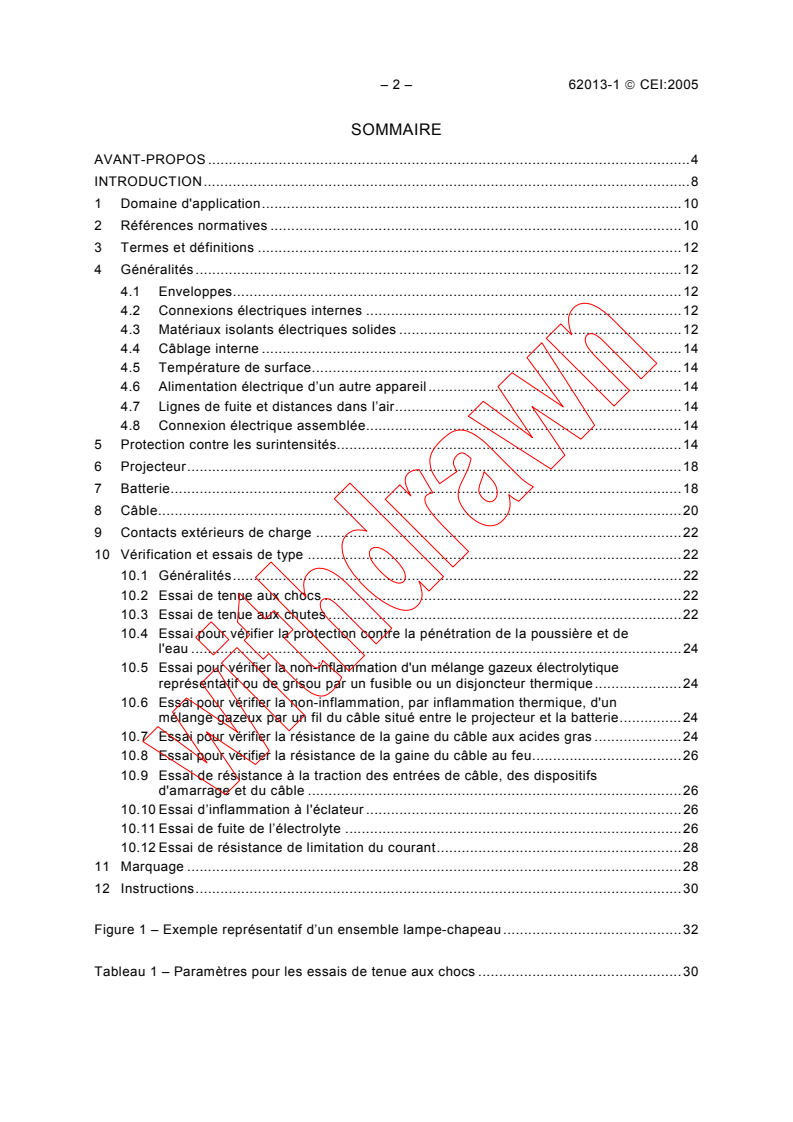
– 2 – 62013-1 CEI:2005
SOMMAIRE
AVANT-PROPOS .4
INTRODUCTION.8
1 Domaine d'application.10
2 Références normatives .10
3 Termes et définitions .12
4 Généralités.12
4.1 Enveloppes.12
4.2 Connexions électriques internes .12
4.3 Matériaux isolants électriques solides .12
4.4 Câblage interne .14
4.5 Température de surface.14
4.6 Alimentation électrique d’un autre appareil.14
4.7 Lignes de fuite et distances dans l’air.14
4.8 Connexion électrique assemblée.14
5 Protection contre les surintensités.14
6 Projecteur.18
7 Batterie.18
8 Câble.20
9 Contacts extérieurs de charge .22
10 Vérification et essais de type .22
10.1 Généralités.22
10.2 Essai de tenue aux chocs .22
10.3 Essai de tenue aux chutes .22
10.4 Essai pour vérifier la protection contre la pénétration de la poussière et de
l'eau .24
10.5 Essai pour vérifier la non-inflammation d'un mélange gazeux électrolytique
représentatif ou de grisou par un fusible ou un disjoncteur thermique.24
10.6 Essai pour vérifier la non-inflammation, par inflammation thermique, d'un
mélange gazeux par un fil du câble situé entre le projecteur et la batterie.24
10.7 Essai pour vérifier la résistance de la gaine du câble aux acides gras .24
10.8 Essai pour vérifier la résistance de la gaine du câble au feu.26
10.9 Essai de résistance à la traction des entrées de câble, des dispositifs
d'amarrage et du câble .26
10.10 Essai d’inflammation à l'éclateur .26
10.11 Essai de fuite de l’électrolyte .26
10.12 Essai de résistance de limitation du courant.28
11 Marquage .28
12 Instructions.30
Figure 1 – Exemple représentatif d’un ensemble lampe-chapeau .32
Tableau 1 – Paramètres pour les essais de tenue aux chocs .30
62013-1 IEC:2005 – 3 –
CONTENTS
FOREWORD.5
INTRODUCTION.9
1 Scope.11
2 Normative references.11
3 Terms and definitions .13
4 General .13
4.1 Enclosures .13
4.2 Internal electrical connections.13
4.3 Solid electrical insulating .13
4.4 Internal wiring.13
4.5 Surface temperature .15
4.6 Supply of electrical power to another apparatus .15
4.7 Creepage and clearance distances .15
4.8 Assembled electrical connection .15
5 Overcurrent protection .15
6 Headpiece .19
7 Battery.19
8 Cable.21
9 External charging contacts.23
10 Type verifications and tests.23
10.1 General .23
10.2 Impact test .23
10.3 Drop tests.23
10.4 Test to verify the protection against ingress of dust and water .25
10.5 Test to verify the non-ignition of a representative electrolytic gas mixture or
firedamp by fuse or thermal circuit-breaker .25
10.6 Test to verify the non-ignition of a gas mixture by one strand of the cable
between the headpiece and the battery by thermal ignition .25
10.7 Test to verify the resistance of the cable sheath to fatty acids .25
10.8 Test to verify the resistance of the cable sheath to fire .27
10.9 Test to verify the strength of cable entries, anchoring devices and cable .27
10.10 Spark ignition test.27
10.11 Electrolyte leakage test.27
10.12 Current-limiting resistor test.29
11 Marking .29
12 Instructions.31
Figure 1 – A representative caplight assembly.33
Table 1 – Parameters for impact test.31
– 4 – 62013-1 © CEI:2005
COMMISSION ÉLECTROTECHNIQUE INTERNATIONALE
___________
LAMPES-CHAPEAUX UTILISABLES
DANS LES MINES GRISOUTEUSES –
Partie 1: Exigences générales –
Construction et essais liés au risque d'explosion
AVANT-PROPOS
1) La Commission Electrotechnique Internationale (CEI) est une organisation mondiale de normalisation composée
de l'ensemble des comités électrotechniques nationaux (Comités nationaux de la CEI). La CEI a pour objet de
favoriser la coopération internationale pour toutes les questions de normalisation dans les domaines de
l'électricité et de l'électronique. A cet effet, la CEI – entre autres activités – publie des Normes internationales,
des Spécifications techniques, des Rapports techniques, des Spécifications accessibles au public (PAS) et des
Guides (ci-après dénommés "Publication(s) de la CEI"). Leur élaboration est confiée à des comités d'études,
aux travaux desquels tout Comité national intéressé par le sujet traité peut participer. Les organisations
internationales, gouvernementales et non gouvernementales, en liaison avec la CEI, participent également aux
travaux. La CEI collabore étroitement avec l'Organisation Internationale de Normalisation (ISO), selon des
conditions fixées par accord entre les deux organisations.
2) Les décisions ou accords officiels de la CEI concernant les questions techniques représentent, dans la mesure
du possible, un accord international sur les sujets étudiés, étant donné que les Comités nationaux de la CEI
intéressés sont représentés dans chaque comité d’études.
3) Les Publications de la CEI se présentent sous la forme de recommandations internationales et sont agréées
comme telles par les Comités nationaux de la CEI. Tous les efforts raisonnables sont entrepris afin que la CEI
s'assure de l'exactitude du contenu technique de ses publications; la CEI ne peut pas être tenue responsable de
l'éventuelle mauvaise utilisation ou interprétation qui en est faite par un quelconque utilisateur final.
4) Dans le but d'encourager l'uniformité internationale, les Comités nationaux de la CEI s'engagent, dans toute la
mesure possible, à appliquer de façon transparente les Publications de la CEI dans leurs publications
nationales et régionales. Toutes divergences entre toutes Publications de la CEI et toutes publications
nationales ou régionales correspondantes doivent être indiquées en termes clairs dans ces dernières.
5) La CEI elle-même ne fournit aucune attestation de conformité. Des organismes de certification indépendants
fournissent des services d'évaluation de conformité et, dans certains secteurs, accèdent aux marques de
conformité de la CEI. La CEI n'est responsable d'aucun des services effectués par les organismes de
certification indépendants.
6) Tous les utilisateurs doivent s'assurer qu'ils sont en possession de la dernière édition de cette publication.
7) Aucune responsabilité ne doit être imputée à la CEI, à ses administrateurs, employés, auxiliaires ou
mandataires, y compris ses experts particuliers et les membres de ses comités d'études et des Comités
nationaux de la CEI, pour tout préjudice causé en cas de dommages corporels et matériels, ou de tout autre
dommage de quelque nature que ce soit, directe ou indirecte, ou pour supporter les coûts (y compris les frais
de justice) et les dépenses découlant de la publication ou de l'utilisation de cette Publication de la CEI ou de
toute autre Publication de la CEI, ou au crédit qui lui est accordé.
8) L'attention est attirée sur les références normatives citées dans cette publication. L'utilisation de publications
référencées est obligatoire pour une application correcte de la présente publication.
9) L’attention est attirée sur le fait que certains des éléments de la présente Publication de la CEI peuvent faire
l’objet de droits de propriété intellectuelle ou de droits analogues. La CEI ne saurait être tenue pour
responsable de ne pas avoir identifié de tels droits de propriété et de ne pas avoir signalé leur existence.
La Norme internationale CEI 62013-1 a été établie par le comité d'études 31 de la CEI:
Equipement pour atmosphères explosives.
Cette seconde édition annule et remplace la première édition publiée en 1999. Elle constitue
une révision technique.
La révision générale et la mise à jour de l’édition 1 sont le résultat d’un retour d’expérience de
la part des fabricants et des organismes de certification suite à l’utilisation de cette norme. Son
but est la clarification et la suppression de toutes ambiguïtés. Les modifications dans les
normes associées ont également été prises en compte.
62013-1 © IEC:2005 – 5 –
INTERNATIONAL ELECTROTECHNICAL COMMISSION
____________
CAPLIGHTS FOR USE IN MINES
SUSCEPTIBLE TO FIREDAMP –
Part 1: General requirements –
Construction and testing in relation to the risk of explosion
FOREWORD
1) The International Electrotechnical Commission (IEC) is a worldwide organization for standardization comprising
all national electrotechnical committees (IEC National Committees). The object of IEC is to promote
international co-operation on all questions concerning standardization in the electrical and electronic fields. To
this end and in addition to other activities, IEC publishes International Standards, Technical Specifications,
Technical Reports, Publicly Available Specifications (PAS) and Guides (hereafter referred to as “IEC
Publication(s)”). Their preparation is entrusted to technical committees; any IEC National Committee interested
in the subject dealt with may participate in this preparatory work. International, governmental and non-
governmental organizations liaising with the IEC also participate in this preparation. IEC collaborates closely
with the International Organization for Standardization (ISO) in accordance with conditions determined by
agreement between the two organizations.
2) The formal decisions or agreements of IEC on technical matters express, as nearly as possible, an international
consensus of opinion on the relevant subjects since each technical committee has representation from all
interested IEC National Committees.
3) IEC Publications have the form of recommendations for international use and are accepted by IEC National
Committees in that sense. While all reasonable efforts are made to ensure that the technical content of IEC
Publications is accurate, IEC cannot be held responsible for the way in which they are used or for any
misinterpretation by any end user.
4) In order to promote international uniformity, IEC National Committees undertake to apply IEC Publications
transparently to the maximum extent possible in their national and regional publications. Any divergence
between any IEC Publication and the corresponding national or regional publication shall be clearly indicated in
the latter.
5) IEC itself does not provide any attestation of conformity. Independent certification bodies provide conformity
assessment services and, in some areas, access to IEC marks of conformity. IEC is not responsible for any
services carried out by independent certification bodies.
6) All users should ensure that they have the latest edition of this publication.
7) No liability shall attach to IEC or its directors, employees, servants or agents including individual experts and
members of its technical committees and IEC National Committees for any personal injury, property damage or
other damage of any nature whatsoever, whether direct or indirect, or for costs (including legal fees) and
expenses arising out of the publication, use of, or reliance upon, this IEC Publication or any other IEC
Publications.
8) Attention is drawn to the Normative references cited in this publication. Use of the referenced publications is
indispensable for the correct application of this publication.
9) Attention is drawn to the possibility that some of the elements of this IEC Publication may be the subject of
patent rights. IEC shall not be held responsible for identifying any or all such patent rights.
International Standard IEC 62013-1 has been prepared by IEC technical committee 31:
Equipment for explosive atmospheres.
This second edition cancels and replaces the first edition (1999) and constitutes a technical
revision.
The general revision and updating of Edition 1 is a result of feedback from the manufacturers
and the certifiers following the use of the standard. Its purpose is clarification and the
elimination of any ambiguities. Account has also been taken of changes in related standards.
– 6 – 62013-1 CEI:2005
Hormis la révision générale et la mise à jour de l’édition 1, les différences techniques
principales par rapport à l’édition précédente sont les suivantes:
a) l’addition d’un paragraphe (4.5) au sujet de la température de surface maximale (voir aussi
5.3),
b) clarifications et modifications sur la protection contre les surintensités,
c) amendement du paragraphe sur les batteries pour les piles ou accumulateurs en
surpression/scellés hermétiquement,
d) ajout d’un paragraphe sur la documentation.
Le texte de la présente norme est issu des documents suivants:
FDIS Rapport de vote
31/587A/FDIS 31/596/RVD
Le rapport de vote indiqué dans le tableau ci-dessus donne toute information sur le vote ayant
abouti à l'approbation de cette norme.
Cette publication a été rédigée selon les Directives ISO/CEI, Partie 2.
La norme suivante fait également partie de la même série, sous le titre général Lampes-
chapeaux pour mines grisouteuses.
Partie 2: Performance et autres sujets relatifs à la sécurité
Le comité a décidé que le contenu de cette publication ne sera pas modifié avant la date de
maintenance indiquée sur le site web de la CEI sous «http://webstore.iec.ch» dans les données
relatives à la publication recherchée. A cette date, la publication sera
• reconduite;
• supprimée;
• remplacée par une édition révisée, ou
• amendée.
62013-1 IEC:2005 – 7 –
Apart from the general revision and updating of Edition 1, the main technical differences from
the previous edition are as follows:
a) the addition of a subclause (4.5) relating to maximum surface temperature (see also 5.3);
b) overcurrent protection clarifications and changes;
c) battery clause amended to allow pressurized/hermetically sealed cells;
d) clause on documentation added.
The text of this standard is based on the following documents:
FDIS Report on voting
31/587A/FDIS 31/596/RVD
Full information on the voting for the approval of this standard can be found in the report on
voting indicated in the above table.
This publication has been drafted in accordance with the ISO/IEC Directives, Part 2.
The following standard is also part of the same series, under the general title Caplights for use
in mines susceptible to firedamp:
Part 2: Performance and other safety-related matters
The committee has decided that the contents of this publication will remain unchanged until the
maintenance result date indicated on the IEC web site under "http://webstore.iec.ch" in the data
related to the specific publication. At this date, the publication will be
• reconfirmed;
• withdrawn;
• replaced by a revised edition, or
• amended.
– 8 – 62013-1 CEI:2005
INTRODUCTION
Cette norme s’appuie sur une combinaison des concepts de protection cités dans la
CEI 60079, par exemple la sécurité augmentée «e» et la sécurité intrinsèque «i» ainsi que sur
l’incorporation de l’expérience acquise depuis plusieurs années dans le domaine de la
prévention de l’inflammation des gaz.
62013-1 IEC:2005 – 9 –
INTRODUCTION
This standard is based on a combination of the protective concepts listed in IEC 60079, for
example Increased Safety “e” and Intrinsic Safety “i” as well as incorporating operating
experience gained over many years in the field of gas ignition prevention.
– 10 – 62013-1 CEI:2005
LAMPES-CHAPEAUX UTILISABLES
DANS LES MINES GRISOUTEUSES –
Partie 1: Exigences générales –
Construction et essais liés au risque d'explosion
1 Domaine d'application
Cette partie de la CEI 62013 spécifie les règles pour la construction et les essais des lampes-
chapeaux avec un point de connexion pour d’autres matériels utilisables dans les mines
grisouteuses (Groupe I – matériels électriques pour les atmosphères explosives gazeuses
comme définies dans la CEI 60079-0). Elle traite uniquement du risque présenté par une
lampe-chapeau, de devenir une source d’inflammation.
NOTE 1 Les exigences d’aptitude à la fonction se trouvent dans la CEI 62013-2 .
Les règles de la CEI 60079-0 ne s’appliquent pas à moins que cela ne soit spécifié.
La présente norme est aussi applicable pour une utilisation dans les mines qui sont
temporairement mises en danger par la présence d’une atmosphère explosive grisouteuse.
NOTE 2 L’utilisation dans de telles circonstances dépend de l’évaluation du risque par l’utilisateur.
Les lampes-chapeaux conformes à cette norme sont destinées à être utilisées par des
personnes dans des conditions normales de:
Température 0 °C à +40 °C
Pression: 0,8 bar à 1,1 bar
NOTE 3 Dans la conception de matériel destiné à fonctionner dans des conditions autres que celles indiquées ci-
dessus, cette norme peut servir de guide; cependant des essais supplémentaires peuvent être nécessaires.
2 Références normatives
Les documents de références suivants sont indispensables pour l'application du présent
document. Pour des références datées, seule l'édition citée s'applique. Pour les références
non datées, c’est la dernière édition du document référencé (y compris les éventuels
amendements) qui s’applique.
CEI 60050(845):1987, Vocabulaire Electrotechnique International (VEI) – Chapitre 845:
Eclairage
CEI 60079-0:2004, Matériel électrique pour atmosphères explosives gazeuses – Partie 0:
Règles générales
CEI 60079-1:2003, Matériel électrique pour atmosphères explosives gazeuses – Partie 1:
Enveloppes antidéflagrantes «d»
CEI 60079-7:2001, Matériel électrique pour atmosphères explosives gazeuses – Partie 7:
Sécurité augmentée "e"
___________
CEI 62013-2 :, Lampes chapeaux utilisables dans les mines grisouteuses – Partie 2: Performance et autres
sujets relatifs à la sécurité (à publier)
62013-1 IEC:2005 – 11 –
CAPLIGHTS FOR USE IN MINES
SUSCEPTIBLE TO FIREDAMP –
Part 1: General requirements –
Construction and testing in relation to the risk of explosion
1 Scope
This part of IEC 62013 specifies requirements for the construction and testing of caplights,
including caplights with a point of connection for another apparatus, for use in mines
susceptible to firedamp (Group I – electrical apparatus for explosive gas atmospheres as
defined in IEC 60079-0). It deals only with the risk of the caplight becoming a source of
ignition.
NOTE 1 The requirements for performance are in IEC 62013-2 .
The requirements of IEC 60079-0 do not apply unless specified.
This standard is also applicable to caplights intended for use in mines which have become
temporarily endangered by an explosive gas atmosphere, for example in mine rescue
operations.
NOTE 2 The use in such circumstances is dependent on a user’s risk assessment.
Caplights complying with this standard are intended for personal use under normal conditions
of:
o o
Temperature: 0 C to +40 C
Pressure: 0,8 bar to 1,1 bar
NOTE 3 In designing apparatus for operation in conditions other than those given above, this standard may be
used as a guide; however, additional testing may be required.
2 Normative references
The following referenced documents are indispensable for the application of this document. For
dated references, only the edition cited applies. For undated references, the latest edition of
the referenced document (including any amendments) applies.
IEC 60050(845):1987, International Electrotechnical Vocabulary (IEV) – Chapter 845: Lighting
IEC 60079-0:2004, Electrical apparatus for explosive gas atmospheres – Part 0: General
requirements
IEC 60079-1:2003, Electrical apparatus for explosive gas atmospheres – Part 1: Flameproof
enclosures "d"
IEC 60079-7:2001, Electrical apparatus for explosive gas atmospheres – Part 7: Increased
safety "e"
___________
IEC 62013-2:, Caplights for use in mines susceptible to firedamp – Part 2: Performance and other safety-related
matters (to be published)
– 12 – 62013-1 CEI:2005
CEI 60079-11:1999, Matériel électrique pour atmosphères explosives gazeuses – Partie 11:
Sécurité intrinsèque «i»
CEI 60079-20:1996 , Matériel électrique pour atmosphères explosives gazeuses – Partie 20:
Données pour gaz et vapeurs inflammables en relation avec l'utilisateur des matériels
électriques
CEI 60127-2:2003, Coupe-circuit miniatures – Partie 2: Cartouches
Amendement 1 (2003)
CEI 60332-1:1993, Essais des câbles électriques soumis au feu – Partie 1: Essai sur un
conducteur ou câble isolé vertical
CEI 60529:2001, Degrés de protection procurés par les enveloppes (Code IP)
3 Termes et définitions
Pour les besoins du présent document, les définitions de la CEI 60079-0 et de la
CEI 60050(845) sont applicables, ainsi que les définitions indiquées ci-après.
3.1
boîtier de batterie
enveloppe de la batterie
NOTE Le couvercle fait partie du boîtier de la batterie.
3.2
lampe-chapeau
matériel comprenant un projecteur, un câble de liaison et un ou des accumulateurs dans un
boîtier connectés en un ensemble complet (voir Figure 1)
3.3
grisou
mélange de gaz inflammables survenant naturellement dans une mine
4 Généralités
4.1 Enveloppes
4.1.1 Les enveloppes réalisées en alliage léger doivent être conformes à 8.1 de la
CEI 60079-0.
4.1.2 Les enveloppes réalisées en matière plastique doivent être conformes à 7.3 de la
CEI 60079-0.
4.2 Connexions électriques internes
Les connexions électriques internes doivent être conformes à 4.2 de la CEI 60079-7.
4.3 Matériaux isolants électriques solides
Les matériaux isolant solides doivent être conformes à 4.5 de la CEI 60079-7.
___________
Annulé et remplacé par la CEI 60332-1-1 (2004) et la CEI 60332-1-2 (2004).
62013-1 IEC:2005 – 13 –
IEC 60079-11:1999, Electrical apparatus for explosive gas atmospheres – Part 11: Intrinsic
safety "i"
IEC 60079-20:1996, Electrical apparatus for explosive gas atmospheres – Part 20: Data for
flammable gases and vapours, relating to use of electrical apparatus
IEC 60127-2:2003, Miniature fuses – Part 2: Cartridge fuse-links
Amendment 1 (2003)
IEC 60332-1:1993, Tests on electric cables under fire conditions – Part 1: Test on a single
vertical insulated wire or cable
IEC 60529:2001, Degrees of protection provided by enclosures (IP Code)
3 Terms and definitions
For the purposes of this document, the definitions of IEC 60079-0, IEC 60050(845) and the
following apply.
3.1
battery container
enclosure to contain the battery
NOTE The cover is part of the battery container.
3.2
caplight
apparatus comprising a headpiece, cable and rechargeable secondary cell(s)/battery in a
container connected together as a complete assembly (see Figure 1)
3.3
firedamp
flammable mixture of gases naturally occurring in a mine
4 General
4.1 Enclosures
4.1.1 Enclosures made of light alloy shall conform to 8.1 of IEC 60079-0.
4.1.2 Enclosures made of plastic material shall conform to 7.3 of IEC 60079-0.
4.2 Internal electrical connections
Internal electrical connections shall conform to 4.2 of IEC 60079-7.
4.3 Solid electrical insulating
Solid electrical insulating materials shall conform to 4.5 of IEC 60079-7.
4.4 Internal wiring
Internal wiring shall conform to 4.8 of IEC 60079-7.
___________
Cancelled and replaced by IEC 60332-1-1 (2004) and IEC 60332-1-2 (2004).
– 14 – 62013-1 CEI:2005
4.4 Câblage interne
Le câblage interne doit être conforme à 4.8 de la CEI 60079-7.
4.5 Température de surface
La limitation de la température de surface maximale doit être conforme à 5.3.2.1 de la
CEI 60079-0.
4.6 Alimentation électrique d’un autre appareil
Lorsque la batterie de la lampe-chapeau est également utilisée pour l’alimentation d’un autre
matériel, la conformité à cette norme ne doit pas en être affectée.
4.7 Lignes de fuite et distances dans l’air
Toutes les connexions filaires et les pistes de circuits imprimés qui peuvent affecter le mode
de protection procuré doivent être considérées comme ayant des séparations infaillibles si
elles répondent aux exigences suivantes pour les lignes de fuite et distances dans l’air:
– 1,6 mm dans l’air jusqu’à 24 V, puis le Tableau 1 de la CEI 60079-7 s’applique;
– 0,5 mm au travers d’un isolant solide ou sous un revêtement.
4.8 Connexion électrique assemblée
Il ne doit pas être possible d’obtenir un courant plus grand que 50 mA entre deux points
accessibles de la lampe-chapeau lorsque qu’elle est assemblée pour l’utilisation.
5 Protection contre les surintensités
5.1 Une protection contre les surintensités doit être fournie, qui limite efficacement le courant
de décharge à un niveau non susceptible de provoquer l’inflammation d’une atmosphère
rendue dangereuse par le grisou. Une telle protection doit être procurée par un ou plusieurs
des moyens suivants:
a) un fusible ou coupe-circuit thermique répondant aux exigences de 5.2,
b) le choix d’une batterie ayant les caractéristiques internes appropriées répondant aux
exigences de 5.3,
c) une résistance de limitation du courant infaillible répondant aux exigences de 5.3 et 5.4,
d) une résistance de limitation du courant infaillible répondant aux exigences de 5.3 et 5.5.
Si le courant de charge de la batterie traverse le moyen de protection, les caractéristiques
doivent être fonction du plus grand des courants de charge ou de décharge.
5.2 Lorsque le moyen de protection contre les surcharges est un fusible ou un disjoncteur
thermique et que la lampe-chapeau est construite de telle manière que
– la tension nominale ne dépasse pas 6 V;
– l'intensité du courant normal d'utilisation ne dépasse pas 1,5 A, et
– la puissance nominale de la lampe ne dépasse pas 6 W
62013-1 IEC:2005 – 15 –
4.5 Surface temperature
The limitation of maximum surface temperature shall be in accordance with 5.3.2.1 of
IEC 60079-0.
4.6 Supply of electrical power to another apparatus
Where the caplight is also used to supply electrical power to another apparatus (internal or
external to the caplight) the other apparatus shall not affect compliance with this standard.
4.7 Creepage and clearance distances
All wiring connections and printed wiring boards which can affect the type of protection
afforded shall be considered to have infallible separations if they meet the following creepage
and clearance requirements:
– 1,6 mm in air up to 24 V, thereafter Table 1 of IEC 60079-7 applies;
– 0,5 mm through solid insulation or under a coating;
4.8 Assembled electrical connection
It shall not be possible to obtain a current of greater than 50 mA between any two accessible
points of the caplight when assembled for use.
5 Overcurrent protection
5.1 Overcurrent protection shall be provided which effectively limits the discharge current to a
level unlikely to cause an ignition of an atmosphere endangered by firedamp. Such protection
shall be provided by one or more of the following means:
a) a fuse or thermal circuit-breaker meeting the requirements of 5.2;
b) selecting a battery with appropriate internal characteristics meeting the requirements of 5.3;
c) an infallible current limiting resistor meeting the requirements of 5.3 and 5.4;
d) an active current limiting device meeting the requirements of 5.3 and 5.5.
If the battery-charging current passes through the protective means, the rating of that means
shall be based on the charge current or caplight working current, whichever is the greater.
5.2 Where the means of overcurrent protection is a fuse or thermal circuit-breaker and the
caplight is constructed in such a manner that
– the nominal voltage is not greater than 6 V;
– the value of the current in normal use is not greater than 1,5 A, and
– the nominal rating of the lamp is not greater than 6 W
– 16 – 62013-1 CEI:2005
le fusible ou le disjoncteur thermique doit être conforme aux exigences suivantes:
a) un fusible ou disjoncteur thermique non logé dans une enveloppe répondant aux exigences
de la CEI 60079-1 doit être protégé de sorte que, lorsqu’il est soumis aux essais décrits en
10.5, aucun mélange gazeux environnant ne s’enflamme ;
NOTE Un exemple de protection valable est l'encapsulage, sauf des sorties, dans un compound approprié
(voir 4.21 de la CEI 60455-1 ) ayant une épaisseur minimale de couche de 1 mm.
et
b) le fusible doit être conforme avec la CEI 60127-2 et doit répondre de plus aux exigences
suivantes.
Les courants et les temps de fusion ou de coupure doivent être aussi faibles que possible par
rapport aux caractéristiques courant/temps de charge et décharge de la batterie. Les règles
suivantes s’appliquent:
– temps de fusion ou de coupure à 12 A ± 0,1 A: pas plus de 1 s, et
– temps de fusion ou de coupure à 15 A ± 0,1 A: pas plus de 200 ms.
5.3 Dans les cas 5.1b), c) ou d), l’association de la batterie et des moyens de protection doit
être conforme aux règles de la CEI 60079-11 concernant l’essai d’inflammation à l'éclateur
décrit en 10.10. Au cours de l’essai d’inflammation à l’éclateur où un fusible est fourni, il doit
être remplacé par une résistance équivalente de valeurs assignées adéquates pour permettre
de réaliser l’essai.
Sinon, l’essai d’inflammation à l’éclateur des circuits à sécurité intrinsèque dans des conditions
de défaut peut être réalisé conformément à l’Article A.2 de la CEI 60079-11.
5.4 Dans le cas de 5.1c), lorsque le moyen de protection contre les surcharges est une ou
des résistances, il doit être relié au circuit le plus près possible des connexions de la batterie.
La ou les résistances doivent être de type métallique ou couche d’oxyde métallique ou
bobinées à simple couche avec une protection mécanique pour éviter le débobinage du fil dans
l’éventualité d’une rupture, ou être de construction équivalente possédant un mode de
défaillance qui augmente la résistance. Les résistances doivent
a) fonctionner à pas plus de 2/3 de la puissance assignée et répondre aux exigences de la
CEI 60079-11 pour une résistance de limitation du courant infaillible, ou
b) ne pas dépasser 450 °C, ou diminuer en résistance de plus de 10 % de sa valeur en essai
préliminaire ou s’enflammer ou se déformer de telle sorte que le conducteur adjacent court-
circuite la résistance lorsqu’il est soumis aux essais de résistance de limitation du courant
décrit en 10.12. La température ne doit pas affecter le mode de protection.
5.5 Dans le cas de 5.1d) lorsque la protection contre les surintensités est faite par des
dispositifs de limitation de courant actifs, deux dispositifs conformément à 7.1 de la CEI 60079-
11 placés en série doivent être utilisés. Cela n’empêche pas l’utilisation d’un dispositif actif et
d’un fusible conforme à 5.2, placé en série.
5.6 La disposition physique des moyens de protection contre les surintensités et du câble à
l’intérieur du boîtier de la batterie doit être telle qu’il soit improbable qu’un court-circuit passant
ailleurs qu’à travers les circuits de protection puisse se produire.
___________
CEI 60455-1:1998, Composés réactifs à base de résine utilisés comme isolants électriques – Partie 1: Définitions
et prescriptions générales
62013-1 IEC:2005 – 17 –
the fuse or thermal circuit-breaker shall conform to the following requirements:
a) a fuse or thermal circuit-breaker not housed in an enclosure meeting the requirements of
IEC 60079-1 shall be protected so that, when tested according to 10.5, there is no ignition
of any surrounding gas mixture,
NOTE An example of such suitable protection is to cover, except for the terminations, with an appropriate
encapsulation compound (see 4.21 of IEC 60455-1 ) with a minimum thickness of 1 mm.
and
b) the fuse shall comply with IEC 60127-2 and additionally meet the following criteria.
The fusing or interrupting current and fusing or interrupting time shall be as small as possible
with regard to the current/time charging and discharging characteristics of the battery. The
following rules shall apply:
– fusing or interrupting time at 12 A ± 0,1 A: not more than 1 s, and
– fusing or interrupting time at 15 A ± 0,1 A: not more than 200 ms.
5.3 In the case of 5.1b), c), or d) the combination of the battery and the means of protection
...