


EN 15085-4:2023
(Main)Railway applications - Welding of railway vehicles and components - Part 4: Production requirements
General Information
- Abstract
This series of standards applies to welding of metallic materials in the manufacture and maintenance of railway vehicles and their parts.
This part of the series describes the production requirements (i.e. preparation and execution) of the welding work.
- Status
- Published
- Publication Date
- 14-Mar-2023
- Technical Committee
- CEN/TC 256 - Railway applications
- Drafting Committee
- CEN/TC 256/WG 31 - Welding of railway vehicules and components
- Current Stage
- 6060 - Definitive text made available (DAV) - Publishing
- Start Date
- 15-Mar-2023
- Due Date
- 07-Dec-2021
- Completion Date
- 15-Mar-2023
- Directive
- Harmonized Standard2016/797/EU - Directive (EU) 2016/797 of the European Parliament and of the Council of 11 May 2016 on the interoperability of the rail system within the European Union (Text with EEA relevance)OJ Ref: OJ L, 2025/424 OJ Date: 06-Mar-2025
Harmonized Standard2016/797/EU - Directive (EU) 2016/797 of the European Parliament and of the Council of 11 May 2016 on the interoperability of the rail system within the European Union (Text with EEA relevance)OJ Ref: 2025/424, OJ L OJ Date: 06-Mar-2025
Harmonized Standard2016/797/EU - Directive (EU) 2016/797 of the European Parliament and of the Council of 11 May 2016 on the interoperability of the rail system within the European Union (Text with EEA relevance)OJ Ref: 2025/424, OJ L OJ Date: 06-Mar-2025
Harmonized Standard2016/797/EU - Directive (EU) 2016/797 of the European Parliament and of the Council of 11 May 2016 on the interoperability of the rail system within the European Union (Text with EEA relevance)OJ Ref: 2025/424, OJ L OJ Date: 06-Mar-2025
Harmonized Standard2016/797/EU - Directive (EU) 2016/797 of the European Parliament and of the Council of 11 May 2016 on the interoperability of the rail system within the European Union (Text with EEA relevance)OJ Ref: 2025/424, OJ L OJ Date: 06-Mar-2025
Harmonized Standard2016/797/EU - Directive (EU) 2016/797 of the European Parliament and of the Council of 11 May 2016 on the interoperability of the rail system within the European Union (Text with EEA relevance)OJ Ref: OJ L, 2025/424 OJ Date: 06-Mar-2025
Harmonized Standard2016/797/EU - Directive (EU) 2016/797 of the European Parliament and of the Council of 11 May 2016 on the interoperability of the rail system within the European Union (Text with EEA relevance)OJ Ref: OJ L, 2025/424 OJ Date: 06-Mar-2025
Harmonized Standard2016/797/EU - Directive (EU) 2016/797 of the European Parliament and of the Council of 11 May 2016 on the interoperability of the rail system within the European Union (Text with EEA relevance)OJ Ref: OJ L, 2025/424 OJ Date: 06-Mar-2025
Harmonized Standard2016/797/EU - Directive (EU) 2016/797 of the European Parliament and of the Council of 11 May 2016 on the interoperability of the rail system within the European Union (Text with EEA relevance)OJ Ref: OJ L, 2025/424 OJ Date: 06-Mar-2025
Harmonized Standard2016/797/EU - Directive (EU) 2016/797 of the European Parliament and of the Council of 11 May 2016 on the interoperability of the rail system within the European Union (Text with EEA relevance)OJ Ref: 2025/424, OJ L, OJ L, 2025/424 OJ Date: 06-Mar-2025
Harmonized Standard2016/797/EU - Directive (EU) 2016/797 of the European Parliament and of the Council of 11 May 2016 on the interoperability of the rail system within the European Union (Text with EEA relevance)OJ Ref: 2025/424, OJ L, OJ L, 2025/424 OJ Date: 06-Mar-2025
Harmonized Standard2016/797/EU - Directive (EU) 2016/797 of the European Parliament and of the Council of 11 May 2016 on the interoperability of the rail system within the European Union (Text with EEA relevance)OJ Ref: 2025/424, OJ L, OJ L, 2025/424 OJ Date: 06-Mar-2025
Harmonized Standard2016/797/EU - Directive (EU) 2016/797 of the European Parliament and of the Council of 11 May 2016 on the interoperability of the rail system within the European Union (Text with EEA relevance)OJ Ref: 2025/424, OJ L, OJ L, 2025/424 OJ Date: 06-Mar-2025


Overview
EN 15085-4:2023 - "Railway applications - Welding of railway vehicles and components - Part 4: Production requirements" is the CEN standard that specifies the preparation and execution requirements for welding metallic materials in the manufacture and maintenance of railway vehicles and their parts. Part 4 is one element of the EN 15085 series that links design weld performance classes with production control, weld quality and inspection. This 2023 edition supersedes EN 15085-4:2007 and updates preparation and execution clauses, adds guidance on filler material, and includes an Annex ZA mapping to EU requirements.
Key topics and technical requirements
- Preparation before welding
- Welding planning documents and working plans
- Welding Procedure Specification (WPS) requirements
- Training and qualification requirements for welders, operators and weld setters
- Supplementary production weld tests
- Production tests to demonstrate design suitability, welding conditions, welder skill and joint quality
- Tests covering specialised processes (electron beam, laser, laser‑arc, resistance, flash, stud and friction stir welding)
- Requirements for welding execution
- Weld preparation, joint fit-up, execution controls and procedural adherence
- Criteria for acceptable weld quality and non‑conformity treatment
- Welding consumables
- Selection, conformity verification, storage and handling of filler materials and fluxes
- Annex A provides guidance on choosing filler materials for steels, stainless steels, aluminium and other metals
- Parent materials
- Rules for selection and conformity of steels, cast irons, stainless steels and aluminium alloys
- Special considerations when dissimilar metals are joined
- Welding processes
- Coverage of mechanized, manual and specialised welding processes with reference to ISO/EN process standards
Practical applications and users
EN 15085-4:2023 is intended for organisations involved in new build and repair of railway rolling stock and components, including:
- Rolling stock manufacturers and subcontractors
- Maintenance workshops and depot operations
- Welding coordinators, QA/QC engineers and production planners
- Design engineers specifying weld performance classes
- Certification bodies and auditors assessing compliance with EN 15085 series and EN ISO 3834 welding quality requirements
Practical uses include preparing WPS documentation, establishing production test regimes, qualifying welders for safety‑critical components, selecting appropriate filler metals, and defining storage and handling procedures for consumables.
Related standards
- EN 15085 series: Part 1 (General), Part 2 (Welding manufacturers), Part 3 (Design), Part 5 (Inspection, testing & documentation), Part 6 (Maintenance)
- EN ISO 15609‑1/2 (WPS), EN ISO 9606 (welder qualification), EN ISO 14732 (welding operators), and EN ISO 3834 (welding quality requirements)
Keywords: EN 15085-4:2023, railway welding, welding production requirements, WPS, weld quality, welding consumables, welder qualification.
Relations
- Effective Date
- 26-Jun-2019
- Effective Date
- 28-Jan-2026
- Effective Date
- 28-Jan-2026
- Effective Date
- 28-Jan-2026
- Effective Date
- 28-Jan-2026
- Effective Date
- 28-Jan-2026
- Effective Date
- 28-Jan-2026
- Effective Date
- 28-Jan-2026
- Effective Date
- 28-Jan-2026
- Effective Date
- 28-Jan-2026
- Effective Date
- 28-Jan-2026
- Effective Date
- 28-Jan-2026
- Effective Date
- 28-Jan-2026
- Effective Date
- 28-Jan-2026
- Effective Date
- 28-Jan-2026
Get Certified
Connect with accredited certification bodies for this standard

DVS-ZERT GmbH
German welding certification society.
IRIS Certification (UNIFE)
International Railway Industry Standard certification.

TÜV SÜD Rail GmbH
TÜV SÜD railway certification services.
Sponsored listings
Frequently Asked Questions
EN 15085-4:2023 is a standard published by the European Committee for Standardization (CEN). Its full title is "Railway applications - Welding of railway vehicles and components - Part 4: Production requirements". This standard covers: This series of standards applies to welding of metallic materials in the manufacture and maintenance of railway vehicles and their parts. This part of the series describes the production requirements (i.e. preparation and execution) of the welding work.
This series of standards applies to welding of metallic materials in the manufacture and maintenance of railway vehicles and their parts. This part of the series describes the production requirements (i.e. preparation and execution) of the welding work.
EN 15085-4:2023 is classified under the following ICS (International Classification for Standards) categories: 25.160.10 - Welding processes; 45.060.01 - Railway rolling stock in general. The ICS classification helps identify the subject area and facilitates finding related standards.
EN 15085-4:2023 has the following relationships with other standards: It is inter standard links to EN 15085-4:2007, EN ISO 15609-6:2013, EN 1011-3:2018, EN ISO 15609-2:2019, EN ISO 9606-1:2017, EN ISO 17652-1:2003, EN 14532-1:2004, EN ISO 544:2017, EN ISO 15614-7:2019, EN ISO 4063:2010, EN ISO 15614-12:2021, EN ISO 9606-3:1999, EN ISO 14732:2013, EN 1011-1:2009, EN ISO 15609-5:2011. Understanding these relationships helps ensure you are using the most current and applicable version of the standard.
EN 15085-4:2023 is associated with the following European legislation: EU Directives/Regulations: 2016/797/EU, 2016/797/EU, 2016/797/EU, 2016/797/EU, 2016/797/EU, 2016/797/EU, 2016/797/EU, 2016/797/EU, 2016/797/EU, 2016/797/EU, 2016/797/EU, 2016/797/EU, 2016/797/EU; Standardization Mandates: M/483, M/591. When a standard is cited in the Official Journal of the European Union, products manufactured in conformity with it benefit from a presumption of conformity with the essential requirements of the corresponding EU directive or regulation.
EN 15085-4:2023 is available in PDF format for immediate download after purchase. The document can be added to your cart and obtained through the secure checkout process. Digital delivery ensures instant access to the complete standard document.
Standards Content (Sample)
SLOVENSKI STANDARD
01-maj-2023
Železniške naprave - Varjenje železniških vozil in komponent - 4. del: Zahteve za
proizvodnjo
Railway applications - Welding of railway vehicles and components - Part 4: Production
requirements
Bahnanwendungen - Schweißen von Schienenfahrzeugen und -fahrzeugteilen - Teil 4:
Fertigungsanforderungen
Applications ferroviaires - Soudage des véhicules et des composants ferroviaires - Partie
4: Exigences de production
Ta slovenski standard je istoveten z: EN 15085-4:2023
ICS:
25.160.10 Varilni postopki in varjenje Welding processes
45.060.01 Železniška vozila na splošno Railway rolling stock in
general
2003-01.Slovenski inštitut za standardizacijo. Razmnoževanje celote ali delov tega standarda ni dovoljeno.
EN 15085-4
EUROPEAN STANDARD
NORME EUROPÉENNE
March 2023
EUROPÄISCHE NORM
ICS 25.160.10; 45.060.01 Supersedes EN 15085-4:2007
English Version
Railway applications - Welding of railway vehicles and
components - Part 4: Production requirements
Applications ferroviaires - Soudage des véhicules et des Bahnanwendungen - Schweißen von
composants ferroviaires - Partie 4: Exigences de Schienenfahrzeugen und -fahrzeugteilen - Teil 4:
production Fertigungsanforderungen
This European Standard was approved by CEN on 23 January 2023.
CEN members are bound to comply with the CEN/CENELEC Internal Regulations which stipulate the conditions for giving this
European Standard the status of a national standard without any alteration. Up-to-date lists and bibliographical references
concerning such national standards may be obtained on application to the CEN-CENELEC Management Centre or to any CEN
member.
This European Standard exists in three official versions (English, French, German). A version in any other language made by
translation under the responsibility of a CEN member into its own language and notified to the CEN-CENELEC Management
Centre has the same status as the official versions.
CEN members are the national standards bodies of Austria, Belgium, Bulgaria, Croatia, Cyprus, Czech Republic, Denmark, Estonia,
Finland, France, Germany, Greece, Hungary, Iceland, Ireland, Italy, Latvia, Lithuania, Luxembourg, Malta, Netherlands, Norway,
Poland, Portugal, Republic of North Macedonia, Romania, Serbia, Slovakia, Slovenia, Spain, Sweden, Switzerland, Türkiye and
United Kingdom.
EUROPEAN COMMITTEE FOR STANDARDIZATION
COMITÉ EUROPÉEN DE NORMALISATION
EUROPÄISCHES KOMITEE FÜR NORMUNG
CEN-CENELEC Management Centre: Rue de la Science 23, B-1040 Brussels
© 2023 CEN All rights of exploitation in any form and by any means reserved Ref. No. EN 15085-4:2023 E
worldwide for CEN national Members.
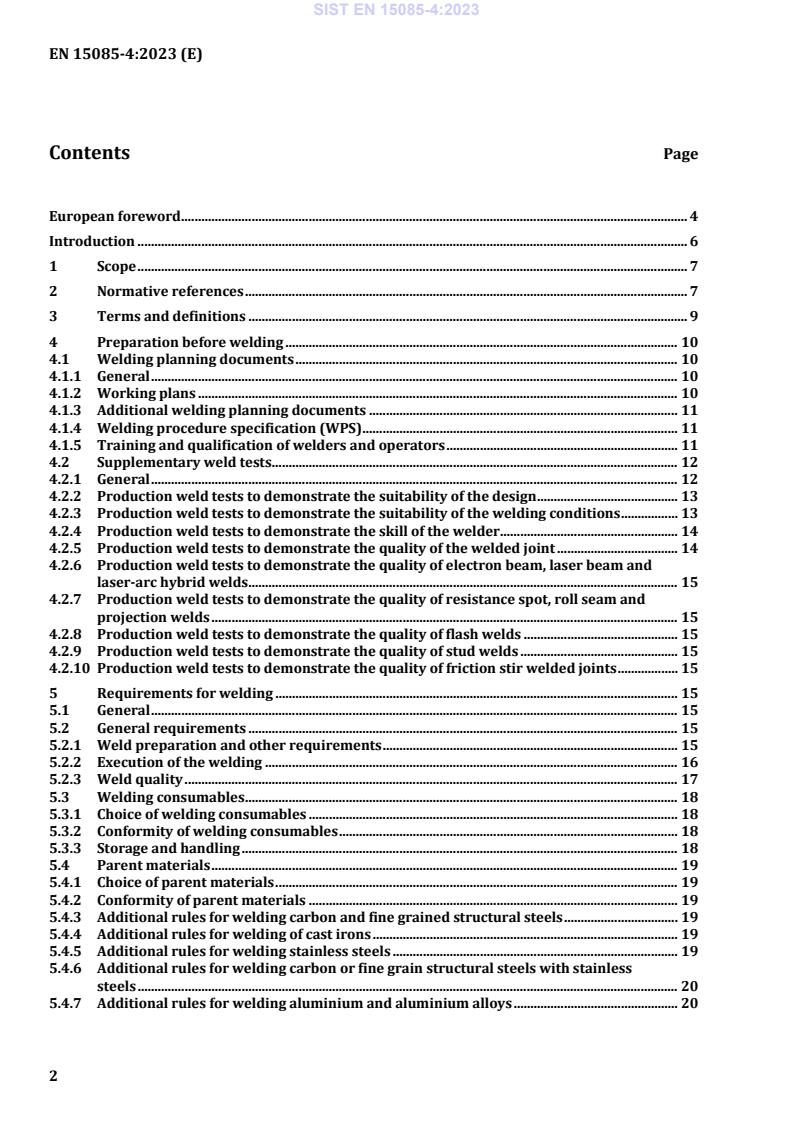
Contents Page
European foreword . 4
Introduction . 6
1 Scope . 7
2 Normative references . 7
3 Terms and definitions . 9
4 Preparation before welding . 10
4.1 Welding planning documents . 10
4.1.1 General . 10
4.1.2 Working plans . 10
4.1.3 Additional welding planning documents . 11
4.1.4 Welding procedure specification (WPS) . 11
4.1.5 Training and qualification of welders and operators . 11
4.2 Supplementary weld tests . 12
4.2.1 General . 12
4.2.2 Production weld tests to demonstrate the suitability of the design . 13
4.2.3 Production weld tests to demonstrate the suitability of the welding conditions . 13
4.2.4 Production weld tests to demonstrate the skill of the welder . 14
4.2.5 Production weld tests to demonstrate the quality of the welded joint . 14
4.2.6 Production weld tests to demonstrate the quality of electron beam, laser beam and
laser-arc hybrid welds . 15
4.2.7 Production weld tests to demonstrate the quality of resistance spot, roll seam and
projection welds . 15
4.2.8 Production weld tests to demonstrate the quality of flash welds . 15
4.2.9 Production weld tests to demonstrate the quality of stud welds . 15
4.2.10 Production weld tests to demonstrate the quality of friction stir welded joints . 15
5 Requirements for welding . 15
5.1 General . 15
5.2 General requirements . 15
5.2.1 Weld preparation and other requirements . 15
5.2.2 Execution of the welding . 16
5.2.3 Weld quality . 17
5.3 Welding consumables . 18
5.3.1 Choice of welding consumables . 18
5.3.2 Conformity of welding consumables . 18
5.3.3 Storage and handling . 18
5.4 Parent materials . 19
5.4.1 Choice of parent materials . 19
5.4.2 Conformity of parent materials . 19
5.4.3 Additional rules for welding carbon and fine grained structural steels . 19
5.4.4 Additional rules for welding of cast irons . 19
5.4.5 Additional rules for welding stainless steels . 19
5.4.6 Additional rules for welding carbon or fine grain structural steels with stainless
steels . 20
5.4.7 Additional rules for welding aluminium and aluminium alloys . 20
5.5 Welding processes . 20
Annex A (informative) Guidance on the choice of filler material . 22
A.1 General . 22
A.2 Non-alloy steel with non alloy steel . 22
A.3 Stainless steel with stainless steel or non alloy steel . 22
A.4 Aluminium and its alloys . 23
A.5 Other parent metals . 23
Annex ZA (informative) Relationship between this European Standard and the Essential
Requirements of Directive (EU) 2016/797 aimed to be covered . 26
Bibliography . 28
European foreword
This document (EN 15085-4:2023) has been prepared by Technical Committee CEN/TC 256 “Railway
applications”, the secretariat of which is held by DIN.
This European Standard shall be given the status of a national standard, either by publication of an
identical text or by endorsement, at the latest by September 2023, and conflicting national standards shall
be withdrawn at the latest by September 2023.
Attention is drawn to the possibility that some of the elements of this document may be the subject of
patent rights. CEN shall not be held responsible for identifying any or all such patent rights.
This document supersedes EN 15085-4:2007.
This series of European Standards EN 15085 “Railway applications – Welding of railway vehicles and
components” consists of the following parts:
— Part 1: General;
— Part 2: Requirements for welding manufacturers;
— Part 3: Design requirements;
— Part 4: Production requirements;
— Part 5: Inspection, testing and documentation;
— Part 6: Maintenance welding requirements.
a) Normative reference have been updated;
b) Clause 4, Preparation before welding has been revised;
c) Clause 5, Requirements for welding has been revised;
d) Clause 6, Special requirements for maintenance welding of railway vehicles has been deleted
e) Annex A, Guidance on the choice of filler material has been added
f) Annex ZA has been added.
This document has been prepared under a Standardization Request given to CEN by the European
Commission and the European Free Trade Association, and supports essential requirements of EU
Directive(s) / Regulation(s).
For relationship with EU Directive(s) / Regulation(s), see informative Annex ZA, which is an integral part
of this document.
Any feedback and questions on this document should be directed to the users’ national standards body.
A complete listing of these bodies can be found on the CEN website.
According to the CEN-CENELEC Internal Regulations, the national standards organisations of the
following countries are bound to implement this European Standard: Austria, Belgium, Bulgaria, Croatia,
Cyprus, Czech Republic, Denmark, Estonia, Finland, France, Germany, Greece, Hungary, Iceland, Ireland,
Italy, Latvia, Lithuania, Luxembourg, Malta, Netherlands, Norway, Poland, Portugal, Republic of North
Macedonia, Romania, Serbia, Slovakia, Slovenia, Spain, Sweden, Switzerland, Türkiye and the United
Kingdom.
Introduction
Welding is a special process in the manufacture of railway vehicles and their parts. The required
provisions for this process are defined in the standards series EN ISO 3834. The basis of these provisions
is the basic technical welding standards with respect to the special requirements for the construction of
railway vehicles.
This series of standards applies to welding of metallic materials in the manufacture and maintenance of
railway vehicles and their parts.
It describes the control for the welding process for railway vehicles and their components for new
manufacture and maintenance.
With respect to the railway environment, this series of standards defines the quality requirements for the
welding manufacturer to undertake new building and repair work.
Components, parts and subassemblies are assigned a classification level, based on their safety relevance.
According to these levels, qualifications for welding personnel of the manufacturer are specified.
This series provides an essential link between the weld performance class defined during design, the
quality of the weld, and the demonstration of the required quality by inspection.
This series of standards does not deal with product qualification.
NOTE This series of standards can also be used by internal and external parties, including certification bodies,
to assess the organization's ability to meet customer, regulatory and the organization's own requirements.
1 Scope
This document specifies the production requirements (i.e. preparation and execution) of the welding
work on railway vehicles and components.
2 Normative references
The following documents are referred to in the text in such a way that some or all of their content
constitutes requirements of this document. For dated references, only the edition cited applies. For
undated references, the latest edition of the referenced document (including any amendments) applies.
EN 1011-1:2009, Welding - Recommendations for welding of metallic materials - Part 1: General guidance
for arc welding
EN 1011-2:2001, Welding - Recommendations for welding of metallic materials - Part 2: Arc welding of
ferritic steels
EN 1011-3:2018, Welding - Recommendations for welding of metallic materials - Part 3: Arc welding of
stainless steels
EN 1011-4:2000, Welding - Recommendations for welding of metallic materials - Part 4: Arc welding of
aluminium and aluminium alloys
EN 1011-5:2003, Welding - Recommendations for welding of metallic materials - Part 5: Welding of clad
steel
EN 1011-6:2018, Welding - Recommendation for welding of metallic materials - Part 6: Laser beam welding
EN 1011-7:2004, Welding - Recommendations for welding of metallic materials - Part 7: Electron beam
welding
EN 1011-8:2018, Welding - Recommendations for welding of metallic materials - Part 8: Welding of cast
irons
EN 287-6:2018, Qualification test of welders - Fusion welding - Part 6: Cast irons
EN 10204:2004, Metallic products - Types of inspection documents
EN 14532-1:2004, Welding consumables - Test methods and quality requirements - Part 1: Primary
methods and conformity assessment of consumables for steel, nickel and nickel alloys
EN 14532-2:2004, Welding consumables - Test methods and quality requirements - Part 2: Supplementary
methods and conformity assessment of consumables for steel, nickel and nickel alloys
EN 15085-1:— , Railway applications — Welding of railway vehicles and components — Part 1: General
EN 15085-3:2022, Railway applications - Welding of railway vehicles and components - Part 3: Design
requirements
Under preparation. Stage at time of publication: prEN 15085-1:2021.
EN 15085-5:2023, Railway applications - Welding of railway vehicles and components - Part 5: Inspection,
testing and documentation
EN 10025-1:2004, Hot rolled products of structural steels - Part 1: General technical delivery conditions
EN 10340:2007, Steel castings for structural uses
EN ISO 544:2017, Welding consumables - Technical delivery conditions for filler materials and fluxes - Type
of product, dimensions, tolerances and markings (ISO 544:2017)
EN ISO 4063:2010, Welding and allied processes - Nomenclature of processes and reference numbers (ISO
4063:2009, Corrected version 2010-03-01)
EN ISO 9606-1:2017, Qualification testing of welders - Fusion welding - Part 1: Steels (ISO 9606-1:2012
including Cor 1:2012 and Cor 2:2013)
EN ISO 9606-2:2004, Qualification test of welders - Fusion welding - Part 2: Aluminium and aluminium
alloys (ISO 9606-2:2004)
EN ISO 9606-3:1999, Approval testing of welders - Fusion welding - Part 3: Copper and copper alloys (ISO
9606-3:1999)
EN ISO 9606-4:1999, Approval testing of welders - Fusion welding - Part 4: Nickel and nickel alloys (ISO
9606-4:1999)
EN ISO 9606-5:2000, Approval testing of welders - Fusion welding - Part 5: Titanium and titanium alloys,
zirconium and zirconium alloys (ISO 9606-5:2000)
EN ISO 14555:2017, Welding - Arc stud welding of metallic materials (ISO 14555:2017)
EN ISO 14732:2013, Welding personnel - Qualification testing of welding operators and weld setters for
mechanized and automatic welding of metallic materials (ISO 14732:2013)
EN ISO 15609-1:2019, Specification and qualification of welding procedures for metallic materials -
Welding procedure specification - Part 1: Arc welding (ISO 15609-1:2019)
EN ISO 15609-2:2019, Specification and qualification of welding procedures for metallic materials -
Welding procedure specification - Part 2: Gas welding (ISO 15609-2:2019)
EN ISO 15609-3:2004, Specification and qualification of welding procedures for metallic materials -
Welding procedures specification - Part 3: Electron beam welding (ISO 15609-3:2004)
EN ISO 15609-4:2009, Specification and qualification of welding procedures for metallic materials -
Welding procedure specification - Part 4: Laser beam welding (ISO 15609-4:2009)
EN ISO 15609-5:2011, Specification and qualification of welding procedures for metallic materials -
Welding procedure specification - Part 5: Resistance welding (ISO 15609-5:2011, Corrected version 2011-
12-01)
EN ISO 15609-6:2013, Specification and qualification of welding procedures for metallic materials -
Welding procedure specification - Part 6: Laser-arc hybrid welding (ISO 15609-6:2013)
EN ISO 15613:2004, Specification and qualification of welding procedures for metallic materials -
Qualification based on pre-production welding test (ISO 15613:2004)
EN ISO 15614-1:2017, Specification and qualification of welding procedures for metallic materials -
Welding procedure test - Part 1: Arc and gas welding of steels and arc welding of nickel and nickel alloys
(ISO 15614-1:2017, Corrected version 2017-10-01)
EN ISO 15614-2:2005, Specification and qualification of welding procedures for metallic materials -
Welding procedure test - Part 2: Arc welding of aluminium and its alloys (ISO 15614-2:2005)
EN ISO 15614-3:2008, Specification and qualification of welding procedures for metallic materials -
Welding procedure test - Part 3: Fusion welding of non-alloyed and low-alloyed cast irons (ISO 15614-
3:2008)
EN ISO 15614-4:2005, Specification and qualification of welding procedures for metallic materials -
Welding procedure test - Part 4: Finishing welding of aluminium castings (ISO 15614-4:2005)
EN ISO 15614-7:2019, Specification and qualification of welding procedures for metallic materials -
Welding procedure test - Part 7: Overlay welding (ISO 15614-7:2016)
EN ISO 15614-11:2002, Specification and qualification of welding procedures for metallic materials -
Welding procedure test - Part 11: Electron and laser beam welding (ISO 15614-11:2002)
EN ISO 15614-12:2021, Specification and qualification of welding procedures for metallic materials -
Welding procedure test - Part 12: Spot, seam and projection welding (ISO 15614-12:2021)
EN ISO 15614-13:2021, Specification and qualification of welding procedures for metallic materials -
Welding procedure test - Part 13: Upset (resistance butt) and flash welding (ISO 15614-13:2021)
EN ISO 15620:2019, Welding - Friction welding of metallic materials (ISO 15620:2019)
EN ISO 17652-1:2003, Welding - Test for shop primers in relation to welding and allied processes - Part 1:
General requirements (ISO 17652-1:2003)
EN ISO 17652-2:2003, Welding - Test for shop primers in relation to welding and allied processes - Part 2:
Welding properties of shop primers (ISO 17652-2:2003)
EN ISO 25239-3:2020, Friction stir welding - Aluminium - Part 3: Qualification of welding operators (ISO
25239-3:2020)
EN ISO 25239-5:2020, Friction stir welding - Aluminium - Part 5: Quality and inspection requirements (ISO
25239-5:2020)
3 Terms and definitions
For the purposes of this document, the terms and definitions given in EN 15085-1:— apply.
ISO and IEC maintain terminological databases for use in standardization at the following addresses:
— ISO Online browsing platform: available at http://www.iso.org/obp
— IEC Electropedia: available at http://www.electropedia.org/
4 Preparation before welding
4.1 Welding planning documents
4.1.1 General
Welding planning documents shall be prepared by the manufacturer with the assistance of the
responsible welding coordinator.
When the technical specification requires approval of welding planning documents, these shall be
submitted prior to starting the welding activity. Welding planning documents may include working plans,
welding sequence plans, test planning documents, and welding procedure specifications.
Weld preparations defined in the drawing may be adapted for manufacturing under the supervision of
the responsible welding coordinator. However, the following changes shall not be made without
permission from the design department:
— weld type;
— reduction of the weld performance class;
— reduction of the weld inspection class;
— base material;
— minimum mechanical properties of welded joints;
— welding consumables specification;
— reduction of weld throat thickness;
— location of the weld;
— addition of welded joints;
— elimination of welded joints;
— addition of tack welds or temporary attachments outside of the joint preparation.
Any changes resulting from manufacturing adaptation shall be documented and included in the welding
planning documents.
4.1.2 Working plans
For the production of railway vehicles and components, a documented and controlled process of
manufacturing operations shall be available for the following sub-assemblies:
— bogie (sub-assemblies, assembly);
— underframe (with sub-assemblies);
— car body components (side wall, end wall, roof);
— car body assembly;
— further sub-assemblies with high safety relevance (e.g. cardan shafts, motor housing, hollow shaft
drive, drawbar coupling, bogie pivot pin).
4.1.3 Additional welding planning documents
For series production, in addition to the working plan, tacking and welding sequence plans may be used
to minimize weld shrinkage and distortion, to reduce residual stresses and to avoid missing welds, e.g.
for:
— bogie frames and their components, and
— underframes and their components.
Standardized welding sequence plans (that applies for different types of components) are also allowed.
Other welding planning documents may be necessary (e.g. repairing plans, documents for jigs and tools,
plans for cutting off damaged parts).
An inspection and test plan shall be prepared according to EN 15085-5:2023.
4.1.4 Welding procedure specification (WPS)
WPS according to the relevant part of EN ISO 15609:2019, EN ISO 14555:2017, EN ISO 15620:2019 or
EN ISO 25239:2020 are required for all weld performance classes except CP D. For weld performance
class CP D a welding instruction shall be prepared.
For all weld performance classes except CP D a welding procedure specification shall be supported by a
WPQR according to the relevant part of the following standards:
• EN ISO 15613:2004;
• EN ISO 15614 series (for EN ISO 15614 only level 2 is applicable);
• EN ISO 14555:2017;
• EN ISO 15620:2019;
• EN ISO 25239:2020.
For fillet welds a separate fillet weld qualification is necessary.
The manufacturer shall have a written procedure detailing how to manage the welding procedure
qualification process.
Each WPS shall be verified and authorized for use by the responsible welding coordinator or by the
welding coordinator in charge.
4.1.5 Training and qualification of welders and operators
The manufacturer shall have welders and welding operators qualified in accordance with EN ISO 9606
series, EN 287-6:2018, EN ISO 14555:2017, EN ISO 14732:2013 or EN ISO 25239-3:2020. Additionally,
all welding personnel should be trained for welding related tasks that are performed in the workshop
(e.g. grinding, flame cutting, tacking, etc.). The manufacturer shall maintain a list of the valid qualifications
of its welders and welding operators.
The manufacturer shall have an adequate number of qualified welders and welding operators. It is
recommended that at least two welders or welding operators, employed by the manufacturer, should be
qualified for each welding process and material type/grade.
For qualification according to the EN ISO 9606 series of standards the following rules shall be applied:
— For fillet welds a separate fillet weld qualification is necessary.
— The FW/BW – test sample according to EN ISO 9606-1:2017, Annex C is not permitted.
In addition, welders and operators should be trained about in the following as needed:
— checking the correct condition / operation of the welding equipment and its calibration status;
— use of and compliance with the relevant welding planning documents;
— checking of joint preparations;
— welding consumable designations;
— methods of cleaning, controlling preheating and inter-pass temperatures, and post weld heat
treatment;
— reading welding drawings and welding symbols;
— weld acceptance criteria;
— correct use and application of tack welds;
— content of this document, 5.2 (and applicable parts of EN 1011:2009);
— safety at work.
For welding of steel the revalidation of the qualification of welders shall be in accordance with
EN ISO 9606-1:2017, 9.3 option a or b.
4.2 Supplementary weld tests
4.2.1 General
4.2.1.1 Objectives of production weld tests
Due to the diversity of the welded joint types required in the manufacture of railway vehicles, the
responsible welding coordinator may decide to undertake production weld tests (supplementary weld
tests) to demonstrate that the required weld quality level can be, or has been, achieved.
The objectives of production weld tests are:
— to demonstrate the suitability of the design (see 4.2.2);
— to demonstrate the suitability of the welding procedure for specific joint types (see 4.2.3);
— to demonstrate the skill of the welders (see 4.2.4);
— to demonstrate the quality of the welded joint (see 4.2.5 to 4.2.10).
One production weld test may be used to demonstrate that the requirements indicated above have been
satisfied. With the exception of the production weld test to demonstrate the skill of the welder, the period
of validity of a production weld test is unlimited provided that the conditions are unchanged.
4.2.1.2 Realization and amount of production weld testing
The necessity for production weld tests and the amount of testing shall be specified by the welding
coordinator during the design review or the manufacturing phase.
Where production weld tests are deemed necessary, these shall be performed using the same
manufacturing conditions as the product, under the supervision of the welding coordinator and they shall
be documented.
The production weld tests may be welded as a separate test sample, as a mock-up of the production
assembly, or as an extension of the production weld.
The production weld tests and the amount of testing should be identified in the weld test plan by the
welding coordinator.
The results of all production weld testing shall be documented.
The results of the production weld testing shall be reviewed and approved by the welding coordinator.
4.2.2 Production weld tests to demonstrate the suitability of the design
Production weld test samples to demonstrate the suitability of the design should be welded as a mock-
up during the design phase. These are typically used to demonstrate:
— practicability (design which is suitable for welding);
— selection of the correct material;
— feasibility of testing;
— achieving the quality requirements;
— mechanical property data (e.g. strength, ductility).
The amount and type of testing shall be in accordance with EN ISO 15613:2004 and shall be defined in
the test plan. Additional testing may be requested by the welding coordinator when deemed necessary.
Production weld test results may be used as evidence to support similar designs providing that the
manufacturing conditions are comparable.
4.2.3 Production weld tests to demonstrate the suitability of the welding conditions
For joint types with a different configuration than those used for qualification according to the
EN ISO 15614 series of standards, production weld tests may be used to provide evidence of the correct
fusion and quality of the weld. The welding coordinator shall decide which production weld tests are
necessary for example:
— partial penetration butt and T joints;
— welds where the quality is diffic
...