


EN 1015-1:1998
(Main)Methods of test for mortar for masonry - Part 1: Determination of particle size distribution (by sieve analysis)
General Information
- Abstract
This European Standard specifies two methods of determining the particle size distribution of dry mixed or non hardened wet mixed mortars. The method of wet sieving is applicable to mortars containing normal weight aggregates and the method of dry sieving to mortars containing lightweight aggregates. This European standard does not cover particle size distribution of separate aggregates which should be determined in accordance with the test method described in European Standard EN 933, nor does it cover mixes containing fibres which cannot be removed before sieving.
- Status
- Published
- Publication Date
- 20-Oct-1998
- Technical Committee
- CEN/TC 125 - Masonry
- Drafting Committee
- CEN/TC 125/WG 4 - Test methods
- Current Stage
- 9093 - Decision to confirm - Review Enquiry
- Start Date
- 23-Jan-2025
- Completion Date
- 17-Sep-2026
- Directive
- Harmonized Standard305/2011 - Regulation (eu) No 305/2011 of the European Parliament and of the Council of 9 march 2011 laying down harmonised conditions for the marketing of construction products and repealing council directive 89/106/eec
Not Harmonized89/106/EEC - Construction products
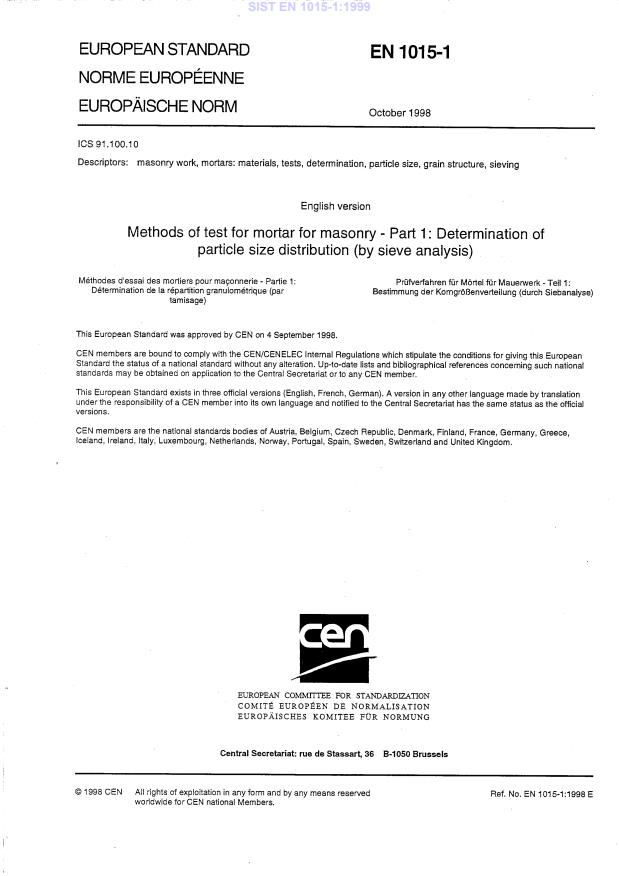
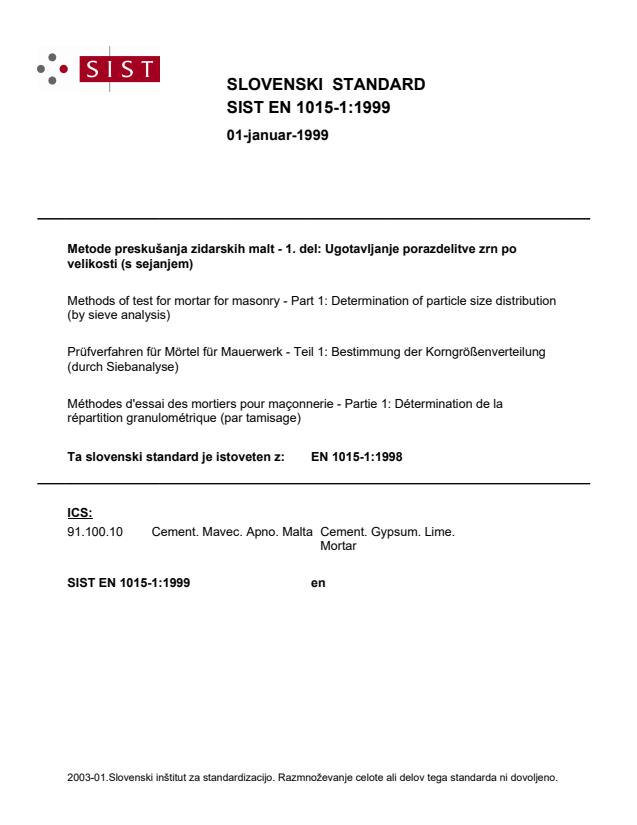

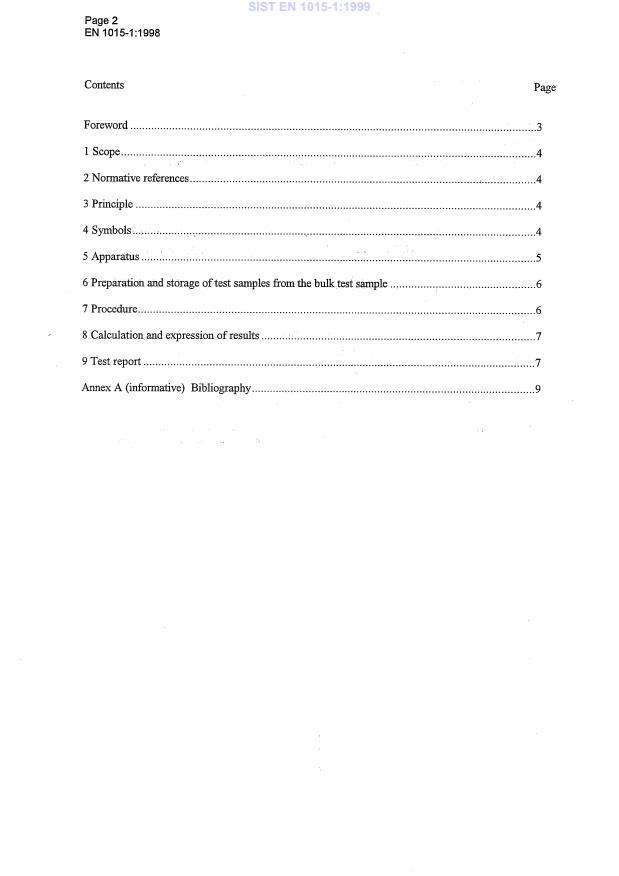
Overview
EN 1015-1:1998 is a European Standard established by CEN that specifies precise methods for determining the particle size distribution of mortar used in masonry. This standard covers both dry mixed mortars and non-hardened wet mixed mortars, ensuring reliable and consistent results through standardized sieve analysis techniques. The determination of particle size distribution is critical for assessing the quality and performance characteristics of masonry mortars, directly influencing workability, strength, and durability.
The standard defines two test methods: wet sieving and dry sieving. Wet sieving is intended for mortars containing normal weight aggregates, whereas dry sieving applies to mortars with lightweight aggregates. It is important to note that EN 1015-1:1998 excludes the particle size analysis of separate aggregates and fiber-containing mixes, which should be tested according to other relevant standards.
Key Topics
- Particle size distribution: Essential characterization of mortar granulometry to optimize masonry performance.
- Test methods:
- Wet sieving: Used for mortars with normal weight aggregates; involves sieving wet mixed mortar to separate particles by size.
- Dry sieving: Applicable to mortars containing lightweight aggregates; involves sieving dry mixed mortar particles.
- Scope exclusions:
- Particle size testing of individual aggregates is covered under EN 933.
- Mortar mixes containing fibers that cannot be removed prior to sieving are not addressed.
- Material specifications: Applies to dry mixed and non-hardened wet mixed mortars for masonry applications.
- Accuracy and reproducibility: Provides standardized procedures to ensure comparable results across laboratories and projects.
Applications
EN 1015-1:1998 serves as a vital reference for construction professionals, testing laboratories, and material manufacturers who assess the quality and suitability of masonry mortars. The standard's methods facilitate:
- Quality control during mortar production by verifying the correct particle size distribution.
- Material specification compliance to ensure mortar mixes meet technical requirements.
- Performance optimization by understanding how particle size affects properties such as workability, curing behavior, and strength development.
- Research and development of new mortar formulations targeting enhanced durability and mechanical characteristics.
- Ensuring conformity with European construction regulations by following harmonized testing protocols.
Related Standards
To complement EN 1015-1:1998, several other European and international standards regulate related aspects of masonry mortar testing and aggregate characterization:
- EN 933 – Tests for geometrical properties of aggregates, including particle size distribution of individual aggregate components.
- EN 1015-11 – Methods of test for mortar for masonry - Determination of flexural and compressive strength.
- EN 998-1 – Specification for mortar for masonry – Requirements, ensuring overall compliance of materials.
- EN 196-1 – Methods of testing cement - Chemical and physical testing including particle size impact on cement behavior.
Applying EN 1015-1 in conjunction with these related standards ensures comprehensive quality assurance and material characterization for masonry mortars, leading to more durable and reliable construction outcomes.
Keywords: EN 1015-1:1998, particle size distribution, mortar testing, sieve analysis, masonry mortar, wet sieving, dry sieving, lightweight aggregates, normal weight aggregates, mortar quality control, European Standard, CEN standards.
Relations
- Effective Date
- 28-Jan-2026
- Effective Date
- 28-Jan-2026
- Effective Date
- 28-Jan-2026
- Effective Date
- 28-Jan-2026
- Effective Date
- 28-Jan-2026
- Effective Date
- 28-Jan-2026
- Effective Date
- 28-Jan-2026
- Effective Date
- 28-Jan-2026
- Effective Date
- 22-Dec-2008
Get Certified
Connect with accredited certification bodies for this standard

DIBt (Deutsches Institut für Bautechnik)
German Institute for Building Technology.
DIN CERTCO
DIN Group product certification.

Aboma Certification B.V.
Specialized in construction, metal, and transport sectors.
Sponsored listings
Frequently Asked Questions
EN 1015-1:1998 is a standard published by the European Committee for Standardization (CEN). Its full title is "Methods of test for mortar for masonry - Part 1: Determination of particle size distribution (by sieve analysis)". This standard covers: This European Standard specifies two methods of determining the particle size distribution of dry mixed or non hardened wet mixed mortars. The method of wet sieving is applicable to mortars containing normal weight aggregates and the method of dry sieving to mortars containing lightweight aggregates. This European standard does not cover particle size distribution of separate aggregates which should be determined in accordance with the test method described in European Standard EN 933, nor does it cover mixes containing fibres which cannot be removed before sieving.
This European Standard specifies two methods of determining the particle size distribution of dry mixed or non hardened wet mixed mortars. The method of wet sieving is applicable to mortars containing normal weight aggregates and the method of dry sieving to mortars containing lightweight aggregates. This European standard does not cover particle size distribution of separate aggregates which should be determined in accordance with the test method described in European Standard EN 933, nor does it cover mixes containing fibres which cannot be removed before sieving.
EN 1015-1:1998 is classified under the following ICS (International Classification for Standards) categories: 91.100.10 - Cement. Gypsum. Lime. Mortar. The ICS classification helps identify the subject area and facilitates finding related standards.
EN 1015-1:1998 has the following relationships with other standards: It is inter standard links to EN 1015-2:1998, EN 13498:2002, EN 998-2:2016, EN 13495:2002, EN 13497:2002, EN 16383:2016, EN 998-2:2010, EN 13494:2002, EN 1015-1:1998/A1:2006. Understanding these relationships helps ensure you are using the most current and applicable version of the standard.
EN 1015-1:1998 is associated with the following European legislation: EU Directives/Regulations: 305/2011, 89/106/EEC. When a standard is cited in the Official Journal of the European Union, products manufactured in conformity with it benefit from a presumption of conformity with the essential requirements of the corresponding EU directive or regulation.
EN 1015-1:1998 is available in PDF format for immediate download after purchase. The document can be added to your cart and obtained through the secure checkout process. Digital delivery ensures instant access to the complete standard document.
Standards Content (Sample)
2003-01.Slovenski inštitut za standardizacijo. Razmnoževanje celote ali delov tega standarda ni dovoljeno.Metode preskušanja zidarskih malt - 1. del: Ugotavljanje porazdelitve zrn po velikosti (s sejanjem)Prüfverfahren für Mörtel für Mauerwerk - Teil 1: Bestimmung der Korngrößenverteilung (durch Siebanalyse)Méthodes d'essai des mortiers pour maçonnerie - Partie 1: Détermination de la répartition granulométrique (par tamisage)Methods of test for mortar for masonry - Part 1: D
...