


EN 998-2:2010
(Main)Specification for mortar for masonry - Part 2: Masonry mortar
General Information
- Abstract
This European Standard specifies requirements for factory made masonry mortars (bedding, jointing and pointing) for use in masonry walls, columns and partitions (e.g. facing and rendered masonry, load bearing or non-load bearing masonry structures for building and civil engineering).
This European Standard defines for fresh mortars the performance related to workable life, chloride content, air content, density and correction time (for thin-layer mortars only). For hardened mortars it defines e.g. performances related to compressive strength, bond strength, density measured according to the corresponding test methods contained in separate European Standards.
This European Standard provides for the evaluation of conformity of the product to this European Standard.
The marking requirement for products covered by this European Standard is included.
This European Standard covers masonry mortars defined in Clause 3 with the exception of site made mortars. However, this European Standard or part of this European Standard may be used in conjunction with codes of applications and national specifications covering site made mortars.
- Status
- Withdrawn
- Publication Date
- 14-Sep-2010
- Withdrawal Date
- 22-Sep-2026
- Technical Committee
- CEN/TC 125 - Masonry
- Drafting Committee
- CEN/TC 125/WG 2 - Mortar
- Current Stage
- 9960 - Withdrawal effective - Withdrawal
- Start Date
- 09-Nov-2016
- Completion Date
- 23-Sep-2026
- Directive
- Harmonized Standard305/2011 - Regulation (eu) No 305/2011 of the European Parliament and of the Council of 9 march 2011 laying down harmonised conditions for the marketing of construction products and repealing council directive 89/106/eecOJ Ref: C, C 259 OJ Date: 08-Aug-2014
Not Harmonized89/106/EEC - Construction productsOJ Ref: C, C 344 OJ Date: 17-Dec-2010

Relations
- Effective Date
- 13-May-2009
- Effective Date
- 16-Nov-2016
- Effective Date
- 28-Jan-2026
- Effective Date
- 28-Jan-2026
- Effective Date
- 28-Jan-2026
- Effective Date
- 28-Jan-2026
- Effective Date
- 28-Jan-2026
- Effective Date
- 28-Jan-2026
- Effective Date
- 28-Jan-2026
- Effective Date
- 28-Jan-2026
- Effective Date
- 28-Jan-2026
- Effective Date
- 28-Jan-2026
- Effective Date
- 28-Jan-2026
- Effective Date
- 28-Jan-2026
- Refers
EN 771-5:2011+A1:2015 - Specification for masonry units - Part 5: Manufactured stone masonry units - Effective Date
- 28-Jan-2026
Get Certified
Connect with accredited certification bodies for this standard

DIBt (Deutsches Institut für Bautechnik)
German Institute for Building Technology.
DIN CERTCO
DIN Group product certification.

Aboma Certification B.V.
Specialized in construction, metal, and transport sectors.
Sponsored listings
Frequently Asked Questions
EN 998-2:2010 is a standard published by the European Committee for Standardization (CEN). Its full title is "Specification for mortar for masonry - Part 2: Masonry mortar". This standard covers: This European Standard specifies requirements for factory made masonry mortars (bedding, jointing and pointing) for use in masonry walls, columns and partitions (e.g. facing and rendered masonry, load bearing or non-load bearing masonry structures for building and civil engineering). This European Standard defines for fresh mortars the performance related to workable life, chloride content, air content, density and correction time (for thin-layer mortars only). For hardened mortars it defines e.g. performances related to compressive strength, bond strength, density measured according to the corresponding test methods contained in separate European Standards. This European Standard provides for the evaluation of conformity of the product to this European Standard. The marking requirement for products covered by this European Standard is included. This European Standard covers masonry mortars defined in Clause 3 with the exception of site made mortars. However, this European Standard or part of this European Standard may be used in conjunction with codes of applications and national specifications covering site made mortars.
This European Standard specifies requirements for factory made masonry mortars (bedding, jointing and pointing) for use in masonry walls, columns and partitions (e.g. facing and rendered masonry, load bearing or non-load bearing masonry structures for building and civil engineering). This European Standard defines for fresh mortars the performance related to workable life, chloride content, air content, density and correction time (for thin-layer mortars only). For hardened mortars it defines e.g. performances related to compressive strength, bond strength, density measured according to the corresponding test methods contained in separate European Standards. This European Standard provides for the evaluation of conformity of the product to this European Standard. The marking requirement for products covered by this European Standard is included. This European Standard covers masonry mortars defined in Clause 3 with the exception of site made mortars. However, this European Standard or part of this European Standard may be used in conjunction with codes of applications and national specifications covering site made mortars.
EN 998-2:2010 is classified under the following ICS (International Classification for Standards) categories: 91.100.10 - Cement. Gypsum. Lime. Mortar. The ICS classification helps identify the subject area and facilitates finding related standards.
EN 998-2:2010 has the following relationships with other standards: It is inter standard links to EN 998-2:2003, EN 998-2:2016, EN 1745:2002, EN 1015-17:2000, EN 1015-2:1998, EN 1015-10:1999, EN 771-6:2011+A1:2015, EN 1015-7:1998, EN 1015-9:1999, EN 771-3:2011+A1:2015, EN 1015-11:2019, EN 13501-1:2018, EN 771-4:2011+A1:2015, EN 1015-18:2002, EN 771-5:2011+A1:2015. Understanding these relationships helps ensure you are using the most current and applicable version of the standard.
EN 998-2:2010 is associated with the following European legislation: EU Directives/Regulations: 305/2011, 89/106/EEC; Standardization Mandates: M/116. When a standard is cited in the Official Journal of the European Union, products manufactured in conformity with it benefit from a presumption of conformity with the essential requirements of the corresponding EU directive or regulation.
EN 998-2:2010 is available in PDF format for immediate download after purchase. The document can be added to your cart and obtained through the secure checkout process. Digital delivery ensures instant access to the complete standard document.
Standards Content (Sample)
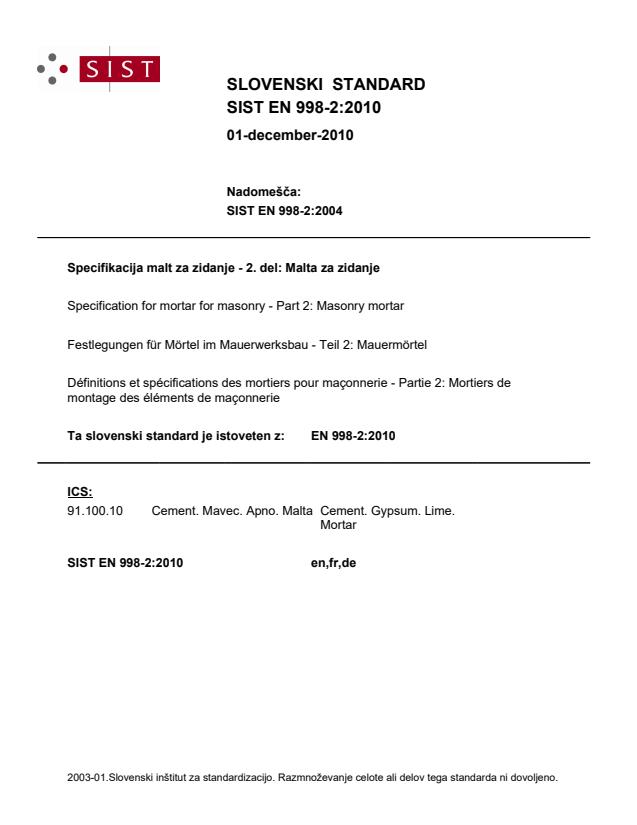
2003-01.Slovenski inštitut za standardizacijo. Razmnoževanje celote ali delov tega standarda ni dovoljeno.Specifikacija malt za zidanje - 2. del: Malta za zidanjeFestlegungen für Mörtel im Mauerwerksbau - Teil 2: MauermörtelDéfinitions et spécifications des mortiers pour maçonnerie - Partie 2: Mortiers de montage des éléments de maçonnerieSpecification for mortar for masonry - Part 2: Masonry mortar91.100.10Cement. Mavec. Apno. MaltaCement. Gypsum. Lime. MortarICS:Ta slovenski standard je istoveten z:EN 998-2:2010SIST EN 998-2:2010en,fr,de01-december-2010SIST EN 998-2:2010SLOVENSKI
STANDARDSIST EN 998-2:20041DGRPHãþD
EUROPEAN STANDARD NORME EUROPÉENNE EUROPÄISCHE NORM
EN 998-2
September 2010 ICS 91.100.10 Supersedes EN 998-2:2003English Version
Specification for mortar for masonry - Part 2: Masonry mortar
Définitions et spécifications des mortiers pour maçonnerie -Partie 2: Mortiers de montage des éléments de maçonnerie Festlegungen für Mörtel im Mauerwerksbau - Teil 2: Mauermörtel This European Standard was approved by CEN on 12 August 2010.
CEN members are bound to comply with the CEN/CENELEC Internal Regulations which stipulate the conditions for giving this European Standard the status of a national standard without any alteration. Up-to-date lists and bibliographical references concerning such national standards may be obtained on application to the CEN Management Centre or to any CEN member.
This European Standard exists in three official versions (English, French, German). A version in any other language made by translation under the responsibility of a CEN member into its own language and notified to the CEN Management Centre has the same status as the official versions.
CEN members are the national standards bodies of Austria, Belgium, Bulgaria, Croatia, Cyprus, Czech Republic, Denmark, Estonia, Finland, France, Germany, Greece, Hungary, Iceland, Ireland, Italy, Latvia, Lithuania, Luxembourg, Malta, Netherlands, Norway, Poland, Portugal, Romania, Slovakia, Slovenia, Spain, Sweden, Switzerland and United Kingdom.
EUROPEAN COMMITTEE FOR STANDARDIZATION
COMITÉ EUROPÉEN DE NORMALISATION EUROPÄISCHES KOMITEE FÜR NORMUNG
Management Centre:
Avenue Marnix 17,
B-1000 Brussels © 2010 CEN All rights of exploitation in any form and by any means reserved worldwide for CEN national Members. Ref. No. EN 998-2:2010: ESIST EN 998-2:2010
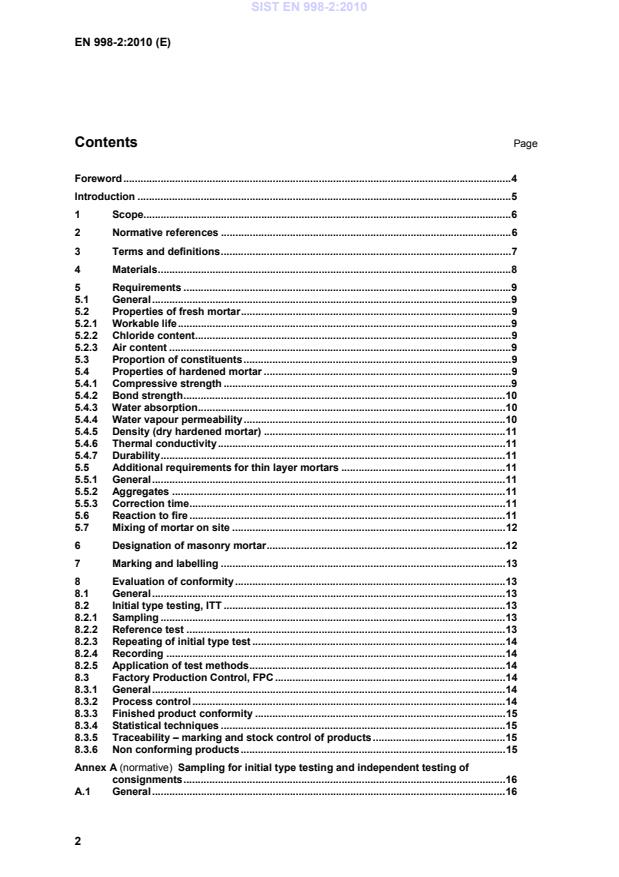
Sampling for initial type testing and independent testing of consignments . 16A.1 General . 16SIST EN 998-2:2010
Use of masonry units and masonry mortar . 17Annex C (normative)
Characteristic initial shear strength of designed masonry mortars . 19Annex ZA (informative)
Clauses of this European Standard addressing the provisions of EU Construction Products Directive . 20Bibliography . 29 SIST EN 998-2:2010
When the masonry mortar is sampled from a consignment in accordance with EN 1015-2 and tested in accordance with EN 1015-11 the compressive strength shall not be less than the declared compressive strength or the declared compressive strength class. It shall be declared if the air-lime content calculated as calcium hydroxide Ca(OH)2 is equal to or higher than 50 % of the total amount of binder mass. 5.4.2 Bond strength For designed masonry mortars intended to be used in elements subjected to structural requirements the bond strength of the mortar in combination with a masonry unit shall be declared in terms of the characteristic initial shear strength. The declaration may be made either on the basis of tests as a) below or tabulated values as b) below. The manufacturer shall declare the basis for his declaration. a) Declaration based on tests The characteristic initial shear strength of the mortar in combination with a specific type of unit in accordance with EN 771 may be based on tests on mortar sampled from a consignment in accordance with EN 1015-2 and tested with the relevant unit in accordance with EN 1052-3. The characteristic initial shear strength shall not be less than the declared value. b) Declaration based on tabulated values When no declaration is made under a) the characteristic initial shear strength of the mortar in combination with a range of unit types shall be declared by reference to Annex C. NOTE 1 Bond strength depends on the mortar, the masonry unit, its moisture content and the workmanship. NOTE 2 Until a direct method of test for bond strength is available the test for initial shear strength should be used. 5.4.3 Water absorption For masonry mortars intended to be used in external elements and exposed directly to the weather, the water absorption shall be declared by the manufacturer. When sampled from a consignment in accordance with EN 1015-2 and tested in accordance with EN 1015-18, the water absorption shall not be higher than the declared value. 5.4.4 Water vapour permeability For masonry mortars intended to be used in external elements, the water vapour permeability shall be declared by the manufacturer by reference to EN 1745:2002, Table A.12 giving tabulated values for water vapour diffusion coefficient for mortar. SIST EN 998-2:2010
...